
2018-19 Market Snapshot: Second Base
This is the third installment in our Market Snapshot series. Previously, we covered the catching market and the first base market. Next up, we’ll take a look at second base.
Teams In Need
The Athletics could see Jed Lowrie hit the open market, though there’s been talk of an extension. If he’s not re-signed, the A’s have Franklin Barreto in Triple-A. Similarly, the Rockies could lose DJ LeMahieu but have prospects Brendan Rodgers and Garrett Hampson in the upper minors.
The Dodgers, meanwhile, will lose Chase Utley to retirement while Brian Dozier reaches free agency. One of the game’s great curators of depth, the Dodgers organization isn’t hurting for replacement options with Chris Taylor, Enrique Hernandez and Max Muncy on hand.
The Twins sent Dozier to L.A. and replaced him with Logan Forsythe, who’s also a free agent. Top prospect Nick Gordon could pair with Jorge Polanco up the middle, but Gordon has yet to hit in Triple-A. The Nationals shipped out Daniel Murphy and received little from Wilmer Difo following that swap. The Pirates, too, could be in need if Josh Harrison‘s option is bought out.
It’s possible that the Cardinals could enter the mix for an offensive boost if they decide to move on from Kolten Wong‘s glove-first approach. Perhaps the Angels feel set with David Fletcher, but they may want a more impactful bat. The rebuilding Tigers don’t have an established option but could give prospect Dawel Lugo an audition. And if the Indians can jettison Jason Kipnis‘ contract, they could seek help at the keystone, too (moving Jose Ramirez back to third base).
Free Agents
Potential Regulars: DJ LeMahieu, Jed Lowrie, Brian Dozier, Daniel Murphy, Ian Kinsler
Lowrie is coming off his best season but has been open about his desire to remain with the A’s. He may never reach the market, and even if he does, Oakland will try to retain him. LeMahieu has carved out a nice spot as a high-average hitter with quality glovework but minimal power. Dozier was the game’s most powerful second baseman by a landslide from 2015-17 but played through a knee injury in 2018 and had his worst full season since 2013. Murphy started slow in his return from knee surgery but hit .322/.358/.502 in his final 293 PAs. Kinsler will be 37 next June, but he’s still an elite defender even as his bat continues to decline.
Timeshare/Utility/Reserve Options: Josh Harrison, Logan Forsythe, Daniel Descalso, Asdrubal Cabrera, Neil Walker
Harrison had the worst full season of his career, so the cost-conscious Pirates may simply buy out his option. He can play at least three positions, though, and was a quality regular as recently as 2017. Forsythe’s 2018 season was a nightmare, but he’s spent much of his career giving left-handed pitchers fits. He can play either second or third and hit much better following a July trade to Minnesota. Descalso quietly had his best season at the plate and is capable of playing all over the diamond. He’ll be 32 next season but makes for a potential utility piece. Switch-hitters Cabrera and Walker (.249/.349/.438 from July 1 through season’s end) can still provide some value at the plate, but their defensive abilities are more in question.
Depth: Dixon Machado, Gordon Beckham, Ryan Goins, Eric Sogard, Sean Rodriguez, Brad Miller, Andrew Romine
Trade Targets
Potential Regulars: Whit Merrifield, Scooter Gennett, Starlin Castro, Kolten Wong, Ketel Marte, Cesar Hernandez, Joe Panik, Jason Kipnis, Devon Travis
The late-blooming Merrifield has established himself as one of baseball’s premier second basemen over the past two seasons. He’s controlled another four years, making him a premium trade chip who could fetch some MLB-ready pieces, as GM Dayton Moore has targeted in other deals. Gennett, too, has broken out over the past two years, though he’s only controlled for one more season. A Cincinnati native, Gennett hopes to stay with the Reds, and the feeling seems mutual. He’s projected by MLBTR contributor Matt Swartz to earn $10.7MM through arbitration, but an extension is possible.
Castro (one year, $12MM plus a 2020 option) had another solid season but is somewhat expensive relative to his potentially available peers. Wong (2/$17.25MM plus 2021 option) was one of baseball’s premier defenders in 2018 (19 Defensive Runs Saved, 13.4 Ultimate Zone Rating) but has persistently been in trade rumors for the past couple seasons. Marte, 25 tomorrow, isn’t a star but provided average offense and solid defense in ’18 and comes with cost certainty (4/$19MM remaining plus two club options).
The Phillies are reportedly willing to deal anyone other than Rhys Hoskins and Aaron Nola, and the 28-year-old Hernandez is a steady hitter controlled through 2020. He’s due a raise in arbitration ($8.9MM projection). Also arb-eligible for two more years ($4.2MM projection for ’19), Panik had a career-worst season and could be a change-of-scenery candidate depending on the views of the new Giants GM.
Cleveland would presumably love to shed the remaining year and $17MM on Kipnis’ deal (he also has an option for 2020) as the organization faces payroll constraints and has numerous holes to fill. Given his .230/.315/.389 slash, though, Kipnis would be tough to move.
It’s worth wondering if the Jays would move on from the injury-prone Travis. He’s controlled for another two seasons ($2.4MM arb projection), but the Jays have alternatives, including Lourdes Gurriel Jr. in the bigs and top prospect Bo Bichette looming.
Timeshare/Utility/Reserve Options: Yangervis Solarte, Derek Dietrich, Cory Spangenberg, Carlos Asuaje, Jose Pirela, Tyler Wade, Alen Hanson, Dilson Herrera
Solarte had an awful first season with the Jays but was a steadily productive player with the Padres, so perhaps a team would dub his $5.5MM option a worthy gamble. Dietrich, a perennial trade candidate like many Marlins, is a solid hitter with no real defensive home. He’s controlled through 2020 and projected at $4.8MM in 2019.
The Padres have three potential trade pieces now that top prospect Luis Urias is ready for a big league look. None of Spangenberg, Asuaje or Pirela hit in the Majors in 2018, though. Asuaje is the youngest of the bunch and has another five seasons of control, perhaps making him the most desirable. It’s a similar tale for Wade with the Yankees; the 24-year-old has hit in Triple-A but is a ways down the depth chart and has yet to produce in the Majors.
Hanson and Herrera are former Top 100 prospects who’ve yet to perform in the Majors. Hanson did show surprising pop against righties with the Giants, but his lack of plate discipline held him to a .275 OBP. Herrera returned from shoulder woes with a strong Triple-A season, but he didn’t hit in 97 MLB plate appearances down the stretch and would be blocked if the Reds extend Gennett.
2018-19 Market Snapshot: First Base
This is the second installment in our Market Snapshot series. Previously, we covered the catching market. Today, we’ll turn to the first base position.
Teams In Need
Quite a few organizations went without regulars at the first base position in 2018, seemingly content with timeshare situations. That could again be the case, though it’s also possible that a few tantalizing trade targets might lead to a re-thinking on the part of some clubs.
Among likely contenders, only the Rockies jump off the page with an opening — assuming, at least, that they will move Ian Desmond to an outfield or utility role of some kind. Teams like the Mariners and Twins could arguably stand to add at the position, but also might address it by shuffling existing players.
Of course, others could free up space if they see an opportunity to improve. The Yankees, for instance, will have to decide how much they wish to rely upon Luke Voit (while also considering how their DH and catching situations will play out). The Red Sox, Nationals, and Angels are among the clubs that’ll at least be looking for complementary pieces capable of spending some time in the first base mix.
Free Agents
Likely Regulars: Frankly, there don’t appear to be any in this group — making the trade candidates listed below all the more tantalizing.
Top Timeshare/Reserve Options: Steve Pearce has hit a ton in 2018 and deserves a significant role, though he has long been dogged by heath questions. Mark Reynolds proved he can still do damage, while Hanley Ramirez is a wild card. On the left side of the plate, a trio of veterans returns to the open market. Matt Adams collapsed down the stretch but was productive earlier in the year; Lucas Duda did the opposite; Logan Morrison will be looking for a bounceback chance after an injury-plagued campaign. It seems unlikely that Joe Mauer will play anywhere other than Minnesota, but perhaps that can’t be ruled out entirely.
Depth: Pedro Alvarez, Adam Lind, Danny Valencia
Trade Targets
Likely Regulars: The most intriguing name that could be on the market has to be Paul Goldschmidt (1/$14.5MM). It stands to reason that the D-Backs will put him on the block early, seeing whether offers reach a sufficient level to make a move. Another player entering his final year of team control, Jose Abreu of the White Sox ($16MM projected), is perhaps still as much an extension as a trade candidate. Switch-hitter Justin Smoak sustained the better part of his 2017 outbreak this year and will earn a reasonable $8MM in the final season of his contract (his club option value was boosted by escalators). Trading him could offer the Blue Jays a chance to pick up some young talent while clearing the deck for existing young players to get some chances at the MLB level.
There are also some larger contracts worth considering. Wil Myers arguably doesn’t fit the roster puzzle for the Padres, though his deal (4/$64MM plus option) is just about to ramp up in cost. Though the Giants’ remaining obligations to Brandon Belt (3/$48MM) outstrip his present value — particularly after another season in which he missed time and didn’t hit to his typical levels — he’d still represent an interesting target for some clubs, potentially opening the door to some off-the-wall trade concepts. Speaking of which, the Phillies could seek to bail on Carlos Santana (2/$35MM plus option), depending upon how untold other possibilities play out, though they likely won’t find a terribly receptive market. And while an offseason trade remains hard to fathom, it’s still worth remembering that the Tigers could try to move some of their remaining obligations to Miguel Cabrera (5/$162MM plus options) at some point.
Top Timeshare/Reserve Options: Despite a strong year at the plate and still-palatable salary, C.J. Cron ($5.2MM projected) seems not to be in the Rays’ plans following the acquisition of Ji-Man Choi. Jose Martinez of the Cardinals (pre-arb) is another quality righty bat that might hold appeal, though his struggles to handle first base defensively may make him a DH-only target.
Teams considering lefty sluggers could take a look at the Phillies’ Justin Bour ($5.2MM projected) or Brewers’ Eric Thames (1/$7MM plus option), depending upon how those organizations proceed. Greg Bird of the Yankees ($1.5MM projected), Dominic Smith of the Mets (pre-arb), and AJ Reed of the Astros (pre-arb) could represent upside plays for the right team if their current orgs decide it’s time to move on.
Projected Arbitration Salaries For 2019
As explained here, Matt Swartz and MLB Trade Rumors have developed an accurate model to project arbitration salaries. This is the eighth year we’ve done these projections, and I’m proud to present the results for 2019. Official service time is in parentheses next to each player. The Super Two cutoff has been announced as 2.134.
Angels (8)
- Tyler Skaggs (4.135) – $3.6MM
- Andrew Heaney (3.150) – $2.8MM
- JC Ramirez (3.139) – $1.9MM
- Luis Garcia (4.006) – $1.7MM
- Cam Bedrosian (3.153) – $1.7MM
- Nick Tropeano (3.068) – $1.6MM
- Hansel Robles (3.119) – $1.4MM
- Tommy La Stella (4.057) – $1.2MM
Astros (10)
- Gerrit Cole (5.111) – $13.1MM
- Roberto Osuna (3.097) – $6.5MM
- Collin McHugh (5.085) – $5.4MM
- Carlos Correa (3.119) – $5.1MM
- Lance McCullers (3.140) – $4.6MM
- Will Harris (5.102) – $3.6MM
- Ryan Pressly (5.039) – $3.1MM
- Brad Peacock (4.165) – $2.9MM
- Jake Marisnick (4.132) – $2.4MM
- Chris Devenski (3.000) – $1.4MM
Athletics (9)
- Khris Davis (5.104) – $18.1MM
- Marcus Semien (4.118) – $6.6MM
- Blake Treinen (4.065) – $5.8MM
- Sean Manaea (2.157) – $3.8MM
- Liam Hendriks (4.164) – $2.1MM – signed for $2.15MM
- Mark Canha (3.092) – $2.1MM
- Ryan Buchter (3.010) – $1.3MM
- Josh Phegley (4.087) – $1.2MM – signed for $1.075MM
- Ryan Dull (2.143) – $900K – signed for $860K
Blue Jays (9)
- Marcus Stroman (4.148) – $7.2MM
- Ken Giles (4.113) – $6.6MM
- Kevin Pillar (4.113) – $5.3MM
- Randal Grichuk (4.033) – $4.8MM
- Aaron Sanchez (4.069) – $3.8MM
- Devon Travis (3.163) – $2.4MM
- Ryan Tepera (3.008) – $1.7MM
- Brandon Drury (2.165) – $1.4MM
- Joe Biagini (2.134) – $1.0MM
Braves (8)
- Kevin Gausman (4.151) – $9.2MM
- Mike Foltynewicz (3.163) – $5.5MM
- Arodys Vizcaino (5.168) – $4.8MM
- Adam Duvall (3.096) – $3.1MM
- Dan Winkler (4.000) – $1.6MM
- Jonny Venters (5.159) – $1.5MM – signed for $2.25MM
- Sam Freeman (4.066) – $1.5MM
- Charlie Culberson (3.084) – $1.4MM
Brewers (10)
- Travis Shaw (3.088) – $5.1MM
- Corey Knebel (3.151) – $4.9MM
- Jimmy Nelson (4.107) – $3.7MM
- Hernan Perez (4.079) – $2.7MM – signed for $2.5MM
- Junior Guerra (2.155) – $2.7MM
- Zach Davies (3.020) – $2.4MM
- Domingo Santana (3.024) – $2.0MM
- Manny Piña (3.046) – $1.8MM
- Erik Kratz (4.156) – $1.7MM – signed for $1.2MM
- Tyler Saladino (3.053) – $1.0MM – signed for $887.5K
Cardinals (4)
- Marcell Ozuna (5.124) – $13.4MM
- Michael Wacha (5.062) – $6.6MM
- Dominic Leone (3.123) – $1.3MM
- Chasen Shreve (3.167) – $1.2MM – signed for $900K
Cubs (7)
- Kris Bryant (3.171) – $12.4MM
- Kyle Hendricks (4.081) – $7.6MM
- Javier Baez (3.089) – $7.1MM
- Addison Russell (3.167) – $4.3MM
- Kyle Schwarber (3.086) – $3.1MM
- Mike Montgomery (3.089) – $3.0MM
- Carl Edwards Jr. (2.134) – $1.4MM
Diamondbacks (11)
- David Peralta (4.120) – $7.7MM
- Robbie Ray (4.007) – $6.1MM
- Taijuan Walker (4.142) – $4.825MM
- Jake Lamb (4.053) – $4.7MM
- Steven Souza Jr. (4.072) – $4.0MM
- Nick Ahmed (4.054) – $3.1MM
- Archie Bradley (3.112) – $2.0MM
- Andrew Chafin (4.020) – $1.8MM
- T.J. McFarland (4.164) – $1.4MM
- Matt Andriese (3.071) – $1.1MM
- John Ryan Murphy (3.043) – $1.1MM
Dodgers (10)
- Joc Pederson (4.028) – $4.3MM
- Enrique Hernandez (4.054) – $3.2MM
- Chris Taylor (3.037) – $3.2MM
- Josh Fields (5.083) – $2.8MM
- Tony Cingrani (5.088) – $2.7MM – signed for $2.65MM
- Corey Seager (3.032) – $2.6MM
- Pedro Baez (4.059) – $1.8MM
- Yimi Garcia (3.149) – $900K
Giants (3)
- Sam Dyson (4.142) – $5.4MM – signed for $5MM
- Joe Panik (4.100) – $4.2MM – signed for $3.8MM
- Will Smith (5.155) – $4.1MM
Indians (7)
- Trevor Bauer (4.158) – $11.6MM
- Francisco Lindor (3.113) – $10.2MM
- Danny Salazar (4.162) – $5.0MM – signed for $4.5MM
- Leonys Martin (5.161) – $2.8MM – signed for $3MM
- Neil Ramirez (4.001) – $1.3MM – signed for $1.0MM
- Cody Anderson (3.017) – $900K
- Nick Goody (2.160) – $700K – signed for $675K
Mariners (1)
- Roenis Elias (3.069) – $1.0MM
Marlins (5)
- J.T. Realmuto (4.038) – $6.1MM
- Dan Straily (4.126) – $4.8MM
- Jose Urena (3.040) – $3.6MM
- Miguel Rojas (4.043) – $2.6MM
- Adam Conley (2.147) – $1.3MM
Mets (7)
- Jacob deGrom (4.139) – $12.9MM
- Noah Syndergaard (3.149) – $5.9MM
- Zack Wheeler (5.098) – $5.3MM
- Michael Conforto (3.043) – $4.4MM
- Travis d’Arnaud (5.044) – $3.7MM
- Steven Matz (3.099) – $3.0MM
- Kevin Plawecki (2.167) – $1.3MM
Nationals (7)
- Anthony Rendon (5.130) – $17.6MM
- Tanner Roark (5.055) – $9.8MM
- Trea Turner (2.135) – $5.3MM
- Michael Taylor (4.010) – $3.2MM
- Kyle Barraclough (3.059) – $1.9MM
- Joe Ross (3.067) – $1.5MM
- Sammy Solis (3.061) – $900K – signed for $850K
Orioles (3)
- Jonathan Villar (4.113) – $4.4MM
- Dylan Bundy (3.026) – $3.0MM
- Mychal Givens (3.069) – $2.0MM
Padres (6)
- Kirby Yates (4.021) – $3.0MM
- Austin Hedges (2.166) – $1.8MM
- Travis Jankowski (2.169) – $1.4MM
- Bryan Mitchell (3.049) – $1.2MM – signed for $900K
- Robbie Erlin (4.078) – $1.1MM
- Greg Garcia (3.083) – $900K – signed for $910K
Phillies (9)
- Cesar Hernandez (4.154) – $8.9MM
- Aaron Nola (3.076) – $6.6MM
- Maikel Franco (3.170) – $5.1MM
- Vince Velasquez (3.086) – $2.6MM
- Hector Neris (3.068) – $2.0MM
- Jose Alvarez (4.035) – $1.7MM
- Jerad Eickhoff (3.045) – $1.7MM
- Aaron Altherr (3.028) – $1.6MM
- Adam Morgan (3.017) – $1.1MM
Pirates (3)
- Corey Dickerson (5.101) – $8.4MM
- Keone Kela (4.000) – $3.2MM
- Michael Feliz (3.026) – $900K – signed for $850K
Rangers (4)
- Nomar Mazara (3.000) – $3.7MM
- Jurickson Profar (4.165) – $3.4MM
- Delino DeShields Jr. (3.116) – $1.9MM
- Alex Claudio (3.114) – $1.3MM
Rays (4)
- Mike Zunino (4.165) – $4.2MM
- Tommy Pham (3.107) – $4.0MM
- Matt Duffy (4.059) – $2.6MM
- Chaz Roe (3.094) – $1.4MM
Red Sox (12)
- Mookie Betts (4.070) – $18.7MM
- Xander Bogaerts (5.042) – $11.9MM
- Jackie Bradley Jr. (4.150) – $7.9MM
- Eduardo Rodriguez (3.130) – $4.8MM
- Brock Holt (5.052) – $3.4MM
- Tyler Thornburg (5.057) – $2.3MM – signed for $1.75MM
- Sandy Leon (4.149) – $2.3MM
- Matt Barnes (3.110) – $1.5MM
- Brandon Workman (4.051) – $1.4MM
- Steven Wright (4.087) – $1.4MM
- Heath Hembree (3.106) – $1.2MM
- Blake Swihart (2.164) – $1.1MM
Reds (5)
- Yasiel Puig (5.102) – $11.3MM
- Scooter Gennett (5.071) – $10.7MM
- Alex Wood (5.123) – $9.0MM
- Jose Peraza (2.141) – $3.6MM
- Anthony Desclafani (4.062) – $2.1MM
- Michael Lorenzen (3.159) – $1.9MM
- Curt Casali (2.151) – $1.3MM
Rockies (8)
- Nolan Arenado (5.155) – $26.1MM
- Trevor Story (3.000) – $6.4MM
- Chad Bettis (4.096) – $3.2MM
- Jon Gray (3.062) – $3.2MM
- Tyler Anderson (3.065) – $2.9MM
- Chris Rusin (4.092) – $1.7MM – signed for $1.6875MM
- Scott Oberg (3.063) – $1.2MM
- Tony Wolters (2.161) – $1.1MM
Royals (3)
- Jesse Hahn (3.067) – $1.7MM – signed for $800K
- Cheslor Cuthbert (3.030) – $1.1MM – signed for $850K
- Brian Flynn (3.086) – $1.0MM – signed for $800K
Tigers (6)
- Nicholas Castellanos (5.029) – $11.3MM
- Shane Greene (4.075) – $4.8MM
- Michael Fulmer (2.157) – $3.0MM
- Matthew Boyd (2.136) – $3.0MM
- Daniel Norris (3.073) -$1.4MM
- Blaine Hardy (3.108) – $1.2MM
Twins (10)
- Jake Odorizzi (5.042) – $9.4MM
- Kyle Gibson (5.039) – $7.9MM
- C.J. Cron (4.097) – $5.2MM – signed for $4.8MM
- Eddie Rosario (3.120) – $5.0MM
- Max Kepler (2.152) – $3.2MM
- Miguel Sano (3.066) – $3.1MM
- Ehire Adrianza (4.131) – $1.8MM – signed for $1.3MM
- Taylor Rogers (2.145) – $1.6MM
- Byron Buxton (2.160) – $1.2MM
- Trevor May (4.012) – $1.1MM
White Sox (5)
- Jose Abreu (5.000) – $16MM
- Alex Colome (4.118) – $7.3MM
- Yolmer Sanchez (3.134) – $4.7MM
- Carlos Rodon (3.168) – $3.7MM
- Leury Garcia (4.025) – $1.9MM – signed for $1.55MM
Yankees (9)
- Didi Gregorius (5.159) – $12.4MM
- Sonny Gray (5.061) – $9.1MM
- Dellin Betances (5.078) – $6.4MM
- Aaron Hicks (5.041) – $6.2MM
- James Paxton (4.151) – $9.0MM
- Luis Severino (2.170) – $5.1MM
- Austin Romine (5.045) – $2.0MM
- Tommy Kahnle (3.131) – $1.5MM
- Greg Bird (3.053) – $1.5MM
2018-19 Market Snapshot: Catcher
As we enjoy the postseason festivities, it’s an opportune time to prepare for the coming wheeling and dealing of the winter. We always take an in-depth look at every team’s situation and also focus in on the major free agents. To get things rolling, though, we’ll also add a new angle with this market snapshot series.
Whether analyzing things from the perspective of a given team looking to address a certain position or from a player hoping to find a fit, the broader market context is a key consideration. Accordingly, we’ll use this series to get a general sense of the market setting at each position.
Teams In Need
Quite a few organizations will be interested in finding new options to take the lion’s share of the time behind the dish. The Angels, Astros, Athletics, Diamondbacks, Dodgers, Nationals, and Rays all plainly lack clear-cut, number-one options behind the dish and could be interested in significant upgrades.
Other teams could mostly roll with what’s already on hand but will likely at least dabble in the market for regulars. The Braves, Brewers, Mets, Phillies, Red Sox, and Rockies could justifiably go after top backstops, for instance, and are also among the teams that will be eyeing part-time contributors.
Meanwhile, the Yankees‘ views on Gary Sanchez could represent a major wild card in the development of the market. And, of course, catching depth is always valued even for clubs whose MLB roster spots are already mostly accounted for.
Free Agents
This class certainly isn’t exactly loaded with stars, but that’s never really the case at the catching position. It does appear to have two clear regulars on offer, along with a variety of other backstops who might be entrusted with significant playing time again in 2019.
Likely Regulars:
Yasmani Grandal and Wilson Ramos have each hit quite well this year, but the former has the edge in framing and health. Both should secure strong, multi-year deals.
Top Timeshare/Reserve Options:
Kurt Suzuki and Martin Maldonado are arguably the top options here, the former owing to his solid bat and the latter to his well-regarded defensive work. A few former everyday receivers — Jonathan Lucroy, Brian McCann, and Matt Wieters — seem likely to be forced into lesser roles. Otherwise, A.J. Ellis, Nick Hundley, and Devin Mesoraco turned in solid campaigns this year.
Depth: Drew Butera, Chris Gimenez, Bryan Holaday, Jeff Mathis, Rene Rivera, Bobby Wilson
Trade Targets
It’s tough to know just how many of these players will truly be made available — at least, at a palatable price. And the market could feature some other names as well, particularly if a player is freed up to be moved based on other maneuvering.
Likely Regulars:
With two more seasons of arbitration control remaining, and coming off of a huge campaign, J.T. Realmuto of the Marlins ought to be pursued by a variety of contenders. Francisco Cervelli (Pirates, 1/$11.5MM) had an outstanding year and could be on the block if the Bucs see a chance to achieve an intriguing return and fill in with cheaper pieces. There’s no indication the Royals will deal Salvador Perez (3/$36MM), but he’ll surely be asked about.
Top Timeshare/Reserve Options:
Some might argue that Robinson Chirinos (Rangers, 1/$2.375MM) did enough in 2018 to be viewed as a regular, but the guess here is that he’d be valued as a primary but not everyday type catcher who has an attractive contract. He might also be an extension target. Both Welington Castillo (White Sox, 1/$7.75MM + option) and Russell Martin (Blue Jays, 1/$20MM) could be moved to save at least some of the remaining cash owed and to clear the way for younger options on both rosters. It’s plenty imaginable that the Red Sox will do some trimming, with three catchers (Sandy Leon, Christian Vazquez, and Blake Swihart) on hand.
Poll: Which Is The Most Intriguing General Manager Job?
After recently polling MLBTR’s readership about which of the six open managerial positions had the most to offer, it only follows that we ask the same question about the three general manager vacancies.
For simplicity’s sake, let’s use “general manager” in this sense as the person in charge of a team’s baseball operations department, even if that official title could be something different (i.e. president of baseball ops) on a particular team. If you’re a hypothetical executive who has multiple GM offers presented to them, deciding which job to take demands a big-picture view. Which franchise has the most to offer a new GM in terms of resources, which range from everything from player payroll to front office staffing? Would a GM have full control of baseball ops, or is there another rung above them on the organizational ladder? Does a team already have some good players in place and is expecting to win, or is a rebuild under way, or will a rebuild be under way in the near future?
With all these factors (and more) in mind, let’s take a look at the three open GM jobs…
Mets: As disappointing as New York’s 2018 season was, this is still a team that boasts one of the game’s best pitching staffs, plus some intriguing young building blocks in Brandon Nimmo, Amed Rosario, and a healthy Michael Conforto. If incumbent veterans like Yoenis Cespedes, Jay Bruce, and Todd Frazier can avoid the DL and regain some of their old productivity, the team’s lackluster lineup will already get a huge boost, not even factoring in what external additions can bring into the fold. There is certainly opportunity for quick improvement in 2019, and since the team doesn’t have any payroll money guaranteed beyond the 2020 season, there’s plenty of room for extending in-house stars and adding some other notable salaries in trades or free agents.
That’s the good news about the Mets job, though as any follower of New York’s sports media could tell you, there’s also quite a bit of bad news. It’s still unknown how much financial flexibility the Mets actually have, as while team payroll has cracked the $150MM mark in each of the last two seasons, that’s still a modest figure for a club that plays in the New York market. There’s also the open question about how much autonomy a general manager truly has within the organization, given how owners Fred and Jeff Wilpon are so often accused of taking a heavy hand with their input in the baseball operations department. For instance, it’s unusual that an incoming GM would be inheriting three influence senior members of a team’s current front office staff, and there is uncertainty if a new GM would really be allowed to fire John Ricco, J.P. Riccardi, and/or Omar Minaya unless ownership allows it. Manager Mickey Callaway is also staying on for 2019, so a new general manager wouldn’t even able to select their own preferred voice in the dugout. It also might not help that the Wilpons themselves are reportedly looking for different things in a general manager, as Jeff prefers to hire a younger GM with an analytics background, while Fred wants a more experienced name from a scouting and personnel background.
Giants: The main pro and the main con of the San Francisco job amount to the same thing — this is a team that expects to win. Even if 2019 may be a season more focused on something of a rebuild-on-the-fly, there is little doubt that the franchise wants a turn-around after two straight losing seasons. To this end, a new GM will have money to spend, as the Giants haven’t afraid of exceeding the luxury tax threshold in the past, and are now free for more big spending after (barely) getting payroll under the threshold this season to reset their escalating tax payment figure to zero. There’s also no small amount of appeal in taking over one of baseball’s top-tier, most historically-rich franchises, and a team that has three World Series championships within the last decade.
The downside, of course, is that taking over such a team means taking on a lot of pressure. There may be more of a case that the Giants need a rebuild rather than a reload, given how many expensive veteran contracts are on the books. (And how more veteran additions could be coming, if the Giants stick to their logic from last offseason.) Madison Bumgarner, the Giants’ best asset, is also scheduled for free agency after the 2019 season, so the contention window may be particularly short unless Bumgarner can be extended, though the team is at least open to listening to a GM that would suggest Bumgarner be traded.
There is also some question of autonomy within the chain of command, as long-time executive Brian Sabean is staying on in an upper-management role, plus Bruce Bochy is being retained as manager. Team CEO Larry Baer has said, however, that the new baseball operations head will be reporting to him, and will have the freedom add new faces to the front office mix. This could be a situation where the “new GM” is really a president of baseball operations, with a general manager also hired in a secondary role to handle day-to-day duties.
Orioles: The cleanest slate of the three jobs, the Orioles are undergoing a change in direction at the very top of the organization, as John and Louis Angelos take over ownership duties from their father, Peter. It remains to be seen how the Angelos brothers’ style will differ from that of Peter Angelos’ style, though there has already been some indication that the Orioles are adopting a more standard approach to baseball operations (such as a new willingness to spend on international players). It also isn’t clear if a new GM will have the full autonomy that the team’s recent media release claims, or if incumbent VP of baseball operations Brady Anderson will still have a major voice in the decision-making process.
This all being said, while it might take some years for a general manager to remake the Mets or Giants in their own image, the new Orioles GM can put their big stamp on the organization as early as this offseason. Rather than navigate pre-existing payroll hurdles or expectations of contention, the new Orioles only has to focus on rebuilding for the next several years. As low as the Orioles sunk in 2018, the lure of a total rebuild could be enticing to many candidates — Blue Jays baseball ops VP Ben Cherington, for one, would seemingly only leave his position in Toronto “to build an organization from the ground up,” according to The Athletic’s Ken Rosenthal. A new general manager also has something of a head start on the rebuilding process due to the number of young talents acquired by former baseball operations executive VP Dan Duquette in the trade deadline deals of Manny Machado, Zach Britton, Kevin Gausman, Darren O’Day, Brad Brach, and Jonathan Schoop.
(poll link for app users)
Which Is The Most Intriguing GM Job?
-
Giants 41% (4,267)
-
Mets 32% (3,344)
-
Orioles 27% (2,867)
Total votes: 10,478
Sorting The Relievers Of The Upcoming Free-Agent Class
On Saturday, we took a look at which pending free-agent starters had the most successful regular seasons in terms of velocity, strikeouts, walks, generating ground balls and inducing weak contact. We’ll do the same here with relievers who are scheduled to become free agents in a few weeks (once again, thanks to MLBTR’s Steve Adams for coming up with this method a year ago and to FanGraphs for supplying such invaluable data).
To qualify, a reliever must have thrown at least 20 innings this past regular season. Notably, we’re leaving Sean Doolittle, Mark Melancon, Pedro Strop and Brandon Kintzler off the list. Everyone from that group has either a team option or an opt-out for 2019 (or both in Kintzler’s case), but it appears highly unlikely any will hit free agency. On the other hand, just to be safe, we are including Milwaukee’s Joakim Soria, Oakland’s Fernando Rodney and the White Sox’s Nate Jones.
Soria and the Brewers will have to decide on a $10MM mutual option, but he may instead return to free agency on the heels of a strong season. Both Rodney’s age (42 in March) and the Athletics’ low payroll seem to increase the odds of them buying out the journeyman for $250K instead of exercising his $4.25MM option. Jones has a similarly affordable option ($4.65MM), so it’s hard to imagine the White Sox cutting ties with him in favor of a $1.25MM buyout, but perhaps his history of injuries will convince the team to go in another direction. (The guess is he’ll remain with the White Sox, but we’ll err on the side of caution.)
Hardest Throwers (FanGraphs leaderboard)
League average = 93.4 mph
- Joe Kelly: 98.1 mph fastball velocity
- Nate Jones: 97.2 mph
- Craig Kimbrel: 97.1 mph
- Kelvin Herrera: 96.5 mph
- Jeurys Familia: 96.2 mph
- Ryan Madson: 95.8 mph
- John Axford: 95.6 mph
- Daniel Hudson: 95.4 mph
- Zach McAllister: 95.2 mph
- Fernando Rodney: 95.2 mph
Top Strikeout Arms (FanGraphs leaderboard)
League average = 23.2 K%, 8.95 K/9
- Craig Kimbrel: 38.9 K%, 13.86 K/9
- Adam Ottavino: 36.3 K%, 12.98 K/9
- David Robertson: 32.2 K%, 11.76 K/9
- Tyler Clippard: 30.2 K%, 11.17 K/9
- Joakim Soria: 29.4 K%, 11.13 K/9
- Andrew Miller: 29.2 K%, 11.91 K/9
- Justin Wilson: 29.2 K%, 11.36 K/9
- Tony Sipp: 27.8 K%, 9.78 K/9
- Cody Allen: 27.7 K%, 10.75 K/9
- Jeurys Familia: 27.5 K%, 10.38 K/9
Fewest Walks (FanGraphs leaderboard)
League average = 9.3 BB%, 3.57 BB/9
- Jesse Chavez: 4.5 BB%, 1.6 BB/9
- Tony Barnette: 4.8 BB%, 1.71 BB/9
- Zach McAllister: 5.0 BB%, 2.0 BB/9
- Kelvin Herrera: 5.5 BB%, 2.03 BB/9
- Shawn Kelley: 5.8 BB%, 2.02 BB/9
- Sergio Romo: 6.1 BB%, 2.3 BB/9
- Joakim Soria: 6.3 BB%, 2.37 BB/9
- Matt Belisle: 6.8 BB%, 2.88 BB/9
- Ryan Madson: 6.9 BB%, 2.73 BB/9
- Jim Johnson: 7.6 BB%, 2.9 BB/9
Highest Groundball Rates (FanGraphs leaderboard)
League average = 43.5 percent
- Zach Britton: 73.0 percent
- Brad Ziegler: 71.1 percent
- Zach Duke: 59.4 percent
- John Axford: 53.4 percent
- Tony Barnette: 51.2 percent
- Peter Moylan and Blaine Boyer: 51.2 percent
- Jorge De La Rosa: 50.9 percent
- Jim Johnson: 49.2 percent
- Jake Diekman: 47.8 percent
- Andrew Miller: 47.7 percent
Least Hard Contact Allowed (FanGraphs leaderboard)
League average = 34.8 percent
- Adam Ottavino: 25.3 percent
- Joakim Soria: 25.9 percent
- Tony Sipp: 26.3 percent
- John Axford: 26.4 percent
- Craig Kimbrel: 27.1 percent
- Justin Wilson: 28.4 percent
- Jeurys Familia: 28.6 percent
- Ryan Madson: 28.7 percent
- Zach Britton: 28.8 percent
- Zach Duke: 29.0 percent
No surprise, but Kimbrel figures prominently here. After enjoying yet another excellent regular season, during which he racked up 42 saves in 47 chances and posted a 2.74 ERA, the 30-year-old is poised to to sign one of the richest deals in the history of relievers. He’s joined by several other high-end options (Ottavino, Robertson, Familia and Britton, to name only a few) who should garner notable paydays on the open market. For teams that can’t afford the top relievers available, some of the less exciting names above may carry appeal as reclamation projects. Madson, for instance, had a horrid year with respect to run prevention (5.47 ERA in 52 2/3 innings), but he’s coming off a standout season in terms of velo, walks and weak contact. The 38-year-old also brings an impressive track record to the table.
Sorting The Starting Pitchers Of The Upcoming Free-Agent Class
With the MLB offseason only a few weeks away, most of the league’s teams are already focusing on how to improve their rosters for 2019. Many of those clubs will look to free agency to repair their starting rotations, though only a few will land the top arms who are expected to be available in Clayton Kershaw (if he opts out of the two years and $65MM remaining on his deal), Patrick Corbin and Dallas Keuchel. Nevertheless, as you’ll see below, there should be some intriguing starters on the market who may be able to offer solid production at lesser costs next year.
Following the method MLBTR’s Steve Adams came up with last year, here are the top free agents-to-be with respect to velocity, missing bats, limiting walks and inducing weak contact in 2018. The list includes Kershaw, who seems likely to opt out, and also features several hurlers who pitched out of their teams’ bullpens in 2018. However, the numbers they compiled in relief aren’t factored in here. (Special thanks to FanGraphs for providing such valuable, easily accessible information.)
Hardest Throwers (FanGraphs leaderboard)
League average = 92.4 mph
- Nathan Eovaldi: 97.2 mph fastball
- Charlie Morton: 96.6 mph
- Garrett Richards: 95.9 mph (note: Richards underwent Tommy John surgery in July)
- Matt Harvey: 94.1 mph
- Lance Lynn: 93.1 mph
- Martin Perez: 92.5 mph
- J.A. Happ and Francisco Liriano: 92 mph
- Trevor Cahill and Matt Moore: 91.8 mph
- Derek Holland: 91.5 mph
- Jason Hammel: 91.4 mph
Top Strikeout Arms (FanGraphs Leaderboard)
League average = 21.6 K percentage, 8.25 K/9
- Patrick Corbin: 30.8 K%, 11.07 K/9
- Charlie Morton: 28.9 K%, 10.83 K/9
- Hyun-Jin Ryu: 27.5 K%, 9.73 K/9
- Garrett Richards: 26.9 K%, 10.26 K/9
- J.A. Happ: 26.3 K%, 9.78 K/9
- Anibal Sanchez: 24.6 K%, 8.96 K/9
- Clayton Kershaw: 23.9 K%, 8.65 K/9
- Lance Lynn: 22.7 K%, 9.16 K/9
- Trevor Cahill: 22.5 K%, 8.32 K/9
- Derek Holland: 22.3 K%, 8.52 K/9
Fewest Walks (FanGraphs leaderboard)
League average = 8.0 BB percentage, 3.03 BB/9
- Nathan Eovaldi: 4.1 BB%, 1.51 BB/9
- Bartolo Colon: 4.2 BB%, 1.61 BB/9
- Clayton Kershaw: 4.5 BB/%, 1.62 BB/9
- Hyun-Jin Ryu: 4.6 BB%, 1.64 BB/9
- Matt Harvey: 5.1 BB%, 1.93 BB/9
- Jeremy Hellickson: 5.4 BB%, 1.97 BB/9
- Clay Buchholz: 5.6 BB%, 2.01 BB/9
- Patrick Corbin: 6.0 BB%, 2.16 BB/9
- Doug Fister: 6.6 BB%, 2.59 BB/9
- Dallas Keuchel: 6.6 BB%, 2.55 BB/9
Highest Groundball Rates (FanGraphs leaderboard)
League average = 43 percent
- Trevor Cahill and Dallas Keuchel: 53.7 percent
- Wade Miley: 52.8 percent
- Doug Fister: 50.4 percent
- Lance Lynn: 50 percent
- Martin Perez: 49.4 percent
- Garrett Richards: 49.3 percent
- Adam Wainwright: 48.7 percent
- Patrick Corbin: 48.5 percent
- Francisco Liriano: 48.3 percent
- Clayton Kershaw: 47.9 percent
Least Hard Contact (FanGraphs leaderboard)
League average = 35.6 percent
- Jeremy Hellickson: 26.4 percent
- Adam Wainwright: 26.5 percent
- Dallas Keuchel: 28.1 percent
- Anibal Sanchez: 28.3 percent
- CC Sabathia: 28.5 percent
- Charlie Morton: 29.8 percent
- Marco Estrada: 29.9 percent
- J.A. Happ: 30.9 percent
- Gio Gonzalez: 31.7 percent
- Nathan Eovaldi: 33.2 percent
Many of the starters above won’t fetch big-money contracts this offseason, nor did they land high-paying deals last winter. Eovaldi, who’s still pitching with the title-contending Red Sox, has posted encouraging production in his first action since undergoing Tommy John surgery in 2016. Meanwhile, Lynn, Liriano, Cahill, Holland, Miley, Sanchez, Colon, Hellickson, Buchholz, Fister, Sabathia and Estrada are all coming off either one-year major league contracts or minor league deals. At least a few of those pitchers recorded quality numbers this past regular season, showing that you don’t necessarily need to splurge in free agency to upgrade your rotation.
Poll: Which Is The Most Intriguing Managerial Job?
Six teams are currently on the hunt for new managers, leading to a flurry of rumors and reports about experienced skippers, and coaches/broadcasters/former players all linked to these jobs. If you’re being offered your first shot at managing a big league team, obviously, you perhaps can’t be afford to be too picky — the same could be said of veteran ex-managers who don’t know if they’ll ever get another chance at running a dugout.
So technically, the question of “which job would you prefer to take?” might not apply to many candidates, but it’s just fine for a hypothetical poll here on MLB Trade Rumors. All of these six openings have their pros and cons, and it really comes down to individual preference about what makes one job more attractive than another. Would you prefer to manage a team that has shown a willingness to spend? One with a proven organizational track record of success (and stability)? A rebuilding club with a bunch of promising minor leaguers on the way?
Here are the six teams currently conducting a manager search…
Orioles: Nowhere to go but up after 115 losses, right? Baltimore’s new manager will be entering an organization in a state of flux after a disastrous campaign, as the O’s are also looking for a new GM to replace Dan Duquette, as well as the Angelos brothers fully taking over the team’s operations from their father. With the rebuild just underway, however, a new skipper wouldn’t be expected to win for at least a few years, creating a low-pressure teaching environment to help bring along the Orioles’ younger talents (some of whom were acquired in the team’s deadline fire sale). There’s plenty of opportunity here for a manager to enter at day one and put their stamp on a new era of Orioles baseball.
Blue Jays: Another AL East team that is technically “starting” a rebuild, though the front office has unofficially been reloading the farm system over the last few years. Some of those young names made their debuts in 2018, though the biggest stars of Toronto’s highly-touted minor league ranks (including Vladimir Guerrero Jr.) are still to come in 2019 or 2020. Since GM Ross Atkins is targeting 2021 for the Jays’ return to contention, a new manager has two years of building and development ahead before expectations rise. With payrolls topping the $160MM mark in each of the last two seasons, a new manager can be confident that ownership and the front office will eventually spend to add talent.
Reds: Similar to the situation with the Jays, Cincinnati’s new skipper will step into a situation where some of the heavy lifting has already been done in terms of rebuilding. The Reds have built an interesting core of position players (Eugenio Suarez, Scooter Gennett, Jose Peraza, Jesse Winker, and franchise cornerstone Joey Votto) that should only improve once top prospect Nick Senzel cracks the big league roster. The problem, of course, is a dearth of starting pitching, though the club is prepared to spend this winter to address that and other needs.
Rangers: Here’s another team in sore need of pitching help, which GM Jon Daniels has said “is a priority” for the coming offseason. The Rangers are in an interesting, and perhaps unwelcome, spot compared to the other teams on this list, in that they’re not really clearly rebuilding or planning to contend in 2019. This is what happens when a team almost entirely en masse, as neither the established players (Elvis Andrus, Rougned Odor), the youngsters (Ronald Guzman, Willie Calhoun) or the former star prospects in between the two camps (Joey Gallo, Nomar Mazara) particularly distinguished themselves last year. That said, a new voice in the dugout could help in unleashing the talent that this group clearly possesses, plus there’s organizational stability in the form of Daniels, who is the game’s second-longest tenured general manager.
Angels: What manager wouldn’t relish the opportunity to lead the game’s best player in Mike Trout, or the game’s most fascinating player in Shohei Ohtani? Combine those two with Justin Upton, Andrelton Simmons, Andrew Heaney, Tyler Skaggs and a host of young relievers, and there’s a lot to like about the Angels’ roster. Beyond the star names, however, the Halos are still trying to fully get through a stunning onslaught of pitching injuries that have thinned the pitching depth (including sidelining Ohtani from the mound in 2019 due to Tommy John surgery). The new Angels skipper will be expected to turn things around quickly, especially with Trout only under contract for two more seasons. There are some big shoes to fill in the wake of Mike Scioscia’s departure, and it’s fair to wonder how much rope owner Arte Moreno will give to a manager who didn’t have a World Series title on his resume or the organizational influence that Scioscia held in the club.
Twins: If the team continues its yo-yo performance of the last four seasons under Paul Molitor, then it should be due for another winning season in 2019 — do we have a bizarro Giants/#OddYear scenario here? In all seriousness, Minnesota might actually be in the best position of any of these six teams to contend next season, given the weakness of the AL Central. The better odds might be on a bit of a step backwards as baseball operations heads Derek Falvey and Thad Levine figure out which of their young talents are actual building blocks and which might be trade chips. A manager who can get Byron Buxton or Miguel Sano back on track, however, could make a quick impact.
(poll link for app users)
Which Managerial Job Looks Most Interesting?
-
Angels 44% (6,871)
-
Blue Jays 20% (3,049)
-
Reds 12% (1,873)
-
Twins 12% (1,819)
-
Orioles 8% (1,215)
-
Rangers 5% (800)
Total votes: 15,627
Each Team’s Offseason 40-Man Roster Status, Free Agents
The 2018 playoffs are underway! For some baseball fans, that means cheering on your favorite team or just watching some exciting baseball games. For others, including myself, the offseason can’t get here soon enough because we have no rooting interest and/or just really love free agency and trade rumors.
Once the offseason begins, things will move quickly. A five-day window following the conclusion of the World Series allows for teams to have exclusive negotiating rights with their own pending free agents. By the time that window closes, teams will have reinstated players from the 60-day disabled list or restricted list, and all contract options will have been exercised or declined. Players with an opt-out clause will also have made their decision on whether to stay or become a free agent.
Since several teams will be above the 40-man roster limit once players are reinstated, there will be a flurry of transactions — mostly minor trades and players being designated for assignment or outrighted — prior to the start of the free agency period. These first rounds of cuts are usually not difficult. Typically, teams have at least a few relievers or bench players who are expendable because they are buried on the depth chart and not expected to play an integral role on the MLB roster in the foreseeable future.
Freeing up spots to prepare for December’s Rule 5 draft, however, will be much more challenging. For example, the Padres, who will need to clear two spots initially, could have as many as six or seven prospects that they’ll want to add to the 40-man roster. The front office might need to get creative in order to clear several more spots by the deadline to set the 40-man roster (usually around November 20th). I’ll be discussing this more in a few weeks.
Each team’s roster total (after reinstatements and the departure of free agents) is listed below to show how many spots will need to be cleared or how much space the team will have at the start of the free agency period. The Angels lead with 45, meaning they will have to remove five players from their 40-man roster. The Diamondbacks currently have the most space with 32, although they have one obvious club option to be exercised.
*These numbers will continue to be updated through the first week of November.
Progress Report: Last Winter’s Richest Contracts
The MLB playoffs are underway, which means we’re just a few weeks from seeing dozens of players reach free agency in search of significant paydays. Of the major leaguers who went to the open market last winter, only 11 signed contracts worth upward of $30MM in guaranteed money. It’s still too soon to fully pass judgment on those deals, but there are several that don’t look good through Year 1. While those players could rebound beginning next season, it’s undoubtedly troubling to see a big-money free agent struggle during the initial year of his contract, when he’s supposed to be providing the most value to his team. Here’s a look at how last winter’s upper-class free agents have fared thus far…
Eric Hosmer, 1B, Padres – eight years, $144MM: The Padres didn’t figure to contend this season even with the best version of Hosmer (they ended up 66-96), who wasn’t a bastion of consistency during his Royals tenure from 2011-17. This came off as a questionable signing from the start, then, and it looks downright bad through its first season. Hosmer had his high points as a Royal, including during a career-best 2017, but also posted a negative fWAR over multiple seasons in KC. He just completed his third such season, recording minus-0.1 fWAR in 677 plate appearances. The main problem? The 28-year-old didn’t pose much of a threat offensively, as his .253/.322/.398 line ranked 5 percent below league average, according to FanGraphs’ wRC+ metric. Relative to other first basemen, Hosmer has never been a high-end power hitter, and that continued this season with 18 home runs and a .145 ISO. Hosmer will have a chance to opt out of his contract after its fifth season, but the way things look right now, he’ll be a Padre for the full eight-year span.
Yu Darvish, RHP, Cubs – six years, $126MM: One thing you can say for Hosmer, who played 157 games this season: He was available. That wasn’t the case with Darvish, whose first year in Chicago didn’t go according to plan. The 32-year-old went on the disabled list toward the end of May with arm issues and suffered multiple setbacks during his rehab, forcing the Cubs to shut him down for the season in late August. Darvish, who last pitched May 20, totaled just eight starts and 40 innings in 2018. He logged a career-worst ERA (4.95), FIP (4.86) and xFIP (4.23) and BB/9 (4.73) along the way, looking nothing like the front-end starter the Cubs thought they were getting. There’s still hope for the hard-throwing Darvish, who continued to strike out batters at a high clip this year (11.03 per nine), but there’s no doubt he’s off to an inauspicious start as a Cub. As of now, it doesn’t appear he’ll exercise his opt-out clause after next season. Doing so would mean leaving a four-year, $81MM guarantee on the table.
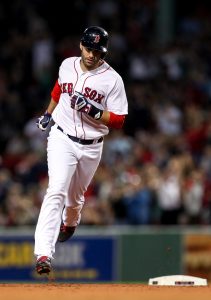
J.D. Martinez, OF/DH, Red Sox – five years, $110MM: As the Red Sox sought a game-changing bat last offseason, it seemed like a question of when – not if – they’d reel in Martinez. The two sides’ standoff took longer than expected, though, with the 31-year-old sitting on the unemployment line until late February. Now, Boston’s surely thrilled it won the Martinez sweepstakes.
An elite hitter since his stunning breakout with the Tigers in 2014, Martinez has joined Mookie Betts to comprise the sport’s foremost one-two offensive punch in 2018. Martinez concluded the regular season second in the majors in home runs (43), batting average (.330) and slugging percentage (.629); third in ISO (.299) and wRC+ (170); fifth in on-base percentage (.402); and 10th in fWAR (5.8). Thanks in large part to Martinez, the Red Sox finished with the majors’ best record (108-54) and its top offense. While the BoSox and Martinez are focused on winning a World Series this year, he’s only 13 months away from potentially hitting free agency again. Martinez has three opt-outs in his deal, including one after next season.
Lorenzo Cain, CF, Brewers – five years, $80MM: So far, the addition of Cain has been a major boon for the Brewers, the just-crowned NL Central champions. Cain was among the Brewers’ heroes during their division-deciding triumph over the Cubs on Monday, when he hit what proved to be the winning RBI single in the eighth inning of a tie game. The Brewers’ second-best player behind NL MVP hopeful Christian Yelich – yet another huge pickup from last winter – Cain accrued 5.6 fWAR during the regular season. As he did during his Royals heyday, Cain has delivered his value this year by relying on his all-around excellence. He has frustrated opponents at the plate (.308/.395/.417 in 620 PA), on the bases (30 steals, 6.2 BsR) and in the field (20 Defensive Runs Saved, 17 Outs Above Average, 7.9 Ultimate Zone Rating), continuing his run as one of the majors’ most well-rounded stars.
Jake Arrieta, RHP, Phillies – three years, $75MM: Arrieta and agent Scott Boras fell well shy of their $100MM-plus goal last offseason, when the former’s stay on the market lasted into March. While Arrieta was a tremendous starter with the Cubs from 2014-17, some cracks began to show last season, helping lead to his long stay in free agency. Arrieta continued to go downhill this year, his age-32 season, though he did perform decently and amass at least 30 starts (31) for the fourth straight campaign. Across 172 2/3 innings, Arrieta pitched to a 3.96 ERA/4.26 FIP with 7.19 K/9, 2.97 BB/9 and a 51.6 percent groundball rate. That’s solid production, but it’s clear Arrieta’s not the Cy Young-caliber starter he was for part of his Cubs tenure. Arrieta’s yet another signing from last winter who will have a chance to opt out of his contract after next season, which would mean passing on a $20MM guarantee, though the Phillies could void that clause in favor of a two-year, $40MM team option.
Carlos Santana, 1B, Phillies – three years, $60MM: Like Arrieta, Santana was closer to average than spectacular for the Phillies in the first season of an expensive deal. The former Indian, 32, continued his long run of durability, appearing in a personal-high 161 games, but he only managed a 109 wRC+ in 679 PA. Encouragingly, the ever-patient Santana easily racked up more unintentional walks (110) than strikeouts (93), and his expected weighted on-base average (.364) left his real wOBA (.334) in the dust. Although Santana’s offense has long been his calling card, he’s also a capable defender at first. But there’s some question moving forward as to whether Santana will stay at first or shift to third, where he saw time late in the season.
Alex Cobb, RHP, Orioles – four years, $57MM: Cobb went unsigned until late March, making him one of the most notable stragglers on a slow-moving market. When the Orioles finally did sign him, it was clear they were of the belief they’d contend for a playoff spot. Ultimately, the O’s finished as the majors’ worst team (47-115), and they now find themselves in a full-blown rebuild. Given that he’s an expensive veteran on a bottom-feeding team, it would make sense for Baltimore to try to move Cobb in the offseason. Finding a taker would be challenging, though, because Cobb has only offered back-end production as a member of the Orioles – with whom the ex-Ray has recorded a 4.90 ERA/4.80 FIP in 152 1/3 innings. The good news is that Cobb was much more effective in the second half of the season. After heading to the All-Star break with a horrendous 6.41 ERA/5.12 FIP, he came back to notch a 2.56 ERA/4.28 FIP over the past couple months.
Wade Davis, RP, Rockies – three years, $52MM: Davis was a premier reliever with the Royals and Cubs from 2014-17, but that excellence hasn’t always been present in his first year with the Rockies. To his credit, Davis closed the regular season with a flourish, allowing one earned run over his last 18 innings, and then added another 1 1/3 scoreless frames in Tuesday’s NL wild-card game. Good thing, too, because the 33-year-old had been amid a horrific campaign during the summer, when his ERA ballooned to a season-high 5.51 on Aug. 6. Davis had totaled six losses and six blown saves at that point, but he didn’t add to either category from that point, and he ended the regular season converting 12 straight save opportunities. He wrapped up the campaign with 43, a franchise record for the Rockies, and a 4.13 ERA with 10.74 K/9, 3.58 BB/9 in 65 1/3 innings. That’s not the overall production Colorado wanted when it signed Davis, but his late-season resurgence did help the club earn a playoff berth.
Jay Bruce, OF/1B, Mets – three years, $39MM – The five-time 30-HR hitter put up a career-low nine in 2018, owing in part to a hip injury that shelved him for two-plus months over the summer. Bruce’s overall line of .223/.310/.370 (89 wRC+) looks ugly, but he did turn things around after coming off the disabled list in late August. That’s an encouraging development for the Mets heading into next year, when Bruce – a longtime corner outfielder – may be its starting first baseman. Regardless of where Bruce lines up in 2019, the Mets will hope the soon-to-be 32-year-old returns to his long-established ways as a quality offensive contributor. Thus far, though, the team’s decision to bring back Bruce last offseason looks regrettable.
Tyler Chatwood, RHP, Cubs – three years, $38MM – The Cubs thought they had a steal in Chatwood, who drew some hype going into last winter after back-to-back respectable seasons with the Rockies. But Chatwood was a dud in his first season in Chicago, with which he last took the mound Sept. 8. Control problems defined 2018 for the 28-year-old Chatwood, who posted a nightmarish walk rate (8.25 per nine) over 103 2/3 innings. Chatwood’s inability to find the zone helped lead to an atrocious 5.30 ERA/5.60 FIP and cost him his place in the Cubs’ rotation in late July.
Zack Cozart, INF, Angels – three years, $38MM: 2018 was a disappointing season in general for the Angels, and Cozart was among the reasons. One of their high-profile pickups in a winter packed with them, Cozart saw his season end in mid-June after undergoing shoulder surgery – a procedure which could also keep him out for some of spring training next year. When he was healthy enough to take the field this year, the substantial offensive gains he made as a Red in 2017 didn’t carry over. Cozart compiled an 83 wRC+ (down from 140 last season) and a .219/.296/.362 line in 253 trips to the plate.
Photo courtesy of USA Today Sports Images.