
Silver Linings: American League West
In our Silver Linings series, we’re checking in on the most promising developments for non-contending teams during an otherwise disappointing 2018 season. We’ll finish it out with the American League West.
[Previous “Silver Linings” Posts: AL Central, NL Central, NL East, AL East, NL West]
With the Astros back on top on the American League West and the Athletics gearing up for a Wild Card date with the Yankees, that leaves three clubs nursing their wounds. Here are the silver linings from the division…
Mariners – A promising core
And no — not the core they once boasted, which featured an in-prime Robinson Cano, Kyle Seager, Felix Hernandez and an aging-but-still-productive Nelson Cruz. This Mariners team won 89 games largely in spite of that group (Cruz being the exception), as Cano was suspended 80 games while Seager and Hernandez had the worst seasons of their still-excellent careers.
Instead, it was Mitch Haniger, Jean Segura, Edwin Diaz, James Paxton and Marco Gonzales who carried the Mariners for much of the season. At 30 years old next month, Paxton is by far the oldest of that bunch, meaning the Mariners should have a good chunk of each player’s prime left.
Haniger and Segura turned in star-caliber performances on the season as a whole (even if each slumped late in the year). Both were deserving All-Stars. Diaz set a franchise record with 57 and posted a preposterous 15.2 K/9 mark with a 1.96 ERA that fielding-independent metrics actually felt was indicative of some poor luck (1.61 FIP, 1.78 xFIP, 1.49 SIERA). Paxton pitched a career-high 160 1/3 innings with career-best K/BB numbers. Gonzales’ 4.00 ERA doesn’t immediately stand out, but he showed excellent control and was credited with a more encouraging 3.43 FIP and 3.59 xFIP through 166 2/3 innings.
General manager Jerry Dipoto has been widely panned for some of his trades — there’s no getting around the Chris Taylor/Zach Lee swap, for instance — but that’ll come with the territory for virtually any top-level executive (especially one who trades so prolifically). To this point, though, Dipoto & Co. deserve credit for the acquisitions of Haniger, Segura, Gonzales, James Pazos and even veteran Mike Leake (4.36 ERA, 4.14 FIP, 4.15 xFIP in 185 1/3 innings). Each has yielded positive results thus far. There are payroll problems and aging veterans that complicate things in Seattle, but the Mariners have a nice foundation in place — especially if either Seager or Hernandez can bounce back to some extent.
Angels – Co-Stars
Remember those quaint days this spring when many were wondering if Shohei Ohtani would deliver anything close to the hype — both on and, especially, off the mound? The 24-year-old has laid waste to the doubters of his offensive abilities, even as his season as a pitcher ended in disappointment and the Halos’ team effort crumbled.
It’s hard to overemphasize just how impressive Ohtani has been. He hit .285/.361/.564 with 22 homers and 10 steals in just 367 plate appearances, which was 52 percent more productive than a league-average bat when adjusting for park and league (152 wRC+). Among players with 350 PAs, that wRC+ ranked Ohtani eighth in all of baseball. Still, he won’t be on the mound next year after undergoing Tommy John surgery this week, meaning he’ll be limited to providing impressive work from the plate. That leaves a direct conundrum — how to manage the situation with Albert Pujols — along with gaping hole at the top of the rotation.
Fortunately, the Halos have stockpiled some other star performers to place around centerpiece Mike Trout like the side stones in a ring. Andrelton Simmons is now providing enough offense to rate not “just” as one of the league’s top defenders, but rather as one of the its best overall players. Justin Upton‘s .257/.344/.463 slash rated more than 20 percent better than the league-average hitter by measure of stats like OPS+ (122) and wRC+ (124). And 24-year-old rookie David Fletcher held his own with the bat while providing terrific defense at both second base and third base.
The rotation is mired with question marks, to be sure, but the makings of a solid relief corps are there with Blake Parker, Jose Alvarez, Cam Bedrosian and up-and-coming Ty Buttrey all giving reason for optimism.
Rangers – Young players on the rise
Frankly, it feels like Jurickson Profar should be older than 25 at this point. The switch-hitting infielder was the Baseball America’s No. 1 overall prospect way back in the 2012-13 offseason — and that was already his third consecutive season drawing Top 100 fanfare. After shoulder injuries wiped out two seasons for the Curacao native, he delivered a forgettable 2017 campaign that called his upside into question. Fast forward a year, and Profar hit .254/.335/.458 with a career-high 20 homers and 10 steals while appearing at five different positions.
It’s not just Profar, either. Rougned Odor signed a $49.5MM extension prior to the 2017 campaign and promptly faceplanted with an abysmal .204/.252/.397 slash last season. This year, however, Odor rebounded to the tune of a .253/.326/.424 with 18 homers, a dozen steals and radically improved defensive numbers at second base — all while nearly doubling his previous career-high walk rate.
Perhaps no Texas youngster shined brighter than emergent closer Jose Leclerc, though. The 24-year-old reined in last season’s ghastly 7.9 BB/9 mark and managed to up his strikeout rate in the process. Leclerc posted 57 2/3 innings of 1.56 ERA ball in 2018, averaging 13.3 K/9 and 3.9 BB/9 while allowing just one home run along the way. His 17.2 percent swinging-strike rate ties him with Craig Kimbrel for the fifth-best among qualified relievers, trailing only Josh Hader, Edwin Diaz, Blake Treinen and Ryan Pressly. Controlled through 2022, Leclerc could either be a long-term piece or, if he can sustain his success a bit longer, the the type of power arm for which opposing teams would surrender a king’s ransom on the trade market.
Joey Gallo, meanwhile, clubbed 40 homers with his typical brand of absurd strikeout totals. Ronald Guzman swatted 16 home runs in an uneven debut season. Nomar Mazara had his best season to date, even if he’s yet to achieve the stardom many expected. The Rangers’ 2019 rotation looks like a disaster waiting to happen, but their bats — even veteran Shin-Soo Choo turned back the clock with an excellent 2018 — and their otherworldly young closer give fans something to look forward to next year.
Poll: Yankees’ Wild-Card Starter
While we know the Yankees will host the Athletics in the American League wild-card game on Wednesday, it’s not yet clear which pitcher will start for either team. The A’s seem poised to take an unconventional path and roll with their bullpen all night, as Susan Slusser of the San Francisco Chronicle reported Saturday, while the Yankees are likely to take a more traditional path. New York’s brass is currently debating whether to start Luis Severino, J.A. Happ or Masahiro Tanaka, who comprise the top three in the team’s rotation.
No matter who starts for the Yankees, one thing’s obvious: He’s in for an extremely difficult test against Oakland, whose offense ranks fourth in the majors in runs scored. The A’s have been death on both right-handers (112 wRC+) and lefties (106), meaning the Yankees can’t base their pick largely on pitcher handedness, and own the majors’ best road wRC+ (116). They also lead the league in fly ball rate (38.9 percent) and rank third in home runs, which bodes well for a team set to play at HR-friendly Yankee Stadium.
The A’s power could help steer the Yankees away from Tanaka, a homer-prone righty whose HR-to-FB rate (17.7 percent) is the majors’ sixth highest among pitchers who have thrown at least 150 innings this year. The left-handed Happ’s 30th in that category (13.4 percent), while Severino sits 45th (11.4 percent). On the other hand, the fact that Tanaka tends to shy away from fastballs could work in his favor. Tanaka has thrown his splitter 32 percent of the time this year, and according to Statcast, the A’s have only managed the majors’ second-worst weighted on-base average (.162) against that pitch. The 29-year-old’s main offering is his slider, which he has gone to 33 percent of the time. Oakland does place third in the majors in wOBA versus that pitch, though its .287 mark still doesn’t look that threatening. The A’s have also held their own against four-seam fastballs, evidenced by their .361 wOBA (ninth in the game), and that’s the pitch both Severino (50 percent) and Happ (59 percent) rely on the most.
The above numbers may factor into the Yankees’ decision for Wednesday, though if they make their call largely on upside, Severino will be the choice. The hard-throwing 24-year-old has been one of the sport’s most electrifying starters since last season, after all, and looked like an AL Cy Young front-runner during the first half of the season. Severino has experienced some turbulence since then, as he posted a horrid 5.57 ERA in the second half. At the same time, though, the righty still recorded excellent secondary numbers (10.86 K/9 against 2.00 BB/9, 3.37 FIP/3.06 xFIP), which suggests he deserved much better than his unsightly ERA, and finished the regular season allowing two or fewer earned runs in three straight starts.
Like Severino, Happ has been hot lately. Not only does Happ own a 2.62 ERA in the second half, but the 35-year-old has helped the Yankees to wins in nine of his 11 starts since they acquired him from the Blue Jays on July 26. However, his 4.21 FIP as a Yankee indicates fortune has been on his side. Tanaka, meanwhile, enjoyed a lights-out second half of the season in which he put up a 2.85 ERA/2.98 FIP with 9.41 K/9 and 1.61 BB/9. But it’s worth pointing out he’s fresh off back-to-back rough starts that saw him yield a combined eight earned runs in as many innings.
Based on numbers, selecting a starter against the A’s may not be a slam dunk for the Yankees. But in the end, the club’s choice might not even be on the mound for long. Whether it’s Severino, Tanaka or Happ, New York won’t gives its first-inning pick much rope Wednesday, largely because its bullpen is loaded with appealing choices. That relief corps was put to the test early in the Yankees’ wild-card game win last year, when the Twins teed off on Severino and chased him off the mound after he recorded just one out and allowed three earned runs. The Yankees’ bullpen saved them in a comeback victory in the Bronx that night, and they can only hope they won’t need that kind of help again in this season’s sudden death round.
(poll link for app users)
Who should start for the Yankees on Wednesday?
-
JA Happ 45% (4,176)
-
Luis Severino 34% (3,117)
-
Masahiro Tanaka 13% (1,206)
-
Go with a bullpen game instead 8% (743)
Total votes: 9,242
Top Five Trade Candidates: NL West
With the season nearing its end, and the teams who fell short of playoff contention well into their offseason preparations, it’s a good time to scan around the league and take a look at the top five trade candidates in each division.
We’ll start in the NL West, which features two of the most intriguing targets in baseball:
- Nolan Arenado, Rockies: Arenado, 27, will enter his final year of arbitration in 2019 as one of the most decorated performers in club history. He was the MVP frontrunner in the season’s first half, smashing out of the gate to a .312/.395/.586 line in the lead-up to his fourth consecutive all-star appearance. Though he slumped to a near league-average line after the break, and his usual vacuum-like defense wasn’t always on display, Arenado is arguably the league’s most consistent performer over the last four seasons, where his 20.5 fWAR ranks third in the National League, and his 629 games played is tied for fifth among all performers. Colorado, loath for years to deal from their lot of established contributors and minor league riches, may have to acquiesce here: the club has already shelled out massive deals to 30-somethings Charlie Blackmon, Ian Desmond, and Wade Davis, and has scores of dead money buried in aging relievers Mike Dunn, Jake McGee, and Bryan Shaw. Fitting Arenado into the books would leave precious little space with which to maneuver; a monster haul, however, could set them right back on a division-pacing track.
- Paul Goldschmidt, Diamondbacks: Goldschmidt, 31, has rebounded from an awful start to the season to yet again place himself among the league’s best: his 145 wRC+ almost exactly mirrors his career average, and his 5.1 fWAR is the fourth consecutive season in which he’s eclipsed the 5.0 mark. The Diamondbacks, though, are a in a precarious position – a mostly barren farm seems to preclude any major upgrades, and the club boasted little in the way of unexpected production from under-the-radar performers this year. Plus, there’s the departing free agents – a dominant Patrick Corbin, who figures to parlay his bat-missing ways into a huge contract this offseason, and A.J. Pollock, whose steady performance when healthy will surely not go unnoticed. The mid-market club is still saddled, too, by Zack Greinke‘s behemoth deal, and doesn’t figure to fit both Goldschmidt – who’ll hit free agency after the club picks up his $14.5MM option for ’19 – and the veteran hurler on the books without severely compromising the team’s flexibility moving forward. A wide-ranging infusion of talent seems just what Arizona needs this offseason.
- Joc Pederson, Dodgers: Pederson, 26, has quietly put together another stellar season, slicing his strikeout rate for the fourth consecutive year (to a career-low 19%) and delivering 2.7 fWAR in just 436 PAs. But he remains unplayable against lefties (60 career wRC+), and his center-field defense, over the last two seasons, has earned mostly subpar reviews. Still, he’s a fierce power threat against right-handers, offers quality defense in a corner, and has shown an aptitude for plate-discipline adjustments not often seen in exploitable power bats. With a healthy Corey Seager set to return in ’19, Max Muncy, and Cody Bellinger, the platoon-happy Dodgers figure to have more than enough left-side thump to go around: perhaps moving the second-time arbitration-eligible Pederson for bullpen help and/or rotation depth will be a priority come November.
- Brandon Belt, Giants: No player in the division seems in more desperate need of a scenery change than Belt, who is routinely harangued by his fanbase for a supposed lack of power, propensity for the fluke injury, and a perceived failure in the ‘clutch.’ Belt, 30, has done little but produce when on the field, though, pairing elite first-base defense (his 13 DRS – in just 112 games – was tied for the league lead among 1B this season) with sky-high walk rates and steady gap power (limited, perhaps, by the cavernous right-field at AT&T Park) to cement himself as above-average regular (12.2 fWAR in limited time since the beginning of ’15 ) at the position. His contract – he’s owed $48MM through the end of the 2021 season – and recent injury history (a meniscus issue that precipitated a second-half decline) may give some teams pause, but the retooling Giants should net a significant return if they’re willing to eat a little cash.
- Robbie Ray, Diamondbacks: Ray, 27 on Monday, seems the perfect target for a team that leans heavily on the bullpen: he rarely makes its past the 6th inning, preferring instead to max out with the heater (his 94.1 MPH average fastball velocity ranks third among left-handers since the start of the 2016 season) and a wipeout breaking ball mix that’s allowed him to post the league’s second highest strikeout total (11.70) over the same frame. With two years of arbitration eligibility left, the man with the 85 xFIP- over the last three seasons (good for 22nd in baseball) is sure to bring back an attractive return from a data hungry team with bat-missing preferences.
Past, Present & Future: National League Closer Turnover
While a new breed of pitcher, one who can rack up holds, strikeouts and throw multiple innings, is beginning to emerge as an integral role on a baseball roster, becoming the “closer” is still the ultimate goal for a Major League relief pitcher. The closer gets the entrance music. The closer gets the congratulatory hug from the catcher after the third out, followed by handshakes from every teammate. Closers get paid! Most importantly, being the closer usually means that your manager trusts you above all other pitchers in that bullpen.
Give up a lead in the seventh or eighth inning and your team still has a chance to pick you up. The later in the game a players fails, the better chance that mistake will stand out to anyone watching. It will be in the headlines. Fantasy Baseball owners will want to know who is “next in line.” And for a team that has fought tooth and nail to get to the ninth inning with a lead, it can be debilitating if the last pitcher standing can’t close things out. Managers don’t have much patience for blown saves, either. There is a lot of pressure and a lot of turnover, which is why most teams won’t have the same closer in September as they did on Opening Day.
Here’s a look back at each National League team’s closer situation on Opening Day versus where they are now and where they will be as they head into the offseason. (We ran through the American League earlier this week.)
[Related: MLB closer depth chart at Roster Resource]
Arizona Diamondbacks | Diamondbacks Depth Chart
Opening Day 2018: Brad Boxberger
September 2018: Committee — Yoshihisa Hirano, Archie Bradley, Boxberger
Future Outlook: The Diamondbacks opted to keep their best reliever, Bradley, in a setup role while plugging offseason acquisition Boxberger into the closer’s role. For the majority of the season, things went according to plan. That duo, along with Hirano and lefties Andrew Chafin and T.J. McFarland, were a strength on a team that led the NL West on September 1. But as the bullpen has fallen apart over the past few weeks, the team has quickly descended in the standings and fallen out of the playoff hunt.
As a result, the D-backs will head into the offseason with their closer situation somewhat up in the air. Overall, Boxberger, Bradley and Hirano have each been mostly effective and can still be counted on as valuable late-inning relievers. The D-backs will need to decide if they want add a better ninth inning option, though with numerous holes to fill as key players like A.J. Pollock and Patrick Corbin depart via free agency, the team could decide it has bigger needs.
—
Atlanta Braves | Braves Depth Chart
Opening Day 2018: Arodys Vizcaino
September 2018: Arodys Vizcaino
Future Outlook: Vizcaino was entrenched as the Braves’ closer to start the season, and he’s seemingly back in as the Braves prepare for their first playoff series since 2013. A.J. Minter proved to be a capable fill-in during both of Vizcaino’s disabled list stints. For a time, he even appeared to be more of a co-closer with a healthy Vizcaino on the roster, presenting a very formidable righty-lefty combination in the late innings.
With a solid group of relievers, including Minter, Jesse Biddle, Shane Carle and Dan Winkler, all under contract for next season and the chance that one or two of their enticing young prospects could help out of the ‘pen, the Braves appear to be in good shape in 2019. They could be tempted, however, to bring back free agent Craig Kimbrel, who had 186 saves, four All-Star appearances and won the NL Rookie of the Year award during a five-year stint with the team from 2010-2014.
—
Chicago Cubs | Cubs Depth Chart
Opening Day 2018: Brandon Morrow
September 2018: Committee — Jesse Chavez, Jorge De La Rosa, Steve Cishek, etc.
Future Outlook: The offseason signing of Morrow came with significant risk due to his long history of injuries and a heavy postseason workload (14 appearances) with the Dodgers in 2017. And while the Cubs did their best not to overuse him—he made back-to-back appearances just six times and pitched on three consecutive days only once—his season ended in mid-July due to a bone bruise in his elbow and biceps inflammation.
Pedro Strop was up to the task as the fill-in closer—he had a 1.77 ERA and 11 saves in 13 chances after Morrow went on the disabled list—but a strained hamstring ended his regular season on September 13. He could return for the playoffs. In the meantime, the Cubs have been mixing and matching in the late innings, at times relying on journeymen like Chavez and De La Rosa as they try to hold off the Brewers in the NL Central race.
Morrow and Strop will be back in the picture in 2018—Strop’s $6.25MM club option will almost certainly be exercised—as will setup men Carl Edwards Jr. and Cishek. Finding a left-hander who can close, if necessary, might be on the team’s agenda. Zach Britton could be a target if that’s the case.
—
Cincinnati Reds | Reds Depth Chart
Opening Day 2018: Raisel Iglesias
September 2018: Raisel Iglesias
Future Outlook: Iglesias has had three consecutive good seasons out of the bullpen with 63 saves in 71 opportunities. The Reds, however, have been in last place with less than 70 wins in each of those years, making Iglesias’ contributions less significant.
If the Reds are confident that they can be a much better team in 2019, it makes perfect sense to hold on to the 28-year-old right-hander—he’s under team control through 2021—and make him available via trade only if they fall out of contention during the season. Since he’s been able to stay healthy as a relief pitcher—not to mention that there is no clear “next in line” closer in the organization—they’re be better off leaving things as they are rather than experimenting with a move back to the rotation. The ninth inning should belong to Iglesias again come Opening Day 2019.
—
Colorado Rockies | Rockies Depth Chart
Opening Day 2018: Wade Davis
September 2018: Wade Davis
Future Outlook: Despite a few rough patches along the way, the 33-year-old Davis has 42 saves for the first-place Rockies and has been on a roll when it counts the most. In his last 17 appearances, he’s 10-for-10 in save chances with 23 strikeouts in 17 innings and only one earned run allowed.
Davis is still guaranteed $36MM over the next two seasons—he’ll also get another $14MM in 2021 if he finishes 30 games in 2020—so his mid-season struggles and continued decrease in fastball velocity (95.9 MPH in ’15; 94.9 MPH in ’16, 94.3 MPH in ’17; 93.8 MPH in ’18) are a concern. He has done enough to hold on to the closing job for 2019, but it would be a good idea to have a backup plan in place. Adam Ottavino, the team’s most valuable reliever with a 2.47 ERA, six saves and 33 holds, will be a free agent after the season. Re-signing him or replacing him with a top free agent will be difficult considering that Jake McGee and Bryan Shaw, both disappointments thus far, signed $27MM contracts last offseason. They could rely heavily on Seunghwan Oh, who recently had his $2.5MM option vest for 2019 and has been very good since being acquired from Toronto in July.
—
Los Angeles Dodgers | Dodgers Depth Chart
Opening Day 2018: Kenley Jansen
September 2018: Kenley Jansen
Future Outlook: Jansen allowed six earned runs with two blown saves and a loss in his first seven appearances of 2018. He missed 13 days in August due to an irregular heart beat that will likely require offseason surgery. Upon his return, he allowed seven earned runs with two losses and a blown save over four appearances. And yet, the 30-year-old right-hander has 37 saves and a sub-3.00 ERA for a Dodgers team that is fighting for a playoff spot as we head into the last weekend of the regular season.
Jansen’s occasional struggles on the mound and health concerns only magnified the team’s inability to replace Morrow, who was their primary setup man and bullpen workhorse last post-season. Setup relievers seem likely to be an area of focus this winter, and the Dodgers will be keeping their fingers crossed that Jansen comes back strong in what will be year three of a five-year, $80MM contract.
—
Miami Marlins | Marlins Depth Chart
Opening Day 2018: Brad Ziegler
September 2018: Co-Closers — Drew Steckenrider and Adam Conley
Future Outlook: It’s not clear why the rebuilding Marlins stuck with the veteran Ziegler through a rocky two-month stint as the closer to begin the season. Even though he had just one blown save in 10 chances when he was removed from the role, he had an ERA near 8.00 and Kyle Barraclough, next in line, had a 1.48 ERA. If they had any reluctance to turn it over to Barraclough, he showed why that might’ve been the case by losing the job two months later.
After locking down all seven save chances while allowing just one hit over 12 scoreless innings in June, Barraclough fell apart in July. Over his next 13 appearances, he blew four saves and allowed 14 earned runs in 10 2/3 innings before the Marlins decided on a closer-by-committee approach in early August. Steckenrider and Conley lead the team with four and two saves, respectively, since Barraclough was removed from the closer’s role. Both pitchers have an ERA over 5.00 in the second half, however, so it’s very likely that the team will look to find a more reliable option during the offseason.
—
Milwaukee Brewers | Brewers Depth Chart
Opening Day 2018: Corey Knebel
September 2018: Committee — Knebel, Jeremy Jeffress, Josh Hader
Future Outlook: Knebel suffered a hamstring injury during his third appearance of the season, forcing him to the disabled list for a month. By the time he returned, Hader and Jeffress had each established that they were more than capable of picking up the slack if Knebel could not return to his 2017 form. And this did prove to be the case. The 26-year-old Knebel, sharing the closer’s role with Hader and Jeffress, had a 5.08 ERA through August 31st. September has been a different story, however, as Knebel has allowed just four hits and three walks over 13 1/3 scoreless innings with 26 strikeouts. Regardless of how things go in the playoffs, the Brewers appear set with the same trio of late-inning relievers heading into 2019.
—
New York Mets | Mets Depth Chart
Opening Day 2018: Jeurys Familia
September 2018: Committee — Robert Gsellman, Seth Lugo, Anthony Swarzak
Future Outlook: The return of Familia, who missed time in 2017 due to a 15-game suspension and a three-and-a-half month-stint on the disabled list, was supposed to help propel the Mets back into playoff contention. While things have not gone swimmingly for the Mets, Familia’s comeback has actually gone quite well. He posted a 2.88 ERA with 17 saves for the Mets, was traded to Oakland in July and should be headed for a decent payday in free agency this offseason.
The Mets, coincidentally, will likely be in the market for a closer, although it’s not known whether they or Familia would be open to a reunion. Gsellman has held his own as the primary closer, saving eight of nine games since Familia’s departure, but probably isn’t the long-term answer. Lugo has been terrific out of the ‘pen, although his best role could be as a multi-inning setup man for whoever the team’s next closer will be.
—
Philadelphia Phillies | Phillies Depth Chart
Opening Day 2018: Hector Neris
September 2018: Committee – Neris, Seranthony Dominguez, Tommy Hunter, etc.
Future Outlook: Neris was 8-for-10 in save chances with three losses and an ERA over 5.00 in mid-May when manager Gabe Kapler declared that he would no longer have a set closer. It didn’t take long for rookie Seranthony Dominguez to emerge as the most significant part of the group, pitching 14 2/3 scoreless innings with only two hits allowed, no walks and 16 strikeouts to begin his MLB career. He would falter as the season progressed, though, leaving Kapler to rely more on veterans Hunter and Pat Neshek down the stretch.
Considering that Dominguez was a starting pitching prospect with no experience in the upper minors prior to the 2018 season, it wouldn’t be a stretch to think he can take a big leap forward and solidify the closer’s job for a full season. But with expectations for the Phillies likely to be in the high-to-extremely-high range, it wouldn’t be a surprise to see the Phillies pursue a more established free agent to close out games.
—
Pittsburgh Pirates | Pirates Depth Chart
Opening Day 2018: Felipe Vazquez
September 2018: Felipe Vazquez
Future Outlook: Vazquez signed a $22MM contract extension in the offseason and changed his name in April. By the end of May, Vazquez had an ERA near 5.00 and four blown saves. There wasn’t the normal negative buzz that surrounds most closers after blowing a save or two, though. He had only allowed an earned run in four of 24 appearances and the Pirates were playing much better than expected. He was also dealing with forearm discomfort and, of course, was one of the most dominant relief pitchers in baseball in 2017. He earned that long leash. Over his last 44 appearances, the 27-year-old lefty has a 1.77 ERA and 26 saves in 27 chances. Yep– still one of the most dominant relievers in baseball.
With three games to go, Vazquez is two appearances shy of reaching at least 70 games for the third consecutive season. He pitched both ends of a double-header twice in 2018 and pitched three consecutive days on three occasions, including two days after experiencing the forearm pain. The acquisition of Keone Kela and the emergence of Kyle Crick and Richard Rodriguez as reliable setup men should help ease Vazquez’s workload in 2019.
—
San Diego Padres | Padres Depth Chart
Opening Day 2018: Brad Hand
September 2018: Kirby Yates
Future Outlook: While Hand’s offseason contract extension removed any sense of urgency that the Padres had to trade him, it also made him a much more valuable trade chip. After saving 24 games and posting a 3.05 ERA with 13.2 K/9 in 41 appearances, Hand was traded to the Indians for catcher Francisco Mejia, one of the top prospects in baseball. Yates stepped into the closer’s role, although there was a decent chance that it would be a short stint with 12 days to go until the non-waiver trade deadline and several contending teams potentially interested in acquiring him. The 31-year-old stayed put, though, giving him an extended opportunity to prove himself as an MLB closer. He’s passed the test with flying colors, saving 10 games in 11 chances—he has 12 saves overall—while continuing to strike out more than 12 batters per nine innings.
The Padres, who currently have 95 losses, aren’t likely to build a legitimate playoff contender during the offseason. However, they’re far enough into their rebuild that they’ll want to go into 2019 with a team that can at least be .500. In that case, holding on to Yates would be smart, although general manager A.J. Preller will surely be willing to pull the trigger on a deal if a team meets his asking price.
—
San Francisco Giants | Giants Depth Chart
Opening Day 2018: Hunter Strickland
September 2018: Will Smith
Future Outlook: With Mark Melancon on the disabled list to begin the season, the Giants turned to Strickland as their closer. For the most part, he did a fine job, but his days as a closer swiftly came to an end, at least for the near future, on June 18th. Strickland entered the game with a two-run lead over the Marlins, an ERA just over 2.00 and 13 saves in 16 chances. After allowing three earned runs in the eventual 5-4 loss, he punched a door in frustration and fractured his hand. Upon returning in mid-August, Smith had 10 saves and a strong grasp on the closer’s gig.
Smith will likely be the front-runner to keep the job in ’19 with Melancon also firmly in the mix given his experience and his sizable contract (four years, $62MM). He’s not quite back to his pre-injury form, but Melancon has a 3.08 ERA in 40 appearances.
—
St. Louis Cardinals | Cardinals Depth Chart
Opening Day 2018: Committee — Dominic Leone, Tyler Lyons, Bud Norris
September 2018: Carlos Martinez
Future Outlook: The committee was supposed to be temporary while Greg Holland, who signed a one-year contract in late March, worked his way back into shape with a Minor League stint. Holland, though, was brought to the Majors before he was ready and never looked right with the Cardinals. He walked four in his St. Louis debut and never quite recovered. Norris, as he did in 2017 with the Angels, quickly separated himself from the other closer options and proved to be a steady force in the ninth inning with 28 saves and a sub-3.00 ERA through August. The 33-year-old ran out of gas, though, forcing the team to use a temporary committee in early September. Martinez, who returned from a disabled list stint to pitch out of the bullpen in late August, has emerged as the team’s primary closer as they fight for a Wild Card spot.
It’s highly unlikely that Martinez, the Cardinals’ Opening Day starter, will remain in the bullpen beyond this season. Barring any injury concerns, he’s just too good as a starting pitcher. Rookie Jordan Hicks, who has dazzled with his 100+ MPH sinking fastball, is a good bet to be the team’s closer at some point. It’s just not certain that the Cardinals will trust him enough at the beginning of the 2019 campaign, which could put them in the market for a stop-gap closer this offseason.
—
Washington Nationals | Nationals Depth Chart
Opening Day 2018: Sean Doolittle
September 2018: Sean Doolittle
Future Outlook: Doolittle was the Nationals’ closer on Opening Day, an NL All-Star selection in July, and he’s the Nationals’ closer as we enter the last weekend of the regular season. You’d figure things went pretty well for the Nats in 2018. But you’d be wrong.
A stress reaction in Doolittle’s foot forced him out of the All-Star game and out of action for a majority of the second half. When he returned in September, the Nats were out of the playoff chase. Five different relievers, including Kelvin Herrera, picked up saves while Doolittle was out. Brandon Kintzler, Ryan Madson and Shawn Kelley were all traded, and Herrera suffered a season-ending foot injury in late August.
Doolittle will be back in 2019—his $6MM club option will surely be exercised—and should jump right back into the ninth-inning role unless the Nats make a bold acquisition for another closer. In all likelihood, they’ll bring in another veteran setup man to help out a group that includes Koda Glover and Justin Miller. Greg Holland is one possibility. He has been a pleasant surprise since signing with the team in early August (0.89 ERA in 23 appearances) .
—
Silver Linings: National League West
It’s time for another installation of our Silver Linings series, where we look at the positive takeaways that can be drawn from otherwise underwhelming seasons. In this edition, we’ll head out to the National League West. As the Dodgers and Rockies sprint towards a photo finish, here are the reasons for optimism for the three clubs that have been left behind:
[Previous “Silver Linings” Posts: AL Central, NL Central, NL East, AL East]
Diamondbacks: Bullpen Pieces
Following an unceremonious exit in the 2017 NLDS at the hands of the rival Dodgers, the Diamondbacks hoped 2018 would be the year they’d break through to win a division title. Indeed, a blistering start to the season saw Arizona jump out to a 21-8 record, and the Snakes appeared poised to dethrone the Dodgers as division champions. Unfortunately, the D-Backs allowed the rest of the division to catch up over a stretch in May during which the team lost 13 of 14 games. The team now sits at a mediocre 80-78 and has lost 8 of its last 10 games, forcing an early exit from the heated race for the NL West crown.
Despite the disappointment, there’s obviously talent on hand. But that doesn’t mean it’s easy to identify silver linings that portend significant hope for the future. True, the rotation was generally a bright spot, but perhaps not in a manner that’s particularly exciting for the future. Zack Greinke and breakout star Patrick Corbin have anchored the staff, but the former is a highly-paid veteran who’ll be entering his age-35 season and the latter is destined for free agency. Surprising production from the resurgent Clay Buchholz helped quite a bit, but he finished with injury and is also heading back to the open market. The team received contributions from Robbie Ray and Zack Godley, though neither was as effective as might have been hoped.
If there’s something to carry out of the 2018 campaign, though, perhaps it’s to be found on the other side of the pitching staff. The Diamondbacks’ bullpen was the source of a number of bright spots for the club in 2018. After several lackluster seasons spent pitching in Baltimore, left-hander T.J. McFarland has enjoyed a career year in Arizona, posting a 2.00 ERA in 72 innings. Yoshihisa Hirano, who signed as a free agent after 11 seasons in Japan, proved to be a reliable option out of the bullpen, and Archie Bradley pitched well in 70 games, though not at the same level as he established in 2017. In 48 2/3 innings, Andrew Chafin has yet to concede a home run while striking out more than a batter per inning. And Silvino Bracho arguably pitched well enough in his 28 appearances that he’s deserving of a steady MLB job going forward.
That relief corps could represent an affordable, reliable unit that allows the organization to invest its resources to address other areas. Make no mistake, there are needs. Center fielder A.J. Pollock will join Corbin in heading onto the open market. The payroll pressures from Greinke’s contracts will not abate. While perennial MVP candidate Paul Goldschmidt will return, 2019 is the last year of his current contract. The Diamondbacks’ window for contention appears to be closing quickly, and 2018 looks like a missed opportunity.
Giants: Rotation Finds
Coming off a last-place finish in 2017, the Giants set their sights on a bounce-back campaign in 2018. The team acquired a pair of pricey veterans, Andrew McCutchen and Evan Longoria, in hopes that the experienced newcomers would ignite the team. However, the Giants’ offense has fallen flat, and an unlucky streak of injuries has left the club mired in mediocrity. Having scored the second-fewest runs in the National League, the Giants’ offense has been a disaster. The team has posted an overall slash line of .241/.302/.371. Longoria is clearly not his former self, and McCutchen was jettisoned in August after the team fell out of contention. Injuries to regulars Buster Posey, Brandon Belt, Hunter Pence, and others have sapped the Giants of their firepower.
Meanwhile, a veteran rotation has fallen apart. Highly paid rotation cogs Johnny Cueto and Jeff Samardzija suffered significant injuries. Staff pillar Madison Bumgarner made it back to the mound and produced good results, but showed reduced velocity and peripherals. Derek Holland turned in a nice bounceback campaign, but he’s a free agent.
In this situation, it’s not hard to spot the brightest glimmer of hope. Rookie Dereck Rodriguez has been a revelation in the Giants’ starting rotation. Since debuting with the big league club in late May, Rodriguez has made 18 starts, posting an impressive 2.50 ERA. His presence in the rotation has mitigated the damage caused by the absence of Samardzija and Cueto, who have combined to make just 19 starts this season. Rodriguez has perhaps also made it easy to overlook rookie left-hander Andrew Suarez, who has also emerged as a serviceable rotation piece. Whether there’s more in the tank is open to debate, but Suarez still looks to be a nice asset after pitching to a 4.22 ERA across 28 starts.
If there’s a case to be made that the Giants can remain competitive while rebuilding, it begins with the idea that they’ll have multiple effective and affordable rotation pieces on hand for the coming seasons. And perhaps there’s reason at least to hope for better health and a return to form from some veteran players. It helps, too, that the organization received some strong performances from relievers who remain under control — Will Smith, Reyes Moronta, Tony Watson, Sam Dyson, and even a rejuvenated Mark Melancon — though some could also be trade fodder this winter. In truth, the club’s near-term course remains to be seen, in no small part because there’ll be a new regime at the controls.
Padres: Incremental Gains
While the Padres hardly sniffed the postseason in 2018, it was not a year without progress in San Diego. Though another losing season marks the 12th consecutive season the Friars will vacation in October, greener pastures appear to be on the horizon in San Diego.
Perhaps that’s scant consolation for fans who had hoped for a more dramatic leap in 2018. After all, the rebuild has been in the works for some time and it’s still unclear precisely which players will make up the anticipated core of the future. Still, it’s hard to ignore the sheer volume of talent — or its proximity to the MLB level.
Even with a number of players succeeding after making the leap to the big leagues in 2018, the biggest splashes may be yet to come. Boasting one of baseball’s premier minor-league systems, the Padres expect to receive an influx of talented players that will help to build the club into a postseason threat in coming seasons. With reinforcements waiting in the wings, the early returns look promising for the Padres.
There was no shortage of impressive rookies in San Diego this season. Pitchers Joey Lucchesi and Eric Lauer showed promise in their debut seasons, and look to have built foundations that will set the pair up for success in 2019 and beyond. Jose Castillo and Robert Stock are among the first-time big leaguers who have impressed in an intriguing bullpen unit that includes several other youngsters as well as hurlers who’ve thrived despite arriving as castaways (Craig Stammen, Kirby Yates, Matt Strahm). Before his season ended prematurely, Franchy Cordero, who features an intriguing combination of power and speed, injected excitement into the Padres offense, homering 7 times in 40 games. Outfielder Franmil Reyes has increasingly impressed at the plate after looking lost when he debuted in May.
Top prospect Luis Urias also received a call-up late in the season. Though his season was cut short due to injury, the 21-year-old infielder projects to hit for high average and play solid infield defense as he matures, a welcome addition to any club. The Padres also brought in the game’s top catching prospect, Francisco Mejia, in a deal that sent Brad Hand to Cleveland. Just 22 years of age, Mejia figures into the team’s future plans at a premium position, potentially functioning alongside Austin Hedges to form an impressive duo behind the dish (if the team can find a way to get Mejia’s bat in the lineup at other positions as well). Pitcher Dinelson Lamet, who flashed tantalizing potential as a rookie in 2017 but missed all of this season with a torn UCL, will offer a boon to the pitching staff in 2019.
Combine these major-league contributors with what may be the game’s deepest prospect pool, and the Padres believe they have a blueprint to contend in the near future. The farm is ripe with pitchers who could debut in the coming years, even if it’s not yet clear which will fully emerge. If there’s a truly exciting presence on the horizon, though, it’s shortstop Fernando Tatis Jr., who is one of the top prospects in baseball. Though he missed time with a thumb injury, he cemented his status as the organization’s most exciting talent by posting a .286/.355/.507 slash and banging 16 long balls in 394 Double-A plate appearances.
As their farmhands graduate to the Majors, the Padres hope to build a young core that has the potential to turn this organization into an annual contender. For now, that’s still a vision rather than a reality; the club’s broad collection of interesting players has yet to coalesce. But the waves of talent are now coming ashore. Perhaps 2019 will be the year that the patience begins to pay off?
Past, Present & Future: American League Closer Turnover
By the end of the 2017 season, the list of pitchers closing out games for their respective teams included Matt Belisle, Alex Claudio, Juan Minaya and Mike Minor. Three of them were without a career save coming into the season—Belisle had five in 13 MLB seasons—and none had been expected to fill a significant late-inning bullpen role. By way of injuries, trades or ineffectiveness from those ahead of them on the depth chart, they were given a chance to record the final out in a close win and proved themselves capable.
Things haven’t changed much this year. Raise your hand if you thought Wily Peralta would have one save in 2018. He has 13! Of the 15 American League teams, only four currently have a closer situation that mirrors what they had on Opening Day. When it comes to closers, uncertainty is the only certainty. And that’s why Mariano Rivera and Trevor Hoffman are Hall of Famers and the relief pitchers who will join them in Cooperstown in the future are few and far between.
Here’s a look back at each American League team’s closer situation on Opening Day versus where they are now and where they will be as they head into the offseason. (Click HERE to view the National League.)
[Related: MLB closer depth chart at Roster Resource]
Baltimore Orioles | Orioles Depth Chart
Opening Day 2018: Committee — Brad Brach, Darren O’Day, Mychal Givens
September 2018: Mychal Givens
Future Outlook: Brach got the majority of the committee’s save chances prior to Zach Britton reclaiming the job shortly after returning from the disabled list in late June. Soon after, Givens was the last man standing following a series of July trades (Brach to the Braves; Britton to the Yankees). O’Day, meanwhile, suffered a season-ending hamstring surgery and was later traded to Atlanta in a separate deal.
A valuable setup man for most of the past three seasons, Givens has done a fine job since taking over ninth-inning duties. In his last 19 appearances, he has a 2.18 ERA and eight saves in 10 chances. With so many holes to fill on the roster, upgrading at the closer position is probably low on the Orioles’ priority list. Givens, therefore, likely enters 2019 with the job — if he isn’t traded himself this offseason as the O’s continue their rebuilding efforts.
—
Boston Red Sox | Red Sox Depth Chart
Opening Day 2018: Craig Kimbrel
September 2018: Craig Kimbrel
Future Outlook: Kimbrel, who recently became the fourth pitcher in MLB history to record at least 40 saves in five different seasons, has been a huge part of Boston’s historic season. As a free agent following the 2018 campaign, the 30-year-old will command a contract that rivals the highest-paid relievers in the game. Can the Red Sox afford to let him walk? Just in case he does, they’ll have to plan accordingly.
With Joe Kelly also set to become a free agent, Matt Barnes is the logical choice to inherit the closer’s gig. He’s earned the opportunity with a 3.28 ERA and 25 holds while serving as the primary setup man on the best team in baseball. The 28-year-old also has an impressive 13.9 K/9 in 60.1 innings of work, an increase from 10.7 K/9 in ’17 and 9.6 K/9 in ’16. The only question is whether a team capable of winning over 100 games will entrust the role to someone with two career saves. If Kimbrel signs elsewhere, it seems likely that the Sox would pursue alternatives in free agency and/or trades.
—
Chicago White Sox | White Sox Depth Chart
Opening Day 2018: Joakim Soria
September 2018: Committee — Nate Jones, Jace Fry, Minaya, etc.
Future Outlook: Soria was as good as he’d been in years, posting a 2.56 ERA with 16 saves and 11.4 K/9 in 40 appearances. The White Sox cashed in by sending him to the Brewers for two pitching prospects in late July. Since then, they’ve handed off the closer’s job to a committee that included just about any relief pitcher on their active roster—seven different pitchers have recorded saves since the Soria trade.
The next step for the rebuilding White Sox is to put together a roster that can, at the very least, be a .500 team and potential playoff contender. Having a reliable closer would be an important part of that plan. Jones looks the part, but he’s missed most of the last two seasons recovering from elbow surgery and still might not be ready to take on the workload of a primary closer. A healthy Zack Burdi, the team’s first-round draft pick in 2016 and one time “closer of the future,” could also be in the mix at some point, though he spent 2018 recovering from Tommy John surgery. They’ll likely play it safe, however, and add at least one veteran with closing experience this offseason.
—
Cleveland Indians | Indians Depth Chart
Opening Day 2018: Cody Allen
September 2018: Co-Closers – Allen and Brad Hand
Future Outlook: Allen has a lot of mileage on his arm, averaging 71 relief appearances per season since 2013, and it’s showed at times during the current season. With Andrew Miller on the disabled list and Allen’s ERA creeping up near 5.00, the Indians’ acquisition of Brad Hand from the Padres on July 19th was a no-brainer.
Not only has it helped them down the stretch—Hand has a 2.45 ERA and eight saves while Allen has 10 consecutive scoreless appearances—it also gives the Indians a very good closer option for 2019. Allen and Miller are both headed for free agency while the 28-year-old Hand is under contract through 2021. The job should be his moving forward.
—
Detroit Tigers | Tigers Depth Chart
Opening Day 2018: Shane Greene
September 2018: Shane Greene
Future Outlook: With a 5.20 ERA and six blown saves in 37 chances, Greene is probably lucky to have held on to the job for the entire season. But on a rebuilding Tigers team, who is going to close out games for them is the least of their worries. With that said, Greene probably fits best as a setup man. Even if they don’t upgrade this offseason, All-Star Joe Jimenez (11.2 K/9, 22 holds, 3 saves, 2.88 FIP) could supplant Greene in 2019.
—
Houston Astros | Astros Depth Chart
Opening Day 2018: Co-Closers – Chris Devenski and Ken Giles
September 2018: Roberto Osuna
Future Outlook: Despite a drop in strikeout rate—8.0 K/9 in ’18; 11.7 K/9 in ’17—Osuna has continued to perform at a high level amid abuse allegations that led to a 75-game suspension under MLB’s domestic abuse policy. The Astros still decided to acquire him in a trade with the Jays despite the ongoing investigation.
Barring any struggles during the team’s playoff run — he’s postseason eligible in spite of that suspension — or any further off-the-field troubles, the 23-year-old Osuna seems likely to enter 2019 as the Astros’ closer. He’s under club control through the 2020 season.
—
Kansas City Royals | Royals Depth Chart
Opening Day 2018: Kelvin Herrera
September 2018: Wily Peralta
Future Outlook: Soon after Herrera was traded to Washington in mid-June, Peralta emerged from the closer committee to become one of the unlikeliest ninth-inning success stories of 2018. It hasn’t always been pretty, but the 29-year-old has 13 saves in 13 chances and a 9.5 K/9 rate.
After getting booted from the Brewers’ rotation last May, he had a disastrous 11-appearance stint as a relief pitcher (17 1/3 innings, 23 ER, 28 H, 15 BB) before getting designated for assignment in late July. He signed a Major League deal with Kansas City this offseason, only to be designated for assignment again and outrighted to Triple-A. He returned to the Majors one day before the Herrera trade and picked up his first MLB save eight days later.
Peralta has a $3MM club option in 2019, which could very well be exercised. Even if it’s not, he’s remain under team control for one more season via arbitration. While he’s been better than anyone could’ve anticipated in his current role, his 22 walks in 31 1/3 innings serve as a red flag that will likely keep the Royals from locking him into the job next season without some form of competition.
—
Los Angeles Angels | Angels Depth Chart
Opening Day 2018: Keynan Middleton
September 2018: Ty Buttrey
Future Outlook: Blake Parker, who finished 2017 as the closer, picked up the team’s first save of 2018 after finishing last season in the role. But it was Middleton who got the call for the next six save chances, all successful, making it clear that he was manager Mike Scioscia‘s preferred choice in the ninth inning. A few weeks later, however, Middleton had undergone season-ending Tommy John surgery and it was back to the drawing board for the Angels.
Parker got the majority of save chances with Middleton out. And as was the case in 2017, he got the job done with a 3.21 ERA and 13 saves in 16 chances from May 14th—the day after Middleton’s last game— through September 3rd. But Buttrey, acquired from the Red Sox in the July deal for Ian Kinsler, is getting a chance to show what he can do as of late. In six appearances from September 7th through September 18th, the 25-year-old tossed seven scoreless innings with 10 strikeouts and four saves. He has failed to convert his last two save chances, though.
Regardless, there probably wasn’t enough time for Buttrey to seal the job for 2019. He will be a candidate alongside Parker, though, unless the Angels acquire a closer this offseason.
—
Minnesota Twins | Twins Depth Chart
Opening Day 2018: Fernando Rodney
September 2018: Trevor Hildenberger
Future Outlook: After saving 25 games and solidifying the ninth inning for Minnesota over the first four months of the season, Rodney was traded to Oakland in August. Ryan Pressly, who would’ve been the logical choice to succeed him, was traded to Houston in late July. A closer committee appeared likely, but Hildenberger has been the go-to guy with seven saves in eight chances since Rodney’s departure. Taylor Rogers, while serving mostly in a setup role, has not allowed a run over his last 23 2/3 innings while logging two saves and 11 holds over that span.
Between Hildenberger, Rogers, Addison Reed and Trevor May, who has five walks and 31 strikeouts in 23 innings in his first season since Tommy John surgery, the Twins have some decent late-inning options for 2019. It’s probably not enough to keep them away from the offseason closer’s market, though.
—
New York Yankees | Yankees Depth Chart
Opening Day 2018: Aroldis Chapman
September 2018: Co-Closers – Zach Britton and Dellin Betances
Future Outlook: Chapman might not have enough time to reclaim the closer’s job before the end of the regular season—he returned from the disabled list last Wednesday—or even the playoffs for that matter. But there’s no reason to think a change is on the horizon in 2019. The 30-year-old lefty, who is 31-for-33 in save opportunities and is striking out 16.1 batters per nine innings, will be entering year three of a five-year, $85MM contract.
—
Oakland Athletics | Athletics Depth Chart
Opening Day 2018: Blake Treinen
September 2018: Blake Treinen
Future Outlook: Treinen has been one of the breakout stars in 2018, saving 37 games while posting an 0.80 ERA and striking out 11.1 batters per nine innings for a playoff-bound A’s team. The 30-year-old is still under team control for two more seasons, although he’s in line for a significant raise from the $2.15MM he made in ’18. Barring injury, there’s no doubt that he’ll retain the job in 2019.
—
Seattle Mariners | Mariners Depth Chart
Opening Day 2018: Edwin Diaz 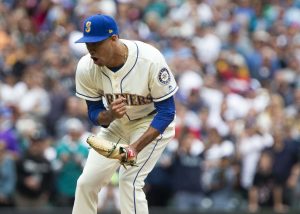
September 2018: Edwin Diaz
Future Outlook: No other closer, arguably, has contributed more to his team’s success than the 24-year-old Diaz, who has 14 more saves (56) than any other pitcher in baseball and 13 more save chances (60). The Mariners play a lot of close ballgames—they are 36-21 in one-run games—and Diaz rarely gives his opponent a chance in the ninth inning. He has held his opponent scoreless in 59 of his 71 appearances and hitless in 44. He also has 41 multi-strikeout games.
The 24-year-old is going to get paid once he reaches arbitration, although he could fall just short during the upcoming offseason. The Super Two cutoff has not fallen under 2.122 (two years, 122 days) since 2009. Diaz will be one day shy of that total.
—
Tampa Bay Rays | Rays Depth Chart
Opening Day 2018: Alex Colome
September 2018: Co-Closers – Sergio Romo/Jose Alvarado
Future Outlook: When Colome was traded to Seattle on May 25th, the Rays were two games under .500 and 10 games out in the division. It’s not clear whether they were throwing in the towel or whether they just had enough confidence in Romo, who had 84 career saves coming into the season, and the remaining group of young arms. In any case, it’s worked out just fine.
Since the trade, the Rays are 64-44 with Romo as the primary closer (3.38 ERA, 23-for-28 in save chances) and Alvarado, a 23-year-old lefty, also playing an integral role (1.98 ERA, 7 saves). Not that you can count on the Rays to do anything conventional like name a closer prior to the season or at any point during the regular season, but Alvarez and the hard-throwing Diego Castillo would be the leading in-house candidates if they did. Tampa Bay could also look to bring Romo back into the fold.
—
Texas Rangers | Rangers Depth Chart
Opening Day 2018: Keone Kela
September 2018: Jose Leclerc
Future Outlook: No relief pitcher has boosted their value more in the second half of the season than Leclerc, who spent the first four months in a setup role. Once Kela was traded to the Pirates on July 31st, it was the 24-year-old Leclerc’s chance to shine. It’s hard to imagine a more convincing way to show that he wouldn’t be relinquishing the job anytime soon.
Aside from converting each of his 11 save opportunities, Leclerc has allowed just two hits and six walks over 17 scoreless innings while striking out 28. The Rangers will look to bolster their bullpen this offseason, but finding a new closer isn’t likely to be on the agenda. Leclerc is controlled through 2022.
—
Toronto Blue Jays | Blue Jays Depth Chart
Opening Day 2018: Roberto Osuna
September 2018: Ken Giles
Future Outlook: Despite being the primary closer on the World Champion Astros, it was clear that Giles was not trusted with the game on the line. The trade to Toronto in late July gave the 28-year-old a chance to re-establish himself, out of the spotlight, as a reliable late-inning reliever. So far, so good.
After a few shaky appearances to begin his Blue Jays tenure, Giles has settled into the closer’s role with 1.29 ERA over his past 15 appearances with 12 saves in 12 chances. It might not be enough to prevent the Jays from pursuing another option this winter, but Giles should at least be in the mix.
—
Brad Brach
Zach Britton
Sean Doolittle (if $6MM club option is declined)
Jeurys Familia
Joe Kelly
Craig Kimbrel
Ryan Madson
Andrew Miller
Sergio Romo
A Layman Attempts To Calculate WAR: Batting Runs
As I explained in my August introduction post, I’m going to attempt to calculate FanGraphs WAR accurately for Chris Taylor‘s 2017 season, in my own spreadsheet. To do this, I expect to make heavy use of FanGraphs’ documentation. I also have to give a big thanks to FanGraphs owner Dave Appelman as well as my sabermetric sage Matt Swartz. Here’s FanGraphs’ overview of WAR For Position Players. The basic formula is this:
WAR = (Batting Runs + Base Running Runs + Fielding Runs + Positional Adjustment + League Adjustment + Replacement Runs) / (Runs Per Win)
This doesn’t look too daunting. Add up the three different ways a position player can create value, make adjustments for position and league, and put it on the correct scale. OK, let’s calculate batting runs!
Show of hands, who knows anything about batting runs? Offhand, I couldn’t tell you how batting runs are tabulated, or what benchmarks for success are. So batting runs is a stat unto itself that requires a full exploration. Here’s the batting runs formula:
Batting Runs = wRAA + (lgR/PA – (PF*lgR/PA))*PA + (lgR/PA – (AL or NL non-pitcher wRC/PA))*PA
Huh. OK, when I look at that formula, the only acronym I’m familiar with is PA, which is plate appearances. We can all agree that we know what a plate appearance is.
I do not, however, know what wRAA is. FanGraphs says it stands for Weighted Runs Above Average. And, well, it has its own formula:
wRAA = ((wOBA – lgwOBA)/wOBA Scale) * PA
It seems that to calculate wRAA, we first need to calculate wOBA. Now, before I lose you in this sea of acronyms, wOBA is actually useful and fairly easy to understand. It stands for weighted on-base average. According to FanGraphs, wOBA “is a rate statistic that attempts to credit a hitter for the value of each outcome (single, double, etc) rather than treating all hits or times on base equally.” Intuitively, I find wOBA to be a simple and useful offensive statistic. At MLBTR, we often cite a batter’s “triple slash” line. Chris Taylor’s triple slash in 2017 was .288 (batting average)/.354 (on-base percentage)/.496 (slugging percentage). These days, people worry a lot less about batting average, since OBP counts a player’s hits, walks, and hit-by-pitches. But OBP fails to give a complete picture, since a walk is valued the same as a home run. That’s why we have slugging percentage, right? SLG is just total bases divided by at-bats, but it wrongly suggests a home run is worth four times as much as a single or twice as much as a double.
The purpose of that aside was to illustrate that wOBA is indeed a strong foundation for the batting runs component of WAR. Here’s the wOBA formula for 2017:
wOBA = (0.693×uBB + 0.723×HBP + 0.877×1B + 1.232×2B + 1.552×3B +
1.980×HR) / (AB + BB – IBB + SF + HBP)
In this formula, there are six things a batter can do to create value: draw an unintentional walk, get hit by a pitch, or hit a single, double, triple, or home run. As I learned from Appelman, and by just playing around with some example numbers, the batter also gets credit for intentional walks, by virtue of those being subtracted in the denominator.
You can see there is a weight assigned to each possibility, like 0.877 for a single or 1.980 for a home run. These weights change a little bit each year, and can be found here at FanGraphs. The concept of linear weights is explained well in this FanGraphs article. There are 24 different base-out states, such as “runner on second with one out” or “bases loaded, nobody out.” FanGraphs explains, “In order to calculate the run expectancy for that base-out state, we need to find all instances of that base-out state from the entire season (or set of seasons) and find the total number of runs scored from the time that base-out state occurred until the end of the innings in which they occurred. Then we divide by the total number of instances to get the average.” So if you know that the bases are loaded with nobody out in the year 2017, you should expect 2.32 runs to score. 50 years prior, you would have expected 2.13 runs to score in that situation.
We have 24 different run expectancy numbers, and each plate appearance moves the team from one box to another. The difference between the two is the run expectancy for that plate appearance. With this information, we can get the linear weights for each of the six batting outcomes. This concept dates back well before FanGraphs and is worth exploring.
One thing to note, from Neil Weinberg of FanGraphs: “the inventors of wOBA decided that it would probably be best to scale it to something familiar to make it easier to understand,” so they made the “aesthetic choice” to scale wOBA to on-base percentage. As we’ll see later in the wRAA calculation, this scaling choice has to be undone to get us back on a run scale. That seems needlessly convoluted, but I’m probably the only one trying to do this by hand.
In theory, one could create a version of wOBA that doesn’t just include these six positive batting outcomes, but rather every batting outcome. To quote Weinberg, “If you wanted to, you could build wOBA with more nuanced stats like fly ball outs, ground outs, strikeouts, etc; it would just get more complicated without much added value.” Well, hold up. First off, we shouldn’t care about making wOBA more complicated, since (this exercise aside), no one is computing it by hand. In fact, in a different FanGraphs wOBA explainer, the author says, “OBP or SLG might be easier to calculate with pencil and paper, but wOBA is extremely easy to find and use on our site, meaning any computational costs of moving to wOBA are minuscule.” I agree with that point, and since WAR is already a very complicated stat, why not incorporate the nuances of all batting events into it by using the most advanced wOBA possible? For example, take two players who have the exact same number of unintentional walks, HBPs, singles, doubles, triples, and home runs. Say those players each also made 400 outs in a season, but one player made every out by strikeout and the other made every out by flyball. Wouldn’t the flyball guy be a more valuable hitter?
In response to that question, Dave Appelman pointed me to this link, a seven-year-old Hardball Times article in which JT Jordan re-calculated wOBA with strikeouts included for batters. Jordan concluded, “The difference is incredibly small. So really, it’s not a big deal to ignore strikeouts when using a context-neutral method like linear weights and wOBA. But it can be done. When all is said and done, we’re talking about a run or two of difference.” Swartz remarked, “I have never gotten a beat on when sabermetricians deem it okay to call something ‘close enough.'” Bottom line: wOBA could be made a tiny bit more accurate, but the keepers of the stat must feel that there is little added value in incorporating other batting outcomes.
Ultimately, a batter’s wOBA is a strong foundation for calculating his offensive value. Let’s calculate that number for Chris Taylor. If we want to cheat, we can just pull up his FanGraphs page to see that his wOBA was .361 in 2017. We don’t want to cheat, though.
wOBA = (0.693×50 + 0.723×3 + 0.877×88 + 1.232×34 + 1.552×5 + 1.980×21) / (514 + 50 – 0 + 1 + 3)
wOBA = 0.3613
Now, we need to turn wOBA into wRAA. wRAA is a counting stat that “measures the number of offensive runs a player contributes to their team compared to the average player.” Here’s the formula again:
wRAA = ((wOBA – lgwOBA)/wOBA Scale) * PA
I feel pretty good about my understanding of wOBA, which required only the number of unintentional walks, hit-by-pitches, singles, doubles, triples, and home runs Taylor hit, as well as the linear weights of each of those events in 2017. I can understand the league average wOBA as well, which FanGraphs shows was .321 in 2017. Keep in mind that lgwOBA does not refer to the National and American Leagues; it refers to all of MLB for that year.
Our next step, wRAA, isn’t that hard to comprehend either. It uses the aforementioned linear weights but presents its results in a cumulative manner, unlike wOBA. wRAA is also scaled such that zero is the league average, so it can be compared across different seasons. Finally, wRAA uses a number called the “wOBA scale” to undo the “scale to OBP” choice that is baked into wOBA. I know from Taylor’s player page that his wRAA in 2017 was 19.3.
wRAA = ((0.3613 – .321)/1.185) * 568
wRAA = 19.317
So far, we’ve found our way to the correct “weighted runs above average” amount for Chris Taylor. It’s worth pausing to appreciate that nothing overly complicated or debatable has been done so far: Taylor received the correct amount of credit (linear weights) for each of the positive batting outcomes (single, double, etc.) and that was scaled against the league’s offensive production since the value of a home run was very different in 2017 vs. 1917. We are most of the way to Batting Runs, which along with fielding and baserunning is one of the three pillars of WAR. What we need to do next is adjust these batting runs for Taylor’s ballpark and league. Here’s the batting runs formula again:
Batting Runs = wRAA + (lgR/PA – (PF*lgR/PA))*PA + (lgR/PA – (AL or NL non-pitcher wRC/PA))*PA
I believe the number we’re aiming for, based on Taylor’s FanGraphs player page, is 18.7, which suggests minimal adjustments were needed to his 19.3 wRAA.
- wRAA = 19.317
- lgR = all the runs scored in all of baseball in 2017 = 22,582
- PA = all the plate appearances in all of baseball in 2017 = 185,295
- lgR/PA = 0.1219
At this point, we need to pause and talk about park factors. Neil Weinberg wrote an informative beginner’s guide to park factors here. Intuitively, it’s logical to make an adjustment for the player’s home stadium. In the case of Taylor, Dodger Stadium suppressed overall run scoring by about 8% from 2013-17, so we apply half of that under the assumption that he played half his games at home. Taylor actually did play half of his games at home in 2017, but even if he didn’t, the park factor would be applied as if he did. Additionally, as Weinberg explains in his article, “parks don’t affect every player evenly and our park factors sort of assume that they do.” If for some reason Dodger Stadium actually improves Taylor’s hitting (due to handedness, batted ball profile, weather, or any number of things) he’d still get a boost in this WAR calculation to account for Dodger Stadium suppressing offense on average. An assumption is also being made that the player played his road games in “a pretty average setting,” which is not necessarily true.
Weinberg wrote his park factor article in January 2015, noting, “We want to know how parks influence each moment of the game, but we simply don’t have granular enough data to really get there. A ball hit at 15 degrees directly over the shortstop while traveling at 93 miles per hour will travel how far and land where? That’s basically what we want to know for every possible angle and velocity, but we just don’t have the data and we don’t have it for every type of weather in every park.” In 2018, we do have most of that data, due to Statcast. I asked Appelman about potential efforts to reboot the park factor component in WAR using Statcast data, and he replied, “I have not personally done much work on park factors. They are in my opinion, very annoying. I just don’t really like dealing with them and they make everything much more complicated. However, they’re obviously good to have.” Swartz was of the same mind, explaining that park factors are “very noisy” and while you could possibly improve them with Statcast or weather data, the precision gained would be minimal. Imperfect as park factors are, Swartz told me it would be “disastrous” to leave them out.
- PF = 2013-17 park factor for Dodgers Stadium = 0.955055 (Good luck finding a park factor this precise. FanGraphs’ Guts page just gives you .96 for the Dodgers. Were I not able to speak directly to Appelman, I wouldn’t know how to get the more precise figure, nor would I know that 2013-17 is the current time period used on the listed five-year park factor).
In this example we added a significant amount of batting runs to account for Taylor playing half his games in Dodgers Stadium – about 3, to the 19 we started with.
Now, we need to talk about one more mini-calculation, for which a custom FanGraphs league-level, non-pitcher leaderboard is needed.
- NL non-pitcher wRC = 11,282
- NL non-pitcher plate appearances = 87,753
Batting Runs = 19.317 + (.1219 – 11.64)*568 + (.1219 – .1286)*568
Batting Runs = 19.317 + 3.111 + (-3.803) = 18.625
That last part of the formula, where we ended up subtracting 3.8 batting runs? That comes from this part:
(lgR/PA – (AL or NL non-pitcher wRC/PA))*PA
I asked Swartz exactly what is being adjusted there, and why it exists. He answered, “What it appears to be doing is some sort of league adjustment (AL vs. NL), but I’m not sure it really makes sense.” He added, “It’s really a very specific approach, so I have to imagine whoever put that together had something in mind. And it needs to be some sort of league adjustment, even if the adjustment is only about the run environment of the league.” I’m left without a clear understanding of the purpose of this part of the batting runs formula.
In the end, I didn’t quite arrive at the 18.7 listed under the Batting section on Taylor’s FanGraphs page. While I used unrounded numbers wherever possible, I believe rounding is the reason I’m slightly off. Getting this close to the correct batting runs number was arduous. Perhaps that’s because WAR isn’t meant to be calculated by hand, but attempting to do so increased by understanding of batting runs well beyond just looking at the formula. It’s easy to read an explanation and think you understand, even when you don’t. I hope MLBTR readers will learn and ask questions along with me. We’ll tackle the baserunning component of FanGraphs WAR next time.
5 Middle Infielders That Posted Surprisingly Strong 2018 Seasons
It’s an exceedingly quiet day on the transactional front, which affords an opportunity to look at some higher-level developments around the game as the 2018 season comes to an end. My perusal of the stat pages revealed that there are several interesting middle infielders — by trade, if not always by use this year — who have posted surprisingly strong campaigns.
There are obviously other shortstops and second basemen who have likewise excelled beyond expectations — e.g. Scooter Gennett and Trevor Story — but it feels as if they’ve received proper recognition and examination already. It’s worth taking a closer look at this handful of players:
- Jurickson Profar, Rangers: Yes, folks, the former top overall prospect in baseball has finally arrived … at the ripe old age of, um, 25. Through 567 plate appearances this season, Profar has produced a .255/.337/.457 slash with 18 home runs and ten steals. He has gone down on strikes just 79 times while drawing 52 walks. While the defensive work hasn’t been valued as highly — whether due to frequent position shifts, Profar’s shoulder issues, short-sample blips, or otherwise — he has made up for that with highly valued work on the bases. All said, it’s the sort of campaign that was once envisioned for a player who debuted at 19 years of age. He’ll remain arbitration eligible for two more campaigns and could step in at third base if Adrian Beltre departs, though Profar’s capabilities in the middle infield still help buttress the Rangers’ options (including in potential trade scenarios).
- Johan Camargo Braves: While Camargo has been handling third base this year, and doing so with aplomb, he spent most of his time in the minors at short and could still factor there in the future, so he gets a spot on this list. Interesting young infielders abound in Atlanta, but this one has come from way off the radar to turn in a season every bit as impressive (if not moreso) than those of his more celebrated brethren. If his 2017 results suggested some likelihood of regression, Camargo’s 2018 follow-up indicates that he has made serious strides. Through 499 plate appearances, he owns a .273/.353/.457 slash with 18 home runs. He’s drawing free passes in ten percent of his trips to the dish (double his rookie rate) while strikeout out twenty percent of the time. Only a surprisingly poor baserunning grade (-3.4 BsR) has held him to an even 3.0 fWAR on the season.
- Joey Wendle, Rays: Entering his age-28 season, Wendle had appeared in just 36 MLB contests. Thus far in 2018, he has contributed 521 plate appearances of .301/.356/.439 hitting with seven long balls and 15 steals. Wendle may struggle to sustain those numbers, given that he’s relying upon a hefty .355 BABIP and isn’t quite supported by Statcast (.341 wOBA vs. .320 xwOBA). Still, he offers value in the other facets of the game and at worst seems to be quite a useful, affordable asset for the surprising Rays. It’s all the better for Tampa Bay given that Wendle was acquired out of DFA limbo over the winter.
- Marcus Semien, Athletics: We can probably stop waiting for Semien to break out at the plate. He’s yet again firmly ensconced between the 90 and 100 wRC+ range — smack dab in the middle, in fact, at 95. He might finish with only about half the dingers he smacked in 2016 (27), but is reaching base at a palatable enough clip. So … his inclusion on this list is almost entirely dependent upon what one thinks of his glovework. Semien is humming along at +8 DRS and +7.8 UZR after mostly posting poor metrics in past seasons. He hasn’t entirely eliminated the errors that once plagued him, though with twenty this year he’s still well shy of the 35 he recorded in 2015. What he is doing is earning big marks for ranging to balls and converting them into outs. The result? 3.6 fWAR and 4.0 rWAR.
- Jose Peraza, Reds: There isn’t a ton to get excited about with Peraza, who has posted solidly average marks in most regards while providing an extra boost on the bases. Still, that makes him a potential regular player — much more than he seemed capable of after his first full MLB run in 2017. At 24 years of age, he’s youthful and controllable. Peraza has made clear strides in the power department, where he has socked nearly as many dingers (13) as he had at all levels in the prior three seasons combined (14). He’s also converting his frequent contact into a high-enough batting average (.290) to support a reasonable on-base percentage (.328) despite a piddling (albeit still-improving) 4.4% walk rate. Though the defensive metrics aren’t in love with the glove, it’s good enough to hold down the position. The overall package is sufficient to induce the Reds to pencil in Peraza at short for some time, giving top prospect Nick Senzel a look in the corner outfield this fall rather than exploring other potential infield configurations.
Silver Linings: American League East
In our Silver Linings series, we’re checking in on the most promising developments for non-contending teams during an otherwise disappointing 2018 season. Today, we’re checking in on the American League East. It has been a runaway all year long for the Red Sox and Yankees, but that doesn’t mean the other three organizations in the division haven’t had promising developments of their own.
[Previous “Silver Linings” Posts: AL Central, NL Central, NL East]
Here are the silver linings from the AL East …
Rays: Sustained Winning
There was plenty of hand-wringing over the 2017-18 offseason as the Rays continued to move established-but-controllable major leaguers — and, with them, salary obligations. Perhaps, then, we might have expected a mid-summer trade of Chris Archer to trigger yet more alarm bells over the perpetually tight-fisted Tampa Bay organization.
By that point, however, the Rays were drawing at least some begrudging respect for wrapping up the month of July one game over .500 despite a piddling payroll and exceedingly youthful roster. Since? Well, they’ve won 33 of their past 48 ballgames, giving the Rays the same 87-68 record as the powerhouse Indians.
Unfortunately, owing to the two division pillars and the yet-more-meteoric rise of the Athletics, the Tampa Bay organization hasn’t really been in contention at all despite its startling success. But in this case, at least, winning is its own reward — particularly in a year in which the club announced new plans for a long-anticipated ballpark.
That’s enough to constitute a true silver lining. But this one is particularly sparkly — diamond-studded, even — because of what it means for the future. Virtually all of the improvement has been driven by young, cheap, controllable players. There are too many interesting developments to single out, in fact, making the Rays a fascinating team to watch going forward.
Young lefty Blake Snell is the most obvious standout, but he’s hardly the lone reason for excitement. Breakout performances from Joey Wendle, Mallex Smith, and Daniel Robertson are nearly as exciting. The return of Matt Duffy, arrival of Jake Bauers and Willy Adames, emergence of slugging duo C.J. Cron and Ji-Man Choi, and stable of young hybrid hurlers leave room for plenty of optimism — particularly if relative veterans Kevin Kiermaier and Tommy Pham can play to their established ceilings and the club can put some of its open payroll space to good use.
Blue Jays: Superstars-in-Waiting
For a team with a hefty payroll and a variety of established veterans, there’s no sugarcoating the disappointing course of the 2018 season. And there really haven’t been many bright spots on the MLB roster.
Rather remarkably, in fact, the Jays do not have a single player on their roster that has reached 2.0 fWAR on the season. Lefty J.A. Happ did exceed that tally before being traded. The club’s current leader in pitching fWAR is Ryan Borucki, who’s at 1.9 fWAR. A nice showing, to be sure, though his success has been predicated on home run suppression that may not be sustainable. On the position-player side, the solid efforts of Justin Smoak, Randal Grichuk, Kevin Pillar, and Aledmys Diaz have put them between 1.6 and 1.8 fWAR to this point in 2018.
That’s not to say that there aren’t some areas of interest on the MLB roster. Catcher Danny Jansen, in particular, could be a foundational piece. Billy McKinney, Dwight Smith Jr., and Lourdes Gurriel Jr. have shown promise in their early exposure to the majors. On the pitching staff, Sam Gaviglio has posted better peripherals than results, perhaps leaving some room for optimism. Relievers Ryan Tepera and Tim Mayza have been solid and remain controllable.
But the bottom line remains that, for the Toronto faithful, the true excitement is on the horizon. MLBTR’s recent roundup of the 20 top minor-league performers of 2018 houses the very best developments for the organization this season. Vladimir Guerrero Jr. seems ready to join Ronald Acuna and Juan Soto as immensely productive young big league sluggers. Shortstop Bo Bichette could be an up-the-middle powerhouse for years to come. A third youngster with big league bloodlines, Cavan Biggio, also turned in a big campaign, as did fellow infielder Kevin Smith.
Orioles: Amateur Outlook
This is, simply put, the worst team in baseball. That undesirable title was up for grabs as of the middle of the season, but the O’s are now running away with the race to the bottom. The club sits at present on a 45-110 record, fully 8.5 games back of the next-worst team in baseball.
So … where do you really go for hope? There’s no uber prospect waiting in the wings, as is the case in Toronto. That’s not to say that the O’s lack promising youngsters, but none truly stand out in anything approaching the manner of Guerrero and Bichette. One young hurler, Dean Kremer, did land on our top-20 list. He, along with top Baltimore prospect Yusniel Diaz, came t the organization in the Manny Machado deal. Another mid-season trade brought in Jonathan Villar, who has thus far been in bounceback form in Baltimore.
Truly, though, the chief silver lining of this abysmal campaign is the team’s outlook for acquiring top-quality amateur players. That’s not quite what you’d hope for, and perhaps portends a lengthy rebuilding process, but it’s hard to deny. In particular, the 2019 draft will afford an opportunity to land one or more premium talents, as the O’s will have the top overall pick. Beyond that, too, the organization seems finally to have turned the corner on its philosophy regarding the spending of international money. With plenty of cash to invest, the organization is slated to pursue the top-available talents and ought to come away with some intriguing new talent to bolster the farm.
Forecasting The Qualifying Offer Market
The first offseason under the newly-adjusted qualifying offer system didn’t seem drastically different from the QO’s first five years of existence. While only nine free agents were issued qualifying offers last winter, that could have had more to do with that offseason’s particular crop of players (or perhaps the shifting state of the free agent market in general) than it did with the new qualifying offer rules.
Still, as we look ahead to this year’s free agent class, you’ll notice we could have trouble even getting to nine names that stand out as clear QO candidates. In the six-year history of the qualifying offer, there has never been fewer than nine players issued the one-year deals, so a new record low could very well be set this offseason.
A brief refresher on the qualifying offer: it is a one-year deal worth the average of the league’s top 125 salaries. (This year’s QO figure will be a bit higher than last offseason’s $17.4MM price tag, but let’s stick with $17.4MM for reference purposes in this post.) Teams have until five days after the last game of the World Series to issue a QO to a player, who then has ten days to decide whether or not to accept.
If a player accepts the offer, he simply returns to his former team. If he rejects the offer and signs elsewhere, his former team receives a compensatory draft pick either immediately after the first round of the 2019 draft, immediately before the third round, or immediately after the fourth round, depending on whether or not the team was a luxury tax payer or revenue-sharing recipient, or if the player signed for more or less than $50MM in his new contract. Those same factors also impact what a team must give up in order to sign a qualifying offer-rejecting free agent, as the signing team will have to surrender at least one draft pick and potentially some international signing bonus pool money.
A free agent is ineligible for the qualifying offer if he has received one in the past (i.e. Nelson Cruz, Daniel Murphy), or if he didn’t spend the entire preceding season with his current team. That means players dealt during the year (i.e. Manny Machado, J.A. Happ, Cole Hamels) can head into the open market without draft pick compensation attached to them.
Last year’s unusually slow-paced offseason will certainly be weighing on the minds of both players and teams when it comes to weighing and issuing qualifying offers this winter. Some players may be more apt to take a one-year deal and a big guaranteed salary rather than risk getting shortchanged in free agency, particularly if that player has a notable injury history and/or a limited track record of success. By that same token, teams may also be more circumspect about issuing qualifying offers, as they obviously won’t want to end up paying over $17.4MM to a player they aren’t absolutely comfortable seeing occupy such a big chunk of payroll space. Of the 73 qualifying offers issued, however, only five players (Jeremy Hellickson, Neil Walker, Colby Rasmus, Brett Anderson, Matt Wieters) have ever accepted the deals.
Injuries, extensions, postseason performance, or any number of factors could still impact this list before the offseason officially begins. For now, however, let’s predict who is likeliest to receive a qualifying offer five days after the World Series…
- The Easy Calls: Elvis Andrus (opt-out clause), Patrick Corbin, Yasmani Grandal, Bryce Harper, Dallas Keuchel, Clayton Kershaw (opt-out clause), Craig Kimbrel, A.J. Pollock
Sticking first with the players who can opt out of their contracts, Andrus has already hinted that he’ll remain in his Rangers contract following his injury-shortened 2018 campaign. Kershaw has dealt with some injury issues of his own in recent years, though he would certainly land more than two years/$65MM (his remaining Dodgers salary) if he opted to join the open market this winter. Prior to the season, both Kershaw and Dodgers owner Mark Walter indicated they’d like to continue the relationship between the franchise and the ace left-hander, so it wouldn’t be too surprising if the two sides reach an extension agreement before the qualifying offer even becomes a factor, a la Justin Upton‘s extension with the Angels last year.
Even if Kershaw does opt out, that’s still only seven players who look like strong-to-surefire candidates for a qualifying offer. It would be a surprise if any of the seven accepted the QO, since this group includes a potential $300MM player in Harper, the top closer (Kimbrel) on the market, at least two of the top three starting pitchers available, and maybe the top catcher in Grandal, depending on how one feels about Wilson Ramos.
Admittedly, I gave some thought about Pollock in this category since he suffered another significant injury (missing six weeks with a fractured thumb), giving him just 225 total games played over the 2016-18 seasons. Over that stretch, Pollock has hit .265/.327/.472 with 33 homers and 35 steals (in 43 chances) over 924 PA, while playing generally above-average defense in center field. These are more the numbers of a solid regular than a player in line for a top-tier free agent deal, though since Pollock turns 31 in December, I doubt he’d pass up his best chance at a big multi-year contract for a one-year qualifying offer. Accepting the QO would mean that Pollock would hold off his free agency until his age-32 season, which quite probably limits his earning potential unless he returned to his superstar 2015 form. Since Pollock is likely to decline a QO, the Diamondbacks can feel safe in floating one without worrying that he’d accept, since Arizona might hesitate at committing another $17.4MM-plus in payroll. The D’Backs already project to have over $65MM tied up in three players (Zack Greinke, Paul Goldschmidt, Yasmany Tomas) in 2019.
Sale ($15MM club option) and Bumgarner ($12MM club option) would also surely be issued qualifying offers if the Red Sox and Giants respectively declined to exercise their options on the two aces, though both of those options are locks to be picked up.
- The Borderline Cases: Michael Brantley, Charlie Morton, Justin Smoak (club option), DJ LeMahieu
Smoak makes the “borderline” category since he wouldn’t be an obvious top-tier free agent like Sale or Bumgarner, plus Smoak is entering his age-32 season and the free agent market hasn’t been too kind to first base-only players over the last two offseasons. Regardless, the Blue Jays will certainly exercise their $8MM club option on Smoak for 2019, so he is just a token option on the list.
Morton discussed the possibility of retiring earlier this year, and while he could explore signing with an East Coast team closer to his wife’s home in Delaware, Morton stressed that his top option would be to continue playing with the Astros. Morton’s most recent comments seemed to indicate that he was leaning towards a return since he was still pitching so well, which led MLBTR’s Steve Adams to suggest that the qualifying offer could be a fit for both Morton and the Astros. Morton would only be committing for one more year while still collecting a nice payday, and Houston would certainly want to have Morton back given his 2018 results. (An x-factor could be the shoulder issues that have bothered Morton in recent weeks, though he is expected to pitch once more before the season ends, and throughout the Astros’ playoff run.)
The Indians already have over $90MM committed to next year’s payroll, and that isn’t counting Carlos Carrasco‘s no-brainer club option, big arbitration raises for Francisco Lindor and Trevor Bauer, and a need to rebuild a bullpen that will likely lose Cody Allen and Andrew Miller. With this in mind, the Tribe may not want to risk adding another $17.4MM to the tally if Brantley accepted a qualifying offer. Brantley does turn 32 next May, and if his age and injury history makes him worried about what offers are available to him in free agency, he might prefer to stick in Cleveland for another year with a contending team. On the flip side, however, Brantley may also want to test the market in the wake of his impressive (and healthy) bounce-back season, and the Tribe could at least recoup some value in the form of a draft pick if he departs. It’s also possible that Brantley accepting the QO wouldn’t be the worst scenario for a Cleveland team that is clearly in “win now” mode and still has a lot of question marks around its outfield.
While he hasn’t returned to the eye-popping offensive levels he carried in 2016, and in fact has been a below-average hitter over the past two seasons, LeMahieu still profiles as a solid all-around performer. LeMahieu’s power is up to personal-high levels in 2018, but his OBP has fallen to a point (.325) not seen since he established himself as a quality regular in 2015. Though he doesn’t earn plaudits for his baserunning, the glovework is a calling card. If you believe DRS more than UZR, you may be a particular believer. The former grades LeMahieu as an outstanding defender at second base, the latter merely a very good one. Regardless, the profile here is of a two-to-three WAR regular. For a Rockies club with other needs and some infield talent waiting in the wings, it seems like it’d be risky to dangle a big single-season payday to a non-star player that might worry about his resulting market situation if he declines the offer. On the other hand, the Colorado organization has been rewarded for being aggressive with the QO in the past (Michael Cuddyer) and may feel that it’d be an acceptable result to keep the 30-year-old LeMahieu for 2019, even at a premium rate.
- Probably Not: Adrian Beltre, Jed Lowrie, Nick Markakis, David Price (opt-out clause), Hyun-Jin Ryu
Most free agents fit into this (or the “absolutely not”) category, though we’ll highlight a few names that at least have some case for a qualifying offer.
David Price has already all but confirmed that he isn’t opting out of the remaining four years and $127MM on his Red Sox contract, so he won’t be a factor in qualifying offer discussions.
The A’s aren’t likely to risk having a $17.4MM player on their payroll, even if the team has little in the way of future salary commitments and may be more willing to spend now that they have a contending team. Lowrie turns 35 in April and has expressed interest in staying in Oakland, so he could accept a QO if offered rather than test the market as a mid-30’s player with a checkered injury history (though he has been healthy the last two seasons and somewhat quietly posted 8.4 fWAR in that stretch). The A’s could forego the qualifying offer and look to bring Lowrie back on a contract extension or perhaps a new deal should he reach free agency, which would give Lowrie more security than just a one-year contract.
Markakis is another veteran entering his age-35 season who could opt to take the qualifying offer and remain in a familiar (and now winning) environment rather than face the uncertainty of the mid-30’s free agent market. I can also see the Braves being open to having Markakis back on a QO contract, as he’d join Freddie Freeman as the only two truly major expenditures on a roster bolstered by lots of pre-arbitration talent. Given that Markakis’ bat has cooled off considerably in the second half, however, I’d still consider it a surprise if Atlanta extended a qualifying offer.
Recent indications seem to hint that if Beltre returns to play in 2019, it will be for the Rangers. Much about Beltre’s plans are still up in the air, of course, though it doesn’t seem like Texas would have to use the qualifying offer to retain the future Hall-of-Famer. Even considering the obvious regard the organization has for Beltre, his injury-shortened and only moderately productive 2018 season doesn’t merit a $17.4MM offer.
As for Ryu, the 31-year-old southpaw caries an exceedingly worrisome injury history. But he warrants mention, as was pointed out in the comments, owing to his incredibly productive work this season when he has been healthy. Ryu has thrown 76 1/3 innings of 2.00 ERA ball, with an impressive combination of 10.1 K/9 and 1.5 BB/9. Statcast thinks he has largely deserved the stingy results, showing a .268 wOBA and .277 xwOBA. The QO amount still feels steep, but a hefty short-term agreement of some kind is likely.