
Sorting The Skills Of The Best Free Agent Corner Outfielders
Last night, I sorted the skills of the best free agent first basemen. While there are always a large number of free agent corner outfielders, this year there are three that stand high above the rest. Justin Upton (who can opt out of the remaining 4 years and $88MM on his current deal), J.D. Martinez and Jay Bruce all had great 2017 seasons, and all three are 30 years of age.
But the similarities don’t stop there. Each of those three corner outfielders smacked at least 35 homers while driving it at least 100 runs in 2017. All three were traded mid-season, making them ineligible for qualifying offers (though Upton wouldn’t have been able to receive one under the new CBA anyway, since he’s been issued a QO in a past season). All have averaged at least 550 plate appearances per season for the past three years. They even share the same first initial.
So what makes these three players different? Let’s start by taking a quick look at their fWAR.
One-Year Sample (2017)
- Upton – 5.0
- Martinez – 3.8
- Bruce – 2.7
Three-Year Sample (2015-2017)
- Martinez – 10.5
- Upton – 9.9
- Bruce – 3.7
Upton seems to have had the best overall 2017 season, while Martinez has been more valuable over the larger sample size. But each of these outfielders provide their value to prospective ballclubs in different ways. Here’s a breakdown of their skill sets.
Power
Isolated Power (ISO):
One-Year Sample
- Martinez – .367
- Upton – .268
- Bruce – .254
Three-Year Sample
- Martinez – .284
- Bruce – .239
- Upton – .230
Extra Base Hits Per Plate 100 Plate Appearances:
One-Year Sample
- Martinez – 15.13
- Upton – 12.44
- Bruce – 10.85
Three-Year Sample
- Martinez – 12.39
- Bruce – 10.67
- Upton – 10.37
It’s no surprise that Martinez leads the way in the power department. Despite missing over a month of the 2017 season with an injury, he still managed to lead the group with 45 homers between the Tigers and Diamondbacks. Ever since his breakout year with the Tigers, he’s been a home run monster. While Upton was better in 2017, Bruce has an advantage over him when a three-year sample is taken into account, probably in part due to Upton’s poor start to 2016. Power is certainly not a weakness for any of these players, but Martinez is the runaway favorite in the pop department.
Plate Discipline
Strikeout Rate (K%):
One-Year Sample
- Bruce – 22.5%
- Martinez – 26.2%
- Upton – 28.3%
Three-Year Sample
- Bruce – 22.1%
- Martinez – 26.1%
- Upton – 27.5%
Walk Rate (BB%):
One-Year Sample
- Upton – 11.7%
- Martinez – 10.8%
- Bruce – 9.2%
Three-Year Sample
- Upton – 10.2%
- Martinez – 9.3%
- Bruce – 8.6%
Chase Rate on Pitches Outside the Strike Zone (O-Swing %):
One-Year Sample
- Upton – 26.9%
- Bruce – 31.3%
- Martinez – 32.1%
Three-Year Sample
- Upton – 25.7%
- Bruce – 32.0%
- Martinez – 33.8%
All three of these players have been pretty consistent in their plate discipline skills across the past three seasons. While Upton seems to have a lot of swing and miss in his game, he chases a much lower percentage of bad pitches than do the others. He also draws more walks. We can probably say with some certainty that Martinez has the worst plate discipline of the group.
Contact Ability
Contact Rate (Contact %):
One-Year Sample
- Bruce – 73.9%
- Upton – 71.7%
- Martinez – 71.2%
Three-Year Sample
- Bruce – 75.8%
- Martinez – 72.0%
- Upton – 71.2%
Bruce would appear to have the best ability to make contact. It’s interesting to see that his contact rate is down so significantly from years past; hopefully this is not a sign of decline but rather a sign of change in approach. Martinez and Upton are close enough that we can basically consider this category a toss-up between those two.
Quality of Contact
Barrels Per 100 Plate Appearances:
One-Year Sample
- Martinez – 12.3
- Upton – 7.9
- Bruce – 7.1
Three-Year Sample
- Martinez – 10.9
- Upton – 7.4
- Bruce – 6.4
Hard Contact Rate (Hard%):
One-Year Sample
- Martinez – 49.0%
- Upton – 41.0%
- Bruce – 40.3%
Three-Year Sample
- Martinez – 44.0%
- Upton – 38.1%
- Bruce – 37.9%
Average Exit Velocity, MPH (AEV):
One-Year Sample
- Martinez – 90.8
- Upton – 88.8
- Bruce – 88.3
Three-Year Sample
- Martinez – 91.2
- Upton – 90.1
- Bruce – 89.0
The numbers are completely consistent across categories and sample sizes; Martinez makes the highest-quality contact by a wide margin, with Upton being just a bit better than Bruce in each of these categories. It’s worth mentioning that Martinez’ 12.3 barrels per hundred plate appearances ranked second in all of baseball this year, behind only the Yankees’ Aaron Judge (12.8).
Offensive Versatility
wRC+ vs. Weak Platoon Side:
One-Year Sample
- Martinez – 147
- Upton – 131
- Bruce – 88
Three-Year Sample
- Martinez – 141
- Upton – 120
- Bruce – 82
Pull Rate (Pull%):
One-Year Sample
- Martinez – 38.3%
- Upton – 38.6%
- Bruce – 44.4%
Three-Year Sample
- Upton – 40.9%
- Martinez – 40.1%
- Bruce – 45.3%
Bruce’s value really falls off here. Martinez and Upton are both worse against righties than lefties, but still right-handers for well-above-average results. Bruce, on the other hand, is a below-average hitter against southpaws. Furthermore, Bruce is far more vulnerable to shifts than his counterparts, consistently pulling the ball far more often. Count Bruce a loser in this arena.
Baserunning
Fangraphs Baserunning Rating (BsR):
One-Year Sample
- Upton – 4.0
- Bruce – [-2.1]
- Martinez – [-5.7]
Three-Year Sample
- Upton – 10.2
- Bruce – [-6.7]
- Martinez [-11.2]
Statcast Sprint Speed, Feet Per Second:
One-Year Sample
- Upton – 27.6
- Martinez – 26.8
- Bruce – 26.5
Upton really separates himself in this regard, providing positive baserunning value while reaching a peak sprint speed nearly a full mile per hour better than his competitors. It’s probably best to use the one-year sample size here, as players don’t often end up getting faster after age 30. Martinez’ baserunning value works against him, but speed doesn’t matter as much when you’re hitting 45 balls out of the park.
Fielding
Ultimate Zone Rating Runs Per 150 Innings (UZR/150):
One-Year Sample
- Upton – 3.5
- Bruce – 2.4
- Martinez – [-14.8]
Three-Year Sample
- Upton – [-0.3]
- Bruce – [-4.0]
- Martinez – [-7.2]
Defensive Runs Saved (DRS):
One-Year Sample
- Upton – 8
- Bruce – 5
- Martinez – [-5]
Three-Year Sample
- Upton – 17
- Bruce – [-1]
- Martinez – [-23]
Here, we see yet another area where Upton distinguishes himself. Upton rates as a far superior option to both Bruce and Martinez over a three-year sample size. If we’re to believe Bruce has genuinely made improvements to his glovework, this category could give his value a bit of a boost. To say Martinez is bad in the field would be an understatement. If he goes to an AL team, that might not matter quite as much. Still, his fielding skills are more likely than not to decline from this point on, and one has to wonder at what point his defense will become a liability.
While Upton and Martinez are probably obvious bets to make more than Bruce in free agency, all three players will ultimately sign lucrative multi-year contracts. Many teams are looking for corner outfielders, and each of these three outfielders provide something the others don’t. Due to his contact ability, Bruce could be a serviceable bargain signing for a team that has the ability to get on base and put the ball in play a lot. A team with a more ground ball-oriented starting staff might care slightly less about Martinez’ outfield defense. Upton’s whiff rate might not matter to teams that are more focused on scoring runs with the long ball. It will be fun to see how these factors influence the market for each of these players.
Poll: What Will The Indians Do With Jason Kipnis?
Since his call-up to the majors in 2011, Jason Kipnis has been a fixture in the Cleveland Indians’ lineup, hitting .268/.340/.422 lifetime while playing mostly second base for the Tribe. He’s been worth 19.7 fWAR across 3,737 plate appearances, helping to lead the club to postseason berths in 2013, 2016 and 2017.
But shoulder and hamstring injuries in 2017 limited Kipnis to 373 plate appearances, and were probably at least partially responsible for his putrid .232/.291/.414 batting line en route to a career-low-tying 82 wRC+. Breakout infielder Jose Ramirez took over at the keystone for Kipnis during his recovery from the hamstring injury, and appears to have displaced him at the position.
After an injury to defensive wizard center fielder Bradley Zimmer, Kipnis took over the position upon his return, manning center throughout the latter half of September and the playoffs. However, he posted supbar defense during that time, so Zimmer is most likely slated to reclaim his spot in the outfield in 2018. This would leave Kipnis without an official position in the Tribe’s defensive alignment.
The Indians could move Kipnis back to second base once again and simply shift Ramirez back to third, where he’s a Gold Glove finalist anyway. But Cleveland might not be done giving Yandy Diaz a look at third. They’ve also been giving top prospect Francisco Mejia reps at the hot corner in the Arizona Fall League. The club could very well decide against blocking all that young upside at third base just to return Kipnis to his natural position.
Kipnis could be utilized in a corner outfield position. Assuming his bat bounces back, it would profile fine in left or right, and it’s easy to imagine him playing passable defense at one of the corners. Unfortunately, the Indians already have a glut of left-handed-hitting corner outfielder options that includes Lonnie Chisenhall, Tyler Naquin, and Michael Brantley, not to mention switch-hitters Greg Allen and Abraham Almonte. To make matters even more complicated, the organization is apparently exploring the possibility of a reunion with lefty Jay Bruce, who became a fan favorite after being traded to the team in August.
If the club declines Brantley’s option and opts not to re-sign Bruce, there would be a bit more space for Kipnis in the outfield. He’d probably be one of their top offensive options out there in that scenario. But if one or both of Brantley and Bruce are brought back in 2018, Kipnis might not fit well into the corner outfield picture.
So with a crowded infield and an outfield that is already lefty-heavy, the Indians might not have a clearly defined role for Kipnis. The former second-round pick is set to make $13.5 million this year via the terms of a contract extension he signed in 2014. That might be more than the Indians are interested in paying for a part-time player. There’s a possibility they could end up exploring trade scenarios. Of course, dealing Kipnis coming off one of the worst offensive seasons of his career would be selling low; the club might not have interest in doing that.
Kip’s newfound positional flexibility could have value to a club that expects to contend in 2018. It’s no secret that Tribe skipper Terry Francona likes having players that can move about the diamond. He could get plenty of at-bats between second base, the outfield and designated hitter. But it’s not a given that Kipnis will rebound offensively, either, and that could leave him without a clearly-defined role on the team in 2018 and beyond.
What do you think? Will the Indians play Kipnis in the infield, move him permanently to the outfield, utilize him in a part-time role or trade him this offseason? (Link for app users.)
What Will The Indians Do With Jason Kipnis?
-
Trade Him In The Offseason 50% (3,464)
-
Start Him At Second Base 24% (1,615)
-
Start Him In An Outfield Corner 13% (908)
-
Utilize Him In A Part-Time Role 13% (883)
Total votes: 6,870
Sorting the Skills Of The Best Free Agent First Basemen
Last offseason featured a particularly deep free agent first base crop. Edwin Encarnacion, Mark Trumbo, Mike Napoli, Brandon Moss, Steve Pearce and Eric Thames ultimately earned a combined $146MM in guarantees. The 2018 offseason is set to feature yet another deep collection of first base talent, with eight free agents at the position who provided at least 0.8 fWAR to their 2017 teams (note: this list assumes that Adam Lind‘s $5MM mutual option will not be exercised). Below is a list of these players sorted by 2017 fWAR, with their respective 2018 season ages indicated in parentheses.
- Eric Hosmer (28) – 4.1
- Logan Morrison (30) – 3.3
- Carlos Santana (32) – 3.0
- Yonder Alonso (31) – 2.4
- Lucas Duda (31) – 1.1
- Adam Lind (34) – 0.9
- Mitch Moreland (32) – 0.9
- Mark Reynolds (34) – 0.8
But while WAR is a great measure of a player’s overall value, it doesn’t necessarily paint a picture of his unique individual skill set. Each of these first basemen have their own individual strengths and weaknesses, so I’ve decided to take a close look at exactly what these players offer to prospective teams. All stats are from the 2017 season.
Power
Isolated Power (ISO):
- Duda – .279
- Morrison – .270
- Alonso – .235
- Reynolds – .219
- Lind – .210
- Moreland – .197
- Santana – .196
- Hosmer – .179
Extra Base Hits Per Plate Appearance (Multiplied by 100):
- Duda – 11.81
- Morrison – 10.14
- Moreland – 9.72
- Alonso – 9.60
- Santana – 9.45
- Lind – 9.30
- Reynolds – 8.94
- Hosmer – 8.49
Duda and Morrison are the clear leading candidates in the power department, with Hosmer showing a weakness in that department relative to the competition. It’s worth noting that Alonso’s power numbers are propped up by a monster first half; he cooled off significantly after a midseason trade to the Mariners. Also worth mentioning is the fact that Reynolds played half his games at hitter-friendly Coors Field last season. A move to any other ballpark could negatively impact his power numbers. Though Santana had a down year in the power department, his larger body of work suggests he might hit for more extra bases in 2018.
Plate Discipline
Strikeout Rate (K%):
- Santana – 14.1%
- Hosmer – 15.5%
- Lind – 15.6%
- Moreland – 20.8%
- Alonso – 22.6%
- Morrison – 24.8%
- Duda – 27.5%
- Reynolds – 29.5%
Walk Rate (BB%):
- Morrison – 13.5%
- Santana – 13.2%
- Alonso – 13.1%
- Duda – 12.2%
- Reynolds – 11.6%
- Moreland – 9.9%
- Hosmer – 9.8%
- Lind – 9.3%
Chase Rate on Pitches Outside the Strike Zone (O-Swing %):
- Santana – 21.4%
- Reynolds – 26.1%
- Duda – 26.8%
- Morrison – 27.7%
- Alonso – 27.7%
- Hosmer – 30.0%
- Moreland – 30.2%
- Lind – 32.6%
Santana is by far and away the leading candidate in the plate discipline department, ranking first or second in all three of the above categories. Reynolds and Moreland could probably be considered to have the worst plate discipline of the group, though it’s interesting that nobody outside of Santana appears to distinguish themselves as extremely good or extremely bad relative to the rest of the crop.
Contact Ability
Contact Rate (Contact %):
- Lind – 83.7%
- Santana – 82.1%
- Hosmer – 80.2%
- Moreland – 75.7%
- Alonso – 75.6%
- Duda – 74.9%
- Morrison – 73.7%
- Reynolds – 67.6%
Contact rate is really the only stat necessary to measure this skill, and Lind, Santana and Hosmer use it to set themselves apart. Reynolds, on the other hand, is an outlier on the opposite end; it seems he’d probably be more valuable to teams like the Athletics or Rays that rely heavily on the home run ball rather than stringing together consecutive walks and hits.
Quality of Contact
Barrels Per Plate Appearance (Multiplied by 100):
- Moreland – 8.2
- Morrison- 7.8
- Duda – 7.1
- Alonso – 6.3
- Lind – 6.3
- Santana – 5.4
- Hosmer – 5.2
- Reynolds – 4.9
Hard Contact Rate (Hard%):
- Duda – 42.1%
- Lind – 39.4%
- Moreland – 38.9%
- Morrison – 37.4%
- Alonso – 36.0%
- Reynolds – 34.5%
- Santana – 33.0%
- Hosmer – 29.5%
Average Exit Velocity, MPH (AEV):
- Lind – 90.6
- Duda – 90.3
- Hosmer – 89.6
- Alonso – 89.2
- Moreland – 89.1
- Morrison – 88.6
- Santana – 88.3
- Reynolds – 87.1
Lind, Duda and Moreland would appear to have a leg up on their competition as far as quality of contact. Santana and Reynolds, meanwhile, rank near the bottom in all three categories. It’s fascinating to observe that, although Hosmer ranks poorly in hard contact rate and barrels per plate appearance, his average exit velocity reflects a valuable skill that led to the best batting average of the group this past season (.318).
Offensive Versatility
wRC+ vs. Left-Handed Pitching:
- Morrison – 109
- Santana – 106
- Hosmer – 99
- Reynolds – 87
- Moreland – 85
- Lind – 81
- Alonso – 80
- Duda – 72
Pull Rate (Pull%):
- Hosmer – 31.3%
- Lind – 35.4%
- Moreland – 37.2%
- Alonso – 40.8%
- Reynolds – 44.0%
- Duda – 46.2%
- Morrison – 46.5%
- Santana – 51.2%
Each of this year’s free agent first basemen is a better hitter against right-handed pitching, even the right-handed Reynolds and switch-hitting Santana. The purpose of looking at their wRC+ vs. left-handed pitching is to expose the weaknesses of Lind, Alonso and Duda, all of whom may not be seen as everyday players. In addition, players without the ability to spray the ball about the field are more vulnerable to defensive shifts, limiting their offensive value. Duda is a clear loser in terms of offensive versatility, while Hosmer is a clear winner in that regard. It would seem as though Reynolds and Moreland are neither helped nor hurt by a look into these statistics.
Baserunning
Fangraphs Baserunning Rating (BsR):
- Hosmer – 1.8
- Santana – 0.8
- Morrison – 0.0
- Lind – [-1.3]
- Moreland – [-2.4]
- Alonso – [-2.5]
- Reynolds – [-2.7]
- Duda – [-3.9]
Statcast Sprint Speed, Feet Per Second:
- Hosmer – 27.5
- Morrison – 26.9
- Santana – 26.7
- Moreland – 26.3
- Lind – 25.9
- Reynolds – 25.9
- Duda – 25.7
- Alonso – 25.3
Hosmer is the best in this category by a notable margin, while Santana provides some positive baserunning value as well. This category also exposes another blatant weakness for Duda. There’s not much else to say about the baserunning value of this group; the above numbers tell a pretty clear story.
Fielding
Ultimate Zone Rating Runs Per 150 Innings (UZR/150):
- Moreland – 5.8
- Santana – 4.7
- Morrison – 2.0
- Duda – [-0.1]
- Hosmer – [-0.4]
- Reynolds – [-1.5]
- Alonso – [-3.3]
- Lind – [-16.3]
Defensive Runs Saved (DRS):
- Santana – 10
- Moreland – 10
- Morrison – 1
- Duda – [-1]
- Lind – [-2]
- Reynolds – [-4]
- Hosmer – [-7]
- Alonso – [-9]
If we’re to evaluate defense based on 2017 statistics, Santana and Moreland get a huge boost to their value. Duda and Morrison grade out close to average, while the remaining four players would seem to be defensive liabilities. While Hosmer is a former Gold Glove winner, he hasn’t been great over the past couple of seasons, so it’s unlikely he’ll be paid for his past defensive reputation. Perhaps most notably, the defensive rankings absolutely cripple Lind, such to the point that he may be limited to American League suitors.
While it wouldn’t be terribly difficult to rank these players based on their expected earning potential, each of the above skills could factor into their ultimate landing spots. The unique skill sets of each of these free agents will cause their overall value to increase and decrease relative to each team, and it will be well worth tracking where each of these players ends up.
Offseason Outlook: Miami Marlins
MLBTR is publishing Offseason Outlooks for all 30 teams. Click here to read the other entries in this series.
The Marlins could hold the key to the offseasons of many other organizations, as new ownership (led by CEO Derek Jeter) will reassess the team’s direction after a disappointing 2017 campaign.
Guaranteed Contracts
- Giancarlo Stanton, OF: $295MM through 2027 (including buyout on 2028 option; contract includes opt-out after 2020)
- Wei-Yin Chen, SP: $52MM through 2020 (technically structured as player option)
- Christian Yelich, OF: $44.5MM through 2021 (including buyout on 2022 option)
- Dee Gordon, 2B: $38MM through 2020 (including buyout on 2021 option)
- Martin Prado, 3B: $28.5MM through 2019
- Edinson Volquez, SP: $13MM through 2018
- Brad Ziegler, RP: $9MM through 2018
- Junichi Tazawa, RP: $7MM through 2018
Contract Options
- Ichiro Suzuki, OF: $2MM club option
Arbitration-Eligible Players (service time in parentheses; projections via MLBTR contributor Matt Swartz)
- Marcell Ozuna (4.124) – $10.9MM
- Derek Dietrich (3.151) – $3.2MM
- Dan Straily (3.126) – $4.6MM
- Justin Bour (3.064) – $3.5MM
- Miguel Rojas (3.043) – $1.1MM
- J.T. Realmuto (3.038) – $4.2MM
Free Agents
[Marlins Depth Chart; Marlins Payroll Information]
Jeter seems to be tweaking, rather than overhauling, the team’s baseball operations department, which will still be led by Michael Hill. But with new decisionmakers at the top of the food chain and key new execs installed downstream (in particular, Gary Denbo), the Marlins seem ripe for at least a partial roster overhaul.
Financial pressures will surely weigh in. Though incoming ownership is surely hoping that an improved business and baseball approach can turn the club into an annually profitable undertaking, that won’t be the case right off the bat. There are continued whispers that the purchase price was high and that the ownership group isn’t quite as firm, financially speaking, as might have been hoped.
Whatever the precise cause, rumor has it that Jeter and his charges will be looking to significantly reduce the team’s payroll this winter, perhaps as far south as $90MM. That’s hardly unfamiliar territory; indeed, the organization has only twice cracked nine figures and has otherwise never gone over $75MM in Opening Day payroll. But after several investments drove last year’s franchise-record $115MM+ slate of salaries, it’s a big drop. Since the existing guarantees and projected arbitration payouts would alone push the team into the $130MM range, the reported target likely portends some major trades.
Much of the speculation thus far has focused on slugger Giancarlo Stanton — for good reason. He nearly reached 60 long balls last year, will just 28 years of age over the offseason, and is going to begin earning annual salaries in excess of $25MM in 2018. While the overall contractual guarantee remains daunting, perhaps it’s an approximately market rate of annual pay for a player of Stanton’s abilities. His appeal is unlikely to be higher than it is now, after he raised his national profile with his dinger barrage and turned in a productive and healthy overall season.
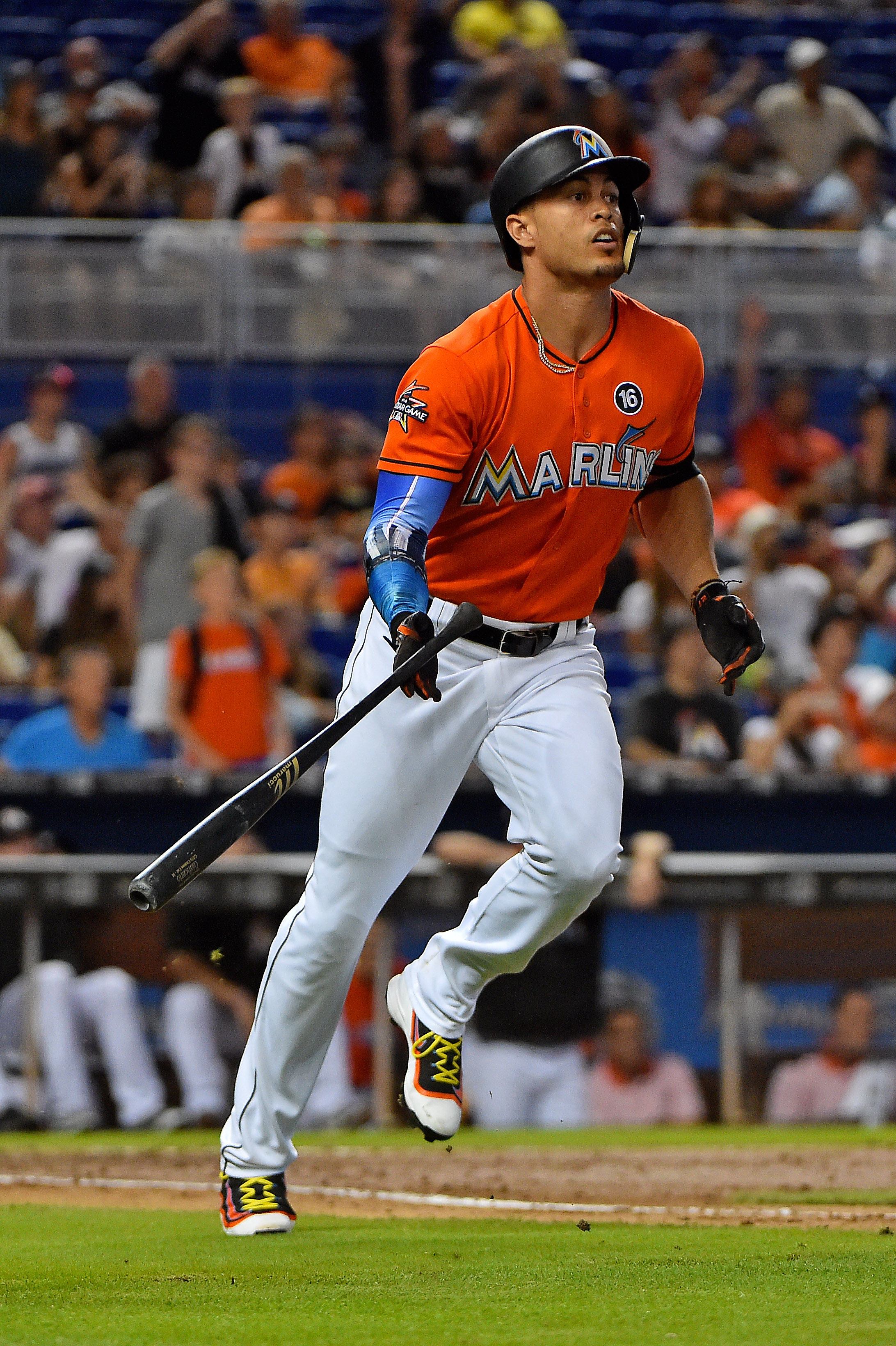
Though Stanton is an obvious trade candidate, his contract is hardly a straightforward asset to deal. From a PR standpoint, it’s hard to move a player of such prominence, though perhaps the ownership change also represents an opportune moment to turn a new leaf. Stanton enjoys full no-trade protection, but he has indicated he would rather not hang out in Miami for a rebuild. The post-2020 opt-out may perhaps give some other teams some pause if asked to give up significant young assets (quite apart from the lofty total contract price). Sufficient future payroll capacity will be an obvious prerequisite to acquiring Stanton. As of yet, the market situation is mostly undeveloped, but there’s been (in some cases speculative) mention of teams like the Phillies, Giants, and Red Sox as potential suitors.
There are any number of fascinating scenarios that could be dreamed up regarding Stanton, depending upon the precise motivations of the teams involved. Will the new Miami leadership be willing to keep some of the money (or take on an underperforming veteran in the swap) to increase the prospect return? Or is the primary goal to realign the balance sheets? And might other veteran Marlins players even potentially enter trade talks as the various teams seek to structure mutually beneficial scenarios?
There are plenty of other conceivable trade candidates on Miami’s roster, especially on the position-player side. In all likelihood, the offseason changes will be driven more by trade interest from rivals than by any specific needs the Marlins wish to address. It’s possible that the club will move Stanton but mostly otherwise keep together its relatively affordable and youthful core. But it’s equally conceivable — and perhaps advisable — that the organization will rip the band-aid off all at once.
Other teams are no doubt eyeing swaths of Miami’s roster as players to consider pursuing over the offseason. Outfielders Christian Yelich and Marcell Ozuna will hold even more appeal than Stanton to many organizations, given Yelich’s eminently affordable contract and Ozuna’s reasonably priced projected salary. There are loads of sluggers that can be had for cheap, but first baseman Justin Bour still stands out as an ascendant and affordable hitter. Derek Dietrich could be a useful platoon piece for other clubs given the solid pop he brings along with defensive capacity (albeit not mastery) at the 3-4-5 spots in the infield as well as the corner outfield.
Miami’s best trade asset, though, could actually be catcher J.T. Realmuto. That’s due in large part to scarcity at the position; reliable everyday backstops are one of the game’s rarest assets. Realmuto, 26, is an above-average hitter and baserunner who comes with three more seasons of affordable control. He throws and blocks well. And while he once rated as a poor framer, there’s now a notable (and quite unusual) split: Stat Corner views him as a wreck at winning strikes, while Baseball Prospectus now sees Realmuto as an ace pitch sweetener.
Those players all carry excess value against their contractual commitments. In a wholesale sell-off scenario, the Fish could recoup serious young talent. Other players hold out more promise of freeing payroll space. Dee Gordon should draw some interest, though there are quite a few other second basemen available and his contract looks to be in range of his hypothetical open-market value. And though Martin Prado won’t be a hotly pursued commodity — he is coming off of an injury-plagued 2017 and turns 34 at the end of October — some clubs would surely take on some of his salary. The better bet, in Prado’s case, might be to hope that an early-season turnaround boosts his value at the trade deadline.
Any acquisitions on the position-player side will be dependent upon what happens with the long list of players just discussed. The Marlins could end up adding young MLB talent in trades. Or they could end up with some pretty distinct holes to be filled by seeking lower-priced veterans in free agency. Third baseman Brian Anderson is perhaps the best candidate to join JT Riddle as a new semi-regular. Otherwise, there isn’t much in the way of quality young talent pressing for MLB time from the upper minors, as most of the Marlins’ best prospects are pitchers and/or lower-level position players.
To the extent the Marlins really try to compete in 2018, the chief needs would be found in the pitching staff. And the team will need enough arms to make it through the season regardless, so odds are that it will at least pursue lower-cost and minor-league free agent candidates.
In the rotation, that could mean adding at least two or three arms. Another opening could be made if the Marlins decide to move righty Dan Straily. He turned in another solid season and offers surplus value to teams that want quality innings at a below-market rate. Straily’s projected $4.6MM salary would represent only represent a small fraction of the sum the Marlins reportedly hope to shed, but he could net some upper-level talent that could conceivably step onto the big league roster in the not-too-distant future. Affordable arms are always in demand, and Straily reportedly drew a fair bit of interest prior to the non-waiver deadline.
While the club would love to find a taker for its remaining obligations to lefty Wei-Yin Chen, that’s hard to imagine after he missed most of the season with a partial UCL tear that did not require surgery. Rather, he’ll be run out there if he’s healthy in hopes that he’ll give innings and perhaps regain his form. His ability to do so is no sure thing, though, as skipper Don Mattingly has questioned whether Chen will be able to pitch at all next season. It’s perhaps still theoretically possible that Edinson Volquez will make it back from Tommy John surgery late in 2018, but the Marlins can’t count on anything from him and aren’t likely to shed his $13MM commitment.
Otherwise, Jose Urena outperformed his peripherals but surely deserves a starting job. And the team’s aggressive promotion of Dillon Peters suggests a belief that he’s ready to shoulder a big load at the game’s highest level. He has typically shown excellent control, so he’ll no doubt pare back his 5.5 BB/9 debut walk rate, and there’s obvious promise in his 63.3% groundball rate. The team can also give more opportunities to southpaws Adam Conley, Justin Nicolino, Chris O’Grady and Jarlin Garcia (who may yet move from the ‘pen back to the rotation) or dip further into the system, where Trevor Richards is one of the more interesting, near-term possibilities. Clearly, though, there’s cause for the front office to pursue some bounceback arms and perhaps make a selection in the Rule 5 Draft to pair with righty Odrisamer Despaigne as depth options.
The situation is rather similar in the bullpen, where there’s one interesting young potential trade candidate (Kyle Barraclough), two expensive veterans that did not quite live up to their salaries (Brad Ziegler and Junichi Tazawa), and a slate of inexperienced youngsters. The team could get something of interest back for Barraclough, who has four more years of team control and has averaged 12.1 K/9 with a sub-3.00 ERA in 163 big league innings. It’s also feasible that Miami could generate some interest in Ziegler following a strong finish to the season (especially if the Fish pay down some of his $9MM price tag), but that’d only mean opening yet more jobs at the MLB level. Regardless of what happens with the existing players, there’s an evident need to add plausible major-league arms, as Drew Steckenrider represents the only other young, controllable lock for a bullpen slot.
All things considered, the Marlins’ pitching staff is among the worst-positioned in baseball for near-term success. While there are some high-upside arms filtering northward, none seem likely to arrive soon, and recent top 10 overall picks Tyler Kolek (No. 2 in 2014) and Braxton Garrett (No. 7 in 2016) have both had Tommy John surgery. The organization has felt the pain of mortgaging the future already; for instance, while Straily worked out about as well as could have been hoped, he cost the team young flamethrower Luis Castillo, who has an exceedingly bright future and has already turned in 89 1/3 quality MLB innings for the Reds.
Fielding a competitive team would mean upgrading the pitching, which in turn would require some combination of: 1) weakening the position-player mix through trade; 2) spending more money; 3) parting with prospect capital; and 4) hitting on buy-low targets. With the Marlins looking to shave payroll and set the stage for a sustainable future, there’s little in the way of opportunity — let alone justification — for trying again to win with this basic roster mix.
Instead, it’s almost surely time for the organization to part with some of its best players in service of a new plan. How far they’ll go (along with how they’ll backfill) remains anyone’s guess — and also represents perhaps the most wide-reaching variable in the development of the overall player market this winter.
Photo courtesy of USA Today Sports Images.
Offseason Outlook: Los Angeles Angels
MLBTR is publishing Offseason Outlooks for all 30 teams. Click here for the other entries in this series.
The Angels were almost the definition of a perfectly average team (80-82 record, 710 runs scored to 709 runs allowed) in 2017, and they stuck around the AL Wild Card race for most of the season. Much of the Angels’ offseason business will hinge on Justin Upton‘s situation, though the team will have some money to spend in addressing several holes on the roster.
Guaranteed Contracts
- Albert Pujols, 1B/DH: $114MM through 2021
- Mike Trout, OF: $99.75MM through 2020
- Andrelton Simmons, SS: $39MM through 2020
- Kole Calhoun, OF: $19MM through 2019 ($14MM club option for 2020, $1MM buyout)
- Luis Valbuena, 1B/3B: $8MM through 2018 ($8.5MM mutual option for 2019, $500K buyout)
Arbitration Eligible Players (service time in parentheses; projections via MLBTR contributor Matt Swartz)
- Eric Young Jr. (5.163) – $1.1MM
- Martin Maldonado (5.156) – $2.8MM
- Garrett Richards (5.148) – $7.0MM
- Blake Wood (5.131) – $2.2MM
- Shane Robinson (5.002) – $600K
- Matt Shoemaker (3.166) – $4.4MM
- Tyler Skaggs (3.135) – $1.9MM
- Blake Parker (3.036) – $1.7MM
- Jose Alvarez (3.035) – $1.1MM
- C.J. Cron (3.010) – $2.8MM
- Cam Bedrosian (2.153) – $1.2MM
- Andrew Heaney (2.150) – $800K
- J.C. Ramirez (2.139) – $2.6MM
- Non-tender candidates: Young, Wood, Robinson
Contract Options
- Justin Upton, OF: $88.5MM through 2021 (Upton can exercise player option and become a free agent)
- Ricky Nolasco, SP: $13MM club option for 2018 ($1MM buyout)
- Huston Street, RP: $10MM club option for 2018 ($1MM buyout)
Free Agents
- Yunel Escobar, Brandon Phillips, Yusmeiro Petit, Bud Norris, Jesse Chavez, Ben Revere, Cliff Pennington, Andrew Bailey
Los Angeles Angels Depth Chart | Los Angeles Angels Payroll Information
Upton has been in talks with the club about his opt-out clause, which would allow him to test free agency and walk away from the four years and $88.5MM remaining on his contract. Upton just turned 30 last August, and coming off his big season, should be able to find a somewhat larger and longer-term deal on the open market. That said, the Angels could be floating the idea of extending his current contract by an extra year or two in order to keep the outfielder in Anaheim. Despite generally strong performance, Upton has played for five different franchises since the start of the 2012 season, so he could welcome the chance at simply staying put. For what it’s worth, Upton would be playing close to his offseason home in Arizona and he reportedly had an interest in the Angels two winters ago.
If Upton stays in the fold, that checks one major bit of business off GM Billy Eppler’s to-do list. Upton enjoyed one of the best seasons of his 11-year career, hitting .273/.361/.540 with 35 homers over 635 PA with the Angels and Tigers. He would both fill a big hole in left field and give the Halos a big bat to pair with the incomparable Mike Trout in the lineup.
If Upton opted out of his deal and left town, it would be a disappointment for the club, but the Angels accepted that risk when they surprisingly acquired Upton on the last day of August. The silver lining of Upton’s departure would be another big salary off the books, giving the Angels even more of what they haven’t had in several winters — financial flexibility.
Counting Upton’s deal and a projected $30.2MM in arbitration costs, the Angels have just over $142MM committed to 19 players next year. (Josh Hamilton‘s contract is finally off the team’s books.) While the club has traditionally stopped short of the luxury tax threshold during Arte Moreno’s ownership, that still gives Eppler plenty of room to address the Halos’ many needs. This doesn’t necessarily mean that the Angels will return to their old ways of splurging on big-ticket free agent deals, however, especially given how often those contracts failed to work out for the team. Still, there is room for one big salary to be added, and maybe two if Upton were to depart.
Looking around the diamond, Los Angeles is set in center field (Trout), right field (Kole Calhoun), shortstop (Andrelton Simmons), catcher (Martin Maldonado) and DH (Albert Pujols). “Set” is not really the right word in Pujols’ case, as the veteran’s -2.0 fWAR was the lowest of any qualified player in baseball last year, though the Halos have no choice but to ride out the final four seasons of Pujols’ contract and hope for a late career renaissance. Catcher could technically also be an area of need, though the Angels love Maldonado’s defense and they think his bat will improve now that he is more used to the rigors of regular catching duty. First base could also potentially use an upgrade, though the likeliest scenario is a platoon between C.J. Cron and Luis Valbuena.
Yunel Escobar and late-season trade acquisition Brandon Phillips are both free agents, leaving the Angels with holes to fill at third and second base. The latter position has been a long-standing problem area for the Halos, and I’d expect the team to try and finally make a solid fix by pursuing Neil Walker in free agency. Walker is the top second baseman on the market this winter, and L.A. has tried to land Walker in the past, falling short in trade talks with the Pirates two offseasons ago.
If Walker again can’t be acquired, the Angels could pursue a reunion with Phillips, or check in on other free agent options like Eduardo Nunez, Asdrubal Cabrera (if the Mets don’t pick up his club option), or Jose Reyes. On the trade front, the Angels had some interest in the Marlins’ Dee Gordon before the July deadline, plus the likes of Ian Kinsler, Josh Harrison, Cesar Hernandez, Scooter Gennett, Yangervis Solarte or Jed Lowrie could also be available in deals. The Angels’ much-maligned farm system still doesn’t have much in the way of prospects that would facilitate trades, though the team’s extra payroll space could help them in this regard.
A multi-positional player like Harrison or Nunez could also help out at third base. As per Pedro Moura of the L.A. Times, Escobar isn’t expected to be re-signed, leaving the Angels thin at the hot corner. The team could turn to Valbuena at third base in lieu of an external addition, as while Valbuena’s first season in Anaheim was underwhelming overall, he did hit quite well after the All-Star break. The big-ticket add, of course, would be signing Los Angeles native Mike Moustakas for a grand homecoming. Moustakas would fill a particular need for the Angels in adding a big left-handed bat to a heavily right-handed lineup — one would think that if the Halos do make a big acquisition for third, second or left field, that player would swing from the left side.
If left field does become a need with Upton gone, the Angels could aim for a splash like trading for Andrew McCutchen, signing J.D. Martinez or (again with a left-handed bat in mind) signing Jay Bruce. Alternatively, shorter-term options like Curtis Granderson, Jon Jay or Howie Kendrick could be explored. Teams like the Marlins and Cardinals have outfielders available in trades this offseason, so expect to see the Angels check in on those options if Upton is no longer in the picture. The club could also look for a backup outfielder, if the Angels aren’t satisfied with Eric Young Jr. and/or Shane Robinson.
Injuries have crushed the Angels’ pitching staff over the last two years, though the team finally appears to have things back on track, health-wise. Garrett Richards will headline the 2018 rotation, with Tyler Skaggs, Matt Shoemaker, JC Ramirez, Andrew Heaney, Parker Bridwell and Nick Tropeano all on hand as starting or depth options.
This is still a pretty unproven rotation even if everyone is healthy, so Anaheim is likely to explore adding at least one more arm. This is another area where Eppler could again splurge on a free agent, as a Yu Darvish or Jake Arrieta would go a long way towards stabilizing a staff with a lot of question marks. Lance Lynn and Alex Cobb are less expensive options, though either hurler would still come at a significant price. It could be that the Angels are okay with their current options and simply want a veteran to purely eat innings, which opens their search to any number of free agent arms available on short-term contracts. To this end, the team could look for a reunion with Jesse Chavez or Ricky Nolasco, though in Nolasco’s case, the Angels would decline their $13MM club option on his services and pursue a lesser deal.
Shohei Otani, of course, could be had at a league-minimum salary and for what’s left of the Angels’ $4.75MM international bonus pool, though the Halos will be competing with every other team in MLB for Otani’s services. While little is known about Otani’s decision-making process as he prepares to jump to North American baseball, the Angels (a big-market west coast team with Mike Trout on the roster) certainly have some selling points. On the other hand, Otani wants the opportunity to hit, and the Angels can’t offer regular DH at-bats thanks to Pujols’ presence. As much as the Angels or any other club may want Otani in the fold, it seems unlikely that a prized starter would be allowed to regularly play the outfield or at first base in between starts.
Turning to the bullpen, the Halos won’t be exercising their club option on Huston Street, thus ending the former closer’s injury-riddled stint in Anaheim. Even with Street out for virtually all of 2017, however, the Angels’ bullpen was quietly one of the game’s more effective relief corps. Yusmeiro Petit’s outstanding season was a big factor in the pen’s success, and with the Angels putting importance on the value of multi-inning relievers, it stands to reason that the team will look to re-sign the veteran righty. Other teams will surely also be interested, and Petit will have one of the more interesting free agent cases of any reliever on the market this winter, given such factors as his age (33 in November) and his value in this era of teams prioritizing bullpen depth.
Blake Parker is the current favorite to be the Angels’ closer next season, as his breakout year earned him save chances down the stretch in 2017. Parker’s potential makes it less likely that Los Angeles would go after one of the big-name experienced closers on the market (i.e. Greg Holland, Wade Davis) but I can see the team adding a veteran reliever to supplement the young bullpen corps of Parker, Keynan Middleton and Cam Bedrosian. One option might be old friend David Hernandez, who posted excellent numbers for the Angels before being dealt to the Diamondbacks at the July trade deadline.
The Angels will be a fascinating team to watch this offseason, as they have a lot of question marks to address but also several proven or intriguing building blocks. Eppler has been much more active in the trade market than in free agency in his first two offseasons as general manager, so more deals could be in the offing, or this could be the winter where Moreno again opens the checkbook for another big signing.
Assessing The Yankees’ Options At Third Base
Now that the Yankees have wrapped up a successful 2017 season, the attention can shift fully to their efforts in 2018. Well, mostly. This is the era of responsible stewardship in the Bronx, so at least one eye will surely also train its gaze to the horizon.
As the team ponders its options at third base, then, it won’t simply be a matter of deciding which top free agent or trade candidate is best. On the face of things, the team is losing its third bagger to free agency and must find a replacement. And, indeed, mid-season acquisition Todd Frazier is headed to the open market. For a Yankees team that’s primed to compete, that could mean its time to add a star. But there’s more at play here, making for a particularly interesting situation.
First, GM Brian Cashman has made clear that the Yankees’ payroll will not top $197MM. The Yanks are finally determined to get under the luxury tax line and seem quite committed to doing so. Given its slate of existing commitments, and assuming the team pays the full amount projected for all of its arbitration-eligible players, it will have just under $145MM committed and the bulk of the roster accounted for. After accounting for pre-arb salaries and the standard medical and other employment allocations, the organization could have something in the realm of $35MM to play with — perhaps a bit more, if some of Jacoby Ellsbury‘s salary can be moved — though the front office may also need to keep some powder dry for mid-season moves. While that’s still a healthy amount of wiggle room, since the Yanks will return quite a few key pieces, it creates some real constraints.
Second, it’s worth bearing in mind that next year’s free agent class offers some extremely exciting possibilities. Among the many superstars hitting the open market, barring extensions, will be Manny Machado and Josh Donaldson — two of the game’s very best third baggers. Two others, Nolan Arenado and Anthony Rendon, will reach free agency in the ensuing winter. It’s difficult to structure near-term decisions around such hypothetical opportunities, of course, but the possibility of landing a star performer in the relatively near future could weigh in favor of some restraint on this year’s market.
Third, the Yankees may well actually already have their next stud already lined up. Gleyber Torres seemed on the verge of a call-up this past summer before going down to season-ending surgery. He’s expected to be prepared for a full and complete spring. But he’ll enter camp just a few months removed from his 21st birthday. Though the much-hyped prospect carried a .863 OPS at both the Double-A and Triple-A levels in 2017, those 235 plate appearances represent the full sum of his upper-minors experience. He’s not even the only quality prospect that could be in position; Miguel Andujar was also excellent in the upper minors last year and even enjoyed a brief but exciting MLB debut.
Fourth, the Yanks may also already have a perfectly useful immediate option on hand. Chase Headley was dispossessed of the job at third when the team added Frazier. But he ended up turning in his best full season at the plate since re-signing with New York. The switch hitter did not grade out positively with the glove at third, but perhaps there’s still reason to believe he can play palatable defense entering his age-34 season. Notably, as has typically been the case throughout his career, Headley was particularly effective against right-handed pitching, posting a sturdy .279/.374/.405 slash line. That makes him a fairly easy player to platoon, perhaps increasing the universe of possibilities as Cashman weighs his options.
So, just what are Cashman’s options?
As always, it’s possible to imagine the team simply going out and signing the best available player in free agency. This year’s market is led by Mike Moustakas, the 29-year-old slugger. His profile is similar to that of Frazier: good power, generally solid glovework (though his metrics slipped in 2017), and on-base struggles. Frazier himself is another possibility, of course, and ought to be available on a shorter term and perhaps at a lower annual salary than will be required to land Moustakas. Those two likely represent the universe of plausible starters, however, unless Zack Cozart is willing to change positions (and teams like the Yankees show interest in trying him at third).
On the trade market, it’s really not yet clear what might be possible. Machado and Donaldson would be major prizes, but the Orioles and Blue Jays have given hints that they won’t be selling either player. (And they’d be especially hesitant to allow them to go to the Yankees, surely.) Eugenio Suarez is a controllable piece coming off of a nice year, an perhaps he could be had for the right price, but it’ll be steep. Adrian Beltre would make for a nice target, but the Rangers aren’t likely to deal him. The Cardinals may have a bit of an infield logjam, potentially freeing Jedd Gyorko or Matt Carpenter, but it’s not yet clear how they’ll proceed. Maikel Franco could conceivably be dangled by the Phillies, though perhaps taking a shot on a talented but inconsistent young player isn’t the right approach at this stage.
Acquiring a new regular would mean not only paying a hefty acquisition price, but also figuring out what to do with Headley. He could be traded, but that would likely mean paying down some of his $13MM salary. Committing to a player such as Moustakas may not be all that desirable given New York’s excellent young options. Plus, his on-base woes come with real risk. Even Frazier could prove a questionable investment and inflexible asset, though at least he’d pair more naturally with Headley and first baseman Greg Bird and wouldn’t require such a lengthy commitment. While the trade side is worth considering, it’s also entirely up in the air at this point. Regardless, if the Yankees are going to make a big move at third — potentially blocking Torres — then perhaps it ought to be saved for next winter.
Under the circumstances, then, the Yanks might be better-served by looking instead at a platoon candidate with broader function. Yunel Escobar could provide a veteran accompaniment to Headley, though perhaps he’ll prefer to join a team that’s willing to promise him more playing time. The versatile Eduardo Nunez might be an interesting option for New York, as he’d also offer some insurance elsewhere around the diamond while upgrading over Ronald Torreyes as the primary utilityman. Asdrubal Cabrera might also make sense if his option is declined (or even if he’s dangled in trade) by the cross-town Mets.
On the trade market, possible options to join Headley at third while also seeing action elsewhere could include Josh Harrison — who’d have the highest acquisition cost and would perhaps take primary duty at the job — as well as Jed Lowrie, Logan Forsythe, David Freese, and old friend Yangervis Solarte (the player dealt to acquire Headley). Nicholas Castellanos and Martin Prado are among other possible trade targets, but the former doesn’t seem to have the glove for third and the latter is coming off of a poor and injury-riddled campaign, though as with Solarte he’s a player the Yankees know well.
That largely covers the array of outside options. Of course, it’s conceivable too that the Yanks will essentially just return the job to Headley while awaiting the mid-season arrival of its youngsters (Torres, in particular) and utilize the existing financial resources to address other areas of need. How do you see things playing out? (Link for app users.)
What Will The Yankees Do At Third Base?
-
Roll with Headley and the prospects. 70% (7,634)
-
Get a new full-time player. 17% (1,860)
-
Find a platoon mate for Headley. 13% (1,432)
Total votes: 10,926
Offseason Outlook: Tampa Bay Rays
MLBTR is publishing Offseason Outlooks for all 30 teams. Click here for the other entries in this series.
Despite making a number of additions prior to the July 31 trade deadline, the Rays faded down the stretch, falling short of both a wild card berth and even a winning record. The club now faces another offseason of adding low-cost pieces while facing hard decisions about trading pricier talent.
Guaranteed Contracts
- Evan Longoria, 3B: $81MM through 2022 ($13MM club option for 2023, $5MM buyout)
- Kevin Kiermaier, CF: $47MM through 2022 ($13MM club option for 2023, $2.5MM buyout)
- Chris Archer, SP: $13.75MM through 2019 (plus club options for 2020-21)
- Wilson Ramos, C: $10.5MM through 2018
Arbitration Eligible Players (service time in parentheses; projections via MLBTR contributor Matt Swartz)
- Shawn Tolleson (5.109) – $1.0MM
- Adeiny Hechavarria (5.060) – $5.0MM
- Dan Jennings (4.171) – $2.5MM
- Brad Boxberger (4.109) – $1.9MM
- Corey Dickerson (4.101) – $6.4MM
- Brad Miller (4.094) – $4.4MM
- Xavier Cedeno (4.060) – $1.4MM
- Jake Odorizzi (4.042) – $6.5MM
- Jesus Sucre (3.137) – $1.3MM
- Chase Whitley (3.123) – $1.0MM
- Alex Colome (3.118) – $5.5MM
- Steven Souza (3.072) – $3.6MM
- Matt Duffy (3.059) – $900K
- Non-tender candidates: Sucre, Tolleson
Contract Options
- Nathan Eovaldi, SP: $2MM club option for 2018
Free Agents
- Alex Cobb, Logan Morrison, Lucas Duda, Tommy Hunter, Sergio Romo, Steve Cishek, Peter Bourjos, Trevor Plouffe, Colby Rasmus
[Tampa Bay Rays depth chart | Tampa Bay Rays payroll outlook]
The Rays haven’t had a winning record since 2013, but with Evan Longoria, Chris Archer and (most recently) Kevin Kiermaier locked up on long-term deals, it seems as though the club will continue to try and contend rather than explore a full teardown and rebuilding process. That being said, Tampa could very well duplicate its approach from last offseason — aiming to add, but prepared to shift course and start selling if an offer too good to refuse comes in for Archer or Jake Odorizzi.
These are the financial realities for the small-market Rays, whose quest for a new ballpark isn’t any closer to resolution, and whose revenues took an extra hit in 2017. While owner Stuart Sternberg recently stated that a total payroll slash wasn’t likely to happen, “the first move is down” for the 2018 payroll.
Salaries for Longoria, Archer, Kiermaier and Wilson Ramos total $36.25MM next year, while the Rays are projected to spend $41.4MM on a large arbitration class of 13 players. Even with a couple of obvious non-tenders, those modest savings would be wiped out by Nathan Eovaldi’s $2MM club option, which is likely to be picked up as he makes his return from Tommy John surgery. That works out to a payroll north of the $77MM mark, which is already higher than any Opening Day payroll figure in franchise history.
The most obvious candidates for trades are the more expensive names within that arbitration class — Odorizzi ($6.5MM), Corey Dickerson ($6.4MM), Alex Colome ($5.5MM), Adeiny Hechavarria ($5MM) and Brad Miller ($4.4MM). It would be surprising if all five of these players were wearing Rays uniforms in April, though they also carry their share of warning signs for potential trade suitors. Hechavarria has an excellent glove but is not a very productive hitter; Colome saw his strikeout rate drop and both his contact and hard-hit ball rates rise; injuries contributed to Odorizzi and Miller delivering replacement-level seasons; and Dickerson’s bat went ice-cold after a strong first half.
Odorizzi’s down year is the biggest concern, as it both lowered his asking price in trades and also gave the Rays a question mark heading into next year’s rotation if the righty is kept. Alex Cobb is a virtual certainty to leave in free agency, whether or not the team issues him a qualifying offer. (There are indications that’s the intention, though putting $17.4MM on the table for one year of Cobb may just be too great a risk, particularly after Jeremy Hellickson took the Phillies’ QO last year.) Cobb’s departure would increase Odorizzi’s importance in next year’s rotation. The starting four looks to be Archer, Odorizzi, Blake Snell and Jake Faria, with Matt Andriese, Eovaldi and top prospect Brent Honeywell all in the mix for the fifth starter’s job. Jose De Leon and Taylor Guerrieri will be at Triple-A but are coming off injury-plagued 2017 seasons, so Ryan Yarbrough and Yonny Chirinos are currently the top minor league depth options.
There’s enough depth here that the Rays could feel comfortable about their pitching even in the event of an Odorizzi trade, provided they get some injury luck and Snell/Faria both continue to develop as reliable-or-better big league arms. Andriese could also be shopped, though a hip injury limited him to 86 IP last year, and the Rays likely aren’t keen on selling low on a pitcher with four years of team control.
The biggest move, of course, would be an Archer trade. The ace right-hander also comes with up to four years of his control via the club options on his team-friendly contract, and he only reinforced his credentials by delivering more strong numbers in 2017. Teams like the Cubs, Dodgers, Braves and Astros have all been linked to Archer in the past and they (and others) are sure to check in with Tampa’s front office about the righty’s availability. It would take a major blockbuster of a trade package to actually trigger a deal, however, as Archer’s contract makes him particularly important to a low-payroll club like the Rays.
Colome’s asking price wouldn’t be nearly as hefty after a tepid 2017, though his experience as a closer, past dominance, and remaining control would still hold appeal to other organizations. That said, he is another pitcher the Rays would likely prefer to keep since Tommy Hunter, Sergio Romo and Steve Cishek could all leave the bullpen in free agency. The Rays don’t have a clear heir apparent at closer if Colome is dealt, unless they feel Brad Boxberger is ready to reclaim his old job after two injury-plagued seasons. After Colome and Boxberger, Tampa Bay probably has enough young arms on hand that they won’t make any hugely notable moves to their relief corps, aside from adding a left-handed pitcher to the mix. Xavier Cedeno missed much of 2017 with forearm problems and advanced metrics didn’t love Dan Jennings’ work, so the Rays could use some extra southpaw depth in the pen.
Consistent offense continued to be a problem for the Rays in 2017, though full seasons from Ramos and Kiermaier should provide an internal boost to the lineup. Logan Morrison’s one-year, $2.5MM deal ended up being a terrific bargain for the Rays, but with Morrison’s 38-homer season likely set to land him a multi-year contract elsewhere, the Rays now have a big hole to fill at first base.
This position could also be addressed from within, should Tampa feel that prospect Jake Bauers is ready for the big leagues. Entrusting a starting role to a rookie who only posted good but not great (.263/.368/.412 over 575 PA) Triple-A numbers would be a bold move, so the Rays could sign a veteran right-handed hitting first baseman like Mike Napoli, Danny Valencia or perhaps even Jose Bautista as a platoon partner.
Alternatively, the Rays could shift Miller back to first base if they feel Bauers needs more seasoning. All of Miller’s 303 career innings as a first baseman came in 2016, when he also enjoyed a breakout year at the plate, and it’s at least possible that playing a less-demanding defensive position contributed to Miller’s performance. Metrics such as UZR/150 and Defensive Runs Saved indicated that Miller was also a below-average defender at first base, though that would be less of a problem than his subpar glovework at second base.
Then again, it’s a question as to whether Miller is in the Rays’ plans at all given his -0.1 fWAR performance last season. A non-tender doesn’t seem likely (it would be hard for the offense-starved Rays to walk away from a player who hit 30 homers in 2016) but Miller is likely to be shopped this winter thanks to his significant arbitration number.
The Rays could again use Miller at second base if they can live with his defense, though options abound in the middle infield. Unlike with Miller, the Rays know what they’re getting in Hechavarria, whose $5MM projected salary comes with the promise of an outstanding shortstop glove. Retaining Hechavarria is probably the safest bet since star prospect Willy Adames has yet to debut in the majors and former shortstop-of-the-future Matt Duffy is a wild card after missing all of 2017 due to complications from heel surgery. Adames and Duffy could factor into the second base picture, however, if Miller is traded or shifted to first.
Dickerson has provided the Rays with capable defense over his two seasons with the team, though he’ll need enough DH time that left field looks like an area of need. Mallex Smith will return as the fourth outfielder but doesn’t have the bat for such a significant role, so Tampa will likely explore veteran outfielders that could be had on a short-term deal, akin to the one-year, $5MM contract with Colby Rasmus from last winter. If the Rays were willing to spend a bit more, a versatile player like Howie Kendrick could be a nice fit as a right-handed bat capable of spot duty in left field, second and first base.
Speaking of versatility, it’s worth noting that the Rays have a “sincere” interest in Shohei Otani, which perhaps implies more than the standard due diligence that every team is undoubtedly doing on the 23-year-old two-way star. Otani’s apparent disinterest in immediate salary riches helps the Rays’ case, though they almost surely wouldn’t be able to offer him a truly massive extension after he has spent enough time in North America for such a deal to pass muster with the league. It can’t be understated what a franchise-altering addition Otani would be, though it’s safe to call the Rays a longshot suitor at best.
After four straight losing seasons, the Rays are still looking for those missing pieces to their roster puzzle, as well as hoping that they can finally get a year where all their key players are both healthy and productive at the same time. The emergence of players like Snell, Faria, Duffy, Honeywell, Adames and Bauers as productive regulars would be an enormous boost for a Rays team that relies on young talent, though some type of proven veteran additions will be necessary to get the club back over the .500 mark.
Poll: Who Will Win The World Series?
The 2017 season will culminate in an epic World Series, matching the Dodgers against the Astros. It is the first time since 1970 that the Fall Classic has featured two teams that each won 100 games or more games — L.A. will have homefield advantage, as the Dodgers’ 104-58 record topped the Astros’ 101-61 mark.
After winning the NL West title and falling short in each of the last four postseasons, the Dodgers finally broke through this year to capture their first National League pennant since 1988. The club overcame scores of injuries (38 DL stints, the most of any team in baseball) to achieve their success, though obviously having the game’s largest payroll goes a long way in securing roster depth. Beyond the expected contributions from established stars like Clayton Kershaw, Kenley Jansen, and Justin Turner, the Dodgers were also buoyed by Corey Seager‘s excellent sophomore year, rookie Cody Bellinger‘s 39 homers, Yasiel Puig‘s bounce-back year, and utilityman Chris Taylor‘s emergence as an everyday threat. If this wasn’t enough, the Dodgers added Yu Darvish at the trade deadline to enhance an already-outstanding rotation.
This is the Dodgers’ 19th World Series appearance, tied with the Cardinals for the third-most in history. By contrast, this is only the Astros’ second trip to the Fall Classic, though they now have the unique distinction of being the only franchise to represent both the American League and National League in the World Series.
This pennant represents the culmination of the Astros’ scorched-earth rebuild under GM Jeff Luhnow. Due to a complete focus on building up the farm system, the Astros went only 162-324 from 2011-13, a brutal stretch of play that saw fan interest in Houston almost evaporate and Luhnow’s methods questioned by many around the game. As with last year’s champion Cubs, however, a long rebuild resulted in an enviable core of young talent. George Springer, Carlos Correa, Dallas Keuchel, Lance McCullers, Alex Bregman and AL MVP favorite Jose Altuve are all homegrown Astros, and the team further supplemented that core with under-the-radar trade pickups (i.e. Marwin Gonzalez, Chris Devenski) and bigger-ticket acquisitions (Yuli Gurriel, Brian McCann, Josh Reddick, Carlos Beltran). The final piece of the puzzle was trading for Justin Verlander at almost literally the last second prior to the August 31st waiver deadline, and Verlander has been nothing short of spectacular since coming to Houston.
With two days to go before Keuchel vs. Kershaw at Dodger Stadium in Game One, we post the question…what is your prediction for the 2017 Series? (link to poll for MLBTR mobile app users)
Who Will Win The World Series?
-
Dodgers in six games 32% (6,716)
-
Astros in six games 25% (5,127)
-
Astros in seven games 17% (3,537)
-
Dodgers in five games 12% (2,537)
-
Dodgers in seven games 7% (1,496)
-
Astros in five games 3% (698)
-
Dodgers in four games 2% (371)
-
Astros in four games 1% (192)
Total votes: 20,674
MLBTR Originals
Here is the past week’s worth of original content of the MLBTR writing team…
- Will Carlos Santana‘s solid and steady production lead to a big contract this winter, or could he be hampered by another cool market for first base/DH players? Connor Byrne examines Santana’s case in a new edition of Free Agent Stock Watch.
- The Cardinals didn’t expect to be looking for ninth-inning help his offseason, though due to Trevor Rosenthal‘s Tommy John surgery, St. Louis is now in need of a closer. Jeff Todd breaks down the Cards’ options in free agency and on the trade front, both for 2018 and over the long term.
- Billy Hamilton could be a nice trade chip for a rebuilding Reds team, as Kyle Downing looks at what teams could have interest in the defensive-gifted speedster.
- Over 88% of MLBTR readers polled by Connor feel the Red Sox will make some major moves to add offense this winter. After a disappointing performance by the lineup, the Sox will be hoping that several locked-in regulars improve, though a big bat or two could be added at first base or perhaps in the outfield (if Jackie Bradley is traded).
- MLBTR’s Offseason Outlook series continued in full swing, with entries on the Brewers (by Steve Adams), Giants (by Mark Polishuk), Pirates (by Jeff), Reds, Phillies (both by Kyle), Mariners, Mets, and Athletics (all by Connor).
Offseason Outlook: Seattle Mariners
MLBTR is publishing Offseason Outlooks for all 30 teams. Click here to read the other entries in this series.
The 2017 season was the 16th in a row that ended after Game 162 for the Mariners, who finished 78-84 to extend their major league-worst playoff drought. A series of injuries to integral performers contributed to Seattle’s woes this year, though, leaving general manager Jerry Dipoto and CEO John Stanton optimistic that a healthier Mariners club could make a postseason push in 2018. But first, Dipoto will spend the next few months working to build a better roster than the one he constructed heading into the 2017 campaign.
Guaranteed Contracts
- Robinson Cano, 2B: $144MM through 2023
- Kyle Seager, 3B: $74.5MM through 2021
- Jean Segura, SS: $67MM through 2023
- Felix Hernandez, SP: $54.7MM through 2019
- Mike Leake, SP: $36MM through 2021
- Nelson Cruz, DH: $14MM through 2018
- Marc Rzepczynski, RP: $5.5MM through 2018
Contract Options
- Yovani Gallardo, SP: $13MM club option or $2MM buyout
- Hisashi Iwakuma, SP: $10MM club option or $1MM buyout
Arbitration-Eligible Players (service time in parentheses; projections via MLBTR contributor Matt Swartz)
- David Phelps (5.156) – $5.8MM
- Drew Smyly (5.154) – $6.85MM
- Erasmo Ramirez (4.158) – $4.7MM
- Nick Vincent (4.067) – $2.7MM
- Mike Zunino (3.161) – $3.2MM
- James Paxton (3.151) – $5.6MM
- Shae Simmons (3.111) – $700K
- Non-tender candidates: Smyly
Free Agents
[Mariners Depth Chart; Mariners Payroll Information]
As you’d expect, injuries weren’t the lone culprit for the Mariners’ sub-.500 finish this year. However, they did play a big part in the Mariners’ weakest aspect – their starting staff. Entering the season, the plan was for James Paxton, Felix Hernandez, Hisashi Iwakuma and winter trade acquisitions Drew Smyly and Yovani Gallardo to eat up the lion’s share of innings from the M’s rotation. Instead, the quintet combined for a mere 368 1/3 frames – roughly 73 apiece – and Paxton was the sole standout when he actually took the mound. Arm problems prevented the promising Smyly from pitching at all, and after undergoing Tommy John surgery in July, he looks like a surefire non-tender. Iwakuma also had an abbreviated year, making just six starts and amassing 31 innings, and is now recovering from September shoulder surgery. He’ll receive his walking papers in the form of a buyout, as will Gallardo, who pitched to a bloated ERA (5.73) over 130 2/3 innings spent between the rotation and bullpen.
While three-fifths of their planned rotation from 2017 is on the cusp of exiting, the Mariners still have three locks to win starting spots next season. Paxton is the unquestioned ace, a distinction that went to Hernandez before him. King Felix has fallen off dramatically over the past couple seasons, but the superstar-type money left on the soon-to-be 32-year-old’s contract and his full no-trade clause indicate he’s not going anywhere. And then there’s Mike Leake, whom the Mariners acquired from the Cardinals in an end-of-August trade. While Leake was tremendous down the stretch with his new team (2.53 ERA, 2.25 FIP in 32 innings), the elite-caliber production he logged during that small sample is an aberration relative to his career. Still, even if Leake regresses toward his lifetime output next season (3.98 ERA, 4.12 FIP), the longtime innings eater will still give the Mariners a durable mid-rotation type. There’s plenty of value in that for a team whose innings leader in 2017 was Ariel Miranda, a back-end starter who accrued 158 frames. Leake hasn’t thrown fewer innings than that in a season since his rookie year, 2010, when he racked up 138 1/3.
It’s unclear what the Mariners’ rotation will look like beyond Paxton, Hernandez and Leake next year, though Dipoto declared earlier this month that he’s satisfied with the “depth” and “quality” on hand. With Erasmo Ramirez, Andrew Moore, Andrew Albers, Ariel Miranda and Marco Gonzales around, the Mariners will go into 2018 with several in-house candidates for the final two sports in their rotation. It’s not the most confidence-inspiring group, however, which means it would behoove the Mariners to seek outside upgrades.
Considering the Mariners lack even a mid-tier farm system, putting together a trade for a controllable, young starter may be unrealistic. But they could add one in free agency if Japanese sensation Shohei Otani immigrates to the majors, as he’s expected to do. Thanks to the international spending limitations in the new collective bargaining agreement, the 23-year-old ace/slugger figures to have all 30 teams vying for his services should he reach the market. The amount of competition will make it especially difficult for any team to reel in Otani, then, but Bob Dutton of the Tacoma News Tribune did report earlier this month that Seattle plans to aggressively pursue him.
It may not affect the Otani chase, but it’s still worth noting that the Mariners have had success picking up Japanese talent in the past, having added Iwakuma, future Hall of Famer Ichiro Suzuki and Kazuhiro Sasaki. Unlike any of those players, Otani comes with the unique ability to make an impact both on the mound and with his bat. Otani will primarily serve as a pitcher if he comes to the majors, but he’s likely to sign with a team that will give him the ability to showcase his offensive skills. As an American League club, the Mariners theoretically have a leg up on half of the majors because they can offer Otani at-bats as a designated hitter. Of course, with Nelson Cruz entrenched at DH for another year, Otani probably wouldn’t have a chance to do much at the plate until 2019 if he chooses the Mariners.
Aside from Otani, the premier impending free agent starters will include Yu Darvish, Jake Arrieta, and, if he opts out of his contract with the Yankees, Masahiro Tanaka. Otani happens to idolize Darvish, setting up the possibility of those two going somewhere as a sort of package deal. The problem for Seattle, if it tries to go after Darvish, Arrieta or Tanaka, is that it doesn’t seem to have the financial wiggle room to make a big splash. While the Mariners’ payroll does have “room for growth,” according to Stanton, it’s unclear how much more they’re willing to spend after opening 2017 with a franchise-record $154MM in commitments. Regardless, the vast majority of the Mariners’ 2018 money is already spoken for, with a handful of veterans on large contracts and several more due raises in arbitration. The Mariners could still get creative in order to sign Darvish, as John Truplin of Lookout Landing wrote this week, but doing so would make it tough for them to adequately address other problems on the roster.
As with Darvish, Arrieta and Tanaka, signing a second-tier starter such as Lance Lynn or Alex Cobb may also prove too costly. But there will be some other potentially useful options on the market at lesser prices, including hard-throwing, groundball-inducing Tyler Chatwood, former Mariners Doug Fister, Jason Vargas and Chris Tillman, and Jaime Garcia, to name a few.
While a major addition to the Mariners’ rotation at least looks somewhat possible, albeit unlikely, their bullpen probably doesn’t need one. The Mariners’ relievers only earned modest rankings in ERA (13th) and fWAR (15th) this year, but Edwin Diaz, Nick Vincent, Emilio Pagan, Tony Zych, Marc Rzepczynski and James Pazos are either shoo-ins or strong bets to factor into their Opening Day plans next season. And with no minor league options remaining for Ramirez or Gonzales, at least one could end up in the bullpen if beginning the year from the rotation doesn’t prove to be in the cards. Beyond those names, Shae Simmons, Dan Altavilla, Ryan Garton and Thyago Vieira are also among those in the organization who could push for big league relief roles.
Similarly, the majority of the Mariners’ position player group is locked in going into next year. Cruz, second baseman Robinson Cano, third baseman Kyle Seager, shortstop Jean Segura, outfielder Mitch Haniger and catcher Mike Zunino will be integral pieces again. They’re going to need complements at first base and in the outfield, though.
Going by fWAR (minus-0.7), nobody was worse off at first this year than Seattle, but soon-to-be free agent Danny Valencia’s lackluster output was the primary reason for that. On the other hand, August acquisition Yonder Alonso fared decently (.265/.353/.439 in 150 plate appearances), though he’s also scheduled to hit free agency. He and the Mariners are interested in working out a new deal, per Greg Johns of MLB.com; failing that, the club could look elsewhere to a free agent market that will include first base types ranging from expensive to reasonably priced in Eric Hosmer, Carlos Santana, Jay Bruce, ex-Mariner Logan Morrison, Lucas Duda and Mitch Moreland. Alternatively, Dipoto may go his signature route – the trade market – for help, with the Braves’ Matt Adams standing out as a possible mover who wouldn’t require much in return.
Some of those names, including the lefty-swinging Alonso, aren’t all that effective against same-handed pitchers. Perhaps it would make sense, then, to bring back the right-handed Valencia as a platoon first baseman, given how well he has performed versus southpaws in his career (.313/.370/.493 in 994 PAs). Otherwise, Mike Napoli, Mark Reynolds, Matt Holliday and Jose Bautista are fellow righty-hitting free agents with the potential to fill that role, though Reynolds is the only member of the group who isn’t coming off a poor season.
Meanwhile, it’s anyone’s guess who will join Haniger to comprise the Mariners’ starting outfield. It’s also to be determined whether Haniger will line up at his typical 2017 spot – right field – or shift to center. Whether that happens could depend on the future of center fielder Jarrod Dyson, arguably the Mariners’ best free agent-to-be. While Dyson will turn 34 next August and doesn’t bring any power to the table, his defensive and baserunning prowess – not to mention his respectable on-base skills – combine to give him a high-floor skillset. Injuries limited Dyson to 111 games and 390 PAs in 2017, his first year as a Mariner, but he still managed upward of 2.0 fWAR for the fourth time in a half-decade. Dyson’s clearly a valuable player, one who’s not going to break the bank this winter, so re-upping him on a short-term deal may be in Seattle’s best interest. If Dyson walks, though, the Mariners will have to replace someone who was easily the leading defender and baserunner on the team in 2017 (notably, despite Dyson’s excellence, the M’s finished toward the bottom of the majors’ in FanGraphs’ BsR metric).
Lorenzo Cain, one of Dyson’s former teammates in Kansas City, will be the premier center fielder available in free agency, but he’s also poised to haul in one of the offseason’s richest paydays. Fellow center fielders Carlos Gomez, Jon Jay, Cameron Maybin and former Mariner Austin Jackson won’t cost nearly as much as Cain, though Dyson is arguably more appealing than each of those four. As for center field-capable trade candidates, there’s Christian Yelich (Marlins), Marcell Ozuna (Marlins), Billy Hamilton (Reds), Keon Broxton (Brewers) and Randal Grichuk (Cardinals). The Mariners probably don’t have the prospect capital to win a bidding war for either Yelich or Ozuna, however, and Hamilton, Broxton and Grichuk all posted sub-.300 on-base percentages in 2017. That could deter Dipoto, who highly values OBP.
Even with Haniger and either Dyson or his successor in the mix, the Mariners may still need help in the grass. Ben Gamel and Guillermo Heredia combined for just 1.6 fWAR (all from Gamel) in 976 PAs, after all, and the former declined sharply at the plate in the second half of the season. Both players are dirt cheap and fairly young, which could convince the Mariners to give them a large amount of rope again in 2018. Still, there’s a variety of corner outfield options slated to reach free agency – including J.D. Martinez and possibly Justin Upton, whom Dipoto knows from their time together in Arizona – and some would at least make for useful bench pieces (Rajai Davis would fit a team in need of a baserunning boost, for instance) if the Mariners don’t shop for a bona fide starter.
The Mariners do appear to have a legitimate starter behind the plate in Zunino, the No. 3 pick in the 2012 draft who has moved past his early career struggles to emerge as an upper-tier backstop since last season. He’ll need a new backup, however, unless the Mariners re-sign respected veteran Carlos Ruiz. Whether it’s Ruiz or someone else, any catcher the Mariners tab for the No. 2 role likely isn’t going to play much next season – which makes it a low-priority need (but a need nonetheless) entering the winter.
This may prove to be a make-or-break offseason for Dipoto, who’s entering the final year of his contract. Putting together a team that at least seriously competes for a wild-card spot in 2018 could be enough to save his job, but it appears he’ll have to make improvements this winter without a ton of spending room. The good news for Dipoto is that the Mariners aren’t exactly devoid of talent, meaning he shouldn’t have to do anything drastic for them to end up as playoff contenders next season.