
Potential Landing Spots For Angel Pagan
Spring Training is underway, and though all of the names on MLBTR’s Top 50 ranking from this past November have come off the board, a handful of useful free agents still remain in search of new homes. Angel Pagan quite arguably tops that list. The 35-year-old has averaged 547 plate appearances and 131 games per season across the past two years after missing much of the 2013-14 campaigns due to injury, and the 2016 season was a productive one for the switch-hitter. Pagan batted .277/.331/.418 with a career-high 12 homers to go along with 15 stolen bases and defense in left that ranged from passable (-4 Defensive Runs Saved) to slightly above average (+4.4 Ultimate Zone Rating).
Though he’s played in about 130 games in each of the past two seasons, Pagan has nonetheless required time on the disabled list in each of those campaigns — most recently spending a few weeks on the shelf with a hamstring injury. His days of playing center field on a regular basis could possibly be behind him as well; the Giants shifted Pagan to left field last year after signing Denard Span to a three-year deal. With Pagan set to turn 36 this season and poor defensive metrics from his last regular work in center field (2015 — though he was hampered by knee troubles that season), some clubs may be wary of his glove in center.
Pagan has drawn interest from the Nationals, per FOX’s Ken Rosenthal, who also reported that the Blue Jays and Royals had interest before adding Jose Bautista and Brandon Moss, respectively. Pagan will hardly break the bank at the stage of the offseason — Rosenthal suggested that the Nats are hoping to land him on a minor league deal — but the longtime Giants and Mets outfielder still seems perfectly capable of helping a big league team. His bat checked in at roughly league average last year, per park-adjusted metrics like OPS+ and wRC+, and depending on one’s preferred defensive metric/WAR version, Pagan was worth one to two wins.
Let’s run down a few speculative landing spots for Pagan that make some sense on paper…
- Athletics [Current depth chart]: Oakland’s outfield mix right now looks to include Khris Davis as the primary left fielder, Rajai Davis in center field and Matt Joyce in right (where he’ll platoon with Jake Smolinski). Mark Canha and/or Adam Rosales could see some occasional time in the outfield corners as well, but there’s enough uncertainty here that Pagan could serve as an upgrade.
- Braves [Current depth chart]: Atlanta still doesn’t have much of an option in center in the event of an Ender Inciarte injury or day off. Matt Kemp is no longer an option there, and Jace Peterson has all of eight innings in the Majors at the position. The Braves have claimed corner options like Adam Walker and Christian Walker this winter, but Pagan profiles as more of a traditional fourth outfielder than either of those younger options.
- Blue Jays [Current depth chart]: Even after re-signing Bautista, it’s not hard to see how Pagan could fit into the Jays’ outfield mix. Toronto is currently set to rely on a platoon of Ezequiel Carrera and Melvin Upton Jr./Steve Pearce in left field. Pagan could compete for at-bats in left and could also help to spell Bautista in right (either late in games as a defensive replacement or in the starting lineup on days when Bautista serves as a DH). Speculating further, he could even push Bautista to first base with some degree of regularity (though the team does have both Justin Smoak and Pearce as options there).
- Giants [Current depth chart]: San Francisco seems set on seeing what it has on its hands with a pair of unproven outfielders: Jarrett Parker and Mac Williamson. Parker, though, has demonstrated significant strikeout issues and needed a .360 average on balls in play to produce a fairly modest .267 average in the Majors. Williamson is the younger of the pair and has come with his own strikeout issues. Left field still looks like the Giants’ biggest hole, on paper, but they seem to prefer to move on to younger options.
- Nationals [Current depth chart]: Jayson Werth, Adam Eaton and Bryce Harper are set to be the primary outfielders in D.C., but Werth has had his own injury issues in recent years. Michael Taylor, Chris Heisey and perhaps an occasional appearance from Adam Lind appear to be the Nationals’ primary reserve options, but Taylor’s yet to make enough contact in the Majors to tap into his considerable upside. GM Mike Rizzo has been highly active late in the winter, adding both Matt Wieters and Joe Blanton in the past week.
- Orioles [Current depth chart]: The O’s were linked to Pagan back in December, though they’ve since added Michael Bourn and Craig Gentry on minor league deals. Bourn, though, will miss the next four weeks due to a broken finger, so perhaps the Orioles will again turn to Pagan as a possible depth piece. GM Dan Duquette reportedly would like an outfielder that can provide some speed and corner defense, and Pagan can fit that bill. Baltimore does have a pair of Rule 5 outfielders in camp in Aneury Tavarez and Anthony Santander, though, so the team may also feel the outfield scene is crowded enough.
- Pirates [Current depth chart]: No one is supplanting any of Gregory Polanco, Starling Marte or Andrew McCutchen for a regular role in the Pittsburgh outfield, but the primary backup outfielders appear to be Adam Frazier (who was more of an infielder in the minors) and John Jaso, who is definitively limited to the corners.
- Twins [Current depth chart]: Minnesota looks to be going young across the board in the outfield, with Eddie Rosario in left, Byron Buxton in center and Max Kepler in right. Switch-hitter Robbie Grossman is on hand and could serve as a right-handed complement to Rosario or Kepler, and Drew Stubbs is in camp with Minnesota trying to win a job. Out-of-options Danny Santana, a former shortstop, has seen his share of outfield action as well. There are plenty of options for the Twins, but if it’s determined that one of the starters needs to return to Triple-A, or if an option like Stubbs or Santana falters, there’s room for an addition.
- Tigers [Current depth chart]: Justin Upton and J.D. Martinez are set for everyday work in the corners, but the Tigers are going piecemeal in center field. Mikie Mahtook and Tyler Collins look primed to form a platoon, with Anthony Gose and young JaCoby Jones also on hand as options. It’s up for debate whether Pagan’s glove will play in center field anymore, but given the uncertainty in Detroit, it’s easy to see where he could slot into the mix.
- White Sox [Current depth chart]: Melky Cabrera, Charlie Tilson and Avisail Garcia look to be the starting trio for the ChiSox in the outfield, with veteran Peter Bourjos in camp on a non-roster invite. Waiver claim Rymer Liriano, too, could enter the mix — perhaps as a platoon partner for Tilson. Pagan could push Garcia or Cabrera to designated hitter, in theory, or he could slot in elsewhere if the Sox decide that Tilson needs more seasoning.
I’ll open this one up for everyone to weigh in (link to the poll for Trade Rumors mobile app users)…
Where Will Angel Pagan Sign?
-
Blue Jays 14% (835)
-
Braves 13% (768)
-
Giants 12% (716)
-
Nationals 11% (680)
-
White Sox 9% (554)
-
Other 9% (540)
-
Tigers 8% (497)
-
Orioles 7% (439)
-
Athletics 7% (411)
-
Pirates 6% (362)
-
Twins 3% (187)
Total votes: 5,989
Possible Landing Spots For Pedro Alvarez
Lefty slugger Pedro Alvarez is a limited player, but he’s just thirty years of age and is coming off of a season in which he slashed .249/.322/.504 with 22 long balls in just 376 plate appearances. Most of the damage, as usual, came against righty pitching. And Alvarez is best kept away from a fielding glove (though he did see time last year at third base). But he has actually generated positive baserunning ratings of late, and the overall package still makes him a potent DH option and bench bat — the same basic formula that landed him a $5.75MM contract last year from the Orioles.
On the one hand, we’ve seen other such hitters fall shy of expectations. Adam Lind, for example, took just $1.5MM from the Nationals. And older lefty sluggers such as Ryan Howard and Justin Morneau also remain available. (The right-handed Billy Butler, among others, also has yet to sign.) Of course, it’s easy to forget that Alvarez waited until March to sign last year, so perhaps it’d be unwise to count out agent Scott Boras’s ability to find money when it’s least expected.
As team sort through their internal options, perhaps an injury or renewed assessment could turn the tide for Alvarez. While it would be foolish to overstate his impact at this stage — he’s no longer an everyday third baseman who can provide over thirty long balls — there’s little reason to think that Alvarez isn’t a useful MLB player. And the fact that he can still handle third base in a pinch doesn’t hurt.
Here are seven landing spots that make some degree of sense; weigh in with your pick in the poll below.
- White Sox [Current Depth Chart] — Chicago currently projects to have quite an unproven MLB roster on Opening Day, and yet more holes could open if the club pulls off a spring trade or two. Unless the team shifts Melky Cabrera to the DH hole, that spot is wide open at present. Adding the veteran hitter might help keep fans in the seats and ease the transition that the club is overseeing.
- Twins [Current Depth Chart] — Though Kennys Vargas, Byung Ho Park, and Robbie Grossman currently factor in the picture as DH candidates in Minnesota, there has been some rumored interest — though there are also indications that it’s overstated. The Twins do have good reason to see what they have in that trio, though perhaps the club could also see the merit in adding a proven slugger to the stable.
- Rangers [Current Depth Chart] — If we suppose that Shin-soo Choo is still deemed capable of playing the outfield without yet another injury, and that Texas still isn’t sold on Joey Gallo, then perhaps there’s still some room for Alvarez on the roster. Alvarez’s camp reportedly tried to get the Rangers to bite before they added Mike Napoli, but it’s not clear whether the interest as reciprocated.
- Athletics [Current Depth Chart] — Catcher Steven Vogt and first baseman Yonder Alonso both hit from the left side, and each could spend time at DH, but adding Alvarez would give the team another weapon against righties. Even if power prospect Ryon Healy is on the roster, the right-handed hitter would still have plenty of opportunities at the corner infield spots as well as the DH hole.
- Orioles [Current Depth Chart] — It’s a bit of a stretch at this point, but if Baltimore is willing to give Mark Trumbo time in right field, Alvarez could make a return. That’d likely mean punting on Rule 5 picks Anthony Santander and Aneury Tavarez, and perhaps passing over a third lefty hitting outfielder in Michael Bourn, but the O’s have not shied away from loading up on sluggers in recent years.
- Mariners [Current Depth Chart] — This really comes down to one question: does Seattle fully believe in Dan Vogelbach? The young southpaw slugger is slated to battle for playing time with Danny Valencia at first base, but if the M’s feel he’s not quite ready to handle a significant load in the majors, then perhaps they could pivot to Alvarez.
- Phillies [Current Depth Chart] — If there’s a National League team that could make some sense, it’s probably the Phils. While they’d like to see what Tommy Joseph can do at first, he’s hardly a slam dunk and currently lacks a platoon partner. The rebuilding club could split time there and perhaps see if Alvarez becomes a deadline trade chip.
Which team do you think will sign Alvarez? (Link for app users.)
Who'll Sign Pedro Alvarez?
-
White Sox 19% (1,437)
-
Other (American League) 19% (1,385)
-
Athletics 13% (974)
-
Orioles 11% (786)
-
Phillies 11% (778)
-
Mariners 8% (614)
-
Other (National League) 7% (502)
-
Twins 7% (485)
-
Rangers 6% (446)
Total votes: 7,407
Make Or Break Year: Travis d’Arnaud
MLBTR is rebooting its “make or break year” series, in which we analyze players who enter the season with up-and-down track records but also an opportunity to stake a claim to significant future earnings.
This time last year, Mets catcher Travis d’Arnaud was looking to build off of a 2015 season in which he established himself as an offensive force, but also continued to deal with a troubling run of injuries. Now, he’s not only still facing the critique that he can’t stay healthy, but also needs to restore his trajectory as a high-quality option behind the dish.
Injuries remain the major question mark. Over his professional career, d’Arnaud has suffered a series of concussions that are all the more concerning given his position of choice. And that’s not all. The hard-working backstop’s health read-out sounds like a game of Operation, as he has racked up problems high, low, and in-between. Hand and elbow, foot and knee, and back injuries were all on the list even before the 2016 season.
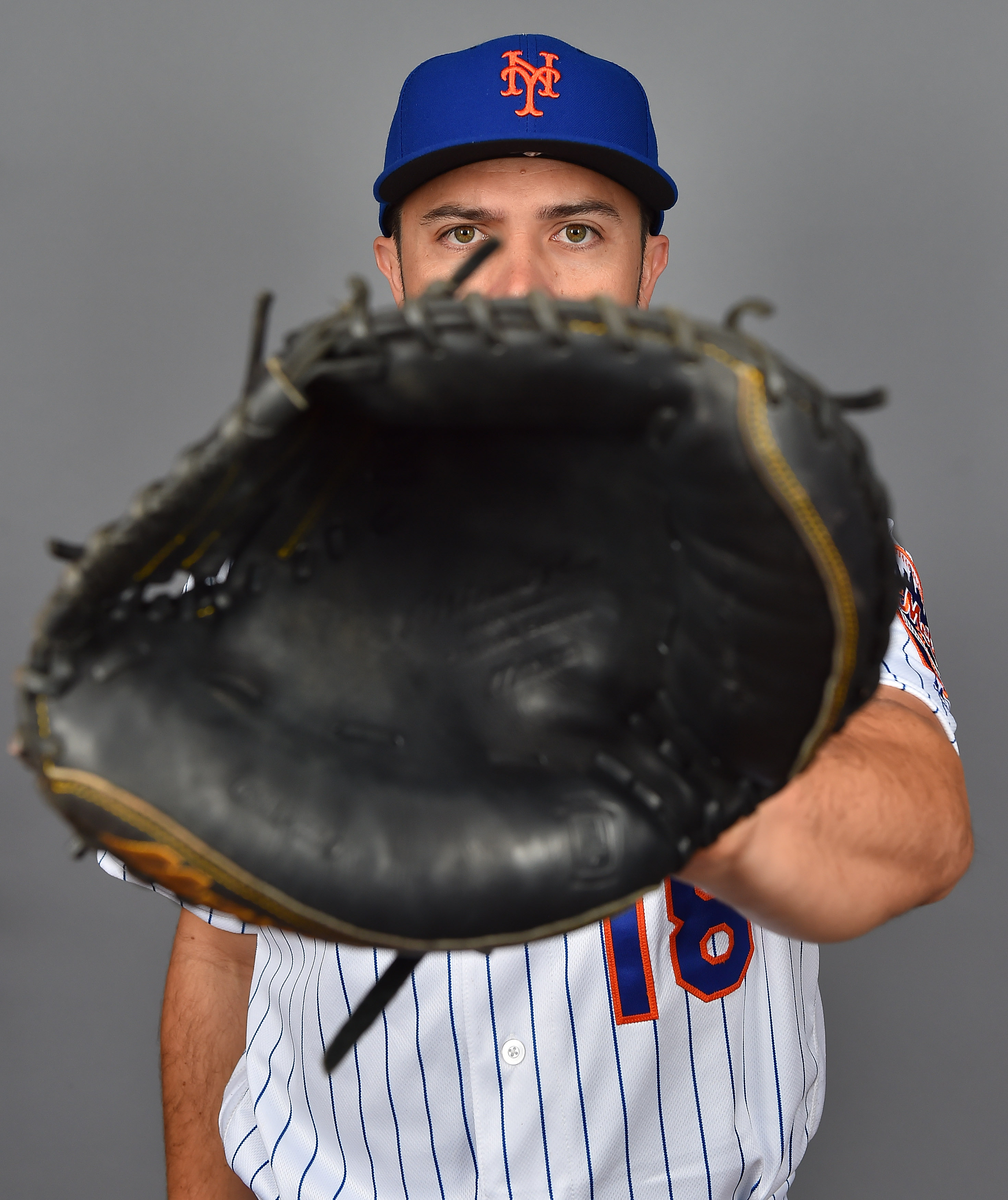
There’s no denying the trouble that d’Arnaud had last year, both before and after a rotator cuff strain sent him to the DL and further clogged his medical rap sheet. He ended the year with a .247/.307/.323 batting line and just four home runs over 276 plate appearances. While his 6.9% walk rate and 18.1% strikeout rate aren’t out of line with career norms, the anemic .076 isolated slugging mark represents a big step back.
The defensive side of the equation brings yet more questions. While he continued to rate well in the pitch-framing department, d’Arnaud cut down just 17 of the 61 baserunners who attempted to steal against him — though certainly the Mets’ staff deserves a hefty share of the blame there. Despite d’Arnaud’s stalling bat, which he hopes to fix with improved swing mechanics, Mets manager Terry Collins says that “the defensive side” is “where we’ve got to really focus.” As John Harper of the New York Daily News recently reported, the young backstop’s pitch calling may have compromised his standing with the Mets’ talented pitching staff.
Given those struggles, there’s a lot for d’Arnaud to prove to an organization that has designs on contending in 2017. That’s not to say that the club doesn’t have confidence in a rebound, as it did decide to pass on potential upgrades behind the dish this winter. Light-hitting veteran Rene Rivera isn’t really suited for more than reserve duty, while Kevin Plawecki has yet to translate his offensive success in the upper minors to the game’s highest level. As Harper writes, the organization could change tack and seek an alternative — as soon as this year’s trade deadline — if d’Arnaud fails to recover his standing.
All that said, there are reasons to hope that the former first-round draft pick can make good on his obvious talent. After a solid 2014 season, d’Arnaud turned in a big (albeit injury-shortened) 2015 campaign at 26 years of age. In his 268 plate appearances that year, d’Arnaud slashed a robust .268/.340/.485 and swatted a dozen long balls, leading some to expect he’d soon establish himself as one of the game’s premier offensive threats from behind the plate. Defensively, the metrics love d’Arnaud’s pitch presentation, which many organizations have adopted as a critical element in assessing catching value. And he only just turned 28 years of age, so it’s not as if there aren’t prime seasons remaining.
While he’s still young, d’Arnaud’s future direction will be determined on the field this year — so long as he can stay in uniform and avoid yet more trips to the DL. His limited playing time has also tamped down his earnings, so he’s only set to take home $1.875MM in his first season of arbitration eligibility; cost pressures, then, won’t likely play much of a role. But as the Mets plot a course for the three further years over which they control d’Arnaud, which coincide with the team’s contract rights over several other core players, they’ll no doubt be assessing carefully the extent to which d’Arnaud is capable of providing the offensive production and defensive work that the organization needs at the catching position.
Photo courtesy of USA Today Sports Images.
Camp Battles: Tampa Bay Rays
After losing 94 games in 2016, it was no surprise that the Rays traded away Logan Forsythe and Drew Smyly for younger players who can possibly help the team in the future. On the surface, these trades would indicate a willingness to take a step back and move towards a rebuild. However, the Rays are a team with a tremendous amount of depth in the upper minors, especially starting pitching, and trading away two key players has opened the door for some young players to compete for a starting job — while Tampa Bay also welcomes a few interesting veterans who were signed to short-term deals.
Here are some notable position battles to keep an eye on. Click here for prior entries in MLBTR’s Camp Battles series.
STARTING ROTATION (TWO SPOTS)
Blake Snell
Age: 24
Throws: L
Contract Status: Pre-Arbitration; projected to become a free agent after ’22 season
Options remaining: 2
Matt Andriese
Age: 27
Throws: R
Contract Status: Pre-Arbitration; projected to become a free agent after ’21 season
Options remaining: 1
Jose De Leon
Age: 24
Throws: R
Contract Status: Pre-Arbitration; projected to become a free agent after ’22 or ’23 season
Options remaining: 3
Erasmo Ramirez
Age: 27
Throws: R
Contract Status: 1 year, $3.13MM; projected to become a free agent after ’19 season
Options remaining: Out of options
Chase Whitley
Age: 28
Throws: R
Contract Status: Pre-Arbitration; projected to become a free agent after ’20 season
Options remaining: 1
Jacob Faria
Age: 23
Throws: R
Contract Status: Pre-Arbitration; projected to become a free agent after ’23 season
Options remaining: 2
Other candidates: Chih-Wei Hu, Austin Pruitt, Jaime Schultz
Despite a long list of viable candidates in the mix for a rotation spot, Snell should be able to lock up a spot with a halfway-decent spring. In 19 MLB starts in 2016, Snell was wild (5.1 BB/9) and inefficient (less than 6 innings in 15 starts), but he also struck out 98 batters in 89 innings while posting a 3.54 ERA. He has the talent to take a big step forward in 2017, but he could end up back in Triple-A if he continues to struggle with his control.
Andriese has nothing left to prove in the minors—he has a 2.83 ERA, 17 walks and 113 strikeouts over his last 95.1 Triple-A innings—but he’s also not overpowering enough to stand out from the other rotation candidates. He can separate himself with a strong spring, but there’s also a chance that he gets buried on the depth chart (or goes to the bullpen, where he spent time in each of the last two seasons) if he doesn’t.
Out of several rookies that will potentially make starts for the Rays in 2017, De Leon is the one to watch. He is one of two Rays prospects, along with Brent Honeywell, with frontline rotation potential. Honeywell only has 10 Double-A starts under his belt, though, and De Leon reached the Majors in 2016. Even though he struggled in his late-season stint with the Dodgers, he dominated in 16 Triple-A starts (2.61 ERA, 2.1 BB/9, 11.6 K/9). If he proves that he’s ready this spring, the only question is how much of a workload he can handle in 2017 and if it’s easier to manage if he begins the season in the minors.
Faria also boasts some impressive numbers in the upper minors, allowing less than seven hits per nine innings and striking out more than a batter per inning. He also might be the prospect most likely to handle the 162-game grind after he logged 151 innings in 27 starts last season.
As is the case with Andriese, Ramirez and Whitley both offer the Rays more experienced back-of-the-rotation options if none of the younger pitchers can prove that they’re up to the task. Ramirez was actually quite effective as a starter in 2015 (3.51 ERA, 151.1 IP, 135 H, 37 BB, 116 K), but only made one start in 2016 as he was utilized heavily out of the ‘pen. Whitley returned from Tommy John surgery in 2016, making four relief appearances in September before an effective four-inning start (2 ER, 6 H, 0 BB, 4 K) in the season finale.
Prediction: Snell, Andriese
FIRST BASE or SECOND BASE (*Brad Miller will occupy one of the spots)
Logan Morrison
Age: 29
Bats: L
Contract Status: 1 year, $2.5MM
Options remaining: Can’t be optioned without consent
Nick Franklin
Age: 26
Bats: S
Contract Status: Pre-Arbitration; projected to become a free agent after ’20 season
Options remaining: Out of options
Tim Beckham
Age: 27
Bats: R
Contract Status: 1 year, $885K; projected to become a free agent after ’20 season
Options remaining: Out of options
Casey Gillaspie
Age: 24
Bats: S
Contract Status:Pre-Arbitration; projected to become a free agent after ’23 season
Options remaining: 3
This won’t be much of a battle if Morrison, who recovered nicely from an awful start to the 2016 season by slashing .270/.355/.478 over his final 330 plate appearances, proves that he’s healthy after September wrist surgery. If he picks up where he left off, Brad Miller, who finished the season as the starting first baseman, would slide over and become the regular second baseman. With Morrison’s inability to stay healthy or be productive over a full season, though, the Rays will leave the door cracked open for another player to win this competition.
Franklin is deserving of an opportunity after finally showing some of the offensive ability (.270/.328/.443 in 191 plate appearances) that the Rays were hoping for when he was acquired from the Mariners in the three-team David Price trade back in July 2014. He also proved to be one of the more versatile players in the league, making starts at five different positions (1B, 2B, SS, LF, RF). He’ll get a shot to earn a steady role at either first or second base, but a super-utility role is most likely, allowing the Rays to continue moving him around the diamond while giving him semi-regular playing time.
After being sent to the minors in late August due to a lack of hustle and not brought back at all in September, it’s a surprise that Beckham is still on the roster, let alone in the mix for a starting job. But as long as he’s around—he was in midst of a strong 2nd half (.327/.365/.520 in 105 plate appearances) when the Rays sent him packing—the former No. 1 draft pick has too much talent to exclude from this competition. Like Franklin, though, he’s likely to remain in a utility role as long as Morrison is healthy.
Gillaspie is a long shot to make the Opening Day roster, but it’s hard to ignore how quickly he’s moved up the ladder. The 20th overall pick in the 2014 draft, he began last season in Double-A, where he slashed .270/.387/.454 in 357 plate appearances, before finishing the season with an impressive 47-game stint in Triple-A (.307/.389/.520 in 203 plate appearances). Even if he doesn’t win the starting job on Opening Day, he could force his way into the picture very quickly.
Prediction: Morrison in a 1B platoon with Rickie Weeks Jr.
CATCHER
Curt Casali
Age: 28
Throws: R
Contract Status: Pre-Arbitration; projected to become a free agent after ’22 season
Options remaining: 1
Luke Maile
Age: 26
Bats: R
Contract Status: Pre-Arbitration; projected to become a free agent after ’22 or ’23 season
Options remaining: 2
Michael McKenry
Age: 32
Bats: R
Contract Status: MiLB deal; $900K in he’s on the MLB roster; can opt out on 3/30 or 6/1
Options remaining: Out of options
Jesus Sucre
Age: 29
Bats: R
Contract Status: MiLB deal
Options remaining: Out of options
Until Wilson Ramos is healthy enough to catch on a regular basis—even if he can return sometime in the 1st half, he’ll likely serve as the designated hitter more often than not—the Rays are hoping to get some production out of the catcher position. While it wouldn’t be a surprise if they added another catcher before Opening Day—Derek Norris would be a logical target—they’re heading into Spring Training with an uninspiring group of options.
Casali has shown some power (18 HR, 16 2B in 369 plate appearances in 2015-16), but he also has a .202 batting average and 116 strikeouts over that span. Defensively, Casali threw out 36% of attempted base stealers in 2016 and has above average numbers as a pitch framer.
Like Casali, Maile is a good defensive catcher who will need to show a lot more offensive ability—he’s slashed .214/.234/.338 in 161 MLB plate appearances—if he’s ever going to be considered more than a backup.
McKenry and Sucre have a chance, if only because Casali and Maile aren’t likely to run away with the starting job.
Prediction: A player not currently on the Rays’ roster
Camp Battles: St. Louis Cardinals
Before they attempt to bounce back from their first non-playoff season since 2010, the Cardinals have a few positions they’ll need to figure out leading up to April. Let’s take a look in the latest edition of MLBTR’s Camp Battles series…
Third Base
Jhonny Peralta
Age: 34
Bats: R
Contract Status: One year, $10MM
Options Remaining: Can’t be optioned without consent
Jedd Gyorko
Age: 28
Bats: R
Contract Status: Three years, $28MM (club option worth $13MM – or $1MM buyout – for 2020)
Options Remaining: 2
Judging by their disparate 2016 outputs, this shouldn’t be much of a competition. Peralta slashed .260/.307/.408 in 313 plate appearances, which paled in comparison to Gyorko’s .243/.306/.495 line buoyed by a team-high 30 home runs across 438 PAs. However, the Cardinals continue to value the normally steady Peralta, who dealt with a thumb injury last season and looks like the favorite to open the year at the hot corner for the Redbirds. If a healthy Peralta grabs the job, Gyorko would serve as a fallback option all over the infield, having accrued double-digit appearances at first, second, short and third last year.
Prediction: Peralta does indeed win the battle, leaving Gyorko to begin the season in a utility role.
Starting Rotation (one spot)
Michael Wacha
Age: 25
Throws: R
Contract Status: One year, $2.775MM (first of three arbitration-eligible seasons)
Options Remaining: 2
Trevor Rosenthal
Age: 26
Throws: R
Contract Status: One year, $6.4MM (second of three arbitration-eligible seasons)
Options Remaining: 2
Luke Weaver
Age: 23
Throws: R
Contract Status: Pre-arbitration; cannot become a free agent until at least the 2022-23 offseason
Options Remaining: 3
Star prospect Alex Reyes might have been the front-runner for this role before tearing his ulnar collateral ligament, which could be a yearslong blow to the Cardinals organization if he’s unable to regain form after Tommy John surgery. While the Cardinals hope for a smooth recovery for Reyes, they’ll choose among three intriguing candidates to fill the No. 5 spot in their rotation this year.
Wacha is easily the most experienced starter of the trio, having totaled 82 appearances from the rotation since debuting in 2013. Wacha looked like a front-end starter in the making in his first three years, during which he combined for a 3.21 ERA (3.48 FIP), 7.95 K/9, 2.8 BB/9 and 44.3 percent ground-ball rate over 353 innings. Unfortunately, shoulder injuries have undermined Wacha lately, especially during a 138-inning 2016 in which he spent some time in the bullpen. Wacha posted a bloated ERA (5.09) and a career-low swinging-strike percentage (8.1, down from a lifetime 9.5), though that did come with a 3.91 FIP and normal strikeout (7.43 K/9), walk (2.93 BB/9) and grounder rates (45 percent). He also maintained his typical velocity.
Like Wacha, Rosenthal went from an eminently valuable contributor during his first few big league seasons to a player who endured a shoulder injury-plagued year to forget in 2016. While Rosenthal has worked exclusively out of the bullpen to this point, he was once a well-regarded starting prospect. The 26-year-old became a top-level setup man/closer from 2013-15, but Rosenthal surrendered the ninth-inning job to Seung-hwan Oh during the summer as he lost his control (his career 3.99 BB/9 climbed to 6.47), saw his home run-to-fly ball ratio more than double (from 6.1 percent to 12.5 percent) and posted a sky-high BABIP (.425, up from .338). However, after returning from a multiple-month absence in mid-September, the hard-throwing Rosenthal closed the season on a high note. In his final five appearances (seven innings), he yielded just one earned run and two walks while striking out eight. Regardless of whether Rosenthal starts or relieves this year, the Cardinals will obviously hope his late-2016 surge proves to be a sign of things to come.
Weaver, meanwhile, has been great in the minors since 2015, which helped lead to a nine-appearance, eight-start audition in the bigs last year. Despite notching 11.15 strikeouts per nine against 2.97 walks, Weaver had home run issues en route to a 5.70 ERA in 36 1/3 innings. All told, Weaver gave up seven long balls and induced grounders at a meager 30.7 percent clip. But Weaver’s troubles last season haven’t turned off MLB.com or Baseball America, two outlets that rank him as a top 70 prospect. FanGraphs’ Eric Longenhagen wrote in January that Weaver “projects as a solid, league-average starter.”
Prediction: Wacha joins Carlos Martinez, Adam Wainwright, Lance Lynn and Mike Leake in the St. Louis rotation. Rosenthal stays in the the bullpen. Weaver heads back to Triple-A Memphis.
Bullpen (one spot)
Tyler Lyons
Age: 29
Throws: L
Contract Status: Pre-arbitration; cannot become a free agent until the 2020-21 offseason
Options Remaining: Out of options
Miguel Socolovich
Age: 30
Throws: R
Contract Status: Pre-arbitration; cannot become a free agent until the 2022-23 offseason
Options Remaining: Out of options
John Gant
Age: 24
Throws: R
Contract Status: Pre-arbitration; cannot become a free agent until the 2022-23 offseason
Options Remaining: 2
Sam Tuivailala
Age: 24
Throws: R
Contract Status: Pre-arbitration; cannot become a free agent until the 2022-23 offseason
Options Remaining: 1
Jordan Schafer
Age: 30
Throws: L
Contract Status: Minor league contract (terms unreported)
Options Remaining: Can’t be optioned without consent
Considering he’s on the mend from a right knee injury suffered last summer, Lyons technically isn’t battling for a role right now. He could be ready in time for Opening Day, though, according to Rick Hummel of the St. Louis Post-Dispatch. Lyons came up as a starter, but he worked solely from the bullpen last season and recorded a 3.38 ERA, 8.63 K/9 and 2.63 BB/9 in 40 innings. He was especially tough on left-handed hitters, who batted a paltry .152/.214/.250 against him.
Socolovich, like Lyons, is out of options on the heels of a productive 2016. His 2.00 ERA and 53.5 percent grounder rate came over a mere 18 innings, though it was the latest encouraging performance from a reliever who has held his own through 64 career frames (2.95 ERA, 3.75 FIP, 7.73 K/9, 3.38 BB/9).
Gant spent the previous two seasons with the Braves, who sent him to the Cardinals in the teams’ Jaime Garcia trade in December. The former Mets farmhand debuted in the majors last year in Atlanta, where he made 20 appearances and seven starts. Along the way, he registered fairly even numbers as a starter compared to a reliever (4.80 ERA, 8.7 K/9, 4.2 BB/9 in 30 innings from the rotation; 4.95 ERA, 9.0 K/9, 3.15 BB/9 in 20 frames out of the bullpen).
The bat-missing Tuivailala brings a fastball which averages 96 mph to the table, but he has had difficulty controlling it. Tuivailala, whose first action with the Cards came in 2014, has handed out 16 free passes in 24 2/3 major league innings and recorded a 4.6 BB/9 in 93 Triple-A frames. He seems like a strong bet to get further seasoning in Memphis to begin 2017.
Schafer, too, could have trouble cracking the 25-man. The longtime outfielder and non-roster invitee’s versatility intrigues the Cardinals, however, and his best chance to make their roster is if he shows the ability to work as a competent hybrid player.
Prediction: Either of the two out-of-options relievers will land the last spot in the Cardinals’ bullpen. If it’s a healthy Lyons, he’ll take it. Otherwise it’ll go to Solovich. Regardless, the Cardinals are loaded in the bullpen, where they figure to prominently feature Oh, Rosenthal, Kevin Siegrist, Brett Cecil, Jonathan Broxton and Matthew Bowman. They also have depth with some of the names above, not to mention on-the-mend pitchers in Zach Duke and Marco Gonzales.
Fourth Outfielder
Tommy Pham
Age: 29
Bats: R
Contract Status: Pre-arbitration; cannot become a free agent until the 2021-22 offseason
Options Remaining: 1
Jose Martinez
Age: 28
Bats: R
Contract Status: Pre-arbitration; cannot become a free agent until the 2022-23 offseason
Options Remaining: 2
Todd Cunningham
Age: 27
Bats: S
Contract Status: Pre-arbitration; cannot become a free agent until the 2022-23 offseason
Options Remaining: Out of options
Chad Huffman
Age: 31
Bats: R
Contract Status: Pre-arbitration; annot become a free agent until the 2022-23 offseason
Options Remaining: Out of options
The odds-on favorite to end up as the Cardinals’ top outfielder behind Dexter Fowler, Stephen Piscotty and Randal Grichuk is likely Pham, who has seen action at all three positions in the grass and slashed a respectable .245/.333/.455 with 14 homers in 358 PAs since debuting in 2014. But now-Diamondback Jeremy Hazelbaker improbably turned a strong spring into a spot with the Cards a year ago, and Martinez, Cunningham and Huffman are surely hoping to follow in his footsteps.
Martinez is the only one of the three who has played with the Cardinals, having picked up 18 PAs with them in 2016, and owns a .324/.392/.483 slash in 885 Triple-A PAs. The switch-hitting Cunningham hasn’t been anywhere near that effective as a Triple-A hitter (.274/.349/.368 in 1,810 PAs), and has been in over his head in 130 plate trips with the Angels and Braves (.207/.256/.264), but he’s a stolen base threat who has accounted for eight Defensive Runs Saved and a 19.7 UZR/150 in a small defensive sample size in the bigs.
Then there’s the eldest of the bunch, Huffman, whose only 21 major league PAs came back in 2010 with the Yankees. Like Martinez, Huffman offers a quality track record of Triple-A production (.272/.364/.455 in 2,604 PAs). Of course, the fact that he’s over 30 and has barely garnered any major league action doesn’t bode well for his chances of bursting on the scene this season or any other year.
Prediction: Pham will defeat a relatively unimpressive group of combatants to remain St. Louis’ fourth outfielder to begin 2017. But it seems he’ll soon have the newly signed Jose Adolis Garcia breathing down his neck. Garcia, whom general manager John Mozeliak views as a five-tool talent, could be major league ready by the summer.
MLBTR Originals
The past week’s original content from the MLBTR staff…
- The recent controversy over Dellin Betances‘ arbitration hearing with the Yankees led MLBTR contributor Matt Swartz to explore how baseball’s arbitration system values saves over every other metric when it comes to evaluating reliever performance.
- The Nationals‘ signing of Matt Wieters gives Washington a surplus behind the plate, and the team is now reportedly trying to deal Derek Norris. Steve Adams looks at some of the potential trade partners who could match up with the Nats in a Norris swap.
- Speaking of the Wieters signing, Jeff Todd polled MLBTR readers about the Nationals‘ somewhat surprising move. Over 39.3% of readers felt the Nats made a necessary upgrade at catcher, though significant portions of voters felt the signing only made sense if Washington can trade another catcher for a closer (27.78% of voters) or that the team should’ve just stuck with the Norris/Jose Lobaton tandem (25.98%).
- In another reader poll, Jeff surveyed the readership about several major names (including Yadier Molina, Jake Arrieta, Masahiro Tanaka, Yu Darvish and Jonathan Lucroy), who could potentially be extension candidates with their respective clubs during Spring Training.
- MLBTR’s Camp Battles series continued, as we explore what positions are up for grabs at spring camps around baseball. Jeff looked at the Giants, Mariners and Royals, Steve covered the Tigers and Twins, Connor Byrne broke down the Yankees, Charlie Wilmoth wrote about the Pirates and Jason Martinez examined the Brewers.
Camp Battles: Detroit Tigers
After a surprisingly quiet offseason, the Tigers enter the 2017 season with a veteran roster that leaves little doubt when it comes to roles around the roster. There are still a few unsettled spots that will be determined over the next five to six weeks, however. Here’s a look at the roster battles set to take place in Tigers’ camp this spring…
Center Field
Mikie Mahtook
Age: 27
Bats: R
Contract Status: Pre-arbitration; cannot become free agent until at least the 2021-22 offseason
Options Remaining: 1
Tyler Collins
Age: 26
Bats: L
Contract Status: Pre-arbitration; cannot become a free agent until at least the 2021-22 offseason
Options Remaining: Out of options
JaCoby Jones
Age: 24
Bats: R
Contract Status: Pre-arbitration; cannot become a free agent until at least the 2022-23 offseason
Options Remaining: 3
Anthony Gose
Age: 26
Bats: L
Contract Status: Pre-arbitration; cannot become a free agent until at least the 2020-21 offseason
Options Remaining: Out of options
For much of the offseason, center field was billed as a likely competition between Gose, Collins and Jones. The fact that the former two are out of minor league options and Jones’ relative lack of experience in center gave Collins and Gose an apparent edge, but the narrative shifted on Jan. 18. That’s the date on which Detroit acquired Mahtook from Tampa Bay and designated Gose for assignment. The speedy Gose would clear waivers and remain in the organization, but he’s now a long shot to make the team as he’s not on the 40-man roster.
A platoon scenario seems like a perfectly plausible option for the Tigers, who could deploy the left-handed-hitting Collins against right-handed starters (career .265/.331/.424 against righties) and the righty-swinging Mahtook against opposing southpaws (.276/.322/.537 career against lefties). Jones has scarcely played above the Double-A level, but GM Al Avila has mentioned him on multiple occasions this winter, so a huge spring could get him a look. And while Gose never hit with the Tigers (or the Blue Jays prior to being traded to Detroit), the 26-year-old could potentially force his way back into the mix with a big performance.
Prediction: A platoon of Collins and Mahtook wins the job and patrols center for the bulk of the regular season.
Starting Rotation (One spot)
Anibal Sanchez
Age: 32
Throws: R
Contract Status: One year, $16MM; club option worth $16MM in 2018 ($5MM buyout)
Options Remaining: Can’t be optioned without consent
Mike Pelfrey
Age: 33
Throws: R
Contract Status: One year, $8MM
Options Remaining: Can’t be optioned without consent
Matt Boyd
Age: 26
Bats: L
Contract Status: Pre-arbitration; cannot become a free agent until at least the 2022-23 offseason
Options Remaining: 1
Other potential candidates: Buck Farmer, Shane Greene, Drew VerHagen
There’s little doubt about the top four in the Tigers’ rotation. A resurgent Justin Verlander will lead the way and be followed by 2016 Rookie of the Year Michael Fulmer. Jordan Zimmermann will hope for better health in the second season of a five-year, $110MM contract. Daniel Norris‘ 3.38 ERA in 13 starts (plus one relief appearance) and 69 1/3 innings last season should land him in the starting five as well.
The Tigers would probably have loved to jettison either Sanchez or Pelfrey this winter, as neither veteran lived up to his salary in 2016. Sanchez is owed $16MM this season plus a $5MM buyout on a 2018 option, while Pelfrey is owed $8MM in the second season of a two-year deal that to this day is still surprising. Neither pitcher’s struggles are confined to the 2016 campaign, though, as Sanchez is toting a 5.42 ERA over his past 310 1/3 innings (two seasons), while Pelfrey carries a 4.97 ERA in 460 innings since returning from Tommy John surgery in 2013.
Boyd is the younger option here and a hopeful long-term piece for the Tigers. Acquired alongside Norris in the 2015 David Price blockbuster with the Blue Jays, the 26-year-old Boyd has excelled in Triple-A but struggled in the Majors to date. In 105 innings at the minor leagues’ top level, Boyd boasts an exceptional 2.40 ERA with 8.1 K/9 against 2.3 BB/9. His big league ERA is well north of the 5.00 mark, but he did improve in 2016, tossing 97 1/3 innings with a 4.53 ERA, 7.6 K/9, 2.7 BB/9 and a 38.1 percent ground-ball rate. That he has an option remaining and is not playing on a significant multi-year deal like Sanchez and Pelfrey works against him.
Prediction: Sanchez wins the rotation spot, with Pelfrey headed to the bullpen to work in a long relief role. (That assumes health among the Tigers’ top four starters, of course.)
Bullpen (One spot)
Daniel Stumpf
Age: 26
Throws: L
Contract Status: Pre-arbitration; cannot become a free agent until at least the 2022-23 offseason
Options Remaining: 3
Blaine Hardy
Age: 30
Throws: L
Contract Status: Pre-arbitration; cannot become a free agent until at least the 2021-22 offseason
Options Remaining: 2
Kyle Ryan
Age: 25
Throws: L
Contract Status: Pre-arbitration; cannot become a free agent until at least the 2021-22 offseason
Options Remaining: 2
Joe Jimenez
Age: 22
Throws: R
Contract Status: Pre-arbitration; cannot become a free agent until at least the 2022-23 offseason
Options Remaining: 3
Shane Greene
Age: 28
Throws: R
Contract Status: Pre-arbitration; cannot become a free agent until at least the 2021-22 offseason
Options Remaining: 1
Other potential candidates: Edward Mujica, A.J. Achter, Logan Kensing
Francisco Rodriguez, Justin Wilson, Alex Wilson, Bruce Rondon, Mark Lowe and whichever of Pelfrey/Sanchez loses a rotation spot this spring figure to be locks for the bullpen, assuming the Tigers don’t simply cut bait on a well-compensated veteran like Lowe or Pelfrey. That leaves one vacant spot in manager Brad Ausmus’ relief corps — assuming the Tigers go with a traditional 12-man pitching staff to open the season.
Hardy has been quite good in the Majors when healthy, but he battled shoulder troubles early last year and spent much of the 2016 campaign shuttling between Triple-A Toledo and Detroit. Ryan could give Detroit a second lefty option behind Justin Wilson. He’s logged 112 frames in the Tigers’ bullpen across the past two years and performed reasonably well in that stretch, but he doesn’t suppress left-handed hitters as well as Hardy (career .703 OPS against for Ryan compared to a .609 mark for Hardy).
Stumpf represents another southpaw option and, as a Rule 5 pick, must remain on the roster in order to stay in the organization (barring a minor trade to fully acquire his rights). He’s been rocked in his only five innings of MLB experience and comes with a previous 80-game PED suspension, but Stumpf was impressive last season in the Phillies’ minor league ranks.
As for right-handed options, Jimenez entered 2016 as one of the better-regarded relief prospects in baseball and furthered that reputation with a sensational 1.51 ERA, 13.1 K/9 and 2.9 BB/9 across three minor league levels. He tossed just 15 2/3 innings in Triple-A, though, so the Tigers may be wary of rushing him to the bigs too quickly — especially with limited bullpen space and others options from which to choose.
Greene’s 5.82 ERA from last season looks disastrous, but he posted solid strikeout, walk and ground-ball rates in 60 1/3 innings with the Tigers. ERA alternatives FIP, xFIP and SIERA all liked him for a sub-4.00 mark, with FIP the most bullish at 3.13.
Mujica, Achter and Kensing are among Detroit’s non-roster invites to Spring Training. Each would give Ausmus an experienced arm, with Mujica offering the lengthiest track record of Major League success. Given the number of internal options on the 40-man roster, any of the bunch strikes me as a long shot, barring numerous injuries and/or underperformances.
Prediction: Had the Tigers moved Justin Wilson this offseason — and they were rumored to have many talks involving him — it’d be easier to envision Stumpf sticking on the roster. But Hardy has achieved repeated success in the Majors in recent years and has had the most success against left-handed hitters out of any of the team’s options for a second southpaw. He’s my pick for their remaining bullpen spot.
Camp Battles: New York Yankees
The vast majority of the Yankees’ roster looks set as the season approaches, but the retooling franchise still has a few areas that will need clarification during spring training. In most cases, relatively young players are vying for the youth-oriented Yankees’ open jobs.
Starting Rotation (two spots)
Luis Severino
Age: 23
Throws: R
Contract Status: Pre-arbitration; cannot become free agent until at least the 2022-23 offseason
Options remaining: 2
Chad Green
Age: 25
Throws: R
Contract Status: Pre-arbitration; cannot become free agent until at least the 2022-23 offseason
Options remaining: 2
Bryan Mitchell
Age: 25
Throws: R
Contract Status: Pre-arbitration; cannot become free agent until at least the 2022-23 offseason
Options remaining: 1
Luis Cessa
Age: 24
Throws: R
Contract status: Pre-arbitration; cannot become free agent until at least the 2022-23 offseason
Options remaining: 2
Adam Warren
Age: 29
Throws: R
Contract status: One year, $2.29MM (second of three seasons of arbitration eligibility)
Options remaining: 2
The Yankees entered the winter with Masahiro Tanaka, Michael Pineda and C.C. Sabathia as their only established starters and exited the offseason in the same situation. Only Tanaka is a top-end option at this point, which made it all the more surprising that the Yankees didn’t bring in more veterans either through free agency or via trade. But it’s clear they’re committed to giving a cadre of unproven right-handers opportunities to seize the last two spots in their rotation this season. Severino, who wasn’t able to follow an outstanding 11 starts in 2015 with a quality showing last season, leads the way.
In terms of run prevention, Severino bombed as a starter over 47 2/3 innings (8.50 ERA), but he did provide some hope with 77 1/3 frames of 3.49 ERA ball out of the Yankees’ Triple-A rotation and another 23 1/3 innings with a microscopic ERA (0.39) as a major league reliever. Despite Severino’s brilliance from the bullpen last year, the Yankees understandably would prefer for the former high-end prospect to develop into a capable starter, so they’re going to leave him in that role for the time being.
Among Severino’s fellow hopeful starters, Cessa threw the most innings last season (70 1/3) and turned in 51 2/3 frames of 4.01 ERA pitching as a starter. The former farmhand of the Mets and Tigers also yielded just 1.39 walks per nine as a starter, which helped offset a below-average K/9 (6.1).
Green, whom the Yankees acquired with Cessa in a 2015 trade with Detroit, had more difficulty preventing runs last year than Cessa did (5.94 ERA in 36 1/3 innings as a starter). However, Green averaged a robust 94 mph on his fastball, induced whiffs on 12.3 percent of swings and registered an outstanding 10.9 K/9 from the rotation.
Mitchell’s average velocity was similar to Green’s in 2016 (93 mph), though he only totaled five appearances – all starts – after April toe surgery knocked him out for the first few months of the year. While Mitchell put up a stellar 3.24 ERA and an above-averaged 48.2 percent ground-ball rate during his 25 innings, he also tallied more walks than strikeouts (12 to 11) and allowed home runs on an unsustainable 3.7 percent of fly balls.
The sole member of the Yankees’ potential back-end starter contingent who isn’t at a prime age is Warren, who will turn 30 in August. However, Warren could be the only one who’s guaranteed to make the major league roster, as manager Joe Girardi said Saturday the ex-Cub will be on the Yankees’ 25-man as either a starter or reliever (Twitter link via Bryan Hoch of MLB.com). Nearly all of Warren’s career has been spent as a reliever (205 appearances, 21 starts), and it’s likely he’ll again fill that role at the outset of 2017. The normally competent Warren will try to bounce back from a 65 1/3-inning season in which he threw to a 4.68 ERA and 5.12 FIP, both of which represented enormous drop-offs from his career numbers (3.63 and 3.96).
Prediction: This is a difficult one to forecast, but Severino is loaded with upside and should be a leading candidate to garner a spot. The Yankees could allow Severino to sink or swim in the majors in the early going, and if he scuffles again, they’d be able to reassess whether to try him in the bullpen again or give him more minor league seasoning as a starter. And we’ll also bet on the bat-missing Green to join Tanaka, Sabathia, Pineda and Severino.
Right Field
Aaron Judge
Age: 24
Bats: R
Contract status: Pre-arbitration; cannot become a free agent until at least the 2022-23 offseason
Options remaining: 3
Aaron Hicks
Age: 27
Bats: S
Contract status: One year, $1.35MM (first of three seasons of arbitration eligibility)
Options remaining: Out of options
The Yankees acquired Hicks from the Twins last winter with the hope that he’d build on a promising 2015 in which he hit .256/.323/.398 with 11 home runs and 13 stolen bases across 97 games and 390 plate appearances. But Year 1 of Hicks’ tenure in the Bronx was a disaster, as he slashed a paltry .217/.281/.336 and swiped just three bags over 361 trips to the plate. The switch-hitting Hicks was particularly ineffective against lefties (.161/.213/.271 in 127 PAs), which hadn’t been the case during his three years in Minnesota.
Hicks’ struggles in 2016 helped open the door for Judge, who logged a woeful .179/.263/.435 line with 42 strikeouts in his 95-PA major league debut. The 6-foot-7, 255-pound Judge packs a wallop, though, and has held his own in the minors since the Yankees selected him in the first round of the 2013 draft. As a result, Judge currently ranks among the game’s top 50 prospects on lists by ESPN’s Keith Law (44th) and MLB.com (45th), while Baseball Prospectus (63rd) and Baseball America (90th) also regard him highly.
Prediction: Judge wins the starting job, but the out-of-options, cannon-armed Hicks stays in the fold as New York’s top reserve outfielder.
Bullpen (one to two spots)
Jon Niese
Age: 30
Throws: L
Contract Status: Minor league contract ($1.25MM on active roster)
Options remaining: Can’t be optioned without consent
Chasen Shreve
Age: 26
Throws: L
Contract Status: Pre-arbitration; cannot become a free agent until the 2020-21 offseason
Options remaining: 1
Ben Heller
Age: 25
Throws: R
Contract Status: Pre-arbitration; cannot become a free agent until at least the 2022-23 offseason
Options remaining: 3
Jonathan Holder
Age: 23
Throws: R
Contract Status: Pre-arbitration; cannot become a free agent until at least the 2022-23 offseason
Options remaining: 3
With Aroldis Chapman, Randy Levine favorite Dellin Betances and Tyler Clippard locked in, and Warren, Mitchell and Tommy Layne perhaps in line to join them, the Yankees should have a good idea of what their bullpen will look like. The picture isn’t fully clear, though, as the likes of Niese, Shreve, Heller and Holder figure to push for roster spots in the coming weeks.
Niese is easily the most experienced, having collected 211 major league appearances. Although 197 of those have come as a starter, the Yankees are intent on seeing what he can offer as a reliever. Niese doesn’t seem like an overly appealing option as anything but a long reliever, however, as he doesn’t throw hard or dominate same-sided hitters (lefties have hit .266/.326/.412 against him). Shreve, on the other hand, hasn’t fared well since a successful 12 1/3-inning stint with the Braves in 2014 and a terrific first half as a Yankee in 2015. He also hasn’t been any kind of solution against lefty-swingers, who have slashed .264/.361/.462 against him. Heller and Holder, meanwhile, have done nicely in the minors – the latter was especially great last season – but didn’t carry that success to the majors in small sample sizes in 2016.
Prediction: The Yankees tab Niese as a third lefty behind Chapman and Layne, who would accompany four righties (Betances, Clippard, Warren and Mitchell) to comprise their season-opening bullpen.
Camp Battles: Pittsburgh Pirates
The Pirates, due to a fairly strong group of young players and to a long string of multi-year contracts for their core hitters (including Andrew McCutchen, Starling Marte, Gregory Polanco, Francisco Cervelli, Chris Stewart, John Jaso, David Freese, Josh Harrison and Jung Ho Kang) have a limited number of jobs available in camp this year. It makes sense, then, that the Bucs signed only a few veterans to minor-league deals this year, and that none of the veterans they did sign appear to have much chance of making the team.
There are, however, a few spots open. Let’s take a look.
FIRST BASE
Josh Bell
Age: 24
Bats: B
Contract status: Pre-arbitration; cannot become a free agent until at least the 2022-23 offseason
Options remaining: 2
John Jaso
Age: 33
Bats: L
Contract status: One year, $4MM remaining on two-year contract
Options remaining: 0
The first base job appears to be Bell’s to lose, but there are a couple of wrinkles here. Bell did not move from the outfield to first base until fall of 2014, and his defense at first still rates as well below average. Also, he recently had knee surgery, although he has already been cleared to do everything but run. Assuming he’s healthy, he’ll likely get the job, with Jaso moving to a bench role. In that scenario, Bell could also see time in the outfield, with Jaso or Freese taking over first base when the Bucs wish to give one of their outfielders a rest.
Prediction: Bell wins the job.
THIRD BASE / BACKUP INFIELD
Philip Gosselin
Age: 28
Bats: R
Contract status: Pre-arbitration; cannot become a free agent until at least the 2020-21 offseason
Options remaining: 2
Alen Hanson
Age: 24
Bats: B
Contract status: Pre-arbitration; cannot become a free agent until at least the 2022-23 offseason
Options remaining: 0
The Pirates’ group of position players appears mostly set, but there appears to be at least one job open, and a number of moving parts will factor into the Pirates’ choice. One is the status of Kang, who appeared in court in South Korea last week to answer for a DUI charge. It’s unknown when Kang will be able to report to camp. If he can’t be ready by Opening Day, Freese would likely take most of the playing time at third base, but a player like Gosselin’s chances of making the team would also increase.
Assuming Kang is ready, though, the team will likely have a bench of Stewart, Freese, Jaso and Adam Frazier, with one spot open. Super-utilityman Frazier played middle infield in the minors, but the bench is otherwise short on middle infield talent. The problem with both Gosselin and Hanson is that both are more second basemen than shortstops, but the Pirates also don’t really have a pure shortstop bench candidate unless they go somewhat off the beaten path and take someone like light-hitting minor-leaguer Gift Ngoepe north.
Between Gosselin and Hanson, Gosselin has much more big-league experience, having amassed 501 career big-league plate appearances over four years with the Braves and Diamondbacks. He also appears, generally, to be a better player than Hanson, who batted a disappointing .266/.318/.389 for Triple-A Indianapolis last year. But there is at least something to be said for Hanson’s candidacy — he’s a former top prospect who’s out of options, and his base-stealing ability would at least give Clint Hurdle an interesting tactical option off the bench. There is perhaps also a possibility the team could keep both — Kang could get stuck in Korea, and there might be a chance the Pirates could option Frazier, although that appears unlikely after his solid 2016 rookie season.
Prediction: Assuming Kang is ready, Gosselin makes the team, and the Pirates lose Hanson off waivers.
FIFTH STARTER
Tyler Glasnow
Age: 23
Throws: R
Contract status: Pre-arbitration; cannot become a free agent until at least the 2022-23 offseason
Options remaining: 2
Drew Hutchison
Age: 26
Throws: R
Contract status: One year, $2.3MM; cannot become a free agent until at least the 2019-20 offseason
Options remaining: 1
Steven Brault
Age: 24
Throws: L
Contract status: Pre-arbitration; cannot become a free agent until at least the 2022-23 offseason
Options remaining: 2
Trevor Williams
Age: 24
Throws: R
Contract status: Pre-arbitration; cannot become a free agent until at least the 2022-23 offseason
Options remaining: 2
The pitcher to watch here is the 6-foot-8 Glasnow, who towers over the other three pitchers both literally and in terms of upside. Glasnow, though, has had trouble with his control and is still working on a third pitch — he arrived in camp this season throwing a new changeup after rarely using a change last season. The Pirates might feel he’s better off continuing to work out the kinks in the minors.
If that’s what they decide, the other three pitchers would battle for the final rotation spot, with the choice perhaps coming down to Hutchison and Brault. Hutchison arrived in the controversial Francisco Liriano trade last season and did not perform well in the Pirates’ organization down the stretch, either in the minors or the Majors. The Pirates’ decision to tender him, though, suggests that they see something in him. Hutchison also has plenty of big–league experience, unlike the other three candidates.
Brault fared well in the minors last season and would give the Bucs a left-handed option to fill out what otherwise figures to be an all-righty rotation, but he looks like a back-of-the-rotation type. Williams did good work for Triple-A Indianapolis but received fewer opportunities in the big leagues than Brault last season; he looks like a long shot.
Prediction: Hutchison wins the job over the howls of Pirates fans, but Brault pressures him early on.
BULLPEN (ONE SPOT)
Wade LeBlanc
Age: 32
Throws: L
Contract status: Signed to a one-year, $750K deal with a team option for $1.25MM or a $50K buyout in 2018
Options remaining: 0
A.J. Schugel
Age: 27
Throws: R
Contract status: Pre-arbitration; cannot become a free agent until at least the 2021-2022 offseason
Options remaining: 1
Tyler Webb
Age: 26
Throws: L
Contract status: Pre-arbitration; cannot become a free agent until at least the 2022-23 offseason
Options remaining: 3, but cannot be optioned as a Rule 5 pick
I assume here that Tony Watson, Daniel Hudson, Felipe Rivero, Juan Nicasio, Jared Hughes and Antonio Bastardo are assured jobs. The complication is that Watson, Rivero and Bastardo are all left-handed, as are LeBlanc and Webb. Bastardo’s name came up in trade rumors over the offseason, but the Pirates did not deal him, perhaps hindered by the late-breaking lefty relief market. He could be a logical trade candidate late in Spring Training as teams finalize their rosters, especially if a lefty reliever on another club suffers an injury. If Bastardo were to be dealt, LeBlanc and Webb’s chances of making the team would increase. It’s perhaps also worth noting that Hughes has an option and looked like a non-tender candidate following a mediocre 2016 season, but the Bucs did tender him and have shown few indications of tiring of his contact- and grounder-inducing ways.
Assuming Bastardo stays, that leaves one bullpen spot. On talent, Schugel looks like the best choice — he was quietly effective in the Bucs’ bullpen last year, and he’s right-handed to boot. He is, however, optionable. The team’s decision to extend LeBlanc last winter might indicate that he has the inside track, even though he’s left-handed. Webb, who the Pirates selected in the Rule 5 Draft last winter, is another possibility after he posted a solid 3.59 ERA, 10.2 K/9 and 2.8 BB/9 with Triple-A Scranton in the Yankees’ system in 2016. It’s been years since the Pirates have kept a Rule 5 pick on their roster for any significant period of time, but Webb could have a real shot if he impresses in camp. Otherwise, LeBlanc could get the job, with the team continuing to look for opportunities to deal Bastardo.
Prediction: LeBlanc makes the team, loading the Pirates’ bullpen with lefties. Schugel heads to Indianapolis, and the Pirates offer Webb back to the Yankees.
Camp Battles: San Francisco Giants
While the Giants already had a host of internal options for their few MLB openings, the club brought in a wide range of alternatives to compete for jobs in camp. It’s possible to imagine the team sticking with some old favorites, but the added contenders create some intrigue as the club looks to overtake a powerful Dodgers team in the NL West.
Here are San Francisco’s ongoing camp battles; click here for previous entries in MLBTR’s Camp Battles series.
THIRD BASE/INFIELD BENCH
Eduardo Nunez
Age: 29
Bats: R
Contract Status: 1 year, $4.2MM
Options remaining: Can’t be optioned without consent
Conor Gillaspie
Age: 29
Bats: L
Contract Status: 1 year, $1.4MM (second of three seasons of arbitration eligibility)
Options remaining: Out of options
Jae-gyun Hwang
Age: 29
Bats: R
Contract Status: Minor-league contract ($1.5MM on active roster)
Options remaining: 3
Kelby Tomlinson
Age: 26
Bats: R
Contract Status: Pre-Arbitration; cannot become free agent until at least the 2021-22 offseason
Options remaining: 2
Orlando Calixte
Age: 25
Bats: R
Contract Status: Pre-Arbitration; cannot become free agent until at least the 2022-23 offseason
Options remaining: 2
Gordon Beckham
Age: 30
Bats: R
Contract Status: Minor-league contract ($1.25MM on active roster)
Options remaining: Can’t be optioned without consent
Aaron Hill
Age: 34
Bats: R
Contract Status: Minor-league contract ($2MM on active roster)
Options remaining: Can’t be optioned without consent
Jimmy Rollins
Age: 38
Bats: S
Contract Status: Minor-league contract ($1MM on active roster)
Options remaining: Can’t be optioned without consent
A pair of deadline swaps drastically altered the outlook for the Giants at the hot corner — out went Matt Duffy, in came Nunez — and the team has gone on to add a whole host of competitors for time there. Given the commitment to Nunez, and his lack of an obvious alternative position, it seems likely that he’ll earn the lion’s share of the time, but perhaps it’s not etched in stone. Also at stake in this battle is a job as a utility infielder.
Hwang represents the most intriguing alternative. He showed a fantastic blend of power and plate discipline last year, though it came in the hitter-friendly KBO and he had to settle for a minor league deal in his bid to make it in the majors. But if any of these players is a threat to Nunez as a semi-regular at third, it may be the unknown Hwang.
Of course, Hill has shown life in the not-so-distant past, and could also be a real contender with a big spring. Beckham would have quite an uphill climb to lay such a claim himself, though the team thought enough of him in a brief cameo late last year to bring him back on a minors deal. Gillaspie was a surprising postseason hero, and may be a favorite for an Opening Day nod, though he’d likely factor as a platoon candidate at the hot corner.
Rollins may fight with Tomlinson and Calixte for a true utility spot. All are capable of playing shortstop, which doesn’t hold for any of the other players — excepting Nunez, who could conceivably add value as a heavily used multi-position player rather than parking on third base.
Prediction: Nunez holds serve, with Gillaspie seeing time against righties. But I’ll guess Hwang stakes out a roster spot, too, and plays third on occasions when Nunez spells left-handed-hitting middle infielders Brandon Crawford and Joe Panik.
LEFT FIELD/BENCH BAT
Jarrett Parker
Age: 28
Bats: L
Contract Status: Pre-Arbitration; cannot become free agent until at least the 2022-23 offseason
Options remaining: Out of options
Mac Williamson
Age: 26
Bats: R
Contract Status: Pre-Arbitration; cannot become free agent until at least the 2022-23 offseason
Options remaining: 2
Gorkys Hernandez
Age: 26
Bats: R
Contract Status: Pre-Arbitration; cannot become free agent until at least the 2021-22 offseason
Options remaining: Out of options
Michael Morse
Age: 34
Bats: R
Contract Status: Minor-league contract (terms unreported)
Options remaining: Can’t be optioned without consent
Justin Ruggiano
Age: 34
Bats: R
Contract Status: Minor-league contract (terms unreported)
Options remaining: Can’t be optioned without consent
Kyle Blanks
Age: 30
Bats: R
Contract Status: Minor-league contract (terms unreported)
Options remaining: Can’t be optioned without consent
Chris Marrero
Age: 28
Bats: R
Contract Status: Minor-league contract (terms unreported)
Options remaining: Can’t be optioned without consent
The Giants have made clear they’d like someone to take the job as a semi-regular in left, which makes this a true battle for an important role — albeit one that could change as the season goes on. Indications are that the out-of-options Parker will battle with Williamson for the job. Both have shown signs of promise in the upper minors and in their brief time in the bigs, though neither has yet been given a full opportunity to sink or swim at the game’s highest level.
While a platoon makes sense at first glance, it’s trickier in practice. Indeed, GM Bobby Evans has strongly suggested that he doesn’t really love the idea of both Parker and Williamson being on the same roster. The former hasn’t shown evidence that he can succeed against lefties, making him a prime candidate to be spelled by a lefty bench bat. But the latter is also better historically against right-handed pitching, meaning he’s not an optimal candidate to do so.
Given the array of veterans assembled here, it seems that San Francisco is giving thought to a few scenarios. If Parker can win the job, as Evans says is his hope, then the club could option Williamson and keep a lefty masher on hand to share time in left and perhaps also spell Brandon Belt at first. Morse and Ruggiano will try to show what they have left this spring, while Blanks will look to get his career on track after a series of injuries, but Marrero could also be a real consideration given that the team targeted him early in the offseason. Any of those players could also conceivably coexist with Williamson, though that would leave just one left-handed-hitting outfielder in Denard Span.
Hernandez, meanwhile, occupies a somewhat different place in the picture. Despite a lack of significant MLB time, he has shown a high-OBP approach in the upper minors. Hernandez could ease the burden on Span in center; he’s also out of options.
Prediction: This is an exceedingly difficult situation to prognosticate, but sometimes you have to go with your gut. I’ll guess that the Giants preserve their control rights and flexibility by handing near-regular duties to Parker, with Williamson optioned back to Triple-A to open the year. Hernandez will be the fourth outfielder, seeing most of his time in center, while one of the four righty bench bat candidates will take a job as well. My guess is Ruggiano, who has actually been rather productive in recent years when healthy and given a MLB opportunity.
ROTATION (ONE SPOT)
Matt Cain
Age: 32
Throws: R
Contract Status: 1 year, $20MM (club option for 2018 at $21MM, with $7.5MM buyout; vests with 200 IP if Cain doesn’t end year on DL for elbow/shoulder injury)
Options remaining: Can’t be optioned without consent
Albert Suarez
Age: 27
Throws: R
Contract Status: Pre-Arbitration; cannot become free agent until at least the 2022-23 offseason
Options remaining: Out of options
Ty Blach
Age: 26
Throws: L
Contract Status: Pre-Arbitration; cannot become free agent until at least the 2022-23 offseason
Options remaining: 2
Clayton Blackburn
Age: 24
Throws: R
Contract Status: Pre-Arbitration; cannot become free agent until at least the 2022-23 offseason
Options remaining: 2
Chris Stratton
Age: 26
Throws: R
Contract Status: Pre-Arbitration; cannot become free agent until at least the 2022-23 offseason
Options remaining: 2
This certainly appears to be Cain’s job to lose; barring injury, it’s difficult to imagine he won’t get another shot at rediscovering his form. Given his salary and history with the organization, he’ll have every chance of proving that he’s back to health — and that his last two seasons (combined 5.70 ERA over 150 frames) aren’t a reflection of his true talent going forward.
While there’s limited opportunity for other hurlers to snatch the job based solely on their performances in camp, there are contenders. Suarez is perhaps a swingman option after giving the Giants 84 serviceable frames in 2016. Blach had a nice debut last year, though it was brief and he doesn’t carry overwhelming minor-league numbers. Much the same holds true of Stratton. Meanwhile, Blackburn has shown signs of greater upside, though he managed only a 4.36 ERA with 6.7 K/9 and 2.3 BB/9 in his repeat of Triple-A last year.
Looking somewhat further down the line, Tyler Beede headlines the team’s prospect pool in the rotation department, and he could soon be ready after strong year at Double-A in 2016.
Prediction: Cain gets the job out of camp, but could be pressured relatively early in the season.
BULLPEN (THREE or FOUR SPOTS)
Cory Gearrin
Age: 30
Throws: R
Contract Status: 1 year, $1.05MM (two remaining years of arbitration eligibility)
Options remaining: Out of options
George Kontos
Age: 31
Throws: R
Contract Status: 1 year, $1.75MM (two remaining years of arbitration eligibility)
Options remaining: Out of options
Steven Okert
Age: 24
Throws: L
Contract Status: Pre-Arbitration; cannot become free agent until at least the 2022-23 offseason
Options remaining: 2
Josh Osich
Age: 28
Throws: L
Contract Status: Pre-Arbitration; cannot become free agent until at least the 2022-23 offseason
Options remaining: 3
David Hernandez
Age: 31
Throws: R
Contract Status: Minor-league contract ($1.5MM on active roster)
Options remaining: Can’t be optioned without consent
Matt Reynolds
Age: 32
Throws: L
Contract Status: Minor-league contract (terms unreported)
Options remaining: Can’t be optioned without consent
Bryan Morris
Age: 29
Throws: R
Contract Status: Minor-league contract ($1.25MM on active roster)
Options remaining: Can’t be optioned without consent
Neil Ramirez
Age: 27
Throws: R
Contract Status: Minor-league contract (terms unreported)
Options remaining: 1
The wild card here is the health of lefty Will Smith, who has been slowed early. Any setback could not only open up another job (at least temporarily), but lock up Okert’s already strong hold on an Opening Day roster spot.
While he only threw 14 MLB frames in his debut last year, Okert recorded a strikeout per inning and also racked up sixty punchouts to go with just 11 walks in his 47 1/3 Triple-A frames. Osich was a similar story entering camp last year, but struggled badly in his sophomore campaign (4.71 ERA, 6.2 K/9, 4.7 BB/9 in 36 1/3 innings) and seems destined for a reboot. The other lefty, Reynolds, has an outside shot at factoring in despite his lack of recent contributions in the majors, though perhaps that’s mostly plausible in the event that Smith is shelved.
On the righty side of the equation, Gearrin and Kontos seem to have the inside track. Gearrin bounced back from two injury-limited seasons to post a 4.28 ERA, though it came along with a solid 8.4 K/9 and 2.6 BB/9. Kontos, meanwhile, has produced outstanding results in recent years (2.49 ERA in 159 innings); while he has averaged only 6.0 K/9 against 2.4 BB/9, he has managed to suppress the runs by generating lots of weak contact (.260 lifetime BABIP).
Those pitchers could be challenged, though, and it’s worth bearing in mind their arb deals aren’t guaranteed (so far as has been reported, at least). Hernandez is fresh off of an uneven year in which he landed with a 3.84 ERA over 72 2/3 innings; while he coughed up four free passes per nine, he also racked up 9.9 K/9 and showed he was healthy. Morris and Ramirez have more to prove, given their health situations, but have big arms and have had success in the majors in the past.
The above-noted Suarez (if not one of the optionable rotation candidates) could also factor here if the Giants elect to keep a long man — and especially if they choose to forego an extra position player on the bench. Dan Slania is another name to consider, perhaps; he showed well in the upper minors last year and could surprise in camp.
Prediction: I’ll go with a somewhat conventional outlook here, predicting that Gearrin and Kontos keep their jobs and are joined by Okert. Just to mix things up, though, I’ll also guess that Smith is unable to start the year in the majors, opening the door to the team preventing Hernandez from opting out by placing him on the active roster.