
Camp Battles: Minnesota Twins
Despite their rebuilding status, the Twins had a mostly uneventful offseason. The signing of Jason Castro and the two month barrage of Brian Dozier rumors headlined an otherwise quiet winter for new chief baseball officer Derek Falvey and new general manager Thad Levine, due in part to the fact that the Twins have a number of young, MLB-ready position players that they hope will cement themselves as core pieces in 2017.
Here’s a rundown of some of the spots that are up for grabs in the Twin Cities…
Starting Rotation (Fifth Spot)
Jose Berrios
Age: 22
Throws: R
Contract Status: Pre-arbitration; cannot become free agent until at least the 2022-23 offseason
Options Remaining: 2
Trevor May
Age: 27
Throws: R
Contract Status: Pre-arbitration; cannot become a free agent until at least the 2020-21 offseason.
Options Remaining: 1
Tyler Duffey
Age: 26
Throws: R
Contract Status: Pre-arbitration; cannot become a free agent until at least the 2021-22 offseason.
Options Remaining: 2
Adalberto Mejia
Age: 23
Throws: L
Contract Status: Pre-arbitration; cannot become a free agent until at least the 2022-23 offseason.
Options Remaining: 2
Ryan Vogelsong
Age: 39
Throws: R
Contract Status: Signed minor league deal in January; $1MM base + $2.5MM of incentives; can opt out near end of Spring Training.
Options Remaining: Can’t be optioned without consent.
Nick Tepesch
Age: 28
Throws: R
Contract Status: Signed minor league deal in January; $1MM base salary
Options Remaining: 1
The Twins’ front four in the rotation won’t wow anyone on paper. But, barring injury, the quartet of Ervin Santana (their likely Opening Day starter), Hector Santiago, Phil Hughes and Kyle Gibson figure to be assured spots.
Berrios is the sexy pick for the fifth spot in the rotation. The former No. 32 overall pick was long heralded as a top 50 prospect and reached the Majors with huge expectations in 2016. However, he was bombed for an astounding 52 runs in 58 1/3 innings. A rookie struggling is hardly uncommon, but Berrios’ excellent command and minor league dominance led many to project a high floor for him. He’ll look to right the ship in 2017 and prove that he belongs at the game’s top level.
Duffey and May have both had success as starters, but each struggled greatly in recent years. Duffey’s brilliant 2015 debut was followed up with a 6.43 ERA in 133 innings as a sophomore. ERA alternatives like xFIP and SIERA don’t feel there was a drastic downturn in his skill-based performance, but an enormous spike in his homer-to-flyball ratio caused his ERA to soar. May went from an intriguing starter to dominant reliever in 2015 when the Twins saw Glen Perkins go down with an injury. He’ll look to prove that he can hack it as a starter this year. If either or both of these arms miss out on the rotation gig, I can envision both in a relief role. May’s been a reliever since July 2015, and Duffey was a reliever in college.
Acquired in last year’s Eduardo Nunez trade with the Giants, Mejia has previously been billed as a top 100 prospect with a strong likeliehood of becoming a back-of-the-rotation arm. While prospect watchers have been less bullish on his ceiling, which may work against him, Mejia tossed 132 innings of 3.00 ERA ball between Double-A and Triple-A last season.
Vogelsong and Tepesch are decided long shots to make the roster, let alone the rotation. The depth is nice to have, but both seem far likelier to open the season as a swingman if they’re on the 25-man roster at all.
Prediction: The Twins’ hope is almost certainly that Berrios makes the decision an easy one. He brings the highest ceiling of the bunch and has dominated Triple-A (2.79 ERA, 10.0 K/9, 2.5 BB/9 in 190 innings). I expect him to claim the job.
Shortstop
Jorge Polanco
Age: 23
Bats: B
Contract Status: Pre-arbitration; cannot become a free agent until at least the 2022-23 offseason.
Options Remaining: None
Eduardo Escobar
Age: 28
Bats: S
Contract Status: Signed one-year, $2.6MM deal to avoid arbitration; controllable through 2018.
Options Remaining: None
Ehire Adrianza
Age: 27
Throws: B
Contract Status: Signed one-year, $600K deal to avoid arbitration; controllable through 2020.
Options Remaining: None
Danny Santana
Age: 26
Bats: B
Contract Status: Pre-arbitration; cannot become free agent until at least the 2020-21 offseason.
Options Remaining: None
The Twins are hoping that the switch-hitting Polanco, who hit .282/.332/.424 with four homers in 270 plate appearances last year, is a long-term piece in their infield. The former top 100 prospect has hit at every stop in his minor league career, and the only question surrounding him is his defensive home. Shortstop isn’t Polanco’s best position, but Miguel Sano is at third base and Brian Dozier remains entrenched at second base. The Twins could bounce Polanco around the diamond, but regular at-bats will be a priority.
The veteran Escobar, like Santana, is former Opening Day shortstop for the Twins but is coming off his worst season in the Majors. He’s well-versed at short, third, and second and has even mixed in a bit of outfield time, so he’s all but assured of a fairly healthy utility role even if he doesn’t win the regular shortstop job.
Adrianza, claimed off waivers earlier in February, might offer the best defensive option of the bunch but has yet to show any offensive potency in the Majors. His ability to handle multiple infield spots could make him a nice utility option, though the Twins could deem it redundant to carry Adrianza and Escobar if neither wins the starting role.
While the out-of-options Santana could certainly win a bench role and see time in both the infield and outfield, he’d likely only be looked at as a shortstop option with a huge spring and an injury to one of his competitors. The 26-year-old had a monster rookie season three years ago (.319/.353/.472), but that was buoyed by a .405 BABIP and never looked sustainable.
Prediction: Polanco is part of the Twins’ future, whether it’s at shortstop, second base or third base. Getting him everyday at-bats and regular exposure to big league pitching should be a priority. He’ll be the Opening Day starter barring a truly disastrous Spring Training.*
Designated Hitter
Kennys Vargas
Age: 26
Bats: B
Contract Status: Pre-arbitration; cannot become a free agent until at least the 2021-22 offseason.
Options Remaining: 1
Byung Ho Park
Age: 30
Bats: R
Contract Status: Owed $9.25MM through 2019 season (including buyout of 2020 team option); has already been outrighted off 40-man roster
Options Remaining: 3
Robbie Grossman
Age: 27
Bats: B
Contract Status: Pre-arbitration; cannot become a free agent until at least the 2020-21 offseason.
Options Remaining: None
Park raked for the first six weeks of the 2016 season but showed a troubling strikeout tendency all the while. Whether his rapid decline was due to the wrist injury that ultimately required surgical repair or due to Major League pitchers exploiting holes in his swing, the results were poor enough that Park went unclaimed on waivers after being surprisingly designated for assignment this winter.
Vargas has shown glimpses of promise at the Major League level but hasn’t replicated his prodigious Triple-A numbers. The switch-hitter has been significantly better from the right side of the dish in his short career. There’s huge power in Vargas’ swing — 10 homers, .270 ISO in 177 MLB plate appearances last season — but he’s also fanned in more than 29 percent of his plate appearances and been ineffective against right-handed pitching.
Grossman will make the team in some capacity after hitting an impressive .280/.386/.443 in 389 plate appearances upon signing a minor league deal with the Twins last May. His production was bolstered by a likely unsustainable .364 BABIP, but he walked at a 14 percent clip and should be a solid on-base option. Grossman’s glovework in left field drew abysmal ratings from UZR and DRS, but the switch-hitter could still serve as a right-handed complement to corner outfielders Eddie Rosario and/or Max Kepler. And, if both Park and Vargas tank in Spring Training, there could be more regular at-bats for Grossman at the DH slot as well.
Prediction: Park could win the job back with an eye-opening March performance, but the pick here is that Vargas, who is already on the 40-man, opens the year with the job. (Bonus prediction: Park forces his way back into the picture by early summer.)
Bullpen (Two to three spots)
J.T. Chargois
Age: 26
Throws: R
Contract Status: Pre-arbitration; cannot become a free agent until at least the 2022-23 offseason.
Options Remaining: 2
Michael Tonkin
Age: 27
Throws: R
Contract Status: Pre-arbitration; cannot become a free agent until at least the 2020-21 offseason.
Options Remaining: None
Justin Haley
Age: 25
Throws: R
Contract Status: Rule 5 pick; must remain on 25-man roster to remain with organization (barring a trade)
Options Remaining: 3
Taylor Rogers
Age: 26
Throws: L
Contract Status: Pre-arbitration; cannot become a free agent until at least the 2022-23 offseason.
Options Remaining: 2
Craig Breslow
Age: 36
Throws: L
Contract Status: Signed minor league deal with $1MM base salary.
Options Remaining: If added to 40-man roster, cannot be optioned without consent.
Mason Melotakis
Age: 25
Throws: L
Contract Status: Pre-arbitration; cannot become a free agent until at least the 2022-23 offseason.
Options Remaining: 2
Buddy Boshers
Age: 28
Throws: L
Contract Status: Pre-arbitration; cannot become a free agent until at least the 2021-22 offseason.
Options Remaining: 2
Ryan O’Rourke
Age: 28
Throws: L
Contract Status: Pre-arbitration; cannot become a free agent until at least the 2021-22 offseason.
Options Remaining: 3
Other Candidates: May, Duffey, Vogelsong, Tepesch (depending on the outcome of the rotation battle)
The number of spots that are open for competition depends on the health of closer Glen Perkins, who missed nearly all of 2016 due to shoulder surgery, as well as the outcome of the rotation battle. If Perkins is able to start the season, he’ll join Brandon Kintzler, Ryan Pressly and Matt Belisle as virtual locks in the Minnesota relief corps. And if May and/or Duffey miss out on the fifth spot in the rotation, either could join the relief corps. Even Vogelsong and Tepesch could be considered for long relief work.
Chargois’ outstanding numbers in Triple-A (1.80 ERA, 41-to-8 K/BB ratio in 35 innings) and near-100-mph fastball should give him a legitimate chance. He was shelled in his MLB debut (five runs in two-thirds of an inning) but logged a 2.82 ERA in 22 1/3 innings from that point forth. Tonkin is out of minor league options and punched out better than 10 hitters per nine innings last year, though an extreme penchant for surrendering long balls tanked his ERA.
Rogers, Breslow, Melotakis, Boshers and O’Rourke represent options to serve as southpaws in Paul Molitor’s bullpen. Rogers is probably the front-runner, coming off a 3.96 ERA, 9.4 K/9 and 2.3 BB/9 in 61 innings as a rookie last season. Breslow’s revamped delivery got a bit of hype this winter, but the results will dictate whether he’s added to the 40-man roster.
Boshers posted a 2.84 FIP in 36 innings with Minnesota last year and an even more impressive 37-to-7 K/BB ratio in 36 innings. He struggled with men on base, though, leading to a 56.7 percent strand rate and a 4.24 ERA. O’Rourke was outrighted last year but fought his way back to the 40-man roster. He’s held lefties to a putrid .134/.244/.239 batting line in 80 career PAs. Righties have been more of an issue, though he’s held his own. Melotakis has yet to crack the big leagues, but he logged a strong 2.97 ERA with 11.3 K/9 against 3.2 BB/9 in Double-A last season.
As a Rule 5 pick, Haley faces an uphill battle. The Twins surely like the idea of hiding him in a long relief role, as they did with Pressly several years ago. However, the number of MLB ready arms — this write-up hasn’t even factored in names like Trevor Hildenberger, Nick Burdi and Jake Reed, who could emerge later in 2017 — is problematic for him.
Prediction: May returns to the ‘pen. The Twins’ new front office will want to get one more look at Tonkin, giving him the edge over the remaining right-handed candidates. (Chargois will be waiting to take his spot should he falter and will be the next in line if Perkins isn’t ready for Opening Day.) Among the lefties, Breslow and Rogers will open the year as Molitor’s primary setup options. The Twins can afford to open the year with an eight-man bullpen to delay the decision a bit, as teams often don’t need a fifth starter in the earlygoing, and Berrios can be optioned to start the season.
Closer prediction: Perkins gets the job back if he can demonstrate his health. Otherwise, Kintzler opens the year in the ninth inning.
Backup Catcher
Chris Gimenez
Age: 34
Bats: R
Contract Status: Signed minor league contract in January.
Options Remaining: None
John Ryan Murphy
Age: 25
Bats: R
Contract Status: Pre-arbitration; cannot become a free agent until at least the 2020-21 offseason.
Options Remaining: 1
Mitch Garver
Age: 26
Bats: R
Contract Status: Pre-arbitration; cannot become a free agent until at least the 2022-23 offseason.
Options Remaining: 3
Three solid defenders that hit from the right side of the dish will give the Twins a number of options. Garver has just 22 games in Triple-A, though, and could use some more seasoning despite a strong minor league performance in 2016. Murphy frames well but didn’t hit in the Majors or in the minors last season. Gimenez is known and well-liked by both Falvey and Levine. And, as a plus defender who hits lefties well, he makes a logical pairing with Castro.
Prediction: Gimenez wins the job.
*Correction: The original version of this post incorrectly stated that Polanco had an option remaining.
Potential Trade Destinations For Derek Norris
The Nationals’ reported two-year agreement with Matt Wieters (which contains a player option/opt-out clause after the first season) gives the team four catchers on the 40-man roster, as Wieters now joins Derek Norris, Jose Lobaton and young Pedro Severino. While Severino was likely to open the year in the minors anyhow, the addition of Wieters immediately made it apparent that the Nats were likely to explore deals involving their remaining two MLB backstops.
Jorge Castillo of the Washington Post wrote this week that manager Dusty Baker strongly implied that the team would gauge interest in Norris, and FanRag’s Jon Heyman wrote today that the Nats are “trying to trade” Norris, citing sources from other clubs that have been contacted by the Washington front office. The Post’s Barry Svrluga adds to the Norris trade buzz as well, tweeting that his expectation is that Norris will be traded. That’d leave the Nats with Wieters and Lobaton to comprise their primary catching corps (with Severino, of course, in the wings at Triple-A).
Unquestionably, Norris’ value was higher a year ago than it is at present. The former Padres and Athletics receiver (who was originally drafted by the Nats in 2007) posted quality offensive numbers from 2013-15 but limped to a dismal .186/.255/.328 batting line in 458 plate appearances last season. That was about 45 percent worse than the league-average bat, per park-adjusted metrics like OPS+ and wRC+, leading many (myself included) to wonder about the possibility of Norris simply being non-tendered by the Padres this winter. Instead, San Diego tendered him a contract and traded him back to the Nats, who avoided arbitration with Norris on a one-year deal worth $4.2MM.
Though his 2016 production (or lack thereof) diminishes Norris’ trade value, there’s also still reason to believe that the Nats could find a taker. Norris only just turned 28 years of age last week, and he’s just one season removed from a .250/.305/.404 batting line that is more than passable for a catcher. From 2013-15 he hit a combined .256/.333/.405, and he’s clubbed left-handed pitching at a .276/.353/.453 clip in his career as well (even including last year’s woeful output).
Norris has received well-above-average marks in pitch framing over the past two seasons, and while he’s been inconsistent in controlling the running game on a year-to-year basis, his career caught-stealing rate checks in at a roughly average mark of 26 percent. (He’s been as high as 34 percent in 2015 and as low as 17 percent in 2014.) Furthermore, Norris has two years of club control remaining. If he’s able to bounce back following a trade, his new team would have the option of retaining him through the 2018 season via arbitration. For a club without a clear answer at catcher or a rebuilding squad that could look to flip a rejuvenated Norris sometime in the next nine months, the extra year of control carries some appeal.
The majority of clubs around the league are set when it comes to a starting catcher, but there are still clubs where Norris can either slot in as a veteran backup or compete with a less-proven option for regular at-bats.
Looking around the league, here’s a rundown of some speculative landing spots for the 28-year-old Norris…
- Angels: The Halos were connected to Wieters at length over the past several months, but his price tag would’ve brought them extremely close to the competitive balance/luxury tax threshold. Anaheim is currently set to deploy light-hitting Martin Maldonado and Carlos Perez as its two primary backstops in 2017, though. For a club that hopes to reverse its fortunes in the American League West this season, that duo doesn’t come with an inspiring track record with the bat. Norris’ $4.2MM salary should be far more palatable for the Angels as well, and the cost of acquisition figures to be low, as the Nats are motivated to deal him. (In other words, the Angels’ lousy farm system won’t be a major deterrent in a deal.)
- Blue Jays: Toronto was tied to numerous veteran backups over the course of the winter but watched nearly all of them sign elsewhere. Now that they’ve released A.J. Jimenez, their primary candidates to back up Russell Martin are non-roster invitee Jarrod Saltalamacchia, whose was nearly as bad as Norris with the bat last season, and winter waiver claim Juan Graterol — a light-hitting minor league veteran with a solid glove. Saltalamacchia’s never been considered a great defensive catcher, and Graterol has less upside on offense. The Jays, though, may not be keen on paying $4.2MM to a backup, considering their payroll is already projected to be about $163MM.
- Brewers: Milwaukee reportedly kept tabs on Wieters in free agency, and their starting catching role is up for grabs at the moment, as MLBTR’s Jason Martinez recently profiled. Andrew Susac, Jett Bandy and Manny Pina are all in the mix for work behind the plate. If none of those options thrill the Brewers, there’s certainly room for Norris and his $4.2MM salary in the Brewers’ modest $66.4MM payroll (as Jason projects at Roster Resource).
- Diamondbacks: The D-backs seemingly have had some semblance of interest in every catcher with a pulse this winter, and while the cupboard is well-stocked with options for new manager Torey Lovullo, uncertainty still abounds in Phoenix. Currently, the D-backs will see Jeff Mathis, Chris Iannetta and Chris Herrmann vie for playing time. Non-roster invitees Hank Conger and Josh Thole are also on the periphery of the picture. Admittedly, the Diamondbacks feel like a reach, but the team’s new front office seems set on creating significant depth at the position.
- Rays: Another team that was heavily linked to Wieters near the end of his free agency, the Rays are set to open the season with some combination of Luke Maile, Curt Casali, Jesus Sucre and Michael McKenry behind the plate. (The latter two are in camp as non-roster invites.) Wilson Ramos was signed to a two-year deal this winter, so there’s some help on the way later in 2017, but Norris certainly seems like a reasonable fit to pair with one of the less-experienced options currently on the 40-man roster. And even when Ramos is healthy, he’ll likely see plenty of time at DH as he eases back into the rigors of an MLB schedule in the wake of last year’s ACL tear.
- Rockies: Reports on the Rockies all winter have suggested that they’re content with young backstops Tony Wolters and Tom Murphy. There’s little reason to doubt that the Rox are pleased with that duo (and with Dustin Garneau serving as a Triple-A depth option), but Norris would bring more experience to the table, which could help with what looks to be a very youthful pitching staff.
- Twins: Chris Gimenez and John Ryan Murphy are slated to battle for the backup gig in Minnesota, where Jason Castro will suit up as the starter in the first season of a three-year, $24.5MM deal. Neither has much of a track record at the plate, though Gimenez is a known commodity to both chief baseball officer Derek Falvey (from his time with Cleveland) and GM Thad Levine (from his time in Texas). Norris’ career marks against lefties and solid framing numbers make him a logical partner for Castro, and the two could form somewhat of a rough platoon. As is the case with the Jays, Norris would be a costly backup, though the Twins’ $94.6MM payroll projection suggests that there’s room to accommodate the salary.
- White Sox: The Pale Hose once again look set to entrust the bulk of their at-bats at catcher to Geovany Soto, who signed a minor league deal to return to the Sox this winter (and is reported to have an excellent chance of making the club). Unproven Omar Narvaez is on hand as a backup option, and the Triple-A ranks in Chicago don’t offer considerably more hope. The Sox and Nats are no strangers to trade talks this winter, and there have been rumors that the ChiSox would be interested in Pedro Severino in a deal involving closer David Robertson. Norris wouldn’t be a significant piece in a Robertson deal, though he could be thrown in along with a few prospects to help balance out the financial component of a deal. Alternatively — and perhaps more likely — he could be obtained in a smaller deal that doesn’t include any notable big league pieces going back to the Nats.
Camp Battles: Seattle Mariners
Ever-active Mariners GM Jerry Dipoto has surrounded his team’s core with a bevy of platoon players and optionable arms this winter. Though only three areas appear ripe for real competition, there are a variety of configurations and playing-time arrangements that remain possible.
Here are Seattle’s ongoing camp battles; click here for previous entries in MLBTR’s Camp Battles series.
FIRST BASE
Dan Vogelbach
Age: 24
Bats: L
Contract Status: Pre-Arbitration; projected to become a free agent after ’22 season
Options remaining: 2
Danny Valencia
Age: 32
Bats: R
Contract Status: 1 year, $5.5MM
Options remaining: Can’t be optioned without consent
D.J. Peterson
Age: 25
Bats: R
Contract Status: Pre-Arbitration; projected to become a free agent after ’22 or ’23 season
Options remaining: 3
It’s all but certain that Vogelbach and Valencia will combine to make up a first base duo to open the 2017 season. (Can someone craft a nickname for that combo?) But the precise mix of playing time is still in the air as camp gets underway.
The youthful Vogelbach, acquired in the deal that sent Mike Montgomery to the Cubs, has only seen 13 MLB plate appearances. But he raked last year at Triple-A, posting an outstanding .292/.417/.505 batting line over 563 plate appearances with 23 long balls and an impressive 97 walks to go with his 101 strikeouts. Beyond proving that he can translate that to the majors, Vogelbach will need to polish his glovework at first.
While Seattle surely hopes that Vogelbach hits enough to push Valencia into a reduced role — the veteran is also capable of playing third base and the corner outfield — there’s reason to believe that the 32-year-old could take over primary duties himself. Since the start of the 2013 season, Valencia owns a productive .284/.334/.464 slash in 1,349 trips to the plate. Of course, he has also posted rather dramatic splits over his career, with a robust .873 OPS against lefties and a less-than-impressive .682 mark when hitting without the platoon advantage.
Peterson, who just turned 25, would be a surprise on the Opening Day roster — barring injury, at least — but perhaps there’s some room for him to impress enough to pressure the V&V tandem. He has, after all, been rated as a top-100 prospect in the past. And he bounced back from a woeful 2015 season, producing at a solid .264/.327/.455 clip in the upper minors last year.
Prediction: This situation seems destined to result in a platoon, with Vogelbach perhaps given a shot to face most of the righties and Valencia appearing against opposing southpaws.
CORNER OUTFIELD
Jarrod Dyson
Age: 32
Bats: L
Contract Status: 1 year, $2.8MM
Options remaining: Can’t be optioned without consent
Mitch Haniger
Age: 26
Bats: R
Contract Status: Pre-Arbitration; projected to become a free agent after ’22 season
Options remaining: 3
Guillermo Heredia
Age: 26
Bats: R
Contract Status: Pre-Arbitration; projected to become a free agent after ’22 season
Options remaining: 2
Ben Gamel
Age: 24
Bats: L
Contract Status: Pre-Arbitration; projected to become a free agent after ’22 season
Options remaining: 2
As with the situation at first, there are plenty of platoon options here. While Shawn O’Malley and Taylor Motter could factor into things, those two players appear more likely to battle for an infield-focused utility job. It’s mostly a four-horse race for the two corner outfield jobs flanking center fielder Leonys Martin — though basically any of this group of players could also see time in center as well.
The M’s are clearly excited about this defensively proficient group of players, but all have something to prove at the plate. Only Dyson is a clear certainty for a roster spot; the veteran was acquired for talented righty Nate Karns and can’t be optioned. His track record of outstanding glovework, excellent baserunning, and good-enough productivity at the plate also perhaps give him the best shot at earning near-regular time, though he has typically been used as a platoon player in the past and has long struggled against left-handed pitching.
The other three primary competitors will be duking it out for playing time, with Haniger perhaps having the inside track on duties in right field. Though he didn’t hit much in a 34-game MLB stint last year, the right-handed hitter laid waste to the upper minors, posting a .321/.419/.581 batting line and swatting a surprising 25 long balls in his 548 plate appearances.
While the M’s would no doubt love to carry both Heredia and Gamel, doing so would mean leaving behind an extra arm. And the optionable players can always be pulled back up as needed. Neither impressed in the majors last year, but both delivered strong on-base numbers in the upper minors. Which gets the first crack at MLB time this year may depend not only upon their respective performances this spring, but also the organization’s views on their potential platoon mates. Even the above-described first base battle could play into things; if Vogelbach secures regular time at first, that would leave Valencia available to provide righty pop in the corner outfield.
Prediction: Dyson seems likely to receive the bulk of the time in left, but right field seems wide open. On the one hand, platooning Haniger and Gamel could hold appeal. On the other, that would leave the M’s with three left-handed-hitting outfielders, perhaps opening the door for Heredia to make the roster with Gamel heading to Triple-A for further seasoning.
BULLPEN (THREE SPOTS)
Casey Fien
Age: 33
Throws: R
Contract Status: 1 year, $1.1MM
Options remaining: Can’t be optioned without consent
Dan Altavilla
Age: 24
Throws: R
Contract Status: Pre-Arbitration; projected to become a free agent after ’22 season
Options remaining: 3
Chris Heston
Age: 28
Throws: R
Contract Status: Pre-Arbitration; projected to become a free agent after ’21 season
Options remaining: 1
Ariel Miranda
Age: 28
Throws: L
Contract Status: Pre-Arbitration; projected to become a free agent after ’22 season
Options remaining: 2
Tony Zych
Age: 26
Throws: R
Contract Status: Pre-Arbitration; projected to become a free agent after ’21 season
Options remaining: 2
Shae Simmons
Age: 26
Throws: R
Contract Status: Pre-Arbitration; projected to become a free agent after ’20 season
Options remaining: 2
Paul Fry
Age: 24
Throws: L
Contract Status: Pre-Arbitration; projected to become a free agent after ’22 or ’23 season
Options remaining: 3
James Pazos
Age: 25
Throws: L
Contract Status: Pre-Arbitration; projected to become a free agent after ’22 season
Options remaining: 2
Zac Curtis
Age: 24
Throws: L
Contract Status: Pre-Arbitration; projected to become a free agent after ’22 season
Options remaining: 2
Other Candidates (non-roster invitees): Christian Bergman, Jonathan Aro, Jean Machi, Nick Hagadone, Dean Kiekhefer, Ryan Weber, Pat Venditte
With Steve Cishek only just beginning to throw, there’s added competition for a bullpen that has plenty of interesting candidates in camp. All of the 40-man members listed above, excepting Fry, saw MLB time last year. But only Fien, who signed a major league deal, seems to be all but presumed as a member of the Opening Day relief corps. And perhaps he’s not completely assured of a spot, meaning as many as three jobs are up for grabs this spring.
Altavilla, too, has a largely unassailable case for a role. After all, he allowed just a single earned run and racked up a 10:1 K/BB ratio in his 12 1/3 debut MLB frames last year. Still, he only worked to the Double-A level previously, and had never before impressed to the extent he did in 2016, so he doesn’t enter camp with a stranglehold on a job.
You could probably argue that Zych, too, deserves a presumption in favor of a spot, but he is still working back from a shoulder procedure. Related issues perhaps contributed to his skyrocketing walk rate last year. Zych may require a DL stint to open the year, and may spend some rehab time ensuring he’s fully back on track before rejoining the major league ranks. Simmons has also shown plenty of promise combined with injury woes. He has drawn the praise of GM Jerry Dipoto and could well earn a job.
Heston and Miranda, meanwhile, might conceivably fight to become the Mariners’ long relief man and spot starter. The latter could also conceivably play a role as a second lefty to join Marc Rzepczynski. If the team is determined to have another southpaw to rely upon, though, that could create opportunities for any of Fry, Pazos, or Curtis — not to mention non-roster options such as Hagadone, Kiekhefer, or even Brad Mills. (And who can forget the unique switch-pitcher, Pat Venditte, who’s back in Seattle camp?)
There are some non-roster contenders on the right-handed side of the equation, too. Bergman, the recently outrighted Aro, and the veteran Machi are also on hand, though none seem particularly likely to crack the roster. With so many arms on the 40-man, the M’s may feel okay about exposing one to waivers if another pitcher shows better in camp; alternatively, the organization could try to stash as many players as possible to maintain loads of depth entering the season.
Prediction: Fien and Altavilla look like strong bets here. Jason Martinez of MLBTR and Roster Resource currently likes Heston to join them. My own inclination, though, is that the organization will prefer another lefty — predicting which one seems a fool’s errand, though Miranda could also handle a swingman function — unless Simmons has such an overwhelming camp that he can’t be held down.
MLBTR Poll: Assessing The Matt Wieters Deal
While the deal is still awaiting a physical to be finalized, we learned yesterday that the Nationals had agreed to a two-year, $21MM pact with Matt Wieters that also allows him to opt out of the second season (and second $10.5MM payday). As the Nationals wrap up that move, and begin looking ahead to perhaps one more roster tweak to come, it seemed like an opportune time to take two quick polls.
By most accounts, the Nats paid less than Wieters was expected to earn entering the winter. Despite lower-than-expected demand, there were other suitors still in play, so perhaps also the deal reflects a still-active market. And in the final analysis, it’s an objectively reasonable price tag that reflects Wieters’s abilities but also his limitations.
Still, market-value deals often make more sense for some teams than others. Dave Cameron of Fangraphs isn’t sold that the Nats were the right team to make a play for Wieters, given the presence of Derek Norris, Jose Lobaton, and Pedro Severino. On the other hand, there may well be other considerations — the front office’s assessment of Wieters’s pitcher-handling and pitch-calling abilities, a scouting assessment of his hitting, etc. — that could impact the analysis. (There’s plenty more discussion of Wieters’s overall value in the above-linked post on his signing, as well as in Cameron’s piece.)
Then, there’s the question of what the team does next. This signing would look somewhat different if, as various reports have hinted, the team goes on to move Norris (along with his $4.2MM arbitration salary and remaining season of control) as opposed to Lobaton (a lower-upside veteran who is also cheaper at $1.575MM and set for free agency next winter). And it would be another matter entirely if the move was designed in part to free up Severino, who currently features as a part of the organization’s long-term planning at the position, to a acquire a late-inning reliever.
Regardless of what happens with Severino, it’s likely that the team will still need to decide between Norris and Lobaton as a second backstop. Though both Wieters and Lobaton are switch-hitters, the former has thrived traditionally against lefties, while the latter has been better against right-handed pitching. Norris, meanwhile, has wide platoon splits that suggest he’s most effective against southpaws.
Since the Nats’ next step impacts the assessment of the deal with Wieters (assuming it’s finalized), we won’t ask a simple yes/no on whether it’s a good signing. Indeed, there are alternative viewpoints on which ensuing transaction truly matters most in assessing this deal, since it’s reasonable to argue that any trade involving Severino really isn’t dependent upon the addition of another short-term, non-optionable veteran. Instead, then, we’ll ask: how would you characterize the move at this point?
(Link for app users.)
Were The Nationals Wise To Agree To Terms With Matt Wieters?
-
Yes, he's an upgrade over the existing options regardless of what they do next. 39% (2,828)
-
Only if they trade a catcher for a closer. 28% (1,999)
-
No, they should've kept the Norris-Lobaton pairing. 26% (1,869)
-
Yes, but only if they keep Norris as the reserve. 7% (498)
Total votes: 7,194
Camp Battles: Milwaukee Brewers
For the rebuilding Brewers, the 2017 season will serve as an audition to determine who will be part of the team’s future. Step one in the process will begin this spring with several players in the mix for openings.
Here are some notable position battles to keep an eye on.
CENTER FIELD and RIGHT FIELD
Keon Broxton
Age: 27
Bats: R
Contract Status: Pre-Arbitration; projected to become a free agent after ’22 season
Options remaining: 1
Domingo Santana
Age: 24
Bats: R
Contract Status: Pre-Arbitration; projected to become a free agent after ’21 season
Options remaining: 1
Hernan Perez
Age: 26
Bats: R
Contract Status: Pre-Arbitration; projected to become a free agent after ’20 season
Options remaining: Out of options
Kirk Nieuwenhuis
Age: 29
Bats: L
Contract Status: 1 year, $900K; projected to become a free agent after ’19 season
Options remaining: Out of options
Lewis Brinson
Age: 23
Bats: R
Contract Status: Pre-Arbitration; projected to become a free agent after ’23 season
Options remaining: 3
Other candidates: Ryan Cordell, Kyle Wren
Sporting a .125/.253/.188 slash line in 75 plate appearances, Broxton was, unsurprisingly, optioned to the minors in early July. That he was recalled later in the month and inserted into the starting lineup was a surprise, but he rewarded the Brewers’ faith in him with a stellar performance over his final 169 plate appearances (.294/.399/.538), including eight homers and 16 stolen bases. The center field job is likely his to lose.
Santana also left quite a late-season impression with a .301/.350/.581 slash line over his final 100 plate appearances. That should also give him a leg up this spring, although his 32.4% strikeout rate presents enough of a concern that he won’t just be handed the starting right field job. Of course, giving him regular playing time during a rebuilding season is how you find out if he’s capable of making the proper adjustments.
Perez probably won’t be named as a “starter”, but that doesn’t mean he won’t be in the starting lineup more often than not in 2017. With his defensive versatility—he played every position but catcher and pitcher in 2016— and an intriguing stat line in his first opportunity at semi-regular playing time in the Majors (.730 OPS, 13 HR, 34 SB in 430 plate appearances), there’s no question that Perez has tremendous value to the Brewers. It just might not be—and doesn’t have to be—as a regular outfielder.
Nieuwenhuis, who started 68 games in center field and 22 games in right field in 2016, gives the Brewers a veteran alternative to bridge the gap to the team’s top outfield prospects. Like the other outfield candidates, he strikes out a ton, but he also showed some power in 2016 (13 HR, 18 2B in 392 plate appearances).
After being acquired from the Rangers in the Jonathan Lucroy on August 1st, Brinson asserted himself as the Brewers’ top prospect heading into the season with a .382/.387/.618 slash line in 93 plate appearances for Triple-A Colorado Springs. He wasn’t having the best season prior to the trade (.237/.280/.431 in 326 Double-A plate appearances), however, and his poor walk-to-strikeout ratio (19 BB, 85 K between Double-A and Triple-A) is an indication that he’s probably isn’t ready to handle Major League pitching on a regular basis.
Prediction: Broxton, Santana
CATCHER
Andrew Susac
Age: 27
Bats: R
Contract Status: Pre-Arbitration; projected to become a free agent after ’21 season
Options remaining: 2
Jett Bandy
Age: 27
Bats: R
Contract Status: Pre-Arbitration; projected to become a free agent after ’21 or ’22 season
Options remaining: 1
Manny Piña
Age: 30
Bats: R
Contract Status: Pre-Arbitration; projected to become a free agent after ’21 season
Options remaining: Out of options
A 2nd round pick by the Giants in 2011 and one of their top prospects soon after, Susac has put up solid numbers throughout the minors (.246/.354/.424) despite being sidelined by injury more often than not—he has played in an average of 86 games per season. Regardless, he was never going to have an opportunity with Buster Posey ahead of him, which is partly why the Giants were willing to include him in the deal for reliever Will Smith at the 2016 trade deadline.
Not only will Susac need to prove that he can stay healthy, he’ll also have to beat out Bandy, who showed some power as a rookie with the Angels in 2016. In 231 plate appearances, the former 31st round pick had eight homers and nine doubles while throwing out 40% of attempted base stealers (19-for-48). Susac’s familiarity with the Brewers’ pitching staff—he spent most of September in the Majors and started four games behind the plate; Bandy was acquired this offseason—could give him an edge.
Piña, a journeyman who slashed .254/.346/.394 in 81 late-season plate appearances for the Brewers in 2016, is most likely competing to be the backup. But since neither Bandy or Susac has earned the right to be handed an MLB job, Piña should have at least an outside chance at regular playing time.
Prediction: Susac
STARTING ROTATION (ALL SPOTS)
Junior Guerra
Age: 32
Throws: R
Contract Status: Pre-Arbitration; projected to become a free agent after ’21 season
Options remaining: 1
Matt Garza
Age: 33
Throws: R
Contract Status: 1 year, $12.5MM; $13MM vesting or $5MM club option for ’18
Options remaining: Can’t be optioned without consent
Wily Peralta
Age: 28
Throws: R
Contract Status: 1 year, $4.275MM; projected to become a free agent after ’19 season
Options remaining: 3
Chase Anderson
Age: 29
Throws: R
Contract Status: 1 year, $2.45MM; projected to become a free agent after ’20 season
Options remaining: 1
Zach Davies
Age: 24
Throws: R
Contract Status: Pre-Arbitration; projected to become a free agent after ’21 season
Options remaining: 2
Jimmy Nelson
Age: 28
Throws: R
Contract Status: Pre-Arbitration; projected to become a free agent after ’20 season
Options remaining: 2
Tommy Milone
Age: 30
Throws: L
Contract Status: 1 year, $1.25MM; projected to become a free agent after ’18 season
Options remaining: Out of options
Josh Hader
Age: 23
Throws: L
Contract Status: Pre-Arbitration; projected to become a free agent after ’23 season
Options remaining: 3
Other candidates: Jorge Lopez, Taylor Jungmann, Brent Suter, Aaron Wilkerson, Brandon Woodruff
After making his first MLB start last May at the age of 31, Guerra went on to be the team’s “ace” in 2016. Unfortunately, an elbow injury slowed him down late in the season and, in all likelihood, hurt his value enough that the Brewers weren’t able to flip him to a contender during the offseason. Barring any setbacks with his elbow, he’ll have a good chance of taking the ball on Opening Day.
Garza wasn’t terrible in 2016, posting a 3.72 ERA over his last 12 starts, but his contract status makes it likely that the Brewers won’t keep him around for the entire season. If he reaches 115 innings—approximately 20-23 starts—his $13 million option for 2018 will vest. This will also make it difficult to trade him. Even if he boosts his trade value with a strong 1st half performance, teams will be wary of taking on his 2018 salary. As a result, it wouldn’t be a big surprise if the Brewers released him if he performs poorly this spring.
CORRECTION: In addition to pitching 115 innings for his 2018 option to vest, he would ALSO need to make 39 starts (110 starts from 2014-17) and not finish the season on the Disabled List. He will not make 39 starts and, therefore, his 2018 option will not vest. The Brewers will hold a $5MM club option. This makes it very likely that he’ll stick around and the Brewers will hope he can turn things around and draw some trade interest.
A mid-season demotion seemed to wake up a struggling Peralta, who responded with 10 very good starts to end the season (2.92 ERA, 61.2 IP, 55 H, 16 BB, 51 K). It saved him from being non-tendered this offseason and, along with being out of options, should give him an edge in this competition.
Anderson and Davies both proved to be solid back-of-the-rotation pitchers in 2016. Nelson has the potential to be more, but an awful finish (7.28 ERA over last 11 starts) could mean that he’s, surprisingly, an underdog to make the Opening Day rotation.
Despite getting knocked around in 2016, Milone should not be underestimated in this competition. He has had plenty of success as a starting pitcher with the A’s and Twins. He’s also out of options and, unlike the aforementioned candidates, he’s left-handed. That should ensure that he gets a long look before the team determines whether he’s a better fit in the rotation or the bullpen.
Not only is Hader the Brewers’ best pitching prospect, Baseball America, Baseball Prospectus and MLB Pipeline each rank him as the best left-handed pitching prospect in the game. He also has 14 (mostly very good) Triple-A starts under his belt while posting an impressive 11.5 K/9. Considering that he wouldn’t be expected to take on a full workload as a rookie, not to mention the potential drawback of starting his MLB service time clock on Opening Day, it’s highly unlikely that Hader is in the Majors in early April.
Prediction: Guerra, Garza, Anderson, Davies, Peralta
Camp Battles: Kansas City Royals
The Royals disappointed in 2016, and entered the winter with questions about how they’d manage payroll with several key players poised for free agency. It’s a bit of tightrope walk, but the organization continued to put resources into the MLB roster. Two positions, in particular, are ripe for competition: one which features several holdovers, and the other of which may be led by two new additions.
Here are the key camp battles for the Royals, who are the third entrant in MLBTR’s new Camp Battles series.
SECOND BASE
Whit Merrifield
Age: 28
Bats: R
Contract Status: Pre-Arbitration; projected to become a free agent after ’22 season
Options remaining: 2
Christian Colon
Age: 27
Bats: R
Contract Status: Pre-Arbitration; projected to become a free agent after ’20 season
Options remaining: Out of options
Cheslor Cuthbert
Age: 24
Bats: R
Contract Status: Pre-Arbitration; projected to become a free agent after ’21 season
Options remaining: Out of options
Raul Mondesi
Age: 21
Bats: S
Contract Status: Pre-Arbitration; projected to become a free agent after ’22 season
Options remaining: 2
This is hardly an established group, but Kansas City elected to forego bringing in veteran competition — despite a market low on demand at the position — even as the organization signed a variety of hurlers to bolster its staff. It’s certainly a calculated gamble, but evidently the Royals front office remains confident that it can achieve value with the in-house options.
Merrifield appears to have the edge entering camp. He excelled in the field and on the bases in his debut last year, while hitting just enough (.283/.323/.392) to compile 1.7 fWAR in a half-season’s worth of games. If there’s another player who can stake a claim to the bulk of the time in camp, it may be Cuthbert. Despite his lack of time at second as a professional, the club has worked with him on learning the position, as Rustin Dodd of the Kansas City Star recently wrote. Cuthbert’s chief advantage comes in the power department; while his overall productivity largely mirrored that of Merrifield, he swatted a dozen long balls in 510 MLB plate appearances last year and added seven more at Triple-A.
The two other possibilities here are both limited in their offensive outlook. Colon struggled badly at the plate last year, slashing just .231/.294/.293, and may be best suited to utility work. Mondesi, who’s still just 21, was similarly unimpressive (.185/.231/.281) in similarly limited major league action, though he was much better in the minors (.268/.322/.469) and comes with a solid prospect pedigree. He’s also the only one of these players who can hit from the left side, though it’s reasonable to think the club will prefer he get some more seasoning in the upper minors.
Players such as Ramon Torres and Corey Toups are also in camp, but don’t appear to have much of a shot. The former hasn’t displayed much bat in the minors, and while the latter hit quite well last year at Double-A, that represents his only action to date in the upper minors.
Prediction: Merrifield opens the year with the lion’s share of the time.
STARTING ROTATION (ONE SPOT)
Travis Wood
Age: 30
Throws: L
Contract Status: 2 years, $12MM (plus $8MM mutual option; $1MM buyout)
Options remaining: Can’t be optioned without consent
Chris Young
Age: 37
Throws: R
Contract Status: 1 year, $5.75MM (plus $8MM mutual option; $1.5MM buyout)
Options remaining: Can’t be optioned without consent
Nate Karns
Age: 29
Throws: R
Contract Status: Pre-Arbitration; projected to become a free agent after ’20 season
Options remaining: 1
The Royals are fairly locked in to their first four starters, with Jason Hammel essentially taking the spot that would’ve gone to dearly departed young righty Yordano Ventura. But there’s an open competition for the fifth and final rotation slot.
Kansas City obviously saw a need to bolster the depth, as the club added Wood late in the offseason after already dealing for Karns early on. The organization also has at least two other conceivable candidates in Mike Minor and Matt Strahm, though indications are that those two lefties will compete instead for bullpen jobs.
Wood says he signed with the Royals in part because he was promised a chance to compete for a rotation job, and he’s probably the favorite after landing a $12MM deal. But if he doesn’t grab the reins in camp — and/or some of the lefty pen options falter — it’s conceivable that the club could place him back in the relief role in which he thrived over the past two seasons.
It certainly seems possible that the other two chief candidates could overtake Wood in the competition. Young, after all, was inked last winter with the premise of working as a starter, and did leap to an 11.1% swinging-strike rate last year despite his unsightly 6.19 ERA (which came due to a reversal in his batted-ball fortunes from the prior two seasons). And Karns likely comes with the most upside, though it may work against him that he’s also an intriguing relief candidate and still has an option remaining.
Prediction: Wood earns the first crack at holding down the job.
MLBTR Poll: Pending Free Agent Extension Candidates
It’s fairly typical to see several free-agents-to-be strike new contracts with their present organizations during Spring Training (or shortly thereafter). Last year, for instance, we saw Adrian Beltre (Rangers), Stephen Strasburg (Nationals), and Francisco Cervelli (Pirates) land long-term deals at the start of the 2016 season, reflecting negotiations that took place over the winter and, perhaps especially, during camp.
In some cases, the dealmaking can occur quite publicly, even if talks don’t result in an agreement. There were high-profile discussions last winter involving the Blue Jays and veteran sluggers Jose Bautista and Edwin Encarnacion. And who can forget the Jon Lester-Red Sox saga of 2014?
I’ve compiled a list of plausible extension candidates for consideration here. There are probably a few others, too, but this group seems to represent the bulk of the possibilities for deals keeping players off of the open market.
Veteran Catchers
Jonathan Lucroy of the Rangers and Yadier Molina of the Cardinals are in very different situations in their respective organizations. Lucroy came to Texas via trade last summer, while Molina is a St. Louis legend. But both appear to be solid extension candidates. The Rangers may look to find some added value in Lucroy, who has been one of the game’s best receivers and doesn’t have a clear replacement behind him. Meanwhile, the Cards will no doubt hope Carson Kelly proves ready to take Molina’s place, but seemingly prefer to keep the veteran around for at least another few years to pass the baton.
[Link for app users]
Which Players Will Likely Reach Extensions?
-
Molina 47% (2,772)
-
Both 23% (1,339)
-
Lucroy 23% (1,338)
-
Neither 8% (459)
Total votes: 5,908
Core Royals Position Players
First baseman Eric Hosmer, third baseman Mike Moustakas, and center fielder Lorenzo Cain were all key parts of the Royals’ Cinderella story, and all three are looking to bounce back from disappointing 2016 seasons (due to a combination of injury and performance downturns). While some had expected Kansas City to engineer a ramp-down of its veteran obligations — the team did trade away Jarrod Dyson and Wade Davis — the organization already locked up Danny Duffy and seems intent on at least exploring deals with this trio. The focus thus far appears to have been on Hosmer, with the similarly youthful Moustakas perhaps also representing a more obvious target, though it’s possible to imagine any (albeit probably not all) signing on to stay.
[Link for app users]
Which Players Will Likely Reach Extensions?
-
Hosmer 31% (1,483)
-
Moustakas & Hosmer 18% (854)
-
Hosmer & Cain 14% (684)
-
None 14% (651)
-
Moustakas 9% (412)
-
Moustakas & Cain 6% (280)
-
All Three 5% (246)
-
Cain 4% (203)
Total votes: 4,813
Star Starters
There could be quite a lot of money spent on starting pitching next winter, at least so long as Jake Arrieta, Yu Darvish, and Masahiro Tanaka make it through strong seasons and don’t ink deals before reaching free agency. (Tanaka can also opt into the remaining three years and $67MM on his deal, it should be noted, though he’ll undoubtedly give that up so long as he remains healthy and effective.)
There’s a case to be made that none will reach new contracts. It’s far from clear whether the Cubs will pay enough to get Arrieta enough to bite, though talks are planned. Darvish’s injury questions may cloud his candidacy, but he could follow Strasburg in a surprise accord. In some ways, Tanaka represents the best possibility, despite his own elbow issues. He’s just 28, and the team is already bearing some risk over his health due to the opt-out (which really functions as a sizable player option).
[Link for app users]
Which Players Will Likely Reach Extensions?
-
None 25% (1,234)
-
Arrieta 16% (788)
-
Darvish 14% (663)
-
Tanaka 11% (516)
-
Arrieta & Darvish 10% (500)
-
Darvish & Tanaka 10% (484)
-
All Three 8% (392)
-
Arrieta & Tanaka 6% (318)
Total votes: 4,895
Additional Possibilities
There are a few other players who could be under consideration as well. Neil Walker and the Mets have engaged in talks already, though it seems those could be foundering. Likewise, the Rockies are reportedly interested in discussing a new contract with Carlos Gonzalez. It’s questionable whether that’s a wise course given the team’s robust array of left-handed-hitting outfielders and Gonzalez’s own injury-related downturn in recent years, but he’s a star player who could still hold appeal to the Colorado organization. And perhaps there’s also a chance that the Indians look at a contract for Carlos Santana, though the presence of Edwin Encarnacion seemingly makes that less likely.
[Link for app users]
Which Players Will Likely Reach Extensions?
-
None 39% (1,365)
-
Walker 17% (586)
-
Santana 14% (492)
-
Gonzalez 12% (406)
-
Santana & Walker 5% (185)
-
Santana & Gonzalez 5% (159)
-
Gonzalez & Walker 4% (138)
-
All Three 4% (126)
Total votes: 3,457
Dellin Betances’ Arbitration Case And The Value Of Closing
The baseball world is abuzz about the controversial recent comments of Yankees president Randy Levine, who criticized Dellin Betances’ $5MM filing in his losing arbitration case this past week. After emerging victorious in arbitration, Levine described the filing as a “half-baked attempt” to “change a well-established market” for setup men, further noting that Betances was not a closer — the reliever type that typically commands big arbitration salaries — any more than Levine himself was an astronaut.
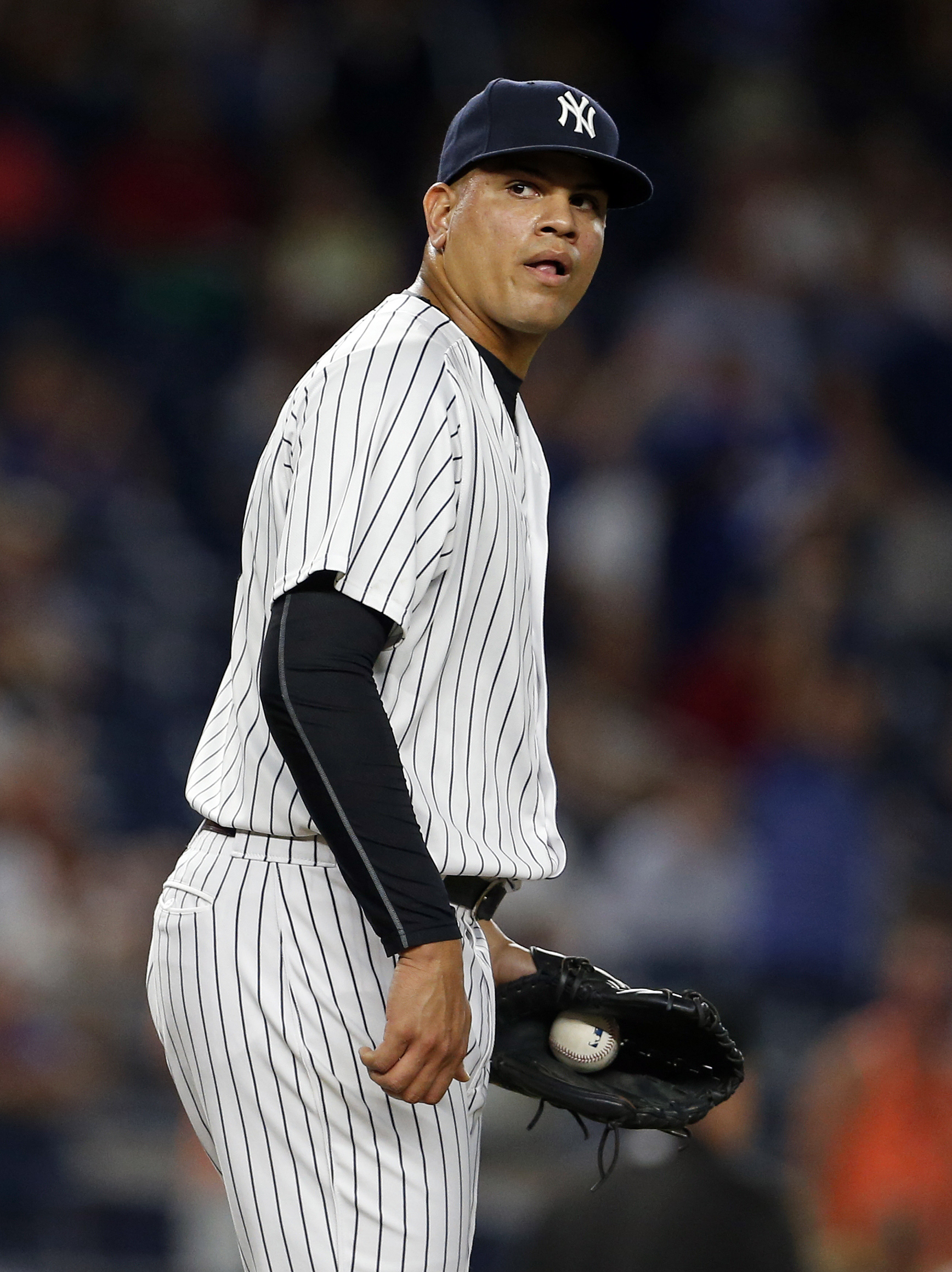 Levine’s decision to call out Betances after defeating him in a case was questionable, but he was right that arbitration pays relievers based on their role rather than their value. Indeed, my arbitration model forecasted Betances would land at $3.4MM, only a few ticks higher than the Yankees’ $3MM filing, and probably very close to where Betances could have bargained had he and the Yankees opted to negotiate a one-year deal to avoid arbitration.
Setting aside the decorum or business wisdom of the quote, the least accurate part of Levine’s comment was his description of Betances’ filing as an attempt to “change a well-established market.” Arbitration is not a market, or at least it is not a market in the way that people generally mean when they talk about markets. There are no multitudes of buyers and sellers trying to exchange the services of relievers in arbitration. Free agency is a market. Arbitration is a manufactured system of loosely defined rules that players and owners have agreed upon as part of the Collective Bargaining Agreement.
The difference is more than semantic. On the free agent market, Betances would be priced like a closer, in the sense that he pitches as well as one. Left up to a free market for his services, Betances could be paid like a closer. This happened just a couple years ago when Andrew Miller, with one career save, received a four-year deal for $36MM from none other than the New York Yankees.
Arbitration, on the other hand, follows a system of rules. Relievers are paid in arbitration based on a series of imperfect retrospective metrics that do not quite estimate value of a performance, rather than a prospective set of metrics designed to estimate the value of a performance, as teams attempt to use in free agency. Each player and team bargain independently, with no other buyers or sellers allowed to enter negotiations like in a typical market.
The most compelling comparables for Betances are those who primarily held setup roles, rather than closer roles, in the bullpen. Limiting to relievers in the last five years who had fewer than 20 saves in their platform year, we only get four pitchers who earned more than $2MM, and all four earned between $2.5MM-2.9MM. Even within that group (Neftali Feliz, Kris Medlen, Mark Melancon, and Drew Storen), all four pitchers had either been closers for longer periods of time than Betances. Medlen had been a starter for a period of time as well.
Looking only at setup men who accumulated large numbers of holds, the comps get even bleaker for Betances. Only four pitchers have gone into arbitration with 70 career holds (Betances has 78 career) in the last five years, and all have received less than $2MM.
Where Betances does differentiate himself is the fact that he has 22 career saves—he does have some closing history—and that he has struck out a whopping 404 hitters in 254 2/3 innings with a career ERA of 2.16. No one discussed in the part-time closer group above or the group with a significant number of career holds could touch those statistics.
And while detailed sabermetric statistics are unlikely to be persuasive in arbitration, Betances’ three All-Star berths were probably one of the better hopes for Betances and his representation. In fact, in recent years, only Craig Kimbrel entered his first year of arbitration with three career All-Star selections, and although he signed a multi-year deal, that only came after the Braves filed at $6.55MM, conceding quite a high value for a player recognized as Betances has been. Only two other players in the last five years even had two All-Star selections going into their first year of arbitration: Aroldis Chapman in 2014 and Andrew Bailey in 2012, who received $5MM and $3.9MM, respectively.
The catch is that Kimbrel had 139 career saves by the time he initially filed for arbitration, while Chapman had 77 and Bailey had 75. At just 22 career saves, Betances was bound to be paid mostly like a setup guy. My model estimates that had Betances’ 28 holds in 2016 all been saves (giving him 40), he would have been estimated to receive $4.5MM instead. If we turn his 50 holds in his pre-platform seasons into saves, that projection shoots up to $6.3MM. But turn those 78 relief appearances back from saves to holds, and we are left with his $3.4MM projection. Levine is, in fact, not an astronaut, and despite Betances’ performance being out of this world, he himself is neither an astronaut nor a closer.
So Betances does not in fact have the halo that typically accompanies a ninth-inning role. In the strictest sense of the word, he is not a closer. Okay … so he does not get coffee. Fine. But let’s discuss how Betances compares to other great relievers and figure out where he stands when we divorce ourselves from the role-based approach to paying arbitration-eligible players.
If arbitration were to reward relievers based on their performance, rather than their context-based statistics, Betances would have entered arbitration in a much more favorable position. Betances has 404 career strikeouts, which is more than any relief pitcher ever to enter arbitration for the first time in the modern era. In the last five years, only Kimbrel himself has even come close with 381 strikeouts, followed by Kenley Jansen at 347. Jansen received a one-year deal for $4.3MM back in 2014.
Limiting to pitchers with 300 career strikeouts and career ERAs under 2.50 (Betances is at 2.16), the only pitchers that emerge are closers already discussed above: Kimbrel, Chapman, and Jansen. From this perspective, Betances filing at $5MM would seem reasonable. Another potential comparable in terms of skill set would be Trevor Rosenthal, who received $5.6MM a year ago from the Cardinals with a 2.66 career ERA and 303 career strikeouts.
Of course, if we know that arbitration is based on retrospective performance, it stands to reason that looking at pitchers based on context-free numbers was unlikely to be persuasive. After all, a lights-out minor league pitcher gets paid the league minimum for his first three-plus seasons. Context matters. What might have been more compelling to an arbitration panel is a statistic like WPA or “Win Percentage Added” as presented by FanGraphs. This statistic simply uses a rough estimate of what the probability a team would win when a pitcher enters an inning (based on inning, score, and base-out situation) and again after he leaves or the inning ends.
For example, when Betances entered with a one-run lead in the bottom of the ninth inning on August 31 against the Royals, the Yankees had a 79% chance of winning. After he saved that game, that 79% chance reached 100%, which gave him 0.21 WPA that day. But when Betances came in with a one-run lead and a runner on first in the seventh inning of an April 12 hold opportunity against the Blue Jays, and struck out Jose Bautista before retiring the side in the eighth en route to a one-run victory, Betances got a nearly identical 0.20 WPA combined for the seventh and eighth innings, because of his large effect on the Yankees’ probability of winning that game as well.
String together Betances’ entire career thus far, and he has 9.30 WPA. That would stand right next to Kimbrel himself, who had 9.29 WPA through 2013 when he first entered arbitration. It would top Jansen, who stood at 7.46 WPA upon reaching arbitration, and well ahead of Chapman, Rosenthal, and Bailey, who had 5.77, 5.72, and 5.05 WPA, respectively at those points in their careers.
I doubt that would have made a strong enough case given the historical importance of saves and holds (in that order), but it might have helped a panel see an alternative way of valuing what Betances has added to the Yankees’ win totals, without resorting to the same old stat columns.
In the narrow sense, Levine is right that Betances has not been a closer. That is almost entirely why the Yankees won this case, because everything else would have shined a brighter light on Betances’ performance.
Photo courtesy of USA Today Sports Images.
MLBTR Originals
The past week’s original content from the MLBTR staff:
- MLBTR contributor Brett Ballantini (links here) had an extensive discussion with White Sox general manager Rick Hahn regarding the franchise’s decision to rebuild, its decline after a hot start in 2016 and the choice to replace former manager Robin Ventura with Rick Renteria, among other topics. Hahn also shared the rather amusing story of where he was when he found out about Chris Sale‘s uniform-related tantrum last July.
- This year’s Camp Battles series kicked off with the Angels and Rockies (Jason Martinez covered the former, Jeff Todd the latter). Left field, closer and two starting rotation spots could be up for grab for the Halos. The Rockies, meanwhile, will stage competitions for catcher, closer and a place in their rotation.
Camp Battles: Colorado Rockies
The Rockies made several moves this winter geared toward putting a contender on the field, but face a tall task to unseat the Dodgers and Giants as the leading team in the NL West. While there’s not a ton to sort out in camp, there are a few notable battles that could impact Colorado’s hopes.
Here are the key camp competitions for the Rockies, who are the second entrant in MLBTR’s new Camp Battles series.
CATCHER
Tony Wolters
Age: 24
Bats: L
Contract Status: Pre-Arbitration; projected to become a free agent after ’21 season
Options remaining: 2
Tom Murphy
Age: 25
Bats: R
Contract Status: Pre-Arbitration; projected to become a free agent after ’22 season
Options remaining: 2
Dustin Garneau
Age: 29
Bats: R
Contract Status: Pre-Arbitration; projected to become a free agent after ’22 season
Options remaining: 2
After relying heavily on veteran Nick Hundley for the past two seasons, the Rox are set to hand off the field generalship to some much less experienced players. Wolters emerged after coming over through a waiver claim, providing solid defense behind the dish while adding value on the basepaths. He’s not much of a hitter — he posted a 75 wRC+ over 230 plate appearances and never did much more in the minors — but seems to have the trust of the organization.
Vying with each other to share time with Wolters, or possibly even take primary duties, are Murphy and Garneau. The former has shown quite a bit of bat in the upper minors and in his brief MLB time, though he’s still a work in progress behind the plate. The latter raked last year at Triple-A, but seems clearly third in line.
There’s still perhaps an outside chance that Colorado will make a move for Matt Wieters — if not some other veteran — before camp breaks. But if that doesn’t come to pass, the plan likely involves hoping that Murphy takes charge while leaning on Wolters to the extent necessary.
Prediction: Murphy is given every opportunity to win semi-regular time, but ends up in a time-share with Wolters.
CLOSER
Adam Ottavino
Age: 31
Throws: R
Contract Status: 2 years, $9.1MM
Options remaining: Can’t be optioned without consent
Greg Holland
Age: 31
Throws: R
Contract Status: 1 year, $6MM with 2018 mutual option ($10MM or $1MM buyout)
Options remaining: Can’t be optioned without consent
Jake McGee
Age: 30
Throws: L
Contract Status: 1 year, $5.9MM
Options remaining: Can’t be optioned without consent
Mike Dunn
Age: 31
Throws: L
Contract Status: 3 years, $19MM
Options remaining: Can’t be optioned without consent
Jason Motte
Age: 34
Throws: R
Contract Status: 1 year, $5MM
Options remaining: Can’t be optioned without consent
These five veterans all have substantial late-inning experience, with most having handled the ninth inning for at least some significant stretch. The only one that hasn’t — Dunn — just signed a contract that includes incentives for games finished, though that hardly means he’s been promised a full-blown shot at the job.
Ottavino seems the obvious choice: he has been nails over the past two seasons, with a 1.93 ERA and 11.6 K/9 against 2.2 BB/9. But he has managed only 37 1/3 total innings in that stretch, owing to Tommy John surgery, and his health will be monitored closely all year long. The veteran Holland is a wild card, as he’s returning from his own TJ procedure and has a long record of dominating from a closer’s role. McGee is looking to bounce back from a subpar 2016 campaign, while Motte could be turned to if he can rebound from his own struggles and the need arises. Unless Ottavino falters, though, it seems the job is likely his.
Prediction: Ottavino
STARTING ROTATION (ONE SPOT)
Jeff Hoffman
Age: 24
Throws: R
Contract Status: Pre-Arbitration; projected to become a free agent after ’22 season
Options remaining: 3
Jordan Lyles
Age: 26
Throws: R
Contract Status: 1 year, $3.175MM
Options remaining: Can’t be optioned without consent
German Marquez
Age: 21
Throws: R
Contract Status: Pre-Arbitration; projected to become a free agent after ’22 season
Options remaining: 2
Kyle Freeland
Age: 23
Throws: L
Contract Status: Pre-Arbitration; projected to become a free agent after ’22 or ’23 season (not yet on 40-man)
Options remaining: 3
The Rockies finally have some hope in the starting staff, but the fifth slot remains undetermined as camp opens. Fortunately, there are a host of intriguing arms that figure to compete for the job, with the losers expected to remain on hand if a leak springs during the season.
Both Hoffman and Marquez struggled in their MLB debuts, but are seen as talented hurlers and obviously have caught the eye of GM Jeff Bridich. If neither grabs the reins in camp, though, it’s plenty possible that they’ll be left in Triple-A for added seasoning when the season opens. That could leave room for a comeback for Lyles, who struggled badly in 2016 and may otherwise end up in the bullpen. Though Freeland has only a dozen Triple-A starts under his belt, that’s more than Marquez, so he too could factor with a big spring — though going to him would require opening a 40-man spot.
Prediction: Hoffman