
7 Notable Transactions From May 2014
May isn’t typically the most action-packed month of the season for the Hot Stove faithful, but it’s also not completely devoid transactions. As MLBTR’s Jeff Todd and Tim Dierkes discussed in yesterday’s episode of the MLBTR Podcast, this May could be even more active than usual due to the early rash of pitching injuries perhaps kickstarting the trade market early. Even if that’s not the case, Jarrod Saltalamacchia should find a new home within a matter of days, the Padres are known to be on the hunt for a shortstop, Rafael Soriano remains a free agent, and, if history is any indication, there will be a handful of other significant moves that impact the long-term outlook of a few organizations/players.
Here are the most notable transactions from the month of May in 2014 (with a helping hand from MLBTR’s Transaction Tracker)…
- Braves sign 3B Chris Johnson to a three-year, $23.5MM extension that includes a $10MM club option for the 2018 season. — The contract was questionable at the time and looked regrettable for the Braves quickly. In hindsight, this move was probably one of several that led to the exit of GM Frank Wren from Atlanta. Johnson would end up hitting just .263/.292/.361 in 2014, and a broken hand suffered last night has sidelined him early in 2015. Johnson was hitting .279/.347/.372 at the time of the injury, though he’s batting just .233/.314/.333 against righties.
- Red Sox sign SS Stephen Drew to one-year, $14.1MM contract. — Drew sat out all of Spring Training and looked to be waiting for the draft’s conclusion before signing in order to shed the draft pick compensation label he’d picked up after rejecting a qualifying offer, but he signed in May for the pro-rated version of the qualifying offer’s salary. Drew rushed through a brief assignment to Triple-A to try to get up to speed, but he never got his bat going and was ultimately traded to the Yankees, where he also struggled. Drew re-signed a one-year deal with the Yankees to man second base, and while a .179 BABIP is weighing down his average (in part due to a massive increase in fly-balls and a dip in his line-drive rate), he’s showing good power and walking at a 12 percent clip.
- Tigers sign RHP Joel Hanrahan to one-year, $1MM contract. — Tigers fans spent the entire season hoping that Hanrahan would emerge as a much needed reinforcement for their club’s shaky bullpen, but Hanrahan’s recovery from Tommy John and flexor tendon repair surgery was slow and never completed. He didn’t pitch in 2014 and re-upped with Detroit a Minor League deal this past offseason, but sadly underwent a second Tommy John surgery and was released by the Tigers in Spring Training.
- Astros sign LHP Tony Sipp to one-year, $700K contract. — The Sipp signing was one of the best and yet most unheralded moves of 2014. Sipp joined Houston with little fanfare, but he wound up firing 50 2/3 excellent innings last year, notching a 3.38 ERA with 11.2 K/9 against 3.0 BB/9. That earned him a boost to $2.4MM in arbitration this winter, and he’s looked to be worth every penny thus far, allowing one run on five hits and three walks with nine strikeouts in 11 1/3 innings in what will be his final season before free agency.
- Padres sign RHP Odrisamer Despaigne to a $1MM Minor League deal. — Despaigne didn’t land the gaudy type of contract that many of his Cuban countrymen have secured, but he’s been a valuable piece for the Padres. In 117 2/3 innings between 2014-15, the 28-year-old has a 3.29 ERA, 5.7 K/9, 2.9 BB/9 and a 51.8 percent ground-ball rate. Despaigne has served as a starter and reliever in San Diego and could be a nice swingman for the club moving forward. The Friars control him through the 2020 season.
- Padres traded C Nick Hundley to Orioles in exchange for LHP Troy Patton. — The long-term impact on both organizations was minimal, as each player is with a new organization in 2015. However, the trade gave the Orioles another option behind the plate following Matt Wieters‘ Tommy John surgery and gave Hundley an opportunity for more playing time, which likely assisted him landing a two-year, $6.25MM contract from the Rockies this winter.
- Padres traded 1B/OF Kyle Blanks to A’s in exchange for OF Jake Goebbert and a PTBNL (RHP Ronald Herrera). — Blanks hit the cover off the ball for 21 games with Oakland before a torn muscle in his calf ended his 2014 campaign and led him to sign a Minor League deal with the Rangers this winter. Goebbert struggled through 115 PAs with San Diego and is a depth piece at Triple-A this year, while Herrera has three average to solid-average offerings despite an undersized frame, Fangraphs’ Kiley McDaniel wrote while evaluating the Padres’ prospects. He projects as a possible fifth starter or a reliever.
Those may have been the most noteworthy transactions in terms of financial investment and lasting impact on an organization, but there were several more moves made over the course of the month. A more brief rundown…
- Astros sign RHP Kyle Farnsworth to one-year $1.2MM contract. — Farnsworth’s time with the Astros was limited to 11 2/3 unsightly innings, as he yielded eight runs on 14 hits and nine walks with just eight strikeouts.
- Marlins sign LHP Randy Wolf to one-year, $1MM contract. — Wolf appeared in six games for the Fish, including four starts, and posted a 5.26 ERA in 25 2/3 innings. A solid 19-to-6 K/BB ratio and his 4.38 FIP indicate that he might’ve been a bit better than his ERA otherwise suggested.
- Blue Jays acquired OF Melky Mesa, RHP P.J. Walters from Royals in exchange for cash considerations. — The Jays acquired some organizational depth in this swap, though neither appeared in the Majors.
- Blue Jays acquire LHP Raul Valdes from Astros in exchange for PTBNL or cash considerations. — Valdes served as a bullpen option at the Triple-A level after Toronto’s relief corps struggled in the early-going last year, though he didn’t appear in the Majors with Toronto.
- Rangers acquire INF Jason Donald from Royals in exchange for cash considerations. — Similar to Toronto’s trades, this was about adding some depth to an injury-plagued Rangers organization, but Donald never appeared with Texas’ big league club.
- White Sox claimed OF Moises Sierra from Blue Jays.
- A’s claimed OF Nick Buss from Dodgers.
- Angels claimed LHP Brooks Raley from Twins.
- Blue Jays re-claimed OF Kenny Wilson from Twins.
- A’s claimed LHP Jeff Francis from Reds.
- Pirates claimed RHP Josh Wall from Angels.
- Rangers claimed RHP Phil Irwin from Pirates.
Looking back at May 2013 and May 2012 also reveals significant moves, including extensions for Anthony Rizzo, Adam Jones and Miguel Montero in addition to a pair of Roy Oswalt signings. The month of May should also serve as a more telling example of which clubs will be buyers and which will be sellers as we head toward the followup to last year’s trade deadline, which was arguably the most chaotic in history.
DFAs By The Numbers
“Designated for assignment”: three words that strike fear in the hearts of players and their agents. The function of the DFA, after all, is to remove a player from the 40-man roster. Often, that means that a big league stint is over, and that another may not be forthcoming for some time. For players currently in the minors on optional assignment, the loss of a 40-man spot adds barriers to a call-up.
Of course, not all DFAs end up badly for the player involved. Upon designating a player, a team has ten days to trade, release, or outright him. In the case of an outright, another club can claim the player on waivers; that scenario, along with a trade, results in another 40-man spot on a new team. Sometimes, that means a better opportunity (though it can also mean a lot of logistical headaches). Unless a trade or claim takes place, however, it’s the minors (sans 40-man spot) or free agency.
MLBTR introduced its DFA Tracker back in August of 2013, and has endeavored to keep tabs on every single DFA since. In addition to tracking whether a trade, release, or outright is pursued, the tracker further reflects the fact that an outrighted player can be claimed, can be assigned to the minors with their original team, or (if they have sufficient service time or have been outrighted before) can elect free agency. (It also covers the rare scenarios of the return of a Rule 5 player and when a player is designated off the 25-man roster and then optioned; we’ll leave those to the side during this exercise.) The primary purpose, of course, is to make it easier to keep an eye on the timing once a DFA hits. But it also serves as a historical record.
With that in mind, let’s take a look at the numbers. All said, there have been 558 instances of a player being designated since the tracker went live. But so far as the use of the DFA goes, the Rangers have been the kings, with a whopping 38 40-man removals. At the other end of the spectrum, the Cardinals, Mets, Nationals, and Twins only used the DFA six times.
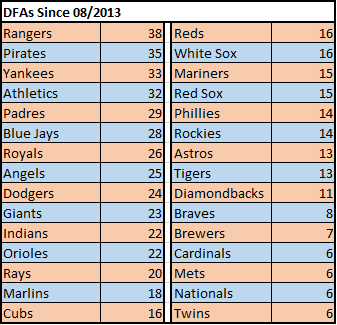
None of that really tells us much, of course. The start and end point are essentially random. And teams can dispose of players through other mechanisms, such as simply going right to an outright or release. But it is at least one indicator of roster management style (as well as recent team needs).
Let’s turn, then, to the results of the DFAs. Tallying things up results in the following distribution:
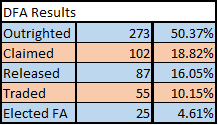
This, again, is not terribly surprising. Most players who have lost their 40-man roster spots are not appealing enough to be claimed, and so make it through waivers and receive outright assignments in their original organizations. The numbers do show that a significant number of players are able to find new 40-man homes — at least temporarily.
At risk of too much excitement in one post, let’s take one more angle for the time being. MLBTR has just one full year — with all the different months covered — in its still-new database. So, here’s a chart of the number of players designated in every month, along with the number of those players who were ultimately successfully outrighted. The first figure gives an idea of when the mechanism is most heavily used, while the latter gives at least some indication of when a club is more likely to be able to hold onto a player that it tries to pass through waivers.
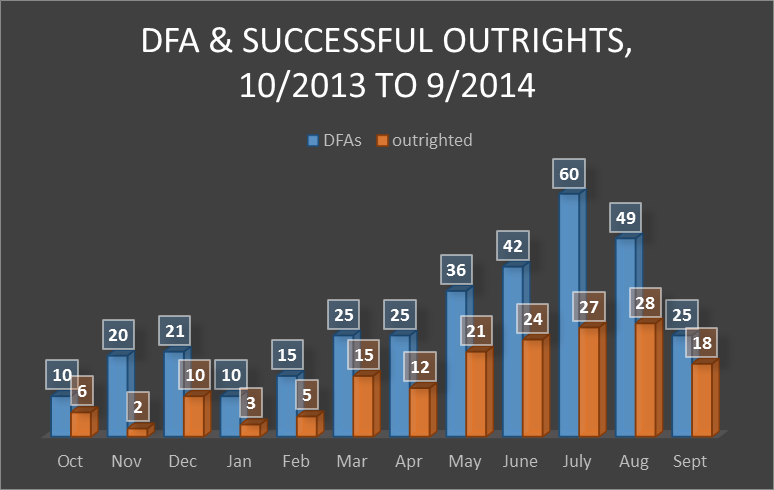
In the end, there is only so much inferring we can do from a dataset limited both by time and the nature of the thing it measures. Perhaps as the DFA Tracker grows, more will be possible. For now, I’ll end with this factoid: in the period of time immediately following the end of the 2013 regular season and running through the end of the 2014 regular season, fully 338 players — that’s more than 11 per team — lost their roster spots by way of the DFA.
MLBTR Originals
A look back at the original reporting and analysis found on MLBTR the last seven days:
- MLB Trade Rumors Podcast featured host Jeff Todd reviewing the week’s news before turning to a discussion of the Mariners with Bob Dutton of The Tacoma News Tribune. A new edition of MLB Trade Rumors Podcast drops every Thursday and can be accessed on iTunes, SoundCloud, and Stitcher.
- Tim Dierkes updated MLBTR’s 2016 Free Agent Power Rankings. Justin Upton remains number one, but there were changes to seven of the other nine spots.
- Top Phillies prospect Aaron Nola spoke with Zach Links about his first MLB camp (including receiving words of praise from Alex Rodriguez), his timetable for reaching the Majors, and the organization’s youth movement.
- With several managers already on the hot seat, Charlie Wilmoth examined the outcome of early-season managerial changes made during the past decade.
- MLBTR learned right-hander Barry Enright signed to play with the Mexican League’s Tijuana Toros.
- Mark Polishuk asked MLBTR readers whether the Nationals will re-sign any of their pending premier free agents. More than 28% of you believe two or three will re-up with the Nats, but over 26% of you foresee all leaving for greener pastures.
- Jeff asked MLBTR readers how the Tigers should replace injured closer Joe Nathan. Nearly 38% of you suggest Detroit President/CEO/GM Dave Dombrowksi should make a move immediately while another 30% advise he should wait and see how the trade market shakes out.
- Steve Adams hosted this week’s live chat.
- Zach assembled the best of the baseball blogosphere for you in Baseball Blogs Weigh In.
How Might The Tigers Deal With The Loss Of Joe Nathan?
The Tigers learned today that closer Joe Nathan will be lost for the year to Tommy John surgery. While the 40-year-old was coming off a rough season, he opened the year installed in the 9th and was obviously an important part of the club’s plans. His hefty salary doesn’t make things any easier, although that cost was inked into the books long ago.
Of course, GM Dave Dombrowski had already added a player with closing experience and stuff at last year’s trade deadline. Joakim Soria will handle save situations going forward, and that gives some comfort. But his ascension reduces the quality and depth of the earlier innings. Simply using Soria to get the final out hardly addresses the fact that it will now be more difficult to get to the spot where he’ll be called upon.
Detroit’s bullpen was already a concern entering the year (as it has been in the past). As MLBTR’s Steve Adams discussed in reviewing the Tigers’ offseason, the club did little more than replace Phil Coke with Tom Gorzelanny. To be sure, young righty Bruce Rondon is expected to bring a big arm when he finally returns from Tommy John surgery. But he is still working cautiously back after an earlier setback.
The results have hardly been disastrous thus far, with the Tigers hovering around the middle of the league in terms of reliever ERA. But xFIP and SIERA paint much less promising pictures of the club’s collective relief effort thus far. And, for what it’s worth, projection systems don’t expect many above-average run prevention efforts to emerge from the Detroit pen.
Given the entirety of the situation, there are several ways the team could react. It does have a nice rotation and can put up a lot of runs, after all, so perhaps there’s little reason to act hastily. On the other hand, the Tigers are firmly in win-now mode and could face a drawn out division battle, so every victory matters.
And there are some prominent players with late-inning experience who could be had. Jonathan Papelbon of the Phillies is among the most available players in the game, and may not cost much in prospects if Detroit will assume a good piece of his salary. Even more conveniently, experienced righty Rafael Soriano is still a free agent. It is obviously rare to have a clear option like that still sitting on the open market in late April, making him an obvious possibility.
While it is probably too early for any teams to give up completely on their seasons, that doesn’t mean that some clubs wouldn’t consider moving a useful arm at the right price — motivated, in part, by a rough open to the season. The Brewers, in particular, have dug a monumental hole in a very tough division and have some younger arms they could justify promoting. Jonathan Broxton might be had for little more than salary relief.
Most other clubs will probably be hesitant to part with depth, but could always be convinced at the right price — particularly if Detroit is looking mostly for competent veterans to plug into the middle innings. While they are hardly shaping up to be a seller, for instance, the Padres have plenty of depth and an obvious willingness to get creative in making deals. The more likely scenario, of course, would be to keep a close eye on the waiver wire. The Dodgers, after all, have been aggressively adding (and, in some cases, outrighting) other teams’ cast-offs to bolster their depth.
Let’s see what MLBTR readers recommend:
How Should The Tigers React To The Loss Of Joe Nathan?
-
Go get a quality late-inning arm ASAP 37% (2,527)
-
Start making a summer shopping list, but wait and see 30% (2,045)
-
Add some cheap middle relief depth 17% (1,141)
-
Do nothing - contingencies are already in place 15% (1,033)
Total votes: 6,746
2016 MLB Free Agent Power Rankings
Most teams are about 9% through their season at this point, and it’s time for our first midseason update of the 2016 MLB Free Agent Power Rankings. These players project to reach free agency after this season.
As a reminder, these rankings represent the earning power in terms of total contract size, assuming everyone reaches the open market and goes to the highest bidder. Here’s MLBTR’s full list of 2015-16 free agents.
1. Justin Upton. Upton, 27, is off to a fine start for the second place Padres. Not coincidentally, the Friars are averaging more than 5.3 runs per game in the early going, tops in the National League. Nothing seems to be cooking on the extension front, and a free agent contract worth $250MM or more could be in play this winter.
2. David Price. Price jumps up a spot after allowing just one earned run in his first 22 1/3 innings. Before that, some low-level extension discussions with the Tigers occurred in late March. Price is willing to continue talking contract into the season and seems to have a number in mind that could result in a fairly quick deal if the Tigers reach it. Logically, that number figures to be in the $200MM range.
3. Johnny Cueto. Cueto moves up a spot as well after a trio of seven-inning outings. As he moves further from his 2013 shoulder strain, Cueto moves closer to Price in earning power. His Reds are hanging in with a .500 record, though a midseason trade at least seems viable. A deadline deal would make Cueto ineligible for a qualifying offer, though at ace prices the loss of a draft pick is a secondary concern for suitors.
4. Jason Heyward. It’s not fair to bump Heyward down two spots because of 53 lousy plate appearances, but I feel that if the season ended today, Price and Cueto would earn bigger contracts. Batting second in the order for the Cardinals, Heyward is at .192/.208/.327 on the young season.
5. Ian Desmond. On the plus side, Desmond has cut his strikeout rate considerably in his first 14 games, an 18% rate that would represent a full-season career best. On the other hand, Desmond has made eight errors in his first 125 1/3 innings in the field. Surely that pace will lessen, but he still has a good shot at 30 on the season. Even with today’s advanced fielding metrics, 30 errors could be hard for a team owner to ignore if Desmond’s price tag exceeds $150MM.
6. Jordan Zimmermann. Zimmermann’s early numbers are off after an April 13th Fenway Park drubbing, and his velocity is down a few ticks from April of last year. Still, every pitcher is allowed the occasional clunker, and Zimmermann has about 29 starts left to go.
7. Alex Gordon. Royals manager Ned Yost intends to exercise extra caution with Gordon in at least the season’s first month due to his December wrist surgery. 11 games don’t tell us much, but it will be worth monitoring whether the wrist saps Gordon’s power at all this year.
8. Yoenis Cespedes. Cespedes is off to a strong start, and seems capable of piling up a huge RBI total batting fifth or sixth in the Tigers’ potent lineup. He is ineligible for a qualifying offer and won’t turn 30 until October, and seems a candidate to move several more spots up this list.
9. Zack Greinke. Greinke has three quality starts in three tries this year, and not much has changed with his status. I still expect him to opt out of his remaining three years and $71MM after the season.
10. Jeff Samardzija. Samardzija’s White Sox debut in Kansas City was a forgettable outing, but he has now turned in consecutive gems. He and Greinke have each fallen a spot only because of Cespedes’ earning power.
In news that was music to the ears of Samardzija, Greinke, Zimmermann, and others, the Red Sox signed Rick Porcello to a four-year, $82.5MM extension earlier this month. The contract covers his age 27-30 seasons. Though part of the calculus is Porcello’s youth and the deal being shortened to four years, if he’s worth $20.625MM per season, that bodes well for next winter’s crop of free agent hurlers.
Cueto leads all 2016 free agents with 0.8 wins above replacement early on, though the Dodgers’ Howie Kendrick and the Yankees’ Chris Young have matched him. Young’s rate stats this year will be skewed, however, if he continues getting more than 40% of his plate appearances against southpaws.
Q&A With Phillies Prospect Aaron Nola
In a draft class that featured several high-quality pitchers at the top, LSU ace Aaron Nola was viewed as one of the very best and universally regarded as the most major league ready of any of them. Scouts were impressed by Nola’s poise, maturity, and (perhaps most importantly) his pinpoint accuracy and multiple teams in the top ten were connected to the hurler, but the Phillies were the club that pounced at No. 7. Back in June, Nola spoke with MLBTR as a part of of our Draft Prospect Q&A series. Recently, we checked in with Nola as he was gearing up for the 2015, a season that could see his big league debut.
Zach Links: When the Phillies drafted you last summer, there was immediately talk of you quickly making a path to the big leagues since you were so polished. Did the Phillies indicate to you last summer that you could be bumped up to the majors rather quickly?
Aaron Nola: They didn’t really say exactly that. They didn’t really say much in terms of that. For me, the way I look at it is, whenever they want me up, its their call. Wherever they put me, my focus is going to be where I am and play to to the best of my ability.
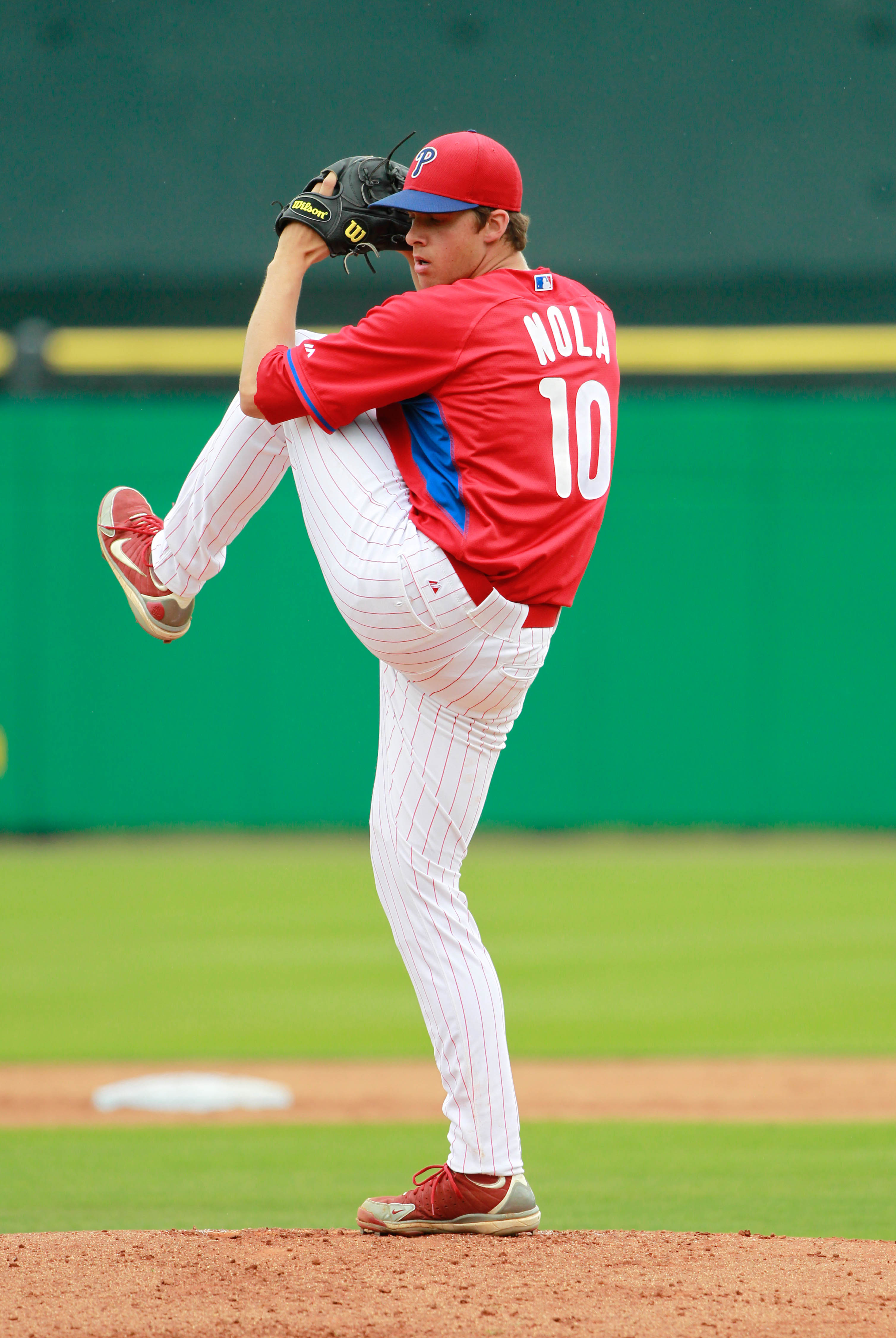
ZL: Some folks were surprised that the Phillies didn’t have you in major league camp for the entirety of the spring. Were you expecting to be in big league camp for the whole thing, as opposed to just a bit at the end?
AN: They just told me that they were going to send me to minor league camp and I was okay with that. I had fun, I had a good time.
I knew a lot of guys there and there’s a good group of guys there and it was pretty cool pitching against the Yankees that one time. I was around guys in the clubhouse and getting to watch what they do and how they play the game, it was a really good and really educational experience.
ZL: Alex Rodriguez offered up some really high praise after facing you in spring training, telling reporters (including Ryan Lawrence of the Philadelphia Daily News), that you had a “good arm” and “a bright future” that “the Phillies should be very excited” about. [Nola allowed a single to Rodriguez in their first meeting, but struck him out with a changeup the next time around.] What was your reaction to that?
AN: I was just thinking that was pretty cool. We all know what he’s done in his career, he’s an unbelievable player and just watching him step in the box and the battle going on, it was surreal. Growing up we were just watching that guy on TV all the time and I was always hoping that one day I would pitch against him, so that was pretty cool.
ZL: Did you have any jitters when he stepped into the box?
AN: Maybe a little bit. I wasn’t too nervous coming in because it wasn’t the first time I pitched in front of a crowd like that. We pitched in front of some huge crowds at LSU. If there were any butterflies, they went away when I stepped on the mound because everything felt normal for me. I think some minor jitters sometimes are good, in a way.
ZL: The Phillies landed you at No. 7 but there were a number of teams connected to you, including the Twins at No. 5. Did you see the Phillies as your most likely landing spot on draft week, or did you see anyone else as the frontrunner?
AN: I just kind of told myself at that point that I was focused on my season at LSU and the games we were playing at that time. At that point, I was blessed and honored to be in that situation, to know that I’d probably be called in the first round wherever I go. I couldn’t control any of that, and I didn’t know where I’d end up when I was watching on TV.
It was an honor that the Phillies picked me, that day is something that I’ll always cherish and remember.
ZL: How has your daily preparation changed from this time last year to today? What kinds of things do the Phillies have you doing differently?
AN: I’m not doing anything different, really. What the Phillies have me doing is pretty much what I’ve done before. The only difference I’m pitching more often. I’m getting out on the mound more and more and I’m pretty accustomed to that at this point.
ZL: When we spoke last year, there were some scouting reports questioning your 3/4 arm slot. Have the Phillies tinkered with that at all?
AN: No they have not. It’s the same slot I’ve always done. I’ve never thrown a pitch another way and always thrown in that arm slot.
ZL: The Phillies were zeroed in on their veterans for a long time and playing for the here and now, but they seem to be focused on building on younger talent now. Are you excited to be part of the youth movement in Philly?
AN: Everyone there, they’re all great guys and I got to know them really well, or at least have good relationships with them. I’ve been hanging out with them a lot this year and I can tell you that they play the game the right way and work really hard.
I think those guys are great and their stars have been at the top of the game for years. They have had unbelievable careers and I don’t know what is going to happen but they’re working so hard this spring. I’m excited to work my way up to that level and play alongside them.
Photo courtesy of USA Today Sports Images.
How Common Are Early-Season Manager Firings?
Already, in late April, there are rumors surrounding Marlins manager Mike Redmond, whose job could be in jeopardy after the team’s 3-10 start. April sounds awfully early in the season to fire a manager, and in fact it is — in the past ten seasons, there have been no manager firings in the month of April. There have been plenty of firings in the first halves of seasons, however. Here’s a look at the nine firings in the past decade that took place before a team had finished 81 games in a season, and a brief glimpse at what happened in the next few years after each dismissal. As we’ll see, the outcomes of these firings run the gamut of possible outcomes, making it difficult to say whether replacing a manager early in a given season is a good idea.
- The Reds fired Dave Miley on June 21, 2005, replacing him with Jerry Narron. Narron lasted barely two seasons and was replaced by Dusty Baker, who had two sub-.500 seasons before leading the Reds to three seasons of 90 or more wins in his next four.
- The Mariners fired John McLaren on June 19, 2008 after a 25-47 start. After Jim Riggleman finished out the season, the Mariners turned to Don Wakamatsu and Eric Wedge, neither of whom had success, before finally turning to Lloyd McClendon, who had a good first season in 2014.
- The Rockies fired Clint Hurdle on May 29, 2009 after they got off to an 18-28 start. Jim Tracy took over and the Rockies went 74-42 the rest of the way, making the playoffs.
- The Diamondbacks fired Bob Melvin on June 8, 2009, replacing him with A.J. Hinch, who managed the team for less than a season and a half before being fired himself.
- The Royals fired Trey Hillman on May 13, 2010 after a 12-23 start, replacing him with Ned Yost. Yost’s tactical managing gives fans fits, and his first two-plus seasons with the Royals were unsuccessful, but the team has played exceptionally well since then.
- The Orioles fired Dave Trembley on June 4, 2010. The team struggled for about two months with interim manager Juan Samuel at the helm, but performed well for the last two months of the season under Buck Showalter, whose hiring has so far been a boon for the franchise.
- The Marlins fired Fredi Gonzalez on June 23, 2010, replacing him with Edwin Rodriguez. Rodriguez posted a .500 record the rest of the season, but he resigned during the 2011 season as the team struggled.
- The Diamondbacks fired Hinch on July 1, 2010, replacing him with Kirk Gibson. The D-backs had a 94-win season in 2011, but after two .500 seasons and a poor 2014, they fired Gibson, too.
- The Athletics fired Bob Geren on June 9, 2011, replacing him with Melvin. The team continued to struggle down the stretch in 2011 but has made the playoffs in three straight seasons since.
The Rockies’ swap of Clint Hurdle for Jim Tracy in 2009 (along with the Marlins’ own Jeff Torborg/Jack McKeon switch in their World Series-winning 2003 campaign) is exactly what a team hopes for when it fires a manager early in the season. The Rockies turned their season around under Tracy and made the playoffs after an amazing stretch run.
But the Hurdle/Tracy swap could also be read as evidence of how difficult it can be to identify or predict a manager’s effect on a team. Tracy had previously managed the Pirates, but was fired after two ugly seasons. He lasted only three more years in Colorado. Meanwhile, Hurdle ultimately took over in Pittsburgh and led the team to its first two winning seasons in two decades, earning praise for his leadership and his integration of sabermetrics into the Pirates’ day-to-day strategy. Perhaps Tracy really was the right manager for the Rockies in 2009, and Hurdle the wrong one. A manager’s job is to lead, and his ability to lead the ever-changing cast of players around him is surely somewhat fluid. But a team’s performance is informed by any number of factors that have little to do with its manager.
With that in mind, it’s difficult to draw conclusions from the list above. Some teams’ manager swaps appear to have worked well, like that of the Rockies, or the Athletics’ switch of Geren and Melvin. Others didn’t, although that’s not surprising, given that teams who fire their managers tend not to be the best ones.
Perhaps there’s a distinction between firings in April and firings in June and July. In April, it’s hard to be completely out of the race, but in June, it isn’t, and maybe it makes sense for a team to make big changes rather than having a lame-duck manager limp through the rest of the season. There’s also the problem of how best to hire a permanent manager while a season is going on. Many teams on the list above turned to interim managers after firings, and surely that’s not what the Marlins would do if they fired Redmond. It probably isn’t easy to hire a permanent manager in-season. Of the teams on the list above, only two, the Royals (Yost) and the Athletics (Melvin), immediately replaced their outgoing managers with managers who turned out to be real long-term replacements.
Then there’s the lack of stability an early-season firing can betray. As FOX Sports’ Ken Rosenthal points out, the Marlins’ struggles are due in part to pitchers’ injuries and to Mat Latos‘ ineffectiveness. Those problems have little to do with Redmond, and replacing him would probably do nothing to solve them. Perhaps Redmond isn’t the right manager for the Marlins, but what might be most striking about the list above is the absence of many successful franchises who seem to highly value organizational stability, like the Cardinals, Giants and Tigers. Of course, it’s surely true that those franchises are mostly stable in part because they’re successful, and not the way around. And there are other franchises who are generally stable, like the Rockies and Twins, who haven’t done well lately. But the Marlins have had five managers since 2010 (Gonzalez, Rodriguez, McKeon, Ozzie Guillen and Redmond). One wonders how difficult it must be for players to develop given that many changes of leadership.
MLBTR Originals
A look back at the original reporting and analysis found on MLBTR this past week:
- MLB Trade Rumors Podcast featured host Jeff Todd and MLBTR’s Steve Adams debating the Craig Kimbrel trade. Jeff also welcomed MLBTR’s Charlie Wilmoth, who wrote last Sunday the Dodgers simply bought a draft pick when they acquired reliever Ryan Webb from the Orioles. A new edition of MLB Trade Rumors Podcast drops every Thursday and can be accessed on iTunes, SoundCloud, and Stitcher.
- Marlins President of Baseball Operations Michael Hill and agent Joe Longo both shared details of the negotiations surrounding Christian Yelich‘s seven-year, $49.75MM extension with Zach Links. “Negotiations have an ebb and flow to them. Ultimately, Christian was okay with waiting on an extension and waiting to see what could come in future years. Really, it’s a positive thing when your employer likes you and in baseball sometimes just getting an offer of an extension feels good, because that’s a good review of what you’ve been doing,” Longo explained to Zach. “I went back to Christian and I told him what the numbers were but I explained that A, they’ve never done anything like this before and B, he’s a unique player and there aren’t a lot of comps out there for him, so we had to be patient and take just the start of the conversation as a positive.”
- Tim Dierkes analyzed the ramifications of 11 prospects from the last decade who made their team’s Opening Day roster in spite of the service time implications. Tim opines two weeks of a rookie in April is rarely directly worth trading for a seventh year of control, but the tradeoff can be defensible for certain teams and players.
- Steve named 13 players whose roles for 2015 have already shifted and how those changes will affect their arbitration earnings.
- Jeff listed five upcoming free agents whose slow starts could affect their market next offseason.
- The 2014-15 Offseason In Review series continued with a look at the Red Sox (by Mark Polishuk), A’s (by Steve), and Braves (by Jeff).
- Steve asked MLBTR readers whether Kris Bryant should have made the Cubs’ Opening Day roster. More than 84% of you believe the Cubs made the correct decision having having Bryant start the season in Triple-A.
- Jeff asked MLBTR readers whether the Rick Porcello four-year, $82.5MM extension was a wise investment by the Red Sox. Nearly 55% of you believe Boston’s money could have been put to better uses.
- Steve hosted the weekly live chat.
- Zach gathered the best the baseball corner of the web had to offer in Baseball Blogs Weigh In.
13 Role Changes That Have Impacted Earning Power
Each offseason, teams and fans alike spend the winter projecting a 25-man roster on paper in an attempt to plot out as accurately as possible the way in which a season will progress. Oftentimes, a roster is more or less set from an early standpoint. Those expectations fluctuate based not only on player movement — trades and free agency, of course, have a strong impact on roster construction — but also on elements such as spring performances, injuries and early season success/struggles. Rarely do rosters, and the roles occupied by the players on that roster, shake out the way in which most pundits expected.
In many cases, the changes within a roster can come with significant financial implications for the players who find themselves in a more prominent role. Those who find themselves receiving the short end of the stick, of course, can see their future fortunes diminished.
It’s early in the 2015 season, but already we’ve seen some shifts in role and/or playing time that will make some players considerably wealthier in arbitration, as well as some that figure to severely damage a player’s arbitration case.
Rising Earning Power
Adam Ottavino: Typically, players like Ottavino are the ones that the Cardinals find rather than let go, but St. Louis tried to get the now-29-year-old Ottavino through waivers in 2012 and lost him to the Rockies. Ottavino has been a revelation in the Colorado bullpen, boosting his velocity and ditching his changeup for a devastating slider that has turned him into a late-inning weapon. Ottavino was recently named the new closer by manager Walt Weiss, and he’ll have a chance to head into his second trip through arbitration with a bucket of saves under his arm. The difference between entering arb as a setup man and entering as a closer could be worth millions.
Jeurys Familia: The same role change that benefits Ottavino will do the same for Familia, who entered the season setting up for Jenrry Mejia. However, an 80-game suspension for Mejia and Bobby Parnell‘s recovery from Tommy John surgery have opened the door for Familia to take the reins in the ninth inning. He’s notched a 6-to-1 K/BB ratio in his first 4 2/3 innings this season, and while he hasn’t necessarily secured the job through season’s end — Parnell or Mejia could reclaim the job later in the year — a season resembling last year’s 2.21 ERA in the ninth inning would yield a significant arbitration payday. Zach Britton, for example, parlayed one elite season as a closer into a $3.2MM payday this year, though the two aren’t perfect comparables. (Britton was a Super Two and didn’t have multiple strong seasons under his belt, as Familia theoretically will.) Ottavino landed a $1.3MM salary his first time through arb after a strong season of setup work, however, giving a rough idea of the potential gap between the two roles.
Lorenzo Cain: Entering last season, Cain was the Royals’ No. 8 hitter and didn’t get into the lineup on an everyday basis, as he split time with Jarrod Dyson in center field. Cain didn’t hit higher in the batting order than sixth until June 17 last season, but he’s batted third every day and started in center each game for the Royals this year. Cain doesn’t have the power one would typically expect from a No. 3 hitter, but his preposterous defense will keep him in the lineup every day, and hitting in the heart of the order will lead to plenty of RBI opportunities. A Gold Glove and a career-high in RBIs (which wouldn’t be hard to come by, as it currently stands at 53) will go a long way toward bolstering his $2.725MM salary.
Evan Gattis: The transition from catcher/outfielder in the National League to DH/outfielder in the American League should afford Gattis with the opportunity to see more playing time and therefore accumulate more counting stats to pad his first arbitration case this winter. While it’s true that he probably has more value behind the plate — that type of offense from a catcher is indeed quite rare — defense isn’t as highly rewarded via the arbitration process as good old fashioned homers and RBIs. Gattis has struggled to open the year, but career-highs in home runs, RBIs and most other counting stats wouldn’t be much of a surprise.
Leonys Martin: Martin’s role may not appear different on the surface, as he still figures to man center field on an everyday basis if healthy. However, Martin received just 40 games in the leadoff spot in 2014, spending the bulk of his time occupying the 7th and 8th slots in the Rangers lineup. Manager Jeff Banister declared Martin his leadoff hitter and voiced confidence in his ability to handle the role, even after struggling out of the gate in 2015. Martin’s dropped to eighth in each of the past two games, but Banister said that decision was “tinkering” to give the lineup “a different look,” rather than anything permanent. Martin averaged 3.76 plate appearances per game in 2014 but has averaged 4.4 per game in 2015. Over the course of 150 games, that comes out to an extra 150 to 155 games, that’d be an extra 96 to 100 plate appearances for Martin — a valuable increase in opportunities to boost his counting stats as he wraps up a five-year, $15.5MM contract and heads into arbitration for the first time.
Jordan Schafer: The former top prospect broke camp with the Braves as a reserve outfielder in 2014 and started just 13 games all season before the Twins claimed him on waivers in early August. Schafer impressed the Twins enough that there was never any real thought to non-tendering him (despite a marginal track record), and he outplayed Aaron Hicks in Spring Training to earn a regular role in center field to begin the season. Schafer is in a platoon with Shane Robinson, and he’ll have to hold off Hicks, Eddie Rosario and perhaps even Byron Buxton to keep his playing time, but he’s unquestionably been presented with a better financial opportunity than he was in Atlanta.
Declining Earning Power
Wilin Rosario: After spending the bulk of the past three seasons as Colorado’s everyday catcher, Rosario will now transition to a part-time role in which he’ll be used as an occasional first baseman against left-handed pitching. Rosario will also make sporadic appearances in the outfield and behind the plate. Rosario’s power has never been in question, but he’s regarded as one of the game’s worst defensive backstops and will be without a regular role of which to speak. The decrease in playing time is a critical blow to his earning potential, as his $2.8MM salary won’t be increasing by much if the early stages of the season are any indication of his playing time. Rosario has seven plate appearances in six games thus far.
Welington Castillo: Manager Joe Maddon can refer to the Cubs’ combination of Miguel Montero, David Ross and Welington Castillo as his “three-headed catcher,” but Castillo, formerly Chicago’s starting catcher, and his agent would likely describe the situation much more colorfully behind closed doors. Castillo took home a $2.1MM payday in his first trip through the arb cycle this winter, but like Rosario, he’s seen virtually no plate appearances in 2015. Castillo has appeared in four games and picked up seven PAs. Now that they’ve been through the arb process once, the raises awarded to Rosario and Castillo will be based almost solely upon their 2015 results, so their pay bumps figure to be rather paltry in nature.
Brett Cecil: Cecil was tabbed to as the Blue Jays’ closer to enter the season, but he relinquished those duties to 20-year-old Miguel Castro almost instantly. Cecil’s diminished velocity played a role in that decision, and while he may work his way back into the ninth inning, he looks like he’s tabbed for a setup role in the immediate future. A full season of saves would be a boon for next winter’s arbitration case, but that looks unlikely now.
Ruben Tejada: The Mets have had a hole at shortstop since Jose Reyes departed, and while Tejada got the chance to fill the void last year, it’s Wilmer Flores getting that opportunity this year. Tejada started 105 games in 2014, but it seems highly unlikely that he’ll come anywhere near that number in 2015, barring injuries around the diamond. Tejada’s light bat limited his earning power in the first place, but a lack of regular at-bats will further limit the raise he’ll receive on this year’s $1.88MM salary.
Peter Bourjos: Lights-out center field defense gave Bourjos a chance to pick up quite a few plate appearances early in his Cardinals tenure, but the club quickly departed from the notion of giving him more regular at-bats in 2014, promoting Randal Grichuk and giving more playing time back to Jon Jay. To this point, Bourjos has had just two plate appearances, though his glove has gotten him into five games. The complete evaporation of playing time makes a significant raise on his $1.65MM salary difficult to envision. Bourjos’ elite glove is strong enough that he could start for a number of teams, but it’s also a luxury and a late-inning weapon for St. Louis, so it’s difficult to envision them moving him into a more financially favorable situation.
Jesse Chavez: Despite the fact that he excelled in the rotation for Oakland last year, Chavez lost his starting spot midseason after the acquisitions of Jeff Samardzija, Jason Hammel and, eventually, Jon Lester. Many, myself included, believed he had a strong case for the rotation heading into 2015, but the final three spots behind holdovers Sonny Gray and Scott Kazmir went to Jesse Hahn, Drew Pomeranz and Kendall Graveman. Chavez’s 2014 breakout should indicate that he’ll be a perfectly useful reliever in 2015, but 20-30 starts would’ve done quite a bit more for his earning power.
Everth Cabrera: Cabrera’s fall in San Diego was somewhat remarkable, as he went from leading the NL in steals in 2012 and earning a 2013 All-Star nod to a 50-game suspension for PEDs, a dismal 2014 season and an eventual non-tender. He’s latched on in Baltimore and has been starting at shortstop with J.J. Hardy rehabbing from injury, but a reserve role is in the cards for E-Cab, making it difficult to envision a substantial raise on his $2.4MM salary, which was a slight decline from last year’s $2.45MM in the first place.
Note: This post isn’t including role changes for players who will not be arbitration eligible following the 2015 season. Players such as Carlos Martinez and Tony Cingrani, for example, will certainly see their future arbitration outlooks impacted if their recent role changes are permanent, but it’s difficult enough to know whether or not all of these changes will hold throughout the current season, let alone through the 2016-17 seasons.
11 MLB Top Prospects Who Conquered Service Time
Is there ever a good reason for a team to put their MLB-ready top prospect on the Opening Day roster, as the Diamondbacks recently did with Archie Bradley? As we’ve seen with the Cubs and Kris Bryant, waiting at least 12 days into the season ensures the team will control the player for a seventh season. Forward-looking teams that are willing to wait before calling up their phenom can delay his free agency by a year, and that extra year of control is generally more valuable than having the player for the first two weeks of April. However, we found 11 examples in the last decade of top MLB prospects who did make the Opening Day roster. You might say these players conquered the service time issue, or at least were lucky enough to have GMs who disregarded it.
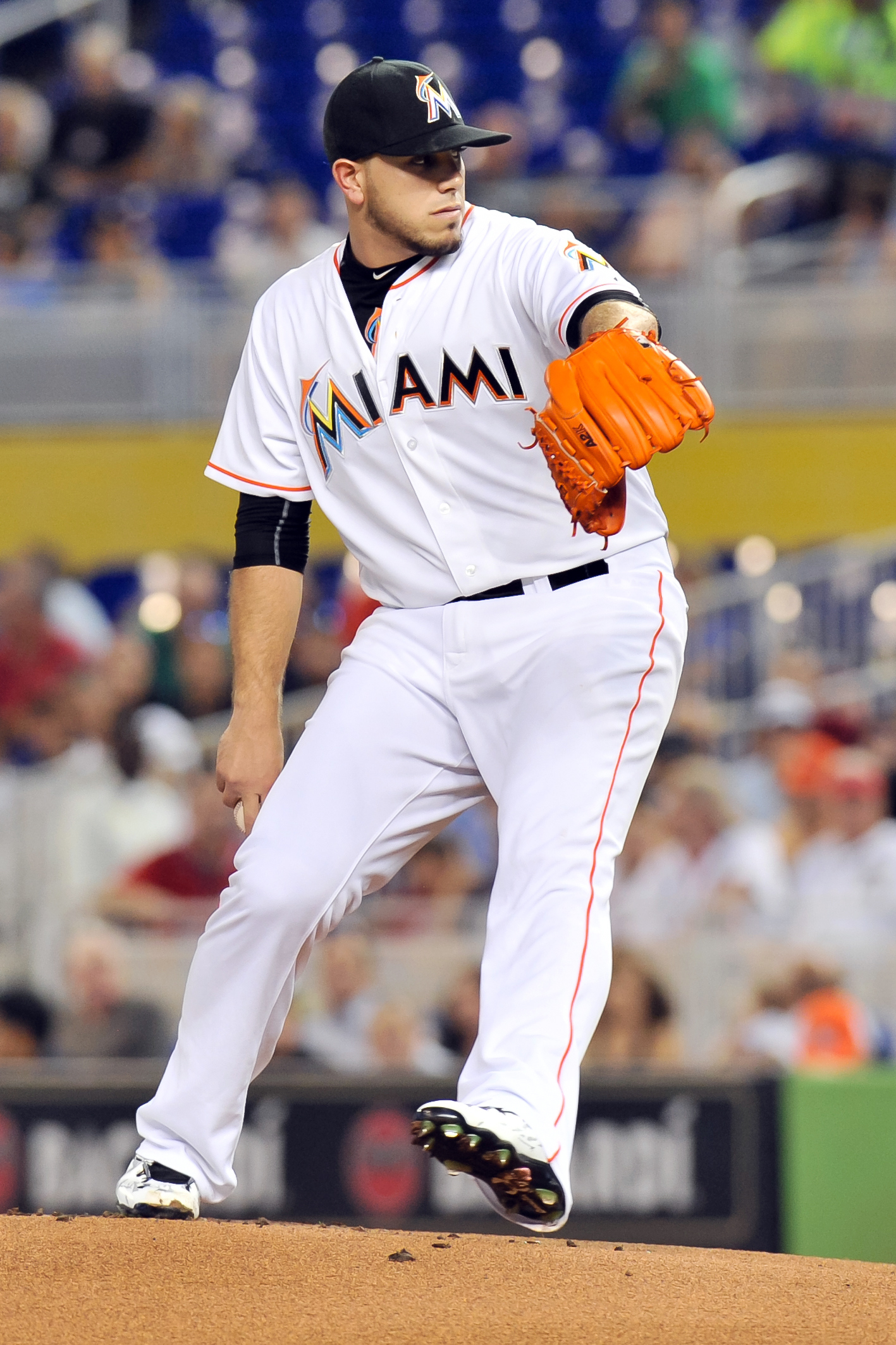
1. Jose Fernandez, Marlins SP. Marlins President of Baseball Operations Larry Beinfest certainly would have been justified giving Fernandez a little more minor league seasoning in 2013. The game’s #5 overall prospect according to Baseball America, Fernandez was just 20 years old and had never pitched above A ball. But when Marlins starters Nathan Eovaldi and Henderson Alvarez got hurt, Fernandez surprisingly made the team.
Was it worth it? Fernandez didn’t make his Marlins debut until April 7th, 2013, so they ultimately traded his five-inning debut for control of his age-26 season, which will happen in 2019. He was clearly ready to make the jump, as Fernandez won the National League Rookie of the Year award. However, over a year of the Marlins’ control of their young ace was lost when he went under the knife for Tommy John surgery the following season. The team put him on the 2013 Opening Day roster even with the knowledge that he was represented by notorious agent Scott Boras, who generally encourages players to avoid extensions that delay free agency. In December, the Marlins reportedly made a six-year offer (with two club options) worth close to $40MM, but no deal was reached. Even if they do reach some kind of precedent-shattering deal, five extra innings from Fernandez as part of a 100-loss season was not worth it for the Marlins.
2. Jedd Gyorko, Padres 2B. Gyorko came into 2013 as BA’s #71-ranked prospect, and he spent Spring Training working on the transition from third to second base. Injuries to Chase Headley and Logan Forsythe helped open the door for GM Josh Byrnes to put Gyorko on the Opening Day roster.
Was it worth it? It’s possible that the goodwill from Byrnes’ lack of regard for service time helped encourage Gyorko to sign a six-year, $35.5MM extension with a club option with the Padres a year later. In that contract the Padres paid a free agent price for the 2019 season ($13MM), which potentially could have been cheaper had that represented his fourth year of arbitration. Or, an extra year of control might have convinced Byrnes to wait another season before proposing an extension. Gyorko struggled mightily with injuries and performance as a sophomore in 2014, and the extension might end up being regrettable.
3. Mike Leake, Reds SP. The Reds drafted Leake eighth overall in 2009 out of Arizona State, and with nothing more than an Arizona Fall League stint under his belt as a pro, he beat Travis Wood for the fifth starter job to begin the 2010 season. He pitched well enough as a rookie, but was moved to the bullpen in August and his season ended on the 24th of that month.
Was it worth it? The Reds won the division by five games in 2010, and Leake was a part of that. Leake was wild on his April 11th debut, but still beat the Cubs. Since GM Walt Jocketty could have easily let him make his debut a few days later, it was not worth it. Controlling Leake for 2016, his age 28 season, would have been valuable, even if he would have cost $14MM through arbitration.
4. Austin Jackson, Tigers CF. Tigers GM Dave Dombrowski acquired Jackson in the epic three-team December 2009 trade that also included Max Scherzer, Curtis Granderson, Ian Kennedy, Edwin Jackson, Phil Coke, and Daniel Schlereth. Jackson was regarded as the #76 prospect in baseball, and he became the Tigers’ Opening Day center fielder.
Was it worth it? Jackson hit quite well in his first dozen games or so, and his performance easily could have led to an additional win or two. It wasn’t worth it in that the Tigers finished at .500, but at the time Dombrowski’s decision was defensible. Jackson was again part of a big three-team deal at the 2014 trade deadline. He would have carried more trade value with 2016 control, though teams will be down on him for next year if his current struggles persist.
5. Jason Heyward, Braves RF. In a situation analogous to Bryant, the Braves had the game’s best prospect prior to the 2010 season in Heyward. Heyward had just three games of Triple-A experience, but GM Frank Wren couldn’t resist putting the 20-year-old on the Opening Day roster after a legendary Spring Training.
Was it worth it? The Braves won the Wild Card by one game and Heyward had a very strong start, so this is a rare case where it was worth it. The Braves traded Heyward to the Cardinals last November with Jordan Walden for Shelby Miller and Tyrell Jenkins. That was a solid return, but of course the Braves would have done better if they controlled Heyward for ’16 as well.
6. Colby Rasmus, Cardinals CF. Rasmus was Baseball America’s #3 prospect prior to the 2009 season. He made GM John Mozeliak’s Opening Day roster, but wasn’t in the outfield when the Cards battled Pittsburgh on April 5th.
Was it worth it? The Cardinals won the Central Division handily in ’09, but since Rasmus didn’t start every game those first few weeks, it probably wasn’t worth putting him on the Opening Day roster. When Mozeliak traded Rasmus to the Blue Jays in an eight-player deal in July 2011, the outfielder had three-plus seasons of control remaining. It was well-known by that point that Rasmus had worn out his welcome in St. Louis, so while the additional year of control always increases a player’s trade value, it might not have made a huge difference here.
7. Elvis Andrus, Rangers SS. In December 2008, Rangers GM Jon Daniels and manager Ron Washington told face of the franchise Michael Young he’d be shifting from shortstop to third base in 2009, paving the way for one of the game’s top 40 prospects in Andrus.
Was it worth it? Andrus hit quite well in those first few weeks, and surely made some plays at shortstop Young would not have. The Rangers won 87 games and fell short of the Wild Card, but at the time the decision was made, it was defensible. Three years later Andrus signed a deal buying out only his arbitration years, and then a year after that Andrus asked agent Scott Boras to get him a long-term extension, even though it meant missing the chance at being the rare 26-year-old free agent. Boras got Andrus a huge deal with a pair of opt-outs. If in spring 2013 the Rangers already controlled Andrus through 2015, they would have at least approached those extension talks differently.
8. Brett Anderson, Athletics SP. Savvy GMs had no problem putting top prospects on Opening Day rosters back in 2009. Even Billy Beane did it with Anderson, the game’s #7 prospect heading into that season, even though the lefty had made only six starts above A ball. Anderson was the team’s fourth starter out of the gate, losing his first couple of starts.
Was it worth it? With a starting pitcher it’s almost never “worth it,” since the extra MLB time amounts to one or two starts. Anderson had a solid rookie year for the A’s, and maybe Beane’s gesture of putting him on the Opening Day roster was a factor in him signing a four-year, $12.5MM deal with two club options a year later. The contract bought back the potential year of control the A’s lost (2015), and that $12MM club option probably still had a bit of value to the Rockies when they acquired Anderson in December 2013. They ultimately chose a $1.5MM buyout instead, as Anderson’s injury woes continued in Colorado.
9. Johnny Cueto, Reds SP. Cueto was BA’s #34 prospect prior to the 2008 season, and he broke camp as part of the Reds’ rotation. Cueto dazzled in his first couple of the starts, and the Reds won his debut by one run.
Was it worth it? That extra Cueto-related win didn’t matter much for the Reds, who finished in fifth place in ’08. It’s possible that some goodwill from GM Wayne Krivsky’s decision came into play in January 2011, when new GM Walt Jocketty signed Cueto to a four-year deal with a club option for ’15 (an easy choice to exercise last fall). If Cueto was held in Triple-A for a few weeks to begin ’08, would he have chosen not to sign an extension later? In that scenario, he would have reached free agency after 2014. It’s also possible that a few weeks as a rookie wouldn’t have mattered to him, and controlling him through ’14 could have meant signing him to an extension running through ’16.
10. John Danks, White Sox SP. White Sox GM Kenny Williams acquired Danks from the Rangers in December 2006, sending Brandon McCarthy to Texas. Like Dave Dombrowski with Austin Jackson, Williams couldn’t wait to get his new acquisition on the big league club. It’s kind of like a kid getting a new toy and opening the box on the ride home.
Was it worth it? Danks would have benefited from additional Triple-A seasoning, as he posted a 5.50 ERA as a rookie. He was decent in his first couple of starts, though the White Sox lost both games en route to a fourth place finish. Williams’ decision set Danks up for free agency after 2012, but he signed a five-year, $65MM extension prior to his walk year. Danks wound up needing shoulder surgery in 2012. An extra year of control might have prevented the White Sox from extending Danks in general, in which case they wouldn’t have him on the books currently.
11. Nick Markakis, Orioles RF/LF. Top Orioles exec Mike Flanagan put Markakis on the team’s Opening Day roster back in 2006. The 22-year-old had played just 33 games above A ball.
Was it worth it? Markakis didn’t play every day in the season’s first few weeks and the Orioles finished in fourth place. Flanagan’s roster decision had Markakis on track for free agency after 2011, but in January 2009 Andy MacPhail signed him to a six-year, $66.1MM extension with a club option for 2015. I don’t think much would have changed with the contract had Flanagan waited a few weeks in ’06 to call Markakis up.
What have we learned? Two weeks of a rookie in April is rarely directly worth trading for a seventh year of control, but the tradeoff can be defensible for certain teams and players. Also, the extra year of control could impact extensions in multiple ways. On one hand, it’s possible some players signed extensions partially because of the goodwill from being placed on the Opening Day roster. On the other hand, an additional year of control might have bought GMs more time to gather data on whether certain extensions were worth pursuing in the first place.
Please note that we looked for examples within the last ten seasons, omitting players like Joe Mauer, and we also left out relievers such as Joel Zumaya and Huston Street.