
Latest On Teoscar Hernandez
The thinking that Teoscar Hernandez would sign early in the offseason or in the immediate aftermath of Juan Soto‘s decision has not played out as such. The 32-year-old slugger remains unsigned, reportedly juggling interest from at least the Dodgers, Blue Jays, Red Sox and Yankees to this point in the winter. Hernandez and the incumbent Dodgers have been unable to bridge a gap in Hernandez’s asking price and the team’s offer. Mark Feinsand of MLB.com adds further context, reporting that Hernandez is seeking a three-year deal that’ll guarantee him $22-24MM annually.
A three-year deal in $66-72MM range would generally dovetail with expectations. Hernandez’s agent, Rafa Nieves, already stated earlier in the offseason that Hernandez had been seeking three years last offseason when they pivoted and took a one-year deal in Los Angeles. A three-year deal on the heels of the slugger’s rebound campaign in L.A. seemed (and still seems) reasonable, even though he’s now headed into his age-32 season after rejecting a qualifying offer (and thus attaching himself to draft pick compensation). That $22-24MM range would align with last year’s $23MM salary (though some of that was deferred, dinging the net present value a bit).
With Soto off the board, Hernandez and fellow slugger Anthony Santander are the top corner outfield bats on the free agent market. Santander is two years younger but is also reportedly seeking a five-year deal after swatting 44 homers for the Orioles in 2024. Both players rejected QOs. Hernandez is the more affordable of the two but is also older and more strikeout-prone. The presence of Cody Bellinger on the trade market and the recent emergence of the now-traded Kyle Tucker might’ve combined to slow things down for Hernandez’s market, speculatively speaking.
Hernandez turned in a .272/.339/.501 slash with a career-high 33 home runs last season before going on to hit .250/.352/.417 in postseason play. His 28.8% strikeout rate was an improvement over his 31.1% mark from 2023 but still sat about six percentage points higher than league average. His 8.1% walk rate was the second-best of his career but fell right in line with the 8.2% league average. At this point, teams can expect plus power, a below-average walk rate and more strikeouts than they’d prefer from Hernandez. He drew well below-average marks for his defense, but Hernandez has plus speed and above-average arm strength, per Statcast, so a team might think there’s enough raw talent to coax some better performance out of him.
The defensive concerns do make a multi-year reunion with the Dodgers a potentially problematic pairing, however. Hernandez has said he hopes to return — and the Dodgers are clearly open to a reunion. Beating the rest of the market when Hernandez is already 32 and there’s no DH opportunity thanks to the presence of Shohei Ohtani could make a long-term arrangement worrisome for Los Angeles in a way that’s not the case with other Hernandez suitors.
Yankees Sign Max Fried
The Yankees made their biggest move of the winter official, announcing Tuesday that they’ve signed left-hander Max Fried to an eight-year contract. The CAA client will reportedly be guaranteed a staggering $218MM on the deal, which does not include an deferrals or opt-out provisions but does include a full no-trade clause. Fried receives a $20MM signing bonus that’ll be paid out in two equal in January 2025 and ’26. He’ll make $12MM in salary for each of the first two seasons and be paid $29MM annually between 2027-32. Fried is set to be introduced at a press conference on Wednesday, which is scheduled for noon ET.
After losing the Juan Soto sweepstakes, the Yankees had plenty of money to outspend the rest of the field for his services and made use of those resources. Jon Morosi of the MLB Network reported earlier this evening that the Yanks were willing to offer Fried seven years, but they were evidently willing to going beyond that to get the market’s top unsigned southpaw on what is the largest contract for a lefty pitcher in MLB history, outbidding the club’s fellow finalists for Fried’s services in Boston and Dallas. It’s not hard to see what they like about the southpaw. Dating back to his first full season in 2019, Fried has a 3.07 ERA in 824 2/3 innings pitched. Only one pitcher in baseball has bested him in both categories during that time: Gerrit Cole, who he’ll now share the front of the Yankees rotation with.
That track record of dominance and durability that made Fried such an appealing target in the Bronx given the question marks that surround the rest of the club’s deep but flawed rotation mix. Carlos Rodón has been utterly dominant at times throughout his career, but he’s looked uneven in two seasons with the Yankees as he’s pitched to a 4.74 ERA and 4.77 FIP in 46 starts. Veteran righty Marcus Stroman has a long history of solid mid-rotation work, but he’s entering his age-34 season and did not make an appearance during the club’s run to the World Series this postseason. Nestor Cortes offers similar mid-rotation stability but struggled as recently as last year and is just one season away from free agency. Reigning AL Rookie of the Year winner Luis Gil and fellow youngster Clarke Schmidt both turned in promising seasons in 2024 but have checkered injury histories and minimal track records in the big leagues.
By contrast, Fried is the whole package. Since breaking out as a front-of-the-rotation arm with Atlanta, Fried’s 2.81 ERA is the third-best figure in all of baseball among qualified starters, bested only by Brandon Woodruff and Clayton Kershaw. While his 23.6% strikeout rate during that time doesn’t exactly jump off the page, his 6.3% walk rate is well above average and he’s also generated grounders at an impressive 54.2% clip that only Alex Cobb, Logan Webb, and Framber Valdez have bested. The southpaw’s grounder-heavy approach should serve as an excellent complement to Cole’s power-pitching reputation and form a fearsome combo at the top of the Yankees rotation for years to come.

That combination was sufficiently intriguing to the Yankees that they were willing to go well over the top to land their man. The #6 ranked free agent on MLBTR’s annual Top 50 MLB Free Agent list, Fried blew away the six-year, $156MM pact we predicted for him as well as other projections around the baseball world. Today’s pact is surely exciting news for Corbin Burnes and agent Scott Boras, to whom anyone hoping to land a top-of-the-rotation free agent this winter will now have to turn with both Fried and Blake Snell off the board. Chris Cotillo of MassLive reports the Red Sox already began preparing an offer for Burnes this afternoon. The Blue Jays, another suitor for Fried, have also expressed interest in Burnes. Burnes landed as MLBTR’s #2 free agent of the winter behind only Soto and was predicted to land a seven-year, $200MM contract at the outset of the offseason but it would hardly be a surprise to see his camp’s asking price increase in light of Fried’s deal.
Turning back to the Yankees, their projected payroll for 2025 now sits at $257MM (per RosterResource). That’s still $46MM below last year’s total. Meanwhile, their $265MM luxury tax payroll is above the first two CBT thresholds; last season it sat above the fourth and highest threshold for penalties. In other words, the Yankees should still have plenty to spend on impact free agents to try to fill the Soto-shaped hole in the roster. However, it’s worth keeping in mind that signing Fried will cost the Yankees their second- and fifth-highest picks in the 2025 draft in addition to $1MM in international bonus pool money.
They might be hesitant to sign a second QO-rejecting free agent and therefore forfeit their third- and sixth-highest draft picks as well. A look at MLBTR’s Contract Tracker reveals that while the Yankees signed three players who declined a QO during the 2022-23 offseason, two of them (Aaron Judge and Anthony Rizzo) were their own free agents and therefore did not cost the club anything beyond a hypothetical compensation pick. To find the last instance of the club signing multiple qualified free agents hailing from other teams in a single offseason, you would have to turn towards the 2013-14 offseason when the club landed Carlos Beltran, Jacoby Ellsbury, and Brian McCann.
With that being said, some have compared the club’s approach to the free agent market in a post-Soto world to their approach that offseason, when they failed to re-sign star second baseman Robinson Cano. That could suggest at least some level of willingness to continue pursuing qualified free agents, particularly given the fact that they’ll receive a compensatory pick for the loss of Soto to help mitigate the losses. Christian Walker, Alex Bregman, Anthony Santander, and Teoscar Hernandez are among the other qualified free agents to which the Yankees have been connected since Soto signed in Queens.
One other avenue for improving the club signing Fried opens up is dealing a different starting pitcher, and with the club’s rotation now featuring seven starters it’s difficult to imagine the club not moving at least one if not two of their starters below Fried and Cole on the pecking order. Rodon’s weak results in the Bronx and hefty contract would appear to make a deal coming together involving him unlikely, but any of the club’s other four starters could reasonably be moved. Stroman and Cortes have frequently found their names in the rumor mill this winter as potential trade targets, though health question marks surrounding Cortes and Stroman’s lackluster 2024 campaign could hamper the potential return for either hurler. Schmidt and Gil would both surely bring back a far more interesting return but it’s unclear if the Yankees have much of an appetite for moving on from either youngster. While the club could dangling one or more of its starters in exchange for big league talent, it’s also possible that trading from the rotation could supplement the farm system and make the Yankees more comfortable losing the draft picks associated with additional qualified free agents signings.
ESPN’s Jeff Passan first broke the agreement and the terms of the deal. USA Today’s Bob Nightengale and Joel Sherman of the New York Post came through with additional details. The Post’s Jon Heyman had the specific salary breakdown.
D-backs Had Interest In Devin Williams Prior To Yankees Trade
The Diamondbacks are known to be on the lookout for high-leverage options in the bullpen — general manager Mike Hazen has said as much on record — and they spoke to the Brewers about a potential deal for Devin Williams before Milwaukee traded him to the Yankees, John Gambadoro of Arizona Sports 98.7 reports.
On the one hand, it’s entirely unsurprising that a team seeking a leverage arm would throw its hat into the ring with regard to Williams. On the other, it’s at least tangentially notable, given the number of similarly priced late-inning arms on the market. If the Snakes were trying to engage the Brewers on Williams, it stands to reason that Cardinals closer Ryan Helsley, Rays closer Pete Fairbanks and perhaps Houston’s Ryan Pressly are all of varying levels of interest. (At $14MM, Pressly costs significantly more than the other listed options, it should be noted.)
The bullpen market, unlike in many recent offseasons, has been slow to develop this winter. That could be in part due to the presence of names like Williams, Helsley, Fairbanks and Pressly (among others) all potentially being available. To this point, the only signings of note have been Aroldis Chapman (one year, $10.75MM to the Red Sox), Blake Treinen (two years, $22MM back to the Dodgers), Yimi Garcia (two years, $15MM back to the Blue Jays) and Jordan Romano (one year, $8.5MM to the Phillies). None of the market’s top relievers have come off the board, save for righty Clay Holmes, who signed a three-year deal to convert to a starting role with the Mets.
After last week’s Winter Meetings drew to a close, D-backs general manager Mike Hazen told Nick Piecoro of the Arizona Republic that both free agent and trade scenarios are still in play. Arizona did not complete any deals at last week’s event, but Hazen expressed confidence that the groundwork for future transactions was laid.
“There’s free-agent situations and trade situations that are both out there for all the areas that we’re looking at,” said Hazen, who is also looking for help at first base. “Trying to find what combinations go together in different ways is part of what we’re discussing right now.”
The top names still on the free agent market include Tanner Scott, Jeff Hoffman and Carlos Estevez. All figure to command multi-year deals, with Scott in particular standing a chance at landing four years. That type of contract length could be an issue for the D-backs. Under Hazen, they’ve never signed a free agent reliever for more than two years and never gone higher than a $7MM annual value (as shown in MLBTR’s Contract Tracker). The market has plenty of intriguing one-year options as well, though any of David Robertson, Kirby Yates or Kenley Jansen would require pushing well past that $7MM highwater mark.
Latest On Yankees’ First Base Search
The Yankees have been linked to such free-agent first baseman as Christian Walker and Pete Alonso this winter, and talks seemingly remain ongoing in some form with the Cubs about Cody Bellinger‘s availability. Recent reports suggest that the Yankees and Cubs are upwards of $10MM apart in deciding how much of Bellinger’s salary will be covered by Chicago, and the New York Post’s Jon Heyman writes today that not much has changed in the stalemate between the two clubs. As Heyman puts it, “it’s a matter of ‘who blinks first,’ if ever.”
If none of these targets end up being a fit, the Yankees are “also considering” several other backup plans. According to Heyman, these options include signing free agent Carlos Santana, or exploring a trade for the Guardians’ Josh Naylor or the Rangers’ Nathaniel Lowe. Given how Yankees GM Brian Cashman usually casts a wide berth in checking in on numerous players every offseason, it’s probably safe to guess that more than just these aforementioned first basemen have drawn some level of interest from New York.
Signing Santana would be the most straight-forward and cost-effective move of the bunch, as Santana will almost surely require just a one-year guarantee because he is entering his age-39 season. Despite his age, Santana rebounded from a few middling seasons to post a .238/.328/.420 slash line and 23 home runs for the Twins over 594 plate appearances in 2024, while also winning the AL Gold Glove at first base. The combination of offense and defense translated to 3.0 fWAR for Santana, the third-highest of his 15 Major League seasons.
This production will merit Santana a raise on the $5.25MM he received in his one-year deal with Minnesota last winter, but concerns over his age and possible regression will probably limit his salary. Signing Santana would also be a relatively low-upside play, whereas trading for Naylor or Lowe represents a higher ceiling for production.
Trading for Lowe would also mean more than just a one-year commitment, as the first baseman is arbitration-controlled through the 2026 season. Projected for a $10.7MM salary this year, Lowe is coming off another solid season that saw him hit .265/.361/.401 with 16 homers over 565 PA, and Lowe also delivered quality defense as a Gold Glove finalist behind Santana.
There was a little buzz about Lowe’s possible availability heading into the trade deadline last summer, but nothing in the way of concrete reports that Texas was seriously considering moving the 29-year-old. In re-signing Nathan Eovaldi and trading for Jake Burger, the Rangers are certainly aiming to return to contention in 2025, but moving Lowe to address another need on the active roster is a plausible tactic. Since the Rangers are known to be looking for left-handed hitting, however, however, dealing such a lefty swinger in Lowe would only serve to tilt the lineup further to the right.
Trading Naylor would also be an imperfect move for a Guardians team that needs offensive help, but Cleveland has typically looked maximize its return on notable players by trading them before they reach free agency. Naylor is therefore a more clear-cut trade candidate than Lowe, and Naylor’s projected $12MM arbitration salary won’t break the bank. While Lowe or the switch-hitting Santana would also be good fits hitting at Yankee Stadium, the short porch in right field seems taylor-made for Naylor’s left-handed power bat, and it is easy to imagine Naylor topping his career-best total of 31 homers (set in 2024) over a full season in the Bronx.
Kyle Manzardo and Jhonkensy Noel are the likeliest candidates to step in at first base for the Guardians if Naylor is traded, though that is putting extra pressure on a pair of inexperienced players, plus the Guards would also need some extra first base/DH depth in that scenario. Cleveland is also in need of outfield help, though the Yankees might not be a fit in that sense since they’re looking for outfielders themselves in the wake of Juan Soto‘s departure.
Details On Yankees’ Pursuit Of Kyle Tucker
Before Kyle Tucker was traded from the Astros to the Cubs, the Yankees were known to be one of the teams also vying to land the star outfielder. Reigning AL Rookie of the Year Luis Gil was reportedly of interest to the Astros in these trade talks, but New York ultimately turned down Houston’s demand for Gil and infield prospect George Lombard Jr. in exchange for Tucker, according to USA Today’s Bob Nightengale.
It makes for an interesting contrast to the trade package that the Astros did accept from Chicago. Lombard and prospect Cam Smith could be viewed as essentially a match as recent first-round draft picks, though Smith is higher regarded in the view of MLB Pipeline (Smith is 73rd on their top-100 prospect list and Lombard isn’t on the list). Gil is a controllable pitcher who has already made a name for himself at the big league level, so Isaac Paredes and Hayden Wesneski represent something of a split of those two resume points. Wesneski is controlled through 2029 and has a solid 3.93 ERA over his 190 Major League innings, but he isn’t considered to have quite Gil’s ceiling, so making up that difference could’ve been achieved by adding a proven hitter like Paredes.
Landing three players instead of two obviously allowed the Astros to address more needs, as Paredes can help fill one of Houston’s corner infield vacancies and Wesneski brings rotation depth. Gil would’ve been a more clear-cut installation into the Astros rotation and perhaps then necessitated another trade, since the Astros on paper have a surplus of rotation options. However, since Luis Garcia and Lance McCullers Jr. are both returning from lengthy injury absences, the Astros might also want to see how things play out in Spring Training before dealing an arm, lest the club again get caught with a lack of depth in the rotation.
Interestingly, the Yankees did indeed trade a starting pitcher and an infield prospect for a prominent star player with one year remaining before free agency, except rather than Gil/Lombard for Tucker, it was Nestor Cortes and Caleb Durbin going to the Brewers for closer Devin Williams. The two trade packages have some differences, of course, as Cortes is a year away from free agency, and was viewed a more expendable part of New York’s pitching mix since he was relegated to bullpen duty in the playoffs and was floated in trade rumors at the deadline. Durbin is also over five years older than Lombard and is considered to be on the verge of his MLB debut, whereas Lombard has yet to reach even the Double-A level.
The timing of the negotiations between the Astros and Yankees was perhaps also a factor. If the Yankees were already well down the road in talks with Milwaukee about Williams, that might’ve made the Bronx Bombers less likely to deplete their pitching and prospect depth even further by accepting the Astros’ offer for Tucker. Some New York fans might well wonder “why not both?”, as even without Gil or Cortes, the Yankees still have a projected starting five of Gerrit Cole, Carlos Rodon, Clarke Schmidt, Marcus Stroman, and newly-signed frontline arm Max Fried. Acquiring both Tucker and Williams would’ve left the Yankees still in search of infield help and now a “sixth starter” type of depth arm, but those are perhaps minor question marks compared to the upside of bringing both an All-Star outfielder and All-Star closer into the mix.
Gil is a known quantity to baseball fans, but the 19-year-old Lombard was the 26th overall pick of the 2023 draft. Baseball America and MLB Pipeline each rank Lombard as the third-best prospect in New York’s farm system, viewing him as a very solid all-around player with five-tool potential, even if he perhaps lacks a true plus-plus calling card. Lombard has played mostly shortstop in the minors and evaluators feel he can stick at the position, but he has also seen time at second and third base. Lombard’s approach and overall hitting potential are both considered good, though he hit only .231/.338/.334 over 497 combined plate appearances with A-level Tampa and high-A Hudson Valley in 2024.
Cubs Notes: Hoerner, Third Base, Bellinger, Steele
The Cubs made a massive splash on the trade market yesterday when they landed star outfielder Kyle Tucker is a blockbuster deal with the Astros. The club surrendered a hefty package of All-Star third baseman Isaac Paredes, 2024 first-rounder Cam Smith, and right-handed youngster Hayden Wesneski in order to make the deal, however, and the loss of Paredes in particular may have changed some of the club’s offseason plans.
Second baseman Nico Hoerner has reportedly been available in trade talks this winter, with the Mariners in particular being said to have interest in the infielder. According to Ken Rosenthal of The Athletic, however, it’s possible that the club’s thinking involving Hoerner has changed in the aftermath of yesterday’s deal with the Astros. Rosenthal notes that the Cubs were motivated to trade from their infield mix in order to open up playing time for top prospect Matt Shaw, who hit a sensational .298/.395/.534 in a late-season cup of coffee at the Triple-A level and appears ready to make the jump to the major leagues.
Shaw was drafted as a shortstop, but is a bat-first prospect who has spent time at both second and third base in the minors since being selected with the 13th-overall pick in the 2023 draft. While Shaw has typically been considered a more natural fit at second than third due to questions about his arm strength, the youngster logged 580 1/3 innings at the hot corner in the minors this past year and seems to be a natural choice to replace Paredes in Chicago’s infield mix next year. That, according to Rosenthal, leaves the Cubs “likely” to keep Hoerner in the fold headed into next season.
It’s at least possible another addition changes those plans, as USA Today’s Bob Nightengale reported earlier today that the club is in the market for third base help following yesterday’s deal. It’s unclear if such an addition would be a part-time player who could offer insurance in case Shaw proves to not be quite ready for the majors or if the Cubs are pursuing more of a regular option at the hot corner, but it would seem likely at this point that the Cubs may only seriously entertain a Hoerner trade going forward if they’re able to land a regular third baseman, thereby allowing them to replace Hoerner with Shaw at the keystone.
While Hoerner may be staying put in Chicago, the same cannot be said for Cody Bellinger. The 2019 NL MVP has been known to be on the trade block all winter due to the outfield logjam the Cubs experienced late in the 2024 season, when Bellinger was vying with Seiya Suzuki, Ian Happ, Mike Tauchman, and top prospect Pete Crow-Armstrong for regular playing time. That logjam already led the Cubs to non-tender Tauchman, and the introduction of Tucker as the surefire everyday starter in right field only further emphasized that Bellinger figures to play in another uniform next year.
The Yankees appear to be perhaps the most aggressive suitor for Bellinger this winter, though reports have previously indicated that the sides remain apart on how much of Bellinger’s contract the Cubs should retain. Peter Botte of the New York Post provided additional details about the situation yesterday, reporting that the sides are “more than $10MM” apart in their negotiations. That’s a hefty gap the sides will need to bridge in order to come together on a deal, as it represents more than a third of Bellinger’s $27.5MM salary for the 2025 season. Freeing up money in order to improve other areas of the roster seems to be one of the primary motivators for the Cubs in trading Bellinger. According to RosterResource, the club’s luxury tax payroll sits at just under $215MM after the Tucker deal, and clearing as much of Bellinger’s $26.67MM average annual value off the books as possible would greatly increase Chicago’s financial flexibility as they look into improving their rotation by dealing for a starter like Mariners righty Luis Castillo or Marlins southpaw Jesus Luzardo.
Speaking of the rotation, Patrick Mooney and Tim Britton of The Athletic recently took a look at the possibility of an extension between the Cubs and left-hander Justin Steele. The pair report that Steele and the Cubs have not engaged in extension talks to this point, though they note that the Cubs frequently use the start of Spring Training as an opportunity to explore extensions with players as they’ve done with Hoerner and Happ in the past before ultimately getting deals done closer to Opening Day.
The 29-year-old lefty is certainly an intriguing extension candidate. Steele is under team control for three more seasons and doesn’t sport high-end velocity or massive strikeout rates. With that said, his results have been undeniably excellent in three seasons since he joined the rotation on a full-time basis. In 427 innings of work across 78 starts over the past three years, Steele has posted a 3.10 ERA (134 ERA+) with a nearly matching 3.14 FIP. He generates grounders at a strong 48.5% clip and has limited walks to just a 5.7% rate over the past two seasons after struggling somewhat with his control in 2022. Among starters with at least 300 innings over the past two years, only Gerrit Cole has allowed a lower ERA than Steele’s 3.07, while his 3.11 FIP ranks third behind Sonny Gray and Logan Webb.
Yankees Acquire Devin Williams For Nestor Cortes, Caleb Durbin
The Winter Meetings might be done, but the big trades aren’t. The Yankees and Brewers on Friday agreed to a trade sending star closer Devin Williams to New York in exchange for left-hander Nestor Cortes, infield prospect Caleb Durbin and a reported $2MM in cash.
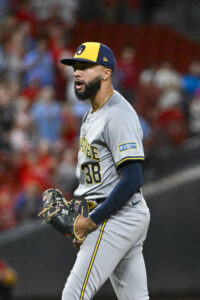
Both Williams and Cortes are entering their final seasons of club control, and both were projected by MLBTR contributor Matt Swartz to earn $7.7MM in 2025. Milwaukee will still come out ahead a couple million dollars, which is of some moderate note, as the Brewers are working on an extremely tight budget this winter. Durbin, meanwhile, is a second baseman with experience at the hot corner. He was added to the Yankees’ 40-man roster ahead of the Rule 5 protection deadline and is likely to slot in at second or third base in 2025, with one of Brice Turang or Joey Ortiz moving to shortstop in place of Willy Adames, who signed with the Giants as a free agent.
Williams, 30, is one of the game’s elite relievers. The 2020 National League Rookie of the Year, he boasts a career 1.83 earned run average with 68 saves, 60 holds, a 39.4% strikeout rate and 48.1% ground-ball rate in his big league career. Command has been an issue at times (11.8% walk rate), but Williams’ utterly devastating changeup — nicknamed the “Airbender” — is one of the most dominant pitches in the entire sport. He’s finished off 2299 big league plate appearances with that pitch, during which opponents have posted a comically feeble .139/.223/.200. The pitch boasts a preposterous 23% swinging-strike rate.
Among pitchers with at least 200 innings pitched since 2019, Emmanuel Clase (1.67) is the only pitcher with a better ERA than Williams’ 1.83 mark. No other pitcher is within even 40 points. (Jacob deGrom is next, at 2.24.) In that same time, only Josh Hader and Edwin Diaz have posted higher strikeout rates than Williams’ 39.4%. Only Gerrit Cole has a higher mark in terms of win probability added. Hader is second in WPA among relievers, but his 12.46 mark isn’t close to Williams’ 14.24. Sports Info Solutions credits Williams’ changeup as far and away the most valuable pitch of its type in the majors.
Dominant as Williams has been, he’ll come to the Yankees with some recent injury concerns. A stress fracture in his lower back caused the right-hander to miss the first four months of the 2024 season. Williams wasn’t activated for his 2024 debut until July 28. Once healthy, he generally looked like his dominant self, rattling off 21 2/3 innings with a microscopic 1.25 ERA, a massive 43.2% strikeout rate and an unsightly 12.5% walk rate (that was largely mitigated by his near-unparalleled ability to rack up strikeouts). Of course, the lasting memory for many fans will unfortunately be the backbreaking three-run homer that Williams surrendered to Pete Alonso in Milwaukee’s NLDS loss to the Mets.
Similarly, one of Cortes’ final moments as a Yankee is one he’d like to forget. The left-hander served up a walk-off grand slam to Freddie Freeman in Game 1 of the World Series — the first of four Gibson-esque home runs the hobbled L.A. first baseman swatted en route to World Series MVP honors. As with Williams, there are some notable 2024 health concerns; Cortes gutted his way through a late-season flexor strain to return to the Yankees in the postseason. Cortes was also limited to 12 starts in 2023, thanks to a strain in his rotator cuff. Clearly, both clubs are satisfied with the medical reports on the veterans they’re acquiring.
Cortes, who just turned 30, has been a rock-solid mid-rotation arm when healthy in recent seasons. Dating back to his 2021 breakout with the Yankees, he’s pitched 489 innings with a 3.33 ERA, 25.2% strikeout rate and 6.2% walk rate. The ERA is skewed by the 4.97 mark he logged in ’23 when dealing with that shoulder strain, but Cortes has been quite effective in three of the past four seasons.
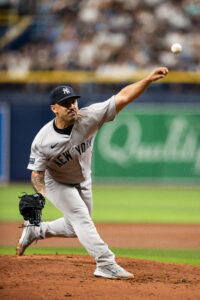
In 2024, Cortes pitched a career-high 174 1/3 innings while sitting a career-best 92.1 mph with his four-seamer. The lefty fanned 22.8% of his opponents and notched a career-best 5.5% walk rate. If he can deliver anything close to that, the Brewers will surely be thrilled. Adding to the rotation was a significant need for the Brewers this offseason, but they’ve been operating with minimal resources as they try to find creative ways to do so.
Cortes will give Milwaukee an experienced arm to slot in behind Freddy Peralta, Brandon Woodruff (returning from 2023 shoulder surgery), Aaron Civale and diamond-in-the-rough Tobias Myers. The Brewers also have lefties Aaron Ashby and DL Hall as rotation candidates, plus young righties Carlos Rodriguez, Logan Henderson and Chad Patrick on the 40-man roster but likely ticketed for Triple-A.
With a full, healthy season, there’s a chance Cortes is a more valuable pitcher on the whole than Williams. He’s been worth about 10 wins above replacement over the past four seasons, per both Baseball-Reference and FanGraphs (even when accounting for his poor showing in an injury-marred 2023 season). For the Yankees, however, he was no more than sixth or seventh on the depth chart — not with Gerrit Cole, Max Fried, Carlos Rodon, Luis Gil, Clarke Schmidt and Marcus Stroman all on the roster.
For the Yankees, the deal is about not only beefing up their bullpen during the regular season but more specifically about bolstering their postseason roster, where Williams would be a focal piece and Cortes would be relegated to a lower-leverage relief role. In that sense, there are some parallels with the 2022 Jordan Montgomery/Harrison Bader swap: ship out a starter who’s not in the playoff rotation in exchange for someone who’ll have greater impact on postseason results. In the end, the trade involves both teams dealing from areas of strength.
The Milwaukee bullpen, after all, was one of the best in baseball last season — even in a year where Williams missed two-thirds of the year. The Brewers’ collective 3.11 bullpen ERA ranked second in the sport, and they were top-10 in terms of FIP (3.78, seventh), walk rate (8.3%, ninth) and K-BB% (15.5, tenth). With Williams out of the picture, they’ll likely look to Trevor Megill (2.72 ERA, 27.3 K%), Joel Payamps (3.05 ERA, 25.1 K%) and Bryan Hudson (1.73 ERA, 26.8 K%) for late-inning work. The previously mentioned Ashby (1.37 ERA, 36.8 K%, 19 1/3 innings) and Hall (3.00 ERA, 26.5 K%, 12 innings) also looked impressive when working as relievers.
The other major piece of the puzzle for the Brewers, of course, is the 24-year-old Durbin. Milwaukee lost Adames to free agency this offseason and has been in search of infield help but with scant money to spend. Durbin could slot in at second or third base, with one of Ortiz or Turang sliding over to shortstop. He could also simply give the Brewers a versatile utility option with intriguing contact skills and speed.
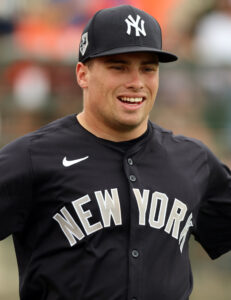
Durbin, who came to the Yankees from the Braves in exchange for Lucas Luetge, spent the bulk of the 2024 season in Triple-A Scranton Wilkes/Barre. He missed more than two months after being hit by a pitch on the wrist in May, but when he was healthy he was quite impressive. An infielder from the Altuve mold, Durbin is listed at just 5’6″ but nevertheless hit .287/.396/.471 (129 wRC+) with 10 homers and 31 stolen bases in 82 Triple-A games (375 plate appearances). He walked more than he struck out, drawing a free pass in 12.5% of his plate appearances versus a 9.9% strikeout rate.
With Durbin having missed a notable chunk of the season, the Yankees sent him to the Arizona Fall League to pick up some extra reps. He thrived there, hitting .312/.427/.548 with another five home runs and an AFL-record 29 stolen bases in 24 games (117 plate appearances). As he did in Triple-A, Durbin recorded more walks (17) than strikeouts (six).
Durbin has yet to take a single big league plate appearance, but the success he’s had in Triple-A and in the Arizona Fall League — coupled with the Brewers’ needs in the infield — give him a legitimate chance to break camp with the club. He might need to earn his way into a starting gig this spring, and his ultimate role will depend on any subsequent moves the Brewers make, but he’s very clearly an option to help the club in 2025. As it stands, he’s controllable through at least the 2030 season.
ESPN’s Jeff Passan first reported the Yankees and Brewers were finalizing a Williams trade. Will Sammon of The Athletic reported that the deal was in place. Robert Murray of FanSided first reported that Cortes was in the deal. Durbin’s inclusion was first reported by Bob Nightengale of USA Today. Bryan Hoch of MLB.com reported that there was cash in the deal, and Nightengale chimed in with the exact amount.
MLBTR Podcast: Winter Meetings Recap
The latest episode of the MLB Trade Rumors Podcast is now live on Spotify, Apple Podcasts, and wherever you get your podcasts! Make sure you subscribe as well! You can also use the player at this link to listen, if you don’t use Spotify or Apple for podcasts.
This week, host Darragh McDonald is joined by Tim Dierkes, Steve Adams and Anthony Franco of MLB Trade Rumors to discuss…
- The Mets signing Juan Soto (2:35)
- The Yankees to sign Max Fried (26:05)
- The Red Sox acquiring Garrett Crochet from the White Sox (36:10)
- The Giants signing Willy Adames (46:40)
- The Athletics signing Luis Severino (51:55)
- The Blue Jays acquiring Andrés Giménez from the Guardians who flip Spencer Horwitz to the Pirates for Luis Ortiz (1:01:25)
- The Orioles signing Tyler O’Neill and Gary Sánchez (1:14:00)
- The Tigers signing Alex Cobb (1:21:35)
- The Rangers re-signing Nathan Eovaldi and acquiring Jake Burger from the Marlins (1:25:20)
Check out our past episodes!
- Blake Snell, Dodger Fatigue, And The Simmering Hot Stove – listen here
- Yusei Kikuchi, The Aggressive Angels, And The Brady Singer/Jonathan India Trade – listen here
- The Rays’ Stadium Plans, Diamond Sports, And Some Offseason Rumors – listen here
The podcast intro and outro song “So Long” is provided courtesy of the band Showoff. Check out their Facebook page here!
Yankees, Wilking Rodríguez Agree To Minor League Deal
The Yankees and right-hander Wilking Rodríguez have agreed to a minor league deal, reports Aram Leighton of Just Baseball. The righty will presumably receive an invite to big league spring training as well.
The Yanks previously signed Rodríguez to a minor league deal in August of 2022. He had been pitching for Tecolotes de los Dos Laredos in the Mexican League that year, posting a 2.01 earned run average over 44 2/3 innings. He struck out 43.2% of batters faced for that club, limiting walks to a 7.7% clip.
That intrigued the Yankees but evidently also the Cardinals. The Cards took Rodríguez in the 2022 Rule 5 draft, a surprising pick since the righty was going into his age-33 season and most Rule 5 picks are guys in their 20s still looking to make their major league debuts. Rodríguez had been in the majors long before, throwing two innings for the Royals in 2014 before spending years away from affiliated ball.
The unorthodox pick didn’t work for the Cards, as Rodríguez required shoulder surgery and spent the entire 2023 season on the injured list. He was outrighted off the roster after that campaign and then re-signed with the Cards on a minor league deal. He spent most of 2024 on the minor league IL and only made 13 appearances.
Though it’s been a rough couple of years, Leighton relays that Rodríguez has been pitching in winter ball of late and hitting 97 miles per hour on his fastball. The Yankees were clearly interested in him a couple of years ago and have circled back to him now that he has perhaps gotten over his injury woes.
The Yankees made a big bullpen addition today by acquiring Devin Williams from the Brewers but all clubs need to reach into their non-roster pitching depth throughout a long season as injuries are inevitable.
Anthony Santander Reportedly Seeking Five-Year Deal
Free agent slugger Anthony Santander is one of the top power bats on the market this winter and has drawn interest from a wide array of suitors, including the Red Sox and Blue Jays. Jon Heyman of the New York Post writes that Santander is also of interest to the Yankees, now that Juan Soto is in Queens, and adds that the longtime Orioles slugger is seeking a five-year contract in free agency.
The switch-hitting Santander is coming off a career year in which he belted a personal-best 44 home runs. He’s heading into his age-30 season and doing so on the heels of a .235/.308/.506 batting line (129 wRC+). Santander doesn’t hit for much average and typically carries a pedestrian (at best) walk rate, but he’s been a consistent source of power for the O’s in recent seasons. Dating back to 2020, the former Rule 5 pick is a .245/.312/.476 hitter with 134 home runs, a 7.8% walk rate and a 20.6% strikeout rate. This past season’s 8.7% walk rate was the best of Santander’s career, while his 19.4% strikeout rate was his second-lowest in a full 162-game season.
Defensively, Santander hasn’t generated particularly strong reviews in recent seasons, but his work in 2024 drew harsher grades than usual. Defensive Runs Saved pegged him at -7, while Statcast’s Outs Above Average was at -2. Santander’s average sprint speed, per Statcast, sat in just the 18th percentile of big league players this past season (26.0 ft/sec). His raw arm strength was better than average, but Statcast still pegged his throwing value as well below average, likely suggesting some inaccurate and/or ill-advised throws.
Historically speaking, there’s some precedent for this skill set — defensively limited, corner-only slugger — still landing a five-year pact. Nick Castellanos comes to mind as the most recent example, having inked a five-year, $100MM deal with the Phillies just three winters ago. That same offseason saw Kyle Schwarber sign for four years and $79MM with the Phils. Prior to that, J.D. Martinez landed a five-year, $110MM deal with the Red Sox to serve as a full-time DH.
Each of Castellanos (140 wRC+), Schwarber (145) and especially Martinez (170) were coming off superior offensive seasons in free agency, however. Of the three, only Castellanos received and rejected a qualifying offer. Neither Schwarber nor Martinez were eligible for qualifying offers when they reached free agency, as both were traded during their respective walk years — Martinez from Detroit to Arizona, and Schwarber from Washington to Boston.
All of those reasons factored into MLBTR’s decision to “only” predict a four-year deal worth $20MM per season for Santander at the outset of free agency. Of course, in the six weeks since our Top 50 Free Agent Rankings were published, the market has proven to be the most aggressive in recent memory. While the position player market hasn’t yet to fully take shape beyond Juan Soto’s expectation-shattering $765MM contract, it’s been a bull market for starting pitching. Whether that will carry over to the offensive side of the market remains unclear, but Santander appears well positioned to cash in.
The Yankees, who were spurned by Soto, have already spent a stunning $218MM on Max Fried and just earlier today acquired Devin Williams from the Brewers. They still have a hole in right field, however, and while Santander wouldn’t make up for all of the lost production from Soto, “Tony Taters” would offer comparable home run power (with lower averages and dramatically lower on-base skills). Similarly, the Blue Jays have been trying to make a splash to upgrade their lineup but came up empty in their Soto bid. The Red Sox don’t need another corner bat at the moment, but if they deal from their stock of outfielders to acquire additional starting pitching, that calculus could change. Other teams seeking middle-of-the-order bats include the Nationals, Tigers and Dodgers, among others.
Santander’s market is in many ways linked to that of Teoscar Hernandez, a similarly powered-up bat with defensive questions and a rejected qualifying offer hanging over his head. Hernandez is two years older and thus seems likely to sign a shorter deal, but he could still land three or perhaps even four years if the market is strong enough.