
Marlins To Hire Gabe Kapler As Assistant General Manager
The Marlins have reached an agreement to hire former Phillies and Giants manager Gabe Kapler as an assistant general manager under new president of baseball operations Peter Bendix, reports Craig Mish of SportsGrid and the Miami Herald. San Francisco dismissed Kapler following the 2023 season, hiring future Hall of Famer Bob Melvin in his place. Mish adds that Kapler has been looking for a new challenge in baseball operations since being let go by the Giants and was also in the running to become the Red Sox’ head of baseball operations before they ultimately hired another former big leaguer, Craig Breslow.
This won’t be the first foray into baseball operations for Kapler, who served as the Dodgers’ farm director prior to being named manager of the Phillies. He’s spent the past six seasons as a manager, compiling a 456-411 record between San Francisco (2020-23) and Philadelphia (2018-19) and won NL Manager of the Year honors in 2021. He’ll now return to the other side of the game, with a primary focus on player development within the Marlins’ system, per Ken Rosenthal of The Athletic. The Marlins don’t have a general manager, with the aforementioned Bendix holding the title of president and heading up baseball ops. But Kapler will join Oz Ocampo, Brian Chattin and Daniel Greenlee as the team’s fourth executive to hold the title of assistant GM.
It’s not the only recent baseball ops hire made by Bendix, who replaced GM Kim Ng after she declined her end of a 2024 mutual option (reportedly because ownership wanted to hire a president of baseball ops to overtake her on the front office hierarchy). Evan Grant of the Dallas Morning News reported earlier this week that Miami hired now-former Rangers assistant director of baseball operations Vinesh Kanthan as their new director of baseball operations.
Changes in the Miami front office figure to continue over the next year, as it’s common for newly hired baseball operations executives to bring in their own team — at times at the expense of holdovers within the department. Bendix and his staff will look to build on the success of the 2023 club, which reached the playoffs for the first time (in 162-game season) since the organization’s 2003 World Series-winning season.
Guardians Open To Offers On Emmanuel Clase
The Guardians are open to offers on All-Star closer Emmanuel Clase and willing to trade him for the right offer, ESPN’s Jeff Passan reports. Even if the club is merely performing its due diligence, it’s a fairly surprising development, given the overwhelmingly club-friendly contract to which the 25-year-old (26 in March) righty is signed.
Early in the 2022 season, Cleveland inked Clase to a five-year, $20MM contract extension that included affordable $10MM club options for the 2027-28 seasons (each with a $2MM buyout). He’s entering the third season of that deal, slated to earn $2.5MM this coming season, $4.5MM the following year and $6MM in 2026.
It’s worth pointing out that Clase is well on his way to boosting the value of both those club options. The contract allows him to increase the value of each by another $3MM based on appearances, innings pitched and awards in the first five years of the deal. Clase has already secured a $500K bump for both options by winning the Mariano Rivera Reliever of the Year Award in 2022. He’ll earn $500K bumps on both options for reaching 200 innings or games pitched (he’s at 145 innings and 152 games presently) and see another $500K tacked onto each option upon reaching 250 innings or games pitched. If he reaches 300 innings or games pitched over the life of the deal, he’ll boost the value of each option by another $1MM. In all, the options can top out at a still-very-reasonable $13MM apiece, and Clase would take home another $1MM assignment bonus if traded.
Even if Clase maxes out all of those remaining escalators, he can be controlled for up to five more seasons at a maximum of $40MM. That’s a bargain rate for a flamethrowing righty who has been one of the top relievers in the American League throughout much of his tenure in Cleveland.
That said, there are some red flags that merit mention. Clase hasn’t lost much life on his signature cutter, which still averaged better than 99 mph in 2023, but he posted a career-low 21.2% swinging-strike rate and saw his walk rate (5.3%), ground-ball rate (55%), swinging-strike rate (13.3%), opponents’ chase rate (35.1%), average exit velocity (88.4 mph) and hard-hit rate (37.6%) all trend in the wrong direction over his 2022 levels. Granted, most of those numbers are still excellent, but Clase’s 3.22 ERA doesn’t look nearly as dominant as the combined 1.33 he posted in 2021-22 — and he blew more saves (12) in 2023 than he did in his entire career prior to this season (9).
While it’s never good to see any pitcher begin to trend in the wrong direction, the 2023 version of Clase was still excellent — and the price tag on his contract is still well shy of what he’d earn if he were on the open market at present. Bullpen help is always in demand, but trading a reliever of this caliber with five years of affordable contractual control remaining is virtually unprecedented.
The Phillies traded five years of Ken Giles to the Astros back in 2015, though Giles was a pre-arbitration player with 115 career innings under his belt to that point; Clase is more established. The Mariners traded four years of Edwin Diaz to the Mets but did so largely as a means of shedding the remainder of Robinson Cano‘s contract. Both trade packages netted former top-six overall draft picks (Mark Appel, Jarred Kelenic) in addition, plus at least one other top prospect/young big leaguer of note (Vince Velasquez, Justin Dunn) and other near-MLB pitchers. None of those names from those trade returns have gone onto MLB stardom, but at the time of those swaps they were highly touted young talents. Clase could arguably command an even larger haul, potentially netting the Guardians multiple top-100 prospects and/or young MLB-ready players.
It should of course be emphasized that Clase is far from a sure thing to move. Because of the massive amount of remaining control on his contract and his eminently affordable salary — even for a low-payroll club like the Guardians — the Cleveland front office might simply opt to hold onto him. The Guards project for a $94MM payroll in 2024, per Roster Resource, which is only a $5MM jump from last year’s Opening Day mark and about $40MM shy of their franchise-record mark of $134MM.
There’s no financial urgency to deal Clase, especially since that $94MM mark figures to drop if Cleveland ultimately moves Shane Bieber — a far likelier trade candidate given his projected $12.2MM salary (via MLBTR contributor Matt Swartz) and his status as a free agent at the end of the 2024 campaign. Cleveland has previously traded Corey Kluber, Carlos Carrasco, Trevor Bauer and Mike Clevinger all before those players reached the open market, and if they continue that pattern, Bieber will be on the move between now and Opening Day. The Cubs and Reds are among the teams with interest, although the 2020 AL Cy Young winner has surely commanded a broader array of inquiries than just those two teams.
Chris Young Discusses Rangers’ Spending Outlook
The Rangers have made plenty of headlines in each of the past two offseasons. After signing Corey Seager, Marcus Semien and Jon Gray during the 2021-22 winter, they added Jacob deGrom, Nathan Eovaldi and Andrew Heaney a year ago.
It doesn’t appear Texas is planning to be so aggressive this time around. A few weeks removed from the franchise’s first World Series, general manager Chris Young hinted at a quieter offseason than the previous two.
“We expect to be active in free agency, but probably not spending at the level that we have spent in previous offseasons,” Young told reporters on Thursday afternoon (relayed by Evan Grant of the Dallas Morning News). The GM noted there’s “a great returning core group” and said the front office is “really looking for additions to kind of shore up the team.”
That’s a generally fair assessment of the roster. Texas is returning the vast majority of an elite batting order. Seager, Semien, Adolis García, Jonah Heim, Josh Jung, Nathaniel Lowe, Leody Taveras and Evan Carter will be back. Designated hitter/backup catcher Mitch Garver hit free agency after the Rangers opted against issuing a qualifying offer. He’s the biggest potential departure on the offensive side. Robbie Grossman and Travis Jankowski also hit the market after solid performances as depth outfielders.
Texas faces a few more impactful losses on the pitching side. Deadline acquisition Jordan Montgomery is one of the top free agent starters. Aroldis Chapman, Will Smith and Chris Stratton could depart the relief corps, while Martín Pérez played a swing role.
Garver and Montgomery are the most notable losses. Texas doesn’t has a perfect in-house replacement at designated hitter, although the likes of Ezequiel Durán and prospect Justin Foscue could take on larger roles. Wyatt Langford, selected out of Florida with the fourth overall pick last summer, briefly reached Triple-A at the end of his draft year. It’d be a surprise if he’s in the majors on Opening Day. He could hit his way to the big leagues at some point during the summer.
Of course, the headline-grabbing play at designated hitter would be a massive strike for Shohei Ohtani. Texas is reportedly in the mix for the defending AL MVP. Signing Ohtani would quite likely require the largest contract in MLB history. Young’s comments downplay that as a possibility, although perhaps ownership and the front office would pivot if there’s a realistic chance to land the sport’s best player.
Texas has also expressed interest in retaining Montgomery. That’d be a bit of a luxury strike. Effective as the southpaw was down the stretch, the Rangers could open next season with Max Scherzer, Eovaldi, Gray, Heaney and Dane Dunning as a strong rotation. deGrom could join the group in the second half as he rehabs from June’s Tommy John procedure.
Young made clear the Rangers aren’t planning to sit out free agency entirely. Yet adding a depth starter rather than meeting a nine-figure price for Montgomery could be more likely. Texas figures to bring in multiple relievers and will probably add to what presently projects as an inexperienced bench.
While the strength of the existing roster is one factor in projecting a relatively quiet offseason, it also seems the front office is working with more limited spending room than they’ve had in previous winters. Roster Resource projects the Rangers’ 2024 payroll around $203MM. That includes projected salaries for arbitration-eligible players but does not account for any additions they’ll make. That’s already above the approximate $196MM payroll which the team carried into this past season, which was itself a franchise high.
To be clear, Young didn’t forecast any kind of payroll cut. It seems all but assured they’ll go into 2024 at a franchise-record spending level. The championship run brought in extra revenue in the form of playoff gate receipts. Ownership and the front office are surely motivated to push for a repeat. The midseason acquisition of Scherzer (whom Texas will pay $12.5MM next season as part of the trade from the Mets) paired with arbitration raises for the likes of Lowe, García and Dunning organically raise the payroll in comparison to this year’s Opening Day mark.
The Rangers are also one of the teams facing short-term uncertainty about their local television rights. The organization’s deal with Diamond Sports Group for in-market broadcasting on the Bally Sports network is in jeopardy. The Athletic recently reported that Diamond was considering dropping its deals with the Rangers and Guardians before next season amidst its ongoing bankruptcy. Young pointed to the uncertainty about the rights fees, noting that the front office has “a responsibility to be financially prudent.”
That all hints at a less flashy offseason than Texas has had in the last two years. Grant suggests the team could try to stay below the luxury tax threshold during the offseason. While there’s not a clear mandate to avoid paying the tax, it seems ownership prefers to leave some flexibility for midseason acquisitions. A team’s CBT number isn’t finalized until the end of the year, so in-season pickups count against that figure.
Roster Resource pegs the Rangers’ 2024 tax projection (which is calculated using contracts’ average annual salaries and includes player benefits) around $219MM. That checks in $18MM below next year’s $237MM base threshold. If the organization truly prefers to stay under that during the winter, they’d be limited to complementary additions. Back-end starting pitchers Lance Lynn and Kyle Gibson have signed for $11MM and $13MM, respectively, for reference.
The Rangers exceeded the tax threshold in 2023. If they surpass it next season, they’d be taxed at a heightened 30% rate as repeat payors on any spending between $237MM and $257MM (with heightened penalties if they surpass the $257MM mark).
Orioles Have Shown Interest In Josh Hader, Jordan Hicks
At the GM Meetings earlier this month, Baltimore general manager Mike Elias told reporters the team was seeking a late-game reliever. They’re considering plugging that vacancy in free agency.
Jon Heyman of the New York Post reports that the O’s have been in contact with each of Josh Hader, Jordan Hicks, Craig Kimbrel and Aroldis Chapman. All four hurlers fit the general profile of a late-inning arm, although they’re clearly in different tiers of free agency.
Hader is the best reliever in the class (and arguably the top bullpen arm in the majors). He worked to a 1.28 ERA over 56 1/3 innings during his platform season. The lanky southpaw punched out 36.8% of batters faced. That’s actually Hader’s lowest strikeout percentage since his rookie year, yet it still ranked fifth in MLB among relievers with 50+ innings. Only Chris Martin and Brusdar Graterol had a lower earned run average.
After frequently working multiple innings earlier in his career, Hader has expressed a preference for a traditional one-inning role over the past couple years. The Padres deployed him as a closer. He picked up 33 saves in 38 attempts.
The year marked an emphatic bounce back from a 2022 season in which he’d posted an uncharacteristic 5.22 ERA. Hader has posted an ERA under 1.30 in two of the last three years and has five sub-3.00 showings over his seven MLB seasons. While he’s a year older than Edwin Díaz was last offseason, Hader figures to take aim at topping Diaz’s $102MM guarantee with the Mets — the largest relief contract in MLB history.
Committing a nine-figure deal would be far bolder than any free agent decision that the Elias front office has made. The O’s have remarkably yet to sign a single multi-year free agent deal in his five years as GM. Much of that came during a rebuild, of course, but the O’s remained cautious even as they’d begun to turn a corner last winter. Baltimore signed a trio of veterans (Kyle Gibson, Adam Frazier and Mychal Givens) for a combined $23MM on one-year guarantees.
After a breakout season that saw the O’s win 101 games to take the top seed in the American League, the front office should be more aggressive than ever. Bringing in Hader would represent a very significant shift in operating procedure. In addition to the huge financial commitment, Baltimore would have to relinquish their third-highest pick in next summer’s draft. Hader declined a qualifying offer from the Padres, so he’s attached to signing compensation.
If the O’s are willing to meet those costs, Hader is a sensible target. He’s one of the few relievers who can approach the kind of production the O’s lost when Félix Bautista underwent Tommy John surgery that’ll cost him the entire 2024 season. Hader is also a Maryland native who began his professional career as a 19th-round pick by the Orioles in 2012. While that selection was made by a previous front office, Elias was a high-ranking scouting official with the Astros when Houston acquired Hader as a prospect at the 2013 deadline.
Hader is in his own tier as a free agent relief target. Hicks finds himself in the next group, arguably the #2 option on the open market. One of the hardest throwers in the sport, he averages around 100 MPH on his sinker. Hicks has wobbly control but consistently runs huge ground-ball numbers. He’s coming off arguably the best season of his career, turning in 65 2/3 innings of 3.29 ERA ball between the Cardinals and Blue Jays. The righty struck out a solid 28.4% of batters faced, the highest rate of his career.
Injuries (most notably a June ’19 Tommy John procedure) dogged Hicks between 2019-21. He has mostly stayed healthy over the past two seasons, topping 60 frames in each. He’s also the youngest free agent reliever of note, having turned 27 in September. Hicks should secure at least three years and has a solid case for a four-year pact at an average annual value in the $8-10MM range.
Chapman and Kimbrel would be shorter-term plays. Two of the best closers of their generation, they’re each entering their age-36 campaign. Both pitchers have battled some inconsistency in recent seasons, but they’re coming off solid 2023 performances. Chapman worked to a 3.09 ERA with an eye-popping 41.4% strikeout percentage over 58 1/3 frames between the Royals and Rangers. Kimbrel posted a 3.26 ERA while fanning a little over a third of his opponents in 69 regular season innings with Philadelphia, although he struggled over six innings in the playoffs.
Mets Sign Joey Wendle To Major League Deal
November 30: Wendle passed his physical and the deal is now official, per Andy Martino of SNY. Wendle can also earn an extra $500K in bonuses, per Joel Sherman of The New York Post, with $100K for getting to 250, 300, 350, 400 and 450 plate appearances.
November 29: A few hours after agreeing to terms with Luis Severino, the Mets have added infield depth. New York is reportedly in agreement with Joey Wendle on a one-year, $2MM guarantee. The deal also contains performance bonuses for the Excel Sports Management client.
Wendle, 34 next April, has spent the last two years in the NL East as a member of the Marlins. His tenure with the Fish didn’t go as planned. Miami acquired the left-handed hitter from the Rays over the 2021-22 offseason. He’d had a solid four-year run in Tampa Bay, hitting .274/.330/.414 and earning an All-Star nod in his final season. Miami installed him as their primary third baseman for the ’22 season.
His offensive numbers took a sharp downward turn. Wendle hit .259/.297/.360 with only three home runs through 371 trips to the plate. Miami brought in Jean Segura to play third base last offseason but kept Wendle in the Opening Day lineup, kicking him up the defensive spectrum. After trading Miguel Rojas to the Dodgers, the Marlins turned to Wendle as their primary shortstop.
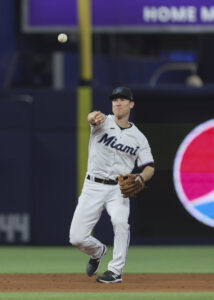
Wendle had an even tougher year. He hit .212/.248/.306 over 318 plate appearances. He connected on only two homers while his strikeout rate jumped from 13.5% to a nearly average 21.1% clip. Of the 293 hitters with 300+ trips to the plate, none had a lower on-base percentage than Wendle. His slugging mark was ninth-lowest among that group. The Fish stuck by Wendle as their primary shortstop, although he struggled significantly down the stretch. He hit .142/.176/.201 in the season’s second half.
To his credit, Wendle handled his more demanding defensive responsibilities. He logged a career-high 754 1/3 innings at shortstop, no small feat for a player in his age-33 season. Defensive Runs Saved rated him highly, estimating he was six runs above average at the position. Statcast’s Outs Above Average metric was more bearish, grading him three runs below par.
Barring injury, Francisco Lindor will take almost every shortstop inning next season. Wendle can handle a utility role off the bench. Public defensive metrics have always graded Wendle highly at second base and pegged him as a solid defender at the hot corner. As a defense-first lefty hitter with the ability to handle multiple infield spots, he’s more or less a direct replacement for Luis Guillorme. The Mets non-tendered the latter two weeks ago.
A $2MM guarantee brings the Mets’ payroll projection around $276MM, as calculated by Roster Resource. Their competitive balance tax number jumps a little north of $289MM. New York is within the third tier of luxury penalization, roughly $8MM below the $297MM mark that represents the fourth and final tier. Given remaining needs on the pitching staff and in the corner outfield, they seem likely to surpass that threshold by the time the offseason concludes.
Since they’re presently in the third tier and have paid the luxury tax in each of the past two seasons, the Mets are charged a 95% rate on their expenditures. Adding Wendle comes with $1.9MM in taxes, bringing the total cost to $3.9MM. If/when they pass the $297MM figure, they’d be taxed at a staggering 110% rate on each additional dollar spent.
Andy Martino of SNY first reported the Mets were in discussions with Wendle. Robert Murray of FanSided was first to report an agreement had been reached. Mark Feinsand of MLB.com reported the approximate $2MM base salary and the presence of unspecified performance bonuses. Joel Sherman of the New York Post pegged the guarantee at exactly $2MM.
Image courtesy of USA Today Sports.
Cardinals Still Showing Interest In Dylan Cease
Even after revamping their rotation with a rapid-fire trio of free agent signings, the Cardinals are still in the mix for White Sox righty Dylan Cease, reports Ken Rosenthal of The Athletic. President of baseball operations John Mozeliak said at the press conference to introduce Sonny Gray that he “doubted” his next move would be to add more starting pitching but conceded that he remains “open-minded” to further rotation additions (link via Derrick Goold of the St. Louis Post-Dispatch).
The Cardinals, of course, signed Gray, Kyle Gibson and Lance Lynn in just over a week’s time, adding a trio of arms who combined for 97 starts in 2023. The addition of Gray added a front-end presence to the St. Louis rotation, while Lynn and Gibson at the very least provided some reliable bulk innings on the back end. It seems clear that the Cards prioritized some stability after years of injury-related starting pitching crunches at Busch Stadium, and Cease would be a fourth addition in that vein.
In terms of pure results, the 27-year-old Cease (28 next month) has been on both ends of the spectrum recently. In 2022, he finished runner-up to Justin Verlander in AL Cy Young voting, while his 2023 campaign saw his ERA more than double from 2.20 to 4.58. Cease’s velocity dipped by a mile per hour, his strikeout rate fell three percentage points, and he yielded far more hard contact than he did during that elite 2022 campaign. What remained constant, however, was the righty’s availability. Cease made 33 starts this past season — his fourth straight year with a full slate of starts. Since 2020, Cease leads all MLB pitchers with 109 games started.
As things stand, the Cardinals project for a five-man rotation of Gray, Miles Mikolas, Lynn, Gibson and Steven Matz. Mikolas and Matz are both signed through 2025 — Mikolas at a total of $32MM and Matz at $24MM. There’s been some speculation about the possibility of an eventual Matz trade, but the Cardinals are also surely reluctant to thin out their depth too much after being burned by a lack of depth in multiple seasons recently.
Cease would give the Cardinals even more bulk innings but do so while carrying more upside than perhaps any member of their current staff. He’d surely benefit from a move out of the White Sox’ homer-happy stadium and away from their poorly ranked defense. With two years of club control remaining, a projected $8.8MM salary in arbitration (courtesy of MLBTR contributor Matt Swartz) and clear Cy Young-caliber upside on the mound, bidding for Cease’s services will be fierce.
Already this winter, he’s been connected to the Braves, Dodgers, Reds and Orioles. That’s surely just a fraction of the teams who’ve at least reached out to the ChiSox to gauge the asking price. The Cardinals’ recent free-agent activity might lessen their urgency relative to some of those other suitors, but it’s nevertheless of note that they remain in the mix at all.
From a payroll perspective, they can likely make a Cease acquisition work without even dramatically raising their spending from last year’s levels. The Cards backloaded Gray’s three-year, $75MM contract such that he’ll be paid just $10MM in 2024. Roster Resource projects a $180MM payroll right now, which is only narrowly higher than last year’s Opening Day mark. And the Cards could yet trade arbitration-eligible names like Tyler O’Neill and Dylan Carlson, which would impact that payroll projection.
Someone like O’Neill — a free agent at season’s end — isn’t likely to hold much appeal to the White Sox, who’ll be looking for controllable talent to build around in the near future. But generally speaking, the Cardinals have a bevy of young, MLB-ready talent that could interest Chicago. Names like Carlson, Brendan Donovan, Nolan Gorman, Alec Burleson, Luken Baker and Matthew Liberatore all have at least three seasons of club control remaining, and that’s not even counting some interesting upper-minors prospects who’ve yet to debut but are relatively close to the Majors (e.g. Gordon Graceffo, Tink Hence).
As for the timing of a potential Cease trade, reports on the matter are conflicting in nature; MLB.com’s Jon Morosi suggested just yesterday that Cease’s market was heating up and a trade could come together by Sunday evening. Not 18 hours later, Rosenthal reported nearly the opposite — that Sox GM Chris Getz has been indicating to teams he prefers to wait until after the top free-agent names have come off the board.
Mets Sign Luis Severino
The Mets are reportedly in agreement with free agent starter Luis Severino on a one-year, $13MM guarantee. The deal also includes $2MM in performance bonuses. Severino, who is represented by Rep 1 Baseball, would receive $500K for reaching 27 starts and $750K apiece for his 29th and 31st start.
 Severino, 30 in February, is a wild card of this winter’s free agent market. He once looked like one of the best pitchers in the majors but has spent the past five years either injured or ineffective or both. He made 63 starts over 2017 and 2018, throwing 384 2/3 innings with a 3.18 earned run average. He punched out 28.8% of batters faced while walking just 6.2% of them and keeping 45.8% of balls in play on the ground. FanGraphs calculated him as worth 11 wins above replacement over that two-year span, trailing just four pitchers around the league: Max Scherzer, Chris Sale, Jacob deGrom and Corey Kluber.
He and the Yankees agreed to a four-year, $40MM extension prior to 2019, with that deal also having a $15MM option for 2023. But shortly after that deal was signed, he ran into health problems. He only made three starts in the first year of that deal due to shoulder and lat injuries, then Tommy John surgery kept him off the field entirely in 2020 and for most of 2021. More lat issues came in 2022, but he was at least able to make 19 starts and log 102 innings with a 3.18 ERA, followed by a couple of playoff starts.
That relatively healthy showing was enough for the Yankees to trigger the player option for 2023. Another lat strain prevented him from making his season debut until May and then an oblique strain in September ended his season early. In the middle of those IL stints, he tossed 89 1/3 innings but with an awful 6.65 ERA. He struck out just 18.9% of opponents, a huge drop from his 27.7% rate in 2022.
Severino averaged 96.5 mph on his fastball in 2023, a bit down from his 97.6 from 2018. It’s higher than his 96.3 mph average from 2022, when he was still effective. His slider had a bigger drop, averaging 84.6 mph in this year whereas it sat 88-89 prior to his injury troubles. But he was still getting good results in 2022 with a slider that averaged 85.1 mph.
Despite the rough season, some club was going to take a chance on Severino’s track record and hope for a bounceback with better health. MLBTR predicted Severino to secure a contract of one-year and $14MM. His guarantee is just beneath that but the bonuses could help him climb to the other side.
That the Mets are the club to take the chance on Severino makes plenty of sense, with reporting from a couple of weeks ago suggesting they were interested. Last year’s struggles led them to trade Max Scherzer and Justin Verlander ahead of the deadline. Then Carlos Carrasco reached free agency and David Peterson required hip surgery that will force him to miss the start of next season.
All of that left the Mets with a 2024 rotation consisting of Kodai Senga and José Quintana in two spots. They had some candidates to fill out the back end, such as Tylor Megill, Joey Lucchesi and José Butto, but each of those guys can be optioned to the minors and make more sense as depth options than as part of the club’s Opening Day plans.
It’s still unclear exactly what kind of offseason the Mets are planning to have and this transaction won’t make that much clearer. The 2023 club had the highest payroll in baseball history but reporting from the deadline indicated that they may opt for a somewhat less-aggressive approach for 2024. But stepping back from unprecedented heights could still lead to plenty of activity, depending on the size of the step.
This deal is fairly modest by free agent standards but could always be paired with a larger move. For example, the Cardinals were looking for three starters this winter and started with one-year deals for Lance Lynn and Kyle Gibson before a bigger three-year strike on Sonny Gray. Perhaps the Mets have a bigger move to come, having been connected to Yoshinobu Yamamoto. But time will tell if that kind of big strike is realistically in their plans.
For now, they’ve added a former star on a short-term deal. He could either help them return to contention or perhaps turn himself into a deadline trade chip. If he isn’t able to get back in good form, the Mets won’t have impacted their plans for competing in the long term.
In the short term, this seems like it will cost them more than the $13MM sticker price. According to Roster Resource, this move pushes the club’s competitive balance tax calculation to $288MM, well beyond next year’s base tax threshold of $237MM. The CBT features escalating penalties for paying in consecutive years and the Mets are set to be a third-time payor in 2024. That means they pay a 50% tax on all overages, 62% for spending over the $257MM line and 95% for going past the third line of $277MM. They could always shed salary somehow but they are already past the third line and not too far from the fourth line of $297MM, when their tax rate would jump to 110%. The tax isn’t calculated until the end of the season, so they could significantly alter all of these calculations between now and next fall, but it’s distinctly possible that they end up paying something close to double that $13MM figure that Severino will receive.
Mark Feinsand of MLB.com first reported Severino was nearing agreement with the Mets. Jeff Passan of ESPN reported the sides were finalizing a one-year, $13MM deal that included $2MM in bonuses. Jon Heyman of the New York Post reported the specific bonus structure.
Brewers Making Progress On Extension Talks With Top Prospect Jackson Chourio
Nov. 29: The two parties are gaining momentum on what would indeed be a record-setting contract extension, reports Curt Hogg of the Milwaukee Journal-Sentinel. Hogg suggests a framework in the eight-year, $80MM range could be in play, with multiple options and a presumably healthy slate of incentives also coming into play. The two sides have been discussing a potential deal since late in the minor league season, Hogg adds, indicating that the ostensibly looming agreement would mark the culmination of months of negotiation.
Nov. 28: The Brewers and outfield prospect Jackson Chourio are discussing an extension, reports Ken Rosenthal of The Athletic. Though the deal is not done, the report states it would set a new benchmark for an extension signed by a player with no major league experience. It’s unclear if the deal is close to being done or if talks are still in early stages. Chourio is represented by Beverly Hills Sports Council.
Chourio is still quite young, as he doesn’t turn 20 years old until March, but he has vaulted himself to the top echelons of prospect lists thanks to his all-around contributions. He spent most of 2023 in Double-A, getting into 122 games at that level. He hit 22 home runs in that time and stole 43 bases. His .280/.336/.467 batting line translated to a wRC+ of 112, at a level where the average age was almost 24. He’s also considered an above-average defender in center field. He received a late promotion to Triple-A and got into six games there.
It’s also possible that his batting line from this year masks his true talent. His scouting report at Baseball America notes that the Double-A Southern League experimented with a pre-tacked ball which led to increased pitch movement and disadvantaged hitters, but they switched to a traditional ball in July. Chourio hit .239/.304/.410 prior to the switch but .323/.380/.544 against the traditional ball.
Chourio is currently considered the #2 prospect in the league, behind Jackson Holliday, by BA, MLB Pipeline and the most recent list from Keith Law of The Athletic. He’s currently listed #3 at FanGraphs and the most recent list from ESPN.
It appears that the Brewers have plenty of faith in Chourio’s ability, despite the fact that he has just six games of experience above Double-A and is still a teenager for a few more months. The exact details of the contract being discussed aren’t known, but Rosenthal indicates it will top the previous benchmark for players who have yet to reach the majors.
As noted by Rosenthal, five different players have received extensions prior to their MLB debuts. MLBTR’s Contract Tracker shows that, of those five deals, the two most lucrative were both given out by the White Sox. In March of 2019, they gave Eloy Jiménez a six-year, $43MM deal, then topped that the following January by giving Luis Robert Jr. $50MM over the same six-year term. The other three players are Jon Singleton, Scott Kingery and Evan White, who each received far more modest deals.
There’s certainly risk in giving out a significant deal to a player who hasn’t proven himself at the big league level, but the Brewers know that there’s also risk in waiting. Not too long ago, they parted with Josh Hader as he continued to thrive and earn higher salaries via arbitration. There are rumors that they may have to consider a similar path with Corbin Burnes and Willy Adames, who are each about to make eight-figure salaries before reaching free agency after 2024.
If the Brewers are able to get something done with Chourio, it should decrease their chances of finding themselves in a similar position in the future. If the deal goes beyond six years, as Rosenthal reports it will, it would also increase his chances of cracking the Opening Day roster in 2024. The club would then have no incentive to keep him down in the minors to start the year and try to gain an extra year of control.
If the club considers Chourio a viable option to start next year in the big leagues, it could perhaps give them an outfield surplus to trade from. They already have Christian Yelich, Garrett Mitchell, Sal Frelick, Joey Wiemer and Tyrone Taylor in the mix for playing time, with Blake Perkins and Chris Roller on the roster as depth options. Making someone in that group available on the trading block could perhaps allow the club to upgrade its infield or pitching staff during an offseason where there are few impact bats available and the demand for pitching is incredibly high.
Most extensions generally ramp up in terms of salary over time, vaguely resembling what a player might have received in the normal course of going through arbitration. The player gets some certainty over future earnings and protection against a significant injury while the club gains some extra control over the player’s future. Other than Yelich, the Brewers have very little on their long-term books. Aaron Ashby is signed through 2027 with two club options, while Freddy Peralta‘s deal goes through 2024 with two club options.
Though there have been plenty of rumors about Burnes and Adames being dealt, it’s generally been expected that those theoretical deals would bring back MLB-ready talent to allow the club to continue competing despite their budgetary limitations. They clearly think Chourio can be a big part of their ability to keep the good times rolling and hope to keep him around for a while. For Chourio, he could potentially sign a 10-year deal and still reach free agency before his 30th birthday. Whether the two sides can find something that works for everyone remains to be seen.
Tigers Sign Kenta Maeda
November 28: The club has now officially announced the deal, which is frontloaded. Maeda will make $14MM in 2024 and $10MM in 2025. The club’s 40-man roster count is now at 38.
November 26: The Tigers have added some experience to their young rotation, agreeing to sign right-hander Kenta Maeda to a two-year, $24MM contract. Maeda will undergo his physical on Monday, so the deal should be officially announced within the next 24 hours. Maeda is represented by the Boras Corporation.
Reports emerged earlier this week linking Maeda and the Tigers, though the Twins (Maeda’s former team) maintained interest. However, SKOR North’s Darren Wolfson writes that the Twins only had interest in Maeda on a one-year contract, so moving to a multi-year looks to have sealed the deal for the Tigers. Minnesota will now have to deal with Maeda as an opponent on a division rival, as Maeda will join the third team of his Major League career as he enters his age-36 season.
With Eduardo Rodriguez possibly leaving Detroit in free agency, Maeda steps in as the veteran presence within a Tigers rotation that is still pretty unseasoned. Most of the Tigers’ young arms were also set back by injuries during the club’s nightmarish 2022 season, though Tarik Skubal and Matt Manning pitched well when healthy, and Reese Olson stepped up as a legitimate rotation candidate. At the moment, Maeda looks to be the No. 2 on the staff behind Skubal, with Manning, Olson, and Casey Mize (set to return after missing 2023 due to Tommy John surgery) looking like the provisional starting five.
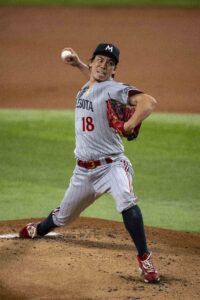 This offseason marked the end of the incentive-heavy, eight-year, $25MM deal Maeda signed with the Dodgers back in January 2016, when Maeda first came to the majors from Nippon Professional Baseball. Maeda’s earning power at the time was somewhat limited due to some concerns over his elbow, though he didn’t have any major arm-related injury issues over four years in Los Angeles before the Dodgers dealt him to the Twins during the 2019-20 offseason. Maeda responded with an outstanding performance in the pandemic-shortened campaign, posting a 2.70 ERA in 66 2/3 innings and finishing second in AL Cy Young Award voting.
With a more modest 4.66 ERA in 106 1/3 frames in 2021, the injury bug then finally bit, as Maeda had to undergo the internal-brace version of Tommy John surgery. Using the brace theoretically could have reduced Maeda’s time on the injured list, yet he ended up missing the entire 2022 season. His comeback year in 2023 was also shortened by close to two months by a triceps strain, but the numbers were pretty solid overall when Maeda did take the mound.
Maeda posted a 4.23 ERA, 27.3% strikeout rate, and 6.5% walk rate over 104 1/3 innings for Minnesota. Both the walk and strikeout rates were well above average, and Maeda wasn’t a high-velocity pitcher even before surgery, so his 90.9mph average was just slightly below his career norm. Maeda did allow a lot of hard contact last year, which was something of a red flag considering that he very good and occasionally elite at inducing soft contact in the seasons prior to his brace procedure.
Between the hard-contact numbers, Maeda’s age, and injury history, the expectation was that Maeda’s market might be limited to a two-year (or two years with an option) contract this winter. MLBTR ranked Maeda 25th on our list of the offseason’s top 50 free agents, and predicted a two-year, $36MM pact for the right-hander. The actual dollar figure will fall below our projection, perhaps suggesting that teams had concerns over Maeda’s ability to stay healthy. Speculatively, it could also be that Maeda preferred to get a deal done sooner rather than later, perhaps as a nod to the strong interest shown by the Tigers this early in the winter.
There’s no doubt that the righty has a high ceiling of performance when he’s healthy, making the signing a pretty solid move for Tigers president of baseball operations Scott Harris. After spending most of his first year in the job in evaluation mode, Harris has started to make some modest but noteworthy expenditures for veteran talent, both in signing Maeda and in trading for Mark Canha earlier this month. Adding Maeda’s deal puts Detroit’s projected payroll (as per Roster Resource) at only $85.26MM, though Harris has spoken of exercising financial caution in the past, and it isn’t yet clear how much the Tigers are willing to spend this winter.
At the very least, the Tigers have the flexibility to perhaps explore a bigger move should an opportunity present itself, and Maeda’s signing perhaps opens such a door in a unique fashion. Evan Petzold of The Detroit Free Press wrote this week that the Tigers were considering Maeda both for the pitcher’s own value and also to “establish themselves in the Japanese pitching market.” This is particularly intriguing in the context of Detroit’s interest in Yoshinobu Yamamoto, and if Harris and Tigers ownership were prepared to break the bank on a player, it might be for this circumstance of a 25-year-old Japanese ace who might have up to a decade of prime baseball still ahead of him.
Shota Imanaga is another prominent name coming to the majors from NPB this winter, even if Imanaga is 30 and his ceiling isn’t considered as high as Yamamoto’s. It is also possible the Tigers might not be done with veteran pitchers from the Major League free agent market, as names like Seth Lugo and Luis Severino are also reportedly on Detroit’s radar as arms available on shorter-term and relatively less-expensive contracts.
An argument could’ve been made for the Twins to issue Maeda a qualifying offer as he entered free agency, yet with Minnesota planning to cut payroll next year, it is easy to see why the Twins might not have wanted to risk Maeda accepting the offer and locking in a $20.325MM salary for 2024. By not issuing a qualifying offer, Minnesota won’t receive anything in compensation for Maeda’s departure.
Jon Heyman of the New York Post (X link) was the first to report the agreement and the term length, while ESPN’s Jeff Passan reported the $24MM figure. Evan Petzold of the Detroit Free Press reported that Maeda’s deal was pending the pass of his physical.
Photo courtesy of USA Today Sports Images
White Sox Sign Paul DeJong
The White Sox announced Tuesday that they’ve signed free agent shortstop Paul DeJong to a one-year deal worth a guaranteed $1.75MM. (Chicago is one of the few MLB organizations that publicly discloses financial terms.) DeJong, a client of the C.L. Rocks Corporation, can reportedly earn another $250K via incentives.
 Signing the 30-year-old DeJong is a clear buy-low move for the Sox, as he has struggled badly in recent seasons. He had an incredible debut with the Cardinals in 2017, hitting 25 home runs in his first 108 major league games. His 28% strikeout rate and 4.7% walk rate were not great, but his overall line of .285/.325/.532 translated to a wRC+ of 123.
The Cards made a bet that DeJong could be their shortstop for many years to come, signing him to a six-year, $26MM extension prior to 2018. Unfortunately for them, DeJong’s production slid downhill from the moment that deal was signed. His wRC+ dropped to 103 in 2018, then 101, 87, 84 and 54 through 2022.
In 2023, he seemed to get back on track somewhat. Through 81 games for the Cards, he hit 13 home runs and slashed .233/.297/.412 for a wRC+ of 94. Though he was still below the league average hitter, that kind of production for a strong defensive shortstop was still welcome, and an obvious boost from his previous nosedive.
However, the Cards flipped him to the Blue Jays prior to the deadline, which was the start of another frustrating run for him. The Jays had recently lost Bo Bichette to the injured list and tried to use DeJong to fill the gap, but the move to Toronto didn’t go well, to put it mildly. DeJong hit .068/.068/.068 in his 44 plate appearances, striking out in 40.9% of them without drawing a walk. Once Bichette was reinstated from the injured list, the Jays designated him for assignment and eventually released him. The Giants took a shot on him but he continued to struggle, hitting .184/.180/.286 for that club, striking out at a 32% clip and not drawing a walk for them either. He was released again near the end of September.
The White Sox just moved on from a different shortstop who also endured an awful season in 2023. Tim Anderson had been an above-average hitter from 2019 to 2022 but hit just one home run this past year while batting .245/.286/.296 overall. His wRC+ of 60 was the worst such number from any qualified hitter for the year. The Sox could have retained Anderson via a $14MM buyout and hoped for a bounceback but decided to move on, declining that option.
A couple of weeks ago, general manager Chris Getz said the club would be looking for a veteran with good defense to take over for Anderson, ideally on a short-term deal to bridge the gap to prospect Colson Montgomery. DeJong certainly fits the bill there, having racked up 41 Defensive Runs Saved, four Outs Above Average and earned a grade of 30.5 from Ultimate Zone Rating in his career. He has shown some offensive potential in the past but the recent results have been grisly.
Perhaps the club will only keep DeJong around until the job is wrested away from him, as Montgomery is considered one of the top prospects in the league. He’s currently listed #14 overall at Baseball America, #12 at FanGraphs and #17 at MLB Pipeline, while midseason updates saw him get the #21 spot from Keith Law of The Athletic and #2 from ESPN. Montgomery hit .287/.455/.484 in the minors this year, posting matching strikeout and walk rates of 19%. He finished the year at Double-A and then went to the Arizona Fall League for a bit more action.
Montgomery is still young, turning 22 in February, and has yet to reach Triple-A. But it’s possible he’s not too far away and DeJong may just be a placeholder. The Sox don’t have an obvious solution at second base either, so perhaps DeJong could move across the bag if he is in decent form, but it’s also possible the club could move on if the guarantee isn’t especially burdensome.
Jon Heyman of the New York Post first reported the White Sox and DeJong were nearing a major league deal. Mark Feinsand of MLB.com first confirmed a deal was in place. Bob Nightengale of USA Today specified it was a one-year contract, and Heyman first reported the terms — which were subsequently publicly confirmed by the club.