
Guardians Promote Tanner Bibee, Designate Konnor Pilkington For Assignment
The Guardians announced Wednesday that they’ve selected the contract of top pitching prospect Tanner Bibee from Triple-A Columbus. He’ll make his Major League debut and start today’s game. In a corresponding roster move, left-hander Konnor Pilkington has been designated for assignment.
Bibee, 24, was Cleveland’s fifth-round pick in 2021 but has quickly outshined that relatively humble draft status. The right-hander breezed through High-A and Double-A in 2022, showing pristine command and a strong ability to miss bats as he pitched to a combined 2.17 ERA in 132 2/3 innings. He’s opened the 2023 campaign with 15 1/3 innings of 1.76 ERA ball and a 19-to-8 K/BB ratio. While Bibee’s command hasn’t been as sharp in this year’s small sample, he’s walked just 6.1% of his opponents since being drafted and boasts a career 32.2% strikeout rate in the minors.
Bibee’s rapid ascension through the Cleveland system is largely attributable to a major jump in fastball velocity. After sitting in the high 80s and low 90s in college at Cal State Fullerton, his heater now resides in the mid-90s. He ranks comfortably within the sport’s top 100 prospects at MLB.com (No. 59), FanGraphs (No. 69) and Baseball America (No. 80). FanGraphs’ Eric Longenhagen details many of the changes Bibee has made to his mechanics, pitch selection and his physique since being drafted — all without sacrificing the command that garnered him attention in the draft.
Cleveland’s rotation has struggled thus far, with Shane Bieber the only member of the Opening Day quintet who’s currently healthy and pitching well. Triston McKenzie is out until at least late next month due to a teres major strain, and Aaron Civale is on the injured list as well thanks to an oblique strain. Cal Quantrill has given up at least three runs in four of his five starts, including a five-run clunker in 3 1/3 innings against the Rockies earlier this week. Zach Plesac has been tagged for a 6.50 ERA through his first four starts. Neither Quantrill nor Plesac have ever missed many bats, but this year’s strikeout rates of 12.8% and 14.9%, respectively, are both career-lows for the pair of righties.
In light of those injuries and shaky performances, Cleveland has begun to tap into its farm system early. Left-hander Logan Allen — not to be confused with the former Cleveland pitcher of the same name — made his big league debut against the Marlins earlier this week and fired six innings of one-run ball. Righty Peyton Battenfield has held his own through three starts in spite of a rocky 10.8% walk rate. Bibee will join the group for now, and with a strong debut, it’s possible he could stake a claim to a rotation spot moving forward.
Given the timing of his call to the big leagues, Bibee won’t have enough days on the schedule to reach a full year of service time in 2023, even if he’s in the big leagues for good. He could still snag that full year of service with a strong showing in the American League’s Rookie of the Year voting, but barring that scenario, he’ll remain under club control through the 2029 season. He will, however, project as an eventual Super Two player if he sticks in the big leagues, which would position him for arbitration eligibility four times rather than three, beginning after the 2025 season.
As for Pilkington, he’s had a tough start to the season in Triple-A. The 25-year-old southpaw has made four starts and been tagged for 13 runs on 19 hits and 11 walks with 14 strikeouts in 14 innings. He had a rough showing in Triple-A last year as well (5.88 ERA in 56 2/3 innings), but Pilkington was also serviceable in 58 Major League frames in 2022.
In last year’s MLB debut, Pilkington worked to a 3.88 ERA over those 58 innings, making 11 starts and another four relief appearances. His pedestrian 19.4% strikeout rate and bloated 12.4% walk rate made that ERA appear rather suspect, but the bottom-line results were solid.
The Guardians will have a week to trade Pilkington or else attempt to pass him through outright waivers. Given that he’s a 25-year-old lefty who’s stretched out to start and has a minor league option remaining beyond this year, there’s a decent chance another club in need of some pitching depth would have interest, if not via a minor trade then at least via waiver claim. If he makes it through waivers unclaimed, he’ll remain in the Cleveland organization, as he doesn’t have the service time or prior outright required to reject an outright assignment to Triple-A.
Pirates Extend Bryan Reynolds
The Pirates have put an end to the Bryan Reynolds trade/extension saga, announcing on Wednesday that they’ve signed the star outfielder through the 2030 season. The seven-year extension reportedly guarantees Reynolds $100MM in new money on top of the $6.75MM he was already earning in 2023, and it also contains a club option for the 2031 campaign. Reynolds, a CAA client, does not have an opt-out provision but does have a limited six-team no-trade clause. The extension is the largest contract in Pirates franchise history.
 Reynolds’ $6.75MM salary for the current season will reportedly remain unchanged, but he’ll now receive a $2MM signing bonus as well. Reynolds will then earn salaries of $10MM in 2024, $12MM in 2025, $14MM in 2026 and $15MM per year from 2027-30. The option is valued at $20MM and contains a $2MM buyout. In all, Reynolds is guaranteed seven years and $100MM on top of the $6.75MM he’d already been earning in 2023. The contract buys out his final two seasons of arbitration and locks in five free-agent seasons with an option for a sixth.
One of two players the Pirates acquired in the trade sending the since re-signed Andrew McCutchen to the Giants, Reynolds hit the ground running with the Bucs in his MLB debut back in 2017, batting .314/.377/.503 with 16 home runs in 546 plate appearances. With the exception of a dreadful showing in a 55-game sample during the shortened 2020 season, Reynolds has continued to hit at a well above-average level. He’s a career .282/.359/.484 hitter in just over 2100 plate appearances, including a .294/.319/.553 start in 2023. By measure of wRC+, he’s been 26% better than a league-average hitter in his career to date.
Moving forward, it seems the Bucs will trot Reynolds out as their primary left fielder, rather than his customary center field. That’s been the case for the majority of the 2023 season, when Reynolds has logged just 35 innings in center compared to 144 innings in left field. Defensive metrics have increasingly soured on Reynolds’ center field work in recent years, and the Pirates have been playing Jack Suwinski and Ji Hwan Bae there more frequently in 2023. The early returns on Reynolds’ glovework have been sharp; he’s posted positive ratings in Defensive Runs Saved (3), Ultimate Zone Rating (0.5) and Outs Above Average (1) during his limited work.
The extension for Reynolds marks the culmination of multiple years of trade rumors and a months-long sequence of extension drama that at one point led the outfielder to request a trade. That trade request was not a steadfast declaration that he wanted out of Pittsburgh — clearly — but rather was borne of the fact that Reynolds was seeking a long-term deal that Pirates ownership then appeared simply unwilling to put forth. Mackey reported in February that the Pirates had made a six-year, $76MM offer to Reynolds prior to that trade request; his camp then sought $50-60MM more.
An agreement on these same financial terms was reportedly reached back in spring training, but there were other hold-ups in the deal. At that point, Reynolds had been pushing for an opt-out clause to be included in the contract. It’s a bit surprising that he’d drop that request without the Pirates coming up on their offer, though the inclusion of some limited no-trade protection perhaps provided some extra incentive for Reynolds. Furthermore, the team’s stunning 16-7 start to the season likely only serves to further Reynolds’ belief that the club is headed in the right direction.
All that said, it’s hard not to like this deal for the Pirates. Reynolds’ prior two-year, $13.5MM deal that bought out his first two arbitration seasons effectively signaled that the Bucs viewed his 2022 and 2023 seasons somewhere in the vicinity of $4.5MM and $9MM, respectively. As a Super Two player, he’d have gone through arbitration twice more, earning a pair of raises in the process. It’s not at all unreasonable to think that Reynolds could’ve topped $13MM in 2024 and $17MM in 2025. His final two arb seasons alone were worth close to $30MM (likely a bit more), meaning the five free-agent years on this contract are being valued at roughly $14MM apiece.
Andrew Benintendi just inked a five-year, $75MM deal in free agency, and while he was two years younger than Reynolds would be by the time he’d have reached the market, Reynolds is a decidedly better hitter. The seven years and $100MM in new money secured by Reynolds on this deal is an exact match for the guaranteed portion of Byron Buxton‘s deal with the Twins, but Reynolds doesn’t come with any of the durability concerns that have plagued Buxton throughout his career — nor does his contract contain the roughly $8MM of annual incentives in that Buxton deal. Even Corbin Carroll, who’s repped by the same agency as Reynolds and entered the season with just 32 MLB games under his belt, landed an eight-year, $111MM extension from the D-backs during spring training.
Every player’s motivation is quite different, of course, and Reynolds has made clear in the past that his eventual hope was to land a long-term deal that allowed him to remain in Pittsburgh for the long term. He’s done just that, securing a nine-figure guarantee in the process. The extension doesn’t necessarily stack up with what players of his caliber might expect to earn at this juncture of their careers, but Reynolds was clearly willing to compromise in order to remain with the teammates, coaching staff and city he’s come to view as home.
Market context notwithstanding, Reynolds now firmly joins Ke’Bryan Hayes as a foundational piece for the Pirates. The two are the only players signed to a guaranteed deal beyond the current season, and both are under team control through at least 2030. Hayes’ $70MM extension runs through the 2029 season, and Pittsburgh holds a team option for that 2030 season — the final guaranteed year of Reynolds’ new deal.
Reynolds and Hayes will account for $17MM in guaranteed salary next year and for $23MM as far out as the 2029 season. Even for a perennial payroll cellar-dweller like the Pirates, that should leave them with ample room to supplement the roster — particularly if they’re able to convince some of their up-and-coming young talent to agree to club-friendly deals in the same vein as the current pair of extensions they’ve brokered. Talents such as Oneil Cruz and Roansy Contreras are still quite early in their respective MLB careers, and while both Mitch Keller (three-plus years of MLB service) and David Bednar (two-plus) are further along, both are potential candidates as well. Prospects like Endy Rodriguez, Henry Davis, Quinn Priester and Luis Ortiz could all enter the conversation as they get their feet wet in the Majors as well.
For now, Pirates fans have clear cause to celebrate. The team has sprinted out to a surprising first-place start, and after years of watching the team’s best players inevitably head elsewhere via trade, they can now feel secure that Reynolds will be in black and gold for the foreseeable future.
Jason Mackey of the Pittsburgh Post-Gazette first reported the agreement and the terms (Twitter links). Robert Murray of FanSided reported the annual breakdown. Mark Feinsand of MLB.com tweeted that Reynolds can block trades to six teams.
Dodgers To Promote Michael Busch
The Dodgers are going to promote prospect Michael Busch, reports Jorge Castillo of the Los Angeles Times. Busch will take the roster spot of Max Muncy, who is going on the paternity list. Busch is already on the 40-man roster and won’t require a corresponding move in that regard. The Dodgers are off tonight but start a series in Pittsburgh tomorrow, when the move should be made official.
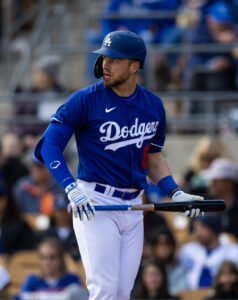
Busch, 25, was a first round pick of the Dodgers, getting selected 31st overall in 2019. He has since been posting excellent numbers in the minors, showing both tremendous power and patience in the box. He spent all of 2021 in Double-A, walking in 14.1% of his plate appearances and hitting 20 home runs in 107 games. Last year, he split his time between Double-A and Triple-A, hitting 32 home runs in 142 games between those two levels, walking in 11.5% of his trips to the plate. His combined .274/.365/.516 batting line translated to a 118 wRC+. Busch was added to the club’s 40-man roster in November to protect him from being selected in the Rule 5 draft. He’s off to a roaring start here in 2023, hitting .337/.461/.506 through 21 Triple-A games.
If there’s a knock on Busch, it’s on the defensive side of things. A first baseman in college, he’s spent a bit of time there recently but has seen the bulk of his action as a professional at second base. He’s also had short stints at third base and left field. Playing all of those different positions is less a reflection of versatility and more a suggestion that he’s not really a strong defender and is a work in progress as the Dodgers try to find a home for him in the field. Some evaluators have compared him to the player he’s replacing today, Muncy, as both players combine power and plate discipline with some degree of defensive versatility.
The Dodgers had a relatively modest offseason by their standards, letting notable players depart while signing various veterans to one-year deals. That’s allowed them to give some runway to various younger players, such as Miguel Vargas, James Outman, Michael Grove and Ryan Pepiot, though the latter two are now on the injured list. Busch will be latest youngster to get a crack at the big leagues.
Coming into this year, Busch was ranked around the middle of many top 100 prospect lists, including Baseball America, MLB Pipeline, FanGraphs and Baseball Prospectus. The first two of those are potentially significant, given the rules under the new collective bargaining agreement. It’s too late in the season for Busch to get to a full year of service time the traditional way, but his status as a top prospect provides him with an alternate path. Under the new CBA, players with less than 60 days of service time that are on two of the preseason top 100 lists of Baseball America, MLB Pipeline or ESPN can earn a full year of service regardless of when they were called up if they finish in the top two of Rookie of the Year voting.
That may end up being a fairly moot point in this case, as it seems possible that Busch will only get a brief stay in the bigs while Muncy is on the paternity list. But if he somehow manages to stick around and perform well enough to get some decent Rookie of the Year votes, he could get himself to that full year. He didn’t crack the top 100 at ESPN but the BA and MLB Pipeline ranks are enough to get that on the table.
Image courtesy of USA Today Sports.
Logan O’Hoppe To Miss 4-6 Months With Torn Labrum
Angels manager Phil Nevin told reporters (including Sam Blum of The Athletic) today that catcher Logan O’Hoppe has a torn labrum on his left (non-throwing) shoulder that will require surgery. The 23-year-old catcher, who was placed on the 10-day injured list yesterday, is expected to miss four to six months, potentially putting his season in jeopardy.
O’Hoppe was acquired by the Angels at the trade deadline last season in the deal that sent outfielder Brandon Marsh to the Phillies. A consensus top-50 prospect in the sport entering the 2023 season, O’Hoppe earned the Angels’ starting catching job out of camp this season despite having just five games of big league experience under his belt as Max Stassi began the season on the injured list. The youngster was off to an impressive start this season, with a .283/.339/.547 slash line across 16 games that was good for a wRC+ of 142.
Losing such a productive bat for most, if not all, of the remainder of the season is a massive blow to the Angels, who have largely seen their offense struggle outside of superstars Mike Trout and Shohei Ohtani, with only O’Hoppe and outfielder Hunter Renfroe posting an above average wRC+ so far this season among the rest of the club’s offense.
In addition to losing O’Hoppe’s bat, the Angels now find themselves without either half of their usual starting tandem, as Stassi does not appear to be close to a return from the hip ailment that sidelined him at the start of the season. Until Stassi returns, the Angels figure to use Matt Thaiss, who opened the season as the club’s third catcher, and journeyman Chad Wallach behind the plate. Neither of those options inspire the same confidence that O’Hoppe would, as Wallach sports just a 59 wRC+ in 274 career plate appearances since his MLB debut with the Reds in 2017, while Thaiss only began catching in 2021 and has a career wRC+ of 81 in 298 plate appearances.
Given the worrying situation behind the plate for Anaheim, it wouldn’t be a shock to see the club explore external catching options to supplement their current group. Robinson Chirinos and Austin Romine are available on the free agent market, while Gary Sanchez and Jorge Alfaro are among the catchers with significant big league experience who are on minor league deals in other organizations.
Pirates Extend Contract Of Manager Derek Shelton
The Pirates have extended the contract of manager Derek Shelton, reports Rob Biertempfel of The Athletic. The terms of the deal are not yet known.
The Bucs are off to a hot start to the season, sitting at 14-7 entering play Saturday, good for second place in the NL Central as they look to emerge from a lengthy rebuild. The 52-year-old skipper has overseen plenty of lean years in Pittsburgh, and so his career managerial record of 156-249 with the Pirates is not necessarily a reflection on his management.
It’s always challenging to assess the performance of a manager when the team is deep in a rebuild and focused more on the prospects in its minor league system than the big league roster. As such, the back-to-back 100-loss seasons Shelton oversaw likely wouldn’t have been much different with another manager at the helm. Evidently, the franchise is comfortable with the direction they’re in with Shelton at the helm. While 21 games is a small sample size, the Pirates were more aggressive than the past in free agency this winter and it won’t hurt that Shelton’s team is getting results. Here’s what GM Ben Cherington had to say to The Athletic last year on Shelton:
“I love working with Shelty and this staff. They work their tails off every day and care so much about getting this right. I’m so confident at the level of effort this staff puts in and I’m looking forward to this group benefiting from the fruits of their labor. I think they will as our roster matures and gets stronger.”
Shelton was hired by the Pirates after a tumultuous 2019 season which saw the team lose 93 games, deal with clubhouse problems and ultimately dismiss general manager Neal Huntington and manager Clint Hurdle. Cherington and Shelton were brought in to oversee bringing the club back to relevance, and while the past three seasons have been a difficult watch, it does appear that the team is close to turning a corner.
Prior to joining the Pirates, Shelton had served as the Twins’ bench coach. He had interviewed for a number of other managerial openings, but the Pirates were the first to hand him the top job.
Guardians Planning To Promote Logan Allen
The Guardians have informed reporters, including Mandy Bell of MLB.com, that pitching prospect Logan Allen is the planned starter for Sunday’s game, weather permitting. Allen isn’t currently on the 40-man roster and will require a corresponding move.
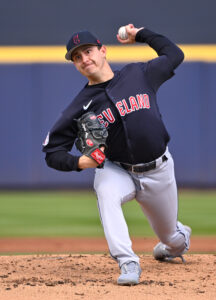
The 24-year-old Allen, not to be confused with former Guardian Logan Allen, was selected by the Guards in the second round of the 2020 draft. He has since shot up through the minor leagues, racking up huge strikeout totals along the way. In 2021, he pitched in High-A and Double-A, posting a 2.26 ERA in 111 1/3 innings. He struck out 33.2% of batters faced while walking just 6% of them. Last year, he tossed 132 2/3 innings between Double-A and Triple-A. His 4.75 combined ERA doesn’t look especially impressive, but the under-the-hood numbers are much nicer. He punched out 31.5% of opponents while giving free passes 9.1% of the time. The ERA was likely inflated by a .335 batting average on balls in play and 68.5% strand rate, both of those being on the unlucky side of typical averages.
Coming into the season, he was ranked the #85 prospect in the game at Baseball America, though he’s since moved up to #80. FanGraphs had him at #57 and ESPN at #53, though he didn’t crack the list at MLB Pipeline. He’s made three starts at Triple-A so far this year with a 1.26 ERA, 34.5% strikeout rate, 8.6% walk rate and 57.6% ground ball rate.
The Guardians have been dealing with a few injuries to their rotation this year, with Triston McKenzie on the 60-day injured list due to a teres major strain and Aaron Civale on the 15-day IL due to a strained oblique. That pushed Peyton Battenfield and Hunter Gaddis into the mix, though the latter posted a 7.64 ERA in four starts and was optioned to the minors this week. The Guardians have a seemingly never-ending supply of intriguing pitching prospects and will give Allen a shot at taking that open rotation spot this weekend as long as Mother Nature cooperates.
Since Allen is getting promoted a few weeks into the season, he can’t earn a full year of service time the traditional way. A major league season is 187 days long but a player needs 172 days in the big leagues, or on the injured list, to earn a full year. Allen would fall short of that even if he were to remain in the majors the rest of the way. However, there is one way he could still earn that full year of service, courtesy of the latest collective bargaining agreement. Any player with less than 60 days of MLB service coming into the season who was on at least two of the preseason top 100 prospect lists at Baseball America, ESPN or MLB Pipeline receives a full year if they finish in the top two in Rookie of the Year voting. This already happened once when Adley Rutschman finished second in the Rookie of the Year voting to Julio Rodríguez last year. Rutschman had missed the start of the season on the injured list but was able to get a full year of service regardless.
As mentioned, Allen didn’t crack the MLB Pipeline list but was on the BA and ESPN lists, making him eligible for that full year. But doing so would require him not only sticking on the roster, but thriving enough to earn those votes at year’s end.
Image courtesy of USA Today Sports.
Garrett Mitchell Will Likely Require Shoulder Surgery, Putting Season In Jeopardy
Brewers manager Craig Counsell informed reporters, including Curt Hogg of the Milwaukee Journal Sentinel, that outfielder Garrett Mitchell‘s MRI revealed significant damage. Counsell said that Mitchell will seek a second opinion but surgery is likely and the remainder of his season is in jeopardy. Mitchell had been placed on the 10-day injured list earlier this week with a left shoulder subluxation.
Mitchell spoke after Counsell and provided more information to reporters, including Adam McCalvy of MLB.com. He said the plan is to go see Dr. Neal ElAttrache in Los Angeles on Monday. If it is deemed that surgery is necessary, that will take place the following day.
At this point, it’s not a foregone conclusion that Mitchell will go under the knife, but it seems the most probable course of events. If it does indeed come to pass, it will be a very frustrating setback for Mitchell and the Brewers, given the promising start to his career. Between his debut last season and the start of this year, he’s been in 44 major league contests so far. He’s struck out in a worrisome 40% of his plate appearances but has still managed to be productive. He’s hit five home runs and currently has a batting line of .286/.341/.462, which translates to a 121 wRC+. He’s also stolen nine bases and been graded well for his defensive work in center field.
Whether Mitchell is ultimately out for the remainder of the season or some shorter timeline, the Brewers will be pressing on without him for the foreseeable future. Joey Wiemer, who had been playing right field, took over center field last night and is in there again tonight, pointing to him having the job for now. With Tyrone Taylor also on the injured list, Brian Anderson might now be the regular right fielder. He had been playing third base but that could now fall to Owen Miller and Mike Brosseau. Blake Perkins is also now up with the club and can provide cover at all three outfield spots. Outfield prospect Sal Frelick won’t be an option in the short term, as he has been placed on the injured list in the minors due to a thumb sprain, per Hogg.
Kris Bubic To Undergo Tommy John Surgery
Royals left-hander Kris Bubic will undergo Tommy John surgery, per Anne Rogers of MLB.com. That will put him out of action for the remainder of 2023 and a portion of the 2024 season as well. The typical recovery timeline for Tommy John surgery is roughly 14-18 months. Bubic was placed on the 15-day injured list last week but the club will inevitably move him to the 60-day once they need a roster spot.
It’s a very unfortunate setback for Bubic, 25, who was showing some positive signs here in 2023. Coming into this year, he had a 4.89 ERA through 309 innings, a somewhat disappointing mark for a guy who was selected 40th overall in 2018 and had been a touted prospect in the years after that. But through his first three starts this year, he had a 3.94 ERA and possibly was even better than that number would indicate. He struck out 23.5% of batters faced and walked just 2.9%, big improvements over his 20% strikeout rate and 10.5% walk rate coming into the year. He also saw his ground ball rate jump to 52.1%, which was just 44.3% in prior seasons.
This is just three starts and small sample caveats certainly apply, but it’s also worth pointing out that Bubic had added a slider to his repertoire this year. Both Eno Sarris of The Athletic and Jake Mailhot of FanGraphs wrote pieces last week that highlighted Bubic’s improved arsenal in the early parts of the year, suggesting that his better results might have been for real and perhaps could have gotten better going forward. Though his 2023 ERA was about a full run better than his career mark, he had an even shinier 2.71 FIP and 3.45 SIERA. Again, it’s just three starts, but it was backed up by actual changes to his arsenal and might not have been just noise. Bubic and the Royals will now have to wait over a year to test those changes over a larger sample.
It’s obviously a blow for Bubic personally but also for the Royals, who have made some decisions that put their fortunes in the hands of young starters. They have used many of their early draft picks in recent years on pitchers, with not a lot of success. Between 2015 and 2018, Bubic, Brady Singer, Josh Staumont, Daniel Lynch, Jackson Kowar and Jonathan Bowlan were all selected in the first 65 picks of their respective drafts. Up until last year, none of that group had found much major league success. Singer finally bucked the trend in 2022 by posting a 3.23 ERA in 153 1/3 innings and it seemed there was a chance that Bubic was following him. But now the latter is out for the remainder of the year and the former is struggling to a 8.14 ERA through his first four starts.
This loss will only compound the various struggles that the Royals are facing right now, as they have limped out to a 4-15 start, with their .211 winning percentage below all MLB teams except for the Athletics. Without Bubic, the Royals will proceed with four regular starters in Zack Greinke, Jordan Lyles, Brad Keller and Singer. Tonight, Taylor Clarke is serving as an opener in front of Ryan Yarbrough, who figures to get the bulk of the innings. Lynch is on the IL with a shoulder strain but could factor in whenever he’s healthy.
Bubic qualified for arbitration this past offseason as a Super Two player, meaning this is his first of four arb seasons. He and the club agreed to a $2.2MM salary for this year. Even though he’s going to miss the vast majority of the season, he’ll be in line for a similar salary next year, since the arb system is designed so that salaries almost never go down. He can then go through the arbitration system twice more after that before he’s slated for free agency after 2026.
NPB To MLB: 7 Players To Watch
A new wave of NPB players have chosen to pursue their big-league dreams in recent years. Just this past offseason, Kodai Senga signed a five-year, $75MM deal with the Mets, Masataka Yoshida signed a five-year, $90MM deal with the Red Sox, and Shintaro Fujinami signed a one-year, $3.25MM deal with the Athletics. One offseason prior, Seiya Suzuki signed a five-year, $85MM deal.
Making the move from NPB to MLB is a complicated process. A player needs to have nine seasons of experience on the first team (i.e. the NPB “major league” club, as opposed to their minor league team) before they can become an overseas free agent. At the earliest, a player drafted out of high school becomes a free agent at age 27 and a player drafted out of college becomes one at age 31. This is a long period of time and can take even longer if a player misses time due to injury. Players who want to make the move sooner instead opt to use the NPB-MLB posting system. The posting system grants all 30 MLB teams the right to negotiate with a player after posting, but the team is subject to paying a posting fee based on the amount of guaranteed money in the contract.
The two main difficulties with the posting system are that 1.) players need their team’s permission to be posted, and 2.) players need to wait several years before being classified as “professionals” rather than “amateurs” under Major League Baseball’s international free agency standards. In order to be considered a “professional” and thus be exempt from MLB’s hard-capped bonus pool system for international amateurs, a foreign-born player must be at least 25 years of age and have at least six years of experience in a professional league (NPB, in this case). Shohei Ohtani knew this and chose to pursue a jump to MLB at age 23 anyway, limiting himself to a signing bonus a little north of $2.3MM because his age made him an “amateur.” Had he waited two more years, Ohtani could have potentially commanded 100 times that sum as a “professional” under MLB’s classifications. It was a sizable bet on himself, but it looks like one that will pay off.
Some teams are traditionally open-minded about letting players pursue their MLB dreams, most notably the Nippon Ham Fighters, while other teams such as the Yomiuri Giants and the Fukuoka Softbank Hawks have traditionally not given permission to their players when they ask to be posted for MLB clubs.
This series will keep track of NPB players who may be making their way to the MLB in the near future.
Let’s get started with players who may be available in the 2023 offseason.
Players likely available in the 2023 offseason (most rumored or have publicly announced desire to play in MLB)
1. Yoshinobu Yamamoto
Yoshinobu Yamamoto is a 24-year-old right-hander for the reigning Pacific League and Nippon Series champions Orix Buffaloes. He began his career as a starter but moved to the bullpen in 2018 and became one of the best relievers in NPB. He was moved back to the rotation in 2019 and established himself as an elite starter by leading the Pacific League with a 1.95 ERA.
Yamamoto has since become the undisputed ace of NPB. He’s won the Sawamura Award — the Japanese equivalent of the Cy Young Award — and the Pacific League MVP Award in back-to-back seasons. He posted an insane 1.39 ERA, 206 strikeouts, 28% strikeout rate, and 5.4 walk rate in 2021, and followed that up with a 1.68 ERA, 205 strikeouts, a 27.4 strikeout rate, and a 5.6 walk rate in 2022. Yamamoto also won the Gold Glove award in each of those seasons. MLBTR’s Steve Adams wrote more on Yamamoto back in Februrary. Some scouts believe that Yamamoto is ahead of Senga.
The Pacific League MVP relies on a deep six-pitch repertoire and elite control to pile up strikeouts. Yamamoto primarily leans on his mid-90s fastball, splitter, and curveball, but he occasionally mixes in a cutter, two-seamer, and slider. The right-hander is known for his unique training style, with a focus on flexibility and mobility as well as using javelin-like and hammer-like tools. He also has a personal chef/nutritionist to manage his diet. While he has not had a major injury so far in his career, the only concerns with the Buffaloes ace are his slight frame (5’10″, 175 pounds) and adjusting to the grueling MLB schedule. Although he has not thrown on a four-day rest schedule, he has showcased his durability by throwing over 190 innings in each of the past two seasons.
As MLBTR’s Tim Dierkes wrote in his recent 2023 FA class power rankings, Yamamoto’s contract could exceed Masahiro Tanaka’s contract with the Yankees in 2014. Tim wrote: “Ten years after the Tanaka deal, I feel Yamamoto is indeed capable of reaching $200MM before accounting for a posting fee.”
Yamamoto is off to another fantastic start this season. In the two games he’s started so far, he has a 0.75 ERA and 15 strikeouts in 12 innings of work.
2. Yuki Matsui
Yuki Matsui is a 27-year-old left-handed reliever for the Tohoku Rakuten Eagles. He has a career 2.46 ERA, 31.9% strikeout rate, 201 saves, and 68 holds in 447 appearances. Matsui has a four-pitch arsenal featuring a four-seam fastball that goes up to 96mph but averages between 92-94, a dominant splitter and slider, and a lesser-used curveball.
Matsui is on track to become a true international free agent this offseason, so he won’t need to utilize the posting system to gauge interest from MLB clubs. Japanese media is already speculating that he may sign with an MLB team. Matsui has said he is focused on the upcoming season but is open to the move. Sports Hochi reported that Matsui and the Eagles have discussed future MLB plans during contract negotiations over the years.
Matsui first hit the national spotlight as a high school player at the 2012 Summer Koshien Tournament, the Japanese equivalent of March Madness, where he set the tournament record for most strikeouts in a single game with 22, and the longest consecutive strikeouts with 10. He finished that tournament with the most strikeouts in a single tournament by a lefty with 68.
Matsui came into the league as a starter but was moved to the bullpen in 2015 and since then has consistently been one of the best closers in the NPB. Out of the seven seasons he was the primary closer, Matsui recorded over 30 saves in five of them. His only “down” year came in 2018 — he still posted a 3.34 that season — but he bounced back with a career-high 68 appearances and 38 saves in 2019. He was moved to a starting role in 2020, before ultimately moving back to the bullpen at the end of the season where he has remained until now. Matsui struggled adjusting to the WBC ball, which is closer to the MLB ball, so that may be a concern moving forward.
Despite his difficulties at the WBC, Matsui had a terrific start to the season. He’s thrown five shutout innings, recorded four saves and fanned eight of his 18 opponents (44.4%). Dating back to 2021, Matsui has a 1.26 ERA in 99 2/3 innings of relief work.
3. Shota Imanaga
Shota Imanaga is a 29-year-old left-handed starting pitcher for the Yokohama DeNa Baystars. Fans might recognize Imanaga’s name after his start for Team Japan in the World Baseball Classic final against Team USA. The left-hander has a 3.24 ERA, 24.3 strikeout rate, 7.3 walk rate and 854 2/3 innings in 136 career starts. He had a career year last season, posting a 2.26 ERA, 23.6 strikeout rate and 5.2 walk rate in 143 2/3 innings. He also recorded his first no-hitter in June.
The Baystars ace primarily throws four pitches, including a 91-94 mph fastball, a changeup that is close to a split-change, a cutter, and a curveball, while occasionally mixing in a slider. While he does not have an overpowering fastball, he has elite command and uses his changeup to get strikeouts. He had shoulder surgery in 2020 but has made a full recovery, and shoulder trouble hasn’t been a recurring issue for him.
Imanaga has expressed his desire to pitch in the big leagues since 2021 but won’t be an overseas free agent until the 2025 season. Sponichi reported in December that Imanaga planned to sign with the U.S.-based agency Octagon to help talks toward a posting agreement. The Baystars have never posted a player before, so it is unclear if they are open to posting Imanaga. However, Imanaga is set to become a domestic free agent within NPB this offseason, so if the Baystars do not allow Imanaga to go to the big leagues, he could potentially move to another NPB team.
Imanaga is yet to pitch for the first team this season as the Baystars manage his workload after pitching for Team Japan. He’s completed his minor league starts with no complications and is set to make his regular-season debut with the first team soon.
4. Kona Takahashi
Kona Takahashi is a 26-year-old right-handed starter for the Saitama Seibu Lions who had his career-best season last year. In his 26 starts, Takahashi recorded a 2.20 ERA and struck out 18.2% of hitters faced in 175 2/3 innings. He was wilder earlier in his career, walking more than 12% of his opponents, but has improved his command more recently. Takahashi has a career 3.55 ERA, 17.4% strikeout rate, and 9% walk rate in 133 starts. He primarily relies on four pitches: a fastball that sits at around 93-95mph, a splitter, a slider, and a cutter, while occasionally throwing a curveball.
Takahashi called MLB “the world’s greatest peak” and said he was inspired by former teammate and now Toronto Blue Jays pitcher Yusei Kikuchi. “Yusei-san changed my baseball career. I want to give back to him by performing at the highest level and even surpassing him,” Takahashi said. He attended Game 4 of the 2022 World Series in Philadelphia and said “The atmosphere was amazing and I thought that I’d love to pitch here [in MLB].”
Despite Takahashi’s wishes, the Lions may not post him this offseason. Lions GM Hisanobu Watanabe said that there are no plans as of right now to post Takahashi. “We’ve just listened to his [Takahashi’s] wishes at this point. We’ve discussed things of that nature with him before, but it’s not a story of when we are going to post him,” Watanabe said. The right-hander wants to be posted in the near future since the earliest he can earn his overseas free-agent rights is 2026. The good news for Takahashi is that his manager is former New York Met Kazuo Matsui, who is open-minded about the possible move. “If he reaches another level as an ace, he might get closer to that goal,” Matsui said.
Takahashi is doing his best to reach that next level, with a 0.39 ERA, 27.4% strikeout rate and 23 innings pitched in his three starts. He has not given up a run in 18 consecutive innings.
5. Naoyuki Uwasawa
Naoyuki Uwasawa is a 29-year-old right-handed starter for the Nippon Ham Fighters who has a 3.29 ERA, 19.9% strikeout rate, and 8% walk rate in 148 career starts. The right-hander throws a variety of pitches, including a low-90s fastball, cutter, slider, splitter, knuckle curve, changeup, and a two-seam fastball (usage in that order). His four-seam fastball was hit hard last season, with opponents batting .272 against it.
Uwasawa announced his desire to pitch in the majors at his contract negotiations last December and requested to be posted in the 2023 offseason. He said that he was inspired when he participated in the 2018 MLB Japan All-Star Series. “I’ve always wondered what it’s like to play in a league with players coming from around the globe, and it’s the type of experience I can’t miss if I have the chance to. I only have a limited amount of time to take on the challenge, so if I have the opportunity I would take it,” Uwasawa said. Uwasawa began working with Driveline last offseason to help prepare his transition to the big leagues, looking to optimize his pitching mechanics and improve the quality of his slider.
Uwasawa has had a poor start to the season, with a 6.46 ERA and 16.9% walk rate through 15 1/3 innings in his three starts.
Younger stars to keep an eye on
The following players are already some of the biggest stars in the NPB, but are likely unavailable until the 2025-26 offseason due to their age.
1. Munetaka Murakami
Munetaka Murakami, nicknamed Mura-Kamisama (Mura-God), is a 23-year-old corner infielder for the Tokyo Yakult Swallows. He burst onto the scene in 2019, with 36 home runs and 96 RBIs, winning the Central League Rookie of the Year Award in the process. He was the back-to-back Central League MVP in 2021 and 2022. Murakami has a career slash line of .281/.405/.583, hitting 160 homers and driving in 430 runs, along with a .988 OPS and 166 wRC+. Murakami’s 2022 season was nothing short of historic. He batted .318/.458/.710 with 56 home runs and 134 RBIs, along with a jaw-dropping 1.168 OPS, 221 wRC+ and 10.3 WAR. He became the youngest-ever Triple Crown winner in NPB and set the single season record for home runs hit by a Japanese player.
Murakami’s leap in 2022 can likely be attributed to overcoming hard-thrown fastballs. Hitting high velocities was a weakness early in his career, with batting averages of .088 in 2019, .167 in 2020, and .229 in 2021 against fastballs thrown over 150 km/h (93.75 mph). In 2022, Murakami hit .327 against those pitches. Consistent growth in this area will be essential to Murakami’s success in MLB, where the average velocity is higher than the NPB. Murakami is not necessarily known for his defense at third base. In 2022, he recorded 15 errors, the second-highest in all of NPB and the most among third basemen. If he cannot improve his defense as he did with his contact against higher velocity, he most likely projects to be a first baseman in MLB.
Murakami signed a three-year deal this past offseason that came with a guarantee that he will be posted in the 2025-26 offseason. By 2025, Murakami will be 25 years old and shed his “amateur” status under MLB rules, thus exempting him from the bonus pool system. There is a clause that will allow him to get posted sooner if the age-25 rule is lowered.
Murakami has had a slow start to the season, hitting just .189/.328/.373 with two homers and a 33.3% strikeout rate in a small sample of 66 plate appearances. The good news is that he is walking in 18.2% of plate appearances, and hitting .375 with runners in scoring position.
2. Roki Sasaki
Roki Sasaki is a 21-year-old right-handed starter for the Chiba Lotte Marines, known as “The Monster of Reiwa”, who is entering his fourth season in NPB. Sasaki has been highly scouted since his high school days, throwing 100mph fastballs with ease. He was drafted in 2019 by the Marines, who took a patient approach to his development. The 6’3″ right-hander clearly had an outstanding arsenal, but teams were concerned about his thin frame, in-game stamina, and the repeatability of his mechanics. He did not pitch in 2020 and only started in 11 games and pitched 63 1/3 innings in 2021.
The Marines’ patience paid off, with Sasaki quickly becoming one of the most dominant starters in NPB. In his first full year in the Marines’ rotation, the phenom recorded a 2.20 ERA and 1.70 FIP, striking out 35.3% of hitters while walking just 4.7% in 129 1/3 innings. Sasaki became the 16th pitcher in the history of NPB to pitch a perfect game last April, and followed up the performance by throwing eight more perfect innings in his next outing, before getting pulled with 102 pitches. In the 17 perfect innings, Sasaki struck out 33 of the 51 batters faced. Sasaki has a three-pitch mix, a fastball that averages between 99-101mph and tops out at 104mph, a devastating splitter, and a slider.
As of right now, there is no clear timetable for Sasaki’s jump to Major League Baseball. Sasaki will not hit the professional experience threshold and does not turn 25 years old until 2026, so unless he takes the Ohtani route of posting before age 25, the earliest that Sasaki will make his MLB debut is in 2027. Sasaki said in March that “Before thinking about the timing of moving to the majors, playing in Japan comes first, and I think that things will become more clear after that.”
Sasaki has picked up right where he left off last season and has yet to allow a run in his two starts. Last week, he outdueled Yamamoto and shut down the Buffaloes, only allowing one hit and striking out 11 in seven innings.
Honorable Mentions
The following players have either expressed their desire to play in the big leagues, been rumored by Japanese media, or have drawn interest from MLB scouts but have factors (age, team stance on posting system) preventing a potential move:
Kazuma Okamoto, Corner Infielder, Yomiuri Giants; Shosei Togo, right-handed starting pitcher, Yomiuri Giants; Keiji Takahashi, left-handed starting pitcher, Tokyo Yakult Swallows; Taisei Ohta, right-handed reliever, Yomiuri Giants; Hiroto Takahashi, right-handed starting pitcher, Chunichi Dragons; Kaima Taira, right-handed starting pitcher, Saitama Seibu Lions; Atsuki Yuasa, right-handed reliever, Hanshin Tigers; Shinnosuke Ogasawara, left-handed starting pitcher, Chunichi Dragons
Twins Extend Pablo Lopez
April 21: The Twins formally announced this morning that they’ve signed Lopez to a four-year extension, covering the 2024-27 seasons. FanSided’s Robert Murray reports that the contract breaks down in the form of a $1MM signing bonus, an $8MM salary in 2024 and annual salaries of $21.5MM from 2025-27.
April 17: The Twins are keeping their big offseason trade acquisition for the long haul. Minnesota is reportedly in agreement with right-hander Pablo Lopez on a four-year, $73.5MM contract extension. The deal is pending a physical. Lopez is represented by Excel Sports Management.
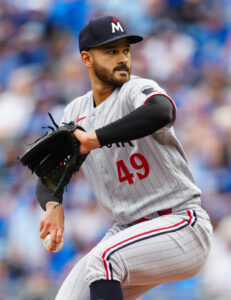
Lopez, 27, came to the Twins alongside top shortstop prospect Jose Salas and minor league outfielder Byron Chourio in the January trade that sent infielder Luis Arraez to the Marlins. He’s already locked into a $5.45MM salary for the ongoing 2023 season, which is his second of three scheduled arbitration seasons. The new contract with the Twins will buy out Lopez’s final arbitration season and what would’ve been his first three free-agent seasons; once completed, the Twins will have Lopez signed through his age-31 season.
Assuming Lopez would’ve landed somewhere in the $10MM range for his final arbitration season, the contract effectively buys out his first three free-agent years for a combined $63MM, give or take a bit. The deal values Lopez at somewhere around $20-21MM per free-agent season. That annual range takes him past the AAVs that mid-rotation arms like Taijuan Walker ($18MM) and Jameson Taillon ($17MM) agreed to this past offseason.
From a structural standpoint, there are some similarities to the recent extension between the Giants and their own top starter, Logan Webb. That $90MM deal, a record for the three-plus service class, also bought out three free-agent seasons. However, Webb’s deal bought out two arbitration seasons, and his first arbitration salary ($4.6MM) topped that of Lopez ($2.425MM), which helps to explain the gap between the final guarantees on the two deals.
Lopez could certainly have gone the year-to-year route, reaching free agency in advance of his age-29 season and perhaps setting himself up for a five- or even six-year deal in the process. Of course, that’d have been a gamble to some extent, given the ever-present risk of injury that’s inherent to all pitchers. That’s particularly notable for Lopez, who has thrice been on the injured list due to right shoulder troubles to this point in his career.
Through his first four starts with the Twins, Lopez has looked like a star. After pitching to a 3.75 ERA in a career-high 32 starts and 180 innings in 2022, he’s surged out to a 1.73 ERA through four starts and 26 innings with the Twins. Lopez’s 95.4 mph average fastball is a career-best mark, and his 33.7% strikeout rate trounces the 23.2% mark he posted in parts of five seasons in Miami. He’s managed to up his velocity and strikeout rate without sacrificing his pinpoint command; this year’s 6.1% walk rate tops the 6.7% mark he posted in his Marlins career.
Much of Lopez’s success to date can be attributed to a newly unveiled sweeper that has thus far befuddled opposing batters. Opponents are batting just .111 against the pitch with a massive 50% whiff rate, per Statcast. Between that and the gains on his fastball, Lopez is unsurprisingly boasting career-best marks in swinging-strike rate and opponents’ chase rate. It’s only a sample of four starts, of course, but the results have generally exceeded even the most optimistic expectations for the righty. Time will tell whether he can sustain it all over a larger sample — a .236 BABIP and 89.1% strand rate both seem ripe for regression — but the Twins can only be thrilled with their end of that offseason trade.
With Lopez now locked in through at least the 2027 season, he joins Carlos Correa and Byron Buxton among the focal points of the Twins’ core. The Twins control catcher Christian Vazquez, second baseman Jorge Polanco and righty Chris Paddack through the 2025 season, but Correa, Buxton and now Lopez are the only players on guaranteed deals beyond that ’25 campaign. Of course, the Twins will have plenty of core players in arbitration at that point: closer Jhoan Duran, starter Joe Ryan and corner infielder Jose Miranda among them. Further cost certainty through extensions among that group or touted youngsters like Edouard Julien remain possible.
Looking to strictly the rotation, both Lopez and Ryan are now under club control through the 2027 season — which is slated to be Ryan’s final year of arbitration eligibility. Each of Sonny Gray, Tyler Mahle and Kenta Maeda will be up for free agency at the end of the current season, so it’s understandable that the Twins had extra incentive to lock up their top starter and lock in some additional continuity.
Minnesota also has towering 6’9″ righty Bailey Ober under club control through at least that same 2027 season, and while he opened the season in Triple-A St. Paul, his performance in the big leagues to date suggests he can be a part of that long-term starting staff (3.82 ERA, 24.3% strikeout rate, 5% walk rate in 148 1/3 innings). The aforementioned Paddack is signed through 2025 under the three-year, $12MM deal he signed while rehabbing from 2022 Tommy John surgery. Other in-house rotation options beyond the current campaign who’ve already had some big league seasoning include prospects Louie Varland, Simeon Woods Richardson and Josh Winder, though Winder’s frequent shoulder issues could eventually push him more toward to the bullpen.
Generally speaking, the Twins have shown increased willingness to spend in recent seasons, pushing their payroll up into the $150-160MM range in both 2022 and 2023. Assuming that’ll continue to be the norm in years to come, there’ll be plenty of room to supplement the core down the line. Lopez’s deal will likely land the Twins between $75-80MM in guaranteed money on the 2024 books, followed by something in the vicinity of $90-95MM in 2025 and around $70MM in both 2026-27 (depending on the extension’s exact year-to-year breakdown). The Twins aren’t and never have been at risk of paying the luxury tax, but they’ve also come quite a ways from their days as a perennial bottom-of-the-scale payroll club.
The trade bringing Lopez to Minnesota originally gave the Twins only two years of club control over Lopez, while Miami picked up three years of control over Arraez. The extension with Lopez more than balances out that disparity in club control, and it comes less than two years after the Twins begrudgingly made the decision to trade rotation stalwart Jose Berrios to Toronto after being unable to come to terms on an extension. Hindsight is always 20/20, but the seven-year extension Berrios inked with the Jays hasn’t panned out at all, and the Twins ultimately found their way to a prime-aged starter who was willing to commit to an extension on more favorable terms.
This surely isn’t exactly how they drew it up dating back to that pivotal trade deadline, but the Twins have added some long-term stability both in the lineup and in the rotation and done so without completely clogging the long-term payroll.
Craig Mish of SportsGrid and the Miami Herald first reported the sides were nearing agreement on a four-year, $73.5MM agreement. Dan Hayes of the Athletic reported the sides had agreed to terms.