
Mets Sign Eduardo Escobar
The Mets announced Wednesday they’ve signed free agent infielder Eduardo Escobar to a two-year guarantee with a 2024 club option. It’s reportedly a $20MM guarantee for the DJ Rengifo y Associates client. Entering the offseason, MLBTR ranked Escobar the game’s #35 free agent, forecasting him for the two-year, $20MM guarantee he ultimately landed.
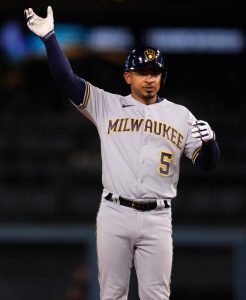
Escobar gives the Mets cover at three infield positions, as he’s coming off a season in which he logged 100+ innings at each of first base, second base and third base. He also had extended run as a shortstop earlier in his career, but he’s only played two innings there over the past three years. Escobar doesn’t rate as a particularly strong defender anywhere on the diamond, but he’s at least capable of bouncing between a few spots on the dirt.
While that defensive versatility is a nice bonus, the calling card with Escobar has been his bat. He’s been an above-average hitter by measure of wRC+ in each of the last three full seasons, unexpectedly morphing into a power threat late in his career. While he hit just 27 home runs over his first 1620 major league plate appearances, Escobar found another gear in that department in 2017. He hit 21 homers in 499 trips to the dish that season, and he’s knocked between 23 and 35 longballs with an above-average ISO (slugging minus batting average) in all three full campaigns since then.
Escobar has gotten to that increased impact without sacrificing much in the way of contact. He’s kept his strikeout rate right around 20% over the course of his career, around three percentage points below the league mark. His contact and swinging strike rates have also hovered right around average. And the switch-hitting Escobar has fared well from both sides of the plate. Going back to the start of 2018, he’s a .283/.333/.482 batter against left-handed pitching; his .249/.311/.473 mark against righties over that same stretch isn’t as impressive, but it’s still around league average output from his weaker side.
There’s a lot to like about Escobar’s offensive game, although he’s not completely without flaws. The Venezuela native had an awful .212/.270/.335 showing over 222 plate appearances in the truncated 2020 season. He bounced back to offer more typical .253/.314/.472 output between the D-Backs and Brewers in 2021. That clearly erased some doubts about Escobar’s 2020 struggles, but he’ll turn 33 years old in January. And even at his best, Escobar has an aggressive approach that tamps down his walk rate and leads to on-base percentages right around the league average.
Escobar is coming off his first career All-Star selection, but that nod was also influenced by the rule requiring an All-Star rep from every team and his presence on a lackluster Arizona club. He’s more solid regular than star, but Escobar was valued around three wins above replacement by each of Baseball Reference and FanGraphs in 2018, 2019 and 2021. The Mets will hope for more of that same steadiness over the coming seasons, and Escobar’s versatility enables Eppler and his staff to be flexible in building the infield around him.
Francisco Lindor and Pete Alonso are ensconced at shortstop and first base, respectively. Second and third base are less settled, though, with Jeff McNeil and J.D. Davis the respective in-house favorites at those spots. Both players can also man the corner outfield, and neither is without question marks. McNeil didn’t make his typical level of offensive impact in 2021, while Davis is a below-average defender at the hot corner. Davis, in particular, has been frequently mentioned as a speculative trade candidate — so much so that he’s even expressed some doubt about whether he’ll be back in Flushing next season. Robinson Canó is also slated to return from a season-long performance-enhancing drug suspension and could factor into the second base mix, although it remains to be seen how much faith a new front office head and manager will have in the 39-year-old veteran.
Jon Heyman of the MLB Network first reported that Escobar and the Mets were in agreement on a two-year contract. Joel Sherman of the New York Post was first to report the $20MM guarantee as well as the presence of a 2024 club option.
Image courtesy of USA Today Sports.
Rangers Sign Jon Gray
The Rangers continue their offseason spending spree, announcing agreement Wednesday on a four-year contract with right-hander Jon Gray. It’s reportedly a $56MM guarantee for the CAA Sports client. Gray will make $15MM apiece over the next two seasons, followed by successive $13MM salaries in 2024-25 on the front-loaded deal.
After signing Marcus Semien to a huge seven-year, $175MM deal and then adding Kole Calhoun to the outfield on another free agent deal, Texas has now addressed its pitching staff with another veteran addition. The Rangers emerged as a suitor for Gray a few days ago, and they beat out the division rival Angels, as well as the Tigers and Mets as teams known to have interest in signing the 30-year-old.
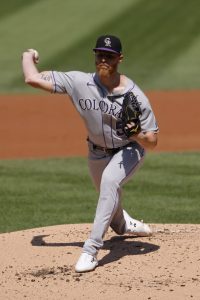 The four-year, $56MM pact exactly matches MLBTR’s projection for Gray, who ranked 19th on our list of the winter’s top 50 free agents. The Rangers’ offer was also north of the three-year extension offer the Rockies reportedly made Gray prior to the end of the season, which was said to be somewhere around $35-$40MM in value. While Gray only got a bit more extra in average annual value, he’ll also gain an extra year of security, and also now get to pitch in a more hurler-friendly venue than Coors Field.
The third overall pick of the 2013 draft, Gray has spent his entire MLB career with Coors Field as his home ballpark, and for the most part has acquitted himself a lot better than most at the notoriously hitter-friendly stadium. Gray has a career 4.54 ERA in home games, with that number inflated by some rough outings over the smaller sample size of 45 1/3 innings over the 2015 and 2020 seasons. While Gray also has a 4.65 ERA over 412 2/3 career innings in road games, several players (both pitchers and hitters) have talked about how playing in Denver’s thin air impacts adjustments throughout an entire season, so it could be that getting out of Coors Field entirely will allow Gray to unlock a new level of performance.
Several rival teams have long speculated that Gray’s stuff would thrive in a more normalized pitching environment, given what he already showed as a Rockie. Gray has a career 46.7% grounder rate, 23.9% strikeout rate, and 7.9% walk rate over his career, all above-average metrics. The righty’s fastball that has averaged 95.2 mph over his career, and that high-velo heater is augmented by an above-average spin rate on his curveball.
Focusing on Gray’s positives while attributing his negatives only to Coors Field isn’t wise, however, as there are some concerns about whether or not Gray can be a true front-of-the-rotation pitcher. He has given up quite a bit of hard contact over his career and his fastball (while quick) is lacking in spin rate. Injuries have also been a factor — Gray tossed only 39 innings in 2020 due to shoulder inflammation, and he missed time this year with a flexor strain and forearm tightness, though those two IL stints only totaled roughly a month.
The Rangers are making a $56MM bet that Gray’s best is yet to come, and it’s a risk the team can afford to take given how much money Texas is reportedly willing to spend on payroll this winter. Between Gray, Semien, and Calhoun, the Rangers have added $44.2MM in average annual value to next year’s payroll alone, which might represent less than half of the team’s work if they really are prepared to top last year’s mark by $100MM.
Gray immediately becomes the most experienced arm of a Rangers rotation that features Dane Dunning, Taylor Hearn, Spencer Howard, Glenn Otto, and A.J. Alexy all in the mix for starting jobs. Dunning and Hearn seem like the only members of that group who are assured of rotation spots, and while Texas won’t sideline all of its younger arms with veteran, there is certainly still room for another notable addition or two beyond Gray.
Beyond the money, Gray doesn’t cost the Rangers anything further in terms of compensation, as the Rockies didn’t issue Gray a qualifying offer. While there was some expectation that Gray might have taken the one-year, $18.4MM contract if Colorado had made it, the amount of interest in Gray’s services makes that scenario seem a little unlikely in hindsight. If Gray had accepted, the Rockies would have still retained a pitcher they had obvious interest in keeping, even if at a higher price point than they would have preferred. Without the QO involved, however, the Rockies now don’t receive any draft pick compensation for Gray’s departure.
Evan Grant of the Dallas Morning News was first to report the Rangers and Gray were closing in on an agreement. Robert Murray of FanSided reported that an agreement had been reached. Jeff Passan of ESPN reported the four-year, $56MM guarantee. Kennedi Landry of MLB.com reported the breakdown of terms.
Photo courtesy of USA Today Sports Images
Blue Jays Sign Kevin Gausman
The Blue Jays have made another big strike in free agency, signing right-hander Kevin Gausman to a five-year, $110MM deal. As per Sportsnet’s Shi Davidi (Twitter link), Gausman will earn $21MM in each of the next two seasons, $22MM in 2024, and $23MM in 2025 and 2026. Gausman is represented by Tidal Sports.
The signing represents the end of a rather lengthy courtship, as the Blue Jays’ interest in Gausman dates back to at least the 2019-20 offseason, when the right-hander was coming off a rough season split between the Braves and Reds. After being non-tendered by Cincinnati, Gausman instead opted to sign with the Giants on a one-year, $9MM deal, and after a very successful 2020 season, he chose to accept the Giants’ $18.9MM qualifying offer to return to San Francisco. The Jays were one of the teams who floated a multi-year offer Gausman’s way, but he turned down the Jays’ reported three-year offer in the $40MM range to instead try and further bolster his value with another strong year with the Giants.
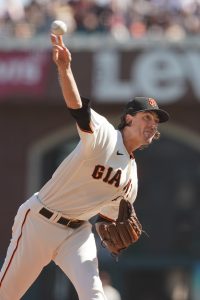 Over two years in San Francisco, Gausman not only bounced back from his tough 2019 numbers, but hit a new plateau of success. Gausman posted a 3.00 ERA/3.38 SIERA over his 251 2/3 innings as a Giant, with an excellent 30% strikeout rate and a solidly above-average 6.5% walk rate.
While Gausman pitched well over 59 2/3 innings in the shortened 2020 season, he duplicated his performance over a full year in 2021, tossing 192 frames and finishing sixth in NL Cy Young Award voting. One notable wrinkle between the two years was that Gausman increased the use of his split-finger fastball to a career-high 36.6% in 2021, and Gausman’s splitter became one of the more devastating pitches in any arsenal in baseball.
The 192 innings marked a new career high for Gausman, though he was a solid workhorse while averaging 183 IP per year from 2016-18 with the Orioles and Braves. It is worth noting that Gausman was much better in the first half (1.73 ERA in 114 2/3 IP) than he was after the All-Star break (4.42 ERA over 77 1/3 IP) last year, yet some regression might have been inevitable given that gaudy 1.73 number. Gausman was also dealing with hip soreness for much of the year, and it could be that he simply started to wear down as many starters did while getting back to a regular workload following the shorter 2020 season.
The Blue Jays got plenty of looks at Gausman during his Orioles days, but while Gausman was a decent but unspectacular member of Baltimore’s rotation, he will now be expected to replicate his front-of-the-rotation numbers from 2020-21. Toronto has been focusing on the pitching market for much of the winter, and in landing Gausman, it is possible the club has now its replacement for Robbie Ray, should Ray sign elsewhere in free agency.
MLBTR ranked Gausman fifth on our list of the winter’s top 50 free agents, and his contract falls a bit shy of our six-year, $138MM projection. However, it appears as though Gausman did leave some money on the table to join the Blue Jays, as SNY’s Andy Martino tweets that the Mets offered Gausman a larger deal than Toronto’s five years and $110MM. The Giants were also known to be making a solid push to retain Gausman, while the Angels, Mariners, and Red Sox all had some degree of interest. Julian McWilliams of The Boston Globe reports that the Sox didn’t offer “anything real” to Gausman during their negotiations.
Gausman (who turns 31 in January) joins Jose Berrios, Hyun Jin Ryu, and Alek Manoah as the four locks in the Jays rotation, with former top prospect Nate Pearson favored for the fifth spot, and Ross Stripling and Anthony Kay on hand if Pearson struggles or runs into more injury problems. Between Gausman’s deal, Berrios’ seven-year/$131MM extension, Ryu signed for two more seasons, and Manoah and Pearson providing lower-cost control as the starters of the future, Toronto has built a solid core of arms that the club hopes can withstand the stiff competition of the AL East.
The Gausman signing could also close the door on the chances of Ray re-signing with the Jays, and Toronto has also lost another starter in Steven Matz, who signed a four-year pact with the Cardinals. It seems possible that the Blue Jays might yet seek out another lower-cost depth arm to compete with Pearson and company, perhaps looking to strike big on another bounce-back candidate as they did with Ray and Matz last winter.
Since Gausman had already been issued a qualifying offer in his career, he was ineligible to receive another one this time around in free agency, meaning the Blue Jays don’t have to give up any draft picks as compensation for his services. The Jays have already landed one compensatory pick when Marcus Semien signed with the Rangers, and would receive another if Ray signed elsewhere since both Ray and Semien rejected Toronto’s qualifying offers. With this extra draft capital on hand, the Blue Jays might be more open to now signing a QO free agent of their own, as they were able to land their sought-after rotation upgrade in Gausman without the cost of any picks.
ESPN.com’s Jeff Passan (via Twitter) reported that the Jays and Gausman had reached an agreement. MLB Network’s Jon Morosi tweeted earlier in the day that the two sides were “gaining momentum towards a deal,” and Morosi’s earlier reports suggested that Gausman would land a five-year deal in the $100MM range, with the Jays as a finalist for the right-hander’s services.
Photo courtesy of USA Today Sports Images
Giants Sign Alex Cobb
The Giants have continued to build their rotation by signing right-hander Alex Cobb. The Beverly Hills Sports Council client signed a two-year contract worth $20MM in guaranteed money, and Cobb is set to earn $9MM in each of the 2022 and 2023 seasons. San Francisco also holds a $10MM club option on Cobb for 2024, with a $2MM buyout.
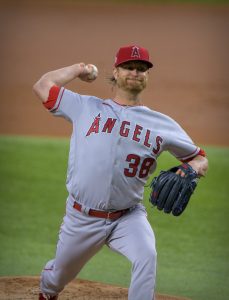
Cobb spent the 2021 campaign in Orange County, after the Angels acquired him from the Orioles last winter. It was an eyebrow-raising move at the time, since Cobb had struggled with both injuries and underperformance over his three seasons in Baltimore. The ten-year big league veteran rewarded the organization’s faith, though, tossing 93 1/3 innings of 3.76 ERA/3.83 SIERA ball across 18 starts.
Along the way, Cobb generated more whiffs than he ever had before. His 11.2% swinging strike rate and 24.9% strikeout percentage were both career-best marks, each checking in a touch above the respective league averages for starting pitchers. Cobb paired that uptick in whiffs with his typically robust ground-ball tendencies (53.3%) and solid control (8.4% walk rate) en route to a nice season.
Cobb’s run prevention numbers were partially propped up by one of the league’s lowest home run rates (0.48 per nine innings). It’s unlikely he’ll continue to be quite that successful keeping the ball in the yard moving forward. But Cobb’s blend of average or better whiffs, control and grounders should allow him to be a solid back-of-the-rotation option even if his homer rate regresses. The bigger concern might lie in his health, as he had separate injured list stints this past season due to blisters and right wrist inflammation. Cobb didn’t seem any worse for wear after returning from his time on the IL, though, with the velocity on all of his offerings remaining intact during his final few outings of the year.
The Giants entered the offseason known to be targeting rotation help. Only Logan Webb remained under club control from the team’s primary five this past season. They’ve already re-signed Anthony DeSclafani and reportedly were nearing agreement to bring Alex Wood back. Kevin Gausman’s departure to the Blue Jays leaves one prominent vacancy, though, and teams often have to rely on seven or eight starters to navigate the injury attrition of a full season.
There’s still room for further additions to the rotation, and there should be plenty of spending capacity with which to do so. Cobb’s two-year, $20MM guarantee narrowly tops MLBTR’s two-year, $16MM forecast entering the winter.
The Giants now have a little more than $113MM in estimated 2022 commitments, according to Jason Martinez of Roster Resource. For a franchise that has logged player payrolls in the $200MM range in the past, a fairly modest Cobb signing shouldn’t be especially prohibitive to the club’s future goals.
Jon Heyman of the MLB Network (Twitter link) first reported that the deal was being finalized, and Susan Slusser of the San Francisco Chronicle reported the club was making a strong run at the right-hander last week. The Athletic’s Ken Rosenthal (via Twitter) reported the $20MM figure, NBC Sports Bay Area’s Alex Pavlovic (Twitter link) reported the existence of the option year, and USA Today’s Bob Nightengale tweeted the salary breakdown.
Image courtesy of USA Today Sports.
Mariners Sign Robbie Ray
The Mariners announced their agreement with reigning American League Cy Young winner Robbie Ray, as first reported by Michael Mayer of MetsMerized (Twitter link). It’s a five-year deal worth $115MM and an opt-out after the third season, reports ESPN’s Jeff Passan (via Twitter). Joel Sherman of the New York Post adds that the contract includes a full no-trade clause in the first two seasons and a trade assignment bonus if he’s moved thereafter. Ray is represented by VC Sports Group.
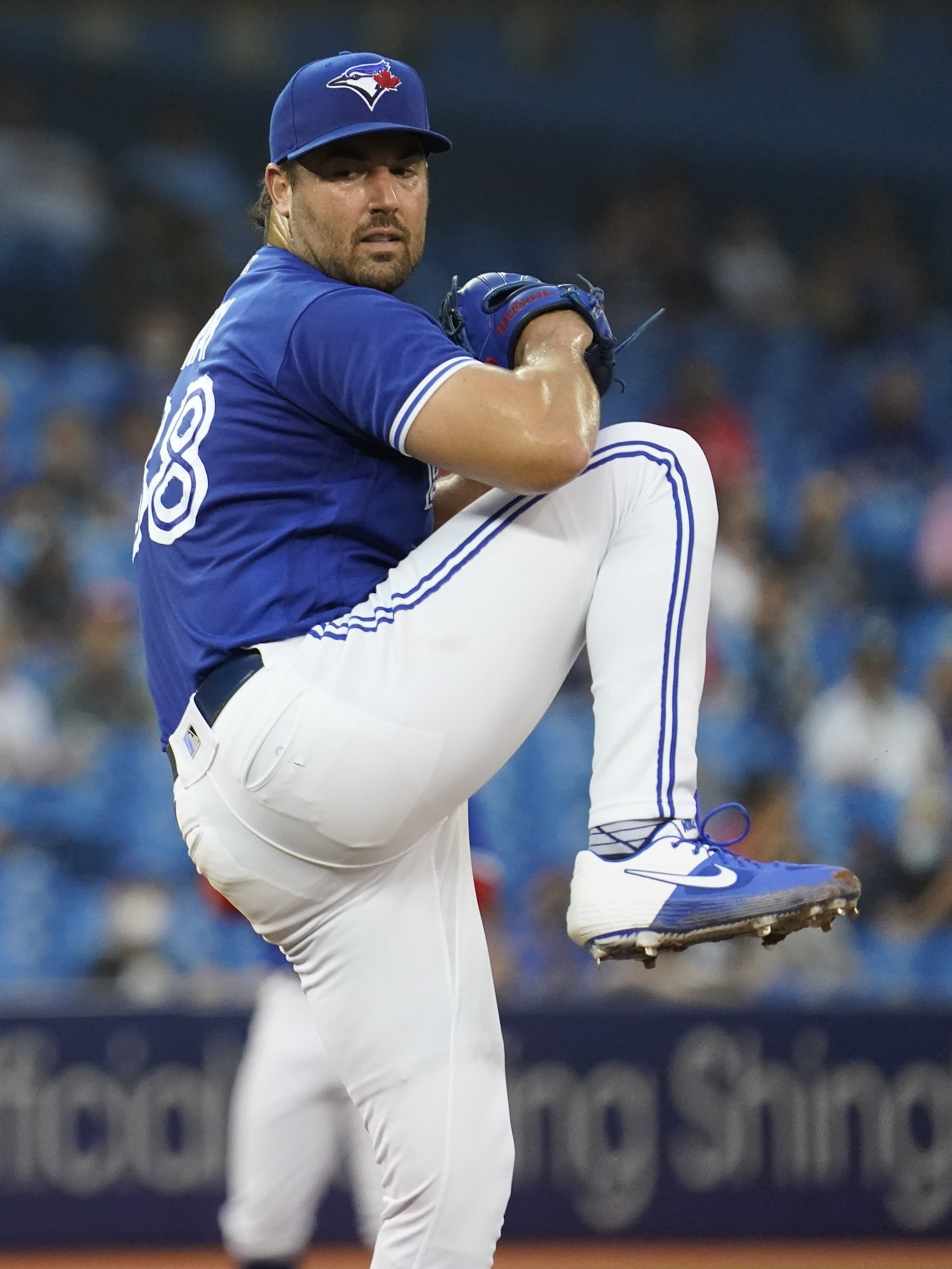
Ray, 30, has long been a premier strikeout arm with command issues, which culminated in a 2020 season that saw him traded from Arizona to Toronto in what amounted to a salary dump. While the lefty didn’t immediately turn things around, the Jays jumped to re-sign him for a year and $8MM right out of the gate in the 2020-21 offseason, clearly believing they could help the lefty find another gear.
Even the Toronto front office’s best-case scenario might not have mirrored the 2021 breakout enjoyed by Ray, who was near-unanimously named AL Cy Young (29 of 30 first-place votes). Ray not only restored his command to prior levels but took it to new heights, walking a career-low 6.7% of his opponents. Ray ramped up the usage of his four-seamer at the expensive of his curveball, largely favoring a two-pitch mix that leaned heavily on his plus slider’s ability to perplex opponents.
The results were obviously outstanding, as Ray compiled an AL-best 2.84 ERA and also paced the American League in innings pitched (193 1/3), total strikeouts (248) and ERA+ (154). Among pitchers with at least 100 innings, Ray’s overall 32.1% strikeout rate trailed only Corbin Burnes, Carlos Rodon, Max Scherzer, Freddy Peralta and Gerrit Cole. His 15.5% swinging-strike rate ranked third among the 129 hurlers who tossed 100-plus frames.
Ray was still prone to the long ball, evidenced by an unsightly 1.54 HR/9 mark, but his ability to keep runners off the basepaths led to nearly 70 percent of those long balls coming with the bases empty. It’s fair to wonder how much concern over that penchant might have impacted his market and kept him from reaching a sixth guaranteed year, but one would also imagine that a move to Seattle and a move out of the generally hitter-friendly AL East will only help to lower that mark.
With Ray departing the Blue Jays, it’s hard to ignore the striking similarity between his contract and the $110MM guaranteed by his former team to another free-agent starter: righty Kevin Gausman. Perhaps the Jays weren’t keen on including an opt-out in the deal, or perhaps they just generally prefer Gausman to Ray when all is said and done. Toronto did pursue Gausman both in the 2019-20 and 2020-21 offseasons, so he’s clearly been of interest to GM Ross Atkins & Co. for quite some time.
In signing Ray, who rejected a qualifying offer in Toronto, the Mariners will surrender their third-highest selection in the 2022 draft. Toronto, meanwhile, will pick up a compensatory pick at the end of the first round by virtue of the fact that Ray signed for more than $50MM in guaranteed money.
With the Mariners, Ray will head up a rotation that also includes lefty Marco Gonzales, righty Chris Flexen and righty Logan Gilbert. Gonzales has long been a steady and durable source of above-average innings, while Flexen proved to be a savvy KBO reclamation project for president of baseball ops Jerry Dipoto and his staff this past offseason. Gilbert, meanwhile, is a former first-round pick and top-end pitching prospect who struggled in the middle of the 2021 season but bookended those struggles with a strong start and strong finish to the season.
Other options in the Seattle rotation currently include Justus Sheffield and Justin Dunn, though the Mariners are deep in tantalizing pitching prospects after a protracted rebuilding effort. Top prospects George Kirby, Matt Brash and Emerson Hancock are all progressing through the system, with Brash and Kirby in particular not far from big league readiness. Lefty Brandon Williamson, too, could emerge as an option before long.
Of course, it’s fair to wonder with all that pitching depth and with a good bit of outfield depth, if the Mariners might not choose to trade for another established rotation piece. Ray figures to be the big-ticket free agent addition on the pitching side — not that they couldn’t simply sign another notable arm — but there’s a bevy of quality arms rumored to be available in trade. Sean Manaea, Chris Bassitt, Frankie Montas, Sonny Gray, Tyler Mahle and Luis Castillo have all had their names kicked about the rumor circuit already, and the Marlins are reportedly open to dealing from their pitching depth as well. Whether it’s a trade or a free agent, another addition to the starting staff to complement the Mariners’ new ace seems likely at some point.
For the time being, it’s possible Seattle will pivot to acquire the bat Dipoto has already suggested he hopes to sign. Dipoto name-checked both Marcus Semien (now with the Rangers) and Javier Baez earlier this winter in voicing a desire to add some “adaptable” free agents, and the Mariners have also been tied to Kris Bryant and Chris Taylor, among others.
From a payroll vantage point, there’s no reason the Mariners shouldn’t be able to add a high-end bat and another rotation addition piece. Even after adding Ray, the Mariners are still projected by Roster Resource’s Jason Martinez to field a payroll of about $88MM (assuming an even distribution of his $23MM annual value). For a Mariners club that has taken payroll north of $150MM in the past, there’s plenty of space to add to pile. Ray currently stands as the largest free-agent addition the Mariners have made under Dipoto, but if he wants to spend more aggressively, the means to do should be present.
After all, the Mariners are staring down a two-decade playoff drought, and now more than ever might be the time for Seattle to push toward ending that dry spell. The Mariners were surprisingly in contention for a Wild Card berth right up until the final weekend of the offseason, and they’ll have even more products of their ballyhooed farm system graduating to the Majors in 2022 — headlined by outfielder Julio Rodriguez. Beyond that, the A’s are on the verge of a tear-down that will see them trade several key players, while the Astros could lose Carlos Correa in free agency. The Rangers are spending aggressively to help put a contender back on the field in the second season of their newly constructed stadium but may be a year or two from truly competing.
In many ways, the time for the Mariners to throttle ahead is now, and the signing of Ray serves as a firm indicator that the front office feels similarly. Armed with an elite farm system and tens of millions of dollars in payroll space, Seattle appears poised for an aggressive winter where Ray is just one of several high-end additions.
Photo courtesy of Imagn/USA Today Sports.
Astros Sign Hector Neris
The Astros have made an addition to their bullpen, announcing a two-year contract with reliever Hector Neris. The deal, which reportedly guarantees $17MM, also contains a 2024 option valued at $8.5MM ($1MM buyout). That’s currently a club option, but Neris can vest that provision into a player option in any of three ways: making at least 50 appearances in both 2022 and 2023, making 60 appearances in 2023 alone, or making a combined 110 appearances over the next two seasons. Neris is represented by Brian Mejia and Ulises Cabrera of Octagon Baseball.
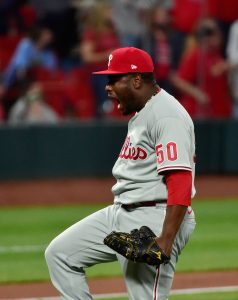
The former Phillies’ closer was reportedly in high demand, despite being the face of a bullpen in Philadelphia that led the league in blown saves. Neris himself notched 12 saves and 11 holds, but also seven blown saves while tossing 74 1/3 innings across 74 games. He had a 3.63 ERA/4.08 FIP while pairing a strong 31.6 percent strikeout rate with a less-than-ideal 10.3 percent walk rate.
To his credit, Neris kept the ball on the ground more frequently than usual, logging a 48.9 percent groundball rate. The Phillies were hardly known for their infield defense, but that’s a positive sign nonetheless as he heads to Houston. In total, Neris was credited with 1.4 rWAR, a solid number for a reliever.
The 32-year-old has spent his entire eight-year career with the Phillies, totaling 405 appearances and a career 3.42 ERA/3.79 FIP. The Dominican right-hander was originally signed by the Phillies back in 2010 as an amateur free agent. Despite moving in and out of the closer role during his time in Philly, Neris was an overall positive contributor going back to 2015.
He’ll now embark on the next chapter of his career in Houston, where he steps in to assume Kendall Graveman‘s late inning responsibilities. Graveman, acquired midseason from the Mariners, recently signed a three-year, $24MM deal. The Astros will pay Neris a half million more per season, but with only a two-year commitment, which tracks market-wise, given that Neris is two years older than Graveman.
Neris will team with fellow righties Ryne Stanek, Phil Maton, Pedro Baez, and Rafael Montero to try and bridge the gap from the starter to closer Ryan Pressly. If nothing else, the Astros can rest assured that Neris can handle the mental burden of pitching for an often-maligned franchise in Houston. Having spent so long in Philly, Neris should be used to hearing his share of criticism on the hill.
Neris leans heavily on a 84 mph split finger, which has long been the bell cow offering of his arsenal. He’s especially reliant on the split versus lefties, against whom he uses the split finger roughly 50 percent of the time. For comparison’s sake, he went to the split just 36.9 percent of the time against right-handers. For same-handed hitters, he leans heavily on a 94.1 mph four-seamer (43.9 percent usage rate) and a 94.8 mph sinker (31.1 percent usage rate).
He has also occasionally toyed with a slider against righties, which he threw just 44 times last year – only thrice to lefties – though the breaker wasn’t particularly effective for Neris. Against lefties, Neris throws the heater 37.3 percent of the time, while dialing back usage on his sinker. On the whole, the split finger has been his most effective pitch, producing a mere .152 expected batting average and .240 expected slugging. He finished 2021 in the 93rd percentile for both whiff rate and chase rate while finishing in the 91st percentile for strikeout rate.
Jim Salisbury of NBC Sports Philadelphia first reported the Astros were signing Neris to a two-year deal. Ken Rosenthal of the Athletic reported the $17MM guarantee. Chandler Rome of the Houston Chronicle reported the presence of the 2024 option and its specific provisions.
Image courtesy of USA Today Sports.
Nationals Sign Cesar Hernandez
The Nationals announced they’ve signed second baseman César Hernández to a one-year contract. It’s reportedly a $4MM guarantee for the Octagon client that contains an additional $1MM in available incentives.
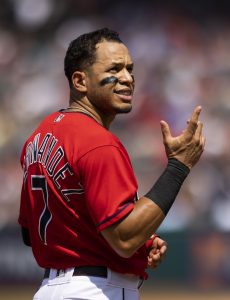
Hernández returns to the NL East, where he spent the bulk of his career with the Phillies. The switch-hitting infielder broke into the majors in 2013, taking hold of the Phils’ regular second base job by 2015. He spent the next five seasons as a solid regular. Hernández didn’t bring a ton of power to the table, but he drew plenty of walks, put the ball in play and rated as a plus defender at the keystone.
Philadelphia was happy to keep Hernández for the early stages of his career, but they non-tendered him after the 2019 campaign as his arbitration salaries escalated. The Venezuela native signed with Cleveland that offseason, hitting at a solid .283/.355/.408 clip in the shortened season. They brought Hernández back last winter, and he continued to produce — albeit in a completely different manner than he had previously.
Over 420 plate appearances, Hernández popped a career-best 18 homers. But he also saw his batting average fall to a personal-low .231 as he became more fly-ball oriented. That led to a corresponding drop in on-base percentage, although his power uptick kept his overall numbers right around league average. The White Sox acquired Hernández at the trade deadline in the wake of Nick Madrigal’s season-ending hamstring injury, hoping he’d solidify the keystone for the stretch run.
That proved not to be the case, as Hernández sputtered to a .232/.309/.299 line with only three homers in 217 trips to the plate with Chicago. Given those struggles, it’s not surprising the Sox elected to decline his $6MM club option and look elsewhere at the position this winter.
Hernández won’t quite match that salary on his deal with the Nats, but he has a chance to come fairly close if he maxes out all the incentives. He’ll offer some short-term veteran stability to a Washington infield that also features Josh Bell at first base and Alcides Escobar, Carter Kieboom and Luis García around the diamond. The 21-year-old García had been pencilled in as the regular at second base. With the Nats retooling, it’s unlikely they’ll cut into his playing time. García has ample minor league experience at shortstop and could conceivably kick back across the bag to accommodate Hernández while relegating Escobar to a utility role.
Jesse Dougherty of the Washington Post was first to report the Nationals’ interest in Hernández. Jon Heyman of the MLB Network first reported the contract terms.
Image courtesy of USA Today Sports.
Dodgers Sign Daniel Hudson
The Dodgers have added a late-game option to the bullpen, announcing a one-year guarantee with free agent reliever Daniel Hudson on Tuesday. It’s reportedly a $7MM guarantee for the Jet Sports Management client, which takes the form of a $6MM salary and at least a $1MM buyout on a 2023 club option valued at $6.5MM. That club option will increase by $100K increments if he finishes 30, 35, 40, 45, and 50 games in 2022, for a total of $500K in potential incentives.
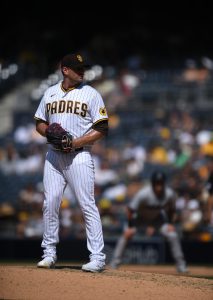
It’ll be Hudson’s second stint in Dodger blue. The right-hander also spent the 2018 season with Los Angeles, tossing 46 innings of 4.11 ERA ball out of the bullpen. He’s been far better in two of the past three years, though, again attracting the attention of the Dodgers’ front office.
Hudson split the 2019 campaign between the Blue Jays and Nationals, combining for 73 frames with a 2.47 ERA. That didn’t come with nearly as impressive peripherals, but the Nats saw enough to re-sign the Virginia native to a two-year deal. Hudson didn’t pitch well during the shortened 2020 campaign, struggling with both walks and home runs en route to a 6.10 ERA.
The veteran hurler turned things around in 2021, getting off to a sterling start. Hudson made 32 appearances with Washington over the season’s first few months, pitching to a minuscule 2.20 ERA with an elite 37.8% strikeout rate and a tiny 5.5% walk percentage. That made him a desirable trade chip, and the Padres landed him a few days before the deadline.
Hudson didn’t sustain that level of success with San Diego down the stretch. He allowed 13 runs (11 earned) in 19 innings with the Friars, nearly doubling his first-half walk rate. The 34-year-old continued to miss plenty of bats, though, and it seems the Dodgers are betting that kind of swing-and-miss stuff will allow him to find more success keeping runs off the board than he did with San Diego.
Altogether, Hudson tossed 51 2/3 innings with a 3.31 ERA in 2021. His 35.7% strikeout rate and 15.7% swinging strike rate were each career-best marks, while his 97 MPH average fastball velocity tied a personal-high. There’s a chance Hudson’s high-octane arsenal allows him to thrive as a late-game option for manager Dave Roberts, although it’s critical that he continue to miss plenty of bats. Hudson’s an extreme fly-ball pitcher who gives up quite a bit of hard contact when batters do the ball in play. That’s led to him surrendering 1.7 homers per nine innings pitched over the past two years, a mark that’s a fair bit worse than that of the league average bullpen arm.
Jeff Passan of ESPN first reported the Dodgers and Hudson were nearing agreement on a one-year deal worth around $7MM. The Associated Press reported the presence of the 2023 club option, as well as the specific salary breakdown.
Image courtesy of USA Today Sports.
Tigers Non-Tender Matthew Boyd
The Tigers announced Tuesday that they will not tender a contract to left-hander Matthew Boyd, immediately making him a free agent. Boyd, 30, pitched just eight innings after June 14 this season due to a pair of forearm injuries, ultimately leading to flexor tendon surgery in late September. He’d been projected by MLBTR contributor Matt Swartz to earn $7.3MM in what would have been his final season of arbitration eligibility.
A specific timeline for Boyd’s return to the mound was never provided, with the team stating only it was “hopeful” he’d be able to pitch at some point in the 2022 season. Tigers GM Al Avila briefly discussed Boyd in his end-of-year press conference and acknowledged that a non-tender was a possibility. At the very least, it’s reasonable to expect Boyd to miss a notable portion of the 2022 campaign; were the Tigers expecting him to be ready early in the season, they’d surely have tendered him a contract, given his track record and lengthy tenure with the club.
The 2020 season was brutal for Boyd, who was knocked around for a 6.71 ERA, but he’s otherwise been a solid starter in Detroit — at times looking like an intriguing mid-rotation option. Boyd has shown the ability to miss bats in droves in the past, though he traded some punchouts for efficiency in 2021 when he attacked the strike zone at a career-best rate and accordingly dropped his walk rate to 6.8% — the second best mark of his career.
Even with that woeful 2020 showing, Boyd carries a 4.66 ERA, a 24.9% strikeout rate and a 6.9% walk rate over his past 494 2/3 innings at the MLB level. He’s often been homer-prone in the past, but Boyd has also gone through stretches where he looks on the cusp of taking his game to a new level. He pitched to a 3.44 ERA and 3.75 FIP through 13 starts this past season before landing on the injured list, for instance, and Boyd looked dominant for a good chunk of the 2019 season as well before a dismal second-half swoon. Whenever he’s healthy, Boyd will surely be viewed by teams around the league as an upside play who, with a few tweaks, could potentially sustain some of those flashes of success he’s shown in the past.
For the time being, with the looming lockout and uncertainty surrounding Boyd’s arm, it’s likely he’ll remain a free agent until the expiration of the collective bargaining agreement and instead field offers from other clubs once the forthcoming transaction freeze is lifted.
Mets Sign Starling Marte
The Mets have landed the market’s top center fielder, announcing agreement with Starling Marte on a four-year, $78MM deal. The star outfielder will lock in a $14.5MM salary in 2022 to go with a $5MM signing bonus, then receive $19.5MM salaries from 2023-25. Marte is represented by Rep 1 Baseball.
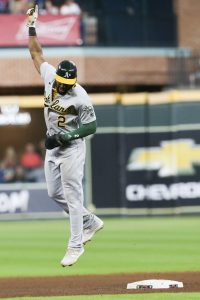
It’s the culmination of a shocking evening for the Mets, who have also agreed to terms with Eduardo Escobar and Mark Canha within the past few days. Marte was the prize of this offseason’s free agent center field class, easily the top option in an otherwise thin market. A 2016 All-Star and two-time Gold Glove award winner, he’s coming off perhaps the best season of his ten-year big league career. Marte split the 2021 campaign between the Marlins and A’s, posting a .310/.383/.458 line with 12 home runs and an MLB-best 47 stolen bases in just 120 games.
A rib fracture cost Marte more than a month of action between April and May, but he was as productive as ever upon returning. After adjusting for the pitcher-friendly home parks in which he played, Marte’s hitting alone was 34 percentage points better than league average, by measure of wRC+. That’s the best mark of his career, and the speedy outfielder added significantly more offensive value on top of that with incredible baserunning. Not only was he the game’s most prolific base-stealer, he was successful on 90.4% of his attempts — an incredible rate considering opposing pitchers were well aware of the threat he posed every time he reached base.
While Marte might be coming off his best season, he’s been a consistently above-average player for the bulk of his career. His 2021 campaign was the most extreme version of a generally steady skillset: plenty of balls in play, high-end baserunning, and an all-fields approach that makes him difficult to defend. Marte’s .372 batting average on balls in play this past season was one of the league’s higher rates, but he’s consistently had a knack for turning batted balls into hits. So while that BABIP may take a bit of a step back in 2022, it’s likelier he’ll regress closer to his career .344 mark as opposed to the .292 league average.
Marte’s an aggressive hitter, and he’s never had a season with an above-average walk rate. His 8.2% walk percentage in 2021 was a personal best, and his patience tailed off significantly after he was traded from Miami to Oakland midseason. His free-swinging ways also keep his strikeouts down, though, as the Dominican Republic native hasn’t punched out in more than 20% of his plate appearances in a season since 2014. So while Marte doesn’t take many free passes, he nevertheless typically manages solid on-base numbers based on batting averages that regularly push (or, in 2021’s case, exceed) .300.
Defensively, Marte broke in as a left fielder with the Pirates in deference to Andrew McCutchen. One of the game’s top corner outfield defenders, he kicked over to center field in 2018 after Pittsburgh traded McCutchen away. He’s spent the past four seasons playing almost exclusively up the middle, drawing mixed reviews. Defensive Runs Saved has pegged Marte as a bit below-average over each of the past three seasons. Statcast’s Outs Above Average typically rates him a bit above par with the glove.
However one falls on Marte’s glovework, it seems the Mets view him as a defensive upgrade over incumbent center fielder Brandon Nimmo. Signing Marte will allow New York to kick Nimmo into right field, where he’ll replace free agent Michael Conforto (who almost certainly will wind up elsewhere after today’s transactions). They’ll be joined in the regular outfield by Canha, the culmination of a drastic shakeup on the grass that unfolded within the span of a few hours.
How long Marte will be capable of manning center field remains to be seen. He signed an early-career extension with the Pirates that delayed his first trip to the free agent market by a few seasons. Marte turned 33 years old last month, and it’s possible he’ll need to move to a corner spot at some point over the course of this deal. He’s not yet shown an appreciable drop-off in sprint speed, according to Statcast, and the Mets are counting on his speed and defense holding up for at least the next couple seasons.
A four-year guarantee for a player at this age whose game is so reliant on athleticism isn’t without risk. Between Marte’s great platform season and the lack of obvious center field alternatives, that always seemed likely to be the price a team would have to pay to bring him aboard, though. Entering the offseason, MLBTR projected a four-year, $80MM guarantee and ranked Marte this winter’s #13 free agent.
Marte is the highest-ranked player of this winter’s class to sign to date, and he’s also secured the largest guarantee of any player so far (edging out Eduardo Rodríguez’s deal with the Tigers by $1MM). In the span of a day, the Mets have become the offseason’s most active club — the kind of spending spree fans in Queens envisioned when Steve Cohen purchased the franchise from the Wilpon family last offseason.
The club opened Cohen’s first season as owner with a payroll in the $195MM range, per Cot’s Baseball Contracts. It’s clear they’re prepared to shatter that mark in year two, as Jason Martinez of Roster Resource estimates that spreading the Escobar, Canha and Marte deals evenly would push the Mets’ 2022 commitments to $225MM. The organization’s estimated luxury tax bill, meanwhile, now sits above $229MM.
That’s including projections for arbitration-eligible players, some of whom will be non-tendered or traded. Speculatively speaking, Dominic Smith, J.D. Davis and/or Jeff McNeil could be flipped elsewhere, as today’s series of acquisitions could inhibit the path to everyday reps for that trio (particularly Smith and Davis). Yet it’s also apparent that Cohen is giving general manager Billy Eppler wide leeway to bolster the roster in hopes of snapping a five-year playoff drought, and further moves could be on the horizon. All three of today’s additions are position player pickups, and Eppler is already on record about the team’s desire for rotation help.
While the Mets’ roster is the main story of today’s transactional barrage, their agreement with Marte has trickle-down reverberations for the rest of the league. As the only clear everyday center fielder available in free agency, he’d drawn wide interest over the offseason’s first couple weeks. Teams like the division-rival Phillies, crosstown Yankees, Marlins, Giants, Astros and Rangers had all been rumored to have interest in his services. Having missed out on Marte, a few of those clubs might now have to pivot to the trade market.
Arizona’s Ketel Marte, Pittsburgh’s Bryan Reynolds and Baltimore’s Cedric Mullins stand out as the top potential targets, but it remains to be seen how attainable any of those players may be. The D-Backs have been resistant to moving any of their core controllable stars; the Pirates were reportedly disinclined to consider deals involving Reynolds at the trade deadline, viewing him as a long-term building block. The O’s are at least willing to field offers on Mullins, but it’s not clear that’s anything more than due diligence at this point.
Jon Heyman of the MLB Network first reported the Mets had agreed to terms on a four-year, $78MM guarantee with Marte. MLB.com’s Anthony DiComo of MLB.com first reported the salary breakdown of Marte’s contract.
Image courtesy of USA Today Sports.