
MLBTR Chat Transcript: Ohtani, Stanton, Cardinals, More
Click here to read a transcript of today’s chat with host Jeff Todd.
Mariners Trade Thyago Vieira To White Sox For International Bonus Money
1:03pm: MLB.com’s Jonathan Mayo reports that the Mariners are picking up $500K in the trade (Twitter link). However, Mayo also notes that the previously reported sum of $1.57MM that the Mariners had to work with was incorrect. Seattle, according to Mayo, initially had just a bit north of $1MM remaining in their pool, so this trade pushes their remaining total to $1.5575MM.
11:08am: The Mariners announced on Thursday that they’ve traded right-hander Thyago Vieira to the White Sox in exchange for international bonus money. The move opens a spot on Seattle’s 40-man roster in advance of next week’s deadline to set 40-man rosters for the Rule 5 Draft, and it also gives the Mariners some additional funds for the pursuit of Shohei Ohtani and other high-end international amateurs.
The amount of money Seattle is receiving isn’t yet known, though international money must be traded in increments of $250K under the new collective bargaining agreement, so they’ll add at least that much to their pool. Ronald Blum of the Associated Press reported last week that Seattle’s bonus pool stood at $1.57MM, so they’ll add at least $250K to that sum. The Rangers ($3.535MM), Yankees ($3.25MM) and Twins ($3.245MM) still have the most to offer Ohtani, if he is indeed posted.
In exchange for the additional funds, the White Sox will reel in an MLB-ready bullpen arm capable of reaching triple-digit velocity readings on his fastball with regularity. Vieira, 25 in January, pitched to an even 4.00 ERA between Double-A and Triple-A last season. While his strikeout numbers at those upper levels weren’t what they were in Class-A Advanced, Jim Callis and Jonathan Mayo of MLB.com still pegged Vieira eighth among Mariners farmhands, placing a true 80 grade his fastball and giving him a 55-grade (above-average) curveball as well. Vieira has struggled with control at times in the minors, though Callis and Mayo note that he comes with a closer’s ceiling if he can put everything together.
For a White Sox club that traded David Robertson, Tommy Kahnle, Anthony Swarzak, Dan Jennings and Tyler Clippard this past summer, the addition of Vieira gives them an intriguing young piece with six years of club control if all pans out well.
Rangers Plan To Discuss Extension With Jon Daniels
The Rangers have no plans to move on from president of baseball ops/general manager Jon Daniels, whose contract expires after next season, reports Jeff Wilson of the Fort Worth Star-Telegram. Wilson was told that Daniels “isn’t going anywhere” and may already be discussing a new contract with the team.
Daniels was barely 28 years of age when he was named general manager of the Rangers, making him the youngest GM in the game’s history. He’s now overseen the Rangers for 12 seasons, though, and is among the game’s longest-tenured general managers.
At the time Daniels was promoted to GM (when then-GM John Hart resigned), the Rangers had struggled to losing records in five of their past six seasons. While winning didn’t come immediately under Daniels’ watch, he eventually built the Rangers up to a perennial contender. Texas averaged 92 wins per season from 2009-12 and appeared in back-to-back World Series in 2010-11. The Rangers have won 87 or more games six times in the past nine seasons and only had two losing records in that span (including this past year’s 78-84 finish).
While the Rangers’ outlook is somewhat bleak given their substantial pitching needs and the presence of the Astros atop the AL West, Daniels and his staff have kept the club largely competitive for the better part of a decade. In that time, some of his more notable moves include trading Mark Teixeira to the Braves in exchange for Elvis Andrus, Neftali Feliz, Matt Harrison, Jarrod Saltalamacchia and Beau Jones; acquiring Cole Hamels and Jake Diekman from the Phillies in exchange for Jorge Alfaro, Nick Williams, Jerad Eickhoff, Jake Thompson and Alec Asher; and the signings of Adrian Beltre and Yu Darvish.
Of course, Daniels’ regime has had its share of misses. Surrendering Lewis Brinson and Luis Ortiz in the trade that netted the Rangers Jonathan Lucroy and Jeremy Jeffress stands out as a recent regrettable decision, and the Prince Fielder/Ian Kinsler swap didn’t pan out after a debilitating neck injury ended Fielder’s career.
Obviously, every front-office regime comes with its triumphs and low points, but Texas has been a generally successful organization under Daniels during his time as general manager and president of baseball operations (which was added to his title back in 2013).
Yankees Reportedly Interested In Jurickson Profar
10:57am: Most teams have at least checked in on Profar’s availability, per Evan Grant of the Dallas Morning News (on Twitter). Grant, however, adds that he finds it likelier that Profar would be part of a larger deal than this and/or that the Rangers would wait until deeper into the offseason to make a move.
10:01am: The Yankees have interest in swinging a deal for Rangers infielder Jurickson Profar in the next few days, reports Joel Sherman of the New York Post. The Yanks are a surprising entrant into Profar’s list of potential suitors given their considerable infield depth. New York has Didi Gregorius at shortstop, Starlin Castro at second base and Chase Headley at third, with Ronald Torreyes in a utility role and well-regarded prospects Gleyber Torres and Miguel Andujar on the cusp of MLB-readiness. Young Tyler Wade represents another utility option that is already on the 40-man roster.
Nonetheless, Sherman notes, the Yankees are intrigued by the idea of adding the game’s former No. 1 overall prospect in exchange for some of the pitchers on the fringes of their 40-man roster as they look to set that 40-man roster in advance of the Rule 5 Draft. The deadline to add players to the 40-man roster in advance of the Rule 5 Draft will come on Monday. Names like Bryan Mitchell, Caleb Smith, Luis Cessa and Chasen Shreve are among those listed by Sherman as possible players on the Yankees’ 40-man bubble.
[Related: New York Yankees depth chart & Texas Rangers depth chart]
Profar has long been an obvious trade candidate. The Rangers have Elvis Andrus at shortstop and Adrian Beltre at third base, and they committed to Rougned Odor as their long-term second baseman last offseason by signing him to a $49.5MM extension. While both Beltre and Andrus could leave the Rangers after next season — Beltre’s contract runs through 2018, while Andrus has an opt-out next offseason — the Rangers don’t have much of a spot for Profar in the interim. He’s out of minor league options and hasn’t thrived in a utility role in recent seasons.
The Rangers, furthermore, need starting pitching depth more than almost any other club in the Majors. Their rotation options beyond Cole Hamels and Martin Perez (neither of whom was impressive in 2017) are sparse, at best. If the Yankees like the idea lessening their 40-man crunch by condensing two arms into a single player with greater individual upside, then Profar certainly makes some degree of sense.
Of course, it remains to be seen just how Profar would fit into their plans. He’s controllable for another three seasons but cannot be optioned to the minors, meaning he’d leapfrog one of Torreyes or Wade on the current depth chart. Neither Torreyes nor Wade has proven himself to be an especially potent bat in the Majors, though the same can be true of Profar. That said, Profar was once considered baseball’s best prospect before a pair of shoulder surgeries wiped out two years of his career, and he did hit .287/.383/.428 in 383 Triple-A plate appearances this season. The Yankees may very well relish the notion of acquiring a player they can slot in at any position on the infield if he comes with greater offensive upside than either of their currently projected utility candidates.
Latest On Cubs’ Bullpen Targets
The Cubs’ bullpen search figures to be expansive this offseason, but Patrick Mooney of NBC Sports Chicago provides some insight into the team’s thinking. Per Mooney, while the Cubs performed their due diligence on Zach Britton at this week’s GM Meetings, they found the asking price to be too high this past summer and aren’t likely to rekindle those talks. Rather, they’ve landed on free-agent righty Brandon Morrow as one potential ninth-inning option and will also monitor the market for former White Sox/D-backs/Mets closer Addison Reed in free agency, according to Mooney.
Chicago got an up-close look at Morrow in the National League Championship Series as he made four practically unblemished appearances against them (4 2/3 innings, one hit, one walk, no runs, seven strikeouts). The resurgent Morrow, whom the Dodgers signed on a minor league contract last offseason, burst back onto the scene midway through the 2017 campaign and emerged as the Dodgers’ best non-Kenley Jansen reliever late in the year. The 33-year-old Morrow turned in a 2.06 ERA with 10.3 K/9, 1.9 BB/9 and a 45 percent ground-ball rate in 43 2/3 regular-season innings before dominating for much of the postseason.
The Dodgers rode Morrow incredibly hard in the playoffs, though, and by the end of the World Series some fatigue was clear. Morrow became just the second pitcher in MLB history to pitch in all seven games of the World Series, and he appeared in a staggering 14 of the Dodgers’ 15 postseason contests. Though he was excellent in most of those games, he was shelled for four runs without recording an out in Game 5 of the World Series — the lone game in 2017 in which he was asked to pitch on three consecutive days.
That extreme postseason workload and Morrow’s greater injury history could give some teams pause in the free-agent market, but interest in Morrow figures to be robust all the same. We pegged him for a three-year deal on our top 50 free agent list, and it wouldn’t be a surprise to see half the league express some level of interest.
As for Reed, he’s been as durable as relievers come. The 28-year-old (29 next month) has never been on the disabled list in the Majors and has averaged 67 appearances and 66 innings per season over the life of his big league career. Reed has plenty of ninth-inning experience, having 15 or more games in four separate seasons.
Control was an issue for the Chicago bullpen for much of the season — their 4.25 BB/9 rate tied for second-worst among big league bullpens — and it’s one area in which Reed excels. He’s averaged just 2.3 walks per nine innings pitched in his seven-year career, and that includes an even more minuscule 1.6 BB/9 mark over the past two years. (It’s perhaps telling that the Cubs are interested in two free-agent relievers that ranked among the top of the free-agent class in terms of best control.) Reed’s age, durability and track record make him one of the more appealing arms on the market — to the point that we pegged him as one of just four relievers to secure a four-year deal on this year’s free agent market.
It stands to reason that Morrow and Reed are just two of many names that the Cubs are intrigued by in the early stages of the offseason. In addition to free agency, there will be no shortage of relievers discussed in trades this offseason. President of baseball ops Theo Epstein, however, implied to Mooney that the Cubs may not continue to operate as they have in recent years when it comes to targeting bullpen talent, stating that he has no desire to “make a it a habit” to trade players with five or six years of control (e.g. Jorge Soler, Gleyber Torres) for one-year rentals.
Offseason Outlook: Arizona Diamondbacks
MLBTR is publishing Offseason Outlooks for all 30 teams. Click here for the other entries in this series.
After surprising many by earning a wild card slot and advancing to the NLDS last season, the Diamondbacks will juggle a large arbitration class and several key free agent decisions while trying to return to the postseason.
Guaranteed Contracts
- Zack Greinke, SP: $126.5MM through 2021
- Yasmany Tomas, OF: $42.5MM through 2020 (final two seasons are player options)
- Paul Goldschmidt, 1B: $11MM through 2018 (club option for $14.5MM in 2019, $2MM buyout)
- Jeff Mathis, C: $2MM through 2018
- Daniel Descalso, IF/OF: $2MM through 2018
Arbitration Eligible Players (service time in parentheses; projections via MLBTR contributor Matt Swartz)
- Patrick Corbin (5.105) – $8.3MM
- Randall Delgado (5.100) – $2.5MM
- A.J. Pollock (5.052) – $8.5MM
- Shelby Miller (4.166) – $4.9MM
- J.J. Hoover (4.153) – $1.6MM
- Chris Owings (4.027) – $3.8MM
- Chris Herrmann (4.001) – $1.4MM
- T.J. McFarland (3.165) – $1.0MM
- Taijuan Walker (3.142) – $5.0MM
- David Peralta (3.120) – $3.8MM
- Nick Ahmed (3.054) – $1.1MM
- Jake Lamb (3.053) – $4.7MM
- Andrew Chafin (3.020) – $1.2MM
- Robbie Ray (3.007) – $4.2MM
- Non-tender candidates: McFarland, Herrmann, Hoover
Free Agents
- J.D. Martinez, Fernando Rodney, Chris Iannetta, Jorge De La Rosa, David Hernandez, Gregor Blanco, Adam Rosales
[Arizona Diamondbacks Offseason Page | Arizona Diamondbacks Payroll Information]
It only took one offseason for first-year GM Mike Hazen to get his team back on the winning track, though in fairness to the former Tony La Russa/Dave Stewart-led front office, the 2017 D’Backs were blessed with much better health and far more breakout performances than the unfortunate 2016 squad. Since the team is now perhaps a bit ahead of schedule in terms of returning to contention, however, Hazen now faces an interesting offseason of trying to fill various roster holes while still keeping the payroll in check.
The Diamondbacks project to owe just over $114MM to 19 players next year (the five guaranteed deals and the whopping 14-player arbitration class), and that number rises to the $120MM range if you factor in the key pre-arb players who will certainly be on next year’s team. While some money could be saved via non-tenders, the D’Backs still project to have the largest Opening Day payroll in the franchise history. There isn’t going to be much, if any, of a payroll increase, according to team president Derrick Hall, who also recently stated that the D’Backs will “have to get creative in a few spots financially if we’re going to get aggressive in certain areas.”
With this in mind, it doesn’t seem like there’s much chance of a reunion with J.D. Martinez, especially given Martinez’s reported asking price of a staggering $210MM. Team management hasn’t closed the door on the chances of Martinez returning, though even if he and agent Scott Boras settle for “only” the six years and $150MM projected by MLBTR, that will leave the D’Backs committing well over half their payroll to just two players: Martinez and Zack Greinke. And that doesn’t even factor in possible extension talks with Paul Goldschmidt, as the star first baseman is only controlled through the 2019 season.
So, how could Hazen and company “get creative” in finding a way to bring Martinez back? The three cited non-tender candidates would account for $4MM, though more money could be saved in that department if Shelby Miller or Randall Delgado were also non-tendered. The D’Backs would have to be pessimistic about Miller’s recovery from Tommy John surgery or Delgado’s flexor strain to consider dumping either pitcher, though as Welington Castillo could tell you, Arizona isn’t shy about making surprising non-tender calls.
Other possibilities include shopping Patrick Corbin or A.J. Pollock, both of whom are free agents after the 2018 season. Pollock missed virtually all of 2016 due to a fractured elbow and was limited to only 112 games in 2017 due to groin and quad injuries, though he was still an above-average run creator and center field defender last season. Several teams looking for center field help would have interest in Pollock if he was made available, though given the superstar ceiling he exhibited in 2015, Arizona probably sees a healthy Pollock as a way to help fill the offensive hole left behind if Martinez departs.
After a bullpen demotion in 2016, Corbin re-established himself as a starter with a solid 3.0 fWAR season, posting a 4.03 ERA over 189 2/3 innings. He’d be a good trade chip to teams looking to add pitching, and the Diamondbacks can potentially afford to part with Corbin given how the rest of their rotation emerged as a strength last year. Even without Corbin, the Snakes would still have a nice core of Greinke, Robbie Ray, Taijuan Walker, and Zack Godley, with Miller scheduled for a midseason return and prospects Anthony Banda and Taylor Clarke knocking on the door to battle for the fifth starter’s job. A low-cost veteran could also be brought in if the D’Backs prefer Banda and Clarke as Triple-A depth to start the year.
Of course, the boldest move would be to trade Greinke, who just turned 34 in October and is still owed $138.5MM over the next four years. Greinke rebounded from a disappointing 2016 to display his usual excellent form last season. While the D’Backs are certainly more comfortable paying Greinke that much if he pitches like an ace, the fact that he accounts for such a significant portion of the payroll means that the team has to at least keep an eye out for trade possibilities. (Greinke has some control over his destiny in the form of a 15-team no-trade clause.) The D’Backs were reportedly trying to unload all of Greinke’s contract during trade talks in the summer of 2016; this still seems like a long shot now, though Greinke’s strong year will aid in getting more of his salary off Arizona’s books.
Losing Greinke rather than Corbin is obviously a much bigger blow to the rotation, though if a Greinke trade did become a reality, the D’Backs could still shop for more pitching. Consider that MLBTR projects Lance Lynn and Alex Cobb to find free agent deals this winter that combined won’t match what Greinke will earn over the next four seasons. Dealing Greinke and then signing Lynn or Cobb would be a downgrade at the front of the rotation but a major dose of payroll relief.
(Obligatory Shohei Ohtani mention: the D’Backs will certainly join every other team in baseball in trying to gain the attention of the Japanese superstar if and when the bidding begins on Ohtani’s services. It’s probably safe to categorize the Diamondbacks as a less-likely candidate to sign Ohtani, though they have been in the mix for high-profile Japanese players in the past.)
Turning to the relief side of the pitching equation, Arizona has some holes to fill with closer Fernando Rodney, Jorge De La Rosa and David Hernandez all hitting free agency. None of this trio would be particularly expensive to re-sign if the D’Backs simply wanted to get the band back together, though some upgrading will be necessary depending on what happens with the likes of Hoover or McFarland in arbitration. Archie Bradley could potentially take over the closer’s job from the somewhat shaky Rodney, though the team may feel he is more valuable as a multi-inning pitcher who can be deployed at any point in a game. Given their other needs and lack of payroll flexibility, expect the D’Backs to again target low-cost relief signings in the hopes of succeeding as they did with Rodney, De La Rosa, and Hoover last offseason.
Speaking of winning signings, Chris Iannetta more than delivered on his one-year, $1.5MM deal from a winter ago, as he hit .254/.354/.511 with 17 homers over 316 plate appearances. Arizona could try to re-sign Iannetta, or perhaps look to take advantage of what could be a somewhat quiet free agent catching market. The Rockies are the only contender with a clear need behind the plate, with the Nationals, Athletics, and White Sox all speculative candidates to look for catching help. With Jonathan Lucroy, Alex Avila, and Castillo as the big names on the market, a relative lack of suitors could bring one of these catchers into the Diamondbacks’ price range, or at least allow Iannetta to be re-signed on another relatively inexpensive deal. Castillo probably isn’t a candidate given that the D’Backs just parted ways with him last offseason, though Lucroy or Avila could add more pop from the catcher position if the Snakes don’t feel Iannetta can replicate his 2017 numbers.
Looking elsewhere around the diamond, the D’Backs are set at first base (Goldschmidt), third base (Jake Lamb), center field (Pollock), and right field (David Peralta). Yasmany Tomas is still penciled in as the left fielder, though he was plagued by injuries in 2017 and he has yet to show much consistency at the plate over his three-year MLB career. Socrates Brito looks like an interesting fourth outfielder candidate who could earn more playing time as Tomas’ late-game defensive replacement or even platoon partner. A Pollock trade would obviously shake things up considerably in the outfield; depending on the return in that deal, the D’Backs would then be in the market for center field help, perhaps a veteran like Cameron Maybin or Jarrod Dyson.
The D’Backs are also more than set in the middle infield in terms of sheer numbers, though they’ll be hoping for more production at the plate. Ketel Marte and Brandon Drury are the respective favorites at shortstop and second base, with Nick Ahmed also in the mix at short and Chris Owings available at both positions in his multi-position utility role. Veteran Daniel Descalso, whose 2018 option has already been exercised by the D’Backs, will also be back in a utilityman role.
This surplus of infielders capable of playing multiple positions makes the D’Backs a good trade partner for teams looking for infield help, such as the Blue Jays, Angels, Brewers, Red Sox, Rays, Mets, and Giants. No trade is likely to approach the scope of the Jean Segura deal from a year ago unless an infielder is included as part of a larger trade package, though the Snakes can certainly address at least one need depending on which infielder is traded. Drury and Owings have the most trade value but are also the two the D’Backs would probably most like to keep, particularly since Lamb still needs to be spelled against left-handed pitching.
This is just my speculation, but Lamb could also be a trade chip if Arizona is looking for players that could bring back a decent return. The 27-year-old has delivered a lot of pop over the last two seasons, though he also has some significant flaws — an inability to hit southpaws, below-average third base defense, and a tendency to fade after the All-Star break. Lamb is arb-eligible for the first time this winter and is controllable through 2020, so while the Snakes would miss his power, they could deal Lamb to address another need and then look for a third base alternative (or move Drury to the hot corner). Speculating further, the D’Backs could also try packaging Lamb and Tomas as a way of getting at least some of Tomas’ contract off the books.
Hazen decided against cleaning house in his first offseason as Arizona’s GM, and his relatively quiet winter was rewarded by a postseason trip. A busier offseason seems to be on the horizon now, however, as while Hazen is still looking to better position the team for the future, there is more pressure to win in the aftermath of 2017’s good results.
NL East Notes: Nationals, Mets, Conforto, Marlins
The Nationals have yet to hold any extension discussions with stars Bryce Harper or Anthony Rendon, agent Scott Boras told reporters at the GM Meetings on Wednesday (via Chelsea Janes of the Washington Post). Asked whether there’d be any talk about a deal for Harper before he reaches free agency next winter, Boras suggested that the matter is presently up to the Nationals. GM Mike Rizzo told the New York Post’s Joel Sherman yesterday that he’d be “surprised” if there were no extension talks with Harper this winter, though as Janes points out, those types of negotiations typically occur later in the offseason.
A bit more from the division…
- With both Ryan Madson and Sean Doolittle under team control next season, the Nationals are less inclined to pursue top-tier free agent relievers, Janes writes in a second piece. Rizzo expressed confidence in that duo and offered a generally encouraging review of his relief corps overall, health permitting. Injury concerns are present, though, as Janes notes; both Koda Glover and Shawn Kelley were heavily limited by arm troubles in 2017. As such Rizzo indicated that it’s possible his team will pursue some right-handed bullpen help this offseason. Janes runs down several options that Nats fans will want to check out, and she also notes that Matt Albers may ultimately end up elsewhere as he cashes in on a career year.
- Mets GM Sandy Alderson strongly downplayed the notion of signing an outfielder upon leaving the GM Meetings, tweets Mike Puma of the New York Post. Alderson indicated that a player that can handle some outfield as well as first base, or even just a pure first baseman are considerations, however. As Newsday’s Marc Carig tweets, that effectively points to regular center field work for Juan Lagares in 2018. Per Carig, the Mets have received trade interest in Lagares in the past and shown little inclination to move him. Of note, Carig also tweets that the Mets consider Jay Bruce versatile enough to handle both the outfield and first base, so a reunion remains on the table.
- Michael Conforto‘s agents tell Joel Sherman of the New York Post that their client has received “excellent” medical updates from the surgeons that performed his shoulder operation thus far in his recovery. The young Mets oufielder is expected to be swinging a bat by late January and should be ready for Spring Training, as things presently stand.
- Tim Healey of the South Florida Sun Sentinel spoke to Marlins president of baseball operations Michael Hill about the team’s need for rotation help. Adding starting pitching is reportedly a priority for the Fish even as they look to pare down payroll by roughly $50MM and market several of their biggest stars, including Giancarlo Stanton, in trades. Of course, as Hill alluded to, the composition of the returns on their trades could well help to satisfy that priority. “We know we need to get better,” Hill said of his team’s starting pitching options.“Some of the trades may dictate what that looks like, what shape or form that looks like.” Hill also indicated that the Marlins could look at smaller trades and waiver claims as a means of adding additional options.
Pirates Part Ways With Director Of Latin American Scouting Following MLB Investigation
The Pirates announced on Wednesday that they will not renew the contract of director of Latin American scouting Rene Gayo following a league investigation into alleged rules violations against Gayo. Ken Rosenthal of The Athletic first reported that Gayo would be dismissed, noting that several years ago, he accepted kickback payments from a team in the Mexican Summer League as compensation for the sale of “at least one player to the Pirates,” per Rosenthal.
In a press release announcing that Gayo’s contract would not be renewed, Pittsburgh GM Neal Huntington offered the following statement:
“We had been apprised of Major League Baseball’s investigation into alleged Rules violations committed by Rene during his tenure with the Pirates and the fact that MLB intends to discipline Rene as a result of those violations. Other than confirming our profound disappointment in the breach of trust that was the subject of MLB’s investigation, we will have no further comment on the investigation or MLB’s intended discipline.”
It’s not clear exactly what form of punishment the league will impose on Gayo, though Rosenthal notes that the Pirates organization will not be penalized for Gayo’s actions. The Pirates, Huntington added in the press release, will begin an “exhaustive” search for a replacement.
Mariners Acquire Ryon Healy
The Mariners announced that they’ve acquired first baseman Ryon Healy from the division-rival Athletics in exchange for right-hander Emilio Pagan and minor league infielder Alexander Campos.
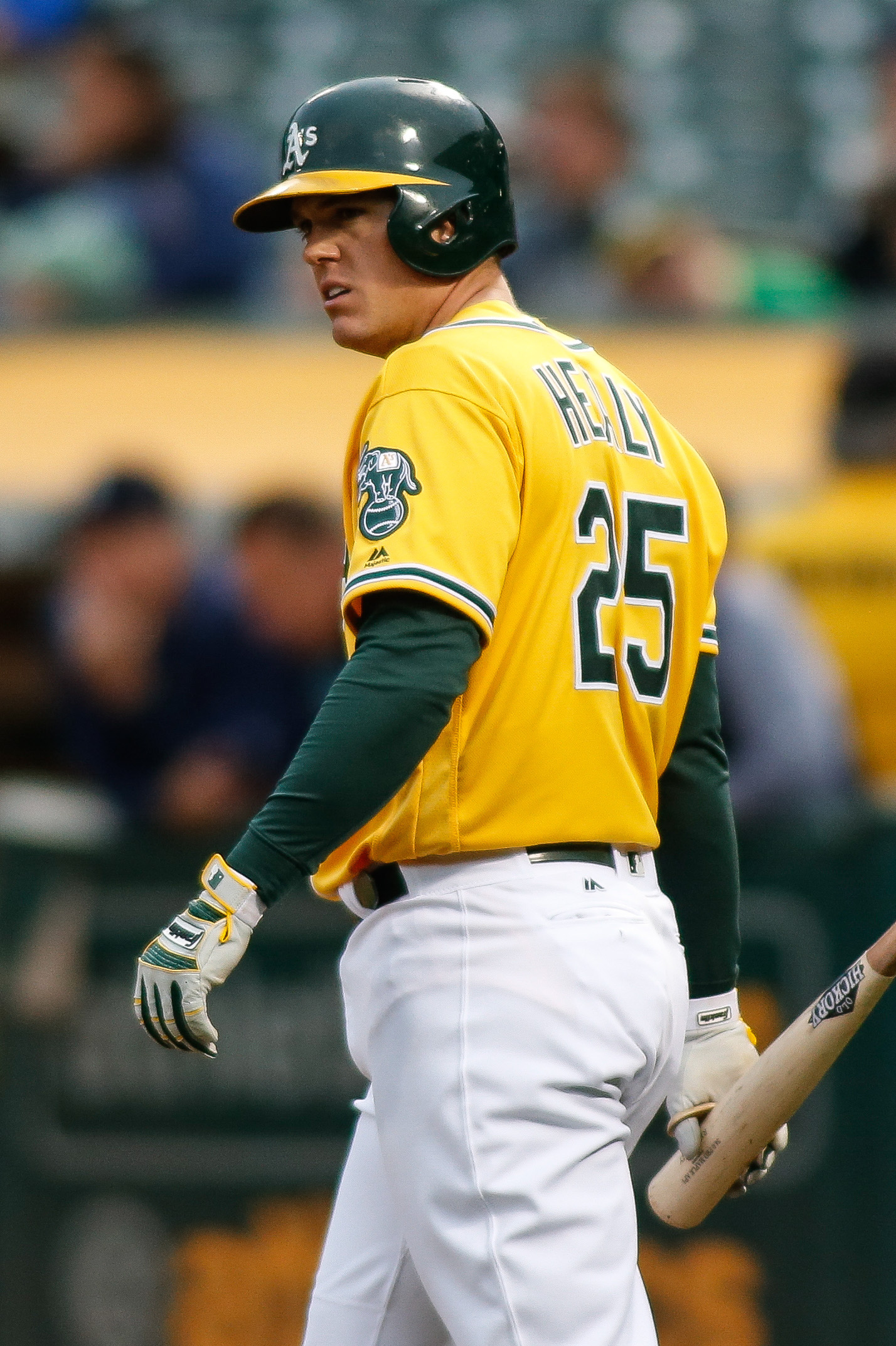
Seattle GM Jerry Dipoto wasted little time in making his first significant move of the offseason, as Healy should now vault to the top of the Mariners’ depth chart at first base. Healy’s name has been oft-suggested as a trade candidate with the emergence of corner infielders Matt Chapman and Matt Olson in Oakland. Susan Slusser of the San Francisco Chronicle has reported on multiple occasions that the A’s would prefer to shift slugging left fielder Khris Davis to DH, and the move of Healy to Seattle allows Oakland to do just that. The A’s are reportedly on the hunt for a controllable, right-handed-hitting outfielder this offseason, and there’s now a more clear vacancy for them in left field.
That, of course, is not to downplay the value of Healy, who comes to the Mariners with another five years of team control. The 25-year-old has belted 38 home runs through his first 888 plate appearances (221 games) with the A’s from the 2016-17 seasons. Healy hasn’t shown much plate discipline to go along with that pop (3.9 percent walk rate), but his overall .282/.313/.475 batting line is solid — especially considering the fact that he’s played half of his games in the spacious Oakland-Alameda County Coliseum.
[Related: Updated Oakland Athletics Depth Chart and Seattle Mariners Depth Chart]
While Healy originally came to the Majors as a third baseman, he quickly moved across the diamond to first base last season in Oakland after posting poor defensive ratings at the hot corner. He’s only played 307 innings of first base in the Majors, though Defensive Runs Saved and Ultimate Zone Rating both peg him at about a run better than average there. Obviously, time will tell whether he’s capable of playing a plus first base over the course of a full season, but the Mariners typically place a premium on defense, so it seems that they’re confident in Healy’s ability to do so for the time being. (Designated hitter Nelson Cruz will be a free agent after this season, so Healy could theoretically slide into that spot next year if his glovework proves to be sub-par.)
“Ryon brings a power bat to our line-up at first base, while providing the flexibility to play third base,” said Dipoto in a statement announcing the move. “He adds to a growing core of productive young players who impact our present and future.”
The move has further ramifications for the Mariners, who have been linked to both Carlos Santana and Yonder Alonso early in the offseason but now seem largely set at first base. The move also further blocks Dan Vogelbach‘s path to regular big league playing time, though the 25-year-old still has a minor league option remaining and can also factor in as a bat off the bench and/or a part-time first baseman and DH himself.
Looking to the Atheltics’ side of the equation, they’ll not only free up a spot for the addition of a new left fielder, they’ll add an intriguing big league setup option to their bullpen in the form of Pagan. Set to turn 27 next May, Pagan logged a 3.22 ERA with 10.0 K/9 against 1.4 BB/9 in 50 1/3 innings with the Mariners in 2016 — his rookie season.
Those K/BB numbers are fairly jaw-dropping, though Pagan’s value last season was curbed by his susceptibility to home runs. While only 9.5 percent of his fly-balls left the yard for homers (well below the league average), Pagan is such an extreme fly-ball pitcher (22.3 percent ground-ball rate, 56.9 percent fly-ball rate) that he still yielded an average of 1.25 homers per nine innings pitched. Pagan has been a pronounced fly-ball pitcher throughout his minor league tenure, though never quite to that extreme, so it’s possible that he could cut back on his home run tendencies a bit moving forward.
Because Pagan didn’t even make his big league debut until midway through the 2017 season, he fell shy of a full year of service time. That gives Oakland six years of control over him if he can indeed settle in as a regular in their bullpen. He also has two minor league options remaining, so the A’s can freely shuttle him back to Triple-A if he needs additional development time.
As for Campos, the 17-year-old shortstop was rated as the No. 15 prospect in Seattle’s farm system per MLB.com’s Jonathan Mayo and Jim Callis. Campos signed for a $575K bonus with the Mariners in July 2016 and went on to bat .290/.413/.367 through 254 plate appearances in the Dominican Summer League this past season. Callis and Mayo praise his above-average speed and “advanced defensive skill set” in noting that while he’s a long ways from the Majors, he profiles as at least a reserve player with the possibility to grow into more as he continues to add strength and develop his offensive game.
Photo courtesy of USA Today Sports Images.
Angels Considering Ian Kinsler, Neil Walker, Zack Cozart
The Angels have had “extensive” internal discussions about the possibility of acquiring Ian Kinsler from the Tigers, reports Anthony Fenech of the Detroit Free Press. While Fenech notes that it’s not yet clear if the two sides have opened negotiations this offseason, he adds that the Halos’ interest in Kinsler dates back to late last season.
While Kinsler is certainly a logical target for any club in need of a second baseman, Jeff Fletcher of the Orange County Register casts some doubt onto how seriously they’ll actually pursue a trade for the 35-year-old (Twitter link). Fletcher points out that Kinsler is probably a genuine consideration, it’s unlikely that he sits atop the Halos’ list of targets due to the fact that he’s a right-handed bat and would only represent a one-year solution.
Two players that also appear to be on the Angels’ list of targets are free agents Neil Walker and Zack Cozart, per ESPN’s Jerry Crasnick (Twitter link). As Crasnick notes, though, it’s not clear if Cozart would be willing to move off of shortstop. He’s also a right-handed bat, though perhaps the Angels would live with that in order to have a defensively gifted middle-infield duo of Andrelton Simmons and Cozart for the foreseeable future.
Kinsler had a down year at the plate in 2017, hitting .236/.313/.412 in 613 plate appearances. Though his average, OBP and slugging marks all fell off considerably from a superlative 2016 season (.288/.348/.484), Kinsler still connected on 22 homers this past season and exhibited other encouraging signs.
For starters, the nine percent walk rate Kinsler logged in 2017 was his highest since the 2011 season, and his 14 percent strikeout rate was not only an improvement over the ’16 campaign but also tied for the 27th-lowest mark among qualified big league hitters. Kinsler’s 37 percent hard-contact rate was the highest mark of his career as well, but despite the uptick in hard-hit balls his BABIP plummeted to .244. Granted, some of that is attributable to a career-worst 14.4 percent infield fly rate, but the rest of his batted-ball profile suggests that Kinsler could be due for some better fortune in 2018. On the defensive side of the coin, Kinsler remains an excellent option and one of the more underrated defensive players in all of baseball, regardless of position.
Walker, 32, is the most obvious fit on the free-agent market. The switch-hitting second baseman would add the lineup balance that the Angels seem to crave, and he’s been an above-average hitter and steady defender at second base throughout his big league career. The limited number of teams aggressively pursuing second base upgrades and some recent durability issues could suppress Walker’s price point as well; we pegged him for a two-year deal worth $11MM per year on our top 50 free agent list, and while a third year is possible, it’d be a genuine surprise to Walker command anything longer than that.
Cozart is perhaps the most intriguing option of the bunch. The longtime Reds shortstop had a breakout season at the plate in his age-32 season, batting a ridiculous .297/.385/.548 with 24 homers in just 507 trips to the plate. Durability is a very real knock on Cozart, who hasn’t played more than 122 games in a season since 2014 due to a torn knee ligament (2014) and myriad hamstring and quadriceps issues across the past two seasons.
There are also skeptics when it comes to Cozart’s age-32 breakout, but even if his bat settles in at the .271/.340/.480 (115 OPS+) that he’s averaged across the past three seasons, that above-average output and Cozart’s strong glovework would make him an immensely valuable asset. As Crasnick alludes to, however, Cozart is a sterling defensive shortstop and it’s not known if he’d be willing to change positions to better position himself on the open market.
Regardless of the order of their preferences, it seems clear that the Halos are likely to add a second base upgrade this winter. The position is an easily identifiable area of need, as Angels second basemen collectively posted a ghastly .206/.274/.327 batting line in 2017, making them one of the two least-productive second base units in all of Major League Baseball. (The Rangers, weighed down by a dismal season from Rougned Odor, struggled similarly.)
In addition to the options listed by Fenech and Crasnick, the trade market contains options such as Dee Gordon and Cesar Hernandez, as well as more speculative candidates like Scooter Gennett, Jonathan Villar and Joe Panik (to name only a few).