
Angels Considering Ian Kinsler, Neil Walker, Zack Cozart
The Angels have had “extensive” internal discussions about the possibility of acquiring Ian Kinsler from the Tigers, reports Anthony Fenech of the Detroit Free Press. While Fenech notes that it’s not yet clear if the two sides have opened negotiations this offseason, he adds that the Halos’ interest in Kinsler dates back to late last season.
While Kinsler is certainly a logical target for any club in need of a second baseman, Jeff Fletcher of the Orange County Register casts some doubt onto how seriously they’ll actually pursue a trade for the 35-year-old (Twitter link). Fletcher points out that Kinsler is probably a genuine consideration, it’s unlikely that he sits atop the Halos’ list of targets due to the fact that he’s a right-handed bat and would only represent a one-year solution.
Two players that also appear to be on the Angels’ list of targets are free agents Neil Walker and Zack Cozart, per ESPN’s Jerry Crasnick (Twitter link). As Crasnick notes, though, it’s not clear if Cozart would be willing to move off of shortstop. He’s also a right-handed bat, though perhaps the Angels would live with that in order to have a defensively gifted middle-infield duo of Andrelton Simmons and Cozart for the foreseeable future.
Kinsler had a down year at the plate in 2017, hitting .236/.313/.412 in 613 plate appearances. Though his average, OBP and slugging marks all fell off considerably from a superlative 2016 season (.288/.348/.484), Kinsler still connected on 22 homers this past season and exhibited other encouraging signs.
For starters, the nine percent walk rate Kinsler logged in 2017 was his highest since the 2011 season, and his 14 percent strikeout rate was not only an improvement over the ’16 campaign but also tied for the 27th-lowest mark among qualified big league hitters. Kinsler’s 37 percent hard-contact rate was the highest mark of his career as well, but despite the uptick in hard-hit balls his BABIP plummeted to .244. Granted, some of that is attributable to a career-worst 14.4 percent infield fly rate, but the rest of his batted-ball profile suggests that Kinsler could be due for some better fortune in 2018. On the defensive side of the coin, Kinsler remains an excellent option and one of the more underrated defensive players in all of baseball, regardless of position.
Walker, 32, is the most obvious fit on the free-agent market. The switch-hitting second baseman would add the lineup balance that the Angels seem to crave, and he’s been an above-average hitter and steady defender at second base throughout his big league career. The limited number of teams aggressively pursuing second base upgrades and some recent durability issues could suppress Walker’s price point as well; we pegged him for a two-year deal worth $11MM per year on our top 50 free agent list, and while a third year is possible, it’d be a genuine surprise to Walker command anything longer than that.
Cozart is perhaps the most intriguing option of the bunch. The longtime Reds shortstop had a breakout season at the plate in his age-32 season, batting a ridiculous .297/.385/.548 with 24 homers in just 507 trips to the plate. Durability is a very real knock on Cozart, who hasn’t played more than 122 games in a season since 2014 due to a torn knee ligament (2014) and myriad hamstring and quadriceps issues across the past two seasons.
There are also skeptics when it comes to Cozart’s age-32 breakout, but even if his bat settles in at the .271/.340/.480 (115 OPS+) that he’s averaged across the past three seasons, that above-average output and Cozart’s strong glovework would make him an immensely valuable asset. As Crasnick alludes to, however, Cozart is a sterling defensive shortstop and it’s not known if he’d be willing to change positions to better position himself on the open market.
Regardless of the order of their preferences, it seems clear that the Halos are likely to add a second base upgrade this winter. The position is an easily identifiable area of need, as Angels second basemen collectively posted a ghastly .206/.274/.327 batting line in 2017, making them one of the two least-productive second base units in all of Major League Baseball. (The Rangers, weighed down by a dismal season from Rougned Odor, struggled similarly.)
In addition to the options listed by Fenech and Crasnick, the trade market contains options such as Dee Gordon and Cesar Hernandez, as well as more speculative candidates like Scooter Gennett, Jonathan Villar and Joe Panik (to name only a few).
MLBTR Chat Transcript
Click here to read the transcript for MLBTR Chat With Jason Martinez: November 15, 2017
Corey Kluber, Max Scherzer Win Cy Young Awards
Indians ace Corey Kluber and Nationals ace Max Scherzer have been named the Cy Young Award winners in their respective leagues, the Baseball Writers Association of America announced tonight. Scherzer has now won back-to-back Cy Young Awards and three total in his career after receiving 27 of the 30 first-place votes. (Clayton Kershaw received the other three first-place votes.) It’s the second AL Cy Young nod for Kluber, who won in even more convincing fashion with 28 of 30 first-place votes. (Chris Sale received the other two first-place votes in the AL.)
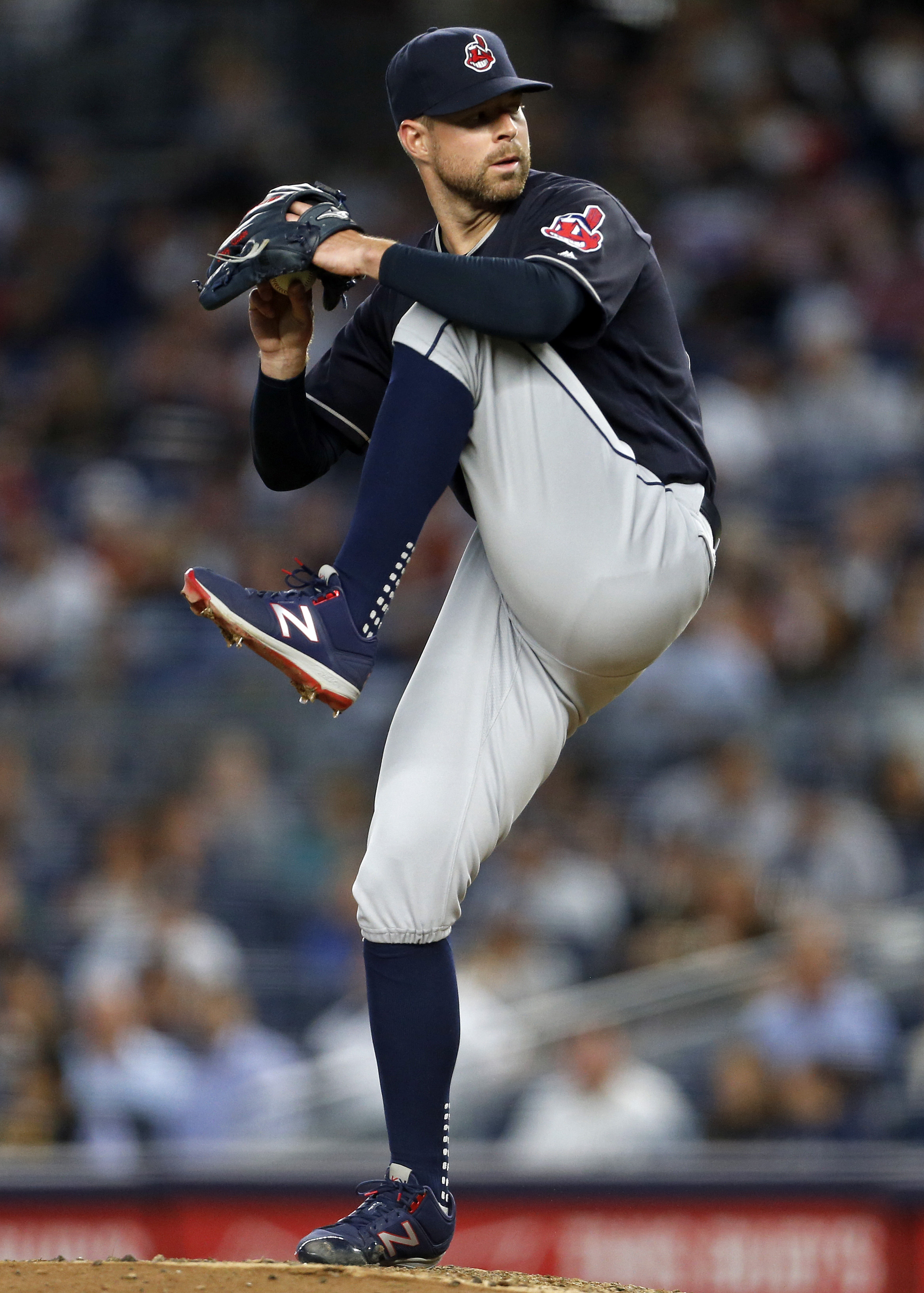
Kluber, who also took home the award back in 2014, rode a blistering hot finish to his second career Cy Young honor. The 31-year-old missed nearly all of May after going on the DL early that month with a lower back strain. At the time of Kluber’s DL placement, he carried a 5.06 ERA through his first six appearances on the season.
The Kluber of old resurfaced upon returning from injury, though. In his first appearance upon activation, Kluber fired six innings of shutout ball with two hits, one walk and 10 strikeouts. From that point forth, he went on an otherworldly hot streak, pitching to an immaculate 1.62 ERA with a 224-to-23 K/BB ratio that looked more like something one would see in MLB: The Show than in real life. All told, Kluber wrapped up his season with an AL-best 2.25 ERA through 203 2/3 innings. Kluber also led the American League in complete games (five), shutouts (three) and walks per nine innings (1.6) while averaging 10.3 punchouts per nine frames as well.
Sale took not only the other two first-place votes but 28 second-place votes, meaning that he and Kluber were first or second on all 30 ballots. Luis Severino finished a distant third place, while Carlos Carrasco, Justin Verlander, Craig Kimbrel, Ervin Santana and Marcus Stroman rounded out the ballot.
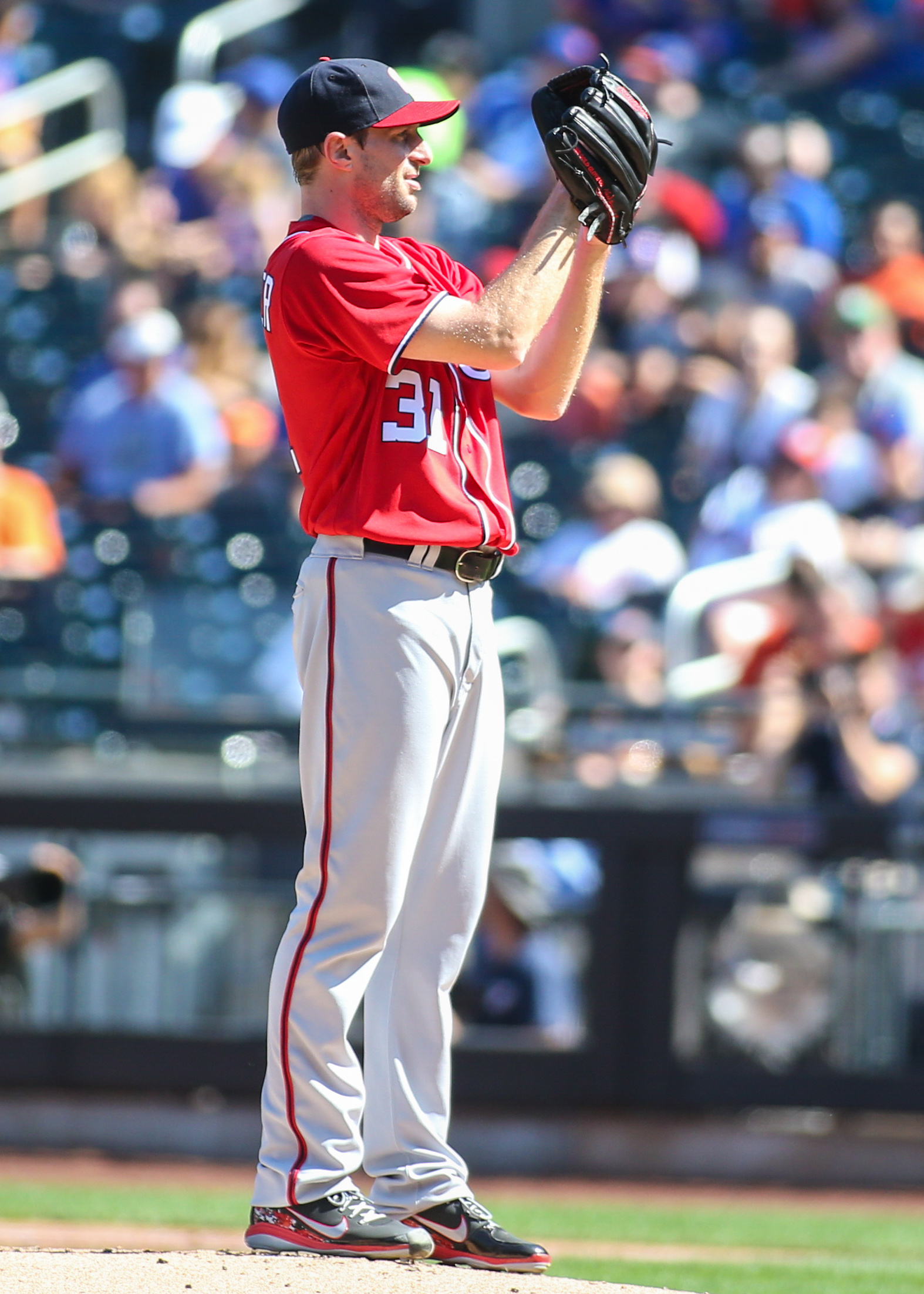
As for Scherzer, the 33-year-old topped 200 innings for the fifth consecutive season and led the National League in strikeouts for the second consecutive year. His gaudy 2.51 ERA and 12.0 K/9 rates were both career-bests, and he’s now made at least 30 starts in the past nine seasons after taking the hill 31 times this season.
Unlike Kluber, Scherzer was dominant from day one in 2017. Remarkably, there was only one point throughout the entire season where Scherzer’s ERA crept above 3.00; on May 20, he yielded three runs in five innings to bump his ERA to 3.02. From that point forward, Scherzer was virtually unhittable, posting a 2.30 ERA over his final 141 innings and at one point whiffing at least 10 hitters in six straight outings.
Kershaw received 25 of the 30 second-place votes, while Zack Greinke and Scherzer’s teammate, Stephen Strasburg, each took home a second-place vote as well. Strasburg wound up finishing in third place, with Greinke taking fourth and Kenley Jansen landing fifth overall in the balloting. Yet another Nats starter Gio Gonzalez, came in sixth place overall, giving the Nats three of the top six in the NL. Robbie Ray, Jacob deGrom, Jimmy Nelson and Alex Wood each collected an odd fourth- or fifth-place vote here and there, rounding out the ballot in that order.
Photos courtesy of USA Today Sports Images.
Giancarlo Stanton Rumors: Wednesday
The Giancarlo Stanton rumor mill was churning yesterday as teams jockey for position with the Marlins — and, perhaps, with Stanton himself, who can veto any trade. At the end of the day, though, it seemed there was no greater clarity as to where he might be dealt and when a trade might go down.
We’ll use this post to track any new developments today …
- MLB.com’s Jon Morosi reports that teams that have spoken to the Marlins have informed them that they feel the 10 years and $295MM on Stanton’s deal is a rough approximation of his market value (all Twitter links). In other words, other clubs don’t perceive there to be much, if any, surplus value on Stanton’s deal. As such, the Marlins will have to pay down a notable portion of the deal to also extract premium prospects from a potential trade partner. One exec suggested that Miami would need to pay as much as $5MM annually in order to receive good prospect value. Morosi notes that the Cardinals and Marlins once again discussed trade concepts today.
- The Marlins initiated a brief conversation with the Yankees regarding Stanton, writes FanRag’s Jon Heyman. The Yankees aren’t considered a serious suitor, though, and the Yankees simply said they’d be open to hearing what the Marlins had in mind, perhaps as a matter of sheer due diligence. Both Yankees GM Brian Cashman and owner Hal Steinbrenner have publicly stated a desire to dip under the $197MM luxury tax barrier, and Stanton’s $25MM annual salary would obviously get in the way of that goal.
Earlier Updates
- Marlins CEO Derek Jeter says he has not yet spoken with Stanton, as Clark Spencer of the Miami Herald was among those to report on Twitter. “If there’s a reason to call him, I’ll call him,” said Jeter. The new Marlins boss did not commit to dealing Stanton and noted that such a move would be complicated, as Bob Nightengale of USA Today tweets. But Jeter also suggested that the team cannot continue operating in the same manner financially as it did under prior ownership.
- Of course, president of baseball operations Michael Hill sat down with Stanton and says he has a sense of what the slugger is interested in. He’s also running point on Stanton talks with other teams. Hill tells Ken Rosenthal of The Athletic that he is putting the onus on suitors to come forward with some information on what they are willing to do to land Stanton. “Until I know where you’re at on the contract, the money, all that stuff, I can’t engage,” Hill said of his rival executives.
- Rosenthal said that eight teams had engaged on Stanton to this point. Six of those are fairly serious pursuers, according to a report from Clark Spencer of the Miami Herald.
- There’s “little momentum” regarding Stanton between the Dodgers and Marlins, Andy McCullough of the Los Angeles Times reports on Twitter. Of course, the most notable point at this stage seems to be that the Dodgers are involved at all. Los Angeles seems like a solid fit for Stanton, though it’s also not difficult to imagine the organization preferring not to tie up such a significant portion of its payroll in one contract.
- John Shea of the San Francisco Chronicle ran down the latest on Stanton from the Giants‘ perspective. Derrick Goold of the St. Louis Post-Dispatch did the same with regard to the Cardinals. And WEEI.com’s Rob Bradford explained why he still thinks the Red Sox could be in Stanton (or another superstar hitter) despite some indications to the contrary.
Offseason Outlook: Kansas City Royals
MLBTR is publishing Offseason Outlooks for all 30 teams. Click here to read the other entries in this series.
A lengthy rebuild for the Royals culminated in consecutive World Series appearances and a 2015 championship, but competitive cycles are an ever-present reality for smaller- and mid-market clubs, and the Kansas City organization now faces what will likely be a franchise-altering offseason.
Guaranteed Contracts
- Danny Duffy, LHP: $60MM through 2021
- Ian Kennedy, RHP: $49MM through 2020
- Alex Gordon, OF: $44MM through 2019 (includes $4MM buyout of 2020 mutual option)
- Salvador Perez, C: $43.5MM through 2021
- Jorge Soler, OF/DH: $12MM through 2020 (may opt into arbitration this offseason but is unlikely to do so)
- Jason Hammel, RHP: $11MM through 2018 (includes $2MM buyout of 2019 mutual option)
- Joakim Soria, RHP: $10MM through 2018 (includes $1MM buyout of 2019 mutual option)
- Brandon Moss, 1B/DH: $8.25MM through 2018 (includes $1MM buyout of 2019 mutual option)
- Drew Butera, C: $2.3MM through 2018
Arbitration-Eligible Players (service time in parentheses; projections via MLBTR contributor Matt Swartz)
- Kelvin Herrera (5.157) – $8.3MM
- Brandon Maurer (4.089) – $3.8MM
- Mike Morin (3.089) – $700K
- Nate Karns (3.033) – $1.4MM
- Non-tender candidate: Morin
Other Financial Obligations
- $6MM to the Padres for Travis Wood‘s contract
Free Agents
- Eric Hosmer (received qualifying offer), Lorenzo Cain (received qualifying offer), Mike Moustakas (received qualifying offer), Mike Minor, Jason Vargas, Alcides Escobar, Trevor Cahill, Melky Cabrera, Peter Moylan
[Kansas City Royals depth chart | Kansas City Royals payroll outlook]
A year ago at this time, I noted that the Royals would be facing some tough decisions on their longtime core of Eric Hosmer, Lorenzo Cain, Mike Moustakas, Danny Duffy, Alcides Escobar and Wade Davis. With each of that group set to hit free agency after the 2017 campaign, it was a virtual impossibility that the Royals could retain them all. Kansas City took definitive action with two of the six, locking Duffy up on a franchise-record deal for a pitcher while trading Davis to the Cubs in the hope that former super-prospect Jorge Soler could blossom in a new setting. (Thus far, it has not worked.)
The other four remained with the club as GM Dayton Moore and his staff eyed one more run at a postseason berth with the core that brought baseball back to life in K.C. The Royals were in possession of a Wild Card spot at the trade deadline and had just watched the former first-place Twins drop six of seven games. Moore acted decisively, operating as a buyer rather than selling off Cain, Hosmer and Moustakas for prospects.
The GM has drawn his share of flak for that, but he’d almost certainly have been widely criticized for selling while in possession of a playoff spot had he moved his veteran core. That’d send an awful message to fans, and the city would’ve been left wondering what might’ve been when the team plummeted in the standings. That outcome, unfortunately, came to fruition for the Royals in spite of acquiring Melky Cabrera, Trevor Cahill, Ryan Buchter and Brandon Maurer. While Cabrera and Cahill have departed for free agency, both Maurer and Buchter can remain on hand as longer-term pieces in the bullpen.
In addition to whatever value Maurer and Buchter provide in future seasons, Kansas City will quite likely recoup three picks in the 30 to 35 range of next year’s draft if Hosmer, Cain and Moustakas all sign elsewhere. That will give them one of the largest bonus pools to work with in the amateur draft — a nice consolation prize and a good start on restocking a farm system that was depleted by trades for Johnny Cueto, Ben Zobrist and others over the course of the Royals’ impressive run of success.
While it can’t be entirely ruled out that the Royals bring back one of their departing stars — they’re reportedly most focused on Hosmer and Moustakas — it’s also difficult to see how they’d fit into a crowded payroll picture. Agent Scott Boras figures to pitch owner David Glass on the importance of both Hosmer and Moustakas not only to the on-field unit but also to the clubhouse and to the fanbase. Whether that argument carries weight with ownership remains to be seen.
Hosmer is a polarizing free agent due to his inconsistencies at the plate and the disconnect between scouts’ positive valuation of his defense and his substandard defensive metrics. He has at times been one of the better-looking hitters in the American League but has also yet to string together consecutive excellent seasons. He won his fourth Gold Glove this season but also posted one of the worst Defensive Runs Saved totals of any first baseman.
The Royals are said to love Hosmer, though, and he’s been one of the faces of the franchise as the team has returned to prominence in the AL. It’s possible that ownership ultimately views him as a special exception and fits him into the payroll, though doing so would eat up the majority of the Royals’ resources while only addressing one spot on a roster that is teeming with question marks.
Recent reports have suggested that the Royals are growing increasingly pessimistic about their chances of retaining any of that trio, though. If it ultimately proves that all three sign elsewhere, it’d open a number of doors for Moore and his staff as they ask themselves whether to take aim at another playoff pursuit in 2018 or to set their sights on a return to contention a couple of years down the line.
The Royals have little in the way of short-term assets that they could sell off for prospects. Late-inning relievers Kelvin Herrera and Joakim Soria would appeal to contenders, but both are fairly expensive and come with just one year of control. (Soria technically has two, but the second year is a mutual option, which is almost never exercised by both parties.) Brandon Moss and Jason Hammel each struggled in the first season of their respective two-year deals in 2017; Moss surely comes with negative trade value, while the best the Royals may be able to hope with regard to Hammel is that his 180 innings and respectable FIP convince a competitor to take a decent chunk of his salary off their hands.
If Kansas City deems, then, that a full rebuild is necessary, it’d have to face the tough scenarios of marketing longer-term assets in trades. Left-hander Danny Duffy, who has four years and $60MM remaining on his contract, would be one of the top starting pitchers on the trade market and could fetch multiple quality prospects and/or an MLB-ready young talent. Few teams are aggressively seeking starting catchers, but dangling the remaining four years of Perez’s contract would cause some teams to rethink their catching situations. And late-blooming star Whit Merrifield, controlled all the way through 2022, would be of immediate interest to teams in need of infield upgrades.
That said, the American League Central isn’t an intimidating division at present, with both the White Sox and Tigers rebuilding. Rather than a full rebuild, it seems likelier that Kansas City could look to operate similarly to the 2016-17 offseason. Herrera and/or Soria could be marketed as a means of acquiring some young talent and shedding payroll while still largely attempting to field a competitive unit. After all, both Duffy and Perez would come with substantial value whether marketed now, next summer or next offseason. With that in mind, the Royals may well look to shorter-term solutions at affordable rates as they wait for Moss, Hammel and albatross deals for Ian Kennedy and Alex Gordon to come off the books.
In the outfield, the Royals will have little choice but to hope that Gordon can somewhat return to form in the third season of a four-year, $72MM contract that has proven disastrous thus far. Jorge Bonifacio‘s .255/.320/.432 output and 17 homers this past season could get him a full season’s worth of at-bats in right field, and the Royals at some point likely feel they need to see what they have in Jorge Soler — be it as a DH or an outfielder. Paulo Orlando and Terrance Gore remain on the 40-man roster, but at this point there’s little reason to believe that either can hit enough to command regular playing time in the Majors. Bubba Starling represents another 40-man option, but he posted a dismal .303 OBP in 80 games at Triple-A last year. Billy Burns gives Kansas City another option for a reserve role.
All of that is to say, there’s probably room for at least one outfield addition. Cameron Maybin has already been reported as a potential option, and there’s a natural on-paper fit for Jarrod Dyson to return to the Royals as a free agent. If the Royals are willing to spend a bit more, then Carlos Gomez could be brought in to play center field and likely provide more offense than any of the previously mentioned outfield candidates.
The infield is also rife with options but littered with uncertainty. Merrifield will absolutely hold down a starting spot after hitting .288/.324/.460 with 19 homers and a league-leading 34 steals. The rest of the infield is anyone’s guess. Assistant GM J.J. Picollo recently told MLB.com’s Jeffrey Flanagan that some combination of Cheslor Cuthbert and Hunter Dozier could man the infield corners in 2018 if neither Hosmer nor Moustakas is retained. Moss will be on hand as a first-base/DH option, unless the Royals can find a taker for his salary (a daunting task in a market with so many left-handed corner bats already available). Young Raul Mondesi Jr. will likely be given the opportunity to prove his mettle at shortstop.
As is the case in the outfield, though, there’s enough uncertainty here that the Royals could add a veteran without completely blocking the paths of all their young but unproven options. Logan Morrison has already stated that it’d be a “dream come true” to play in front of his family for his hometown Royals. The Royals could once again try to wait out the first-base market as they did last winter, hoping to land a bat at a discount rate, as the supply again looks to outstrip the demand for such players.
It’s a similar situation at shortstop; as intriguing as Mondesi may be, it’d be hard not to take a look at Zack Cozart if his market remains in the three-year range. At a certain point, he represents a notable value play even if he “blocks” a shortstop option. Furthermore, Merrifield could theoretically be moved to third base or left field if the team wished to get Mondesi or prospect Nicky Lopez a look at second base.
On the pitching front, the Royals will enter the year with Duffy, Hammel, Kennedy, Jake Junis and Nate Karns penciled into the rotation — at least as things currently stand. Certainly, there’s room for another addition. Junis has yet to log a full big league season, while Karns is returning from thoracic outlet surgery. Duffy, Hammel and Kennedy have all had injuries in recent seasons as well, and no club can expect to navigate a full season with just five starters. Eric Skoglund and Sam Gaviglio are nice depth pieces, but there’s room for the Royals to add either a bounceback candidate or a solid innings eater. Chris Tillman, Clay Buchholz and Brett Anderson are among the rebound candidates available, while Jaime Garcia, Wade Miley, R.A. Dickey and Doug Fister are among the names that could be counted on for some back-of-the-rotation innings.
The bullpen, too, should give the Royals ample room to make some opportunistic additions later in the offseason. It’d be unwise to jump early and beat the market for a top-tier reliever, but there are always a few arms expected to receive hefty multi-year deals that ultimately settle for more reasonable one- and two-year pacts. It’s next to impossible to accurately forecast which arms will be left out in the cold, so to speak, but the Royals’ in-between status heading into the 2018 season likely affords them the luxury of waiting to find out.
Kansas City opened the 2017 season with a franchise-record $143MM payroll and brought that number closer to $150MM by the end of the season. With Hosmer, Moustakas and Cain all potentially departing, it’s hard to imagine owner David Glass green-lighting anything beyond that 2017 Opening Day mark. The Royals currently project to have around $129MM on next year’s books, though potential trades of Herrera, Soria, Hammel or Moss would impact that number. Assuming there’s no exception made for one of the big three free agents, then, Kansas City could have somewhere in $10-20MM worth of available funds to add to the 2018 roster (again, contingent on moving at least one veteran’s contract).
It’s not an enormous amount to play with, but the Royals have made a habit of backloading contracts and effectively utilizing mutual options as an accounting tactic to defer the guaranteed salary on a contract. That strategy could again allow the team to pursue some veterans on two- and three-year commitments this offseason.
The Royals are highly unlikely to enter the 2018 season as any kind of division favorite. However, the fact that they’re in a division with two all-out rebuilders and have their most appealing trade assets controlled for another four years makes a compelling case for Kansas City to sell short-term assets and make mid-range commitments in an effort to hang around in 2018. If that plan fails to pan out, they’ll still be able to fall back on dealing their most palatable chips down the road and embarking on a more aggressive rebuild.
Extending Shohei Ohtani
If Japanese sensation Shohei Ohtani signs with an MLB team, perhaps in the new year, he’ll be limited to a minor league deal. The most Ohtani could receive is $3.535MM from the Rangers, according to Ronald Blum of the Associated Press. The Yankees and Twins are able to offer similar amounts. The Pirates, Marlins, and Mariners can offer $1.5MM or more. Everyone else is capped below $1MM, all the way down to the Indians and Rockies at $10K each.
The assumption is that these differences will not matter much to Ohtani, who might be leaving $200MM on the table by attempting to come to MLB now instead of in two years. He’s already banked millions of dollars from his NPB career, and he would earn the MLB minimum of $545K as a rookie.
It is also true that if Ohtani wants to lock down life-changing money, he would be able to do so with little or no MLB experience. Ohtani’s team can sign him to an extension at any time, as long as the extension wasn’t discussed as an inducement to sign him in the first place. Three players have signed extensions with fewer than 30 days of big league service time:
- The Rays signed Evan Longoria in April 2008 to a six-year, $17.5MM deal that included three club options, two of which covered potential free agent years. Longoria had six days of MLB service.
- The Rays signed Matt Moore in December 2011 to a five-year, $14MM deal that included three club options, two of which covered potential free agent years. Moore had 17 days of big league service.
- The Astros signed Jonathan Singleton in June 2014 to a five-year, $10MM deal that included three club options, one of which covered a potential free agent year. Singleton’s extension coincided with his big league promotion, meaning he signed with no big league service.
Ohtani’s NPB experience could stand in for the extensive minor league experience that justified these contract extensions. I think a team could offer $20-25MM to Ohtani in April without sounding alarm bells at MLB’s offices. Ohtani’s team would already control him for six years, or even close to seven years if they’re willing to keep him in the minors for a few weeks as the Cubs did with Kris Bryant. So the incentive for a team to offer an extension would be gaining control over some of Ohtani’s potential free agent years. One can imagine that the player’s agent would advise against this, but it is a way Ohtani could guarantee himself good money right out of the gate. It is possible, too, that the agent could attempt to play with the structure established by Longoria, Moore, and Singleton. For example, Singleton’s contract covered only one potential free agent year, with a club option for $13MM. What if Ohtani made the same concession, but with an option price of $20MM or more?
Other players, such as Salvador Perez, Chris Archer, and Tim Anderson, signed extensions with service time ranging from 50 to 156 days. Those deals topped out at Anderson’s $25MM, signed last March. If Ohtani waits until he has one year of Major League service time, the ceiling on a reasonable extension increases quite a bit. Four such players — Anthony Rizzo, Ryan Braun, Christian Yelich, and Andrelton Simmons — signed for $40MM or more guaranteed. Simmons is tops in the one-plus service class, with a seven-year, $58MM deal. After one decent year in MLB, Ohtani should be able to sign an extension worth $60MM or more.
As for that monster deal that would have been a lock if Ohtani waited until he was a true free agent? That probably becomes an option if he logs two successful years in the Majors. Mike Trout signed for $144.5MM over six years, while Buster Posey inked a deal worth $159MM over eight years. It is entirely conceivable that Ohtani could come to the Majors now and sign a $200MM extension in March of 2020. Granted, he would need to play like an MLB superstar over the 2018-19 seasons to make that possible. But to reach those heights in a true MLB free agent bidding war in the 2019-20 offseason, he would have needed to continue at a very high level in NPB anyway. Viewed in that light, Ohtani’s decision to jump to MLB this winter at perhaps his peak ability doesn’t seem so crazy.
Free Agent Rumblings: Walker, Cobb, Chatwood, Minor, Lucroy, Bautista
As major league organizations compete to bring home the shiniest new cars in Playoffville (Copyright Scott Boras), let’s check in on the latest rumored connections:
- The Pirates have at least “some interest” in old friend Neil Walker, Jon Morosi of MLB Network tweets. Morosi cites uncertainty surrounding Jung Ho Kang as driving the possibility of a reunion, though as MLB.com’s Adam Berry writes, there’s another perspective on that subject, too. GM Neal Huntington says there’s still some hope that Kang will be able to return and finish his contract. If not, though, he feels the team is in good shape in the infield without him, due in part to the acquisition of Sean Rodriguez over the summer.
- It seems there’s some mutual interest between the Cubs and righty Alex Cobb, as Gordon Wittenmyer of the Chicago Sun-Times writes. That’s not a surprising connection, given the common roots with the Rays of Cobb and several key Cubs figures. The sides have engaged in preliminary discussions, though Wittenmyer’s sources tell him that contract particulars haven’t yet been broached.
- Another starter getting a bite is Tyler Chatwood, in whom the Orioles have shown interest, per Morosi (via Twitter). That’s a connection that comes as little surprise. Baltimore is going to have to take some chances to fill out its staff, and Chatwood looks to be one of the market’s more interesting possibilities to provide value. He won’t turn 28 until December and has posted solid results outside of Coors Field, prompting MLBTR to predict a three-year deal (albeit at a relatively modest annual value). While Camden Yards and the AL East are an intimidating prospect for many pitchers, Chatwood at least has plenty of experience dealing with similar challenges.
- The Mets are among the teams with interest in free agent southpaw Mike Minor, according to Ken Rosenthal of The Athletic. We’ve heard recently about New York’s desire to pursue impact relief pitching, and Minor certainly fits that mold. Given his past history as a starter and dominance against southpaws last year, the 29-year-old would provide quite a bit of functionality.
- The Astros are showing some interest in free agent catcher Jonathan Lucroy, according to Jon Heyman of Fan Rag (via Twitter). Lucroy could make for an interesting fit in Houston, though adding a backstop of that quality no doubt would represent a luxury for the team that already has most everything. Presumably, the ‘Stros could plan to split time between Lucroy and fellow veteran Brian McCann, with the other spending quite a lot of time at DH (if not also some first base). Signing Lucroy could mean non-tendering Evan Gattis, though he might also be retained and also utilized in the same rotation. There are certainly some intriguing possibilities here, though Lucroy should also be pursued by others that might offer him significant time as a primary catcher.
- It seems the Rays could again be a suitor for veteran slugger Jose Bautista, per Morosi (Twitter links). Talks haven’t really progressed to this point, but that’s hardly surprising — particularly since Tampa Bay’s entire offseason approach remains largely unclear. For his part, Bautista is said to be willing to spend time at DH or the corner infield, per agent Jay Alou.
Rangers Acquire Hunter Cole To Complete Sam Dyson Trade
The Rangers have acquired minor-leaguer Hunter Cole from the Giants, per a club announcement. Cole becomes the player to be named later from the deal that sent reliever Sam Dyson to San Francisco over the summer.
Cole, 25, has topped out at the Double-A level thus far in his career. Indeed, he has played there in each of the past three seasons without yet cracking the highest level of the minors. In 2017, he slashed only .249/.323/.431 over 319 plate appearances with seven home runs, though Jeff Wilson of the Fort Worth Star-Telegram tweets that he finished strong.
Dyson, whose unbelievable struggles early in the year prompted the swap, turned things around to some extent upon landing with the Giants. While he was still far from the high-quality hurler he had been previously, Dyson managed a 4.03 ERA and even picked up 14 saves in his 38 frames with the Giants.
Latest On Cardinals’ Offseason Targets
The Cardinals have discussed closer Alex Colome in trade talks with the Rays, according to Jon Morosi of MLB Network (via Twitter). St. Louis has an opening at the back of its bullpen, among other needs, after releasing Trevor Rosenthal following Tommy John surgery.
Colome is one of many names I raised recently as theoretical possibilities in addressing the Cards’ closer opening. He’s only projected to earn $5.5MM and can be retained for two additional seasons through the arbitration process. And there’s no question he can handle the pressures of the ninth inning, having secured 84 saves over the past two seasons.
Of course, as the above link shows, there are quite a few other options as well. And Colome’s record is not spotless. While he led the American League in saves last year, he also failed to match his output from the prior campaign. After carrying a 1.91 ERA with 11.3 K/9 and 2.4 BB/9 in 2016, Colome sported a 3.24 ERA in 2017 with only 7.8 K/9 against 3.1 BB/9 in 2017.
It’s also not yet clear just how the Rays will proceed. There have been calls for some kind of rebuild, which the organization is evidently at least willing to consider. Should the team decide it is willing to part with Colome or other veteran assets, though, it seems likely that it’ll demand quality young talent at or near the majors in return.
Generally, the Cardinals have quite a few routes they could still go. The team is looking, especially, to improve the back of the pen and bolster its offense. With numerous controllable position players to dangle in trades, as well as some payroll capacity to work with, the Cards will be looking to craft a path to addressing all of their desires as efficiently as possible.
In seeking a major bat, reports Derrick Goold of the St. Louis Post-Dispatch, the team “has no interest” in pursuing free agent J.D. Martinez. Beyond their well-known interest in some Marlins targets, the Cards are also chatting internally about the possibility of going after free agent Carlos Gonzalez, who will surely be available for less (in terms of contract amount assumed and prospect capital) than would the others.
Meanwhile, the St. Louis organization is considering some tinkering with existing players. President of baseball ops John Mozeliak says he has informed Dexter Fowler that he could be shifted to left field in favor of Tommy Pham. And Matt Carpenter may be asked to move around in a utility role, though the expectation would be that he’d get near-everyday time.
Similarly, the Cardinals are also weighing how best to handle their pitching staff, as Rick Hummel of the St. Louis Post-Dispatch writes. Righty Alex Reyes, who will be returning from Tommy John surgery, could be slowed down to open the season and work from the bullpen, Mozeliak suggested. The club might also boost its relief corps by utilizing Sandy Alcantara there, though he’ll likely stretch out in camp. These hurlers will surely factor into the construction of the bullpen, though their presence obviously does not obviate the need for new arms — especially in the ninth inning.
Twins Void Contract Of International Signee Jelfry Marte
The Twins have voided their contract with young Dominican shortstop Jelfry Marte, according to a report from Ben Badler of Baseball America. The 16-year-old had agreed to a $3MM bonus.
Marte evidently did not pass his physical, with Badler citing a vision problem as the basis for the Twins’ action. The youngster is now a free agent and has begun once again showcasing for potential suitors.
Entering the most recent July 2 signing period, Marte was viewed as a “true shortstop,” as Badler phrased it. While Marte’s glovework and speed on the bases tantalized, there were some questions about his future at the plate. Those interested in reading more can check out Badler’s full and excellent coverage (subscription link).
Today’s news is fairly notable not only because it throws Marte back into the pool of open-market talent. It also leaves the Twins with a big chunk of international spending to work with even as other organizations are mostly tapped out.
With the refund, Minnesota is just one of three teams with over $3MM in capacity.* That leaves the club in a better position than most rivals as just about every team in baseball lines up to pursue Japanese star Shohei Ohtani. The Twins could utilize those funds to chase Ohtani, trade them to another organization that wishes to do so, or instead deploy them for some of the remaining international talent. (Badler cites a few intriguing possibilities, including Cuban outfielder Julio Pablo Martinez, who is attempting to make it to the majors.)
*This post initially stated that the savings from Marte’s voided contract would add to the team’s previously reported $3MM+ in available spending capacity. As BA’s J.J. Cooper notes in a tweet, the contract rescission is actually what creates the bulk of that availability.