
Trade Candidates: Top 5 Hitters By xwOBA
Plenty of major league hitters are trade candidates leading up to the July 31 deadline, but which ones truly stand out as players who could help a team’s offense down the stretch? Let’s take a look at the cream of the crop (minimum 100 plate appearances), with help from the enormous trade candidates list MLBTR’s Jeff Todd and Steve Adams put together last week and Statcast’s expected weighted-on base average metric…
Justin Smoak, 1B, Blue Jays: expected weighted-on base average: .387; real wOBA: .332
- Smoak’s .211/.350/.406 line (106 wRC+) isn’t pretty, nor does the impending free-agent first baseman play a premium position. However, judging by the 55-point gap between his xwOBA and wOBA, the switch-hitting Smoak has been one of the unluckiest batters in baseball this year and someone whose presence could be a late-season boon for a playoff-level team. He’s also sporting an unfortunate .219 batting average on balls in play, down from a lifetime .267, and has amassed almost as many unintentional walks (49) as strikeouts (60).
Franmil Reyes, OF, Padres: xwOBA: .379; real wOBA: .350
- Unlike Smoak, Reyes comes with several seasons of control. The 24-year-old won’t be eligible for arbitration until after 2021 or free agency until the conclusion of 2024, so prying Freyes from the up-and-coming Padres wouldn’t be an easy task. While Reyes’ work in right field hasn’t been great this year (minus-6 Defensive Runs Saved, neutral Ultimate Zone Rating), he has established himself as an above-average offensive player dating back to his 2018 debut. This season, the right-handed slugger’s slashing .253/.307/.540 (115 wRC+) with the majors’ seventh-most home runs (25). Reyes is also a Statcast favorite, not just because of his impressive xwOBA. He ranks in the 76th percentile or better in expected batting average, hard-hit percentage, expected slugging percentage and exit velocity.
Brandon Belt, 1B, Giants: xwOBA: .370; real wOBA: .343
- The numbers aren’t quite up to date for Belt, who collected a pair of hits during the Giants’ destruction of the Rockies on Monday afternoon. They don’t alter the picture much, though – with or without them, the 31-year-old Belt has long been a quality major league hitter. Belt has dealt with his fair share of injuries, however, and isn’t locked up to an appealing contract, which are factors that hamper his trade value. He’s on a $16MM salary this year and will earn the same total in each of the next two seasons. Belt also has the right to block a trade to 10 teams.
Trey Mancini, OF/1B, Orioles: xwOBA: .354; real wOBA: .353
- There are large xwOBA/wOBA gaps for Smoak, Reyes and Belt, but Mancini’s production is apparently just about where it should be. The 27-year-old has batted a strong .281/.340/.500 (119 wRC+) with 17 homers in 373 PA, and as someone who’s on a minimum salary in 2019 and has three seasons of arbitration control left, he could interest teams as a long-term offensive building block. That said, Mancini brings little to the table on the defensive side, and Orioles general manager Mike Elias doesn’t seem inclined to trade him unless a highly beneficial offer comes along.
Kole Calhoun, OF, Angels: xwOBA: .351; real wOBA: .337
- Whether the Angels are poised to sell this month is up for debate. After all, they’re a decent 48-46 and five games back of a wild-card spot. If they do deal veterans, though, the 31-year-old Calhoun may hold appeal to other teams. Calhoun has bounced back from a miserable 2018 at the plate to hit .238/.323/.485 (112 wRC+) with 21 homers and a career-high .247 ISO in 373 PA this season, helping put him on track for his fifth campaign of at least 2.0 fWAR. He’s also an adept defender who has posted 2 DRS and a 1.6 UZR in the outfield (mostly right) this year. Because of his solid production this season, Calhoun might not be a pure rental. He’s making $10.5MM now and is controllable through 2020 on a $14MM club option (with a $1MM buyout).
Mike Elias Discusses Orioles’ Deadline Approach, Organizational Progress
Rookie Orioles GM Mike Elias held a long and interesting chat with Dan Connolly of The Athletic (subscription link), touching upon a host of topics of interest to the broader player market. The full interview transcript is essential reading for fans of the Baltimore organization, in particular, but we’ll cover a few key bits of hot stove relevance here.
Though the Orioles roster isn’t exactly brimming with trade chips, it does have a few of note. Elias says that trade chatter volume is “already very high.” Deadline work is “really the main thing that the front office staff and I are spending our time on now in the month of July.”
While he wasn’t willing and/or able to predict how many moves the O’s will end up swinging this summer, Elias left no doubt that he’s ready for action. He did drop a few clues on some key player assets as well. Elias suggested the Orioles put a high value on reliever Mychal Givens, saying that “he’s striking out more people than ever and is throwing really hard.” While the results haven’t been there for Givens, he figures to be a target of contenders in search of pen upgrades — as we discussed in ranking him the top O’s trade candidate.
The most valuable potential summer trade piece on the roster is surely outfielder Trey Mancini, a player examined not long back by MLBTR’s Mark Polishuk. Elias largely reiterated his previously stated stance on Mancini, calling him “a very big part of the future of this team” while reiterating that the team is “in a position in our competitive cycle where we need to be open to anything that comes our way.”
On paper, the single likeliest player to be moved is starter Andrew Cashner. Prior reporting indicates the organization is unsurprisingly quite willing to do so. The veteran righty threw his trade status into some uncertainty with some ambiguous recent comments (also in a chat with Connolly) in which he suggested he’d need to decide whether to accept a trade despite lacking no-trade protection. Elias wisely skirted the topic, saying: “I don’t read too much into it. It’s not anything that we’ve discussed.”
That doesn’t necessarily mean it’s a matter of no moment whatsoever. MLBTR’s Steve Adams has argued that Cashner ought to be shifted into a relief role; some clubs would surely consider him as such, particularly entering the postseason. They’ll want assurances that the hurler will report if they strike a deal, making some added work for Elias to avoid complications. The GM heaped praise upon Cashner, saying that he has enjoyed “a big bounceback” and “looks terrific.” No doubt the O’s will hope they can massage the situation and come away with a decent return.
If interest never develops on Cashner, it could still make sense to hang onto him. After all, the club has an interest in filling innings even in a hopeless season. Elias discussed the difficulty of keeping palatable arms on the roster. To his credit, he didn’t sugarcoat the situation or pull punches, acknowledging that the organization has had to rely on players that may not quite have been prepared for the challenge. “They’re working hard,” he said of the many members of the staff, “but it’s difficult to come up and compete in the major leagues [and] in this division against major-league hitters if you don’t have major-league command or major-league stuff or some combination of the two of those things.” The O’s hope to build out greater depth to further “stabilize” the pitching situation. “I think we’ve made some minor additions recently in the past couple weeks and we’ll continue to do that,” said Elias.
That doesn’t mean the long-term focus will change, of course. Elias cited “three broad goals” and identified progress in each area. “[E]levating the talent level across the organization” was an obvious key. The top Baltimore baseball decisionmaker says he was pleased with recent amateur efforts. He calls 1-1 draft pick Adley Rutschman “a player that, across draft years, is somebody that stands out.” Elias also praised the organization’s international efforts: “it was just important for us to get it going and I think that we even exceeded our own expectations.”
Of equal importance for long-term sustainability, Elias gave a glimpse of some of the less visible work being done:
“We also want to elevate the capabilities of our baseball operations department and we have certainly done that on the international side. But [Vice President & Assistant General Manager, Analytics] Sig Mejdal and staff are doing so much behind the scenes to equip our decision-makers and our player development people and our scouting people with tools that they need to do their jobs well and compete around the league and provide us with an edge, one day, in terms of our decision-making and our capabilities. And we’ve got a lot going on there. And we’ve also got all kinds of projects going on behind the scenes in terms of planning with infrastructure, with facilities and all that’s happening. And happening with the support and involvement of ownership. So, I really think we’re moving things in the right direction this year, in a big way. We’re doing it fast and we’re gonna keep going.”
In one other area of particular contractual interest, Elias again addressed the subject of highly paid former slugging star Chris Davis. The 33-year-old has had some moments this year, but there’s no denying that his problems are far from resolved. Elias reiterated the team’s commitment to Davis:
“He’s a big part of this team and this team’s history and we’ve got him here. So it makes sense for everyone to try to make the most of the situation and get him back to where he needs to be. We think it’s possible. And we’ve seen flashes of it and it’s a big priority for us.”
While one wonders whether the O’s will eventually have a breaking point with Davis, who’s owed $23MM annually through 2022 (a chunk of it deferred), the club obviously isn’t there yet.
Trey Mancini Drawing Interest
To state that the Baltimore Orioles figure to be deadline sellers would be an understatement. At 27-61, the Orioles are likely on a fast-track to the #1 overall pick in the 2020 Rule Four draft, and it’s no secret that teams at such a juncture are often the most eager to unload veteran assets for pieces that more neatly fit within the next contention window.
Of course, a bigger issue for a team like the Orioles is what, if any, pieces are on hand that would attract serious attention from clubs in search of improvement. After trading star third baseman Manny Machado at last year’s deadline, Baltimore’s Opening Day lineup this season consisted mostly of lightly regarded journeymen and faded former standouts like Jonathan Villar and Chris Davis. One member of that Opening Day lineup, however, has begun to generate serious trade interest in advance of the July 31st trade deadline, according to a report from Ken Rosenthal (via Twitter).
After a 2018 season that saw him regress to below-average league offensive levels (93 wRC+), outfielder Trey Mancini has reasserted himself this year as a high-caliber big league bat. From an offensive standpoint, Mancini’s .297 /.354 /.528 slash line (130 wRC+) would seem to represent a marked improvement over the outfield options of many clubs, even if defensive metrics continue to dog the 27-year-old’s performance on the grass. At worst, Mancini would seem to profile as a cheap, controllable DH option for an acquiring AL club.
Rosenthal does point out, however, that such cheap control could actually prove to be an impediment to a potential trade. Mancini, who will carry an arbitration figure for the first time next season, is currently making the league minimum, and–as a productive and recognizable Orioles player–he could be considered more valuable to the O’s franchise than to any other club. It may be just as reasonable, based on that viewpoint, to speculate the Orioles could play the wait-and-see game on Mancini’s market – perhaps with an eye on an offseason deal.
Injury Notes: Lowrie, Mancini, Marte
Let’s check in on a few injury updates from around the league…
- Jed Lowrie does not appear anywhere near a return for the Mets, as his left side hip and hamstring are both causing him some pain, tweets Deesha Thosar of the NY Daily News. The Mets maintain that Lowrie will play this season, but there’s no timetable for him to begin a rehab assignment. Given that Lowrie’s initial injury was a left knee capsule strain, it would seem Lowrie’s rehab has become a complex and dynamic healing process.
- Trey Mancini returns to the lineup after nursing a sore elbow after getting plunked by Chris Bassitt of the A’s, per MLB.com’s Joe Trezza. Mancini, 27, is the Orioles likely all-star and best trade chip as of right now (.304/.361/.558), but he may also be their best chance to stop their current 9-game skid.
- Good news for the Arizona Diamondbacks as Ketel Marte‘s injury appears minor. He is day-to-day for now with a left groin cramp, tweets Nick Piecoro of the Arizona Republic. Marte’s health is crucial for the Diamondbacks if they are to stay in the hunt for the Wild Card. They are 2.5 games back entering play today, largely driven by Marte’s .309/.359/.586 season, his 20 home runs already 6 more than his previous career high.
O’s GM Elias Discusses Trade Availability Of Trey Mancini
Orioles GM Mike Elias addressed the media today regarding an unfortunate development for the team’s pitching staff. The conversation also drifted into the upcoming trade deadline — Elias’s first at the helm of the Baltimore baseball operations department.
In particular, as Roch Kubatko of MASNsports.com covers, the rookie GM discussed the potentially tricky issue of how to handle young outfielder Trey Mancini. The 27-year-old has been the club’s most productive player this year, as Elias readily volunteered. Mancini is controllable through 2022 and will reach arbitration for the first time this fall.
Elias looked to walk a line in his comments, inviting offers while also making clear that he’s not going to just take whatever he can get for the team’s best trade chip. “We’re not looking to part with Trey,” said Elias. “That said, as I’ve said all along, we’re open to anything.”
Elias called Mancini “an integral part of this team.” He also left rather a wide door in discussing what it would take to make a deal. Rather than suggesting that the club would need to be overwhelmed or specifying the type of return he’d want, Elias said a trade would at least be possible if his front office “feel[s] that what we’re getting back is better for the organization than what we’re giving up.”
The rebuilding O’s are focused on the future, giving them ample reason to consider deals while Mancini is in good form. (After all, he wasn’t in 2018.) But it’s not the only option by any stretch. There is still some time left to enjoy Mancini. It never hurts to have at least one popular, homegrown star to please the fans that show up and help bridge to a new period of competitiveness.
If that’s the path that Elias takes, then it certainly would make sense for the club to check in on the possibility of an extension. It doesn’t sound as if talks have occurred to this point, but Elias said that it’s “certainly a thought that’s crossed my mind.” Labeling Mancini a player the team would like to keep “around for the long haul,” the new chief baseball decisionmaker certainly opened the door to that possibility without setting any expectations. Mid-season deals for younger players are rather rare, but some chatter over the winter or next spring would hardly be surprising — if Mancini remains in Baltimore.
Trade Candidate: Trey Mancini
As the Orioles begin what will be a lengthy rebuilding process, it’s fair to assume they’re open to offers on virtually any player on their roster with a modicum of Major League experience. This extends even to players like Trey Mancini, who under some circumstances would seem like a potential building block.
Mancini burst onto the scene with an impressive 2017 campaign before seeing his production drop to sub-replacement levels (-0.2 fWAR) in 2018. Aside from minor improvements to his swinging strike rate and walk rate, Mancini’s numbers dropped pretty much across the board in every major batting category from 2017 to 2018. This could be attributed to an old-fashioned sophomore slump as pitchers got a book on a young hitter, or perhaps Mancini suffered from the added mental stress of being caught up in the Orioles’ disastrous 115-loss season.
Perhaps the most telling number, however, was Mancini’s .285 BABIP in 2018. It marked a big decline from his .352 BABIP in 2017, which had a particularly deleterious effect on a player who had such extreme trouble keeping the ball off the ground. Mancini’s 52.9% ground-ball rate over the 2017-18 seasons was the sixth-highest total of any qualified player in that stretch, so when Mancini’s grounders weren’t sneaking through the infield with as much regularity, it had a significant impact on his production. This issue wasn’t a new one for Mancini, who also had high grounder rates throughout his minor league career.
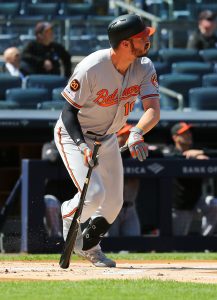
Almost two months into the 2019 season, however, Mancini has done a much better job of driving the ball through the air. His grounder rate this season stands at only 38.3%, plus a .342 BABIP indicates that Mancini’s lesser number of ground balls are sneaking through the infield. Beyond just getting more good luck from the BABIP gods, Mancini’s 25.3% line drive rate, 36.4% fly ball rate, and 37.7% hard-hit ball rates are all career bests, and his .365 xwOBA is a virtual match for his .369 wOBA.
These underlying factors are a big reason why the 2019 version of Mancini is looking like a more sustainably productive player than the the 2017 model. The 27-year-old is hitting .295/.345/.529 with 10 home runs, a 128 wRC+ and 132 OPS + through 229 plate appearances. With this production looking up, Baltimore could decide now is the time to sell high on what could be its best position-player trade chip.
It’s worth noting, of course, that the Orioles are under no pressure to trade Mancini by July 31 — he isn’t eligible for arbitration until this coming offseason, meaning that he is under team control through the 2022 season. It also isn’t totally out of the question that the O’s hang onto Mancini altogether, though the club’s timeline for a return to contention doesn’t really fit Mancini’s age and skillset.
Over his two-plus seasons in the big leagues, Mancini has played 793 innings as a first baseman and 1808 2/3 innings as a corner outfielder, despite being drafted as a first baseman out of Notre Dame in 2013 and never seeing any outfield action over his four minor league seasons. With Chris Davis and Mark Trumbo holding down the first base/DH spots, the Orioles deployed Mancini in the outfield as a way of getting his bat into the lineup, with predictably subpar defensive results.
Mancini has a -12.9 UZR/150 and minus-20 Defensive Runs Saved as an outfielder, making him an ill fit at the position now, let alone in the future. He has been seeing more time at first base recently with Davis on the IL, and there’s really no reason for Baltimore to not continue playing Mancini at his original position going forward; he wouldn’t be the first player to take his hitting to another level after being relieved from a troublesome defensive situation.
While Orioles GM Mike Elias surely hopes he can have the club on track in shorter order, the fact remains that the O’s might still not be full-fledged contenders by the 2023 season, given the extensive nature of the team’s rebuild. At that point, Mancini will be in his age-31 season and in all likelihood a full-time first baseman/DH, making it a better bet that he will be starting into a decline phase just as the Orioles as a whole plan to be rising up.
Waiting for the winter to explore Mancini trades would theoretically expand Baltimore’s market for the young slugger, since dealing him now would limit the O’s to only contending teams….or would it? Mancini’s extra years of control make him an interesting option for teams who might be riding the fence between being a pure buyer or a pure seller. Mancini could fit on a team like the White Sox, who aren’t contenders this season but surely have an eye towards taking a step forward in 2020 (especially now that Tim Anderson, Yoan Moncada, and Lucas Giolito are all breaking out).
Holding off on a Mancini deal also carries risk beyond just the normal concerns of a potential dropoff. As we’ve seen over the last two offseasons, teams are putting less and less value on defensively-limited players and first base/DH types, no matter how big a bat they might be swinging. Nicholas Castellanos (a free agent this winter) has far less team control than Mancini, but is almost exactly the same age and a much more established MLB hitter, yet the Tigers have had no luck shopping Castellanos for over a year.
Plus, once the offseason hits and the free agent market opens, teams with a first base or corner outfield vacancy might prefer to just sign a productive veteran at a relatively low price rather than give up prospects to Baltimore for Mancini. This could open the door to a more immediate trade, as the urgency of a pennant race might encourage teams to give up some solid minor league talent for a quality bat like Mancini, with his years of control as a significant bonus.
Looking at teams who could fit as trade partners for Mancini, I considered both contenders and non-contenders (who were planning to be competitive sooner rather than later) with both outfield/first base needs for 2019 and longer-term needs at first base going forward. More teams could certainly emerge as injuries, slumps, and other factors impact this summer’s deadline business, though a few clubs stand out as possible candidates at the moment.
Astros: Mancini would help them now, though Houston isn’t exactly hurting for bats, and the Astros have several interesting young names (Yordan Alvarez, Kyle Tucker) waiting in the wings.
Red Sox: Mitch Moreland and Steve Pearce are pending free agents, and J.D. Martinez could join them if he chooses to opt out of the final three years and $62.5MM on his contract. Boston’s first base spot has been seen as a potential eventual landing spot for either Rafael Devers or Michael Chavis, though those two emerging stars may end up at third base and second base, and prospect Bobby Dalbec may be at least a year away. A case can be made for the Red Sox to pursue Mancini at the deadline, though with JDM, Moreland, and Pearce all still in the fold, Boston is more likely to wait until the offseason to address its first base/DH situation.
Nationals: On paper, Washington fits since Ryan Zimmerman‘s $18MM club option isn’t likely to be picked up for 2020. In practice, all the bad blood between the Nationals and Orioles stemming from the ongoing legal dispute over broadcast rights makes any sort of trade between the two Beltway rivals next to impossible.
White Sox: As mentioned earlier, Mancini could fit nicely into an emerging White Sox lineup. Yonder Alonso is unlikely to have his club option exercised, and Jose Abreu is slated for free agency at the moment (though the Sox certainly want to keep Abreu on the south side). If Abreu does stay, he and Mancini would provide a lot of pop from the first base/DH positions.
Mariners: Something of a similar case to the White Sox, as Seattle also aren’t contenders now, but their quest to “re-imagine” their roster wasn’t seen as a long-term endeavor. Edwin Encarnacion could himself be traded by the deadline, and if he does stay, the M’s are more likely to buy out his 2020 option for $5MM than exercise it for $20MM. The surprising Daniel Vogelbach has definitely slugged his way into Seattle’s 2020 plans, so he could join Mancini splitting time between first base and designated hitter. Jay Bruce is also likely to still be in the mix barring a trade, though Bruce’s presence wouldn’t stop GM Jerry Dipoto from picking up a player like Mancini.
Rangers: Between Shin-Soo Choo, Hunter Pence, and even top prospect Willie Calhoun, Texas already has multiple players who might be best suited for DH duty, and Ronald Guzman is still young and controllable at first base. Texas also doesn’t have a deep farm system, and might not be willing to meet Baltimore’s asking price for Mancini, or maybe even any team’s price tag on any notable midseason upgrade since the Rangers weren’t fully committing to contending this year. Nevertheless, the surprising Rangers are maybe an interesting outside-the-box candidate for Mancini since the team has stayed in the wild card race. Acquiring Mancini is both a go-for-it type of move, while also serving as a long-term piece. Mancini would also give Texas some much-needed right-handed lineup balance.
Brewers: Only two teams have received less bWAR from the first base position this season than Milwaukee, Jesus Aguilar‘s breakout 2018 season has given way to some major struggles this year, while Eric Thames‘ hot start has given way to an ice-cold May. It would be a bold move to see the Brewers move on entirely from Aguilar less than a year after his big season, though the club doesn’t have much margin for error in a tight NL Central race. Like Texas, the Brew Crew also doesn’t have a lot of minor league talent to spare in trades.
Photo courtesy of USA Today Sports Images
Injury Notes: Warren, Farquhar, Mancini, Rodon
The Yankees announced today that they’ve placed right-hander Adam Warren on the 10-day disabled list with a back strain. The move comes in conjunction with the promotion of fellow righty Jonathan Holder, who’s being called upon to reinforce the bullpen. It’s yet another unfortunate development for a Yankees team that’s seeing its disabled list grow larger and larger; notable players among that number already include Tommy Kahnle, Greg Bird, Brandon Drury, Clint Frazier and Jacoby Ellsbury. The club is already facing harsh criticism from its fans and the city’s media outlets for its mediocre start, particularly in comparison to the division rival Red Sox, who are off to a historically hot 17-2 start. The growing list of injuries certainly won’t help their situation.
More injury-related items from around baseball…
- In a still-developing situation, Bob Nightengale of USA Today Sports tweets that White Sox reliever Danny Farquhar has been hospitalized and is undergoing a series of tests. According to Nightengale, there’s a possibility that Farquhar has a serious injury following passing out in the club’s dugout. We’ll have more in this unfortunate and scary situation as it continues to develop.
- James Fegan of The Athletic notes in his latest piece that White Sox right-hander Carlos Rodon is set to begin pitching some games in extended spring training soon. Rodon hasn’t pitched since undergoing an arthroscopic shoulder surgery late last year, but he’s reportedly set to throw a sideline session with pitching coach Don Cooper at some point this weekend before heading back to Arizona. His presence will certainly be a boost to a largely-inexperienced White Sox rotation that’s posted a 5.99 ERA so far this season.
- According to Eduardo A. Encina of the Baltimore Sun, Orioles slugger Trey Mancini‘s knee is still “really swollen” after colliding with the wall in foul ground during yesterday’s game. X-rays and a CT scan came back negative, so Mancini and the Orioles are hopeful that he can avoid a DL stint and return to the lineup in a few days’ time. He’ll sit out today’s contest against the Indians, however.
Quick Hits: Braun, Kemp, Brewers, Dodgers, BoSox, Mancini, Saunders
A trade rumor centering on Brewers outfielder Ryan Braun and Dodgers outfielder Matt Kemp made the rounds Saturday evening on social media, but “there’s nothing to it,” according to Milwaukee general manager David Stearns. While the executive told Adam McCalvy of MLB.com and other reporters that he doesn’t normally respond to rumors, he felt the need to shoot this one down publicly. “You guys know my policy, I don’t like commenting on this type of stuff,” he said. “But given that I don’t want this to be any sort of distraction, I’ll say when I first read it, I thought maybe someone was making an early April Fool’s joke.” The Dodgers reportedly showed serious interest in Braun in the past, but “there’s nothing clearly relevant” this time around, per Stearns.
More from around the majors…
- It could be a month before Red Sox reliever Tyler Thornburg joins the team’s bullpen, president of baseball operations Dave Dombrowski told WEEI on Saturday (via Ian Browne of MLB.com). Thornburg remains on the comeback trail from the thoracic outlet syndrome surgery he underwent last June. The 29-year-old, whom the Red Sox acquired from the Brewers in a December 2016 deal that also involved third baseman Travis Shaw, still hasn’t pitched in a meaningful game for Boston.
- With pre-arb players Paul DeJong Scott Kingery, Ketel Marte all having signed contract extensions recently, Jon Meoli of the Baltimore Sun wonders if the Orioles could try to lock up outfielder Trey Mancini. The 26-year-old slugger, who has five seasons of control left (including three arb-eligible years), told Meoli that the aforementioned extensions make for “an interesting trend. I’ve definitely taken notice of that, and I’m sure there’s probably been some more offers to other guys that nobody has heard about and they didn’t take them. You don’t know what goes on. But it is pretty interesting what’s going on there.” While there’s no indications that the Orioles and Mancini have actually discussed a long-term deal, Meoli suggests a five-year, $22MM to $24MM pact would be reasonable for the player at this stage. Power pays well in arbitration, Meoli points out, and Mancini’s coming off a rookie year in which he hit 24 homers and batted .293/.338/.488 in 586 trips to the plate.
- Free-agent outfielder Michael Saunders has gotten four offers since the Royals released him a week ago, and he’s expected to sign with a new club soon, Jon Heyman of FanRag tweets. Saunders, 31, lasted a month with Kansas City, which added him on a minor league pact. He was unable to secure a big league deal in the offseason (or make KC’s roster during the spring) after batting a paltry .202/.256/.344 (56 wRC+) in 234 PAs between Philadelphia and Toronto in 2017.
Orioles Rumors: Schoop, Mancini, Givens, Machado, Cards, Duffy
The latest on the Orioles comes in a pair of articles from Roch Kubatko of MASNsports.com…
- It’s unclear how many “untouchable” players the Orioles have, but second baseman Jonathan Schoop, outfielder Trey Mancini and reliever Mychal Givens are among them, an executive from outside the organization told Kubatko at the Winter Meetings. The lone player of those three who’s not under control for the long haul is Schoop, who has two arbitration-eligible years remaining. The Orioles will attempt to extend him sometime soon, Kubatko suggests. Mancini is controllable for the next half-decade, including two pre-arb campaigns, while Givens is under wraps for four more seasons (he’ll be eligible for arbitration in a year).
- While talking Manny Machado with the Cardinals, the Orioles showed interest in a trio of right-handers – Luke Weaver, Jack Flaherty and Jordan Hicks – as well as catcher Carson Kelly, Kubatko relays. In acquiring Weaver and Flaherty, the Orioles would accomplish their goal of getting two major league-ready starters for their top player. Of course, it’s questionable whether the Cardinals would even part with one (let alone both) for a single year of Machado. Weaver held his own across 60 1/3 innings last season for the Cards, who may not be in position to lose another starter with free agent Lance Lynn likely set to depart, while Flaherty ranks as MLB.com’s 48th-best prospect.
- The Orioles are reportedly trying to acquire Royals left-hander Danny Duffy, but Kubatko throws cold water on the possibility. Baltimore is indeed interested in Duffy, but it’s unlikely a deal with Kansas City will come together, in part because the Royals aren’t “aggressively shopping” the soon-to-be 29-year-old, Kubatko hears.
- Although the Orioles are seeking a left-handed hitter, they don’t seem to have interest in free agent Jon Jay, per Kubatko. That differs from previous offseasons when Jay was on the O’s radar, he notes. Conversely, Baltimore could consider Preston Tucker, whom the Astros designated for assignment Friday.
Orioles Notes: Miley, Rotation, Lineup, Farm System
There was a “legitimate possibility” of the Orioles exercising Wade Miley‘s $12MM club option for the 2018 season before a late collapse, writes Eduardo A. Encina of the Baltimore Sun, but the team now looks likely to buy that option out for $500K. Baltimore will be on the hunt for a left-handed starter this winter, but as Encina points out, the free-agent market is hardly rife with appealing options. Most of the lefties available are reclamation projects or back-of-the-rotation starters, with 35-year-old Jason Vargas and 37-year-old CC Sabathia representing the southpaws that enjoyed the most success in 2017. Encina notes that the weak crop of lefty starters may force the O’s to really evaluate whether they’d like to “balance” out their all-right-handed rotation or simply set their sights on overall quality regardless of handedness. Of course, it should be noted that even the offseason crop of right-handed starters carries more question marks than sure things, and the O’s will need to add a minimum of two starters. Suffice it to say, GM Dan Duquette will have his work cut out for him.
More out of Baltimore…
- The O’s don’t look likely to make any significant additions to their lineup, writes Roch Kubatko of MASNsports.com. Catcher Welington Castillo is expected to decline his modest $7MM player option on the heels of a terrific all-around season, but Baltimore may simply hand catching duties over to top prospect Chance Sisco and Caleb Joseph. In the outfield, Adam Jones will return in center field, with Trey Mancini and young Austin Hays the favorites to work in the corners. (Mark Trumbo, then, would be the DH.) However, Kubatko does note that Hays, a 2016 third-rounder who skyrocketed through the system, won’t merely be handed a job. Inferring a bit, that’d suggest that the O’s could add a veteran outfield option to push Hays and possibly handle some corner work early in the year of Hays proves to need more development time.
- While the Orioles’ farm has long been ranked among the bottom minor league systems in the game, they’ve made some significant progress in that regard as of late, writes MASNsports.com’s Steve Melewski. Melewski spoke to MLB.com’s Jim Callis and both J.J. Cooper and John Manuel of Baseball America in recent weeks, with each suggesting that the Orioles now rate more as a middle-of-the-pack farm (in the 15 to 20 range throughout MLB). The improvements come largely based on Hays’ breakout and the presence of Sisco, both of whom will likely exhaust their rookie status early in the 2018 season. But 2017 first-rounder DL Hall, 2015 supplemental rounder Ryan Mountcastle and a once-again healthy Hunter Harvey have helped bolster the top end of the farm for the time being. There’s still a lack of pitching help in the upper levels, however — an element that is particularly troublesome given the current state of the big league roster.