
Adam Warren Announces Retirement
Right-hander Adam Warren confirmed to Bryan Hoch of MLB.com yesterday that he’s retired as a player after spending parts of eight seasons in the Majors (Twitter link, with video, to Hoch’s interview with Warren). Warren, who was making an appearance at Yankees Fantasy Camp, told Hoch that he’s been enjoying time with his family but also misses being around the game and would be open to “maybe getting into some kind of coaching” role in the future.
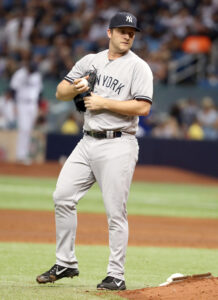
“There’s no more attempt to come back or anything like that,” Warren replied upon being asked if he’s formally put an end to his playing career. “I’m happy with it. I had a great career — didn’t really leave anything out there, so no regrets. Totally happy with it.”
Originally signed by the Yankees as a fourth-round pick out of UNC back in 2009, Warren made his big league debut as a 23-year-old in 2012 — a spot start that proved to be his lone MLB appearance that season. He made the Opening Day roster the following year, however, and quickly established himself as a pivotal swingman providing quality, multi-inning relief out of then-manager Joe Girardi’s bullpen. Warren’s official rookie season resulted in 77 innings of 3.39 ERA ball; he made two starts, finished 11 games and picked up his first Major League win, save and hold along the way, foreshadowing the jack-of-all-trades approach to pitching that he’d embody throughout his career.
Warren worked as a setup man for the Yankees in 2014, tallying 23 holds and saving three games while pitching to a sharp 2.97 ERA in 78 2/3 innings. He stepped into the rotation for part of the 2015 season and did so almost seamlessly, starting 17 games (plus another 26 relief appearances) and working to a 3.29 ERA over the life of a career-high 131 2/3 frames. His early Yankees work caught the attention of the Cubs, who acquired him that offseason in a trade that sent Starlin Castro to the Bronx.
Warren’s time with the Cubs in 2016 went poorly and proved to be short-lived, as he was knocked around for a 5.91 ERA. As the trade deadline approached, the Cubs, then hoping to bolster the roster for a World Series push (an endeavor that ultimately proved successful) quickly traded Warren … back to the Yankees, as one of four players in a package that shipped Aroldis Chapman to Chicago. Warren almost immediately righted the ship in his return to the Bronx, and he went on to have strong performances with the Yankees in both 2017 and 2018 before being traded to the Mariners, where he had a nice finish to his 2018 campaign.
Upon reaching free agency, Warren signed with the Padres, but his time in San Diego was marred by injury. After just 25 appearances, the right-hander landed on the injured list with an arm issue that ultimately proved to be a ligament tear in his pitching elbow. He underwent Tommy John surgery that year, rehabbed in 2020 and eventually made his way back to the mound for a third stint with the Yankees organization — this time with their Triple-A affiliate in 2021.
Though Warren posted solid results in Scranton that season — 3.59 ERA in 57 2/3 innings — he didn’t receive a call to the big leagues. Warren told Hoch that “the velocity never came back like I wanted it to.” That season proved to be the final chapter in his playing career, as Warren didn’t suit up for the 2022 campaign and now, at 35 years old, doesn’t appear to be contemplating a comeback.
Warren’s career draws to an official close with a 3.53 ERA, a 20.9% strikeout rate, an 8.3% walk rate, a 30-24 record, 57 holds and six saves over the course of 492 1/3 innings. He pitched for four different big league clubs, but fans will surely remember him as a versatile, quietly excellent member of the Yankees’ pitching staff who found success in just about every role asked of him. Baseball-Reference pegs his career earnings at approximately $11.5MM, and if Warren indeed plans to pursue potential coaching opportunities, there’ll surely be chances for him to add to that tally in the next phase of his career.
Yankee fans will want to check out the entire clip of Hoch’s chat with Warren, as he talks briefly about his favorite moments in pinstripes and notes that with so many great teammates over the years, “it’s just nice to be remembered” by fans with whom he interacts. That humble mentality undersells the right-hander’s importance to the Yankees’ staff during his run with the club, and it seems quite safe to say that their fans in particular will have plenty of fond memories Warren’s time in the Bronx. Best wishes to Warren and his family in whatever’s next, and congratulations on a very fine career.
Details On 2022 Team Payrolls
The Mets had the sport’s highest competitive balance tax payroll in 2022, reports Ronald Blum of the Associated Press. For CBT purposes, New York’s final tally checked in at $299.8MM. According to the report, that was around $2MM higher than the 2015 Dodgers’ $297.9MM mark that had stood as the previous spending record.
New York is responsible for a $30.8MM tax bill, the second-largest tally in the majors, after paying the tax for the first time in franchise history. The Dodgers will foot the highest tax payment at $32.4MM, Blum writes. While Los Angeles’ $293.3MM CBT payroll trailed that of the Mets, the Dodgers were subject to higher penalties as a payor for a second consecutive season.
The Mets are sure to shatter their own record this coming season, as they’re currently projected for a tax number north of $368MM. The Dodgers have trimmed spending, reportedly in hopes of resetting their tax status this year in preparation for a more active offseason next winter. They’re narrowly above the lowest CBT threshold at the moment. Roster Resource forecasts the Dodgers at approximately $238MM, around $5MM north of this year’s $233MM base threshold.
As the Associated Press first reported last September, six teams went over the CBT mark in 2022. Blum reports today the specifics of the payments owed by the Yankees ($9.7MM), Phillies ($2.9MM), Padres ($1.5MM as a second-time payor) and Red Sox ($1.2MM). The final three figures, in particular, are very modest expenditures relative to club payrolls. Nevertheless, the decision to narrowly surpass the threshold is significant in that it raises penalties for payments in future seasons and alters teams’ compensation for signing or losing qualified free agents. The Padres and Phillies surely don’t have regrets after each posted one of the best years in recent franchise history, but the decision didn’t translate to success in the Red Sox’s case. Blum writes that the tax money will be paid to MLB by the end of this week.
A team’s CBT number is determined by the average annual value of a club’s commitments plus player benefits and their contributions to the new bonus pool for pre-arbitration players. The CBT figure isn’t a match for an organization’s actual player payroll in a given season. Blum reports each club’s final raw payroll figure as well, with the Mets again fronting the pack at roughly $274.9MM. The Dodgers, Yankees, Phillies, Padres, Red Sox, White Sox, Braves, Astros and Blue Jays filled out the top ten.
On the other side, the A’s had the lowest payroll at approximately $49MM. The bottom 10 was rounded out by the Orioles, Pirates, Guardians, Marlins, Royals, Rays, D-Backs, Reds and Mariners. Full team data is available at the AP link.
Royals, Padres Among Teams Interested In Aroldis Chapman
Both the Royals and Padres have some level of interest free-agent lefty Aroldis Chapman, tweets Mark Feinsand of MLB.com. This comes just one day after the Marlins were also reported to have interest in the former Yankees, Cubs and Reds closer.
The 2022 season was a rough one for Chapman, who’ll turn 35 next month. The lefty’s fastball, which once averaged better than 101 mph, dropped to a 97.5 mph average in 2022. Simultaneously, his command troubles spike to their worst levels since back in 2011. Chapman’s 26.9% strikeout rate in 2022 was better than league-average but still a career-low by a wide margin, and he walked a massive 17.5% of his opponents, which is the second-worst mark of his career.
Chapman’s 4.46 ERA was passable but nevertheless the highest of his career, and he missed six weeks of the season with an Achilles injury in addition to a roughly three-week absence owing to a leg infection related to a recent tattoo he’d received. He was also left off the Yankees’ postseason roster after skipping a team workout
Kansas City has taken its share of low-cost gambles on former high-profile closers in recent years, inking Trevor Rosenthal prior to the 2020 season and also bringing former K.C. stars Wade Davis and Greg Holland back for buy-low reunion tours. Chapman would be a page out of a similar playbook.
With just an $85MM projected payroll (via Roster Resource) and plenty of uncertainty behind closer Scott Barlow, the Royals represent a sensible enough on-paper fit. They already have three potential southpaws for the ‘pen, with Amir Garrett, Anthony Misiewicz and Richard Lovelady on hand, but Misiewicz does have a pair of minor league option years remaining. And, if Chapman were able to bounce back into form, he could potentially be someone they look to flip to another club as the trade deadline draws nearer.
As for the Padres, nary a free agent with any name value passes by without being connected to them. The Friars already have a deep bullpen, headlined by Josh Hader, Robert Suarez, Luis Garcia and a hopefully healthy Drew Pomeranz, but Chapman would add another big arm to the mix. Ownership and president of baseball operations A.J. Preller have shown a clear affinity for high-profile stars in recent years, even if some of those name-brand players have been past their peak production.
Then again, they’re also already sitting on a $251MM payroll, and Chapman could push them into the third tier of luxury penalization, given the projected $270.6MM currently on their luxury ledger. In terms of monetary penalization, the jump from adding Chapman likely wouldn’t be large. The Padres would pay a 42% tax on every dollar up to $273MM in luxury obligations, and that number would jump to 75% thereafter. However, presuming Chapman won’t command much more than a few million dollars on a one-year rebound deal, that sum won’t be particularly burdensome.
That said, there’s a greater cost to consider if the Padres want to continue spending in free agency. Exceeding the luxury tax threshold by more than $40MM also results in a team’s top pick in the subsequent year’s draft pushed back by 10 places. Tacking on even a $3MM salary for Chapman would come with something like $4MM in costs between his salary and luxury tax penalties, but would more importantly drop the Padres out of the top 30 in the 2024 draft while also reducing the size of their bonus pool. Further trades, of course, could always alter that calculus, but the Padres were recently reported to be approaching a “self-prescribed” spending limit. It wouldn’t be a surprise to learn that the point at which payroll begins to detrimentally impact future drafts is indeed that limit.
While much of the free-agent market moved at an accelerated pace this offseason, the market for left-handed relievers has been curiously slow. Taylor Rogers took until late December to land his three-year deal with the Giants, and Chapman joins the likes of Andrew Chafin, Matt Moore, Will Smith, Brad Hand and Zack Britton as a southpaw reliever of note that has yet to sign a team for the 2023 season.
Post-Tommy John Players That Could Impact 2023
News items about Tommy John surgeries are fairly commonplace in baseball circles, but there’s no doubting it’s a significant event for the impacted player. It usually takes over a year to return to form, with a multi-stage rehabilitation process required to regain functionality.
Once a player gets back into game shape, there’s no guarantee the results will be the same. Justin Verlander looked just as good as ever in 2022, but Mike Clevinger didn’t get his velocity all the way back and saw his strikeout rate dip. He could still take another step forward in 2023 now that he’s another year removed from the procedure, but it goes to show that there are no guarantees about what happens in the aftermath.
Here are some players who went under the knife over the past year or so and who will be looking for good progress in 2023, both for their teams and themselves. Huge shoutout to the Tommy John Surgery list for having these details and so much more.
Forrest Whitley, Astros — Surgery Date: March 2021
Whitley, 25, was once considered one of the best pitching prospects in baseball, but his progress has been stalled by various factors. He missed 50 games in 2018 due to a drug suspension, and injuries have hampered him in the years since. He returned from his layoff late last year and tossed 40 innings in the minors but walked 14.5% of batters faced. The Astros already have a great rotation without him, but if Whitley could get back to the form that made him such a hyped prospect, they would be even more loaded.
Kirby Yates, Braves — March 2021
Yates, 36 in March, was one of the best relievers in the league in 2018 and 2019, arguably the best. He posted a 1.67 ERA over 125 games, striking out 38.7% of batters faced, walking just 6.1% of them and getting grounders on 45.2% of balls in play. Since then, however, he’s thrown just 11 1/3 innings. Seven of those came late in the 2022 season, though Yates gave up four runs on six hits and five walks in seven innings. This will be his first full season back. The Braves have a strong bullpen even if Yates can’t get back to peak form, but they’ll likely be in a tight division race and that kind of elite stuff would provide a nice boost.
José Leclerc and Jonathan Hernández, Rangers — March and April 2021, respectively
Leclerc, 29, seemed to be establishing himself as an excellent reliever in 2018. He got into 59 games for the Rangers and posted a 1.56 ERA, getting 12 saves and 15 holds in the process. A .211 BABIP surely helped, but there was a lot to like. He took a step back in 2019 with a 4.33 ERA and then missed most of the following two years. Leclerc returned in June of last year and struggled at first before posting a 2.01 ERA from July onwards. Hernández had a 2.90 ERA in 2020 before missing the 2021 campaign. He returned last year and posted a 2.97 ERA, but with concerning peripherals. His 6.4% walk rate from the former campaign jumped to 13% while his strikeout rate fell from 24.8% to 20.6%. On the more encouraging side, his ground ball rate went from 45.7% to 62.4%. The Rangers totally overhauled their rotation without doing much to the bullpen, but they could potentially get a boost from within if Leclerc and/or Hernández look good this year.
Adrián Morejón, Padres — April 2021
Once considered a top pitching prospect, Morejón, 24 next month, has been slowed by various injuries. He returned in 2022 but worked only in relief, tossing 34 innings in the majors and 13 1/3 in the minors. The Padres have some uncertainty in the back of their rotation that Morejón could help with if he stays healthy, but he’ll likely have workload concerns after so much missed time.
James Paxton, Red Sox — April 2021
Paxton, 34, had a great four-year run with the Mariners and Yankees from 2016 to 2019. However, he’s hardly pitched over the last three years due to various arm issues. He got back on the mound last summer while attempting to come back from Tommy John but then suffered a lat tear that halted his comeback effort. The Red Sox then had the choice to trigger a two-year option on the lefty worth $26MM, which they turned down based on his uncertain health outlook. He then had a $4MM player option that he triggered and will be with the Sox for 2023. He and Chris Sale would have made for a formidable one-two punch at the top of a rotation a few years ago, but neither has been healthy and effective for quite some time. Their status this year figures to have a huge impact on the fortunes of the Sox for the upcoming campaign.
Dustin May, Dodgers — May 2021
May, 25, returned late last year and was able to make six starts for the Dodgers. He posted a 4.50 ERA in that time and struck out 22.8% of batters faced, with both of those numbers paling in comparison to his pre-surgery form. The Dodgers let Tyler Anderson and Andrew Heaney depart from their 2022 rotation, while bringing in Noah Syndergaard. The quiet offseason will be easier to accept if May can post results like he did over 2019-2021: 2.93 ERA, 24.2% strikeout rate, 5.9% walk rate, 51.6% ground ball rate.
Joey Lucchesi, Mets — June 2021
Lucchesi, 30 in June, made 56 starts for the Padres in 2018 and 2019 with a 4.14 ERA. He didn’t get much of an opportunity in 2020 and was flipped to the Mets as part of the Joe Musgrove trade. He isn’t one of the club’s five best starters right now, but their rotation features four veterans who are 34 or older in Verlander, Max Scherzer, Carlos Carrasco and José Quintana. Also, Kodai Senga is making the transition from Japan, where starters frequently only pitch once a week. The club will surely need to rely on its depth this year at some point, making Lucchesi a key part of the equation.
Spencer Turnbull, Tigers — July 2021
Turnbull, 30, was seeming to make progress towards being a quality starter for the Tigers. He posted a 4.61 ERA in 2019 but got that down to 3.97 in 2020. He pushed it down even more in 2021, registering a 2.88 ERA over nine starts before getting shut down and requiring surgery. The Tigers seem likely to be without Casey Mize and Tarik Skubal to start the year as those pitchers deal with their own injuries. That could leave a path for Turnbull to get back on track.
Tyler Glasnow, Rays — August 2021
Glasnow, 29, didn’t live up to expectations with the Pirates but made good on his prospect pedigree after getting traded to the Rays. From 2019 to 2021, he had a 2.80 ERA while striking out 35.9% of batters faced and walking just 7.8% of them. Tommy John surgery put him out of action for a while but he was able to return late last year, making two starts in the regular season and one in the postseason. Glasnow has looked like an ace at times but still hasn’t maintained it over an extended stretch, still never reaching 115 innings in a major league season. The Rays have been fairly quiet this winter, but a healthy Glasnow is arguably a bigger upgrade to their roster than any move they could have made.
Tejay Antone, Reds — August 2021
Antone, 29, debuted in 2020 and was excellent out of the Reds’ bullpen. Over that year and 2021, he tossed 69 innings with a 2.48 ERA, 32.3% strikeout rate and 48% ground ball rate. The walks were a little high at 10.8% but he was still able to be incredibly effective regardless. He isn’t slated to reach free agency until after 2025, but the rebuilding Reds might have to consider a deadline deal if Antone is healthy and pitching well this summer.
Garrett Crochet, White Sox — April 2022
Crochet, 24 in June, was selected 11th overall in the 2020 draft and made his MLB debut later that year. Between his five appearances in 2020 and 54 more the following year, he has a 2.54 ERA and 29% strikeout rate. He’ll likely miss at least part of the upcoming campaign but the club is planning on keeping him in a relief role, which could help him return quicker.
Luke Jackson, Giants — April 2022
Jackson, 31, had a huge breakout with the Braves in 2021. He tossed 63 2/3 innings with a 1.98 ERA, striking out 26.8% of batters faced while getting grounders at a healthy 52.5% clip. He wasn’t as effective in the playoffs but nonetheless was part of the club’s World Series victory that year. He reached free agency and signed with the Giants, who are taking a shot on a return to form, though Jackson might miss the first couple of months of the 2023 season.
John Means, Orioles — April 2022
Means, 30 in April, was one of the few highlights for the Orioles during their leanest rebuilding years. He has a 3.81 ERA in 356 2/3 career innings, keeping his walks down to an excellent 5% rate. The Orioles took a huge step forward last year, graduating many of their top prospects and actually flirting with postseason contention. They’ll be looking to make more progress this year, but the rotation is still lacking in proven options. Getting Means back into the mix would be a big help if some of the younger guys struggle.
Chris Paddack, Twins — May 2022
Paddack, 27, had a great debut with the Padres in 2019, making 26 starts with a 3.33 ERA. His results fell off in the next two seasons, and he dealt with an elbow strain late in the 2021 season, but the Twins still liked him enough to acquire him as part of their return for Taylor Rogers. He was only able to make five starts before landing on the shelf. Their faith doesn’t seem to have wavered, as they recently signed him to a three-year extension. The Twins have a solid rotation on paper, but nearly the entire group landed on the injured list at some point in 2022. Kenta Maeda missed the whole season while rehabbing from an internal brace procedure, a modification of Tommy John surgery. Since injuries were the big story for the Twins in 2022, better health and/or better depth will be important in 2023.
Chad Green, Free Agent — June 2022
Green, 32 in May, spent the past seven seasons pitching for the Yankees. He tossed 383 2/3 innings in that time with a 3.17 ERA, striking out 32.5% of batters faced against a 6.3% walk rate. Unfortunately, he required Tommy John just a few months away from qualifying for free agency. He has yet to sign with a club, but players in this position often sign two-year deals that cover their rehab and give the team an extra year of control. If Green can find himself a deal like that, he could be a wild card down the stretch.
Casey Mize, Tigers — June 2022
Mize, 26 in May, was selected first overall by the Tigers in 2018. He posted a solid 3.71 ERA in 2021, but with disappointing underlying metrics. He only struck out 19.3% of batters faced and had a much higher 4.92 xERA, 4.71 FIP and 4.45 SIERA. After a dreadful 2022 season, the Tigers need to see how Turnbull, Mize, Skubal and Manning look this year before deciding how to proceed for the future.
Hyun Jin Ryu, Blue Jays — June 2022
Ryu, 36 in March, has oscillated between being injured and dominant for much of his career. He signed a four-year deal with the Blue Jays prior to 2020 and posted a 2.69 ERA that year, coming in third in the AL Cy Young voting. His ERA ticked up to 4.37 in 2021, and Ryu struggled even more last year before going under the knife. The Jays have a solid front four in their rotation but uncertainty at the back. Ryu is targeting a July return, and his health at that time could impact how the Jays approach the trade deadline.
Andrew Kittredge, Rays — June 2022
Kittredge, 33 in March, dominated in 2021 by posting a 1.88 ERA over 71 2/3 innings. He struck out 27.3% of batters he faced while walking just 5.3% of them and also got grounders on 53.5% of balls in play. He took a step back last year but made multiple trips to the injured list and likely wasn’t 100%. He’ll surely miss the first several months of the season but could jump into Tampa’s bullpen down the stretch.
Walker Buehler, Dodgers — August 2022
Buehler, 28, has an excellent track record for the Dodgers, having posted a 3.02 ERA in 638 1/3 innings. He’s struck out 27% of opponents while giving out free passes to just 6.3% of them. The Dodgers will have to get by without him for the majority of 2023, though there’s a chance he could be a late addition to the roster if all goes well. His August surgery makes him roughly one year behind Glasnow, who was able to return late in 2022. However, Glasnow’s procedure was August 4th of 2021 while Buehler’s was on the 23rd of last year. Still, if the Dodgers make a deep postseason run, that could give Buehler the runway he needs to make a landing this year.
September 2022 Or Later: Shane Baz, Anthony Gose, Scott Effross, Tyler Matzek, Bryce Harper
These players face longer odds of making an impact since their surgeries were so late in the year. The major exception is Harper, since position players require less recovery time than pitchers. Harper is hoped to be able to return to the Phillies around the All-Star break as a designated hitter, with a chance of returning to the field later in the campaign.
Padres Sign Ángel Sánchez To Minor League Deal
The Padres and right-hander Ángel Sánchez are in agreement on a minor league deal, reports Robert Murray of FanSided. The righty will get an invitation to major league Spring Training.
Sánchez, 33, has a very small amount of major league experience, which came back in 2017 with the Pirates. He got into eight games but posted an ERA of 8.76 in that brief time. At the end of that season, he was released by the Bucs to sign with the Korea Baseball Organization’s SK Wyverns, now known as the SSG Landers.
His first season in Korea was a bit of a struggle, as he posted a 4.89 ERA over 26 starts and three relief appearances. The subsequent season was much better though, as he made 28 starts and got his ERA down to an excellent 2.62. He then went from Korea to Japan, joining the Yomiuri Giants for the 2020 season. Over that year and the 2021 campaign, he made 29 appearances with the Giants, tossing 160 2/3 innings with a 3.81 ERA.
It doesn’t appear as though Sánchez pitched anywhere in the summer of 2022, but he has been getting some action recently for the Gigantes del Cibao in the Dominican Winter League. He’s made four appearances for that club, posting a 1.29 ERA in seven innings.
It’s been over five years since his last major league appearance, with Sánchez putting various stamps on his passport since then. He’ll now head to camp with the Friars and try to earn his way back into the big leagues for the first time since 2017, having had good results in different leagues in the interim.
Padres Sign Domingo Tapia To Minor League Deal
The Padres have signed right-hander Domingo Tapia to a minor league deal, according to his transactions tracker at MLB.com. He will presumably be invited to major league Spring Training.
Tapia, 31, had some major league success in 2021, split between the Mariners and Royals. Between those two clubs, he tossed 33 2/3 innings over 34 appearances, registering a 2.67 ERA. His 19.3% strikeout rate and 11.1% walk rate were both a bit worse than league average, but he got grounders at a solid 46.8% rate.
In 2022, he was claimed off waivers by the A’s and spent the season being shuttled between the majors and minors. His Triple-A and MLB results could hardly have been more different, as he had a 1.76 ERA with Las Vegas and a mark of 8.47 for Oakland. This was likely a symptom of his low-strikeout approach, as he allowed a .387 batting average on balls in the play in the majors but a .276 rate with the Aviators. He also stranded 72.2% of baserunners with Vegas but just 62.2% with the A’s.
The Padres will take a chance that Tapia’s fortunes will change in 2023 or perhaps he can simply take his fate into his own hands by finding a few more strikeouts. His fastball averaged 97.9 mph last year, which cracked the 95th percentile among qualified hurlers, despite just a 13.3% strikeout rate. If Tapia can earn his way onto San Diego’s roster, he still has one option year remaining, allowing him to provide the club with some roster flexibility. He could also be cheaply retained into the future given that he has yet to crack one year of MLB service time.
Boras: Blue Jays, Cubs, Twins “Were Really After” Xander Bogaerts
Xander Bogaerts‘ first visit to free agency resulted in an 11-year, $280MM deal with the Padres that greatly exceeded projections, even for a player who was expected to land one of the offseason’s biggest contracts. Agent Scott Boras discussed some of the twists and turns of Bogaerts’ free agent trip with USA Today’s Bob Nightengale, and Boras identified that Bogaerts was San Diego’s second choice, once Trea Turner rejected a reported $342MM offer from the Padres.
Once Turner turned down the Padres’ offer to sign with the Phillies, “we kind of knew the Padres’ guy was Bogaerts,” Boras said. “They wanted that personality, that leadership in that locker room.” Left unspoken by Boras was the fact that the Padres were clearly itching to land a big target of some kind, even to the point of considering a $400MM bid for Aaron Judge. With Judge and Turner off the board, the Padres may have been more willing to go above and beyond to sign Bogaerts, and ensure that their offseason endeavors would include at least one superstar name.
The Red Sox reportedly made a last-ditch effort to sign Bogaerts in the hours preceding his deal with San Diego, though Sox chief baseball officer Chaim Bloom later downplayed the chances that a reunion between Bogaerts and the Red Sox was becoming a possibility. There were mixed signals from Boston’s ownership and front office all season long about the franchise’s willingness to retain Bogaerts, and from Boras’ perspective, the Red Sox weren’t ever a major bidder.
“It was just really clear to us there was a separation where Boston was going to go for Bogaerts, compared to where the market was,” Boras said. “They probably made a decision they were going to sign [Rafael] Devers, and were going to pay only one of them. So we knew at the forefront that Bogey would be somewhere besides Boston.”
Sure enough, the Red Sox indeed ended up extending Devers, while Bogaerts landed in San Diego. As for other teams in the hunt, such teams as the Phillies, Diamondbacks, Orioles, Mariners, Dodgers, and Giants were all linked to Bogaerts at various points in the offseason, even if some of these pursuits were perhaps more cursory than others. Boras implied that three teams in particular (beyond the Padres) separated themselves from the pack, saying that “Minnesota, the Cubs, the Blue Jays, they were really after” Bogaerts’ services.
The Cubs and Twins were already known to be Bogaerts’ suitors, and as both clubs were monitoring the high-end shortstop market and eventually came away with two of the winter’s top options at the position — Chicago signed Dansby Swanson, while Minnesota (eventually) reunited with Carlos Correa. The Twins’ interest in Bogaerts was framed as a backup plan if Correa signed elsewhere, though Bogaerts ended up signing with the Padres before Correa agreed to his initial deal with the Giants. As for the Cubs, MLB.com’s Mark Feinsand wrote that the team gave some consideration to the idea of signing both Bogaerts and Swanson, with Bogaerts playing third base in that blockbuster scenario.
It makes for some fascinating “what-if” material, since neither the Twins or the Cubs were previously considered top candidates to sign Bogaerts. However, the Blue Jays’ involvement is perhaps the most interesting, as Toronto hadn’t previously been linked to Bogaerts or any of the top shortstops whatsoever. While the aggressive Jays are known to be a team that routinely checks in on most free agents as a matter of due diligence, Toronto’s focus was known to be on the club’s greater needs in the outfield and in the rotation. Such names as Justin Verlander, Brandon Nimmo, and Kodai Senga were among the many players linked to the Blue Jays, and Toronto has thus far signed Chris Bassitt, Kevin Kiermaier, and Brandon Belt, while Daulton Varsho and Erik Swanson were respectively acquired in major trades with the Diamondbacks and Mariners that saw Gabriel Moreno, Lourdes Gurriel Jr., and Teoscar Hernandez change uniforms.
These moves have sent the Jays’ payroll to franchise-record heights, and set the team up to exceed the luxury tax threshold for the first time. So in that sense, making a splash to sign Bogaerts wouldn’t have been out of line with the Blue Jays’ spending habits, even if obviously landing Bogaerts would have entirely changed the scope of Toronto’s offseason.
First and foremost, the Blue Jays already have a star shortstop in Bo Bichette, who is only entering his age-25 season and already amassed two top-12 finishes in AL MVP voting, an All-Star nod, and 9.6 fWAR in 2021-22. (For comparison, Bogaerts had 10.4 fWAR in 2021-22.) Bichette’s success at the plate, however, was tempered by a rather drastic defensive decline in 2022, as public metrics placed Bichette among the league’s worst defensive players. Ironically, Bogaerts’ glovework had long been a source of controversy, but he quelled some doubts over his viability as a shortstop by delivering the best defensive season of his career in 2022.
Had the Jays signed Bogaerts, they could’ve installed him at shortstop and moved Bichette to second base, and then used the current collection of second-base options (i.e. Santiago Espinal, Cavan Biggio, Whit Merrifield) either purely as depth options or as trade chips. Since Matt Chapman is a free agent after the 2023 season, the Blue Jays might’ve considered moving Bogaerts to third base at that point and returning Bichette to shortstop, if Chapman wasn’t retained. Or, if signing Bogaerts would’ve taken up much or all of Toronto’s payroll space, the Blue Jays might have been considered trading Bichette in order to address other needs. If the Jays hadn’t had the money to sign a Bassitt-level starter, for instance, Bichette could have been shopped to land a front-of-the-rotation arm.
Notable International Signings: 1/15/2023
Major League Baseball’s international signing period for 2023 has officially opened up today, with many of the big names signing almost immediately. Teams have long since agreed to verbal agreements with newly eligible teenage players, and today’s signings largely represent confirmation of what was anticipated. Still, it’s a day of no small moment, particularly for the young men embarking upon the start of their professional careers.
As previously mentioned, most of the agreements have been known for a while, with Baseball America‘s Ben Badler and MLB.com‘s Jesse Sanchez having listed each player’s expected landing spot. You can find each team’s total bonus pool and other information on the process right here. Here are a few key deals:
- Ethan Salas, C, Venezuela — Padres ($5.6MM): Ranked as the top prospect by both Baseball America and MLB Pipeline, the 16-year-old is considered by MLB Pipeline as “one of the best catching prospects in recent history” and is lauded for his strike zone control, power, and defense. Scouts have specifically highlighted his swing and soft hands. Born in June 2006, the backstop is the youngest player in MLB Pipeline’s Top 10 International Prospect Rankings. The young switch-hitter is no stranger to high-level baseball, with his grandfather, father, and uncle all playing professionally, and his older brother Jose Salas signed by the Marlins in 2019. Salas’ $5.6MM deal will comprise almost all of the Padres’ base signing pool of $5.825,000.
- Felnin Celesten, SS, Dominican Republic — Mariners ($4.7MM): MLB Pipeline’s second-best prospect and Baseball America’s third-best, Celesten has been heralded as having “the highest ceiling of any international shortstop prospect in a decade” by MLB Pipeline. Scouts have noted the switch-hitter’s plus speed, arm, and raw power. However, Baseball America reports that Celesten has “an aggressive approach” and “might need to become a more selective hitter.“
- Brando Mayea, OF, Cuba — Yankees ($4.4MM): Baseball America’s second-best prospect and MLB Pipeline’s ninth-best, Mayea has drawn praise for his bat speed, power, and approach to the plate, with one scout going as far as to describe the 17-year-old as a “mini Gary Sheffield.” Scouts have praised the righty’s strong arm, with some expecting an eventual move to a corner outfield position.
- Alfredo Duno, C, Venezuela — Reds (Unknown): MLB Pipeline’s fourth-best prospect and Baseball America’s seventh-best, Duno is a 17-year-old catcher that boasts three above-average tools — his fielding, arm, and power. Scouts have praised his “elite bat speed” and defensive ability. MLB Pipeline and Baseball America both predict that Duno will remain behind the plate, but both also cite his swing-and-miss tendencies as a result of his aggressive approach.
- Emmanuel Bonilla, OF, Dominican Republic — Blue Jays ($4.1MM): Baseball America’s fourth-best prospect and MLB Pipeline’s seventh-best, Bonilla profiles as a slugging outfielder that has a chance to remain in centerfield but will likely move to a corner position as the 16-year-old matures. Scouts have praised the righty’s bat speed and swing, with Baseball America reporting that some scouts believe Bonilla has “one of the best combinations of hitting ability and power in the class.”
- Luis Morales, RHP, Cuba — Athletics (Unknown): MLB Pipeline’s fifth-best prospect and Baseball America’s ninth-best, Morales is a hard-throwing righty with a fastball that sits between 94-97 MPH with a slider, changeup, and curveball as secondary pitches. Born in Cuba, Morales was considered the best U-18 pitcher on the island, setting a record for strikeouts (161) in 82 2/3 innings between 2019 and 2020. He defected in 2021 while playing for Cuba’s U-23 team in Mexico. Morales, 20, is one of the oldest high-profile international prospects and thus may be potentially fast-tracked through the A’s system.
- Sebastian Walcott, SS, Bahamas — Rangers (Unknown): Baseball America’s sixth-best prospect and MLB Pipeline’s eighth-best, Walcott is a 6’3, 170 lbs (6’4, 190 lbs, per Baseball America) 16-year-old that has impressed scouts with high raw power and bat speed. Despite being 6’3, Walcott has drawn praise for his contact skills, hand-eye coordination, and his fluid swing. Baseball America projects that as Walcott matures, he will outgrow the shortstop position and transition to third base.
Several other well-regarded prospects also secured bonuses of $2M or more, with the specifics provided by Sanchez:
- Brailer Guerrero, OF, D.R., Rays ($3.7MM) [MLB Pipeline #12, BA #5]
- Jesus Caba, SS, D.R., Phillies ($3MM) [MLB Pipeline #11, BA #8]
- Ariel Castro, OF, Cuba, Twins ($2.5MM) [MLB Pipeline #11, BA#13]
- Rayner Arias, OF, D.R., Giants ($2.8MM) [MLB Pipeline #15, BA #8]
- Camilo Diaz, OF, D.R., Astros ($2.25MM) [MLB Pipeline #17, BA #19]
- Luis Almeyda, SS, D.R., Orioles ($2.3MM) [MLB Pipeline #20, BA #17]
- Roberto Calaz, OF, D.R., Rockies ($2.5MM) [MLB Pipeline #24, BA #14]
Padres Avoid Arbitration With Juan Soto, Josh Hader
The Padres have avoided arbitration with two stars. San Diego and Juan Soto agreed to a $23MM contract, while they inked Josh Hader to a $14.1MM deal.
Aside from Shohei Ohtani — who agreed to a $30MM deal with the Angels at the end of last season — Soto is the highest-profile player in this year’s arbitration class. MLBTR contributor Matt Swartz projected him for the highest salary of any arb-eligible player, forecasting him to land at $21.5MM. Soto comes in a bit above that and secures a little more than a $6MM raise on last season’s $17.1MM salary.
Acquired from Washington in one of the biggest deadline trades in MLB history, Soto posted a .236/.388/.390 line through his first 228 plate appearances with the Friars. That was below his usual otherworldly standards but still excellent output thanks to a massive 19.3% walk percentage and just a 14.9% strikeout rate. Including his first-half numbers in Washington, he hit .242/.401/.452 with 27 homers over 664 plate appearances.
The Friars will be able to control Soto for one additional season before he’d hit free agency after the 2024 campaign. He’s on track to reach the open market in advance of his age-26 season and trending towards a potential record-setting deal. San Diego surely has interest in working out a long-term agreement with the Boras Corporation client. Soto declined a 15-year, $440MM extension offer from Washington before being traded, ostensibly setting the floor in any negotiations with the Friars.
Hader landed with the Padres in a massive deadline deal as well. Acquired from the Brewers in a surprising swap, he struggled to a 7.31 ERA through his first 16 innings in San Diego. A spike in walks played a role in those anomalous struggles, though Hader was also plagued by an unsustainably high .372 batting average on balls in play against him. He’d only managed a 4.24 ERA over 34 innings with Milwaukee before the trade but struck out an eye-popping 41.8% of his opponents for the Brew Crew.
The lanky southpaw has an established multi-year track record as one of the sport’s most dominant late-game arms. He owns a career 2.71 ERA with a 43.2% strikeout percentage over 332 1/3 big league innings. Hader has collected 132 saves along the way and been selected to the All-Star Game four times. He’s rewarded with one of the largest arbitration deals of the winter himself, narrowly topping his $13.6MM projection.
With over five years of MLB service, Hader avoids arbitration for the final time. He’s on track to hit free agency next winter, when he’ll be headed into his age-30 season. With a typically dominant showing in 2023, Hader would have a chance at topping the reliever record $102MM free agent contract signed by Edwin Díaz this offseason.
Jeff Passan of ESPN reported the Soto agreement. Robert Murray of FanSided reported the Hader deal.
Padres, Alfonso Rivas Agree To Minor League Contract
The Padres are signing first baseman Alfonso Rivas to a minor league deal, tweets Jeff Sanders of the San Diego Union-Tribune. The La Jolla native will get a non-roster invitation to MLB Spring Training with his hometown club.
Rivas, 26, hit free agency last week after being released by the Cubs. That ended a three-year tenure in the organization that began when Rivas was acquired from the A’s for Tony Kemp. He didn’t play in 2020 thanks to the canceled minor league season but spent the past two seasons at the upper levels. Rivas hit .284/.405/.411 in 58 games with Triple-A Iowa in 2021, earning his first big league call in the process. He made a strong impression, posting a .318/.388/.409 mark across 18 contests before suffering a season-ending injury to his right middle finger.
The left-handed hitter returned in 2022 and split the season between Chicago and Iowa. He again hit well against minor league arms, posting a .298/.368/.415 line over 26 games. His production at the MLB level was more middling. Over 287 plate appearances, Rivas put up a .235/.322/.307 mark. He connected on only three home runs and 10 extra-base hits overall.
To his credit, Rivas drew walks in a quality 10.1% of his trips to the dish. He paired that with an ugly 30.3% strikeout rate though. Combined with his lack of power, his overall offensive production checked in 17 percentage points below league average by measure of wRC+. That’s not the typical output expected from a player who’s limited to first base or the corner outfield. Rivas was credited by prospect evaluators as a potential plus gloveman at first base, and Defensive Runs Saved pegged him as six runs better than average over 674 1/3 innings at the position last year.
Even with a quality glove, Rivas will need to perform better at the plate than he did last season to hold a roster spot. He’s an accomplished, high-OBP minor league hitter, owner of a .289/.391/.411 line in parts of four seasons. That makes him an interesting upper level depth pickup. Rivas still has two option years remaining as well. If he cracks San Diego’s 40-man roster at any point, they can keep him at Triple-A El Paso for the next couple seasons.