
Giants, Nick Duron Agree To Minor League Deal
The Giants have signed reliever Nick Duron to a minor league contract, according to his transactions log at MLB.com. The 26-year-old joins the fourth organization of his professional career.
Duron entered the pro ranks in 2015, selected by the Red Sox in the 31st round out of Clark College in Washington. He spent a few seasons in the Boston system but didn’t advance past Low-A before being released in 2018. Signed to a minor league deal by the Mariners, he pitched his way to Triple-A in 2021 before qualifying for minor league free agency. Last winter, Duron hooked on with the Phillies on a minor league pact.
The 6’4″ hurler would again spend most of the season in Triple-A, but he earned a cup of coffee at the MLB level. Duron was called to the majors in July as a replacement for unvaccinated players in a series in Toronto. He came out of the bullpen once, working around two hits to get out of a scoreless inning. After the contest, Philadelphia returned him to Triple-A Lehigh Valley, where he spent the remainder of the season before again hitting minor league free agency.
While Duron only has that one inning of MLB experience, he’s an interesting depth flier for the Giants. He averaged 97.2 MPH on his fastball during his MLB appearance. That strong velocity translated into plenty of whiffs in the minors, as he struck out a strong 29.6% of opponents over 48 2/3 innings for the IronPigs. Duron walked an alarming 13.6% of batters faced, but the strikeouts and a lofty 50.4% ground-ball percentage helped him to a 2.77 ERA.
Duron’s control has been inconsistent, but he’s flashed decent stuff and is coming off a career-best showing in Triple-A. He’ll presumably start next year with the Giants highest affiliate in Sacramento but could put himself in the mix for an MLB bullpen job at some point. Duron has all three option years remaining, so if he cracks the 40-man roster at any point, the Giants can freely move him between San Francisco and Sacramento for a long while.
Giants Sign Sean Manaea
DECEMBER 16: The Giants have officially the signing of Manaea.
DECEMBER 12: Lefty Sean Manaea and the Giants have agreed to a two-year, $25MM deal with an opt-out after the 2023 season, according to Jon Heyman of the New York Post. Manaea is represented by the Boras Corporation.
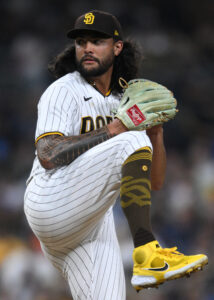
The deal marks a return to the Bay Area for the 30-year-old Manaea, who was traded from Kansas City to Oakland as a prospect at the 2015 trade deadline as part of the Ben Zobrist deal. Manaea debuted for the A’s the following year and was a steady presence in their rotation throughout his six seasons in Oakland, though he did miss most of the 2019 season after undergoing shoulder surgery.
Still, with both his career ERA (3.86) and FIP (3.96) under 4.00, Manaea was a fairly attractive arm to teams searching for rotation help after the lockout ended this spring, and so the A’s shipped him to San Diego along with relief prospect Aaron Holiday to acquire prospects Euribiel Angeles and Adrian Martinez. Things didn’t go so well for Manaea in San Diego, however, as he struggled in 2022, posting an unsightly 4.96 ERA (75 ERA+) in 158 innings that his 4.53 FIP only slightly improves upon.
That rough platform season is likely why Manaea was available to San Francisco, who showed interest in him during last week’s Winter Meetings, at such a low price compared to what we’ve seen from the rest of the mid-rotation market. It’s of course possible that Manaea eschewed a larger guarantee in order to secure a chance to test the market again next offseason, hoping to see his results improve in 2023.
In that regard, the deal is similar to the one the Giants signed Carlos Rodon to last offseason, albeit at a much lower AAV of just $12.5MM compared to Rodon’s $22MM. Manaea may prove to be Rodon’s replacement in a rotation that includes Logan Webb, Alex Cobb, Alex Wood, and Anthony DeSclafani, should Rodon ultimately sign elsewhere this offseason. Rodon is known to be seeking a seven-year deal this offseason, with the Cardinals and Yankees among those interested.
While it seems unlikely Manaea can imitate Rodon’s sterling 2022 production in 2023, there’s still reason to believe that Manaea can bounce back from his difficult 2022 in the coming season. His strikeout and walk rates of 23.2% and 7.5%, respectively, are roughly in line with his career norms and were actually slightly above league average last year according to Baseball Savant. And for the season’s first three months, Manaea’s numbers were right in line with his career marks. Through the end of June, he’d posted a 3.92 ERA and 3.76 FIP with a 25.8% strikeout rate and 9% walk rate. Over the final three months of the season, however, Manaea was rocked for an ERA just over 6.00, with a huge portion of the damage coming in a pair of eight-run drubbings at Dodger Stadium.
Manaea’s biggest problem in 2022 was the long ball, as he allowed a whopping 1.65 home runs per nine innings that doubtlessly contributed to his strand rate of just 67.5% — his lowest in any full season of his career. Moving his home games Oracle Park, one of the most difficult ballparks in the majors for home run hitters, should aid Manaea in his bid to return to form in 2023. If Manaea can post a season more in line with his 2021 performance, where he posted a 3.91 ERA/3.66 FIP in his 179 1/3 innings of work, he’ll justify the investment from San Francisco and be in line for a larger deal, more in line with the four-year, $52MM guarantee MLBTR predicted for him this offseason.
With their starting five for 2023 likely set barring another surprise addition, the Giants seem primed to turn their attention to the lineup, which largely struggled in 2022 with the exception of All-Star Joc Pederson, who returned to the Giants by accepting a qualifying offer early in the offseason. San Francisco already added Mitch Haniger but is rumored to be interested in adding a second outfielder, even after missing on pursuits of Aaron Judge, Brandon Nimmo, and Cody Bellinger.
The Giants are also are expected to address an infield that lost Brandon Belt and Evan Longoria to free agency this offseason, while suffering a considerable step back from shortstop Brandon Crawford after his resurgent 2021 season. The Giants reportedly have Carlos Correa as their top option in the free agent shortstop market, with the Twins and Cubs representing possible competition for Correa’s services. San Francisco also seems likely to look to upgrade their relief corps for next season. Earlier, they were rumored to have interest in pairing Kenley Jansen, who signed with the Red Sox, with Camilo Doval at the back of their bullpen, so a pursuit of another back-end bullpen option like Taylor Rogers seems feasible.
Giants, Curt Casali Have Discussed Reunion
The Giants have made big splashes to their infield and outfield this offseason with the signing of Carlos Correa and Mitch Haniger. They upgraded their rotation by signing Sean Manaea and Ross Stripling. One thing still on the to-do list is addressing their catching corps, with Susan Slusser of the San Francisco Chronicle reporting the club has been in contact with Curt Casali about him returning to the club.
When Buster Posey retired after the 2021 season, it was hoped that prospect Joey Bart could step up and take over as the club’s everyday backstop. Unfortunately, that hasn’t come to fruition just yet. At the plate, he’s got some power but undercuts his value with strikeouts. He’s been punched out in 38% of his plate appearances thus far in his career and has a batting line of .215/.296/.364 for a wRC+ of 90. He was also given negative marks by Defensive Runs Saved and FanGraphs’ framing metric in 2022. As Slusser notes in her piece, Bart was nudged out of working with either Carlos Rodón or Logan Webb down the stretch last year.
Veteran Austin Wynns, who is still on the roster, ended up getting into 57 games behind the plate for the club last year. His defensive numbers were around league average, better than Bart, but he’s unlikely to provide much with the bat. The 32-year-old has a career batting line of .231/.275/.337 for a wRC+ of 68. There’s a third catcher on the 40-man roster in Blake Sabol. The Giants just acquired him from the Reds, who grabbed him from the Pirates in the Rule 5 draft. He has great batting numbers in the minors but no major league experience. He also plays the outfield, making him perhaps best suited for a third catcher/utility role.
Given those options, it’s unsurprising that the club would be open to finding more certainty behind the plate. They were connected to both Sean Murphy and Christian Vázquez in recent weeks, but those players are each now off the board, having been traded to Atlanta and signed with Minnesota, respectively.
Casali, 34, is a perfectly serviceable big league catcher, though he’s never really been a club’s primary option. Though he has 462 career games played, he’s never tallied more than 84 in any individual season. He’s generally been a strong defender behind the plate, having tallied 16 Defensive Runs Saved in his career and a slightly above-average mark in terms of framing. He’s not a liability at the plate either, with a career batting line of .223/.316/.392. That amounts to a wRC+ of 92, which is 8% below league average overall but roughly average for a catcher. His 27.8% strikeout rate is definitely on the high side but he also has drawn walks at a strong 10.7% rate. The Giants are surely familiar with him as he played for them in 2021 and the first half of 2022, getting dealt to the Mariners at the deadline.
Casali would be a perfectly defensible addition, but the Giants will have other options. The trade market is now headlined by the Blue Jays and their trio of backstops: Danny Jansen, Alejandro Kirk and Gabriel Moreno. The free agent market doesn’t have many super exciting options now that Vázquez and Willson Contreras have signed, with Austin Hedges, Roberto Pérez, Omar Narváez and Gary Sánchez some of those still out there.
None of these options are likely to break the bank from a financial perspective. Roster Resource currently pegs the Giants’ payroll at $190MM and their CBT figure at $206MM. They are getting near their franchise high payroll of $201MM, per Cot’s Baseball Contracts, though that was back in 2018. They also have plenty of room under the luxury tax, though if they succeed in their continued attempts to retain Rodón, that would significantly change the picture.
Minor MLB Transactions: 12/14/22
Teams have been quite active over the past couple of weeks and a few minor league deals slipped through the cracks. Here’s a quick roundup.
- The Giants signed infielder Donovan Walton to a minor league deal, according to his transactions tracker at MLB.com. Walton, 29 in May, began 2022 with the Mariners but was traded to the Giants in May. He spent the year as a frequently-optioned depth piece for the Giants, getting into 25 MLB games and hitting .158/.179/.303, wRC+ of 31. In the minors this year, he hit .248/.353/.403, wRC+ of 94. He was non-tendered at the end of the season but has now re-joined the organization in a non-roster capacity. He has some experience at all four infield positions and left field, giving the club a versatile depth option. If he makes it back onto the 40-man, he’s now out of options and will have to stick on the active roster or else be designated for assignment.
- The Braves signed catcher Joe Hudson to a minor league deal, according to his transactions tracker at MLB.com. Hudson, 32 in May, has 18 games of MLB experience stretched across three seasons from 2018 to 2020. He spent 2022 in the Rays’ system, getting into 49 games for the Triple-A Durham Bulls. He hit .226/.345/.489 in that time for a wRC+ of 119. The Braves recently acquired Sean Murphy to be their primary catcher, but sent William Contreras and Manny Piña packing as part of the deal. The club does still have Chadwick Tromp and the oft-injured Travis d’Arnaud but Hudson will give them a depth option with major league experience.
- The Twins signed first baseman Tyler White to a minor league deal, according to his transactions tracker at MLB.com. White, 32, played for the Astros from 2016 to 2019, and a brief stint with the Dodgers, but played in Korea in 2020. He came back to North America for the past two years but has been stuck in Triple-A. Though he generally hits well, his defense is essentially limited to first base at this point, aside from brief stints at third. With the Blue Jays’ system in 2021, he hit .292/.424/.476 for a wRC+ of 141. He split 2022 between the Triple-A teams of the Braves and Brewers, hitting .230/.357/.412, 108 wRC+.
- The Marlins signed infielder Alex De Goti to a minor league deal, according to his transactions tracker at MLB.com. De Goti, 28, has spent his entire career with the Astros thus far, getting into two big league games in 2021. He spent all of 2022 in Triple-A, hitting .253/.352/.377 for a wRC+ of 87. He’s played every position on the diamond in his minor league career except for catcher, even taking the mound for the occasional mop-up stint. He should serve as a versatile depth piece for the Fish.
- The Nationals have signed right-hander Ronald Herrera to a minor league deal, according to his transactions tracker at MLB.com. Herrera, 28 in May, has three innings of MLB experience, which came as a 22-year-old back in 2017 with the Yankees. He spent most of 2022 with the Double-A affiliate of the Nats, making 24 starts and throwing 129 innings. He posted a 4.40 ERA in that time with a 21.4% strikeout rate, 6.4% walk rate and 39.8% ground ball rate. The Nats had the worst rotation ERA in the majors in 2022, coming in at 5.97. They’ve signed Trevor Williams to help out but there’s a still a good chance they might have to rely on some depth options throughout the year.
- The Angels signed right-hander Nash Walters to a minor league contract, according to his transactions tracker at MLB.com. Walters, 26 in May, spent his entire career in the Brewers’ organization until getting sent to the Angels in a September 2022 trade. He made his major league debut with the Halos on the last day of the season, facing three batters, retiring one while surrendering one hit and one walk. His minor league work for 2022 amounted to 53 2/3 innings with a 4.70 ERA, 30.2% strikeout rate and 8.2% walk rate. He was non-tendered at the end of the year but has returned to the organization without taking up a spot on the 40-man.
- The Mariners signed right-hander Jose Rodriguez to a minor league deal, according to his transactions tracker at MLB.com. Rodriguez, 27, tossed 21 1/3 innings with the Angels over 2019 and 2020, posting a 2.53 ERA in that time. That number looks impressive but came with an unsustainable 100% strand rate and .226 batting average on balls in play. His 14.1% strikeout rate and 13% walk rate suggest he was lucky to allow so few earned runs. He spent 2022 in the Mets’ system, tossing 76 1/3 innings in Triple-A with a 4.95 ERA, 20.5% strikeout rate, 10.9% walk rate and 42.2% ground ball rate. If he’s able to crack Seattle’s 40-man roster, he still has two option years remaining and can be moved between the majors and minors with regularity.
Giants, Carlos Correa Agree To 13-Year Deal
The Giants have landed the star player they’d been seeking. San Francisco is reportedly in agreement with Carlos Correa on a 13-year, $350MM contract. The deal doesn’t contain any opt-out provisions but the Boras Corporation client will receive a full no-trade clause.
It’ll be the third team in as many years for Correa, who turned 28 in September. The longtime Astro hit free agency last winter. Generally regarded as the top player in that offseason’s class, he didn’t find the long-term megadeal he’d sought after declining a qualifying offer from Houston.
After the lockout, Correa pivoted to a shorter-term gamble on himself, inking a three-year guarantee with the Twins that paid him the largest per-year salary ($35.1MM) for a free agent position player in MLB history. That deal allowed Correa to opt out and retest the market this winter, and he was ineligible for another QO thanks to the CBA’s prohibition on a player receiving the offer multiple times in his career.
Correa’s 2022 campaign got off to a slower than expected start. He hit .243/.309/.324 in April, presumably dealing with some lingering effects of his late signing and cold early-season weather that took a toll on his power output. In the first week of May, Correa dealt with a scare when he was struck on the right hand on a check swing. Initial x-rays indicated he may have fractured his right middle finger, but follow-up testing revealed he suffered only a bruise. He still landed on the injured list but returned after a minimal stint. Aside from a brief stay on the COVID-19 list a few weeks later, Correa stayed healthy the rest of the way.
After returning from the finger bruise, Correa was one of the sport’s best players. He hit .299/.376/.488 in 487 plate appearances from mid-May onwards. Among 133 qualified hitters over that stretch, he ranked 14th in on-base percentage and 23rd in slugging. That excellent finish brought his season line up to .291/.366/.467 in 136 games. Correa’s overall offensive productivity was 40 percentage points above league average, by measure of wRC+. That’s right in line with the levels he’d established late in his time in Houston. Correa stumbled in the abbreviated 2020 campaign but had respective wRC+ tallies 42 and 33 points above average in 2019 and ’21.
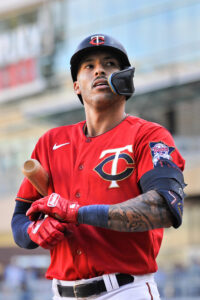
Over the past four seasons, the former first overall pick has tallied just under 1800 plate appearances. He’s hit .281/.359/.481 with a strong 10.6% walk rate and a lower than average 20.4% strikeout percentage. Correa has posted a hard contact rate north of 42% in each of the past four seasons, well above the 35-36% league marks. Broadly speaking, there’s nothing to nitpick with his offensive ability. He makes contact, has strong plate discipline and has topped 20 home runs in six of the seven 162-game seasons of his career. Correa has unsurprisingly been better against left-handers than righties, but he’s been excellent against pitchers of either handedness. He owns a .291/.386/.482 career mark against southpaws, while he’s hit .274/.346/.477 against same-handed arms.
Correa had some injury issues earlier in his career, missing time in 2018 with back discomfort and fracturing a rib in 2019. He’s only twice topped 600 plate appearances in a season, but the aforementioned finger contusion is the only non-virus ailment that has sent him to the IL within the past three seasons. With his recent health and the strong finish to his 2022 campaign, his camp made the easy call to opt out of the final two years and $70.2MM on his Twins deal.
For the second straight winter, he was the top free agent option in a loaded shortstop class. Even with Trea Turner, Xander Bogaerts and Dansby Swanson hitting the open market, Correa was the best available shortstop. Aaron Judge was the market’s top free agent overall on the heels of an MVP-winning, 62-homer season, but one can argue Correa was the best long-term bet available.
In addition to his strong offensive track record, the two-time All-Star is typically one of the sport’s most valuable defenders. Defensive Runs Saved has pegged him as an above-average shortstop in every season of his career. Altogether, DRS has pegged him as 70 runs better than par in more than 7600 innings. Statcast hasn’t been as bullish, but it also generally rates him as a plus gloveman. Statcast has pegged Correa as 17 runs above average since it began tracking defense in 2016, including plus grades each year from 2018-21.
Correa’s defense marks were particularly excellent during his final season in Houston, when he rated as +20 runs by DRS and +9 runs at Statcast. He secured his first career Gold Glove award in the process. This year’s reviews weren’t so impressive. DRS still considered him a net positive at three runs above average, but that was the lowest mark of his career. Statcast pegged him two runs below par, his first below-average showing by that metric since 2017.
Defensive metrics can vary on an annual basis, and it doesn’t seem San Francisco’s concerned with this past season’s mid-tier showing. Correa boasts a plus arm and has generally been very sure-handed. There may be some trepidation about how his 6’4″, 220 pound frame will hold up into his mid-late 30’s, particularly since he’s only an average runner. With his hands and arm strength, however, the Giants can at least project above-average glovework for the next few seasons.
San Francisco has four-time Gold Glove winner Brandon Crawford under contract for another year. They didn’t enter the offseason needing shortstop help necessarily, but their infield around Crawford had its share of question marks. San Francisco re-signed Wilmer Flores to a two-year guarantee to add a productive righty bat to the mix at first, second or third base. Tommy La Stella is under contract for another season but hasn’t played well since landing in San Francisco. J.D. Davis and David Villar are on hand as corner options, while Thairo Estrada can cover the middle infield and adds a solid righty bat.
There are a lot of moving pieces available for skipper Gabe Kapler, but adding Correa figures to solidify the left side of the infield with an everyday pair. Susan Slusser of the San Francisco Chronicle wrote last month the team planned to move Crawford to the hot corner if they were to sign Correa. Crawford has never played an inning outside of shortstop in the majors, but he figures to handle the less demanding position well.
While shortstop itself may not have been a priority for president of baseball operations Farhan Zaidi and his front office, adding impact talent certainly was. The Giants made no secret of their desire to land Judge. When he returned to the Bronx, the club pivoted to Correa — the clear top hitter remaining. He’ll now become the highlight acquisition of the offseason, joining outfielder Mitch Haniger and pitchers Sean Manaea and Ross Stripling as players brought in to try to rebound from an 81-81 campaign.
Doing so requires one of the largest investments in major league history. The $350MM guarantee checks in as the fourth-largest ever. It’s the second-biggest free agent deal of all-time, just narrowly below the $360MM deal that Judge inked a week ago. Correa becomes the second free agent to land a 13-year contract, matching the record length secured by Bryce Harper with the Phillies over the 2018-19 offseason. The deal runs through the 2035 campaign, what will be Correa’s age-40 season.
That kind of lengthy megadeal has become en vogue this offseason. Turner and Bogaerts signed 11-year deals with the Phillies and Padres, respectively, taking them each through their own age-40 seasons. Judge inked a nine-year deal that paid him through age 39. MLBTR had predicted Correa for a nine-year, $288MM contract at the start of the offseason. As with Turner and Bogaerts, those deals lasted longer than anticipated, with each correspondingly securing a greater guarantee than expected.
That has involved a bit of a tradeoff with regards to annual salary, however. Correa’s deal comes with an average annual value around $26.92MM, a mark that’s outside the top 25 in MLB history. That’s well lower than the $32MM per-year salary MLBTR had projected, with the Puerto Rico native electing to sacrifice some money on an annual basis to secure a larger total sum. Doing so could very well position him to spend the remainder of his career in the Bay Area.
From a team perspective, spreading the guarantee over a longer term adds more future downside but has the more immediate benefit of reducing the club’s luxury tax hit. A team’s CBT commitments are based on deals’ average annual values, and the $26.92MM mark is more manageable in that regard.
That’s now relevant for the Giants, whose payroll has spiked dramatically. The specific financial breakdown isn’t yet clear, but an evenly distributed salary would push the Giants 2023 payroll around $190MM, as projected by Roster Resource. Their luxury tax figure is about $206MM, $27MM below the base threshold. San Francisco’s spending is well above the $150-155MM range of the past few seasons, but it’s still shy of their $200MM franchise-record Opening Day mark from 2018.
The Giants could keep pushing forward as they jostle for position atop a stacked NL West with the Dodgers and Padres. The bullpen is still a question mark, and San Francisco could look into upgrades at first base and/or center field. The Giants remained involved in the bidding for ace Carlos Rodón as of this afternoon as well, although signing both Correa and the top remaining free agent starting pitcher may push beyond their financial comfort level.
As for Correa’s now-former team, they’ll be left to regroup having missed out on their top target of the winter. Minnesota offered a 10-year deal worth $285MM, tweets Jon Heyman of the New York Post. That came with a higher annual salary than the offer Correa actually accepted, but the Twins were apparently reluctant to commit deep into his 30’s. They’re now facing an uncertain shortstop situation, with Kyle Farmer and Royce Lewis looking like the top internal options.
Minnesota has already had some discussions with Swanson this offseason, keeping tabs on him as a fallback possibility to Correa. The organization should have a decent amount of financial flexibility and could now pivot more strongly after Swanson if they’re determined to address shortstop. They’ve also been linked to Rodón at various points and could try to allocate their spending capacity to a top-of-the-rotation arm. The Twins surely aren’t done in any event, although that’ll be little consolation for the front office and fanbase for the moment. Because Correa was ineligible for the qualifying offer, they don’t receive any compensation for his departure.
It’s the latest massive move in an offseason that has gained plenty of steam since the calendar flipped to December. Correa joins an increasingly loaded division and, more generally, a very competitive National League. In the process, he becomes the new face of the Giants — a role the club hopes he’ll effectively hold well into the next decade.
Jeff Passan of ESPN first reported Correa and the Giants had agreed to a 13-year, $350MM contract. Jon Heyman of the New York Post reported the deal didn’t include any opt-out provisions but contained a full no-trade clause.
Image courtesy of USA Today Sports.
Latest On Carlos Rodon’s Market
10:42pm: The Yankees have indeed put forth an offer to Rodon, Heyman writes. There’s apparently still a fair bit of work to do in order to get a deal done, as Heyman indicates there’s a notable gap between New York’s proposal and Rodon’s asking price.
2:55pm: Carlos Rodon is the clear top pitcher remaining on the open market, and despite a lofty asking price reportedly in the $200MM neighborhood, multiple clubs remain in pursuit of the left-hander. Jon Heyman of the New York Post reported yesterday that the Yankees are prepping a formal offer for Rodon, and Brendan Kuty of NJ.com now tweets that the Yankees appear to be Rodon’s preferred landing spot. However, Kuty adds that both the Twins and the Cardinals both remain “seriously in play” for the southpaw as of this afternoon. Meanwhile, Susan Slusser of the San Francisco Chronicle tweets that even after agreeing to identical two-year, $25MM deals with both Ross Stripling and Sean Manaea this week, the Giants are still involved in Rodon’s market.
The Twins’ interest in Rodon is perhaps contingent on the looming decision of Carlos Correa who, like Rodon, is represented by the Boras Corporation. Dan Hayes of The Athletic suggests that Correa remains the Twins’ top priority, though he adds that the team nonetheless made a pitch to Rodon earlier in the month (Twitter thread). Given that the Giants are viewed as Minnesota’s primary competition for Correa, it’s fair to wonder whether both clubs might be prioritizing Correa with the intent of pivoting to Rodon should they be spurned by Correa. That both players have the same agent makes concurrent negotiations a smoother process.
After agreeing to a three-year deal with free-agent catcher Christian Vazquez yesterday, Minnesota projects to about $107MM in total commitments for the upcoming season. That’s well shy of the more than $140MM they spent on last year’s Opening Day roster, but not so far south of the mark that it becomes easy to envision a scenario in which both Correa and Rodon sign on to call Target Field home. The Twins have drawn interest in right fielder Max Kepler this winter, but even in the event of a Kepler deal coming together, a Correa/Rodon combo would push Minnesota well past $150MM in total payroll for the first time in franchise history and would likely lock them into $75-80MM worth of annual commitments to the trio of Correa, Rodon and Byron Buxton.
The Giants, meanwhile, are roughly $43MM from their franchise-record Opening Day payroll even after their deals with Stripling and Manaea. Similarly, though, it’s difficult to see both players landing in San Francisco. The Giants are already a bit north of $180MM in terms of luxury obligations, and that pairing would likely push them into tax territory for the first time. That said, the Giants have topped $200MM in payroll before, and the only player currently signed beyond the 2024 season is Mitch Haniger, who’s signed through 2025. The Giants have been averse to long-term contracts under president of baseball operations Farhan Zaidi, though they made hefty bids for both Aaron Judge and Bryce Harper under his watch.
As for the Cardinals, they were linked to Rodon this past weekend, and Kuty paints them as a fairly prominent player in the bidding. The Cards would make for something of a surprise bidder, having already spent $87.5MM to bring Willson Contreras to St. Louis on a five-year contract. Signing Rodon would likely mean doling out the largest commitment in franchise history and pushing payroll to height never before seen in St. Louis. The Cardinals’ current record for Opening Day payroll is a bit more north of $163MM, in 2021, but they’re already at that rough level right now Rodon could well take them north of $190MM.
Circling back to the Yankees, they at one point reportedly hoped to limit any Rodon deals to four or five years in length, though that doesn’t seem likely to get them in the ballpark. With Judge and Cole both locked into a combined $76MM in annual commitments through the 2028 season (2029 in Judge’s case), adding Rodon to the mix would require budgeting more than $100MM annually for a trio of players for at least the next six years. Giancarlo Stanton is under contract through 2027, as well, further complicating the long-term scenario for Rodon.
At present, Roster Resource projects a $266MM luxury-tax ledger for the Yankees. They’re already set to pay the tax for a second straight season, so they’ll owe $6MM on the first $20MM by which they cross the $233MM threshold and $8.5MM on the next $20MM. Once they reach $273MM in luxury obligations, they’ll be taxed at a rate of 75%, and they’d be taxed at 90% on any dollars beyond the $293MM mark.
Speculatively penciling in an even $30MM AAV (which could, of course, be off by a few million dollars one way or another), the Yankees would jump from their currently projected $11.74MM of penalties all the way up to about $32.65MM in penalties. In other words, they’d pay an approximate $21MM in taxes on top of Rodon’s actual salary for the 2023 season. Passing the luxury threshold by more than $40MM would also drop the Yankees’ top pick in the 2023 draft by 10 places, and any Rodon deal would make it quite difficult to drop under the tax line (and avoid even steeper tax rates as a third-time offender) in 2024.
Mets Interested In Carlos Correa
The Mets are showing interest in Carlos Correa, report Ken Rosenthal, Dan Hayes and Andy McCullough of the Athletic. It’s not clear precisely how committed they are to making a run at the top remaining free agent, but their presence on at least the periphery of the market makes for a fascinating twist.
This offseason has been dominated by Mets headlines, with the team signing a number of top free agents. New York made nine-figure commitments to retain Edwin Díaz ($102MM over five years) and Brandon Nimmo ($162MM over eight years). The Mets brought in Justin Verlander on a two-year, $86.66MM deal — tying the annual salary record they established with last offseason’s three-year pact for Max Scherzer. They agreed to terms with Kodai Senga on a five-year, $75MM pact and have signed smaller but still notable deals with José Quintana (two years, $26MM) and David Robertson (one year, $10MM).
That spending spree added to a roster that already had the league’s highest payroll. Certainly, the Mets faced a number of key departures as well. They allowed Jacob deGrom, Chris Bassitt and Taijuan Walker to sign elsewhere. That said, they’re already projected well beyond this year’s spending level. New York opened the 2022 campaign with a player payroll around $264MM; they’re projected by Roster Resource at a staggering $336MM figure for next season.
It’s an unparalleled number in league history, one that leaves open the question of how far owner Steve Cohen and his front office are willing to go. Cohen has proven himself undeterred by traditional spending habits, and he’s certainly seemed unfazed by the luxury tax that’s ostensibly in place to prevent any team from spending head and shoulders above the rest.
Roster Resource projects the Mets’ luxury tax number around $350MM at the moment. They’re $117MM clear of the base tax threshold and are going to blow past all four tiers of penalization. New York paid the CBT this past season, so they’re also facing escalating penalties for going over for a second straight year. The Mets will pay a 30% tax on their first $20MM above the threshold ($6MM), a 42% tax on their next $20MM in overages ($8.4MM), a 75% tax on their next $20MM in surplus spending ($15MM) and a 90% tax on any additional dollars. New York is currently an estimated $57MM above the fourth and final tier, one colloquially known as the “Cohen tax” after being introduced in the most recent CBA at least partially in response to Cohen’s reputation for spending. That’s another $51.3MM in taxes, bringing New York’s total projected tax bill to a staggering $80.7MM.
Of course, that’s before considering the possibility of adding another megadeal. Correa is the best free agent still on the board. At the start of the offseason, MLBTR forecasted a nine-year, $288MM contract. The two top shortstops already off the board — Trea Turner and Xander Bogaerts — each best our predictions, with Bogaerts’ $280MM contract coming in well above most expectations. In light of the strength of the market, Correa pushing past $300MM now seems likely, and one could argue for him to approach the $360MM guarantee Aaron Judge received from the Yankees given Correa’s youth and greater defensive value.
Even if we conservatively pencil Correa in for the pre-offseason prediction of $288MM over nine years, that’d come out to a $32MM annual salary. New York would be taxed at 90% on top of that, effectively making it a $60.8MM commitment to the star shortstop for next season. It’d be the kind of move a team has never made for an individual player, and again, that now seems a rather pessimistic view of Correa’s earning power. Certainly, the deal could push longer than nine years and lower the annual salary somewhat — Turner and Bogaerts each received 11 years despite being older than Correa — but any permutation of the contract would involve the team investing an immense sum. Cohen has clearly established himself as an owner unconcerned with precedent, and it’d be foolish to count the Mets out on any free agent at this point.
The Mets don’t need a shortstop, of course, with Francisco Lindor locked in as their long-term answer at the position. Third base isn’t accounted for by a star, with veteran Eduardo Escobar coming off an average season and top prospect Brett Baty still unproven at the MLB level. Relying on Escobar and Baty wouldn’t be a disaster, but installing Correa alongside Pete Alonso, Jeff McNeil and Lindor would lock in All-Star caliber players everywhere on the infield.
Beyond the Mets, the Giants and incumbent Twins are reported to be prioritizing Correa at this stage of the offseason. They’re widely viewed as the top suitors, while teams like the Cubs and Red Sox have been more loosely linked to him. Dansby Swanson, who’s drawing attention from many of the same clubs, remains available as the clear second-best position player still on the open market.
Reds Acquire Jake Wong From Giants
The Reds announced they’ve acquired minor league pitcher Jake Wong from the Giants. The deal completes a swap the teams orchestrated in the hours after the Rule 5 draft, when Cincinnati sent outfielder Blake Sabol to San Francisco.
Wong was a third-round pick of San Francisco out of Grand Canyon in 2018. His progression up the minor league ladder was delayed after the 2019 season, as the canceled minor league season wiped out his 2020. The Arizona native spent the following year on the minor league injured list, returning in 2022. He played this year at High-A Eugene, starting 17 of 25 appearances. In 97 2/3 innings, the righty pitched to a 4.52 ERA with a solid 25.3% strikeout rate and a slightly elevated 10.3% walk percentage.
Now 26 years old, Wong has still yet to reach the high minors. Given that lack of upper level experience, it’s not surprising he was left unprotected for and went unselected in this month’s Rule 5 draft. The Reds liked him enough to take a shot on him now that they need not dedicate him an active or 40-man roster spot. He’ll presumably start next year in Double-A or Triple-A and add some rotation depth to the organization.
Sabol has a much better chance of breaking camp in the big leagues. Cincinnati nabbed him out of the Pirates organization with the fourth pick in the Rule 5 draft. They presumably had worked out an understanding with the Giants — who didn’t select until 16th — that they’d flip him to San Francisco before making the pick, since the selections themselves cannot be traded. San Francisco will have to carry Sabol on the MLB roster or injured list all season or place him on waivers and, if he goes unclaimed, offer him back to Pittsburgh without requiring a 40-man spot.
Giants Have Been In Contact With Dansby Swanson
The market for shortstop Dansby Swanson has begun to heat up, according to Russell Dorsey of Bally Sports. He lists the Dodgers, Giants, Twins, Cubs, Red Sox and Braves as teams with interest. Jon Morosi of MLB Network reports that the Giants have been in touch with Swanson’s representatives, but that it doesn’t appear any decision is imminent.
The Twins, Cubs, Red Sox and Braves have all previously been connected to Swanson this offseason, though the mentions of the Dodgers and Giants are new. This offseason featured a group of shortstops known as the “big four,” with Trea Turner already signed with the Phillies and Xander Bogaerts with the Padres. That leaves Carlos Correa and Swanson as the two of that group left for all those shortstop-needy teams.
Though Correa and Swanson are connected in the sense that they are the two surefire everyday shortstops remaining, there’s a significant difference between the two. Both have strong reputations for their glovework, though Correa’s overall body of work at the plate is stronger. At the start of the season, MLBTR predicted a nine-year, $288MM contract for Correa but a seven-year, $154MM deal for Swanson.
Most teams would surely prefer Correa in a vacuum but the price might be an issue. Both Turner and Bogaerts got at least three years longer than projected and each secured a larger overall guarantee as well. With that context, it wouldn’t be a surprise to see Correa and Swanson also end up getting deals larger than their projections.
The Giants were seen by many as the favorites for Correa after they made an offer in the $360MM range to Aaron Judge that he declined in order to return to the Yankees. However, it stands to reason that they would also reach out to Swanson and see if there’s a significant difference in the respective markets. Since the Judge non-signing, they’ve agreed to some smaller deals for Sean Manaea and Ross Stripling, bringing their 2023 payroll up to $164MM, per Roster Resource. It’s unclear how far they want to push spending this offseason, but they are still sitting on a competitive balance tax figure of $180MM, leaving them over $50MM of room before reaching the lowest luxury tax barrier of $233MM.
Giving Correa a salary in the $30MM range wouldn’t push them into the luxury tax on its own, but they do have other needs on the roster as well. They are reportedly still interested in retaining Carlos Rodón, who will also require a contract somewhere in the vicinity of $30MM on an annual basis. Adding both Rodón and Correa would start pushing them into luxury tax territory, whereas the dropdown to Swanson could lead to something closer to $20MM annually. If the CBT barrier is something they’re trying to avoid, then it’s possible the difference between a Correa and a Swanson deal could be significant for them.
For the Dodgers, they have lost their incumbent shortstop in Turner, who is now with the Phillies. The club is reportedly comfortable with moving Gavin Lux from second base to be their new shortstop, though it also makes sense for them to explore what else is available. However, they are apparently not pursuing Correa, given both his ties to the scandal-plagued 2017 Astros team that defeated the Dodgers in the World Series, as well as his high asking price. Perhaps Swanson is an attractive backup plan for the club, though they might also prefer to wait until they get clarity on the Trevor Bauer situation before making firm commitments. He is appealing his suspension and if he is successful in overturning it, the club’s CBT figure would jump from around $189MM to over $220MM. A decision is expected in the next month or so.
If that scenario were to come to pass, even a slightly more modest deal for Swanson would push them over the line into tax payor status. Since the club is reportedly considering dipping under the line to reset their status, that could be an issue. The CBT features escalating penalties for paying in consecutive seasons, meaning that the Dodgers could stay under the line in 2023 but go into 2024 as “first-time” payors.
Though he’s likely to secure a lesser contract than Correa, Swanson is no slouch. He hit 27 home runs in 2022 and produced an overall batting line of .277/.329/.447 for a wRC+ of 116. That was his first time being above-average at the plate over a full season, though it showed that he is capable of being an all-around contributor. He also stole 18 bases and posted excellent defensive marks, leading to 6.4 wins above replacement on the season, in the eyes of FanGraphs.
Giants Outright Miguel Yajure
The Giants passed right-hander Miguel Yajure through outright waivers unclaimed and have assigned him to Triple-A Sacramento, tweets Alex Pavlovic of NBC Sports Bay Area. That removes him from the 40-man roster and opens a spot for right-hander Ross Stripling, whose two-year deal has been officially announced by the Giants.
San Francisco claimed Yajure off waivers from the Pirates just 11 days ago, and they’ll now be able to stash the 6’1″, 215-pound righty in the upper minors as a depth piece for either the rotation or the bullpen. The 24-year-old righty, originally signed as an amateur by the Yankees, went to Pittsburgh alongside Roansy Contreras as part of the package that sent Jameson Taillon from the Pirates to the Yankees.
Yajure has spent time in the Majors in each of the past three seasons but has yet to find much success, logging a 7.58 ERA in 46 1/3 MLB frames to date. Command has been a considerable obstacle, as he’s walked 13% of his opponents and been tagged for an average of 1.94 home runs per nine innings pitched. That said, Yajure isn’t all that far removed from ranking as one of the better pitching prospects in both the Yankees’ and Pirates’ systems, and he enjoyed a strong Triple-A showing with Pittsburgh in 2021 when he logged 43 2/3 innings of 3.09 ERA ball with a 23% strikeout rate and 7.5% walk rate.
Elbow and forearm injuries limited Yajure to just nine starts during that otherwise solid 2021 showing in Triple-A, however, and he returned with struggles not only in the big leagues but in Triple-A this past season as well (6.09 ERA in 54 2/3 innings). Now that he’s successfully been passed through waivers, Yajure can focus on getting healthy and rounding back into form with an organization that has developed a knack for maximizing output from its pitchers. The Giants are exceptionally deep in rotation options, with Logan Webb, Alex Wood, Alex Cobb, Anthony DeSclafani, Jakob Junis and newcomers Stripling and Sean Manaea, so at this point, Yajure is likelier to be viewed as bullpen depth than starting depth.