
Rays Sign Craig Kimbrel
2:30pm: The Rays have officially announced Kimbrel’s signing. In a corresponding active roster move, right-hander Jesse Scholtens has been placed on the 15-day injured list with a right wrist strain.
11:36am: Veteran reliever Craig Kimbrel is heading to the Rays on a major league deal, reports Ken Rosenthal of The Athletic. Kimbrel was designated for assignment by the Mets last week and elected free agency. The 37-year-old is represented by SportsMeter.
The Rays have yet to announce the move. The club has multiple openings on its 40-man roster, so no tweak will be needed there. Kimbrel is expected to be available for tonight’s game against the Orioles, per Marc Topkin of the Tampa Bay Times.
The Mets added Kimbrel on a minor league deal in January. He failed to break camp with the team, but was called up in early April. The right-hander didn’t allow an earned run over his first four appearances in New York. He has struggled recently, permitting seven earned runs over 9 2/3 innings in May. He covered 2 2/3 frames on Wednesday, ceding two earned runs. The Mets DFAed him on Friday.
The well-traveled Kimbrel will have appeared with 11 MLB teams once he gets into a game with the Rays. Tonight could be considered a revenge game for the righty, but he’s pitched for three other clubs since his 2024 stint in Baltimore. Kimbrel put himself back on the big-league map to close 2025. He opened the year with the Braves, but only threw an inning in the majors. The veteran bounced to the Rangers, then landed in Houston. Kimbrel put together 13 solid appearances with the Astros, posting a 2.45 ERA with a 34.8% strikeout rate.
Tampa Bay lost Pete Fairbanks to free agency and Edwin Uceta to a shoulder injury heading into 2026. Griffin Jax got the first crack at the vacated closer role, but faltered. He’s now being stretched out as a starter. Bryan Baker has assumed the 9th-inning gig and performed quite well. The former Oriole has piled up 14 saves through 24 appearances. He’s been scored upon just twice in May. Kimbrel and his 440 career saves are unlikely to unseat Baker anytime soon.
Photo courtesy of Rick Scuteri, Imagn Images
Latest On Wander Franco’s Legal Proceedings
Rays shortstop Wander Franco‘s retrial reached a verdict yesterday, with Marc Topkin of The Tampa Bay Times among those to cover the details. Franco was found guilty of sexual and psychological abuse of a minor but will not serve prison time because the three-judge panel ruled that he was both a defendant and a victim in the case. He was given a judicial pardon which exempts him from punishment but the conviction stands. The minor’s mother was sentenced to ten years for money laundering and threats of exposure. The full verdict with more details will be read in court on the morning of June 16th.
It’s a similar result to the previous trial, which concluded in June of last year. At that time, Franco was found guilty. He received a two-year suspended sentence and would only have to serve the sentence if he didn’t meet certain conditions. The minor’s mother was found guilty of trafficking her daughter and sentenced to ten years. Both sides appealed and a new trial was ordered. Once again, the victim’s mother has received a ten-year sentence while Franco has been found guilty but is not expected to serve prison time.
“We are aware of today’s verdict in the Wander Franco trial and will conclude our investigation at the appropriate time,” Major League Baseball said in a statement late Monday afternoon.
“The Tampa Bay Rays are aware of today’s ruling in the Dominican Republic involving Wander Franco,” the team said in a statement. “We respect the legal process and the decision issued by the court. This is a serious matter, and our thoughts remain with those affected by the case. The Rays will continue to cooperate fully with Major League Baseball as it completes its review under the league’s joint domestic violence, sexual assault and child abuse policy. Out of respect for the legal process and all parties involved, we will have no further comment at this time.”
In August of 2023, investigators in the D.R. began looking into accusations that the Rays shortstop had engaged in a sexual relationship with a 14-year-old girl while he was 21. The age of consent in that country is 18. In July of 2024, Franco was formally charged with sexual abuse and sexual exploitation against a minor, as well as human trafficking. In September of last year, it was reported that the case would proceed to trial.
Major League Baseball placed Franco on administrative leave in August last year when the accusations first emerged, standard procedure for players who are being investigated under the joint domestic violence, sexual assault and child abuse policy. He was reinstated for the offseason in a procedural move but placed back on administrative leave when the 2024 campaign began. He was moved to the restricted list in July of 2024 when he was formally charged, at which point he was no longer receiving big league pay or service time.
Throughout the proceedings, accusations had also emerged against the girl’s mother, that she received payments from Franco worth thousands of dollars to remain silent about her daughter’s abuse.
Back in 2021, Franco and the Rays signed an 11-year, $182MM extension which was set to run through 2032. In the wake of his conviction, it’s unclear if he’ll be able to get the work visa necessary for him to return to the United States. Even if he somehow were able to get a visa, he may not be able to get back on the field. Under the aforementioned league policy, MLB can suspend players even in situations lacking a conviction. In Franco’s case, even though he may not serve time, he has been twice found guilty. The Rays haven’t been paying him for almost two years now and that will continue to be the case if he can’t get a visa or receives a suspension that keeps him on the restricted list.
Photo courtesy of Brad Penner, Imagn Images
Jonny DeLuca To Miss Six To Eight Weeks With Hamstring Strain
The Rays placed outfielder Jonny DeLuca on the ten-day injured list with a right hamstring strain yesterday. He’s going to miss far more than ten days, however. Per Marc Topkin of the Tampa Bay Times, DeLuca’s strain is significant enough that he’ll miss about six to eight weeks.
DeLuca, 27, has been in Tampa’s outfield mix all year. His contributions have mostly been as a speed-and-defense guy. His .269/.298/.412 batting line isn’t bad, translating to a 98 wRC+ that puts him just below league average. However, he only has two home runs and a tiny 4% walk rate. His offense has been swelled by a fortunate .330 batting average on balls in play.
Though he may not be a thumper in the box on the whole, he has been a useful player in other ways. He has been better with the platoon advantage, as the righty swinger has a .315/.500/.815 line and 126 wRC+ against southpaws. He is one of the fastest guys in the league, with Statcast ranking his sprint speed in the 95th percentile of qualified big leaguers. He has stolen six bases and been credited with three Defensive Runs Saved and three Outs Above Average on the year.
The Rays will now have to proceed without DeLuca’s contributions into July. So far, the club has used only five outfielders this year, coming into today’s action. Beyond DeLuca, they have had Cedric Mullins, Chandler Simpson, Jake Fraley and Ryan Vilade in the mix. Last week, it was reported that Fraley would require a hernia procedure and would also have a return timeline of about six to eight weeks.
It will be interesting to track how the group performs over the next little while, as the timelines for DeLuca and Fraley will keep them out until fairly close to the August 3rd deadline. Simpson is an ever more extreme version of DeLuca, with huge speed and strong defense but subpar offense. Mullins has a good track record but is having a bad season, while Vilade is in the opposite position. Mullins is hitting just .192/.255/.285 on the year, though with an unlucky .218 BABIP. Vilade has a strong .308/.382/.477 line on the year but with a fortunate .346 BABIP. Víctor Mesa Jr., who has a career batting line of .188/.297/.344, was recalled to join the club when DeLuca hit the IL yesterday.
The Rays are currently the best team in the majors with a 34-16 record. They have racked up those wins despite a pretty lackluster outfield. There are some good defenders and the outfielders have more stolen bases than any other outfield group in the majors, but the Rays have received a collective .254/.302/.357 line from the outfield this year. That leads to an 85 wRC+ which is better than just five other clubs.
Given their strong record, the Rays will almost certainly be in position to buy at the deadline. The outfield could be a clear area to upgrade, given the numbers so far. As the club will be talking deals with other teams in July, Fraley and DeLuca should be getting healthy. If the Rays do make external additions, Fraley, Mullins and Vilade can’t be optioned to the minors but DeLuca, Mesa and Simpson can.
Photo courtesy of Nick Turchiaro, Imagn Images
IL Transactions: DeLuca, Winn, Coulombe, Baddoo
Here’s the round-up of some players departing and joining the injured list on Sunday…
- The Rays placed outfielder Jonny DeLuca on the 10-day injured list (retroactive to May 23) due to a right hamstring strain, and called up Victor Mesa Jr. from Triple-A Jacksonville. DeLuca suffered the injury while running the bases in Friday’s 4-2 Rays victory over the Yankees, and he underwent an MRI today to determine the severity of the strain. DeLuca has hit .269/.298/.412 over 125 plate appearances while chipping in at all three outfield positions, though most of his work has come as the right-handed hitting side of a right field platoon with Jake Fraley. Both sides of that platoon are now on the IL since Fraley is recovering from sports hernia surgery, leaving Ryan Vilade, Richie Palacios, and Mesa as the top candidates to pick up the slack in the outfield.
- The Rangers placed right-hander Cole Winn on the 15-day IL due to fatigue in his throwing arm, and called up right-hander Gavin Collyer (this was the only corresponding move since Collyer was already on the 40-man roster). Winn has a 25.8% strikeout rate and 7.9% walk rate over 19 1/3 innings out of the Texas bullpen, but a lot of hard contact and an unfavorable .345 BABIP have resulted in a 5.59 ERA that is far higher than his 3.25 SIERA. While Winn’s arm issue doesn’t seem too serious, he missed significant time in both the 2024 and 2025 seasons due to shoulder and rotator cuff problems.
- The Red Sox activated Danny Coulombe from the 15-day IL prior to today’s game with the Twins, and the left-hander tossed a scoreless inning of relief in Boston’s 6-5 loss. (Left-hander Tyler Samaniego was optioned to Triple-A in the corresponding move.) Coulombe missed a little over three weeks due to back spasms, and his 5.00 ERA over nine innings this season can be largely attributed to one very rough outing against the Yankees on April 23. Beyond that bad game, the southpaw has only allowed two runs over his other 8 1/3 frames of work.
- The Brewers announced that outfielder Akil Baddoo was activated from the 60-day injured list and optioned to Triple-A Nashville. After signing a split contract with Milwaukee during the winter, Baddoo suffered a quad strain near the end of Spring Training and has spent the entire season on the 60-day IL. The outfielder has logged some rehab games in Nashville already and will continue to bide his time until a possible call-up to the Show.
Nick Anderson Retires
Right-hander Nick Anderson has retired, reports Jeff Passan of ESPN. The 35-year-old spent six seasons in the big leagues. He pitched for five teams, most recently appearing with the Rockies in 2025.
Anderson inked a minor league deal with the Athletics in November. He earned an invitation to Spring Training, where he pitched reasonably well, tossing 10 1/3 frames with a 4.35 ERA and more than a strikeout per inning. The veteran fell short of a big-league roster spot out of camp. He triggered an upward mobility clause in his deal, but no club stepped in to add him.
With no MLB roster spot waiting for him, Anderson headed to Triple-A Las Vegas. He pitched well with the Aviators. The righty posted a 2.16 ERA with a 16:5 strikeout-to-walk ratio over 15 appearances. It wasn’t enough for him to earn a call-up to the A’s.
The Twins signed Anderson as an undrafted free agent in 2015. He was already 24 years old when he got his first look in pro ball. Anderson pitched well in the minors with Minnesota, reaching Triple-A by 2018. He was dealt to Miami for third baseman Brian Schales that offseason. Anderson broke camp with the Marlins in 2019. He delivered a sub-4.00 ERA with a massive 37.1% strikeout rate over 45 appearances. Miami shipped Anderson and righty Trevor Richards to Tampa Bay at the trade deadline for outfielder Jesus Sanchez and righty Ryne Stanek.
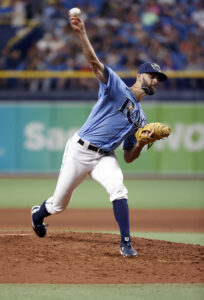
Anderson put together the best stretch of his career with the Rays, though injuries limited him from emerging as a true shutdown reliever. He closed the 2019 season with a ridiculous 52.6% strikeout rate in 23 appearances with his new team. Anderson was just as good in the postseason, allowing one earned run over 5 2/3 innings with eight strikeouts. He continued his strong work in the shortened 2020 season, opening the year with 11 scoreless appearances. He missed time with forearm inflammation, but returned in time to pick up three saves and two holds in September.
The 2020 postseason marked a shift in Anderson’s career. He struggled mightily as the Rays marched to the World Series. The righty was scored upon in eight of 10 outings. Anderson blew leads in Game 4 and Game 7 of the Fall Classic. He was charged with the loss in the final game of the series.
Anderson threw just six innings from 2021 to 2022 as he dealt with a back injury, a torn UCL, and plantar fasciitis. He departed for the Braves in free agency ahead of the 2023 season. Anderson bounced around frequently after his tenure with the Rays. He spent time with eight different organizations over the past four years. Anderson posted decent seasons with the Braves and Royals, but was ineffective in a brief stint with the Rockies last year.
Anderson wraps up his time as a big leaguer with a 3.43 ERA over 173 innings. He recorded 10 saves. The righty was one of the league’s best bat-missing relievers for a couple of seasons. Despite tailing off in the past few years, he’ll conclude his career with a 30.2% strikeout rate. We at MLBTR wish Anderson the best in whatever comes next.
Photos courtesy of Nick Wosika, Kim Klement, Imagn Images
Outrighted To Triple-A: Slater, Blach, Brooks
Catching up on some players recently designated for assignment…
- The Mets outrighted outfielder Austin Slater to Triple-A Syracuse, as per Slater’s MLB.com profile page. There isn’t yet any word on whether or not Slater will accept the assignment, as Slater has the ability to elect free agency rather than report to Triple-A and remain in the Mets organization. Since he has more than five years of MLB service time, Slater can become a free agent while still keeping the $1MM he is guaranteed in 2026, as per the terms of the contract he signed with the Marlins just before the season began. Over 49 combined PA with Miami and New York, Slater has hit only .209/.286/.233 with just one extra-base hit.
- Ty Blach cleared waivers and was outrighted to the Cubs‘ Triple-A Iowa affiliate, according to the left-hander’s MLB.com profile page. Chicago selected Blach’s contract to the active roster last weekend but DFA’ed him two days later, after Blach tossed three shutout innings of relief work in the Cubs’ 9-3 loss to the Brewers on Monday. That cup of coffee represented Blach’s first bit of MLB work since 2024, and he now has the option of rejecting the outright assignment in favor of free agency or returning to Iowa. Given the ongoing injury woes on the Cubs’ pitching staff, Blach might prefer to stay put, as another call to the majors might come sooner rather than later.
- Aaron Brooks pitched for Triple-A Durham yesterday, indicating that the right-hander accepted his outright assignment to the Rays‘ top affiliate. Brooks was outrighted last Sunday and he had the ability to elect free agency, but it looks like the righty has opted to stay in Tampa’s organization. Like Blach, Brooks was also making his first MLB appearance since 2024 in his own one-game cameo back in the Show, though Brooks’ lone outing was much rockier. He was charged with three earned runs in one-third of an inning of work in the Rays’ 5-3 loss to the Blue Jays on May 13.
Rays Select Oliver Dunn
The Rays announced that they have selected the contract of just-acquired infielder Oliver Dunn from Triple-A Durham. He’ll take the active roster spot of fellow infielder Ben Williamson, who’s headed to the 10-day injured list due to a lower back strain. The Rays acquired Dunn from the White Sox in exchange for lefty Joe Rock last night.
Tampa Bay also reinstated veteran left-hander Steven Matz from the 15-day injured list and optioned righty Chase Solesky to Durham in a corresponding move. Matz will start today’s game, per the team.
Dunn, 28, doesn’t have an impressive big league track record but has been on a tear with the Sox’ top affiliate in Charlotte this season. He’s a .206/.261/.290 in parts of two seasons (145 plate appearances) with the Brewers, but Dunn has raked at a .295/.393/.545 clip with the Knights this season. He’s connected on nine homers, gone 9-for-10 in stolen base attempts and walked at a stout 13.1% clip (against a 23.5% strikeout rate).
Dunn gives the Rays a left-handed bat with some versatility to step in for Williamson, who’s seen time at second base, shortstop and third base for the Rays this season while batting .268/.349/.349 (99 wRC+). Dunn hasn’t played shortstop in the majors but has 262 minor league innings there (196 across the past two seasons). He has ample experience at third base and second base in addition to more limited work in left field and at first base.
Rays, White Sox Swap Joe Rock For Oliver Dunn
The Rays and White Sox announced a one-for-one trade that sends lefty reliever Joe Rock from Tampa Bay to Chicago. Minor league infielder Oliver Dunn goes to the Rays; Dunn had not been on Chicago’s 40-man roster.
Chicago optioned Rock to Triple-A Charlotte and transferred Kyle Teel to the 60-day injured list to open a 40-man spot. That’s a procedural move, as the 60-day window backdates to Opening Day. Teel won’t be back until late June at the earliest after suffering an LCL sprain in his left knee over the weekend.
A 6’6″ southpaw, Rock was a second-round pick by Colorado in 2021. The Rays acquired him in Spring Training 2024 for former first-rounder Greg Jones. Rock spent that season working out of the Triple-A rotation, struggling to a 4.58 earned run average. He made a very brief MLB debut last summer, pitching 7 2/3 innings of two-run ball with 11 strikeouts over three appearances.
Rock otherwise spent the season in a swing role in Triple-A, posting a 5.21 ERA across 96 2/3 frames. The Rays moved him to short relief this year in the hope that his stuff would play up in 1-2 inning stints. Rock has missed more bats, striking out 27 of 78 opponents (34.6%) in the minors.
His 92.9 mph average fastball isn’t much above where it sat last year, though, and Rock has battled the worst control of his career. He has walked 17 batters and plunked four more, giving out free passes to more than a quarter of batters faced. Rock has allowed 10 runs (nine earned) through 15 Triple-A innings this year.
The lack of strikes had pushed the Ohio University product to the fringe of the roster. The Rays didn’t designate Rock for assignment but had soured enough on him that they were willing to deal him for a depth infielder on a minor league contract. Chicago will see if a change of scenery can get him on track. Rock is in his second of three option years, so there’s still some roster flexibility.
Sean Newcomb and Bryan Hudson have pitched well as Will Venable’s top two lefty relievers. The Sox brought Brandon Eisert back up from Charlotte last week as a third southpaw in the MLB bullpen. Tyler Schweitzer, Tyler Gilbert and Chris Murphy are on the 40-man roster and on optional assignment. The Sox certainly aren’t lacking left-handed bullpen arms.
Dunn is a 28-year-old utilityman who appeared at the MLB level with the Brewers from 2024-25. The lefty batter owns a .206/.261/.290 slash with one home run in 145 career plate appearances. Milwaukee sent Dunn unclaimed through waivers last September and allowed him to walk as a minor league free agent. He signed a non-roster deal with the Sox in December.
After struggling to a .208/.315/.338 line in Triple-A a year ago, Dunn has gotten out to a much better start this season. He hit .296/.397/.533 with eight homers in 40 games for Charlotte. Dunn takes a lot of pitches and had shown strong on-base numbers up through Double-A. He’s primarily a third baseman who can play the middle infield if necessary and has some left field experience in the minors.
The Rays recently lost one of their left-handed bench bats when Jake Fraley suffered a sports hernia injury that required surgery. They’re also a little shorthanded in the infield with Ben Williamson day-to-day with back tightness. Tampa Bay might add Dunn directly to the MLB bench if Williamson requires an injured list stint. They don’t have any depth infielders on optional assignment to Triple-A, and Dunn has outhit internal non-roster pieces Logan Davidson and Raynel Delgado. Tampa Bay has a pair of openings on the 40-man roster if they want to select Dunn’s contract.
Jake Fraley To Undergo Sports Hernia Procedure
Rays outfielder Jake Fraley will undergo sports hernia surgery tomorrow, reports Marc Topkin of The Tampa Bay Times. He’ll be out for six to eight weeks.
Fraley landed on the 10-day injured list on Saturday. The surgery timetable may lead to a transfer to the 60-day IL at some point. Fraley has had at least one injured list stint in every season of his MLB career. He had three absences last year between Cincinnati and Atlanta, capping him at 76 games. Between the injuries and his limited usage against left-handed pitching, Fraley has yet to reach 400 plate appearances in a season.
It has been a slow start for the 30-year-old outfielder. Fraley has hit .232/.300/.390 with two home runs in 90 trips to the dish. It’s nevertheless suboptimal for the Rays to lose him, as their bench skews very heavily to the right side. Topkin notes that the Rays’ two lefty-hitting outfielders who are on optional assignment, Jacob Melton and Victor Mesa Jr., are themselves on the minor league injured list.
Middle infielder Carson Williams came up as the corresponding move for Fraley’s IL placement. Manager Kevin Cash tells Topkin that’s driven partially by Ben Williamson, who hasn’t played since Friday while dealing with back tightness. Cash didn’t rule out an injured list stint. Teams can backdate an IL placement by up to three days, so the Rays may view Tuesday as the cutoff for deciding whether to put him on the shelf for at least another week.
Rays Place Jake Fraley On 10-Day IL, Recall Carson Williams
The Rays announced a trio of moves this morning, including the news that outfielder Jake Fraley has been placed (retroactive to May 16) on the 10-day injured list due to a hernia. Shortstop Carson Williams was called up from Triple-A Durham to take Fraley’s spot on the 26-man roster. Tampa also noted that right-hander Aaron Brooks has been outrighted to Triple-A after clearing waivers.
Fraley was scratched from yesterday’s lineup, and Marc Topkin of the Tampa Bay Times reported yesterday that the outfielder was headed for an IL stint (and that Williams was the likely replacement). It isn’t known yet how long Fraley could be out of action, though Topkin floated a six-week estimate depending on the severity of the hernia.
The Rays claimed Fraley off the Braves’ waiver wire last November, then cut him loose at the non-tender deadline only to quickly re-sign the outfielder to a one-year, $3MM contract a week later. The left-handed hitting Fraley has been used almost exclusively in platoon duty in right field, though he has yet to get going at the plate, hitting .232/.300/.390 over 90 plate appearances.
Jonny DeLuca and Ryan Vilade have each been used as the right-handed hitting complement within the right field platoon. Tampa Bay could give more playing time to either outfielder while Fraley is sidelined, or stick to a platoon structure by using Richie Palacios (a lefty bat) in right field rather than his usual second base spot. Topkin believes the latter scenario is more likely, as evidenced by the call-up of Williams to add to the Rays’ infield depth.
Heralded as one of baseball’s top prospects at the time of his MLB debut last season, Williams is still a fixture on top-100 rankings except further down the lists heading into the 2026 campaign. Between 32 games in 2025 and seven games this season, Williams has hit only .164/.209/.320 over 131 PA against big league pitching. His numbers at Triple-A have also not stood out — Williams has hit .216/.318/.433 with 28 homers over 607 PA for Durham.
Williams has struck out in 203 of those 607 trips to the plate in Triple-A, while also whiffing 53 times in his 131 PA in the Show. While Williams is still over a month shy of his 23rd birthday, the alarming amount of swing-and-miss in his game may have already dropped his stock as a potential Rays building block. Defensively, Williams has primarily played shortstop but he has logged a handful of games as a second and third baseman, so he could get some action at the keystone if Palacios is indeed ticketed for more time in right field.
Brooks was signed to a minor league contract in April, and he was selected to the Rays’ roster last weekend for what ended up being a brief tenure with the club. The righty’s one appearance resulted in an 81.00 ERA over a third of an inning of work, as Brooks allowed a walkoff grand slam to Daulton Varsho in Wednesday’s 5-3 loss to the Blue Jays.
Tampa Bay designated Brooks for assignment two days ago, and now that Brooks has cleared waivers, the ball is in his court about his future with the club. Because Brooks has been outrighted in the past, he can reject this latest outright assignment in favor of free agency.