
Yankees Acquire Spencer Howard
The Yankees acquired right-hander Spencer Howard from the Rangers for cash considerations, according to FanSided’s Robert Murray (Twitter link).
Howard, 27, was selected by the Phillies in the second round of the 2017 draft and quickly rose up prospect boards, becoming a consensus top-35 prospect in the game ahead of the 2020 campaign. He made his debut later that season and struggled to a 5.92 ERA in 24 1/3 innings of work. Those struggles continued into 2021, where he posted a 5.72 ERA despite a solid 4.02 FIP in 28 1/3 innings with the Phillies before being shipped to Texas as part of the deal that brought right-hander Kyle Gibson to Philadelphia.
Things took an even more dire turn when Howard arrived in Texas, as he allowed a whopping 26 runs (23 earned) in just 21 1/3 innings down the stretch with the Rangers, leaving him with a 7.43 ERA on the season. While Howard opened the 2022 campaign as a member of the club’s starting rotation, he didn’t last in that role for long, ultimately pitching just 37 2/3 innings in the majors that season to the tune of a 7.41 ERA. Howard’s struggles in recent years have extended even to the minor league level, where he’s posted a 4.89 ERA in 77 1/3 innings the past two seasons despite a solid 31% strikeout rate.
Going forward, Howard figures to provide the Yankees with an optionable depth piece for their pitching staff. Howard seems unlikely to secure a spot in the club’s bullpen, which stands as one of the best in the sport even before adding right-hander Keynan Middleton earlier today. That being said, it’s possible Howard could compete for spot starts with depth options such as Randy Vasquez or Jhony Brito. As for the Rangers, the club sports an exceptionally deep rotation after the recent additions of Max Scherzer and Jordan Montgomery, and depth pieces like Glenn Otto and Cole Winn leave Texas well-positioned to absorb the loss of Howard without much issue.
Rays, Rangers, Diamondbacks Interested In Catchers
With the trade deadline rapidly approaching, there are still many moving pieces. Joel Sherman of The New York Post (Twitter links) reports that the Rays, Marlins, Rangers and Diamondbacks are in the catching market, with Austin Hedges of the Pirates a speculative fit. It was reported in June that the Marlins were keeping an eye on the catching market.
Hedges, 30, has never provided much offensively, with a career batting line of .189/.247/.323 dating back to 2015. This year’s line of .180/.237/.230 is even lower than his career output. But he’s always garnered attention as a glove-first backstop. He has career tallies of 83 Defensive Runs Saved and a grade of 77.3 from the FanGraphs framing metric. The former figure is tops in the majors for that stretch while the latter places him third.
Despite that strong defensive work, there would be logic in the Pirates moving on. They are currently nine games out of a playoff spot with a record of 47-58. Hedges is on a one-year, $5MM deal and is an impending free agent. They have already traded another impending free agent in Carlos Santana and reportedly have a deal in place to send Rich Hill and Ji Man Choi to the Padres as they approach the open market as well. With catching prospects Henry Davis and Endy Rodríguez already at the big league level, it makes sense to send Hedges elsewhere and let those two take the reins.
The listed suitors all make sense due to recent injuries. The Rays lost Francisco Mejía to a left knee MCL sprain about two weeks ago, leaving them with Christian Bethancourt and René Pinto as the only healthy backstops on their 40-man roster. The Diamondbacks are in a similar position after placing Gabriel Moreno on the IL about a week ago due to shoulder inflammation, leaving them with Carson Kelly and José Herrera. The Rangers recently lost Jonah Heim to the injured list due to a wrist issue and surgery is still possible, leaving them with Mitch Garver and Sam Huff as their health options on the roster.
Any of those clubs would be a sensible addition for extra catching help, as they are each currently in possession of a playoff spot. Apart from Hedges, some catchers that could be available include Yasmani Grandal, Elias Díaz, Joey Bart, Víctor Caratini, Iván Herrera, Tom Murphy and Omar Narváez.
Rangers Acquire Jordan Montgomery, Chris Stratton
The Rangers continue to bolster their pitching ranks, as ESPN’s Jeff Passan (Twitter links) reports that Texas and St. Louis have completed a trade to send Jordan Montgomery and Chris Stratton to Arlington. The Cardinals will receive left-hander John King, as well as infield prospect Thomas Saggese and right-handed pitching prospect Tekoah Roby. In the Rangers’ official announcement of the deal, it was noted that Texas also received an international bonus pool slot from the Cardinals. To create roster space, Texas designated right-hander Joe Barlow for assignment.
With the Cards in seller mode, Montgomery and Stratton were seen as two of the likeliest players to be moved prior to the deadline, as both pitchers are free agents after the season. Between this swap with the Rangers and the Cardinals’ move to send Jordan Hicks to the Blue Jays earlier this afternoon, it’s fair to guess that Jack Flaherty (another pending free agent) might also soon be headed elsewhere, and St. Louis could also look to some surplus position players with more team control as the Cards look to reload for 2024.
As for the Rangers, acquiring Max Scherzer on Saturday and now Montgomery today throughout reinforces the team’s rotation. Despite season-ending injuries to Jacob deGrom and Jake Odorizzi, Texas had gotten solid results from its starters for much of the year, but some cracks have begun to show. Most prominently, Nathan Eovaldi hasn’t pitched since July 18, and was placed on the 15-day injured list today due to a forearm strain.
It’s an ominous diagnosis for a pitcher who already has two Tommy John surgeries on his health history, and the Rangers obviously aren’t taking any chances with Eovaldi’s recovery or in their pitching staff’s ability to thrive without Eovaldi in action. Manager Bruce Bochy told reporters (including MLB.com’s Kennedi Landry) today that the team is “pretty confident” Eovaldi will be able to return after just the minimum 15 days, though Eovaldi will visit with a doctor for precautionary purposes.
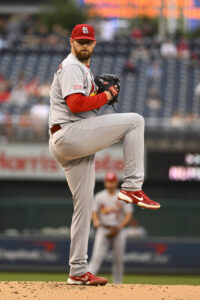 Scherzer and Montgomery now join a rotation that also includes Martin Perez, Jon Gray, Andrew Heaney, and Dane Dunning, though it remains to be seen if Texas will stick with a six-man staff. Keeping an extra starter might be useful to help keep everyone fresh for the pennant race (and, the Rangers hope, through October), yet moving Dunning back to a relief role might also be an option. On the other hand, Dunning has pitched quite well since his return to starting work, whereas Perez and Heaney have been much more inconsistent and Gray has been struggling over the last month.
Montgomery was already part of a notable deadline trade last year, when the Yankees sent the left-hander to the Cardinals in a one-for-one trade for Harrison Bader. In his first full year with the Cardinals, Montgomery has a 3.42 ERA over 121 innings, though his SIERA is a less-impressive 4.30. The southpaw has done his usual above-average job of avoiding free passes (6.9% walk rate) and limiting hard contact, though Montgomery now has a second straight season of a below-average strikeout rate (21.2%). While Montgomery has never been a huge strikeout pitcher, his whiff rate has also taken a tumble to 24.1% in 2023 after years of much more solid results.
If Scherzer is expected to be more of a front-of-the-rotation arm, then Montgomery represents a mid-rotation starter who can be relied on to take the ball every fifth (or sixth) day and deliver respectable results. Likewise, Stratton won’t be displacing Will Smith as the Rangers’ closer or even taking over a top set-up role, but he gives Texas another good arm for higher-leverage situtions late in games.
Montgomery and Stratton will each be reuniting with Mike Maddux, who was the Cardinals’ pitching coach from 2018-22 before moving on to join the Rangers’ coaching staff this year. Stratton is also a known quantity to skipper Bruce Bochy, as Stratton broke into the majors in the Giants organization back when Bochy was managing the team in 2016.
Stratton is also on the move for the second straight year at the deadline, as the Pirates sent Jose Quintana and Stratton to the Cardinals last August. Stratton’s 2022 numbers picked up considerably after that deal, and he has somewhat continued that form this season, even if his bottom-line results haven’t been reflective. Stratton has a 4.36 ERA in 53 2/3 innings, though a 3.48 SIERA and 3.06 FIP indicate some bad luck on Stratton’s part, perhaps due to an unusually low 61.6% strand rate.
The right-hander doesn’t have the high-velocity arsenal associated with most relievers, nor are his hard-contact or walk rates anything special. However, Stratton does bring durability in his ability to pitch multiple innings, and he has some of the most elite fastball and curveball spin rates of any pitcher in baseball.
Without any reports of money changing hands between the two teams, it looks like the Rangers will be absorbing the remainder of the 2023 salaries for Montgomery (roughly $3.5MM) and Stratton (around $1MM). It’s not a big financial commitment to a team that has already been splurging on big-name talent over the last two seasons, and Roster Resource projects that Texas is still just barely under the $233MM luxury tax threshold. The Rangers reportedly don’t have any issue crossing the tax threshold, so if another upgrade presents itself before Tuesday’s trade deadline, it wouldn’t be surprising to see the front office make another deal or two.
Among the players going back to the Cardinals, King is the best-known name to fans, as the lefty has a 4.27 ERA over 126 1/3 innings out of the Texas bullpen since he made his big league debut in 2020. A grounder specialist who has a very impressive 61.7% career groundball rate, King is naturally more susceptible than most to batted-ball luck, so his huge .379 BABIP over 18 2/3 innings has been the main factor in his 5.79 ERA.
The Rangers have sent King back and forth from Triple-A on a couple of occasions this season, and he is under team control through the 2026 campaign. The Cardinals will have the rest of the year to take a look at King and see if he might be an option for their bullpen going forward, plus in a more immediate sense King will add some left-handed depth to the St. Louis relief corps.
That said, Roby and Saggese are the bigger parts of this trade from the Cards’ perspective, as they join the three youngsters obtained in the Scherzer and Hicks deals as part of the sudden reload of the St. Louis farm system. MLB Pipeline ranked Roby as the Rangers’ 11th-best prospect and Saggese 14th, while Baseball America had a similar tack in placing Roby 13th and Saggese 15th.
Roby was a third-round pick for Texas in the 2020 draft, and he has a 5.05 ERA over 46 1/3 innings and 10 starts at Double-A Frisco this season. While he has cut back on his walks and home runs allowed, Roby’s strikeout rate has also tumbled during his three pro seasons, though his 25.6% mark this year is still respectable. The scouting reports from both Pipeline and BA pinpoint Roby’s command as his biggest issue, as his overall arsenal is solid. Pipeline gives a 55 grade (on the 20-80 scale) to all four of Roby’s pitches, though their report notes that the 21-year-old “may not have a true plus pitch” as a go-to offering.
Adding Roby will help St. Louis restock the minor league pitching ranks, while Saggese seems to fit the Cardinals’ preferred profile of a multi-positional infielder. Saggese has mostly played second and third base over his three pro seasons, while also getting a good chunk of action as a shortstop. He isn’t necessarily a standout defender at any position, but Pipeline liked his ability to stick at second base, and Saggese’s versatility is surely an asset as he climbs the ladder towards the big leagues.
The 21-year-old was also a 2020 draft pick (taken in the fifth round), and Saggese has done nothing but hit in the minors, including a .314/.380/.514 slash line and 15 homers over 417 plate appearances at Double-A in 2023. The pundits note that Saggese’s aggression at the plate can sometimes backfire, yet he has shown a bit more patience this season with an 8.2% walk rate.
Photo courtesy of USA Today Sports Images
Cardinals Rumors: Montgomery, Flaherty, Bullpen, Outfield
The Cardinals are perhaps the most intriguing seller of this trade deadline. The preseason favorite for the NL Central expected to build upon a 93-win campaign in 2022, the team has failed to live up to expectations with a brutal 46-60 record that leaves them in last place in the division and ahead of only the Rockies and Nationals in the NL. With the club’s eyes turned toward the future, speculation has run rampant regarding many of the club’s interesting pieces, both those who are set to hit free agency after the season and those who are under team control longer-term.
Despite their status as the league’s premiere seller, the Cardinals have largely been quiet to this point with the trade deadline just over 48 hours away. While reports earlier in the week hinted at the possibility of a blockbuster involving third baseman Nolan Arenado, president of baseball operations John Mozeliak firmly shut those rumors down yesterday. While Arenado may not be on the move, Derrick Goold of the St. Louis Post-Dispatch recently discussed a bevy of other rumors regarding the club’s options ahead of the trade deadline.
Most clearly positioned to move over the next two days are the club’s duo of mid-rotation rental starters: left-hander Jordan Montgomery and right-hander Jack Flaherty. Goold notes that both players, along with closer Jordan Hicks, are generating interest throughout the league, though the returns on each of those players, if traded by themselves, would reportedly not fit the mold of the Cardinals’ preferred return: controllable, major-league ready starting pitching.
That’s hardly a surprise, given controllable starters are typically regarded as some of the most valuable commodities in the sport. Given this, Goold indicates that the club could get creative and pair rental players with younger, controllable pieces would yield their desired return. In particular, Goold name-checks outfielders Alec Burleson and Dylan Carlson alongside relievers Giovanny Gallegos and Ryan Helsley as longer-term pieces who could be moved. In terms of potential Cardinals targets, Goold references both Yankees prospect Clayton Beeter and Mariners right-hander Logan Gilbert, though Goold cautions that Gilbert would require a “high-ceiling return.”
Recent reporting had previously indicated trade interest in Burleson from multiple clubs, and Goold reaffirms the Yankees’ previously reported interest in Carlson. Goold adds that, in addition to Carlson, the Yankees have interest in Hicks, who has also drawn interest from the Rangers. Additionally, Goold notes that the market for Flaherty and Montgomery includes the Marlins, who have scouted Flaherty in person this trade season, while the Rays are noted to have interest in St. Louis’s available pitchers more generally.
While Miami is seemingly focused on Flaherty among the club’s duo of rental starters, Jon Morosi of MLBNetwork reported last night that talks surrounding Montgomery were “gaining momentum” and that a deal was becoming increasingly likely. While Morosi didn’t specify which team the Cardinals were discussing Montgomery with, he noted that both the Diamondbacks and Orioles have engaged in discussions with St. Louis in recent days.
Rangers Interested In Further Pitching Additions
Even after acquiring future Hall of Famer Max Scherzer in a blockbuster deal with the Mets last night, MLB.com’s Mark Feinsand indicates the Rangers are not done adding to their pitching staff. Texas is reportedly looking to add a reliever or two or their relief corps and are also interested in adding to the bottom of the rotation.
An additional starting option would certainly make sense for Texas. While Nathan Eovaldi (2.69 ERA in 19 starts) and Scherzer create a strong top 2 at the front of the rotation, southpaws Martin Perez and Andrew Heaney have combined for a concerning 4.81 ERA in 40 starts this season. Righties Dane Dunning and Jon Gray both have stronger numbers for the season, Gray has posted a 6.49 ERA in his past seven starts while Dunning’s best work this season has come as a member of the bullpen.
While Feinsand doesn’t connect specific names to the Rangers, Justin McWilliams of the Boston Globe notes that the club has been scouting Red Sox left-hander James Paxton. Paxton, 34, came into the season with a 6.65 ERA in 21 2/3 innings of work since the start of the 2020 season. He dealt with back and forearm issues towards the end of his tenure with the Yankees before requiring Tommy John surgery in 2021. Separate injuries, including a late-season hamstring strain, slowed his rehab process and prevented him from returning to the mound with Boston in 2022.
Since making a healthy return to the mound in the middle of May this season, however, Paxton has looked like a quality, playoff-caliber starter. In 70 innings of work across 13 starts this season, Paxton has posted a 3.34 ERA that’s 40% better than league average by measure of ERA+ with a 3.61 FIP. His 28.4% strikeout rate and 7.1% walk rate are both a touch better than his career norms and while his .269 BABIP is noticeably lower than his career .302 figure, Paxton would be a significant upgrade to Texas’s rotation, or that of virtually any contender.
Of course, it’s an open question as to whether or not the Red Sox would actually move Paxton ahead of Tuesday’s deadline. After all, Boston sports a solid 56-48 record. While that puts them in fourth place in the AL East and seven games back of the division lead, they’re just 2.5 games out of a Wild Card spot even with the likes of Trevor Story, Chris Sale, and Tanner Houck on the injured list.
While the Red Sox have already made one “sell-side” trade so far this July, last week’s deal that sent utilityman Enrique Hernandez to the Dodgers doesn’t seem particularly indicative of the club’s future plans. After all, the trade came in the midst of a brutal season on Hernandez’s part and at a time when the Red Sox are flush deep with middle infield options: Yu Chang, Christian Arroyo, and Pablo Reyes are all on the roster with Justin Turner also chipping in at second base and Story nearing a return to action.
Should Paxton wind up unavailable, there’s still plenty of other options for the Rangers to consider in looking to upgrade their pitching staff. Michael Lorenzen, Mike Clevinger, and Jack Flaherty are among the starters who seem likely to move, to say nothing of the possibility that the Padres or Cubs opt to sell and dangle an arm like Blake Snell or Marcus Stroman. As for relief options, right-handers Jordan Hicks, Scott Barlow, Chris Stratton, and Paul Sewald all appear in the top 15 of MLBTR’s most recent Top 50 Trade Candidates list. So too does relief ace Josh Hader, though his availability is contingent on San Diego opting to sell just as Snell’s is.
Rangers Acquire Max Scherzer From Mets
The Rangers and Mets have agreed to a trade that will see the star right-hander Max Scherzer head to Texas, with prospect Luisangel Acuña heading the other way. The Mets are paying down all but $22.5MM of the remaining money owed to Scherzer, who will waive his no-trade clause. He will also trigger his player option for 2024, forgoing his opt-out opportunity.

The Mets signed Scherzer to a three-year, $130MM deal going into the 2022 season, as part of a high-spending strategy aimed at contention. The first year generally went well, as the Mets won 101 games with Scherzer contributing 23 starts of 2.29 ERA ball. This year hasn’t been nearly as successful, however, as the Mets have slumped to 49-54 and 6.5 games out of a playoff spot. It seems they have accepted the fact that they have to do some selling, having already flipped David Robertson to the Marlins.
That’s also come with diminished results from Scherzer, who has posted an ERA of 4.01 this year, working around a 10-game sticky stuff suspension earlier in the season. His strikeouts have dipped this season, with his 27.3% rate representing his lowest since 2011.
With the Mets struggling, it’s led to speculation about how they would react. Impending free agents like Robertson, Tommy Pham and others seemed like natural trade candidates, but Scherzer’s situation was more complicated. As mentioned, he had a full no-trade clause and would need to agree to any deal. It was reported in June that he was willing to waive that clause under certain circumstances, though without concrete information about what it would take for him to do so.
Further complicating matters was Scherzer’s ability to opt out of the final year of his deal, leaving $43.33MM on the table. Some sources describe this as a player option, though the situation is the same either way, with Scherzer getting to decide whether to become a free agent or not. He spoke about his situation earlier this week, saying that he’s “not going to be a free agent” and “can see a path to contend next year” with the Mets. Though he also said he would speak with the front office about the club’s direction.
He’s still owed just under $15MM for the remainder of this season, on top of the $43.33MM for next year, a total just north of $58MM. Whatever return the Rangers were willing to send to the Mets might have taken a different shape if they were to view Scherzer as a rental or a pickup for a year and a half with a massive salary. They reportedly wanted Scherzer to lock in that 2024 season, which he has now apparently done.
Since the Mets are paying down all but $22.5MM, that means they’re eating more than $35MM in this deal. The Mets have shown a tendency to eat money in trades in order to maximize returns, such as sending Eduardo Escobar to the Angels and James McCann to the Orioles, and have done so here.
The Rangers have been clearly looking for starting pitching recently, having been connected to Lance Lynn, Jack Flaherty, Jordan Montgomery, Eduardo Rodriguez, Shohei Ohtani, Justin Verlander and Scherzer. They have had a couple of rotation setbacks this year, most notably the loss of Jacob deGrom. He was signed to a five-year, $185MM guarantee in the offseason but required Tommy John surgery in June, putting him out for the remainder of this year and some of 2024 as well. They also lost Jake Odorizzi to a season-ending shoulder surgery.
The club has operated for most of the season with a rotation of Nathan Eovaldi, Jon Gray, Martín Pérez and Andrew Heaney, with Dane Dunning stepping in for deGrom. The results from that group have been varied, with Eovaldi’s 2.69 ERA the lowest and Pérez the highest at 4.91. Dunning is at 3.28 but with a 15.5% strikeout rate that’s well below league average. Since his .269 batting average on balls in play and 77.5% strand rate are on the lucky side, his 4.26 FIP and 4.88 SIERA suggest he’s skirted around some runs. He’s the only member of the rotation with options and could perhaps wind up in the minors as depth, though he’s also worked out of the bullpen before. Additionally, Eovaldi is dealing with some elbow soreness, per Evan Grant of the Dallas Morning News. He’s not going on the IL yet but his scheduled start is being pushed back. Although Scherzer’s not having his best season, he would still be an upgrade for that group. By sticking around for 2024, he will also help them cover for Pérez becoming a free agent, with deGrom potentially returning later in the year.

The Rangers are currently 60-44 and hold a two-game lead over the Astros in the American League West, with the third-place Angels aggressively pursuing upgrades as well. The Rangers haven’t made the postseason since 2016, which was also the last time they finished above .500. They’ve shown a willingness to be very aggressive in recent years as they look to get out of that spiral, giving out huge deals to players like Corey Seager and Marcus Semien, as well as the aforementioned starting pitchers. They’ve already bolstered their bullpen by acquiring Aroldis Chapman and now have made a massive move for their rotation.
It was reported this week that the club would be open to surpassing the $233MM base threshold of the luxury tax for Verlander, though it remains to be seen if they will do the same for Scherzer. Roster Resource currently lists their CBT figure at $224MM, or $9MM below the line. Assuming the $22.5MM they are paying Scherzer is evenly distributed between now and the end of next year, they’ll be adding just under $6MM to that. That will leave them shy of the line for now but further moves could tip the scales.
In order to obtain Scherzer’s services, the club has parted with Acuña. The 21-year-old shortstop is the younger brother of Atlanta’s superstar outfielder Ronald Acuña Jr. Signed out of Venezuela in 2018, he has climbed through the minor league ranks to reach Double-A. In 84 games at that level this year, he’s hitting .315/.377/.453 for a wRC+ of 121 while stealing 42 bases. Baseball America currently lists him at the #87 prospect in the league while FanGraphs has him at #56. BA suspects he’ll have to move to second base eventually but that he could be a solid regular there.
As for the Mets, this could perhaps give some hint as to how far they are willing to go in trading from this year’s roster in order to acquire help for future seasons. They’ve already traded Robertson and could shop other impending free agents like Pham and Carlos Carrasco. Mark Canha and Brooks Raley could also make sense, though they are pure rentals since the club has options for 2024. Omar Narváez and Adam Ottavino have player options for 2024. José Quintana‘s contract runs through 2024 and he has received some trade interest.
The bigger fish, though, is Verlander. He just signed a two-year deal in the offseason that pays him $43.33MM per year, matching Scherzer’s salary, with a conditional $35MM option for 2025 as well. Like Scherzer, he also has a full no-trade clause and said just a few days ago that the club hadn’t yet approached him about waiving it. But it was later reported that the club would only approach the players about their clauses after finding workable trade packages, which seems to have been the case in this Scherzer deal.
Images courtesy of USA Today Sports.
Michael Schwab of Juice Box Journal first reported that the Rangers had a deal in place for Scherzer, contingent on him waiving his no-trade clause. Andy Martino of Steve Gelbs of SNY relayed that Scherzer would waive his clause, but that the financial components of the deal weren’t complete. Jon Heyman of The New York Post first reported on Acuña’s inclusion in the deal, as well as the fact that the Rangers wanted him to forego his opt-out at season’s end and that the deal was done. Martino relayed the financials while Jeff Passan of ESPN reported that Scherzer will trigger in his 2024 option, with Heyman adding that he’ll receive some additional amenities for doing so.
Latest On Justin Verlander
Few potential trade candidates are as notable as Justin Verlander. There are myriad complications that could stand in the way of a deal, but there’s been speculation over the past couple days about the chance of Verlander being on the move.
Mark Feinsand of MLB.com suggested Thursday night there was some industry sentiment the Mets would look to move him. Feinsand listed the Astros and Rangers as potential fits. Will Sammon and Tim Britton of the Athletic also indicated that the two Texas-based franchises had expressed some interest, writing that the Mets at least appear willing to genuinely consider offers on Verlander and Max Scherzer.
Still, it remains to be seen how aggressively other teams would pursue either player. Sammon and Britton characterize Texas’ interest in Verlander mostly as due diligence as they evaluate all their rotation possibilities. Evan Grant of the Dallas Morning News wrote yesterday that Texas would be open to surpassing the competitive balance tax threshold in a Verlander trade. However, he similarly indicated the Rangers are checking in on virtually every pitcher on the market, with nothing to suggest Verlander talks have gotten particularly advanced. Joel Sherman of the New York Post reports that Texas has also inquired on reliever Brooks Raley and corner outfielder Tommy Pham.
Texas has a luxury tax number around $224MM, as calculated by Roster Resource. They’re $9MM shy of the $233MM base threshold. Verlander is due around $15.4MM through season’s end, so an acquisition would push Texas past that marker unless the Mets paid down a significant chunk of the salary.
New York might be willing to do so. They paid down all of Eduardo Escobar’s deal and are reportedly willing to send cash in other trades, although they didn’t include any money in the David Robertson swap with Miami. There’s a ways to go to get to that point, though. New York would have to weigh the possible return against subtracting a key player who’s under contract for 2024, when the Mets surely envision a return to competitiveness.
That’s even before considering the players’ ability to block any deal. Both Verlander and Scherzer have complete no-trade rights. Understandably, neither has gone on record about whether they’d waive that provision. Verlander said a few days ago the Mets had not approached him about that possibility. Scherzer told the New York beat last night that he’d likely speak with the front office about the franchise’s direction over the next few days. Sherman indicates the Mets would only gauge the pitchers’ willingness to waive the no-trade clauses if they first find a potentially workable trade package.
Texas pursued Verlander as a free agent last winter. He reportedly wasn’t keen on joining the Rangers at the time, although that’s seemingly because he questioned how quickly they’d be competitive. That’s no longer in doubt with the Rangers topping the AL West by two games and motivated deadline buyers.
There’s plenty of familiarity between Verlander and the Astros, of course. Houston has been on the hunt for a starting pitcher for a few weeks. General manager Dana Brown downplayed the rotation need a bit after acquiring reliever Kendall Graveman yesterday, however. Brown indicated that while Houston was still open to adding a starter, the rotation is “not as high a priority as the bullpen was,” in part because of the loftier asking price teams are demanding to relinquish starting pitching (link via Chandler Rome of the Athletic).
Rangers Acquire Kevin Plawecki From Padres
The Rangers announced they’ve acquired catcher Kevin Plawecki for cash in a minor league trade with San Diego. Plawecki had not been on the Padres’ 40-man roster and won’t immediately go onto the roster with Texas. He’ll be assigned to Triple-A Round Rock for the time being.
It’s a sensible depth pickup for Texas. The Rangers just placed All-Star backstop Jonah Heim on the injured list with a left wrist issue. He’ll be shut down for a few weeks before it’s determined whether season-ending surgery is necessary. The best case scenario is that Mitch Garver and Sam Huff will hold down the fort for a few weeks before Heim makes it back.
Texas doesn’t have any other catchers on the 40-man, so an injury to either Garver or Huff would force them to tap into the minor league ranks. None of the Rangers’ Triple-A backstops had any big league experience, so it makes sense to fortify the group with a veteran.
Plawecki is no stranger to the organization. He signed with the Rangers late last season after being released by the Red Sox. Despite his impending free agency, a then-uncompetitive Texas club valued his clubhouse presence enough to carry him on the roster at the end of the season.
The 32-year-old has spent this year in Triple-A with the Nationals and Friars. He has combined for a .268/.341/.400 line over 229 trips to the plate. In parts of eight big league seasons, he’s a .235/.313/.342 hitter.
Jonah Heim To Miss At Least 2-3 Weeks With Wrist Strain; Surgery Possible
The Rangers announced that catcher Jonah Heim has been placed on the 10-day injured list, retroactive to July 27, with a left wrist tendon strain. Outfielder Bubba Thompson was recalled to take his place on the roster. The club also swapped a couple of pitchers, with righty Josh Sborz reinstated from the 15-day IL while righty Owen White was optioned to Triple-A. Evan Grant of the Dallas Morning News relays that Heim will rest for two to three weeks before seeing if he can play through the pain. If not, he may require season-ending surgery, or that could be pushed to the offseason.
Heim, 28, departed Wednesday’s game with wrist soreness and it appears the issue is serious enough that he’ll sit out a few weeks. There’s still hope of him returning, but being without Heim for any amount of time is surely unwelcome for the Rangers, as he’s been one of the best backstops in the majors this year. He’s already tallied 14 home runs and is slashing .280/.337/.479 for a wRC+ of 123. He’s also been graded as a strong defender, leading to a tally of 3.5 wins above replacement from FanGraphs this year, trailing only Sean Murphy‘s 3.7 among all major league catchers.
In the meantime, the club will rely on a catching tandem of Sam Huff and Mitch Garver. The latter is an above-average hitter but frequent injuries have prevented him from ever playing 105 games in a season and he hasn’t reached 70 games since 2019. He missed two months this year due to a knee sprain and has played 33 games, only donning the tools of ignorance in 13 of those. Huff has only played nine major league games this year, spending most of his time in the minors. But he’s hit well down there, slashing .298/.389/.546 for a 121 wRC+.
The Rangers should be fine with that duo for a while but will likely look for reinforcements of some sort. There are no other catchers on the 40-man roster and Garver’s persistent health issues make him hard to bank on for extended playing time. The trade deadline is now just four days away and midseason trades of catchers are tricky given the challenges of learning a new pitching staff on the fly, but the Rangers might have to try.
Austin Hedges of the Pirates would be an obvious candidate as an impending free agent on a struggling Pirates club, and he has already reportedly drawn trade interest. He’s a poor hitter but is generally considered an excellent defender. The White Sox are busily selling and could move Yasmani Grandal, though he’s making $18.25MM this year. Joey Bart seems to have been leapfrogged by Patrick Bailey and Blake Sabol in San Francisco. He’s in his final option year and will be out of options next year, which perhaps makes him disposable to the Giants in the long-term but useful to the Rangers in the short-term. The Mets are rolling with rookie Francisco Álvarez and could perhaps part with Omar Narváez or Tomás Nido. Victor Caratini is stuck behind William Contreras in Milwaukee and has garnered trade interest. Iván Herrera seems to be blocked in St. Louis by Willson Contreras and Andrew Knizner.
The Rangers have had a big lead in the American League West for much of the season but have recently seen the Astros pull within two games while the Angels, six games back, are aggressively making upgrades. Losing a key player like Heim is a rough development for them but they still have a few days to address it.
Latest On Justin Verlander, Max Scherzer
The Mets’ sell-off began in earnest last night when they traded David Robertson to the division-rival Marlins, and further deals are widely expected to come together in the days leading up to Tuesday’s trade deadline. Veteran outfielders Mark Canha and Tommy Pham can be free agents at season’s end — Canha has a 2024 club option — and figure to hold interest to contenders seeking right-handed bats and/or general outfield help. But perhaps no two players will be of as much interest to fans in the next few days as future Hall of Famers Justin Verlander and Max Scherzer.
Andy Martino of SNY reports that the Mets have thus far received “moderate” interest in Verlander but have not had meaningful enough talks to even approach the three-time Cy Young winner about waiving his no-trade clause. Scherzer has drawn less interest, per Martino.
Mark Feinsand of MLB.com reported late last night that a pair of executives with other clubs believe there’s a real chance the Mets will ultimately trade Verlander. He listed the Rangers and Astros as potential fits, and Martino adds (without directly tying them to Verlander) that the Angels and Reds have been scouting the Mets of late. Feinsand adds that the Rangers were in on Verlander in the offseason, but the 40-year-old righty was more keen on signing with what he viewed as a contending club in Queens. It’s only reasonable to think he’d view the Rangers more favorably now; Texas is leading the AL West and owns the third-best winning percentage and top run differential in the American League. He’s certainly no stranger to pitching in Texas either, having spent several years with the Astros.
Obviously, there would be plenty of obstacles to any trade actually coming together. First and foremost, both Verlander and Scherzer have full no-trade clauses in their contracts. They’d have to approve any deal, although one can imagine that the opportunity to go from a struggling Mets team into the type of playoff chase both envisioned when signing in New York would be quite enticing. Both players are also earning a record $43.333MM annual salary on the contracts they signed in free agency — a massive number which would rule some contending clubs out entirely. Owner Steve Cohen could of course pay down some of that salary in order to facilitate a trade, but the specifics of how much cash to include and what caliber of prospects to send back for either multi-time Cy Young winner would be difficult to broker.
Beyond the contractual hurdles, the simple fact is that neither Verlander nor Scherzer has pitched as well in 2023 as in recent seasons. Verlander’s 3.24 ERA is a perfect match for his career mark, but this year’s 20.9% strikeout rate 8.2% walk rate are nowhere close to last year’s respective rates of 27.8% and 4.4%. Verlander’s 94.6 mph average fastball, 10% swinging-strike rate and 34.9% opponents’ chase rate are all down slightly from last year’s levels of 95.1 mph, 11.6% and 36.9%, as well.
Verlander, who missed the first five weeks of the season due to a strained teres major, is guaranteed $43.333MM this year and next. His contract contains a conditional $35MM player option for the 2025 season that would vest if he pitches 140 innings next year.
As for Scherzer, he’s sporting a 4.20 ERA that would be the second-highest mark of his career — his worst since a 4.43 showing way back in 2011. His 27.4% strikeout rate and 6.7% walk rate are down from his 2022 levels (30.6% and 4.2%) but still remain considerably better than the league average. However, he’s also giving up home runs at the highest rate of his career. Scherzer has yielded an average of 1.97 round-trippers per nine innings pitched and seen a whopping 16.8% of his fly-balls leave the yard. The latter of those two numbers seems bound for some regression, but Scherzer is giving up hard contact at his highest levels since Statcast began tracking batted-ball data (89.1 mph average exit velocity, 10.3% barrel rate, 38.7% hard-hit rate).
Scherzer is in the second season of a three-year, $130MM contract pays him $43.333MM annually, but he has the right to opt out of the final year of that deal this winter. Barring a return to vintage form over the final couple months, he’s unlikely to match that type of payday on the open market. However, Scherzer suggested prior to the season that the opt-out was negotiated into his contract in large part to see where the organization stood at that point. He knew his now-former teammate Jacob deGrom had a looming opt-out in his deal and wanted to ensure that the Mets would remain committed to fielding a winning club in the event deGrom departed. The Mets certainly strived to do so in 2023, but things haven’t worked out.
Reports have since suggested that Scherzer is willing to waive his no-trade clause, which is only sensible if winning is his his top priority. His willingness to do so hardly guarantees that a deal will come to fruition, but with the Mets beginning to trade short-term veterans, both Scherzer and Verlander figure to be oft-discussed names over the next four days.