
Mets Sign Luis Severino
The Mets are reportedly in agreement with free agent starter Luis Severino on a one-year, $13MM guarantee. The deal also includes $2MM in performance bonuses. Severino, who is represented by Rep 1 Baseball, would receive $500K for reaching 27 starts and $750K apiece for his 29th and 31st start.
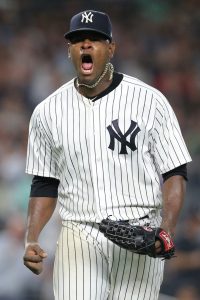 Severino, 30 in February, is a wild card of this winter’s free agent market. He once looked like one of the best pitchers in the majors but has spent the past five years either injured or ineffective or both. He made 63 starts over 2017 and 2018, throwing 384 2/3 innings with a 3.18 earned run average. He punched out 28.8% of batters faced while walking just 6.2% of them and keeping 45.8% of balls in play on the ground. FanGraphs calculated him as worth 11 wins above replacement over that two-year span, trailing just four pitchers around the league: Max Scherzer, Chris Sale, Jacob deGrom and Corey Kluber.
He and the Yankees agreed to a four-year, $40MM extension prior to 2019, with that deal also having a $15MM option for 2023. But shortly after that deal was signed, he ran into health problems. He only made three starts in the first year of that deal due to shoulder and lat injuries, then Tommy John surgery kept him off the field entirely in 2020 and for most of 2021. More lat issues came in 2022, but he was at least able to make 19 starts and log 102 innings with a 3.18 ERA, followed by a couple of playoff starts.
That relatively healthy showing was enough for the Yankees to trigger the player option for 2023. Another lat strain prevented him from making his season debut until May and then an oblique strain in September ended his season early. In the middle of those IL stints, he tossed 89 1/3 innings but with an awful 6.65 ERA. He struck out just 18.9% of opponents, a huge drop from his 27.7% rate in 2022.
Severino averaged 96.5 mph on his fastball in 2023, a bit down from his 97.6 from 2018. It’s higher than his 96.3 mph average from 2022, when he was still effective. His slider had a bigger drop, averaging 84.6 mph in this year whereas it sat 88-89 prior to his injury troubles. But he was still getting good results in 2022 with a slider that averaged 85.1 mph.
Despite the rough season, some club was going to take a chance on Severino’s track record and hope for a bounceback with better health. MLBTR predicted Severino to secure a contract of one-year and $14MM. His guarantee is just beneath that but the bonuses could help him climb to the other side.
That the Mets are the club to take the chance on Severino makes plenty of sense, with reporting from a couple of weeks ago suggesting they were interested. Last year’s struggles led them to trade Max Scherzer and Justin Verlander ahead of the deadline. Then Carlos Carrasco reached free agency and David Peterson required hip surgery that will force him to miss the start of next season.
All of that left the Mets with a 2024 rotation consisting of Kodai Senga and José Quintana in two spots. They had some candidates to fill out the back end, such as Tylor Megill, Joey Lucchesi and José Butto, but each of those guys can be optioned to the minors and make more sense as depth options than as part of the club’s Opening Day plans.
It’s still unclear exactly what kind of offseason the Mets are planning to have and this transaction won’t make that much clearer. The 2023 club had the highest payroll in baseball history but reporting from the deadline indicated that they may opt for a somewhat less-aggressive approach for 2024. But stepping back from unprecedented heights could still lead to plenty of activity, depending on the size of the step.
This deal is fairly modest by free agent standards but could always be paired with a larger move. For example, the Cardinals were looking for three starters this winter and started with one-year deals for Lance Lynn and Kyle Gibson before a bigger three-year strike on Sonny Gray. Perhaps the Mets have a bigger move to come, having been connected to Yoshinobu Yamamoto. But time will tell if that kind of big strike is realistically in their plans.
For now, they’ve added a former star on a short-term deal. He could either help them return to contention or perhaps turn himself into a deadline trade chip. If he isn’t able to get back in good form, the Mets won’t have impacted their plans for competing in the long term.
In the short term, this seems like it will cost them more than the $13MM sticker price. According to Roster Resource, this move pushes the club’s competitive balance tax calculation to $288MM, well beyond next year’s base tax threshold of $237MM. The CBT features escalating penalties for paying in consecutive years and the Mets are set to be a third-time payor in 2024. That means they pay a 50% tax on all overages, 62% for spending over the $257MM line and 95% for going past the third line of $277MM. They could always shed salary somehow but they are already past the third line and not too far from the fourth line of $297MM, when their tax rate would jump to 110%. The tax isn’t calculated until the end of the season, so they could significantly alter all of these calculations between now and next fall, but it’s distinctly possible that they end up paying something close to double that $13MM figure that Severino will receive.
Mark Feinsand of MLB.com first reported Severino was nearing agreement with the Mets. Jeff Passan of ESPN reported the sides were finalizing a one-year, $13MM deal that included $2MM in bonuses. Jon Heyman of the New York Post reported the specific bonus structure.
Braves Sign Penn Murfee, Jackson Stephens To Major League Deals
The Braves announced the signings of relievers Penn Murfee and Jackson Stephens to one-year split deals. A split contract means the player would be paid at differing rates for time spent in the majors versus Triple-A. Both pitchers rejoin Atlanta’s 40-man roster. The team still has seven openings on the 40-man on the heels of an active non-tender deadline.
Murfee and Stephens were each dropped from the roster within the past couple weeks. Atlanta had cut Murfee loose at the non-tender deadline. Stephens hit the open market not long before that after going unclaimed on outright waivers.
The Braves had just snagged Murfee off waivers a few days before cutting him loose. The 29-year-old righty has 80 games of major league experience, all of which have come with the Mariners over the past two seasons. Leaning heavily on a sweeping slider, Murfee has posted strong results. He owns a 2.70 ERA in 83 1/3 innings, striking out nearly 28% of batters faced. He has found success against hitters of either handedness.
Murfee’s season was unfortunately cut short in June. The 29-year-old underwent surgery to repair a UCL tear in his elbow. He’ll miss a good portion of next season as a result. There’s no injured list during the offseason, explaining Seattle’s decision to move on despite his strong body of work. The Braves have enough roster space to give Murfee a spot, at least for the time being. If he sticks on the roster for the rest of the offseason, they could place him on the 60-day injured list whenever they need a 40-man spot from the start of Spring Training onward.
Stephens, 29, has spent the past two seasons in the Atlanta organization. The righty logged more big league action in 2022, when he turned in a 3.69 ERA through 53 2/3 frames. He didn’t see as much time this past season, tallying only 12 MLB innings over five appearances in September. Stephens worked to a 3.28 ERA with a strong 26% strikeout rate across 24 2/3 innings with Triple-A Gwinnett.
Since he is out of minor league options, he’d have to open next season on the active roster or again be exposed to waivers. Stephens would have the right to elect free agency if the Braves successfully passed him through waivers unclaimed. Since he has less than five years of service time, he’d have to forfeit his guaranteed salary to become a free agent. By signing him to a split deal that locks in an undisclosed amount of money for whatever time he spends in Triple-A, the Braves increase their chance of retaining Stephens as non-roster depth in the event they try to run him through waivers at some point.
Jeff Passan of ESPN reported that Murfee was returning to the Braves on a major league deal shortly before the club announcement.
Guardians, Jaime Barria Agree To Minor League Deal
The Guardians are in agreement with right-hander Jaime Barria on a minor league contract, reports Ken Rosenthal of the Athletic (on X). The former Angels hurler elected free agency after clearing outright waivers last month.
Until that point, Barria had spent his entire career with the Halos. He signed out of Panama in 2013 and reached the big leagues five seasons later. Barria debuted as a 21-year-old and turned in a strong rookie season, working to a 3.41 ERA over 26 starts.
While he hasn’t recaptured that level of success, Barria has shouldered a decent number of innings in a swing role over the past few seasons. The results have been inconsistent. He allowed an ERA of 4.61 or worse in each of 2019, ’21 and this year. Barria fared better in a limited sample during the shortened season and had a strong 2.61 mark over 79 1/3 relief innings in 2022.
The Halos have mostly deployed him in lower-leverage situations. Barria doesn’t throw especially hard or miss many bats. He has struck out a below-average 17.1% of batters faced in each of the past two seasons. A spike in home runs dramatically flipped the script on his run prevention this year. Barria was tagged for 5.68 earned runs per nine in 82 1/3 frames spanning 34 appearances (including six starts).
The 27-year-old owns a 4.75 ERA in 333 1/3 big league innings over the last five years. He has a modest 17.8% strikeout percentage but has kept his walks to a solid 7.2% clip. He’ll presumably get a look in big league Spring Training and can compete for a long relief role with the ability to step into the rotation as needed. Barria is out of minor league options, so if he cracks the MLB roster at any point, he’d need to remain with the big league club or be designated for assignment. He has a little over four years of MLB service. If he carves out a role on the major league staff, Cleveland could retain him via arbitration for at least one additional season.
Royals Sign Garrett Hampson
The Royals announced that they have signed infielder/outfielder Garrett Hampson to a one-year contract. Hampson will make a salary of $2MM, per Jeff Passan of ESPN.
Hampson, 29, spent the 2023 season with the Marlins in a utility capacity. He got into 98 games and stepped to the plate 252 times, striking out at a 26.6% clip and only hitting three home runs but he did draw walks 9.1% of the time. His .276/.349/.380 batting line was a hair above league average, translating to a wRC+ of 101, though his .379 batting average on balls in play was almost 60 points higher than his career rate in that department. That roughly average offensive production was actually a big step up from his time in Colorado, as Hampson slashed .233/.292/.369 for the Rockies from 2019 to 2022.
Hitting aside, Hampson can provide value in other ways. His sprint speed was considered by Statcast to be in the 98th percentile in 2023. He only stole five bases on the year but has 57 in his career. Defensively, he has spent time at all three outfield positions and the three infield spots to the left of first base, giving him plenty of versatility.
After the 2022 season, the Rockies non-tendered him instead of paying a projected $2.1MM salary. He then had to settle for a minor league deal with the Marlins and ended up having a decent campaign in a part-time role but it wasn’t enough for the Fish to keep him on the roster. He exhausted his final option year in 2023 and would have less roster flexibility going forward, so the Marlins opted not to tender him a contract at a projected rate of $1.3MM.
The Royals are willing to give him $2MM and a roster spot, presumably to utilize him in the same multi-positional role he has held so far in his career. The club has Bobby Witt Jr. implanted at shortstop but second base and third base have less certainty. Maikel Garcia is the favorite at the hot corner and has a good floor with his speed and defense, but he hit just four home runs in 515 plate appearances in 2023. Michael Massey could be in line for the lion’s share of playing time at second after hitting 15 homers this year but his .274 on-base percentage was among the worst in the league last year. Center field has similar question marks after subpar offensive seasons from Drew Waters and Kyle Isbel.
In addition to those aforementioned areas, injuries will inevitably arise over the course of a 162-game season, creating holes elsewhere. Hampson can help fill in there or perhaps serve as a late-game defensive replacement or pinch runner, depending on how things shake up over the remainder of the offseason. Nick Loftin and Samad Taylor are also on the roster as utility options but they each have options and less than a year of service time.
Tigers Sign Kenta Maeda
November 28: The club has now officially announced the deal, which is frontloaded. Maeda will make $14MM in 2024 and $10MM in 2025. The club’s 40-man roster count is now at 38.
November 26: The Tigers have added some experience to their young rotation, agreeing to sign right-hander Kenta Maeda to a two-year, $24MM contract. Maeda will undergo his physical on Monday, so the deal should be officially announced within the next 24 hours. Maeda is represented by the Boras Corporation.
Reports emerged earlier this week linking Maeda and the Tigers, though the Twins (Maeda’s former team) maintained interest. However, SKOR North’s Darren Wolfson writes that the Twins only had interest in Maeda on a one-year contract, so moving to a multi-year looks to have sealed the deal for the Tigers. Minnesota will now have to deal with Maeda as an opponent on a division rival, as Maeda will join the third team of his Major League career as he enters his age-36 season.
With Eduardo Rodriguez possibly leaving Detroit in free agency, Maeda steps in as the veteran presence within a Tigers rotation that is still pretty unseasoned. Most of the Tigers’ young arms were also set back by injuries during the club’s nightmarish 2022 season, though Tarik Skubal and Matt Manning pitched well when healthy, and Reese Olson stepped up as a legitimate rotation candidate. At the moment, Maeda looks to be the No. 2 on the staff behind Skubal, with Manning, Olson, and Casey Mize (set to return after missing 2023 due to Tommy John surgery) looking like the provisional starting five.
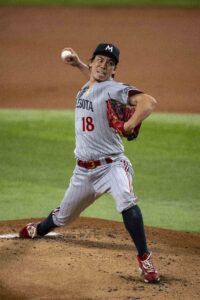 This offseason marked the end of the incentive-heavy, eight-year, $25MM deal Maeda signed with the Dodgers back in January 2016, when Maeda first came to the majors from Nippon Professional Baseball. Maeda’s earning power at the time was somewhat limited due to some concerns over his elbow, though he didn’t have any major arm-related injury issues over four years in Los Angeles before the Dodgers dealt him to the Twins during the 2019-20 offseason. Maeda responded with an outstanding performance in the pandemic-shortened campaign, posting a 2.70 ERA in 66 2/3 innings and finishing second in AL Cy Young Award voting.
With a more modest 4.66 ERA in 106 1/3 frames in 2021, the injury bug then finally bit, as Maeda had to undergo the internal-brace version of Tommy John surgery. Using the brace theoretically could have reduced Maeda’s time on the injured list, yet he ended up missing the entire 2022 season. His comeback year in 2023 was also shortened by close to two months by a triceps strain, but the numbers were pretty solid overall when Maeda did take the mound.
Maeda posted a 4.23 ERA, 27.3% strikeout rate, and 6.5% walk rate over 104 1/3 innings for Minnesota. Both the walk and strikeout rates were well above average, and Maeda wasn’t a high-velocity pitcher even before surgery, so his 90.9mph average was just slightly below his career norm. Maeda did allow a lot of hard contact last year, which was something of a red flag considering that he very good and occasionally elite at inducing soft contact in the seasons prior to his brace procedure.
Between the hard-contact numbers, Maeda’s age, and injury history, the expectation was that Maeda’s market might be limited to a two-year (or two years with an option) contract this winter. MLBTR ranked Maeda 25th on our list of the offseason’s top 50 free agents, and predicted a two-year, $36MM pact for the right-hander. The actual dollar figure will fall below our projection, perhaps suggesting that teams had concerns over Maeda’s ability to stay healthy. Speculatively, it could also be that Maeda preferred to get a deal done sooner rather than later, perhaps as a nod to the strong interest shown by the Tigers this early in the winter.
There’s no doubt that the righty has a high ceiling of performance when he’s healthy, making the signing a pretty solid move for Tigers president of baseball operations Scott Harris. After spending most of his first year in the job in evaluation mode, Harris has started to make some modest but noteworthy expenditures for veteran talent, both in signing Maeda and in trading for Mark Canha earlier this month. Adding Maeda’s deal puts Detroit’s projected payroll (as per Roster Resource) at only $85.26MM, though Harris has spoken of exercising financial caution in the past, and it isn’t yet clear how much the Tigers are willing to spend this winter.
At the very least, the Tigers have the flexibility to perhaps explore a bigger move should an opportunity present itself, and Maeda’s signing perhaps opens such a door in a unique fashion. Evan Petzold of The Detroit Free Press wrote this week that the Tigers were considering Maeda both for the pitcher’s own value and also to “establish themselves in the Japanese pitching market.” This is particularly intriguing in the context of Detroit’s interest in Yoshinobu Yamamoto, and if Harris and Tigers ownership were prepared to break the bank on a player, it might be for this circumstance of a 25-year-old Japanese ace who might have up to a decade of prime baseball still ahead of him.
Shota Imanaga is another prominent name coming to the majors from NPB this winter, even if Imanaga is 30 and his ceiling isn’t considered as high as Yamamoto’s. It is also possible the Tigers might not be done with veteran pitchers from the Major League free agent market, as names like Seth Lugo and Luis Severino are also reportedly on Detroit’s radar as arms available on shorter-term and relatively less-expensive contracts.
An argument could’ve been made for the Twins to issue Maeda a qualifying offer as he entered free agency, yet with Minnesota planning to cut payroll next year, it is easy to see why the Twins might not have wanted to risk Maeda accepting the offer and locking in a $20.325MM salary for 2024. By not issuing a qualifying offer, Minnesota won’t receive anything in compensation for Maeda’s departure.
Jon Heyman of the New York Post (X link) was the first to report the agreement and the term length, while ESPN’s Jeff Passan reported the $24MM figure. Evan Petzold of the Detroit Free Press reported that Maeda’s deal was pending the pass of his physical.
Photo courtesy of USA Today Sports Images
Brewers Agree To Minor League Deals With Easton McGee, Brewer Hicklen
The Brewers have signed right-hander Easton McGee and all-too-appropriately-named outfielder Brewer Hicklen to minor league contracts, reports Adam McCalvy of MLB.com. They’ll both be in major league camp during spring training, though McGee won’t be pitching, as he’ll still be rehabbing from last May’s Tommy John surgery. McCalvy further adds that McGee’s minor league deal is a two-year pact, so he’ll be in the Brewers system through at least the 2025 season.
McGee, 26 next month, appeared briefly in the big leagues with the 2022 Rays and 2023 Mariners, combining for 9 2/3 shutout innings. He fanned three hitters and walked just one during that time. He’s a soft-tosser by today’s standards, averaging 91.5 mph in ’22 and seeing that number drop to 90.1 mph prior to this past season’s surgery.
McGee was Tampa Bay’s fourth-round pick back in 2016, and though he doesn’t have power stuff or a history of elite run prevention in the upper minors (4.78 ERA in 141 Triple-A frames), he does boast outstanding command. He’s faced just shy of 2100 hitters since being drafted and walked only 4.6% of them. At 6’6″, his lanky frame likely helps his pedestrian fastball velocity play up a bit, and that standout command is difficult to develop in players. On what amounts to a no-risk minor league pickup for the Brewers, he’s a nice arm to stash in the system in hopes that he can eventually emerge as a back-end starter or perhaps a multi-inning reliever.
Hicklen, 28 in February, made his MLB debut with the 2022 Royals but went hitless in a minuscule sample of six plate appearances. He’s a 2017 seventh-round pick with a career .244/.348/.486 line at the plate in 853 Triple-A plate appearances.
While he didn’t hit for much power in 2023 (10 homers in 72 games), Hicklen popped 28 long balls with Kansas City’s Triple-A club in 2022 and has drawn praise for his plus-plus (70-grade) speed. Those wheels have been on display in Triple-A, where he’s swiped 56 bags in 61 tries. Overall, he’s stolen 186 bases in the minors with a hefty 85% success rate. He’s worked primarily in left field during his minor league career, but Hicklen has 1310 innings in right field and another 621 frames in center, so he’s capable of playing all three spots.
White Sox Designate Adam Haseley For Assignment
The White Sox announced Tuesday that they’ve designated outfielder Adam Haseley for assignment. His spot on the 40-man roster will go to infielder Paul DeJong, whose previously reported one-year deal has now been confirmed by the team. Chicago’s 40-man roster remains at capacity.
Haseley, 27, was the eighth overall selection in the 2017 draft by the Phillies but hasn’t lived up to the lofty expectations associated with that draft stock. He’s appeared in parts of five big league seasons — the past two with Chicago after coming over in a 2022 trade sending McKinley Moore to the Phils — but compiled a tepid .259/.319/.356 batting line in 419 career plate appearances. The bulk of his offensive production came during his 2019-20 run with the Phils; he’s struggled at the plate in three seasons since.
Haseley spent the bulk of the 2023 season with the White Sox’ Triple-A affiliate in Charlotte, where he posted a .264/.338/.386 batting line that checked in 17% worse than league average, by measure of wRC+. The speedy outfielder walked in 8.9% of his plate appearances, showed good bat-to-ball skills with a 16.6% strikeout rate and went 10-for-14 in stolen base attempts in his 72 games at that level.
While Haseley’s bat hasn’t been up to the MLB standard, he’s logged time at all three outfield positions in the big leagues and graded out as an above-average defender according to each of Defensive Runs Saved (11), Ultimate Zone Rating (3.6) and Outs Above Average (1). He’s had a particularly tough time against fellow lefties in his career (.243/.309/.297) but handled righties at a more passable .262/.320/.371 clip.
Because he’s out of minor league options, Haseley would’ve needed to crack the White Sox’ Opening Day roster or else eventually be designated for assignment, as he was today. Another club in search of a lefty bat with some speed and contact skills who can handle all three outfield spots could place a waiver claim or acquire him in a small trade, but Haseley’s lack of minor league options would put that new team in the same spot. Now that he’s been DFA, Haseley will either be traded, released or run through outright waivers within a week’s time. He cleared waivers this time a year ago and was assigned outright to Charlotte, and that prior outright assignment will give him the right to elect free agency if he goes unclaimed a second time.
White Sox Sign Paul DeJong
The White Sox announced Tuesday that they’ve signed free agent shortstop Paul DeJong to a one-year deal worth a guaranteed $1.75MM. (Chicago is one of the few MLB organizations that publicly discloses financial terms.) DeJong, a client of the C.L. Rocks Corporation, can reportedly earn another $250K via incentives.
 Signing the 30-year-old DeJong is a clear buy-low move for the Sox, as he has struggled badly in recent seasons. He had an incredible debut with the Cardinals in 2017, hitting 25 home runs in his first 108 major league games. His 28% strikeout rate and 4.7% walk rate were not great, but his overall line of .285/.325/.532 translated to a wRC+ of 123.
The Cards made a bet that DeJong could be their shortstop for many years to come, signing him to a six-year, $26MM extension prior to 2018. Unfortunately for them, DeJong’s production slid downhill from the moment that deal was signed. His wRC+ dropped to 103 in 2018, then 101, 87, 84 and 54 through 2022.
In 2023, he seemed to get back on track somewhat. Through 81 games for the Cards, he hit 13 home runs and slashed .233/.297/.412 for a wRC+ of 94. Though he was still below the league average hitter, that kind of production for a strong defensive shortstop was still welcome, and an obvious boost from his previous nosedive.
However, the Cards flipped him to the Blue Jays prior to the deadline, which was the start of another frustrating run for him. The Jays had recently lost Bo Bichette to the injured list and tried to use DeJong to fill the gap, but the move to Toronto didn’t go well, to put it mildly. DeJong hit .068/.068/.068 in his 44 plate appearances, striking out in 40.9% of them without drawing a walk. Once Bichette was reinstated from the injured list, the Jays designated him for assignment and eventually released him. The Giants took a shot on him but he continued to struggle, hitting .184/.180/.286 for that club, striking out at a 32% clip and not drawing a walk for them either. He was released again near the end of September.
The White Sox just moved on from a different shortstop who also endured an awful season in 2023. Tim Anderson had been an above-average hitter from 2019 to 2022 but hit just one home run this past year while batting .245/.286/.296 overall. His wRC+ of 60 was the worst such number from any qualified hitter for the year. The Sox could have retained Anderson via a $14MM buyout and hoped for a bounceback but decided to move on, declining that option.
A couple of weeks ago, general manager Chris Getz said the club would be looking for a veteran with good defense to take over for Anderson, ideally on a short-term deal to bridge the gap to prospect Colson Montgomery. DeJong certainly fits the bill there, having racked up 41 Defensive Runs Saved, four Outs Above Average and earned a grade of 30.5 from Ultimate Zone Rating in his career. He has shown some offensive potential in the past but the recent results have been grisly.
Perhaps the club will only keep DeJong around until the job is wrested away from him, as Montgomery is considered one of the top prospects in the league. He’s currently listed #14 overall at Baseball America, #12 at FanGraphs and #17 at MLB Pipeline, while midseason updates saw him get the #21 spot from Keith Law of The Athletic and #2 from ESPN. Montgomery hit .287/.455/.484 in the minors this year, posting matching strikeout and walk rates of 19%. He finished the year at Double-A and then went to the Arizona Fall League for a bit more action.
Montgomery is still young, turning 22 in February, and has yet to reach Triple-A. But it’s possible he’s not too far away and DeJong may just be a placeholder. The Sox don’t have an obvious solution at second base either, so perhaps DeJong could move across the bag if he is in decent form, but it’s also possible the club could move on if the guarantee isn’t especially burdensome.
Jon Heyman of the New York Post first reported the White Sox and DeJong were nearing a major league deal. Mark Feinsand of MLB.com first confirmed a deal was in place. Bob Nightengale of USA Today specified it was a one-year contract, and Heyman first reported the terms — which were subsequently publicly confirmed by the club.
KBO’s SSG Landers Sign Robert Dugger
The SSG Landers of the Korea Baseball Organization announced Tuesday that they’ve signed right-hander Robert Dugger to a one-year deal worth $750K (link via Jee-ho Yoo of the Yonhap News Agency). He can earn another $150K via incentives.
Dugger, 28, logged MLB time each season from 2019-22, compiling a total of 86 2/3 innings between the Marlins, Mariners, Rays and Reds. He was hit hard during that stretch, yielding a 7.17 ERA, but he’s posted solid results in an exorbitantly hitter-friendly Triple-A setting in each of the past two seasons. Dugger’s 4.31 earned run average with the Rangers’ Triple-A affiliate in 2023 actually led all qualified starting pitchers in the Pacific Coast League and ranked ranked fourth among starters with at least 70 innings pitched. He coupled that mark with a 22.6% strikeout rate, 9.5% walk rate and 43.5% ground-ball rate.
Baseball America ranked Dugger among the Marlins’ top 30 prospects each year from 2018-20, labeling him a potential back-of-the-rotation starter thanks more to a deep and varied five-pitch arsenal than due to any one truly plus offering. He’ll take that skill set overseas in his first foray into professional ball in Asia, and in doing so will secure a much larger payday than he’d have commanded as a depth arm in Triple-A hoping for what would’ve likely been a brief call to the Majors before again being a DFA candidate as an out-of-options journeyman.
Dugger has never been seen as a power arm, averaging just 90.9 mph on his four-seamer and 90.1 mph on his sinker throughout his big league trials. That lack of velo won’t be as glaring in the KBO, where the average fastball clocks in lower than in MLB.
As a former 18th-round pick, he’ll relish this opportunity to secure the largest guaranteed salary of his career. And with a nice season for the Landers, Dugger could position himself to re-sign on a seven-figure deal (or close to it). Enough success could garner him some interest from Japan’s NPB or perhaps even pave the way for an eventual return to the Majors.
Cardinals Sign Sonny Gray To Three-Year Deal
The Cardinals have added their desired top-of-the-rotation starter. St. Louis announced the signing of right-hander Sonny Gray to a three-year guarantee with a club option for the 2027 season. It’s a reported $75MM deal, while the option is valued at $30MM and comes with a $5MM buyout (which is included in the overall guarantee).
Gray, who celebrated his 34th birthday earlier this month, hit free agency on the heels of a dominant 2023 campaign with the Twins that saw him earn his third career All Star appearance and finish as the runner-up in AL Cy Young award voting behind Yankees righty Gerrit Cole. The veteran hurler posted a sterling 2.79 ERA (54% better than league average by measure of ERA+) along with an MLB-best 2.83 FIP in 184 innings of work across 32 starts. His 24.3% strikeout rate was a top-25 figure among qualified starters this season, while his 47.3% groundball rate ranked ninth among that same group. Only Framber Valdez, Zach Eflin, Justin Steele, and Kyle Bradish posted better figures in both stats this year.
The deal will be the first free agent contract of Gray’s 11-year major league career, as the 18th overall pick of the 2011 draft signed an extension with the Reds upon being traded to Cincinnati in early 2019 that covered the 2020-22 seasons, with a team option for 2023. At the time of the three-year, $30.5MM deal, Gray was coming off a brutal 2018 campaign with the Yankees that saw him post a 4.90 ERA (86 ERA+) with a 4.17 FIP. Fortunately for both the Reds and Gray, the righty quickly turned things around with a 2.87 ERA, 175 1/3 inning performance during the 2019 season. Altogether, Gray posted a 3.22 ERA (138 ERA+) and 3.34 FIP over the life of his extension, though the final two seasons of the deal were spent with the Twins after the righty was shipped to Minnesota in exchange for right-hander Chase Petty just before the 2022 season.

Strong as Gray’s platform season in 2023 was, there were some potential red flags in his performance. Most notably, Gray allowed a microscopic 5.2% of his fly balls to leave the yard for home runs, by far a career low that flies in the face of his career-high 6.9% barrel rate. That disparity leaves Gray with expected stats that are significantly less impressive than his actual production last season, including a 3.64 xFIP and a 3.95 SIERA. While those are both still top-20 figures among qualified starters this season, it’s reasonable to be concerned that Gray’s elite home run prevention figures may not hold up over time, particularly as he enters his mid-thirties. Of course, a move from the Twins’ home ballpark of Target Field (which has played slightly homer-friendly in recent years) to the Cardinals’ home field of Busch Stadium could help alleviate those concerns to some extent. While Busch played as an essentially neutral ballpark in terms of home runs in 2023, the stadium has been among the best for suppressing the long ball in recent years.
Though a deal for Gray comes with its fair share of risk, it’s hard to imagine a team better situated to enjoy the benefits of his services than the Cardinals. St. Louis starters posted a collective ERA of 5.02 in 2023, the fifth-worst figure in the majors. The club’s struggles with starting pitching this season led president of baseball operations John Mozeliak to announce the club’s desire to add three starting pitchers this winter to a rotation that included little certainty beyond veteran righty Miles Mikolas headed into 2024. Between deals for Lance Lynn, Kyle Gibson, and now Gray, St. Louis has accomplished that goal before the calendar flips to December.
Lynn and Gibson both pitched to the results of a back-end starter in 2023 with ERAs of 5.73 and 4.73, respectively. Adding Gray to the mix gives the Cardinals a bonafide, front-of-the-rotation arm to whom they could confidently assign a playoff start to as they look to turn things around on the heels of a 91-loss season that saw them finish dead last in the NL Central this year. Gray was among the top free agent starters this winter, coming in at the #9 spot of MLBTR’s Top 50 MLB free agents list with a projected four-year, $90MM contract. That projection ended up a year and $15MM above the contract Gray received, though our $22.5MM projected average annual value was actually slightly below the $25MM figure Gray ultimately received.
It’s possible the deal completes the club’s 2024 rotation with a projected starting five of Gray, Mikolas, Gibson, Lynn, and left-hander Steven Matz. That would make for a rotation entirely comprised of veteran arms well past their 30th birthdays; Matz, 33 in May, would be the youngest of the group. That being said, it’s at least feasible the club could look to add a younger arm to the rotation later in the offseason. Matz has seen considerable use out of the bullpen during his two years in St. Louis, leaving a plausible path to a fourth rotation addition should the club to make one. In addition to Gray, the Cardinals have been connected to both NPB ace Yoshinobu Yamamoto and a potential reunion with southpaw Jordan Montgomery this offseason.
That being said, it’s unclear whether the signing of Gray will preclude the club from adding either of those arms from a payroll perspective. It’s worth noting that Mozeliak has indicated payroll could stay relatively stagnant compared to last year’s expected figure prior to their sell-side moves at the trade deadline. That would likely leave the Cardinals with around $40-50MM of payroll space to work with this offseason, $22MM of which has already been dedicated to the signings of Gibson and Lynn. Between the $25MM reported cost for Gray and the Cardinals’ reported desire to add multiple arms to the bullpen this offseason, the club seemingly has minimal financial wiggle room for other moves of significance going forward.
In addition to the $75MM the Cardinals are committed to Gray, the club stands to lose their second-highest pick in the 2024 draft and $500K in international bonus pool space from the signing of a qualified free agent. The Twins, who extended Gray a qualifying offer earlier this month, are in line to receive a compensatory draft pick after the first round in next year’s draft, as Gray signed for more than $50MM. It’s the second consecutive offseason during which St. Louis has signed a qualified free agent after the Cardinals signed catcher Willson Contreras away from the Cubs last winter.
The Cardinals weren’t the only known suitor for Gray’s services this winter, as the Braves have frequently been connected to the right-hander in recent weeks. It’s unclear whether the Braves ultimately made an offer to Gray, but the veteran righty represents the second front-of-the-rotation arm Atlanta has shown interest in who ultimately signed elsewhere this offseason. The club reportedly offered right-hander Aaron Nola a deal worth $162MM over six years prior to him landing with the Phillies on a seven-year, $172MM deal. While there’s still plenty of front-of-the-rotation caliber arms available this offseason, it’s worth noting that Atlanta’s financial outlook is somewhat murky and the club has already signed Reynaldo Lopez to a three-year deal with an eye toward stretching him out as a starter.
Jon Heyman of the New York Post first reported the Cardinals and Gray were likely to finalize a contract. Ken Rosenthal of the Athletic reported it would be a three-year, $75MM guarantee. Derrick Goold of the St. Louis Post-Dispatch reported the option value.
Image courtesy of USA Today Sports.