
14 Players Receive Qualifying Offers
Today was the last day for teams to issue qualifying offers to eligible free agents, as teams had to make their decisions by 4pm CT. With the deadline now behind us, here are the players who were issued the one-year, $18.4MM offers…
- Brandon Belt, Giants (link)
- Nick Castellanos, Reds (link)
- Michael Conforto, Mets (link)
- Carlos Correa, Astros (link)
- Freddie Freeman, Braves (link)
- Raisel Iglesias, Angels (link)
- Robbie Ray, Blue Jays (link)
- Eduardo Rodriguez, Red Sox (link)
- Corey Seager, Dodgers (link)
- Marcus Semien, Blue Jays (link)
- Trevor Story, Rockies (link)
- Noah Syndergaard, Mets (link)
- Chris Taylor, Dodgers (link)
- Justin Verlander, Astros (link)
This is the highest number of qualifying offers issued since the 2015-16 offseason, when a record 20 players received the QOs. Only six players received qualifying offers last winter, which was the lowest ever issued in an offseason, yet not really surprising given the pandemic’s impact on the 2020 season and league revenues.
These 14 players now have until November 17 to decide whether or not to accept the offer. If they accept, they’ll receive $18.4MM next season, and can’t be traded until June 15, 2022. They also won’t be eligible to receive a qualifying offer in any future trips to free agency (players are also ineligible for the qualifying offer if they haven’t spent at least one full season with their current team). Since the qualifying offer system was introduced in the 2012-13 offseason, 10 of the 96 players to receive a QO have taken the deal.
If a player rejects the qualifying offer, draft pick compensation is now attached to their market, unless they re-sign with their former team. Teams who sign a QO free agent will have to surrender at least one draft pick, and potentially some international bonus pool money depending on their status as revenue-sharing recipients or whether or not they exceeded the luxury tax threshold. (Here is the list of what every team would have to give up to sign a QO free agent.)
If a QO free agent signs elsewhere, that player’s former team receives a compensatory draft pick based on this criteria….
- A draft pick after Competitive Balance Round B will be awarded if the team losing the free agent did not receive revenue sharing or if the free agent in question signed a contract worth less than $50MM in guaranteed money.
- A draft pick after Round 1 will be awarded if the team losing the free agent received revenue sharing and the free agent in question signed for more than $50MM.
- A draft pick after Round 4 will be awarded if the team losing the free agent paid luxury tax penalties in the preceding season.
As always, several factors are weighed by both teams and players about whether or not to issue or accept qualifying offers. This winter provides yet another wrinkle — this could be the final year of the current qualifying offer system due to the expiration of the current Collective Bargaining Agreement on December 1. It is widely expected that the owners could lock out the players if a new deal isn’t reached by that date. In the event of a lockout, MLB would institute a roster freeze on all transactional business involving Major League players, thus bringing the free agent market to a halt.
With this deadline looming, it is possible we could see some QO recipients (those less certain of landing big multi-year contracts) choose to accept the one-year deal in order to guarantee themselves some financial and contractual security prior to a possible lockout. By that same token, this could make teams warier about extending the qualifying offer to certain players due to a larger suspicion that they would accept…or perhaps a player’s willingness to accept could make a team more inclined to issue a QO to a so-called borderline case.
Free Agent Notes: Verlander, Schwarber, Heaney
Justin Verlander will hold a showcase for scouts and evaluators tomorrow, The Athletic’s Britt Ghiroli reports (Twitter links). This is the first time Verlander will throw in front of evaluators from other teams since his Tommy John surgery in September 2020. Multiple teams are expected to have personnel on hand, if just as a matter of simple due diligence rather than a clear interest in signing Verlander on the free agent market. As WFAN’s Sweeny Murti observes, it probably safe to assume the Yankees will have personnel on hand — Verlander is throwing at a Cressey Sports Performance facility, and Eric Cressey is the Yankees’ director of player health and performance.
It stands to reason that Verlander will probably hold multiple showcases in order to prove that his arm has recovered from the TJ procedure, and that he’ll be ready to roll when Spring Training camps open. The timing of a second showcase could be particularly important, however, since Verlander has until November 17 to decide whether or not to accept the qualifying offer extended by the Astros today. If Verlander throws well and gets some good buzz coming out of Monday’s session, it could make him lean against taking the one-year, $18.4MM offer to return to Houston, if he gets an indication that at least one other club is interested in making him a more lucrative multi-year deal on the open market.
More from the free agent market….
- J.D. Martinez‘s decision to pass on his opt-out clause will keep the veteran slugger in Boston for another season, though it doesn’t mean that free agent Kyle Schwarber is necessarily roadblocked from a return to the Red Sox. Chief baseball officer Chaim Bloom told reporters (including The Boston Globe’s Alex Speier) that the Sox have already been in touch with Schwarber and will continue to monitor his market throughout the winter. Martinez’s role as the regular DH and a fill-in outfielder might be the ideal spot for Schwarber, as while Schwarber did okay at first base for someone who had never played the position before, he probably isn’t a viable solution at first over the longer term (plus, the Sox have Bobby Dalbec and prospect Triston Casas ready for more first base time). However, Schwarber hit so well during his two-plus months in Boston that it isn’t surprising that the club will look to get creative in trying to find a fit for him in the lineup. For his part, Schwarber said after the ALCS that he would be interested in a return to the Sox.
- Despite Andrew Heaney‘s very rough 2021 season, several teams are eyeing the left-hander as a possible bounce-back candidate. The New York Post’s Joel Sherman (Twitter link) lists the Blue Jays, Cardinals, Dodgers, and Nationals as some of the teams interested in the free agent hurler. Heaney still had above-average strikeout and walk rates last year, as most of his problems stemmed from an inability to avoid home runs — Heaney allowed a whopping 29 homers over his 129 2/3 innings with the Angels and Yankees.
Red Sox Exercise Club Option On Christian Vazquez
The Red Sox have picked up their club option on catcher Christian Vazquez for the 2022 season. Under the terms of Vazquez’s original three-year, $13.55MM extension with the Sox, he will receive $7MM next year, and 2022 is now his last year under team control. The club option included a $250K buyout, making it a $6.75MM decision for the Red Sox.
There wasn’t much doubt that the veteran would be back for his eighth year in Boston, as the Red Sox highly value Vazquez’s veteran leadership, his ability to work with pitchers and his overall glovework. Vazquez’s bat has been much more inconsistent, as while he has had some strong seasons (most notably his 2019-20 campaigns), he has also been a below-average hitter on multiple occasions. After batting .278/.327/.472 with 30 homers over 710 plate appearances in 2019-20, for example, Vazquez’s offense fell off sharply this season, as he hit only .258/.308/.352 with six homers in 498 PA.
Given how the catcher has rebounded from subpar performances in the past, it wouldn’t be a surprise to see Vazquez rebound in 2022. Even if he hits only a little better next year, Boston probably wouldn’t mind as long as Vazquez continues his good work behind the plate. Vazquez’s extension (signed in March 2018) has proven to be a very nice investment for the Red Sox, and at the cost of $7MM, Vazquez is still a very solid value for one season. Kevin Plawecki hit decently well in backup duty last year, and he will also return to potentially add a little more pop at the catching position in 2022.
It wouldn’t even be a surprise to see the Red Sox discuss another extension with Vazquez come Spring Training, though the team does have some future options in the pipeline. Connor Wong made his MLB debut this past season and Ronaldo Hernandez is expected to debut in 2022, so the Red Sox could wish to give either of those younger backstops a longer look next year. Or, if the Sox did look to extend Vazquez, one of these catching prospects (or 2021 fifth-rounder Nathan Hickey) could be plausible trade chips.
Red Sox Extend Qualifying Offer To Eduardo Rodriguez
The Red Sox have issued a qualifying offer to left-hander Eduardo Rodriguez, according to MLB Network’s Jon Heyman (Twitter link). Rodriguez has 10 days to decide whether or not to accept the one-year, $18.4MM contract. If he rejects the QO and signs elsewhere, the Red Sox will get draft pick compensation in return, and E-Rod’s new team will have to surrender at least one pick.
Rodriguez’s 4.74 ERA wouldn’t make him an obvious qualifying offer candidate at first glance, yet it isn’t surprising that Boston would issue the QO once you look at the underlying statistics. Rodriguez posted above-average strikeout, walk, and hard-hit ball rates, and his .289 xwOBA fell far under his .330 wOBA. The southpaw’s .363 BABIP was also pretty telling, as Rodriguez didn’t receive much luck on batted balls or help from Boston’s defense. Other ERA estimators (3.32 FIP/3.43/xFIP/3.64 SIERA) painted a much more appealing picture of Rodriguez’s 2021 performance.
Most importantly, Rodriguez was healthy and capable of tossing 157 2/3 innings in 2021 — a welcome sight considering that he missed all of 2020 recovering from myocarditis, caused by a case of COVID-19. Apart from a brief bout of elbow inflammation that caused him to miss the first week of the season, E-Rod looked much like his normal self in 2021.
With of all these factors in mind plus the fact that Rodriguez doesn’t turn 29 until April, there is little doubt he’ll receive plenty of attention in free agency this winter. There may be a slim chance Rodriguez accepts the qualifying offer, but he should still be able to land a healthy multi-year deal, given all of the advanced metrics that teams will pay heed to moreso than the 4.74 ERA.
The QO probably shouldn’t have too much of an adverse impact on his market, and the Sox have now put themselves in line to capitalize via the compensation route if Rodriguez does sign with another team. That said, the Red Sox have also expressed interest in re-signing the left-hander, and the two sides have discussed contract extensions as recently as this past Spring Training.
J.D. Martinez Does Not Opt Out Of Contract With Red Sox
J.D. Martinez has declined to exercise the opt-out provision in his contract and will therefore remain with the Red Sox for 2022, as reported by Jon Heyman of MLB Network. His original five-year deal with the club prior to the 2018 season contained three opt-outs: after the second, third and fourth years of the deal. Martinez has now declined to opt out for a third consecutive year and will play out the final season of the contract on a salary of $19.35MM.
This was a decision that really could have gone either way, as Martinez himself admitted in September that he was “right in the middle” about it. On the one hand, Martinez bounced back from an awful showing in the pandemic-shortened 2020 campaign with a solid performance in 2021. His slash line this year was .286/.349/.518, good enough for a wRC+ 128 and 2.9 fWAR. There is also the fact that a universal DH is widely expected to be implemented for next year, which would open up the slugger’s market considerably, since he’s primarily a DH and only suited to occasional outfield duty. (He played 148 games this season but only took the field in 38 of them.)
But on the other hand, the Collective Bargaining Agreement is expiring December 1st, creating an offseason with a high degree of uncertainty and the potential for a labour stoppage or transaction freeze. Furthermore, if Martinez opted out of his $19.35MM guarantee, he would certainly be offered an $18.4MM qualifying offer by the Red Sox, meaning the 34-year-old would be wading into that uncertain market with draft pick forfeiture attached to him, thus dampening his earning potential.
Martinez will now stick around Boston for one more year as the Red Sox try to repeat their surprising 92-win campaign that carried them all the way to the ALCS. He figures to be the regular DH and occasionally manning the field to give a breather to regulars Enrique Hernandez, Hunter Renfroe and Alex Verdugo. If he has another strong year at the plate, he would certainly be a candidate to receive a qualifying offer a year from now, assuming that system survives the upcoming CBA negotiations in tact.
Red Sox Decline Options On Martin Perez, Garrett Richards
The Red Sox have declined their $6MM club option on left-hander Martin Perez, per Alex Speier of The Boston Globe. He will instead receive a $500K buyout and head into free agency. Right-hander Garrett Richards will also have his $10MM option declined, per Chris Cotillo of MassLive. He gets a $1.5MM buyout on his way into the free agent pool.
The decision on Perez is largely unsurprising, given how things went for him in 2021. He posted mediocre results over the first few months of the season and was eventually bumped to a bullpen role for the playoff stretch. In 22 starts, the last of which was August 5th, he threw 100 innings with an ERA of 4.77, 19.1% strikeout rate and 7.4% walk rate. After moving to the bullpen, he logged 14 innings in 14 games with similar results, as he had an ERA of 4.50, strikeout rate of 18.8% and 4.7% walk rate. Perez also pitched three postseason innings for the Red Sox, but they didn’t go well, as he allowed six hits, four walks and four earned runs, without tallying a strikeout.
Despite that meager showing, Perez could garner some interest for a job at the back of a rotation or a swing role. Although he has a lengthy track record, he’s still relatively young, turning 31 in April. The lack of strikeouts have always been a part of his numbers and that hasn’t stopped him from having productive seasons in the past. He could help a team soak up some innings without a huge financial commitment.
As for Richards, he also made 22 starts but eventually got bumped into a bullpen role, just like Perez. His last start was August 8th, just a few days after his teammate’s. In those starts, he logged 110 1/3 innings with an ERA of 5.22, strikeout rate of 17.2% and 9.5% walk rate. After moving into a relief role, things seemed to greatly improve for him, as explored by MLBTR’s Steve Adams in September. At that time, Richards had thrown 20 2/3 innings out of the bullpen with an ERA of 0.87, a 29.4 percent strikeout rate, a 9.4 percent walk rate and a 48.1 percent ground-ball rate. However, his final few appearances weren’t great and his ERA as a reliever shot up to 3.42. Richards made one postseason appearance but was removed from the ALDS roster with a hamstring strain that ultimately ended his season.
He will make for an interesting wildcard option on the free agent market this year. He’s now far removed from his best stretch as a starter, which came in 2013-2015, but he showed flashes of potentially being an effective reliever, albeit in a fairly small sample size. He’ll turn 34 in May and seems to be in line for a short-term deal, whether it’s as a starter or reliever.
Red Sox Claim Tim Locastro From Yankees
The Red Sox have claimed outfielder Tim Locastro off waivers from the Yankees, both teams announced. Locastro is eligible for arbitration this winter, and MLBTR contributor Matt Swartz projects him to receive a $700K salary if tendered a contract.
Locastro’s stint in New York proved brief. Acquired from the Diamondbacks last July, he unfortunately suffered an ACL tear in his ninth game in pinstripes. That ended his season and ultimately proved to conclude his tenure in the Bronx.
An ACL injury is particularly worrisome for Locastro, since his skillset is based around blazing speed. The 29-year-old is among the game’s fastest players, and he perennially rates as one of the better baserunners around. In 209 major league games, Locastro has swiped 31 bags on 34 attempts, a stellar 91.2% success rate. That athleticism also allows him to cover all three outfield positions.
Locastro doesn’t bring a ton of upside in the batter’s box, though. In 503 plate appearances over parts of five seasons, the right-handed hitter owns a .231/.333/.329 line with just five home runs. Locastro has very little power and rarely walks, but he’s shown a huge propensity for being hit by pitches. That willingness to absorb some body blows has enabled him to reach base at a decent clip in spite of a subpar batting average.
Robert Murray of FanSided first reported the move.
Kyle Schwarber Declines Mutual Option
Red Sox outfielder Kyle Schwarber declined his half of an $11.5MM mutual option and is now a free agent, per the Associated Press. Schwarber signed a one-year, $10MM contract with the Nationals last winter — a deal that guaranteed him a $7MM salary in 2021 plus a $3MM buyout on the option he’s now declined. The Red Sox will not be able to issue a qualifying offer, as he’s ineligible to receive one after being traded from Washington to Boston midseason.
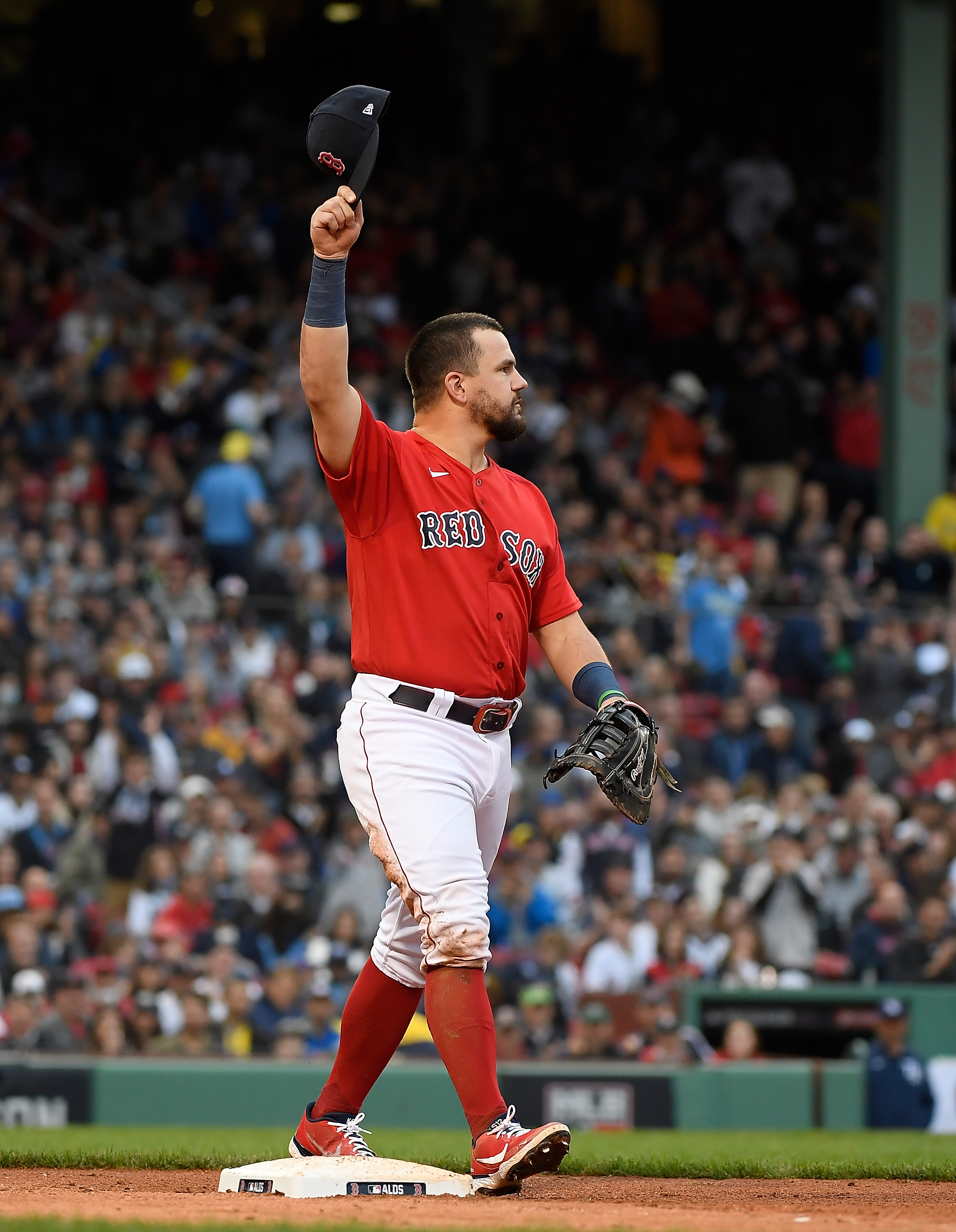
It was a season to remember for the 28-year-old Schwarber, who opened the year with a rather pedestrian two-month stretch in D.C. before embarking on one of the great hot streaks in the history of Major League Baseball. The former No. 4 overall draft pick carried a .218/.312/.404 batting line through his first 215 plate appearances in Washington, making the Cubs’ decision to non-tender him the prior winter look at least somewhat justified. From that point forth, however, Schwarber found another gear and delivered the best production of his career.
On June 12, Schwarber went 1-for-3 with a solo homer in the first game of a doubleheader. An inauspicious game in and of itself, that kicked off a prodigious stretch that saw Schwarber blast a near-unfathomable 16 home runs in a span of 18 games — a total of just 77 plate appearances. From June 12 through July 2, Schwarber posted a Herculean .338/.409/.974 batting line. It looked as though no pitcher could stop Schwarber at that point, but unfortunately for both him and the Nats, an injury could. A hamstring strain landed Schwarber on the injured list on July 3, and during his absence, a free-falling Nats club engineered a rare (for them) fire sale that saw an injured Schwarber traded to the Red Sox.
The Sox knew full well that Schwarber wouldn’t be ready for a bit at the time of his acquisition, but his activation on Aug. 13 was rather surprising. The Sox, facing some dire needs in the lineup, reinstated Schwarber from the injured list after a six-week layoff without even sending him out on a minor league rehab assignment. And yet, despite being dropped cold into the throes of the AL East, Schwarber immediately resumed his juggernaut status at the plate.
In 168 plate appearances down the stretch with the Sox, Schwarber mashed at a .291/.435/.522 clip with seven home runs and 10 doubles. The hot streak carried on into the postseason, where Schwarber opened with a 9-for-32 showing with three home runs — including an epic Game 3 ALCS grand slam. That proved to finally be the stopping point for Schwarber, however, as he was held hitless in his next 16 plate appearances as the Astros came back to topple the Sox and end their season.
Schwarber played in just 113 regular season games but nevertheless belted 32 home runs while slashing a stout .266/.374/.554 with a 13.6% walk rate and a 27.0% strikeout rate. He won’t win any awards for his glovework in the outfield, and his brief foray at first base wasn’t exactly smooth sailing. However, the the likely advent of the designated hitter in the National League and a mammoth showing at the plate, Schwarber should see a robust market for his services this winter.
Teams may still have some questions about Schwarber’s ability to handle lefties. He hit .268/.389/.398 against them in 2021, albeit with a .377 average on balls in play and in only 149 plate appearances. In 435 prior plate appearances against southpaws, from 2015-20, Schwarber managed only a .197/.301/.348 output. He did cut his strikeout rate and improve his walk rate against southpaws in 2021, however, so the gains weren’t solely BABIP-driven. The extent to which he can sustain (or build upon) those improvements against lefties will be pivotal to Schwarber’s market, but regardless, he’s positioned himself as one of the top bats of the offseason.
MLBTR Poll: Will J.D. Martinez Opt Out?
With all but two teams eliminated and the offseason proper fast approaching, focus across much of baseball has shifted to 2022, particularly given an unusually strong free agent class and an uncertain (and volatile) labor situation. As previously noted by MLBTR’s Mark Polishuk, this means the resurfacing of what’s become an annual question: will J.D. Martinez exercise the opt-out clause in his contract with the Red Sox?
This will be Martinez’s third and final opportunity to opt out of the front-loaded five-year/$110MM deal he signed with Boston following the 2017 season. That call was probably never on the table last year, thanks to a less-than-stellar showing (.680 OPS, more than 200 points below his career average) in the pandemic-shortened 2020 season. It was a live possibility after 2019, though, when he put together a .304/.383/.557 line on the heels of a monster .330/.402/.629 mark in 2018. He has one year and $19.375MM left on his deal and is essentially a lock to receive a qualifying offer (set for $18.4MM) should he choose to test the market.
Following a bounceback 2021 (.286/.349/.518 in 634 plate appearances) that saw Martinez return to roughly his career averages, the opt-out is again a real option, though it does not come without potential downside. Martinez told WEEI’s Rob Bradford in late September that he’s “right in the middle” on the decision. While it’s entirely possible that his public statements are mere posturing, there are good reasons for Martinez to waffle on a decision that would require him to leave significant guaranteed money on the table without a clear picture of what the market or labor situation are likely to look like. The rumor mill is split on the issue, with Ken Rosenthal suggesting (on the Athletic Baseball Show) that he expects Martinez to exercise the clause while Peter Abraham of the Boston Globe is less convinced, particularly given the uncertain state of the universal DH.
On one hand, the 34-year-old Martinez has an enviable track-record (his .881 career OPS ranks 10th among active players) and proved in 2021 that his bat still has enough pop to make any lineup stronger. Indeed, Martinez’s would-be walk year showed few significant signs of decline; he maintained a K% and BB% (23.7% and 8.7%) roughly in line with both his career marks and MLB averages and a hard-hit rate (defined as the percentage of balls in play with an exit velocity of 95 mph or higher) of 49.4% that falls only just below his career mark of 50.8% and well above the MLB average of 38.7%. He also stayed mostly healthy, playing in 148 regular-season and nine postseason games for the Red Sox, though a late-season ankle sprain did keep him out of Boston’s AL Wild Card matchup with the Yankees.
On the other, Martinez’s defensive limitations don’t necessarily limit him to DH-only status but do make it unlikely any team would bank on playing him in the outfield on more than an occasional basis. While he was solid in limited defensive action in 2021 (2 defensive runs saved in 36 games), his career numbers tell a different story (-38 DRS, though 35 of these came in right field), and he hasn’t seen action in the outfield more than 60 times in a season since a poor showing (-18 DRS) across 118 games in right for Detroit in 2016. The probable introduction of the DH to the National League in the new CBA likely expands his market but does little to extend his on-field value.
With significant but mostly one-dimensional production, Martinez’s decision isn’t the easiest. Arguably a top-20 free agent in a strong class, Martinez is likely to receive some multi-year offers, but it’s unlikely many GMs will be eager to give a player with limited defensive value and nearing the back half of his 30s anything remotely approaching the deal he signed with the Red Sox — particularly as it will also cost them a draft pick. Another front-loaded deal is a real possibility, but teams will likely ask Martinez to take a cut in AAV for any significant length.
Accordingly, the question likely comes down to which Martinez values more: his short-term salary or a longer-term guarantee. Will Martinez bet on himself to put up another strong year and hit the market next offseason in a similar situation, or will he try to cash in on his strong 2021 and seek a longer deal?
Will J.D. Martinez Opt Out?
-
No 62% (7,042)
-
Yes 38% (4,281)
Total votes: 11,323
(Link to poll for Trade Rumors app users)
Latest On Mets’ Front Office Search
NOVEMBER 1: The Red Sox are expected to grant Ferreira permission to interview with the Mets, assuming she’s interested in doing so, reports Jon Heyman of the MLB Network (on Twitter).
OCTOBER 30, 1:23PM: Brewers VP of baseball operations Matt Kleine is another candidate the Mets have discussed, as per Martino (Twitter link). With both Kleine and Rodriguez, however, the Mets are wary about approaching the Brewers and Rays since both teams have repeatedly denied New York’s requests to interview other front office personnel in the past. Kleine is believed to be interested, and his hiring could help set the stage for the Mets to land Stearns as a free agent a year from now (or after the 2023 season, depending on the reported vesting option in Stearns’ deal with Milwaukee).
OCTOBER 30, 8:05AM: The Mets’ attempts to hire a new president of baseball operations or general manager has hit its share of roadblocks, and Dodgers assistant GM Jeff Kingston is the latest executive to decline an interview with the team, according to The New York Post’s Mike Puma. However, several other prospective candidates remain, as it seems as though the Mets now could be specifically looking for a general manager, rather than someone to fully take the entire reigns of the baseball ops department.
To this end, Puma writes Rays VP of player development Carlos Rodriguez, and assistant GMs Daniel Adler (Twins), Randy Flores (Cardinals), and Ben Sestanovich (Braves) are all “on the Mets’ radar” as possible candidates. The Mets have also asked the Red Sox for permission to speak with assistant GM Raquel Ferreira, SNY’s Andy Martino reports.
Any of these five executives would be a first-time GM, and ostensibly in charge of the baseball operations department even without the official “president” label. The unusual nature of the Mets’ front office dynamic has led to some questions about how much authority a new GM would have, as team president Sandy Alderson is remaining with the club and has said he’ll be shifting over to focusing on the team’s business matters once a new baseball ops head is in place.
Had Mets owner Steve Cohen been successful in luring one of his big-ticket initial targets (i.e. Billy Beane, Theo Epstein, David Stearns) to New York, it would’ve made for a smoother transition, as any of those execs would’ve been the PBO and had the sway to make their own choice for a general manager to act as their chief lieutenant. However, it is perhaps understandable why Kingston and others have opted out of what could be considered as something of a glorified one-year trial period. If the Mets play well in 2022, a newly-hired GM could be entrusted to become the president of baseball operations; if the Mets struggle, Cohen could resume his search for a major name as PBO, leaving the general manager as perhaps something of a lame duck.
Cardinals GM Michael Girsch, Giants GM Scott Harris, newly-promoted Brewers GM Matt Arnold, and another Dodgers assistant in Brandon Gomes have all declined to be considered for the Mets’ job. For the five names mentioned by Puma and Martino, it is possible any of the Rays, Twins, Cardinals, Braves, or Red Sox could deny New York permission to interview their personnel, though teams usually don’t stand in the way of their executives being offered a promotion.
Kingston technically has experience as a general manager, as he served as the Mariners’ interim GM for the last month-plus of the 2015 season after Jack Zduriencik was fired. Kingston has worked as an assistant GM for the last six seasons (three with the Mariners, three with the Dodgers) and he has been considered for other front office openings in recent years. The Phillies and Angels each had interest in Kingston for their most recent GM vacancies, and Kingston was a finalist for the Angels’ position before the team hired Perry Minasian.