
Astros To Interview John Gibbons
The Astros have lined up their first reported interview as they search for a new manager. They’ll meet with veteran skipper John Gibbons on Thursday, according to Mark Berman of Fox 26.
The Texas-raised Gibbons is one of many experienced possibilities to reportedly land on the Astros’ radar early in their quest to replace A.J. Hinch. Gibbons has nearly 1,600 games on his resume, all of which have come with the Blue Jays. The 57-year-old had two separate stints as Toronto’s manager (one from 2004-08, the next from 2013-18), combining for 11 years, a 793-789 regular-season record and a pair of playoff berths. The Blue Jays advanced to the ALCS in each of those two seasons.
After the Blue Jays parted with him, Gibbons spent last season out of coaching. Gibbons made it known back in the fall that he was hoping to get back into managing, but he didn’t receive any reported interviews before now.
Latest On Astros’ Managerial Opening
After firing suspended manager A.J. Hinch on Monday, the Astros suddenly find themselves in the unenviable position of trying to find a new skipper just weeks before the start of spring training. But there’s no shortage of candidates to replace Hinch, according to Mark Berman of Fox 26.
The Astros have an in-house option in bench coach Joe Espada, but they otherwise appear to be looking outside the organization. Veteran managers Dusty Baker, Buck Showalter, Bruce Bochy and Jeff Banister are on the team’s list of candidates. So are Raul Ibanez and Will Venable, who – like Espada – carry no managerial experience at the MLB level.
Baker, Showalter and Bochy are three of the most accomplished managers of the past couple decades. It’s already known Baker, who last managed in 2017, has interest in the position. Baker and Showalter were serious contenders for the Phillies’ managerial job before they hired Joe Girardi in the fall. Bochy, meanwhile, doesn’t seem likely to take the helm in Houston or anywhere else this year. The soon-to-be 65-year-old told Bob Nightengale of USA Today that he’s hitting “pause” after managing in every season from 1995-2019.
Banister, 56, has prior managerial experience in Texas. He led the Rangers for four years, but they parted with him after the 2018 campaign, and he spent last season in Pittsburgh’s front office. Ibanez has been working in the Dodgers’ front office – a role he seems content to keep. As of October, Ibanez wasn’t interested in interviewing for managerial posts, but perhaps the Astros will be able to change his mind. Venable, the Cubs’ third base coach, did meet with Chicago as well as the Giants regarding their managerial openings before those teams went in other directions earlier this offseason.
Along with trying to find a new manager, the Astros and owner Jim Crane will have to land a GM to succeed the ousted Jeff Luhnow. They hope to reel in Hinch’s successor by Feb. 1, per Berman, and Brian McTaggart of MLB.com writes that they’re likely to fill that position before tabbing Luhnow’s replacement.
Yordan Alvarez Changes Representation
Astros designated hitter/outfielder Yordan Alvarez has changed agencies and is now a client of MVP Sports Group, Tim Brown of Yahoo Sports tweets.
Alvarez just debuted last season, which went down as an AL Rookie of the Year-winning campaign, so he’s not eligible to reach arbitration or free agency in the near future. As such, Houston – which, thanks to its sign-stealing scandal from 2017, has far bigger fish to fry at the moment – doesn’t have to worry about losing Alvarez any time soon. However, barring an extension, Alvarez figures to consider making a case for rich arbitration paydays over the next couple years.
Although his career’s only 87 games old, Alvarez already looks like one of the premier hitters in baseball. The 22-year-old stepped to the plate 369 times in 2019 and batted a video game-like .313/.412/.655 with 27 home runs. Among those who amassed at least 350 PA, just one hitter – the venerable Mike Trout – outdid Alvarez’s 178 wRC+.
Alvarez’s change in representation will be reflected in MLBTR’s Agency Database, which contains agent info on thousands of Major League and Minor League players. If you see any errors or omissions within, please let us know: mlbtrdatabase@gmail.com.
Quick Hits: Astros, Baker, Bochy, Phils, Herrera, Ventura, Hudson
The Astros, suddenly in need of a new manager after the suspension and firing of A.J. Hinch on Monday, “plan to open an outside search to find his replacement,” Bob Nightengale of USA Today writes. Nightengale names longtime manager Dusty Baker as someone with interest in the job, but it’s unclear whether the team will want to talk to him about the position. Although fellow veteran skipper Bruce Bochy has been mentioned in speculation, it appears he’s serious about taking time away from the game in the wake of his long run with the Giants. Bochy told Nightengale he’s hitting the “pause button.”
- The Phillies designated center fielder Odubel Herrera for assignment Tuesday, which could pave the way for his release. However, the likelihood is that Herrera will still be a member of the organization when spring training rolls around, according to Matt Breen of the Philadelphia Inquirer. It’s unlikely anyone will take Herrera in a trade, the Phils don’t seem keen on releasing him and eating the $19.5MM left on his contract, and it’s improbable he’d reject an outright assignment and leave that money on the table. So, while Herrera’s no longer on the Phillies’ 40-man roster, it doesn’t appear his time with the organization is up just yet.
- Former major league third baseman and ex-White Sox manager Robin Ventura has resurfaced at Oklahoma State as a student assistant, per Kendall Rogers of D1baseball.com. The Cowboys’ staff now boasts him and fellow former big leaguer Matt Holliday, whose brother, Josh Holliday, manages the team. The 52-year-old Ventura hasn’t coached in the majors since the White Sox let him go after the 2016 season. Ventura’s name came up when the Mets were seeking a manager in 2017, but he reportedly didn’t have interest in the position.
- In more ex-MLBer/college baseball news, longtime right-hander Tim Hudson is joining Auburn as a pitching/volunteer assistant coach, Teddy Cahill of Baseball America reports. Prior to enjoying an excellent MLB career, Hudson starred at Auburn. In Hudson’s return to his old stomping grounds, Cahill notes that the 44-year-old will work with potential first-round righty Tanner Burns – who has drawn comparisons to Hudson.
News & Notes On Astros Punishment
If you missed it yesterday, the Astros sign-stealing scandal reached a breaking point. The organization was fined $5MM and lost its top two draft choices in each of the next two drafts. The club canned GM Jeff Luhnow and skipper A.J. Hinch after each received one-year league suspensions. Individual players were not punished. Former bench coach and current Red Sox manager Alex Cora awaits his fate.
We ran some polls on the punishment. You can add your opinion there. But don’t expect to hear from other organizations at this time. We also covered an apparent leaguewide gag order on the controversy that emerged last night through a curious club announcement from the Dodgers.
Let’s run through some other notes and reactions …
- Baseball America’s J.J. Cooper explains how the draft situation will be resolved. Rather than simply striking the Astros’ picks from existence, and reducing the overall spending pool by a significant figure, MLB will bump every other team up a peg in the slotting system. That’ll result in only a relatively meager reduction in the total draft spending outlay that incoming professionals can receive. Jonathan Mayo of MLB.com looks at the lost prospect value for the Astros. It’s reasonably significant, though it’s important to highlight the fact that the Houston club was already locked into a low choice for the coming season and seems highly likely (barring a change in organizational direction) to select down the line again in 2021. While there’s no questioning the impact to the overall slate of talent that the team will be able to pull from these two drafts, it’s not likely that the ‘Stros will end up missing out on down-the-line superstars.
- There’s still a lack of clarity regarding the near-term leadership of the Houston baseball ops department and dugout. In the front office, Crane says he’ll run things for the time being (via MLB.com’s Mark Feinsand; Twitter links). He also noted that he still employs someone who was brought in previously for GM interviews by other organizations — clearly, a reference to assistant GM Pete Putila. It stands to reason that Putila will be leaned upon heavily in the near-term, though the long-term plan remains to be seen. Feinsand further tweets that bench coach Joe Espada is “expected” to take over for Hinch. It’s fair to wonder whether these approaches are really set in stone. Crane said he was looking for a blank slate and said the team’s internal assessments were still ongoing. Perhaps there’s a path for Putila and/or Espada to take on expanded roles, but that’ll surely depend in no small part upon whether either ends up being implicated in whole or part in the scandal. And Crane will need to consider whether an immediate outside hire or two would be wise — a tough move at this late juncture of the offseason.
- ESPN.com’s Jeff Passan examines the (still muted) reaction from around the game. It seems that other teams aren’t overly impressed by the seriousness of the sanctions, which were announced by Manfred in a conference call in which he also made clear that there was to be no public whining. But anonymous complaints are perhaps only beginning. Passan reports that those in other organizations feel the Astros — and Crane in particular — were able to orchestrate things to perfection. As we noted yesterday in our above-linked poll, Manfred cabined responsibility to the Astros’ baseball operations while specifically absolving Crane (and the team’s business side as well). And Crane got to put on a public show of shock and contrition, filling the airwaves with his emotional response and the drama of a live, public firing announcement.
- That report mirrors the earlier trickles of reactions that we have seen. An unnamed top executive that spoke with ESPN.com’s T.J. Quinn (Twitter link) explained why even the seemingly harsh sanctions weren’t really adequate. The impact on game and season/postseason outcomes is impossible to isolate but unquestionably significant. Quite a few opposing players surely missed out on earning opportunities, whether through missing postseason proceeds, dents to their statistical track record, and/or lost MLB opportunities. The same is true of rival organizations, though it seems in at least some cases they may also have misused technology — albeit not, so far as has been alleged, in anything like the manner the Astros did. None of that can be unwound, but it’s important perspective.
- Additional top baseball decisionmakers spoke to that same point with Ken Rosenthal of The Athletic (subscription link). The damage is widespread. So is the blame, Rosenthal opines. While we’ll all have our preferred villains and heroes in the scandal, perhaps none but a few brave whistleblowers deserve anything approaching plaudits. If Luhnow’s punishment reflected the culture he created within the Houston organization, as much as anything, then perhaps Manfred carries an analogous responsibility for the sport’s overall spiral in this arena. Rosenthal says “this is Manfred’s sport,” hinting at a lack of foresight in rolling out replay streams and facilitating the rise of a generation of “general managers emboldened by analytics, all trying to outsmart one another.”
MLBTR Poll: The Astros Scandal
It’s a rather ugly day for baseball, even if we saw it coming. The Astros’ video-aided sign-stealing effort had already been laid bare by video evidence. But all the underlying facts weren’t known. And it was far from clear how commissioner Rob Manfred would handle the punishment.
As it turns out, the Houston organization was hit with a $5MM fine (the maximum permissible) and the loss of four top draft choices. General manager Jeff Luhnow and manager A.J. Hinch were each suspended for a year. The team subsequently fired both men. Then-bench coach and current Red Sox manager Alex Cora also seems likely to be punished, though his precise comeuppance has yet to be determined pending an investigation into the Boston organization.
For full details on the team punishments, click here. In brief: Manfred found that a 2017 scheme to convey signs to batters in real-time “was, with the exception of Cora, player-driven and player-executed.” An ensuing effort “to decode signs using the center field camera was originated and executed by lower-level baseball operations employees working in conjunction with Astros players and Cora.” Punishing players was deemed “impractical given the large number of players involved, and the fact that many of those players now play for other Clubs.” That wasn’t the only reasoning, though. More relevant, Manfred said, was the fact that GMs and managers are made “responsible for ensuring that the players both understand the rules and adhere to them.”
So, our first poll question: was the assessment of a fine and taking of four top draft choices an appropriate punishment for the organization? Some around the game weren’t satisfied, but how do you see it? (Poll link for app users; response order randomized.)
Did Manfred Issue The Right Punishment To Astros?
-
Too light 49% (13,289)
-
On the mark 43% (11,711)
-
Too heavy 9% (2,390)
Total votes: 27,390
While he declined to pursue players — beyond the factors he noted, there’d have been major labor-relations implications and complications under the CBA — Manfred did still find that individual punishment was warranted for those in a position of added responsibility. Specifically, Luhnow and Hinch received personal punishment. (Cora, an active participant, presumably will as well.) Manfred did not find any reason to discipline or chastise Crane personally. To the contrary, he specifically cleared the owner of culpability. Evidently, the oversight responsibility concepts that undergirded the punishment of Hinch and (especially) Luhnow did not extend past the baseball operations department.
Whether there was any coordination or exchange of information between the league and the Astros regarding the firing of those two leaders is not known. But the team’s subsequent action certainly added quite some heft to the total blow that landed. For full details on the firings, click here.
Luhnow disclaimed any knowledge of the schemes, though the report indicates he likely had some level of awareness of the team’s 2018 efforts. His statement cited the report’s reference to lower-level employee and player responsibility, though he also acknowledged and accepted his own failure of oversight. Luhnow was punished because he “failed to take any adequate steps to ensure that his Club was in compliance with the rules.” Manfred also blasted the culture that Luhnow created in the baseball operations department, a characterization that Crane disputed.
Ultimately, Luhnow was suspended for one year and dismissed from his position. Fair? (Poll link for app users; response order randomized.)
Did Luhnow Get What He Deserved?
-
On the mark 54% (10,430)
-
Too light 33% (6,294)
-
Too heavy 13% (2,466)
Total votes: 19,190
As for Hinch, the circumstances were somewhat different. He was unquestionably aware that the sign-stealing efforts were ongoing and acknowledged as much in his statement. While he is said to have disagreed and at times even attempted to interfere with the stratagem, Hinch obviously did not utilize his authority or avail himself of the available means of halting the effort. In his statement after today’s outcome, he apologized for that failure.
Like the GM, Hinch received a one-year ban and ended up canned. Was this a just outcome? (Poll link for app users; response order randomized.)
Did Hinch Get What He Deserved?
-
On the mark 48% (9,744)
-
Too light 38% (7,733)
-
Too heavy 13% (2,718)
Total votes: 20,195
Astros Fire Jeff Luhnow, A.J. Hinch
In the wake of severe MLB discipline arising out of the Astros sign-stealing scandal, team owner Jim Crane announced that he has fired both GM Jeff Luhnow and manager A.J. Hinch. It’s a stunning end to a notable tenure in Houston for both men.
The Astros organization has been a lightning rod ever since Luhnow took over in December of 2011. But the swings in fortunes have reached dizzying levels in recent months. The club bungled a self-created controversy even as it prepared for the World Series, then lost consecutive home games in spectacular fashion, thus failing to win a second title in a three-year span.
It turned out that was only the beginning. It started out as a normal-enough offseason — some change was afoot with top starter Gerrit Cole reaching free agency and Crane suggesting the team might tighten up payroll. But things took a calamitous turn when allegations emerged in mid-November that the Houston organization had improperly utilized technology to ascertain opposing teams’ signs and then convey them in real-time to Astros hitters during the 2017 and 2018 seasons.
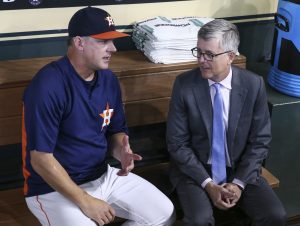
The resulting league investigation unfolded even as public evidence emerged to fully confirm the claims. It became undeniably clear that the Astros had acted in a manner that fell well outside the traditional sign-stealing culture of the game and clearly broke the rules. Commissioner Rob Manfred had made clear previously that he’d come down hard on any teams that misused technology.
While a big punishment had been anticipated, this nevertheless rates as a momentous decision for the organization as well as for the game generally. The fallout will be immense and can’t be fully known at the moment.
From the Astros’ perspective, the firing unquestionably taints the team’s successes in recent years — even if Crane declined to acknowledge that fact in his press conference. And it raises huge questions about the future. It takes out the club’s baseball architect in Luhnow, even as his top understudies have already departed the organization. (Brandon Taubman was fired. Previously, David Stearns and Mike Elias left for GM jobs elsewhere.) There had already been some degree of uncertainty regarding the team’s precise direction this offseason and beyond. Now, the club’s top leaders are gone and more could still follow. Crane said he was still assessing the culpability of other personnel and deciding how to fill the void for the departing leaders. He’ll personally oversee baseball ops for the time being. Whether there’ll be an impact to the roster isn’t yet known.
Across the league, there’ll surely be a strong desire to avoid a similar fate. Available information and scrutiny — both publicly and within the game — are obviously reaching new heights. Manfred’s statement made clear that, despite the lack of a smoking gun linking Luhnow to the cheating effort, he and Hinch were being punished for overseeing a baseball operations department and uniformed staff that pursued it. As Crane told reporters today, it was obvious that both men were aware of and did not intervene to stop the sign-stealing. The onus will now be on other top organizational leaders to halt any untoward behavior, at risk of severe consequences.
Beyond that, any changes to the course of the Houston organization will obviously impact the broader player market and their competitors in the American League West. The organization’s philosophical approach and its near-term decisionmaking could well undergo change.
Baseball has long grappled with the cutthroat approach to roster building that Luhnow brought to the Astros. As an analytically focused executive who launched a full-blown tear-down/rebuild, that was somewhat inevitable. But the organization went to extremes to build what has been characterized as “an unprecedented player-development machine” — albeit one that also created “human costs.” The win-at-all-costs vibes left many feeling uneasy well before news emerged of actual rules violations.
Luhnow insists that he did not direct any cheating and wasn’t even aware it was occurring, as Jared Diamond of the Wall Street Journal reports (Twitter link). But the league investigation did find that Luhnow failed to take adequate action to ensure compliance with league rules — and that he had at least some amount of knowledge regarding the sign-stealing operation. Despite disavowing any intent to break the rules, Luhnow did state that he accepts responsibility for what went on during his stewardship of the organization’s baseball operations.
Luhnow’s baseball operations department carried an image akin to the unfeeling Soviet boxing-industrial complex portrayed in the Rocky series. But Hinch was no Ivan Drago. He and some of the team’s biggest stars put a much more personable face on the organization. He was by all appearances not only a high-quality skipper and tactician, but also a genuinely thoughtful and caring figure.
But that reputation, even if largely accurate, did not absolve Hinch of responsibility. Manfred’s report on the investigation’s findings makes clear that the manager knew what was going on. He’s said to have had some misgivings about the actions but obviously failed to act firmly to halt the operation, either by issuing clear orders to those theoretically under his command or by raising the matter to higher authorities. Hinch acknowledged as much in his own statement on the matter (via Chandler Rome of the Houston Chronicle, on Twitter). Though he says he did not “endorse or participate in the sign stealing practices,” he acknowledges that he “failed to stop them.”
It’s a major shift for a Houston organization that had seemingly arrived at a winning formula. With Luhnow masterminding the talent flow and Hinch maximizing the pieces made available to him, the organization built a powerhouse that won the 2017 World Series, came up just shy in another, and reeled off three-straight 100-win regular seasons. Much was achieved and it seemed likely there was more success yet to come. Quite a lot of creative thinking and hard work went into the undertaking. But the wins will be remembered with an asterisk — in collective memory, if not in the actual record books — and the Astros will now embark upon a new era under new leadership.
Photo courtesy of USA Today Sports Images.
MLB To Suspend Jeff Luhnow, A.J. Hinch For One Year; Astros Stripped Of Draft Picks
Major League Baseball commissioner Rob Manfred announced an unprecedented level of discipline against the Astros organization Monday in the wake of the sign-stealing scandal that many feel has called into question the legitimacy of their 2017 World Series victory. President of baseball operations/general manager Jeff Luhnow and manager A.J. Hinch will both be suspended, without pay, for one year — beginning today and running through Jan. 13, 2021.
[RELATED: Astros Fire Jeff Luhnow, A.J. Hinch]
The Astros will also lose their first- and second-round picks in each of the next two seasons and be fined the maximum $5MM that is allowable under the league’s constitution. If the team does not have a first- or second-round selection in either draft — due to draft forfeitures for signing a free agent, for instance — they’ll lose that pick in the subsequent year’s draft. Per Manfred’s report on the investigation, the Astros “will forfeit two regular first round selections and two regular second round selections in total,” whether they come in 2020-21 or in later seasons.
Punishment stemming from the 2017 sign-stealing scandal won’t stop with the Astros organization, either. ESPN’s Jeff Passan reports that “harsh” punishment will be levied against Red Sox manager Alex Cora as well for the role he played in the now-infamous “trash can” setup. Cora was the Astros’ bench coach at the time but was hired by the Red Sox in the 2017-18 offseason, and Manfred’s report leaves little doubt that he’ll be sanctioned heavily.
Manfred’s report outlines the role that Luhnow, Hinch, Cora and the Astros’ players had not only in the trash-can scheme but also in improperly utilizing the reply review room to decode opponents’ signs. Manfred’s report also explains the rationale for the punishment (or, in Cora’s case, the surely forthcoming punishment).
Beginning with Luhnow, Manfred details that the president/GM was “adamant” in denying knowledge of the ongoing sign-stealing scheme. However, the report cites “both documentary and testimonial evidence” which indicates that Luhnow had “some” knowledge of the operation but “did not give it much attention.” Manfred makes clear that he holds Luhnow accountable for the action of all employees, both in the front office and in the dugout, and he goes out of his way to explain that Luhnow largely neglected the memo sent out by the Commissioner’s Office regarding further disciplinary measures for improper use of technology:
Luhnow did not forward the memoranda and did not confirm that the players and field staff were in compliance with MLB rules and the memoranda. Had Luhnow taken those steps in September 2017, it is clear to me that the Astros would have ceased both sign-stealing schemes at that time.
Manfred’s report goes on to suggest that under Luhnow, the Astros’ baseball operations department has developed a “problematic” and “insular” culture that has lacked “sufficient oversight” — all of which is reflected in Luhnow’s punishment:
[W]hile no one can dispute that Luhnow’s baseball operations department is an industry leader in its analytics, it is very clear to me that the culture of the baseball operations department, manifesting itself in the way its employees are treated, its relations with other Clubs, and its relations with the media and external stakeholders, has been very problematic. At least in my view, the baseball operations department’s insular culture – one that valued and rewarded results over other considerations, combined with a staff of individuals who often lacked direction or sufficient oversight, led, at least in part,to the Brandon Taubman incident, the Club’s admittedly inappropriate and inaccurate response to that incident, and finally, to an environment that allowed the conduct described in this report to have occurred.
As far as Hinch is concerned, Manfred indicates in his report that the manager was aware but not supportive of the trash-can system. That system, it seems, was largely put into place by Cora and newly hired Mets skipper Carlos Beltran. Hinch, according to the league’s investigation, actually expressed frustration with the operation and damaged the hallway monitor to the point of needing replacement on two occasions, but he also never brought the issue to the attention of Luhnow or anyone in the Commissioner’s Office. “As the person with responsibility for managing his players and coaches, there simply is no justification for Hinch’s failure to act,” the report reads.
Furthermore, the report leaves little doubt that harsh punishment indeed is nigh for Cora. Manfred indicates that it was Cora who “arranged for a video room technician to install a monitor displaying the center field camera feed immediately outside of the Astros’ dugout.” Says Manfred of the impending discipline for Cora:
Cora was involved in developing both the banging scheme and utilizing the replay review room to decode and transmit signs. Cora participated in both schemes, and through his active participation, implicitly condoned the players’conduct. I will withhold determining the appropriate level of discipline for Cora until after the DOI completes its investigation of the allegations that the Red Sox engaged in impermissible electronic sign stealing in 2018 while Cora was the manager.
As for the players themselves, the Commissioner’s Office will not be seeking out punishment against them. That seemingly includes Beltran, who is being treated as a player (as he was in ’17) rather than his newfound role as a Major League manager. Manfred explains that in 2017, he made the decision that he “would hold a Club’s General Manager and Field Manager accountable for misconduct of this kind” and has no plans to deviate from that line of thinking. He’s also clear to note that multiple players acknowledged they were keenly aware that they were crossing a line and would have stopped had Hinch or another authority figure cracked down on the behavior — a reality that surely factored into the decision to suspend Hinch.
As for owner Jim Crane, the report indicates that he was “unaware” of any wrongdoing and will not face punishment outside of the reported $5MM fine and loss of two years’ worth of first- and second-round draft selections.
Ken Rosenthal and Evan Drellich of The Athletic first reported the news.
2020 Arbitration Filing Numbers
MLBTR’s Arbitration Tracker is the place to go to see the arbitration contracts agreed upon thus far, as well as the figures exchanged between teams and players that were not able to reach agreement before today’s deadline to swap salary positions. Matt Swartz’s arbitration projections are available here.
After a busy day of dealmaking, 161 players (at last check) have reached agreement on arbitration salaries for the coming season. But 29 other tendered players have yet to reach reported agreements with their clubs. Of course, those players can still settle before their hearings (which will take place in early to mid-February). If the case goes to a hearing, the arbitrator must choose one side’s figures, rather than settling on a midpoint. It’s hardly an unusual number of unresolved cases at this stage, but there are quite a few high-dollar situations still at issue and teams have increasingly adopted a “file-and-trial” approach to the process in recent years. (That is, no negotiations on single-season salaries after the deadline to exchange figures.)
We’ve gathered the highest-stakes arbitration situations remaining in this post, but you can find them all in the tracker. We’ll update this list as the figures are reported:
- George Springer, Astros: $22.5MM versus $17.5MM (Jeff Passan of ESPN.com, via Twitter)
- J.T. Realmuto, Phillies: $12.4MM versus $10MM (Jim Salisbury of NBC Sports Philly, via Twitter)
- Trevor Story, Rockies: $11.5MM versus $10.75MM (Jon Heyman of MLB Network, via Twitter)
- Joc Pederson, Dodgers: $9.5MM versus $7.75MM (Jon Heyman of MLB Network, via Twitter)
- Eduardo Rodriguez, Red Sox: $8.975MM versus $8.3MM (Jon Heyman of MLB Network, via Twitter)
- Nick Ahmed, Diamondbacks: $6.95MM versus $6.6MM (Mark Feinsand of MLB.com, via Twitter)
- Shane Greene, Braves: $6.75MM versus $6.25MM (Jon Heyman of MLB Network, via Twitter)
- Josh Hader, Brewers: $6.4MM versus $4.1MM (Jon Heyman of MLB Network, via Twitter)
- Chris Taylor, Dodgers: $5.8MM versus $5.25MM (Jon Heyman of MLB Network, via Twitter)
- Hector Neris, Phillies: $5.2MM versus $4.25MM (Jon Heyman of MLB Network, via Twitter)
- Max Muncy, Dodgers: $4.675MM versus $4MM (Mike DiGiovanna of the Los Angeles Times, via Twitter)
- Jose Berrios, Twins: $4.4MM versus $4.025MM (Jon Heyman of MLB Network, via Twitter)
- Andrew Benintendi, Red Sox: $4.15MM versus $3.4MM (Jon Heyman of MLB Network, via Twitter)
- Archie Bradley, Diamondbacks: $4.1MM versus $3.625MM (Jon Heyman of MLB Network, via Twitter)
- Pedro Baez, Dodgers: $4.0MM versus $3.5MM (Jon Heyman of MLB Network, via Twitter)
Players Avoiding Arbitration: American League
Entering the day, there were more than 150 players on the clock to exchange arbitration figures with their respective teams prior to a noon ET deadline. As one would expect, there’ll be an utter landslide of arbitration agreements in advance of that deadline. We already ran through some key facts and reminders on the arbitration process earlier this morning for those who are unfamiliar or simply need a refresher on one of MLB’s most complex idiosyncrasies, which will hopefully clear up many questions readers might have.
We’ll track the majority of the American League’s settlements in this post and split off a separate one for NL settlements as well. Note that all projections referenced come courtesy of MLBTR contributor Matt Swartz:
- Newly acquired Angels righty Dylan Bundy receives a $5MM salary, per Jon Heyman of MLB Network (Twitter links). He had projected at a $5.7MM price tag. Teammate Hansel Robles gets $3.85MM, per Heyman, just shy of his $4MM projection.
- The Yankees have worked out deals with all of their eligible players. The team has a hefty $8.5MM pact with Aaron Judge, per MLB.com’s Mark Feinsand (via Twitter). Backstop Gary Sanchez settled for $5MM, per Feinsand (via Twitter). The New York org will pay righty Luis Cessa $895K and Jonathan Holder $750K, Murray reports (Twitter links). Fellow reliever Tommy Kahnle will earn $2.65MM, per Jon Heyman of MLB Network (via Twitter). And star lefty James Paxton has settled at $12.5MM, Heyman adds via Twitter. Chad Green and Jordan Montgomery have also agreed to terms, the former at $1.275MM and the latter at $805K, per Heyman (Twitter links).
- The Twins announced that they struck deals with Trevor May, Taylor Rogers, Eddie Rosario and Byron Buxton. Jon Heyman of MLB Network followed up with salary terms (all links to Twitter). May earns $2,205,000; Rogers takes home $4.45MM; Rosario lands at $7.75MM; and Buxton receives $3.075MM. While the first and last of those land rather close to the projected amount, Rogers got $550K more and Rosario got $1.15MM less than the calculators predicted.
- Shortstop Carlos Correa settled with the Astros for $8MM, per MLB.com’s Brian McTaggart (via Twitter). Righty Brad Peacock lands at a $3.9MM salary, per Chandler Rome of the Houston Chronicle (Twitter link). The former went for more than his $7.4MM projection, while the latter ended up shy of the $4.6MM mark produced by the computers. The ‘Stros also have agreed with closer Roberto Osuna as well, per an announcement. It’s a $10MM deal, slotting in just $200K shy of his projection, per Rome (via Twitter).
- The Orioles have a deal with outfielder/first baseman Trey Mancini, Roch Kubatko of MASNsports.com tweets. It’s for $4.75MM, per Dan Connolly of The Athletic (via Twitter), well south of the $5.7MM projection.
- Outfielder Jorge Soler has agreed to a $7.3MM deal with the Royals, MLB.com’s Jeffrey Flanagan tweets. That’s well off of the $11.2MM that MLBTR’s model projected, though it is likely that the cause of the gulf lies in the interpretation of the correct baseline to start from in building Soler’s salary. He’s in the 4+ service class but had been playing on the original deal he signed out of Cuba.
- The Tigers have a deal in place with southpaw Matthew Boyd, per Anthony Fenech of the Detroit Free Press (via Twitter). It’ll pay him $5.3MM, per Chris McCosky of the Detroit News (Twitter link). That falls comfortably below the $6.4MM, suggesting that Boyd’s camp was concerned with the way his suboptimal ERA would play in the arb process. Fellow lefty starter Daniel Norris will earn $2.96MM, McCosky tweets.
Earlier Settlements