
Braves, Cubs Swap Sean Newcomb, Jesse Chavez
The Cubs have acquired reliever Sean Newcomb from the Braves for right-hander Jesse Chavez and cash, according to announcements from both teams. Both clubs’ 40-man rosters are now full.
It’s a new landing spot for Newcomb, who has spent the past six seasons in Atlanta. A first-round pick of the Angels in 2014, the left-hander quickly developed into one of the sport’s top pitching prospects. After the 2015 season, the Angels flipped him alongside Chris Ellis to Atlanta for five years of Andrelton Simmons.
Newcomb was a starting pitching prospect at the time, with evaluators holding out hope that his high-octane arsenal could make him a top-of-the-rotation caliber hurler. He remained in that role for his first couple major league seasons, starting 49 of his 50 appearances between 2017-18. Newcomb showed some promise, posting a 4.06 ERA with a solid 23.3% strikeout rate. As he had throughout his time in the minor leagues, though, he struggled to throw strikes. After walking 12% of batters faced through his first couple seasons, the Braves transitioned him to the ‘pen in 2019.
During his first season of relief, Newcomb pitched to a 3.16 ERA in 68 1/3 frames over 55 outings. Curiously, his strikeout and swinging strike numbers took a step back relative to where they’d been while he was starting, but he induced grounders on nearly half of batted balls against him and posted a personal-low 9.9% walk rate.
It looked as if Newcomb might thrive in shorter stints, but the Braves made an ill-fated effort to return him to the rotation in 2020. He was bombed in four starts and spent most of the season at the alternate training site. He returned to the big league bullpen last season but dealt with his worst control woes yet. In 32 outings, Newcomb walked a ghastly 18% of opponents while seeing his ground-ball rate tumble back to 39%. His 28.7% strikeout percentage was a career-high, but the free passes allowed hitters to rack up a .383 on-base percentage.
Newcomb has gotten off to another rough start this season. He’s worked five innings of four-run ball, allowing seven hits with four walks and strikeouts apiece. Because he’s out of minor league option years, the Braves had to either continue running him out against MLB hitters or designate him for assignment. They chose the latter course of action yesterday, likely knowing someone else would take a chance on him.
That team will be the Cubs, who add a live-armed southpaw to their bullpen. Newcomb has averaged north of 95 MPH on his heater in each of the past two seasons. He generated plus swinging strike rates on both his cutter-slider and curveball last year. For a team that entered the night with Daniel Norris as its only lefty reliever, it’s understandable why Chicago will take a shot to see if they can iron out Newcomb’s control woes.
He’s making a modest $900K this season (a little more than $800K of which remains owed) and can be controlled via arbitration through 2025. There’s a chance Newcomb sticks around on the North Side for the next few seasons, but the Cubs — like the Braves before them — will have to keep him on the active roster or designate him for assignment themselves.
The Braves, meanwhile, will replace Newcomb in the bullpen with one of his old teammates. Chavez, a 15-year MLB veteran, spent the 2021 season with Atlanta after being selected onto the big league roster in June. He pitched to a sterling 2.14 ERA in 33 2/3 innings, striking out a career-high 27.1% of batters faced against a fine 8.3% walk rate. Chavez rather remarkably didn’t allow a single home run in his 30 appearances.
That impressive strikeout total came in spite of a 91 MPH fastball and a subpar 7.1% swinging strike rate, though. Between Chavez’s lack of velocity, swing-and-miss stuff and understandable skepticism about his ability to repeat his 2021 home run suppression, teams didn’t ardently pursue him in free agency. He signed a non-roster deal with Chicago, although he wound up breaking camp nonetheless.
Chavez made three appearances as a Cub, tossing 5 2/3 frames of three-run ball. He has punched out three batters with a pair of walks and a homer allowed. He’ll return to Atlanta and again serve as a multi-inning bullpen option for skipper Brian Snitker.
Jake Arrieta Announces Retirement
A former Cy Young winner is stepping away from the game. In an appearance on Barstool’s Pardon My Take podcast, Jake Arrieta announced he is set to retire (interview around 56:00 mark). “I haven’t signed the papers, man, but I’m done,” Arrieta said.”It’s time for me to step away from the game. At some point, the uniform goes to somebody else. It’s just my time, really. … Yeah, man, I’m done.”
Arrieta, now 36 years old, retires after a 12-season MLB career. A fifth-round pick of the Orioles out of TCU in 2007, he made it to the majors midway through the 2010 campaign. He spent three-plus seasons in Baltimore, never really clicking despite getting a few opportunities to crack the starting rotation. Arrieta made 69 appearances in black and orange, pitching to a cumulative 5.46 ERA/4.72 FIP. His strikeout and walk numbers improved later in his time with the O’s, but the results never lined up and Baltimore traded him to the Cubs in early July 2013.
That deal — which saw Arrieta and reliever Pedro Strop head to the North Siders for starter Scott Feldman and backup catcher Steve Clevenger — proved one of the most consequential trades in recent MLB history. Arrieta had decent results down the stretch with the Cubs, but his peripherals didn’t suggest he was on the verge of a breakout.
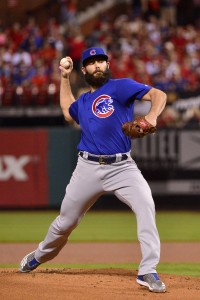
That’s exactly what transpired, though. By 2014, Arrieta had emerged as a top-of-the-rotation starter. He tossed 156 2/3 innings of 2.53 ERA ball, earning a ninth-place finish in NL Cy Young balloting. That was an unexpected age-28 breakout, but rather than showing any signs of regression, Arrieta took his game to another height the next season. In 2015, the right-hander tossed a personal-high 229 innings with an incredible 1.77 ERA. He led MLB with four complete games and three shutouts, allowing a league-low 5.9 hits per nine frames.
Arrieta had a very strong first half that year, posting a 2.66 ERA in 121 2/3 innings. Yet it’s the second half of that 2015 season for which he might best be remembered, as he orchestrated one of the most overpowering runs by any pitcher in MLB history. After that year’s All-Star break, Arrieta threw 107 1/3 frames and allowed just nine earned runs (0.75 ERA). Opposing hitters posted a laughable .148/.204/.205 line in just shy of 400 plate appearances during that stretch, as the Cubs won 97 games and earned a postseason berth.
During that year’s Wild Card game, Arrieta continued his run of absolute dominance, tossing an 11-strikeout shutout in that season’s Wild Card game against the Pirates. He wasn’t as excellent during starts in the NLDS or NLCS, but he had launched himself into the upper echelon of starting pitchers. Arrieta won that season’s Cy Young award, and he’d pick up a third consecutive top ten finish the following season.
In 2016, Arrieta worked to a 3.10 ERA in 197 1/3 frames. He again allowed a league-low 6.3 hits per nine, picking up his first All-Star selection in the process. Alongside Jon Lester and a career-best season from Kyle Hendricks, Arrieta played a key role in the Cubs team that snapped their 108-year title drought. Chicago won both of his starts during the seven-game triumph over the Indians, during which he tossed 11 1/3 innings of three-run ball.
Arrieta remained in Chicago for one more season. He never recaptured his otherworldly 2014-15 form, but he still offered mid-rotation production with a 3.53 ERA in 168 1/3 innings. That offseason, he signed a three-year, $75MM guarantee with the Phillies. Arrieta’s first season in Philadelphia was solid, as he allowed just fewer than four earned runs per nine in 31 starts.
The past three seasons proved a struggle, as Arrieta’s velocity had begun trending downwards from its mid-90s peak by 2017. He posted a 4.64 ERA or higher in each of his final trio of campaigns, including a 7.39 mark in 24 starts between the Cubs and Padres last season. Arrieta returned to the place where he’d had the most success last winter, but the Cubs released him in August. He struggled in four starts with the Friars, and San Diego let him go shortly before the regular season wrapped up.
Obviously, Arrieta’s career didn’t end the way he would’ve liked. Yet there’s no question he reached a height few players in the game’s recent history have hit. From 2014-16, only future Hall of Famer Clayton Kershaw bested Arrieta’s 2.42 ERA among qualified starters. He played a pivotal role on the most successful teams in the past century of Cubs baseball and leaves the game with a Cy Young and a World Series title. Over his 12-year run, he won 115 games, and struck out upwards of 1400 batters in 1612 1/3 innings.
Arrieta retires with a career 3.98 ERA, although that mark is inflated by the struggles he experienced at each end. For a three-to-four year period, he was among the top few pitchers on the planet. MLBTR congratulates him on his excellent run and wishes him the best in retirement.
Image courtesy of USA Today Sports.
Cubs Sign Luke Farrell
The Cubs have signed Luke Farrell, according to Chris Hilburn-Trenkle of Baseball America. This is Farrell’s second stint in Wrigleyville, as he previously pitched for the organization in 2018, tossing 31 1/3 innings at the big league level.
Farrell has seen action in each of the last five MLB seasons, amassing 87 2/3 career innings with five different clubs. Most recently, the righty pitched for the Twins in 2021, posting a 4.74 ERA, 22.1% strikeout rate, and 11.5% walk rate over 24 2/3 innings of work, as Farrell missed over two months recovering from a right oblique strain.
Problems with walks and home runs have kept Farrell from enjoying consistent success at the big league level, though he has shown flashes of impressive strikeout ability in both the majors and minors. Farrell has worked mostly as a starter in the minors but has only started five of his 63 career Major League contests.
Farrell joins a long list of experienced pitchers in Chicago’s farm system, as the Cubs have stocked up on seasoned hurlers to augment what had been a very young bullpen mix. He’ll provide some depth for a Cubs team that continues to add as many pitchers as possible to cover innings.
Quick Hits: Pitch Clocks, Mariners, Brash, Cubs, Baez
After one day of enforcing new pitch clock rules in the minor leagues, supporters of faster action and shorter games will be encouraged. Per J.J. Cooper of Baseball America, yesterday’s games were more than 25 minutes shorter on average. The pitch clock is set to 14 seconds with the bases empty and 18 seconds with men on base, but equally important is the fact that batters are expected to remain in the box. The experiment will last all season long, and enforcement is expected to be stricter this year than with smaller-scale experiments of past seasons. If yesterday’s sample is any indication, these changes could very well be on their way to the Majors. With all this extra time, let’s check in elsewhere around the game…
- When the Mariners traded for right-hander Matt Brash at the 2020 trade deadline, their interest was based on a 71-pitch sample from the 5 1/3 innings in High-A that, at that point, made up the entirety of Brash’s professional career. Because of the pandemic, he wasn’t pitching in the minor leagues where the Mariners (or Padres, for that matter) could gather more data. He was at home in Canada lifting weights, per The Athletic’s Corey Brock, who charts the path Brash took from Niagara University to the big leagues. Brash was a surprise addition to the Major League roster this season, making his theoretical breakout an inflection point that could impact the American League West. It’s too early to tell, but Brash is certainly worth keeping an eye on.
- Javier Baez and the Cubs were on the verge of an extension when the pandemic hit in 2020, per Gordon Wittenmyer of NBC Sports Chicago. Timing is everything, however. It was timing that allowed those young Cubs stars to converge for a 2016 title, and it was the timing of their free agencies that ultimately pushed Cubs leadership to ship them out.
Cubs Option Alfonso Rivas, DFA Cory Abbott, Greg Deichmann
The Cubs made a number of roster moves this afternoon, in part to make room for Mark Leiter Jr., whose addition to the roster was reported earlier. Leiter Jr. is starting today’s ballgame for the Cubbies. To make room on the active roster for Leiter Jr., first baseman Alfonso Rivas was optioned to Iowa. In other moves, Locke St. John was added to the 40-man roster and sent to Triple-A. Cory Abbott and Greg Deichmann were both designated for assignment to make room on the 40-man for St. John and Leiter Jr., respectively, per the Athletic’s Sahadev Sharma (via Twitter).
The Cubs are not long on starting pitching, hence Leiter Jr. getting the call so early in the year. They could have simply turned to Abbott, who made his big league debut last season in seven appearances (one start), but they instead chose to risk losing Abbott on waivers. The 2-year-old Abbott made 19 starts in Triple-A last year, putting up a 5.91 ERA over 96 innings.
Leiter Jr.’s opportunity in the Majors might not be long, however, as the Cubs could see some starters return from the injured list soon. Wade Miley three 15 pitches off the mound today, and Alec Mills, out with an injured back, is scheduled to throw a bullpen session later today, per MLB.com’s Jordan Bastian (via Twitter). Both players will make their season debut when they return.
Deichmann was one of two players acquired last season from the A’s in the Andrew Chafin deal. Even at the time, Deichmann was an older prospect, but there was at least some hope that in an emptied outfield, the southpaw swinger might see some run. Deichmann made just 30 plate appearances with the Cubs last season, however, mostly as a pinch-hitter.
Fangraphs placed the outfielder/first baseman as the 22nd-ranked prospect in the Cubs’ system coming into the season, so it’s a tad surprising to see the Cubs expose him to waivers. Furthermore, Fangraphs had Abbott, a former second round pick, as the 26th-ranked prospect in the Cubs’ system, so they’re exposing two somewhat interesting players to waivers. A deal could still be worked out, and given the roster crunches all around baseball, it would not be surprising if one or both cleared waivers outright.
Besides, there’s lots of smoke and mirrors in prospect pedigree, and the Cubs’ system has not been all that highly regarded in recent years. For what it’s worth, neither Abbott nor Deichmann landed in the top-30 Cubs’ prospect by measure of MLB.com, and only Abbott made Baseball America’s list, coming in at number 23.
As for St. John, the Cubs signed the 29-year-old lefty as a free agent in November. His only time in the Majors came in 2019, when he made seven appearances for the Rangers. Last season, he tossed 58 1/3 innings for the Tigers’ Triple club in Toledo, posting a solid 2.58 ERA with a 29.2 percent strikeout rate.
Cubs Planning To Select Mark Leiter Jr.
The Cubs are planning to add right-hander Mark Leiter Jr. to the big league roster, manager David Ross told reporters (including Maddie Lee of the Chicago Sun-Times) this evening. He’ll get the start tomorrow night against the Rockies, his first MLB action in four years.
Leiter, the son of the longtime big league hurler with the same name, is a former Phillies draftee who reached the majors in Philadelphia in 2017. The New Jersey Tech product started 11 of his 27 appearances that season, working a career-high 90 2/3 innings. He pitched to a 4.96 ERA with capable if unspectacular strikeout, walk and ground-ball rates.
It seemed as if Leiter might settle in as a long-term swing option for the Phils, but he had a difficult follow-up campaign. Working exclusively in relief, he was tagged for a 5.40 ERA in 12 appearances in 2018. Leiter allowed five home runs in 16 2/3 innings, and the Phils designated him for assignment late in the year. The Blue Jays grabbed him off waivers, but they outrighted him that offseason after he struggled in eight more appearances with Toronto.
Leiter underwent Tommy John surgery the following March, an injury that cost him the entire 2019 season. He signed a minor league deal with the Diamondbacks in 2020, but the pandemic wiped out the minors schedule. Leiter landed with the Tigers last season on another non-roster pact. He pitched to a 3.77 ERA in 114 2/3 innings between Double-A Erie and Triple-A Toledo, striking out an excellent 30.7% of opponents in the process.
Detroit never gave him a big league look, but Leiter’s strong showing caught the attention of the Cubs’ front office last winter. After just one four-inning outing with their top affiliate in Iowa, he’ll head back to the majors. Leiter is not on the 40-man roster, so the Cubs will need to free up a spot before tomorrow’s game.
NL Central Notes: Pirates, Nutting, Crowe, Contreras
Shortly after signing third baseman Ke’Bryan Hayes to an eight-year $70MM extension, Pirates owner Bob Nutting spoke to Jason Mackey of the Pittsburgh Post-Gazette about the team’s plans moving forward. After applauding the work done by third-year GM Ben Cherington to rebuild the team’s talent pipeline, Nutting stated his belief “that we’ve rebuilt that foundation to the point that now we can really focus on the major league club.” That’s surely welcome news for Pittsburgh fans, who have sat through an arduous rebuilding process that’s included three consecutive fifth place finishes and a bottom-three payroll entering the 2022 season (per Cot’s Contracts).
Of further note, Nutting spoke of the need to look internally and pick “a few key building blocks […] to start building here in Pittsburgh.” It’s already known that the team tried to extend All-Star outfielder Bryan Reynolds prior to the 2021 season, and have since settled on an arbitration-avoiding pact with the 27-year-old earlier today. Still, with Hayes locked up through his prime years and extensions on the front office’s mind they’ll be hard-pressed to find a better building block than Reynolds. Whether further extension talks take place with Reynolds or other “building blocks”— Mackey suggests breakout reliever David Bednar as one option— remains to be seen, it’s clear the franchise is ready to pivot and secure a division title for the first time since 1992.
Some other news of note from the NL’s central division…
- We’re only a few games into the new season but the Pirates feel they may have another breakout reliever on their hands, reports Kevin Gorman of Tribune-ReviewSports. After picking up a three-inning save yesterday, the first of his career, converted-starter Wil Crowe extended his streak to seven scoreless innings to open the season. Small sample size caveats are abound here, but it’s clear that the headlining return from 2020’s Josh Bell trade has seen his stuff play up out of the bullpen. After posting a 5.48 ERA across 26 games (25 starts) with below average strikeout numbers last year, Crowe has upped his swinging strike rate and ranks among the early leaders in avoiding hard contact this season.
- The Cubs and catcher Willson Contreras remain far apart in arbitration talks and it doesn’t appear an agreement will be reached without an arbiter, per NBC Sports’ Gordon Wittenmyer. While a few months remain for both sides to settle on a midpoint between their exchanged figures— Contreras filed at $10.25MM while the Cubs put forth a $9MM offer— a tidy resolution never seemed likely between the club and one of the last members of their 2016 World Series-winning core. The Cubs are a file-and-trial club and take a hard stance on discussing arbitration salaries after the figure-exchanging deadline (this year’s deadline was March 22). When asked if the club would make an exception for Contreras, given his reputation on the team and as one of the league’s better hitting catchers, team president Jed Hoyer replied “That’s not our policy. We went past the deadline.” For his part, Contreras doesn’t seem too bothered by the prospect of an arbitration hearing, noting that he’s “been going through a lot of [criticism] since I was in the minor leagues, and everything they have to say I’ve already heard it”. The 29-year-old Contreras is set to headline a decent free agent catcher market after the season, and while he hasn’t closed the window on lengthening his Cubs tenure he did note his chances of remaining with the team may take a hit once the Cubs allow him to test the market. The two-time All-Star also drew trade interest over the offseason, which may eventually expedite the catcher’s exit from his original organization.
MLB Issues Three-Game Suspension To Cubs’ Keegan Thompson
Major League Baseball announced this afternoon that Cubs right-hander Keegan Thompson has been suspended three games and fined an undisclosed amount “for intentionally hitting Andrew McCutchen … with a pitch during the top of the eighth inning of Saturday afternoon’s game at Wrigley Field.”
Chicago manager David Ross has also been suspended one game and fined for Thompson’s actions, as is customary. Ross will serve his ban tomorrow afternoon and miss Chicago’s upcoming game with the Pirates. Thompson’s suspension is set to go into effect tomorrow as well, but unlike Ross, he has the right to appeal.
The Cubs and Brewers traded hit batsmen on Thursday. Milwaukee pitching hit three Cubs players during the early stages of Saturday’s contest. After Milwaukee’s Trevor Gott hit Ian Happ, Thompson faced McCutchen with no one on base in a 9-0 game. His 1-1 offering was well inside and went to the backstop; on the next pitch, Thompson plunked the veteran outfielder. The benches cleared, although there was little more than barbs traded on each side. Home plate umpire Lance Barksdale ejected Thompson.
In the following inning, Cubs righty Ethan Roberts hit Milwaukee’s Christian Yelich. That pitch was a 1-2 slider that clipped the left-handed hitter in the back foot, though, and Roberts remained in the game to record the final three outs.
NL Central Notes: Happ, Cardinals, Sims, Solano, Castillo, Minor
Cubs left fielder Ian Happ was removed from today’s 9-0 win over the Brewers after being hit in the left kneecap by a Trevor Gott pitch during the seventh inning. X-rays were negative, as Happ told NBC Sports Chicago’s Tim Stebbins and other reporters after the game. “It’s going to be pretty stiff [Sunday], I’m sure, but right now it’s not too bad,” Happ said. It would seem as if Happ is questionable for tomorrow’s lineup, and since the Cubs don’t play on Monday, Happ has some more time to heal up and receive further treatment to determine if an IL trip could be necessary.
The Cubs/Brewers series has thus far seen seven batters hit by pitches over two games, which has some a frequent occurrence in recent meetings between the two division rivals. The result was a skirmish that saw both benches and bullpens empty after Andrew McCutchen was hit by a Keegan Thompson pitch in the eighth inning, but ultimately nothing but harsh words were exchanged.
More from the NL Central…
- Busch Stadium is known as a pitcher-friendly ballpark, and the Cardinals have added to this built-in run suppression by creating a tremendous defensive roster. As Derrick Goold of the St. Louis Post-Dispatch examines, the club has embraced this to the point of deciding against moving in the walls at their ballpark, even after commissioning a study to examine the possible impact. “We started to think we may have an edge here with this particular configuration,” chairman Bill DeWitt III said. “In theory, a bigger ballpark, more balls in play, a defense that catches anything — why don’t we put this on ice and see how things develop? We have an elite defense and we’re contemplating doing something that might minimize the impact of that defense. Let’s not.” Goold’s piece breaks down some of the findings of the study, with the Cards looking at how potential alterations to any of the dimensions would affect everything from fan experience to on-field performance.
- Reds manager David Bell provided reporters (including MLB.com’s Mark Sheldon) with several updates on injured players over the last two days. Lucas Sims is on pace to head to Triple-A this week after throwing a live BP session at the team’s extended Spring Training camp, and Bell set April 20 or 22 as the target dates for Sims’ likely return. Donovan Solano is out with a left hamstring injury, but Boone said Solano has been doing some running drills and even took some swings during some simulated game sessions.
- Mike Minor and Luis Castillo both began the season on the IL due to shoulder soreness, and while Castillo was initially thought to have the quicker return of the two, Minor has now seemingly moved ahead after throwing a 35-pitch simulated game on Friday. Minor could now be ready for Triple-A work or at least another sim game, while Castillo still has to get a second bullpen session under his belt. In terms of projections, the Reds are now aiming for Castillo to be back by late April, while Minor could make his debut closer to the middle of the month.
Offseason In Review: Chicago Cubs
The Cubs made two big signings and added a ton of veterans on short-term deals as they attempt to move past their 2016 championship core.
Major League Signings
- Seiya Suzuki, RF: five years, $85MM plus $14.625MM posting fee
- Marcus Stroman, SP: three years, $71MM
- Yan Gomes, C: two years, $13MM
- Jonathan Villar, IF: one year, $6MM
- Drew Smyly, SP: one year, $5.25MM
- Mychal Givens, RP: one year, $5MM
- Andrelton Simmons, SS: one year, $4MM
- David Robertson, RP: one year, $3.5MM
- Chris Martin, RP: one year, $2.5MM
- Daniel Norris, RP: one year, $1.75MM
- Clint Frazier, LF/RF: one year, $1.5MM
- Michael Hermosillo, OF: one year, $707K
- Total spend: $213,832,000
Options Exercised
Trades and Claims
- Claimed SP Wade Miley off waivers from Reds
- Acquired OF Harold Ramirez from Guardians; later traded to Rays
- Acquired cash considerations from Diamondbacks for IF Sergio Alcantara
Notable Minor League Signings
- Jesse Chavez, Steven Brault, Robel Garcia, Robert Gsellman, Adrian Sampson, Ildemaro Vargas, Jonathan Holder, Eric Yardley, John Hicks
Extensions
- None
Notable Losses
- Zach Davies, Matt Duffy, Sergio Alcantara, Eric Sogard, Robinson Chirinos, Rex Brothers
The Cubs’ first order of business during the 2021-22 offseason was hiring a general manager, after leaving the position under president of baseball operations Jed Hoyer open for nearly a year. Hawkins had spent 14 years in Cleveland, regarding which Hoyer noted, “certainly their ability to develop pitching has been remarkable.” Finding pitching late in the draft or cheaply in the marketplace and getting good Major League results had not been a strong suit of the Theo Epstein/Jed Hoyer regime.
In addition to improving the pipeline, the Cubs needed pitching to get through the 2022 season, which Hoyer called his “top priority” in early October. Hoyer spoke about being “active” in free agency, a word echoed by owner Tom Ricketts in a letter to fans. Hoyer and Ricketts made sure to couch their comments with words like “intelligent” and “thoughtful,” which I took to mean the Cubs would be out on the top dozen or so free agents given a desire to avoid long-term commitments.
After following the Hawkins hire with the additions of Ehsan Bokhari as assistant GM and Greg Brown as hitting coach, the Cubs kicked off their active offseason by claiming veteran lefty Wade Miley off waivers from the cost-cutting Reds. Given the Cubs’ extremely thin starting rotation at the time behind Kyle Hendricks, snagging Miley off a 3.37 ERA/163 inning campaign without giving up any players was an easy win – even if he doesn’t meet the desire for someone with strikeout ability. It was the equivalent of an early free agent signing, at a commitment probably a bit lower than what the market would have required. An injury development has dampened enthusiasm for the Miley claim, as the 35-year-old southpaw is experiencing elbow inflammation that will keep him out until at least late April.
As the lockout approached in late November, the Cubs reportedly made an offer to free agent lefty Steven Matz. According to Sahadev Sharma of The Athletic, “The Cubs were heavily involved with Matz, but were unwilling to go to four years,” as the Cardinals ultimately did. Instead, the Cubs were able to lure Marcus Stroman with a three-year, $71MM offer that was very different from MLBTR’s projected five years and $110MM. Apparently the pre-lockout market wasn’t offering Stroman four or five years at an AAV he liked, and the Cubs pounced.
The Stroman signing marked the Cubs’ biggest free agent expenditure since they signed Yu Darvish nearly four years earlier. Like Miley, Stroman still didn’t match Hoyer’s goal of adding strikeout pitchers to the rotation, as Stroman’s success has been built on groundballs and good control. It was another case of the Cubs adapting to what the market gave them while avoiding long-term commitments, and Stroman should give the team much-needed above-average innings. They didn’t have to commit to his age 34 and 35 seasons, as the Blue Jays did with Kevin Gausman, or forfeit their second-highest draft pick as they would have with Robbie Ray.
The Cubs also added a pair of position players prior to the lockout, signing catcher Yan Gomes and corner outfielder Clint Frazier. Gomes, perhaps the best catcher in a weak free agent market at the position, will serve as Willson Contreras insurance in multiple ways. For as long as the two are together, Gomes will lighten the load on Contreras, who caught two-thirds of the Cubs’ innings behind the plate in 2021 despite missing more than three weeks with a knee sprain. Gomes also ensures the Cubs will have a capable backstop in the event they trade Contreras between now and the August 2nd deadline.
The Cubs seem to have little desire in extending Contreras, one of the last remaining links to the 2016 championship club. Thus far, they haven’t even been able to agree on his 2022 salary, and they’re headed toward a midseason hearing over the $1.25MM gap. Contreras’ free agency will begin with his age-31 season, and he figures to seek at least a four-year deal. The Cubs have one well-regarded catching prospect in Miguel Amaya. He underwent Tommy John surgery in November after playing only 23 games in 2021, so Gomes is necessary to bridge the gap.
Frazier is a lottery ticket that makes tons of sense for the Cubs. The 27-year-old former fifth overall pick cost just $1.5MM, and if he has any measure of success the Cubs can control him through 2024 as an arbitration eligible player. Frazier hit well in the brief 2020 season, but he’s also dealt with the effects of multiple concussions. The Cubs’ outfield should offer ample opportunity for Frazier to re-establish himself.
The Cubs’ first post-lockout move was a contract extension for manager David Ross. After that, it was back to the free agent market. While fans had visions of Carlos Correa, to whom the Cubs were at least loosely connected, they instead signed Andrelton Simmons to a modest one-year deal. The 32-year-old defensive wizard will start the season on the IL due to a sore shoulder, putting Nico Hoerner into the starting role.
As for Correa? His three-year, $105.3MM deal with the Twins, which includes opt-outs after each season, reportedly came together with the Twins in the span of 14 hours, initiated by agent Scott Boras. Boras certainly spoke to other clubs during that frenzied late-March period. Aside from the draft pick forfeiture, Correa’s contract generally fit with the Cubs’ new m.o., but it’s unknown whether they were in the mix late. As of now, shortstop is an unsettled position for the Cubs for the next several years.
I had mentioned in November that free agent right fielder Seiya Suzuki, one of the best players in Japan and only 27 years old, made sense for the Cubs. Hoyer agreed, winning the bidding with an aggressive five-year, $85MM contract plus a $14.625MM posting fee. According to MLBTR’s Steve Adams, “The most bullish opinions we’ve gotten peg Suzuki as an everyday Major League right fielder — a solid defensive player with a strong arm and enough power to hit in the middle of a big league lineup.” This is the type of player the Cubs were sorely lacking, and if Suzuki’s power translates, fans will start to replace those Rizzo, Baez, and Bryant jerseys with Suzuki ones.
Beyond the big splashes in Stroman and Suzuki, the Cubs lived up to their word about being active in free agency. I can’t remember another time a team brought in a dozen free agents on Major League contracts, and the number grows to 14 once you add Miley and Jesse Chavez, whose contract has already been selected. It’s a crazy number of players to add to the Major League roster in one offseason, and it speaks to the lack of MLB-ready talent the Cubs had after trading away every decent veteran last summer.
The Cubs’ approach to building a bullpen is as good as any, given the volatility of relievers and how often the larger free agent contracts go bust. With basically no established bullpen to speak of, especially after Codi Heuer went down for Tommy John surgery, Hoyer added five free agents on one-year deals for a total of $14MM: Mychal Givens, David Robertson, Chris Martin, Daniel Norris, and Jesse Chavez. It’s difficult to say which of these five new relievers will succeed in Chicago, but the Cubs were likely emboldened by getting excellent work out of Ryan Tepera and Andrew Chafin after signing them for a total of $3.55MM last winter. The pair signed two-year deals for $14MM and $13MM with the Angels and Tigers, respectively, this offseason.
We thought Jonathan Villar might require a two-year deal, so the Cubs did well to grab him for one year and $6MM. He’ll likely see time mainly at third and second base, but could also serve as the Cubs’ third-string shortstop. Villar is a switch-hitter without much of a platoon split, and he’ll spell Patrick Wisdom, Nick Madrigal, and Hoerner.
Drew Smyly has had interesting free agent experiences in his career. The 32-year-old southpaw has just one 2-WAR season on his resume, back in 2014. He signed a two-year, $10MM deal with the Cubs with an eye on his 2019 season, as he spent 2018 recovering from Tommy John surgery. The Cubs instead shipped him to Texas to save money before realizing that plan. Smyly struggled in ’19 but still found $4MM the following offseason as one of the Giants’ pitching projects. That went well enough that the Braves gave Smyly $11MM on the strength of 26 1/3 innings in 2020.
After middling results for Atlanta, Smyly received another $5.25MM from the Cubs and will open the season in a rotation that’s missing both Miley and Adbert Alzolay due to injuries. The Cubs also added some rotation depth with Steven Brault, who continues to battle injuries. The Cubs’ season-opening rotation is shaky behind Hendricks and Stroman, with Smyly, Justin Steele, and Alec Mills penciled in. As aggressive as Hoyer was in free agency, the Cubs are still running a competitive balance tax payroll more than $60MM below the $230MM threshold, and it seems like they could have piled up more rotation depth.
The 2022 Cubs figure to be, if nothing else, a watchable club with the additions of Suzuki and Stroman and the likely summer promotion of top prospect Brennen Davis. FanGraphs projects them for about 75 wins. Given a 12-team playoff field, the Cubs should at least be able to hang around the periphery in a division where the Pirates are rebuilding and only the Brewers stand out.