
Coaching/Front Office Notes: Dodgers, Orioles, Rays
The latest on some coaching and front office personnel decisions from around the game…
- The Dodgers are expected to hire Dino Ebel as their new third base coach, Bill Plunkett of the Orange County Register reports. Ebel would fill the role left behind by newly-hired Rangers manager Chris Woodward, who was also the Dodgers’ infield coach in addition to his duties in the third base box. No stranger to Los Angeles baseball, Ebel has spent the last 13 years on the Angels’ staff as a third base coach and bench coach, plus he also has an extensive background in the Dodgers organization. Ebel spent his entire six-year playing career in the Dodgers’ farm system, before going on to spend over a decade as a coach and manager at various levels of the minor league ladder.
- Orioles scouting director Gary Rajsich’s contract with the team expires at the end of November, and Roch Kubatko of MASNsports.com reports that there has yet to be any word on whether or not Rajsich will continue with the organization (either in his current role or a reassigned position). Rajsich has been with the O’s since 2011, though it isn’t clear if his tenure will continue, given how the team has been overhauling its front office and new general manager Mike Elias may prefer to have his own hire in place.
- Rays minor league catching coordinator Paul Hoover looks like the favorite to become the team’s new field coordinator, Marc Topkin of the Tampa Bay Times writes. The job opened up when Rocco Baldelli was hired by the Twins to become their new manager. A former big leaguer with the Rays, Marlins, and Phillies, Hoover appeared in parts of seven MLB seasons from 2001-10, and he has been working in Tampa’s minor league system since 2012.
Minor MLB Transactions: 11/24/18
In this post, we’ll track the minor moves from around the MLB today…
- Jacob Scavuzzo announced, via his instagram, that he will continue his professional ball playing career with the San Diego Padres organization. Scavuzzo, 24, was a 21st round draft pick of the Dodgers in 2012, hitting .258/.310/.448 with 91 career home runs across six minor league seasons in the Dodgers system. High strikeout rates and poor plate disciplines have limited Scavuzzo as he has reported to Double A Tulsa for three straight campaigns, but the power potential is there. Fangraphs’ Eric Longenhagen named him among a list of “fliers with big pop” in the Dodgers organization last May, but 2018 brought more of the same from Scavuzzo – he hit 26 home runs with a .523 SLG, 5.9% BB% and 23.5% K% for the Drillers. For the Padres, he represents respectable left field depth in the upper levels of the minors with at least a hint of potential for more if progress can be made by way of his plate discipline.
Dodgers Release Erik Goeddel, Zac Rosscup
The Dodgers released right-hander Erik Goeddel and left-hander Zac Rosscup, tweets Ken Gurnick of MLB.com. Both pitchers were designated for assignment earlier this week as the Dodgers worked to set their 40-man roster before the deadline to protect players from the Rule 5 Draft.
Goeddel, 30 next month, quietly enjoyed a nice year split between the Mariners and Dodgers, pitching to a combined 2.95 ERA with 10.8 K/9, 4.9 BB/9, 1.0 HR/9 and a 44.8 percent ground-ball rate in 36 2/3 innings of work. He also did an excellent job of limiting hard contact (23.3 percent, per Statcast) while posting a swinging-strike rate (15.8 percent) and a chase rate (37.4 percent) that were vastly better than the league average (10.7 percent and 30.9 percent, respectively).
That said, Goeddel’s control was clearly a problem, as he walked 20 batters, hit another and threw three wild pitches in those 36 2/3 frames. Goeddel also posted below-average spin rates on both his four-seamer and his curveball, and he was projected by MLBTR contributor Matt Swartz to earn $900K in his first winter of arbitration eligibility. Any team adding Goeddel would have the ability to control him through the 2021 season.
The 30-year-old Rosscup was claimed off waivers out of the Rockies organization in July and pitched 11 1/3 innings out of the L.A. ‘pen thereafter. He was tagged for six earned runs in that time but also posted a terrific 20-to-4 K/BB ratio in that time. Rosscup, who threw his slider at a 50 percent clip in this year’s small sample of work, posted a massive 19.5 percent swinging-strike rate and a 37.9 percent chase rate. However, he also yielded a 43.5 percent hard-hit rate (via Statcast).
Rosscup has overwhelmed lefties throughout his career, holding same-handed opponents to a .138/.266/.275 slash. On the other side of the coin, righties have utterly clobbered him, hitting .317/.389/.634 in parts of five big league seasons. Like Goeddel, he has three-plus years of big league service and can technically be controlled through the 2021 seasons by any organization that adds him.
Trade & Free Agent Rumors: Dodgers, Indians, Phils, Harvey, Goldschmidt, Brantley
Always active on the offseason trade market, the Dodgers have been having “lots” of discussions with the Indians regarding a variety of potential scenarios, tweets Ken Rosenthal of The Athletic. Los Angeles unsurprisingly is intrigued by Cleveland’s pitching — as all teams would be — and Rosenthal notes that catcher Yan Gomes could make sense there as well. Conversely, Cleveland has a significant need in the outfield — an area of depth for Los Angeles. There’s no indication that there’s anything especially close to fruition between the two sides, and Rosenthal even notes that both clubs are chatting with several other teams. The Dodgers, for instance, are one of the many clubs with interest in Marlins star J.T. Realmuto.
Some more chatter on the trade and free-agent markets…
- Carlos Santana‘s name has come up on the rumor mill early in the offseason, but Fancred’s Jon Heyman tweets that the Phillies also have relievers Pat Neshek and Tommy Hunter “on the block.” Reports since the team’s late-season collapse have indicated that the Phillies will be open to trading just about any player other than Aaron Nola and Rhys Hoskins, so it’s only reasonable that they’d be open to moving either relatively high-priced setup man. Neshek is owed $7.75MM and has a $750K buyout on an option for the 2020 season, while Hunter is owed $9MM and will be a free agent next offseason.
- Heyman also tweets that in addition to the Reds, Matt Harvey is drawing some level of interest from the Athletics. Cincinnati’s interest in Harvey has been well-documented, as he won over some decision-makers in the organization during his four-month run with the Reds. As for Oakland, their search for rotation help is no secret. It’s unlikely that the cost-conscious A’s will be players for the highest-priced options on the free-agent market, making second- and third-tier options
- The Twins checked in on Diamondbacks first baseman Paul Goldschmidt, tweets Jon Morosi of MLB.com, though the report describes the talks as “preliminary.” While Minnesota has an obvious opening at first base following the retirement of Joe Mauer, though, Dan Hayes of The Athletic downplays the possibility of a Goldschmidt pursuit for Minnesota (Twitter link); Hayes notes that the Twins did make some form of inquiry but adds that this “doesn’t appear to be a path the Twins will go down.” The fit is obvious, but Arizona’s asking price on the perennial MVP candidate will be quite high, and he’s a free agent after the 2019 season.
- Morosi also tweets that the Cardinals have “maintain[ed] interest” in free-agent outfielder Michael Brantley, although Derrick Goold of the St. Louis Post-Dispatch suggests (via Twitter) that Brantley isn’t a top priority for St. Louis. Per Goold, the Cards would need to miss out on more preferable targets and perhaps move other pieces of the roster before embarking on a legitimate pursuit of the 31-year-old. Brantley is coming off a strong season in which he hit .309/.364/.468 with 17 homers, 36 doubles and 12 steals, but the Cards do have in-house alternatives and are known to be looking at bigger fish (i.e. Bryce Harper).
Yankees Acquire Tim Locastro
The Yankees have acquired infielder/outfielder Tim Locastro from the Dodgers, per a club announcement. Righty Drew Finley and cash considerations will head to Los Angeles in return.
Locastro was dropped from the L.A. 40-man yesterday, among many other moves. He has experience all over the diamond, with most of his time in the minors coming at second base and shortstop, but was announced by the Yanks as an outfielder.
It seems his likeliest fit, though, is as a pure utility piece; perhaps he’ll have a shot at competing with Ronald Torreyes (assuming he’s tendered), Hanser Alberto, and any other potential contenders to take up a reserve role. It’s not hard to see why the Yankees had interest, given that broad defensive background combined with Locastro’s generally productive numbers at the plate in the upper minors. He’s a .283/.354/.401 hitter through 626 Double-A plate appearances and has turned in an eyebrow-raising .307/.402/.443 slash in his 471 trips to the dish at the game’s highest level.
Finley, a 22-year-old righty, has yet to move past the low A level despite three attempts. In 120 innings as a professional over four seasons, he carries an unsightly 5.48 ERA with 9.7 K/9 and 4.8 BB/9. That said, Finley was a third-round pick back in 2015, and it could well be that the Dodgers still think there’s some talent to be unlocked.
Dodgers Designate Erik Goeddel, Release Tom Koehler
The Dodgers announced today that they have designated three players: righty Erik Goeddel, lefty Zac Rosscup, and infielder/outfielder Tim Locastro. Meanwhile, the club released right-hander Tom Koehler, who signed with the club as a free agent last winter but was arbitration-eligible.
Those moves helped create space for new additions to the 40-man roster. Notable prospects Keibert Ruiz and Yadier Alvarez were selected, along with infielders Matt Beaty and Edwin Rios as well as right-hander Josh Sborz.
Goeddel, who’s a month from his 30th birthday, was rather effective last year after several tough campaign. He worked to a 2.95 ERA in 36 2/3 innings with the Mariners and (mostly) Dodgers. Goeddel racked up 44 strikeouts but also issued twenty walks.
Those productive innings were expected to come from Koehler, who signed a $2MM deal last winter but ended up being sidelined all year due to injury. His season ended with shoulder surgery, so he’ll be looking for a place to rebuild value in 2019.
Rosscup has bounced around in recent years and has never yet entrenched himself in the majors. He did record twenty strikeouts in 11 1/3 innings for the Dodgers in 2018, but also coughed up three homers and six earned runs. As for Locastro, he has posted strong numbers at the plate in the minors over the past two years but has received scant MLB opportunity. He could appeal to teams that are looking for versatility, as he has plenty of experience playing up the middle on both the infield dirt and the outfield grass.
Projecting Payrolls: Los Angeles Dodgers
In the opening piece in this series, we looked at the Philadelphia Phillies, a team almost certain to be a major player in this winter’s free agent market. In addition to being a fun look at a key market participant, that piece also sets forth some key assumptions to be used in this series regarding financial information available to the public.
With Philadelphia in our rear view mirror, we turn our attention to the biggest spender in recent years: the Los Angeles Dodgers.
Team Leadership
Despite being a marquee franchise, the Dodgers found themselves embroiled in a quagmire during much of the last decade, with Frank McCourt’s tumultuous ownership ending with a bankruptcy sale to Guggenheim Partners in 2012. Guggenheim — consisting of Mark Walter, Magic Johnson, Stan Kasten, Peter Guber, Bobby Patton, and Todd Boehly — added Billie Jean King and Ilana Kloss as minority owners in 2018, comprising the current group. As is well known, they have spent aggressively throughout their ownership, fueled in large part by an $8.3 billion, 25-year television rights deal with Time Warner.
After directing a run of success in Tampa Bay, Andrew Friedman joined the Dodgers as President of Baseball Operations on a lucrative five-year, $35 million deal after the 2014 season. Despite that massive contract, this is actually a time of some uncertainty with the front office. Friedman named Farhan Zaidi his general manager shortly after taking over in 2014, but Zaidi left to run the rival Giants earlier this month. It is also worth noting that the Dodgers have yet to guarantee an outside free agent even $50 million during Friedman’s tenure.
Historical Payrolls
Before hitting the numbers, please recall that we use data from Cot’s Baseball Contracts, we’ll use average annual value (“AAV”) on historical deals but actual cash for 2019 and beyond, and deferrals will be reflected where appropriate. And, of course, the value of examining historical payrolls is twofold: they show us either what type of payroll a team’s market can support or how significantly a given ownership group is willing to spend. In the most useful cases, they show us both.
As with the Phillies, we’ll focus on a 15-year span for the Dodgers, covering 2005-18 for historical data as a means to understanding year 15: 2019. We’ll also use Opening Day payrolls as those better approximate expected spending by ownership. With the Dodgers, this captures nearly the entirety of the McCourt years and all of Guggenheim’s free spending ways. Here is what the Dodgers have spent in the prior 14 seasons:
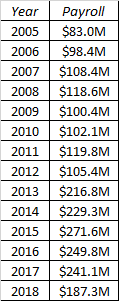
The Dodgers payroll story tracks the story of their ownership changes remarkably well. In the mid-2000s, McCourt increased spending to build a winner before corralling expenditures as his divorce from ex-wife Jamie and the effects of purchasing the team with so much debt caught up with him. Then the Guggenheim folks showed up and blew the top off of what most of us thought was the ceiling for spending outside of the Bronx. Importantly, the figures above do not include luxury tax payments, meaning that Dodgers spending was actually notably higher over that span thanks to the taxes that accompanied their lavish spending.
Unlike Philadelphia, the Dodgers were substantial players in the Latin American amateur market before Major League Baseball imposed significant spending restrictions, handing out substantial deals to the likes of Yadier Alvarez, Yusniel Diaz, Omar Estevez, and Erisbel Arruebarrena. In the end, as gaudy as the Major League spending figures were, amateur spending added a significant amount to overall expenditures reflected above, at least during the Guggenheim period of ownership.
Future Liabilities
For a team known for its massive spending habits, the Dodgers have surprisingly little in the way of long-term guarantees, especially when compared to other big spenders in major markets competing for the World Series each year.
Here is a look at their future guarantees with the powder blue highlight indicative of a player option — in the case of Kenley Jansen, this is an opt-out prior to the 2020 season. As mentioned above, note that the numbers shown on here are cash payments by year, not the salary plus the prorated amount of any bonus. The AAV column captures the player’s luxury tax number.
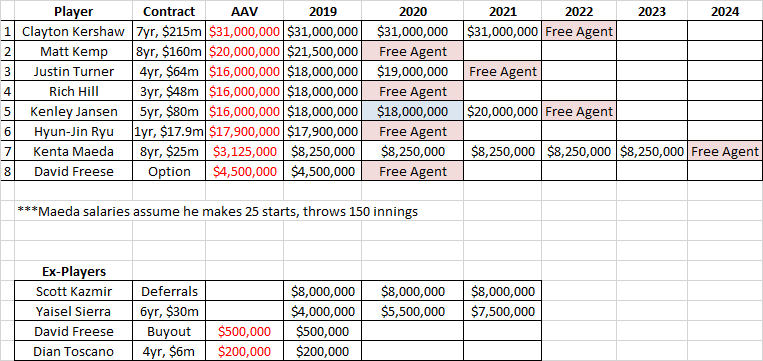
The Dodgers’ new deal with Clayton Kershaw gives them an ace on a reasonably short-term deal. While the annual financial commitment is high, the Dodgers must have been pleased to keep the term so modest.
Beyond Hill, their salary sheet is loaded with short-term commitments until we hit Maeda. Maeda’s contract is heavily incentive driven. Maeda receives $3 million annually, then receives the following incentives:
- $0.15 million for making Opening Day roster
- $1 million for each of 15 and 20 starts, then $1.5 million for each of 25, 30, and 32 starts
- $0.25 million for each of 90, 100, 110, 120, 130, 140, 150, 160, 170, 180, and 190 innings pitched, then $0.75 million for 200 innings pitched
It is an extraordinarily team-friendly pact, one that has played out handsomely for Los Angeles. From a budgetary standpoint, however, it does present plenty of uncertainty.
At the bottom of the chart, we see two lines with hefty numbers but no tax component. First, we see the remaining half of the $48 million owed to Scott Kazmir from his three-year deal covering the 2016-18 seasons. Instead of receiving $16 million per year or something close to it, Kazmir received $8 million annually for six years. As such, he will receive his $8 million annual payouts in 2019-21, but those cash receipts won’t count against the Dodgers’ luxury tax figure. Cuban pitcher Yaisel Sierra obtained a substantial guarantee from the Dodgers, but he is yet to pass Double-A and didn’t record an inning in affiliated ball in 2018. Because L.A. removed him from their 40-man roster (under a rule that has now been amended), his significant cash guarantees do not count against the luxury tax figure for the Dodgers either.
Moving to arbitration, the Dodgers feature a pair of massive paydays for pending free agents in Yasiel Puig and Alex Wood. On the other hand, they appear to have “lucked” into artificially deflated arbitration pay rates for shortstop Corey Seager due to a poorly timed injury in his platform year. Here are the arbitration statuses (salary projections by MLBTR and Matt Swartz):
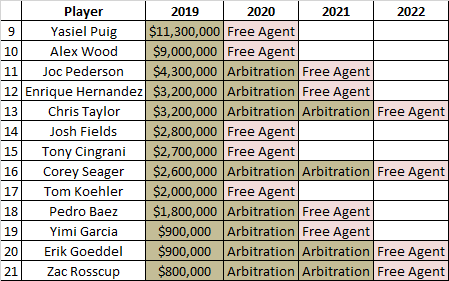
The Dodgers have a number of key contributions controlled via arbitration, but as is the case with most teams, there are some players here who stand a good chance of being non-tendered. From this viewpoint, it looks like Koehler, Garcia, and Rosscup will likely get the boot. Regardless of what happens with that trio, only a couple of million dollars in savings are there to be found.
What Does Team Leadership Have to Say?
This is where things get interesting. Really interesting. Last week, the Bill Shaikin of the Los Angeles Times got hold of a document prepared by the Dodgers before the 2017 postseason for potential investors indicating that the club intended to stay below the luxury tax threshold each year from 2019-22. This would be a striking shift from the free-spending club. The document pegged future payrolls roughly $5 million south of the luxury tax threshold in each season once player benefits are factored in, as they are for luxury tax purposes, projecting payroll at $185 million in 2019 and 2020, $191 million in 2021, and $196 million in 2022.
Will such a spending restriction come to fruition? Your guess is as good as mine. It’s worth stressing that the document was prepared before the 2017 postseason and that Shaikin cited a team official as saying that he would be “shocked” if the payroll stayed below $200 million in 2019. The team’s plans might have changed in the last 13 months, especially after back-to-back World Series losses. But one significant data point out there regarding Dodgers spending in 2019 suggests that the 2018 payroll will be far more predictive of spending in 2019 and beyond than were the payrolls from 2013-17.
Are the Dodgers a Player for Bryce Harper or Manny Machado?
Simply put, this depends on how you feel about the two preceding paragraphs. If the Dodgers haven’t altered their plans since that document was prepared, it’s difficult to see them making a serious push for either player. If the Dodgers were merely posturing with the leaked document or setting forth an aspirational threshold that they don’t actually expect to hit, Harper or Machado is surely in play as the franchise continues to be flush with cash as they chase a World Series title that has proved elusive. (Those same leaked projections also predicted significant revenue increases.)
What Will the 2019 Payroll Be?
The standard disclaimer: ownership and management knows the actual budget whereas we’re focusing on historical data and other relevant factors to project future spending in the immediate and more distant years to come.
Whereas the Phillies will clearly spend and spend big, the Dodgers enter this offseason as a wild card. They have enough talent on the Major League roster and in the upper levels on the farm to expect another excellent season in 2019 without marquee additions this winter. They lack an obvious hole — provided, at least, that the Dodgers believe in Matt Kemp’s 2018 resurgence. Of course, even if they don’t buy into Kemp repeating his surprising success, Alex Verdugo is likely ready to jump to the big club to take his job.
If the Dodgers are serious about capping their spending south of the tax line, they won’t make a big move. Even removing Koehler, Garcia, and Rosscup, the Dodgers are projected to spend $196.5 million including the hits for Kazmir, Sierra, and Toscano. Removing that trio, they are still at $184.3 million. There just isn’t enough payroll space to make a splash. If, on the other hand, the Dodgers get serious about Harper, they could create enough financial wiggle room to sign him by upping payroll by a few million dollars, shipping out Puig, and trading one of their lefty starters: Wood, Rich Hill, or Hyun-Jin Ryu. Friedman would likely be able to find a market for his moderate-sized contracts should he elect to go that route, though Ryu would have to approve any deal before June 15th of 2019 since he accepted a qualifying offer and is therefore treated like a signing free agent.
While it seems crazy to think that they’ll actually hold tight to their purse strings, the presence of impact talent on the farm and a strong Major League roster lends credence to the idea that L.A. could roll into 2019 with their core largely intact from 2018, allowing Machado to leave in free agency after a mercenary visit while passing on the chance to bring Harper back to the Southwest. Crazier things have happened.
We’ll find out if I’m a chump for believing this in the coming weeks.
Projected 2019 Payroll: $195 million
Projected 2019 Payroll Space: -$1.5 million
NL Notes: Braves, Kimbrel, Dodgers, Jansen, Reds
A few items from the National League…
- Atlanta’s a speculative landing spot for closer Craig Kimbrel, who starred with the Braves from 2010-14 and is now the most proven reliever available in free agency. However, barring a drop in Kimbrel’s asking price, it’s “highly unlikely” he’ll rejoin the Braves this offseason, Mark Bowman of MLB.com writes. MLBTR predicts the 30-year-old Kimbrel will reel in a whopping $70MM guarantee, which could be too much for an Atlanta team that may not be in position to make a big-money splash this offseason, as general manager Alex Anthopoulos suggested last month. Anthopoulos has made it known the Braves are interested in adding a closer this winter, though, so whether it’s Kimbrel or someone else, it appears the club is primed to bring in some late-game help.
- Dodgers closer Kenley Jansen announced Friday that he’ll undergo heart surgery Nov. 26, per Chad Thornburg of MLB.com. The procedure comes with a two- to eight-week recovery timeline, meaning Jansen should be fine by spring training. It’ll be the second heart surgery since 2012 for Jansen, who missed time with an irregular heartbeat that season and during both the 2011 and ’18 campaigns. The 31-year-old has been particularly susceptible to an irregular heartbeat at high altitude – the issue cropped up in Colorado in 2012, and he was hospitalized after a game at Coors Field last August. As a result, Jansen sat out a road series against the Rockies in September on doctors’ recommendation.
- The Reds have hired J.R. House to serve as their third base coach and catching coach, Mark Sheldon of MLB.com reports. The 39-year-old House will replace Billy Hatcher, who had been the Reds’ third base coach, and ex-catching coach Mike Stefanski, though it’s not yet known if those two will stay in the organization in different roles, per Sheldon. House, a former professional catcher and first basemen, spent the past seven seasons in player development with the Diamondbacks. He’s the third new hire for rookie manager David Bell, who previously tabbed Derek Johnson as the Reds’ pitching coach and Turner Ward as their hitting coach.
Heyman’s Latest: Mets, Machado, Red Sox, Dodgers, Marlins
After the Mets hired Brodie Van Wagenen as their new general manager last month, he declared the team expected to be “in on every free agent” this offseason. Van Wagenen’s comment led some to wonder whether the Mets, who could stand to upgrade the left side of their infield, would pursue Manny Machado. However, considering Machado figures to sign for $300MM-plus and the Mets have never even handed out a contract worth half that much, a marriage between the two always looked like a long shot. It appears to be fully out of the question now, as Jon Heyman of Fancred hears that the Mets have decided they’d rather spread their money around to various areas than splurge on Machado. As far as New York’s position player group goes, Heyman lists catcher, second base and center field as spots the team could spend on this winter. As for infielder Wilmer Flores, a non-tender candidate, Heyman notes that the Mets will “likely” tender him at a projected $4.7MM if they’re unable to trade him.
Here’s more from Heyman:
- The reigning World Series champion Red Sox may soon lose free-agent right-handers Joe Kelly and Craig Kimbrel, who finished first and second among their relievers in innings last season. With the futures of Kelly and Kimbrel in question, the bullpen is Boston’s primary focus this offseason, according to Heyman. Given that the 30-year-old Kimbrel is in line to sign one of the richest contracts in the history of relievers this winter, he’ll be harder than Kelly to retain. While the Red Sox do have interest in re-signing Kimbrel, per Heyman, he adds that the team “seems adamant about not wanting to go five years” for the highly accomplished closer. Meanwhile, to no one’s surprise, the Sox also hope to re-up free-agent starter Nathan Eovaldi. The 28-year-old righty had a terrific run in Boston last season after it acquired him from Tampa Bay in July, and he’s now one of the most appealing starters on the open market.
- The Dodgers, whom Boston defeated in the World Series, are looking to address the bullpen, the catcher position and possibly second base, Heyman relays. One of Los Angeles’ highest-profile free agents is catcher Yasmani Grandal, who rejected a $17.9MM qualifying offer from the Dodgers and, according to Heyman, now appears likely to head elsewhere. If Grandal does walk, the Dodgers may end up replacing him with a short-term option, observes Heyman, who notes that two of their top prospects – Keibert Ruiz and Will Smith – are catchers.
- The Marlins are hoping to add a left-handed hitter via free agency or the trade market, Heyman writes. No team scored fewer runs in 2018 than the Marlins, in part because they slashed a meager .241/.304/.361 (85 wRC+) against right-handed pitching. As of now, they’re slated to feature a righty-heavy lineup next year, with utilityman Derek Dietrich and light-hitting shortstop JT Riddle the only lefty batters on their projected roster.
Examining Draft Pick Compensation For The 5 Teams That Could Lose Qualified Free Agents
Five different teams made qualifying offers to free agents this winter. Six of the seven players turned down the one-year, $17.9MM offer. Here’s what each of those teams stands to gain in draft pick compensation.
Astros
The Astros made a qualifying offer to Dallas Keuchel. The Astros were neither a revenue sharing recipient nor a competitive balance tax payor. Therefore, regardless of the size of the contract Keuchel signs, the Astros will receive draft pick compensation after Competitive Balance Round B, which takes place after the second round.
Diamondbacks
The Diamondbacks made qualifying offers to Patrick Corbin and A.J. Pollock. The D’Backs were a revenue sharing recipient. If Corbin or Pollock signs for a guarantee of $50MM or more, the D’Backs get draft pick compensation after the first round. If one of the players signs for less than $50MM, the Diamondbacks get draft pick compensation after Comp Round B. Corbin is a near-lock to sign for more than $50MM, while Pollock is a borderline case. Of the six qualified free agents, the $50MM contract size threshold only matters in the cases of Corbin and Pollock.
Dodgers
The Dodgers made a qualifying offer to catcher Yasmani Grandal (Hyun-Jin Ryu already accepted his). Like the Astros, they were neither a revenue sharing recipient nor a competitive balance tax payor. Regardless of the amount Grandal signs for, the Dodgers will receive draft pick compensation after Competitive Balance Round B.
Nationals
The Nationals made a qualifying offer to Bryce Harper, and the Nats were a competitive balance tax payor. Therefore, the Nationals will receive draft pick compensation after the fourth round regardless of the size of contract Harper signs.
Red Sox
The Red Sox made a qualifying offer to Craig Kimbrel, and the Sox were a competitive balance tax payor. Therefore, the Red Sox will receive draft pick compensation after the fourth round regardless of the size of contract Kimbrel signs.
The Nationals and Red Sox stand to gain fairly unimpressive draft picks, likely somewhere in the 140s. The Astros and Dodgers should get picks in the 80s. The D’Backs should get a pick in the 30s for Corbin. Pollock could land them a pick in the 30s or the 80s depending on whether he gets $50MM.