
Brewers President Downplays Possibility Of Freddy Peralta Trade
Brewers right-hander Freddy Peralta is a speculative trade candidate since he’s now just a year away from free agency. However, president of baseball operations Matt Arnold downplayed the possibility in speaking to Robert Murray of FanSided. “I anticipate him being part of our team moving forward,” Arnold said.
Arnold didn’t completely wipe a trade from the table, acknowledging the reality of Peralta’s situation. “We’ve had to make tough decisions on the (Josh) Hader’s and Corbin Burnes’ of the world,” Arnold said. “Freddy is certainly in that conversation.” He noted that the Brewers have to listen to offers because “we’re the smallest market in the league” but it seems they would prefer to keep Peralta in blue and yellow.
One can’t always take baseball executives at their word, as it’s usually in their best interest to hide their true intentions. If Arnold were shopping Peralta, admitting it publicly would only diminish his leverage in trade talks. However, Andy Martino of SNY reports that rival teams are expecting Peralta to stay. Perhaps some club can bowl the Brewers over with an overwhelming offer, but it seems the winds are blowing Peralta back to Milwaukee for the moment.
The reason it’s a discussion comes from the club’s history, as Arnold alluded to. The Brewers have traded key players as they have neared free agency, with Hader and Burnes two notable examples. Devin Williams is another. A trade seemed plausible enough that MLBTR gave Peralta the #8 spot on the list of Top 40 Trade Candidates for this offseason. However, it doesn’t always play out that way, as Milwaukee held Willy Adames until he reached free agency. They received draft pick compensation after he rejected a qualifying offer and signed with the Giants.
Peralta is only going to make $8MM this year, as part of the extension he signed back in 2020, which has worked out brilliantly for the club. Peralta wasn’t fully established as a big league starter at that time, as he also worked out of the bullpen earlier in his career. He took over a rotation gig in 2021 and logged 738 1/3 innings over the past five seasons with a 3.30 earned run average, 29.6% strikeout rate and 9% walk rate.
The $8MM salary is far less onerous than when the Brewers have been in this situation before. Burnes was going to make $15.6375MM in 2024 when he was flipped to the Orioles. Hader was making $11MM when he was traded at the deadline in 2022 and was going to get another raise in 2023. Adames made $12.25MM with the Brewers in his final season before free agency. Williams made $8.6MM with the Yankees in 2025. Even for a low-spending club like the Brewers, $8MM for a front-of-rotation starter is very affordable.
There could still be an argument for trading Peralta to upgrade other parts of the roster, but it would weaken the rotation. When the Brewers traded Burnes, they knew they could still count on Peralta to step up and take over as the ace. The succession plan wouldn’t be as smooth now. It’s theoretically possible for someone like Jacob Misiorowski to inherit that crown but he isn’t fully established yet. He has great stuff and made his big league debut this year but posted a 5.36 ERA in the second half and doesn’t turn 24 until April.
It’s possible something changes in the coming months but perhaps the Brewers will again have Peralta anchoring the rotation in 2026. He’ll be followed by some combination of Misiorowski, Quinn Priester, Chad Patrick, Logan Henderson, Robert Gasser and Tobias Myers.
Arnold added to Murray that the Brewers would love to bring Brandon Woodruff back. That’s not a surprising admission, as Woodruff has thus far spent his entire career with the Brewers. Milwaukee made him a $22.025MM qualifying offer even though he has some health question marks. He just came back from a lengthy absence due to shoulder surgery and also finished the 2025 season back on the injured list with a lat strain.
In between those IL stints, he was excellent. His velocity was down relative to his pre-surgery work but he still managed to post a 3.20 ERA over 12 starts. His 32.3% strikeout rate and 5.4% walk rate were both excellent numbers.
Even with the question marks and the QO attached, MLBTR predicted he could still secure a three-year, $66MM deal. It would be pretty surprising if the Brewers gave out a deal like that. They have only once gone beyond $50MM for a free agent, which was their $80MM deal for Lorenzo Cain back in 2018. If Woodruff signs elsewhere, the Brewers would be entitled to draft pick compensation.
Photo courtesy of Michael McLoone, Imagn Images
Pat Murphy, Stephen Vogt Win Manager Of The Year
For the second consecutive season, Pat Murphy and Stephen Vogt have been named the Managers of the Year. Murphy received 27 of 30 first-place votes in the National League. The American League tally was closer, but Vogt picked up 17 first-place nods to keep his title.
Both skippers have won the award in their first two seasons on the job. They’ve each led a small-market franchise to a Central division title in consecutive seasons. Milwaukee won 97 games and played .500 or better ball in every month after starting the season 0-4 in the final few days of March. The Brewers coasted to another division title and held off the Phillies for the top seed in the Senior Circuit.
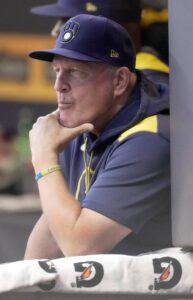
The Brewers seamlessly integrated a few quality rookies along the way. Caleb Durbin, Isaac Collins, Chad Patrick and Jacob Misiorowski all made strong contributions in their debut campaigns. Milwaukee also weathered a series of early-season rotation injuries behind Freddy Peralta. A mid-April trade for Quinn Priester paid massive dividends. The offense, meanwhile, trailed only the Yankees and Dodgers in scoring despite the free agent departure of Willy Adames.
Milwaukee knocked off the Cubs in a five-game Division Series. They were swept by the Dodgers in the NLCS and are still searching for their first trip to the Fall Classic since 1982. Awards voting takes place at the end of the regular season, so the postseason performance is irrelevant.
While the Brewers were well positioned to make the playoffs by the end of June, the Guardians got in via a late-season run that surely surprised even the Cleveland front office. The Guards were deadline sellers and seemed more or less finished once Emmanuel Clase was placed on administrative leave. A ten-game losing streak dropped them as low as eight games under .500 shortly before the All-Star Break, and they trailed Detroit by as much as 15.5 games in the division.
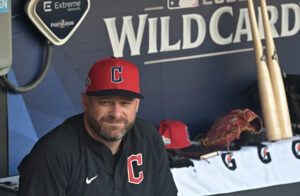
The Guards went 14-13 in August before reeling off a 20-7 record in September to steal a division title. They never led the AL Central by more than one game but had the edge when it mattered, finishing the season at 88-74. That included a 5-1 showing against the Tigers in the final two weeks of the regular season. Detroit wound up getting the last laugh in October, though, going into Cleveland and bouncing the Guards in the Wild Card Series.
Murphy appeared first or second on all but one ballot in the NL. Cincinnati’s Terry Francona and Philadelphia’s Rob Thomson also received at least one-first place vote. They finished second and third, respectively. Craig Counsell, Clayton McCullough, Torey Lovullo and Mike Shildt all received votes. Toronto’s John Schneider was a close-runner up in the Junior Circuit. He received 10 first-place votes. Seattle’s Dan Wilson (the other finalist) and Boston’s Alex Cora also had at least one first-place nod. A.J. Hinch and Joe Espada received votes.
Full vote tallies courtesy of the BBWAA. Images via Imagn Images.
Drake Baldwin Wins National League Rookie Of The Year, Earns Braves PPI Pick
Braves catcher Drake Baldwin is the 2025 National League Rookie of the Year, the Baseball Writers Association of America announced. Cade Horton of the Cubs and Caleb Durbin of the Brewers finished second and third in the voting, respectively. Baldwin’s win will net Atlanta a bonus draft pick after the first round in 2026, via the Prospect Promotion Incentive. Horton earns a full year of service time from his top two finish. The full voting results can be found here.
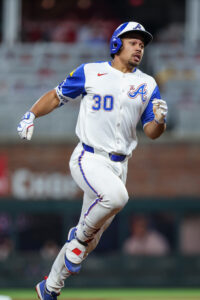
Baldwin came into the year as one of the top prospects in baseball. Since he finished the 2024 season at Triple-A, he had a shot at a big league job to start 2025. However, Atlanta was set to open the season with Sean Murphy as the primary backstop. Rather than be a backup at the major league level, there was an argument for Baldwin to stick at Triple-A and get regular reps.
In early March, Murphy suffered a rib fracture, an injury with a timeline of four to six weeks. That opened the door for Baldwin to get an Opening Day job. He hit well in the spring and Atlanta added him to the roster prior to Opening Day. Though Murphy got healthy by early April, Baldwin had already started producing and he never really stopped. The two shared the catching duties fairly evenly for a few months, though Murphy returned to the injured list in September due to a right hip labral tear.
Baldwin finished the year with 446 plate appearances over 124 games. He hit 19 home runs and slashed .274/.341/.469 for a wRC+ of 125. That means he was 25% better than the league average hitter, though that’s even further above par for a catcher. Most outlets considered his defense to be a bit below average, but not by much. FanGraphs credited him with 3.1 wins above replacement on the year.
While Baldwin’s win is surely gratifying for him personally, it also benefits the team. The current collective bargaining agreement introduced measures to combat service time manipulation. If a team promotes a top prospect early enough for him to earn a full service year, then that player meets certain awards criteria, the team is awarded with an extra pick just after the first round in the next draft. Since Baldwin was a consensus top prospect who was up all year, his Rookie of the Year win gives Atlanta a PPI bonus pick in 2026.
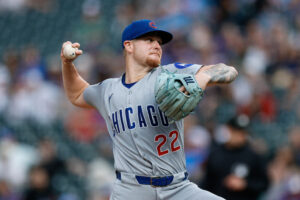
Horton also came into the season as one of the top prospects. He had finished 2024 at Triple-A but with just five appearances at that level. He was sent back to Triple-A to start 2025 but the Cubs needed rotation help fairly early on, as Justin Steele and Shota Imanaga were both on the injured list by early May.
Horton was called up on May 10th. He stayed up with the club the rest of the way, though a rib fracture put him on the injured list late in September. He finished the season with 118 innings pitched, having allowed 2.67 earned runs per nine.
There was probably some luck in there. Horton’s 20.4% strikeout rate was subpar, though his 6.9% walk rate was good and his 42.3% ground ball rate right around average. His .258 batting average on balls in play and 78.3% strand rate were both to the fortunate side. ERA estimators like his 3.58 FIP and 4.26 SIERA feel his ERA should have been around a run higher, though the performance was still good enough for a second-place finish in the voting.
That is significant for Horton, as there’s a flipside to the aforementioned PPI bonuses for teams. If a top prospect is not promoted early enough in the season to get a full service year, he can earn one retroactively with a top-two finish in the Rookie of the Year voting. Horton only earned 142 service days this year, 30 shy of the 172 needed for a full season, but this vote result will get him bumped up to the one-year mark. That means he will be on pace to become a free agent after 2030 instead of 2031.
Durbin was not a top prospect to open the year, meaning PPI wasn’t a factor for him, but he had a good season regardless. Acquired from the Yankees last offseason, he was called up in April and took over the third base job in Milwaukee. He appeared in 136 games and stepped to the plate 506 times. He hit just 11 home runs and didn’t walk much but rarely struck out, leading to a .256/.334/.387 line and 105 wRC+. He also stole 18 bases and was credited with five Defensive Runs Saved and two Outs Above Average at the hot corner.
Several other players also received some recognition from the voters. Isaac Collins of the Brewers finished fourth, followed by Daylen Lile of the Nationals, Agustín Ramírez of the Marlins, Chad Patrick of the Brewers, Jakob Marsee of the Marlins, Jack Dreyer of the Dodgers, Matt Shaw of the Cubs, Jacob Misiorowski of the Brewers, Nolan McLean of the Mets and Heriberto Hernández of the Marlins.
Photo courtesy of Geoff Burke, Jordan Godfree, Isaiah J. Downing, Jeff Hanisch, Imagn Images
Brewers Release Tucker Davidson
The Brewers have moved on from left-hander Tucker Davidson. He was released at the end of the season, as noted by Baseball America’s Matt Eddy in a breakdown of minor league transactions. The 29-year-old had latched on with Milwaukee in August. He made six appearances for Triple-A Nashville prior to his departure.
Davidson had one of his most successful professional seasons in 2025. He headed overseas to pitch for the KBO’s Lotte Giants and delivered 22 starts with a 3.65 ERA. Davdison struck out just under a batter per inning and won 10 games with the Giants. He was waived in August when the team brought in Vince Velasquez. Davidson was unable to continue his solid season upon joining the Sounds. He posted a 4.68 ERA across six starts. Triple-A bats hit .277 against Davidson over 25 innings.
Atlanta took Davidson in the 19th round of the 2016 draft. He cruised through the minors, reaching Triple-A by 2019. Davidson put up a pristine 2.15 ERA across 25 starts between Double-A and Triple-A that season. He wasn’t missing a ton of bats, but he piled up ground balls at a high rate.
The strong year earned Davidson an MLB look in 2020, though just for one appearance. He made seven starts for the Braves from 2021 to 2022, before heading to the Angels in the Raisel Iglesias trade. Davidson was moved to relief in 2023, making 37 appearances out of the bullpen for the Angels and Royals. He also made a start with Kansas City, who acquired him in an August trade after the Angels designated him for assignment. Davidson has a 5.76 ERA across 129 2/3 big-league innings.
Photo courtesy Denny Medley, Imagn Images.
Coaching Notes: Leiper, Weeks, Rangers, Twins
With so many new managers taking over this season, it’s no surprise we’ve seen plenty of coaching staff turnover. Changes have been trickling in this week. Here are some quick highlights…
- The Mets are expected to hire Tim Leiper as their third base coach, reports Joel Sherman of the New York Post. Leiper has spent nearly three decades as a coach at various levels. He most recently served as the Padres’ third base coach, a role he has held since 2024. Leiper would be taking over for Mike Sarbaugh, who was not brought back after the season.
- Rickie Weeks is changing roles with the Brewers, reports Curt Hogg of the Milwaukee Journal Sentinel. After serving as associate manager for the past two seasons, Weeks will move to the front office as a special assistant to the general manager. Weeks was drafted by the Brewers with the second overall pick in 2003. He spent 11 of his 14 big-league seasons with the team. Weeks returned to Milwaukee in 2022 as an assistant to player development. The Brewers will not be hiring a new associate manager, notes Hogg.
- The Rangers are in the process of filling out new manager Skip Schumaker‘s staff. The club is expected to add Alex Cintron as an assistant hitting coach, reports Michael Schwab. Cintron has been a hitting coach with the Astros since 2019. Texas has also expressed interest in Twins’ bullpen coach Colby Suggs, reports Dan Hayes of The Athletic. Suggs seems to be on the market, with Minnesota expected to hire LaTroy Hawkins for the bullpen coach position.
- More from Minnesota, as new manager Derek Shelton continues to put his staff together. Hayes reported that Hank Conger will not be returning next season. Conger joined the Twins in 2022 as first base coach. After three seasons in the role, he served as assistant bench coach in 2025. Minnesota is also slated to lose bench coach Jayce Tingler, who is expected to join San Francisco’s staff in some capacity.
13 Players Receive Qualifying Offers
Thirteen players have received a qualifying offer this year, reports Jeff Passan of ESPN. The list is as follows:
- Kyle Tucker, OF, Cubs
- Kyle Schwarber, OF/DH, Phillies
- Bo Bichette, SS/2B, Blue Jays
- Framber Valdez, LHP, Astros
- Dylan Cease, RHP, Padres
- Ranger Suarez, LHP, Phillies
- Edwin Diaz, RHP, Mets
- Zac Gallen, RHP, D-backs
- Shota Imanaga, LHP, Cubs
- Michael King, RHP, Padres
- Trent Grisham, OF, Yankees
- Gleyber Torres, 2B, Tigers
- Brandon Woodruff, RHP, Brewers
This year’s QO is valued at $22.025MM. All 13 players will have until Nov. 18 to decide whether to accept that one-year offer or decline and become a free agent. They can spend that time gauging the open market to determine interest in their services. If a player accepts the QO, he’ll be treated as a free agent signing and thus will be ineligible to be traded without his consent until June 15 of next year. If he declines, any team that signs him will be subject to draft and/or international bonus forfeitures, depending on its revenue-sharing and luxury tax status.
The bulk of the list was generally expected. Every recipient other than Torres and Imanaga was pegged as likely or a no-doubter to receive the QO on MLBTR’s annual lists of qualifying offer previews for position players and for pitchers. Torres was viewed as something of a long shot, at least on the MLBTR staff. He’s coming off a nice season in Detroit but struggled through a poor finish — perhaps in part due to injury — and wasn’t hit with a QO last offseason when coming off a comparable year at the plate in the Bronx.
Imanaga was listed as a borderline call on our preview as well. The Cubs declined a three-year, $57.75MM option on Imanaga last week. He subsequently declined a $15.25MM player option (which came with an additional player option at $15.25MM) — effectively opting out of a remaining two years and $30.5MM. The Cubs are banking on Imanaga also turning away one year at just over $22MM after turning down that remaining $30.5MM in guaranteed money.
The qualifying offer is determined each year by taking the average of the game’s 125 highest-paid players. We’ve already covered the penalties that each team would face for signing a qualified free agent, as well as the compensation each club would get for losing a qualified free agent to another team.
Among the notable free agents to not receive a qualifying offer are Lucas Giolito, Robert Suarez, Devin Williams and Jorge Polanco. Giolito might have received one had it not been for a late elbow issue that ended his season. Suarez has been excellent and just opted out of the remaining two years and $16MM on his contract, but he’ll be 35 next year. The Padres have been reducing payroll in recent seasons and likely didn’t want to risk Suarez locking in that weighty one-year sum. Williams would have received a QO with a typical season, but he struggled throughout much of the season’s first four months before a dominant finish. Polanco enjoyed a terrific rebound campaign but is 32 years old and was limited to DH work for much of the season due to ongoing injury issues.
The qualifying offer grants each of these free agents the chance at a notable one-year payday, though the majority of them will reject without much thought. Players like Tucker, Bichette, Schwarber, Valdez, Cease, Suarez and Diaz are likely to see comparable or larger (much larger, in Tucker’s case) salaries on multi-year deals in free agency. Even players like Grisham, who probably won’t land a $22MM annual value over multiple years, are still likely to reject. Major league free agents typically — though not always — prioritize long-term earning over short-term, higher-AAV pacts. A three- or four-year deal worth $14-16MM per year, for instance, is typically viewed as preferable to accepting one year at a higher rate.
There’s risk in declining the offer, of course. Teams are more reluctant to sign players who’ll cost them valuable draft picks and/or notable portions of their hard-capped bonus pool for international amateurs. Every offseason, there are a handful of free agents whose markets are weighed down by the burden of draft pick compensation. That typically applies to the “lower end” of the QO recipients. For top stars like Tucker, Bichette, etc. — draft/international forfeitures are simply considered the cost of doing business and don’t tend to have much (if any) impact on the player’s earning power.
MLBTR Podcast: Offseason Preview Megapod: Top Trade Candidates
The latest episode of the MLB Trade Rumors Podcast is now live on Spotify, Apple Podcasts, and wherever you get your podcasts! Make sure you subscribe as well! You can also use the player at this link to listen, if you don’t use Spotify or Apple for podcasts.
This week, host Darragh McDonald is joined by Steve Adams and Anthony Franco of MLB Trade Rumors to discuss…
- The 2025 World Series between the Dodgers and Blue Jays (1:55)
- The Cubs letting Shota Imanaga becoming a free agent (9:05)
- Ha-Seong Kim opting out of his deal with the Braves (19:00)
- MLBTR’s list of the Top 40 Trade Candidates for the offseason (28:15)
- The Cardinals having six guys on the list (32:15)
- Why the Nationals will likely make MacKenzie Gore and CJ Abrams available (42:40)
- The Twins, Joe Ryan, Pablo López and Ryan Jeffers (54:05)
- The Pirates have a bunch of pitchers they could trade (1:06:20)
- The Rays, Pete Fairbanks and Brandon Lowe (1:18:05)
- The Brewers and Freddy Peralta (1:25:50)
- The Marlins having some arms who could move (1:31:50)
- Tyler Soderstrom of the Athletics, who did not make the list (1:41:40)
- A theoretical trade sending Brady Singer to the Angels and Taylor Ward to the Reds (1:47:20)
Check out our past episodes!
- Bo Bichette’s Health, Kazuma Okamoto, And Dylan Cease’s Market – listen here
- The Phillies’ Outfield, Tarik Skubal, And Hiring College Coaches – listen here
- Murakami To Be Posted This Offseason, Managerial Vacancies, And More! – listen here
The podcast intro and outro song “So Long” is provided courtesy of the band Showoff. Check out their Facebook page here!
Photo courtesy of Jeff Curry, Imagn Images
Brewers, Royals To Return To Main Street Sports
The Brewers announced that they have a new deal in place with Main Street Sports, the company that owns FanDuel Sports Network Wisconsin. It’s unclear if it’s a one-year deal or a multi-year pact, but the Brewers will be back on the same channel in 2026. Adam McCalvy of MLB.com was among those to relay the news.
It’s presumably good news for the Brewers, or at least not bad news. The regional sports network (RSN) model has been crumbling in recent years, thanks to cord-cutting and the rise of streaming. Several clubs in the majors have seen their RSN deals collapse. Those clubs have been left to have Major League Baseball run their broadcasts in a direct-to-customer model. That can work out better for some fans, as they can avoid blackouts, but it leads to less revenue for teams.
The Royals are also re-upping with Main Street Sports, exercising their mutual option for the 2026 season. “There is nothing more important to us than connecting with and making our games available to our great fans,” Royals Chairman/CEO John Sherman said in a press release. “Our viewership is growing and continues to rank among the best in baseball, both through linear cable and streaming.”
The partnership with Main Street Sports has been an effective one. Royals games ranked No. 1 in primetime in the Kansas City area this past season, according to the release. “Our multi-platform strategy drove strong viewership growth last season, and we look forward to working together to expand their audience reach and drive fan engagement,” Sarah Tourville, Executive Vice President, Team Partnerships, FanDuel Sports Network, said in the release.
Photo courtesy of Ron Chenoy, Imagn Images
William Contreras Undergoes Finger Surgery
Brewers catcher William Contreras underwent a minor procedure to repair his broken left middle finger, president of baseball operations Matt Arnold told reporters (link via Adam McCalvy of MLB.com). It’ll keep him from participating in baseball activities for 5-6 weeks but is not expected to impact his availability for Spring Training.
Contreras played through the fracture for the entire 2025 season. The injury is believed to have occurred during the ’24 campaign, though the team didn’t announce the presence of a break until this past May. Contreras did not spend any time on the injured list and has not had a single IL stint in his career. Only J.T. Realmuto logged more starts or innings behind the dish this year.
The injury did seem to weigh down Contreras a little bit at the plate. He hit .260/.355/.399 with 17 home runs through 659 trips. That’s still strong production, especially from a catcher, but is below the .285/.366/.462 combined slash he posted over his first two seasons in Milwaukee.
Milwaukee declined a $12MM option on Contreras this afternoon. That’s a procedural move that isn’t related to the injury. He remains eligible for arbitration. MLBTR contributor Matt Swartz projects him for an $11.1MM salary. Contreras collected a $100K option buyout, so any arbitration salary under $11.9MM would mean the Brew Crew saved themselves a little bit of money with the option decision. Contreras will go through arbitration once more and is on track to hit free agency during the 2027-28 offseason.
Brewers Announce Three Option Decisions
The Brewers announced decisions on three options decisions today. First baseman Rhys Hoskins and left-hander Jose Quintana both had mutual options declined and are now free agents. The club also turned down a club option on catcher William Contreras, who remains under club control via arbitration.
Contreras, 28 in December, qualified for arbitration for the first time a year ago. He and the Brewers couldn’t agree on his salary for 2025, his first of three arb years, prior to the January 15th filing deadline. Late in January, they avoided a hearing by agreeing to a one-year deal with a club option. It was a $6.1MM guarantee in the form of a $6MM salary for 2025 and a $100K buyout on a $12MM club option for 2026.
In the season which just ended, Contreras still put up decent numbers but he played through a finger fracture and wasn’t quite at his previous level. His .260/.355/.399 line translated to a 113 wRC+, indicating he was 13% above league average, but he was 26-39% better than par in the three previous seasons.
MLBTR contributor Matt Swartz projected Contreras for $11.1MM in his second arbitration season, a bit below the value of the club option. Presumably, Milwaukee’s internal projections are somewhat similar. They will give Contreras the $100K buyout for now. Later, they will try to get him signed for his second arbitration season with a salary below $12MM, therefore saving a few bucks.
The other two decisions were more straightforward. Mutual options are mostly an accounting measure designed to move part of the guarantee to the end of the deal. It’s been more than a decade since a mutual option was exercised by both parties.
Hoskins, 33 in March, signed with the Brewers going into the 2024 season. He had missed the entire 2023 campaign due to a torn ACL. It was a two-year deal with an opt-out halfway through. He would make $12MM in 2024 with a $4MM buyout on an $18MM player option, followed by an $18MM mutual option for 2026 with a $4MM buyout.
Ideally, Hoskins would have returned to form before heading back to free agency, but it didn’t play out that way. He hit .214/.303/.419 in 2024. That translated to a 101 wRC+, indicating he was barely above average. That wasn’t awful but also wasn’t good enough for a guy who isn’t an especially strong defender or baserunner. He triggered his player option and returned to Milwaukee for 2025.
His bat ticked up slightly this year, as he hit .237/.332/.416 for a 109 wRC+, but he missed about two months with a sprained left thumb. He got Wally Pipped by Andrew Vaughn while he was out and was left off the club’s playoff roster.
The Brewers will move on while Hoskins will look for a new opportunity elsewhere. His reputation should be enough for a major league deal but his age and recent performance will likely limit him to one-year deals.
Quintana, 37 in January, lingered in free agency last offseason. The Brewers grabbed him in March, signing him to a one-year deal with a $4MM guarantee. That broke down as a $2MM salary and a $2MM buyout on a $15MM mutual option.
The lefty had a decent year, making 24 starts with a 3.96 earned run average, though he worked around a subpar 16% strikeout rate. His .259 batting average on balls in play was on the low side, which is why measures like his 4.81 FIP and 5.04 SIERA feel his ERA should have been about a full run higher. He’ll take his buyout and look for his next opportunity. Despite the low strikeouts, a solid veteran innings eater like Quintana will still be in line for a major league deal.
Photo courtesy of Jeff Hanisch, Imagn Images