
Free Agent Stock Watch: Didi Gregorius
The Xander Bogaerts extension was quite surprising when signed and has only increased in value to the Red Sox since. That deal gave the Yankees’ chief nemesis extended control over a core asset. It also removed the chief potential market rival for New York shortstop Didi Gregorius.
Gregorius will presumably be basking in the glow of a long-term deal when he celebrates his thirtieth birthday at the outset of Spring Training next year. He enjoys a rather favorable free-agent outlook from a structural standpoint, though he’ll likely have to decline a qualifying offer (and take on the drag of draft compensation) to get there. Just scan the list of pending free agents and you’ll see why Gregorius is still sitting pretty despite his somewhat tepid initial showing this year.
There’s some slight possibility Elvis Andrus will opt out of his deal with the Rangers, but the smart money says he’ll stay put in Texas. Veterans like Freddy Galvis, Jose Iglesias, and Jordy Mercer will be seen only as bench or second-division fill-in options. There’s competition on the left side of the infield more generally, with Anthony Rendon and Josh Donaldson hitting the open market, and there are some other solid options capable of playing third or second base. But teams intent on signing a quality regular shortstop have nowhere else to turn.
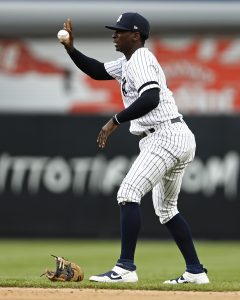
The circumstances are ripe for Sir Didi to maximize his value. But the fundamentals will still drive the bidding. Gregorius has still only played about a quarter of a season’s worth of games this year, having missed the early portion of the season due to Tommy John surgery, but he’s also now nearly halfway through his platform presentation. Let’s see where things stand …
In his first three seasons in New York, Gregorius hit at a roughly league-average .276/.313/.432 clip while averaging 18 long balls annually. His power and output was trending northward, but didn’t fully arrive until a breakout 2018 campaign in which he slashed a robust .268/.335/.494, swatted 27 dingers, and posted a much-improved 69:48 K/BB ratio over 569 trips to the plate.
The difference in the offensive output is significant, obviously. Gregorius is generally perceived and graded as a solid fielder and quality baserunner. With even league-average hitting mixed in, he’s arguably a 3 WAR true-talent player. But with the 121 wRC+ performance he put up last year? Now you’re looking at a guy that’s pushing 5 WAR in a good and healthy season.
We’ve seen signs of both ends of the range for Gregorius thus far in 2019. The overall output sits right in range of league average, with a familiar blend of good pop and middling on-base skills. He’s averaging the same above-average sprint speed as usual and has mostly graded in range of average in the field — not that metrics are particularly telling with just over 300 innings as a sample.
Unsurprisingly, Gregorius has chased both high four-seamers (as he has long been wont to do) and low offspeed offerings (ditto). Pitchers have long attacked him in this manner — and for good reason. Chasing lots of pitches out of the zone has been a part of the Gregorius way since he landed with the Yankees. But he’s doing so now at heretofore unseen levels: 42.2%, up from 36.2% last year. Gregorius is also swinging and missing more now (11.1%) than he did in 2018 (9.2%).
As a result, there has been a notable and somewhat concerning backslide in the plate discipline department. That’s where Gregorius really thrived in 2018, driving his career year. Last season: 12.1% strikeout rate, 8.4% walk rate. Thus far in 2019: 13.5% strikeout rate, 4.5% walk rate.
But let’s slow down. Gregorius was coming back in the middle of the season after his long rehab effort. And he has already shown notable mid-season plate-discipline improvement. Through his first 22 games, Gregorius maintained a .298 on-base percentage. In his next 20? Um, also a .298 OBP. But he’s getting there in a different way. Gregorius went down on strikes 17 times while drawing just three walks in the first period. In the past twenty contests he has seven strikeouts and five free passes. While his BABIP has taken a downturn in period #2, that’s all but assuredly happenstance (not least of which since his slugging percentage is up to .500, suggesting he’s having little trouble putting the barrel on the ball).
In the power department, Gregorius is carrying the same dozen-plus-percent HR/FB rate and steep average launch angle (17.1 degrees, currently) we’ve become accustomed to. Statcast doesn’t love Gregorius’s batted-ball profile any more than it has in recent seasons, but it also still shows that he isn’t exactly getting by on cheap dingers. While he isn’t making consistently loud contact, with an 87.0 mph average exit velo and .294 xwOBA, he can put a charge in a ball. Gregorius’s eight long balls this year have left the yard at an average 101.1 mph velocity and 28.1 degree launch angle.
All things considered, it seems Gregorius is at worst much the same player he was before his uptick last year. Depending upon how one grades his anticipated future glovework, it’s quite possible to believe he’s a solid 3.5 WAR shortstop who is worthy of being installed as an everyday option for the next several seasons. Given his showing at the plate over the past three weeks, it also seems possible that he’ll end the present season looking more like his 2018 self — the best version we’ve yet seen of Didi.
Either way, we already have a pretty good hint as to one element of Gregorius’s market valuation. The Yanks tendered him a contract last winter, ultimately agreeing to a substantial $11.75MM payday, despite knowing in advance that Gregorius would miss a significant amount of time and face some rehab uncertainty. Gregorius won’t challenge Bogaerts (even at the reduced rate he settled for) in terms of annual salary or years, but the Yankees shortstop is in position — especially with a strong finish — to line up a strong three or four-year pact at a relatively hefty AAV.
Photo courtesy of USA Today Sports Images.
Have The Yankees Found A Keeper In Mike Tauchman?
The story of this Yankees season hasn’t been one of larger-than-life stars (though some of those have played significant roles as well). It’s one of savvy organizational decisionmaking and depth, of unheralded players stepping up when called to the big stage. A future team biographer might well frame them The 2019 Yankees: Humble Savages. It’s all enough to make even the staunchest fan of an Evil Empire rival start rooting for the New York leviathan. (No? Okay, okay, just checking.)
But what does it all mean? We can and should tip our caps to GM Brian Cashman and his front office, for starters. There are a whole lot of well-conceived individual decisions snowballing here, involving smart roster management, wise player acquisition and development, and deft deployment of talent. Overcoming the injuries — the roster is still riddled with them — has been an impressive feat.
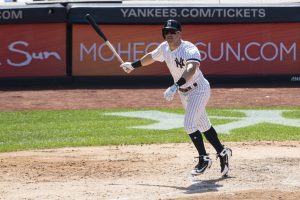
Still, at some point the club is going to pick a 25-man postseason roster. And then there’ll be the eventual wave of 40-man roster culling at the end of the campaign. Fringe roster members — even those that factored prominently this year — can and will be traded or decommissioned to suit the needs of the Yankees machine.
Which leads us to wonder about those heart-and-soul types, those scrappy unknowns who have given so much to this year’s Yanks. Which of them has earned a place in the future plans of the vaunted franchise — or at least a ticket out of town to a greater opportunity elsewhere? And which may ultimately look back on this time not as the start of a long and prosperous Yankees career, but as a blissful-but-fleeting moment when it all came together?
Put otherwise, in the words of the fans of rival clubs (I can only presume): are you serious with this Mike Tauchman guy?
Tauchman landed with the Yanks late in camp when it became clear he wasn’t needed in Colorado. He was already 28 years of age and had only just tasted the majors. All it cost the Yankees was a decent but hardly overwhelming reliever prospect who wouldn’t tie up a 40-man spot for the Rockies.
You know what happened next. It didn’t occur right away, as Tauchman didn’t thrive in his first fill-in work in New York earlier this year. But he has been ablaze since being recalled just after the All-Star break and is currently enjoying something like near-regular playing time in the absence of Aaron Hicks, Giancarlo Stanton, and Edwin Encarnacion.
Tauchman’s numbers of late have indeed been ridiculous. He has strode to the dish with bat in hand seventy times over a twenty-game span, driving in twenty runs along the way. Five of those plate appearances have ended in home runs. There are 28 base knocks and six walks. Tauchman has thrown in a pair of steals for good measure.
When you add up all of Tauchman’s contributions this year, he sits at a .299/.371/.563 slash line with ten long balls over 194 MLB plate appearances. That’s a 143 wRC+ — quite good! It’s only fair to note that defensive metrics are also fans of his glovework in left field, boosting him to an eye-popping 2.0 fWAR over just sixty games of action.
There was a reason the Yanks targeted Tauchman in the first place. He had struggled in two brief runs with the Rox, but that’s easy to dismiss. Heck, now that we can put it all in context … was this the inevitable rise of an excellent hitter? Tauchman devastated Triple-A pitching at Albuquerque for two-straight seasons, posting consecutive .331/.386/.555 and .323/.408/.571 batting lines. Even with league context, those were strong numbers. Tauchman’s numbers this year with the top New York affiliate are also strong: .274/.386/.505 with as many walks as strikeouts (16 apiece).
All good so far. But what does a look under the hood show us? There’s not much of particular interest in the K/BB department. Tauchman is walking at a 10.3% clip, which is slightly above-average these days. He’s also going down on strikes at a 27.3% rate. That’s rather elevated, though not to the point of being a major concern in and of itself. Tauchman’s 9.8% swinging-strike rate isn’t alarming and he has a high-contact history in the minors, having typically sat in the fifteen-percent K-rate range. He’s also carrying a meager 22.8% chase rate, so he’s obviously seeing the ball well at the moment.
It’s somewhat intriguing to wonder about a version of Tauchman that maintains the power — he owns a hefty .264 ISO — while drawing down the strikeouts closer to his upper-minors levels. But that probably isn’t realistic. True, he has done it before, but never to this extent … and only in high-powered offensive environments against sub-MLB pitching.
The biggest red flags come when you look at the contact outputs. Tauchman is carrying a .378 batting average on balls in play — an obviously unsustainable number, but one that can reflect the fact that a player is absolutely stinging the baseball.
That’s not really the case here. Tauchman does have a strong 9.2% barrel rate, but he’s carrying an unremarkable 88.5 mph exit velocity. Statcast credits him only with a .316 xwOBA, vastly lagging his .384 wOBA and suggesting that there has been no shortage of good fortune in outcomes. Indeed, Tauchman’s ten long balls have flown an average distance of only 384 feet — a Sogardian level that doesn’t exactly portend an ability to sustain a whopping 27.0% HR/FB rate.
Odds are, Tauchman’s hot streak will subside. This probably isn’t a true breakout; it’s not the result of some major change to mechanics or approach that might support a sustainable power boost. But that doesn’t mean Tauchman is destined to be dumped at season’s end. It’s possible he’ll feel the roster crunch and end up elsewhere — notably, he’ll be out of options next year — but it isn’t too hard to imagine the Yanks giving him an ongoing role. Tauchman has an excellent hit tool and at-least-decent pop. He comes with loads of minor-league experience in center field and (as noted) has graded quite well this year with the glove. There’s a potential path to a left-handed-hitting fourth outfielder role that’d fit the roster quite nicely… depending upon how things turn out with long-time Yankees stalwart and pending free agent Brett Gardner, who has enjoyed a renaissance year at the plate thus far.
Photo courtesy of USA Today Sports Images.
Previewing Club Option Decisions: Relievers
This is the fourth and final piece in a series previewing offseason club option decisions. This edition will focus on relievers…
Right-handers
- Tony Barnette, Cubs ($3MM option): Barnette hasn’t been a factor this year in Chicago, where he has thrown just 1 1/3 innings. The former Ranger sat out until late June because of shoulder issues and then landed on the restricted list July 1 for personal reasons. He won’t be a Cub again in 2020, at least not for $3MM.
- Jared Hughes, Reds ($3MM option or $250K buyout): The grounder-heavy Hughes overcame a lack of strikeouts to post ERAs ranging from 1.96 to 3.03 as a Pirate and Red from 2013-18. While Hughes has continued to induce grounders at a world-class clip this year (62.1 percent), the run prevention hasn’t been there. He owns a 4.36 ERA/4.94 FIP with 6.23 K/9, 3.53 BB/9 and a 22.2 percent home run-to-fly ball rate over 43 1/3 innings. Hughes has also seen his swinging-strike rate dip by almost 3 percent since last season. The Reds could try to upgrade over the 34-year-old, though his track record of keeping opposing teams at bay – not to mention an affordable price tag for 2020 – may save him if they decide his HR troubles are a fluke. Opponents have mustered a meager .668 OPS off Hughes this season, so clubs aren’t exactly lighting him up.
- Jeremy Jeffress, Brewers ($4.3MM option): Jeffress, 32 next month, hasn’t come close to replicating the dream season he put together in 2018. His average fastball velocity has dipped about 2 mph (from 95.3 to 93.7), which has helped lead to a 4 percent drop in swinging-strike rate, an 8 percent fall in his strikeout rate and a 10.5 percent decline in his grounder rate. His 5.00 ERA and 3.99 FIP through 45 innings aren’t great, either. However, despite a litany of red flags, Jeffress still looks cheap enough for the Brewers to bring back.
- Nate Jones, Rangers ($3.75MM option or $1.25MM buyout): Once among the game’s top relievers, injuries have derailed the 33-year-old Jones’ career in recent seasons. He has thrown just 10 1/3 innings in 2019 and is out for the season after undergoing right forearm surgery in May. The Rangers nonetheless took on Jones in a deadline trade with the White Sox, and they seem likely to give him a shot to make an impact next year.
- Shawn Kelley, Rangers ($2.5MM option or $250K buyout): Meanwhile, it’ll be a bigger surprise if the Rangers don’t retain Kelley, who – despite some health issues this year – has worked to a 3.00 ERA/4.09 FIP with 8.73 K/9 and 1.36 BB/9 in 33 innings.
- Brandon Morrow, Cubs ($12MM option or $3MM buyout): Morrow was brilliant when healthy from 2017-18, but he hasn’t pitched since last July because of elbow problems. Although Morrow expects to return sometime this season, it’s hard to believe the oft-injured 35-year-old will have enough time to show the Cubs they should invest another large sum of money in him for 2020.
- Pat Neshek, Phillies ($7MM option or $750K buyout): Neshek has been ineffective when healthy this year and may be done for the season on account of a hamstring injury. It’ll be a shock if the Phillies pick up his option over the winter.
- Dan Otero, Indians ($1.5MM option or $100K buyout): While he’ll be extremely affordable next season, Otero hasn’t done much this year to justify even a small investment. Out since the end of May with shoulder inflammation, the 34-year-old has recorded a 4.56 ERA/5.62 FIP with 3.8 strikeouts per nine. He also had a hard time keeping the opposition off the scoreboard in 2018.
- Yusmeiro Petit, Athletics ($5.5MM option or $1MM buyout): Petit, 34, has been a valuable workhorse out of the A’s bullpen since he joined the team prior to 2018. Through 153 innings with the franchise, Petit has pitched to a 2.82 ERA/3.89 FIP with 7.35 K/9 and 1.41 BB/9. He’ll stick around in 2020.
- David Phelps, Cubs ($1MM option that can increase based on appearances): Phelps, whom the Cubs acquired from the Blue Jays at the deadline, has an option that will climb to $3MM if he makes 30 appearances, $5MM at 40 and $7MM at 50. He’s currently at 20, over which he has put up a 3.86 ERA/4.61 FIP with 9.64 K/9 against 3.86 BB/9. Considering Phelps’ floating option value, it’s too soon to forecast whether he’ll return to the Cubs next year. It’ll depend how well the soon-to-be 33-year-old performs through season’s end and the amount of appearances he winds up making.
- Adam Warren, Padres ($2.5MM option or $500K buyout): The value of Warren’s 2020 option looked more than reasonable entering the season, but the ex-Yankee, Cub and Mariner has since endured a rocky few months in San Diego. Not only has Warren been on ice for two months with a right forearm strain, but he managed an unappealing 5.34 ERA/6.91 FIP in 28 2/3 innings before hitting the shelf. It’s likely he’ll end up back on the open market over the winter.
Left-handers
- Jake Diekman, Athletics ($5.75MM mutual option or $500K buyout): Diekman’s year, which he has divided between Kansas City and Oakland, has been a mixed bag. His 4.91 ERA and 5.32 BB/9 across 44 innings are ugly, yet he has notched a 3.49 FIP and 13.5 strikeouts per nine. The low-budget A’s may not want to invest in Diekman again next season, however, even if he exercises his half of a mutual option.
- Sean Doolittle, Nationals ($6.5MM option or $500K buyout): The Nationals will absolutely keep Doolittle – by far their brightest light in what has been a shaky bullpen.
- Aaron Loup, Padres ($2MM option): An elbow sprain has kept Loup out of action since April 7. If he does return this season, the 31-year-old will need a strong finish to give himself any chance to collect $2MM from the Padres in 2020.
- Oliver Perez, Indians ($2.75MM option): Perez’s option will automatically vest at 55 appearances. He’s 10 away right now, having registered a 2.79 ERA/3.18 FIP with 10.86 K/9 and 2.48 BB/9 in 45 games and 29 innings. Barring a serious injury or a trade, he’ll be an Indian again in 2020.
Previewing Club Option Decisions: Starting Pitchers
This is the third in a series of pieces previewing offseason club option decisions. This edition will focus on starting pitchers…
- Chris Archer, RHP, Pirates ($9MM option or $1.75MM buyout): The Archer era hasn’t gone as planned for Pittsburgh since it acquired him from Tampa Bay in a July 2018 blockbuster. This year, his first full season as a Pirate, Archer has notched an awful 5.35 ERA/5.55 FIP across 107 2/3 innings. His $9MM salary for next year no longer looks like a bargain, but it’s not pricey enough for the Pirates to cut the cord.
- Andrew Cashner, RHP, Red Sox ($10MM option): Cashner was the reigning world champion Red Sox’s headlining July acquisition, but he hasn’t helped matters during a skid that could knock the team out of contention. After pitching decently for the Orioles prior to the deal, the soon-to-be 33-year-old Cashner has yielded 18 earned runs on 31 hits and 10 walks (with 16 strikeouts) in four starts and 23 1/3 innings as a member of the Red Sox. He won’t be on their roster in 2020.
- Derek Holland, LHP, Cubs ($6.5MM option or $500K buyout): We could technically group Holland in with the relievers, as he has spent most of the season in that capacity for the Giants and Cubs after an abysmal start to the season out of San Francisco’s rotation. Holland has been good for the Cubs since they acquired the then-designated 32-year-old, having logged 5 2/3 innings of three-hit, one-run ball. As of now, though, he’s a strong bet to return to free agency over the winter.
- Corey Kluber, RHP, Indians ($17.5MM option or $1MM buyout): The two-time Cy Young winner got off to a surprisingly rough start before suffering a forearm fracture May 1, and he hasn’t returned since. But the 33-year-old Kluber’s option should still be an easy one for the Indians to exercise.
- Wade LeBlanc, LHP, Mariners ($5MM option or $450K buyout): While LeBlanc was a respectable source of innings for the Mariners in 2018, he’s likely pitching his way back to the free-agent market this season. The 35-year-old owns a 5.38 ERA/5.30 FIP over 92 innings divided between the M’s rotation and bullpen.
- Martin Perez, LHP, Twins ($7MM option or $500K buyout): It was just last offseason that the Rangers declined a $7.5MM option for Perez, who has since emerged as a decent buy-low pickup for the Twins. Perez, 28, is averaging a career-high 94.1 mph on his fastball and has pitched to a 4.58 ERA/4.44 FIP with 7.76 K/9, 3.57 BB/9 and a 49.3 percent groundball rate across 116 innings. That’s acceptable production for a back-end starter, though it’s worth noting Perez’s numbers have tailed off over the past couple months. Minnesota may opt to move on as a result, which would save the team $7MM. Then again, the club could be leery of having to replace yet another starter behind ace Jose Berrios with Jake Odorizzi, Kyle Gibson and Michael Pineda all headed for free agency.
- Jose Quintana, LHP, Cubs ($11.5MM option or $1MM buyout): The Cubs traded two potential long-term building blocks, outfielder Eloy Jimenez and righty Dylan Cease, to the crosstown rival White Sox for Quintana back in 2017. Quintana was amid an excellent multiyear stretch then, though his effectiveness has waned since changing Chicago homes. Still, the soon-to-be 31-year-old absolutely hasn’t struggled enough for the Cubs to reject his option two seasons after giving up Jimenez and Cease. Quintana has recorded a 4.40 ERA/4.09 FIP in 122 2/3 innings this year.
- Julio Teheran, RHP, Braves ($12MM option or $1MM buyout): This is a pretty debatable case. On one hand, Teheran’s 3.46 ERA and team-leading 130 innings are impressive. On the other, his 4.47 FIP, 5.11 SIERA, 5.25 xFIP, 4.29 BB/9 and 39.7 percent grounder rate combine to paint a much drearier picture. That said, the 28-year-old Teheran has become known for regularly outperforming underwhelming peripherals. Whether the Braves trust his ability to do it again in 2020 will determine his fate with the organization.
- Jason Vargas, LHP, Phillies ($8MM option or $2MM buyout): Vargas was among the game’s worst starters in 2018, but he has rebounded this season to post passable back-end numbers with the Mets and Phillies. The soft-tossing 36-year-old has amassed 100 2/3 innings of 3.93 ERA/4.66 FIP pitching with 7.69 K/9, 3.58 BB/9 and a 40.7 percent grounder mark. He’s still far from a slam dunk to have his option picked up – cutting Vargas would save the Phillies $6MM – but they’ll need competent innings from somewhere in 2020. They haven’t consistently gotten enough of those this year from anyone but Aaron Nola. He and the declining Jake Arrieta will be back in Philly’s rotation next season, but questions abound otherwise.
Previewing Club Option Decisions: Designated Hitters, Outfielders
This is the second in a series of pieces previewing offseason club option decisions. This edition will focus on designated hitters and outfielders…
Designated hitters
- Nelson Cruz, Twins ($12MM option or $300K buyout): So let’s get this straight: Cruz has slashed .294/.385/.642 with 30 home runs in 362 plate appearances on a $14MM salary this year, and he’s actually in line for a pay decrease? This is looking like a brilliant signing by the Twins, who will no doubt exercise the 39-year-old Cruz’s option.
- Edwin Encarnacion, Yankees ($20MM option or $5MM buyout): Like Cruz, the 36-year-old Encarnacion has been one of the most prolific sluggers in recent memory. That doesn’t mean the Yankees will keep Encarnacion around, though. While he was enjoying another high-end year (.240/.346/.518 with 30 HRs in 451 PA) before fracturing his right wrist last weekend, the Yankees might decide they could spend Encarnacion’s money better elsewhere. After all, they won’t be hard up for other DH options in 2020.
Outfielders
- Alex Gordon, Royals ($23MM mutual option or $4MM buyout): The Royals certainly won’t bring Gordon back next year for $23MM, but he’s a franchise icon who hasn’t made it a secret he wants to spend his whole career in Kansas City. And Royals general manager Dayton Moore has great respect for Gordon, so expect the soon-to-be 36-year-old left fielder to return to KC next season at a more team-friendly price.
- Billy Hamilton, Royals ($7.5MM option or $1MM buyout): The same probably won’t apply to Hamilton, who has posted the worst offensive season of his light-hitting career. Hamilton has batted a woeful .209/.276/.262 with no homers in 293 PA, and even his always strong defense and base running haven’t been able to make up for his punchless production at the plate. He’ll return to free agency over the winter.
- Juan Lagares, Mets ($9.5MM option or $500K buyout): The 30-year-old Lagares joins Hamilton as another weak-hitting center fielder on his way to the open market. Lagares has long been known for his defense, but he has managed an unappealing minus-5 DRS/minus-4.0 UZR in center this season. Meanwhile, he has put up a horrid .186/.263/.267 line with a pair of HRs over 180 trips to the plate.
- Starling Marte, Pirates ($11.5MM option or $2MM buyout): This should be a no-brainer for the Pirates to exercise, as the soon-to-be 31-year-old Marte has turned in another respectable season in 2019. Despite a career-low 3.9 percent walk rate, Marte has slashed .285/.326/.505 and notched 20 homers and 17 steals across 462 PA. The defense hasn’t exactly been stellar (minus-5 DRS, minus-2.1 UZR), yet Marte has still been worth 2.5 fWAR.
- Kole Calhoun, Angels ($14MM option or $1MM buyout): This will be a tough choice for the Angels, who have seen Calhoun rebound from a subpar 2018 to bat .233/.318/.481 with 25 HRs (one fewer than his personal-high total) in 448 PA. Calhoun’s also a capable defender, which has helped him record the fifth season of at least 2.0 fWAR in his career. He’s set to turn 32 in October, though, and the Angels have an elite outfield prospect in Jo Adell knocking at the door. Therefore, they may be tempted to jettison Calhoun – quality track record be damned – and save $13MM.
- Adam Eaton, Nationals ($9.5MM option or $1.5MM buyout): The Eaton acquisition hasn’t worked out as hoped for the Nationals, who traded pitchers Lucas Giolito, Reynaldo Lopez and Dane Dunning to the White Sox for him prior to the 2017 season. Eaton hasn’t performed poorly by any means, but injuries limited him to just 118 games in his first two seasons in D.C. He has appeared in 108 this year, however, and batted a decent .276/.357/.396 with six HRs, 10 steals and 1.4 fWAR in 480 PA. As of now, the guess is they’ll keep the soon-to-be 31-year-old in the fold.
- Nick Markakis, Braves ($6MM option or $2MM buyout): Markakis has been one of baseball’s most durable players since his career began in 2006, but he took a pitch off the left wrist in late July and won’t return until sometime in September. His streak of 150-plus appearances will end at six seasons as a result. Still, the 35-year-old was in the midst of another decent season at the time he went down, and with Austin Riley perhaps set to move from the corner outfield to third base in 2020 (starting 3B Josh Donaldson‘s a pending free agent), the Braves just might bring the affordable Markakis back for a sixth season.
Previewing Club Option Decisions: Catchers, Infielders
This is the first in a series of pieces previewing offseason club option decisions. We’ll start with catchers and infielders…
Catchers
- Welington Castillo, White Sox ($8MM option or $500K buyout): This looks like a buyout waiting to happen for the White Sox, who have gotten awful offensive production from the typically competent Castillo. The 32-year-old has hit .184/.262/.340 with six home runs in 164 plate appearances. Castillo has also graded as one of the game’s worst defensive backstops.
- Tyler Flowers, Braves ($6MM option or $2MM buyout): The 33-year-old Flowers’ offensive output has waned this season in comparison to the previous three campaigns, though his line – .229/.307/.432 with nine HRs in 215 PA – is closer to average than terrible relative to his position. And Flowers remains a strong defender, so it’ll be a surprise if the Braves buy him out – especially with Brian McCann‘s future in question.
- Yan Gomes, Nationals ($9MM option or $1MM buyout): This has been a miserable year for Gomes, a former Indian whom the Nationals acquired last offseason. Gomes, 32, owns a .207/.313/.327 line with six homers across 240 PA, and has been a mixed bag behind the plate. With fellow catcher Kurt Suzuki under control through next season, the Nationals may not feel compelled to bring Gomes back.
- Yasmani Grandal, Brewers ($16MM mutual option or $2.25MM buyout): At this rate, the Brewers will exercise their half of Grandal’s mutual option, but he’s sure to decline his end of it. Grandal’s amid another strong all-around year and, unlike last offseason, will enter free agency without a qualifying offer weighing him down.
- Chris Iannetta, Rockies ($4.25MM option or $750K buyout): It’s not a prohibitive price for Iannetta, but he hasn’t done himself any favors by hitting .212/.306/.409 with six dingers in 157 trips to the plate as Tony Wolters‘ backup. Expect the Rockies to move on without Iannetta.
First basemen
- Matt Adams, Nationals ($4MM option or $1MM buyout): This will amount to a $3MM decision for the Nationals, who are already paying Adams that much this year. The 30-year-old has been a useful piece for the club, with a powerful .245/.296/.532 line and 17 HRs in 233 PA. The guess is the Nats will exercise his option, especially with other first base choices Ryan Zimmerman, Howie Kendrick and Gerardo Parra possibly on the way out after this season.
- Anthony Rizzo, Cubs ($16.5MM option or $2MM buyout): The Cubs will obviously pick up Rizzo’s option.
- Eric Thames, Brewers ($7.5MM option or $1MM buyout): Thames has somewhat bounced back from an underwhelming 2018, his price for next year is reasonable, and the Brewers just sent fellow first baseman Jesus Aguilar packing. They’ll likely keep Thames around for 2020.
- Ryan Zimmerman, Nationals ($18MM option or $2MM buyout): Zimmerman’s days as a star third baseman are long gone, and the now-first baseman’s time as a National is likely to end after the season.
Second basemen
- Starlin Castro, Marlins ($16MM option or $1MM buyout): It’ll be easy for the low-budget Marlins to move on from Castro, who’s mired in the worst season of his career at the age of 29.
- Wilmer Flores, Diamondbacks ($6MM option or $500K buyout): The 28-year-old Flores was a quality bench piece for the Mets prior to this season, but his first (and possibly only) D-backs campaign has been an injury-limited one. The production hasn’t been great, either, as Flores has hit just .277/.327/.387 with a pair of HRs in 168 attempts. As of now, he looks like a strong possibility for a buyout.
- Jedd Gyorko, Dodgers ($13MM option or $1MM buyout): Speaking of injuries, Gyorko has taken just 62 PA this season, and he has slashed a meager .196/.274/.304 in that sample size. The Dodgers acquired the soon-to-be 31-year-old from the Cardinals at last week’s trade deadline, but despite LA’s deep pockets, he figures to hit free agency after the season.
- Jason Kipnis, Indians ($16.5MM option or $2.5MM buyout): In terms of aggregate production, this is the third straight unspectacular season for the 32-year-old Kipnis, who has batted .255/.317/.405 with 11 homers through 383 PA. Kipnis has been a lot better since an ice-cold start to the season, but so good that the budget-conscious Indians will pick up his pricey option? Highly doubtful. While Kipnis has been an Indian since they chose him in the second round of the 2009 draft, his long run with the organization may be on the verge of ending.
- Mike Moustakas, Brewers ($11MM mutual option or $3MM buyout): Like Grandal, the Brewers figure to exercise Moustakas’ option. But Moustakas is likely to join Grandal in taking another stab at free agency. Set to turn 31 next month, Moustakas has performed well this year at second (where he hadn’t played prior to 2019) and third, and is on track for his second 30-HR campaign.
Shortstops
- Freddy Galvis, Blue Jays ($5.5MM option or $1MM buyout): It’s not a crazy price for the durable, switch-hitting Galvis, who has slashed a competent .272/.306/.455 and smacked 18 homers over 449 PA in his age-29 campaign. But it may not be palatable for the Blue Jays, who have seen touted middle infield prospects Bo Bichette and Cavan Biggio emerge as major leaguers this year.
Third basemen
- We already covered Flores, Gyorko and Moustakas, the only third base-capable players with options.
The Mets’ Unsung Offensive Star
It was an action-packed offseason for rookie Mets general manager Brodie Van Wagenen, who stole headlines with his transactions and his bold proclamations naming his club the favorite in the National League East. Van Wagenen’s roster hasn’t performed to expectations since then, but after a tumultuous few months, the team has climbed above .500 and put itself in the thick of the NL wild-card race. One of Van Wagenen’s less heralded offseason pickups has been among the Mets at the forefront of their midsummer hot streak.
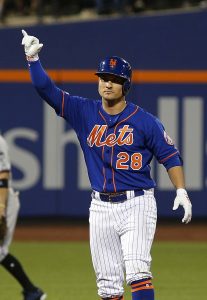
There was little hype accompanying the Mets’ acquisition of infielder/outfielder J.D. Davis from the Astros on Jan. 6. The Mets surrendered three minor leaguers for Davis, who – despite being a 2014 third-round pick and a solid prospect in Houston – didn’t have an obvious path to playing time with the Astros. However, the 26-year-old quickly worked his way into New York’s plans, thanks in part to season-opening injuries to infielders Todd Frazier and the still-hurt Jed Lowrie, and hasn’t graced the minors at all in 2019 after spending almost all of his Astros tenure there.
While Davis did hold his own at the lower levels with the Astros, he collected just 181 major league plate appearances from 2017-18 – in which he batted an unimpressive .194/.260/.321. On the other hand, the Mets’ version has amassed 293 PA and slashed a terrific .300/.369/.498 (131 wRC+) with 12 home runs and respectable strikeout and walk percentages (20.1 K, 9.2 BB). Much of the damage has come in the summer months for Davis, who overcame an unproductive May to post an .881 OPS in June and a 1.017 mark in July. His recent output has helped New York to a second-half awakening – after going into the All-Star break at 40-50, the team has shockingly risen to 57-56.
Although his production has benefited from a .347 batting average on balls in play – which is sure to drop considering the slow-moving Davis’ groundball-heavy profile – that’s not to say he has lucked into his success. To the contrary, according to Statcast, which places Davis in the league’s 91st percentile or better in expected slugging percentage, average exit velocity, expected weighted on-base average, hard-hit percentage and expected batting average. As impressive as Davis’ .369 wOBA is, his .389 xwOBA is even better and ties for 17th among all qualified hitters, sandwiching him between Juan Soto and teammate/NL Rookie of the Year favorite Pete Alonso. It helps, of course, that Davis has chased far fewer pitches out of the zone than the average hitter.
Regardless of whether the Mets do the unthinkable and rally to a playoff berth this year, it looks as if they have a legitimate long-term piece in Davis. As someone who has handled both right- and left-handed pitchers, the righty-swinging Davis has the makings of an everyday player. And while he has accrued more appearances in left field (38) than at third (31), it’s possible he’ll take over for Frazier – a pending free agent – at the hot corner next season.
Photo courtesy of USA Today Sports Images.
2018 Rule 5 Draft Update
Let’s check in on the players chosen in the 2018 Rule 5 draft …
On Active MLB Roster
Richie Martin, SS, Orioles (from Athletics): While most Rule 5 draftees have been shipped back to their original organizations or shelved on the injured list, Martin is sill grinding on the Orioles’ roster. It hasn’t been pretty, as Martin has struck out in 29.2% of his 240 plate appearances while maintaining an ice-cold 81.0 mph average exit velocity. He carries paltry .191/.249/.300 batting line and grades out as a distinct negative at shortstop. He has simply been one of the worst players in baseball. But the rebuilding O’s can take the pain and obviously feel it’s worth the while for the toolsy 24-year-old.
Brandon Brennan, RHP, Mariners (from Rockies): There have been some ups and downs over the course of the season. Brennan has a 55.4% ground-ball rate and has compiled 9.3 K/9 on a 13.7% swinging-strike rate. Unfortunately, he is also dishing out too many free passes (5.3 BB/9) and carries a 5.56 ERA. A strained shoulder offered a respite, but Brennan was activated from the injured list today. With the M’s continuing to churn through pitching to keep their staff afloat, it’s likely Brennan will be afforded further opportunity to establish himself in the majors.
Injured List
Travis Bergen, LHP, Giants (from Blue Jays): The southpaw was mostly solid for the first month and a half of the season, getting knocked around twice for multiple runs but putting up zeroes in fifteen of his sixteen other appearances. Through 17 innings, he carried a 4.24 ERA with 15 strikeouts and seven walks. His 6.7% swinging-strike rate wasn’t exactly cause for excitement, and he’d have faced a tough path to keep his roster foothold over the ensuing months, but a shoulder injury put Bergen on ice. Now well into his rehab, where he owns a 3.63 ERA and 18:10 K/BB ratio in 17 1/3 innings, Bergen could be sent packing if the surprisingly competitive Giants don’t want to clear active and 40-man roster space when he’s ready.
Elvis Luciano, RHP, Blue Jays (from Royals): Still 19, Luciano has been completely overmatched in the bigs. In 27 2/3 innings over twenty appearances, he carries a 6.51 ERA with 22 strikeouts and 23 walks. But the Jays are committed to earning full rights over the live-armed youngster. Now that he’s on ice for an elbow strain, the roster pressures are eased. If Luciano makes it back this year, he’ll likely continue to see sparing action while running out the clock. If not, the team will simply need to put him on the active roster for at least 14 days in order to acquire his rights permanently. (To be kept, a player must be kept on the MLB roster for an entire season, with at least ninety days spent on the active roster. Luciano spent 76 days with the Jays this year before hitting the IL.)
Returned After Start Of Season
Kyle Dowdy, RHP, returned to Indians by Rangers (via Mets): The 26-year-old never found a groove in Texas, allowing more walks (18) than he generated strikeouts (17) in his 22 1/3 innings while pitching to a 7.25 ERA. He hasn’t thrown well in the minors, either, though most of his innings came in a rehab stint with the Rangers. We’ll see whether the Cleveland organization can help him unlock the talent that led to his initial selection.
Riley Ferrell, RHP, returned to Astros by Marlins: Not only did Ferrell endure the tumult of the Rule 5 process, but he failed even to get a single MLB appearance out of the whole affair. An ill-timed, late-spring injury cut off his chance at earning an Opening Day job and the Marlins decided against creating roster space after watching Ferrell’s rehab work. Now back in the Houston organization, he has thrown 7 1/3 solid frames in the upper minors, allowing just one earned run while recording nine strikeouts against four walks.
Reed Garrett, RHP, returned to Rangers by Tigers: It seemed Garrett had a real shot at staking out a bullpen role in Detroit, but he couldn’t keep his edge. Through 15 1/3 MLB innings, he was tagged for 14 earned runs and managed only an ugly 10:13 K/BB ratio. Things haven’t gone all that much better since Garrett landed back at Triple-A with the Rangers org. He’s sporting a 6.03 ERA with 8.0 K/9 and 4.3 BB/9 in 31 1/3 innings there.
Connor Joe, INF/OF, returned to Dodgers by Giants (via Reds): Soon to turn 27, Joe didn’t impress in a 16-plate appearance sample with San Francisco to hang onto his roster spot. But he’s turning in strong work at Triple-A now that he’s back with the Dodgers. Joe owns a .300/.427/.526 slash with 14 home runs and a healthy combination of sixty walks and 68 strikeouts.
Drew Jackson, INF, returned to Dodgers by Orioles (via Phillies): The 26-year-old barely got a look in the majors, striding to the plate four times but failing to record his first hit. Unfortunately, he has not followed up on a promising 2018 campaign now that he’s back in the Dodgers system. In 251 plate appearances at Triple-A, Jackson is slashing just .223/.328/.340.
Chris Ellis, RHP, returned to Cardinals by Royals (via Rangers): Ellis has gone backwards since going back to the St. Louis organization after just one MLB outing in Kansas City. He has been tagged for 7.49 earned runs per nine in 57 2/3 innings. Ellis’s walk total, 37, matches the number he gave out last year — in 132 2/3 frames.
Returned Before Start Of Season
Sam McWilliams, RHP, returned to Rays by Royals: The tall right-hander has taken his licks since being promoted to the hitter-friendly International League, but earned the bump up with a strong run at the Double-A level to begin the season back with the Tampa Bay organization (2.05 ERA with 6.8 K/9 and 3.1 BB/9 in 87 2/3 innings).
Jordan Romano, RHP, returned to Blue Jays by Rangers (via White Sox): As it turns out, Romano got his first look at the majors the old-fashioned way, via mid-season call-up. That only lasted four appearances, but Romano is now on the Toronto 40-man. He has struggled to deliver consistent results, but does have 58 strikeouts in 39 1/3 total innings between the majors and Triple-A.
Nick Green, RHP, returned to Yankees by Diamondbacks: Green still hasn’t really found his footing since going back to the New York organization. After missing time with a shoulder injury, he has posted an ugly 7.91 ERA in 46 2/3 Double-A innings.
Drew Ferguson, OF, returned to Astros by Giants: Ferguson certainly earned his return trip to the Houston organization with a lowly showing in spring camp, but he has equally earned his keep since. Through 382 plate appearances at Triple-A, Ferguson is slashing .290/.398/.449 with nine long balls. If he’s not dealt or added to the 40-man roster over the offseason, he could again be a possible Rule 5 target.
Yusei Kikuchi’s Difficult Start
The Mariners made a slew of moves last offseason as part of their “reimagining” plan, but no addition came with more hype than free-agent signing Yusei Kikuchi. The club handed the Japanese star a four-year, $56MM contract – a deal that could turn into a seven-year, $109MM pact – with the expectation it was landing at least a mid-rotation starter. The left-handed Kikuchi could still evolve into that for the Mariners, but their investment hasn’t paid off as planned so far.
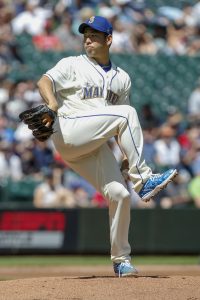
In his most recent start last Friday, the Astros lit up the 28-year-old Kikuchi for six earned runs on nine hits, including four home runs, in four innings. The performance dropped Kikuchi’s already uninspiring ERA to 5.49 through his first 118 innings in the majors, with FIP (5.95), xFIP (5.18) and SIERA (5.17) indicating he has deserved his poor run prevention numbers thus far. Home runs have been the main problem for Kikuchi, who has yielded them on 20.1 percent of fly balls and surrendered 2.14 HRs per nine innings. He ranks in the bottom five of the majors in both departments, including dead last in the latter category.
Unlike other recent ballyhooed Japanese imports (Yu Darvish, Masahiro Tanaka and Shohei Ohtani, to name a few), Kikuchi hasn’t excelled at missing bats in his initial MLB action. While Darvish, Tanaka and Ohtani each struck out more than a batter per inning upon reaching the bigs, Kikuchi has only set down 6.41 per nine via K, which outdoes just five qualified starters. Therefore, even though Kikuchi has logged a decent BB/9 (2.9), he sits 13th last in K/BB ratio (2.21). Unsurprisingly, his swinging-strike, chase and contact rates are also subpar.
To this point, Kikuchi has relied on a four-seam fastball (51.3 percent), slider (26.0) and curveball (17.4), per Statcast. The trouble is that two of those offerings – Kikuchi’s fastball and curve – have been eminently hittable. Batters have teed off on Kikuchi’s four-seamer for a .422 weighted on-base average/.386 expected wOBA, while they’ve lit up his curve for a .397/.431 pairing. Although they’ve mustered a .334 wOBA off Kikuchi’s slider, his .271 xwOBA against is far more encouraging. Looking at the location heatmaps for those pitches (via FanGraphs: four-seamer, slider, curve), it’s not hard to believe two have gotten crushed.
Lefties and righties alike have smacked around Kikuchi, who has yielded a .385 wOBA against the former and a .359 versus the latter. While his overall xwOBA against (.339) paints a much more optimistic picture than the actual mark (.369) hitters have put up, that’s not saying much. After all, according to Statcast, Kikuchi still only ranks in the majors’ 24th percentile in the category. Meanwhile, he’s in the league’s 48th percentile or worse in expected batting average against, expected slugging percentage against, hard-hit percentage against, exit velocity against, average fastball velocity (93.0 mph), fastball spin and strikeout percentage.
There clearly hasn’t been much to like about the rookie version of Kikuchi, which isn’t what the Mariners had in mind when they made him their headlining acquisition last offseason. Manager Scott Servais preached patience in regards to Kikuchi on Monday, saying this has been “a developmental year” and he’ll “learn from it.” That may prove to be the case. So far, however, Seattle can’t be thrilled with what Kikuchi has provided.
Photo courtesy of USA Today Sports Images.
The 10 Biggest Non-Headlines Of The Deadline
We ran through the biggest headlining moves of Wednesday’s trade deadline (American League; National League). But what about the trades that didn’t take place?
1. Gun-Shy Big Spenders. They had explanations for their decisions not to add significant talent on deadline day, but it was still stunning to see the Dodgers and Yankees — and, to a lesser extent, the Red Sox — bypass big moves. Both clubs are excellent just the way they are. Each rightly respects the value of young talent and perennial contention. But still … it has been quite some time since either took down a World Series title. And there could well be opportunities to second guess if the roster is lacking that one key piece at a big moment.
2. Mets Withhold Wheeler. On the other side of the coin, this was by far the boldest non-sale. The Mets put a lofty price tag on their rental starter and stuck to it. It’s a bold gambit that could easily backfire. True, there’s value in pressing to contend. And Wheeler could still be issued a qualifying offer. (He might be a nice value on even an expensive one-year deal; if he declines, the Mets would likely recoup draft compensation.) But if the Mets can’t continue their recent run, and/or health issues preclude a QO to Wheeler, this could be regrettable.
3. High-Powered Relievers Stay In Lower-Leverage Situations. Felipe Vazquez. Edwin Diaz. Kirby Yates. Mychal Givens. Raisel Iglesias. Alex Colome. Amir Garrett. Joe Jimenez. Jose Leclerc. There was some firepower and late-inning experience out there! And contenders that could’ve used it, with affordable team control helping to justify any addition. We never expected all of those arms to change hands, but I sure thought at least one or two would.
4. Boyd Not Bought. The Tigers just don’t seem that close to contending, if we’re being honest. Sure, the tide can start to turn more quickly than one might anticipate. But there are a load of questions facing the organization over the next few seasons. Dealing Matt Boyd, whose eye-popping peripherals and three seasons of control are highly appealing, seemed to offer a ready-made path to boosting the Tigers farm in a way that other recent deadline pieces haven’t. It would’ve been foolish to settle for a meager return, and it may be that the offers just weren’t there, but it’s surprising that nothing came together on the breakout lefty.
5. Cardinals Keep Bird In Hand. With an increasingly glaring postseason drought, the game’s model smaller-market team seemed to be positioned to chase glory at the deadline. It was frustrating for the team, and no doubt also for quite a few fans, to come away empty when there were some clear areas to improve on the roster. A division crown is still plenty possible, but the odds would be better with another quality starter and another bullpen or bench piece in the fold.
6. All Smoak, No Fire. As rental pieces go, defensively limited hitters aren’t that exciting. But man, Justin Smoak is a pretty good one. He’s a switch-hitter on an affordable deal. His power is down a bit, but it’s still there and he has been walking like a man possessed. Plus, he’s a Statcast darling, with a lofty .389 xwOBA.
7. That Dog Don’t Hunt[er]. Ditto Hunter Pence, who came back from the dead and turned in an All-Star first half. He’s swinging a hot stick. He’s cheap. And he’s pure fire in the clubhouse. It feels like we’re all missing out not having Pence giving color to high-leverage moments by stalking the dugout steps and entering the batter’s box in a big moment or two.
8. Frazier Not Freed: Quite apart from the Yanks’ generally quiet outcome was the fact that the club didn’t manage to find a deal involving Clint Frazier. He could still have an impact in New York, at least once rosters expand, but the club has passed over multiple chances to bring him onto the roster and wouldn’t seem to be increasing his trade value by keeping him stashed at Triple-A. It seemed to make an awful lot of sense for Frazier to be cashed in somehow on or before July 31. But he’s still in New York (err, Scranton).
9. Middle Relievers Marooned. So … why exactly didn’t these guys end up on the move? Prices were said to be frustratingly lofty by several contending GMs. Many ended up bypassing the top of the pure rental market, going to second or third-tier rental pieces (e.g., the Nationals) or nabbing controllable, somewhat under-the-radar arms (Nick Anderson, Joe Biagini, Jake Faria, Adam Kolarek). But if those players moved, why not guys like Francisco Liriano, Craig Stammen, Greg Holland, David Hernandez, Jared Hughes, and Cory Gearrin?
10. Buy/Sell Blurred. While the aggregate amount of talent moved ended up being rather typical, the deadline lacked much in the way of decisive action as between contending and rebuilding, buying versus selling. The Mets and Reds made stunning trades that improved their still-middling chances this year, but mostly did so with an eye to the future. Both clubs went on to perform a bit of corresponding payroll/roster management that partially offset their lone acquisitions. The Astros went big, while the Cubs and Braves made substantial adds (particularly when you include their mid-season free-agent expenditures). But on the whole, tepidity abounded on the buy side. It was even more remarkable to see so few teams go for broke in a selling direction. The Giants did some reshuffling but clearly chose to walk a line. Many teams that found themselves in potential selling position after hoping to contend decided against deep cuts, such as the Angels, Rangers, Pirates, Rockies, and Padres. (San Diego’s one major swap did bring in a prospect, but didn’t meaningfully impact the team’s expected contention timeline.) The Marlins and Blue Jays sent out a few pieces, but the Tigers, Royals, and even the Orioles held their most interesting MLB assets (Boyd, Whit Merrifield, Givens, Trey Mancini, etc.). The White Sox did nothing of note. Even the Diamondbacks, who surprised with their Zack Greinke deal, also acted to bring in multiple MLB pieces to stay afloat this year and prepare for a reasonably competitive 2020. What does it all mean? Who can say? Perhaps it’s just how things shook out this time around. Or it may be that the rise of prospect clutching and cheap extensions will usher in a new era of mainly “homegrown” teams, for better or worse.