
Poll: Which Team Has Been Hit The Hardest By Injuries This Year?
Injuries are an inevitable part of baseball. According to the RosterResource Injury Report, there are currently 229 players on major league injured lists. That’s just under one-third as many as there are on active rosters. It works out to about seven or eight injured players per team. Some injuries are predictable or preventable, while others are the result of pure bad luck. In any case, no team can avoid using the IL entirely, but the most successful clubs are those that can minimize injuries, like last year’s surprisingly successful Tigers and Royals, or find ways to overcome them, like last year’s World Series champion Dodgers. As the 2025 season inches closer to its halfway mark, does one team stand out as the most affected by injuries this year?
The most obvious answer is the Dodgers, who currently have 14 players (all pitchers) on their major league injured list, the most of any team. Since the beginning of the season, the Dodgers have placed 22 players on the IL, which is the highest total in the National League and the second-highest in the majors, behind only the White Sox (23). All of those players have combined to miss 960 games in 2025, according to the Baseball Prospectus Injured List Ledger. That is far and away the highest total in the sport. The Mets rank second with 695 cumulative games missed. The 265-game gap between the Dodgers and Mets is roughly the same size as the gap between the second-ranked Mets and 20th-ranked Mariners (441 games missed). If that’s not enough to illustrate just how many players the Dodgers have lost to the IL, consider this: They have already lost more player games to injury through 68 games in 2025 than a handful of teams lost throughout all of 2024.
What’s more, it’s not like we’re just talking about injuries to depth arms or bench bats. Two-time Cy Young winner Blake Snell has been out with shoulder inflammation since his second start of the season. All-Star starter Tyler Glasnow hasn’t pitched since the end of April. He, too, is nursing a shoulder injury, as is rookie phenom Roki Sasaki. Several key bullpen pieces are out as well, including Blake Treinen (forearm tightness) and Evan Phillips (Tommy John surgery). And of course, none of the IL stats I cited above include Shohei Ohtani, who has not been able to pitch so far this year.
Yet, in terms of total value taken away by injuries since the start of the 2025 campaign, Baseball Prospectus estimates the Dodgers have only lost the third-most projected WARP (Wins Above Replacement Player). WARP is only one way to measure value, and projected WARP is just that: a projection. Still, it’s worth considering that just because the Dodgers have lost the most games to the IL, they haven’t necessarily lost the most value.
The two teams that are ever-so-slightly ahead of the Dodgers in projected WARP lost to injury are a pair of AL East rivals: the Yankees and Orioles. The Yankees are without ace Gerrit Cole, who underwent Tommy John surgery in March. Luis Gil, the 2024 AL Rookie of the Year winner, has also been out all year as he nurses a lat strain. On the position player side, elbow injuries have kept designated hitter Giancarlo Stanton off the field all year, though he recently started a rehab assignment. More Yankees who have missed time at some point include Jazz Chisholm Jr., Clarke Schmidt, Fernando Cruz, DJ LeMahieu, and Marcus Stroman, while closer Luke Weaver recently landed on the IL with a hamstring strain.
As for the Orioles, they have been without Grayson Rodriguez all year. He first went on the IL with elbow inflammation before suffering a lat strain that set him back further. Albert Suárez has been out since his first appearance of the season with shoulder inflammation, while Zach Eflin also missed significant time early in the year. In terms of position players, the Orioles are currently without Tyler O’Neill, Ryan Mountcastle, Gary Sánchez, and Jorge Mateo. Others who have missed time this season include Colton Cowser, Jordan Westburg, Cedric Mullins, and Gunnar Henderson.
Ultimately, all three of the Dodgers, Yankees, and Orioles are neck and neck in value lost to injury, according to Baseball Prospectus. However, I have to wonder if anyone can truly argue the Yankees and Dodgers have been “hit hard” by injuries this year. They’re each in first place in their respective divisions and rank among the top five MLB teams in winning percentage and run differential. According to both FanGraphs and Baseball Prospectus, they have the highest playoff and World Series odds in their respective leagues. Despite all the players they are missing (or have missed at some point), they are thriving. I would make a similar argument about the Mets. They have also lost their fair share of players to injury, including Sean Manaea, Frankie Montas, and A.J. Minter. Nonetheless, the Mets have the best record in the National League, and no team in baseball has given up fewer runs.
The Orioles, on the other hand, have severely underperformed expectations. They sit in last place in the AL East, and their 26-39 record has them looking like potential sellers at the deadline. While their bats have been disappointing, pitching has been their downfall so far. Perhaps they wouldn’t be so far out of contention with a healthy Rodriguez leading their rotation.
To that point, the Baseball Prospectus Injured List Ledger also shows the percentage of a team’s projected WARP lost to injury. By this metric, neither the Yankees nor the Dodgers (and especially the Dodgers) rank as highly. Think of it this way: They’ve both lost a lot of good players to the IL, but those losses haven’t hurt them as badly as they might have hurt other teams, because the Yankees and Dodgers have such talented rosters. As you might expect, the Orioles still rank highly; they’re second in MLB in percentage of projected WARP lost to injury. However, by this metric, a new top contender emerges: the Brewers.
Pitching injuries plagued the Brewers last year, and they have continued to be a problem in 2025. When the Brewers signed Brandon Woodruff to a two-year contract during the 2023-24 offseason, knowing he would likely miss the entire 2024 season recovering from shoulder surgery, they were surely hoping he’d pitch significant innings in 2025. So far, that hasn’t been the case. He was hoping to finally make his 2025 debut this week before a right elbow contusion foiled his plans. In addition to Woodruff, Brewers starting pitchers who have hit the IL at some point this year include Nestor Cortes, Aaron Civale, Jose Quintana, Tobias Myers, and DL Hall. Milwaukee is also missing a pair of outfielders, Garrett Mitchell and Blake Perkins. Finally, star catcher William Contreras has been playing through a fractured finger. He hasn’t missed any time, but his injury almost surely explains his uncharacteristically pedestrian performance at the plate.
The Brewers are also in a very different position than either the Yankees and Dodgers, who seem all but guaranteed to make the playoffs, or the Orioles, who have played so poorly that they might still be under .500 even if everyone on their roster were healthy. Milwaukee is 36-32, 5.5 games back in the NL Central and 2.5 games back in the NL Wild Card race. All the injuries they have suffered could ultimately make the difference between the Brewers making the playoffs for the seventh time in the past eight years or hitting the links come October.
The Marlins and Rockies are two more teams that rank highly in percentage of projected WARP lost to injury, but even more so than the Yankees and Dodgers, their records are reason enough to disqualify them from this conversation. The same is true of the White Sox, who have placed more players on the IL during 2025 than any other team. Perhaps injuries have cost the Marlins, Rockies, and White Sox several wins each, but even with those extra wins, all three clubs would still be in the basement.
A couple more teams it is worth considering are those that might not have lost a lot of value to injury yet, but who surely will as the season goes on. For instance, the Diamondbacks recently lost ace Corbin Burnes for the season to a torn UCL. Stud reliever Justin Martinez is also on the IL with a sprained UCL that could require season-ending surgery. The Red Sox, too, have lost a few key players recently, most notably Alex Bregman, who could miss multiple months recovering from a significant quad strain.
So, with so much to consider, which team do MLBTR readers think has been hit the hardest by injuries this year? Have your say in the poll below:
Which team has been hit the hardest by injuries this year?
-
Dodgers 38% (1,674)
-
Orioles 16% (727)
-
Other (explain in comments) 12% (549)
-
Diamondbacks 8% (346)
-
Yankees 8% (336)
-
Red Sox 7% (330)
-
Brewers 6% (248)
-
White Sox 2% (84)
-
Mets 2% (69)
-
Rockies 1% (42)
-
Marlins 1% (25)
Total votes: 4,430
Poll: Can Drew Rasmussen Keep Pitching Like An Ace?
Drew Rasmussen has pitched into the fifth inning in every start he’s made in 2025. That might not seem so impressive, but Rasmussen is one of just 28 pitchers to have recorded an out in the fifth in 13 or more starts this year. That’s fewer than one per team. Not to mention, he’s coming off internal brace surgery, the third major elbow procedure of his career. Few major leaguers have ever returned from a third such surgery, let alone returned and thrived as the kind of arm a team can count on for five innings every five days.
Even better for Rasmussen and the Rays, his innings stand out for their quality as much as their quantity. In 12 of his 13 starts, he has thrown at least five frames whilst allowing no more than seven baserunners and four runs. No other pitcher – not Paul Skenes, not Jacob deGrom, not Zack Wheeler – has made as many starts that fit that description. All told, the 29-year-old has a 2.22 ERA, the eighth-lowest among qualified AL starters, right in between preseason Cy Young favorites Tarik Skubal and Garrett Crochet. His 0.90 WHIP ranks third, just behind Skubal’s and just ahead of deGrom’s. Underlying those strong results are a 5.3% walk rate, a 50.8% groundball rate, and a 4.8% barrel rate, all of which rank him among the AL’s best. None of his ERA estimators (3.43 SIERA, 3.16 xERA, 3.23 FIP, and 3.31 xFIP) is quite as strong as his low-2.00s ERA, but they’re all still excellent numbers, and only four qualified AL starters have him beat in all four metrics: Skubal, Crochet, Kris Bubic, and Hunter Brown. Those are four of the most exciting young hurlers in the league.
Rasmussen has often flown under the radar, but his ace-like performance this year is hardly coming out of nowhere. Since he arrived in Tampa Bay as part of the Willy Adames trade in 2021, he has pitched to a 2.62 ERA in 347 1/3 innings. He has also compiled 8.2 FanGraphs WAR and 8.8 Baseball Reference WAR in that time. That works out to roughly four wins above replacement per 162 innings, an All-Star-caliber clip. Just as impressive is his consistency. In parts of five seasons with the Rays, he has never had an ERA higher than 2.84. Of course, injuries have severely limited his playing time – he threw 59 innings for Tampa Bay in 2021, 146 in 2022, 44 2/3 in 2023, 28 2/3 in 2024, and he’s thrown 69 so far in 2025 – but his steady excellence is remarkable all the same. Before and after each stint on the IL, Rasmussen has remained dominant. We’re also talking about a guy with the underlying metrics and phenomenal stuff to back up his great results. Since he joined the Rays, only three pitchers have thrown more innings than Rasmussen with a lower SIERA, xERA, FIP, and xFIP: Skubal, Chris Sale, and Spencer Strider. Meanwhile, the comprehensive pitch models at FanGraphs, PitchingBot and Pitching+, both suggest his arsenal has been well above average in every season of his Rays tenure.
So, on the one hand, we’re looking at a pitcher who has excelled at every turn over the past five years. On the other hand, that same pitcher has never thrown more than 146 innings in a season. His second-highest single-season innings total at the MLB level is 76. Both of those campaigns came before his third major elbow surgery. In other words, all of Rasmussen’s stats come from a relatively small sample. Furthermore, we have no way to know for sure that he is capable of pitching a full, qualified season without tiring down the stretch. Most important of all, he’s an injury risk, and he will carry that label for perhaps the rest of his career. So, even in a best-case scenario in which Rasmussen continues to shine and shows no sign of slowing down, the Rays will have to manage his workload carefully. At some point, Kevin Cash might stop him from pitching into the fifth inning every start. It’s not out of the question that Rasmussen could eventually move to the bullpen if the Rays are particularly worried about his innings.
Rasmussen has pitched like an ace so far in 2025. Indeed, on a per-inning basis, he’s been one of the most effective arms in the game since he landed with the Rays in 2021. Yet, it’s far from a guarantee he can keep this up over the next several months. So, what do MLBTR readers think? Has Rasmussen done enough to prove he’s one of the game’s premier starting pitchers? Or will his injury history and lack of experience catch up with him as the season wears on? Have your say in today’s poll:
Will Drew Rasmussen keep pitching like an ace?
-
Yes, he is a top-tier starting pitcher. 57% (870)
-
No, he will eventually regress and/or miss time. 43% (652)
Total votes: 1,522
The Astros Are (Again) Not Getting Much From A Pricey First Base Signing
The Astros signed Jose Abreu to a three-year, $58.5MM contract during the 2022-23 offseason, seemingly sealing up a first base position that was one of the few weak links on the club’s World Series-winning roster from the prior season. Abreu was entering his age-36 season and his power numbers had dropped off considerably in 2022, but the former AL MVP still delivered a strong overall year at the plate by hitting .304/.378/.446 in what proved to be his final year with the White Sox. Coming off an impressive 137 wRC+, Abreu’s “professional hitter” track record indicated that he would continue to be productive into his late-30s, making his deal a wise investment for Houston on paper.
In practice, of course, things quickly went south for Abreu in his new home. After hitting only .237/.296/.383 in 594 PA in 2023, Abreu hit so poorly (.124/.167/.195) over his first 120 PA of the 2024 season that the Astros chose to release the veteran in June of last year, and simply ate the remainder of his contract. Right now, roughly $11.9MM is still owed to Abreu through the remainder of the 2025 season.
Even with such a big chunk of Abreu’s deal still on the books for 2025, the Astros certainly felt the need to address first base in a major fashion this past winter. It should be noted, technically, that Christian Walker was Houston’s backup plan for the first base position. After acquiring Isaac Paredes as part of the Kyle Tucker trade, the Astros then seemingly had another deal lined up with the Cardinals to land Nolan Arenado, which would’ve installed Arenado at third base and Paredes as Houston’s new first baseman. Instead, Arenado used his no-trade protection to reject the move to Houston, with later reporting revealing that Arenado wasn’t closing the door on the Astros entirely as a landing spot, but simply wanted a bit more time to evaluate the situation given that Houston had just dealt away a superstar in Tucker.
Rather than wait for Arenado, the Astros instead made a splash on the free agent market by signing Walker to a three-year, $60MM contract. This made Paredes the new third baseman, and that part of the equation has at least worked out since Paredes is off to a great start in his first year in an Astros uniform.
To fill first base, then, the Astros seemed to be solidifying things quite nicely with Walker, a two-time Fielding Bible Award-winning defender. Walker had also hit .253/.332/.464 with 141 home runs over 3171 PA for the Diamondbacks from 2019-24, posting above-average offensive numbers except for his injury-marred 2021 campaign. He was showing no signs of slowing down as he entered his age-34 season, and in the eyes of many observers, Walker was a much surer thing at first base than Pete Alonso, who is four years younger and had to wait much longer than Walker did to land a new contract.
The 36-29 Astros are in first place in the AL West, and appear to be once again lining up to make a run in October. The 2025 season is also only 65 games deep, so we’re still dealing with relatively small sample sizes when discussing players who are or aren’t performing well. Yet, even with the caveat that Walker’s slow start isn’t really holding the Astros back to any great extent, it still isn’t good that his performance has suddenly cratered over his first two-plus months in Houston.
Through 260 plate appearances, Walker is hitting .207/.269/.350 with eight home runs, and only 16 qualified players have a lower wRC+ than Walker’s 76 figure. His 6.2% walk rate and 27.7% strikeout rate are each far below the league average, and on pace to be Walker’s worst BB% and K% rates over any of his full Major League seasons. Walker’s barrel and hard-hit ball rates are slightly down from his 2024 numbers but are still solid, yet his Isolated Power metric has plummeted from .217 in 2024 to just .143 in 2025.
A .258 BABIP is part of the problem, so again, it is certainly possible Walker’s numbers might normalize once more of his hard contact starts translating into hits. However, Walker is chasing more pitches out of the zone than usual, and his 47.9% pull rate is well above the 42% pull rate he carried into the 2025 season. One interpretation could be that the right-handed hitting Walker is focusing a little too much on taking advantage of Daikin Park’s short porch in left field, yet his splits pour cold water on that theory. Walker is hitting .250/.321/.431 at his new home ballpark, and only .165/.217/.273 on the road.
Another set of splits might offer another hint, as Walker has a .662 OPS over 227 PA against right-handed pitching and a .320 OPS in 33 PA against left-handed pitching. Walker’s career splits against righties and lefties are almost exactly even, yet his lack of production against southpaws (when he should have the advantage) may not stand out as much as how rarely Walker has gotten to face left-handed pitching.
This could be a bit of a statistical fluke, but the Astros’ overall lineup is absurdly lopsided in favor of righty bats. With Yordan Alvarez and Taylor Trammell on the injured list, rookie Jacob Melton and two backup catchers (Cesar Salazar and the switch-hitting Victor Caratini) provide the only left-handed balance in Houston’s current mix of position players. Opposing teams have little reason to deploy their lefty pitchers against the Astros’ phalanx of right-handed batters, and Walker may be having some trouble adjusting to this new reality.
If Walker’s batting numbers are a letdown, his glovework is perhaps more shocking than anything. Walker has produced -4 Defensive Runs Saved and +1 Outs Above Average over 543 1/3 innings at the Astros’ first base spot this year, down from a +7 DRS and +13 OAA in 2024. Adding to this puzzling situation is the fact that Walker is now suddenly a relative weak link on one of baseball’s better defensive teams — Houston ranks second in baseball in OAA (18), and Fangraphs’ overall defensive ranking system puts the Astros ninth in the league.
The overall result for Walker is a -0.3 fWAR to show for his first 63 games with the Astros. Needless to say, it is not what Houston expected from its biggest free agent signing, especially since inking Walker cost the Astros not just $60MM but also two compensatory draft picks, since Houston exceeded the luxury tax threshold in 2024.
Perhaps if Abreu’s contract wasn’t still sitting on the Astros’ books, Walker’s performance could just be written off as a slump, or an adjustment period for a player moving to the AL West after eight years in the National League. But, Houston fans can be forgiven for sounding some alarm bells over an underwhelming free agent first baseman, especially with Jose Altuve‘s own struggles and Alvarez’s uncertain injury situation casting some shadows over the Astros’ good start. There is plenty of time for Walker to turn things around, of course, and to provide some more concrete evidence that Houston’s first base issue has been properly solved.
The Orioles’ Long-Term Catching Situation
Things aren’t going well for the Orioles, to state the obvious. They currently have a record of 26-38. They are 8.5 games back of the final American League Wild Card spot. They are behind every A.L. team apart from the White Sox and Athletics. FanGraphs puts Baltimore’s playoff odds at 3.1%. Baseball Prospectus is slightly more optimistic at 9.7%.
Barring a surge in the next few weeks, they will go into the trade deadline as sellers. Ken Rosenthal of The Athletic reports that the club is viewing things that way, unsurprisingly. That’s a disappointing outcome but it also presents opportunities.
Teams on the fringes of contention often have to answer tough questions about how aggressively to attack the deadline. Diving in headfirst as a buyer has short-term appeal but runs the risk of investing in a flawed team while hampering the club in the future. Trying to walk a fine line between buying and selling can sometimes end up as a half measure that doesn’t fully work in either direction.
The O’s should have a more straightforward approach. While they will be sellers, there is still a lot of young talent in the system and on the big league roster. The general strategy should be to move guys with dwindling control while keeping the long-term pieces with an eye towards contending again in 2026. Ramón Urías and/or Ryan O’Hearn could be traded, making more room for Coby Mayo at the infield corners. Cedric Mullins should be flipped, opening playing time for the club’s many young outfielders such as Jud Fabian or Enrique Bradfield.
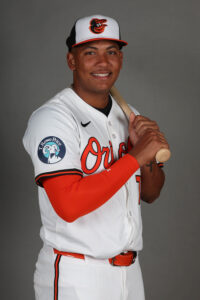
Another interesting name who should be in the mix is Samuel Basallo. An international signing out of the Dominican Republic in 2021, he got a healthy $1.3MM bonus. Since then, he has continued to climb prospect rankings with his excellent work in the minors. In 364 games on the farm to this point, Basallo has a combined .282/.364/.489 batting line and 134 wRC+. That includes a .252/.365/.595 line and 148 wRC+ at Triple-A this year. He has 13 home runs in just 39 games. His 25% strikeout rate is a bit high, but his 14.7% walk rate is almost double the league average.
There have been some question marks about his defense over the years, but prospect evaluators feel he has improved as he has aged. He is still only 20 years old and won’t turn 21 until August. Baseball America currently lists him as the #17 prospect in baseball. MLB Pipeline has him at #16. Keith Law of The Athletic just did a midseason update and had Basallo at #4. Coming into the year, ESPN had him at #17 and FanGraphs at #5.
The Orioles have one of the most talented catchers in baseball in Adley Rutschman, though he’s has been in a slump for almost a year now. The first overall pick of the 2019 draft, Rutschman was doing everything according to plan in his first few years in the big leagues.
From 2022-23, Rutschman hit 33 home runs, drew walks at a 13.6% clip and only struck out 16.2% of the time. His .268/.369/.439 line lead to a 130 wRC+, indicating he was 30% better than league average at the plate. The defense also received strong reviews. FanGraphs credited him with 11.3 wins above replacement over those two seasons, tops among all big league catchers in that time. That number doesn’t even account for intangibles, with Rutschman often complimented for his clubhouse leadership and work with a pitching staff.
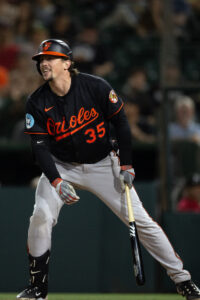
For the first half of 2024, Rutschman continued on that pace. Through June 26th, he had a .297/.350/.470 line and 135 wRC+. On June 27th, he was hit on his right hand by a foul tip and had that hand wrapped up after the game, per Roch Kubatko of MASNsports.com (video clip of the play from MLB.com, though the announcer accidentally refers to Rutschman as James McCann). Maybe the timing is a coincidence, but Rutschman hasn’t been the same since. He sat out the club’s game on June 28th but was back in there on the 29th. He slashed .189/.279/.280 for a 63 wRC+ in the rest of the season.
Here in 2025, the two-time All-Star been better but not back to his previous self. Rutschman has a .227/.321/.374 line and 103 wRC+ this year. Some of that may be luck. He has a .250 batting average on balls in play this season, which is well below his previous level and this year’s .290 league average. His 90.8 miles per hour average exit velocity is actually a career high. His 9.4% barrel rate and 40.9% hard-hit rate are also personal bests.
His batted ball metrics were down in the second half of 2024. Perhaps the most logical explanation is that Rutschman wasn’t 100% healthy after taking that foul tip last year, whereas he’s been mostly healthy but unlucky so far in 2025. He’s had a few knocks this year but has avoided the injured list. Maybe his results will even out in the long run and this dip will eventually look like a footnote. For what it’s worth, I personally think that’s the best and most likely explanation.
Even if Rutschman’s slump was just a blip and he’s back to his old self, the Orioles will still likely have to make some decisions about their plans behind the plate. Rutschman is now just over two years away from free agency, as he’s slated to hit the open market after the 2027 season. Despite a late-May call up in 2022, he earned a full year of service by finishing second in Rookie of the Year voting. There hasn’t been any indication that an extension is especially likely. With 2025 trending toward being a lost cause, the O’s may only have two more real bites of the apple with Rutschman.
There’s also Basallo’s health to consider. Though he continues mashing the ball, he has dealt with some injuries, including a hamstring issue and some elbow inflammation. Those issues, particularly the latter, have cut into his ability to get work behind the plate. In order to get him regular plate appearances, the O’s have put him at first base and in the designated hitter slot with some frequency. This year, he has 17 starts as a DH, nine at first and 11 behind the plate. He only has 90 innings in the catcher position this year. Last year, he had 35 starts as the DH, 32 at first base and 56 as the catcher.
That means it’s not a strict either/or situation. It’s entirely possible to imagine a scenario wherein Rutschman and Basallo share the catching duties and the DH slot while Basallo also gets some time at first base. Gary Sánchez was the planned backup to Rutschman this year, but he’s largely been hurt and is an impending free agent regardless. O’Hearn is an impending free agent as well. Ryan Mountcastle can be controlled through 2026 but looks like a non-tender candidate since he was having a poor year and is now going to be on the IL for months. Mayo could take over at first next year with Jordan Westburg at third base. Urias might still be on the roster next year, but the likely departures of O’Hearn and Mountcastle will free up some plate appearances.
Basallo’s bat will seemingly be good enough to play anywhere, but his offensive contributions will be more valuable if he can be a regular catcher. The Orioles might prefer to use the first base and DH spots for Mayo and their many young outfielders. If the O’s wanted to open the catcher position for Basallo, there might be some temptation to consider trading Rutschman.
Doing so this summer is not likely. Trading catchers midseason can be difficult because the backstop would have to learn an entirely new pitching staff on the fly. There’s also the fact that Rutschman’s value is likely down, on account of last year’s struggles and this year’s slow start. As referenced earlier, better days may be ahead, so waiting may be the smart play. With Basallo still a work in progress, there shouldn’t be short-term urgency to get a deal done.
But over the next few years, it’s possible that the pressure builds. Basallo coming up to the majors this year is totally viable, especially if the O’s sell off some pieces at the deadline and open up playing time. If he can hit big league pitching and continues maturing defensively, his viability as a major league catcher will grow. All the while, Rutschman’s window of control will be narrowing. As mentioned, he’s now about two and a half seasons from the open market. He’s making $5.5MM this year and will be due two more raises in arbitration.
As the window of control shrinks and his salary grows, his trade value will drop. That’s a tricky balance the O’s will have to consider. They have long had a big collection of position player talent but have struggled to have enough starting pitching. They have increased spending a bit in the past year but still haven’t made massive investments in the rotation, which has contributed to their unraveling this year.
Trading Rutschman and handing the catching duties to Basallo would certainly be a massive risk right now. But over time, perhaps it starts to look less risky, depending on how Basallo dives into the major league waters.
For other clubs, Rutschman would certainly hold appeal. Free agency usually isn’t a great place to find catching solutions. Backstops tend to show their age a bit more quickly than other players, due to the demands of the position. By the time players get to free agency, they are usually around 30 years old. Rutschman is now 27 and will be 28 and 29 in his final two arbitration seasons.
It’s practically a given that there would be teams willing to surrender controllable starting pitching to acquire Rutschman down the road. If so, the O’s will have to think about the perfect time to make that strike. Zach Eflin, Tomoyuki Sugano and Charlie Morton are all slated for free agency this winter, so the rotation should be the club’s primary target again in the coming offseason, even with Grayson Rodriguez and Kyle Bradish coming back from injuries.
There are no easy answers here and there are still many different ways it could go. But whenever Basallo does come up, he will start to get tested and the O’s will gradually get more clarity on who he can be. As that is happening, the window will be slowly shutting on the Rutschman era, barring a surprise extension. As those strings unravel simultaneously, decisions will have to be made.
Photo courtesy of Joe Camporeale, Kim Klement Neitzel, and D. Ross Cameron, Imagn Images
Poll: What Will The Rangers Do At The Deadline?
While the 2023 World Series champs missed the playoffs last year, a healthy Jacob deGrom and offseason additions like Joc Pederson and Jake Burger seemed to leave the Rangers in a good place to fight their way back to the top of the AL West this year. That hasn’t worked out very well so far, as despite an elite performance from their starting rotation lackluster offense from virtually everyone (save Wyatt Langford) has allowed the Rangers to fall to a 31-35 record. That leaves them 5.5 games out of the AL West entering play today, and 4.5 games back of an AL Wild Card spot.
It’s a tough position for the club to find itself in, particularly when one considers the team’s position regarding the luxury tax. It’s long been apparent than ducking under that first threshold is a priority for Texas this year and many of the moves they’ve made so far, from taking a flier on Patrick Corbin to fill out the rotation to letting Leody Taveras go on waivers, have been at least partially in service to that goal. RosterResource now estimates that Texas has a payroll of just under $235MM for luxury tax purposes, giving them around $6MM of space to work with under the first threshold.
That’s not a ton of space, even when considering that any players added will only need to be paid the prorated portion of their remaining deal. In that sense, indecision on whether to buy or sell could actually help the Rangers if they do decide to buy because any acquisitions will require less cash. With that being said, if Texas can’t get more from individual key players like Marcus Semien, Corey Seager, and Josh Jung it could be hard for the team to cover all of its needs on a shoestring budget even if they do stay relevant in the Wild Card picture.
One way to handle that would be to try and both buy and sell simultaneously at the deadline. Perhaps someone like Jon Gray (once he’s healthy) or Adolis Garcia (if his numbers improve a bit) could be dealt elsewhere for salary relief to allow the club to take a bigger swing and acquire a bat like Marcell Ozuna to help spark the offense. It’s also possible they could simply offer a larger return package to any clubs they buy from in exchange for the selling team eating most or all of the player’s salary. That would likely require the Rangers to firmly make their way into the playoff conversation from here, however, as teams are often hesitant to part with high-level talent to add players unless the postseason is fully in reach.
That could leave the Rangers to do at least some selling. But if they fall further in the standings, it’s not hard to imagine a larger sell-off. Right-hander Tyler Mahle has been nothing short of fantastic this year with a 2.02 ERA in 13 starts, and he should be one of the more highly coveted rentals if made available. Hoby Milner and Chris Martin would both be extremely attractive relief options for bullpen-needy clubs, as well. The team could even attempt to restructure their payroll in a more significant way by seeing if there are any takers on deGrom’s hefty salary, though moving that kind of money midseason is always challenging.
The final option on the table for the Rangers would be to simply do nothing. It’s fairly rare for a club to stand completely pat at the deadline, and the Rangers in particular have not typically been afraid to make moves under Chris Young’s leadership. With that being said, however, the club’s precarious position relative to the luxury tax and the aforementioned potential benefit of waiting until as close to the deadline as possible to make any buy-side moves could leave the team in position to risk doing very little to alter the club this summer, instead riding with the group they currently have and leaving large scale changes for an offseason that should offer more financial flexibility.
How do MLBTR readers think the Rangers will ultimately approach this summer’s trade deadline? Will they buy, sell, both, or neither? Have your say in the poll below:
How will the Rangers handle the deadline?
-
The Rangers will hedge their bets by both buying and selling at the deadline. 40% (845)
-
The Rangers will mostly stand pat at the deadline and make no significant moves at all. 24% (503)
-
The Rangers will sell at the deadline without making any significant buy-side moves. 23% (497)
-
The Rangers will buy at the deadline without selling off any significant pieces. 14% (294)
Total votes: 2,139
Poll: Which Contender Should Be Most Aggressive On The Rotation Market?
Trade season is fast approaching, and teams have mostly begun to start sorting themselves between the contenders and pretenders. At almost every trade deadline, there’s one need that teams prioritize filling than any other: starting pitching. There’s no such thing as too many starters, and that’s become even more true in recent years as pitching injuries have skyrocketed. Plenty of teams will want to add an impact arm (or at least some depth) to their rotation this summer, but which need help the most ahead of the stretch run? Here’s a look at some of the league’s top contenders:
Toronto Blue Jays
The Blue Jays have fought their way back into the AL Wild Card conversation recently, and they’ve done so despite a bottom-five rotation in baseball by ERA. Kevin Gausman and Chris Bassitt are both solid veterans who can be trusted to start a playoff game, and Jose Berrios is getting good results despite worrisome peripherals for the second year in a row. After that trio, however, things start to look dire. Bowden Francis has been one of the worst qualified starters in baseball this year, and the team has no defined fifth starter at all for the moment.
Spencer Turnbull is coming to help out sooner or later, but relying on a pitcher who last made even 20 appearances back in 2019 to help turn things around is risky. Alek Manoah and Max Scherzer could both contribute at some point in theory, but they’ve similarly dealt with injuries that have made them major question marks in recent years. For Toronto, one could argue that the question is less about whether or not they need another starter, but whether or not they’ll remain firmly enough in contention to justify the expense come July.
Chicago Cubs
The Cubs enter play today with the best record in the NL, and with Kyle Tucker set to reach free agency in November, there’s little question they’ll be buyers this summer. A stacked lineup that features few obvious holes makes pitching the most sensible place for them to look for upgrades, and it’s not hard to argue for starting pitching as the best choice when looking for upgrades. Cubs’ starters have combined for a 3.99 ERA this year, good for 19th in baseball. That’s below average in the league overall despite players like Matthew Boyd (3.01 ERA) and Colin Rea (3.59 ERA) pitching better than anyone would’ve assumed preseason.
Justin Steele is out for the season after undergoing surgery on his UCL, and he’s joined on the IL by co-ace Shota Imanaga while the veteran works his way back from a hamstring strain. Imanaga is expected back at some point this month, but with depth options like Javier Assad, Jordan Wicks, and Brandon Birdsell all also on the injured list, Ben Brown (5.72 ERA) struggling badly this season, and top prospect Cade Horton likely operating on an innings limit, it’s hard to imagine the Cubs not doing something to address their rotation this summer.
Los Angeles Dodgers
The Dodgers, at least on paper, have more rotation arms than they know what to do with. The reality of their situation is much different, however, as the vast majority of those pitchers are presently on the injured list. In conjunction with disappointing performances from players like Tyler Glasnow, Roki Sasaki, Tony Gonsolin, and Clayton Kershaw, those injuries have left the Dodgers with a 4.35 rotation ERA and the fifth-weakest starting staff in the NL this year. Their two-game lead on the Padres and three-game lead on the Giants in the NL West aren’t nearly as comfortable as they would surely like, and with a stacked lineup that has few obvious holes, that could make starting pitching the most obvious area for them to upgrade this summer.
On the other hand, it’s possible L.A. could simply rely on internal improvements as players get healthier. Yoshinobu Yamamoto is in the NL Cy Young conversation this year, and Dustin May has looked like a capable arm for the middle-to-back of the rotation. Glasnow, Sasaki, and Blake Snell are all expected back at some point or other this year, and Shohei Ohtani is of course working his way back to the big league mound. For a club that managed to win a World Series with a patchwork rotation just last year, perhaps that’s enough to feel comfortable standing pat this summer. Even so, at least another depth arm or two couldn’t hurt.
Cleveland Guardians
Long renowned for their excellent starting pitching development, the Guardians were one of several playoff teams last year who limped into October with major question marks in the rotation. With a 4.07 ERA and 4.55 FIP out of the rotation this year, they look to be at risk of doing so once again. Luis Ortiz looks like a solid mid-rotation arm, but Tanner Bibee and Gavin Williams have both seen their peripherals take a nosedive this year despite solid enough results. Cleveland recently lost Ben Lively for the season to Tommy John surgery as well, creating another hole in their rotation mix.
Perhaps an internal option like right-hander Zak Kent can be a surprise contributor, and Shane Bieber‘s eventual return from the injured list could provide a big boost so long as he can shake off the rust from a long layoff. That could make an outfield in need of upgrades a more pressing issue but it’s hard to imagine the rotation not being an area worth upgrading this summer. That’s especially true given that the bullpen that helped carry Cleveland to October last year has looked more “good” than “superhuman” in 2025.
Other Teams In Need
These four aren’t the only teams who could use some pitching help this summer. The Red Sox and Diamondbacks have both struggled to get results from their rotation, but have a deep group of arms in-house already and are far enough out of contention at this point that they may end up selling. That latter point is also true of the Braves, whose pitching situation looks more worrisome than ever after Spencer Strider has struggled in his return from surgery and AJ Smith-Shawver was lost for the year. The Yankees and Twins have pitched extremely well this season, but it would be understandable for either team to look for upgrades given the significant blow losing Gerrit Cole (Tommy John surgery) and Pablo Lopez (Grade 2 Lat Strain) dealt to each respective rotation. The Cardinals have gotten middling results from their rotation but have a bigger need in the outfield. The outfield also seems likely to be a bigger priority for the Astros, who have gotten great results from Hunter Brown and Framber Valdez but are currently relying on a patchwork at the back of their rotation while players like Cristian Javier and Spencer Arrighetti heal up on the injured list. Like the Astros, the Padres are currently running a top-heavy rotation a handful of question marks.
Which team do you think ought to be the most aggressive in pursuing starting pitching this summer? Have your say in the poll below:
Which Team Should Pursue Starting Pitching Most Aggressively?
-
Chicago Cubs 50% (1,679)
-
Toronto Blue Jays 14% (465)
-
Los Angeles Dodgers 14% (458)
-
Other (Specify In Comments) 13% (430)
-
Cleveland Guardians 9% (298)
Total votes: 3,330
How Should The Cardinals Approach The Deadline?
The Cardinals are amidst a transition year. That's true literally, as John Mozeliak will turn control of baseball operations to Chaim Bloom at season's end. Dating back to last fall, they've framed this season as one primarily about evaluating and developing young players. It's not a rebuild, but their only move to improve over the winter was a bargain $2MM signing of setup man Phil Maton.
It set them up as expected deadline sellers. Impending free agents Ryan Helsley and Erick Fedde ranked among the likeliest players to move in July. It was surprising that the Cards even held both players into the season. Nolan Arenado's contract and no-trade clause meant he'd be a tough player to move midseason, but those rumors figured to resurface.
The team is trying its best to avoid those conversations. They have a 34-27 record that has them narrowly ahead of San Francisco and Milwaukee for the NL's final playoff spot. They've outscored opponents by 28 runs, giving them the fifth-best run differential in the National League. They went an MLB-best 19-8 in May. They've played like a contender so far. One opposing GM who was eyeing trade targets on the St. Louis roster succinctly told Jeff Passan of ESPN this week that the team's better than expected play "sucks" for potential buyers.
Much can change in the next six to eight weeks, but the front office may find itself in a tricky spot. Mozeliak addressed the situation in a chat with Derrick Goold of The St. Louis Post-Dispatch last week. "We went into this year with an understanding this was going to be about opportunity for players and depending on what they do with it would determine our next steps, right?" he rhetorically asked. "So when you think about how the public had us as sellers — whether it was selling this offseason or selling at the trade deadline. It might look a little different based on how we’re playing."
It's an acknowledgment that the team could play its way off selling. At the same time, that wouldn't provide much clarity on how aggressively the team should add if they remain competitive. That's a tougher call, especially because of the way their first half has unfolded. The team may be better than expected, but the production has come mostly from their more established players -- particularly on offense. If the Cards are going to upgrade, the most obvious spots to do so would limit the playing time of a pair of young hitters on whom much of their season is supposed to be focused.

Unlock Subscriber-Exclusive Articles Like This One With a Trade Rumors Front Office Subscription
- Access weekly subscriber-only articles by Tim Dierkes, Steve Adams, and Anthony Franco.
- Join exclusive weekly live chats with Anthony.
- Remove ads and support our writers.
- Access GM-caliber tools like our MLB Contract Tracker
Poll: What Will Atlanta’s Deadline Look Like?
It was a tough start to the season in Atlanta, as they lost their first seven games in a row and 13 of their first 18 games. Brutal as that start to the season was, the club managed to turn things around in the latter weeks of April, and as recently as May 19 things were looking good. The Braves were 24-23, leaving them on the periphery of the Wild Card conversation, Spencer Strider was finally back from the injured list, and Ronald Acuna Jr. was just days away from his own return. Unfortunately, they’ve gone just 3-11 since then. That leaves them in fourth place in the NL East with a 27-34 record and 6.5 games out of the final NL Wild Card spot, with six teams they’d need to bypass in the standings in order to make it to the postseason.
Impressive and well-constructed as the team may look on paper, the group simply hasn’t been getting the job done in practice. Strider has pitched poorly (6.43 ERA, 6.93 FIP) in three starts since returning. AJ Smith-Shawver is done for the season after suffering a torn UCL. Ozzie Albies and Michael Harris II aren’t hitting. No qualified reliever in baseball has allowed more home runs than closer Raisel Iglesias. It’s impossible to know what they can expect to get out of Jurickson Profar when he returns from his PED suspension, and even if he plays well he won’t be eligible for the postseason.
Taken together, it’s hard not to see Atlanta as a team that has simply fallen too far behind the pack to justify continuing to push their chips in for the postseason. The good news is that, if they do decide to sell, they’ll have plenty of interesting pieces to move. Iglesias has had a rough year, but still boasts 232 saves and an ERA below 3.00 for his career. Marcell Ozuna has been one of the league’s top designated hitters for three straight seasons now, with a 148 wRC+ stretching back to 2023 that’s top-ten in baseball among hitters with at least 1,000 plate appearances in that time. Perhaps Alex Verdugo can be of interest to a team in need of outfield help, even in the midst of a down season (79 wRC+). Ozuna would immediately become the best hitter available this summer if dangled, and even in spite of his home run woes teams will be hard pressed to find a more decorated reliever than Iglesias to close out games for them.
If the Braves were to decide to sell, would they stop at rental pieces or consider dealing longer-term assets as well? They hold a team option on the services of veteran ace Chris Sale, but the reigning NL Cy Young winner would immediately become the most valuable asset on the market if president of baseball operations Alex Anthopoulos decided to dangle him. A $7MM team option for 2026 would make right-hander Pierce Johnson an attractive multi-year asset on the market as well. And with Drake Baldwin making his case to be NL Rookie of the Year, it’s not impossible to imagine Atlanta listening to offers on Sean Murphy and shedding the $45MM in guaranteed dollars remaining on his deal for his age 31-33 seasons. In a summer that looks like there may not be much impact talent available, there’s plenty of upside to be found in selling aggressively while the majority of the league is scrambling to improve ahead of the stretch run.
As much sense as it might seem to make for the Braves to listen on some of their top short-term pieces, it must be remembered that Anthopoulos and his front office aren’t afraid to zig when the rest of the league zags. Just a few years ago, Atlanta entered the All-Star break with a sub-.500 club that had just lost Acuna to a season-ending injury. It would’ve been understandable if they decided to sell, with Freddie Freeman, Chris Martin, Dansby Swanson, and Charlie Morton among the short-term assets they had in the fold at that point who could have brought back massive returns. Rather than entertain that option, the club added Joc Pederson, Jorge Soler, Adam Duvall, and Eddie Rosario to their beleaguered outfield and stayed the course. A few months later, they hoisted the Commissioner’s Trophy after beating the Astros in the World Series.
It shouldn’t shock anyone if club brass decides to stay the course once again this year in hopes of a similar Cinderella run. After all, the talent on Atlanta’s roster is enviable; all the same reasons that pieces like Iglesias and Ozuna would be attractive to rival organizations are reasons the Braves may simply prefer to try to win while they’re still in the fold rather than bank on figuring things out without them in the future, and that goes double for longer-term pieces like Sale and Murphy. Perhaps Strider will improve as he shakes off the rust from his long rehab, and Acuna has wasted no time thrusting himself back into the conversation as one of the league’s premier stars. With the 2023 NL MVP’s time under team control set to last only three more seasons after this one, it’s far to wonder if the Braves would really sacrifice one of those seasons by selling at the deadline.
How do MLBTR readers think Atlanta will approach the deadline this summer? Will they push their chips in and buy despite long odds, like they did in 2021? Will they do some light selling, casting off rental players in hopes of restocking in 2026? Or will they listen to offers on a wider range of players? Have your say in the poll below:
What Will The Braves Do This Summer?
-
Atlanta will sell at the deadline, but only listen on rental players. 36% (1,078)
-
Atlanta will sell at the deadline, and at least listen on some players controlled beyond 2025. 33% (981)
-
Atlanta will not sell at the deadline. 30% (901)
Total votes: 2,960
Poll: Should The Marlins Trade Ryan Weathers?
When it comes to trade candidates on the Marlins, the majority of the focus has been squarely on right-hander Sandy Alcantara. A recent Cy Young award winner who missed last season while rehabbing Tommy John surgery, Alcantara is earning a healthy salary on a team that is seemingly always looking for opportunities to lower its already-meager payroll and has enough team control remaining for rival clubs to convince themselves to part ways with prospects they’d never consider dealing for a rental arm.
That all makes Alcantara a sensible and attractive trade candidate on paper, but a major issue with those plans has emerged this year: he simply isn’t pitching very well. The righty’s 7.89 ERA through 12 starts is the worst mark among starters with at least 50 innings this year, and even more advanced metrics like his 5.04 FIP and 4.85 SIERA are the 11th- and tenth-worst figures in the sport respectively. It’s going to be hard to convince opposing teams to pay a premium for Alcantara as he’s currently pitching, and that’s a problem for a Miami club that’s in the midst of a deep rebuild.
While Alcantara might not be pitching like the front-line starter the team was hoping to be able to market to needy clubs this summer, another intriguing arm has inserted himself into the discussion with a strong start to the season: left-hander Ryan Weathers. The 25-year-old started the 2025 campaign on the injured list due to a forearm strain he suffered during Spring Training, but in four starts since returning he’s looked nothing short of excellent with a 2.49 ERA, 25.3% strikeout rate, and a 43.1% ground ball rate. Those peripherals don’t quite live up to that ERA, but even his 3.60 SIERA to this point in the year puts him on par with arms like Merrill Kelly and David Peterson who have established themselves as solid mid-rotation, playoff-caliber starters.
On top of his solid performance, Weathers would also be extremely attractive as a trade candidate because he’s making less than $780K this season and comes with plenty of team control. The southpaw won’t be a free agent until the end of the 2028 season, so even clubs facing tight budget restrictions in the short term or who aren’t interested in adding long-term salary commitments could have interest in his services if he’s made available. Weathers’ combination of strong results and a team-friendly contract situation could make him an extremely valuable trade asset for the Fish this summer.
With that being said, there are certainly strong reasons to think the Marlins may not want to part ways with the southpaw. Weathers is still just 25 years old and has yet to complete a full, healthy big league campaign with the club. Four starts is a small sample size that could make him difficult to market, and while good health should allow him to get more like ten to twelve starts under his belt before trade season kicks into high gear, it’s possible he’ll take a step back and wind up pitching closer to the 3.63 ERA and 4.11 FIP he posted in 16 starts last season going forward. Even if he does keep this level of success up, there’s certainly an argument to be made that Weathers could be dealt at a later date when he’s more established and teams might feel more comfortable surrendering a large trade package for him.
What’s more, Weathers’ three seasons of team control after this one could make the Marlins a bit more reluctant to trade the lefty. Miami surely hopes to be competing for the postseason again before 2029, especially with players like Kyle Stowers, Connor Norby, Agustin Ramirez, and Xavier Edwards showing themselves to be solid pieces this year. A potential front three of Eury Perez, Max Meyer, and Weathers under long-term team control would go a long way to making the Marlins legitimate contenders sooner rather than later, and many of those aforementioned pieces only have one more year of team control than Weathers does. Moving someone like Edward Cabrera, who has the same amount of team control remaining as Weathers but is two years older, could also be a preferable option given that Weathers is set to hit free agency ahead of his age-29 season.
Of course, many of the reasons that Weathers would be difficult to part ways with now could be argued as reasons he should be traded at some point. His injury history may make him less valuable in trade, but the Marlins are seeing right now with Alcantara what struggling after a major arm injury can do to a player’s value. The lefty’s youth would mean he’s in the prime of his career when the Marlins will hopefully be trying to contend again, but it also would make him a prime extension candidate for a club with deeper pockets than Miami. The collection of talent the club has at its disposal is impressive, but it still leans much more towards pitching than offense, so swapping a player like Weathers for a bat with similar control could go a long way to improving the team.
How do MLBTR readers think the Marlins should handle Weathers this summer? Should he be kept off the market entirely, shopped aggressively, or moved only if a team makes an overwhelming offer? Have your say in the poll below:
Should The Marlins Deal Ryan Weathers?
-
The Marlins should only trade Weathers if they get an exceptional offer. 58% (1,114)
-
The Marlins should trade Weathers for whatever they can get this summer. 29% (569)
-
The Marlins shouldn't trade Weathers this summer, no matter what. 13% (247)
Total votes: 1,930
Poll: Will The Diamondbacks Be Sellers This Summer?
The Diamondbacks have been one of the better teams in baseball in recent years. The won the NL pennant just two years ago, and last season put together a strong 89-win campaign that just barely missed the playoffs due to a three-way tiebreaker with the Braves and Mets. After an offseason where the club brought in Josh Naylor and Corbin Burnes among a handful of other additions, it wasn’t hard to see the Diamondbacks serving as the main challenger to the Dodgers in the NL West, or at least as an early favorite for one of the NL Wild Card spots.
Things haven’t worked out that way, however. The Diamondbacks entered play today with a 28-31 record that leaves them in fourth place in the NL West, 7.5 games back of the Dodgers but also behind the Padres and Giants. Even in the NL Wild Card race, Arizona is five games back, in line with the records of likely sellers in other divisions like the Nationals and Reds. While they entered the season with a 60.4% chance to make the playoffs according to Fangraphs, today’s playoff odds give them just a 27.9% chance to play in the postseason this year. Those odds are a worrying sign, but they’re hardly the be-all and end-all; the Tigers (20.3%) and Mets (9.8%) both had slimmer odds at the postseason than that one year ago today and ended up not only making the playoffs but playing fairly deep into October.
What separates Arizona from last year’s surprise contenders, however, is that they clearly appear to be on the downswing. Burnes is having elbow troubles, leaving his future at the top of their rotation uncertain at best. Closer A.J. Puk is on the 60-day injured list with an uncertain timeline*. Zac Gallen hasn’t looked like himself all season, and Brandon Pfaadt was having trouble staying consistent even before he gave up eight runs without recording an out in his most recent start against the Nationals. An offense with players like Corbin Carroll, Geraldo Perdomo, Ketel Marte, and even Pavin Smith all hitting incredibly well feels as though it should be a slam dunk to make the postseason, but the club just doesn’t appear to have enough pitching to make a run as presently constructed without significant turnarounds from players like Gallen.
An argument could be made, however, that with Marte nearing the end of his prime years and players like Gallen, Naylor, Merrill Kelly, and Eugenio Suarez ticketed for free agency this winter, that the Diamondbacks would simply be best served supplementing the current roster with more pitching this summer and attempting to make a late-season run. A number of interesting arms could potentially be available this summer, ranging from mid-rotation pieces like Zach Eflin and Nick Martinez to relief help like Pete Fairbanks and Kyle Finnegan. Any of those options could help stabilize the pitching staff enough for Arizona’s vaunted offense to carry the rest of the load, and that’s before considering the unlikely but still feasible possibilities that teams like the Astros and Cardinals decide to dangle Framber Valdez and Ryan Helsley.
The complication with that, however, is that Arizona is already in very uncharted waters when it comes to payroll. Efforts to trade Jordan Montgomery to free up payroll space this winter were unsuccessful, and the fact that he ended up going under the knife before the season began put a stop to any hopes of moving him to make room for other players in the budget this summer. It’s at least theoretically possible ownership could be willing to green-light even more spending for a squad that RosterResource suggests is already costing the club $196MM this year, but it would hardly be a surprise if managing general partner Ken Kendrick was reluctant to invest in the team further without them showing more signs of life. Young players like Carroll, Jordan Lawlar, and Perdomo aren’t going anywhere, so it’s not hard to imagine the club being able to load up on talent this summer by moving players like Gallen and Suarez with an eye towards contending in 2026 and beyond.
Perhaps the best news for the Diamondbacks at this point is that there’s still nearly two months until the deadline, meaning they won’t need to make a decision for at least a few more weeks. A late June stretch where the club enjoys nine consecutive games against the Rockies, White Sox, and Marlins could easily provide just the sort of shot in the arm Arizona needs to get right back into the thick of the Wild Card race, especially if they’re able to take series against more middle-of-the-road clubs like Atlanta, Cincinnati, and Toronto over the next two weeks.
How do MLBTR readers think the Diamondbacks will ultimately handle their deadline dilemma? Will they push their chips in with the 2025 club, or dangle players like Gallen in hopes of building a stronger team for next year? Have your say in the poll below:
What Will The Diamondbacks Do This Summer?
-
Arizona will make moves that both add to and subtract from the roster. 50% (643)
-
Arizona will be sellers at the trade deadline. 35% (458)
-
Arizona will be buyers at the trade deadline. 15% (195)
Total votes: 1,296
*This post originally stated that Puk was done for the year. MLBTR regrets the error.