6 Pending Free Agents Who Improved Their Stock In May
While the usual “it’s still early” caveat goes without saying, some teams have already played a third of their schedule. We’re quickly approaching that point when a good start morphs into simply a good season altogether. Looking at the lists of position players and pitchers (big tip of the hat to Fangraphs) who are eligible to hit the open market after the 2016 season, some notable names have already done a lot to position themselves for big multi-year deals this winter. This post won’t focus as much on the upper-tier players who may sit atop the free agent power rankings, but rather the lower- or middle-tier names coming into this season looking to greatly improve their stock.
Jeremy Hellickson, Phillies: A thin starting pitching class became even thinner after Stephen Strasburg signed an extension with the Nationals, which opens the door for several free agent starters to score larger-than-expected contracts. For instance, look at the 2011 AL Rookie of the Year enjoying a strong rebound season in Philadelphia. Hellickson posted a 3.58 ERA, 8.84 K/9 and 4.63 K/9 rate in 37 2/3 IP last month and delivered similar numbers in April. ERA predictors xFIP (3.37) and SIERA (3.39) actually have an even brighter view of the righty’s season, in a reversal of Hellickson’s early seasons with Tampa Bay when he was posting low ERAs but worrisome peripherals. Hellickson is on pace for career-bests in strikeout and walk rates, and he’s performing well despite an ungainly 16.4% home run rate. You wouldn’t have pegged Hellickson as a qualifying offer candidate prior to the season, though now it’s not out of the realm of possibility…unless, of course, he gets traded, though that could depend on whether or not the surprisingly competitive Phillies decide to take a run at a wild card.
Aaron Hill, Brewers: After two mediocre seasons in Arizona and a rough April in Milwaukee, it looked like Hill’s career simply might have been winding down in his age-34 season. Then, Hill hit .357/.455/.583 with five homers and 14 runs in 100 PA over a scalding-hot May, posting the same fWAR (+1.4) over the month as the likes of David Ortiz, Kris Bryant and Mookie Betts. No doubt the .385 BABIP helped Hill post those big numbers, though when you’re a mid-30’s veteran, even one excellent month could be the difference between your next contract being a Major League or minor league deal. If Hill even remotely approaches similar production over the next six weeks, he would stand out as a trade deadline chip for contenders looking for infield help.
Steve Pearce, Rays: Speaking of veteran infielders coming off a big month, Pearce has started games at first, second and third for Tampa this season, while crushing seven homers and hitting .317/.406/.622 over 96 PA in May. Pearce hit the open market last winter with a rather hard-to-evaluate stock, though with another strong season under his belt, he should finally be able to command a multi-year deal. Pearce still has lopsided splits (.736 OPS vs. righty pitching, 1.297 OPS vs. lefties) but a player who can provide that kind of power in a ballpark that typically suppresses right-handed power (i.e. Tropicana Field) will turn heads.
Doug Fister, Astros: The right-hander was so bad in April that MLBTR’s Steve Adams cited him as one of the free agents who had hurt their stock with a poor showing in the opening month. Like Hill, however, Fister righted the ship in May, posting a 2.84 ERA and 57.4% grounder rate over 38 innings. ERA indicators weren’t as kind (4.12 FIP, 4.06 xFIP, 4.18 SIERA) in May, but even in a couple of his prime seasons, Fister’s low-strikeout, grounder-heavy attack led him to outperform the advanced metrics. Fister still has a couple of warning signs hanging over him, namely a 3.3 BB/9 that would be a career high over a full season and an average fastball that clocks in at 86.4 mph, only a touch higher than his FB velocity during his rough 2015 season. Still, given how poor Fister looked in April, any sort of improvement is welcome.
Logan Morrison, Rays: How bad was Morrison’s April? Put it this way…he posted an astonishing negative-22 wRC+ over 64 PA in April, meaning he created 122% fewer runs than a league-average player. Just as quickly, however, Morrison went from hitting like Bob Friend to hitting like Mike Trout, thanks to a .351/.455/.486 slash line (and a 167 wRC+) over 88 PA in May. The month-to-month gulf was so enormous that it’s somewhat hard to predict what’s next for Morrison, though his big May provides some hope that he can still emerge as a post-hype prospect for Tampa and land a solid contract in the offseason.
Chase Utley, Dodgers: Utley hit .281/.363/.416 with three homers and 18 runs scored over 102 May plate appearances, making it back-to-back solid months for the veteran second baseman. While Utley’s .336 BABIP hints that his revival may not last, he’s still on pace for a big improvement over his poor 2015 campaign. I’m going to go out on a limb and guess that the Mets won’t be bidding on Utley in this winter’s free agent market, though he’ll find plenty of interest amongst the other 29 teams if he chooses to keep playing into his age-38 season.
2017 MLB Free Agent Power Rankings
During the month of May, we saw a pair of key players decide to forgo free agency. Nationals starter Stephen Strasburg, by far the best projected free agent from the 2016-17 class, signed a seven-year, $175MM extension that includes heavy deferrals and two opt-out clauses. I believe Strasburg left at least $50MM on the table in making the surprising decision to sign. With Strasburg off the market, we’re unlikely to see any $100MM pitchers this winter after four hurlers reached that mark last offseason.
Francisco Cervelli, projected to be the best catcher on the 2016-17 free agent market, signed a three-year, $31MM extension with the Pirates. Cervelli may have left $20MM or more on the table in signing his new deal.
So, we’ve lost the #1 and #10 free agents on last month’s power rankings. Below, I’ve ranked the remaining projected free agents by earning power. You can view the full list of 2016-17 MLB free agents here.
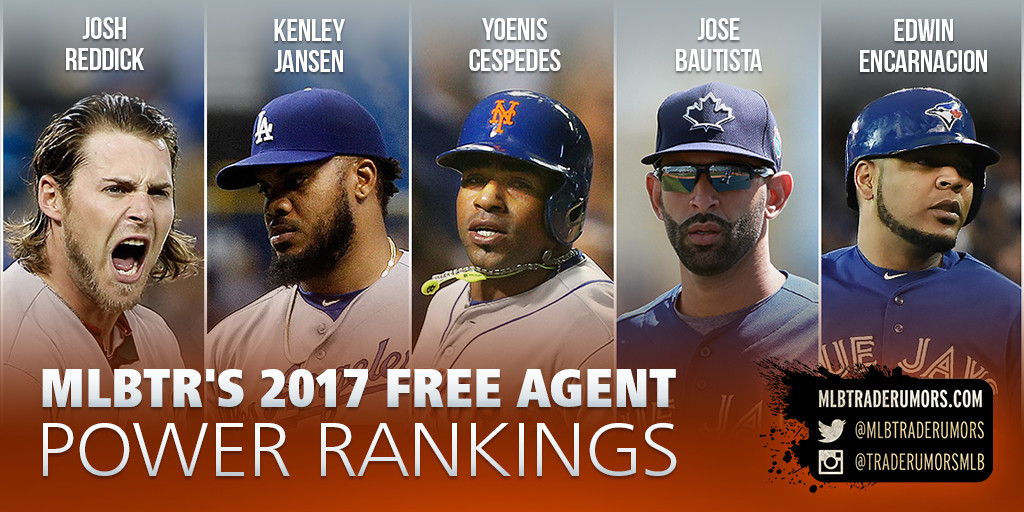
1. Yoenis Cespedes. With 15 home runs in his first 193 plate appearances, Cespedes has a good chance to reach 40 for the first time. He’s increasingly likely to opt out of the remaining two years and $47.5MM on his contract with the Mets. The 30-year-old slugger could be the only free agent to reach $100MM this offseason, underlining the lack of relatively young high-end players on the market.
2. Jose Bautista. The most noteworthy part of Bautista’s May was his run-in with Rougned Odor‘s fist. Bautista served a one-game suspension for his role in the ensuing brawl. At the moment, I’m projecting a four-year deal in the $100MM range for Bautista, who turns 36 in October.
3. Josh Reddick. Reddick fractured his left thumb during a headfirst slide on May 19th. While the injury will not require surgery, he’s expected to be out until late June. Reddick was swinging a hot bat leading up to the injury. Assuming he continues to produce upon his return, I don’t see the injury affecting his earning power. I can see a five-year deal approaching $100MM.
4. Kenley Jansen. Not much has changed with Jansen, who has a shot at a five-year deal. It seems likely that a reliever will end up with the largest pitching contract of the offseason.
5. Edwin Encarnacion. Encarnacion recovered from an ugly April to post a solid May. He could wind up with a three-year deal with a salary in excess of $20MM.
6. Dexter Fowler. Fowler continued to rake in the month of May, hitting .295/.403/.476. He currently ranks third among position players with 3.2 wins above replacement, after Mike Trout and Manny Machado. I’m projecting a four-year deal in excess of $60MM for Fowler, after he was left with a disappointing one-year deal last winter.
7. Aroldis Chapman. Chapman made his Yankees debut on May 9th after serving a 30-day suspension for a domestic violence incident. He’s looked as dominant as ever, and a large free agent payday is in the offing. The question is whether Chapman can get a five-year deal, in light of that October incident.
8. Neil Walker. Walker posted another solid month for the Mets. In a thin market, perhaps he could land a Chase Headley contract (four years, $52MM) if he keeps going strong.
9. Rich Hill. Hill now has 11 starts under his belt this year with a 2.25 ERA and 10.4 K/9. The southpaw, who turns 37 next March, has come a long way in the last year. He appears to have a good chance at a four-win season, which generally seemed impossible for most of the last decade. Despite Hill’s age, I think a three-year deal in excess of $40MM is within reach.
10. Mark Trumbo. After another big power month, Trumbo is now tied for third in the AL with 15 home runs. If he winds up near 40 home runs this year, a strong three-year deal becomes possible. However, his value is hurt by his defensive limitations.
Carlos Gomez, who was ranked fifth on this list last month, has dropped out of the top ten. The hope is that he’ll finally start hitting after serving a May DL stint for bruised ribs. However, at this point he’s a candidate to take a one-year deal to rebuild value.
Four players were very close to making the list: catchers Matt Wieters and Wilson Ramos, and outfielders Michael Saunders and Ian Desmond. Each of them appears to be setting up for a three-year deal at this point. If four years starts to seem likely for any of these players, they’ll have a spot in the top ten.
Top 10 Trade Candidates
We’re introducing a new series in the run-up to the trade deadline, drawing from our power ranking approach to pending free agents. As the summer trade market develops on a fairly tight timeline, you can expect more regular updates when modifications to the list are warranted.
The methodology — if you can call it that — is pretty straightforward. I’ve done some simple ratings of players for their trade value and trade likelihood, giving me a rough guide to work from, then made finer distinctions from there, aided by the input of MLBTR’s Tim Dierkes and Steve Adams.
In terms of trade value, we’re starting with overall on-field value — with a premium on an ability to make an impact in the current season — and then adjusting for contract and market factors. With contenders’ needs in relatively sharp focus, limitations such as future contract status, age, and niche role (platoon bats, relief-only pitchers) tend to have less of a drag on value — though obviously they still matter quite a bit. With regard to the second factor, the focus is on potential selling teams’ motivation to deal, with contract status, near and long-term roster fit, and overall competitiveness all weighing heavily. Some teams simply aren’t in a position at present where it makes sense to include their top potential trade chips, but that will evolve over the coming weeks.
It’s subjective; it’s debatable; and that’s what makes it fun. Here’s the first list, with some additional names and teams to keep an eye on appended at the end:
1. Jonathan Lucroy, C, Brewers — Lucroy was a fairly easy choice for me here. He’s playing well, the contract has value beyond this year but not within Milwaukee’s expected contention timeline, he’s established but not old, and he plays a position of need around the league. It’s unusual to see major deals involving catchers at the deadline, but that should change this year.
2. Rich Hill, SP, Athletics — It may be too soon to say whether and when the A’s will deal, but things are trending strongly in that direction and Hill is a classic deadline piece as a pure rental whose value is peaking at the right time. He could draw widespread interest, sooner rather than later. Fortunately for Oakland, a recent groin tweak seems unlikely to shelve him.
3. Ryan Braun, OF, Brewers — Braun is mashing at career-best levels in his age-32 season, and now may be the best time for Milwaukee to move on from the four years and $76MM left on his contract after this season. Health is a big question, and Braun’s PED past doesn’t help, but that’s a fairly reasonable rate of pay for a player who could well be the best bat available.
4. Jay Bruce, OF, Reds — Perhaps the single most likely player to be traded in all of baseball, Bruce is posting above-average offensive numbers and would deliver some pop to another lineup. On the other hand, his defensive fall-off has been precipitous. His option for 2017 delivers some upside, in theory, but it comes with a $1MM buyout and he’s no bargain at a $12.5MM annual salary this year.
5. James Shields, SP, Padres — Shields isn’t the pitcher he once was at 34 years of age, but he’s as steady and durable as they come and is getting better results than might be expected. His contract is a bit of a wild card, since it allows him to opt out at the end of the year. Shields is earning $21MM this year on a deal that guarantees him another two years and $44MM thereafter if he chooses to take it. Chatter is already picking up on the veteran.
6. Arodys Vizcaino, RP, Braves — Vizcaino, 25, has been about as dominant as any reliever in baseball. Even if the Braves would like to keep their pen ace around for his three remaining seasons of arbitration eligibility, the Ken Giles deal serves as a reminder of both the value of controllable late-inning arms and their volatility.
7. Chris Carter, 1B, Brewers — He’s a streaky, high-K, low-OBP hitter, and everyone knows it. On the other hand, even after a recent lull, Carter has banged 13 long balls and owns a .500+ slugging percentage through just over 200 plate appearances. Oh, and he’s earning only $2.5MM at 29 years of age, with two more arb-eligible campaigns to come. A return to the American League may be in order.
8. Trevor Plouffe, 3B, Twins — He’s not the most exciting player, but Plouffe is sturdy and useful. It’s not immediately clear whether Minnesota will let him go after foregoing a trade over the winter, and a middling start doesn’t help his value, but it’s probably time for the Twins to get value with one more arb year remaining. Plouffe is playing at a reasonable, but hardly bargain rate of $7.25MM.
9. Julio Teheran, SP, Braves — Just 25 years of age, Teheran is showing signs of returning to being the budding frontline starter that he once was. He’s controllable for a meager commitment, Atlanta has proven willing to trade anyone at any time (well, almost anyone), and the empty cupboard of starters on next year’s free-agent market could increase demand. But GM John Coppolella has significantly raised the bar for a deal of the staff ace, even if he didn’t rule it out entirely.
10. Fernando Abad, RP, Twins — This spot probably could have gone to any number of relievers, several of whom are listed below, but I felt that Abad edged the field with his eye-opening work thus far. He’s allowed just a single earned run on 13 hits and five walks in 19 1/3 innings — while racking up 18 strikeouts and posting a career-best 57.1% groundball rate. Plus, he’s a lefty and he’s been effective against hitters from both sides of the plate this year. Additionally, he’s controllable through the 2017 season.
—
Just Missed: Danny Valencia (Athletics); Gordon Beckham and Ender Inciarte (Braves); Jeremy Jeffress (Brewers); Andrew Cashner, Derek Norris, and Fernando Rodney (Padres); Zack Cozart (Reds); Kevin Jepsen and Ervin Santana (Twins)
Injured: Tyson Ross (Padres), Josh Reddick & Sonny Gray (Athletics), Will Smith (Brewers)
Not Yet Eligible: At this stage, there are some teams that are beginning to look like plausible sellers that I’m not quite comfortable considering for these purposes. In some cases, that’s because of unexpectedly solid performances; in others, it’s because expectations were high and the organization is unlikely to act hastily.
The Rays are in an interesting spot; they hope to contend despite an uneven start, but could still move major league rotation pieces (Matt Moore; Jake Odorizzi) given the team’s surplus at the position. The Phillies (Jeremy Hellickson; David Hernandez; Jeanmar Gomez) are still too much in the hunt to go in the sell category, though they could end up there soon enough. Likewise, the Astros have shown signs of life and seem a less likely seller than the division-rival A’s, though they have several short-term pieces (Carlos Gomez; Colby Rasmus; Luis Valbuena; Luke Gregerson) that would be interesting if Houston can’t gain traction. We might eventually see the Angels (Huston Street; Joe Smith; Yunel Escobar) as partial sellers, but they’re not likely to throw in the towel — if at all — until the last moment. On the National League side of the west, the Diamondbacks (Brad Ziegler; Daniel Hudson; Tyler Clippard) and Rockies (Carlos Gonzalez; Jake McGee) are still a good ways away from the tipping point.
Notable Trades In The Month Of June
With the calendar about to flip to June, it seemed like an opportune time to run through some recent transactions in the month before primary deadline season. Most major swaps occur in July, of course, and most of those occur toward the end of the month. (This year, we’ll all be waiting with baited breath on August 1st, which is the trade deadline in 2016.)
The biggest “early” deadline deal of recent memory — the 2014 swap that sent Jeff Samardzija and Jason Hammel from the Cubs to the Athletics in exchange for Addison Russell, Billy McKinney, and Dan Straily — didn’t go through until the 4th of July. Likewise, the equally important deal from the year prior — in which the Cubs nabbed Jake Arrieta and Pedro Strop from the Orioles for Scott Feldman and Steve Clevenger — was reached on July 2nd.
But that doesn’t mean that nothing of consequence occurs in June. Those deals could easily have come a few days sooner, and baseball’s increasingly free-wheeling player market could lead to some surprises. Indeed, we’ve already heard significant chatter involving James Shields. Organizations looking to reap added trade value could well strike earlier than usual this time around.
What kinds of swaps might be anticipated over the thirty days to come? Here are some of the most notable deals that were actually completed in the month of June over the last four seasons:
2015
- The month started with an interest arrangement that saw slugger Mark Trumbo head from the D-Backs to the Mariners along with lefty Vidal Nuno. That seemed mostly motivated by salary from Arizona’s perspective, but the team has received compelling production from backstop Welington Castillo. The team also picked up righty Dominic Leone and prospects Gabby Guerrero and Jack Reinheimer from Seattle.
- One day later, the Orioles sent veteran outfielder Alejandro De Aza to the Red Sox after designating him for assignment, receiving minor league righty Joe Gunkel in return. De Aza performed well in Boston, which took on about $1MM of his remaining salary, but couldn’t turn around a sinking ship, and was eventually passed along to the Giants.
- Later that June, the D-Backs struck another interesting deal. In exchange for taking over about $10MM of salary obligations to injured veteran Bronson Arroyo, and sending over infielder Philip Gosselin, the Braves earned the rights to high-upside pitching prospect Touki Toussaint.
2014
- In another agreement involving prospect assets, the Pirates got the 39th overall pick in the 2014 draft from the Marlins on June 1. Miami picked up righty Bryan Morris, who’s been a sturdy reliever who’s still controlled for two more years, while Pittsburgh ultimately turned that selection into first baseman Connor Joe, who has largely scuffled in the low minors since.
- Later that month, the Pirates and Angels made a change-of-scenery swap that sent Jason Grilli out west in exchange for Ernesto Frieri. While Grilli provided some solid innings, Frieri faded, though both organizations ended up making the post-season.
2013
- DFA swaps are often fruitful in the middle of the year, and the Brewers managed to land a useful piece from the Braves out of limbo. Third baseman Juan Francisco went to Milwaukee for lefty Tom Keeling, and ultimately gave the Brew Crew a league-average bat with some pop while the club dealt with an injury to veteran Aramis Ramirez.
- A middle-of-the-month trade of seemingly limited consequence was reached between the Mets and Rockies. New York added speedy but limited outfielder Eric Young Jr., while Colorado picked up righty Collin McHugh. The latter didn’t find success at Coors Field, but turned into quite a useful starter for the Astros in the season that followed.
2012
- The month of June started with a quiet transfer of cash considerations from the Orioles to the division-rival Yankees. The return? A first baseman by the name of Steve Pearce, who had joined New York on a minor league deal. He showed a bit of a spark that year, filled in usefully in 2013, and then exploded in the following season, when the O’s trounced the Yankees and the rest of the AL East.
- Kevin Youkilis traded color schemes, going from the Red Sox to the White Sox on June 24th. A struggling Youk headed to Chicago along with a stack of salary-offsetting cash for righty Zach Stewart and utilityman Brent Lillibridge. The 33-year-old provided a jolt for the South Siders, though the club ultimately fell shy of the playoffs.
- And at month’s end, the Orioles picked up veteran slugger Jim Thome from the Phillies in exchange for a pair of prospects (Kyle Simon and Gabriel Lino). The 41-year-old Thome wasn’t an impact bat for Baltimore, but neither of the players dealt has been of much consequence since.
MLBTR Originals
Here’s a look back at MLBTR’s original analysis and reporting over the past seven days:
- Before the Mets acquired James Loney on Saturday to take the place of the injured Lucas Duda, Jeff Todd combed through a host of possible outside acquisitions to fill in at first base for the club. Jeff wrote that Loney “might be the most obvious and realistic target.”
- With the season having passed the quarter mark, I examined seven trade candidates whose stock has dropped for performance- or injury-related reasons (or, in some cases, both).
- Athletics left-hander Rich Hill is another potential trade chip, but unlike the aforementioned septet, his value is soaring. I looked at some of the numbers behind his success and ran down several pitching-needy playoff contenders that could try to acquire the 36-year-old this summer.
Rich Hill: This Summer’s Sought-After Arm
Imagine a world without Clayton Kershaw. Following baseball would be a lot less entertaining for those who derive joy from watching a dominant player perform at an all-time great level, but at least the sport wouldn’t be devoid of standout left-handers. The likes of Chris Sale, David Price, Madison Bumgarner, Jon Lester, Cole Hamels, Dallas Keuchel, Jose Quintana and Rich Hill would still be around, after all.
One of those names is eye-catching, and it’s certainly not Sale, Price, Bumgarner, Lester or Hamels, all of whom have long track records of excellence. Keuchel has faltered in the early going this season, but he was stellar in 2014 and followed that up with an American League Cy Young Award-winning campaign in 2015. Quintana, meanwhile, has been one of baseball’s most effective starters since his coming-out party in 2013.
Now we arrive at the 36-year-old Hill, who ranges from four to 10 years the senior of every other southpaw listed above. This is the same Hill who, prior to last September, hadn’t made a major league start since 2009. Between 2007-15, he appeared in the majors with seven different teams – including multiple stints with the Red Sox – and toiled with a slew of minor league clubs. As recently as last August, Hill was in the independent Atlantic League as a member of the Long Island Ducks. The Red Sox then brought back Hill on a minor league deal in mid-August, and they summoned him to the majors a month later. Beginning on September 13th, Hill embarked on a four-start rampage that saw him strike out 32 hitters, walk five and compile a 1.55 ERA across 29 innings. Hill parlayed that resoundingly successful three-week run into the richest payday of his career when he landed a one-year, $6MM deal with the Athletics in November.
Over nearly twice the sample size this year (57 2/3 innings), Hill’s brilliance has continued. Among qualified starters this 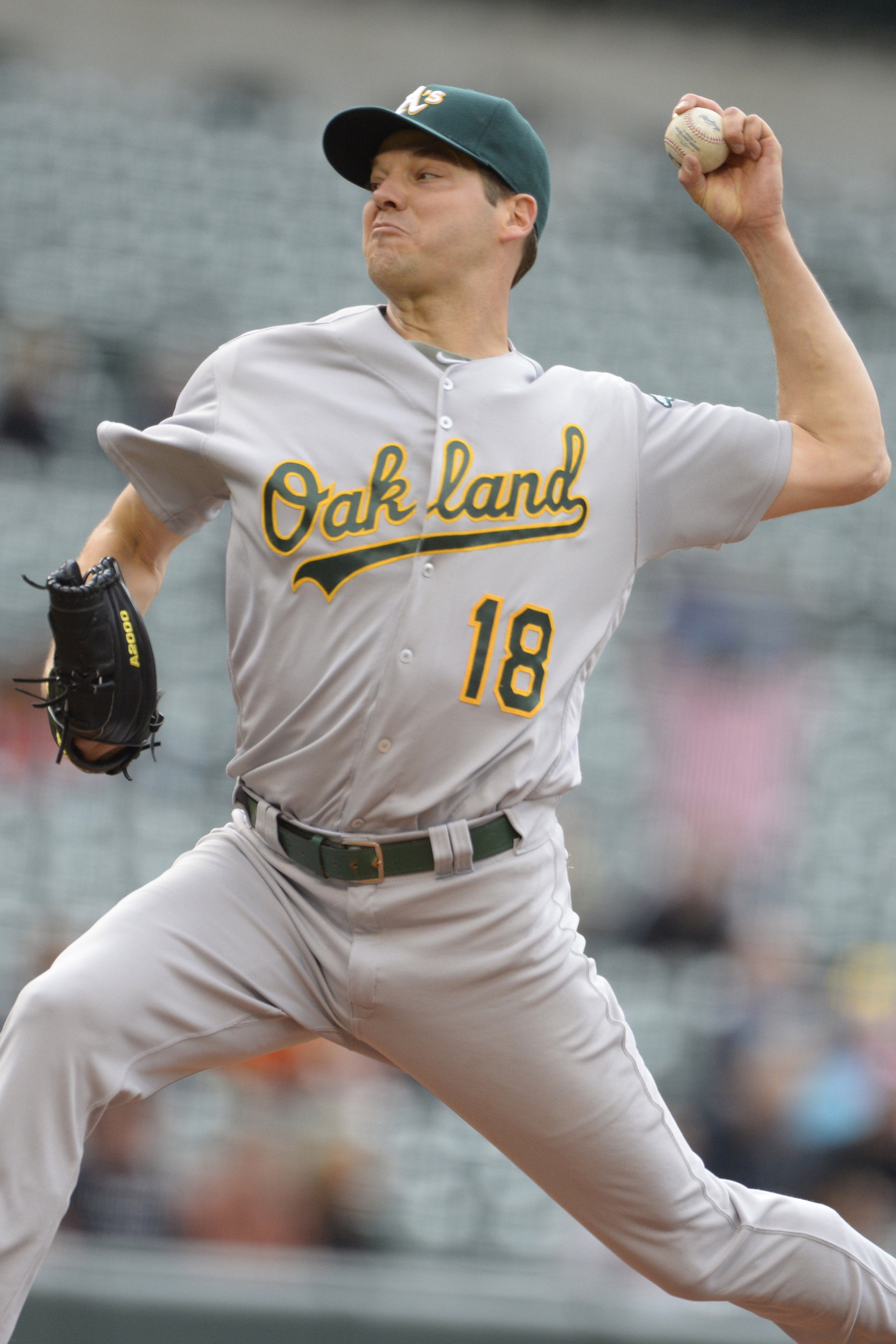 season, Hill ranks eighth in ERA (2.18), ninth in FIP (2.72) and 13th in K/9 (10.13). His 3.60 xFIP is less exciting, albeit still easily above the league-average mark of 4.03, and Hill’s 48.5 percent grounder rate trails only Noah Syndergaard, Kershaw and Danny Salazar among pitchers who have struck out at least 10 batters per nine innings. Amazingly, Hill manages to keep company with their ilk despite neither throwing particularly hard nor possessing an expansive repertoire with which to confound hitters. His 90.4 mph average fastball isn’t exactly imposing, and Hill relies almost exclusively on two pitches. The thing is, opposing offenses can’t seem to figure out either pitch. Hill’s curveball, which he has thrown a little over 50 percent of the time this year, has been the second-most valuable curve in the league to this point, according to FanGraphs. His four-seamer, deployed on 44 percent of pitches, has been the league’s 11th-most valuable fastball, placing him in a class with Syndergaard, Stephen Strasburg and Johnny Cueto.
Moreover, Hill hasn’t shown vulnerability against either left- or right-handed hitters. Lefties have slashed a terrible .200/.238/.254 line while facing Hill, and righties (.207/.320/.280) haven’t exactly resembled Mike Trout. All of that amounts to a .237 wOBA, which means Hill is turning enemy hitters into something resembling the toothless 2016 versions of Jose Iglesias (.234) and Alexei Ramirez (.245).
Everything isn’t perfect for Hill, granted, whose BB/9 of 3.28 is too high. He also could face regression from his 79.2 percent stand rate and .287 batting average on balls in play. Further, Hill has the league’s third-lowest swing rate (40.7 percent), so perhaps his numbers will revisit Earth if opposing hitters adjust and start trying to put the ball in play more against him. Of course, when batters have made contact against Hill, not much has happened. His 16.3 percent infield fly rate ranks seventh in the league, and Statcast (link via Baseball Savant) indicates that Hill has allowed an 86.3 mph average exit velocity on batted balls. Kershaw, by comparison, is at 86.4. As evidenced by some of the other names on the leaderboard, surrendering soft contact doesn’t always guarantee results, but it can’t be construed as a negative. Neither can limiting the distance of batted balls, which Hill has also done. At an average of 191 feet, he’s once again right in line with Kershaw, who’s at 192.
All of this analysis leads us to the fact that the A’s have an eminently valuable commodity on their hands as the August 1st trade deadline creeps closer. At 20-28, Oakland is already nine games out of the AL West lead and 7.5 behind in the Wild Card chase. What’s more, the A’s don’t look like a highly talented team destined for an appreciable turnaround. Assuming the club’s losing ways continue, there won’t be a compelling reason for executive vice president Billy Beane and general manager David Forst to retain Hill beyond the deadline. Not only is Hill a pending free agent, but he’ll likely be the top starter available over the summer if the A’s shop him. That should only serve to drive up the A’s asking price and enable them to secure something enticing in return for Hill. The only reason trading Hill wouldn’t make sense is if the A’s intend to extend the lefty, which can’t be ruled out.
The A’s and Bay Area-rival Giants aren’t known for dealing with each other, but Hill would seem to fit rather well in San Francisco’s rotation as it tries to secure an NL West title. The Giants have an outstanding trio in Bumgarner, Cueto and Jeff Samardzija, but they’re looking for answers otherwise. Another go-around with the Red Sox might make sense, too, given the uncertainty in their rotation past Price, Rick Porcello and knuckleballer Steven Wright. Teams like the Royals, Tigers, Rangers and Orioles (one of Hill’s previous employers), among others, look more hard up for rotation help than the Giants and Red Sox, and bear in mind that Baltimore may have created some in-season spending room with a pair of trades earlier this week. It’s also possible an injury (or injuries) will open up a need that doesn’t currently exist on another club’s starting staff, of course, thus leading to another potential Hill suitor.
FanGraphs pegs Hill’s 2016 contributions at $13.6MM in worth, which means the A’s have already more than doubled their investment so far, and – barring an injury to Hill or a drastic, unexpected decline in performance – they’re primed to continue building on that surplus value over the next couple months. When those months pass and the season reaches the deadline, the A’s will be in position to transform an aging player on whom they took an offseason flyer into at least one quality young piece from another team. Oakland has made some head-scratching decisions in recent years (the Josh Donaldson trade and the Billy Butler signing come to mind immediately), but the move to buy low on Hill is going as smoothly as the club could have hoped, and has the chance to continue paying dividends in future years.
Photo courtesy of USA Today Sports Images.
5 Ways For Mets To Find A Lucas Duda Fill-In
With the news that Mets first baseman Lucas Duda is out for a significant, but still-uncertain amount of time, New York has been left scrambling to identify a replacement. Internal options are questionable, leaving the team eyeing outside help.
Needless to say, the summer trade market remains largely undefined. And early deals are generally hard to come by, at least for more significant players. We’ll also posit that New York is interested in players who have some kind of MLB track record to speak of, both in terms of offensive production and defensive work at first base.
Generally speaking, then, there are five approaches the Mets could take in looking at new additions — most of them, varying approaches to the trade market. Of course, the team could pursue multiple avenues over the coming months.
Let’s take a look:
Controllable Bats
Duda is under club control for one more season after this one, though he’ll be due a raise on a $6.725MM arbitration salary, with the hope that he’ll play at a high level now while providing a bridge to prospect Dominic Smith. But the first base position is far from a certainty, and it’s at least plausible to imagine that longer-term assets would be considered.
Chris Carter of the Brewers could potentially be had, but his big start and remaining control might make him a bit expensive — at least this far in advance of the deadline. He’s also a streaky, all-or-nothing hitter and is less valuable to a National League club that can’t shift him to a DH role if and when that becomes preferable.
The Cardinals could be willing to part with Matt Adams, a 3+ arb class player who has struggled at times in recent years and is somewhat redundant with Brandon Moss on the roster. Of course, Adams has returned to form somewhat thus far while Moss is set to depart via free agency, and the contending Cards may not wish to part with either. It’s worth bearing in mind that Adams has continued to do the vast majority of his damage against righties, so he’s really not an everyday option in the interim and would be a poor fit when Duda returns.
Meanwhile, the Twins are as buried as any team in baseball, but it’s not clear that any of their first basemen are really trade candidates. Byung-ho Park would be a significant piece to pursue given his contract and promising early major league results, and certainly looks to be a part of Minnesota’s plans for a hopeful renaissance in the near future.
Rental Pieces
It’s always tough to assess which players are available, or could be as the deadline approaches, but usually there are some clear short-term veterans who can be had. It’s not really evident this year whether that’s the case, however.
The Orioles never seemed like the best fit for Pedro Alvarez, and he’s struggled at the plate. But he’s also needed now, filling in at times at third with J.J. Hardy out, and it’s anyone’s guess as to whether the club wants him on the roster moving forward. Baltimore could like the idea of shedding some salary to pursue other additions, though, and it did ship out a similarly-priced Alejandro De Aza in early June last year.
Other similarly questionable targets include Logan Morrison of the Rays, Mitch Moreland of the Rangers, and Justin Smoak of the Blue Jays. All are priced in the $4MM to $5MM range and play for teams that could, at least in theory, turn to other options while still seeking to make a run at the playoffs. Of course, only Smoak is hitting among this group, and Toronto seems rather unlikely to give up his bat at this stage.
In some ways, it’s even less clear whether the Rockies will have any willingness to talk about Mark Reynolds, but he’d also be a consideration. He’s a high-K hitter, of course, but is off to a nice start and is owed just $2.6MM this year. Also, Reynolds hits from the right side, making him a nice option to pair with Duda if and when he’s back in action.
That brings us to Kelly Johnson, who was acquired last summer by the Mets from the Braves. He’s back in Atlanta now, and there’s probably no team more willing to trade early than the struggling, rebuilding Braves. Of course, Johnson is off to a slow start and would at best be a solid bat, so he looks more like a stopgap solution.
Creative Possibilities
If the idea of adding Johnson and eventually moving him around the diamond holds appeal to New York, there are some other much more speculative names to consider, too.
MLB.com’s Anthony DiComo noted an interesting suggestion, tweeting that a scout opined that Jonathan Lucroy of the Brewers could be an interesting piece. In theory, he could fill in at first while also shoring up a questionable backstop situation down the line. Of course, Lucroy is expected to be widely pursued, and won’t come cheap.
There are some other options out there who could step in temporarily at first before moving to other spots or filling multi-positional utility roles. Trevor Plouffe of the Twins and Luis Valbuena of the Astros have both seen limited action at first in the majors but are primarily third basemen. Neither is particularly cheap. Their availability is questionable at best — especially at this stage of the season. Minnesota can keep Plouffe for another year and already declined to deal him over the winter, while Houston surely hopes to contend and has plenty of uncertainty at the corners (though plenty of options, as well).
Upper-Minors Veterans
There are plenty of players with significant MLB time who are currently awaiting their next opportunity at the Triple-A level with other clubs. Some possibilities include Travis Ishikawa (White Sox), Allen Craig (Red Sox), Jesus Montero and Casey Kotchman (Blue Jays), Jason Rogers (Pirates), Chris Parmelee and Nick Swisher (Yankees), and Tyler Moore (Braves). Casey McGehee of the Tigers would be another possibility, and he’d give the Mets another option at third as well. And don’t look now, but old friend Ike Davis is producing at Triple-A for the Rangers, who don’t have much need for him so long as they remain content with their current options at the major league level.
Then there’s James Loney, who is the type of patient hitter the Mets like in addition to being a polished fielder. He’s putting up typical numbers in the Padres organization — .333/.368/.417 — and might be the most obvious and realistic target. The Rays are paying Loney’s way this year, aside from a pro-rated portion of the MLB minimum, and Ken Rosenthal of FOX Sports tweets that he can abandon his deal with San Diego if a major league opportunity arises.
Free Agency
We shouldn’t forget that there are still some players kicking around on the open market, though none seem to be particularly promising. Justin Morneau would be a nice fit, but he’s not expected to pick up a bat until June due to elbow surgery and comes with other, more serious health questions. If he is able to return to the field, though, there could be a match, but it’s hard to see him as a viable option for some time.
Jeff Baker, Alberto Callaspo, and Corey Hart all remain free agents, but none have been particularly productive in recent years and it’s not entirely clear whether they’re interested in pursuing new contracts. There’s reason to believe that Michael Morse could have something left in the tank after giving the Pirates solid production in a 45-game run late last year, though he was cut loose by Pittsburgh after just eight plate appearances in 2016. His power numbers have plummeted of late, and he’s not much with the glove, but he’s also done quite a bit with the bat at the major league level.
—
It’s anyone’s guess how this all turns out, but a temporary fill-in seems most likely at present. Players like Johnson, Loney, and Morse look to be the best bets, as they’d all represent affordable and somewhat flexible assets, buying the Mets some time to see how Duda recovers while GM Sandy Alderson and his front office staff canvass the market for bigger adds.
After all, the biggest rental targets (Edwin Encarnacion? Jose Bautista?) won’t be made available unless and until it’s clear their teams are fully out of contention at the deadline. The best-case scenario may involve the addition of a player who’ll plug the gap now and fill another role upon Duda’s return, making for an efficient acquisition, but even smaller game will be more plentiful come July.
Trouble is, the optimal outcomes may not be plausible — at least during the stretch that a replacement is most needed, and at least for a palatable price. In the final analysis, New York has plenty of possibilities, but also some tough calls ahead.
7 Trade Candidates Who Have Hurt Their Stock
The 2016 Major League Baseball season is at the quarter pole and the second month of the campaign is nearly over, which means the Aug. 1 trade deadline is looming on the horizon for all 30 teams. It’s time, then, to highlight several players who entered the season as prospective trade candidates and have since weakened their respective values, be it through poor performance, injury or both. All of these players generated trade buzz during the winter, and each is a member of a team that was expected to be a deadline seller entering the season and hasn’t done anything to prove that belief wrong in the initial 40-plus games.
Athletics
Billy Butler: The A’s had talks with other teams about trading Butler over the winter, but their hopes of dealing the designated hitter are all but gone now. Butler, who’s currently making $10MM and is owed the same amount in 2017, has declined significantly since his heyday in the Royals’ lineup from 2009-13 and is hitting .209/.243/.284 without a home run in 70 plate appearances this year. Since 2014, his swan song in Kansas City, the 30-year-old Butler has batted a meek .258/.319/.379 with 24 homers in nearly 1,300 PAs, and given that he provides negative value in the field and on the base paths, that type of offensive output isn’t going to appeal to anyone. It remains baffling that the A’s signed Butler to a $30MM deal in 2014, and now they’re stuck with him.
Sonny Gray: While the A’s fielded plenty of inquiries on the right-hander during the offseason, they made it clear – at least publicly – that he wasn’t available. “We’ve been adamant with teams that we want to hang on to Gray,” executive vice president of baseball operations Billy Beane said in January. Prior to that comment, general manager David Forst stated in November that the A’s weren’t going to move Gray, saying, “As soon as you trade a young, healthy really good pitcher, you’re looking for another one.” Still, after back-to-back full seasons of ace-like production, four years of control over Gray, 26, would’ve landed Oakland a sizable haul. Gray is now in the midst of the worst year of his young career, having compiled a 6.19 ERA, 7.69 K/9 and 4.5 BB/9 in 48 innings, and the club placed him on the DL earlier today with a strained right trapezius. Given the weakness of the upcoming offseason’s free agent pitching market, teams would’ve kept hounding the A’s about Gray had he continued his effectiveness and stayed healthy this year. Neither of those things has happened, though, which decreases the already dubious odds of the A’s parting with Gray before the deadline.
Braves
Erick Aybar: When the rebuilding Braves acquired Aybar from the Angels as part of the Andrelton Simmons package, their hope was that he’d serve as a sturdy shortstop bridge between Simmons’ reign and the Dansby Swanson/Ozzie Albies era. Aybar has instead been the worst player on arguably the majors’ worst team, having hit .175/.216/.204 in 151 trips to the plate. The 32-year-old’s 7 wRC+ is easily last among qualifying hitters (his closest company is at 43), as is his minus-1.6 fWAR. The Braves had a high asking price on Aybar as of March, but they’ll have difficulty finding anyone willing to take the $8.5MM infielder in the last year of his contract if his play doesn’t substantially improve.
Nick Markakis: The Braves reportedly had opportunities to trade Markakis last winter and in 2015, but they elected to retain the right fielder instead. Considering that Markakis is on a $10.5MM annual salary from now until the end of 2018, Atlanta might regret not dealing the 32-year-old. Since joining the Braves last season, the power Markakis showed in Baltimore from 2006-14 has disappeared. In 871 PAs with the Braves, Markakis has totaled just four home runs – two fewer than Giants pitcher Madison Bumgarner, who has amassed 765 fewer PAs – and logged the majors’ fifth-worst ISO (.083). To Markakis’ credit, he has managed to produce a decent 105 wRC+ with the Braves and has gotten on base at an impressive 36.9 percent clip, but an aging, well-compensated, power-devoid corner outfielder who doesn’t grade well defensively simply doesn’t have much value.
Padres
Andrew Cashner: A report in December stated that the A.J. Preller-run Padres were pushing to move Cashner prior to his contract year, in which he’s making $7.15MM. However, the team was unwilling to deal the right-hander for then-Diamondbacks center fielder Ender Inciarte, Arizona GM Dave Stewart said. Even though Inciarte has struggled this year in Atlanta (he’s hardly alone), acquiring five years of control over him for one season of Cashner would’ve been a boon for the Padres. Instead, Cashner stayed in San Diego and has begun 2016 with 34 2/3 innings of 4.93 ERA/4.42 FIP/4.61 xFIP ball. The injury-prone Cashner – who’s on the DL with a minor hamstring issue – was better last season in posting a 4.34 ERA/3.85 FIP/3.84 xFIP, but he hasn’t been particularly effective at preventing runs since 2012-13 (3.33 ERA in 221 1/3 frames). Cashner’s trade value isn’t dead, but barring a turnaround after he comes back from the DL, odds are the Padres will have a tough time netting a return as enticing as the one they could’ve gotten for him over the winter. If the Padres aren’t satisfied with the offers they receive for Cashner this summer, they could keep the 29-year-old and extend him a qualifying offer after the season. The risk there would be that Cashner would actually accept the $15.8MM offer, as multiple players did last offseason. That would force the Padres to continue with Cashner at a salary worth more than double what he’s making now. Worse, the rebuilding club wouldn’t receive a first-round pick for him as compensation.
Matt Kemp: Nick Cafardo of the Boston Globe reported at the outset of this month that Kemp’s productive April had improved his trade value, but the right fielder has canceled that out with a .169/.173/.312 line in 81 May PAs. Long a below-average defensive outfielder, Kemp’s value throughout his career has been tied to his bat. Kemp’s offensive output has fallen off in recent years, however, and his value has cratered as a result. Since compiling a 3.2-fWAR campaign in 2012, the 31-year-old has been worth a combined 1.2 fWAR while hitting an unspectacular .270/.319/.459 in 1,714 PAs. It’s nice that Kemp continues to show power – he has already accumulated 10 home runs this season after smacking 20-plus in each of the two previous campaigns – but his walk rate (2.3 percent) is alarming and far worse than his career mark of 7.6 percent. Further, the two-time All-Star is being paid commensurate to the MVP candidate he once was. Kemp will collect $21.5MM per annum through 2019, and the Padres were reportedly hesitant to eat a lot of money to deal him over the winter. Now, as an over-30, defensively challenged player who has clearly seen better days at the plate, it appears the Padres could be stuck with Kemp.
Tyson Ross: Unlike Cashner, the right-handed Ross has been consistently superb at preventing runs. Since 2013, his first season as a Padre, Ross has pitched to a stingy 3.13 ERA over 522 innings while averaging more than a strikeout per frame. Unfortunately, the slider-heavy Ross hasn’t pitched since Opening Day because of a shoulder injury. The 29-year-old still hasn’t resumed throwing, which means his return isn’t approaching. Even if Ross were to come back close to the deadline, it’s hard to believe the Padres would trade him. They’d probably be better off hoping Ross – who’s making $9.63MM this year and will make one more trip through arbitration – rebuilds his value either through the end of the season or by the 2017 deadline. San Diego understandably wanted a large return for Ross last winter, but his shoulder troubles have likely killed the chances of that happening in the next couple months.
MLBTR Originals
Here’s a look back at MLBTR’s original analysis and reporting over the past seven days:
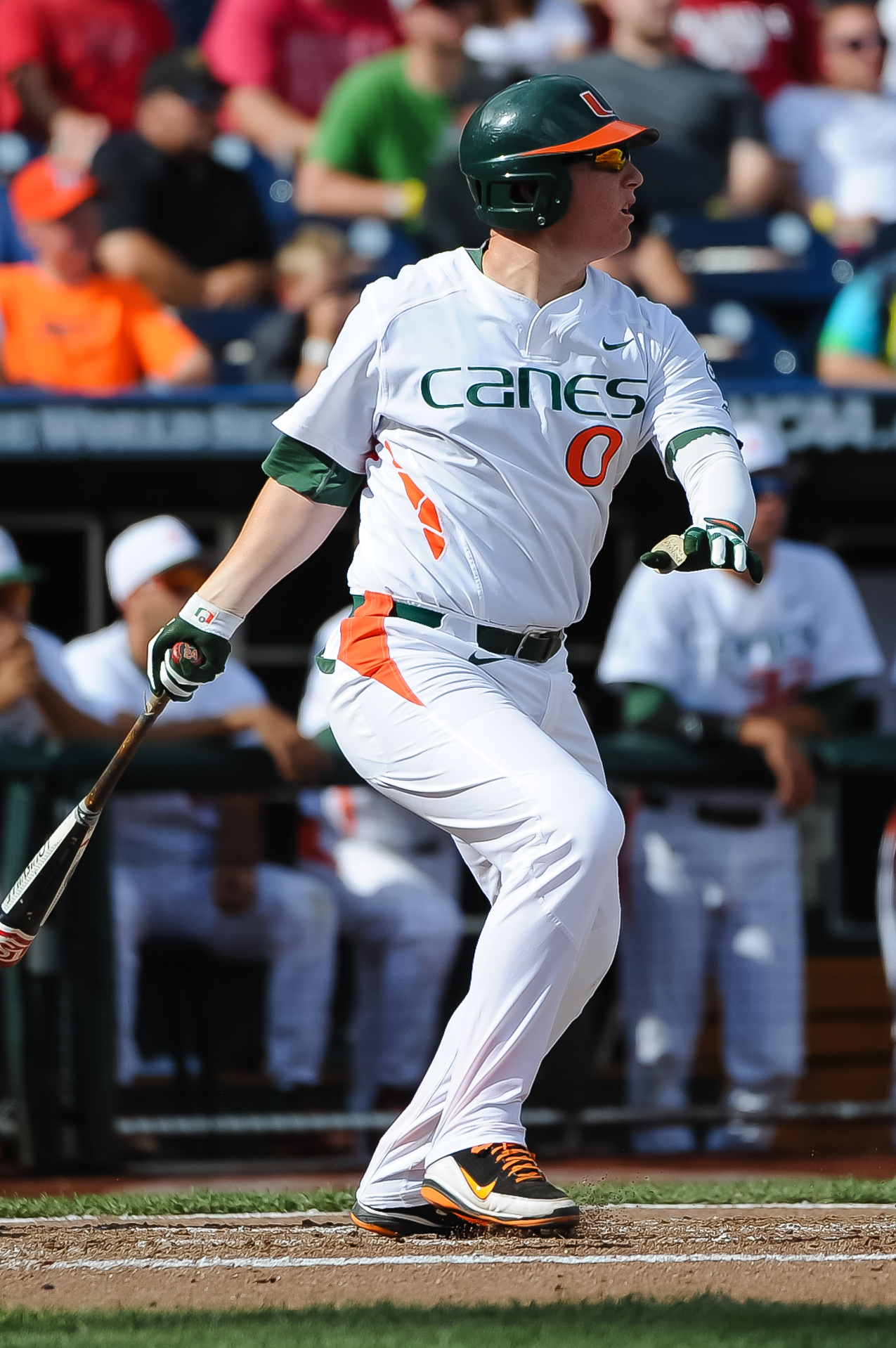
- In the latest edition of MLBTR’s Draft Prospect Q&A Series, Chuck Wasserstrom chatted with University of Miami catcher Zack Collins, a prospective first-round pick in the upcoming draft. Collins explained his decision to forgo signing with the Reds – who took him in the 27th round of the 2013 draft – and instead attend college, how much that choice has helped him, and what he’s doing to become a more well-rounded catcher, among other topics.
Zack Collins (University of Miami) Interview: Draft Prospect Q&A
MLBTR continues its Draft Prospect Q&A series in order to give our readers a look at some of the top names on the board in this year’s draft. MLBTR will be chatting with some of the draft’s most well-regarded prospects as they prepare for the 2016 draft on June 9-11; we’ve already spoken with Florida outfielder Buddy Reed, prep outfielder Blake Rutherford, Mercer’s Kyle Lewis, Oklahoma’s Alec Hansen and Louisville’s Corey Ray.
University of Miami catcher Zack Collins has been down this path before. Three years ago, he was projected to be selected as high as the second round of the MLB draft – but he wasn’t picked until the 27th round due to signability questions. This time around, he figures to hear his name around the middle of the first round.
The 6’3”, 230-pound Collins is a left-handed power hitter with a very patient approach at the plate. Heading into the final week of regular-season play, he ranks among the Division I national leaders in walks (59) and on-base percentage (.560) as part of his .387/.560/.655 slash line.
Last week, Baseball America listed him No. 16 on its Top 100 Draft Prospects chart, and he’s currently 20th on the Top 100 at MLB.com. ESPN.com’s Keith Law recently wrote, “I’ve heard he’s in the mix for at least two teams in the Top 10, including Oakland.”
Collins talked with MLBTR earlier this week:
Chuck Wasserstrom: Hi Zack. Thanks for talking to me today. I want to start out with a couple draft-related questions. Coming out of high school, you could have been a high-round pick, but you weren’t because of signability – and the Cincinnati Reds selected you in the 27th round. Was there any scenario where you would have turned pro instead of going to college?
Zack Collins: “It was a number thing. My family and I set a number, and it wasn’t matched. So I had no problem going to college. It was my dream school, and I think I made the right decision.”
It still must be pretty cool to be 18 years old and know that Cincinnati just drafted you. Was it tough to say, “Thanks – but no thanks?”
“At that point, it was the 27th round – and they were offering nowhere near the number that I set. I was really excited and honored to be drafted by them – and to just be drafted at all – but it honestly wasn’t very tough to say ‘No.’ ”
You grew up less than 30 minutes from the University of Miami campus. Really, how tough of a recruiting process was it for them to lure you there?
“I always wanted to go there. I don’t think there was any other school that I had in mind. I don’t know. I went to all the camps and they liked me. One of the first offers they made to me … I said ‘Yes.’ It was pretty easy.”
There have been some pretty big-time bats that have gone through that program – like Pat Burrell, Ryan Braun and Yonder Alonso. How does it feel to have your name mentioned in the same sentence as them?
“It’s honoring, but it’s kind of tough to put my name in with them. They’ve done a lot more than I have so far. But, honestly, it feels great to be mentioned in those categories. Hopefully, I can keep it up just like them.”
[Interview continued after the page break]