
Extension Candidate: Jake Arrieta
In the midst of a second straight exceptional year, Cubs starter Jake Arrieta appears likely to sign a big contract at some point, whether that’s an extension with the Cubs or a free-agent deal following the 2017 season. The Cubs, however, have not begun extension discussions with Arrieta (as Gordon Wittenmyer of the Chicago Sun-Times recently reported) and it’s not clear whether they’ll do so. Arrieta is already under team control for two more seasons, and the Cubs might feel that adding additional pitching talent this offseason is a higher priority than signing a pitcher they already have.
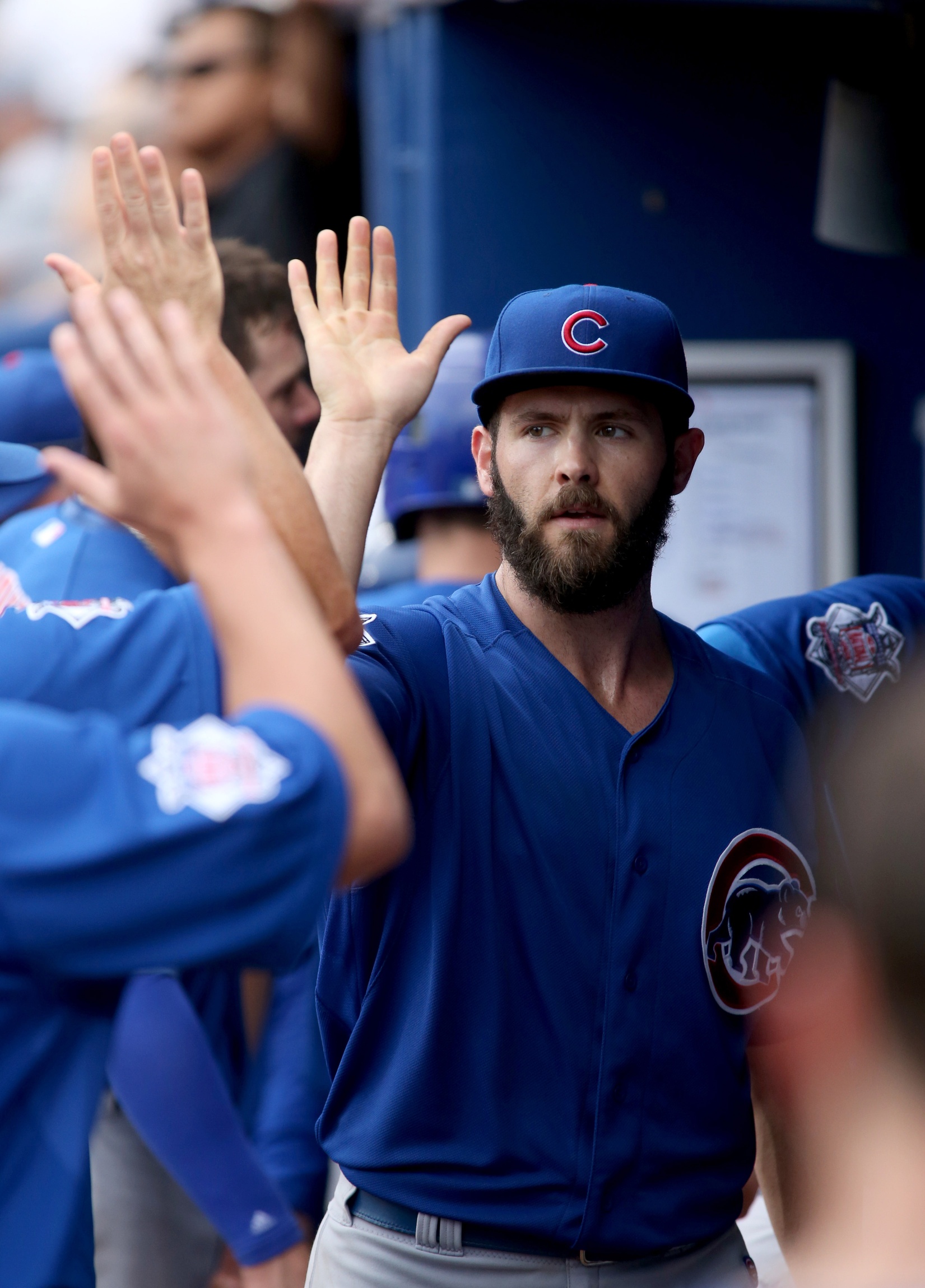 If the Cubs did want to sign Arrieta, they would have a tough task ahead of them, though perhaps not an impossible one. Via CSNChicago.com’s Patrick Mooney, agent Scott Boras strongly suggests Arrieta won’t be cheap, comparing him to Max Scherzer and arguing that Arrieta’s relatively low innings totals (he’s pitched 740 1/3 in his career) make him a good bet to age well. Arrieta’s arm is “kind of ideal for the free-agent dynamic,” Boras says. But Arrieta himself said last season that he would be interested in staying in Chicago and that he wouldn’t ask for an “astronomical amount of money.”
Of course, if Arrieta were to ask for an astronomical amount of money, he’d be more likely to get it now than he was then. He finished ninth in NL Cy Young voting in 2014 and has followed up that breakout season with an even better one, pitching more innings per start and posting a career-high ground-ball rate (53.9%) while maintaining his strong peripherals (9.2 K/9, 2.2 BB/9). He currently ranks first in the league in wins (16), second in ERA (2.22) and fourth in strikeouts (178), setting him up for a huge raise on his $3.63MM salary through the arbitration process this winter.
Finding precedents for an Arrieta extension is difficult. Extensions for pitchers who are already arbitration eligible frequently only buy out arbitration seasons and do not delay free agency, as with recent extensions for Lance Lynn, Jordan Zimmermann and Mat Latos. (It’s certainly possible that the Cubs could sign Arrieta to a two-year deal in a similar mold, but that wouldn’t change much about his future with the organization.) Wade Miley gave up a year of free agency eligibility in his recent deal with the Red Sox, although Arrieta is obviously a much better pitcher. Matt Harrison‘s $55MM deal with the Rangers is probably the clearest comparable for Arrieta, particularly given that Harrison was coming off his first arbitration season and made a salary similar to Arrieta’s ($2.95MM). Arrieta is also better than Harrison was, though, and Harrison’s deal is almost three years old.
Using Harrison’s deal as a potential precedent is tricky for another reason, too. Harrison was only 27 at the time of his deal and figured to have another shot at a significant payday even after it was over. Arrieta is older, and if he were to agree to a long-term deal now, it would likely be the only significant multi-year contract of his career.
Then you have to factor in the escalation in salaries of starting pitchers since Harrison’s extension. Homer Bailey received a nine-figure deal from the Reds, and his best seasons prior to the deal were nowhere near as good as Arrieta’s last two. Bailey was a year closer to free agency than Arrieta is, but given the raise Arrieta is likely to receive this offseason, he could easily make $20MM-$25MM total in his last two years before free agency eligibility anyway. Beyond that, he could credibly ask for $20MM per season, and that might even be slightly undershooting it. Rick Porcello‘s four-year, $82.5MM deal with the Red Sox strongly suggests Arrieta ought to be worth more than $20MM a year, even though Arrieta doesn’t have youth on his side as Porcello did.
A five-year deal for Arrieta, then, could get close to the $100MM mark, and a six-year deal could push past the nine-figure mark. It seems unlikely that Boras would settle for anything less than five years, and probably even six, given that signing an extension that delays free agency by only a year or two likely wouldn’t provide Arrieta with enough of a financial incentive to put off seeking a big free-agent contract.
There’s also the problem of how a five- or six-year deal would work for the Cubs. A five-year deal would still be on the books in 2020, by which point the Cubs look somewhat likely to be dealing with significant arbitration raises for key younger players like Kris Bryant, Addison Russell, Kyle Schwarber, and others. They will probably also wish to extend at least some of those players. They’ll also likely still be dealing with the contracts of Jon Lester, Anthony Rizzo and any pitcher they sign this offseason.
That isn’t to say that a deal for Arrieta would be impossible. It seems likely that the Cubs’ budget will be significantly larger in 2020, with more money coming in from a new TV deal. If it is, the fuss over whether they can afford Arrieta might end up being mostly irrelevant. But, given that they already control Arrieta through his age-31 season, could be in line for a draft pick if he signs elsewhere, and that Boras is surely highly curious about the free-agent market, perhaps it isn’t surprising that the two sides haven’t struck a deal.
Photo courtesy of USA Today Sports Images.
MLBTR Originals
A look back at the original reporting and analysis found on MLBTR the last seven days:
- The MLB Trade Rumors mailbag is back! This week, Steve Adams fielded questions on Zack Greinke, Jeff Samardzija, Khris Davis, C.C. Sabathia, and more. To submit questions for a future installment of the mailbag, email mlbtrmailbag@gmail.com.
- In this week’s edition of the MLBTR Podcast, host Jeff Todd chatted with Josh Chetwynd of Elite Sports Group about his experiences in European baseball as both a player and a player representative. Chetwynd, who has been elected into the British baseball hall of fame and negotiated a European-record $1.3MM bonus for Italian shortstop Marten Gasparini, discussed the key differences between that emerging market and other international arenas. A new episode of the MLB Trade Rumors Podcast will be released every Thursday and can be accessed on iTunes, SoundCloud, and Stitcher.
- Charlie Wilmoth checked in on the free agent stock of Alex Gordon. Charlie speculates on the market that Gordon could encounter this winter and also wonders if KC might be able to come to the table with an offer good enough to retain him
- Recently, MLB Trade Rumors launched a brand new official Instagram account:@TradeRumorsMLB. Each day, we’re sharing conversation-inspiring images about the hottest topics in baseball. From there, we invite you to give us a like, weigh in with your thoughts in the comments section, and even share the link with a friend. So, what are you waiting for? If you don’t have an Instagram account, this is the perfect excuse to sign up and get one. Follow us on Instagram today!
- Gerardo Parra is hitting the ball well this season. What kind of deal could he get for 2016 and beyond? Jeff Todd broke it all down.
- Steve highlighted three major needs that the Rockies have, including their need to find a long-term solution behind the plate.
- If you missed out on Steve’s weekly chat, get caught up with the transcript here.
- Earlier today we rounded up the best from the baseball blogosphere in our weekly feature, Baseball Blogs Weigh In.
Free Agent Stock Watch: Gerardo Parra
As MLBTR’s Charlie Wilmoth noted in his recent look at Alex Gordon, the Royals outfielder joins Jason Heyward as a top-of-the-market corner outfielder who derives significant value from defense while also delivering sturdy production at the plate. The other top two corner outfielders, Justin Upton and Yoenis Cespedes, can generally be categorized in the opposite manner — big bats who are serviceable defenders — though Cespedes has shown new life with the glove of late. Heyward and Upton, in particular, are also appealing due to their youth.
All of those players will be seeking massive free agent contracts, of course, and many clubs will be unwilling and/or unable to pay them. But there’s another group of corner options behind them who may be had for more manageable commitments. Among them is a particularly interesting name: the just-traded Gerardo Parra, who went from the Brewers to the Orioles shortly before the non-waiver trade deadline.

Like Heyward and Upton, Parra stands out in large part due to his age: he won’t turn 29 until May of next year, making him younger than the typical free agent. Of course, he’s also turned in a premium offensive season thus far, slashing .314/.355/.506 and showing signs that it may not just be the result of a .348 BABIP. For one thing, the speedy Parra has maintained a .326 career mark in that department. For another, he’s also carrying the highest line-drive percentage, home run per fly ball rate, and hard contact rate of his career. On the other hand, Parra has been and remains a far more effective hitter with the platoon advantage.
That mix of age and offense stands out relative to others who’ll be considered alongside Parra on the upcoming free agent market. Nori Aoki of the Giants is already 33 and likely won’t reach the market anyway. His $5.5MM club option looks appealing, and injuries have made it likely that he’ll fall shy of the 550 plate appearances needed for that to become a mutual option. Other left-handed bats — David DeJesus, David Murphy, Will Venable, and Alejandro De Aza come to mind — are older, carry mediocre batting lines, and/or have similar platoon issues to Parra.
There are a host of right-handed-hitting platoon options, too — Rajai Davis, Alex Rios, Chris Young — who are well into their thirties and have historically mediocre marks against right-handed pitching. Ben Zobrist is entering his age-35 season and really occupies a market unto himself given his positional flexibility.
There are several other players, however, who could be considered alongside Parra if they don’t get looks more as center field options. Austin Jackson is similar in age but has struggled enough offensively that he looks more like a second-division player or fourth outfielder at this point. Dexter Fowler and Colby Rasmus are both reasonably young options that could be signed as regular corner outfielders. Fowler is a year older and has the most consistent offensive track record. Rasmus, meanwhile, has nine months on Parra and has somewhat quietly had another above-average campaign at the plate, though he’s done so in less-than-full-time duty.
The switch-hitting Fowler continues to produce wherever he goes, though he performs better against lefties. He hasn’t hit as well as Parra has this year — his 112 OPS+ falls a good bit shy of Parra’s 132 mark — but his BABIP is well below its career norm, and he’s also been a more consistent performer than Parra over the years. Both Fowler and Parra are good bets to deliver double-digit stolen base totals in a given year.
Rasmus is a high-strikeout, low-OBP hitter but has nevertheless rated as a better-than-average offensive threat for the past three seasons. He also has had some seasons of outsized production, as Parra has done this year, and he rates quite well on the bases even though he doesn’t attempt many steals. It’s a different overall skill-set from Parra, who walks less than Rasmus but also strikes out half as often. Parra is a higher-average hitter with better on-base numbers, but until this year had never done as much in the power department. Choosing between these two, offensively, is something of a matter of preference, though it’s easy to imagine many teams preferring to take a gamble on Parra continuing to drive the ball.
The defensive side of the equation is where things get most interesting. Fowler and Rasmus have more experience in center than does Parra and could sign to play up the middle (Fowler, in particular, as he’s played center for all but one inning of his career). All three, however, have experience there and could be added by teams that prefer to have another center field-capable option on their rosters.
Interestingly, though, Parra has been as much of a surprise on defense this year as he has been at the plate — albeit in the opposite direction. Parra made his name, really, when he put up an outstanding defensive campaign with the Diamondbacks back in 2013. Moving into a full-time role, he drew plaudits from both UZR and Defensive Runs Saved as one of the game’s premium outfielders. But last season’s metrics were more of the average variety, and Parra has been decidedly in the red this year: he has a -23.2 UZR/150 rating and is valued at 10 runs below average by DRS.
By comparison, Fowler has generally rated out as a slightly to largely below average performer in center. Rasmus has also played mostly up the middle, with overall average results that have varied somewhat over time.
All told, there’s an argument to be made that Parra rates as the most appealing corner outfield option after the top four players noted at the outset — assuming, at least, that Fowler is locked up to fill a void in center. Notably, unlike Fowler, Parra can’t be saddled with a qualifying offer. If nothing else, he’s separated himself from the pack of other players (many of whom were noted above) who’ll garner consideration as non-premium targets.
Given his age, there’s a reasonable chance that Parra could command a four-year guarantee if there are teams that still value him as an above-average defender. While his recent surge in hitting and decline in defense could lead to some hesitation in terms of average annual value, Parra seems likely to be a useful player over that timeline, and it would be easy for a team to find a right-handed-hitting outfielder to pair with a player who’s put up a .777 OPS over his career against opposing righties.
Looking at recent corner outfield signings, there’s an interesting gulf between players who profiled as solid regulars and those who were seen more as platoon options. (Check this list of outfielders who landed guarantees of between $15MM and $75MM.) Players coming off of good years who were added as regular players have tended to score three- or four-year deals with AAVs in the $10MM to $15MM range. Some potentially useful comps include Melky Cabrera (three years, $42MM), Nick Markakis (four years, $44MM), Shane Victorino (three years, $39MM), and Angel Pagan (four years, $40MM) — each of whom was older than Parra when they signed their deals. (Markakis, in particular, stands out as a player whose glove was valued by scouts despite defensive metrics painting a more negative picture.)
While some others have had to settle for shorter deals — Aoki and Rasmus, last year, for example — there’s good reason to think that Parra can cash in. It’s too early to project specific numbers, especially with the market still yet to develop and more than a month of play remaining, but Parra and his representatives can aim high coming off a career year at the plate.
Photo courtesy of USA Today Sports Images.
Three Needs: Colorado Rockies
With September around the corner, the focus for many teams (and their fans — specifically those who read MLBTR with regularity) will shift to the upcoming offseason. A third of the teams in the league currently find themselves more than seven games back from a playoff spot, and about half the teams in baseball are 5.5 games or more away from even securing a Wild Card playoff berth.
We’ll be looking at every team in the league in depth with MLBTR’s annual Offseason Outlook series. For the time being, though, we’re taking preliminary big-picture looks at what some of the non-contending clubs will need to focus on in order to reverse their current standing.
The Rockies are up first as we look at three needs for the upcoming offseason…
1. Increase their willingness to trade hitters. It’s easy enough for people to answer the question when asked, “Who was the last impact bat the Rockies traded away?” thanks to this July’s Troy Tulowitzki blockbuster. However, prior to that swap, the most recent instance of the Rockies trading a significant hitter came in the 2013-14 offseason when they traded Dexter Fowler. Prior to that, it’s probably Matt Holliday — all the way back in 2008. For a team that struggles to develop pitching but seems to routinely produce above-average bats (even after adjusting the numbers to account for Coors Field’s impact), it’s puzzling that they’ve shown such reluctance when it comes to trading hitters. The Tulo trade was a good start, but moving Carlos Gonzalez and perhaps someone like Charlie Blackmon should be a consideration for new GM Jeff Bridich, assuming owner Dick Monfort won’t stand in the way of such a deal.
2. Find a long-term solution at catcher. The Rockies have had a revolving door at catcher for quite some time (Wilin Rosario, Miguel Olivo, Chris Iannetta, Yorvit Torrealba), but more troubling has been the lack of a premium defender at the position. Nick Hundley has been solid with the bat in his first season in Denver, but he also ranks as the worst pitch-framer in all of baseball, per StatCorner.com and second-worst per Baseball Prospectus. Rockies pitchers are already at enough of a disadvantage due to their home environment, and adding a catcher that can help get them ahead in the count via framing would do wonders, even if he comes without a big bat. The Rockies have premium defenders at third base and second base (and had one at shortstop in Tulo); that same emphasis should be applied behind the plate.
3. Overhaul the pitching staff. Yes, it’s obvious. No, it isn’t terribly insightful. But, for a team that has used 12 starters and received a collective 5.34 ERA/4.96 FIP in 2015 (to say nothing of a relief corps with a league-worst 5.00 bullpen ERA), it has to be mentioned. Jon Gray may yet develop into a mid-rotation arm or better, and the Rockies probably still have hope for Eddie Butler as well. Neither is a sure thing at this point, however, and only Gray shows the promise of turning into a strikeout pitcher for Colorado. Dating back to 2007, the Rockies’ collective rotation has posted a K/9 rate greater than 6.5 just twice — 6.8 in 2009 and 7.3 in 2012. The Rockies are right to prioritize ground-ball pitchers, but Colorado’s lack of strikeouts in such a hitter-friendly park is particularly detrimental. Luring free-agent strikeout pitchers to Coors Field is a difficult task, as it requires the team to overpay. However, targeting high-strikeout arms in trades should probably be a priority for the Rockies; recent trade acquisitions for the rotation have included ground-ball pitchers such as Jordan Lyles, Brett Anderson and Wilton Lopez. Bridich’s prioritization of power arms in the Tulo trade was evident, and the continuation of that emphasis could go a long way toward finally developing a pitching staff that can have some degree of success pitching at altitude.
MLBTR Mailbag: Phillies, Samardzija, Brewers, Sabathia
As we announced yesterday, we’re rebooting the MLBTR Mailbag series after a seven-year layoff. We’ve already received a large number of questions, and there’s no way to get to all of them, but I’ll tackle a handful in today’s post as well as each Monday from here on out. Remember that you can submit questions for next week’s Mailbag, via email: mlbtrmailbag@gmail.com.
On to the questions…
Does it make sense for the Phillies to sign some top tier free agents like Heyward and/or Greinke? A lot of money is off the books, and the Phillies have some promising prospects coming up within the next year or two. The first year of the deal may be rough for the newly-signed, but after that the Phillies look to be in a good position to compete. Is this a tough sell to the free agents? — David M.
From a financial standpoint, the Phillies would be in excellent shape to take on a long-term commitment. Philadelphia has just $23MM on the books for the 2017 season and no players guaranteed any money beyond that season, save for a $2MM buyout on Matt Harrison’s option. Practically speaking, it doesn’t make much sense for the Phillies to spend aggressively on an aging free agent like Greinke. As you noted, they’re unlikely to compete in at least the first year of a free agent deal and probably the second as well. By the time 2018 rolls around, Greinke would be into what are typically the decline years for a pitcher. A younger free agent like Heyward, on paper at least, could make some sense as they can afford him, and he’ll be in his prime when the Phillies hope to contend again. However, premium free agents typically prefer to sign with winning clubs — or at least clubs that have the possibility of doing so — and the Phillies have been vocal about their current rebuild.
Philadelphia does need to fill out its roster, but I’d imagine that the team’s free agent expenditures will be second- or third-tier free agents designed to soak up innings, as the Twins did with Ricky Nolasco and the Astros did with Scott Feldman in the 2013-14 offseason (obviously, with the hope for better results than Nolasco has delivered). That might mean someone like Ian Kennedy, though as the Cubs experienced with Edwin Jackson, it can be dangerous to give multiple years to a free agent who isn’t expected to play on a contender until the backside of the deal. Alternatively, the Phillies could be open to more buy-low options on shorter contracts, as they did this season with Chad Billingsley (again, with the hope for better results). Doug Fister is one such option, and Billingsley, Brandon Morrow and Brandon Beachy could also fit that mold. The Phillies could also exercise their financial muscle and lack of long-term commitments to “buy” a prospect — absorbing a Nolasco-like contract in its entirety in order to land a nice prospect from the team whose burden they are relieving while adding a serviceable arm in the process.
What kind of contract can we expect Jeff Samardzija to get in the off season? — Victoria R.
Entering the season, I thought Samardzija had a clear shot to blow past $100MM with a repeat of his 2014 campaign, but he’s gone the opposite direction. Samardzija’s strikeout and ground-ball rates have plummeted, and his ERA has spiked to 4.64 — the worst of his career since joining the rotation. FIP, xFIP and SIERA all come in over 4.00 as well.
There are some positives to Samardzija, though. He’s still averaging 94.2 mph on his fastball, his BB/9 rate is south of 2.00 for the second straight season, and some of his struggles can be attributed to the fact that Chicago’s defense ranks 28th in baseball in Defensive Runs Saved and Defensive Efficiency as well as 29th in Ultimate Zone Rating. With a better defense behind him — even a league-average defense — Samardzija’s bottom-line numbers would probably be better, though his BABIP-against stands at a reasonable .305, indicating that he may be more a victim of unfortunate sequencing.
Scouts love Samardzija’s arm and competitiveness, and by season’s end, he will very likely have turned in his third straight 200-inning season. As such, I can still see a nice multi-year deal, but barring a huge finish, I’m taking the under on $100MM and on five years as well. A four-year deal worth $16-20MM annually is possible, and he can improve his earning power with a big showing over his final eight starts. He fired seven one-run innings on Aug. 19 but was shelled for five runs in 5 2/3 innings tonight, so he’s not off to a great start in terms of altering his fate with a strong finish.
Some might suggest that Samardzija will be forced to sign a one-year deal to rebuild his value, but he’s already going into his age-31 season next year, and delaying the prospect of a significant payday until a contract that would begin at age 32 may not hold much appeal. Players typically don’t want to take one-year deals unless they’re forced to by injury, and I don’t expect Samardzija to be any different.
Hey gang, with [Khris] Davis’s recent hot steak, coupled with the Brewers calling up [Domingo] Santana, do you see the Brewers dealing Davis to make room for Santana this winter? — Jason M.
I’d imagine that the new Brewers’ general manager, whoever it ends up being, will be open to listening to offers for Davis and much of the roster he inherits. There’s no real need to move Davis, with the possible exception, as you said, of freeing up playing time for Santana. There are a number of ways that both could be worked into the lineup though, as either Davis or Ryan Braun could conceivably put in some work at first base over the spring. Santana also has some experience in center field and has appeared there since coming up with the Brewers, so he could continue to get some seasoning there in 2015. While he’s not a long-term answer in center, Santana could be a stopgap solution for the Brewers as they wait for Brett Phillips’ development to continue. They could use 2016 — a rebuilding season — as a means of measuring whether or not Santana can hit consistently in the Majors and deal with the potential corner outfield logjam down the line if and when Phillips is ready.
What if the Yankees had simply let Sabathia go when he opted out a couple seasons ago? Surely his monster salary could have been better spent on a different pitcher or two. Maybe, and I say maybe, he earned his first few years of salary, but why not let him go when he was obviously in steep decline? — John M.
The Yankees’ decision to tack on one year and $30MM in guarantees (plus a vesting option) to Sabathia’s deal was obviously driven by the fact that the lefty had the right to opt out of the contract he signed in the 2008-09 offseason. As MLBTR’s Tim Dierkes explored in detail last year in a deep look at on opt-out clauses, Sabathia was able to land that provision in his free agent deal because he held so much leverage as an outstanding, youthful starter. Effectively, he bought himself another bit of leverage further down the line, which he and his representatives were able to employ. (Sabathia actually reached a new deal before opting out, it should be noted.)
There’s certainly something to be said for avoiding contracts of that magnitude — especially for pitchers, who are more prone to breaking down than position players. But to suggest that Sabathia was in a steep decline at the time he could have opted out isn’t really accurate. From 2009-11, Sabathia averaged six WAR per season, and his 2011 strikeout and walk rates were his best since 2008. Sabathia declined more steeply and more rapidly than most pitchers do, and that’s harmed the Yankees, but that future wasn’t known by the Yankees following the 2011 season.
It’s easy to apply hindsight and say the Yankees should’ve let Sabathia walk. But there were a lot of reasons to like the deal at the time, too, considering the market context. Sabathia was entering his age-31 season — a pretty typical age for the game’s top free agent pitchers to receive contracts of six or seven years of length. Restructuring his contract was akin to signing a pitcher who would’ve been far and away the market’s most desirable starting pitcher. C.J. Wilson got the largest contract of any starter that offseason, followed by Mark Buehrle, and only Yu Darvish would’ve rivaled Sabathia in terms of ace upside, but how he’d transition to the majors was not yet known. Sabathia was coming off a six-WAR season with the Yankees after pitching 237 innings for a second consecutive season. His open-market position would’ve been similar to that of guys like Max Scherzer and Jon Lester this past winter — both of whom landed huge contracts over seven and six years, respectively.
As Tim noted to me in discussing this matter yesterday, it seemed at the time that New York would have to guarantee two additional seasons to get a deal done and keep Sabathia from electing free agency. While the vesting option ($25MM with a $5MM buyout) could still add to the tab, the deal that was reached represented a solid value for the Yankees given the context when the decision was made.
Free Agent Stock Watch: Alex Gordon
This winter, outfielder Alex Gordon appears likely to start a new chapter of his career, and his impending foray into the free agent market could result in his departure from Kansas City. The cases of Gordon and Cardinals outfielder Jason Heyward will be worth watching in part for what they’ll tell us about teams’ willingness to offer big contracts to players whose value derives in part from outstanding corner outfield defense.
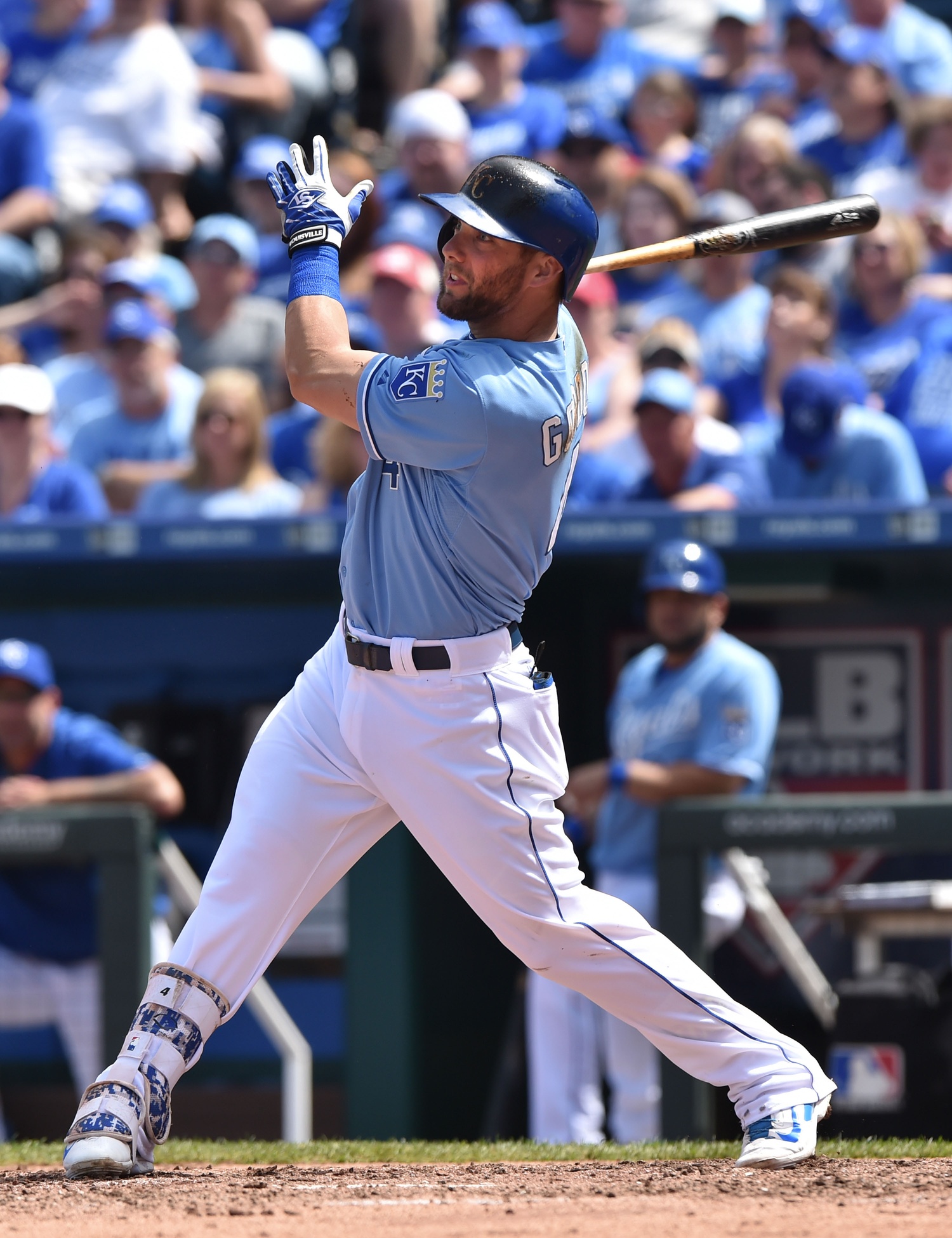 Gordon’s current four-year, $37.5MM deal with the Royals appears likely to end after the season. He has a player option for 2015 that was initially valued at $12.5MM, but has now climbed to $14MM due to performance escalators. Last season, Gordon said that he intended to exercise it, although he has since backed down somewhat from that stance, and he told the Kansas City Star last spring that he and the Royals were not discussing an extension.
Gordon seems to love playing in Kansas City and the Royals seem to want to keep him, and the recent resurgence of fan interest in the team could give them a bigger budget with which to do so. Gordon will be 32 in February, however, and he’ll likely receive long-term offers from other organizations that could carry him into his mid to late 30s. That’s a risk the small-market Royals might not be willing to take, particularly since they haven’t done so already.
Gordon has been out since early July with a groin strain, although he has begun a rehab assignment and should be able to play in September and in the playoffs. When he returns, he’ll continue a 2015 offensive season that has been among the best in his career so far. He’s hitting .279/.394/.457 in 312 plate appearances, demonstrating a typically well-rounded offensive game that features average, power and plate discipline.
Gordon has also been a key part of the Royals’ outstanding team defense. His defensive numbers are down somewhat from last season, although they’re still very strong. UZR says Gordon has been 6.9 runs better than the typical left fielder this year, down from the 25 runs above average he accumulated in 2014, although in twice as much playing time. Defensive Runs Saved, meanwhile, credits Gordon with four runs this year, as compared to 27 last year.
Overall, Gordon still rates as a terrific defensive left fielder, and it would perhaps be unwise to read too much into a one-year drop in his fielding numbers. His defense is, however, likely to decline during his next contract as he slows down and loses range. We might already be seeing signs of that this season, in which he’s only stolen one base after swiping at least ten in all of the previous four years.
Nonetheless, Gordon is at least as worthy of a big contract as, say, Shin-Soo Choo was when he signed a nine-figure deal with Texas after a big year in Cincinnati. Gordon will be a half a year older than Choo was at the time of his deal, and he doesn’t have the .423 on-base percentage Choo did in 2013. But Choo had rated very poorly on defense in the two seasons leading to his contract, whereas Gordon is markedly above average even in an off year. As a group, fast and athletic outfielders tend to age fairly well, maintaining much of their offensive value even as their speed and defense decline. So while Gordon seems very likely to decline over the course of his next deal, he appears likely to remain productive as a hitter.
While next offseason’s class of hitters isn’t particularly strong overall, it does include a good class of outfielders. The three top names (Heyward, Justin Upton, Yoenis Cespedes) are all younger than Gordon. Heyward, who has the advantage of heading into the free agent market at age 26, seems likely to land an enormous contract, and so should Upton, who will be 28. Cespedes, meanwhile, has boosted his stock with a terrific season, and MLBTR’s Tim Dierkes suggested in a recent email that Cespedes was a candidate to receive a seven-figure deal.
Heyward, Upton and Cespedes rank Nos. 2, 3 and 6 in Dierkes’ latest Free Agent Power Rankings, with Gordon at No. 7. As Dierkes notes, Gordon’s age likely caps his next contract at six years. Choo, of course, got seven, but perhaps last year’s market suggests teams are somewhat less willing to hand out such long contracts. Pablo Sandoval got five guaranteed years last winter and Hanley Ramirez four, and even those contracts, like Choo’s, look unfortunate now.
Gordon’s defensive ability gives him an edge on those players, however. He’s a better hitter than Sandoval was as well. It remains to be seen whether Gordon will be able to top Sandoval’s guaranteed $95MM, but he should be able to at least get close. Before the season, Andy McCullough of the Kansas City Star pointed to Hunter Pence‘s five-year, $90MM deal with the Giants as another potential template. If a team were willing to offer a sixth year, Gordon’s contract could easily top $100MM.
It will also be worth watching to see if Gordon takes a somewhat smaller, or shorter, offer to stay with the Royals. It’s no shock that the Casey Close client has gone back on his very surprising announcement that he planned to pick up his team-friendly 2016 option, but that Gordon said that in the first place suggests strongly that his preference would be to remain in Kansas City. The Royals might not be able to offer the kind of big-money deal Gordon could get elsewhere, and they’ll have a number of difficult decisions in the coming years as players like Lorenzo Cain, Eric Hosmer and Mike Moustakas all approach free agency themselves. But they perhaps could offer enough to convince Gordon to stay.
Photo courtesy of USA Today Sports Images.
(Re)Introducing The MLBTR Mailbag
It’s been a good seven years since MLBTR’s Mailbag series ran with regularity, but as we near the end of the 2015 season and gear up for an offseason that features one of the stronger free agent crops in recent memory, we’re once again dusting off the series.
Readers can submit questions on any MLBTR-relevant topic — trades, free agency, extensions, arbitration, etc. — to mlbtrmailbag@gmail.com, and every Monday we will collect a handful of responses and offer our take. While Tim Dierkes and I briefly entertained the notion of answering the most recent questions at the top of that inbox, which included queries on Joe Crede and Akinori Otsuka, among others, we decided it best to start from a clean slate.
Depending on response volume, we’ll run the first edition either later today or next week, and every Monday going forward from that point on.
MLBTR Originals
A look back at the original reporting and analysis found on MLBTR the last seven days:
- The MLB Trade Rumors podcast returned this week as host Jeff Todd spoke with Jason Mastrodonato of the Boston Herald about the Red Sox’s surprising front office shakeup. A new episode of the MLB Trade Rumors Podcast will be released every Thursday and can be accessed on iTunes, SoundCloud, and Stitcher.
- Recently, MLB Trade Rumors launched a brand new official Instagram account:@TradeRumorsMLB. Each day, we’re sharing conversation-inspiring images about the hottest topics in baseball. From there, we invite you to give us a like, weigh in with your thoughts in the comments section, and even share the link with a friend. So, what are you waiting for? If you don’t have an Instagram account, this is the perfect excuse to sign up and get one. Follow us on Instagram today!
- Steve Adams examined Marlins outfielder Marcell Ozuna as a trade candidate. Trading Ozuna would be selling low on a player that could certainly blossom into a premium talent, but that same upside would probably be enough to net the Marlins an enticing return, Steve writes.
- We’ve seen some notable transactions go down on August 23rd in years past. This morning, we reflected on some of the bigger moves to happen on this date in recent years.
- If you missed out on the weekly chat hosted by Steve, you can get caught up with the transcript here.
- Earlier today we rounded up the best from the baseball blogosphere in our weekly feature, Baseball Blogs Weigh In.
This Date In Transactions History: 8/23/15
The non-waiver trade deadline has come and gone but there are still plenty of moves that go down in the month of August. Historically, we’ve seen some significant transactions go down on the date of August 23rd. Could we see some moves of note today on MLB Trade Rumors? While we wait to find out, let’s take a look back at the last few years..
- One year ago today, the Red Sox signed Cuban sensation Rusney Castillo. The seven-year deal could be worth up to $72.5MM in total, assuming that the outfielder does not opt out before 2020. The buzz around Castillo was building momentum all through the summer, but the size of the deal took many around baseball by surprise. Owner John Henry has acknowledged that missing out on Jose Abreu may have played a role in Boston’s aggressive pursuit of Castillo, but Red Sox exec Allard Baird recently defended the signing and stressed that Boston did its homework on Castillo. The 28-year-old hasn’t lived up to the expectations of the contract so far but he has looked strong since his latest recall from Triple-A.
- On this date in 2013, the Nationals sent David DeJesus to the Rays for a player to be named later. Of course, DeJesus’ stint in Washington amounted to little more than a layover. The Nats acquired DeJesus in a waiver deal with the Cubs on August 19th and sent him packing just days later. In total, DeJesus went 0-for-3 with a walk in his brief tenure with the Nationals. DeJesus would enjoy a lengthier stint with the Rays before a late July deal this season sent him to the Angels.
- On the same date as the DeJesus deal, the Nationals also shipped Kurt Suzuki to the A’s for minor leaguer Dakota Bacus. Suzuki’s time in Washington was fairly short, though not as quick as DeJesus’ stint. The catcher, who was sent to the Nationals in August of 2012, found himself back in Oakland just one year and 20 days later. After helping the A’s reach the postseason, Suzuki had his $8.5MM option declined in the offseason. The catcher would go on to sign a one-year deal with the Twins that winter and he later inked a multi-year extension in the midst of his first All-Star campaign.
- On this date in 2009, the Red Sox signed Xander Bogaerts as an amateur free agent. While he’s regarded as a possible up-and-coming star today, Bogaerts did not have a great deal of hype around him when he was signed as a 16-year-old. The Red Sox inked the Aruban shortstop for a paltry $410K signing bonus.
Trade Candidate: Marcell Ozuna
A year ago, Marcell Ozuna was hitting .255/.312/421 with 16 homers on the season, and a strong finish to the 2014 campaign would boost those numbers to .269/.317/.455. Paired with above-average center field defense, that production made the then-23-year-old Ozuna look like a core piece in a dynamic young Marlins outfield that could be controlled for the next five seasons.
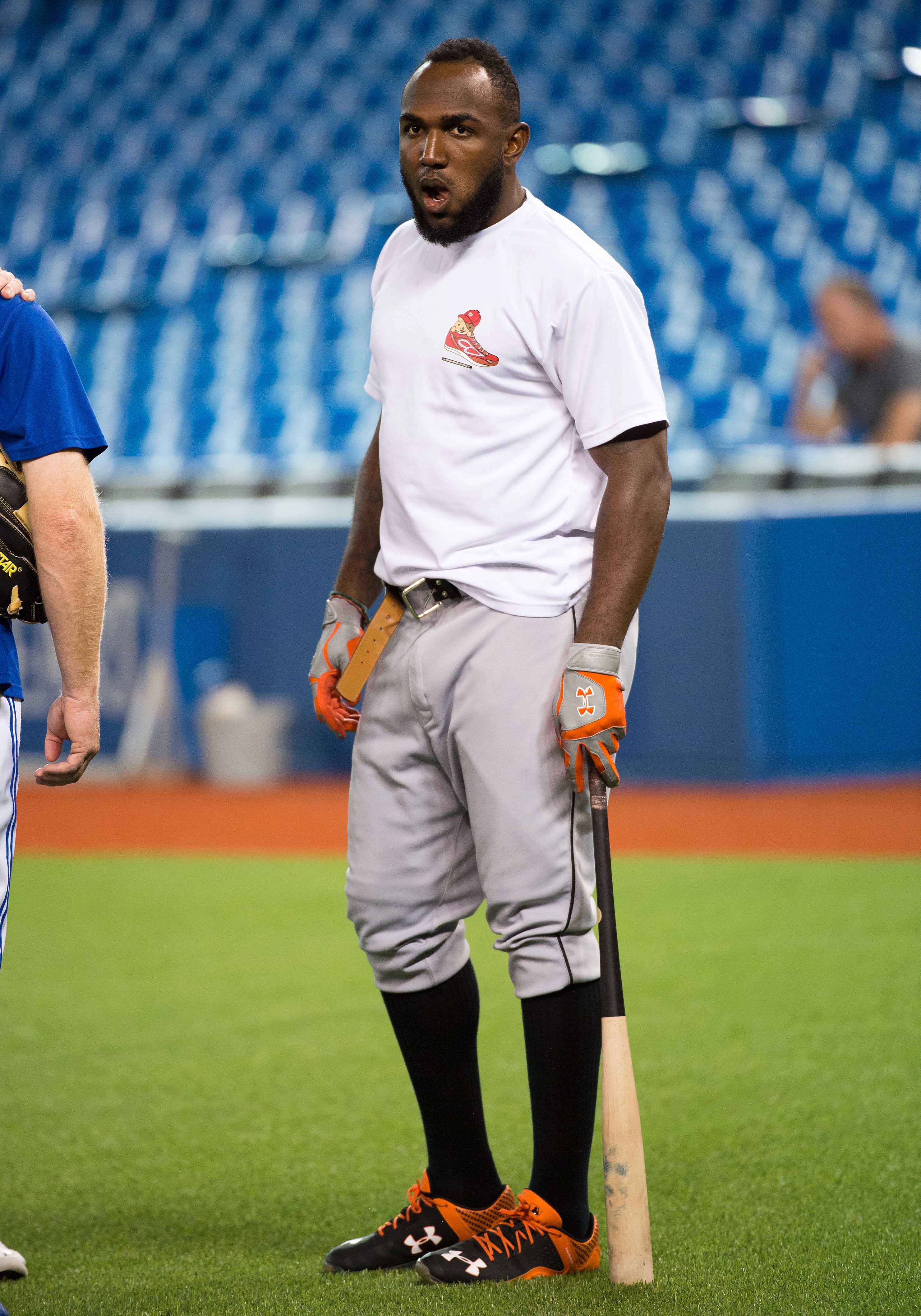
The 2015 season, though, hasn’t been kind to Ozuna. Through his first 79 contests this season, Ozuna batted .249/.301/.337, including a staggering 1-for-36 slump that saw him strike out 14 times in 37 plate appearances. At that point, the Marlins felt it best for Ozuna to collect himself in the minors and sent him to Triple-A.
Ozuna was excellent in his minor league stint — .317/.379/.558, five homers in 21 games — but he didn’t sound overly thrilled with the fairly lengthy nature of his stay. Ozuna recently returned from that 33-day stint at Triple-A and likened his demotion to a jail sentence. Previously, agent Scott Boras had accused the Marlins of holding Ozuna down in the minor leagues in order to limit his service time and prevent him from reaching arbitration. Additionally, Barry Jackson of the Miami Herald reported early in the year that there was some frustration over a dip in Ozuna’s speed, leading some in the organization to question his conditioning.
Ozuna’s name crept up in trade rumors prior to the non-waiver deadline, with the Indians surfacing as one team with particular interest. And, just yesterday, Jackson reported that “at least one prominent Marlins person” is open to dangling Ozuna in trades this winter, though there are others in the front office who are more inclined to hang onto him.
Trading Ozuna would be selling low on a player that could certainly blossom into a premium talent, but that same upside would probably be enough to net the Marlins an enticing return. The Marlins are expected to seek two starting pitchers this winter, and for a team with a limited budget, using Ozuna as a trade chip could help to add a cost-controlled young arm to a rotation that will be fronted by a (hopefully) healthy Jose Fernandez.
Because he spent 33 days in the minor leagues this season, Ozuna will accrue 150 days of Major League service time, placing him at two years, 131 days of service. The early projection for Super Two eligibility this season was two years, 140 days, making it easy to see why Boras was upset with the demotion (though questioning the motives for the demotion and the length of stay in the minors would carry more weight if Ozuna hadn’t been playing so poorly prior to being sent down). Ozuna has a chance to be arbitration eligible this winter but could very well fall just shy, meaning any team that acquires him could get one season near the league minimum plus three arbitration years before Ozuna qualifies for free agency after the 2019 season.
The upside of those four years is significant; Ozuna was worth roughly four wins above replacement last season as a 23-year-old, and there hasn’t been an enormous change in his approach this season with the exception of a dip in power. Ozuna’s strikeout rate has actually improved, and his line-drive rate has increased while his walk rate has remained a steady, if unspectacular 6.4 percent. The loss of power is a concern, but if a team feels the decline to be mechanical in nature or feels that its hitting instructors can restore the lost pop, Ozuna could be a well above-average player for a team for at least the next four seasons.
Miami could conceivably trade him to address part of its need in the rotation and either continue using Christian Yelich in center field (perhaps with Derek Dietrich manning left field) or seek a different center field acquisition. The Indians still make sense as a team to revisit talks, while the Mariners, Giants, Brewers and Padres are just a few clubs that could have a need for a long-term center field option this winter (speculatively speaking, of course).
Photo courtesy of USA Today Sports Images.