
Brodie Van Wagenen Addresses Mets’ Struggles, Deadline Plans
Embattled Mets GM Brodie Van Wagenen discussed his team’s dire straits today with the media. Deesha Thosar of the New York Daily News and Mike Puma of the New York Post were among those to round up the choicest quotes. MLB.com’s Christina De Nicola approached it from a bit of a different perspective, focusing on the forward-looking aspects of Van Wagenen’s chat.
With the Mets all but buried in the standings, Van Wagenen faced the music on his “come get us” pre-season bravado with respect to the rest of the NL East contenders. As he put it today, “they came and got us.”
That may put a satisfactory wrap on a memorable quote, though it also glosses over some of the actual causes of the Mets’ failings by suggesting their rivals simply got the better of them. Van Wagenen’s claim that the club was the favorite in the division wasn’t just an attention-grabbing statement worthy of skepticism; it also seemingly represented a key driving factor for the team’s decisionmaking over his first offseason at the helm.
Van Wagenen did accept blame for how things have gone, though he did so in a curious manner, deflecting even as he absorbed culpability. “I wouldn’t want to put the blame on players or coaches or scouts or anybody of that matter,” he said, “but I can tell you that this team we built was one of unified vision and it hasn’t worked, so I accept my responsibility in that capacity as well.” Likewise, he seemingly minimized the role of big-picture roster-building when he cited a failure to “do enough of the little things right as a team.”
At the end of the day, the top roster-building decisionmakers have to own their missteps. There are quite often intervening factors that do help explain unanticipated struggles, to be sure. But it’s hard to argue that unforeseeable or simply unlucky happenings have really driven the disaster in Queens this season — Jed Lowrie aside, at least. (The oft-injured veteran has yet to play. He is now said to be dealing with a calf injury, with no apparent target for a return.)
The single major blunder, to this point, has been Van Wagenen’s signature trade — the swap that brought in ace closer Edwin Diaz and highly compensated veteran Robinson Cano. It seemed a highly questionable decision at the time, albeit one that would almost certainly deliver short-term rewards. Instead, both players have struggled mightily, and rather unexpectedly, even as the key prospects sent in the trade have prospered.
“You have to look at where we were and where we are now,” Van Wagenen said when asked whether he has had second thoughts on the deal. He noted that Diaz and Cano still have the remainder of the season to “change the narrative.”
Once again, this explanation seems to miss the mark. The real problem isn’t (just) the ensuing struggles of those players. It’s the series of conceptual failings that led to the deal in the first place. First, the deal was rough for the Mets from a value standpoint, given the huge amount of Cano’s contract the team absorbed. Even assuming that away, it was legitimately questionable whether the Mets had a strong enough roster to justify that kind of outlay for such clearly win-now players (a closer and an aging second baseman). Beyond all that, there were quite possibly better ways to utilize the team’s resources — a dedicated pursuit of Manny Machado, increased offer to Yasmani Grandal, etc. — even in a scenario in which the team pushed for contention.
The point here isn’t to lay on the blame. Van Wagenen had a distinctly difficult task as an agent-turned-GM who was trying (with limited resources) to turn around a roster that had struggled in the prior season. That was the strategic direction of ownership — even if the new GM pitched it in his interviews. And it wasn’t a ridiculous thing to attempt. It’s just that the undertaking came with obvious risks, especially in the manner it was pursued, and several of the downside scenarios have come to fruition — none moreso than the big-picture one, in which the Mets are left yet again facing a need to pursue some amount of rebuilding or reloading while also carrying a series of player assets that hints towards near-term contention.
It was a tricky spot; it is now, all the more. Van Wagenen will need to adapt on the fly. So, where do the Mets go from here?
Most notably, Van Wagenen slammed on the brakes so far as expectations are concerned. In mid-June, Van Wagenen said that the Mets were “right where we wanted to be.” Now, about a month later? “In the second half of the year I think we have low expectations for what we can be,” he said bluntly. Rather than posturing as front-runners, says the GM, the Mets will fashion themselves as “underdogs” who’ll “try to prove some people wrong this year and certainly try to improve on it next year.” It’s a starkly different look from an executive who said before the season, upon his latest hot stove conquest: “This action, rather than our inaction, should demonstrate to the fans that we say what we do and we do what we say.”
Without any pretense to immediate contention, the Mets can turn to making the best of the roster they have compiled. “We have to face our reality, to some degree, about where we are in the standings,” said Van Wagenen. Rental players — Zack Wheeler, Todd Frazier, Jason Vargas (who does have an option remaining) — seem clearly to be on the block. But the question remains whether the Mets will also “face reality” with respect to their broader organizational position, which is certainly a question that can’t be answered by Van Wagenen alone.
Van Wagenen says the Mets will be “open-minded, … thoughtful and measured” at the deadline, though that characterization obviously doesn’t offer much in the way of specific direction. He was clear that he does not “anticipate being in a situation where we’d have a total teardown rebuild.” He also says he “fully expect[s]” the team’s best veterans with future contract control “to be on our roster” past the trade deadline — though he didn’t rule out deals of star pitchers Jacob deGrom and Noah Syndergaard. The front office has been bombarded with phone calls of late, adds Van Wagenen. It’ll certainly be interesting to see whether any of those chats lead to creative scenarios in which it makes sense for the Mets to move some of their best and best-known players.
If there’s a definitive statement on the Mets’ near-term approach to be found in Van Wagenen’s words today, it probably resides in this passage:
“The reason why we put some chips on the table this year is because we felt like we had a core of starting pitchers from which we could build around. … Right now, as we look at the halfway point, we feel like we have a core going forward, just maybe a different core. … We have a core from which we can compete, and we’ll look at our moves with both win now or certainly win in 2020 [perspectives] and looking beyond that.”
You can probably read that to mean just about whatever you want it to, but it certainly sounds as if Van Wagenen sees a vision of the future. Perhaps it suggests the club’s ace hurlers are now open to be moved … or that they are part of the “different core.” If there’s a core in place, one might think that a big push for 2020 would yet make sense … yet Van Wagenen was careful to note that the team needs to be “looking beyond that” point in time.
Whatever the precise core concept — it presumably features Michael Conforto, Pete Alonso, and Jeff McNeil at a minimum — there’ll be an awfully tough path to navigate. Whether they pursue immediate contention or some manner of rebuilding, the Mets face a tricky financial situation in 2020, when they owe about $115MM to players (not including David Wright) even before accounting for raises to Syndergaard, Diaz, Conforto, Steven Matz, Seth Lugo, Brandon Nimmo, and a few others. For a team that hasn’t yet cracked $160MM in payroll to open a given season, it’ll be challenging to add enough to spur a turnaround. And with so much already on the books, no small part of it (Cano, Lowrie, Jeurys Familia, Yoenis Cespedes) largely immovable, it’ll also be tough to embark upon a dedicated rebuilding effort.
Mets Release Matt Kemp
The Mets have released outfielder Matt Kemp, according to the International League transactions page. He had been with the organization on a minors deal.
Kemp, 34, only took 36 plate appearances in eight games with the Mets’ top affiliate. He turned in an unremarkable .235/.278/.324 slash there and obviously was not viewed as a candidate to ascend to the MLB roster. Before that, he struggled to a .200/.210/.283 batting line in 62 major-league plate appearances with the Reds.
A broken rib limited Kemp earlier this season. That seems also to be the cause for his unavailability at Triple-A Syracuse. If he’s able to get back to health, it seems likely that some other organization will take a shot on a minors deal. Kemp did pop 21 long balls and carry a 122 wRC+ in over five hundred trips to the plate with the Dodgers in 2018. That said, the former star’s long-term outlook in the game is obviously in doubt.
Mets Designate Wilmer Font
The Mets have designated right-hander Wilmer Font for assignment, Tim Healey of Newsday reports (Twitter link). He’ll be replaced on the active roster by fellow hurler Chris Mazza.
Font was utilized initially as a starter and then in a multi-inning capacity in New York after being shipped up from the Rays in a mid-season swap. The deal cost the Mets a far-off prospect with some interesting physical tools.
The Mets got a useful run out of Font after pushing him to the bullpen in late May. From that point through the end of June, he allowed just four earned runs and carried a 15:6 K/BB ratio over 16 1/3 innings of work. It seems the Mets decided to move on after watching Font struggle through his past two outings, which featured three long balls in just 4 1/3 innings.
As for Mazza, he’s finally enjoying some MLB opportunities at 29 years of age. The former 27th-round pick turned in a solid spot start earlier this year and has thrown well at Triple-A. In 78 frames there, he owns a 3.69 ERA with 8.1 K/9 against 2.4 BB/9.
Mets Likely Won’t Trade Syndergaard, Matz Unless “Overwhelmed” By Offer
While it is becoming increasingly likely that the Mets will be sellers at the deadline, the team won’t be going into a full fire sale. Noah Syndergaard and Steven Matz are two of the names that aren’t likely to be going anywhere before the July 31st deadline, as Mike Puma of the New York Post hears from an industry source that the Mets “would likely have to be overwhelmed by a trade proposal” to deal Syndergaard or Matz.
The Mets’ reluctance to move Syndergaard is well-known, despite the fact that at least three teams (the Brewers, Astros and Padres) have shown interest already, and several more would surely join the bidding if the man they call Thor was actually shopped. We haven’t heard much about Matz as a trade candidate this summer, and it’s interesting that he is seemingly in the same boat as the more heralded Syndergaard, though New York would have largely the same reasons to want to keep either pitcher.
Matz has a 4.89 ERA, 2.69 K/BB rate, 46.9% grounder rate, and 8.7 K/9 over 81 innings this season. Despite some pretty decent overall advanced metrics, Matz has been once again undone by problems with the home run ball. After posting a 1.5 HR/9 in 2017-18, that number jumped even higher to a full 2.0 HR/9 in 2019, as 20.9% of all fly balls allowed by Matz have left the yard. Matz’s struggles peaked in June, as a string of poor outings led the Mets to remove him from the rotation, though he is slated to start on July 17 against the Twins.
Now in his fourth season as a regular, Matz has shown some flashes of brilliance for the Mets but injuries and his propensity for the home run ball have limited his value. After generating 2.4 fWAR in his 2016 rookie season, he has been little more than a replacement-level pitcher since, with 1.3 total fWAR over his next 301 2/3 innings. Matz hasn’t approached the type of ace-level ability Syndergaard has shown at his peak, though like Syndergaard, the Mets would arguably be selling low on Matz if they dealt him now.
Matz is in his first year of arbitration eligibility, earning $2.625MM for the season and thus in line for cost-effective salaries in both 2020 and 2021 even if Matz has a breakout next year. Syndergaard also has two-plus years of team control remaining, though at a higher price (he is earning $6MM in 2019). Between the control and the lack of payroll strain caused by either hurler, the Mets don’t have any particular reason to make a trade, especially since neither is pitching particularly well.
Mets Have Discussed Noah Syndergaard With At Least 6 Teams
10:37pm: The Mets have recently discussed Syndergaard with no fewer than six teams, Tim Healey of Newsday reports. Unsurprisingly, though, there’s “minimal urgency” on the Mets’ part to trade Syndergaard, whom they’d need to be “wowed” to move, Healey writes.
12:19pm: The Padres have checked in recently on the availability of Mets starter Noah Syndergaard, according to MLB.com’s Jon Morosi (Twitter link). The big righty was a known target of the San Diego organization over the winter, though the sides obviously failed to line up at the time.
It’s not at all clear that the two organizations have engaged in substantive trade dialogue to this point. And there are other teams also showing attention to the 26-year-old Syndergaard. It’s still far from certain at this point that the Mets will move him, let alone where.
There are some tough calls ahead for the scuffling New York org. Sitting at ten games under .500, there’s not much hope of digging out of the hole this season. But the club’s balance sheet is set up to continue the pursuit of contention in 2020. Syndergaard would have obvious value to the team then, as he’s controllable for two more seasons via arbitration.
Selling Thor likely won’t make sense for the Mets if it means settling for a return that reflects his 2019 output. Syndergaard carries only a 4.68 ERA through 105 2/3 innings. There certainly seems to be some sequencing and batted-ball misfortune mixed in — he has a slightly depressed 67.0% strand rate; Statcast credits him with a .280 xwOBA-against that’s far better than his .314 wOBA-against — but he’s also carrying career-low levels of swinging strikes (11.9%) and chases out of the zone (31.5%).
Given the levels of early interest being shown, it’s obvious that other organizations still see plenty of skill in Syndergaard’s powerful right arm. He’s still averaging over 98 mph with his fastball. His release point has wandered this year, which could reflect a concern, an attempt at an adjustment, or an area to target for correction.
The key question may ultimately be whether a team is willing to put enough talent on the line to force the Mets’ hand on the matter. For the Friars, adding Syndergaard now would significantly enhance the immediate outlook, though with a yawning gulf in the division that’d be a dubious strategy. Such a move would mostly be about his potential to anchor the rotation next season, with an extension perhaps also a possibility. The San Diego organization is laden with young talent, so there’s no shortage of conceivable pieces that could be included in a deal.
Is It Time For The Mets To Trade Noah Syndergaard?
Judging solely by Mets right-hander Noah Syndergaard‘s decline in performance this year, this summer doesn’t look like the time to trade the 26-year-old. But going by Syndergaard’s pre-2019 numbers and the amount of club control he has remaining, Thor would warrant a haul leading up to the trade deadline. For almost the entire season thus far, there haven’t been rumblings on MLBTR’s pages about a possible Syndergaard swap. The rumor mill has begun picking up since Tuesday, however.
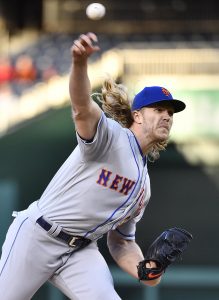
With the deadline exactly three weeks away, the Brewers, Astros and Padres are among those who have demonstrated interest in Syndergaard. It’s probably fair to say even more teams will eye Syndergaard, if they haven’t already, though the Mets don’t seem as if they’re shopping him aggressively.
Little has gone right this year for New York, which has stumbled to a record (40-50) that betters only the Marlins’ mark in the National League. Contention’s highly unlikely for this year’s Mets, but unlike with impending free-agent starter Zack Wheeler, they shouldn’t necessarily feel urgency to part with Syndergaard this summer.
Syndergaard, who’s making an appealing $6MM salary, is eligible for arbitration two more times after 2019. Therefore, the Mets could keep him in hopes they and he bounce back during that two-year span. Alternatively, the club could retain Syndergaard through this season, see if he returns to his typical form in the second half and then solicit offers during the winter. At that point, teams unable to win what should be a hotly contested derby for free agency’s top starter, Gerrit Cole, might view Syndergaard as an enticing consolation prize.
On a per-inning basis, Syndergaard has been a Cole-caliber producer since he broke into the league. Between his 2015 debut and last year, Syndergaard parlayed his high-90s heat into an ace-like 2.93 ERA/2.66 FIP with 9.95 K/9, 2.01 BB/9 and a 49.5 percent groundball rate over 518 innings. But injuries limited him at times, including during a 154 1/3-inning campaign in 2018, and they’ve reared their head again this year. Syndergaard missed time earlier in the season with a hamstring strain, though he returned after missing about two weeks. He has not, however, logged a quality start in any of his three outings since. Overall, Syndergaard has paled in comparison to his 2015-18 self, having notched a 4.68 ERA/3.98 FIP, 8.6 K/9 and 2.56 BB/9, and a 46.7 percent grounder mark across 105 2/3 frames.
While Syndergaard’s continuing to throw hard, his aforementioned K/9, career-low chase rate, career-high contact rate and personal-worst swinging-strike percentage show he’s fooling fewer hitters than ever. On the other hand, Syndergaard’s still a Statcast darling whose 34-point spread between his weighted on-base average/xwOBA against (.314/.280) suggest bad luck has played a part in his issues preventing runs. The fact that Syndergaard’s tasked with pitching in front of a dreadful defense also hasn’t done him any favors.
All things considered, the Mets are facing an interesting decision on Syndergaard as zero hour closes in on July 31. If the Mets were to make Syndergaard available by then, he’d perhaps end up as the most popular player on the block. What should they do?
(Poll link for app users)
What should the Mets do with Noah Syndergaard?
-
Listen to offers and consider moving him for a huge return 59% (3,787)
-
Definitely trade him 27% (1,717)
-
Now isn't the time to deal him 15% (951)
Total votes: 6,455
Photo courtesy of USA Today Sports Images.
Noah Syndergaard Rumors: Brewers, Astros
A trade involving Mets right-hander Noah Syndergaard doesn’t look imminent – it may not even be likely – but he is garnering interest from teams in need of starting pitching, Jon Morosi of MLB.com reports. Although the Mets are not soliciting offers for Syndergaard, the Brewers are “monitoring” him and teammate Zack Wheeler (previously reported), according to Morosi. Meanwhile, Syndergaard has “intrigued” some members of the Astros organzation.
The Mets are 40-50 and seemingly on track to deal veterans by the July 31 trade deadline, yet this may not be the ideal time to sell Syndergaard. While he produced dominant results when healthy from 2015-18, Syndergaard hasn’t been nearly as great this season. So far in 2019, the 26-year-old has registered a career-worst ERA (4.68), FIP (3.98), xFIP (4.22), strikeout rate (8.6 K/9) and swinging-strike percentage (11.9) over 105 2/3 innings.
Syndergaard, to his credit, certainly hasn’t posted bad numbers this season; he also continues to fire heat in the 98 mph range. Beyond that, Syndergaard has his pre-2019 track record working in his favor – not to mention a team-friendly contract that would likely help lead to major interest from playoff hopefuls and non-contenders alike. Syndergaard is on a $6MM salary this year and comes with another two seasons of arbitration control.
The Mets entertained trading Syndergaard last winter, but rookie general manager Brodie Van Wagenen – the hurler’s ex-agent – kept him in hopes of contending this year. The offseason moves Van Wagenen did make haven’t panned out to this point, though, which has put some extra pressure on him to “win” a potential Syndergaard trade, Morosi hears. Regardless, it would take a sizable return – likely a package including a major league-ready starter, per Morosi – for the struggling club to say goodbye to Thor this month.
MLBTR Poll: Should Mets Entertain Offers For Jacob deGrom?
In an interesting examination, Joel Sherman of the New York Post makes the case that the Mets ought to take offers on ace Jacob deGrom. He doesn’t exactly advocate a swap — the club ought to move him only “if the return is so overwhelming that they can’t say no,” in Sherman’s estimation — but does suggest it’s a realistic possibility worth pursuing.
That’d be quite an about-face given that deGrom only just inked an extension with the New York organization over the offseason. It really doesn’t kick in until after the present season. Nominally a four-year, $120.5MM pact, the value of the extension was reduced significantly by deferrals.
That is a lot of coin for a pitcher who recently reached his 31st birthday, though deGrom is not just any hurler. He hasn’t been as dominant as he was last year, but that’s due mostly to regression in the home run department and a few shifts in sequencing fortune. Through 110 innings, he carries a 3.27 ERA with 11.3 K/9 and 2.1 BB/9. All the skills remain evident: deGrom has actually boosted his average fastball velocity to over 97 mph and is maintaining a swinging-strike rate in range of 15%.
There are some obvious barriers to a deal, as Sherman notes, beginning with Mets ownership. Even if the Wilpons are willing to authorize a franchise-altering swap, deGrom would have his say given his full no-trade rights.
That doesn’t mean it isn’t fascinating to consider the possibilities. At the moment, this year’s trade market is led by decidedly less-valuable hurlers such as Madison Bumgarner (who hasn’t lived up to his storied past of late), Marcus Stroman (often excellent but not consistently dominant), and deGrom’s teammate Zack Wheeler (ditto). deGrom is unquestionably one of the game’s very best pitchers; controlling him for four years at big but not eye-watering money would hold plenty of appeal.
There’s certainly some sense in the notion that the Mets ought to be willing to hit the re-set button. The offseason moves of new GM Brodie Van Wagenen have not hit the mark thus far; neither did those of his predecessor Sandy Alderson in the winter prior. Keeping deGrom while dealing only rental pieces would presumably mean a third-straight offseason re-tooling effort on the heels of a disappointing season.
On the other hand, the Mets would find themselves in a funny spot without deGrom. They still owe big money to players such as Yoenis Cespedes, Robinson Cano, Jed Lowrie, Wilson Ramos, and Jeurys Familia. They’ll be paying another arb raise to Noah Syndergaard, unless he’s also made available. (That would arguably make quite a bit of sense, whether or not deGrom is shopped; perhaps the underperforming Thor deserves his own poll.)
The situation obviously does not admit of straightforward solutions. How do you think the Mets should handle it? (Poll link for app users.)
What Should the Mets Do With Jacob deGrom This Summer?
-
Dangle him but only move him for a huge return. 53% (6,420)
-
Don't even think about it! 24% (2,875)
-
Trade him for the best offer they can get. 23% (2,822)
Total votes: 12,117
Yasmani Grandal Reflects On Nearly Joining Mets
Catcher Yasmani Grandal signed with the Brewers in free agency last offseason on a far shorter and cheaper contract than he was expected to secure at the beginning of the winter. The Brewers landed the ex-Padre and Dodger for a one-year, $18.25MM guarantee, but only after Grandal rejected a four-year, $60MM offer from the Mets.
Now set to play in his second All-Star Game, Grandal reflected on his Mets talks Tuesday, telling Ken Davidoff of the New York Post: “I did think [signing with the Mets] was going to happen. We had a really good conversation, Brodie [Van Wagenen] and I. We met. I think the meeting went great. Both sides were on the same page. We just couldn’t come to terms.”
Unable to lock up Grandal, the Mets pivoted to the second-ranked catcher on the market, Wilson Ramos, whom they reeled in for two years and $19MM. The Ramos signing, like most of the Mets’ other high-profile offseason moves, has blown up in their faces thus far. The 31-year-old has continued to log above-average offensive production for his position, but his defense has lagged behind. Ramos has ceded playing time to backup Tomas Nido of late because of his behind-the-plate decline, leading to talk (even from Ramos himself) that the Mets could trade their more expensive backstop either before the July 31 deadline or in the offseason.
With the Ramos signing failing to deliver, the Mets may find themselves back in the market for a starting catcher next winter. Grandal should be available again then, as it seems unlikely he’ll exercise his half of a $16MM mutual option in the wake of yet another strong season as an all-around catcher. Grandal came with a qualifying offer attached last winter, but that won’t be the case if he reaches free agency again in a few months. The fact that the soon-to-be 31-year-old Grandal won’t have draft compensation hanging over his head will only make him more appealing to catcher-needy teams, possibly including the Mets.
Regarding an agreement possibly coming together next winter with the Mets, Grandal said: “You never know, you have another offseason in which it could happen. Everything happens for a reason. I believe in that.”
Poll: Disappointing National League Teams
It wouldn’t have been far-fetched at the beginning of the season to expect any of the Brewers, Cubs, Rockies, Cardinals, Phillies or Mets to end up as part of this year’s National League playoff field. Three of those clubs – Milwaukee, Chicago and Colorado – earned postseason trips a year ago and continued to boast capable rosters coming into 2019. St. Louis won 88 games in 2018 and then made a couple aggressive offseason moves in an effort to get over the hump. Philadelphia and New York were sub-.500 teams last season, though the NL East rivals were among the majors’ busiest franchises over the winter.
With the regular season having reached its brief summer recess, it’s fair to say all of the above clubs have disappointed to varying degrees so far. The Cubs (47-43) and Brewers (47-44) do hold playoff spots at the moment, while the Redbirds (44-44) are just two back of those teams in the NL Central. However, they’ve each contributed to the general mediocrity of their division.
Cubs president Theo Epstein just voiced disgust over his team’s weeks-long slump. Their closest competitors, the Brewers, have gotten another otherworldly season from reigning NL MVP outfielder Christian Yelich. A thumb injury has helped lead to sizable steps back for 2018 outfield complement Lorenzo Cain, though, while first baseman Jesus Aguilar has a mere eight home runs after slugging 35 a season ago. Meanwhile, the Brew Crew’s pitching staff – like the Cubs’ and the Cardinals’ – has underwhelmed throughout the season. The Cards’ offense has also sputtered, in part because headlining offseason pickup and longtime superstar first baseman Paul Goldschmidt hasn’t resembled the player he was as a Diamondback.
The Rockies (44-45) reached the playoffs last year thanks largely to their starting pitching – something which has seldom been true about the team in its history. This season, though, reigning NL Cy Young candidate Kyle Freeland‘s output has been so dreadful that he has spent the past month-plus trying to regain form in the minors. Aside from German Marquez and Jon Gray, nobody else in the Rockies’ starting staff has stepped up to grab a stranglehold of a spot.
Shifting to the NL East, the Phillies are in wild-card position at 47-43, but a .522 winning percentage and a plus-2 run differential may not have been what they had in mind after an action-packed offseason. A record-setting contract for Bryce Harper was the Phillies’ largest strike, but they also grabbed J.T. Realmuto, Andrew McCutchen, Jean Segura and David Robertson in other noteworthy transactions. However, at least offensively, Harper, Realmuto and Segura haven’t matched their 2018 production. McCutchen was enjoying another quality season before suffering a season-ending torn ACL a month ago, meanwhile, and Robertson got off to a terrible start in the year’s first couple weeks. The long-effective reliever has been on the injured list since mid-April with a flexor strain. Even with a healthy McCutchen and Robertson, the Phillies would still be riddled with problems in their pitching staff – including the rapidly declining Jake Arrieta, whose season may be in jeopardy because of a bone spur in his elbow.
The Mets are rife with concerns on and off the field, with recent behind-the-scenes drama involving GM Brodie Van Wagenen and manager Mickey Callaway the source of the franchise’s latest unwanted attention. Van Wagenen’s audacious offseason signings and trades were supposed to help the Mets snap a two-year playoff drought this season. Instead, the team’s an abysmal 40-50 through 90 games and on track to sell at the July 31 trade deadline. Trading for Robinson Cano and Edwin Diaz hasn’t worked out at all, while splashy free-agent additions Jeurys Familia, Jed Lowrie (injured all season and possibly out for the year), Wilson Ramos (a potential trade candidate just a few months into a two-year contract) and Justin Wilson have also failed to meet expectations.
In a league where only the Dodgers and Braves have truly stood out so far, all of these clubs still have at least some chance to earn playoff spots this season. They’re each no worse than seven back of postseason position at the All-Star break. Considering your preseason expectations, though, who’s the biggest disappointment to date?
(Poll link for app users)
Which NL team has been the biggest disappointment so far?
-
Mets 28% (4,894)
-
Phillies 24% (4,260)
-
Cardinals 20% (3,564)
-
Cubs 17% (3,018)
-
Brewers 6% (1,139)
-
Rockies 3% (535)
-
Other 1% (242)
Total votes: 17,652