
Mariners Sign Mitch Garver
The Mariners announced the signing of Mitch Garver to a two-year contract on Thursday afternoon. The deal, which also includes a mutual option for 2026, reportedly guarantees the ISE Baseball client $24MM. Seattle’s 40-man roster count sits at 37.
While Cal Raleigh is still Seattle’s top backstop, Garver gives the Mariners a prominent bat who can act as both a backup catcher and a regular presence at designated hitter. This was the role Garver filled with aplomb for the Rangers last season, as he hit .270/.370/.500 with 19 homers over 344 plate appearances while mostly acting as a DH to allow All-Star Jonah Heim regular time behind the plate. Garver was then the exclusive first-choice DH for the Rangers’ postseason run, as he hit .226/.317/.434 with three homers over 60 PA to help Texas capture its first World Series title.
It wasn’t an entirely perfect platform season for Garver, however, as he missed close to two full months early in the season due to a left knee sprain. This continued a pattern of injuries that has plagued Garver throughout his career, as he has played in only 232 of a possible 546 games since the start of the 2020 season. These health issues (ranging from forearm surgery, an intercostal strain, and knee, groin, and back problems) have contributed to Garver’s increasingly limited usage at catcher, as the move to a DH role should help him stay on the field with a bit more regularity.
 This led to something of a tricky entry into free agency for Garver, as while he was technically the top catcher on the market, it would’ve been risky for a team to rely on him for anything more than a timeshare at the position. As MLBTR’s Nick Deeds suggested back in October, Garver’s ideal landing spot might be “a team with another reliable catching option, so Garver could have a clear path to DH playing time and face less pressure to regularly suit up behind the plate.”
The Mariners fit the bill perfectly, with Raleigh establishing himself as the No. 1 catcher and a big power source over the last two seasons. The switch-hitting Raleigh has much better numbers against right-handers than against left-handers, which dovetails nicely with the right-handed hitting Garver’s ability to mash left-handed pitching.
Tom Murphy signed with the Giants last week, though the M’s seemingly prepared for that departure by acquiring catcher Seby Zavala as part of the Eugenio Suarez trade with the Diamondbacks. If Garver is going to primarily be a DH, the Mariners might still have room for Zavala on the roster to act as more of a traditional backup catcher. This could avoid some roster maneuverings since Zavala is out of minor league options, so the Mariners would have to designate him for assignment and expose him to the waiver wire if they wanted to send him to the minor leagues.
Seattle was known to be looking for a power bat for its DH spot, and a right-handed hitter in particular to help balance out the lineup. Such names as Jorge Soler, J.D. Martinez, and Rhys Hoskins were reportedly on the Mariners’ radar, but Garver will now join the roster on a two-year pact. It’s a little less than the three-year, $39MM that MLBTR projected for Garver, though it’s still a nice payday for a player teams might’ve seen as more of a pure DH than as a regular backstop.
Adding a big bat at any price also helps change the narrative of what has been a distressing offseason for Mariners fans. The Mariners are set to assume total ownership of the ROOT Sports Northwest regional sports network on January 1, and the related additional costs have reportedly limited the team’s ability to spend on player payroll. President of baseball operations Jerry Dipoto said in early December that the Mariners’ payroll would rise from its estimated $140MM figure from 2023, yet most of the club’s moves prior to the Garver signing were designed to cut costs. Suarez’s trade removed one big salary from the books, and Seattle then got rid of a lot more money in the five-player trade with the Braves that saw Jarred Kelenic dealt essentially as a manner of unloading the contracts of Marco Gonzales and Evan White.
As per Roster Resource, the Mariners’ projected 2024 payroll now sits at around $128.5MM with Garver’s salary added. With the $140MM number from 2023 in mind, this still gives the M’s some flexibility to pursue further needs, like an outfielder or infield help. Dipoto has downplayed the idea of trading from the team’s young pitching depth, yet that might be a more cost-effective way of obtaining position-player help than by signing another free agent.
Signing Garver already represents a departure for Dipoto in one sense, as he doesn’t often make notable splashes in free agency. Remarkably, Garver is only the first position-player free agent (and only the fourth free agent whatsoever) Dipoto has signed to a multi-year contract during his eight years running Seattle’s front office. This might imply that Garver could be it for the Mariners this winter as far as relatively notable free agent signings go, or perhaps Dipoto will change tactics and look at other free agents in order to further bolster the lineup.
Jeff Passan of ESPN first reported the Mariners and Garver had agreed to a two-year, $24MM contract.
Photo courtesy of USA Today Sports Images
Dodgers Sign Yoshinobu Yamamoto To 12-Year Deal
For the second time this month, the Dodgers have made a record-setting free agent strike. Los Angeles announced the signing of Yoshinobu Yamamoto to a 12-year contract. The NPB star lands a reported $325MM guarantee, an all-time high for a pitcher. The deal comes with a near-$51MM posting fee to the Orix Buffaloes of Nippon Professional Baseball, bringing the overall commitment north of $375MM. Yamamoto is represented by Wasserman.
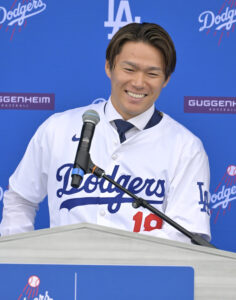
“I’d like to thank everyone in the Orix organization, the Dodger organization and all the people close to me who have given me so much support throughout this free-agent process,” Yamamoto said in a statement released by the team. “I am truly excited to wear Dodger Blue and can’t wait to play in front of a packed Dodger Stadium.”
Yamamoto receives a massive $50MM signing bonus and a pair of opt-out opportunities. Those are conditional on the status of his elbow but would allow him to retest free agency after the 2029 and ’31 seasons if he stays healthy. If he doesn’t incur a serious elbow injury, he’d be weighing whether to opt out of the last six years and $170MM once the 2029-30 offseason arrives. The deal does not contain any deferred money.
The right-hander has been the best pitcher in Japan for the past few seasons. He spent parts of seven years with the Buffaloes. By his age-20 campaign, he’d emerged as one of the top pitchers at the second-highest level of professional baseball in the world. Yamamoto turned in a 1.95 ERA that season, kicking off a run of five straight years allowing no more than 2.20 earned runs per nine.
That includes sub-2.00 ERA showings over his final trio of seasons. Yamamoto has won the Sawamura Award as Japan’s best pitcher in all three years. He worked to a 1.39 ERA over 193 2/3 innings in 2021, followed by a 1.68 mark in 193 frames the next season. Yamamoto somehow turned in an even better year in his final season, pitching to a microscopic 1.21 ERA through 168 frames.
Among NPB pitchers to reach 100 innings, Yamamoto’s ERA was more than half a run lower than anyone else’s. (Shoki Murakami finished second with a 1.75 mark in 144 1/3 frames). Only Shota Imanaga, who is also available to MLB teams this offseason via the posting system, topped Yamamoto’s 169 strikeouts. He punched out 26.6% of opposing hitters against a tidy 4.4% walk rate.
It’s about as dominant a body of work as a pitcher can build before he faces any MLB hitters. The elite production is supported by both scouting and quantitive evaluations of Yamamoto’s arsenal. Evaluators are nearly unanimous in projecting him as a high-octane major league starter. Conservative estimates on his upside point to a future as a high-end #2 starter, while other scouts have pegged him as a potential ace.
Eno Sarris of the Athletic recently broke down Yamamoto’s repertoire. He suggested Yamamoto brandishes three plus or better offerings highlighted by a split-finger that should be among the best in the majors. The righty worked in the mid-upper 90s with his fastball in shorter stints during the World Baseball Classic. He also sports a promising curveball and a cutter as his third and fourth offerings, while evaluators praise his athleticism and command.
Yamamoto would have been in high demand even if he were in his late 20s or early 30s, the standard age for a free agent pitcher. That he debuted in NPB as an 18-year-old and was made available via the posting system only adds to the appeal. Yamamoto turned 25 in August, making him the first marquee free agent pitcher that age since Masahiro Tanaka signed during the 2013-14 offseason. He’ll be paid through his age-36 season.
To the extent there are concerns about Yamamoto, they’re limited to his lack of MLB experience and a smaller 5’10” frame. That hasn’t worried many evaluators, though, and they’re clearly not issues for the Dodgers.
Entering the offseason, it was widely believed Yamamoto would land the largest contract ever for a player coming over from NPB. It’d have been a far bolder prediction to peg him for the largest deal of any pitcher in major league history. That’s what he’ll receive, though, setting the mark in both contract length and guarantee. He’s the first pitcher in recent memory to reach even the 10-year mark. The guarantee edges past the $324MM which Gerrit Cole landed with the Yankees during the 2019-20 offseason. Yamamoto’s deal stretches three more seasons than Cole’s does, but his camp is surely pleased with the guarantee record even if it required slightly lowering the annual salary.
The deal comes with a $27.08MM average annual value. Regardless of the precise salary distribution, that’s the relevant factor for the Dodgers’ competitive balance tax picture. That pushes L.A. well into the third tier of luxury tax penalization. Roster Resource calculates the club’s CBT number in the $282MM range.
The Dodgers are set to pay the tax for a third consecutive season. They’re taxed at a 50% rate for spending between $237MM and $257MM, 62% for their next $20MM, and a 95% clip for spending between $277MM and $297MM. (They’ll be taxed at a 110% rate for any dollars above $297MM.) By pushing the Dodgers from around $255MM to $282MM from a tax perspective, the contract adds roughly $18.2MM in tax payments. It also means that future acquisitions will come with an elevated tax height.
On top of the money to Yamamoto and the tax payments, the Dodgers are on the hook for a huge sum to Orix. Under the terms of the NPB/MLB posting system, a posting fee is calculated as 20% of a deal’s first $25MM, 17.5% of the next $25MM, and 15% of further spending. That comes out to $50.625MM which the Dodgers owe to the Buffaloes.
It’s a staggering outlay, one that pushes near the $400MM mark in aggregate. It’s the kind of massive strike the Dodgers envisioned in the wake of the Shohei Ohtani signing. The defending AL MVP deferred $680MM of his $700MM deal until 2034-43. That left plenty of money at the front office’s disposal to fix the starting rotation. With Ohtani unable to pitch until 2025, he signed with a team that only had Walker Buehler and Bobby Miller as locks for the Opening Day rotation.
Within a couple weeks, the Dodgers have constructed a star-studded pitching staff to complement their strong bullpen and loaded lineup. Los Angeles acquired and promptly extended Tyler Glasnow. Adding Yamamoto to the group gives them a potentially elite front four. There’s still some risk. Glasnow and Buehler have concerning injury histories, while neither Yamamoto nor Miller has pitched a full season in MLB. Yet it’s also not difficult to see the path to excellent results regardless of whomever takes the final spot. Ryan Yarbrough, Emmet Sheehan and Michael Grove project as the top internal options, but it’d be foolish to rule out the Dodgers adding a veteran arm to continue their all-in push.
Aggressive as the signing is for L.A., they weren’t meaningfully above their top competitors in the bidding. Martino reports that the Yankees put forth a 10-year, $300MM offer, while the Mets put the same $325MM figure on the table. According to Martino, Yamamoto’s camp had sought opt-out provisions after the fifth and eighth seasons in those discussions. The Giants, Red Sox, Blue Jays and Phillies were also in the running down to the final week.
In the end, it seems Yamamoto preferred the Dodgers to the other clubs that were seriously involved. The Athletic’s Will Sammon reports that the Mets first presented the $325MM offer, which the Dodgers agreed to match. He’ll join Ohtani, Glasnow, Buehler, Mookie Betts, Freddie Freeman and Will Smith on a team that’s likely to enter the 2024 campaign as the most popular World Series pick.
The rest of the clubs will look elsewhere. The Mets seem likely to have a fairly quiet offseason, as they reportedly viewed Yamamoto as a unique free agent based on his youth and talent. They’re not expected to pivot to the next tiers of free agency. The Yankees, Giants, Blue Jays and Red Sox could all still be in play for top-of-the-market talent, either on the rotation front or at other positions. Blake Snell and Jordan Montgomery now stand atop the starting pitching class, while Cody Bellinger is arguably the best remaining overall free agent. The market could also now accelerate for Imanaga, the #2 NPB pitcher who has until mid-January to sign with an MLB team.
Jack Curry of the YES Network first reported that Yamamoto would sign with the Dodgers for more than $300MM. Jeff Passan of ESPN reported the 12-year, $325MM term. USA Today’s Bob Nightengale was first with the $50MM signing bonus, while Ken Rosenthal of the Athletic reported the absence of deferrals. Passan reported the two opt-out possibilities.
Image courtesy of USA Today Sports.
Guardians Acquire Estevan Florial From Yankees
The Yankees and Guardians have agreed on a trade that will send outfielder Estevan Florial to Cleveland in exchange for right-hander Cody Morris, per an announcement from both clubs.
The trade ends Florial’s tenure with the Yankees, with whom he signed out of the Dominican Republic back in 2015. After posting solid numbers in the lower levels of the minor leagues during his teenage years and reaching the High-A level before his 20th birthday, Florial began getting buzz as a consensus top-50 prospect throughout the sport prior to the 2018 season. Unfortunately, things came off the rails for Florial somewhat from there as the outfielder struggled at the High-A level in both 2018 and 2019. He made his big league debut during the shortened 2020 season and since then has served as a depth outfielder for the big league Yankees, with 48 appearances in the majors total in his four-year big league career.
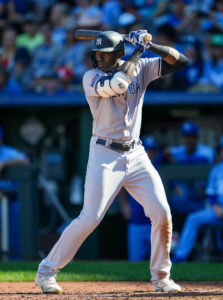
While Florial, 26, has managed a slash line of just .209/.313/.296 across his 134 career plate appearances in the majors, his time in the minor leagues has seen him improve substantially in recent years. Fl0rial sports a career slash line of .265/.358/.490 at the Triple-A level, with an even more impressive .284/.380/.565 slash line in 101 games at the level in 2023. Given Florial’s extremely limited big league exposure to this point in his career, it’s easy to imagine him finding some level of success in Cleveland, where he should have a clear path to at least semi-regular at-bats. The Guardians put forth the third-worst outfield unit in the majors last year by measure of wRC+, as the club’s outfielders collectively hit just .250/.312/.342. Florial could challenge the likes of Ramon Laureano and Myles Straw for regular playing time alongside Steven Kwan, who appears locked into left field entering the 2024 campaign.
In exchange for Florial’s services, the Guardians are parting with Morris. The 27-year-old right-hander was the club’s seventh-round pick in the 2018 draft and first made his big league debut in 2022, where he performed well in seven appearances (five starts). While Morris posted an elevated walk rate of 12% that pushed his FIP up to 4.34, he struck out a respectable 23% of batters faced and managed an excellent 2.28 ERA in 23 2/3 innings of work during his first season in the majors.
In the minor leagues, Morris was even more impressive, with a career 1.68 ERA and a 37.8% strikeout rate in 80 1/3 innings of work between the Double-A and Triple-A levels as the 2022 campaign came to a close. Morris opened the 2023 season on the injured list due to a teres major strain but returned to action in June. While the right-hander put up respectable numbers at Triple-A, including a 3.23 ERA in 39 innings of work across 21 appearances, he struggled badly across six relief appearances in the majors with a 6.75 ERA over eight innings of work.
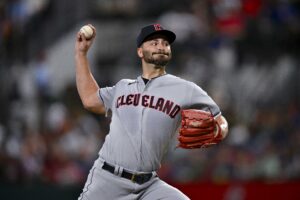
Despite Morris’s struggles with injury and ineffectiveness at the big league level last year, he provides the Yankees with an interesting, optionable arm who has experience pitching both out of the rotation and in the bullpen with strong numbers at the minor league level and some small-sample size success at the big league level. That type of arm would surely be attractive to just about any club, but could be particularly appealing to the Yankees after the club shipped cost-controlled pitchers like Michael King, Randy Vasquez, and Jhony Brito to San Diego as part of the package that landed the club Juan Soto earlier this month.
Image courtesy of USA Today Sports.
Padres Sign Yuki Matsui To Five-Year Deal
The Padres have signed left-hander Yuki Matsui to a five-year contract, the club has announced. Matsui and the Padres were reportedly close to a deal earlier this week. ESPN’s Jeff Passan reports that Matsui will receive $28MM guaranteed over the life of the contract, which includes opt-outs after the third and fourth seasons of the deal as well as an injury clause that can convert the fifth year of the contract into a club option worth $7MM if Matsui suffers a “serious” elbow injury during the life of the contract.
The deal represents San Diego’s first significant buy-side move of the offseason, and their first major move since trading star slugger Juan Soto and center fielder Trent Grisham to the Yankees earlier this month for a five-player package headlined by right-handers Michael King and Drew Thorpe. It’s a somewhat unusual deal for a reliever; right-hander Robert Suarez‘s agreement with the Padres and the record-breaking deal between star closer Edwin Diaz and the Mets, both of which were signed last offseason, are the only contracts for free agent relievers to surpass five years.
Matsui landed at #43 on MLBTR’s annual Top 50 MLB free agents list, where we projected him for a two-year, $16MM deal. Matsui nearly doubled that guarantee, though the average annual value of his deal comes in at just $5.6MM, well below the $8MM MLBTR projected him for over a two-year apct. Despite the unusual length of the deal, the gamble is an understandable one for the Padres to make. The deal covers Matsui’s age-28 through -32 seasons, with his first opt-out opportunity coming after Matsui’s age-30 campaign in 2026. The lowered AAV of the deal was surely particularly appealing to the Padres, who are reportedly hoping to stay under the luxury tax in 2024. Given those financial constraints, Matsui’s deal represents a more cost-effective alternative to reuniting with relief ace Josh Hader, who MLBTR projected for a whopping six-year, $110MM guarantee on the heels of a dominant season as San Diego’s closer.
While Matsui can’t be reasonably expected to match Hader’s incredible production last season (1.28 ERA and 33 saves in 56 1/3 innings), the lefty has put together an excellent career overseas in his own right. Matsui’s spent the past ten seasons pitching for Nippon Professional Baseball’s Tohuku Rakuten Golden Eagles. During his NPB career, Matsui has racked up 236 saves in 501 appearances while earning five All Star nods. In 659 2/3 innings of work during his career, Matsui sports a sterling 2.40 ERA with a 31.9% strikeout rate. He’s been even more impressive over the past three seasons, a combined 1.42 ERA and a 36.4% strikeout rate across 152 innings during that time.
Matsui was a frequent subject of MLBTR’s NPB Players to Watch series throughout the 2023 season, where Dai Takegami Podziewski discussed Matsui’s four-pitch mix that includes a 92-94 mph fastball that touches 96 along with a splitter, slider, and curveball while also noting that Matsui reportedly struggled to adjust to the MLB ball while participating in the World Baseball Classic last spring. Clearly, the Padres were more enticed by Matsui’s deep pitch mix and impressive velocity for a lefty who is listed at just 5’8” and 167 pounds than they were concerned by his struggles to adjust to the ball used in the majors earlier this year.
While the addition of Matsui shores up a Padres bullpen lacking in certainty, there’s plenty left for president of baseball operations A.J. Preller and his front office to do if they hope to return to contention in 2024. Another set-up arm to pair with Matsui and Suarez at the back of the bullpen would be helpful, and at least one more starting pitcher who can step into the void left by the departures of Blake Snell, Seth Lugo, Michael Wacha, and Nick Martinez this offseason alongside King appears to be all but necessary.
On the hitting side of things, the Padres have just two outfielders on their 40-man roster at the moment in Fernando Tatis Jr. and fourth outfielder Jose Azocar, meaning they’ll need to make multiple additions to the lineup to cover the two vacant outfield spots and DH, which lacks a clear starter following the deal that sent Matt Carpenter and his salary to Atlanta earlier in the month.
That’s a hefty shopping list for any club, but it’s especially daunting for a Padres club that projects for a $210MM luxury tax payroll per RosterResource. If the Padres are indeed intent on staying under the first tax threshold of $237MM in 2024, that gives them just under $27MM of payroll space left to work with this offseason as they look to fill the remaining holes in the lineup and pitching staff. While the addition of Matsui is a step in the right direction that didn’t eat into the club’s financial capabilities too excessively, the Padres clearly still have plenty of work to do before they’re ready to contend in an ever-improving NL West next year.
Eight Teams Combine For Record $209.8MM In Luxury Tax Bills
Major League Baseball has finalized the luxury tax calculations for the 2023 season, and the eight teams over the Competitive Balance Tax threshold will combine for a total bill of $209.8MM, Ronald Blum of the Associated Press reports. Both the total number of tax-paying teams and the total sum are new records, surpassing the previous highs of six teams (in 2016 and 2022) and $78.5MM (in 2022).
Here is what each of the eight teams owes for surpassing at least the $233MM base CBT threshold….
- Mets: $100,781,932
- Padres: $39.7MM
- Yankees: $32.4MM
- Dodgers: $19.4MM
- Phillies: $6.98MM
- Blue Jays: $5.5MM
- Braves: $3.2MM
- Rangers: $1.8MM
As a reminder of how the luxury tax operates, the CBT figures are determined by the average annual value of salaries for players on the 40-man roster. A player earning $20MM over two seasons, for example, has a CBT number of $10MM, even if the player might earn $8MM in the first year of the contract and $12MM in the second year. Deferred money in a contract can reduce a luxury tax number to some extent — most famously, Shohei Ohtani‘s $700MM deal with the Dodgers contains $680MM in deferred money, so his CBT hit will be roughly $46MM per season instead of $70MM.
A team is considered a “first-time payor” if they haven’t spent above the CBT threshold in the previous season. A first-time payor would owe a 20% surcharge on any dollar spent between $233MM and $253MM, 32% of anything between $253MM and $273MM, 62.5% on anything between $273MM and $293MM, and then 80% of overages for anything beyond $293MM. These percentages rise if a team is a tax payor for two consecutive seasons, and then even further if a team exceeds the CBT line in three or more consecutive seasons. This year’s CBT class featured three first-time payors (Texas, Atlanta, Toronto), three two-time payors (Philadelphia, both New York teams) and two three-time payors (San Diego, Los Angeles).
The $293MM threshold was instituted in the last Collective Bargaining Agreement as a fourth penalty tier, and it is unofficially known as the “Steve Cohen Tax” in a reference to the Mets owner’s penchant for big spending. Even though New York has only topped the CBT whatsoever in 2022 and 2023, it isn’t surprising that Cohen’s team set new standards for tax payouts. The Mets’ tax payroll of $374.7MM and approximate $100.78MM tax bill far exceeded the 2015 Dodgers’ previous records of $291.1MM and $43.6MM, respectively.
This bill would’ve been even higher if the Mets hadn’t unexpectedly struggled, and unloaded some expensive contracts at the trade deadline in order to save some money and reload with an eye towards probably 2025 as a more clear-cut return to contention. Blum also notes that the Mets received a $2,126,471 tax credit related to a CBA provision, which slightly reduced their bill further.
As always, the actual financial cost of exceeding the tax is perhaps the least-important part of the penalties, especially for teams who barely across the first threshold. Teams who exceed the CBT line would face further punishment in regards to free agents who reject qualifying offers, whether that translates to additional compensation required to sign a QO-rejecting player, or lesser compensation received if a team’s own qualified free agent signs elsewhere. For instance, signing Ohtani cost the Dodgers not just $700MM, but also $1MM in international draft pool money and their second- and fifth-highest picks in the 2024 draft. For a team like the Padres, should Blake Snell or Josh Hader sign elsewhere, San Diego’s compensatory draft selection wouldn’t come until after the fourth round of the 2024 draft.
Spending on talent is more often than not a recipe for success on the field, though obviously hardly a guarantee. The Mets had a losing record, and the Padres and Yankees each squeaked over the .500 mark with 82-80 records. The other five tax payors reached the playoffs, though the Phillies and the World Series champion Rangers were the only members of that group of five to win at least one postseason series.
The $209.8MM in tax revenues will be split up in three ways by the league. The first $3.5MM is devoted to funding player benefits, $103.15MM will go towards funding individual player retirement accounts, and the other $103.15MM will be put into a supplemental commissioner’s discretionary fund and distributed amongst revenue-sharing recipient teams who have grown their (non-media) local revenue over a pre-determined number of years.
Giants Sign Tom Murphy
TODAY: The Giants officially announced the signing.
DECEMBER 18: The Giants are in agreement with free agent catcher Tom Murphy on a two-year deal with a 2026 club option, according to multiple reports. The Ballengee Group client is reportedly guaranteed $8.25MM, including a $250K buyout on the option. The deal can max out at $12MM.
Murphy heads to the Bay Area after five seasons in the Pacific Northwest. The right-handed hitter played a semi-regular role during his time with the Mariners. On a rate basis, Murphy has been one of the most productive power bats at the catcher position.
In 807 plate appearances with Seattle, Murphy blasted 38 home runs. He hit .250/.324/.460 overall, well above-average offense in one of the sport’s more pitcher-friendly home parks. That’s excellent production for a #2 catcher. However, that Murphy has only stepped to the plate 807 times over the last five years also points to a concerning injury history.

Going back to the start of 2020, the Buffalo product has missed time with a fractured left foot, a left shoulder dislocation and a sprained left thumb. The foot injury cost him the entire shortened season, while the shoulder limited him to 14 games in 2022. Last season’s thumb issue, suffered in mid-August, ended his year.
Despite the injury history, it’s easy to see the appeal of bringing Murphy aboard on a fairly low-cost contract. He’ll add a legitimate power presence as the backup behind 24-year-old Patrick Bailey. He’ll strike out a fair amount as well, but there aren’t many depth catchers who have the same kind of slugging upside that Murphy possesses.
The 32-year-old (33 in April) isn’t as highly-regarded on the other side of the ball. Statcast graded him below average from both framing and blocking perspectives. He only threw out one of 28 attempted basestealers in 2023. While that’s not entirely on the catcher — a pitcher’s ability to hold runners is also a factor — Statcast ranked Murphy 69th out of 74 catchers (minimum 10 throws) in average pop time to second base.
Signing Murphy could signal the forthcoming end of Joey Bart’s time in San Francisco. The second overall pick in 2018, Bart has hit only .219/.288/.335 in 162 big league contests. This year marked his final minor league option season, meaning San Francisco will have to carry him on the MLB roster or make him available to other clubs via trade or waivers.
Bailey and Murphy are the top two on the depth chart. Blake Sabol also seems ahead of Bart on the organizational hierarchy, although he has a trio of options and could play the corner outfield. Even if the Giants were to send Sabol to Triple-A, there’s not much value in keeping Bart as a sparsely-used third catcher. A sell-low trade of the former top prospect this offseason seems likely.
The Giants had a payroll in the $155MM range before the Murphy signing, according to Roster Resource. A $4MM salary would push that north of $158MM. The contract’s $4.125MM average annual value puts their luxury tax number around $192MM, about $45MM below next year’s lowest threshold.
Ken Rosenthal of the Athletic first reported the sides were nearing a multi-year deal, as well as the $8MM guarantee. Jon Heyman of the New York Post was first with an agreement. Jon Morosi of MLB.com reported it was a two-year guarantee with a third-year option. Jeff Passan of ESPN was first with the $250K option buyout, which Ari Alexander of KPRC 2 specified was not in the originally reported $8MM total. Susan Slusser of the San Francisco Chronicle reported the $12MM maximum value.
Image courtesy of USA Today Sports.
Angels, Giants Among Teams Pursuing Blake Snell
The Angels have lost Shohei Ohtani to the Dodgers and never appeared to be a finalist for NPB star Yoshinobu Yamamoto, but they’re pursuing the biggest fish remaining on the free agent market, per Susan Slusser of the San Francisco Chronicle, who reports that the Halos have made reigning NL Cy Young winner Blake Snell “their priority” now that Ohtani has officially departed. The Giants, too, are interested in Snell, per Slusser.
Signing Snell would be a departure from the norm for either club. The Angels’ three-year commitment to Tyler Anderson last offseason was the organization’s first multi-year deal for a free agent starting pitcher since signing Joe Blanton to a two-year contract a decade prior. Owner Arte Moreno has been comfortable with long-term deals for position players — oftentimes mega-deals that haven’t worked out favorably (Albert Pujols, Anthony Rendon, Josh Hamilton) — but has generally been wary of similar commitments to pitchers. The Angels did pursue Gerrit Cole when he was a free agent, but they of course lost out to the Yankees’ then-record bid of $324MM. (Yamamoto topped that mark by $1MM when he agreed to terms with the Dodgers.)
Similarly, the Giants have eschewed long-term deals for starting pitchers in five years under president of baseball operations Farhan Zaidi. San Francisco hasn’t gone beyond three years on any starting pitcher under the current regime — arguably a shrewd philosophy but also the reason that Kevin Gausman is starring for the Blue Jays on what now looks to be a wildly affordable five-year, $110MM contract. Zaidi’s club has gone to three years to sign Anthony DeSclafani and issued two-year deals for veterans Alex Wood, Alex Cobb, Sean Manaea and Ross Stripling, but longer-term pacts haven’t been in this front office group’s playbook.
Then again, the Giants also haven’t been consistently successful under this front office regime. Their 107-win season in 2021 stands as a clear highlight, but the Giants have fallen well shy of the lofty expectations set by that outlier season. Andrew Baggarly of The Athletic suggested earlier this week in his latest Giants mailbag that ownership could be providing “a little more direction from above” than in prior offseasons — particularly when it comes to this sort of long-term pursuit (one that, as Baggarly rightly notes, is largely possible by virtue of the front office’s prior aversion to taking on this sort of long-term risk). To be clear, Baggarly wasn’t addressing Snell in particular but rather the general philosophical shift associated with pursuing larger-scale additions from the free-agent market.
From a payroll vantage point, both the Halos and Giants can handle a weighty commitment to Snell, who’s reportedly been seeking a commitment of $200MM or more. San Francisco currently projects for a $158MM payroll, per Roster Resource, to say nothing of the fact that the Giants are about $45MM shy of the $237MM luxury-tax threshold. (Luxury tax is calculated by the sum of the average annual value on the payroll and can thus differ from the bottom-line dollars paid out in a given year; contracts are often backloaded or frontloaded for varying purposes.) The only two players signed beyond the 2025 season are ace Logan Webb (five years, $90MM from 2024-28) and newly signed center fielder Jung Hoo Lee, who inked a six-year, $113MM pact.
As for the Angels, they’re stuck paying the aforementioned Rendon $38MM for each of the next three seasons on his backloaded deal. There’s little no hope of trading that cumbersome contract away, so the team can only hope for a return to his Nationals form — unlikely as it may be as he enters his age-34 season. Anderson is signed through 2025 at $13MM per season, and the Angels still owe former MVP Mike Trout $34.45MM annually through the 2030 season.
Even with the huge commitments to Trout and Rendon, the Angels project for a $152MM payroll in 2024 and sit at just $167MM in terms of luxury-tax obligations. That leaves ample room to sign Snell, even if doing so would require shattering the franchise-record for a starting pitcher contract (Jered Weaver‘s five-year, $85MM deal).
It stands to reason that with both Ohtani and Yamamoto now off the board, the market for Snell will continue to crystalize in the coming weeks. Several runners-up for Yamamoto, in particular, could pivot to consider Snell — although various reports out of New York have indicated that the Mets aren’t expected to be among them. Will Sammon of The Athletic wrote last weekend that the Mets weren’t planning to pursue other top-tier free agents if they fell short in their bid for Yamamoto, whom they considered to be uniquely aligned with their long-term plan given his youth. MLB.com’s Anthony DiComo echoed that sentiment today, reporting that the Mets shouldn’t be expected to pursue Snell or fellow free agent Jordan Montgomery.
Tigers Sign Shelby Miller
1:48pm: The Tigers have announced the signing. It’s a one-year contract worth a guaranteed $3MM, the team announced. They also hold a club option worth $4.25MM and a $250K buyout.
The Tigers, who have recently begun announcing the full terms of their contracts, added that Miller can earn an extra $1.175MM per season via incentives. He’ll receive $100K bonuses for reaching each of 50, 55 and 60 games pitched, plus another $125K for reaching 65 and 70 appearances. If he winds up serving as the closer, there’s even more money to be unlocked. The contract calls for $150K bonuses for 40, 45, 50 and 55 games finished.
The value of the club option can also be boosted by $1.4MM. Those escalators are tied to appearances ($100K for 50, 55 and 60 games pitched; $150K for 65 and 70 games pitched) and games finished ($200K for finishing 40, 45, 50 and 55 games).
8:39am: It’s a one-year contract with a 2025 option, reports Evan Petzold of the Detroit Free Press. Miller is in Detroit for his physical today, Petzold adds, so the contract should become official soon.
8:26am: The Tigers have agreed to a deal with free agent right-hander Shelby Miller, reports Kiley McDaniel of ESPN. The contract is still pending a physical. Detroit’s 40-man roster is full, so they’ll need to make a corresponding move to accommodate this latest addition. Miller is represented by Excel Sports Management.

Miller, 33, enjoyed a resurgent season with the 2023 Dodgers, pitching to a brilliant 1.71 earned run average in 42 innings over 36 appearances (35 relief outings, one start). He fanned a strong 25.8% of his opponents against a bloated 11.7% walk rate and kept the ball on the ground at a 37.4% clip — a few percentage points below the league average. Miller’s fastball is down about a mile per hour from its peak levels, sitting at a league-average 93.6 mph, but he also brandished a newly implemented splitter in 2023, which flummoxed his opponents.
Prior to the 2023 season, Miller had thrown exactly one splitter in his career — way back in 2014. He threw the pitch 26.2% of the time this past season, however, and batters were largely helpless against it. Miller threw 174 splitters in 2023 and finished off 47 plate appearances with the pitch; opponents posted an awful .136/.191/.250 against the pitch in that sample. Statcast credited the pitch with a .170 “expected” opponents’ batting average and a .274 expected slugging percentage.
That marked Miller’s first successful season since back in 2015. While he’d shown flashes of promise in the interim seven years, injuries and poor performances were far more common for the former top prospect and once-promising young starter. The 19th overall pick by the Cardinals back in 2009, Miller debuted in St. Louis as a 21-year-old, pitched to an outstanding 3.22 ERA over his first 575 1/3 big league frames and was twice traded in blockbuster deals — first going from St. Louis to Atlanta in exchange for Jason Heyward and a year later going to Arizona in the trade that brought Dansby Swanson and Ender Inciarte to the Braves.
Miller struggled immediately with the D-backs and never found his footing before undergoing Tommy John surgery in 2017. At various points, his career looked to be on the brink, but he persevered through considerable struggles and now, in his mid-30s, looks to have found new life as a quality bullpen arm.
The Dodgers didn’t use him in high-leverage spots often last year, but Miller could have a clearer path to setup work in Detroit. Right-handers Alex Lange and Jason Foley are the primary ninth- and eighth-inning options, respectively, and Detroit brought lefty Andrew Chafin back on a one-year deal as a left-handed setup option as well. But Miller has a good bit more experience than the bulk of the Tigers’ relievers and could find himself in more tight, late-inning spots this season.
Miller becomes the latest addition in what’s been a nice offseason of veteran pickups for the Tigers. Detroit has added righty Kenta Maeda (two years, $24MM) to help stabilize a young pitching staff and also bought low on former Cardinals ace Jack Flaherty (one year, $14MM), who’ll look to return to his prior heights in a new setting. The Tigers kicked off the winter by acquiring Mark Canha from the Brewers and picking up his 2024 option; he’ll join the team’s outfield and DH mix this coming season. Chafin, as previously noted, is returning to Comerica Park, where he excelled in 2022 before struggling with Arizona and Milwaukee in 2023. He and Miller have the potential to meaningfully fortify the Detroit relief corps.
There’s still room for some further additions, be they in the bullpen, on the bench or perhaps around the infield, where Detroit still lacks some certainty at multiple positions. Some of those could come from the trade market rather than free agency, although president of baseball operations Scott Harris indicated this week that he doesn’t envision trading from his newly deepened rotation mix. Wherever further reinforcements come from, the Tigers’ 2024 outlook is already brighter than the 2023 group. It’s a deepened roster that, with some continued development from young players like Spencer Torkelson, Riley Greene, Kerry Carpenter and prospects like Colt Keith and Justyn-Henry Malloy, could emerge as a viable contender in a weak American League Central division.
Diamondbacks Re-Sign Lourdes Gurriel Jr.
Dec. 22: The D-backs have now formally announced the signing.
Dec. 17: The Diamondbacks have agreed to a reunion with free agent outfielder Lourdes Gurriel Jr. on a three-year, $42MM contract. The deal (which becomes official once Gurriel passes a physical) contains a opt-out clause after the 2025 season, as well as a $14MM club option for the Diamondbacks for the 2027 campaign. Gurriel is represented by Magnus Sports.
The 30-year-old Gurriel played in Arizona in 2023 after he and catcher Gabriel Moreno were acquired from the Blue Jays in the trade that sent Daulton Varsho to Toronto. Gurriel got off to a hot start in his new locale, making his first career All-Star appearance thanks in large part to a blistering month of May (.352/.416/.714 in 101 plate appearances). That production proved to be something of an outlier for the outfielder, however, as he posted a sub-.700 OPS in each of April, June, and July that left him with an overall slash line of just .246/.294/.445 in 388 trips to the plate entering the month of August.
Gurriel managed to turn things back around down the stretch, however, finishing with a .261/.309/.463 slash line to show for 592 PA over the entire regular season. He also performed decently (93 wRC+) in 70 trips to the plate during Arizona’s postseason run, including a .333/.350/.500 slash line against the Rangers during the World Series.
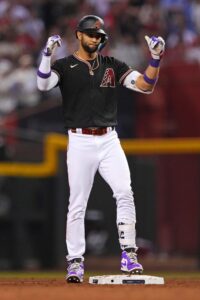 Despite Gurriel’s uneven performance in 2023, he’s been a pretty solid bat throughout his career with an above-average wRC+ every year since he debuted in the majors back in 2018. Since becoming an everyday player during the shortened 2020 season, Gurriel has slashed .279/.326/.456 with a 112 wRC+. He also receives strong marks for his defense in left field, including a +14 Defensive Runs Saves with Arizona last season. While Gurriel managed just five homers in 121 games with the Blue Jays in 2022, he rediscovered his power stroke with the Diamondbacks last year, clubbing 24 home runs to go along with 35 doubles, both career-best figures.
If he can maintain that power output while bouncing back from a career-worst .282 BABIP last season, it’s possible Gurriel can unlock another level of offensive potential as he enters his thirties. The opt-out clause reflects this ceiling, as Gurriel could now re-enter the market heading into his age-32 season after what he hopes are a pair of very productive seasons in the desert.
Given the dearth of consistent offensive options available on the free agent market this offseason, it’s not a shock that Gurriel was able to land a healthy guarantee. The total guarantee of $42MM clocked in below the four-year, $54MM contract MLBTR projected for Gurriel when placing him 14th on our annual Top 50 MLB free agents list, though it’s worth noting that the average annual value of the deal is, by contrast, higher than we projected. While Gurriel is largely limited to left field defensively and has not yet posted truly impactful offensive numbers over a full season as an everyday player, his consistency and potential upside make him a worthwhile investment for an Arizona club that was looking to add to its outfield mix this offseason.
Looking ahead to 2024, Gurriel profiles as the club’s everyday left fielder where he’ll likely patrol the outfield alongside Alek Thomas and Corbin Carroll, with the likes of Jake McCarthy and Dominic Fletcher as depth options behind the starting trio. Gurriel is the only right-handed bat in that outfield mix and could help the club’s outfield produce against left-handers. Arizona struggled badly against left-handed pitching in 2023, though Gurriel slashed an impressive .301/.363/.452 against southpaws. Retaining Gurriel and adding another righty bat in third baseman Eugenio Suarez should help shore up the team’s performance against left-handers.
It has already been a busy offseason for the Diamondbacks, who inked left-hander Eduardo Rodriguez to a four-year deal earlier this month in addition to the aforementioned trade for Suarez. While Roster Resource projects the Gurriel contract to take the club’s 2024 payroll into uncharted territory with a $140MM figure, it appears that the club does not intend on slowing down from here. ESPN’s Jeff Passan suggests the club still plans on adding a power-hitting DH to their lineup before the offseason comes to a close, while USA Today’s Bob Nightengale specifically denotes the club’s interest in right-handed veterans J.D. Martinez and Justin Turner. Jorge Soler is another name the club has been connected to in recent weeks that could fill that role.
Ken Rosenthal of The Athletic was the first to report the agreement between Gurriel and the Diamondbacks. ESPN’s Jeff Passan and Kiley McDaniel had the length of the deal and the financial terms, while MLB.com’s Mark Feinsand had the details on the opt-out clause and the club option.
Photo courtesy of USA Today Sports Images
Giants Out Of Bidding For Yoshinobu Yamamoto
9:06pm: Yamamoto could make his decision within the next 48 hours, tweets Mark Feinsand of MLB.com.
7:55pm: MLB.com’s Jon Morosi tweets that Yamamoto has at least one offer of $300MM or more in hand.
6:59pm: The Giants have been informed they’re out of the running for Yoshinobu Yamamoto, reports Alex Pavlovic of NBC Sports Bay Area (X link). While there’s no indication that Yamamoto has made his final decision, Pavlovic adds the Giants expect he’ll sign with the Dodgers or one of the New York clubs.
Andy Martino of SNY tweets that the Mets have not received any indication they’re out of the running. That’s also true of the Yankees, according to Jon Heyman of the New York Post (X link). Heyman indicates the Yankees have put a “significant bid” on the table.
Crossing San Francisco off the list technically leaves six known finalists. In addition to the Dodgers, Mets and Yankees, the Blue Jays, Phillies and Red Sox have been involved. Philadelphia has made an offer this week. That said, reports have cast the Phils, Jays, and (to a lesser extent) the Sox as longer shots.
Yamamoto has been weighing offers throughout the week. While he technically has until the evening of January 4 to sign, the expectation is that he won’t take things to the wire. That his camp is now in the process of whittling the field lends credence to the idea that a decision might not be far off.
The bidding seems as if it’ll surpass $250MM, before accounting for a posting fee owed to the Orix Buffaloes that could tack on another $45-50MM. That fee is in proportion to the contract size, calculated as 20% of the deal’s first $25MM, 17.5% of the next $25MM, and 15% of additional spending. That reflects Yamamoto’s atypical youth for a free agent pitcher (25) and his sheer dominance in Japan. Named NPB’s best pitcher three years running, he’s coming off a 1.21 ERA while striking out nearly 27% of opponents in 164 innings.
It’s a tough blow for the Giants, who come up short on another top-tier free agent. The Giants have missed on pursuits of Aaron Judge, Trea Turner and Shohei Ohtani within the past two offseasons alone, while their deal with Carlos Correa fell through because of the physical. Yamamoto will join that list. San Francisco did land KBO star Jung Hoo Lee on a six-year, $113MM pact — the largest deal of Farhan Zaidi’s tenure as baseball operations president — but they haven’t gotten a truly elite free agent in some time.
San Francisco still has plenty of spending capacity as they decide on their next steps. Roster Resource projects their 2024 spending around $158MM. That’s about $30MM below this year’s Opening Day figure. From a luxury tax perspective, they’re almost $45MM south of the base threshold. That opens the possibility for a run at any of the top remaining free agent talents. Blake Snell and Jordan Montgomery headline the rotation class, while Matt Chapman was on the radar earlier in the offseason. So was the top available hitter, Cody Bellinger, although the Lee signing seems to rule out a pursuit of another lefty-swinging center fielder.