
Padres Sign Woo-Suk Go To Two-Year Deal
The Padres announced the signing of reliever Woo-Suk Go to a two-year contract with a mutual option covering the 2026 season. He is reportedly guaranteed $4.5MM. Go will make $1.75MM this year and $2.25MM in 2025. There’s a $500K buyout on the option, which is valued at $3MM. San Diego will also owe a $900K posting fee to the LG Twins of the Korea Baseball Organization. The Friars still have five vacancies on the 40-man roster.
The contract also contains a number of performance bonuses. Go would receive an additional $100K if he reaches 70 appearances next season. He can unlock up to $400K in bonuses for 2025 as well: $100K apiece at 40, 45, 55 and 60 games. His 2025 salary could jump by as much as $500K if he reaches 45 games finished next season. Unless the mutual option is exercised, Go will return to free agency two years from now. While he’ll still be well shy of six years of MLB service, most major league deals for players from a foreign professional league include a clause that sends the player back to free agency once the contract expires.
Go, a 25-year-old righty, has pitched parts of seven seasons in the KBO. He has worked as a pure reliever throughout that time, operating as the LG Twins closer for the past five years. After struggling during his first two seasons as a teenager, Go has been a solid bullpen arm for a half-decade.
He has rattled off four seasons with a sub-4.00 ERA, including three campaigns allowing fewer than 2.20 earned runs per nine. Go surpassed 30 saves in each of 2019, ’21 and ’22. He has fanned more than 26% of batters faced in each of the last five years, topping the 30% mark in the last two seasons.
While Go has consistently shown the ability to miss bats, he hasn’t always been around the strike zone. He has walked more than 10% of opposing hitters in four of his seven seasons. Go issued free passes to an alarming 11.6% of batters faced last year, contributing to a 3.68 ERA that made for more of a solid than exceptional platform showing.
Public scouting reports have generally pegged Go as a likely middle reliever at the big league level. Eric Longenhagen of FanGraphs writes that Go leans primarily on a mid-90s fastball and low-90s cutter while occasionally mixing in a curveball. That’s an intriguing arsenal, but the fringy control could make him a risk in higher-leverage spots.
The Twins made Go available via the posting system on December 4. That opened a 30-day period for him to sign with a major league club. (Unlike Japan’s Nippon Professional Baseball, whose posting windows last 45 days, there’s a 30-day opening for South Korean players). That was concluding this afternoon. If Go hadn’t signed with an MLB team by 4:00 pm CST, he’d have remained with the Twins for another season.
San Diego has been one of the sport’s most aggressive teams in targeting players making the jump from Asian professional leagues. They recently signed lefty Yuki Matsui to a five-year, $28MM pact as he came over from NPB. San Diego has added Ha-Seong Kim from the KBO and the likes of Nick Martinez and Robert Suarez from NPB in previous offseasons.
With Josh Hader, Martinez and Luis García hitting free agency, the Padres have Matsui and Suarez as their top two leverage relievers. Go joins that mix alongside righty Enyel De Los Santos, whom San Diego acquired from the Guardians in exchange for Scott Barlow this winter. Go is reportedly in the mix for the ninth inning.
Under the MLB-KBO posting agreement, the release fee is proportional to the size of the contract. For players guaranteed $25MM or less, it is calculated as 20% of the contract value. The $900K fee brings San Diego’s total outlay for Go to $5.4MM.
The deal’s $2.25MM average annual value brings San Diego’s projected luxury tax number to roughly $212MM, according to Roster Resource. That’s $25MM shy of next year’s lowest threshold. Their actual payroll sits in the $156MM range. Even in an offseason defined by budgetary limitations, adding Go shouldn’t have much of an impact on San Diego’s ability to continue bolstering the roster. The Padres still need one or two outfield acquisitions and would benefit from a back-of-the-rotation starter.
Jon Heyman of the New York Post first reported that Go and the Padres were nearing an agreement. The Post’s Joel Sherman reported the sides had agreed to a two-year, $4.5MM guarantee. Dennis Lin of The Athletic was first to report the 2026 mutual option and the specific salary breakdown. The Associated Press reported the bonuses and escalators.
Reports: Wander Franco Detained In Dominican Republic
January 3: Prosecutors accused Franco of commercial sexual exploitation and money laundering on Wednesday, according to a report from the Associated Press. The money laundering charges stem from law enforcement’s assertion that Franco paid the mother of one of the minors. As previously reported, the mother has also been detained. Prosecutors are requesting that a judge order Franco and the woman each remain confined under house arrest and prevented from leaving the country.
A hearing is scheduled for Friday morning, at which point a judge will decide whether Franco is to be released on bond pending further investigation and trial.
January 1: Authorities in Puerto Plata, Dominican Republic have arrested Wander Franco, according to multiple reports out of the D.R. (Spanish-language link via Listín Diario and ESPN Dominican Republic). He is expected to go in front of a judge for arraignment proceedings within the next 48 hours.
Officials have investigated two formal allegations that Franco has had inappropriate relationships with minors. (A third minor has made similar claims but did not file an official complaint.) According to Listín Diario, the mother of one of the alleged victims was also detained this afternoon.
Franco’s arrest was for failure to report for a summons last week, not a reflection of any new information in the investigations themselves, according to a report from ESPN.
The allegations against Franco went viral on social media on August 13. The Rays placed him on the restricted list the following day. A week later, he was transferred to administrative leave — common practice for players under investigation for possible violations of the MLB/MLBPA Domestic Violence, Sexual Assault and Child Abuse policy. Franco was reinstated onto the Rays’ 40-man roster at the beginning of the offseason in a procedural transaction.
While MLB quickly opened its own investigation into the social media allegations, the league is awaiting resolution of the legal process in the Dominican Republic before acting. Authorities summoned Franco for questioning last Wednesday. The 22-year-old did not report at the time. His previous attorneys later informed prosecutors that Franco had dismissed them. He did appear for questioning alongside his new legal representation this morning. Following that meeting with investigators, he was detained.
Red Sox Sign Lucas Giolito
The Red Sox are taking on a flier on Lucas Giolito, announcing to today that they have signed the right-hander. It is reportedly a two-year, $38.5MM guarantee that allows the CAA client to opt out after the first season. Giolito will collect an $18MM salary next year and would receive a $1MM buyout if he exercises the opt-out. His ’25 salary is worth $19MM.
If he doesn’t opt out next winter, a conditional option kicks in covering the 2026 campaign. Were Giolito to throw fewer than 140 innings in 2025, the Sox would have a $14MM club option. If he reaches or tops 140 frames, he’d convert that provision to a $19MM mutual option. Regardless of the option value, there’d be a $1.5MM buyout. The deal also contains $1MM in performance bonuses in each of the next two seasons.
It’s a modified pillow contract for the 29-year-old. That reflects a dismal final few months of last season. Giolito looked on track for a nine-figure deal early in the summer. Over his first 21 starts with the White Sox, he carried a 3.79 ERA while striking out more than a quarter of batters faced. Chicago’s fall out of contention made him one of the top starters available at the deadline.
A trade sending Giolito alongside reliever Reynaldo López to the Angels looked like a boost to his market value. Joining a fringe contender gave him an outside shot at a playoff berth. More meaningfully for his free agency, it took the qualifying offer off the table, as players who change teams midseason can’t be issued the QO.

That’s not how things played out. Giolito was one of the worst pitchers in MLB from the deadline onwards. He made only six starts for the Halos before they placed him on waivers, dumping the remainder of his salary after the team fell from contention to help limbo underneath the luxury tax line. Giolito was hit hard for both Los Angeles and the Guardians, who snagged him off the waiver wire at the end of August.
Over his final 12 appearances, he was tagged for a 6.96 ERA through 63 1/3 innings. He was staggeringly prone to the longball, allowing 21 homers (nearly one in every three innings) over that stretch. His walk rate also spiked. He handed out free passes to nearly 11% of opponents after issuing walks at a manageable 8.3% clip in Chicago.
Short of a major injury, it’d be hard to draw up a more frustrating final two months before free agency. That said, there’s a lot in his career résumé that made him arguably the top reclamation target in the rotation class. Giolito turned in upper mid-rotation results between 2019-21, combining for a 3.47 ERA with an excellent 30.7% strikeout percentage despite the hitter-friendly nature of Chicago’s Guaranteed Rate Field.
He has allowed nearly five earned runs per nine in each of the past two seasons, albeit for different reasons. His 4.90 mark in 2022 was attributable largely to a .340 average on balls in play, by far the highest rate of his career. That dropped to .274 last season, and his early-season results again painted the picture of a solid #3 starter. Then came the late-season homer barrage that left him with a 4.88 ERA at year’s end.
The longball has always been a bit of a problem for Giolito, but his second-half home run rate is unsustainably high. Boston is betting on positive regression in that department, hoping that’ll result in mid-rotation results. While Giolito’s whiffs are down from his 2019-21 peak, he still misses bats at an above-average level. Opposing hitters have swung through 12.2% of his offerings in each of the last two years, which tops the 10.8% league mark for starting pitchers. His fastball sits around 93 MPH and he misses a decent number of bats with both his changeup and slider.
Giolito’s performance has varied over the past few seasons. His durability has not. The 6’6″ hurler has taken the ball almost every fifth day for the last six years. He hasn’t had an injured list stint longer than two weeks at any point in his MLB career. He hasn’t had any arm-related absences as a big leaguer. Giolito has started 29 or more games in each of the past five full schedules and took the full slate of 12 rotation turns during the shortened season. Only Aaron Nola, Gerrit Cole, José Berríos and Patrick Corbin have started more games over that stretch. He’s eighth in the majors in innings pitched since 2018.
A source of volume innings is a sensible addition to a talented but volatile Boston pitching staff. Chris Sale, Nick Pivetta, Brayan Bello, Tanner Houck, Garrett Whitlock and Kutter Crawford are among the in-house options for the Opening Day rotation. Sale has battled various injuries over the past few seasons. Pivetta, Houck, Whitlock and Crawford have all worked out of the bullpen at times. Aside from Crawford, that group has generally found more success in long relief than out of the rotation. Bello’s rotation spot isn’t in jeopardy, but his production dipped at the end of his first full major league season.
That made adding a starter an offseason priority for chief baseball officer Craig Breslow. The Sox were on the periphery of the Yoshinobu Yamamoto market before he signed with the Dodgers. They’d been tied to Jordan Montgomery as well, although recent reporting suggested they were pivoting towards the second tier. Giolito becomes Breslow’s first significant free agent acquisition as Boston’s front office leader. The Sox could still explore the rotation market — they’ve recently been tied to NPB left-hander Shota Imanaga and old friend James Paxton — but this signing may lead them to turn their main focus to another area of need like second base.
The contract falls in line with MLBTR’s prediction of two years and $44MM from the start of the offseason, when we ranked him this winter’s #17 free agent. The two-year guarantee with an opt-out after the first season has become more commonplace in recent years for priority rebound candidates. It affords the player more security than would a straight one-year pact while allowing him to get back to the market after one season if he bounces back.
Giolito turns 30 in July, so he’d be well-positioned for a lofty multi-year pact next winter if he gets on track. Since he was ineligible for the qualifying offer, the signing doesn’t cost Boston any draft compensation. If he pitches well enough to opt out a year from now, the Red Sox would likely make him the QO, allowing them to recoup a draft choice if he only spends one year in Massachusetts.
The Red Sox’s 2024 payroll projection now sits around $187MM, according to Roster Resource. They’re just shy of $200MM from a luxury tax perspective, keeping them $37MM below next year’s lowest threshold. Boston opened last season with a player payroll in the $181MM range after topping $206MM the prior season. They did not exceed the luxury tax threshold in 2023.
Jeff Passan of ESPN first reported the Red Sox were signing Giolito to a two-year, $38.5MM guarantee with an opt-out; Passan was also first with the salary structure and the 2026 option specifics. Chris Cotillo of MassLive first reported the $1MM in annual incentives and specified that the buyout applied regardless of the option scenario.
Image courtesy of USA Today Sports.
Reds Sign Frankie Montas
The Reds announced that they have signed righty Frankie Montas, to a one-year deal with a mutual option for 2025. It’s reportedly a $16MM deal for Montas, who is represented by the Boras Corporation. He’ll make $14MM this year with a $2MM buyout on a $20MM mutual option.
With Nick Martinez signed to a two-year, $26MM deal last month, Montas is the second Boras client to join Cincinnati’s rotation mix. While Martinez might still factor into the Reds’ bullpen plans, Montas is more of a clear-cut starter, assuming that he is back to full health after a lost 2023 season.
The Reds’ projected rotation of Hunter Greene, Andrew Abbott, Graham Ashcraft, and Nick Lodolo have a lot of potential but also a lot of injury questions and not a lot of big league experience. As a result, the Reds were known to be looking for starting pitching help this winter, and have been linked to a wide array of names on both the free agent and trade fronts. A trade has always seemed to be the likeliest route for pitching help given Cincinnati’s wealth of minor league depth, yet the Reds have also been linked to such free agents as Seth Lugo, Yariel Rodriguez, and old friend Sonny Gray.
Gray’s name might linger in the background of today’s signing, as the Reds would surely love to see Montas replicate Gray as a starter who got back on track in Cincinnati after struggling in the Bronx. After finishing sixth in AL Cy Young Award voting with the A’s in 2021, Montas continued to pitch well in 2022 and was one of the more sought-after pitchers at the trade deadline. Oakland ultimately moved Montas to the Yankees as part of a six-player trade, yet things went haywire for Montas almost as soon as the deal was completed.
Montas struggled to a 6.35 ERA over eight starts and 39 2/3 innings for the Yankees, as he tried to pitch through some shoulder problems that bothered him prior to the trade. He spent some time on the injured list due to shoulder inflammation, which unfortunately set the stage for his nightmare of a 2023 campaign. The right-hander ended up undergoing labrum cleanup surgery in February and pitched in just one game (1 1/3 innings on September 30) last year, at least giving himself some peace of mind health-wise as he entered the offseason.
The Yankees felt good enough about Montas’ shoulder that they had some interest in re-signing him this winter, yet Montas will now head to Cincinnati for a fresh start. His deal almost exactly matched the one-year, $15MM pact that MLB Trade Rumors projected for Montas in our top 50 free agents list, with Montas sitting 44th in the ranking. If $16MM seems high for a pitcher who basically missed an entire season, the price tag speaks to the high cost of pitching, and the possible upside Montas brings if he is back to his old self.
Montas showed flashes of his quality in posting a 3.13 ERA over 161 innings for Oakland during the 2018-19 seasons, yet the latter season was cut short by an 80-game PED suspension. He also struggled during the pandemic-shortened 2020 campaign before delivering his first full top-tier season in 2021, with a 3.37 ERA and solidly above-average strikeout and walk rates over 187 innings.
Naturally there’s some risk for the Reds in this deal, as $16MM is a big expenditure for a team with a mid-level payroll and Montas isn’t a sure thing. However, the risk is at least somewhat reduced as just a one-year splurge, plus Montas might have some extra value if he does return to his old form. Should Montas pitch well, the Reds could issue him a qualifying offer next winter, and thus net a compensatory draft pick if Montas signed elsewhere. Or, of course, Montas and the Reds might end up working out a longer-term contract themselves depending on how things play out in 2024.
Cincinnati’s payroll sits just under the $103MM mark after this signing, according to Roster Resource. Considering that the Reds topped the $126MM payroll mark as recently as 2021 before their brief rebuild period, president of baseball operations Nick Krall might have a bit of extra spending capacity in what has already been a busy winter. In addition to Montas and Martinez, the Reds also signed Jeimer Candelario to a three-year, $45MM deal, and reliever Emilio Pagan for two years and $16MM. Cincinnati already emerged from its rebuild with an 82-win season in 2023 and now looks to challenge for the NL Central title, with these veteran signings buoying the club’s exciting core of young talent.
Jon Heyman of the New York Post (links to X) first reported the deal and that Montas would receive somewhere in the range of $15MM-$16MM on the one-year deal. USA Today’s Bob Nightengale added that the salary was indeed $16MM. Mark Sheldon of MLB.com relayed the full financial breakdown.
Braves, Red Sox Trade Chris Sale For Vaughn Grissom
The Braves and Red Sox have agreed to a major trade, as left-hander Chris Sale will head to Atlanta in exchange for infield prospect Vaughn Grissom, ESPN’s Jeff Passan reports. The Sox will also include $17MM in the deal to help cover Sale’s $27.5MM salary for the 2024 season, as per the Boston Globe’s Alex Speier. Sale had a full no-trade clause that he has waived to facilitate the move.
The surprising move ends Sale’s tumultuous run in Boston after seven years and six seasons, as Sale missed all of the 2020 campaign. After acquiring Sale as part of a blockbuster deal with the White Sox in December 2016, Sale pitched brilliantly in his first two seasons at Fenway, twice finishing in the top four in AL Cy Young Award voting and playing a big role in Boston’s World Series title in 2018.
Since 2019 was the last year of Sale’s previous contract, the Red Sox were aggressive in locking up their ace, signing him to a five-year, $145MM extension covering the 2020-24 seasons, with a $20MM club option for the 2025 campaign. Unfortunately, this extension has proven to be a big misfire, as Sale started to run into injury problems even late in the 2018 campaign. He was shut down in August 2019 with elbow inflammation and received a PRP injection, yet that elbow issue was only the harbinger for the Tommy John surgery that cost Sale his entire 2020 season and most of his 2021 campaign.
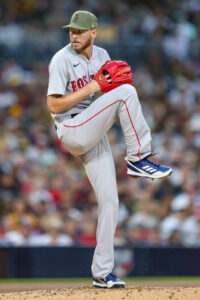
The bad injury luck continued over the last two seasons, as Sale was sidelined by a wide array of maladies including a stress reaction in his ribs, a fractured finger, a broken wrist (suffered in a bicycle accident), and a stress reaction in his shoulder blade. Sale tossed only 48 1/3 innings total in 2021-22, while rebounding to some extent to pitch 102 2/3 frames last season.
Sale’s 93.9mph fastball velocity in 2023 slightly topped his career average, while his strikeout, walk, and hard-hit ball rates were all well above the league average. While the southpaw may never get back to his past elite form, Sale’s 2023 performance at least indicated that he still has a good deal left in the tank as he enters his age-35 season, provided that he can just stay on the field.
This is exactly what the Braves are counting on from Sale as a third or even a fourth starter, behind Max Fried, Spencer Strider, and Charlie Morton in the team’s rotation. President of baseball operations Alex Anthopoulos is counting in Sale’s upside to bolster the pitching staff, and Atlanta’s collection of younger arms (AJ Smith-Shawver, Dylan Dodd, Huascar Ynoa, Darius Vines, and top prospect Hurston Waldrep) and swingman Reynaldo Lopez can provide extra depth should Sale or anyone else in the rotation need time on the injured list.
In typical Anthopoulos fashion, this particular trade came out of nowhere, even if the Braves were known to be looking for some pitching help. Atlanta made a strong bid for Aaron Nola before he re-signed with the Phillies, and such free agent and trade targets as Tyler Glasnow, Dylan Cease, Sonny Gray, and Seth Lugo were also linked to the Braves on the rumor mill.
Because Sale’s extension the Red Sox contained $10MM of deferred money per season, he’ll cost the Braves merely $500K in actual salary in 2024. Even without the deferral involved, a one-year, $10.5MM deal for Sale as a free agent would’ve been a reasonable or even a slight bargain price for a pitcher with his track record. It could perhaps be argued that the Braves might have been better off finding such a pitcher on the free agent market rather than trade away a promising young player like Grissom, but it is also fair to note that such a rotation upgrade might not have existed at a $10.5MM price tag. Or, dealing for a pitcher like Cease, Corbin Burnes, Shane Bieber, or other still-available trade candidates might’ve cost Atlanta lot more than only Grissom.
Sale’s $20MM club option for 2025 shouldn’t be discounted either, as the Braves might consider exercising that option if Sale pitched well. The $20MM figure matches what Morton is earning this season, and since Morton has flirted with retirement over the last few years, Sale could potentially step in as Atlanta’s veteran rotation arm if Morton does hang up his cleats next winter. Sale’s $20MM club option is actually a vesting option that becomes guaranteed if he finishes the year healthy, and finished in the top 10 in NL Cy Young Award voting.
Anthopoulos and team chairman Terry McGuirk weren’t kidding last November when they said that the Braves planned to keep increasing payroll. The Braves’ $203MM Opening Day payroll from 2023 was already a club record, and Roster Resource now projects a payroll just shy of $241MM for the 2024 squad. After topping the luxury tax barrier for the first time in 2023, the Braves’ estimated $280MM tax number now soars over the third penalty tier of $277MM, so they’ll face increasingly hefty overages as second-time payors. Passing the third tier means that Atlanta’s top pick in the 2024 draft will now drop 10 spots, and they’ll face the standard tax penalties related to qualified free agents and the international bonus pool.
This doesn’t appear to be much of a deterrent for an Atlanta club that has been swimming in extra revenues since the opening of Truist Park and its neighboring ballpark village project known as The Battery. The Braves have used this money to lock up several members of its roster on contract extensions, and this young core has already delivered the 2021 World Series championships and six straight NL East crowns.
The outlook hasn’t been as rosy at Fenway Park, as the Red Sox have been very inconsistent since that 2018 title. On the heels of consecutive last-place finishes in the AL East, Craig Breslow replaced Chaim Bloom as the team’s chief baseball officer, and Breslow now has his first true blockbuster trade as a front office executive.
Starting pitching has been a known need for the Red Sox all winter, and Boston just signed Lucas Giolito yesterday to help address the rotation mix. While moving Sale diminishes from the number of available arms, the trade does free up some money to help make other moves, and the Sox simply might’ve wanted a more reliable starting pitching option than the injury-plagued Sale. Plus, adding six years of team control over a promising player like Grissom is a nice return for the Sox at the cost of $17MM.
Grissom immediately fills Boston’s need for second base help. An 11th-round pick for Atlanta in the 2019 draft, Grissom has torn up minor league pitching during his four seasons in the Braves’ farm system and quickly got himself on the radar for a big league call-up. Grissom hit .291/.353/.440 over 156 plate appearances in 2022, though followed up with a more modest .659 OPS in just 80 PA last season. Given a chance at the everyday shortstop job, Grissom fell behind Orlando Arcia on the depth chart, and ultimately spent most the season at Triple-A since the Braves wanted him to play regularly rather than ride the bench.
Grissom has spent much of his minor league career as a shortstop, yet there has been some question about his long-term viability at the position. Moving to second base or third base was difficult on a Braves team with Ozzie Albies and Austin Riley already in place, so Grissom had been getting some reps as an outfielder as a possible candidate to fill the club’s left field vacancy. However, the acquisition of Jarred Kelenic from the Mariners also seemed to close that door.
No such position blocks exist in Boston, as the Red Sox might well just install Grissom as their Opening Day second baseman. He fits Breslow’s preferred add of a right-handed hitter, and Grissom’s glovework could or should work out well at the less-demanding second base position. Getting Grissom in the fold could now relegate Enmanuel Valdez, Pablo Reyes, or Rob Refsnyder to pure backup duty or perhaps even as trade chips, while Ceddanne Rafaela now looks even likelier to be used as an outfielder (and Rafaela might yet be a trade candidate himself).
Photo courtesy of USA Today Sports Images
White Sox Sign Chris Flexen To One-Year Deal
The White Sox are reportedly in agreement with right-hander Chris Flexen on a one-year, $1.75MM guarantee. There are an additional $1MM in incentives available for the O’Connell Sports Management client.
Flexen lands a big league deal despite a frustrating 2023 campaign. The 29-year-old opened the season in long relief with the Mariners, starting four of 17 appearances. He couldn’t find any rhythm, battling significant home run issues en route to a 7.71 ERA in 42 innings. The M’s designated him for assignment in early July, trading him to the Mets alongside reliever Trevor Gott.
New York only wanted Gott from that deal, agreeing to assume the nearly $4MM remaining on Flexen’s $8MM contract in the process. The Mets immediately released him. Flexen signed a minor league deal with Colorado and returned to the majors after two starts in Triple-A.
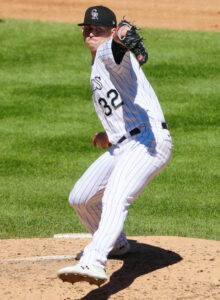
Making seven of 12 starts at Coors Field is a tough assignment for a pitcher looking for a rebound opportunity. Flexen continued to struggle (both at home and in his five road outings), posting a 6.27 ERA over 60 1/3 innings as a Rockie. Between Seattle and Colorado, he allowed a 6.86 ERA through 102 1/3 frames. Among pitchers to reach 100 innings, only Adam Wainwright and Joey Wentz allowed earned runs at a higher rate. The longball was the biggest contributor, as his 2.20 home runs per nine was the highest in the majors.
Flexen returned to free agency at season’s end despite having less than six years of MLB service. That’s common for players who sign a major league deal after a stint in a foreign pro league, as he did during the 2020-21 offseason after one year in the Korea Baseball Organization. Flexen will be a free agent again next winter despite still not reaching the six-year threshold.
It’s difficult to find many positives in Flexen’s 2023 performance, but he was an effective pitcher for Seattle over the preceding two years. Initially signed to a two-year, $4.5MM guarantee by Seattle, Flexen combined for a 3.66 ERA while starting 53 of his 64 appearances. His 16.5% strikeout rate over that stretch was well below-average, but he limited walks and did a much better job keeping the ball in the park. Flexen looked like a serviceable back-end starter two seasons ago.
The Sox will take a low-cost flier on a rebound, continuing an offseason of inexpensive depth pickups for first-year general manager Chris Getz. The Sox have also signed Tim Hill and Paul DeJong to one-year deals and agreed to terms with Martín Maldonado on a $4MM pact. Chicago rolled the dice on veteran catcher Max Stassi in a trade that paid his salary down to the league minimum. Their only multi-year pickup thus far was a two-year, $15MM deal for KBO returnee Erick Fedde.
Fedde has a rotation spot secure. Dylan Cease would be the Opening Day starter if the Sox don’t trade him this offseason. Michael Kopech and Michael Soroka project for middle-of-the-rotation roles, while Jared Shuster, Jesse Scholtens and Touki Toussaint could battle for jobs at the back end. Flexen steps into that fifth starter/long relief competition.
Chicago’s payroll is up to roughly $150MM, according to Roster Resource. That’s nowhere near last year’s $181MM Opening Day mark, although the Sox might not match that spending level as they rework the team. The 40-man roster is at capacity, so they’ll need to make two corresponding moves when they finalize the unofficial pickups of Flexen and Maldonado.
Bob Nightengale of USA Today first reported the White Sox and Flexen had agreed to a one-year deal. MLB.com’s Mark Feinsand reported the $1.75MM guarantee and $1MM in performance bonuses.
Image courtesy of USA Today Sports.
Blue Jays Have Reportedly “Taken The Lead” In Yariel Rodriguez Sweepstakes
After missing out on top free agents Shohei Ohtani and Yoshinobu Yamamoto earlier this month, the Blue Jays have ramped up activity at the lower levels of the market of late by re-signing center fielder Kevin Kiermaier to a one-year pact and landing utility man Isiah Kiner-Falefa on a two-year deal in recent days. It appears the club isn’t stopping there, as Enrique Rojas of ESPN reported Friday afternoon that the club has “taken the lead” in the sweepstakes for the services of right-hander Yariel Rodriguez, who Rojas adds is “close” to making a decision in free agency. It’s hardly a surprise that the Blue Jays have interest in Rodriguez, as a recent report indicated that Toronto was among several teams with interest in the righty.
Rodriguez, 27 in March, is among the most intriguing free agents available on the market this offseason. The right-hander was granted free agency by MLB back in early November after being released from his deal with Nippon Professional Baseball’s Chunichi Dragons back in October. Rodriguez’s professional career began in Cuba during the 2015-16 season, and he spent six seasons pitching primarily as a starter to solid results in his home country before joining the Dragons ahead of the 2020 campaign. Upon arriving in Japan, Rodriguez was moved to the bullpen and broke out in a big way during the 2022 campaign, where he posted a dominant 1.15 ERA with a 27.5% strikeout rate.
Rodriguez participated in the World Baseball Classic in early 2023 as a member of Team Cuba and began to stretch back out as a starter in that series, throwing 7 1/3 innings across two appearances. After the event, Rodriguez declined to report back to the Dragons and sat out the 2023 season before securing his release after the season. Since then, Rodriguez has hosted workouts for a host of MLB clubs in the Dominican Republic, allowing scouts an opportunity to see the right-hander up close.
Whether Rodriguez will be able to stick in the majors as a starter or not has been a point of division among clubs throughout his free agency, though the Blue Jays reportedly fall into the camp that views him as a starting pitcher alongside teams such as the Pirates and Red Sox. While Rodriguez has also received recent interest from the Reds, Padres, and Yankees, each reportedly prefers the right-hander as a reliever. Due in part to that division on whether his future is in the rotation or the bullpen, Rodriguez’s position as the #28 free agent on our annual Top 50 MLB free agents list, where we projected him for a deal worth $32MM over four years, is less concrete than other free agents of a similar caliber.
In spite of the uncertainty involved in Rodriguez’s free agency, the Blue Jays are a solid fit for the right-hander’s services. While Toronto has a full rotation on paper with a stable quartet of Kevin Gausman, Jose Berrios, Chris Bassitt, and Yusei Kikuchi, the uncertainty surrounding right-hander Alek Manoah creates a major question mark at the back of the club’s starting staff. Manoah was a finalist for the AL Cy Young award in 2022 with a dominant 2.24 ERA in 196 2/3 innings of work, but his performance fell off a cliff in 2023 as he managed an ERA of just 5.87 in 19 starts for Toronto as he spent much of the summer in the minor leagues.
By adding Rodriguez to the club’s mix, the Blue Jays add additional starting depth to the club’s mix while also giving Manoah significant competition for the fifth starter role entering the season. If Rodriguez were to either struggle in the rotation or simply be pushed out by the re-emergence of Manoah or a strong debut from top prospect Ricky Tiedemann, he could then be utilized to bolster a bullpen that lost Jordan Hicks to free agency last month. Hicks’s departure leaves open a vacancy at the back of Toronto’s bullpen alongside closer Jordan Romano and set-up man Erik Swanson, where Rodriguez would be an excellent fit if he wound up outside of the club’s preferred rotation mix.
Blue Jays Sign Isiah Kiner-Falefa
The Blue Jays have signed Isiah Kiner-Falefa, per a club announcement. It’s a two-year, $15MM deal, according to FanSided’s Robert Murray (X link), with another $1MM available in incentives. Kiner-Falefa is represented by ALIGND.
Kiner-Falefa won a Gold Glove as the Rangers’ regular third baseman in 2020, but he hasn’t since played much time at the hot corner, since Texas used him primarily at shortstop in 2021 and the Yankees did the same in 2022. This past season saw New York shift IKF all around the diamond since Anthony Volpe took over as the everyday shortstop, with Kiner-Falefa racking up a lot of playing time in center field (278 1/3 innings), left field (248 innings), back at third base (240 1/3 innings), right field (40 innings), shortstop (eight innings) and a lone inning as a second baseman. The public defensive metrics were mixed on his outfield work, but Kiner-Falefa graded pretty well as an infielder, particularly in his return to third base.
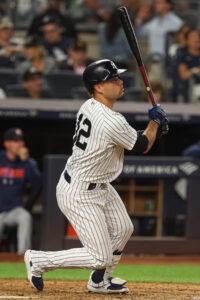 With Matt Chapman a free agent, it would seem like the Blue Jays could install Kiner-Falefa as their regular third base option for the time being, giving the club at least a glove-first starter if either Chapman signs elsewhere or if a more clear-cut starter can’t be found. That said, IKF is probably less of a Chapman replacement than he is a replacement for Whit Merrifield, another right-handed hitter who was deployed regularly as a second base and in the outfield. Kiner-Falefa adds even more versatility since Merrifield played very little third base and no shortstop.
IKF is also a better defensive fit at third base than any of Toronto’s incumbent crop of infielders, such as Cavan Biggio, Davis Schneider, Santiago Espinal, or Ernie Clement. Biggio is the only left-handed bat in that group, so it stands to reason the Jays might trade one of the righty-swingers now that Kiner-Falefa is on board. Adding a more experienced Major Leaguer also gives the Blue Jays more flexibility in giving more minor league evaluation time to top prospects Orelvis Martinez or Addison Barger, who should both be in the Show at some point in 2024 and could factor into the infield picture (particularly at third base).
While Kiner-Falefa may work from a depth and glovework perspective, however, he doesn’t represent much or any help to the Blue Jays’ larger need for offense. Kiner-Falefa hit .242/.306/.340 over 361 plate appearances with the Yankees last season, essentially matching his .261/.314/.346 slash line over 2415 career PA at the big league level. This translates to an 81 wRC+ — tied for the fourth-lowest total of any player with more than 2000 PA since the start of the 2018 season.
The lack of offense has limited Kiner-Falefa to 3.8 fWAR over his six Major League seasons, despite his defensive contributions. He rarely strikes out, yet this contact-hitting approach rarely yields hard contact, and he has little power to speak of with only 26 career home runs.
A two-year, $15MM contract seems like a pretty nice score for Kiner-Falefa with this lack of offense in mind, yet there was still quite a bit of interest in the utilityman on the open market. The Brewers, Dodgers, Marlins, and Yankees were all linked to Kiner-Falefa on the rumor mill, and Toronto’s own interest in IKF was first cited by Sportsnet’s Shi Davidi earlier this month.
Between Kiner-Falefa today and yesterday’s agreement with Kevin Kiermaier, the Blue Jays have sprung into action after a rather quiet offseason caused by the team’s focus on chasing Shohei Ohtani. The Jays remained at least speculatively linked to a number of other players besides Ohtani, of course, as GM Ross Atkins’ front office routinely checks in on basically every available free agent or trade target as a matter of due diligence. While Kiner-Falefa and Kiermaier should help preserve the Jays’ excellent defense from 2023, some offensive pop seems necessary, whether at DH or to further bolster the infield or outfield picture.
As per Roster Resource, the Jays’ 2024 payroll projects to be just shy of the $230MM mark with Kiner-Falefa now on the books. This leaves a bit of space remaining before Toronto hits the $237MM luxury tax threshold, though that isn’t really a barrier considering that the Blue Jays exceeded the tax line (for the first time in franchise history) last season.
Photo courtesy of USA Today Sports Images
Andrelton Simmons Retires
Four-time Gold Glove winner Andrelton Simmons is retiring, his representatives at ISE Baseball announced on Instagram earlier this week. The defensive stalwart last appeared in the majors in July 2022.
Simmons was a second-round draftee of the Braves in 2010 out of an Oklahoma junior college. There was some thought he might be better suited as a pitcher at the time thanks to his elite arm strength. Atlanta stuck with him as a shortstop, where prospect evaluators projected Simmons as a plus defender. He exceeded even the loftiest reviews of his glove, quite likely becoming the best defensive infielder of his generation.
The Braves first called him up in June 2012, a little before his 23rd birthday. Simmons capably held down shortstop from that point forward, putting up roughly league average hitting with strong defensive reviews. He started that year’s Wild Card game and cemented himself as an everyday player for the better part of the next decade.
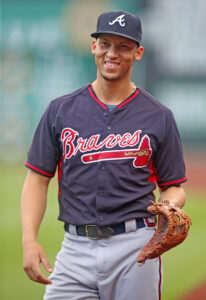
Simmons took what would be a career-high 658 plate appearances the following season. He connected on a personal-best 17 homers with a .248/.296/.396 slash line. While that wasn’t particularly imposing offense, he rated as a staggering 30 runs above average with the glove. That earned him his first Gold Glove and down-ballot MVP support and helped the Braves to an NL East title.
The following offseason, Atlanta signed Simmons to a seven-year extension. His $58MM guarantee established a new record for players with between one and two years of MLB service. Simmons’ power dipped over the next two seasons, but he continued to rack up eye-popping metrics and highlights on defense. He won a second Gold Glove in 2014 and arguably should’ve received the award again the following year.
Atlanta missed the postseason in both seasons, however, kicking off a rebuild. During the 2015-16 offseason, the Braves dealt Simmons to the Angels for a prospect package headlined by Sean Newcomb. While the left-hander had an inconsistent tenure in Atlanta, Simmons spent the next few seasons offering his typical combination of slightly below-average hitting and superlative defense.
He’d win two more Gold Gloves in Orange County, finishing in the top 15 in AL MVP balloting in 2017 and ’18. He was credited with 41 Defensive Runs Saved in 2017, easily the highest single-season mark by a shortstop since the statistic was introduced in 2002. Simmons owns three of the top 10 and six of the top 30 DRS grades on record at the infield’s most demanding position. Unsurprisingly, he easily holds the top career mark among shortstops over the past two decades. His estimated 201 runs saved in more than 10,000 innings is 82 runs higher than second-place finisher Adam Everett.
Simmons remained with the Halos through 2020. He signed a $10.5MM deal with the Twins for the 2021 campaign. While he continued to play stellar defense, his offense cratered. He hit .223/.283/.274 in 131 games, setting the stage for a modest $4MM deal with the Cubs. Simmons mustered only a .173/.244/.187 line in 35 contests for Chicago and was released midseason.
He didn’t sign with a major league team from that point forward. The Curacao native represented the Netherlands in last spring’s World Baseball Classic, as he had in 2013 and ’17. He saw action at third base in an infield also comprising Didi Gregorius, Jonathan Schoop and Xander Bogaerts. Simmons went 2-11 in four games to close his playing career.
Simmons appeared in parts of 11 MLB seasons. He tallied more than 4,800 plate appearances over 1,226 contests, hitting .263/.312/.366 with 70 home runs. He was one of the game’s more reliable contact bats, striking out in fewer than 10% of his plate appearances. Simmons will be better remembered as one of the best defensive shortstops the game has ever seen.
FanGraphs valued his career around 25 wins above replacement, while Baseball Reference credited him with 37 WAR. B-Ref pegs his earnings just under $72MM. MLBTR congratulates Simmons on his excellent run and wishes him the best in retirement.
Image courtesy of USA Today Sports.
Blue Jays Re-Sign Kevin Kiermaier To One-Year Deal
The Blue Jays announced that the club has re-signed center fielder Kevin Kiermaier on a one-year deal Thursday evening. The Equity Baseball client is reportedly guaranteed $10.5MM, while the deal contains additional incentives.
Kiermaier, 34 in April, was a 31st-round pick by the Rays in the 2010 draft and quickly proved to be one of the savvier late-round picks in recent memory. After making his big league debut in a one-game cup of coffee during the 2013 season, Kiermaier stepped into the club’s everyday center field role in early 2014 and remained in that role for nine seasons where he established himself as a generational defender while slashing a respectable .248/.308/.408 during his time with the Rays. He departed the club to join the Blue Jays on a one-year deal last offseason that went very well for both sides. The veteran posted a 104 wRC+ while playing in 129 games, just the third time in his career he eclipsed 120 games in a season.
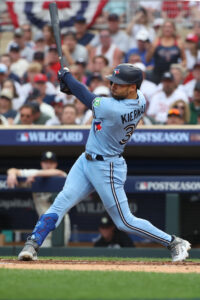
As a superlative defender in center who bats left-handed and slashed a respectable .260/.321/.431 against right-handed pitching last year, Kiermaier still makes some sense for a Jays club that sports few left-handed bats and had a vacancy in the outfield. That being said, the club has been frequently tied to Cody Bellinger to this point in the offseason and, with a strong center field defender in Daulton Varsho still on the roster, had generally been expected to pursue a more offensively oriented addition to their lineup this winter. That makes the club’s reunion with Kiermaier something of a surprise.
With that said, Kiermaier is certainly a quality player in his own right; his decent offense and strong defense earned him the #31 spot on MLBTR’s annual Top 50 MLB free agents list, where we projected him for a two-year, $26MM deal. That projection ended up coming in high by a year and more than $15MM. If the Blue Jays evaluated Kiermaier similarly, they may have felt that reuniting with the veteran at a relative discount was valuable enough to outweigh concerns about the club’s overall offensive production in the outfield, which combined to post a 99 wRC+ last year good for just 20th in the majors. Only the Marlins received less production from their outfield unit than Toronto among playoff teams in 2023.
It must also be noted that the return of Kiermaier needn’t necessarily preclude the club from adding Bellinger or another impact bat to the outfield mix. Talented as Varsho is, the 27-year-old is coming off an abysmal season at the plate where he slashed just .220/.285/.389 in 158 games, and even his strongest season with Arizona saw him post a wRC+ of just 107. That sort of production falls short of the typical everyday left fielder, and it would certainly be defensible for the Blue Jays to move Varsho into a part-time role backing up veterans Kiermaier and George Springer if it meant the addition of an impact bat to the club’s lineup. If the club chooses to go that route, the addition of a bat-first player such as Jorge Soler to the outfield mix could still make plenty of sense.
When discussing Bellinger specifically, the 28-year-old’s experience at first base both in 2023 and throughout his career could also help the Blue Jays fit him into their positional mix if they choose to do so. It’s at least reasonable to imagine a scenario where the club adds Bellinger and utilizes him both in the outfield and also at first base, where he could spell Vladimir Guerrero Jr. and allow the club’s franchise first baseman to spend more time at DH. Roster Resource projects the Blue Jays for a payroll of $213MM in 2024 following the addition of Kiermaier, a figure that’s essentially identical to their $214MM payroll last season. With that being said, the club surely has room for further additions given their reported pursuits of pricey superstars such as Shohei Ohtani and Yoshinobu Yamamoto in free agency as well as Juan Soto via trade.
While that remaining space in the budget could certainly be used to further shore up the outfield, it’s possible the club would prefer to turn its attention toward the infield. The departures of Matt Chapman and Whit Merrifield in free agency leave the Blue Jays without established, surefire starters at either second or third base. While youngster Davis Schneider has shown promise and the likes of Cavan Biggio and Santiago Espinal provide depth at both positions, adding at least one infielder to the mix appears to be a likely top priority for the club going forward this offseason.
In the meantime, the Blue Jays have shored up an area of weakness on the roster by bringing back a four-time Gold Glover at a premium defensive position. Kiermaier’s quality work in 2023 played a major role in Toronto’s 3.8 fWAR in center field tying with Boston for the eight-most production in baseball at the position, and he should provide the club with similar production next season if he can remain healthy headed into his age-34 campaign.
Mark Feinsand of MLB.com first reported the Blue Jays and Kiermiaer were nearing agreement on a one-year deal in the $10MM range. Ben Nicholson-Smith of Sportsnet reported that the sides had an agreement on a $10.5MM guarantee with incentives.
Image courtesy of USA Today Sports.