
Mariners Add Kristopher Negron To Player Development Staff
The Mariners announced Tuesday that they’ve hired recently retired infielder/outfielder Kristopher Negron as an assistant to director of player development Andy McKay. In his new role, the 33-year-old Negron will assist “in all aspects of player development, including on-field instruction and mentoring minor league players on what it means to be a great teammate,” per the Mariners’ release.
“I’ve had the unique perspective of watching Kris play in high school, competing against him in junior college, and then having him be part of the Mariner family the past few years,” said McKay in a statement announcing the hiring. “During these 15 years, whether it was in high school or the Major Leagues, Kris has earned an unparalleled level of respect from his coaches, teammates, fans and members of the media. We couldn’t be more excited to bring Kris into player development where he will immediately begin to impact our people and our process both on and off the field. This is a great day for the Mariners.”
Negron played in parts of six Major League seasons, including 2018-19 stints with the Mariners. Dating back to his 2012 debut with the Reds, he’s seen time in Cincinnati, Arizona, Seattle and Los Angeles and appeared in 170 Major League games. He also played in parts of 10 Triple-A seasons (14 minor league seasons overall) and appeared at every position on the diamond outside of catcher.
MLBTR Chat Transcript
Click here to read a transcript of Tuesday’s chat with MLBTR’s Steve Adams.
Tomorrow Is The Deadline For Rule 5 Protection
As reflected in MLBTR’s handy list of key offseason dates, November 20th is the deadline for teams to protect otherwise-eligible prospects from this year’s Rule 5 draft. Teams must add such players to their 40-man rosters by 8pm ET tomorrow or risk losing them to competitors when selections are made on December 12th.
Eligibility is determined by reference to the age and timing of entry to the professional ranks. A player that signed at 18 years of age or younger and has five seasons of pro ball is Rule 5 eligible if he is not added to the 40-man roster in advance of the deadline. Players that signed at 19 or older and have four seasons of professional experience are also eligible to be selected if they’re not added to the 40-man roster tomorrow. (In other words, college draftees out of the 2016 class, high school draftees out of the 2015 class and most international amateurs signed in the 2015-16 international period are eligible this year if not protected.)
Teams that make selections in the draft will gain conditional control over the chosen players. To be kept permanently, a player must stay on the MLB roster for an entire season, with at least ninety days spent on the active roster. It’s plausible to imagine that the addition of a 26th active roster spot this year will facilitate the utilization of the Rule 5 process.
Full coverage of the Rule 5 landscape will necessarily await tomorrow’s decisions. The need to make tough calls will prompt some action around the game, though it remains to be seen whether that’ll be the usual run of moves on the margins or if a blockbuster or two could be swung. Baseball America’s J.J. Cooper is as usual champing at the bit, so he has released a prediction of some interesting players that are relatively likely to be left unprotected.
As you might imagine, it’s easier to account for protection of prospects for teams with extra 40-man roster space. But it’s not as simple as having an opening. You also must be able to maintain a player in that spot throughout the winter and into the season. Adding a player that wouldn’t have been selected (or wouldn’t have lasted on an active roster) therefore carries its own risk: if you end up needing the roster space, you might have to expose such a player to outright waivers in the middle of the season. It’s worth noting, too, that some teams have already added players that they wish to protect.
There are tons of factors that go into these decisions, but roster space does still matter. Here are the number of open 40-man spots for each MLB team, as things stand this morning (per MLB.com’s roster pages):
10: Nationals
8: Cubs, Twins
7: Braves, Brewers, Tigers, White Sox
6: Astros, Red Sox
5: Mariners, Diamondbacks, Marlins, Orioles, Phillies, Reds
4: Rangers, Rockies, Yankees
3: Dodgers, Mets, Rays
2: Angels, Cardinals, Indians
1: Pirates
0: Athletics, Blue Jays, Padres, Giants, Royals
Elements of this post are adapted in part from a prior post by MLBTR’s Steve Adams.
Yoenis Cespedes Appears To Have Resumed Baseball Activities
In a since-deleted Instagram video posted by minor-league Mets coach (and long-time former big leaguer) Endy Chavez, rehabbing slugger Yoenis Cespedes is shown taking batting practice. MLB.com’s Anthony DiComo covered things via Twitter.
While this fleeting glance at Cespedes doesn’t really tell us much, it’s the first meaningful look at his progress in quite some time. Serious heel and other leg injuries cost Cespedes huge chunks of the 2017-18 campaigns and all of 2019. All told, he has played in just 119 games since the close of his strong 2016 season.
Cespedes has continued to hit when available, and he’s still being paid quite handsomely for one more season ($29.5MM), so the club has an obvious interest in getting him back on the field. At times it seemed a late-2019 return might have been possible, but there was never anything close to a run-up towards the majors.
GM Brodie Van Wagenen seemingly downplayed the likelihood of a significant contribution in 2020 when he addressed the matter recently, saying that lacks “enough information to predict when [Cespedes is] going to be back.” Of course, there is one other way to read that. The Mets understandably don’t want to set expectations and surely also would like to keep things quiet when it comes to negotiating with rivals and free agents.
All of that is to say: if indeed Cespedes is presently capable of swinging the stick, even if in a limited BP setting, that seems to be good and rather notable news. As I noted in discussing the Mets’ offseason outlook earlier today, the complexion of the outfield could look quite a bit different if Cespedes is part of the picture — especially if he can show enough to be relied upon right out of Spring Training. It’s not hard at all to imagine rather significant impacts on the team’s offseason maneuvering based upon the status of Cespedes, though certainly the organization will need to be wary of presuming too much about his health.
Offseason Outlook: New York Mets
MLBTR is publishing Offseason Outlooks for all 30 teams. Click here to read the other entries in this series.
The needs are clearer than the means for the Mets as they enter a critical second offseason under GM Brodie Van Wagenen.
Guaranteed Contracts
- Jacob deGrom: $130.5MM through 2023 (includes $20MM signing bonus, due in two installments on 1/2/20 and 1/4/21)
- Robinson Cano: $81MM through 2023 (excludes $15MM of remaining obligations owed by Mariners)
- Yoenis Cespedes: $29.5MM through 2020
- Jeurys Familia: $22MM through 2021
- Jed Lowrie: $13MM through 2020 (includes $4MM in remaining signing bonus obligations)
- Wilson Ramos: $10.75MM (includes $1.5MM buyout on $10MM 2021 club option)
- David Wright: $9MM through 2020 (excludes estimated $3MM covered by insurance proceeds)
- Justin Wilson: $5MM through 2020
Arbitration-Eligible Players (service time in parentheses; projections via MLBTR contributor Matt Swartz)
- Marcus Stroman – $11.8MM
- Noah Syndergaard – $9.9MM
- Steven Matz – $5.3MM
- Michael Conforto – $9.2MM
- Edwin Diaz – $7.0MM
- Seth Lugo – $1.9MM
- Brandon Nimmo – $1.7MM
- Robert Gsellman – $1.2MM
- Non-tender candidates: None
Free Agents
- Aaron Altherr, Luis Avilan, Brad Brach, Rajai Davis, Todd Frazier, Donnie Hart, Joe Panik, Rene Rivera, Zack Wheeler (declined qualifying offer)
- Juan Lagares (paid $500K buyout in favor of $9.5MM club option)
[New York Mets depth chart | New York Mets Nationals payroll outlook]
The Mets play in New York, as you may already be aware. But the club’s payroll in recent years has not quite matched its top-of-class market size … a fact you’re also likely familiar with if you’re reading this post. As we sit here today, the Mets are already committed to spending as much as or more than they have have in recent seasons, when they have seemingly operated with fairly clear budgetary restrictions.
So, the Mets are tapped out, right? They can try to move money via trades, but that would mean parting with useful players and/or prospects. Tapping into the talent pipeline would be awfully tough to swallow after having already cleared out some of the farm’s most promising youngsters over the past year in other swaps. It seems like a predicament.
Why, then, are we reading articles throwing around concepts of re-signing Zack Wheeler, landing a similarly spendy replacement, risking a good chunk of change on rehabbing reliever Dellin Betances, trading for Mookie Betts, etc? Does Van Wagenen have freedom to pursue such high-priced players or is he limited to value-for-value swaps that don’t add to the team’s existing payroll commitments?
There’s no answer here. It’s all a mystery. The team wouldn’t want the market to know its precise plans, so that’s sensible enough. But it makes it awfully difficult to assess the offseason possibilities and all but impossible to guess some of the key pieces that’ll be available to new skipper Carlos Beltran.
On the one hand, we’ve not been given reason to believe that the Mets organization is on the verge of a big payroll boost. The team seemed in position to do that sort of thing previously — on the heels of a surprise World Series appearance, say — and didn’t really surge in spending. On the other, Van Wagenen actually responded to questions about the $208MM luxury tax line in a manner that suggested it wasn’t completely absurd to ask about. His answer didn’t exactly indicate that the Mets would be ramping up to that level — “if the luxury tax threshold becomes something we have to consider, then we will talk about it at that time” — but the top baseball ops officer could have taken the opportunity to temper expectations and it seems notable that he didn’t.
While we don’t know for sure what financial means the Mets will have to address their needs, we do have a pretty clear idea of what the roster gaps are. And it’s also not hard to identify a few big-league pieces that could be utilized in lieu of prospects to help swing deals. First baseman Dominic Smith is the most obvious candidate to be moved after showing well with the bat but being eclipsed entirely by a large white bear (also known as Rookie of the Year Peter Alonso). And bat-first utilityman J.D. Davis could also be dangled in some scenarios. More on him below. We shouldn’t overstate the value of these players. Smith only had a brief showing last year due to injury; Davis rode a .355 BABIP. Both are limited on the basepaths and in the field. But they’re useful pre-arb performers with clear surplus value who’d hold clear appeal to a good number of rival organizations.
It’s also rather easy to see where the Mets could stand to improve. Let’s start in center field. With the end of the Juan Lagares era, and the failure of the other players brought in last season to supplement/challenge him, there’s a void up the middle. The preference is not to utilize Michael Conforto and/or Brandon Nimmo there, at least in a full-time capacity, so the optimal outcome is to secure the services of a full-time center fielder with a fall-back of getting a right-handed-hitting part-timer to platoon with those existing lefty bats.
Those two paths also play into the question whether Davis ought to be dealt or retained. If the Mets end up with a CF timeshare, then there should be more plate appearances left for Davis to pick up in the corners. But if the Mets find a regular to play in center, then perhaps Davis won’t have as many opportunities as might be preferred in the corner outfield. It’s easier to deal him in that case, perhaps even as part of the swap for the desired center fielder. The Mets could backfill with a low-cost, righty-hitting veteran to serve as a fourth outfielder … or try to dig up the next Davis in another trade. It’s worth pausing to note that Yoenis Cespedes remains a hypothetical candidate to return, though it remains utterly unclear whether and when that might happen. If the Mets have secret cause for optimism on Cespedes, perhaps that also tips in favor of a Davis swap.
So, the options in center … like many teams, the Mets make an ideal fit for Starling Marte of the Pirates. He isn’t cheap, but isn’t so expensive ($11.5MM in 2020 with an option for 2021) that the Mets can’t figure it out. The Bucs have previously chased after MLB-ready pieces rather than prospects, which suits the New York situation. We don’t know if the Pirates will deal Josh Bell, but if they do, Smith would make an awful lot of sense as a target. Trouble is, there ought to be rather intense competition on Marte. And there’s a new front office regime in Pittsburgh, with a shifting mandate that may favor more drastic action.
Rental piece Jackie Bradley Jr. will cost similarly in salary (a projected $11MM) and quite a bit less in return. It’s easy to imagine Ender Inciarte as a fit if the Braves go in a different direction … and decide to deal in their division. Perhaps Manuel Margot would be a nice compromise if something more can’t be done and the Padres decide to move on. He’s priced fairly ($2.1MM projected) as a platoon candidate with some hopeful upside remaining. There isn’t a regular option in free agency, unless you believe in incoming Japanese star Shogo Akiyama. He’s a left-handed hitter who doesn’t seem to have captured the Mets’ interest. Brett Gardner is likewise a lefty bat. The Mets could turn to Cameron Maybin or another righty-swinging part-timer on the open market.
That’s really the bulk of the work on the position player side. Most of the 4-through-6 infield time ought to be accounted for between Jeff McNeil, Amed Rosario, Robinson Cano, and Jed Lowrie — at least, supposing Lowrie can come back from the mystery issues that derailed his first season in New York. Luis Guillorme represents a utility option. Davis can play third base if he remains on hand, though metrics (DRS, especially) have panned his work there. It’s worth noting that top prospect Andres Gimenez is on the rise. He’s just 21 years of age but could crack the majors if he makes strides at Triple-A and there’s a need. You can certainly imagine a bit of supplementation for this group, perhaps in the form of minor-league signings, but the Mets can be rather confident in what they have.
It’s debatable whether that same confidence ought to extend behind the dish, where veteran Wilson Ramos remains a capable hitter and questionable defender. The opposite is true of reserve Tomas Nido. Van Wagenen has indicated he’s not inclined to pursue a major shakeup at the catching position — “we expect to go into the season with Wilson Ramos as our guy” — but will be “in the market looking for backup options.” The Mets could revisit talks with Yasmany Grandal after just missing him last year, but that’d be quite a surprise given those comments and the other, more pressing needs. Expect the Mets to look at the many lower-cost veterans available this year to shore things up behind the plate.
If it was as simple as adding a center fielder and a few complimentary pieces, the budgetary constraints wouldn’t be as worrisome. But the Mets also need arms. The starting staff has four pieces in place but needs several more, particularly given the health scares that some members of the group have had in recent seasons. It’s quite unlikely that the Mets will lure Wheeler back or replace him with an equivalently valuable player — again, unless there’s a much bigger budget to work with than we know. Van Wagenen had names to cite when asked recently about rotation depth. And to be sure, hurlers such as Chris Flexen, Walker Lockett, Corey Oswalt, and recent first-rounder David Peterson do represent near-term options. But it’s tough to rely upon those hurlers for significant contributions, particularly with a full rotation spot as yet unaccounted for. There has been some talk of stretching out Seth Lugo (and also Robert Gsellman), but it seems likely the team will hope Lugo can reprise his excellent relief work from 2019.
Van Wagenen knows that, which is why he has cited a need to improve in the rotation. It’s likely the Mets will try to land multiple pitchers capable of gobbling up innings. New Jersey product Rick Porcello would be the sort of durable bounceback candidate who’d make sense, though he doesn’t figure to be particularly cheap. There are options at every price point on the market this year. No doubt the Mets will be among the many teams prowling patiently as a high-volume class of free-agent starters seeks contracts.
The pen is obviously a need as well. Last year’s unit was one of the worst in baseball. There’s not much choice but to hope that Edwin Diaz figures things out. He could push Lugo back into setup duty with a big spring. Those two hurlers and lefty Justin Wilson will likely make up the key late-inning trio. Jeurys Familia is also going to be given every chance to find his form, though he’s likely destined for a lower-leverage spot to begin the year. Robert Gsellman is another hurler who is looking for redemption. Among the depth options, Paul Sewald stands out. He doesn’t get many swings and misses but got solid results in a brutal Triple-A environment and turned in a 22:3 K/BB ratio in his 19 2/3 MLB innings.
There’s certainly room to improve here. You could argue for two significant additions. But the budget crunch will make it tough to take risks in this area. It’s understandable that some fans would like to see New York native Dellin Betances make a dramatic cross-borough move. But if dollars are tight, that’s a big risk to take. A return for Jersey boy Brad Brach, who was solid late in 2019, would seem more realistic. Fortunately for the Mets, there’s an abundance of solid relief arms that should be available for fairly modest commitments.
In MLBTR’s ranking of the top fifty free agents, we guessed the team would come away with a fifth starter (Ivan Nova) and useful veteran reliever (Craig Stammen). New Yorkers were not especially excited by this — though, to be fair, they were much more upset at our equally ho-hum predictions for the Yankees. There’s no question the Mets can and quite arguably should do more. It’s a tough division, but they’re trying to compete and the window is certainly open. And, yeah, it’s New York.
Substituting out Nova and Stammen in favor of Cole Hamels and Will Harris just might make the difference … and would almost certainly cost an extra $12MM or more in 2020 salary alone. Bringing back Wheeler and adding multiple relievers would be even better … and yet more expensive. We just don’t know how the organization will behave this winter. But we’ll soon find out.
Orioles Notes: MASN, Elias, Bundy
The Orioles have lost another legal ruling in the Mid-Atlantic Sports Network saga that never ends. As conveyed through an AP report, the New York trial court has reaffirmed its major recent decision upholding an arbitration award in favor of the Nationals, who have sought for years to force the O’s-controlled MASN to pay more for their television rights fees. It’s time for the Baltimore club to pony up some long-awaited payments to its southern neighbor, the court ruled, with interest now running on the balance due. This doesn’t end the matter — the O’s can still pursue recalculation of the profit tabulations, appeal these trial court rulings, and/or fight the next market re-set period — but it does mark another step towards final resolution.
More from Baltimore:
- Orioles GM Mike Elias chatted with Jon Meoli of the Baltimore Sun about his first year in charge of the organization’s baseball operations. Elias conveyed broad optimism about where things are headed, while taking every opportunity to caution fans not to expect too much too soon. Process is the name of the game here. “I think the most important thing of this year has been the capabilities of the [baseball operations] department,” he says, though he also noted some player-development strides in the minors and even at the MLB level. Elias warned: “We’re still going to be in a process where it’s possible that we take a step back to take two steps forward at the major league level.” Even once some strides are evident, he noted, “these types of rebuilds don’t always progress linearly.”
- Trades of veteran players are a potential part of the O’s strategy, of course, which Elias acknowledged. So what of righty Dylan Bundy? Rich Dubroff of BaltimoreBaseball.com looks at that possibility. While the accounting of Bundy’s trade candidacy doesn’t reveal an especially enticing profile, it does highlight an important point about the former first-round pick: despite some ups and downs in the performance department, particularly in terms of controlling the long ball, Bundy has thrown a good number of solid-enough innings over the past few seasons. Teams routinely pay good money in free agency hoping for the sort of 2-2.5 WAR season Bundy just turned in. He’s projected to earn a palatable $5.7MM with one more season of control remaining thereafter. Bundy posted a career-high 12.9% swinging-strike rate last year and only just turned 27, so perhaps there’s still hope there’s more in the tank.
MLBTR Poll: Josh Bell’s Future
The Pirates have a new general manager in Ben Cherington, whom they officially introduced as Neal Huntington’s replacement Monday. Pirates owner Bob Nutting indicated then that the Pirates, a few weeks removed from a 69-win season and their fourth straight year without a playoff berth, don’t regard anyone on their roster as untouchable. Even before Nutting made that revelation, many considered high-profile Pirates such as Starling Marte, Chris Archer and Keone Kela as trade candidates. But in the wake of Nutting’s comments, there’s an even bigger name in the mix: first baseman Josh Bell.
Would the Cherington-led Pirates dare shop Bell, who has arguably emerged as their first franchise player since the Andrew McCutchen era came to an end after the 2017 season? Bell, like McCutchen, is a homegrown Pirate made good. A second-round pick of the Pirates in 2011, Bell debuted in 2016 and posted mediocre numbers (relative to his offense-driven position) during the first three years of his career. But the switch-hitting Bell broke out this year during an All-Star season in which he slashed .277/.367/.569 with 37 home runs and 116 runs batted in – an impressive amount even if you regard RBI as an antiquated statistic.
So what’s the problem for Pittsburgh, which seems to have a real building block on its hands at first? As is often the case, it’s about the money. The 27-year-old Bell’s projected to make an affordable $5.9MM via arbitration in 2020, though he has just two more seasons of arbitration control thereafter. And considering their current state, it may be unrealistic on the Pirates’ part to expect they’ll turn back into contenders during Bell’s remaining arb years.
The Pirates could extend Bell in that time span and retain him for the long haul, though as of July, super-agent Scott Boras didn’t sound optimistic about a new deal coming together. Boras took aim at the Pirates for not showing a willingness “to go out and invest in a great young player for a long time,” also criticizing the team for a payroll that has barely climbed (relative to its profits) across the past two decades.
It’s hard to argue with the opinionated Boras regarding the Pirates, especially considering they still haven’t signed anyone for more than the $60MM extension they gave former star catcher Jason Kendall back in November 2000. Bell would likely rake in more on his next pact, but should Pittsburgh make an aggressive push to lock him up at this point? Should the team simply keep Bell and continue going year to year with him? Or maybe now is the time to trade Bell, who’s more appealing than all free-agent first basemen on the open market.
(Poll link for app users)
What should the Pirates do with Josh Bell?
-
Trade him 62% (7,036)
-
Keep him 38% (4,332)
Total votes: 11,368
Trade Candidate: Miguel Andujar
The Yankees entered the 2019 season expecting Miguel Andujar to continue establishing himself as one of the best young third basemen in baseball. It wasn’t an unrealistic thought on the Yankees’ part, as Andujar was then just several months removed from a 2018 rookie campaign in which he posted outstanding offensive numbers and seemed capable of hitting a double at will. But this past season ended up serving as a massive disappointment for Andujar, who battled right shoulder problems from the outset and barely factored into the Yankees’ 103-win outburst.
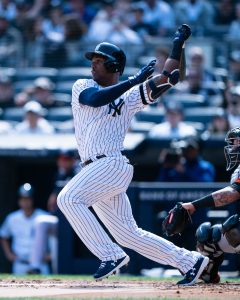
Andujar, owner of a sparkling .297/.328/.527 line with 27 home runs during a 606-PA rookie showing, fell from grace this season over 49 injury-affected trips to the plate. The 24-year-old batted a horrid .128/.143/.128 without a homer, and now it’s fair to wonder if he has walked to the plate as a Yankee for the last time.
General manager Brian Cashman has always advocated for Andujar, and that remains the case, but the executive revealed last week that Andujar – even after a nightmarish season – continues to garner plenty of trade interest. Cashman could easily swat away Andujar suitors, as he has consistently done, but unlike last winter, it wouldn’t be out of bounds to wonder whether the Yankees still have a place for him.
When Andujar’s shoulder troubles put an end to his 2019 in mid-May, there was panic because it didn’t seem the club had an obvious replacement on hand. But it turned out the little-known Gio Urshela was more than up to the task, as the 28-year-old slashed a jaw-dropping .314/.355/.534 and swatted 21 HRs with 3.1 fWAR over 476 PA. Was it a fluke from someone who had never even hit much in the minors? Perhaps. However, when Cashman was discussing the Yankees’ third base plans last week, he suggested the position will remain in Urshela’s hands going into 2020. If Urshela continues clinging to the role, is there any other obvious place to put Andujar – whose defense at third has generated poor reviews thus far? It’s debatable.
Cashman has stated the Yankees are open to trying Andujar at first base or in the corner outfield, but the club also has plenty of talent in those areas. Luke Voit, Mike Ford and even the semi-forgotten, injury-riddled Greg Bird represent options there. Even if you’ve given up on Bird (and who could blame you?), Voit and Ford make for a pair of effective major league bats who are affordable. In the corner outfield, meanwhile, the Yankees have the superstar tandem of Aaron Judge and Giancarlo Stanton with some potential mix of Brett Gardner, Mike Tauchman and Clint Frazier as fallback choices. Would there be space for Andujar there? Maybe, especially as the free agent Gardner (if he re-signs) will likely be the Yankees’ go-to guy in center field with Aaron Hicks recovering from Tommy John surgery. And the Yankees could certainly rotate Andujar in at designated hitter, where they figure to also rely on a capable-looking cast consisting of Voit, Ford, Judge, Stanton, Frazier and catcher Gary Sanchez.
It goes without saying that the Yankees do not have to trade Andujar. He’s a potential offensive star who’ll make a relative pittance for the next couple years and isn’t even on track to reach free agency until after the 2023 season. But for a club that’s targeting starting pitching this offseason, it wouldn’t be stunning to see New York deal from a surplus (offensive talent) to land an arm(s) prior to 2020. If Andujar does indeed end up on the block, teams like the Pirates, Tigers, Rangers, Royals, Brewers, Marlins, Indians, Angels, Braves and Nationals are among those who could end up in pursuit. Cashman’s in the catbird seat, though, as he could simply retain Andujar in hopes of a bounce-back season if nobody makes an offer to his liking.
Photo courtesy of USA Today Sports Images.
NL Notes: Ozuna, Braves, Marlins, Reds, D-backs, Souza
The Braves “have some interest” in free agent outfielder Marcell Ozuna, hears Derrick Goold of the St. Louis Post-Dispatch. Atlanta joins the previously-known Cardinals, Reds, White Sox, Rangers, and Marlins in the early sweepstakes for the corner outfielder. Atlanta already re-signed Nick Markakis, but he could be in line for a lesser role after a subpar age-36 season. Alternatively, Atlanta could move Ronald Acuña to center field full-time should they acquire another corner outfielder, be it Ozuna or someone else. Signing the 29-year-old Ozuna, a qualifying offer recipient, would cost the Braves their second-highest draft choice and $500K of international bonus pool space.
More from the National League…
- The Marlins hired Eddy Rodríguez as catching coach, as first reported by Craig Mish of SiriusXM (via Twitter). Rodríguez, 33, is a former University of Miami catcher who made it to the majors for two games with the 2012 Padres. He retired as a player after the 2017 season, having logged parts of 11 minor league seasons. Rodríguez spent 2019 as the Angels’ minor league catching coordinator.
- The Reds plan to bolster their pitching depth this offseason, reports Bobby Nightengale of the Cincinnati Enquirer. While the club’s main focus figures to be offensive upgrades, GM Nick Krall stressed to Nightengale the importance of stockpiling arms. “Every year, most teams use seven or eight starters,” Krall said. “Most teams use 12 relievers that have significant time. You can’t overlook that.” To that end, Nightengale expects Cincinnati to add a starter and a reliever or two, although it isn’t clear if those additions will be via MLB free agency, trade, or a handful of minor-league free agent signings.
- Diamondbacks outfielder Steven Souza, Jr. is back to running at full speed, the 30-year-old himself tweeted. It’s a good sign, as Souza missed all of 2019 after tearing multiple ligaments in his left knee in spring training. That followed up a disappointing debut in the desert, in which Souza slashed just .220/.309/.369 in 272 plate appearances. Coming off back-to-back lost seasons and projected to make $4.125MM in arbitration, Souza could be a non-tender candidate this offseason. As MLBTR’s Jeff Todd recently explored, the Diamondbacks have quite a few difficult decisions to make in the coming weeks to sort out their outfield mix.
Nutting, Cherington Discuss Pirates’ Offseason
The Pirates have finally cemented a structure in the front office, having officially hired Ben Cherington as general manager. While the club still needs to settle on a field manager, it can also turn towards restructuring a roster that endured a disastrous second half in 2019, both on the field and off. Cherington and owner Bob Nutting met with Pittsburgh media today (including Rob Biertempfel of the Athletic) to discuss the organizational outlook. As expected, changes figure to be in the works.
No player on the roster is off limits in trade, Nutting indicated. He’ll instead give Cherington free rein in player movement. As Biertempfel notes, that figures to be most relevant for the respective futures of Starling Marté, Keone Kela, and Josh Bell, all of whom are productive enough to catch other teams’ attention but are three or fewer years from free agency.
Marté and Kela, especially, figure to be bandied about the rumor mill in the coming months. The Pirates weren’t believed to be shopping Marté when the offseason began, but that always seemed likely to change and the club has since installed Cherington in place of former GM Neal Huntington. Kela, meanwhile, was seemingly part of the club’s fraught clubhouse that boiled over at season’s end. That said, he remains an extremely talented reliever (2.12 ERA in 32 appearances in 2019), so he figures to draw interest elsewhere.
A Bell trade, while perhaps not as likely, would certainly shake up the first base/DH market. The 27-year-old had a disappointing second half, but his full-season .277/.367/.569 slash line (135 wRC+) remained stellar. Neither scouts nor defensive metrics have ever loved Bell as a first baseman, but he certainly looks the part of a middle-of-the-order masher. Speculatively speaking, the Blue Jays, Rays, Red Sox, Twins, and Nationals are among the dozen or so teams who would make sense as Bell suitors. After all, he comes with three seasons of team control and is only projected for a $5.9MM arbitration salary, so he could appeal to organizations in various markets and at different stages of the competitive cycle.
Does that mean the Pirates are destined for a full rebuild? The owner did let on that a change in the organization’s outlook may be necessary. “Shooting to be an 81- or 82-win team year after year is not going to be acceptable,” Nutting told reporters, including Biertempfel. “At the same time, 69 wins is never going to be acceptable. I don’t subscribe to (the notion that) a couple of 69’s leads to a winning team.”
There’s a bit of mixed messaging there, but Nutting’s disavowal of consistently fielding average to slightly above-average rosters and hoping things break right is noteworthy. Pittsburgh has, in the past, done just that, eschewing a full rebuild in hopes of remaining on the fringes of the race each year. That served the organization well from 2013-2015, when they ripped off three consecutive Wild Card berths. It has been much less effective in the four seasons since.
No one in the organization fully committed to a teardown, it’s worth noting. As would be expected, Cherington indicated a desire to get acclimated to his personnel before making any decisions. Among those aids will be assistant GM Kevan Graves, who will return in that position, per Biertempfel. Graves served as interim GM after Huntington’s firing and was in the running for the permanent position. Nevertheless, he’ll remain on hand in his previous role, unlike Kyle Stark, who was let go from his AGM job over the weekend.
With the front office turnover now complete, the Pirates’ on-field product will start to take shape. There are many ways this offseason can go, as MLBTR’s Steve Adams noted in his Offseason Outlook, and it now seems that everything is on the table. The organization could be in for a drastic reshuffling in the coming months.