
The Opener: Astros, Options, Diamondbacks
Welcome to The Opener, our new weekday morning series here at MLBTR! Nick Deeds will take you through three things to watch around MLB, with our typical hot stove leaning.
With the final game of the 2022 MLB season coming as soon as tomorrow night, here are three things we’ll be keeping an eye on around the baseball world:
1. Astros Facing Decisions On Baker, Click
After a hard-fought Game 5 that afforded Justin Verlander his first pitcher win in the World Series, the Astros will look to clinch back home in Houston tomorrow night. As soon as they do, however, they’ll have to face the personnel decisions that their postseason run has put on hold to this point. Both manager Dusty Baker and GM James Click are on expiring contracts, and Astros owner Jim Crane will have to decide their futures with the franchise. The Astros are expected to ask Baker to return in 2023, and Baker has indicated that he would like to continue managing regardless of the outcome of this postseason run. The future is murkier for Click, however, as speculation has run rampant throughout the postseason that he may not be asked to return to Houston in 2023, with Jon Heyman of the New York Post mentioning the uncertainty surrounding Click’s future as recently as last night. While it’s surprising to see so much uncertainty around a GM who has captured back-to-back AL pennants and might add a World Series championship to his resume as soon as tomorrow night, reports of a personality clash between Crane and Click abound. Heyman suggests that the Astros may be interested in David Stearns, who served as their assistant GM prior to running Milwaukee’s front office. While Stearns has stepped down as president of baseball operations for the Brewers, he’s not likely to run the Astros or any other team during the 2023 season, for which he is still under contract in Milwaukee. Even if the Astros are indeed interested in Stearns as their long-term head of baseball operations, the question of who will be at the helm in Houston next season remains unanswered.
2. Option Decisions Loom
A number of players and teams are facing option decisions, and with the World Series set to end this weekend, those decisions will have to be made sometime next week. While some decisions, such as that of Nolan Arenado, have already been made, most are still up in the air. Anthony Rizzo, Jurickson Profar, and Jake Odorizzi are among the players with tougher decisions facing them on whether or not to test free agency. As for club options, the Dodgers have one of the tougher calls on Justin Turner‘s $16MM option, as do the Brewers on Kolten Wong‘s $10MM option. Additionally, many of the biggest names on the free agent market this season, such as Verlander, Jacob deGrom, Carlos Correa, and Xander Bogaerts, are technically not set to be free agents until they opt-out of their current contracts, though for decisions as clear as these this is little more than a formality.
3. Arizona Faces Outfield Logjam
Despite finishing the regular season with an unimpressive 74-88 record, the Diamondbacks are by no means a team without talent. Unfortunately for Arizona, however, a great deal of that talent overlaps heavily, as the team is flush with young, controllable, lefty-hitting outfielders. Corbin Carroll and Alek Thomas highlight the bunch in terms of prospect pedigree, but Jake McCarthy had a breakout season in 2022, Daulton Varsho turned in a quality season as an everyday player spending most of his time in the outfield, Pavin Smith won’t be eligible for arbitration until after next season, and Dominic Fletcher is knocking on the door in Triple-A. Between the DH and some positional versatility — Varsho caught 175 innings in 2022, while Smith played a bit of first base — Arizona could find at-bats for most, or perhaps even all, of these players. A better solution for the Diamondbacks, though, would be to explore trades for one or two of these young players in order to shore up their pitching staff or address other holes in the lineup. Carroll and Varsho would likely be off-limits, but perhaps a team looking to get more left-handed bats into the lineup, such as either Chicago team or the Marlins, could be interested in acquiring McCarthy, Smith, or Fletcher. While it’s not inconceivable Thomas could be moved, after a rough start to his major league career in 2022, Arizona would likely be selling low on him in any deal.
Astros Targeting Friday Return For Justin Verlander
The Astros appear to be on the cusp of getting Cy Young frontrunner Justin Verlander back. Manager Dusty Baker tells reporters that while nothing is finalized yet, the organization’s tentative plan is for Verlander to return on Friday (Twitter link via Chandler Rome of the Houston Chronicle). Verlander hasn’t pitched since departing his Aug. 29 start after three innings due to what would eventually be diagnosed as “fascial disruption” in his calf.
If he indeed returns Friday, it’ll go down as an 18-day absence for Verlander — a near-best case scenario for an injury that, as acknowledged by the pitcher himself in the wake of his IL placement, could have sidelined him through a portion of the postseason had it been even marginally more severe.
[Related: The Changing Landscape of the American League Cy Young Race]
The 39-year-old Verlander has had nothing short of a remarkable season in his return from 2020 Tommy John surgery — not only reestablishing himself as a high-quality starter but resurfacing as a bona fide ace with a legitimate chance at his third Cy Young Award. Missing even a couple of starts could prove a deciding factor, particularly with Dylan Cease and Alek Manoah surging late in the season, but Verlander’s 1.84 ERA still tops American League pitchers. He’s now fallen to 18th in the league in innings pitched, however, narrowing any lead he might have previously held over the field. He’s also returning without a minor league rehab stint, so it’s at least possible the ‘Stros will be a little more cautious than usual with his workload in his first outing.
The extent to which Verlander is able to bounce back from this calf issue will be telling with regard to the Cy Young race, though the team focus is surely just on having him built up to full strength for their now-inevitable postseason run. With 20 games left to play and a 12.5-game lead in the AL West, Houston hasn’t mathematically clinched the division crown, but that’s a fait accompli at this juncture. The Astros have the best record in the American League and the second-best record in baseball, trailing only the Dodgers, positioning them for a first-round bye in this year’s newly expanded 12-team playoff format.
That will give Houston the luxury of lining up the rotation however the team deems fit. Assuming he’s at full strength, Verlander would be the obvious choice to take the ball in Game 1 of the American League Division Series, likely to be followed by lefty Framber Valdez, who figures to get some down-ballot recognition in this year’s Cy Young voting himself. With Lance McCullers Jr. back on the active roster and 25-year-old righties Cristian Javier and Luis Garcia each pitching well (Javier, in particular) — the Astros are deep in options for their postseason rotation.
AL West Notes: Angels, Verlander, Gray, Howard
Dr. Patrick Soon-Shiong is considering a bid on the Angels, according to Sportico’s Eric Jackson and Scott Soshnick. The billionaire isn’t giving official comment, but Bill Shaikin of the Los Angeles Times heard that Soon-Shiong is indeed weighing the possibility of buying the franchise. The 70-year-old Soon-Shiong is a former transplant surgeon who built a fortune in the medical technology and pharmaceutical industries, and his business holdings also include both the L.A. Times and San Diego Union-Tribune newspapers.
This isn’t the first time Soon-Shiong has tried to get involved in baseball, as his ownership group was the runner-up bidder for the Dodgers in 2012 when Guggenheim Baseball Management bought the franchise. Now, Soon-Shiong will apparently see if he can purchase the other Los Angeles area team, as Angels owner Arte Moreno said last month that he is considering a sale. There is expected to be plenty of bidding on the Angels, and it seems quite possible that the price tag could end up approaching the $3 billion mark.
More from around the AL West…
- Justin Verlander threw a live bullpen session today, simulating one inning of work with some batters stepping in against the veteran righty. Verlander has been on the 15-day injured list since August 29 due to calf discomfort, and he told MLB.com’s Brian McTaggert and other reporters that he hoped the session would give him more of a natural pitching feel, and allow him to “stop kind of thinking about the calf and just let my mechanics work…during rehab your throwing is very stagnant and robotic.” Physically, Verlander said he is feeling “great,” and he is hopeful of a relatively quick return to the Astros rotation. Since Verlander saw today’s outing as a pseudo-start day from a preparation standpoint, Verlander could potentially be back in action as early as September 16, provided that he doesn’t have any recovery issues from the bullpen session.
- The Rangers will activate Jon Gray from the 15-day injured list on Monday, as interim manager Tony Beasley told reporters (including MLB.com’s Kennedi Landry) that Gray is slated to start the second game of Texas’ doubleheader against the Marlins. Gray hasn’t pitched since August 1 due to an oblique strain, and he’ll return within the initial 4-6 week recovery timeline. Between this oblique problem and previous IL stints due to a knee sprain and blisters, Gray has only pitched 103 1/3 innings in his first season with Texas, though he has a 3.83 ERA and solid peripherals.
- In other Rangers injury news, the team announced that Spencer Howard will begin a rehab assignment at Triple-A today. Howard has pitched only 37 2/3 innings in the majors this season, as he has been both in the minors and battling fingernail and blister problems before his most recent injury, a shoulder impingement. This shoulder issue sidelined Howard about a month ago, and it remains to be seen if he can ramp up enough to make a return to the majors before the season is over. The former top prospect has yet to show much at the MLB level, posting a 7.09 ERA over 111 2/3 career innings with the Phillies and Rangers.
The Changing Landscape Of The AL Cy Young Race
Two weeks ago, the Cy Young race in the American League looked like a two-horse race, with both Houston’s Justin Verlander and Tampa Bay’s Shane McClanahan hovering at or below the 2.00 ERA mark and racking up innings atop their teams’ respective rotations. McClanahan has the larger strikeout percentage and subsequently superior marks from fielding-independent metrics that some voters increasingly weigh. Verlander was averaging one extra out recorded per start prior to being lifted early his last time out, and his 16-3 win-loss record might hold some sway with traditionalist voters.
Or, all of that could be rendered moot.
Both Verlander and McClanahan are on the 15-day injured list, and Verlander, who had been improbably leading the Majors in ERA as a 39-year-old in his first season back from Tommy John surgery, sounds as though he’ll miss several weeks rather than just the 15-day minimum. McClanahan, a late scratch from his last start, is already throwing and seems likelier to make a quick return. However, the Rays could very well take a cautious approach and limit his innings after a two-week absence due to a shoulder impingement.
At the very least, the door is now open for further competition in Cy Young voting, ostensibly setting the stage for the closest AL vote we’ve seen since 2019, when Verlander and then-teammate Gerrit Cole finished in the top two positions on the ballot. Last year’s NL Cy Young voting sparked plenty of controversy and debate as well, and as things currently stand, we could get an encore of that scene in the AL this year.
If not Verlander or McClanahan, who are the top names to consider? Let’s dive in.
Dylan Cease, RHP, White Sox
Cease, following a near-no-hitter against the Twins that saw him go 8 2/3 before Luis Arraez cracked a ninth-inning single, may have leapfrogged both Verlander and McClanahan as the odds-on favorite in the American League. He’s sitting on MLB’s third-lowest ERA — sandwiched right between Verlander and McClanahan, no less — and that 2.13 mark is complemented by a 31.4% strikeout rate that ranks as the fourth-highest of any qualified starting pitcher in baseball.
At 5.5 wins above replacement (per Baseball Reference), Cease already leads American League pitchers — even over Verlander and McClanahan. That’d due largely to the fact that Cease is putting up these numbers in front of one of the game’s bottom-10 defenses.
It’s not all roses, as Cease has a 10.4% walk rate that sits dead last among qualified starters. He hasn’t been terribly efficient, either; where both Verlander and McClanahan have averaged comfortably more than six innings per start, Cease has averaged 5.77 innings per appearance this year.
Still, Chicagoans can no doubt see the parallels between Cease’s 2022 showing and the 2016 performance of another Chicago hurler — crosstown righty Jake Arrieta, when he rode a historic summer surge to Cy Young honors. Over his past 15 starts, Cease has tallied 93 innings of 1.45 ERA ball and held opponents to one or zero runs on a dozen occasions. Cease isn’t quite in Arrieta territory (0.86 ERA in his final 147 innings), but he’s not terribly far off, either. If he can sustain anything close to this pace, Cease will finish the season at or near the top of the AL in terms of innings pitched, ERA, total strikeouts and strikeout rate.
Alek Manoah, RHP, Blue Jays
Manoah looked borderline unhittable for the season’s first two months, carrying a 1.67 ERA in that time and allowing just 55 hits and a 0.59 HR/9 mark through June 13 (75 2/3 innings). He had a solid but closer-to-average run for much of the summer but has now yielded just three runs in his past 28 1/3 innings.
At 171 innings of 2.42 ERA ball on the year, the 24-year-old is on the periphery of the race at present. He ranks fourth in American League ERA but trails McClanahan, Cease and especially Verlander in that department. He lacks the gaudy strikeout ratios boasted by both Cease and McClanahan but limits hard contact better than any non-McClanahan pitcher in the AL, evidenced by a 31.3% hard-hit rate. (McClanahan leads qualified AL starters at 30.1%.)
However, Manoah’s 171 are second-most in the American League, and if he continues this hot streak, there’s a chance he could wind up among the league leaders in ERA, innings pitched and other key categories. In terms of wins and losses, everyone’s trailing Verlander’s 16 victories, but Manoah’s 14 are tied with Framber Valdez for second in the league. Speaking of which…
Framber Valdez, LHP, Astros
It’s easy to be overshadowed by the season Verlander is enjoying, but we should all probably be discussing Valdez’s outstanding year more than we are. The 28-year-old southpaw is just one-third of an inning behind Manoah at 170 2/3, and he also sits sixth in ERA (2.64) and ninth in bWAR (3.4).
Valdez has emerged as baseball’s preeminent ground-ball starting pitcher, and it’s not close; he leads all qualified pitchers in ground-ball rate at 66.7%, and Logan Webb‘s 57.5% rate is second-best. Even dropping the minimum to 50 innings as a starter, he still leads Alex Cobb (61.9%) and Andre Pallante (61.4%) by a wide margin.
In an age where starters are yanked from the game earlier than ever before, Valdez is a throwback. He’s worked at least six innings in every one of his starts since April 25, completing seven or more innings on 11 occasions and twice going the distance with a complete game. Over his past five starts, Valdez has 35 2/3 innings of 1.77 ERA ball. It’ll be a challenge for him to drop his ERA into the low 2.00s, and he can’t match Cease or McClanahan in terms of strikeouts, but Valdez will likely be the American League innings leader and finish with a mid-2.00s ERA and MLB-leading ground-ball rate.
Shohei Ohtani, RHP, Angels
When Ohtani pitched to a 3.99 ERA through the first six weeks of the season, it looked as if we were in for an (almost) mortal season out of the two-way phenom. He averaged just over five innings per start, and while the strikeouts were still there in droves, he was also unusually homer-prone. A Cy Young pursuit did not appear to be on the horizon.
In 88 2/3 innings since that time? Ohtani has a 1.83 ERA with fewer homers allowed (six) than in his first 47 1/3 innings (seven). He at one point rattled off six consecutive starts with double-digit strikeout totals, and opponents have batted .199/.249/.301 against him during this stretch.
Ohtani’s 33% strikeout rate on the season leads qualified starting pitchers (though would trail Braves phenom Spencer Strider by a good margin if Strider had a few more innings), and while many fans and Ohtani detractors bristle at the notion, it’s hard not to consider that he does all this while also serving as a middle-of-the-order slugger who ranks among the league’s top power threats.
Ultimately, with just 136 innings pitched this season, it’s hard to imagine that Ohtani will actually garner many (if any) first-place Cy Young votes. Yes, he’s sporting a 2.58 ERA, leading the league with a 33% strikeout rate and sitting second among AL starters with 4.7 bWAR. But Ohtani is ultimately going to be up against multiple starters with better bottom-line run prevention numbers and as many as 40 to 50 additional innings pitched. Corbin Burnes won an NL Cy Young last year with just 167 frames, but the top names in the American League this year have had better seasons.
Kevin Gausman, RHP, Blue Jays
Gausman will be the analytic darling in this year’s field. I debated whether to mention him at all for this breakdown, as he’d need a pretty dominant finish to push his way in among the leaders in more traditional categories, but the right-hander is second in the American League at FanGraphs with 5.2 wins above replacement. fWAR is based on fielding-independent pitching rather than actual runs allowed, and Gausman has been quite good this season — 3.12 ERA in 147 innings — despite being one of the game’s least-fortunate pitchers in terms of balls in play. He’s lugging around an MLB-worst .368 BABIP, and the next-highest mark (Jordan Lyles at .323) isn’t even close.
There’s perhaps some temptation to think that Gausman is then yielding far too much hard contact, but that’s not necessarily the case. He’s not managing contact as well as any of the others profiled here, but his 89 mph average exit velocity and 39% hard-hit rate are barely north of the respective 88.6 mph and 38.3% league averages in those regards.
Gausman has the game’s third-best walk rate (3.8%), the tenth-best strikeout rate (27.9%) and is sixth-best in the differential between those two (24.1 K-BB%). He’s averaging just 5 2/3 innings per start, however, and isn’t particularly helping his cause down the stretch (3.99 ERA over his past five outings… again, with a .370 BABIP).
—
A lot can (and will) change between now and season’s end, but since this is all just for debate anyhow, I’ll include a poll to close this out:
Who will win the American League Cy Young Award?
-
Justin Verlander 36% (657)
-
Dylan Cease 26% (472)
-
Alek Manoah 14% (250)
-
Shane McClanahan 10% (177)
-
Shohei Ohtani 9% (170)
-
Framber Valdez 3% (46)
-
Other (specify in comments) 2% (31)
-
Kevin Gausman 1% (17)
Total votes: 1,820
Injury Notes: Franco, Verlander, Arano
Rays shortstop Wander Franco resumed his rehab assignment yesterday, slotting in as the designated hitter for the Triple-A Durham Bulls as he attempts to return from July hamate surgery. The plan, as relayed by Marc Topkin of the Tampa Bay Times, is for Franco to stick with the Bulls for a few more games and rejoin the Rays for their series against the Blue Jays on September 12.
Of course, this is contingent on Franco feeling well in the coming days. He attempted to begin a rehab assignment a few weeks ago but was pulled off due to continued soreness in his hand. It seems like he’s in a better position this time around, however. “This is definitely the best I’ve felt since the injury,” Franco tells Topkin, via interpreter Manny Navarro. “That’s probably the most important thing, if he feels good where he’s at, where we’re at,” manager Kevin Cash said.
Getting Franco back for the final few weeks of the regular season would certainly be a boon for the Rays. They are currently five games back of the Yankees in the battle for the AL East crown and sandwiched between the Mariners and Blue Jays in the Wild Card picture. The club also put second baseman Brandon Lowe on the IL last week, which further subtracted from their infield depth.
Other injury notes from around the league…
- Astros righty Justin Verlander went on the IL a week ago due to a calf injury, with both Verlander and general manager James Click expressing optimism that a significant absence wouldn’t be necessary. However, Verlander probably won’t return after the 15-day minimum, Click tells Chandler Rome of the Houston Chronicle. The Astros are fortunate enough to be sitting on a record of 86-48, six games ahead of the Yankees for the best record in the American League and 17 games ahead of the Central-leading Guardians/Twins. That means the club is cruising to a first round bye and can allow Verlander to return at whatever pace is best for his health, as opposed to rushing him back for meaningful games down the stretch. Prior to the injury, the 39-year-old was having an incredible season, especially when considering he effectively missed the previous two years. He’s thrown 152 innings in 2022 with a 1.84 ERA, 26.5% strikeout rate and 4.5% walk rate. By surpassing the 130-inning mark, he has vested a $25MM player option for next year, but would likely be able to do better than that on the open market if he declined the option.
- The Nationals placed right-hander Victor Arano on the 15-day injured list, retroactive to September 2, due to a right shoulder strain. The club hasn’t released any information about Arano’s timeline, but with only about four weeks left on the schedule, it’s possible that this ailment will end his season. He’s thrown 42 innings so far this year, his first MLB action since 2019. He has a 4.50 ERA, 23.5% strikeout rate, 6.4% walk rate and 51.6% ground ball rate. A 58.9% strand rate is probably inflating that ERA, with advanced metrics like FIP (3.71), xFIP (3.45) and SIERA (3.12) thinking he deserved much better. The 27-year-old will cross three years of MLB service time by season’s end, meaning he will qualify for arbitration for the first time.
Previewing Upcoming Opt-Out Decisions And Player Options
With the offseason approaching, so is the time for players and teams to decide upon any 2023 options in their contracts. MLBTR has taken a look through various option decisions in recent weeks: first with players whose deals contain vesting provisions, then a respective look at the team options in both the American and National Leagues.
Today, we’ll turn our attention to the players’ side. A number of players could hit free agency this winter either by triggering an opt-out clause in their current deal or bypassing a player option for the 2023 campaign. We’ll take a run through those decisions, many of which will have implications at the very top of the free agent market.
Note: All stats referenced are through play Sunday
Elite Potential Free Agents
- Nolan Arenado, Cardinals 3B (can opt out of final five years and $144MM)
Arenado was already on a Hall of Fame trajectory before 2022, but he’s bolstering his case with the best season of his career. Through 500 plate appearances, he owns a .306/.370/.567 line with 27 home runs. He’s had seasons with that kind of slash line in years past, but they came with the caveat that he’d played half his games at Coors Field. That’s no longer a factor, and it’s easily his best offensive output once one adjusts for the ballpark. Arenado’s 162 wRC+ is the fourth-best mark among qualified hitters.
That kind of offensive production alone would get him in the MVP discussion, but Arenado’s obviously valuable for far more than his bat. One of the best defensive third basemen in MLB history, he’s continued to post elite marks with the glove even as he’s entered his 30s. Arenado is among the top handful of players in the game. While walking away from $144MM wouldn’t be an easy decision, it’d seem the prudent one from a strict financial perspective. Freddie Freeman received six years and $162MM from the Dodgers (albeit with deferrals that reduced the net present value closer to the $148MM range) headed into his age-32 season. Freeman was coming off a 135 wRC+ platform showing, and he plays a less valuable position. Arenado and his camp could make a strong argument the Freeman contract should represent his floor, and it’s not outlandish to seek a six-year deal at the $35MM annual range Anthony Rendon received from the Angels (which would bring the guarantee to $210MM).
On paper, Arenado’s opt-out decision looks like a slam dunk. There’s at least some amount of uncertainty, though, as he forewent an opt-out opportunity last offseason and told Derrick Goold of the Post-Dispatch it was “always the plan” to remain in St. Louis long term. Passing on free agency coming off a .255/.312/.494 showing in 2021 is a lot easier than doing so after a career-best year that should make him an MVP finalist. Maybe he’s comfortable enough with the Cardinals he’ll return, but he’d probably be leaving a lot of money on the table to do so. At the very least, he looks to have a case for a renegotiation of his contract with the Cards, which is slated to pay him just $15MM in the final season (2027).
- Carlos Correa, Twins SS (can opt out of final two years and $70.2MM this offseason; deal also contains post-2023 opt-out if Correa opts in this winter)
Regarded by many (MLBTR included) as the top free agent in last winter’s class, Correa reportedly turned down at least one ten-year offer early in the offseason in search of a guarantee that rivaled the $341MM Francisco Lindor had received from the Mets last April. That proposal seemingly never came, and Correa reversed course in Spring Training. He signed a shocking three-year deal with the Twins that guaranteed him the largest annual salary ($35.1MM) for a free agent position player and afforded the opportunity to retest the market in either of the next two offseasons via opt-out.
Conventional wisdom was that Correa was sure to trigger his first opt-out and make another run at a long-term deal in a winter unaffected by a lockout. That still seems likely, although he hasn’t resoundingly made the case for teams to be more willing to approach the Lindor range that they had been. He’s having a similar offensive season as he did during his final year with the Astros. After posting a .279/.366/.485 showing his last year in Houston, Correa is hitting .276/.355/.439 over 440 plate appearances with Minnesota. His raw power production is down, but that’s not quite as alarming when considering the leaguewide slugging percentage has dropped from .411 to .395. Perhaps of greater concern is that the elite defensive marks that garnered Correa a Gold Glove last season are unanimously down, ranging anywhere from below-average (-2 Outs Above Average) to solid (+4 Defensive Runs Saved, +1 Ultimate Zone Rating).
There’s no question Correa’s an excellent player having a very good season. Yet he’s not likely to wind up a top five finisher in MVP balloting as he did in 2021. He’d top a $200MM guarantee on the open market, but he’s unlikely to reach the kind of money he anticipated last offseason. Could he return to Minnesota (where he’s by all accounts very happy) for one more year and look to trigger his post-2023 opt-out after hopefully putting up MVP-caliber numbers? That feels unlikely, but he’s already bet on himself once and would only be entering his age-29 season if he put off opting out for a year.
- Xander Bogaerts, Red Sox SS (can opt out of final three years and $60MM)
Bogaerts has been the Red Sox’s everyday shortstop since 2014, but his time in Boston could be nearing its end. He and the club didn’t make progress in extension talks this spring, and he’s a lock to opt out and top $60MM on the open market barring a catastrophic injury. One of the game’s top offensive shortstops, Bogaerts is amidst another strong season. He carries a .303/.372/.448 line through 508 plate appearances. His slugging output is below where it was from 2018-21, but he consistently gets on base and has a strong pre-2022 track record from a power perspective.
One can quibble about certain aspects of Boagerts’ profile. In addition to this year’s slugging dip, he’s traditionally rated as a below-average defender. Even with generally solid defensive metrics this season, clubs will probably have some question whether he’ll eventually need to move to second or third base. Those are nitpicks for whether Bogaerts would be a worthwhile investment in the $180MM – $200MM range, though. A 30-year-old shortstop with an elite durability track record and a .299/.370/.478 line since the start of 2020, he’s certainly going to shatter $60MM even if the market takes a relatively pessimistic view of his long-term projection.
- Jacob deGrom, Mets RHP (can opt of final year and $33.5MM this offseason)
There’s no suspense with this one, as deGrom has publicly maintained his plan to opt out for months. That’s in spite of elbow/shoulder injuries that kept him from throwing a major league pitch between July 2021 and this August. With only one guaranteed year remaining on his deal (plus a 2024 club option that’d go into effect if he doesn’t opt out this winter), that’s been a pretty easy call. To the extent there may have been any lingering doubts, deGrom has silenced them with his first five starts since returning from the injured list. He’s looked like his vintage self, averaging 99.3 MPH on his fastball while posting a laughable 46:2 strikeout-to-walk ratio through 29 1/3 innings. On an inning-for-inning basis, he’s the best starting pitcher on the planet.
deGrom’s free agent case will be fascinating. Even if he finishes the season healthy, he’ll have gone three consecutive years without topping 15 starts or 100 innings (although he’s obviously not at fault for the shortened 2020 schedule). What kind of volume a signing team can expect is an open question, particularly as he enters his age-35 season. Yet the upside of a healthy deGrom is through the roof. He’ll receive a multi-year deal that beats the $33.5MM remaining on his current contract. Can he top teammate Max Scherzer’s $43.333MM AAV over a three or even four-year term? Time will tell.
- Justin Verlander, Astros RHP ($25MM option for 2023)
While we’re on the topic of upper-echelon starting pitchers who are basically certain to opt out, let’s turn to Verlander. The future Hall of Famer triggered a $25MM option for next season by throwing 130 innings, but that’s largely a moot point. Verlander told Ken Rosenthal of the Athletic last week he was likely to opt out if things went as planned down the stretch. It’d have been surprising if he were even considering exercising the option.
Verlander has returned from 2020 Tommy John surgery to lead the major leagues with a 1.84 ERA. He’s striking out 26.5% of opponents and has a strong argument for a third career Cy Young award. He’s also a proven playoff performer and a prototypical ace who eats about as many innings as anyone else in the game. Even heading into his age-40 season, Verlander can try to beat the Scherzer AAV on a multi-year contract.
Verlander did injure his calf in his most recent start, resulting in a placement on the injured list just this afternoon. The Astros announced that an MRI of his calf revealed “fascial disruption, but no muscle fiber disruption” — an extremely specific diagnosis but one that both Verlander and GM James Click touted as good news. Click expressed hope the injury will be short-term, and Verlander suggested that had he sustained damage to the muscle fibers themselves, he’d likely have missed the remainder of the regular season and perhaps part of the postseason.
The manner to which Verlander rebounds will obviously be key in his opt-out scenario, but if he misses only a couple weeks’ time and returns strong for his final regular-season and postseason starts, this opt-out is an easy call.
- Carlos Rodón, Giants LHP ($22.5MM option for 2023)
We’ll wrap up the trifecta with Rodón, who’s also going to have an easy decision, barring injury. While there was some trepidation about Rodón’s breakout 2021 season — both due to his inconsistent track record before last season and some shoulder soreness and a velocity drop last August — he’s doubled down and looks to have cemented himself among the game’s top ten starters. Rodón has avoided the injured list thus far, and he’s striking out 32.1% of opponents while posting a 2.81 ERA through 25 starts. By topping 110 innings, he earned the right to opt out after this season.
Heading into his age-30 campaign, he should land the nine-figure deal that eluded him last offseason. Between his youth and last two years of production, Rodón has an argument for the largest guarantee of any free agent starter. He won’t get paid at the deGrom or Verlander level on an annual basis, but he could push for six years and look to top $150MM.
Quality Regulars Likely To Opt Out
- Anthony Rizzo, Yankees 1B ($16MM option for 2023)
Rizzo’s market last offseason seemed a bit underwhelming. The veteran first baseman was coming off two fine but unspectacular seasons, and it looked as if his best days might be behind him with his mid-30s approaching. Rizzo still made plenty of contact and hit the ball hard, but he’d gotten quite pull-oriented and had rough ball-in-play results against an increasing number of defensive shifts. He signed a two-year deal with the Yankees that paid him matching $16MM salaries and allowed him to opt out after this season.
That now looks like an easy call, as Rizzo has bounced back with a year more reminiscent of his peak days with the Cubs. He carries a .223/.337/.480 line and is going to top 30 homers for the first time since 2017. He’s still getting dismal results on balls in play and doesn’t have a particularly impressive batting average, but even that looks as if might turn around next year. It’s widely expected MLB will institute limits on shifting next spring. Few players would stand to benefit more than Rizzo, who’s facing a shift on a whopping 83.5% of his plate appearances according to Statcast. His age and lack of defensive versatility will limit the length of any deal, but he’ll probably beat the $16MM salary over at least a two-year term, even if the Yankees tag him with a qualifying offer.
- Jurickson Profar, Padres LF ($8.5MM option, $1MM buyout)
The Padres’ signing Profar to a three-year, $21MM deal that allowed him multiple opt-out chances was one of the more eyebrow-raising moves of the 2020-21 offseason. The switch-hitter was coming off a solid 2020 campaign, but that shortened schedule was the first in which he’d posted above-average production. It looked like a misstep when he struggled last year and unsurprisingly forewent his first opt-out clause, but Profar has rewarded the organization’s faith with a career-best showing in 2022.
Through 530 plate appearances, he’s hitting .241/.339/.387 with 12 homers. He’s walking at a robust 12.3% clip while only going down on strikes 15.1% of the time. He looks like a solid regular, and headed into his age-30 season, Profar’s a candidate for another multi-year deal this time around. After major throwing issues as an infielder early in his career, he’s played exclusively left field this year. Profar isn’t a prototypical corner outfield masher, but his plate discipline and bat-to-ball skills should allow him to top the guaranteed money remaining on his current deal.
Starting Pitchers With High Buyouts
- Taijuan Walker, Mets RHP ($6MM option, $3MM buyout)
Walker signed a $20MM guarantee with the Mets over the 2020-21 offseason. The deal was front-loaded but came with a $6MM player option or a $3MM buyout for 2023. Adding a player option allowed the Mets to soften the contract’s luxury tax hit. Because player options are treated as guaranteed money, it technically qualified as a three-year, $20MM deal with a $6.67MM average annual value for CBT purposes. Yet the $3MM gap between the option value and the buyout meant Walker was a virtual lock to opt out, barring injury that made him unable to pitch next season. The Associated Press reports the option has various escalators that could push its value as high as $8.5MM if Walker throws 175 innings this year, but even that figure is modest enough he’s going to decline.
Walker should opt out in search of a multi-year deal, as he’s been a valuable mid-rotation arm for New York. Over 117 1/3 frames, he owns a 3.38 ERA despite a modest 18.3% strikeout rate. His blend of plus control and solid ground-ball rates makes him a candidate for a three-year pact as he heads into his age-30 season. The Mets will have an interesting decision on whether to tag him with a qualifying offer.
- Jake Odorizzi, Braves RHP ($12.5MM option, $6.25MM buyout)
Like Walker, Odorizzi signed late in the 2020-21 offseason on a deal that locked in the first two seasons and gave the player a third-year option. Odorizzi’s contract with the Astros was similarly structured to facilitate a third-year buyout while diminishing the AAV for luxury tax purposes, although he’s deciding on a bit more money. The option was initially valued at $6.5MM with a $3.25MM buyout, but the Associated Press provided a breakdown of various escalators. The option value would jump by $2MM apiece if Odorizzi reached 20, 25 and 30 appearances between 2021-22 in which he either started the game or worked four-plus innings of relief. The buyout value would spike by $1MM apiece for hitting each of those thresholds.
Odorizzi has already made 41 such appearances over the past two years, so he’s long since maxed out both thresholds. He’ll therefore be deciding between a $12.5MM option to return to the Braves or taking a $6.25MM buyout and heading to free agency. With only a $6.25MM difference between the option value and the buyout, Odorizzi looks like a borderline opt-out case. He owns a 3.90 ERA across 85 1/3 innings this season, although his 18.3% strikeout rate is a few points below league average. He’ll be 33 by next Opening Day, and he didn’t find as robust interest as most expected he would during his last trip through free agency. He’s a quality strike-thrower and a perfectly fine back-of-the-rotation starter, but it’s now been three years since he’s missed bats at an above-average rate, and he was traded this summer in a one-for-one swap for an underperforming reliever (Will Smith).
Easy Calls To Return
- Chris Sale, Red Sox LHP (can opt out of final two years and $55MM)
Sale has the right to pass on the final two years of his extension with the Red Sox this winter, but he certainly won’t do so. He’s made just 11 starts over the past three seasons due to various injuries, including a 2020 Tommy John surgery and a trio of fractures (rib, finger and wrist) this year. Sale has still flashed mid-rotation or better upside in the limited time he’s been on the field, but there’s too much uncertainty with his health to land anywhere near $55MM were he to test the market.
- Eric Hosmer, Red Sox 1B (can opt out of final three years and $39MM)
Hosmer’s opt-in decision is a no-brainer. Since signing a $144MM contract with the Padres heading into 2018, he’s posted a league average .264/.325/.409 slash line. Paired with his lack of defensive versatility and mixed reviews on his glovework (public metrics have never been as fond of Hosmer as his four Gold Gloves would suggest), he’d probably be limited to one-year offers were he a free agent. The Padres will remain on the hook for virtually all of the money, as they agreed to pay down Hosmer’s deal to the league minimum salary to facilitate his trade to the Red Sox.
- Jorge Soler, Marlins LF (can opt out of final two years and $24MM; deal also contains post-2023 opt-out if Soler opts in this year)
Soler parlayed a big second half and huge batted ball metrics into a three-year deal with Miami last offseason. His massive raw power hasn’t translated into especially strong results since he’s become a Marlin, however. He’s been a below-average hitter, and it’s now been three years since he was a middle-of-the-order caliber player over a full season. Paired with a limited defensive profile that keeps him in the corner outfield or at designated hitter, he’s been right around replacement level this season. He’s not opting out this year, but a big showing in 2023 could allow him to reconsider the possibility next winter.
- AJ Pollock, White Sox LF ($11MM option, $5MM buyout)
The White Sox acquired Pollock just before the start of the season, sending Craig Kimbrel to the Dodgers in a surprising one-for-one swap. The hope was that they’d addressed a notable hole in the corner outfield, but Pollock’s production has cratered in Chicago. Just a season removed from a .297/.355/.536 showing in L.A., he’s stumbled to a .237/.284/.363 line through 401 plate appearances with the ChiSox. Even with a fairly modest $6MM gap between the option’s present value and the buyout, Pollock is likely to bypass a trip to free agency after a replacement-level platform season.
The present $11MM option value isn’t fixed, as Pollock’s contract contains escalators that could boost it a bit further. Originally set at $10MM, he’d lock in an extra $1MM for hitting each of 400, 450, 500, 550 and 600 plate appearances this season. He’s already surpassed 400 trips, and the 450 mark is well within range with 34 games remaining. Consistent playing time down the stretch would allow him to reach 500 plate appearances as well, although it’s hard to envision him getting to 550. The most likely outcome is that the option price ends up at $12MM, but anywhere between $11-13MM is viable.
- Jonathan Schoop, Tigers 2B ($7.5MM option)
Schoop signed a two-year, $15MM extension amidst a productive 2021 season in Detroit. While a defensible enough decision for the Tigers at the time, that hasn’t panned out. The veteran second baseman has a .235 on-base percentage that’s easily the worst in the majors among players with 400+ plate appearances. He’s posted otherworldly defensive marks this season and could well collect a Gold Glove, but the complete lack of production at the dish should make him a lock to exercise his option.
- Charlie Blackmon, Rockies DH/RF ($12MM option)
Blackmon exercised a 2022 option last season, and he went on the record at the time as saying he’d trigger the 2023 provision as well. There’s no intrigue as to his decision — he’ll be back in Colorado next year — the only question is how much he’ll make. The ’23 option came with a $10MM base value, but ESPN reported it’d escalate by $500K apiece if Blackmon reached 400, 425, 450, 475, 500, and 525 plate appearances in 2022. It’d jump another $1MM apiece at 550 and 575 trips.
The veteran outfielder enters play Tuesday with 490 plate appearances, so he’s already pushed the value to $12MM. Barring injury, he’s a lock to hit at least the 525 PA mark, and he’s quite likely to get all the way to 575. Colorado has 33 games remaining, and Blackmon is only 85 plate appearances (2.76 per game) from maxing out the plate appearance threshold at $15MM. The deal also contained escalators based on MVP finishes which Blackmon will not hit.
Relievers
- Nick Martinez, Padres RHP (can opt out of final three years and $19.5MM this offseason, $1.5MM buyout; deal also contains opt-out chances after 2023 and 2024 if Martinez opts in)
Martinez signed a four-year, $25.5MM guarantee with San Diego this past winter. That deal contained opt-out chances after each of the first three seasons for the former NPB hurler, but it seems unlikely Martinez will take his first opportunity to return to the open market. He has a strong 3.02 ERA over 92 1/3 innings during his return season in the big leagues, but he’s worked as a swingman for a San Diego team that has quite a bit of rotation depth. Martinez has excelled as a reliever, pitching to a 1.35 ERA while holding opponents to a .208/.258/.295 line in 40 innings. That’s come with a modest 21.5% strikeout rate, though, and he doesn’t brandish the power arsenal teams tend to prioritize late in games.
Entering his age-32 season, Martinez probably wouldn’t find a better deal that the opt-out laden three years and $18MM (after factoring in the buyout price) he’d be bypassing to return to the open market. The Friars have to be happy with their investment considering his excellence out of the bullpen, but the surprisingly strong deal they gave him in the first place makes it hard to see him doing much better elsewhere even on the heels of a quality first season.
- Andrew Chafin, Tigers LHP ($6.5MM option)
Detroit signed the ever-reliable Chafin late last offseason, and they’ve been rewarded with another excellent year. Through 43 1/3 innings, he’s posted a 2.91 ERA while striking out more than 30% of opponents with an excellent 52.3% ground-ball rate. The market probably undervalued Chafin last winter; it’d be hard to do so again after another very good season. In a vacuum, declining the option and topping $6.5MM in free agency seems likely.
That said, the Tigers decision to not trade Chafin at this summer’s deadline was tied to a belief he could stick around. Evan Petzold of the Detroit Free-Press reported shortly before the deadline that Detroit’s proximity to Chafin’s Ohio home could lead him to return in 2023 if he weren’t moved before August 2. That led to a disconnect in his trade value, with the Tigers confident they still possessed a year and a half of his services while other clubs viewed him as an impending free agent. From a strict financial perspective, opting out is the prudent call. Yet the family considerations Petzold noted would make the decision more complicated if Chafin’s priority isn’t simply to maximize his earnings.
- Robert Suárez, Padres RHP ($5MM option, $1MM buyout)
San Diego added Suárez, who’d never previously pitched in the majors, on the heels of an excellent career closing in Japan. He had a nightmare outing on Opening Day where he dished out free passes to all three batters he faced, but he’s been quite effective since that point. Excluding his first appearance, Suárez owns a 2.36 ERA with a strong 29% strikeout rate in 34 1/3 innings. He’s still had spotty control, but he’s averaging north of 97 MPH on his fastball. He’d only need to beat $4MM on the open market, and something around that rate over a multi-year term feels attainable heading into his age-32 season. A rough final couple months could change the calculus, but Suárez seems likely to retest free agency at the moment.
Astros Place Justin Verlander On IL With Calf Injury
The Astros announced a series of roster moves today, the most notable of those being Justin Verlander‘s placement on the 15-day injured list. Verlander, whose IL placement is retroactive to August 29, left his last start due to calf discomfort. Additionally, outfielder Jake Meyers was optioned to Triple-A. To take the two open rosters spots, righty Brandon Bielak and first baseman/outfielder J.J. Matijevic were recalled.
Verlander, 39, pitched only six innings in 2020 and missed the entire 2021 campaign due to Tommy John surgery. He held a showcase in the offseason and showed enough promise that the Astros were willing to give him a $25MM salary this year, despite that length layoff. Up until this calf issue popped up, Verlander was pitching beyond just about everyone’s expectations for a 39-year-old returning from such a lengthy absence. Through 152 innings over 24 starts, he’s currently sporting a 1.84 ERA with a 26.5% strikeout rate, 4.5% walk rate and 38.6% ground ball rate.
His fantastic comeback season will have to take a pause, at least for a little while. It doesn’t seem as though anyone is expecting a lengthy absence, based on the word coming from members of the organization today. A team announcement said that Verlander’s MRI showed “fascial disruption, but no muscle fiber disruption,” as relayed by Chandler Rome of the Houston Chronicle on Twitter.
Astros general manager James Click spoke to the media to provide more context, generally downplaying the significance of the issue. (Twitter links from Rome.) “This was relatively good news, is my understanding,” Click said. “Our hope and expectation is that this should be relatively short-term.” Verlander himself then spoke on the matter, with Rome relaying some more quotes on Twitter. “The doctors said there was an injury, but when it comes to calf injuries, I feel like I really kind of dodged a bullet here where the muscle isn’t involved,” Verlander said. He then added that he’s disappointed to have to go to the IL, but provided the caveat that “on the spectrum of calf injuries go, this is as good of news as I could have gotten.” He also added that, had his muscle fibers been injured, he would have been shut down for weeks, missing the rest of the season and possibly some of the playoffs.
All in all, it seems everyone involved feels Verlander can make a quick return, which would be great for both him and the team. In the short-term, there’s no reason for the Astros to panic, as their 82-47 record is the best in the American League, 11 1/2 games ahead of the Mariners in the West division. They are also effectively guaranteed to earn one of the two byes through the first round of the playoffs, as they are four games ahead of the East-leading Yankees and 13 1/2 games ahead of the Central-leading Guardians. Even without Verlander, the rotation should be in good shape, with Lance McCullers Jr., Framber Valdez, Luis Garcia, Jose Urquidy and Cristian Javier still in place. In the long-term, the ‘Stros will surely be hoping that the issue passes quick enough for Verlander to return for postseason action. There are just over five weeks remaining on the regular season schedule.
Verlander’s return could also have an impact on his offseason, as he could be returning to free agency. By surpassing 130 innings pitched this year, he vested a $25MM player option for 2023. Since he just got $25MM after two lost seasons, it stands to reason that he could surpass that number on the heels of his excellent campaign here in 2022. Based on that logic, it seems likely that he would turn down that option and return to the open market, especially if he can come back healthy and show no ill effects of this calf issue. On the other hand, if the next few weeks don’t go quite as smoothly as hoped and the injury persists, it could have a negative effect on his market this winter.
As for Meyers, 26, he had a nice debut for Houston last year, hitting .260/.323/.438 in 49 games. However, he hasn’t been able to carry that forward into 2022, as he’s slashed .209/.255/.302 for the year so far. Houston was rumored to be looking for center field upgrades at the deadline but didn’t end up pulling the trigger on a deal. Based on those slouching numbers, Meyers will be sent down to the minors to try to get back on track. Mauricio Dubon and Chas McCormick seem to be ticketed for the work in the middle of the grass without Meyers, with Rome relaying word from Click.
Justin Verlander Undergoing MRI To Evaluate Calf Injury
Aug. 29: Verlander will undergo an MRI today to further evaluate the injury, manager Dusty Baker told reporters (link via Brian McTaggart of MLB.com).
Aug. 28: Justin Verlander threw only three innings and 60 pitches before leaving today’s start against the Orioles due to right calf discomfort. It was Verlander’s shortest outing and lowest pitch count of the season.
More will be known about the right-hander’s condition after the game, and presumably after the Astros medical staff runs a battery of tests on Verlander’s calf. At least for now, the team’s description of the injury as just “discomfort” is a good sign, as there was no immediately apparent strain.
The Astros have off-days on both Monday and Thursday this week, so unless Verlander’s issue turns out be very minor, Houston can skip his next turn in the rotation without any larger reshuffling within the pitching staff. Of course, the Astros have arguably the sport’s best and deepest pitching staff, so if Verlander had to visit the injured list, Cristian Javier could step right back into starting duty after his recent move to the bullpen. While a short-term fill-in situation is no problem, naturally losing Verlander for any significant length of time would be a severe blow to the Astros and their chances of a return trip to the World Series.
After Tommy John surgery forced Verlander to miss virtually all of the 2020 and 2021 seasons, he has returned at age-39 to post one of the very best seasons of his already legendary career. Verlander entered today’s action with a MLB-leading 1.87 ERA over 149 innings, showing no ill effects from his two-year layoff and looking like a favorite to capture the AL Cy Young Award (which would be the third CYA of Verlander’s career).
Astros Notes: Pressly, Verlander, Javier
The Astros placed closer Ryan Pressly on the 15-day injured list this afternoon, retroactive to August 22, with neck spasms. Righty Seth Martinez was recalled to take the vacated active roster spot. Pressly has been unavailable for the past couple games dealing with stiffness in his neck, and the issue is apparently severe enough it’ll take him out of commission for at least a couple weeks. The club hasn’t provided a more specific timetable on his return.
Pressly has excelled again this season, continuing along as one of the sport’s top late-game relievers. Through 37 2/3 innings on the year, the right-hander owns a 3.11 ERA with an excellent 32.2% strikeout percentage and just a 6.3% walk rate. His 44.2% ground-ball rate is the lowest mark in his four full seasons in Houston, but the two-time All-Star has more than offset that with elite swing-and-miss stuff. He’s gotten a whiff on 17.1% of his pitches, the 13th-highest rate among 214 relievers with 30+ innings pitched.
More out of Houston:
- Justin Verlander chatted with Ken Rosenthal of the Athletic earlier this week, discussing his progression back from the Tommy John surgery that wiped out virtually all of his 2020-21 seasons. The future Hall of Famer has put himself firmly in the conversation for a third career Cy Young award, posting an MLB-best 1.87 ERA over 23 starts. Verlander hasn’t looked at all fazed by his lack of innings over the prior two seasons, as he’s soaked up 149 frames (the 12th most in MLB). He’s already surpassed the 130-inning threshold to vest a player option in his deal that could keep him in Houston for $25MM next season. With how well he’s performed, however, he seems all but certain to forego that provision and retest the open market in search of an annual salary near or above the $43.333MM former teammate Max Scherzer landed from the Mets last offseason. Verlander noted he won’t be able to make a formal decision on the option until after he sees how he finishes the season, but he unsurprisingly tells Rosenthal that “if things continue to go the way they are and knock on wood, everything goes the way I think everybody would hope, then I would probably opt out. I’ve pitched pretty damn well.“
- There’s a bit of a shake-up alongside Verlander in the starting staff, as skipper Dusty Baker told reporters the club will move from the six-man rotation they’d been deploying to a five-man staff for now (via Danielle Lerner of the Houston Chronicle). Righty Cristian Javier will be the odd man out, at least temporarily. Baker indicated the team would skip the 25-year-old’s scheduled start this weekend, with Javier available out of the bullpen instead. It’s not out of the question they eventually go back to the six-man staff, but with off days scheduled for next Monday and Thursday, there’s room for the club to consolidate the rotation for the time being. Javier’s return to the bullpen certainly isn’t an indictment of his performance. Through 112 1/3 frames, he owns a sterling 2.88 ERA with a 32.4% strikeout rate. Still, with a top five of Verlander, Lance McCullers Jr., Framber Valdez, Luis Garcia and José Urquidy, the Astros have enviable depth (although Garcia has struggled of late). Javier’s willingness to work as a multi-inning relief weapon as needed could forecast his potential role in the postseason, as he has far more recent bullpen experience than any of the other top rotation options on staff.
MLBTR Poll: Justin Verlander’s Next Contract
Last winter, Max Scherzer hit the open market as one of the more unique free agents in recent memory. While most baseball players, and athletes of all kinds, generally decline in quality as they get farther from their 20s, Scherzer was 37 and still playing at an elite level. Though last year was his age-36 season, he turned 37 years old on July 27th. (A player’s age on July 1 is generally considered to be their age for the year.) In that year, he threw 179 1/3 innings and somehow registered a career-best 2.46 ERA. Though he got ground balls at a below-average 33.5% clip, his 34.1% strikeout rate and 5.2% walk rate were both much better than the mean. He also added 16 1/2 innings of 2.16 ERA ball in the postseason, just for a little icing on the cake.
So, how do you value an elite pitcher who is 37 years old? The answer from the market was high salary over a short term. Scherzer received a three-year deal covering his age-37 through age-39 seasons, with Scherzer turning 40 in the last year of the deal. The deal comes with a $130MM guarantee, spread out evenly with a $43.33MM salary in each year. That AAV shattered the previous record, which was Gerrit Cole’s $36MM. Scherzer can also opt out of the deal after the second year.
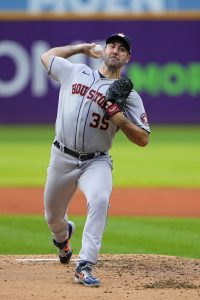
This winter might feature a similar but perhaps more extreme free agent. Justin Verlander threw only six innings in 2020 before Tommy John surgery wiped out the rest of that season and all of 2021. After returning to health, he held a showcase for interested teams, eventually re-signing for the Astros. The contract guaranteed him $25MM for 2022, despite having barely pitched for two years. It also came with a $25MM player option for 2023, conditional on Verlander reaching 130 innings pitched this year. Verlander has already surpassed that mark, allowing him to cash in another $25MM salary next year.
However, he’s pitching so well this season that he’s likely to decline his option and return to the open market in search of a larger payday. Through exactly 130 innings coming into tonight, he has a 1.73 ERA with a 25.5% strikeout rate, 4.6% walk rate and 37.4% ground ball rate. The strikeouts aren’t as high as Scherzer’s were last season, but his ERA is significantly better, with a lower walk rate and better ground ball rate.
Verlander is older than Scherzer, having turned 39 years old in February. However, if he got an annual average value of $25MM after two lost seasons, what would he get after a Cy Young-caliber campaign, even if he is one year older? It will be a fascinating and unprecedented experiment. Verlander could rightly ask for a similar AAV to Scherzer, in the $40-45MM range, depending on how strong he finishes. But how much term will teams be willing to commit to a player about to enter his age-40 season? How many teams will be willing to go to two years? Will any go to three like they did for Scherzer?
But then what does Verlander want? Would he prefer something like a one-year, $50MM deal or try to land around $40MM annually spread out over three years? Verlander has previously said he wants to pitch into his mid-40s, perhaps pointing towards the latter option, but we can’t really know.
MLBTR readers, what do you think? Below are two polls, one for what kind of term you think Verlander will get and another for what kind of guarantee. Let us know your thoughts.
How many years will Justin Verlander get on his next contract?
-
2 55% (1,499)
-
3 36% (971)
-
1 5% (137)
-
4 4% (101)
Total votes: 2,708
(link to poll for Trade Rumors iOS/Android app users)
What total guarantee will Justin Verlander get on his next contract?
-
Between $50MM and $100MM 65% (1,375)
-
Over $100MM 22% (459)
-
Less than $50MM 14% (297)
Total votes: 2,131
(link to poll for Trade Rumors iOS/Android app users)
Image courtesy of USA Today Sports.