
Mariners Acquire Jesse Winker, Eugenio Suarez From Reds
The Mariners made a massive addition to their lineup, announcing the acquisition of star outfielder Jesse Winker and third baseman Eugenio Suárez from the Reds. Seattle will reportedly assume the entirety of the three years and $35MM remaining on Suárez’s contract. In return, they’re sending pitching prospect Brandon Williamson, outfielder Jake Fraley, right-hander Justin Dunn and a player to be named later to Cincinnati.
Mariners president of baseball operations Jerry Dipoto has been open about his hunt for offensive help throughout the winter. Seattle already signed reigning AL Cy Young winner Robbie Ray to a five-year contract, but they hadn’t previously done a whole lot to bolster the offense aside from a deal that brought in Adam Frazier from the Padres.
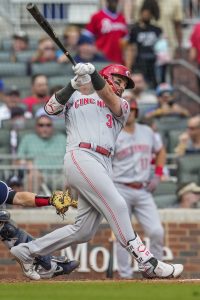
Winker got his due as a first-time All-Star last season, but he’s quietly been an excellent hitter for some time. He’s had a wRC+ of 127 or better (output at least 27 percentage points above the league average) in four of his five career seasons. The former supplemental first-rounder has been particularly impressive the past couple years. Going back to the start of the 2020 campaign, he owns a .292/.392/.552 line with 36 home runs over 668 plate appearances.
Last year, he tallied 485 trips to the dish and hit a personal-best .305/.394/.556 with a strong 10.9% walk rate and a 15.5% strikeout percentage that’s more than seven points lower than the league average. Winker rarely swings and misses or chases pitches outside the strike zone, and he’s capable of doing plenty of damage when he makes contact. He posted well above-average marks in terms of barrel rate, hard contact percentage and average exit velocity.
It’s easy to see the appeal for Seattle in adding that kind of offensive firepower to the lineup. Despite winning 90 games, the Mariners didn’t have an especially productive offense last year. Seattle hitters ranked just 21st in team wRC+ (excluding pitchers). They finished 22nd in total runs scored. Winker should be a massive boon to a unit that’ll need to improve if they’re to snap a 20-year playoff drought.
That said, Winker isn’t entirely without flaws. He’s limited to the corner outfield defensively, and he’s never rated favorably in the eyes of public metrics. Defensive Runs Saved has pegged him as 20 runs below average in 2,335 2/3 career innings in the corners (in addition to three runs below average in 138 innings as a center fielder). Statcast’s Outs Above Average has him at -21 plays as a big leaguer, including a -7 mark last season.
The left-handed hitting Winker also has some of the league’s most notable platoon splits. He’s been downright elite in his career against right-handed pitching (.313/.405/.556), but his numbers without the platoon advantage (.188/.305/.295) have been unimpressive. Winker’s probably not a strict platoon player — he does at least draw a boatload of walks against southpaws — but his impact has been concentrated to feasting on righties.
Perhaps of more concern than any aspect of his talent, though, has been his lack of volume. Winker has gone on the injured list in every full season of his MLB career. Heading into last season, the 28-year-old had never tallied even 400 plate appearances in a big league campaign. He picked up a personal-high in playing time last year, but he ended the season on the IL after suffering an intercostal strain in mid-August (from which he unsuccessfully tried to return in September).
That all makes Winker a tricky player to value, but there’s little question he’ll improve Seattle’s overall offense. He’ll presumably step in as the M’s regular left fielder, joining an outfield that could feature Jarred Kelenic in center and Mitch Haniger in right. Former Rookie of the Year Kyle Lewis is coming off another serious knee injury, and Dipoto told reporters (including Ryan Divish of the Seattle Times) he’s unlikely to be ready for the start of the season as they proceed with caution in his recovery. Former top prospect Taylor Trammell and utilityman Dylan Moore could be depth options behind the presumptive season-opening trio of Winker, Kelenic and Haniger. Julio Rodriguez, among the top handful of prospects in the game, mashed at Double-A at the end of last season.
Winker will probably be in the Pacific Northwest for at least the next two seasons. He’s projected by MLBTR contributor Matt Swartz for a $6.8MM salary via arbitration this year. He’ll be controllable via that process once more next winter before reaching free agency in advance of his age-30 season.
In order to entice the Reds to part with a player of Winker’s caliber, the M’s are taking on far more money than just his projected arbitration figures. Cincinnati signed Suárez to a $66MM extension in March 2018, which will pay him a bit more than $13MM annually for the next three seasons. (The deal also includes a $15MM club option for 2025). Initially, that looked to be a shrewd investment by the Cincinnati front office, as Suárez went on to earn down-ballot MVP support in each of the following two years. Yet after combining for a .277/.362/.550 line over that stretch, he’s struggled the past couple seasons.
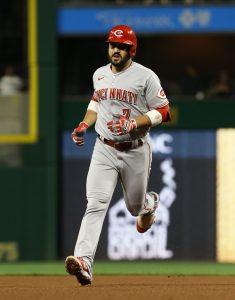
Suárez hit .202/.312/.470 during the shortened 2020 campaign. That’s a ghastly batting average, but he offset it somewhat with a robust 13% walk rate and 15 homers in only 231 plate appearances. However, his issues at the plate mounted last year. His walk percentage dipped to a solid but no longer elite 9.8%, not sufficient to make up for an even lower .198 batting average. Suárez reached base at only a .286 clip — the sixth-lowest mark among the 135 players who totaled 500+ plate appearances. He still hit for power (31 homers), but the on-base issues and his inability to successfully acclimate to an ill-advised move from third base to shortstop kept his overall production in the realm of replacement level.
Clearly, the Mariners assumed Suárez’s deal as a means to acquire Winker. That said, it seems likely they’ll give him some opportunity to try and right the ship in his new environs. Seattle bought out longtime third baseman Kyle Seager at the end of the year. Abraham Toro looks like the in-house favorite for playing time at the hot corner, but Toro can bounce between the corners and second base as a bat-first utility option as well. Divish tweets that Suárez is likely to step in as the primary third baseman, at least to begin the year, with Toro deployed around the diamond as needed.
The acquisitions of Suárez and Winker will add around $20MM to the Mariners’ 2022 books. That puts this year’s estimated expenditures at $106MM, per Jason Martinez of Roster Resource. That’s well above last year’s season-opening $73MM mark but nowhere close to franchise-record payrolls that exceeded $150MM from 2017-18. Precisely how much remains in the coffers isn’t clear, although it seems they’re content with the position player group. Dipoto told reporters (including Daniel Kramer of MLB.com) the club was unlikely to make further moves on that side of the ball. Seattle had been linked to big-ticket free agents like Kris Bryant and Trevor Story this offseason, but Dipoto called their pursuits of free agent hitters “dead ends.”
The Winker acquisition marked another aggressive move for a win-now Mariners team, but it’s a continuation of payroll-cutting efforts for the Reds. Cincinnati traded away Tucker Barnhart and lost Wade Miley on waivers for little to no return in November. They’ve listened to trade offers on their top three starting pitchers, and they moved Sonny Gray to the Twins for pitching prospect Chase Petty over the weekend.
This afternoon’s swap is the most notable to date, as the Reds slice around $20MM in 2022 commitments off the books. Of arguably greater import, they find a way out of the future commitments to Suárez. Only Joey Votto ($25MM) and Mike Moutakas ($18MM) have guaranteed money on the Cincinnati books in 2023, and the payroll slate is completely clean by 2024. Reds brass has pushed back against the idea they’re orchestrating a full teardown, but the recent subtractions of Winker and Gray make it more difficult for what had been an 83-79 team to contend this season.
Against that backdrop, it wouldn’t be surprising to see further subtractions by Cincinnati. Luis Castillo and Tyler Mahle each have two more seasons of arbitration control, as Winker did. Both pitchers would bring back a haul if the Reds made them available, particularly with the free agent market essentially now bereft of mid-rotation options.
Even if the Reds have further moves on the horizon, however, the players they bring back should all factor into the mix in short order. Fraley and Dunn are immediate big leaguers, and Fraley seems likely to step right into the left field spot vacated by Winker’s departure. The left-handed hitter struggled in limited big league looks between 2019-20, but he showed reasonably well this past season.
Fraley picked up 265 plate appearances last year, hitting .210/.352/.369 with nine homers and ten steals. The batting average is obviously subpar, but the LSU product more than compensated with an elite 17.4% walk rate. Fraley’s extremely patient approach at the plate should make him a serviceable on-base option. He’s primarily been a left fielder in the big leagues, but he’s capable of covering center in a pinch. Fraley’s controllable through 2026 and isn’t on track to reach arbitration eligibility until 2024.
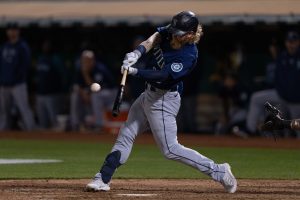
Dunn, meanwhile, is a former first-round pick who went to Seattle from the Mets in the Edwin Díaz/Robinson Canó trade. He’s made 25 starts over his three big league seasons, posting a 3.94 ERA in 102 2/3 innings. The 26-year-old’s peripherals don’t support that kind of run prevention; he’s benefitted from an unsustainable .205 opponents’ batting average on balls in play and has walked an untenable 15.5% of batters faced. Despite averaging a decent 93.8 MPH on his four-seam fastball last year, he only generated swinging strikes on 9.7% of his offerings (a bit below the 10.9% league mark for starters).
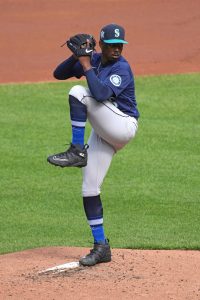
Like Fraley, Dunn is an affordable, MLB-ready piece though. He’s controllable through 2025 and won’t reach arbitration until next season. If the Reds do move one or both of Castillo and Mahle, Dunn could factor into the back of the rotation immediately. He might also be a candidate for a bullpen transfer — some prospect evaluators have long suggested he’d be a better fit in relief — where he could aid a Cincinnati bullpen that was among the league’s worst.
Fraley and Dunn are the more well-known parts of the return, but Williamson is quite likely the player the Reds value most of the trio. A second-round pick out of TCU in 2019, the southpaw has impressed evaluators since getting into pro ball. Baseball America ranked him as the game’s #83 overall prospect this winter (fifth in the Seattle system), noting that the 6’6″ lefty can run his fastball into the mid-90s and has a potential 70-grade curveball on the 20-80 scouting scale.
BA writes that the 23-year-old could develop into a #3/4 starter. FanGraphs slotted Williamson 61st on their recent Top 100 list, opining that control issues could limit his ability to work deep into games consistently but praising his repertoire and suggesting he could be “dominant” for five-six innings per start. Williamson pitched his way to Double-A last year, working 67 1/3 innings of 3.48 ERA ball with an excellent 33% strikeout rate and a fine 8.1% walk percentage. He seems likely to get a big league look at some point this season and may eventually work alongside college teammate Nick Lodolo in the Reds’ rotations of the future.
The Reds also pick up a player to be named later who is reportedly a notable part of the return. Moreover, general manager Nick Krall told reporters (including Mark Sheldon of MLB.com) they plan to reinvest some of the money they saved in free agency. Cincinnati fans may roll their eyes at their assertion, given the club’s cost-cutting efforts to date, but Krall reasserted that this was not going to be a multi-year teardown.
The deal offers a major shakeup to both organizations. The M’s continue to push forward in an effort to hang with the Astros (and perhaps the Angels) at the top of the AL West. The Reds’ hopes of contending were dealt another blow, but the front office continues to maintain they’re not punting on the 2022 campaign. Whether Cincinnati’s future moves back up that assertion remains to be seen, but there’ll be no shortage of demand if they turn their attention to trading away either Castillo or Mahle.
Jeff Passan of ESPN first reported the Mariners were acquiring Winker. Mark Feinsand of MLB.com reported the Mariners were acquiring Suárez and that the Reds were acquiring Fraley, Williamson and Dunn. Joel Sherman of the New York Post reported that Seattle was taking on the entirety of Suárez’s contract. Ken Rosenthal of the Athletic reported the Reds were acquiring a player to be named later who “enhances” the quality of their return.
Images courtesy of USA Today Sports.
Rockies “Aggressively Pursuing” Kris Bryant
The Rockies are “aggressively pursuing” Kris Bryant, tweets Jon Heyman of the MLB Network. Nick Groke and Ken Rosenthal of the Athletic reported this afternoon (on Twitter) that Colorado’s interest in Bryant was continuing.
This isn’t the first time the Rox have been tied to Bryant. They were reported to have interest in his services just before the lockout, but today’s link between the two sides reinforces that the club is actively involved in the pursuit a few months later. The Rockies have been known to be searching for offense, with a big bat to add to the outfield the primary target.
They’ve also been linked to Kyle Schwarber and Michael Conforto (although later reports threw some cold water on the possibility of Conforto winding up in Denver). Thomas Harding of MLB.com tweets that Schwarber and Conforto remain in play as possible alternatives if Colorado doesn’t get a deal with Bryant done.
The Rockies making a run at any one of those three outfielders might seem a bit counterintuitive, as Colorado’s coming off a 74-87 showing. For better or worse, ownership and the front office have maintained they’re trying to contend in 2022, in spite of losing Trevor Story and Jon Gray from an already below-average team. They’ve signed José Iglesias and Chad Kuhl to replace those respective players positionally, but those aren’t high-impact solutions. Bryant, needless to say, would be a much more notable and costly splash.
Colorado should have some payroll flexibility to accommodate a noteworthy free agent signing. Jason Martinez of Roster Resource currently estimates their 2022 commitments around $112MM, including projections for arbitration-eligible players. That’s already above last season’s Opening Day mark but well shy of the franchise-record $145MM figure from 2019. COO Greg Feasel said earlier this offseason that the Rox would push their player expenditures back towards that 2019 number over the coming two seasons.
Mariners On The Hunt For Right-Handed Power Bat
In a profile of Mariners president of baseball operations Jerry Dipoto, USA Today’s Bob Nightengale outlined the team’s remaining offseason plans, noting specifically that Seattle hopes to add a right-handed power bat (ideally at third to replace the recently retired Kyle Seager) and a left-handed bat in the outfield. In addition to landing 2021 NL All-Star Adam Frazier in a November trade with the Padres, Dipoto already made one of the bigger offseason splashes of the pre-lockout free agent frenzy, inking reigning AL Cy Young winner Robbie Ray to a five-year, $115MM deal to anchor manager Scott Servais’ rotation.
Given what’s already a relatively crowded outfield picture in Seattle (Mitch Haniger, Jarred Kelenic, 2020 AL Rookie of the Year Kyle Lewis, and uber-prospect Julio Rodriguez all figure to see significant time there, as could Frazier and former top-100 prospect Taylor Trammell), the outfielder Nightengale suggests Dipoto is targeting is likely to be of the versatile bench-bat sort. Any of Odubel Herrera, Travis Jankowski, Billy Hamilton, Gerardo Parra, Matt Joyce, or Billy McKinney could come without a significant commitment, and Dipoto might check in on Joc Pederson or Eddie Rosario if either is willing to take on a part-time role.
The right-handed power bat is unlikely to come cheaply, however. The obvious option on the current market is Kris Bryant, and it’s no surprise that nary a report on Bryant passes without a prominent reference to the Mariners. Given how much money Dipoto is known to have left to spend — the Mariners, who have one of the youngest rosters in the bigs, have just under $87MM in salary committed to the 2022 roster (per Roster Resource) — Bryant remains a very live possibility, as might Seiya Suzuki (though he’d contribute to the outfield glut). Trevor Story and (perhaps) Carlos Correa could also be on the table.
The presence of incumbent shortstop J.P. Crawford may be a roadblock to a major move at the position, since Dipoto has repeatedly stated that Crawford isn’t changing positions. The Fielding Bible ranked Crawford as the sixth-best defensive shortstop in baseball in 2021, though both Story and Correa ranked higher on that list. With Story reportedly uninterested in a position change and Correa on the hunt for a mega-deal, neither seems likely at this point barring a trade of Crawford for another piece.
With no other clear upgrade over utilityman Abraham Toro on the free agent market, Dipoto is likely to explore trade possibilities should Bryant sign elsewhere. With the A’s reportedly entering a fire sale, Matt Chapman is the obvious first port of call, though he’ll draw widespread interest and will command a small fortune in prospect capital. Seattle could also look to engage the Guardians on Jose Ramirez, though he’d take an even bigger bite out of the Seattle system than Chapman and is well on his way to an enormous payday when he becomes a free agent following the 2023 season. Josh Donaldson, who posted a solid-if-unspectacular .247/.352/.475 line in 135 games with the Twins in 2021, still has plenty of power and isn’t likely to cost much more than a willingness to eat a substantial chunk of the two years and $50MM (including an $8MM buyout of his 2024 option) remaining on his contract. The 2015 AL MVP could be an intriguing upside play, but he’d be a particularly risky bet for a club hoping to catapult into the upper echelons of the American League sooner rather than later.
Regardless of how Dipoto addresses the loss of Seager — indeed, he could well head into Opening Day with Toro manning the hot corner and reexamine the position at the trade deadline — the Mariners are sure to be a hot pick to take a major step forward in 2022 whenever the season gets rolling. After overachieving in 2021 with 90 wins and a spot at the periphery of playoff contention well into the season’s final week, the young M’s will be expected to contend for this year’s AL West title — particularly if, as expected, Correa doesn’t return to Houston. Should they add another big bat, don’t be surprised to see them picked as a dark horse to win a pennant as early as next season.
Mariners Notes: Haniger, Rodriguez, Kirby, Bryant
Mitch Haniger‘s sensational rebound on the heels of four surgeries was one of the highlights in a generally exciting 2021 season for Mariners fans. The now-31-year-old Haniger belted a career-high 39 home runs in a career-high 691 plate appearances, announcing his return from a gruesome sequence of injuries with authority and cementing himself in the heart of Seattle’s order — at least for now.
Haniger is set to become a free agent next offseason, and Ryan Divish of the Seattle Times takes a lengthy look at his status within the organization, noting that it’s quite possible this is Haniger’s final year with the club. The Mariners, to this point, haven’t had much interest in an extension due both to Haniger’s recent injury woes and the fact that he’ll be 32 in the first season of a new deal. It’s always possible that stance could change and talks could pick up when the lockout lifts, but barring that, Haniger would play out the current season and reach the market next winter, at which point all 30 teams would have the ability to sign him.
Further complicating the Haniger situation, of course, is the enviable depth the Mariners have in the outfield. While Haniger is entrenched in right field for the 2022 season, the Mariners hope that can be the long-term home for top prospect Julio Rodriguez, whom most outlets peg among the game’s top five to ten overall prospects. Seattle also has Jarred Kelenic, who struggled early in his debut campaign before a much stronger finish, 2020 Rookie of the Year Kyle Lewis and former top-100 prospect Taylor Trammell as potential long-term options — to say nothing of current part-time options like Jake Fraley and Dylan Moore.
Rodriguez, in particular, is on the cusp of the Majors after hitting a combined .347/.441/.560 between Class-A Advanced and Double-A this past season. The Athletic’s Corey Brock takes a look the immediate outlook for Rodriguez and three other Mariners prospects, noting that there’s at least a small chance that Rodriguez could play his way onto the Opening Day roster. As Brock notes, president of baseball ops Jerry Dipoto has stated that there’s “no unrealistic expectation” for someone as talented as the 21-year-old Rodriguez.
Of course, Rodriguez has yet to play in Triple-A, and Mariners fans in particular will recall that the organization kept Kelenic in the minors to open the 2021 campaign under similar circumstances. That was a controversial decision, due largely to comments made by former Mariners CEO Kevin Mather, though Kelenic’s early struggles and his subsequent option back to Triple-A Tacoma at least made the Mariners’ decision look justifiable.
Heading into the 2022 season, Seattle could reasonably look to Haniger, Kelenic, Lewis, Fraley and newcomer Adam Frazier in the outfield (the latter depending heavily on what type of infielder or infielders Seattle adds in trade or free agency). There’s no urgent need for Rodriguez to break camp, but a big enough showing in whatever limited exhibition games we get could make his future a bigger talking point.
Also knocking on the door to the big leagues is 24-year-old right-hander George Kirby — a consensus top-100 prospect himself who’s expected to make his big league debut this coming season. He’s yet to pitch in Triple-A and only logged 26 frames in Double-A last season, so that’ll quite likely come later in the season — and Brock suggests it’d likely happen only if a legitimate rotation spot is opened due to injury or other circumstances. Kirby pitched in just 67 2/3 innings last season, and electric as they were, he could still use some further development.
In some respects, Rodriguez and Kirby are similar to last year’s ballyhooed duo of Kelenic and righty Logan Gilbert. Both debuted with huge fanfare, and while there were plenty of highlights (particularly down the stretch), there were plenty of ups and downs as well. Still, Seattle reliever Paul Sewald mentioned both Kelenic and Gilbert in an interview with Stacy Rost and Jake Heaps on 710 ESPN (YouTube link), pointing to both as potential examples of service-time manipulation when explaining the MLBPA’s stance in the ongoing labor talks.
Sewald, a close friend of Kris Bryant, pointed back to the longtime Cubs slugger’s delayed debut as the most egregious incident of service-time manipulation but also used the 2021 Mariners to rhetorically raise another aspect of the service-time debate.
“If we had Logan Gilbert and Jarred Kelenic from Opening Day, are we two games better and maybe we make the playoffs?” Sewald said. “I don’t know. I don’t know that for a fact. I’m just saying, if we weren’t looking at service-time manipulation, could they make an impact where you [instead of] finishing one game back, two games back, you maybe make the playoffs? It’s disappointing.”
Sewald certainly isn’t claiming Seattle would’ve been postseason-bound had both players debuted earlier — Kelenic certainly didn’t hit the ground running, after all — but it’s another aspect of the puzzle to consider. A more prominent example of that could be the 2010 Braves, who did make the decision to carry Jason Heyward on the Opening Day roster and ultimately edged out the Padres by one game for a Wild Card berth. Had they withheld Heyward, who hit .277/.393/.456 and finished second in Rookie of the Year voting, they could well have missed the postseason. There are obvious business reasons for teams to keep players down, and those who choose to do so aren’t necessarily doing anything wrong and are simply using the current system to their long-term advantage. Still, Sewald’s general point, outside of any specific examples, is one piece of the issue that isn’t always discussed.
Of greater note to Mariners fans, perhaps, is Sewald’s mention that he and Bryant are close friends. The Las Vegas natives are college teammates who’ve known each other since high school, and Sewald acknowledged that he’s lobbied for a reunion.
“I convinced him to go to University of San Diego with me and play with me there,” Sewald said with a laugh. “I am doing the best that I possibly can to convince him to be a Seattle Mariner for the next few years.”
Dollars and years figure to win the day whenever Bryant puts pen to paper, and Sewald’s comments are little more than anecdotal. That said, Mariners fans surely don’t mind having a close friend of Bryant on the roster who’s attempting to sell him on the team, city and fan base — all else being equal.
Latest On Mariners’ Infield Pursuits
It’s already been a fairly active offseason for the Mariners, who before the league-implemented lockout by signing reigning Cy Young winner Robbie Ray to a five-year contract and acquiring second baseman/left fielder Adam Frazier in a trade with the Padres. Whenever the transaction freeze lifts, the M’s are expected to resume that aggressive approach as they look to capitalize on a top-ranked farm system and take the next step from last year’s 90-win showing to their first playoff berth in two decades.
The checklist, in some ways, looks similar to early in the offseason. Even with Ray on board, Seattle is likely to add some veteran innings to the back of the rotation. The big right-handed bat sought by president of baseball operations Jerry Dipoto has not yet been acquired. As such, it’s hardly a surprise that the M’s have been linked extensively to all three of Kris Bryant, Trevor Story and Seiya Suzuki in recent weeks.
Perhaps more interesting is the idea that the Mariners could potentially add two of those names to the fold. Ryan Divish of the Seattle Times suggests that it’s at least possible for Seattle to add both Bryant and Story, adding not to “underestimate the possibility” that Frazier could be traded before ever playing a game for the Mariners.
That’s a new and yet-unexplored topic by and large, so it’s worth taking a bit of time to unpack — after establishing a few points up front. For starters, it’s certainly possible that even if Seattle were to pull off an unlikely stunner and sign both Bryant and Story, Frazier could still be deployed as a multi-position super utility player. That’d cut into the available playing time for switch-hitting Abraham Toro, but Toro could conceivably rotate between multiple infield positions (third base, second base and perhaps even first base) and designated hitter himself. He also has minor league options remaining.
Secondly, it should be emphasized that there’s no indication in the report that a blockbuster addition of both Bryant and Story is at all likely, nor does Divish suggest that Frazier will be actively shopped by the Mariners. Some would question the logic of acquiring Frazier in the first place if the end result were only for him to be traded just a couple months later. However, in the (very) hypothetical event that scenario plays out, it surely wouldn’t have been the plan at the time of the deal. Any further activity involving Frazier would quite likely stem from the Mariners unexpectedly landing some big-ticket items they originally didn’t anticipate being possible. And, as Divish notes, a Frazier deal would likely only come together if he were to bring back some form of immediate big league help (perhaps pairing him with some minor league talent).
While Frazier’s time with the Padres didn’t go as either player or team hoped, the 2021 season was nevertheless a strong one for the 30-year-old veteran. In 639 trips to the plate, Frazier slashed .305/.368/.411 — good for a 114 wRC+ — adding in five home runs, five triples and career-highs in doubles (36) and steals (10). His 10.8% strikeout rate was also the lowest of his career by a good margin.
That said, Frazier is a free agent after the 2022 season and is projected by MLBTR contributor Matt Swartz to earn a $7.2MM salary this year. It’s certainly plausible that the Mariners, with a deep outfield mix and the more cost-effective Toro as an option at both second and third base, might not relish the idea of relegating Frazier to a rather pricey bench piece — if they were able to add a pair of bats. Furthermore, a team with a need at second base (e.g. White Sox) or in the outfield (e.g. Guardians) could potentially show interest were Frazier’s trade market to be rekindled. Dipoto has already made clear he has no intention of trading his top prospects this offseason, but some mid-range talents plus a win-now piece like Frazier could theoretically net some needed pitching help from a trade partner.
Again, it’s safest to assume this is all a long shot and that Frazier will end up playing a notable role with the Mariners this coming season. But with no end in sight to the lockout, it’s also hard not to think about some outside-the-box possibilities and what might lie ahead when baseball returns to brighter days. A second Frazier swap or the Mariners shocking the baseball world with a pair of big-name additions might feel like a reach, but with just $87MM in projected 2022 payroll and only $37MM in 2023, the money is there for Dipoto & Co. to at least consider some ambitious possibilities.
Who Will Sign Kris Bryant?
Kris Bryant had a rough showing in 2020, with injuries limiting him to 34 games and batting line of .206/.293/.351 for a wRC+ of 75. However, that is the clear outlier on his resume, as his six other seasons have seen him put up a wRC+ of at least 123. Overall, in 884 games, his line is .278/.353/.481, 134 wRC+.
Bryant has been primarily a third baseman in his career, but has diversified his defensive portfolio in recent seasons. In 2021, he still played 55 games at third, but also 48 games in left field, 39 in right, 19 in center, 12 at first base and one at shortstop. With that defensive versatility, it’s possible to fit him into just about any team’s lineup puzzle.
However, some teams won’t be serious contenders for Bryant’s services for financial reasons. MLBTR predicted Bryant to get a contract of $160MM over six years. Some teams have never given a free agent a contract close to that in franchise history, such as the Athletics, Guardians, Pirates and Royals. The Rays made an exception for Wander Franco but don’t seem likely to give out another huge deal this year, even though they considered trading for him last year. The Orioles and Diamondbacks don’t seem likely to throw that kind of money around given the state of their current rosters. The Reds considered acquiring Bryant at last year’s deadline but now seem like they want to subtract payroll rather than adding. Let’s take a look at some of the other options.
Teams With Known Interest
- Mariners — The Mariners tried to trade for Bryant last year and have been connected to him in free agency. With Kyle Seager reaching free agency and eventually retiring, they have a vacancy at third base for the first time in years. Abraham Toro would be the favorite for now, but he could also platoon at second with Adam Frazier or serve a utility role. They also have an uncertain outfield mix, with a great many talented youngsters on hand, though they all still come with varying degrees of uncertainty. After a 90-win season, they’ve been aggressive in trying to load up for 2022, adding Robbie Ray and Adam Frazier to the squad.
- Rockies — The Rockies have been fairly quiet so far this offseason, letting Jon Gray go to the Rangers and seemingly content to let Trevor Story eventually depart as well. However, one move they’ve considered is a pursuit of Bryant. If they were to put Bryant at third, Ryan McMahon could theoretically slide to second base with Brendan Rodgers playing shortstop. If they want Bryant in the outfield, they have lots of room there, with none of Charlie Blackmon, Sam Hilliard, Connor Joe or Raimel Tapia being a real obstacle. The addition of the DH in the NL would make the fit even easier.
- Mets — The Mets had discussions about acquiring Bryant at the deadline last year and have been connected to him in free agency. After spending big on Max Scherzer, Starling Marte, Mark Canha and Eduardo Escobar, it’s possible the Mets are done with throwing huge checks around. Although now that they’ve pushed their 2022 payroll up to $263MM, it’s unclear if they have any limitations at all, meaning nothing can be ruled out completely.
- Angels — The Angels were listed among Bryant’s suitors before the lockout. With Anthony Rendon pencilled into third base, Bryant would likely need to play the outfield as long as Rendon is healthy and in the lineup. Mike Trout would take another outfield slot, with Brandon Marsh, Jo Adell and Justin Upton on hand as options as well. The Angels have serious questions about their middle infield, however, meaning they should have higher priorities than Bryant.
- Padres — Similar to the Angels, the Padres were connected to Bryant before the lockout, despite having an incumbent third baseman in Manny Machado. He could certainly help in the outfield, however, as he’d be a clear upgrade to their current options of Trent Grisham, Wil Myers and Jurickson Profar. The question will be how much money they have to spend, as they ran a franchise record payroll of $174MM in 2021 and are already set to start 2022 just under $200MM.
- Phillies — The Phillies were also rumored to be interested in Bryant before the lockout, which makes sense given their needs. The club has some big question marks in the outfield, outside of Bryce Harper. Bryant could also act as an insurance policy if third baseman Alec Bohm continues to struggle after a disappointing 2021 season.
- Astros — The Astros reportedly checked in Bryant before the deadline, though it’s a bit hard to see the fit on paper. Alex Bregman is slotted in at third, with the club having an outfield/DH rotation of Michael Brantley, Yordan Alvarez, Kyle Tucker, Jose Siri, Chas McCormick and Jake Myers. Shortstop is their most obvious area of need, making someone like Trevor Story a better theoretical fit.
- Giants — Bryant would be a logical fit with the Giants, given that they traded for him in 2021. However, they are apparently unlikely to consider nine-figure contracts this offseason, which would seem to rule out a reunion.
Speculative Fits
- Blue Jays — The Blue Jays could certainly use an infield upgrade to make up for the loss of Marcus Semien. They reportedly made a run at Corey Seager before both he and Semien ended up with the Rangers. They apparently still have spending to do after the lockout, even after adding Kevin Gausman and Yimi Garcia. If Bryant were to take over at third base, Cavan Biggio could return to his natural position of second base, which Semien nudged him off of. They’ve also been connected to Seiya Suzuki, suggesting they’re open to adding in the outfield as well.
- Dodgers — The Dodgers re-signed Chris Taylor before the lockout to be their super-utility option and seemingly have bigger needs in the rotation. But given how much they love adding depth, they can’t be completely discounted. 2022 is also potentially the team’s final year with AJ Pollock and Justin Turner. (Pollock has a 2023 player option, while there is a club/vesting option for Turner.) Adding Bryant now would be a way for the Dodgers to prepare for the departure of either.
- Rangers — The Rangers have already spent huge amounts of money to upgrade their infield, adding Corey Seager and Marcus Semien. With Josh Jung on the way to take over the third base, there’s little room for Bryant on the infield. However, the current outfield of Adolis Garcia, Kole Calhoun, Willie Calhoun and Nick Solak could certainly accommodate him. They’ve been connected to Seiya Suzuki recently, suggesting they are considering a significant outfield addition of some sort.
- Red Sox — Boston subtracted a big right-handed bat when they traded Hunter Renfroe to the Brewers. Since then, they have been connected to Seiya Suzuki, suggesting they’re looking to replace Renfroe’s bat through free agency. With Bryant in one outfield corner and Alex Verdugo in another, they could have Jarren Duran and Jackie Bradley Jr. competing for the center field job.
- Yankees — The Yanks have been a sleeping giant so far in this offseason, seemingly pushing major moves until after they could get a look at the new CBA. DJ LeMahieu is the best fit for third base duties at the moment, though he could also defer to Bryant and move over to first base, especially if the club pulls the trigger on a Luke Voit trade. Like the Blue Jays and Red Sox, the Yankees were also connected to Seiya Suzuki, suggesting they could also find a way to work Bryant into the outfield mix, perhaps in combination with a Joey Gallo trade.
Long Shots
- Braves — The staring contest between Freddie Freeman and the Braves was not settled before the lockout. If they can’t work out a deal, Atlanta could always pivot to Bryant to try and make up for the outfield losing Eddie Rosario, Jorge Soler and Joc Pederson. But with Freeman and Bryant likely looking at similar contracts, it seems much more likely they spend that money on the guy who’s been the face of the franchise and just helped them win the World Series.
- Brewers — Luis Urias had a nice breakout season in 2021 and seems like the favorite for Milwaukee’s third base job, but he can also play second and shortstop, making him a good candidate for a super-utility role. If the NL adds the DH, it would be even easier for him and Bryant to share playing time. However, the Brewers are currently set to run a payroll of $121MM this year, just shy of their franchise record, which was $123 in 2019. Adding the money it would take to sign Bryant doesn’t seem likely.
- Cardinals — The Cards already have an excellent third baseman in Nolan Arenado, as well as a solid outfield of Tyler O’Neill, Harrison Bader, Dylan Carlson and Lars Nootbaar. After the lockout, they’re reportedly going to be focused on upgrading in the bullpen, though the addition of the DH to the NL could make them more interested in another bat.
- Cubs — Bringing Bryant back to Wrigley would be a lot of fun, but doesn’t seem likely. The club seems to be eschewing lengthy commitments for the short-term. They did make the surprising add of Marcus Stroman, though his deal is only for a maximum of three years and could be even less if he opts out.
- Marlins — The Marlins are looking for outfield help but it’s hard to see them putting enough cash on the barrel for Bryant. The $53MM guarantee given to Avisail Garcia was the largest of the Bruce Sherman/Derek Jeter era. A few days later, they broke that record with Sandy Alcantara‘s $56MM extension. With Bryant likely to get more than both of those combined, it’s hard to see the Marlins winning the bidding.
- Nationals — All signs points to the Nats taking a step back in 2022 and giving playing time to younger, cheaper players. After last year’s fire sale, they have lots of payroll space and could theoretically use it on a big signing like Bryant, though it seems like they’ll be holding their cash for at least a year.
- Tigers — The Tigers have been aggressive so far but may have already made their big moves with Javier Baez and Eduardo Rodriguez. Another huge contract would be a surprise, though a Bryant-Baez reunion would certainly be a fun one.
- Twins — The Twins have to do something if they want to bounce back from a nightmare season and compete again in 2022. But they already have a strong lineup and have heavy lifting to do in the rotation.
- White Sox — The White Sox have their biggest need at second base, making Bryant an imperfect fit. They also ran a franchise record payroll of $129MM in 2021 and are currently slated to demolish that with a projected Opening Day payroll of $180MM for 2022. Adding Bryant into the mix would be a surprise.
Which landing spot makes the most sense to you? Which jersey do you think Bryant will be wearing in 2022?
Where Will Kris Bryant Sign?
-
Mariners 23% (3,142)
-
Phillies 12% (1,596)
-
Mets 12% (1,593)
-
Giants 8% (1,120)
-
Cubs 6% (826)
-
Blue Jays 6% (775)
-
Dodgers 3% (427)
-
Red Sox 3% (424)
-
White Sox 3% (388)
-
Yankees 3% (377)
-
Padres 3% (377)
-
Angels 2% (268)
-
Tigers 2% (256)
-
Brewers 1% (203)
-
Rockies 1% (202)
-
Marlins 1% (197)
-
Nationals 1% (182)
-
Astros 1% (168)
-
Braves 1% (167)
-
Rangers 1% (140)
-
Guardians 1% (131)
-
Cardinals 1% (129)
-
Reds 1% (123)
-
Orioles 1% (120)
-
Twins 1% (102)
-
Pirates 1% (102)
-
Royals 1% (82)
-
A's 1% (79)
-
Rays 1% (70)
-
D-Backs 0% (63)
Total votes: 13,829
(poll link for app users)
The Giants Need A Right-Handed Bat
While nothing about baseball’s future can be set in stone, the scuttlebutt coming out of San Francisco suggests pretty strongly that Kris Bryant will not be returning in black and orange. Concerns about his defensive efficiency and contract demands have the Giants looking elsewhere. If the price for Bryant drops, however, he still very much fits a need. Bryant and the retired Buster Posey brought the right-handed thump to balance a left-leaning lineup in 2021. Evan Longoria contributed as well, but the veteran third baseman is far from a sure thing, health-wise.
The hallmark of this Giants’ regime is discipline, so despite their need for a right-handed bat, they aren’t likely to overpay to bring Bryant back, writes Alex Pavlovic of NBC Sports. The Giants appear most comfortable looking for match-up-based value adds, a department where they have succeeded recently with players like Darin Ruf, LaMonte Wade Jr, and Wilmer Flores.
There is one higher-profile free agent they could pursue. The Athletic’s Andrew Baggarly wrote back in mid-December that the Giants are interested in Japanese import Seiya Suzuki, who should command a contract in a range wherein the Giants feel comfortable. There are many suitors chasing Suzuki, however.
Donovan Solano has been another one of those part-time players for the Giants, but Pavlovic notes that he’s probably “gone for good.” Solano had a productive three seasons with the Giants, even winning a silver slugger award in 2020.
His departure should make room to give Thairo Estrada a real opportunity. After slashing .273/.333/.479 across 132 plate appearances in 2021, there’s certainly reason to think that the 25-year-old Estrada can be a younger, cheaper version of the 34-year-old Solano.
Depth is key in the modern landscape, however. Since Estrada is out of options, the Giants need to be relatively certain about whether or not he can be the guy they need to fill out their bench. The Giants need a right-handed complement to Tommy La Stella at second and someone who can spell Evan Longoria at third. If Estrada is that guy, then the Giants can focus their post-lockout roster-building on adding potential rotation arms to fill out their depth on that end.
Giants Unlikely To Pursue Free Agents With Nine-Figure Asking Prices
Prior to the lockout, the Giants worked quickly to revamp a rotation that appeared poised to lose as many as four members to free agency. Right-hander Anthony DeSclafani returned on a three-year, $36MM contract and was joined by lefty Alex Wood, who inked a two-year deal worth $25MM. Right-hander Alex Cobb was add to the mix on a two-year, $20MM deal.
That gives San Francisco three veteran arms to slot in behind burgeoning ace Logan Webb, but the Giants also allowed top 2020-21 starter Kevin Gausman to depart, declining to match the five-year, $110MM contract he received from the Blue Jays. The decision to let Gausman walk is of extra note now, as ESPN’s Kiley McDaniel reports in his latest look at what to expect throughout the league, post-lockout, that there’s a belief the Giants aren’t keen on pursuing any targets with nine-figure asking prices.
That serves as a potential explanation for why the team ultimately let Gausman leave, and it could also be instructive when forecasting what’s on the horizon for president of baseball operations Farhan Zaidi, GM Scott Harris and the rest of the front office. Zaidi has already thrown some cold water on the idea of re-signing Kris Bryant, for instance, and if the Giants are indeed averse to $100MM+ commitments, his return would seem highly unlikely. San Francisco didn’t seem like a great match for most of the remaining free agents with that type of asking price in the first place (e.g. Carlos Correa, Freddie Freeman, Trevor Story), though eschewing contracts of this magnitude could take them out of the running not only for Bryant but for Nick Castellanos, who has reportedly sought a seven- or even eight-year deal.
An aversion to lengthy deals of this magnitude would align with the approach employed by the archrival Dodgers during Zaidi’s time as general manager under L.A. president of baseball operations Andrew Friedman. Like the Dodgers, the Giants are a major-market team with huge payroll capacity, but we’ve yet to see them dole out the type of long-term arrangements that were more common under the prior Giants front office regime. That’s not to say Zaidi’s Giants definitively won’t sign a $100MM+ deal at some point — they reportedly pursued Bryce Harper when he was a free agent — but thus far, indications point more toward the shorter-term, higher-annual-value deals that are increasingly popular as many teams seek to mitigate long-term risk.
Whenever the transaction freeze finally thaws, the Giants still have some work to do. In addition to another proven rotation piece, at least one outfield upgrade would make sense, and there’s always room for a contending club to bolster its bullpen. The Giants have about $126MM in 2022 commitments and about $135MM worth of luxury-tax obligations at the moment, per Roster Resource’s Jason Martinez, which ought to leave ample room for spending. Michael Conforto, Kyle Schwarber and Seiya Suzuki are among the notable free-agent alternatives still on the outfield market, and the likely implementation of a DH in the National League would give the Giants further runway to explore creative options. As for the pitching needs, Carlos Rodon is seeking a multi-year deal but probably won’t command an especially lengthy deal after ending the season with shoulder concerns.
Beyond the free-agent market, the Giants (and other teams) have myriad trade opportunities to consider. The A’s and Reds are known to have starting pitchers available. The Mets’ recent wave of free-agent spending pushed some notable bats to the bench. Speculatively, San Francisco could swing for the fences and try to pry Ketel Marte from the D-backs or even Cedric Mullins from the Orioles. There’s no real limit to what paths the Giants could explore, particularly since the team’s farm system has improved by leaps and bounds in recent years (landing No. 5 among MLB clubs on Baseball America’s mid-August rankings).
Kris Bryant Drawing Widespread Interest
With just a few hours to go in advance of tonight’s expected CBA expiration, MLB Network’s Jon Heyman tweets that numerous teams are showing interest in free agent Kris Bryant. Heyman lists a whole host of teams who have checked in with Bryant’s camp recently, including the Mets, Angels, and Padres. These teams add to the growing list of previously reported teams like the Rockies, Mariners, Phillies, and Astros to express interest in the longtime Cub.
It’s no surprise that Bryant continues to draw such wide interest. Between his ability to play multiple positions and status as one of the best free agents left on the market, several teams likely view Bryant as the best solution to a roster problem that money can buy. Still, despite being of the perspective that the “Bryant market is really starting to move”, Heyman notes that a deal is unlikely to come together tonight. Even if Bryant is content to wait through the work stoppage like Heyman asserts, it’s nonetheless notable to hear new teams kicking the tires on such a high impact player.
In the wake of their recent spending bonanza it would be unwise to count out the Mets on any free agent pursuit, even if every additional dollar spent under Steven Cohen’s watch represents a new franchise high. Bryant may seem like a curious fit for a team that has no shortage of corner options, but it’s worth remembering that several of those options contributed to a team that finished 27th in runs scored last season. Accordingly, it’s possible some players could cede playing time to (or be traded to accommodate) a steady producer like Bryant.
The Angels and Padres represent somewhat imperfect fits on the surface as well, as both have high profile third basemen already in the form of Manny Machado and Anthony Rendon. One could further argue that both teams have a greater need in the rotation than in their lineups. That said, LA and San Diego field two playoff-hopeful teams who finished 17th and 14th respectively in runs scored last season. Signing Bryant would take resources away from pitching investments for either franchise, but would represent more of a sure thing than relying on Jurickson Profar in left field or either Brandon Marsh or Jo Adell in right.
Rockies Interested In Kris Bryant
It’s been a quiet few weeks on the Kris Bryant front since the free-agent market opened, but MLB Network’s Jon Heyman and MLB.com’s Mark Feinsand both report that he has a somewhat surprising suitor in the form of the Rockies (Twitter links). Feinsand suggests that while the Rockies have “real” interest in getting something done, however, there may not be time to put together a contract and complete a physical between now and the expiration of the collective bargaining agreement.
Similarly, Patrick Saunders of the Denver Post reports that it’s “less and less likely” the Rockies will make any sort of major move prior to the lockout (Twitter links). Saunders adds that the Rox have “definite” interest but that Bryant could be eyeing a deal in the $160-170MM range, which likely makes a more affordable outfield target (e.g. Michael Conforto) more palatable in Denver.
A deal with Bryant would be at least somewhat surprising given that the Rockies last major, nine-figure expenditure (Nolan Arenado) resulted in a trade to St. Louis that saw Colorado covering more than $50MM of the guaranteed money on the deal. The Rockies also balked at even a qualifying offer for righty Jon Gray and haven’t to this point been strongly linked to their own free agent with a case for a nine-figure deal: Trevor Story.
That said, it’s easy to see how Bryant could fit into the Colorado lineup — either in the outfield or at third base. The Rox could play Ryan McMahon at second base, move Brendan Rodgers to his original position (shortstop) and clear an easy path for Bryant at the hot corner.
In the outfield, things are even more open. Neither center fielder Sam Hilliard nor infielder/outfielder Garrett Hampson has provided any offense over the past two seasons, and while Connor Joe hit well this past season, it was only a sample of 211 plate appearances for the 29-year-old journeyman. Charlie Blackmon remains entrenched in right field, but it’d be easy to write Bryant in as the primary left fielder and let the others vie for time in center and/or around the infield.
It remains to be seen whether the Rockies will actually engage in a serious pursuit of Bryant or are merely hoping to serve as an opportunistic landing spot in the event his market doesn’t crystallize as hoped. But from a payroll vantage point, Colorado can certainly afford to make a splash of that nature. The Rox currently have about $103.5MM in projected salary, per Roster Resource — a far cry from the franchise-record $136MM payroll.
The dollars on any offer to Bryant will be paramount for Colorado — perhaps more so than with other teams. While Bryant would surely be intrigued by playing half his games at Coors Field, the Rockies’ generally noncompetitive status for the past several seasons could make for a tough sell to high-end free agents — at least if they have comparable offers from contending clubs. The Rockies have made some moves early in the offseason, re-signing would-be free agents C.J. Cron and Jhoulys Chacin while extending both righty Antonio Senzatela and catcher Elias Diaz.
However, all of those pieces were already in place in a 2021 season that resulted in a lowly 74-87 finish. Meanwhile, the Rox have already lost Gray to the Rangers and could potentially lose their best position player, Story. A series of extensions for 2021 holdovers shows a willingness to spend some money — as does even passing interest in Bryant — but doesn’t make a particularly compelling sales pitch for prospective free agents hoping to sign with a win-now team. That’s not to say the Rockies don’t have any chance at signing Bryant (or another free agent of this caliber), but they’ll likely need to go the extra mile in terms of an additional year and/or a premium in terms of annual salary — similar to the Rangers’ approach this winter.