
8 AL West Pitchers Looking For Bounce-Back Years
Our preseason series exploring potential bounce-back candidates for 2020 began with a look at several AL West hitters hoping to rebound. Let’s stay in the division and focus on a group of talented pitchers who want to put disappointing seasons behind them…
Corey Kluber, RHP, Rangers: Kluber was the Rangers’ highest-profile offseason pickup and someone who’s now near the front of a revamped rotation, but the Indians decided the 33-year-old was expendable in the wake of a truncated 2019. In a limited number of innings (35 2/3), Kluber came nowhere near his two-time Cy Young form, notching a 5.80 ERA/4.06 FIP, and didn’t pitch past May 1 as a result of a broken forearm. Kluber did strike out almost 10 batters per nine when he was healthy enough to take the mound, but he offset that with some of the worst walk (3.79 BB/9), groundball (40 percent) and average fastball velocity (91.6 mph) marks of his career. With the Rangers holding an $18MM option or a $1MM buyout over him for 2021, this is an especially pivotal season for Kluber.
Jose Leclerc, RHP, Rangers: Leclerc was an absolute force during a breakout 2018, but his run prevention numbers took noticeable steps backward because of control problems. He lost his job as the Rangers’ closer at one point early in the year and wound up with a 4.33 ERA and 5.11 BB/9 in 68 2/3 innings. However, the 26-year-old did get a lot better after a terrible May, and he also concluded with 13.11 K/9 and a career-high 96.8 mph average fastball velocity (1.5 mph better than he recorded during his dream ’18).
Andrew Heaney, LHP, Angels: Considering their lack of high-end pitching additions in the offseason, it’s particularly important for the the Angels to get a healthy and better version of Heaney in 2020. Injuries victimized Heaney last year, holding him to 95 1/3 innings of 4.91 ERA/4.63 FIP ball. He also struggled to induce grounders (33.6 percent), which helped lead to an 18.3 percent home run-to-fly ball rate. But Heaney did log 11.14 K/9 against 2.83 BB/9 with a personal-best average fastball velocity (92.5 mph) and a career-high swinging-strike rate (14.1 percent).
Lou Trivino, RHP, Athletics: Trivino had an outstanding rookie year from the A’s bullpen in 2018, but with the clear exception of his 97 mph-plus velocity, just about everything went downhill last season. Fewer strikeouts and more walks meant far more runs against, with Trivino’s ERA/FIP shooting from the twos and threes to 5.25/4.53 over 60 frames during a year that ended early because of rib issues. And Trivino wasn’t as lucky as he was a rookie, as his batting average on balls in play and strand rate each went the wrong way. On a more encouraging note, the 28-year-old did rank near the top of the majors in a few notable Statcast categories, including average exit velocity against (85.5 mph).
Joakim Soria, RHP, Athletics: Soria was another A’s reliever who may not have produced as the team hoped he would have in 2019. The A’s signed Soria to a two-year, $15MM deal in December 2018 after a terrific season between the White Sox and Brewers, but for the most part, he couldn’t match what he did then. That’s not to say Soria was bad – he still posted a 4.30 ERA/3.62 FIP with 10.3 K/9 and 2.61 BB/9, and his mean fastball velocity remained in the 93 mph range. Also, as with Trivino, Soria was something of a Statcast favorite, mostly earning good marks in that area.
Yusei Kikuchi, LHP, Mariners: On the heels of an excellent tenure in his homeland of Japan, Kikuchi was a high-profile signing for the Mariners entering the 2019 campaign. They guaranteed Kikuchi $56MM on a contract that could max out at $109MM, but Year 1 of the deal probably didn’t go to the Mariners’ liking. In his first season in the majors, the 28-year-old recorded a 5.46 ERA/5.71 FIP – both among the worst in the game – across 161 2/3 innings. He relied primarily on a fastball-slider-curve mix, but all three of those offerings ranked among the least effective of their kind, per FanGraphs. Kikuchi did walk fewer than three hitters per nine, though his K/9 (6.46) placed sixth from the bottom out of 75 pitchers who accumulated at least 150 innings.
Carl Edwards Jr., RHP, Mariners: It wasn’t long ago that Edwards was a key component of the Cubs’ bullpen. As recently as 2018, he put up a 2.60 ERA/2.93 FIP with 11.6 K/9 across 52 innings, though that stellar production did come in spite of a 5.54 BB/9 and a lowly 28.9 percent groundball rate. Edwards found a way to dodge home runs then, as he gave them up on just 3.8 percent of the many fly balls he allowed, but he wasn’t able to do so during an abbreviated, shoulder injury-plagued 2019 in the majors. Edwards only totaled 17 innings between the Cubs and Padres (his other 17 2/3 frames came in Triple-A ball), and he gave up HRs 15 percent of the time en route to an abysmal 8.47 ERA/5.74 FIP. His control got worse along the way, as he surrendered almost seven walks per nine, and so did his strikeout rate. Edwards fanned a little over 10 hitters per nine, but his strikeout percentage fell almost six points from the prior year, while his swinging-strike rate dropped nearly 4 percent. Still, for $950K, you can’t fault the Mariners for rolling the dice.
Yoshihisa Hirano, RHP, Mariners: Hirano’s another low-cost bullpen flier for the Mariners, whom they inked for $1.6MM last month. No doubt, they’re hoping they get a version of Hirano closer to 2018 than ’19. The former Diamondback recorded a 2.44 ERA/3.69 FIP in his first year in the majors, but those numbers rose to 4.75 and 4.04, respectively, last season. Hirano also generated fewer ground balls, gave up more home runs and issued more walks, though he did see his K percentage go up almost 4 percent, finishing with 10.36 per nine. Like the Edwards signing, there’s little to no harm from the M’s perspective in taking a chance on a rebound.
West Notes: Diamondbacks, Marte, Marte, Mariners, Lewis, Kikuchi
The Arizona Diamondbacks have put together one of the more intriguing rosters as we approach spring camp, and they’ve done so while maintaining flexibility. The Starling Marte acquisition, for instance, secures center field as GM Mike Hazen had hoped – secondarily allowing star Ketel Marte to stay at second base – but that doesn’t mean Ketel’s days in center are done. The Martes could very well play side-by-side in the outfield against tough lefties while David Peralta or Kole Calhoun gets a breather, writes MLB.com’s Steve Gilbert. Most of Arizona’s bench hits from the left side, though Ildemaro Vargas, Domingo Leyba, and Andy Young can all hit righty, making them candidates to spell Marte at second when he vacates. Let’s jump the the Junior Circuit to check in on the Mariners…
- Opportunity abounds in the Mariners outfield now that Mitch Haniger is set to miss opening day. With plenty of internal candidates to choose from, there’s no need for a reactionary signing in Seattle, though Executive VP and GM Jerry Dipoto never rules anything out. For now, Kyle Lewis has the inside track on left field, writes MLB.com’s Greg Johns. Lewis put together a mighty 75 plate appearances at the end of 2019 to stake his claim to the grass in 2020. The Haniger injury may mean more consistent at-bats for Mallex Smith in the early going, but the real growth opportunity exists for youngsters like Braden Bishop and Jake Fraley. It’s unclear how much time they’ll have to put their stamp on 2020, but the Mariners are likely to temper their expectations for Haniger’s return and enjoy the opportunity to preview Bishop and/or Fraley in the outfield. The Mariners also recently brought Eric Filia into their spring mix, who could earn a spot, while infielders Shed Long, Dee Gordon, Tim Lopes and Aaron Nola can capably shag fly balls as well.
- Yusei Kikuchi put together a less-than-stellar inaugural season in Seattle, but he’s not a lost cause, writes Johns. The 28-year-old southpaw went 6-11 with a 5.46 ERA/5.71 FIP across 32 starts (161 2/3 innings) in 2020. Despite Kikuchi’s struggles and a lack of established rotation arms, the Mariners have less interest in extending their use of the Opener in 2020. A focus on relievers who can throw multiple innings will allow the Mariners to protect Kikuchi somewhat. Mostly, the Mariners envision progress through regression. Writes Johns, “…there is a feeling that he tinkered far too much with his arm angles and throwing motion — both over the course of the year and even during games — and needs to get back to just being himself and letting it rip as he did when he first arrived.”
Yusei Kikuchi’s Difficult Start
The Mariners made a slew of moves last offseason as part of their “reimagining” plan, but no addition came with more hype than free-agent signing Yusei Kikuchi. The club handed the Japanese star a four-year, $56MM contract – a deal that could turn into a seven-year, $109MM pact – with the expectation it was landing at least a mid-rotation starter. The left-handed Kikuchi could still evolve into that for the Mariners, but their investment hasn’t paid off as planned so far.
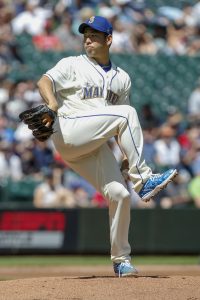
In his most recent start last Friday, the Astros lit up the 28-year-old Kikuchi for six earned runs on nine hits, including four home runs, in four innings. The performance dropped Kikuchi’s already uninspiring ERA to 5.49 through his first 118 innings in the majors, with FIP (5.95), xFIP (5.18) and SIERA (5.17) indicating he has deserved his poor run prevention numbers thus far. Home runs have been the main problem for Kikuchi, who has yielded them on 20.1 percent of fly balls and surrendered 2.14 HRs per nine innings. He ranks in the bottom five of the majors in both departments, including dead last in the latter category.
Unlike other recent ballyhooed Japanese imports (Yu Darvish, Masahiro Tanaka and Shohei Ohtani, to name a few), Kikuchi hasn’t excelled at missing bats in his initial MLB action. While Darvish, Tanaka and Ohtani each struck out more than a batter per inning upon reaching the bigs, Kikuchi has only set down 6.41 per nine via K, which outdoes just five qualified starters. Therefore, even though Kikuchi has logged a decent BB/9 (2.9), he sits 13th last in K/BB ratio (2.21). Unsurprisingly, his swinging-strike, chase and contact rates are also subpar.
To this point, Kikuchi has relied on a four-seam fastball (51.3 percent), slider (26.0) and curveball (17.4), per Statcast. The trouble is that two of those offerings – Kikuchi’s fastball and curve – have been eminently hittable. Batters have teed off on Kikuchi’s four-seamer for a .422 weighted on-base average/.386 expected wOBA, while they’ve lit up his curve for a .397/.431 pairing. Although they’ve mustered a .334 wOBA off Kikuchi’s slider, his .271 xwOBA against is far more encouraging. Looking at the location heatmaps for those pitches (via FanGraphs: four-seamer, slider, curve), it’s not hard to believe two have gotten crushed.
Lefties and righties alike have smacked around Kikuchi, who has yielded a .385 wOBA against the former and a .359 versus the latter. While his overall xwOBA against (.339) paints a much more optimistic picture than the actual mark (.369) hitters have put up, that’s not saying much. After all, according to Statcast, Kikuchi still only ranks in the majors’ 24th percentile in the category. Meanwhile, he’s in the league’s 48th percentile or worse in expected batting average against, expected slugging percentage against, hard-hit percentage against, exit velocity against, average fastball velocity (93.0 mph), fastball spin and strikeout percentage.
There clearly hasn’t been much to like about the rookie version of Kikuchi, which isn’t what the Mariners had in mind when they made him their headlining acquisition last offseason. Manager Scott Servais preached patience in regards to Kikuchi on Monday, saying this has been “a developmental year” and he’ll “learn from it.” That may prove to be the case. So far, however, Seattle can’t be thrilled with what Kikuchi has provided.
Photo courtesy of USA Today Sports Images.
AL Notes: Athletics, Kikuchi, Buttrey, Tribe
The Athletics are welcoming designated hitter Khris Davis back from the 10-day injured list on Saturday, the team announced. The slugger hasn’t taken an at-bat since May 21 because of a left hip/oblique contusion. In further positive news for the A’s, injured hurlers Sean Manaea, Jesus Luzardo and Marco Estrada are all making progress, Martin Gallegos of MLB.com reports (Twitter links here). Manaea, recovering from the left shoulder surgery he underwent last September, will throw live batting practice Tuesday. The promising prospect Luzardo threw a two-inning, 30-pitch sim game Saturday, after which A’s manager Bob Melvin offered an encouraging update. Luzardo hasn’t pitched this season on account of a rotator cuff strain in his left shoulder, while Estrada has been down since mid-April because of a back problem. Estrada will start playing catch Monday and isn’t far from beginning a regular throwing program, Gallegos relays.
- On the heels of back-to-back brutal performances from Yusei Kikuchi, the Mariners are skipping the southpaw’s start Tuesday in an effort to “recharge the batteries,” according to manager Scott Servais (via Greg Johns of MLB.com). Kikuchi will slot back into their rotation “later next week,” Johns writes. The 27-year-old Kikuchi yielded 10 earned runs on 20 hits, including three homers, over 6 2/3 innings in his two latest starts. He joined the Mariners in the offseason as a ballyhooed signing from Japan, and has gotten off to a so-so start in the majors. Kikuchi owns a 4.43 ERA/4.64 FIP with 6.72 K/9, 2.28 BB/9 and a 45 percent groundball rate through 67 innings. Now that Kikuchi’s headed for a brief respite, the Mariners could promote lefty Jon Niese or righty Anthony Misiewicz from Triple-A Tacoma as his replacement, per Johns. Neither hurler is on the M’s 40-man roster, but the team does have a pair of openings at the moment.
- Righty Ty Buttrey has been the Angels’ top reliever in 2019, but they’re leery of overusing the rookie, Mike DiGiovanna of the Los Angeles Times explains. Acquired from Boston last July for second baseman Ian Kinsler, the hard-throwing Buttrey has tossed 28 1/3 innings in his first full season with the Angels. He leads Halos relievers in ERA (1.27) and FIP (2.09), and has helped his cause with 11.12 K/9, 2.22 BB/9 and a 46.5 percent grounder rate. Buttrey’s currently on pace for 74 appearances and 80 innings. It doesn’t appear the 26-year-old will get to either figure by the end of the season, however, as manager Brad Ausmus noted he’s “got to think about this kid’s health.”
- Indians right-hander Jefry Rodriguez exited his start against the White Sox on Saturday with right lat tightness, Zack Meisel of The Athletic tweets. It’s yet another unfortunate development for Cleveland’s rotation, which has gone without the injured Corey Kluber–Mike Clevinger duo for most of the season and has gotten somewhat underwhelming performances from Trevor Bauer and Carlos Carrasco. Rodriguez logged good results in four innings Saturday, but the 25-year-old has only managed a 4.74 ERA/4.47 FIP with 6.6 K/9 and 3.92 BB/9 in 43 2/3 frames on the season.
West Notes: Preller, Harper, Halos, Kikuchi
Padres GM A.J. Preller has a lot riding on his hand-picked roster, particularly with the team now having made a huge commitment to Manny Machado, and he laid out his belief in the club not long after announcing the Machado deal. As Kevin Acee of the San Diego Union-Tribune reports, the top San Diego baseball decisionmaker turned in a fiery locker-room speech that seems to have made quite an impression on the players. It was a rare address for Preller, who sent the message that this group was compiled with winning intentions. There’s no shortage of interesting storylines to watch in San Diego — Machado’s impact, remaining roster needs, camp battles, prospect timelines — some of which may well carry into the regular season.
More from out west …
- It’d be a convenient narrative to see the Dodgers‘ late-breaking pursuit of Bryce Harper as something of a response to their division rivals to the south, but there’s really no reason to believe that’s much of a factor. Dylan Hernandez of the Los Angeles Times examines what might actually be driving the Los Angeles powerhouse, suggesting that the foray into the superstar’s market may just be an attempt to see if Harper “is open to striking a deal on their terms — and their terms only.” Hernandez argues that the Dodgers should be willing “to create exceptions to their analytically dictated rules” in situations like these, but casts ample doubt as to whether the organization will in fact do so.
- Elsewhere in the greater Los Angeles region, the city of Long Beach, California appears to be making a play to woo the Angels, according to a report from Jason Ruiz of the Long Beach Post. Details are scant at the moment, but it seems the pitch involves a waterfront ballpark lot. Long Beach mayor Robert Garcia acknowledged having “approached the Angels” to open a dialogue on a possible move. Long Beach has a history with the Halos, including some serious dalliances in the past. For the time being, the club is still under contract to remain in Anaheim through at least 2020. Long-term talks to stay in Angels Stadium are ongoing, with some recent warming of relations but plenty of uncertainty overall.
- While a spring outing won’t be mistaken for the real thing, it was nevertheless fascinating to observe how MLB newcomer Yusei Kikuchi fared in his first game appearance in Mariners duds. As Ryan Divish of the Seattle Times reports, the initial showing was fairly impressive. Kikuchi managed to induce a ghastly swinging strikeout from none other than Joey Votto, who afterward praised the “potential” (and relative rarity) of Kikuchi’s “very good” and “very surprising” curve. Seattle manager Scott Servais felt his new workhorse “was outstanding for the first time out there.” The M’s committed at least four years and $56MM to Kikuchi, a significant outlay for a club that spent the winter focusing on the near-future (2020 and beyond) rather than the immediate future (the coming season). His ability to translate his success in Japan’s top league to the majors will factor heavily into the Seattle organization’s ability to rebound quickly into full competitiveness.
AL Notes: Astros, Luhnow, Kikuchi, Orioles, Machado
Astros GM Jeff Luhnow spoke to Chandler Rome of the Houston Chronicle (Twitter links) and other reporters about today’s five-player trade with the Mets, noting that New York “was aggressive” in asking about J.D. Davis. The Astros weren’t originally thinking of moving Davis, but Luhnow explained that “there was enough of a market for him that we decided to go ahead and explore it because there’s no obvious spot for him on our 25-man roster next year, at this point.” The Mets‘ inclusion of catching prospect Scott Manea as part of the return going back to Houston “was a big part of it for us,” Luhnow said, due to the Astros’ lack of catching depth. In terms of future moves, Luhnow also said that the Astros are still considering the starting pitching and bullpen markets.
Here’s more from around the AL…
- Speaking to media (including the Kyodo News) in his return to Japan, Yusei Kikuchi mentioned that the Mariners were the first team to make him a contract offer. It isn’t clear if other teams also made offers after the fact and Seattle eventually altered its offer to win the bidding, or if perhaps the M’s were the only club to issue a concrete offer to the left-hander. The latter scenario seems rather unlikely, given that multiple teams reportedly had interest in Kikuchi during his posting period. Then again, given how impressed Kikuchi and agent Scott Boras were with the Mariners’ detailed plans for managing Kikuchi’s workload and arm health in his transition to Major League Baseball, it isn’t entirely out of the question that Kikuchi decided to jump on the offer, especially considering the money involved (at least $56MM, and worth as much as $106MM) in the deal’s unique salary structure.
- The Orioles have offered their bullpen coach job to minor league pitching coordinator John Wasdin, Roch Kubatko of MASNsports.com reports. Wasdin has been in his current role in the organization for the last two seasons, after spending the previous six years as a minor league pitching coach in the Athletics’ farm system. Wasdin briefly pitched for the O’s in 2001 as part of his 12-year career in the majors. It isn’t yet known if Wasdin will accept the offer, though regardless, Kubatko writes that the Orioles will head into 2019 with an entirely new coaching staff under new manager Brandon Hyde.
- The latest round of Manny Machado speculation had the free agent infielder reportedly visiting Chicago today, attending the Eagles/Bears NFL playoff game as a guest of White Sox owner Jerry Reinsdorf. As per Daryl Van Schouwen of the Chicago Sun-Times, however, this rumor wasn’t accurate. In terms of free agency, Machado is already seeing a Chicago vs. Philadelphia (vs. New York) battle play out, as the White Sox, Phillies, and Yankees are the three teams most directly connected to his pursuit, and it’s possible these three clubs could be the finalists for Machado’s services.
Quick Hits: Free Agency, Harper, Machado, Tulo, Kikuchi, Red Sox
Why are Bryce Harper and Manny Machado still available on the free agent market, with relatively few teams in the hunt for two 26-year-old stars? As The Athletic’s Ken Rosenthal (subscription required) explores, their situation is another sign of how baseball’s “current economic system is outdated and flawed.” Teams are increasingly leery of signing players to ultra-long contracts, yet are also just as worried about signing players to contracts with fewer years but higher average annual salaries out of fear of crossing the luxury tax threshold. The result is “baseball’s version of a Catch-22,” Rosenthal writes, and he also points out that teams seem unnaturally adverse to making luxury tax payments given that relatively tiny amount of money actually spent on the tax.
More from around the game as we head into the weekend…
- In a conference call with reporters (including ESPN.com’s Coley Harvey) today, Yankees GM Brian Cashman said that he kept in contact with Manny Machado’s camp, and let them know in advance about the team’s plan to sign Troy Tulowitzki. Beyond that, Cashman unsurprisingly didn’t share details about New York’s pursuit of Machado, and in fact stressed that Tulowitzki is atop the club’s depth chart at shortstop, at least until Didi Gregorius is healthy. “We have really reacted in a positive way to have that type of dialogue with Troy and to commit to giving him that opportunity to be our everyday shortstop,” Cashman said. Of course, this doesn’t necessarily close the door on the idea of Machado joining the Yankees — beyond just gamesmanship on Cashman’s part, Machado could also be deployed as a third baseman, with Miguel Andujar then either moving to first base or perhaps traded to another team.
- Yusei Kikuchi received several seven-year contract offers from teams, agent Scott Boras told reporters (including TJ Cotterill of the Tacoma News Tribune) during Kikuchi’s recent introductory press conference. While such offers guaranteed Kikuchi more security, they also would’ve required Kikuchi to adopt a regular MLB workload right away, which concerned both the southpaw and Boras given how several Japanese pitchers in the past have suffered arm injuries while adapting from a Japanese pitching schedule to North American baseball’s every-five-days rotation lineup. Mariners GM Jerry Dipoto answered those concerns with both a unique plan for managing Kikuchi’s arm and innings, as well as a contract that could last three, four, or seven years in length.
- Pitching has gone from a weakness to a strength for the Red Sox over the last five seasons, and Alex Speier of the Boston Globe details how the club upgraded its scouting and development system to better identify talent and then further build on that talent once on the Sox roster. Speier delves into the team’s acquisition of Nathan Eovaldi at the trade deadline, and how Eovaldi took on some tips from pitching coach Dana LeVangie and assistant pitching coach Brian Bannister to make his fastball more of a weapon. These tweaks and an increased usage of his curveball took Eovaldi’s performance up another notch (after he already pitching well for the Rays) after joining the Red Sox, and he then was one of the stars of Boston’s World Series run.
Follow-Up Notes On Yusei Kikuchi’s Deal With The Mariners
Yusei Kikuchi‘s introductory presser was a hit in Seattle this afternoon, as the lefty kicked off his address in English and expressed his great delight in becoming the latest to revel in the Japanese-rich heritage of the Mariners, who’ve featured at least one player from the country in every season since 1998. The 27-year-old hurler – or, perhaps to a greater degree, his agent Scott Boras, acting on his behalf – seemed lured to the Pacific Northwest by the promise of a seminal pitching plan developed by GM Jerry Dipoto and staff, one crafted with the express purpose of easing the rigorous transition from Japan’s Pacific League to MLB. “He’s pitched 160-180 innings over the last couple years in Japan, so we’re not going to get super conservative,” Dipoto said (link to article from MLB.com’s Greg Johns). “But we do feel over the course of 30-32 starts of a season, if every sixth start we … make that more of a bullpen day where he … stays on turn and prepares as a normal start, and then goes out and throws a one inning or 30-pitch start, it gives him a nice little breather without breaking turn or taking him away from his routine.” Such a plan would be without precedent in the majors, though with so many Japanese hurlers hitting the shelf soon after their major-league transition, it seems a savvy one indeed.
Here’s more reaction and follow-up from the deal . . .
- The Blue Jays were a surprise entry in the sweepstakes, with Fancred’s Jon Heyman tweeting that the team made a “strong play” for the lefty. The top of Toronto’s rotation crumbled last season, as both Aaron Sanchez and Marcus Stroman struggled to prevent runs, and the back half offered little in way of compensation. The Blue Jays have reportedly made it known that Stroman – who still posted excellent ground-ball (62%) and home-run (0.79 HR/9) rates last season – is available in trade talks, though recent reports have hinted that the club is more likely to keep him. Beyond that, prospects are grim: the club boasts no track records on which it can count, and upper-minors depth is scarce. Toronto does seem high on Trent Thornton, acquired from Houston in a November deal that sent away Aledmys Diaz, but the team will need to concentrate the majority of its efforts on finding quality hurlers in the months to come.
- Keith Law of ESPN (subscription required) offers his analysis of the deal, writing that Kikuchi has “N0. 2 starter stuff” if healthy, but noting that the lefty’s delivery places undue stress on his shoulder, which has already endured a litany of setbacks in his young career. Shoulder troubles, of course, are notoriously difficult to overcome, and often leave the hurler unable to replicate earlier-career levels of success, so Seattle will certainly need to keep close watch on their new investment in his initial MLB foray.
- Per Dipoto, via The Athletic’s Corey Brock on Twitter, the Mariners would still like to acquire relievers, “most likely” of the free-agent variety, and are looking to acquire a veteran infielder capable of handling shortstop. The club, of course, has been heavily rumored to be shopping recent acquisition Edwin Encarnacion, and is reportedly still looking to find a way to move both Kyle Seager and Mike Leake. The roster, under Dipoto’s watch, has been in near-constant flux, so it’s safe to assume the Mariners aren’t close to wrapping up their offseason wish list.
Mariners Sign Yusei Kikuchi
The Mariners have spent much of the offseason making trades to aggressively reshape their roster, but they announced on Wednesday what figures to be one of the largest pitching signings of the offseason: a four-year contract for free-agent left-hander Yusei Kikuchi. The Scott Boras client, who had been posted for MLB clubs by the Seibu Lions of Nippon Professional Baseball, will reportedly receive a guaranteed $56MM on a uniquely structured contract.
The first three years of Kikuchi’s contract will reportedly pay him $43MM, and at that point he’ll have a player option for the 2022 season that is valued at $13MM. However, the Mariners can also preemptively exercise a four-year club option on Kikuchi that would promise him an additional $66MM. In doing so, they’d effectively be extending his contract to a seven-year, $109MM deal. Conceptually, the deal is similar to the contract that Boras brokered between the Phillies and Jake Arrieta last year, though the overall length of the two pacts differs (as one would expect give the age discrepancy between the two).
Kikuchi, 27, was one of the more intriguing players available on this year’s free-agent market. He was free to sign with any team that he wanted after being posted by the Lions, but he had until early January to come to terms with a new team after being posted in early December, as the current posting agreement between Major League Baseball and NPB gives MLB clubs a 30-day window from the onset of the posting period. As part of that agreement, the Mariners will pay the Lions a release fee equal to 20 percent of the contract’s first $25MM, 17.5 percent of the next $25MM and 15 percent of anything on top of that. In other words, the Mariners are effectively agreeing to pay the Lions as much as $10.275MM on top of Kikuchi’s guarantee. If the four-year option/extension is picked up in 2022, they’d pay the Lions a total of $19.725MM in addition to the full $109MM guaranteed to Kikuchi.
The connection between Kikuchi and the M’s has long been obvious, particularly since the organization has made no secret of its interest. Though the Seattle club has made clear it’s taking a step back from competitiveness, it hopes to bounce back to contention by 2020 or 2021. That has been a driving factor in Seattle’s acquisition of young, controllable players such as Mallex Smith, Omar Narvaez, Domingo Santana, J.P. Crawford and Justus Sheffield.
The still-youthful Kikuchi seems to fit that timeline. It’s also hard to ignore the simple geographical match. Seattle and other west coast clubs are more convenient locales for Japanese players; the M’s have previously enjoyed positive stints from players such as Ichiro Suzuki and Hisashi Iwakuma and were selected as a finalist for Shohei Ohtani‘s services last winter as well.
The addition of Kikuchi will give the Mariners’ rotation some upside to line up alongside young southpaw Marco Gonzales and veteran hurlers Felix Hernandez, Mike Leake and Wade LeBlanc. Bringing Kikuchi into the fold will give the Mariners the luxury of being able to ease Sheffield and/or righty Erik Swanson (acquired alongside Sheffield in the James Paxton swap with the Yankees) into the mix rather than forcing one or both into the rotation out of necessity. Of course, that complexion could still change over the course of the offseason; the Mariners are reportedly still exploring the market for Leake and other veterans.
Over the past four seasons, Kikuchi has worked to a pristine 2.58 ERA with averages of 8.9 strikeouts, 3.1 walks and 0.68 home runs per nine innings pitched. He’s said to have a fastball in the low to mid 90s and multiple average-or-better secondary offerings to pair with that heater. Though the M’s are committing a fairly substantial sum to a pitcher who is largely a wildcard, if Kikuchi is able to find success at the MLB level, that contract could quickly become a bargain. And while that $56MM guarantee is fairly hefty for a player who has yet to throw a pitch in the Majors, it’s more along the lines of the contract a mid-rotation starter would expect to receive on the open market here. If Kikuchi can prove himself as a quality big league arm, it’s quite possible that there’ll even be surplus value on the deal.
The Kikuchi signing is somewhat of a rarity among non-contending clubs these days: a move designed to improve the team for the upcoming season even as it looks to retool/rebuild its organization for the long haul. In an era of tanking teams that are motivated by a collective bargaining agreement that heavily incentivizes losing, few teams make this type of investment early in the rebuilding (or, to use GM Jerry Dipoto’s term, “re-imagining”) process. But the acquisition of Kikuchi and the focus on MLB-ready or near-MLB assets in the majority of the growing web of trades Dipoto has made this winter do all speak to the fact that, as opposed to the arduous multi-year rebuilds on which so many other organizations have embarked, the Mariners hope to be competitive far sooner than later.
Tim Brown of Yahoo Sports first reported that the two sides were nearing a deal (Twitter link). Fancred’s Jon Heyman tweeted that the two sides had reached an agreement. MLB Network’s Jon Morosi reported the length of the contract (via Twitter), and Heyman added further details on the contract structure (also via Twitter).
Quick Hits: Red Sox, Farm Systems, Kikuchi
Rounding up the latest from around the game . . .
- The Boston Globe’s Peter Abraham takes issue with the team’s allocation of resources, writing that the team is at risk of “going cheap” on the bullpen. As it stands, just over $8MM of the club’s projected $237MM payroll will be spent on the pen, with President of Baseball Ops Dave Dombrowski apparently noting that he would be “comfortable” entering the season with Matt Barnes or Ryan Brasier in the closer role. The club, of course, has been linked with numerous high-end relief options, including former closer Craig Kimbrel, but may be wary of incurring even steeper penalties by again eclipsing the luxury tax. Skimping on the pen is, to be sure, a Dombrowski hallmark – his early-decade Tiger teams were often pilloried for their assortment of scrap-heap late-inning options – but the longtime executive did kick off his Boston tenure with a big trade for the then-28-year-old Kimbrel, sending off top prospects Manuel Margot, Logan Allen, and Javy Guerra in the deal. The farm has been steadily pilfered since, and now stands as one of the game’s weakest, so a major acquisition via trade seems unlikely. It is true, too, that Dombrowski, wherever he has gone, has unearthed some of the game’s brightest late-inning talent, including Trevor Hoffman, Robb Nen, Matt Mantei, and Fernando Rodney.
- MLB.com’s Jim Callis takes a look at the game’s most improved farm systems over the last calendar year, citing the Mariners, Astros, Royals, Tigers, and Twins as teams who’ve taken huge leaps forward. Seattle, of course, has done much of its heavy lifting in the area in this offseason alone, acquiring former first-rounders Justus Sheffield, Jarred Kelenic, and Justin Dunn in less than a month’s span. Of particular note from my perspective is the Twins’ system, which saw SS/OF Royce Lewis and OF Alex Kirilloff make leaps into the game’s prospect elites by the end of the season, plus enjoyed big jumps from pitchers Brusdar Graterol and Australian lefty Lewis Thorpe, the latter of whom posted one of the upper minors’ highest strikeout rates in ’18 and appears poised to make the big-league plunge.
- Jim Allen’s piece for Kyodo News takes a behind-the-scenes-look at Japanese lefty Yusei Kikuchi, whose 30-day posting window closes on January 3. Kikuchi, it seems, has had his eye on the majors for a number of years now, sharpening his English skills weekly and making an effort to learn a two-seam fastball, which is apparently a “rare sight” on the Island. Kikuchi, of course, flew to Los Angeles two weeks ago to meet with prospective clubs, and looks to be a sought-after commodity on the rotation market this winter. In 494 1/3 innings for Seibu over the last three seasons, the 27-year-old has set down a sterling 497 batters while walking just 161, and has surrendered only 39 home runs in the process.