
Yusei Kikuchi Likely To Exercise Player Option For 2022
The Mariners’ original signing of Yusei Kikuchi provided the left-hander with one of the more unconventional option scenarios in recent memory. The team can exercise a four-year, $66MM extension option after the current season, and if the Mariners turn down that effective extension clause, he’ll have a one-year, $13MM player option for the 2022 season.
It looked like an intriguing dilemma for the Mariners midway through the season, when Kikuchi had made the All-Star team and was in the midst of what looked like a breakout campaign. However, the left-hander faded down the stretch to the extent that it now looks likelier that the Mariners will decline their portion of the option. Ryan Divish of the Seattle Times reports that if the Mariners indeed decline to pick up the additional four years of Kikuchi, the pitcher plans to exercise his portion of the deal, setting him up for a fourth season in Seattle and a $13MM salary.
Back in early July, I took a lengthy look at the situation at what was perhaps the peak point of Kikuchi’s season. At the time, he carried a 3.18 ERA with a 25.4 percent strikeout rate, an 8.5 percent walk rate and a career-high 53.8 percent grounder rate. Kikuchi’s average fastball jumped immensely from 2019 in his second and third big league seasons, and he was missing bats more than ever with career-best command. He’d held opponents to three or fewer runs in 13 of 15 starts and rattled off a 2.33 ERA over his past 11 starts — averaging 6 1/3 frames per outing along the way.
Things almost immediately took a turn for the worse, as Kikuchi yielded a combined 12 runs over his next two starts and never fully regained his footing. There were still some strong starts mixed in along the way, including seven shutout frames against the Astros on Aug. 31, but Kikuchi pitched to a collective 6.22 ERA over his final 14 outings. His strikeout rate dipped slightly (23.3 percent), his walk rate rose (10.3 percent) and his ground-ball rate plummeted from that 53.8 percent mark all the way down to 41.7 percent. Unsurprisingly, the huge uptick on balls hit in the air against Kikuchi prompted his home-run rate to spike as well (1.70 HR/9 in those final 14 starts).
The end result doesn’t necessarily look that bad on paper. Kikuchi totaled 157 innings and notched a 4.41 ERA with a roughly average strikeout rate, a worse-than-average walk rate and an above-average ground-ball rate. Taken in its entirety, it was a respectable overall season. And if Kikuchi had flipped things around, starting with those ugly 14 starts before more or less dominating in his final 15, we’d be viewing the option decision quite differently even though the end results would look exactly the same.
There’s a case to be made that perhaps Kikuchi could exceed that $13MM he’s guaranteed on the player option by declining and seeking a multi-year deal at a lower annual rate. We’ve seen plenty of two-year contracts in the $16-20MM range for veteran arms with comparable bottom-line numbers and less-impressive combinations of strikeout rate and ground-ball tendencies. That said, he likely wouldn’t exceed that $13MM salary by much, so it’s not a huge surprise that on the heels of a dismal second half, he’d lock that salary in and hope to position himself for a stronger trip to the market in the 2022-23 offseason.
Looking to the Mariners’ payroll, they may not consider paying Kikuchi $13MM next year to be ideal, but it’s hardly a backbreaker. The only guaranteed contracts on the books are Marco Gonzales ($5.5MM), Ken Giles ($5MM in what will be his return season from 2020 Tommy John surgery), Chris Flexen ($2.75MM) and Evan White ($1.4MM). They hold a $20MM club option on Kyle Seager that Divish and others have suggested is likely to be bought out, and the Mariners will also pay $3.75MM to the Mets under the previous Robinson Cano trade. They’ll be looking at arbitration raises for Mitch Haniger, J.P. Crawford, Paul Sewald and Diego Castillo, among others, but Haniger’s $3.01MM salary from 2021 is the highest starting point for any of those raises. None should break the bank.
Seattle only opened the 2021 season with a payroll in the $74MM range, but from 2017-19 the M’s averaged an Opening Day payroll of roughly $152.9MM. Recently promoted president of baseball operations Jerry Dipoto has already said that ownership has authorized him to increase payroll next year, and with such a light slate of commitments on the books, a returning Kikuchi at $13MM shouldn’t prove too much of a detriment.
Mariners Notes: Kikuchi, Anderson, Gilbert
The Mariners are poised for one of their most active offseasons in years, with their recent retooling effort having reached its conclusion. Before turning their attention to outside acquisitions, they’ll have to determine whether to retain a few of their own key players. This morning, MLBTR’s Steve Adams covered their looming decision regarding Kyle Seager, and Seattle will also have some notable calls to make on the pitching side.
Yusei Kikuchi, the team’s All-Star representative, could hit the open market. The team has to decide on a four-year, $66MM package deal of conjoined club options this winter. If the club declines to make that long-term commitment, Kikuchi will either exercise his own $13MM option to return in 2022 or choose to test free agency.
Entering the season, the team exercising the options looked like a long shot. Kikuchi then got off to the best start of his three-year MLB career, seemingly making that a tougher call for the front office, as Steve explored here in early July. Over the season’s first half, the 30-year-old worked to a 3.48 ERA across 98 1/3 innings, en route to the aforementioned All-Star selection. He’s struggled mightily over the past couple months, though, with just a 6.04 ERA in 47 2/3 frames. The southpaw’s strikeout rate has dipped a couple percentage points relative to the season’s first few months, while his walk rate has spiked. He’s also been tagged for eleven home runs in his last ten starts as his rate of hard contact allowed has ticked up.
Given those recent struggles, the odds the club picks up Kikuchi’s options look to be dwindling, writes Corey Brock of the Athletic. That’s not particularly surprising, as the southpaw now owns a 4.32 ERA with league average strikeout and walk rates (24.3% and 9.3%, respectively) over the course of the season. Paired with his subpar showings in 2019-20, making that level of long-term commitment to Kikuchi would seem quite risky, even for a club with ample payroll space.
Declining the options would give Kikuchi the chance to become the third Mariners’ starter to hit the open market, joining James Paxton and Tyler Anderson. Seattle could be motivated to bring Anderson back, as he’s fared well since being acquired from the Pirates in a midseason deal. Over eight starts, the southpaw has a 3.83 ERA, offsetting a below-average 18.1% strikeout percentage with a very low 3.7% walk rate. Anderson tells Brock he’d have interest in re-signing with Seattle, and M’s manager Scott Servais said he’s “very intrigued” about the possibility of a reunion, opining that Anderson “would be a good fit going forward.”
Anderson has posted back-to-back reliable seasons. Since the start of 2020, the 31-year-old has a 4.25 ERA in 207 2/3 innings. He hasn’t missed many bats, but he throws plenty of strikes and has done fairly well to avoid damaging contact. It’s possible he and his representatives look for a multi-year deal this offseason, but Anderson was limited to a one-year, $2.5MM guarantee last winter and has split this season between two clubs with pitcher-friendly home ballparks.
In addition to augmenting the group in free agency, the Mariners could look into a long-term deal with one of their pitchers already under team control. Ken Rosenthal of the Athletic reports that Seattle offered righty Logan Gilbert an extension last September, which the former first-round pick declined. Rosenthal doesn’t suggest there are any plans for a future offer in the near future, but it wouldn’t be surprising if the front office decides to make another effort at some point.
Gilbert had yet to make his big league debut at the time of the M’s offer, but he’s since made his first twenty starts. While the 24-year-old only has a 5.10 ERA, his peripherals have been far more encouraging. Gilbert’s 26% strikeout rate and 5.1% walk percentage are each a few points better than the league average, as is his 12.7% swinging strike rate. The front office is likely as bullish as ever on the young starter’s long-term outlook.
While Gilbert reached the majors this year, his mid-May promotion was late enough in the season that he won’t accrue a full year of service time. He won’t reach free agency until after the 2027 season, although his promotion should enable him to qualify for early arbitration as a Super Two player over the 2023-24 offseason (assuming the existing service time structure survives this winter’s collective bargaining negotiations). No starting pitcher in the 0-1 year service class has signed an extension since Chris Archer’s April 2014 deal with the Rays. With nothing of recent precedent, it could be difficult for the sides to line up on a mutually agreeable price point.
2021-22 Qualifying Offer Candidates
With the trade deadline in the rearview mirror and a little more than six weeks remaining in the regular season, plenty of front offices are turning their attention towards the upcoming offseason. The first notable decision for many clubs will be to decide whether to tag one or more of their top impending free agents with a qualifying offer.
As a reminder, the qualifying offer is a one-year contract offer teams can make to certain impending free agents. The precise value of the QO has yet to be calculated, but it’s determined as the average salary of the game’s 125 highest-paid players. Last season, the QO value was set at $18.9MM. If the player accepts the offer, he returns to his current team on that one-year deal. If he rejects, his previous team would receive draft pick compensation should he sign elsewhere.
Last season, six players (George Springer, Trevor Bauer, J.T. Realmuto, DJ LeMahieu, Kevin Gausman and Marcus Stroman) received qualifying offers. Gausman and Stroman accepted the QO, while Realmuto and LeMahieu re-signed with their current clubs as free agents. The Reds and Astros received compensatory picks (used on Jay Allen and Chayce McDermott, respectively) when Bauer and Springer departed.
The collective bargaining agreement prohibits a player from being tagged with a qualifying offer multiple times in his career. (A list of every active big leaguer who has previously received a QO is available here). Similarly, in order to be eligible, the player must have spent the entire preceding season on the same team. Players traded midseason cannot be tagged with a QO.
With the majority of the 2021 season in the books, we can take a look at the upcoming free agent class to predict which players might wind up receiving qualifying offer this winter.
Locks
- Carlos Correa, Freddie Freeman, Clayton Kershaw, Robbie Ray, Carlos Rodón, Corey Seager, Marcus Semien, Trevor Story
This group is fairly straightforward, as there’s very little chance any of these players would accept a qualifying offer. Correa, Seager and Freeman all have MVP-caliber upside and are locks to pull in long-term deals this winter. Semien didn’t receive a QO from the A’s after a down year in 2020, took a pillow contract with the Jays for almost the value of the QO ($18MM), and has essentially replicated his 2019 form that earned him a third place finish in AL MVP voting. He should find a big multi-year deal this time around.
Story is having a bit of a down year, but there’s no doubt the Rockies will make him a qualifying offer after not trading him at the deadline. Nick Groke of the Athletic wrote this week that Colorado hasn’t given up hope of convincing him to sign a long-term extension, but that seems unlikely given Story’s own bewilderment he wasn’t moved to a contender this summer. Whether Story is willing to return to Denver or not, he’ll receive a QO.
Kershaw, Ray and Rodón will be among the top pitchers on the market. Kershaw has spent the past couple months on the injured list due to forearm soreness, but he’s expected back in September and is in the midst of another fantastic season. So long as he’s healthy, he’s a lock for a QO. Ray and Rodón both had to settle for one-year deals after poor 2020 seasons, but they’ve each been among the best pitchers in the American League this year.
Likely
- Michael Conforto, Jon Gray, Yusei Kikuchi, Eduardo Rodríguez, Noah Syndergaard, Chris Taylor, Justin Verlander
Over the past two seasons, Taylor has somewhat quietly been one of the game’s top 25 qualified hitters by measure of wRC+ and he’s versatile enough to cover any non-catcher position on the diamond. He’s not a true everyday player at any one spot and he’s making contact at a career-worst rate this season, so he falls just short of being an absolute lock for a QO. But the Dodgers would be as willing as any team to shoulder a significant one-year salary were Taylor to accept, and his body of work should be sufficient to warrant a multi-year deal regardless.
The Mets’ players in this group are two of the more interesting free agents in the class. Conforto entered the season looking like a lock for a QO and seemingly having a chance at landing nine figures with a strong platform year. He missed a month with injury, though, and hasn’t made anywhere near his typical level of impact at the plate. He’s shown some life over the past few weeks, and between his track record and age (28), Conforto still seems a good bet to land a long-term deal.
Syndergaard was a top-of-the-rotation starter at his peak, but he hasn’t pitched since 2019 because of Tommy John surgery. He’s eyeing a September return — likely in relief, given his dwindling time to build up arm strength — and his late-season form will obviously be critical to his market. The Mets should run one of the higher payrolls in the league, and Syndergaard has the upside to be an ace if healthy, so New York still seems more likely than not to make the offer.
Similarly, Verlander has essentially missed two full seasons because of his own Tommy John procedure. That’s a scary development for a pitcher who’ll be 39 on Opening Day 2022, but he was still every bit an ace when we last saw him in 2018-19. The Astros are a win-now club that runs high payrolls, so Verlander accepting a QO wouldn’t be the worst thing in the world. If he declines and signs elsewhere, Houston would recoup some much-needed draft compensation after losing their past two first-round picks as punishment for the sign-stealing scandal.
Colorado reportedly showed even less interest in trading Gray than they did with Story at the deadline. There’s apparently mutual interest about working out a multi-year extension, and the QO could serve as a temporary measure to keep Gray in Denver while the Rockies and Gray’s representatives work on a long-term deal.
Rodríguez has bounced back to take the ball every fifth day this year after a scary bout with myocarditis cost him all of 2020. His ERA’s pushing 5.00, but his peripherals are far better than that bottom line run prevention and the southpaw has an established track record of mid-rotation production.
The Mariners are facing a difficult decision regarding Kikuchi, as MLBTR’s Steve Adams explored last month. Seattle must decide whether to exercise a package deal of four successive club options at $16.5MM apiece (essentially a four-year, $66MM extension) this winter. If the Mariners don’t exercise their four-year option, Kikuchi has a $13MM player option to return to Seattle for 2022. If both parties decline their ends, the 30-year-old would hit free agency this offseason, although the M’s could then tag Kikuchi with a qualifying offer.
Given that Kikuchi will only be a free agent if he passes on a $13MM player option, the Mariners would likely make him a QO worth a few million dollars more if it comes to that — either with the expectation he’ll decline in search of a longer-term deal, or with the hope he accepts and Seattle can keep him in the fold next season without committing themselves to the additional three years of guaranteed money.
Possible
The Giants have plenty of payroll space this offseason and seem likely to try to keep most of this season’s core together. Belt has been one of the sport’s most productive offensive players on a rate basis over the past two years. But he’s also 33 years old, has a long injury history and is striking out at the highest rate of his career.
San Francisco bought low on DeSclafani over the winter after he had a tough 2020 season with the Reds. He’s bounced back to post a very strong 3.26 ERA, although his peripherals are closer to average and he’s benefitted from opponents’ .257 batting average on balls in play. The Giants will likely see 4/5 of their starting rotation hit free agency this winter, so they could be eager to bring DeSclafani back, even if that comes via a lofty 2022 salary.
Morton has had another productive season in his first year as a Brave, but his previous two teams (the Astros in 2018 and the Rays in 2020) let him reach free agency without making a qualifying offer despite his consistently strong track record. That’s presumably due to concerns about his past injury history and age. He’ll turn 38 this winter and might check his potential earning power by limiting himself to teams in the Southeastern part of the country — as he reportedly did last offseason. That could inspire the Braves to pass on a QO, but Morton continually reels off above-average performances, and this is an Atlanta front office that has been eager to dole out hefty single-year salaries for key veteran upgrades in recent years.
Iglesias looks like the top impending free agent reliever (assuming the White Sox exercise their option over Craig Kimbrel). He’s sporting an ERA under 3.00 for the fifth time in his six seasons since moving to the bullpen, and he’s never had a single-season SIERA above 3.55. Home runs have been an issue, but Iglesias gets above-average results year in and year out and has some of the best strikeout and walk numbers in the game in 2021.
Long Shots
The Giants hold a $22MM club option (with a $3MM buyout) over Posey’s services for next season. If the front office is willing to commit him a significant salary, they’ll just exercise the option rather than going the QO route. Indeed, they’re reportedly planning to do exactly that (or to potentially pursue a multi-year extension with the franchise icon). Either way, there’s no real reason to involve the qualifying offer here.
Canha would be a very plausible qualifying offer candidate on many teams. He’s been a well above-average hitter and overall performer three years running and is generally one of the game’s more underrated players. The A’s, though, didn’t make a QO to either of Semien or Liam Hendriks last season. Canha’s a Bay Area native, and his age (33 in February) will cap the length of offers he receives from other clubs. Given that, it’s not hard to envision him accepting a QO if offered. The A’s, who perennially run low payrolls and will have a loaded class of arbitration-eligible players this winter, don’t seem likely to take that risk.
Wainwright has had a fantastic 2021 season, and the Cardinals figure to be motivated to keep the franchise icon in St. Louis in some capacity. But that also looked to be true after his strong 2020 campaign, and Wainwright only wound up landing a one-year, $8MM deal. He’d be well-deserved in demanding a raise over that sum to return next season, but it remains to be seen if the Cardinals would be willing to chance more than doubling his salary — particularly if they feel Wainwright’s motivated to remain in St. Louis rather than pursue the highest possible offers in free agency.
Kluber signed an $11MM deal with the Yankees last offseason after back-to-back seasons wrecked by injury. He pitched well through ten starts but has been out since late May with a shoulder strain. Kluber’s nearing a return to action, but his missing nearly three months only adds to prior concerns about his ability to handle a significant workload at this stage of his career.
Kim, García and Wood are all having strong 2021 seasons and could plausibly land solid multi-year deals this winter. Each has enough question marks that their teams don’t seem especially likely to offer a salary in the range of the qualifying offer, though. Kim doesn’t miss many bats; García has had extreme highs and lows throughout his career; Wood has a checkered injury history. García’s contract contains a $12MM club option that vests into a mutual option if he reaches 492 plate appearances this season. If that option doesn’t vest, the Brewers would obviously have no incentive to decline the option only to make a qualifying offer at a higher price point.
Opt-Out Clauses
Each of Arenado (six years, $179MM), Castellanos (two years, $34MM) and Martinez (one year, $19.35MM) has significant guaranteed money remaining on their contracts but can opt out of those deals this winter. Arenado and Castellanos would be locks to reject qualifying offers if they trigger their opt-out provisions, since they’d be foregoing bigger guarantees to test the market.
Martinez’s player option is of similar enough value to the projected value of the qualifying offer that he could plausibly trigger the opt-out but then accept a QO. Even if that proved to be the case, the Red Sox would probably be happy to keep him in the middle of the lineup for another season.
Ineligible
- Javier Báez (midseason trade), Kris Bryant (midseason trade), Alex Cobb (previous QO), Nelson Cruz (previous QO/midseason trade), Danny Duffy (midseason trade), Eduardo Escobar (midseason trade), Kevin Gausman (previous QO), Kendall Graveman (midseason trade), Zack Greinke (previous QO), Kenley Jansen (previous QO), Starling Marte (midseason trade), Anthony Rizzo (midseason trade), Max Scherzer (previous QO/midseason trade), Kyle Schwarber (midseason trade), Marcus Stroman (previous QO)
Mariners Designate Will Vest For Assignment
The Mariners announced Monday that they’ve designated right-hander Will Vest for assignment in order to open a spot on the roster for lefty Yusei Kikuchi, who has been reinstated from the Covid-related injured list.
Vest, the Mariners’ pick in December’s Rule 5 Draft, was selected out of the Tigers organization and had a nice run with the Mariners early in the season. The 26-year-old pitched to a 1.38 ERA in 13 innings in April, albeit with shakier K-BB numbers, and kept his ERA at a respectable 4.03 through the end of May.
Since the calendar flipped to June, however, it’s been increasingly tough for the Mariners to trust Vest. He’s tallied 12 2/3 frames in that time and surrendered 14 runs on 18 hits and eight walks with 11 strikeouts. Overall, he’s tossed 35 innings for the Mariners and been roughed up to the tune of a 6.17 earned run average with a 17.3 percent strikeout rate and an 11.5 percent walk rate.
Were the Mariners playing the way that many onlookers expected, it might be easier for them to continue dedicating a roster spot to Vest for the balance of the season. Doing so would’ve given the Mariners his long-term contractual rights. However, Seattle is five games over .500 and is only three and a half games out of a Wild Card spot. The seven-game gap they’re facing in the division is a bit tougher to surmount, but the Mariners are at least on the periphery of the postseason picture and will have a harder time finding opportunities for a pitcher who cannot be optioned and has looked increasingly overmatched.
Vest will now be placed on outright waivers and, if he clears, must be offered back to the Tigers organization. If a team does claim Vest, he’ll retain his Rule 5 status for the balance of the season.
Mariners Promote Cal Raleigh
The Mariners announced they’re selecting the contract of catching prospect Cal Raleigh. All-Star southpaw Yusei Kikuchi was placed on the COVID-19 injured list to create active and 40-man roster space. Additionally, utilityman Donovan Walton has been recalled from Triple-A Tacoma, while outfielder Taylor Trammell was optioned to Tacoma after last night’s game.
Raleigh is now set to make his major league debut. A third-round pick out of Florida State in 2018, the switch-hitting backstop has developed into one of the game’s more promising young catchers. After a pair of quality seasons in the low minors, Raleigh entered 2021 as one of the Mariners top prospects. Each of Baseball America, Eric Longenhagen of FanGraphs and Keith Law of the Athletic slotted him among the top ten farmhands in a strong system this year.
All three outlets laud Raleigh’s combination of power potential and solid receiving skills, with Longenhagen noting that he’s rated as a strong pitch framer throughout his amateur and minor league career. The general expectation among evaluators is that he’ll develop into an average or better regular behind the plate.
The M’s would have had to add Raleigh to the 40-man roster to protect him from the Rule 5 draft at the end of the season, but he forced his way to the big leagues a bit early by performing well at Triple-A. Assigned to Tacoma for the first time this year, he’s hit .324/.377/.608 with nine home runs across 199 trips to the plate. Raleigh has slashed his strikeout rate to a personal-best 12.6% this year, swinging and missing at a lower-than-average 10.9% clip.
With the 48-42 Mariners hanging in the postseason picture, Raleigh will get an immediate opportunity to contribute to a playoff race. The Mariners catching trio of Luis Torrens, Tom Murphy and José Godoy has offered slightly below-average production on the season, although Torrens has been better lately after a bad start. It’s not a given that Raleigh will stick on the active roster from here on out, but his selection clears the way for him to contribute at the big league level down the stretch.
As for Kikuchi, there doesn’t seem to be much cause for concern. The 30-year-old has been feeling virus-like symptoms recently, but he’s fully vaccinated and has already tested negative for COVID-19, relays Ryan Divish of the Seattle Times (Twitter link). Assuming a follow-up test today comes back negative, he’ll be cleared to participate in the All-Star Game and return to the Mariners next week.
The Mariners Have A Yusei Kikuchi Decision To Make
Yusei Kikuchi‘s first two seasons in the Major Leagues didn’t go as either the Mariners or the left-hander himself hoped. After establishing himself as one of the premier pitchers in Japan by pitching to a 2.77 ERA in parts of eight seasons (2.51 in his final three years), he tested international free-agent waters as one of the most coveted talents in recent memory.
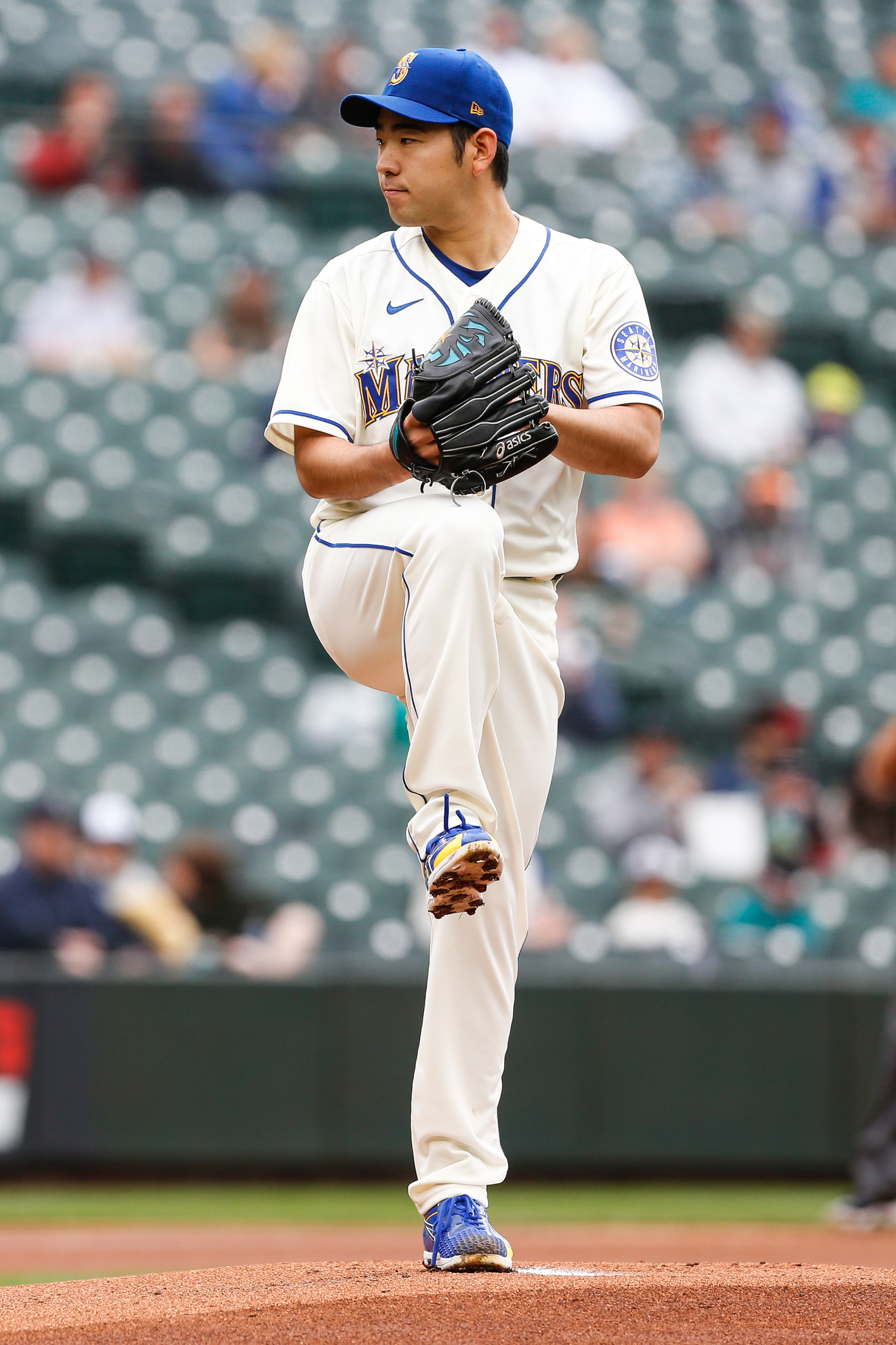
Beyond his excellent numbers in Japan and his arsenal of what many scouts believed to MLB-caliber offerings, Kikuchi was a free agent at just 27 years of age. Unlike many of his countrymen, he was seeking his first opportunity in North America while firmly in the midst of his prime seasons. The level of interest and intrigue in the left-hander was readily apparent both in the size and the structure of his contract. Kikuchi hired the Boras Corporation to represent him as he looked to jump to the big leagues and eventually secured a four-year, $56MM guarantee from the Mariners.
Put rather simply, Kikuchi’s first year in the Majors went poorly in just about every regard. He remained healthy, but Kikuchi struggled in adjusting from pitching every sixth day in NPB to every fifth in MLB. The Mariners did, at times, find ways to get him an extra day’s rest, and they even gave him a few starts that were short by design. (He tossed just one inning in an April 26 “start,” for instance, as he adjusted to his new workload.)
The numbers weren’t there. He made 32 starts but pitched to a 5.46 ERA and 5.17 SIERA. His 6.9 percent walk rate was a good bit better than league average, but Kikuchi also had a well below-average 16.1 percent strikeout rate and was tagged for a whopping 36 home runs in just 161 2/3 frames. It was not a great debut. Mariners fans might’ve hoped that a second season would produce better results as Kikuchi overcame his adjustment phase, but he came back with a 5.17 ERA in 47 innings (nine starts). He understandably drew a fair bit of criticism.
However, there was also good reason to believe that Kikuchi’s 2020 season marked something of a turning point. While the ERA wasn’t great, the signs of a forthcoming breakout weren’t exactly hidden.
Kikuchi’s average four-seam velocity jumped from 92.6 mph to 95.1 mph in 2020, and he began using an effective cutter that wasn’t in his 2019 repertoire. His strikeout rate jumped from 2019’s 16.1 percent to 24.2 percent, and his ground-ball rate spiked from 44 percent in ’19 to 52 percent in 2020. The home run troubles that plagued him in 2019 were gone; Kikuchi yielded just three round-trippers in those 47 innings. Despite the improvements in many of his underlying stats, however, Kikuchi was hindered by an elevated 10.3 percent walk rate and a 59.9 percent strand rate that looked rather fluky.
Just as many of those indicators suggested, Kikuchi looks like a different pitcher in 2021. He’s started 15 games and ridden a 3.18 ERA, 25.4 percent strikeout rate, 8.5 percent walk rate and career-best 53.8 percent ground-ball rate to his first career All-Star nod. Kikuchi has allowed three or fewer runs in 13 of his 15 starts, with the lone exception being a pair of five-run hiccups in his third and fourth starts of the season. Over his past 11 trips to the mound, Kikuchi has logged a 2.33 ERA while averaging 6 1/3 innings per start.
The transformation is striking, although it’s worth noting that similarly to 2020, when he pitched better than his ERA indicated, Kikuchi probably isn’t quite this good. He’s benefiting from a tiny .221 average on balls in play and a huge 82.9 percent strand rate that, like his 2020 mark, looks unsustainable (just in the other direction). Still, if you combine Kikuchi’s 2020-21 results, it’s a pretty nice-looking pitcher without too many red flags: 140 1/3 innings, 3.85 ERA, 3.97 SIERA, 25 percent strikeout rate, 9.1 percent walk rate, 53.1 percent ground-ball rate. The combined .251 BABIP is a bit lower than should be expected, but few pitchers can boast that combination of missed bats, solid control and strong ground-ball tendencies.
All of this is particularly notable given the aforementioned unique structure of Kikuchi’s contract. He’s technically guaranteed $56MM from 2019-22, but the Mariners will have a pivotal decision at season’s end. They can choose to exercise a quartet of one-year, $16.5MM options all in conjunction with one another — effectively a four-year, $66MM extension. If not, Kikuchi will have a $13MM player option that he can decline in order to test free agency. (Seattle could make him a qualifying offer at that point.)
The Mariners are in the late stages of a multi-year rebuild and will surely be aiming to contend beginning in 2022. But while they’ve begun to see a growing number of position prospects emerge at the MLB level, the pitching looks far less certain. Justus Sheffield is still looking to settle in as a consistent producer. Logan Gilbert has looked sharp after a few rocky outings early in his MLB career. Chris Flexen has proven to be a shrewd signing thus far. Marco Gonzales has battled injuries in 2021 and taken a step back. Top prospects George Kirby and Emerson Hancock shouldn’t be expected to be too far behind Gilbert in terms of MLB readiness, but the rotation could certainly use some stability — which Kikuchi has provided to this point in the season.
As such, there’s good reason for the Mariners to want to keep Kikuchi around, though the question will be whether that four-year, $66MM price point proves palatable. The team has just $19MM committed to the 2022 payroll beginning in 2022, so Seattle can certainly afford to keep Kikuchi around and still make another notable addition to the rotation either via free agency or trade this winter. The $66MM price point is roughly in line with recent deals signed by Nathan Eovaldi (four years, $68MM), Miles Mikolas (four years, $68MM), Dallas Keuchel (three years, $55.5MM) and Alex Cobb (four years, $57MM). If Kikuchi continues pitching near his current level, a deal in that range wouldn’t be unreasonable in free agency.
That’s particularly of note, too, because if the Mariners choose not to pick up their end of the arrangement, Kikuchi currently looks like a lock to turn down that $13MM player option, given how well he’s pitched. He’d quite likely reject a qualifying offer as well, based on the strength of his performance.
Other teams could try to pry Kikuchi away from the Mariners with a strong trade offer, but if he’s pitching well enough to carry substantial trade value, that probably means he’s also pitching well enough for the Mariners to look favorably on that four-year extension. Trading a player with such a virtually unprecedented conditional option would also be immensely complicated. It’d be tough for Seattle to extract considerable value when the best-case scenario is having the exclusive right to extend Kikuchi at a fairly notable rate.
There’s also downside for an acquiring team that can’t be overlooked; were Kikuchi to incur a substantial injury in the months following a trade, he’d likely exercise that $13MM player option. The Mariners have already taken that risk in issuing the initial contract — but they weren’t parting with young talent in addition to taking that risk. Another club would be doing just that, which would weigh down the potential return in a trade.
We’re only at the season’s halfway point, so there’s still time for Kikuchi to make this decision look more straightforward — either with a continued run of dominance or a return to his 2019-20 form. But the fact that he’s begun to make the four-year option/extension route look viable in and of itself is a testament to the strength of his season. He’s gone from looking like a possible front office misstep to the potential rotation cornerstone the Mariners envisioned when signing him in the first place.
Pitcher Notes: Gray, Kikuchi, Peralta, Brasier
Rockies right-hander Jon Gray went on the injured list yesterday with the ominous-sounding diagnosis of elbow soreness/forearm tightness in his throwing arm. Fortunately, an MRI revealed no structural damage, manager Bud Black told reporters (including Patrick Saunders of the Denver Post). That’s fantastic news for player and team alike. Gray is scheduled to reach free agency at the end of this season, so his finishing the year healthy is of upmost importance as he looks to market himself around the league. His contractual status, coupled with the Rockies 23-36 record, also makes him one of the game’s most obvious trade candidates in advance of the July 30 deadline.
A few more notes on pitchers around the league:
- Mariners left-hander Yusei Kikuchi left last night’s start against the Angels in the fifth inning after being struck on the right knee by a David Fletcher line drive. The team announced he’s been diagnosed with a knee contusion/bone bruise. Kikuchi, who had to be helped off the field, was able to put some weight on his leg after the game manager Scott Servais told reporters (including Corey Brock of the Athletic). Servais suggested he didn’t believe there was any sort of fracture, and Kikuchi’s feeling “better than expected” today (via Brock), although it’s still possible he’ll need an IL stint. Kikuchi has been the Mariners best starter this year, tossing 66 2/3 innings of 3.92 ERA/3.64 SIERA ball.
- Brewers righty Freddy Peralta has been one of the best pitchers in baseball. The 25-year-old is among the league’s top fifteen hurlers in ERA (2.25), SIERA (3.11), and strikeout/walk rate differential (26.1 percentage points). Will Sammon of the Athletic looks back at the December 2015 trade that sent Peralta, then a low minors pitching prospect, from the Mariners to the Brewers as part of the return for first baseman Adam Lind. Matt Kleine, now the Brewers vice president of baseball operations, initially spotted Peralta on the Mariners back fields in 2013. Intrigued by his fastball shape and athleticism, Kleine pushed the Milwaukee higher-ups to bring in Peralta via trade, and the opportunity presented itself when the Mariners expressed interest in Lind. Sammon breaks down Peralta’s continued progression and evolution (including the development of a slider and changeup to diversify his once fastball-heavy repertoire) in a piece that’ll be of interest to Brewers fans.
- Red Sox reliever Ryan Brasier, who has been rehabbing from a left calf strain, was hospitalized after being struck in the head by a comebacker during a simulated game in Fort Myers this week. He has since been released, although Brasier suffered a concussion and an ear laceration, notes Pete Abraham of the Boston Globe (Twitter link). That will halt his rehab process for the time being, although it’s certainly a relief he escaped more serious injury after the scary incident.
Previewing 2021-22 Opt-Out Clauses & Player Options
Next year’s free-agent class is a legitimately star-studded group even when focusing only on true free agents who’ll hit the market due to service time or an expiring contract. But the class has the potential to become even stronger depending on the play of this year’s collection of veterans who have opt-out clauses and player options in their contracts. Their performance over the next five months will determine whether they opt for another trip to the free-agent market or simply stick with the remaining salary guaranteed to them on their existing deals.
We’re about a sixth of the way through the season, so it’s worth taking an early look at how this group is faring…
Nolan Arenado, 3B, Cardinals (can opt out of remaining six years, $179MM): Arenado, who was always a better hitter at Coors Field, is yet another example of the manner in which home/road splits are overstated with regard to Rockies players. The 30-year-old is now playing his home games at Busch Stadium and still raking at a .279/.336/.507 clip with top-notch defense at the hot corner. Arenado has stated that he plans “to be a Cardinal the rest of the way” and said there is a “very, very high” chance that will forgo the opt-out clause in his contract. After the Cardinals tacked a year and $15MM onto the original five years and $164MM he had remaining on the deal, there’s less incentive for him to test the market.
Trevor Bauer, RHP, Dodgers (can opt out of remaining two years, $62MM): While some might balk at the notion of Bauer opting out when he’s guaranteed a whopping $45MM next year on this front-loaded contract, the opt-out wouldn’t really be about 2022 — it’d be about improving upon the total guarantee. Right now, if Bauer were to suffer an injury in 2022, he’d have a $17MM player option for the 2023 season. If he opts out this winter, however, he could aim to negotiate something similar to or greater than his original three-year, $102MM guarantee with the Dodgers. Bauer could still secure a huge salary in year one of a new contract but give himself a greater safety net against injury or decline. He also won’t have a qualifying offer to deal with this time and would be entering what most expect to be a market with more teams willing to spend. With a 2.50 ERA, 34.7 percent strikeout rate and 7.3 percent walk rate, the current NL strikeout leader is enjoying the kind of start that will make him think about it.
Nick Castellanos, OF, Reds (can opt out of remaining two years, $34MM): If Castellanos keeps hitting anywhere near this pace, that opt-out clause will assuredly be exercised. His age-29 season has kicked off with an outstanding .303/.346/.607 slash, and he already has 18 extra-base hits (nine homers, eight doubles, one triple) in just 126 plate appearances. Castellanos fizzled after a similarly electric start in 2020, so we’ll have to see if he maintains — but he’s one of the best hitters on the planet right now.
Charlie Blackmon, OF, Rockies ($21MM player option for 2022; $10MM player option for 2023): The Colorado fan favorite has come to life after a woeful start to the 2020 season. Over his past 13 games, Blackmon is hitting .319/.396/.447 with more walks than strikeouts. That surge still only has his season line up to .222/.328/.343 in 125 plate appearances, though, so Blackmon has plenty of work to do before he’d even consider opting out of a $21MM payday in what will be his age-35 season.
J.D. Martinez, OF/DH, Red Sox ($19.375MM player option for 2022): An ugly 2020 season had many wondering whether Martinez was beginning to decline. It seems safe to stop wondering. The first few weeks of the 2021 season have been some of the finest of JDM’s career; offense around the league is down, but he apparently didn’t get the memo, as he’s destroyed opposing pitchers at a .331/.416/.632 clip. His 10 dingers give him a share of the MLB lead. While there were some conflicting reports on the number of opt-outs in his contract at the time of the deal, MLBTR confirmed this week that Martinez has a $19.375MM player option for the 2022 season on his deal, so he’s controlling his own fate, so to speak. If he keeps hitting like this, why wouldn’t he test the market again (or at least parlay his performance into an extension in Boston)?
Jackie Bradley Jr., OF, Brewers ($11MM player option for 2022): The Bradley signing hasn’t panned out for the Brewers just yet. No one should be surprised to hear that Bradley has excellent defensive ratings through his first 260 innings in center field, but he’s hitting a mere .175/.242/.316 in 124 plate appearances. Bradley didn’t sign until a few weeks into Spring Training, and we’ve seen plenty of late signees start slowly in the past, but so far things aren’t going great.
Jurickson Profar, INF/OF, Padres ($6.5MM player option for 2022; $7.5MM player option for 2023): Profar hasn’t been anywhere near the hitter he was in 2020, slashing just .234/.333/.308 through 128 trips to the plate. The investment in Profar was always a risk. He was one of the least-productive hitters in the National League for the first month of the 2020 season and only salvaged his year with a blistering .375/.398/.534 showing in his final 93 plate appearances. That well-timed hot streak rather stunningly earned him a three-year guarantee and multiple opt-out opportunities, and he’ll need some more of that magic if he’s going to consider walking away from the $14MM he’s still owed beyond 2021. Profar is currently on the Covid-related IL for contact-tracing purposes.
Kevin Pillar, OF, Mets ($2.9MM player option for 2022): Pillar entered the season with a sub-.300 OBP for his career, and he’s not doing that mark any favors in 2021. We’re only looking at 66 plate appearances, but his .254/.288/.381 output looks more like his below-average career line than last year’s stronger showing. Pillar found a pretty frosty market for his services even on the heels of last summer’s .288/.336/.462 performance, so if he doesn’t turn things around at the plate, it wouldn’t be a shock to see him pick up the option.
Justin Wilson, LHP, Yankees ($2.3MM player option for 2022; Yankees hold $7.15MM club option/$1.15MM buyout if Wilson declines): Wilson has served up a pair of homers, walked five batters, hit a batter, and yielded a total of six runs in 8 2/3 innings. He also opened the year on the IL due to shoulder soreness, and his average fastball velocity is down at 93.7 mph after sitting at 95.1 mph in each of the past two seasons. A reliever with Wilson’s track record can turn things around in a hurry, but it hasn’t been the start he or the team envisioned. If Wilson exercises his player option, it triggers a 2023 club option valued at $500K over the league minimum, meaning he’d only do so with a particularly poor year on the mound.
Brett Gardner, OF, Yankees ($2.3MM player option for 2022; Yankees hold $7.15M club option/$1.15MM buyout if Gardner declines): The Yankees lifer hasn’t shown much life at the plate in 2021, hitting .190/.284/.238 in 75 turns at the dish. He has just one multi-hit game to his credit so far in 2021 and is being used in his most limited role ever.
Darren O’Day, Yankees, RHP ($1.4MM player option for 2022): The 38-year-old O’Day has been great for the Yankees through nine innings, but he’s currently on the injured list due to a strained rotator cuff in his shoulder. As long as he comes back and demonstrates his health, he should be expected to decline his option in favor of a $700K buyout. He’s only securing himself an additional $700K if he picks the option up — barely more than the current league minimum (which could very well rise in the offseason CBA talks).
Dellin Betances, RHP, Mets ($1-3MM player option depending on number of games pitched): Betances needs to reach 60 games pitched in 2021 for his player option to be valued at $2MM and 70 games for it to check in at $3MM. So far, he’s pitched one. It’s all but certain to be a $1MM player option on the righty, who may still take the deal given how catastrophic the last few years have been. Betances is on the 60-day IL with a shoulder impingement at the moment, and since Opening Day 2019, he’s totaled just 13 2/3 innings due to injuries.
Beyond this group, there’s also a conditional player option in the Mariners’ deal with left-hander Yusei Kikuchi. Seattle has until three days after the World Series wraps up to decide whether it wants to exercise a quartet of one-year, $16.5MM options on Kikuchi — a total of four years and $66MM. All four must be exercised together. If they do not make that sizable investment, Kikuchi then has a one-year, $13MM player option for the 2022 season on which he must decide.
At least based on Kikuchi’s career numbers in MLB, it seems unlikely that the Mariners would pick up their end of the deal. He’s compiled a 5.22 ERA through his first 246 1/3 big league innings. That said, Kikuchi saw a major velocity spike in 2020 that he’s actually improved upon again in 2021. Fielding-independent metrics were much more bullish on him than ERA in 2020 (3.30 FIP, 3.37 xERA, 3.78 xFIP, 4.34 SIERA), and this year’s current 4.30 ERA is respectable. He’s also sporting career-bests in swinging-strike rate, opponents’ chase rate, walk rate and ground-ball rate.
It’s still a long shot that the Mariners will pick up all four years on Kikuchi, who’ll turn 30 in June. However, that may simply set him up for a return to the market. It’s certainly plausible that he pitches well enough to command more than the $13MM salary on his player option but less than the four years and $66MM on the Mariners’ end of the arrangement.
Mariners Likely To Open With Six-Man Rotation
The Mariners are planning to begin the season with a six-man rotation in place, general manager Jerry Dipoto told reporters yesterday (Twitter link via Greg Johns of MLB.com). That tactic should allow the Seattle club the opportunity to manage the innings of younger arms on a per-game basis while also maximizing their opportunity to evaluate some up-and-coming arms who could factor into the long-term outlook.
Recently extended southpaw Marco Gonzales seems likely to get the Opening Day nod as the Mariners’ most established starter, and the team will hope for better results from 29-year-old lefty Yusei Kikuchi in the second season of his uniquely structured free-agent deal. Kikuchi, who had established himself as one of Nippon Professional Baseball’s premier arms prior to 2019, is locked in at $43MM from 2019-21. After the contract’s third year, Seattle can pick up a four-year, $66MM “option.” If the club declines to do so, Kikuchi can instead exercise a $13MM player option. In essence, he’s guaranteed $56MM over four years, while the M’s have the opportunity to lock him up at what would be a total of seven years and $109MM if he takes his game to a new level between now and the completion of the 2021 campaign.
Beyond that pair of lefties, Seattle will get longer looks at southpaw Justus Sheffield and righty Justin Dunn — two key trade acquisitions that came over in the 2018-19 offseason. Sheffield, a former first-rounder and longtime top prospect, was the headline piece of the trade that sent James Paxton to the Yankees. Dunn came to the Mariners alongside vaunted outfield prospect Jarred Kelenic and righty reliever Gerson Bautista in the Robinson Cano/Edwin Diaz blockbuster.
The Mariners also rolled the dice on a pair of low-cost free agents this winter, nabbing former division rival Kendall Graveman and former Mariner Taijuan Walker on one-year pacts. Both have seen their careers slowed by 2018 Tommy John surgery. Graveman, who had his procedure in late July that year, didn’t make it back to the big leagues in 2019. Walker’s surgery was in April 2018, but a strained shoulder capsule limited him to one inning in 2019, which came in the final game of the season.
As one would expect from a rebuilding club, the Mariners have plenty of other young options to dream on, though the organization’s very best pitching prospects are likely a bit too far down the pipeline to factor into the 2020 season. The Mariners have selected a college right-hander with their top pick in each of the past three drafts — Logan Gilbert, George Kirby and now Emerson Hancock — and while that trio is unlikely to pitch in the Majors this year (Gilbert being the lone plausible exception), Dipoto did suggest that they and other top prospects could be on the taxi squad primarily for developmental purposes (link via Ryan Divish of the Seattle Times). Working out with other taxi squad members would give that promising group critical developmental reps in a year where no formal minor league season is expected to be played.
A Seattle Signing That Didn’t Work Out In 2019
Japanese left-hander Yusei Kikuchi entered the majors with quite a bit of fanfare heading into the 2019 season. At that point, Kikuchi was coming off a terrific eight-year tenure as a member of Nippon Professional Baseball’s Seibu Lions, with whom he posted a 2.77 ERA and put up 8.0 K/9 against 3.3 BB/9 across 1,010 2/3 innings. Kikuchi parlayed that run into a high-paying contract with the Mariners, who signed him to a four-year, $56MM guarantee. It’s an unusual deal – one that could keep him in Seattle for as few as three years and as many as seven, as MLBTR’s Jeff Todd and Steve Adams explained at the time.
For now, the Mariners may be disappointed in their investment. Kikuchi struggled mightily during his first major league season, and there don’t seem to be many clear reasons to expect a turnaround. Starting with some optimism, it’s nice that Kikuchi amassed 161 2/3 innings, approaching the career-high 163 2/3 he accrued during an NPB season. But while Kikuchi ranked a respectable 59th in innings last year, he wasn’t very productive otherwise.
Among 70 pitchers who threw at least 150 frames, Kikuchi ranked last in FIP (5.71) and home runs per nine (2.00), second from the bottom in ERA (5.46) and 10th last in K/BB ratio (2.32; 6.46 K/9 against 2.78 BB/9). And the 28-year-old wasn’t effective against either lefties or righties. Same-handed hitters recorded a .340 weighted on-base average against him, meaning Kikuchi essentially turned lefties into the 2019 version of Dodgers shortstop Corey Seager. Righties, meanwhile, averaged a lofty .374 mark – the same number Astros second baseman Jose Altuve registered during the season.
So why was Year 1 such a disaster for Kikuchi? Well, as you’d expect, none of his pitches graded out well. According to Statcast, Kikuchi mostly relied on a four-seam fastball (49 percent), a slider (28 percent) and a curveball (15 percent). FanGraphs ranked all of those offerings among the worst of their kind, making it no surprise that so many hitters teed off on him. With that in mind, it’s hardly a shock that Kikuchi ranked toward the basement of the majors in a slew of important Statcast categories, finishing in the league’s 35th percentile or worse in exit velocity, hard-hit rate, expected ERA and expected wOBA, to name a few.
Had Kikuchi gotten off to a slow start and then made a late charge, it would be easier to have some hope going into this season. It was essentially the opposite, though, as Kikuchi owned a passable 4.37 ERA/4.51 FIP through April and then went in the tank from there. His monthly FIP only dipped below 5.00 once after the season’s first month, and it exceeded the 6.00 mark overall after the All-Star break.
In terms of performance from a hyped pitcher, it’s tough to make a much worse first impression than Kikuchi’s from 2019. That doesn’t mean he’ll never amount to anything in the majors – you have to sympathize with someone trying to adjust to a new country and the best baseball league in the world, after all. However, it’s not easy to find encouraging signs from Kikuchi’s first year in the majors, which is not what the rebuilding, long-suffering Mariners had in mind when they took a gamble on him in free agency.
Photo courtesy of USA Today Sports Images.