
AL Notes: Red Sox, Twins, deGrom
While adding to the front of the rotation once appeared to be a top priority for the Red Sox this winter, they’ve largely come up short in that regard as they simply swapped Chris Sale out for Lucas Giolito in their rotation mix. More recently, it appears the club has begun looking for other options in their quest to improve the club’s pitching staff. MassLive’s Chris Cotillo reported recently that the club has interest in right-handers Jakob Junis and Codi Heuer.
Junis, 31, defied the odds as a 29th-round pick by the Royals in the 2011 draft and managed to make the majors during the 2017 season. In the years since then, the right-hander has managed to put together a solid career while swinging between the bullpen and the rotation for both Kansas City and San Francisco. While he typically offered roughly league average production for most of his career, Junis enjoyed a career year with the Giants this past season as he pitched to a 3.87 ERA with a 3.74 FIP in 86 innings of work. In 40 appearances for San Francisco last year, Junis struck out a career-best 26.2% of batters faced while walking just 5.7%.
Impressive as Junis was last season, the right-hander is unlikely to be an impactful addition to the Red Sox rotation mix if signed as he tended to pitch most effectively in shorter bursts last year. The righty surrendered a 5.32 ERA in 31 innings of work across nine appearances where he threw 50 pitches or more last year. By contrast, Junis posted a strong 2.95 ERA across 39 2/3 innings of work in 26 appearances where he threw 40 pitches or less. Junis’s success in shorter appearances could make him an interesting relief option for the Red Sox, particularly if the club parts with closer Kenley Jansen before Opening Day.
Heuer, meanwhile, would be more of a speculative addition by the Red Sox. The right-hander last pitched in the majors back in 2021 due to Tommy John surgery and a fractured elbow, but sports a solid 3.56 ERA and 3.66 FIP across 91 innings of work in the majors between the White Sox and Cubs. The righty was nothing short of dominant for the south siders during the 2020 season in particular, as he paired a 50% groundball rate with a upper-90s heater that allowed him to strike out 27.2% of batters faced in 21 appearances. The Cubs non-tendered Heuer earlier this offseason, likely thanks to his two-year layoff from pitching while rehabbing from multiple elbow issues. Still, the 27-year-old hurler has flashed set-up caliber skills during his limited big league appearances and could be a savvy add to the Boston bullpen if healthy.
More from around the American League…
- The Twins are lacking in starting pitching depth after losing right-handers Sonny Gray, Kenta Maeda, and Tyler Mahle in free agency earlier this winter, and GM Thad Levine acknowledged that concern during a recent appearance on MLBNetwork Radio. During the appearance, Levine noted that the club feels comfortable with its current starting five of Pablo Lopez, Joe Ryan, Bailey Ober, Chris Paddack, and Louie Varland, but that hasn’t stopped the club from exploring both the trade and free agent markets for other rotation options. Bolstering the club’s rotation mix would not only provide the club with much-needed depth to safeguard against injury but could also give Varland competition for the fifth-starter role, allowing him to return to the multi-inning bullpen role in which he thrived late last season. Michael Lorenzen, Mike Clevinger, and Hyun Jin Ryu are among the mid-level rotation options still available this winter.
- Rangers right-hander Jacob deGrom made just six starts for the reigning World Series champions before undergoing Tommy John surgery last spring, but optimism remains at the oft-injured ace will be able to contribute to the club at some point during the 2024 campaign. As noted by Shawn McFarland of the Dallas Morning News, deGrom provided a health update to reporters during the club’s FanFest this weekend. The righty indicated that his arm is feeling good seven months removed from going under the knife and that he currently plans to begin throwing again “sometime this spring.” While deGrom did not mention a timetable for his return to the big league mound, the update tracks with previous comments from the right-hander back in October, which indicated he was targeting a return to the majors in August of 2024. Among the most talented pitchers of his generation, it’s hard to overstate the potential impact deGrom could have for the Rangers this year if he’s available for the stretch run and a potential playoff push. Over his past 108 starts dating back to the 2018 season, deGrom has posted a 2.08 ERA with a near-matching 2.11 FIP and a whopping 921 strikeouts in just 675 2/3 innings of work.
Rangers Notes: Scherzer, Montgomery, Garcia
Rangers fans received good news during the club’s FanFest this weekend, as future Hall of Famer Max Scherzer provided an update on his health following back surgery earlier this winter. As noted by Jeff Wilson of Rangers Today, Scherzer noted that he has yet to suffer any setbacks in his recovery in the six weeks since he went under the knife, and added that he expects to begin working out in about three weeks. While that timeline puts him on pace to begin workouts shortly after Spring Training begins next month, there’s still a lengthy rehab ahead for Scherzer, who GM Chris Young indicated when announcing the surgery last month would be sidelined into June or even July of the coming campaign.
An eight-time All Star and three-time Cy Young award winner, Scherzer’s return to the rotation over the summer is sure to provide a major boost to the club’s pitching corps. The veteran righty pitched to a 3.20 ERA and 3.41 FIP in 45 innings of work for the Rangers down the stretch before being sidelined in September due to the back issues that would ultimately require surgery. Scherzer managed to work his way back onto the mound for three short starts during the club’s championship run before ultimately being shut down for the season following three scoreless innings during Game 3 of the World Series against the Diamondbacks.
With Scherzer, Jacob deGrom and offseason signing Tyler Mahle all expected to open the 2024 season on the shelf, the Rangers have plenty of questions marks in the Opening Day rotation. The starting five in Texas currently projects to be Nathan Eovaldi, Jon Gray, Andrew Heaney, Dane Dunning, and Cody Bradford as things stand, without much healthy depth behind that quintet to protect against additional injury woes. The club’s clear rotation needs have paved the way for the club to be tied to a reunion with lefty Jordan Montgomery throughout the winter, though Evan Grant of the Dallas Morning News recently cast doubt on the likelihood of the sides coming together on a deal when all is said and done. During a recent appearance on a the Foul Territory podcast, Grant noted that while he believes that both sides have interest in a reunion, he thinks that the club would rather rely on minor league pitching talents to step up and contribute at the big league level early in the season while Scherzer, deGrom, and Mahle rehab than offer Montgomery a hefty deal in the 5-6 year range.
While the Rangers have a trio of pitching prospects in Owen White, Jack Leiter, and Kumar Rocker who were recently very well regarded, both Leiter and White had difficult 2023 campaigns while Rocker made just six professional starts before undergoing Tommy John surgery in May of last year and may not even reach the upper levels of the minors in 2024, much less the big leagues. Given those question marks, it’s hardly a surprise that the club has at least remained engaged with Montgomery. Speculatively speaking, the club could perhaps look to lower-tier alternatives remaining on the starting pitching market such as Mike Clevinger and Hyun Jin Ryu to bolster their depth in the event Montgomery signs elsewhere.
Moving from the rotation to the offense, Stephen Hawkins of the Associated Press recently reported that the Rangers remain at odds with star outfielder Adolis Garcia regarding his 2024 salary with arbitration hearings just around the corner. The only Ranger who didn’t reach an agreement with the club prior to the deadline earlier this month, Garcia requested a salary of $6.9MM while the Rangers countered with $5MM. That $1.9MM gap is the widest among all players who failed to reach an agreement before the deadline. While many teams have adopted a “file and trial” approach to salary arbitration, meaning that they do not continue negotiations after figures are exchanged, Young noted that the club has remained in contact with Garcia’s camp and that the club is “very encouraged” by the dialogue between the two sides.
For Garcia’s part, the 30-year-old slugger said he wasn’t sure if there was a chance of avoiding an arbitration hearing and added that he’s “just a little bit disappointed” about how the process has gone. Garcia enjoyed a breakout campaign in 2023, slashing .245/.328/.508 in 632 trips to the plate as he notched his second career All Star appearance. The slugger also earned a Gold Glove award for his work in right field and posted a .323/.382/.786 slash line in the postseason en route to MVP honors for the ALCS.
Rangers Designate Daniel Duarte For Assignment
The Rangers announced they’ve designated righty Daniel Duarte for assignment. That move and this morning’s trade of J.P Martínez to the Braves clear the necessary 40-man roster spots for reliever David Robertson and outfielder Travis Jankowski, each of whom have officially signed one-year deals.
Texas acquired Duarte last week, sending cash to the Reds after Cincinnati had DFA him. His stay on the Rangers’ 40-man only lasted 10 days. Signing Robertson strengthened the relief corps, nudging Duarte off the roster bubble. As was the case when he was designated by the Reds, he’ll be traded or placed on waivers within a week.
Duarte, a 27-year-old righty, has pitched for Cincinnati in each of the past two seasons. He only made three appearances during his debut campaign but got into 31 contests last year. The 6’0″ hurler turned in a solid 3.69 ERA in 31 2/3 innings, but mediocre strikeout and walk numbers explain why he has found himself in DFA limbo twice. Duarte issued a free pass to nearly 15% of opposing batters while striking hitters out at a below-average 16.9% rate.
While he didn’t miss many bats, Duarte kept the ball on the ground on half the batted balls he allowed. He averaged a little above 94 MPH on his sinker and nearly 96 MPH when throwing a four-seam fastball. The grounder rate and decent velocity could again lead to a minor trade or waiver claim. Duarte has one option year remaining, so any team that acquires him would be able to keep him in Triple-A for another season.
Rangers Sign Travis Jankowski To One-Year Deal
The Rangers announced the signing of outfielder Travis Jankowski to a one-year major league deal. He is reportedly guaranteed $1.7MM on a deal that also includes unspecified performance bonuses.
Jankowski, 32, parlayed a minor league deal with the Rangers last offseason into a role of significance on their World Series-winning roster. The veteran speedster appeared in 107 games for Texas and hit .263/.357/.332 with a 12.2% walk rate and just a 14.6% strikeout rate. Jankowski connected on only one homer but went 19-for-20 in stolen bases and provided the Rangers with above-average defense in all three outfield positions, becoming a key backup on a deep Texas roster.
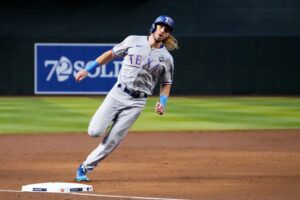
That marked the first time since 2018 that Jankowski had reached 100 games played or 200 plate appearances in a season. While he’s appeared in the majors every year dating back to 2015, he’s been an oft-optioned and twice-DFA’ed player who hasn’t always held a firm grip on a roster spot. Last year’s impressive blend of speed, plate discipline, contact and defense clearly made a favorable impression on the Rangers, however, and it seems he’ll have an opportunity to reprise that role in 2024.
The Texas outfield won’t have much change in 2024 when compared to the end of the 2023 season. Star right fielder Adolis Garcia will look to build on last year’s 39-homer campaign. Leody Taveras is expected to return as the primary center fielder. Top prospect Evan Carter seized the left field job with a big showing late in the season and, particularly, in the playoffs. If any of that trio struggles or falls to injury, 2023 No. 4 overall pick Wyatt Langford is on the cusp of big league readiness himself. Langford will get a chance to earn an Opening Day roster spot this spring, and if he succeeds in doing so, he could form an outfield/DH rotation with the other three starting outfielders.
Jankowski will once again serve as a backup across all three spots, providing the potential for a late-game defensive replacement or pinch-running appearance on any given day. As a career .254/.343/.333 hitter against righties with just a .186/.256/.237 slash against lefties, any starts for Jankowski will likely be limited to those against right-handed opponent on the mound. The emergence of Carter and perhaps Langford could leave him with a more limited role than he saw in ’23, but Jankowski has the makings of a valuable bench piece who could step into a more prominent role for a short term, should injuries necessitate (as was the case with Garcia during the World Series).
Evan Grant of the Dallas Morning News first reported the Rangers and Jankowski were discussing a reunion. ESPN’s Buster Olney reported the $1.7MM guarantee and the inclusion of performance bonuses.
Image courtesy of USA Today Sports.
Rangers Sign David Robertson
The Rangers announced the signing of reliever David Robertson to a one-year deal with a mutual option for 2025. The right-hander, who is self-represented, is reportedly guaranteed $11.5MM. He’ll make just $5MM in 2024 and is guaranteed the $1.5MM buyout on the option, which is valued at $7MM. The final $5MM is deferred, with $1MM paid annually between 2027-31.
Robertson split the 2023 campaign between a pair of NL East clubs. He signed a one-year, $10MM pact with the Mets. Initially tabbed as a setup man, he was pushed into the ninth inning by the Edwin Díaz injury. Robertson’s time in Queens ended up briefer than he or the team envisioned because the club quickly fell out of contention. That wasn’t any fault of his, as Robertson had an excellent 40-game run as a Met.
He tossed 44 innings with a 2.05 ERA, striking out nearly 28% of opposing hitters. For a second straight summer, Robertson was one of the better rental relievers at the deadline. New York flipped him to the Marlins for a pair of low minors prospects (Marco Vargas and Ronald Hernandez).
While Miami surprisingly stayed in contention and secured a Wild Card berth, Robertson wasn’t immediately effective. He had a tough first month in South Florida, allowing 13 runs (10 earned) with six walks and 10 strikeouts over 10 innings in August. Miami took him out of the closer’s role towards the end of that month. Robertson responded with a much better September, striking out 19 while allowing only two runs over his final 10 1/3 frames.

Despite the blip early in the second half, the former All-Star had another productive year. He finished the season with a 3.03 earned run average through 65 1/3 innings. Robertson fanned an above-average 29% of batters faced against a manageable 9.3% walk rate. He missed bats on a solid 12.6% of his overall offerings.
The Rangers have made no secret of their desire to add to the bullpen. Texas had been among the perceived frontrunners for Héctor Neris, arguably the top unsigned relief pitcher. They were also linked to Ryan Brasier a couple weeks ago. Robertson, who turns 39 in April, is available on a one-year pact. Neris and Brasier each have a shot at two years, with Neris likely to top the overall guarantee that Robertson secured.
Robertson is the second free agent bullpen acquisition of the offseason for GM Chris Young and his front office. The Rangers inked Kirby Yates to a $4.5MM deal during the Winter Meetings. Texas lost a trio of bullpen arms to free agency. Aroldis Chapman, Will Smith and Chris Stratton have all landed elsewhere. That left the relief group as the shakiest part of the defending champions’ roster. Robertson and Yates join Josh Sborz as bridge options to closer José Leclerc. Texas could still stand to add a left-hander after Brock Burke turned in a middling 2023 season.
Roster Resource projected their 2024 payroll around $210MM before the Robertson signing. He’ll push that to roughly $215MM. More importantly, the deal moves them into luxury tax territory. Texas was at roughly $231MM in CBT obligations before this signing. While the deferrals marginally reduce the contract’s net present value, the contract’s tax hit for next season is much closer to the $11.5MM overall guarantee than it is to next year’s $5MM salary.
Their CBT number jumps past the $240MM mark, pushing above the $237MM base threshold. Texas surpassed the CBT threshold last season, so they’ll pay escalating penalties for a second consecutive year of payments. The Rangers are taxed at a 32% rate on spending between $237MM and $257MM.
The tax for the Robertson signing is fairly modest. It’ll land in the $2MM range. The more significant impact could be on future tax obligations incurred on any further acquisitions. They’ve had a fairly quiet offseason amidst uncertainty about their broadcasting deal with Diamond Sports Group, but they’re bracing for another showdown with the Astros at the top of the AL West.
Jon Heyman of the New York Post first reported the Rangers had interest in Robertson. Jeff Passan of ESPN reported the Rangers and Robertson had agreed to a one-year deal in the $11-12MM range. MLB.com’s Mark Feinsand was first to report the $11.5MM guarantee, the mutual option, and the salary breakdown.
Image courtesy of USA Today Sports.
Rangers Trade J.P. Martinez To Braves
The Rangers announced Friday that they’ve traded outfielder J.P. Martinez to the Braves in exchange for minor league right-hander Tyler Owens. Texas needed to open a spot on its 40-man roster in order to finalize yesterday’s reported signing of David Robertson, and a trade of the 27-year-old Martinez seemingly paves the way for that signing to be made official. Robertson is taking his physical in Texas today.
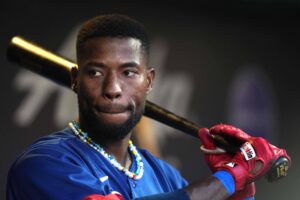
Martinez made his big league debut with the Rangers in 2023, appearing in 17 games and tallying 44 plate appearances late in the season. He hit .225/.250/.325 with a homer, a double and an unsightly 16 strikeouts (36.4%) during that cup of coffee. His output in 77 Triple-A games (353 plate appearances) was far more encouraging. The lefty-swinging Martinez slashed .298/.418/.543 with 14 long balls, 21 doubles, four triples and a hefty 38 stolen bases in 42 attempts. The small-sample strikeout woes that plagued him in the majors weren’t present in Triple-A; he walked at a 15.6% clip in Round Rock and fanned at a much more manageable 22.9% rate.
It’s worth noting that Martinez was older and more experienced than much of his competition in Triple-A. In addition to five minor league seasons, he played five years in the Cuban National Series (Cuba’s top professional league) and spent two seasons in the independent Canadian-American Association. Be that as it may, it was still an impressive showing and far and away his most productive minor league performance to date since signing with the Rangers organization in March of 2018. Martinez at one point ranked second among Rangers prospects, per Baseball America, but he dropped to 27th the following year (2020) and has been off the radar on major prospect rankings for the organization since.
The Braves’ outfield is full with Jarred Kelenic in left, Michael Harris II in center and reigning National League MVP Ronald Acuna Jr. in right field. It’s feasible that Martinez could compete with Forrest Wall and non-roster veteran Jordan Luplow for a bench spot to begin the season. Martinez (two) and Wall (three) both have minor league option years remaining, so either could be sent down without needing to first be exposed to waivers. Luplow isn’t on the 40-man roster and would need to earn a job this spring.
Turning to the Rangers’ side of the swap, they’ll add a 23-year-old righty who was the Braves’ 13th-round pick in the 2019 draft. Owens split the 2023 season between High-A and Double-A, working to a combined 3.03 ERA in 65 1/3 innings split between the bullpen and the rotation. He fanned 23.4% of his opponents against a 7.7% walk rate, although both his strikeout and walk rate took a turn for the worse when moving up to the Double-A level from High-A.
Listed at 5’10” and 185 pounds, Owens is undersized but nonetheless elevated his prospect status with his 2023 performance. Baseball America ranked him 22nd among Braves prospects this offseason, touting a plus fastball that reaches 98 mph and befuddles hitters thanks in part to a lower-than-usual release angle. BA’s report also notes that Owens has a slider with strong spin rates which could be a plus pitch if he can locate it more consistently — which he’s struggled to do at this point in his career.
Owens gives the Rangers a potential bullpen arm who could be in the big leagues at some point in 2024 or in 2025, although it should also be noted that all 29 other teams passed on selecting him in December’s Rule 5 Draft despite being eligible.
The Rangers have more outfield depth in the upper minors and on their big league bench than the Braves, who have a stacked bullpen that left Owens with little chance of breaking through in the immediate term (barring multiple injuries on the MLB roster). Martinez is more interesting than the standard player who might be designated for assignment to make room for a free agent signing, and the Braves accordingly sent a relatively near-term bullpen prospect who seemingly has a chance to make it in the big leagues. Both clubs dealt from positions of depth and addressed areas of need; on the whole, it seems like a sensible swap for both parties.
Francys Romero first reported that Martinez had been traded to Atlanta.
Rangers Sign Jared Walsh, Matt Duffy, Blake Taylor To Minor League Deals
The Rangers announced that they have signed first baseman Jared Walsh, infielder Matt Duffy and left-hander Blake Taylor to minor league deals. All three deals come with invites to major league Spring Training. Walsh and Taylor are repped by ISE Baseball, Duffy by TWC Sports.
Walsh, 30, once looked like a mainstay of the lineup for the Angels. He hit nine home runs in the shortened 2020 season and then added another 29 the year after. His .280/.338/.531 batting line in that time translated to a wRC+ of 130, indicating he was 30% better than the league average hitter. He wasn’t considered a strong defender but the bat was clearly enticing.
Unfortunately, he hasn’t been anywhere near that level since, with injuries holding him back. He hit .215/.269/.374 in 2022, with that season ultimately ended by thoracic outlet syndrome surgery. He returned in 2023 but battled neurological issues, including insomnia and headaches, something he discussed with Sam Blum of The Athletic in May. He hit just .125/.216/.279 in 39 major league games last year, getting passed through waivers twice. The second such instance was in October and he elected free agency afterwards.
For the Rangers, they have Nathaniel Lowe at first base but don’t have a strict designated hitter. If Walsh were able to get over his recent health issues and return to that strong form he showed a few years ago, he would be a candidate to take over the bulk of the DH at-bats, while also providing depth for a possible Lowe injury. If he were to get back in form and earn himself a roster spot, he could be retained for future seasons via arbitration, though he is out of options.
Duffy, 33, is a veteran utility guy. He spent 2023 with the Royals and hit .251/.306/.325 in his 209 plate appearances for a wRC+ of 72. That offense is obviously subpar, but he provided the club with defensive versatility. He spent some time at all four infield positions and even tossed two innings of mop-up duty on the mound. He’s also played a bit of left field in previous seasons.
The Rangers have Lowe at first, with the rest of the infield set to be filled out by Corey Seager, Marcus Semien and Josh Jung. They also have infielders like Ezequiel Durán, Jonathan Ornelas, Josh H. Smith and Justin Foscue on the roster, but Duffy will add a bit of veteran non-roster depth.
Taylor, 28, pitched in 92 major league games for the Astros over the 2020 to 2022 seasons. He allowed just 3.06 earned runs per nine frames over 79 1/3 innings combined, but a bit of luck may have been involved. His 19.1% strikeout rate and 12.6% walk rate were both a few ticks worse than average, while his .249 batting average on balls in play and 79.3% strand rate were both on the fortunate side. His 4.65 FIP and 4.94 SIERA each suggest he may have deserved worse results than the ERA might indicate.
In 2023, he began the year on the injured list due to a left elbow strain. He was activated a couple of weeks later and optioned to Triple-A Sugar Land. He made 35 appearances for the Space Cowboys with a 5.15 ERA, 14.9% strikeout rate and 13.1% walk rate. He was released in August.
The Rangers lost lefties Aroldis Chapman and Will Smith to free agency and then non-tendered Brett Martin. Their southpaw relief contingent now consists of Brock Burke, Jake Latz and Antoine Kelly. They could also have Cody Bradford back there if he’s not working out of the rotation. Taylor will give them some non-roster depth with a bit of major league experience under his belt. If he is able to earn his way back to the majors, he does have one option year remaining.
Adrián Beltré, Joe Mauer, Todd Helton Elected To Baseball Hall Of Fame
The Hall of Fame announced this evening that Adrián Beltré, Joe Mauer and Todd Helton have been elected by the Baseball Writers Association of America. They will be elected alongside Jim Leyland, who was selected by the Era Committee last month.
Beltré received 95.1% of the vote, Helton 79.7% and Mauer 76.1%. Billy Wagner got 73.8%, just shy of the 75% threshold. This was his ninth year on the ballot, meaning next year will be his last. Gary Sheffield received 63.9% of the vote in his 10th year on the ballot and will therefore not be present on next year’s. The full results can be found at this link from the BBWAA.
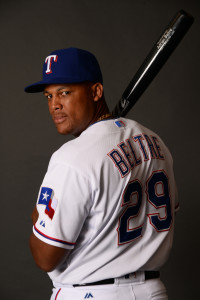
Beltré was an international signing of the Dodgers out of the Dominican Republic. He debuted in the majors in 1998 when still just 19 years old. Though it took him some time to realize his full potential, he would eventually go on to have an incredible career in just about every respect.
He eventually played in parts of 21 seasons with the Dodgers, Mariners, Red Sox and Rangers. In 2,933 career games, he had 3,166 hits, which included 636 doubles, 38 triples and 477 home runs. He was also considered to be an excellent third baseman, tallying 200 Defensive Runs Saved even though that metric didn’t exist for the first few years of his career. He also stole 121 bases over the years.
Due to the combination of his offense, defense and longevity, he produced 83.8 wins above replacement in eyes of FanGraphs while Baseball Reference has him a 93.5. He was on four All-Star teams, won five Gold Glove awards and four Silver Slugger Awards. This was his first year on the ballot.
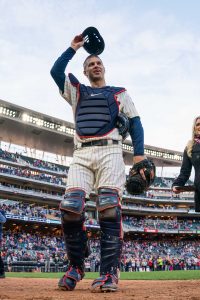
Mauer’s career exploits were many, but there was also a poetic connective tissue in that he was so specifically tied to one franchise. Born and raised in Saint Paul, Minnesota, he entered the 2001 Major League Baseball draft and the Twins used the first overall pick to select him.
He would go on to play his entire career for the Twins, which lasted from his 2004 debut through the 2018 season. He played in 1,858 games, with injuries reducing his playing time and eventually moving him from catcher to first base. But he still managed to notch 2,123 hits and finish his career with a .306 batting average.
Of the seven batting titles won by catchers, Mauer has three of them. That included his 2009 season, wherein he hit .365 and won Most Valuable Player in the American League. He finished his career with 53 fWAR and 55.2 bWAR. He was selected to six All-Star teams, won three Gold Glove awards and five Silver Slugger Awards. This was his first year on the ballot.
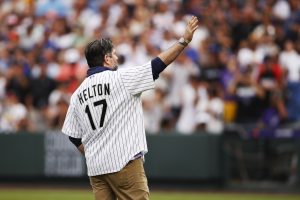
Helton also spent his entire career with one organization, having been drafted eighth overall by the Rockies in 1995. He would make his major league debut in 1997 and stick with the Rockies through 2013.
In his 2,247 games, he tallied 2,519 hits, including 1,521 doubles and 369 home runs. In 2000, he hit .372 with 40 home runs, then followed that up by hitting 49 homers with a .336 batting average the year after. He made five All-Star teams, won three Gold Glove awards and five Silver Sluggers. He has career tallies of 54.9 fWAR and 61.8 bWAR. This was his sixth year on the ballot.
Per the BBWAA, this was the 10th time they elected three players, the last being when Jeff Bagwell, Tim Raines and Iván Rodríguez were elected in 2017.
Latest Details On Diamond Bankruptcy
The Diamond Sports Group saga took another turn yesterday when the broadcasting company announced a restructuring agreement that’d see debt holders invest $450MM to keep the company afloat. As part of the deal, Amazon would receive streaming rights for the NBA, NHL and MLB teams for which Diamond currently holds those rights.
While there’s an agreement in place between Diamond and Amazon, it’s worth emphasizing that the plan can’t become official without approval from the bankruptcy court. That’ll take time as the court and Diamond’s creditors sort through the details.
Evan Drellich and Mike Vorkunov of the Athletic report that Amazon would pay $115MM, with an additional $50MM investment possible. While that’d entitle them to streaming rights for every NBA and NHL team that contracts with Diamond, it’s only applicable to five MLB teams. Diamond has streaming rights for the Royals, Tigers, Marlins, Brewers and Rays. Those clubs would still be broadcast on cable on Diamond’s Bally Sports networks, but in-market streaming access would move to Prime Video. MLB has opposed selling additional streaming rights to Diamond, but Alden González of ESPN reports that Amazon’s involvement is not conditional on further streaming acquisitions.
Until this week, it had seemed likely Diamond would abandon the regional sports network entirely after the 2024 MLB season. The agreement with Amazon represents a significant shift and leaves a few MLB teams in a state of continued uncertainty.
Diamond holds broadcasting deals with 11 MLB teams. The corporation’s attorney said yesterday that nine of those clubs — the Angels, Braves, Brewers, Cardinals, Marlins, Rays, Reds, Royals and Tigers — will be paid in full for the ’24 campaign (relayed by González). The company is seeking to renegotiate its deals with two others, the Guardians and Rangers, at lesser fees. It is also in discussions with the Twins, whose previous contract with Diamond expired at the end of last season — leaving them as something of a broadcasting free agent.
The Diamond attorney informed the court yesterday that the company has offered terms to each of the Cleveland, Texas and Minnesota organizations to continue broadcasting their games in 2024 (via The Athletic). He said the company expects answers from all three franchises by the start of February. A hearing scheduled for tomorrow morning has been postponed indefinitely so the sides can review the framework of the streaming deal, per Drellich and Vorkunov.
None of the Rangers, Guardians or Twins are obligated to accept reduced rights fees. If they decline, however, it seems likely Diamond will drop the Texas and Cleveland contracts and leave Minnesota without a deal. Diamond already showed a willingness to abandon unprofitable terms during the 2023 season, when it dropped agreements with the Padres and Diamondbacks.
That leaves Texas, Cleveland and Minnesota without a ton of leverage. Diamond’s attorney said one of the organizations (without specifying which) plans to negotiate a deal that would even extend beyond next season, as relayed by The Athletic.
The uncertainty has been reflected in those franchises’ activity, or lack thereof, in free agency. Minnesota declared they were cutting payroll at the start of the offseason. They allowed Sonny Gray and Kenta Maeda to depart and have thus far signed one free agent to a major league contract. That was a $950K guarantee for reliever Josh Staumont, who is rehabbing from thoracic outlet surgery.
Texas is coming off a World Series that’d normally spur a team to act aggressively in the offseason. Instead, GM Chris Young indicated they wouldn’t be as active as they’d been in previous winters. The Rangers have signed a few free agents — most notably a two-year, $22MM pact for Tyler Mahle — but they haven’t splurged at the top of the class. The broadcasting situation is commonly cited as a reason they haven’t brought back Jordan Montgomery, who remains on the open market.
Cleveland is never a big spender, so the lack of activity on their end is characteristic. Still, the club is seemingly operating with limited flexibility. They’ve taken on some salary in the Scott Barlow trade and signed Austin Hedges to a $4MM free agent deal.
Whether all those teams can reach a new contract with Diamond should become clear in the next few weeks. Even if they stay on the networks for next season (and potentially beyond), it’d come with some kind of hit to their revenues. Paul Hoynes of Cleveland.com reported the Guardians made $55MM in local rights fees last season. It was a similar amount for Minnesota, whom Phil Miller of the Minneapolis Star-Tribune reports received $54MM in 2023. Evan Grant of the Dallas Morning News wrote yesterday the Rangers’ deal has paid around $111MM annually.
If any of those teams don’t reach an agreement, they’d join a trio of clubs likely to operate without an RSN deal this year. MLB stepped in to handle in-market broadcasting for Arizona and San Diego last season. While MLB subsidized a portion of the D-Backs and Padres deals last season, commissioner Rob Manfred has made clear they won’t do so next season. Allowing MLB to handle the broadcasts would likely be less profitable for the teams than if they land a new deal with Diamond.
It seems MLB is also going to handle broadcasts for the Rockies, whose contract was dropped by AT&T SportsNet Rocky Mountain at the end of 2023. Patrick Saunders of the Denver Post reported this month that MLB is expected to stream Colorado games in-market on its MLB.tv platform, as it is doing with the D-Backs and Padres. The Rockies made roughly $57MM off their broadcasting deal a year ago, Saunders adds.
Rangers Sign Jose Urena To Minor League Deal
The Rangers announced Tuesday that they’ve signed veteran right-hander Jose Urena to a minor league contract. He’ll be in big league camp as a non-roster invitee this spring. Urena is represented by Premier Talent Sports & Entertainment.
Each of the past two seasons has played out somewhat similarly for the now-32-year-old Urena. He’s split both years between two organizations — Brewers/Rockies in 2022; Rockies/White Sox in 2023 — and pitched poorly for the first before rebounding for the second. In 2022, Urena tossed 7 2/3 innings for the Brewers, limiting opponents to three runs but doing so with more walks (five) than strikeouts (three). He latched on in Colorado after being cut loose and gave the Rox 89 1/3 innings of 5.14 ERA ball over the life of 17 starts. That’s not the most appealing ERA mark, of course, but pitching at Coors Field is hardly an enviable task — and Urena was quite successful down the stretch (2.25 ERA, 25-to-9 K/BB in his final five starts).
That run with the Rockies was enough for Colorado to bring him back on a one-year, $3.5MM contract, but that deal went south in a hurry. Urena was torched for a 9.82 earned run average in his first five starts and cut loose after pitching just 18 1/3 innings overall. He caught on with the White Sox later, was called to the big leagues in September, and posted an overall 4.10 ERA in his five starts with Chicago (26 1/3 innings, 20-to-8 K/BB ratio).
Urena had some solid seasons with the Marlins earlier in his big league career, but consistency has long eluded him. All told, he’s pitched 839 1/3 innings as a big leaguer and turned in a 4.89 ERA with a well below-average 15.5% strikeout rate, a roughly average 8.6% walk rate and a strong 48.2% ground-ball rate.
The Rangers will likely try to add a few arms of this nature — veterans who can be stashed in the upper minors as depth. With Max Scherzer and Jacob deGrom both recovering from surgery and Jordan Montgomery currently a free agent, they’re looking at a projected rotation of Nathan Eovaldi, Jon Gray, Andrew Heaney, Dane Dunning and Cody Bradford. Some additional certainty would be prudent — be it re-signing Montgomery or acquiring a different free agent or trade option — but improving the depth is similarly important and Urena helps to fill that need.