
NL East Notes: Chavez, Ridings, Doolittle
The Braves dodged a bullet yesterday when righty Jesse Chavez was hit in the leg by a comebacker and helped off the field, as initial x-rays did not reveal a fracture. The team originally believed Chavez would be able to avoid an IL stint entirely, that didn’t prove to be the case. Atlanta placed Chavez on the 15-day injured list, per a club announcement, and recalled right-hander Ben Heller from Triple-A Gwinnett in his place. Losing Chavez even just for two weeks or so will sting. The 39-year-old has been outstanding for Atlanta, pitching to a 1.55 ERA with a career-best 30.8% strikeout rate against a 7.7% walk rate. Chavez has already picked up a save and a dozen holds for the Braves, and he was on an 11-inning scoreless streak prior to his injury.
A few more notes from the NL East…
- The Mets announced Thursday that they’ve reinstated right-hander Stephen Ridings from the 60-day injured list and optioned him to Triple-A Syracuse. The move fills a spot on the team’s 40-man roster, increasing their count from 37 to 38 players. Ridings, 27, has yet to throw a pitch for the Mets, spending the entire season to date on the injured list due to a lat strain. The Mets claimed the right-hander off waivers from the Yankees back in mid-November, just before teams set their rosters in advance of the 2022 Rule 5 Draft. Shoulder troubles derailed Ridings’ 2022 season, but he posted a 1.24 ERA and 42-to-4 K/BB ratio in 29 innings between High-A and Double-A in the Yankees system back in 2021.
- Veteran lefty Sean Doolittle was transferred from the Nationals‘ Double-A affiliate to their Triple-A club Thursday, signaling that he’s completed his rehab work and is now considered fully healthy. The 36-year-old Doolittle, who signed a minor league deal with the Nats over the winter, is being formally reinstated from the injured list and will try to pitch his way back into the Majors with a strong showing in Rochester. Doolittle allowed three runs and posted a 10-to-2 K/BB ratio in seven rehab frames between Class-A and Double-A. The lefty pitched just 5 1/3 frames for the Nats in 2022 before requiring an internal brace procedure in his elbow over the summer.
Nationals Release Erasmo Ramírez
The Nationals have released right-hander Erasmo Ramírez, according to his transactions tracker at MLB.com. He had been designated for assignment earlier in the week.
Ramírez, 33, has had a very rough go of it so far this year. Through 27 innings over 23 appearances, his ERA is 6.33. His 4.8% walk rate is excellent and his 43.1% ground ball rate is close to average, but his 10.3% strikeout rate is less than half of the 23.9% league average for relievers across the majors this year.
That’s a significant drop-off from last year, when he posted a 2.92 ERA in 86 1/3 innings with a 17.6% strikeout rate. On the heels of that solid campaign, the Nats retained him by signing him to a one-year deal with a salary of $1MM for 2023. But that investment hasn’t paid off and Ramírez has lost his roster spot.
It’s not a shock to see him end up released as he would have been able to reject an outright assignment anyway. All players with more than five years of major league service time have the right to elect free agency instead of accepting such an assignment, while retaining all of their salary. The Nats have simply skipped that formality and sent Ramírez to the open market.
They will remain on the hook for that money while Ramírez will be free to sign with any other club. Should he get a roster spot somewhere else, that club would only be responsible for the prorated league minimum salary for any time spent on the active roster, with that amount subtracted from what the Nats pay.
Best Deadline Rental Returns In Recent History, #8: Nationals Get Everyday Outfielder For Jon Lester
With the trade deadline now less than two months away, we at MLBTR are setting our sights backwards for a bit to highlight past trades. With an arbitrary cutoff point of 2017, we’re counting down the top 10 returns that a team got when selling a rental player in recent years. We’ve already published some honorable mentions, the #10 entry and the #9 deal. If you disagree with our rankings, let us know! It’s all part of the subjective fun! Onto #8…
The Nationals were consistently competitive in the second decade of the millennium, finishing with a winning record in each season from 2012 to 2019. They qualified for the postseason five times in that stretch and won the World Series in that final year.
The next decade got off to a rough start, as they went 26-34 in the pandemic-shortened 2020 campaign. Nonetheless, they went into 2021 with some excellent players still on the roster, including Juan Soto, Trea Turner and Max Scherzer. They fortified that group by trading for Josh Bell and giving one-year deals to Brad Hand, Kyle Schwarber and Jon Lester.
Unfortunately, they couldn’t get things back on track that season and had a record of 48-55 on July 30. They were in fourth place in the National League East, seven games behind the Mets with Philadelphia and Atlanta between them. They were even further back in the Wild Card race, 11 games, as the West featured three excellent clubs in the Giants, Dodgers and Padres.
That put them into sell mode at the deadline and they did plenty of it. Each of Turner, Scherzer, Hand and Schwarber were traded, as were Yan Gomes, Josh Harrison and Daniel Hudson. The deal that sent Scherzer and Turner to the Dodgers technically wasn’t a rental trade, as Turner had another year of control, so we didn’t consider it for this series. Those other deals mostly yielded players that are still in the minors as of this writing. But in addition to all those, the Nats also made a trade that sent Lester to the Cardinals in exchange for MLB-ready outfielder Lane Thomas, who we will get to in a moment.
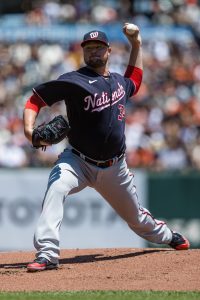 Lester had already had a very impressive career that began back in 2006. He had many great seasons with the Red Sox and Cubs and already had three World Series rings. In 2021, he was 37 years old and had naturally fallen off a bit from his peak. His ERA went from 3.32 in 2018 to 4.46 the year after and 5.16 in the shortened 2020 season.
The Nats felt he still had something left in the tank and signed him to a one-year, $5MM deal. Lester made 16 starts for the Nationals with a 5.02 ERA. His 14.9% strikeout rate was a noticeable drop from his peak years but his 8.5% walk rate and 42% ground ball rate were around league average. In short, he was a back-of-the-rotation starter, which is just what the Cardinals needed.
Their rotation had been sliced up by injuries to Jack Flaherty, Miles Mikolas, Carlos Martínez, Dakota Hudson and others. Despite that, they were hovering above .500 and in the playoff race. They didn’t go after aces that summer, just guys who could take the ball and give them a chance, figuring that a modest stabilization of the rotation could be enough for them to improve their fortunes. They grabbed 36-year-old Wade LeBlanc, 38-year-old J.A. Happ and the 37-year-old Lester to fortify things alongside 39-year-old Adam Wainwright.
The gambit would pay off for St. Louis as they finished strong. Lester did his job by making 12 starts with a 4.36 ERA. The Cards ended the season at 90-72, securing a playoff spot, though they lost the Wild Card game to the Dodgers.
For the Nats, they weren’t able to make much use of Lester’s services, so it was a logical move to swap him out for a promising outfielder in Thomas. He had made his major league debut with the Cardinals in 2019 and hit an excellent .316/.409/.684 in 44 plate appearances but was nonetheless frequently optioned to the minors. Despite his strong results, he was squeezed out of the St. Louis outfield that also featured the likes of Dexter Fowler, Marcell Ozuna, Harrison Bader, José Martínez, Tyler O’Neill and others.
Thomas would continue to get sporadic playing time in the next couple of seasons. He only got into 18 games in the 2020 season and then 32 more in 2021 prior to the trade. He struggled badly in those two cups of coffee, hitting just .107/.235/.179, but continued showing his promise in the minors. He was slashing .265/.339/.451 in Triple-A at the time of the deal.
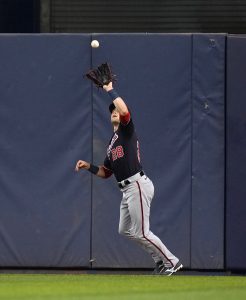
The Nationals likely hoped that Thomas would thrive with a better path to playing time, and that has largely proven to be true. He was briefly kept in Triple-A after the deal but was called up after just three games. He hit .270/.364/.489 at the major league level in the final few weeks of 2021, launching seven home runs and stealing four bases in just 45 games.
2022 saw him finally get the everyday gig he didn’t get in St. Louis, as he tallied 548 plate appearances in 146 games. It wasn’t a spectacular showing, but he was serviceable. He hit 17 home runs and stole eight bases, though his 7.5% walk rate and 24.1% strikeout rate were both slightly worse than average. His .241/.301/.404 batting line amounted to a wRC+ of 96 and he was worth 1.1 wins above replacement on the year according to FanGraphs, 1.6 at Baseball Reference.
Things are going better here in 2023, as he already has nine home runs and five steals. His plate discipline numbers are fairly similar, but he’s hitting .281/.336/.455 for a wRC+ of 114. His .350 batting average on balls in play is much higher than last year’s .291, but that can’t be entirely dismissed as just good luck since his hard hit rate, barrel rate and average exit velocity have also increased compared to a year ago.
Defensively, Thomas isn’t considered an excellent fielder, which is surprising considering his 95th percentile sprint speed. Nonetheless, he’s capable of holding his own at any of the three outfield slots, which is useful for a rebuilding club that is rotating through various players on a regular basis. He qualified for arbitration for the first time in the most recent offseason and is making $2.2MM this year. He’ll be eligible for two more passes before he’s slated for free agency after 2025.
Whether the Nats can come out of their rebuild in that time frame remains to be seen. But even in the event that they linger outside of contention for a while, they could always market Thomas and his remaining control to other clubs around the league.
In the end, both teams got what they wanted out of the deal. The Cards firmed up their rotation as hoped and were able to make a late charge and earn a playoff spot, while the Nats turned a couple months of a veteran pitcher into four and a half years of a solid outfielder who has stepped into an everyday role.
Images courtesy of USA Today Sports.
Nationals Claim Joe La Sorsa
The Nationals have claimed left-hander Joe La Sorsa off waivers from the Rays, the team announced Thursday. La Sorsa, who was designated for assignment by Tampa Bay earlier this week, been optioned to Triple-A Rochester. The Nats had multiple 40-man vacancies after this week’s DFAs of Andres Machado and Erasmo Ramirez, so a corresponding move is not necessary. Ari Alexander of KPRC 2 in Houston first reported the move.
La Sorsa, 25, made his big league debut with the Rays this month, pitching 4 1/3 innings of one-run ball with three hits and three walks with three strikeouts. He’s had a nice showing so far between Double-A (three innings) and Triple-A (21 innings) so far in 2023, pitching to a combined 3.38 ERA with a 7.5% walk rate. La Sorsa’s 14.2% strikeout rate is well below average, checking in at less than half the 31.7% clip he showed between High-A and Double-A just last season. It’s a generally small sample, though, and La Sorsa’s 13% swinging-strike rate in Triple-A certainly seems to portend an eventual uptick in the strikeout department.
While La Sorsa has never ranked as a top prospect, he’s a controllable lefty with a nice minor league track record who has all three minor league option years remaining. He’s pitched 203 2/3 innings of minor league ball with a 2.87 ERA, fanning nearly four and a half times as many hitters — about a quarter of his total opponents — as he’s walked in that time. For a Nationals club with little stability in the bullpen, he’s an interesting potential long-term pickup who could eventually carve out a regular role in the relief corps.
Nationals Outright Andres Machado
Nationals reliever Andrés Machado has gone unclaimed on waivers after being designated for assignment this week, the club announced. Machado has the right to refuse an outright assignment in favor of minor league free agency because he’s cleared waivers multiple times in his career. However, Mark Zuckerman of MASNsports.com tweets the right-hander will bypass the open market and join the Nats’ Triple-A club in Rochester.
Machado opened the season in Triple-A. He tossed 12 1/3 frames of five-run ball to earn a call back to the majors at the end of April. He couldn’t carry that success over against big league hitters. Machado allowed 16 runs over 17 MLB frames, surrendering a staggering six homers in the process. He’s out of option years, so the Nats had to take him off the 40-man roster to send him back to the minors.
The 30-year-old Machado has pitched in each of the last three seasons for Washington. He posted a sub-4.00 ERA in both 2021-22 but never had the peripherals to match that decent run prevention. Machado fanned less than 20% of opposing hitters in both years while walking opponents at a slightly higher than average pace. That led to him going unclaimed on waivers over the offseason and again clearing this week.
Washington has made a couple changes in the bullpen in the last few days. The Nats also designated veteran righty Erasmo Ramírez for assignment this morning. The pair of moves has dropped their 40-man count to 38.
Tigers, Nationals Relievers Drawing Trade Interest
Now that the calendar has flipped to June and the trade deadline is just over the horizon, teams will be starting to line up their plans for the deadline. Relief pitchers tend to always be in demand since just about every contender could squeeze another quality arm or two or three into their bullpen.
With the expanded playoffs, there are few obvious sellers at the moment, which puts a spotlight on those that do make sense to have players on the block. As such, Ken Rosenthal of The Athletic reports that clubs with bullpen needs are interested in the relievers of the Tigers and Nationals. He specifically mentions Kyle Finnegan, Hunter Harvey, Carl Edwards Jr., Alex Lange, Will Vest and Jason Foley as those being targeted.
It’s not terribly surprising to see either club being eyed up by competitors. The Nats have been firmly in rebuild mode for a few years now, trading away established players like Trea Turner, Max Scherzer and Juan Soto. Their 25-35 record this season has them in the basement of the National League East. The Tigers are a bit more murky, as they tried to come out of their rebuild last year but ended up at 66-96. Their 26-33 record this year isn’t great but that leaves them only four games back in a weak American League Central. Perhaps they could hang around for the next couple of months but they recently lost both their best pitcher and position player when Riley Greene and Eduardo Rodriguez hit the injured list. That doesn’t guarantee they will slide out further back in the coming weeks but the possibility is there.
Of course, each individual player will require a different calculus based on their performance, years of control, age, etc. Let’s take a look at all six of those names that were mentioned and see what the sellers and the buyers will be looking at. Most of these guys have multiple years of control, meaning the Tigers/Nationals don’t strictly need to pull the trigger on a trade this summer. However, relievers are often volatile from year to year and there’s the ever-present injury risk, meaning there’s always a temptation to sell high when the opportunity is there.
Alex Lange, Tigers
Lange, 27, is in his third major league season and is seemingly improving every time the calendar flips over. He posted a 4.04 ERA in 2021, 3.41 last year and is down to 2.55 this year. His strikeout rate has also ticked up at the same time, going from 24.1% to 30.3% to 35%. However, the same is true of his walk rate, which has grown from 9.9% to 11.4% to 13%. That’s a bit concerning but his overall results are still trending in a positive direction as he’s taken on a higher-leverage role. He earned 21 holds last year and has jumped into the closer’s role this year with 10 saves already. He likely won’t even reach arbitration after this season and he’s not slated for free agency until after the 2027 campaign.
Will Vest, Tigers
Vest, 28, is similarly improving year over year like Lange. He had a 6.17 ERA with the Mariners in 2021 as a Rule 5 pick before getting sent back to the Tigers in July. They are surely glad the M’s made that decision as he then had an ERA of 4.00 last year and is down to 2.74 this year. He’s striking out 27.5% of opponents this year while walking just 8.8% and getting grounders on half of the balls in play he’s allowed. He hasn’t been in as many high-leverage spots, only notching a couple of holds on the year. Much like Lange, he’ll likely come up short of Super Two status this winter and won’t be on path for free agency until the 2027-28 offseason.
Jason Foley, Tigers
Foley, 27, made a brief debut in 2021 with a 2.61 ERA in 11 outings. He got a lengthier showing last year and his ERA jumped up but was still at a respectable 3.88. He’s cut that way down to 1.42 this year thanks to an incredible 61.4% ground ball rate. His 21.6% strikeout rate is a bit below average but his 5.2% walk rate is very good. He’s been moved into a setup role, earning 10 holds and a couple of saves on the year so far. Like his two teammates listed above, he’s yet to qualify for arbitration and isn’t scheduled for free agency until after the 2027 campaign.
Kyle Finnegan, Nationals
Finnegan, 31, moved into a high-leverage role with the Nats in recent years. He earned 22 saves and 27 holds over 2021 and 2022 with a 3.53 ERA in that time as well as a 24.6% strikeout rate, 10% walk rate and 47.9% ground ball rate. His ERA has ticked up to 4.56 this year, but that’s mostly due to one really bad outing early in the season. The Rays put a five spot on him on April 4 and he has a 2.11 ERA since. Every pitcher’s stats would look better if you took out their worst game, but his peripherals are fairly close to his career norms and it’s possible that he continues to even things out over time. He drew some trade interest a year ago but ultimately stayed in Washington. He came into this season with exactly three years of service time and is making a salary of $2.3MM. He’ll be in line for raises in the next two years before qualifying for free agency after 2025.
Hunter Harvey, Nationals
Harvey, 28, got some brief time in the big leagues with the Orioles earlier in his career but was put on waivers after the 2021 season. He was claimed by the Giants and then the Nationals on a second waiver claim. Last year, he got his first extended stretch in the big leagues and responded with a 2.52 ERA in 38 outings. He struck out 28.7% of batters faced while walking 7.6%. This year, his strikeout rate is up to 31.4% but some extra home runs have pushed his ERA to 3.33. He got six holds last year but is already up to 11 this season, along with a trio of saves. He’s making $870K this year and would be able to go through arbitration two more times before reaching free agency after 2025.
Carl Edwards Jr., Nationals
Edwards, 31, had some solid seasons with the Cubs earlier in his career but he didn’t pitch much over the 2019-2021 period due to various injuries. He signed a minor league deal with the Nats prior to 2022 and has been able to bounce back. He had a 2.76 ERA in 57 appearances last year and is at 3.28 this year. He’s only striking out 18.2% of opponents this season and is walking 12.7% but he’s getting grounders at a strong 48% clip. He had 13 holds and a couple of saves last year and is at 12 holds and one save already this year. Unlike the other names on this list, he’s a pure rental, making $2.25MM and slated for free agency this winter.
Nationals To Designate Erasmo Ramirez For Assignment
The Nationals are designating veteran righty Erasmo Ramirez for assignment, reports Andrew Golden of the Washington Post. His spot on the roster will go to right-hander Cory Abbott, who is being recalled from Triple-A Rochester, as first reported by Talk Nats. Ramirez is the Nationals’ second reliever to be designated for assignment in as many days; righty Andres Machado was designated for assignment just yesterday.
It’s been a tough season for the veteran Ramirez, who has been tagged for a 6.33 ERA in 27 innings out of Davey Martinez’s bullpen. The 33-year-old right-hander is only a year removed from logging 86 innings of 2.92 ERA ball for the Nats, but after re-signing in D.C. over the winter, he’s seen his strikeout rate, walk rate, home-run rate, ground-ball rate and fastball velocity all trend in the wrong direction.
Ramirez’s 2022 season always appeared to have benefited from some degree good fortune. His .267 average on balls in play was well south of league average (and a bit shy of his own career mark), and an 81% strand rate is difficult to sustain over a larger sample — particularly with a below-average strikeout rate.
Still, the wheels have come off far more than last year’s numbers might have suggested. Ramirez’s 10.3% strikeout rate and 6% swinging-strike rate in 2023 rank as the third-lowest and fourth-lowest of any MLB pitcher (min. 20 innings pitched). After yielding just an 88.7 mph average exit velocity in 2022, he’s been torched for an average of 92.2 mph off the bat in 2023. Ramirez’s sinker sat at 93.1 mph last season but is down to 92.1 mph so far this year.
The Nats will have a week to trade Ramirez, pass him through outright waivers or release him. As a veteran with more than five years of big league service time, he can reject on outright assignment in favor of free agency without forfeiting the remainder of his $1MM guaranteed salary. Any team could sign him at that point, owing only the prorated league minimum for any time spent on the big league roster.
Abbott, 27, was with the Nationals earlier this season and tossed four innings of one-run ball across a pair of relief appearances. He also logged 48 innings for the 2022 Nats, yielding a 5.25 ERA. Abbott has been tagged for a 5.71 ERA across 41 Triple-A frames, operating exclusively as a starter in the minors. He’s likely ticketed for a bullpen role with the Nats, where he’ll replace Ramirez. In 69 1/3 career innings at the MLB level, Abbott has a 5.45 ERA with an 18.7% strikeout rate against a 12.1% walk rate.
Nationals’ Victor Arano To Undergo Shoulder Surgery
Nationals reliever Víctor Arano will require shoulder surgery later this month, the team informed reporters (including Andrew Golden of the Washington Post). The club didn’t provide specifics on a timetable, though it seems likely to cost him most or all of the season.
Arano hasn’t thrown a major league pitch since September 1, 2022. The Nats placed him on the injured list with a season-ending shoulder strain at that point. The shoulder has unfortunately continued to bother him in the months since then. He was shut down in Spring Training with an impingement and placed on the 60-day IL. He felt renewed soreness when he tried to ramp up last month.
The right-hander has been in a similar position before. He underwent an elbow procedure while a member of the Phillies in May 2019, costing him the remainder of that year. Arano wouldn’t reappear at the MLB level until last season, when he broke camp with the Nats after signing a minor league deal. He worked 42 innings of middle relief, posting a 4.50 ERA with a solid 23.5% strikeout rate and a stellar 51.6% grounder percentage.
Arano has been a productive reliever when healthy, carrying a 3.32 ERA in 116 2/3 big league frames. Injuries have kept him to two seasons topping the 40-inning mark. He’s making $925K this year after avoiding arbitration last winter. He remains controllable via that process through 2025 but the Nats could non-tender him if this indeed winds up going down as a lost season.
Nationals Designate Andres Machado For Assignment
June 6: The Nationals have now made these moves official.
June 5, 1:28pm: The Nationals are recalling righty Jordan Weems from Triple-A in a corresponding move to the Machado DFA, per Talk Nats (Twitter link). Weems is already on the 40-man roster, so the Nats’ 40-man will simply drop to a count of 39 players for the time being. It’ll be Weems’ second stint of the season with the Nats. He tossed 2 1/3 scoreless frames earlier in the year and has a 3.75 ERA with a 24.7% strikeout rate and 13.4% walk rate in 24 Triple-A innings.
9:29am: The Nationals designated right-hander Andres Machado for assignment Sunday, reports Jesse Dougherty of the Washington Post, although the team has not yet announced the move or a replacement for Machado in the bullpen.
Machado, 30, was an oft-used member of the Washington bullpen in 2021-22, appearing in 91 games and pitching to a 3.41 ERA in 95 innings. Those solid bottom-line results came despite pedestrian strikeout and walk rates (18.8% and 9.9%, respectively) and came with a well below-average .261 average on balls in play, contributing to some far less favorable grades from fielding independent metrics (4.56 FIP, 4.45 SIERA).
They also likely aided in the Nationals’ successful effort to pass Machado through waivers unclaimed back in January, when he was designated for assignment after the team signed outfielder Corey Dickerson to a one-year contract. Machado remained with the organization and was selected back to the big league roster at the end of April.
It’s been a tough go for the right-hander since his return. Machado has appeared in 14 games and been clobbered for 16 runs on 25 hits and six walks in 17 innings. He’s punched out just 15.4% of his opponents against a 6.4% walk rate, and opposing hitters have already connected for six home runs — more than half the number he allowed (11) in total from 2021-22.
Machado is throwing harder than ever before, averaging 96.8 mph on his fastball this season, but the uptick in velocity hasn’t done him any favors. Machado has seen a slider that ranked as his best pitch in 2021 hit increasingly hard across the past two seasons, which has prompted him to instead favor his changeup as his primary secondary offering. The changeup has been a good pitch for him this year, but his four-seamer, sinker and now-seldom-used slider have all been hit hard.
The Nats will have a week to trade Machado or attempt to pass him through outright waivers. He’s out of minor league options, so any team to acquire him would need to carry him on the big league roster. Because he was also outrighted back in January, Machado would have the right to reject an outright assignment in favor of free agency even if he once again goes unclaimed on waivers.
Best Deadline Rental Returns In Recent History: Honorable Mentions
The calendar has flipped to June, and more than one-third of the season is in the rearview mirror. While there’s still plenty of time for the standings to change in dramatic fashion — just ask the 2022 Phillies or 2019 Nationals — the “early” portion of the season is a bit behind us. As the weather heats up and playoff pictures begin to take a more definitive shape, the baseball world inherently turns its focus to a few things: the looming All-Star Game, the upcoming amateur draft and, of course, the annual trade deadline.
June trades of note are admittedly rare — particularly over the past ten years or so — but we’re fast approaching the portion of the season where trade needs, potential trade candidates and many other deadline-adjacent minutiae begin to crystallize. It’s common for fans of rebuilding and/or underperforming clubs to begin to wonder just what sort of returns their favorite team might be able to eke out for veteran players with dwindling club control.
Some of the most common questions we’re asked in chats at MLBTR these days center around what a team might be able to get for a certain player — rentals in particular. Names like Lucas Giolito, Cody Bellinger, Jordan Montgomery and Jeimer Candelario were just a few readers asked me about this past week. To be clear, it’s not a given that all or even any of those specific names will change hands in two months’ time (or sooner), but it’s obviously a hot topic that’s on people’s minds.
As such, it only seemed natural to take a look back through recent history and look at some high-profile trades of rental players and see which panned out the best for the team selling off the veteran player in question. Over the next couple weeks, we’ll roll out a look at the ten “best” returns for rental players in recent trade deadline history.
A few caveats of note! At times, it can take three, four, five years or even longer for a team to begin reaping the benefits from such a deal. An immediate return isn’t always apparent, particularly when you’re only selling two months of a player or players. As such, we’re not considering trades completed at last year’s deadline for our top ten, even though they could well prove excellent as soon as 2024 or 2025. It’s simply too soon to evaluate those swaps. Also, these rankings are subjective; they’re not based on a hard-and-fast WAR criteria or anything of the sort. If you think we should’ve ranked No. 7 higher and No. 4 lower, let us know. It’s all part of the fun.
While I said we’re omitting last year’s deadline from our top ten, that doesn’t mean we’ll completely ignore the results of the 2022 deadline. To kick off the series, here’s a quick look at three honorable mentions from 2017-21 as well as a handful of 2022 trades that will be worth keeping an eye on in the years to come. Present-day impact of these 2022 trades has either been minimal or nonexistent, but each brought the “selling” team some nearly MLB-ready help that could be impactful as soon as this season. These honorable mentions and 2022 swaps aren’t ranked — they’re just sorted alphabetically by the last name of the player who was traded.
Let’s begin!
Honorable Mentions
Orioles acquire RHPs Dillon Tate, Cody Carroll and LHP Josh Rogers from the Yankees in exchange for LHP Zack Britton (7/24/18)
Two-thirds of this return for Baltimore wound up making little to no impact, but the acquisition of Tate, a former No. 4 overall draft pick, wound up paying dividends. Though Tate isn’t the rotation piece the Rangers hoped for when drafting him or the Yankees envisioned when acquiring him for Carlos Beltran, he’s emerged as a quality setup man at Camden Yards. The O’s gave Tate just ten starts after the trade before moving him to the bullpen, and while his rookie effort in 2019 left plenty to be desired, he’s since pitched quite well.
Dating back to 2020, Tate has a 3.65 ERA in 158 innings of relief, adding 25 holds and eight saves along the way. Tate’s 19.1% strikeout rate is below-average, but his 6.8% walk rate is better than average and his 57.9% grounder rate is outstanding. In 2022, he pitched to a pristine 3.05 ERA through 73 2/3 frames, tallying five of those saves and 16 of those holds. A forearm strain has kept Tate out of action this year, however.
Tate isn’t peak Britton and likely never will be, but trading two months of an elite reliever and winding up with six years of club control over an above-average reliever isn’t a bad outcome for Baltimore. As for the Yankees, they got the tail end of Britton’s prime. He notched a 2.88 ERA in 25 innings down the stretch and re-signed on a three-year deal with a fourth year option (that had to be exercised after the contract’s second season to prevent a Britton opt-out). Britton posted a sub-2.00 ERA in both 2019 and 2020, but he pitched just 19 innings over his final two years in New York due to injuries.
Rays acquire LHP Jalen Beeks from the Red Sox in exchange for RHP Nathan Eovaldi (7/25/18)
Few could’ve predicted what an impactful trade this would end up being at the time it was made. At the time of the swap, Eovaldi was in his first season back from Tommy John surgery and had pitched 57 innings of 4.26 ERA ball for Tampa Bay. He’d long intrigued teams with his power arsenal but was inconsistent and carried a career ERA that more or less matched that season total.
Eovaldi took off in Boston, however, tossing 54 frames of 3.33 ERA ball as the Sox marched to the postseason, where he cemented his status in Red Sox lore. Eovaldi was a star that October, tossing 22 1/3 innings of 1.61 ERA ball with a 16-to-3 K/BB ratio. Those are impressive numbers on their own, but they only tell part of the tale. Eovaldi won his first two starts of the playoffs before moving to the bullpen and picking up a pair of holds. But it was Game 3 of the World Series, where Eovaldi gutted out six innings of relief in an 18-inning marathon and finished out the game, that many will remember. The Dodgers wound up winning when Eovaldi’s 97th (!) pitch out of the bullpen was deposited in the seats by Max Muncy, but he saved the Boston bullpen with six innings of one-run ball that night. The Sox went on to win the World Series in five games.
As for the Rays, they came away with a lefty who’d come up through Boston’s system as a starter but would be used in a jack-of-all-trades role in St. Petersburg. Beeks has served as a long reliever, a setup man and an opener in parts of five seasons with Tampa Bay, totaling 258 innings of 4.12 ERA ball along the way. He’s been the type of versatile arm whose value can’t be neatly encapsulated in what looks like an otherwise modest WAR total. Beeks has handled just about any role the Rays could ask, and he’s generally been effective in doing so. He’s not a star, but he’s been an important member of their pitching staff for a half decade now and is still under team control through the 2024 season.
Tigers acquire RHP Reese Olson from the Brewers in exchange for LHP Daniel Norris (7/30/21)
The 23-year-old Olson made his big league debut on Friday when he stepped into the Detroit rotation to take the spot of the injured Eduardo Rodriguez. As far as debuts go, it was nearly as good as a young pitcher could ask for. Olson carried a no-hitter into the sixth inning before being tagged for a pair of runs and departing five frames of two-run ball in the books.
Olson isn’t regarded among the sport’s top 100 prospects and isn’t even universally considered to be among the Tigers’ top 10 prospects, but he’s missed bats consistently in the upper minors and is regarded as a potential long-term rotation piece if he can improve upon the command of his fastball. Scouting reports at Baseball America, FanGraphs, The Athletic and MLB.com praise Olson’s secondary pitches, particularly his changeup, which he’s begun using effectively even in right-on-right situations.
Detroit has seen a lot of turnover in the baseball operations department since this trade, but former GM Al Avila, AGM David Chadd and others will be in line for some praise if the Tigers get a viable big leaguer in exchange for two months of the veteran Norris, who was sitting on a 5.38 ERA in 36 2/3 innings at the time of the deal. Norris had been tough on lefties, and the Brewers surely felt they could coax a higher level of performance out of him with some tweaks. That didn’t happen, however, as Norris was rocked for a 6.64 ERA in Milwaukee, walking 15 of the 63 batters he faced (23.8%) and serving up five homers in 20 1/3 frames (2.2 HR/9).
2022 Deadline Swaps to Watch
Pirates acquire RHP Johan Oviedo, INF Malcom Nunez from the Cardinals in exchange for LHP Jose Quintana, RHP Chris Stratton (8/2/22)
Yes, technically this isn’t a pure rental. Stratton had an additional year of club control, and that surely factored into the return. But he was also sitting on a 5.09 ERA at the time of the deal, and this was largely a trade centered around getting Quintana to land some much-needed rotation help in St. Louis.
The Cardinals got just what they wanted out of this deal — and then some. Quintana stepped into the rotation and not only solidified the staff but pitched to a brilliant 2.01 ERA in 62 2/3 frames down the stretch. The lefty was so excellent that St. Louis wound up tabbing him as the Game 1 starter in last year’s National League Division Series. Quintana had signed a one-year, $2MM deal in the offseason and was acquired as a back-end starter but pitched like an ace. The script doesn’t get much better for the acquiring team.
That said, this trade also has the makings of a winner for Pittsburgh. The 25-year-old Oviedo has been inconsistent but shown flashes of brilliance with the Bucs. He’s throwing fewer fastballs and more breaking pitches — particularly more curveballs, which has been an extremely effective offering for him through 11 starts. Oviedo’s 4.50 ERA in 58 innings looks pretty pedestrian, but he’s upped his ground-ball rate and improved his velocity even in a rotation role. He’s allowed one or zero runs in six of his 11 starts this year. The Pirates can control Oviedo for four more years beyond the current season, and if he’s a legitimate starter or even a multi-inning relief piece, that’ll be a fine return for their modest Quintana flier. Nunez, meanwhile, hit .286/.381/.476 in Double-A following the trade and is at .255/.338/.369 in 160 Triple-A plate appearances this year.
Cubs acquire RHP Ben Brown from the Phillies in exchange for RHP David Robertson (8/2/22)
Robertson was one of the most in-demand relievers — or trade candidates in general — at last year’s deadline, and the rebuilding/retooling Cubs needed to get their return right. So far, it looks like they’ve done just that. Brown is out to a sensational start in the upper minors this year, pitching to a combined 2.63 ERA with a 35.5% strikeout rate against a less-appealing 11.7% walk rate. Baseball America ranked him sixth among Cubs prospects heading into the season, and The Athletic’s Keith Law called him a “heck of a get for two months of a 37-year-old reliever.” FanGraphs currently has him ranked 87th on their top-100 prospect list, and MLB.com moved him into its top-100 just this morning.
Despite Brown’s wide-reaching acclaim, the Phillies might not even regret making the swap. Robertson struggled with his command following the trade but still posted 22 1/3 innings of 2.70 ERA ball and saved six games for Philadelphia down the stretch in a tight Wild Card race that saw them edge out the Brewers by exactly one win. The Phillies needed every single victory, and if they’d held onto Brown and targeted a different reliever(s), who knows whether they’d have reached the playoffs? Were it not for Robertson — who pitched 7 2/3 innings of one-run ball in the playoffs — the Phils may never have experienced J.T. Realmuto‘s NLDS inside-the-parker, Rhys Hoskins‘ four-homer NLCS, or Bryce Harper‘s iconic NLCS-clinching bomb.
Angels acquire OFs Mickey Moniak, Jadiel Sanchez from the Phillies in exchange for RHP Noah Syndergaard (8/2/22)
This trade might not have gone as well as the Phillies hoped. Syndergaard was decent down the stretch, pitching to a 4.12 ERA in 10 appearances, nine of them starts. He started just twice in the postseason and made one relief appearance. Syndergaard pitched like a fourth or fifth starter but saw his already diminished velocity and strikeout rate step even further back following the trade. Again, the Phils needed every last win to get to the playoffs, though, so it’s hard to say they’d definitively have done anything different. They won six of Syndergaard’s nine starts and also picked up the victory in the lone game they used him out of the bullpen, when he tossed two scoreless frames.
At least thus far, Angels fans can’t complain about the return. Moniak isn’t going to sustain a .429 batting average on balls in play, but he’s hitting .327/.340/.694 in 50 plate appearances. The BABIP and a 34% strikeout rate scream for regression, but the former 1-1 pick has already hit as many homers through 50 trips to the plate with the Halos (four) as he did in 167 with the Phillies. He’s played good defense, run well and given some hope that he can carve out a role moving forward.
Red Sox acquire INF Enmanuel Valdez, OF Wilyer Abreu from the Astros in exchange for C Christian Vazquez (8/1/22)
Trading Vazquez was part of a disjointed Red Sox trade deadline that saw Boston trade away their longtime catcher and lefty reliever Jake Diekman while also acquiring Eric Hosmer and Tommy Pham. It wasn’t clear that their 2023 roster was improved, and the decision to hold onto other trade targets while adding Pham’s salary left them just over the luxury tax line (thereby reducing their compensation for qualifying offers extended to Xander Bogaerts and Nathan Eovaldi).
Digression aside, the swap might prove beneficial to the Sox in the long run. Valdez has already made his big league debut, and although his bat faded after a hot start, he’s still sporting a passable .244/.292/.422 batting line (91 wRC+) in his first 97 big league plate appearances. He’s picked up four homers, four doubles and three steals (in four tries) while subbing in at second base in the wake of a slew of middle-infield injuries. Valdez posted absolutely massive numbers in 205 Double-A plate appearances last year (.357/.463/.649) before moving up to Triple-A and hitting .265/.327/.488.
Abreu, meanwhile, was added to the 40-man roster over the winter and is hitting .264/.379/.479 in 40 Triple-A games so far. He’s regarded as a potential plus outfield defender, and his success in Triple-A and status on the 40-man roster mean the Red Sox could possibly have two MLB contributors within a year or so of trading Vazquez.
It’s hard to say anything moves the 2022 Astros made “didn’t work out,” as the team won the World Series in the end. But Vazquez took a backseat to Martin Maldonado both in the regular season and the playoffs, hitting just .250/.278/.308 in 108 regular-season plate appearances following the swap (plus .235/.316/.235 in just 19 playoff plate appearances).