
Twins Option Miguel Sano
The Twins have optioned struggling third baseman Miguel Sano, the club announced and Phil Miller of the Star Tribune was among those to report on Twitter. Outfielder Jake Cave will also go down on optional assignment with the team preparing to activate Joe Mauer.
Sano, 25, has long been seen as a premium talent and had been a high-quality big-league hitter through his first three seasons in the majors. Despite ongoing questions about his propensity to strike out and generally subpar work in the field and on the bases, Sano entered the year as an important part of the Twins lineup.
Unfortunately, the results have been brutal thus far in 2018, particularly since Sano returned from a DL stint. In 73 plate appearances since being activated, Sano has racked up thirty strikeouts while recording only a pair of walks and a .191/.247/.353 overall batting line.
Given the severity of his struggles, Sano isn’t just going to be heading to the team’s top affiliate. Rather, he’ll report to High-A Fort Myers. Chief baseball officer Derek Falvey explains, via Miller (on Twitter), that the organization “wanted to take a step back and blank-canvas this” and saw the team’s Spring Training home as “the most supportive environment” for Sano.
Sano surely still holds a place in the team’s future plans at the moment. After all, he was coming off of an All-Star appearance in 2017 and at times has looked like one of the game’s more fearsome power hitters. He has not expressed any intransigence in the wake of the move, instead telling reporters (again, via Miller on Twitter) that he’s “happy” to go down and rebuild himself at the plate.
There are several interesting dimensions to this move, of course, but it doesn’t seem that Sano’s contractual status will be a source of any real intrigue for the time being. He entered the year with 2.095 years of service to his credit, leaving 77 to go before he’d top three full years of service and thus qualify for arbitration. Sano recently cleared that bar, so there won’t be any question as to whether the Twins ought to hold him down and keep him from reaching the arb process.
MLBTR Chat Transcript: O’s, Braves, Jays, Nats
Click here to read a transcript of today’s chat with host Jeff Todd.
Free Agent Stock Watch: Michael Brantley
When the 2017 campaign came to a close, it was an open question whether the Indians should and would exercise a $12MM club option over outfielder Michael Brantley. The alternative — which MLBTR poll respondents narrowly preferred — was to send him onto free agency with a $1MM buyout.
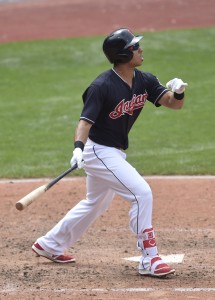
As it turned out, of course, Cleveland elected to roll the dice on Brantley, betting that he’d have his first healthy season since 2015 — when he was a high-end offensive performer. Significant shoulder and ankle problems conspired to limit Brantley to just 101 total games over the ensuing two seasons. Though he hit well in 2017, turning in a .299/.357/.444 with nine home runs in 375 plate appearances, that wasn’t near the top-level output he had turned in previously. All said, it was open to question just what Brantley would contribute in 2018
For the budget-conscious contenders, it wasn’t an easy call, particularly with a variety of potential buy-low targets available in free agency and other needs clamoring for attention. While the overall roster performance hasn’t been quite to expectations in 2018, though, the decision to hang onto Brantley has paid off handsomely.
Through 245 plate appearances on the year, Brantley carries a .316/.359/.529 slash with 11 home runs. He has returned to striking out in less than ten percent of his plate appearances. And while he isn’t walking as much as he did in 2015, with a slightly below-average 6.1% rate, Brantley is producing more power (.213 isolated slugging) than he ever has in a full season. Better still, Statcast thinks there’s more in the tank, as it credits him with a .410 xwOBA that significantly exceeds the .374 wOBA mark that has resulted.
Still, there are some questions facing Brantley away from the plate. Typically a plus runner, he has rated as a negative thus far in 2018 under Fangraphs’ BsR measure. More worrisome, perhaps, is the slippage in his defensive metrics. Most of his career has been spent in range of average in left field, but Brantley has been panned by both DRS (-8) and UZR (-5.6) in 2018.
In regard to the baserunning and glovework, a full-season sample or finer analysis could change the picture. Still, though, those aren’t the most promising developments for a player who is already 31 years of age and has fought through major health concerns of late. Brantley has also typically carried fairly significant platoon splits over his career, though he has generally produced palatable numbers against southpaws.
If Brantley can maintain his current offensive trajectory, and perhaps exhibit reasonable form in the other areas of play as well, then he’ll have quite an interesting free-agent case. His premium plate discipline and contact skills ought to play well in the market — former teammate Carlos Santana got $20MM annually last winter despite being limited to first base defensively — though age will certainly come into play.
Frankly, there are no shortage of interest market markers to consider here. On the lower end, the agreement that Denard Span inked with the Giants covered his age-32 through age-34 campaigns. Like Brantley, he was coming off of some injury-marred campaigns with questions about how he’d bounce back. Melky Cabrera was more youthful but not as accomplished as Brantley when he signed his three-year, $42MM pact with the White Sox. The same is true of Jay Bruce, who was born months apart from Brantley but reached the market one year sooner, securing $39MM over three seasons.
There’s certainly a ready argument that Brantley ought to out-perform those contracts, particularly if teams still view him as a plausible corner outfielder for most or all of the contractual term. Players of a similarly advanced age have secured five-year guarantees, with recent examples including Lorenzo Cain ($80MM), Dexter Fowler ($82.5MM), and Ian Desmond ($70MM). In each of those cases, though, the length of the deal was perhaps less concerning since the players involved were considered capable of playing center field (as well as the infield, in Desmond’s case), even if Brantley still carries a better offensive profile.
Barring an unreal run to finish the year, Brantley will likely struggle to command a fifth year, particularly as we’ve generally seen a movement toward shorter contracts in free agency. Even with the injury history, though, might he be a strong candidate for a fourth year? Curtis Granderson got to four years, at a $15MM rate, at a more advanced age. He was coming off of an injury-shortened season, though he was also an established 40-homer bat at a time when that meant more than it does today. Alex Gordon landed $72MM on a four-year term, but didn’t face the kinds of long-term health questions that Brantley does. Nick Swisher was 32 years old when he signed for four years and $56MM after a run as a steadier, but lower-ceiling hitter than Brantley. Of course, those four-year contracts are also somewhat out of date. Josh Reddick recently secured four years and $52MM. But he was entering his age-30 campaign.
Taken together, that’s quite a broad range. Given his return to form thus far, one could reasonably craft an argument that Brantley ought to rate in the Granderson-Gordon range as a high-quality, veteran corner bat. Then again, teams will need to examine and weigh his long-term medical outlook quite closely, as Brantley has dealt with quite a bit more than the sort of acute injuries that take place in the course of playing baseball. In that view, perhaps the three-year arrangements provide a better model, though even in that event Brantley is on track to staking a claim to a significant AAV.
Photo courtesy of USA Today Sports Images.
White Sox Place Nate Jones On 10-Day DL
The White Sox have announced that righty Nate Jones is going on the 10-day DL with a pronator muscle strain. Fellow righty Juan Minaya has been recalled to take his place on the active roster.
While a timeline isn’t yet known, this injury does not bode well for Jones’s potential trade status this summer. Elbow problems limited the 32-year-old to 11 appearances last year and have perhaps contributed to his struggles thus far in 2018.
It had seemed that Jones may be a target for contenders, particularly given that he has been generating swinging strikes at about at 14% clip again in the early going. He had recorded 27 strikeouts but also 14 walks in his 24 2/3 innings this year. Though he is throwing about as hard as ever, averaging just under 98 mph with his fastball, Jones was also throwing first-pitch strikes at a lower rate than ever before (54.5%).
That mixed bag did not prevent Jones from earning mention along with some other controllable, high-K relief arms in our recent ranking of the top fifty trade deadline chips. With relatively few appealing rental arms likely to be available, it stands to reason that some contenders will go looking at bullpen pieces that can be kept for future seasons.
In Jones’s case, a few weeks of success could still turn him into an intriguing asset. He has been dominant in the past, is throwing hard and getting whiffs now, and comes with a great contract situation. His deal includes cheap club options for the next three years to come — the league minimum next year and just $8MM total for the ensuing two campaigns, with an alternative, one-time buyout price of only $1.25MM. (Escalators could boost those values, but only if Jones is healthy and pitching well enough to finish games.)
A potentially analogous situation arose last year with Sean Doolittle. Though he never showed the walk issues that Jones has, Doolittle did have a similar combination of an impressive track record and concerning injury history. While he had missed time in 2017, Doolittle was healthy at the trade deadline and ended up being dealt. In his case, he returned in mid-June, so Jones will have less time to reestablish himself — if he’s able to make it back before the end of July at all. The odds of that coming to pass still aren’t clear. Long-term health will remain the priority, in any event, particularly since the White Sox still have a lengthy term over which to achieve value on the contract.
Mets Claim Chris Beck
The Mets have claimed righty Chris Beck off waivers from the White Sox, per club announcements. The 27-year-old had been designated for assignment by the Chicago organization.
Beck came up as a starter but has mostly worked in a relief role in recent years. He has 119 2/3 MLB innings under his belt, with a cumulative 5.94 ERA and 6.1 K/9 against 5.0 BB/9. The results have improved so far in 2018, as Beck owns a 4.18 ERA in 23 2/3 frames. Frankly, the peripherals don’t really indicate that he has made any strides, though Beck is working at a career-high 95.8 mph with his average fastball.
Perhaps the Mets feel they can unlock something from the former second-rounder. Of course, the club also may simply feel Beck will help improve the team’s depth situation as several hurlers filter back from the DL.
Notable Trades In The Month Of June
I’ve done a version of this post in each of the last two years, both times in late May. We’re already through nearly half of the month of June, but that doesn’t mean we can’t still take stock of the recent history of swaps in the month before primary deadline season begins. Most major swaps occur in July, of course, and most of those occur toward the end of the month.
The biggest “early” deadline deal of recent memory — the 2014 swap that sent Jeff Samardzija and Jason Hammel from the Cubs to the Athletics in exchange for Addison Russell, Billy McKinney, and Dan Straily — didn’t go through until the 4th of July. Likewise, the equally important deal from the year prior — in which the Cubs nabbed Jake Arrieta and Pedro Strop from the Orioles for Scott Feldman and Steve Clevenger — was reached on July 2nd.
That’s not to say that nothing of consequence occurs in June; indeed, as covered below, there’s already been some dealing this year. Here are some of the most notable deals that came together in the month of June over the last several seasons:
2018
- After a late-May strike of rare significance, in which the Mariners put unexpected cash availability to work in adding both Alex Colome and Denard Span, the month of June has seen a pair of notable swaps. The fading Rays acquired first baseman/outfielder Ji-Man Choi from the contending Brewers in a deal that sent recently-designated infielder Brad Miller to Milwaukee. And the D-Backs bolstered their outfield mix with veteran Jon Jay, sending minor-league hurlers Gabe Speier and Elvis Luciano to the Royals.
2017
- There wasn’t much of an early trading period in 2017, with the most significant action waiting until July and even August. The most notable swap occurred early in the month of June, when the Giants took a flier on once-dominant Rangers reliever Sam Dyson. Taking over some of Dyson’s salary proved a reasonable price to pay for the San Francisco organization, which received 38 innings of 4.03 ERA pitching, including 14 saves, as Dyson edged back toward his prior form. But the real payoff has come this year. Dyson — who still has two more seasons of arbitration eligibility — has turned in thirty frames of 2.70 ERA ball to date, with 7.2 K/9, 2.7 BB/9, and a monster 63.9% groundball rate.
- The Rays were exceedingly busy and somewhat unusually willing to take on some salary in bolstering the left side of their infield. Tampa Bay added third baseman Trevor Plouffe (link) and shortstop Adeiny Hechavarria (link) in swaps with the Athletics and Marlins, respectively, with the latter deal sending outfielder Braxton Lee and right-hander Ethan Clark to Miami. While Plouffe did not last long with the Rays, Hechavarria performed well enough to have a contract tendered for the 2018 season. He’ll likely never reach base at a palatable rate, but has hit just enough to keep his high-quality glove in the lineup. As for the young players, Lee is considered a top-twenty organizational prospect and has touched the majors, though he’s struggling at the plate in 2018. The 23-year-old Clark has yet to move past the High-A level, though he has shown an ability to get some swings and misses in the low minors.
2016
- The first and most significant deal in June of 2016 is a good place to point friends when they ask, “why don’t teams make big trades earlier in the season?” With the White Sox fading after a hot start, they took a chance on struggling veteran James Shields, absorbing about $27MM of his remaining salary obligations while also sending righty Erik Johnson and young infield prospect Fernando Tatis Jr. to the Padres. Shields continued to decline, the Sox crashed, and Tatis blossomed into a top-ten leaguewide prospect. UPDATE: Tatis still looks to be the lost jewel from a still-ballyhooed White Sox farm system. Johnson is throwing well at Triple-A in 2018 after working back from Tommy John surgery, so this deal could tip further in the Friars’ favor. Shields is still giving worthwhile veteran support to a very young group of pitchers in Chicago, but that’s scant consolation.
- In a reprisal of a deal from the prior July, the Mets picked up utilityman Kelly Johnson from the Braves. New York had a need for a veteran lefty bat capable of moving around, and Johnson fit the bill, hitting quite well and helping the Mets eke into the postseason. Relief prospect Akeel Morris, who made up the return, ended up leaving Atlanta via the waiver wire.
- A similar deal went down shortly thereafter, as the Cubs brought back Chris Coghlan after a brief stint with the Athletics. Like Johnson, he showed new life once back in his old uniform. Outfielder Arismendy Alcantara went to Oakland in the deal, but was later lost on waivers.
- In a swap of former prospects who had fallen on hard times, the Dodgers added infielder Chris Taylor from the Mariners in exchange for righty Zach Lee. The immediate impact was minimal, but Taylor broke out in 2017 and has become an everyday asset for the Dodgers. Lee, like Alcantara, was lost on the waiver wire over the ensuing offseason.
- The Dodgers also made another trade right at June’s end, adding righty Bud Norris along with outfielder Dian Toscano from the Braves in exchange for righty Caleb Dirks and lefty Phil Pfeifer. Norris fell flat in Los Angeles in 2016, though he has rebounded since. Dirks has shown some promise at times but hasn’t appeared at an affiliate thus far in 2018.
2015
- The month started with an interest arrangement that saw slugger Mark Trumbo head from the D-Backs to the Mariners along with lefty Vidal Nuno. Trumbo hit at just over a league-average rate in a half-season in Seattle but was dealt in the ensuing winter. This swap seemed mostly motivated by salary from Arizona’s perspective, but the team also received good production from backstop Welington Castillo before moving on from him the next winter. The team also picked up righty Dominic Leone, but let him go on waivers before he started turning in interesting numbers elsewhere. Prospects Gabby Guerrero and Jack Reinheimer also came from Seattle, but both are still stuck in the minors (Guerrero in another org).
- One day later, the Orioles sent veteran outfielder Alejandro De Aza to the Red Sox after designating him for assignment, receiving minor league righty Joe Gunkel in return. De Aza performed well in Boston, which took on about $1MM of his remaining salary, but couldn’t turn around a sinking ship, and was eventually passed along to the Giants.
- Later that June, the D-Backs struck another interesting deal. In exchange for taking over about $10MM of salary obligations to injured veteran Bronson Arroyo, and sending over infielder Philip Gosselin, the Braves earned the rights to high-upside pitching prospect Touki Toussaint.
2014
- In another agreement involving prospect assets, the Pirates got the 39th overall pick in the 2014 draft from the Marlins on June 1. Miami picked up righty Bryan Morris, who’s been a sturdy reliever who’s still controlled for two more years, while Pittsburgh ultimately turned that selection into first baseman Connor Joe, who has bounced around since but is currently playing well at Double-A in the Dodgers organization.
- Later that month, the Pirates and Angels made a change-of-scenery swap that sent Jason Grilli out west in exchange for Ernesto Frieri. While Grilli provided some solid innings, Frieri faded, though both organizations ended up making the post-season.
2013
- DFA swaps are often fruitful in the middle of the year, and the Brewers managed to land a useful piece from the Braves out of limbo. Third baseman Juan Francisco went to Milwaukee for lefty Tom Keeling, and ultimately gave the Brew Crew a league-average bat with some pop while the club dealt with an injury to veteran Aramis Ramirez.
- A middle-of-the-month trade of seemingly limited consequence was reached between the Mets and Rockies. New York added speedy but limited outfielder Eric Young Jr., while Colorado picked up righty Collin McHugh. The latter didn’t find success at Coors Field, but turned into quite a useful starter for the Astros in the season that followed.
2012
- The month of June started with a quiet transfer of cash considerations from the Orioles to the division-rival Yankees. The return? A first baseman by the name of Steve Pearce, who had joined New York on a minor league deal. He showed a bit of a spark that year, filled in usefully in 2013, and then exploded in the following season, when the O’s trounced the Yankees and the rest of the AL East.
- Kevin Youkilis traded color schemes, going from the Red Sox to the White Sox on June 24th. A struggling Youk headed to Chicago along with a stack of salary-offsetting cash for righty Zach Stewart and utilityman Brent Lillibridge. The 33-year-old provided a jolt for the South Siders, though the club ultimately fell shy of the playoffs.
- And at month’s end, the Orioles picked up veteran slugger Jim Thome from the Phillies in exchange for a pair of prospects (Kyle Simon and Gabriel Lino). The 41-year-old Thome wasn’t an impact bat for Baltimore, but neither of the players dealt has been of much consequence since.
Amateur Draft Signings: 6/13/18
We’ll use this post to track Wednesday’s notable agreements from the top few rounds of the draft (rankings referenced are courtesy of Baseball America, MLB.com, Fangraphs and ESPN’s Keith Law — with the scouting reports from MLB and Fangraphs both coming free to the general public) …
- Reds second-round pick Lyon Richardson scored a $2MM payday to forego his commitment to the University of Florida, per MLB.com’s Jim Callis (via Twitter). That’s nearly half a million over the slot value ($1,520,300) for a player who has only recently emerged as a high-end pitching prospect. MLB.com’s team was highest among major prospect outlets, ranking Richardson 67th on the basis of his ample upside as an athletic hurler who has shown big velocity despite unpolished mechanics.
- The Yankees have announced a variety of signings, including deals with second-rounder Josh Breaux and third-rounder Ryder Green. These agreements were first reported by Callis (Twitter links), with the bonus values pinned down by Jon Heyman of Fan Rag (Twitter links). Breaux’s bonus of $1,497,500 handily tops his $1,086,900 slot value, while Green, too, receives an over-slot $997,500 bonus that exceeds his $576,400 slot value. All of the above lists include Breaux among the top 100 available prospects, with an increasingly promising bat and improving work behind the dish justifying the placement.
- The Braves got second-round selection Greyson Jenista for a $1.2MM bonus that leaves them $250,500 of extra pool space to work with, Callis reports on Twitter. The Wichita State slugger received a fairly broad array of grades from prospect hounds, but the Fangraphs crew was highest. With big power and the ability to draw walks, but also plenty of swing-and-miss in his game, there’s a lot to like about the bat. One major question is whether Jenista will be able to work into being a reasonable defender in the corner outfield, or whether instead he’s destined for first base in the long run.
- Second-rounder Alek Thomas will join the Diamondbacks rather than heading to TCU, as Callis also tweets. The deal includes a $1.2MM bonus that tops the $1,035,500 allocation that came with the 63rd overall draft slot. Law was quite bullish on the young outfielder, crediting him with “five-tool potential” and “an advanced feel on both sides of the ball.”
- The Nationals have also agreed to terms with their second-round selection, UConn lefty Tim Cate, Callis adds on Twitter. It’s an at-slot, $986,200 bonus for the 65th overall choice of the draft. Best known for his big hook, Cate is an undersized hurler who has also had some worrying arm health questions crop up. Still, Baseball America ranked him 54th on its board, noting his “exceptional feel to land his breaking ball in the zone and bury it for swings and misses.”
- Still another second-rounder, Florida Atlantic infielder Tyler Frank, will take home a $997,500 bonus from the Rays, per MLB.com’s Jonathan Mayo (Twitter link). That leaves the Tampa Bay club with some extra funds to work with, as the 56th slot came with a $1,228,000 allocation. Also going under-slot were Royals second-rounder Jonathan Bowlan ($697,500 bonus vs. $1,168,300 slot) and Twins second-rounder Ryan Jeffers ($800K bonus vs. $1,140,600 slot), according to Callis (Twitter links)
Braves Designate Luke Jackson
The Braves have designated right-hander Luke Jackson for assignment, per a club announcement. His roster spot will go to starter Mike Soroka, who has been activated from the 10-day DL.
Jackson, 26, has been on and off the Atlanta 40-man roster a few times already in the past two seasons. For the most part, other than exhibiting good velocity, he has not shown much cause to command a regular MLB job.
That said, Jackson has shown an intriguing increase in his strikeout rate thus far in 2018, recording nine strikeouts (and allowing just two hits) in 5 1/3 MLB innings and 34 more in his 21 1/3 frames at Triple-A. He has also doled out too many free passes, though, including four in his brief time this year in the majors.
We’ll see if another organization decides to give Jackson a look, or if he’ll strike out onto the open market if he clears waivers. Having been outrighted previously, he’ll have the right to decide.
Meanwhile, the Braves will gladly welcome back Soroka. The 20-year-old phenom ended up missing about a month with a shoulder injury. He’ll make his fourth MLB start today.
White Sox Release T.J. House
The White Sox have released lefty T.J. House, per a club announcement. He had been playing with the organization’s top affiliate on a minor-league deal.
House, 28, had a very promising debut showing back in 2014, when he sported big groundball numbers and spun 102 innings of 3.35 ERA ball. But House ran into shoulder problems in the ensuing campaign and hasn’t really shown the same form since.
For most of the 2016 and 2017 seasons, House produced palatable earned run averages with middling peripherals at the Triple-A level, with brief MLB interludes. Last year, with the Blue Jays, he posted a 4.32 ERA with 7.3 K/9 and 4.3 BB/9 over 133 1/3 innings at the highest level of the minors.
Upon joining the White Sox, it seemed House would have a reasonable chance at elbowing onto the major-league staff. His efforts through 39 2/3 innings in nine starts at Triple-A, however, have not been terribly encouraging. House owns a 6.81 ERA with 5.4 K/9 and 4.1 BB/9, though he has no doubt been unfortunate to strand only 42.9% of the baserunners to reach against him.
AL Central Notes: Zimmermann, Mauer, Royals, Giolito
There was some (exceedingly mild) AL Central intrigue this morning, as reliever Matt Belisle bounced from the Indians over to the Twins, but otherwise it has been a quiet news day. Let’s take a look in at the latest items out of the AL Central:
- Tigers starter Jordan Zimmermann says he’s ready to return to the majors after his latest minor-league start, as Peter Wallner of MLive.com reports. Zimmermann has been out for just over a month with a shoulder impingement, but he says he “feel[s] strong” and has now worked up to 89 pitches in his third rehab outing. As we noted upon his DL placement, Zimmermann has continued to post mediocre results but had at least boasted much/improved strikeout and walk numbers (9.2 K/9 and 2.6 BB/9). The Tigers are still milling around in an uninspiring AL Central race, though the odds of true contention this year remain long. Zimmermann’s hefty salary commitment and full no-trade protection — it converts to partial protection after the season — make him a difficult trade candidate, though a swap at some point can’t be ruled out entirely.
- Twins first baseman Joe Mauer is just launching his own rehab assignment, MLB.com’s Jarrid Denney reports. Concussion-like symptoms have kept the 35-year-old out for the past several weeks. He has dealt with similar problems in the past, of course, which represents a major reason that he no longer plays behind the plate. Though he has not contributed enough on-field value to justify his lofty salary in quite some time, Mauer has been a productive hitter over the past two years. Thus far in 2018, he is slashing .283/.404/.355 with 28 walks against 22 strikeouts but just one home run through 167 plate appearances. Meanwhile, young outfielder Byron Buxton is going through some running and baseball activities, but still evidently remains some ways away from returning from a fractured toe.
- Giving up lefty Sean Manaea helped the Royals win a World Series, but his rise in Oakland has surely left some K.C. fans wondering what might have been. As Rustin Dodd of The Athletic writes in a subscription piece, though, GM Dayton Moore has no regrets whatsoever about how things turned out. He explains how it was that the club sent Manaea to the A’s for utility star Ben Zobrist, saying that “Billy Beane was persistent” while the Royals “weren’t going to be outbid” for a key asset after coming up just shy the season prior. Now, though, Moore says the goal is to create a broad-based array of talent that will allow the organization to “compete for a long time,” hopefully without pursuing such drastic, win-now swaps.
- Meanwhile, Lucas Giolito continues to fall shy of expectations for the White Sox. Through a dozen starts this year, including his latest yesterday evening, he carries a 7.08 ERA with just 31 strikeouts to go with 39 walks and a league-leading ten hit batters. As Teddy Greenstein of the Chicago Tribune writes, Giolito is getting plenty of leash with the rebuilding South Siders, though it’s tough to know whether or not that’s for the best given just how much he has struggled. There’s still some hope that the former top prospect will develop into a quality big league starter, writes Greenstein, and Giolito is only due to reach his 24th birthday this summer. Still, it’s fair to wonder just how long the club will keep trotting him out if things don’t improve. Skipper Rick Renteria says there haven’t been any recent discussions about sending Giolito down, though he did hint that the club has contemplated the possibility in the past.