
Minor MLB Transactions: 1/2/18
We’ll track the day’s minor moves in this post:
- The Reds have reached a minor league agreement with utilityman Phil Gosselin, Chris Cotillo of SB Nation reports (Twitter link). The 29-year-old Gosselin divided last season between the Pirates and Rangers organizations, hitting an ugly .146/.180/.188 over a small sample of big league PAs (50). While Gosselin was also ineffective at the Triple-A level (.260/.299/.326 in 292 PAs), he’s not far removed from a useful two-year showing in the majors. From 2015-16, Gosselin combined for 1.4 fWAR on the strength of a .280/.340/.411 line in 358 trips to the plate with the Braves and Diamondbacks.
Earlier updates:
- The Phillies have agreed to a minor league contract with right-handed reliever Steve Geltz, Cotillo tweets. Geltz worked exclusively with the Dodgers’ Triple-A affiliate in 2017 and posted a 2.67 ERA, 9.67 K/9 against 4.00 BB/9 and a 37.1 percent groundball rate over 27 innings. The 30-year-old previously saw major league action with the Angels (2012) and Rays (2014-16). Across 104 1/3 big league frames, Geltz owns a 4.23 ERA to accompany 8.54 K/9, 3.71 BB/9 and a 28.8 percent grounder mark.
- Infielder Ivan De Jesus Jr. is joining the Red Sox on a minor league deal, per Cotillo (Twitter link). De Jesus, 30, has past experience with the Boston organization, having been a member of it in 2012 and ’14. More recently, he spent last season with the Brewers’ Triple-A club and batted a robust .345/.407/.488 in 466 trips to the plate. He hasn’t been nearly as successful across 545 major league PAs with the Dodgers, Red Sox and Reds, having slashed .242/.303/.327.
- The Cardinals have added backstop Steven Baron on a minors pact, according to MLB.com’s Jenifer Langosch (via Twitter). (As she also notes, and we covered previously, the club also added catcher Francisco Pena.) Baron, 27, was the 33rd overall pick in the 2009 draft, but he has never hit much at all in the minors and has only minimal MLB experience. Still, he’ll represent another upper-level depth option for the Cards, who’ll become his first organization other than the Mariners. Baron spent most of 2017 at Triple-A, where he slashed .256/.339/.329 in 187 plate appearances.
Free Agent Notes: Hosmer, JDM, Arrieta, Cards, Twins, Abad
In his column today on the molasses-slow free agent market, Bob Nightengale of USA Today drops a few nuggets of information. The Padres‘ offer to free agent first baseman Eric Hosmer would promise him seven years, says Nightengale. Meanwhile, top open-market slugger J.D. Martinez is sitting on a five-year offer from the Red Sox. In other chatter, Nightengale suggests the Cubs could be willing to go as high as $110MM over four years to bring back Jake Arrieta. Of course, the teams and players just cited have likely known one another’s positions for some time now, and these stalemates have yet to be resolved. These details also fall in line with what has been reported previously about the respective situations, though they are surely interesting data points as we seek to divine when and how the free agent dam will finally break.
More on the open market:
- The Cardinals still seemingly have a wide array of potential targets as they aim to continue adding bats to their lineup (among other possibilities for improvement). Per Jon Morosi of MLB.com, via Twitter, the Cards shouldn’t be counted out on Hosmer. According to the report, St. Louis “remain[s] involved” on the first bagger, with Morosi noting the club could conceivably then bump Matt Carpenter to third base. From an outside perspective, that still seems like a hefty investment for the potential reward, particularly since the organization decided just last year to shift Carpenter across the diamond — in part, at least, to improve the defensive situation at third. With Jedd Gyorko coming off of a strong two-way campaign at the hot corner, Kolten Wong still occupying second, and a pair of young options on hand at first (Jose Martinez and Luke Voit), there are some other components at play here for the Cards. Presumably, the addition of Hosmer would mean a trade involving one or more of those existing players.
- Some down-market free agent starters may still be waiting to see what happens up top. Per Darren Wolfson of 1500 ESPN, via Twitter, the Twins are giving the “sense” to the reps of some hurlers that they want to see what happens with Yu Darvish before pursuing next-tier hurlers such as Alex Cobb and Lance Lynn. That said, as Nightengale also notes, Darvish (like Arrieta) is still waiting to see if he can secure a sixth or even seventh guaranteed season. No doubt some possible trade situations are also contributing to the stasis; as ever, some player or some team may need to blink before things get flowing.
- Lefty reliever Fernando Abad has drawn some interest from multiple organizations, per Craig Mish of MLB Network Radio (via Twitter). Mish lists a few plausible fits, in his view, though it’s not clear which particular teams have actually reached out. Abad was among the hurlers who we cited yesterday as a reliever of note on a market that has already lost many of its biggest names. He was fairly effective last year, though most of his work came in low-leverage spots. It’s possible to imagine Abad lining up with quite a few organizations, though some will undoubtedly be interested primarily in a non-roster deal.
Taking Inventory: San Diego Padres
The Padres are in a fairly flexible spot this offseason, as the team entered the winter with fairly low payroll obligations for the 2018 season and a long-term balance sheet that features just one notable commitment. While nobody really expects the team to contend in the coming season, its pursuit of Eric Hosmer shows that the organization would like to begin building toward MLB competitiveness.
On the whole, there’s no real reason to think the Padres need to trade any particular player. But the organization has one fairly obvious, high-end trade candidate and it also seems reasonaby likely that at least one veteran infielder will end up hitting the road.
Click here to view the previous entries in this series.
[Related: San Diego Padres depth chart and Padres payroll outlook; MLBTR 2018 arbitration projections]
One-Year Rental
Chase Headley, 3B ($13MM in 2018): The Friars brought back their former star in a deal that was designed mostly to acquire righty Bryan Mitchell, who’ll compete for a rotation spot. Now, it seems likely that Headley will be dangled as a means of trimming some salary. Entering his age-34 season, Headley profiles as a solid average player who could hold down the fort for a year in the right circumstances. But his overall output with the bat has been average or worse over the past four seasons, so despite the limited contractual commitment, it seems likely the Padres will have to keep some of the salary if he ends up on the move.
Two Years of Control
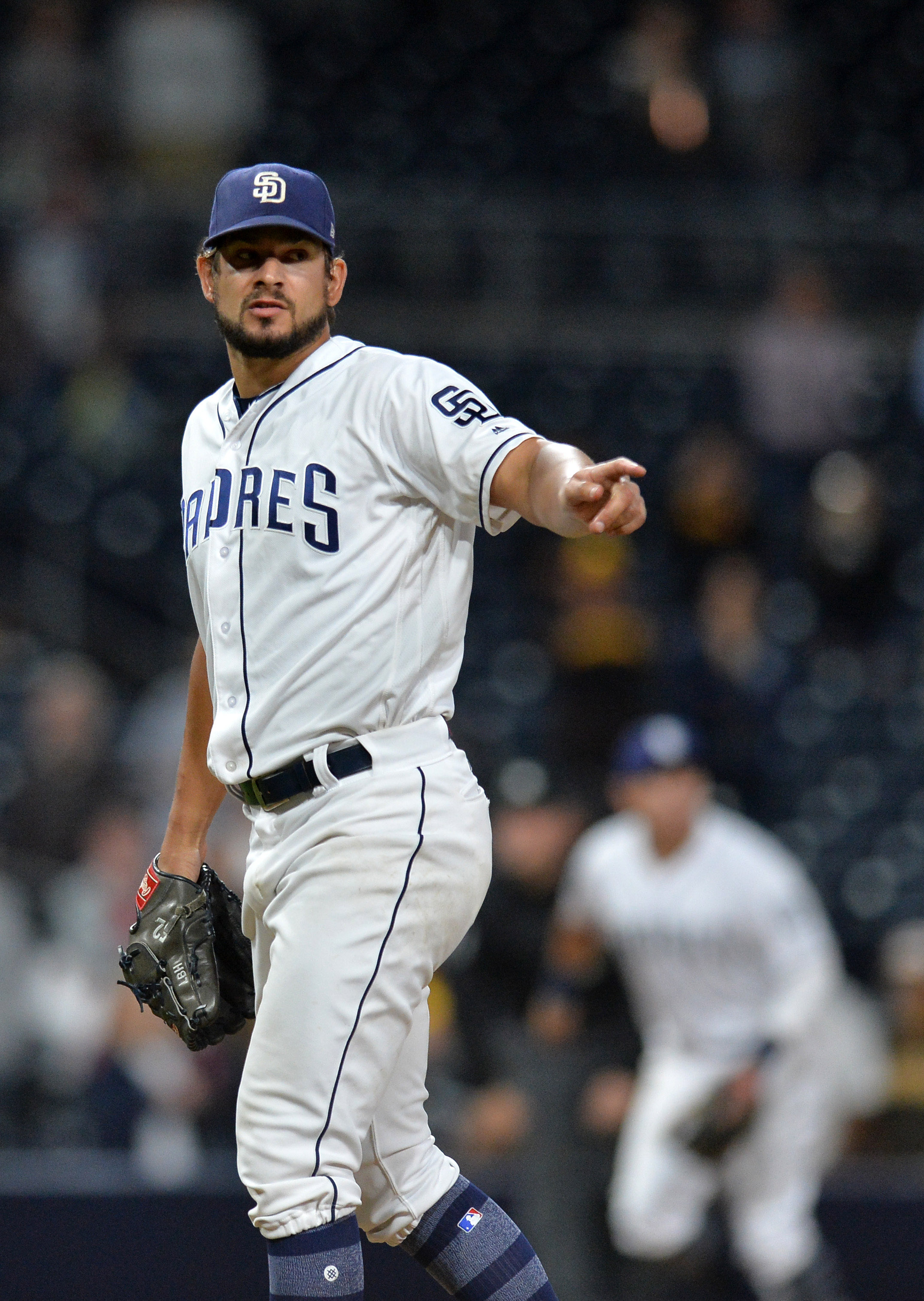
Brad Hand, RP (projected $3.8MM arbitration salary; arb-eligible thru 2019): This is the one player who stands out as a premium veteran trade asset. With Orioles lefty Zach Britton suffering an offseason injury, and a busy market for free agent relievers, Hand stands out as a highly valuable asset. He has retired more than 11 batters per nine via strikeout in each of the past two seasons and upped his output in 2017, when he ran a 2.16 ERA over 79 1/3 innings and stepped seamlessly into the closer’s role. It’s arguable the Pads ought to cash in on Hand in the near term, rather than risking any injury or performance decline, though we haven’t heard much chatter surrounding him so far this winter.
Carter Capps, RP (projected $1.3MM arbitration salary; arb-eligible thru 2019): It was an open question whether the Padres would tender Capps a contract at all following his tepid return from Tommy John surgery. The 27-year-old managed just seven strikeouts and allowed nine earned runs in his 12 1/3 innings in 2017, while showing a whopping 5+ mph drop in his average fastball velocity and carrying only a 7.8% whiff rate. But the Padres evidently feel that Capps can still build himself back into being a quality reliever, and it’s certainly worth bearing in mind just how dominant he had become before the elbow injury. It seems unlikely he’ll be moved, but it’s certainly possible a roster need could push him out or that another organization may put a slightly higher value on his upside.
Clayton Richard, SP/RP ($6MM through 2019): The southpaw just inked an extension at the tail end of the 2017 campaign, so it’s quite unlikely the Pads would turn around and deal him before the start of the coming season. Instead, the 34-year-old is likely to hold down a rotation spot and perhaps eventually slide into a swingman role as situations dictate.
Longer-Term Assets
Yangervis Solarte, INF ($5.5MM through 2018, including buyout of 2019-20 club options): If the Friars don’t trade Headley, it may be because they find a better deal that involves Solarte. A solid switch-hitting option who can handle third base, second base, and even a bit of time at short, Solarte would fit on a lot of rosters around the game. The flexibility in his contract boosts his value, though surely other organizations won’t be offering up top talent for a player who is coming off of a personal-worst .255/.314/.416 season at the plate.
Wil Myers, 1B ($78.5MM through 2022, including buyout of club option for 2023): There’s no indication that the Padres have interest in shopping Myers, who had a less-than-inspiring first season under his new contract. Rather, it seems the club is weighing a move for free agent Eric Hosmer, which would bump Myers into a corner outfield spot. But Myers does carry the team’s only large, long-term contract, so he certainly merits mention.
Cory Spangenberg, UTIL (projected $2.0MM arbitration salary; arb-eligible thru 2020): In his most extensive MLB action, a 486 plate appearance run in 2017, Spangenberg turned in a .264/.322/.401 batting line with 13 home runs and 11 steals. That’s a handy batting line for a player who rated as an outstanding overall baserunner and can play just about anywhere on the field. Then again, the output was still below the league average and there are limits to Spangenberg’s defensive function; he graded poorly at third last year and isn’t really an option at short or in center. All told, though, he’s a useful asset who’d draw interest if dangled.
Kirby Yates, RP (projected $1.1MM arbitration salary; arb-eligible thru 2020): Though he’ll turn 31 before the start of the 2018 season and has not really thrived in prior attempts at the majors, Yates is an interesting player after a strong 2017 season. Home runs marred his balance sheet in the end, but it’s hard to ignore his 14.0 K/9 strikeout rate and robust 17.3% swinging-strike rate. Odds are the Padres will keep Yates and hope he can produce the results to match those promising peripherals, but his name could also come up in trade talks.
Matt Szczur, OF (projected $800K arbitration salary; arb-eligible thru 2021): It’s hard to imagine teams lining up for a player who seemingly profiles at best as a solid, right-handed-hitting fourth outfielder. But Szczur did produce at a roughly league-average rate over 237 plate appearances in 2017, most of which came after he moved to the Friars from the Cubs in the middle of the season. Most impressively, Szczur maintained a 14.3% walk rate over the season. He’s also still affordable as a Super Two.
Austin Hedges, C (pre-arb): In all likelihood, the 25-year-old Hedges is going to continue to take the bulk of the time behind the dish for the Padres in 2018 and beyond. But there’s some uncertainty in his outlook after a marginal .214/.262/.398 output with the bat in 2017, even if he did swat 18 long balls. It’s important to bear in mind that Hedges is considered a high-quality defender; indeed, he was one of the game’s highest-rated pitch framers in his first full season as a big leaguer. There may not be a ton of offensive upside, but the Padres have good reason to continue to allow Hedges to develop as a hitter while he gives a boost to the organization’s pitching staff.
Of course, the Padres have a variety of other younger players around who could conceivably also be traded. To take a few examples, it isn’t impossible to imagine deals involving outfielder Hunter Renfroe, starter Luis Perdomo, or reliever Phil Maton. But those and others don’t seem particularly likely to be targeted by contending organizations weighing win-now moves, so we needn’t consider them in detail. We’re also going to go ahead and assume that the team intends to utilize the just-acquired Freddy Galvis at shortstop, so there’s no real cause to weigh his trade candidacy.
Photo courtesy of USA Today Sports Images.
Dodgers Acquire Dylan Baker
12:10pm: The transaction actually occurred as a trade, with the Brewers set to receive cash or a player to be named later in the deal, per a club announcement.
11:13am: The Dodgers have claimed righty Dylan Baker off waivers from the Brewers, according to a tweet from Chris Cotillo of SB Nation. Baker had been designated for assignment by Milwaukee.
The 25-year-old hurler has spent his entire professional playing career to date with the Indians, who took him in the fifth round of the 2012 draft out of Western Nevada College. He was claimed by the Brewers earlier in the offseason, though obviously he won’t end up suiting up with that organization (barring future waiver movement).
Though Baker has not thrown much of late, owing to Tommy John surgery, he has obviously drawn the attention of scouts around the game. In 2017, Baker worked to a 2.84 ERA in 12 2/3 Double-A frames over 13 appearances, recording a healthy 10:1 K/BB ratio. He had mostly worked previously as a starter, so it’s somewhat unclear what role he might occupy moving forward.
MLBTR Poll: Best 3-Year Signing To Date
Remarkably, no free agents have secured MLB guarantees of four or more years to this point, as the MLBTR 2017-18 free agent tracker shows. Hyun-soo Kim did get that length of deal to return to his native Korea, and several players picked up vesting options for fourth seasons, but it’s still a notable aspect of this winter’s player market.
That said, several players have secured promises for at least three campaigns, some of which include hefty average annual values. Relievers have dominated the early proceedings, but two position players and two pitchers who are expected to work as starters are among those to secure the largest contracts to date.
Keeping our field to the group of players who’ve secured three-year pacts, which do you think was the wisest signing, all things considered?
- Carlos Santana, 1B, Phillies ($60MM with club option): While most sluggers remain uncommitted entering 2018, Santana was pursued by multiple teams and ended up as a surprise first splash from the Phils’ front office. This was a competitive bidding situation for an accomplished hitter who is limited to playing first base, but there’s an argument to be made that the team has added a cornerstone piece at a palatable price and manageable term of commitment.
- Wade Davis, RP, Rockies ($52MM with vesting player option): While we had guessed that Davis could take down four years, he took a higher annual value over a slightly shorter term. The deal also leaves Davis with some protection at the back end, as he’ll have a very achievable vesting player option for the 2021 campaign. It’s possible to highlight the record-setting AAV here, but the Rox also no doubt feel pleased that they got the open market’s best closer at a lower overall guarantee than that secured by Mark Melancon last winter.
- Tyler Chatwood, SP, Cubs ($38MM): Here at MLBTR, we thought we might be a bit bullish on Chatty when we predicted he’d secure a three-year guarantee. It turned out we were extremely light on the dollars, as he ended up nearly doubling our best guess. Teams obviously were enamored of his stuff and youth; if he can thrive while pitching full-time away from Coors Field, perhaps the Cubs may yet have a bargain.
- Zack Cozart, SS/3B, Angels ($38MM): Year after year, Cozart has rated among the best defenders in baseball. And more recently, he has shown the bat to match, never more than in a highly productive 2017 campaign. But there just has never been adequate demand at short to drive his market. Enter the Angels, who intend to utilize Cozart at third base, where he’ll pair with the incomparable Andrelton Simmons and new second baseman Ian Kinsler to form an incredibly talented trio of defensive infielders.
- Mike Minor, SP/RP, Rangers ($28MM): Though he rebounded as a reliever in 2017, Minor has in the past been quite a high-quality starter. It seems that the Rangers’ willingness to utilize him in that role may have been a separator to allow the team to land Minor. His health remains a question, but if Minor can return to anything like his former form in the rotation he’d deliver huge value on the contract.
- Jake McGee, RP, Rockies ($27MM with vesting option): We expected the power lefty to secure a three-year deal, but he flew past our best guess ($18MM) at the guarantee. Still, it’s worth remembering that McGee succeeded in baseball’s most difficult pitching environment last year, so he has already shown the Rox what he can do at altitude. And he regained the velocity he had lost in his first year in Colorado, though he still is working at about two mph less than he did in his best days with the Rays.
- Bryan Shaw, RP, Rockies ($27MM with vesting option): Here again, an accomplished reliever secured a larger guarantee than we foresaw (in his case, $21MM). Shaw’s recent track record is of the sort that invites the question: does his durability through heavy use prove that he’s a workhorse, or suggest he could be carrying some worn-out parts that might be prone to breaking? Colorado is betting on the former. The 30-year-old has been steadily effective and has always answered the call to this point in his career.
Best 3-year free agent signing to date?
-
Zack Cozart - Angels 33% (5,489)
-
Carlos Santana - Phillies 26% (4,349)
-
Tyler Chatwood - Cubs 17% (2,797)
-
Wade Davis - Rockies 13% (2,087)
-
Mike Minor - Rangers 6% (978)
-
Bryan Shaw - Rockies 3% (555)
-
Jake McGee - Rockies 1% (230)
Total votes: 16,485
NL Notes: D-Backs, Feldman, Cardinals
Here are a few recent notes out of the National League to wrap up a quiet first day of the new year. While it’s crickets for now, there figures to be quite a lot of action over the next several weeks as the market sorts itself out in advance of the opening of Spring Training.
- The Diamondbacks‘ catching unit is designed to “take care of the pitchers first and foremost,” GM Mike Hazen tells Steve Gilbert of MLB.com (in a post that covers that and four other key issues facing the club). Hazen says the team is comfortable with the current triumvirate, which consists of Jeff Mathis, Chris Herrmann, and John Ryan Murphy, even if it doesn’t figure to over much in the way of offensive firepower. Moving forward with a trio of options is a possibility again for the Snakes, says Hazen. There are several other outstanding roster questions, of course, which Gilbert breaks down.
- We missed this one at the time it was originally reported, but it’s worthy of note. The Giants have engaged free agent righty Scott Feldman in talks, per a report from Henry Schulman of the San Francisco Chronicle, via Twitter. It seems San Francisco’s interest is in a minor-league pact. Feldman, who’ll soon turn 35, opened the 2017 season in good form but stumbled before ultimately requiring season-ending knee surgery. While he ended the year with a 4.77 ERA over 111 1/3 innings, Feldman had allowed less than four earned per nine in each of the prior four campaigns. He figures to represent a potentially steady rotation or long relief piece who ought to be available for a limited commitment.
- The Cardinals‘ recent trade of outfielder Stephen Piscotty was designed, in part, to make way for the team’s addition of Marcell Ozuna. At the same time, as Derrick Goold writes for Baseball America, the deal brought in some much-needed middle-infield depth. Youngsters Yairo Munoz and Max Schrock now sit atop the org’s prospect chart at shortstop and second base, respectively. The complexities involved in these two deals (and a few other related negotiations that did and did not come to fruition) serve to illustrate how many moving pieces can be involved in trade talks.
Taking A Look At What Is Left On The Relief Market
While the overall free-agent market continues to lag, relievers have moved freely thus far. And that hasn’t been the result of settling for lesser contracts, either. As a group, in fact, those relievers that ranked among MLBTR’s top 50 free agents have signed for nearly exactly the projected amount of guaranteed money. And a handful of other relievers (some of whom were listed by MLBTR as honorable mentions) have also scored significant contracts.
Take a look (link for app users; results compiled utilizing MLBTR’s 2017-18 free agent tracker):
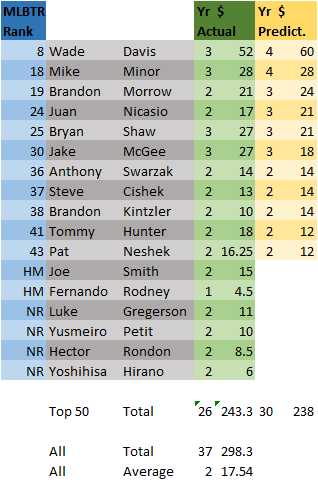
(Yes, Minor is likely slated for rotation work with the Rangers, but he spent 2017 as a reliever and was pursued by many organizations in that capacity. Click here to view all the relievers that have signed thus far.)
Quite a few matches have obviously been made already, but some yet remain. Notably, the trade market has been rather quiet with regard to relievers. The biggest names to move are players such as Jim Johnson and Thyago Vieira. That leaves a host of significant potential trade targets.
Still, many organizations will first consider the possibility of obtaining a needed arm for the cost of cash alone. Teams venturing back onto the open market for relievers will find a depleted stock, but still some possibility of finding impact, depth, or both. You can scroll through all of the relievers still available in free agency, but we’ll run through some of the most notable names below …
Premium Relievers
Two of the three top pen men are still available. Former Royals and Rockies closer Greg Holland, who MLBTR predicted would earn $50MM over four years, is certainly the biggest name left. After seeing his former teammate, Wade Davis, settle for three years (albeit at a record AAV), it seems reasonable to downgrade expectations a bit for Holland, though there’s no reason to think he won’t cash in.
Likewise, the much younger Addison Reed is still available. He has succeeded as a closer and setup man in recent years, with impeccable control and recent health. We guessed he’d secure a fourth guaranteed season and earn a total $36MM contract, though it’s arguable he could yet be worthy of more (or that he’d need to settle for less).
Either of those two pitchers would represent major additions for teams looking to shore up their late-inning units. But they aren’t the only useful relievers left …
Quality Performers
Just one top fifty free agent, lefty Tony Watson, remains unsigned. That’s rather remarkable, really, given the dearth of signings for players at other positions. In any event, Watson ought to draw strong interest. He has ample late-game experience, including as a closer, and turned in twenty strong frames with the Dodgers after a mid-season trade. MLBTR predicted a two-year, $12MM deal.
Otherwise, the top remaining lefty is Brian Duensing, who rewarded the Cubs’ faith in him with 62 1/3 innings of 2.74 ERA pitching. Notably, Duensing was about as effective when pitching with and without the platoon advantage in 2017, though that hasn’t been the case over the duration of his career. It doesn’t help his cause that he’s nearing his 35th birthday, though Duensing ought to do well on a one or two-year deal.
On the right-handed side, former closers Sergio Romo and Koji Uehara both showed signs of life in 2017. The former was lights-out after a mid-season trade, allowing just five earned runs in his 30 2/3 innings (over 25 appearances) with the Rays. And though Uehara posted the second-worst ERA of his career (3.98) and is already 42 years of age, he also averaged 10.5 K/9 against 2.5 BB/9. Both of these hurlers maintained swinging-strike rates in the range of fifteen percent. Of course, Uehara’s future is unclear, particularly given that he missed time late in the year with a neck issue.
Meanwhile, one of the game’s best relievers in terms of results was Matt Albers. Soon to turn 35, Albers recorded a 1.62 ERA over 61 stunning innings. He benefited from some good fortune, to be sure, but his peripherals (including 9.3 K/9, 2.5 BB/9, and a 51.0% groundball rate) also gave evidence of a quality performance. Likewise, 32-year-old David Hernandez produced all year long, ending the season with 55 frames of 3.11 ERA ball and 8.5 K/9 against 1.5 BB/9. Neither of these two pitchers is likely to clean up in free agency, but both seem likely to draw interest from contenders as middle relievers and stood out somewhat from some of the others covered below.
Some of the Best of the Rest
There’s quite an arbitrary dividing line between some of the names just listed and some of those yet to come (not to mention those not listed at all), but we had to draw them somewhere. Here are a few of the other notable hurlers who have also yet to sign (by handedness and alphabetical order):
Righties
- Matt Belisle – He was quite good after a miserable start and ended the year with a 4.03 ERA in 60 1/3 innings.
- Tyler Clippard – Clipp is still getting swings and misses like he did in his prime, but his flyball heavy approach has yielded an increasing number of long balls in the past two seasons and he struggled with the free pass in 2017.
- Seung-hwan Oh – His sophomore MLB season fell far shy of his debut effort, with only a 4.10 ERA through 59 1/3 innings, but the veteran Korean hurler still generated a 12.9% swinging-strike rate.
- Peter Moylan – The Aussie continues to thrive in his still-ongoing comeback tour; in 2017, he threw 59 1/3 innings of 3.49 ERA ball.
- Bud Norris – Though Norris could not hold his edge as the Angels closer, he had an extended run of success and finished with 10.7 K/9 for the season.
- Craig Stammen – In a bounceback campaign, Stammen gave the Padres 80 1/3 innings of 3.14 ERA ball. Though his peripherals (8.3 K/9, 3.1 BB/9, 51.6% groundball rate, 1.34 HR/9) were more good than great, there’s reason to hope he might have another couple seasons of workhorse output left in the arm.
- Huston Street – Teams interested in taking a shot on a highly accomplished veteran reliever will surely have interest in Street.
Lefties
- Fernando Abad – He quietly posted a 3.30 ERA in 43 2/3 innings, though he was not given much action in high-leverage spots.
- Jorge De La Rosa – In his first season as a full-time reliever, De La Rosa only carried a 4.21 ERA but utterly dominated lefties, who struggled to a .192/.253/.292 batting line.
- Francisco Liriano – It was not a productive overall season for Liriano, who struggled both before and after a trade and move to the pen, but he nevertheless held the 100 opposing southpaws who strode to the plate against him to a .247/.300/.355 slash.
- Oliver Perez – Though the overall results weren’t great, Perez was still tough for lefties to square up (.227/.301/.364).
- Travis Wood – There wasn’t much to love about Wood’s output in 2017, and he was just cut loose by the Padres, but it wasn’t long ago that he was a useful pen presence with swingman abilities.
Taking Inventory: Cincinnati Reds
The Reds have already parted out most of the components of their most recently competitive roster. It seems the inclination now is to begin climbing the hill rather than continue to strip away veterans. That being said, this is a club that won just 68 games in 2017 and has shown no real indication of ramping up spending.
In short, the Reds are in no position to decline to consider trades involving shorter-term veteran assets. At the same time, indications are that they have fairly hefty asking prices affixed to some of their most notable trade pieces.
[Related: Cincinnati Reds depth chart and Reds payroll outlook]
Two Years of Control
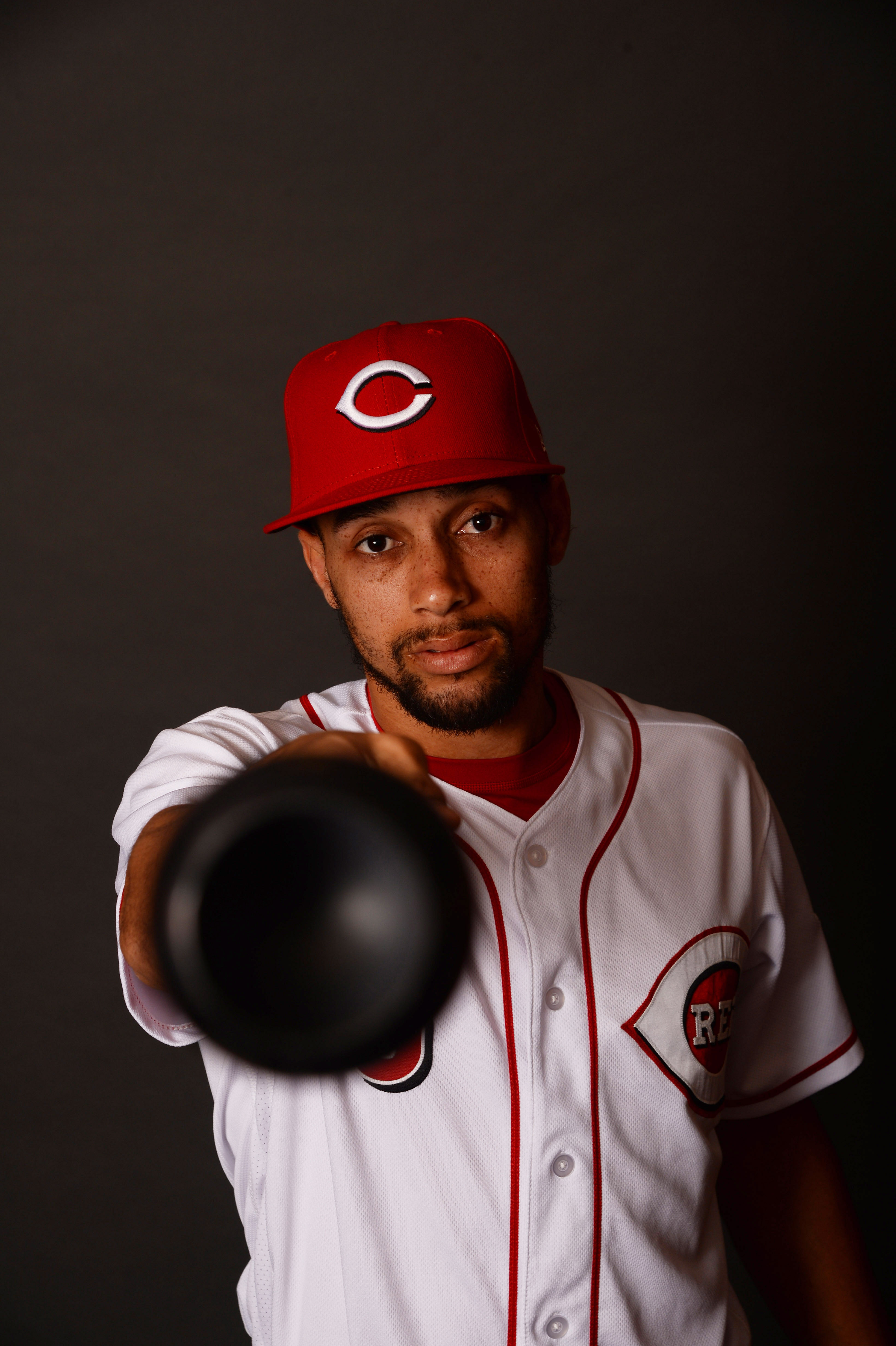
Billy Hamilton, CF (projected $5.0MM arbitration salary; arb-eligible thru 2019): The game’s preeminent burner, Hamilton has drawn a steady drumbeat of trade chatter all winter. Thus far, nothing has come together, but it still feels reasonably likely that another organization will make a significant enough offer to tempt the Reds. After all, though Hamilton has yet to show he can consistently reach base, his lofty baserunning and defensive value make him a highly useful player even if his career ceiling with the bat is still about twenty percent below league average. Dealing Hamilton would clear room in the outfield rotation for youngster Jesse Winker, who showed well in his 2017 debut.
Scooter Gennett, 2B (projected $6.1MM arbitration salary; arb-eligible thru 2019): The Cinci front office made good on its surprising claim of Gennett before the 2017 campaign. He rewarded the faith with 497 plate appearances of .295/.342/.531 hitting and 27 home runs — far and away his best full-season output. That said, Gennett has never hit lefties much and is generally graded as a below-average defender at second, limiting his value. There has been little reported interest to this point, though perhaps it still wouldn’t surprise if he ends up on the move.
Longer-Term Assets
Joey Votto, 1B ($157MM thru 2023; includes buyout on 2024 club option): Sure, he’s 34 years of age, but Votto has been the second-best hitter in baseball over the past three years. That makes the remainder of his massive extension seem quite a bit less onerous than might have been feared. Odds are, though, we won’t get a chance to see how the rest of the league values Votto. All indications are that Votto is not interested in waiving his full no-trade protection and the Reds seem happy to keep him around.
Raisel Iglesias, RP ($13.5MM thru 2020; may opt into arbitration; arb-eligible thru 2021); The Reds’ most obviously marketable player, Iglesias has blossomed into one of the game’s better young late-inning relievers. He’s capable of functioning as a traditional closer or multi-inning stopper. Though he’ll ultimately have a chance to boost his earnings by opting into arbitration, Iglesias remains a controllable bargain. While we analyzed his possible market earlier in the offseason, indications are that the Reds have advertised such a high and firm asking price that interested parties aren’t even coming onto the lot to kick the tires.
Eugenio Suarez, INF (projected $4.4MM arbitration salary; arb-eligible thru 2020): With three years of control remaining, the Reds don’t need to deal Suarez. But they could conceivably find it an opportune time to move the 26-year-old, who is fresh off of an excellent .260/.367/.461 campaign, with top prospect Nick Senzel nearing MLB readiness. That said, Suarez is capable of playing elsewhere in the infield, and it seems likelier that the Reds will explore a long-term contract than try to work out a deal for a player who could well be a key part of the organization’s next contender.
Tucker Barnhart, C ($16MM through 2021; includes buyout on 2022 club option): A quality defender who has increasingly shown he can hit at a useful rate, Barnhart only signed his contract in September. It’d rank as quite a surprise were he to be moved at this point.
Adam Duvall, OF (pre-arb eligible): Though he has swatted over thirty home runs in each of the past two seasons, Duvall has been a roughly league-average hitter due to his inability to get on base (career .296 OBP). That said, highly-rated glovework in the gives Duvall the profile of a solid average regular in the corner. There’d be interest if the Reds make him available, but it still seems likely he’ll be kept in the fold.
Scott Schebler, OF (pre-arb eligible): You can basically take exactly what was written about Duvall and apply it to Schebler. While the latter did not grade as a top-end right fielder in 2017, he did show he can palatably patrol center. With just 1.132 years of service to this point, though, Schebler is likely to remain in Cincinnati for the time being.
Anthony DeSclafani, SP (projected $1.1MM arbitration salary; arb-eligible thru 2020): Elbow troubles robbed all of 2017 from DeSclafani. He remains an exciting pitcher when healthy, and the Reds are all but certain to hold onto his upside this winter.
Brandon Finnegan, SP (pre-arb eligible): Similarly, Finnegan is coming off of a season in which entered with big expectations but managed only four outings. Cinci has little choice but to hope for better health. It’s worth noting, too, that other controllable starters — most notably, eye-opening 2017 debutante Luis Castillo — are likely to be kept in the stable.
Michael Lorenzen, RP (projected $1.4MM arbitration salary; arb-eligible thru 2021): Perhaps the Reds would at least listen to offers on Lorenzen, who did not produce results to match his big-time stuff in 2017. He’d surely draw interest after showing a personal-high 10.4% swinging-strike rate and strong 54.6% groundball rate in heavy usage (83 innings over seventy appearances). But for the Reds, the hope remains that he’ll join Iglesias to form a dominant late-inning duo. It’s even less likely that the club will end up dealing other relief assets, though perhaps there could be some interest in Wandy Peralta, who turned in a solid (if hardly dominant) rookie season.
Jose Peraza, INF (pre-arb eligible): Unless the Reds decide to give up on Peraza, he’ll remain on hand to fill out the infield. But the team is no doubt concerned with what it saw over his 518 plate appearances in 2017, as Peraza managed 23 stolen bases but otherwise produced a marginal .259/.297/.324 batting line.
Salary Dump Candidates
Homer Bailey, SP ($49MM through 2019; includes buyout of 2020 mutual option): If you’re looking for positives, you’d note that Bailey showed velocity in the range of his career peak (94 mph or so) over 91 frames in 2017 — his most extensive action since 2014. But he managed only a 6.43 ERA in that span, with just 6.6 K/9 against 4.2 BB/9. Given that the Reds have a need for innings, and no doubt still have some hope that Bailey will find his way, it seems likeliest this contract will remain on the books for the time being.
Devin Mesoraco, C ($13.125MM in 2018): Just as he was finally showing some signs of health and productivity with a .260/.345/.600 output last June, Mesoraco hit the DL with a shoulder strain. He scarcely hit at all upon returning and ended up suffering a season-ending foot fracture in mid-August. In the aggregate, the Reds have received virtually nothing for the $28MM they committed to Mesoraco via extension: he has provided just 271 plate appearances of 61 OPS+ hitting over the past three seasons. With nearly half of that outlay still left to be paid in the final year of the deal, it’s hard to see Mesoraco as anything but a potential salary dump candidate at this stage. In all likelihood, the Reds will carry him into the season and see what they can get — with the idea of a mid-season trade still carrying at least some potential for saving a bit of cash.
Photo courtesy of USA Today Sports Images.
5 Key Stories: 12/24/17 – 12/30/17
Here are the biggest stories from the past week at MLBTR …
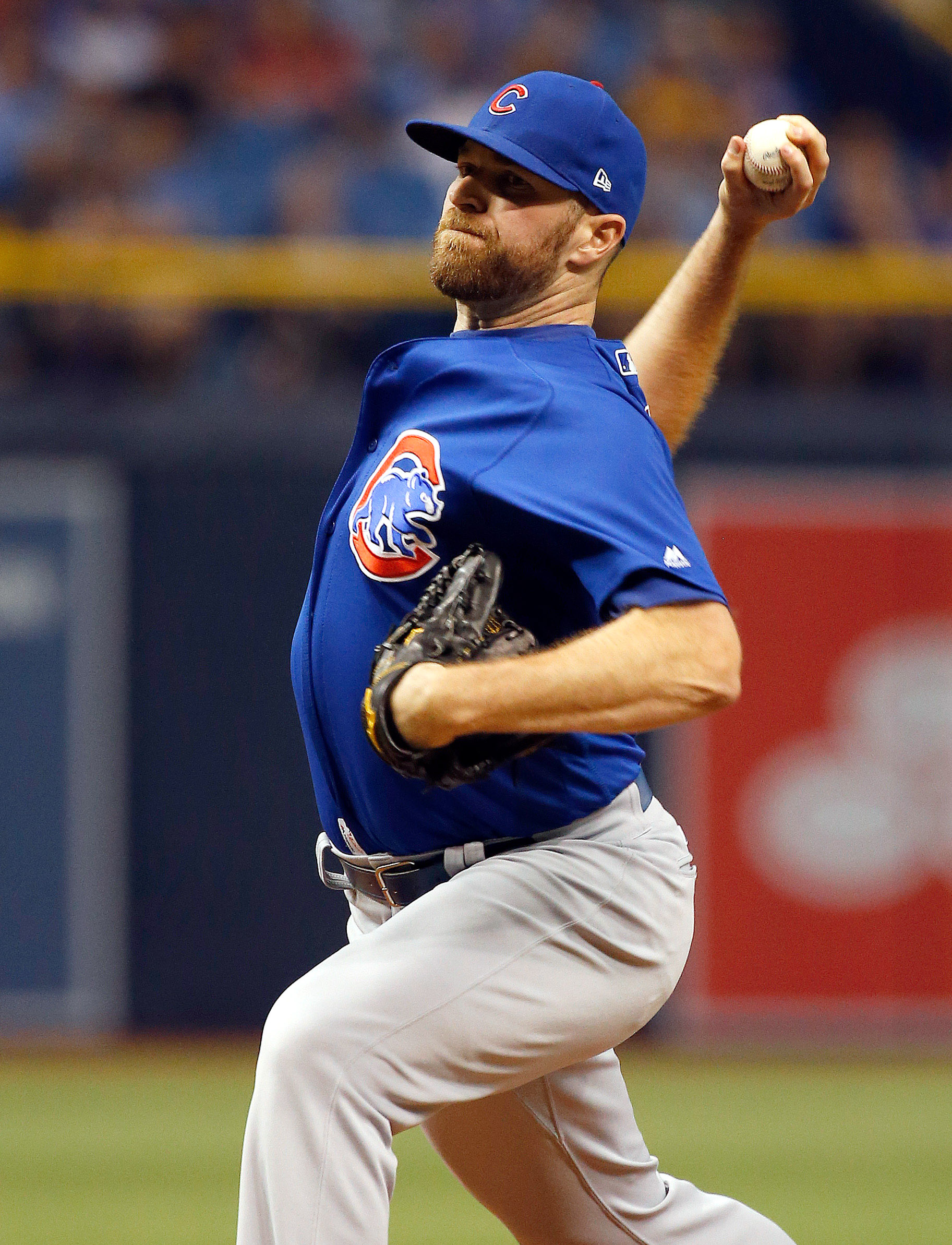
Rockies complete trio of high-priced relief additions: After committing $27MM apiece to two top setup men, the Rockies went for broke by signing top free agent closer Wade Davis to a three-year, $52MM deal. Davis can lock in yet more money if he’s healthy and holds onto the closer’s role for the third season of the contract, via a vesting player option. All told, it’s a significant commitment — indeed, the deal includes the highest average annual value ever given to a reliever — that confirms the Rox believe they are primed to contend.
Twins star Sano accused of assault: Earlier this week, a photographer made some troubling accusations of assault against young Twins third baseman Miguel Sano. At this point, it is not clear whether legal or league disciplinary action will occur. The incident is being investigated under MLB’s domestic violence, sexual assault, and child abuse policy, which gives the commissioner authority to investigate and punish players regardless of arrest or prosecution.
Reds building out bullpen: After two seasons of mostly miserable output from the Cincinnati pitching staff, the Reds entered the offseason in search of a few arms to help turn the tide. While the club does not seem to be gearing up for any major spending, it can probably hope for significant improvements merely by replacing sub-replacement-level output with solid hurlers. That’s likely an element of the thought process in the team’s signing of righty Jared Hughes to a two-year pact. Giving him a multi-year guarantee likely tamped down the annual cost (he’s promised just $4.5MM) and helped draw the veteran to town. It remains to be seen whether further relief upgrades will be pursued, though if so it’s likely they’ll be similarly low-cost acquisitions.
Twins ink bounceback relief candidate: Much like the Rockies, the Twins were a somewhat surprising postseason team in 2017. Both organizations have solid young cores in place but also still admit of a few holes. But while the Rox spend big on premium relief arms, the Minny brass has adopted a somewhat more conservative strategy. Most recently, the club signed veteran southpaw Zach Duke to join aging closer Fernando Rodney in the late-inning mix. More significant additions could also be pursued, but it seems the Twins intend to be a bit more protective of their future balance sheets while still trying to add veterans to the 2018 roster.
Old favorites seek redemption in San Diego: It has been an interesting offseason thus far for the Padres, mostly owing to a surprise pursuit of top free agent first baseman Eric Hosmer (status: unresolved). Perhaps it’s mostly a curiosity at this point, but the organization has also landed a few former stars. After agreeing to take over the contract of third baseman Chase Headley, the Friars went out and struck minor-league pacts with former right-handers Chris Young and Tyson Ross (see here and here). Both of the hurlers will need to pitch their way onto the roster in camp, and Headley could well end up being traded, but it’s still fun to see such notable alums filtering back. As MLBTR’s Jason Martinez noted on Twitter, the Pads could really make things interesting if they found a way to bring back current free agents such as Andrew Cashner, Jake Peavy, and Mat Latos.
Photo courtesy of USA Today Sports Images.
Brewers Among Teams To Show Interest In Alex Cobb
The Brewers are among the MLB organizations to have shown some level of interest in free agent righty Alex Cobb, according to a report from Jon Morosi of MLB Network (via Twitter). Per Morosi, Milwaukee has spoken with Cobb’s agency “recently” about the veteran starter. Of course, it’s also far from clear how serious the interest is.
Last we heard, the asking price was still high for Cobb, who even appears to have some hope of securing five guaranteed seasons. As MLBTR’s Tim Dierkes has noted, the surprisingly lofty payday secured by Tyler Chatwood seemingly bodes well for Cobb’s market.
The ongoing delay in free agent signings has many wondering whether some open-market players will end up taking a haircut as against expectations. To this point, however, we’ve yet to see any top-tier free agents settle for contracts that would support such a conclusion.
In Cobb’s case, it seems there’s still wide interest in his services. While the Brewers won’t be expected to bid up a massive payday, they have plenty of money to work with, making them a legitimate potential suitor on paper. The division-rival Cubs have long been cited as a top potential landing spot, with teams like the Rangers, Yankees, Blue Jays, and Orioles among those having shown prior interest.
Prior surgeries continue to represent a possible drag on Cobb’s market, but he is fresh off of a productive and healthy 2017 campaign in which he ran up a 3.50 ERA over 179 1/3 innings. Plus, of course, Cobb has demonstrated the talent for even greater productivity; in 309 2/3 innings over 2013-14, he compiled a 2.82 ERA with 8.2 K/9 and 2.7 BB/9.