
Twins Interested In Justin Turner, A.J. Pollock
Justin Turner and AJ Pollock are among the veteran free agents under consideration by the Twins as they look to further bolster their lineup, The Athletic’s Dan Hayes reports. Of note, Hayes’ piece was written yesterday prior to Minnesota’s signing of Joey Gallo to a one-year, $11MM contract — Gallo was also listed as a player the Twins were targeting, though his addition could change the equation for other pickups.
In particular, Pollock might no longer be on the radar given how Minnesota’s outfield picture was already pretty crowded even before Gallo joined the roster. Gallo, Byron Buxton, Max Kepler, Alex Kirilloff, Trevor Larnach, Mark Contreras, Matt Wallner, Gilberto Celestino, and Kyle Garlick are all outfield options for 2023, plus the versatile Nick Gordon could also get some time on the grass when he isn’t in the infield.
That said, there has been some trade speculation surrounding Kepler, and Gallo’s deal might be some hint that the Twins could view Gallo as something of a Kepler replacement. Furthermore, Buxton, Celestino, and Garlick are the only right-handed hitters within that large outfield grouping, so acquiring Pollock would add more lineup balance and depth at all three outfield positions (though Pollock is no longer a defensive standout at any spot).
The Twins got a close look at Pollock when he played for the division rival White Sox last season, but they hardly saw the veteran at his best. Pollock’s 92 wRC+ was his lowest in a full season since 2013, and he hit only .245/.292/.389 over 527 plate appearances. Since he is entering his age-35 season, there is surely concern among some teams that Pollock has started to decline.
On the plus side, Pollock’s overall Statcast numbers were pretty decent, with an above-average strikeout rate and hard-contact numbers. While his .317 xwOBA was nothing special, his .297 wOBA indicates some degree of bad luck. Furthermore, Pollock’s overall batting line only took a hit against right-handed pitching — he had a .935 OPS in 133 PA against left-handed pitching in 2022, but a dreadful .593 OPS in 394 PA against righties.
As much as Pollock still looks capable of crushing southpaws, these drastic splits give pause to any club considering Pollock for an everyday job. The Twins’ plethora of left-handed outfielders would make a platoon or timeshare pretty easy, though it remains to be seen if Pollock would be open to a reduced role. Pollock already showed confidence in his ability to bounce back by declining his $13MM player option with Chicago and taking a $5MM, essentially making an $8MM bet on himself to find a larger deal on the open market.
There hasn’t been a lot of public interest in Pollock to date, while the Marlins, Dodgers, and Diamondbacks have all been linked to Turner, and at least one team (Miami) has made the infielder a proper offer. Turner and Pollock were teammates with the Dodgers from 2019-21, and while the 38-year-old Turner is the older of the two, he also figures to be more expensive given the larger interest and a better platform year.
Turner hit .278/.350/.438 with 13 homers over 532 PA with Los Angeles in 2022, essentially having a split season in terms of production. Turner had a measly .611 OPS over his first 243 PA of the year, but then snapped back into form and had a .940 OPS over his last 289 PA. Considering the unique circumstances (i.e. the lockout, and the shortened Spring Training) of the lead-up to the 2022 campaign, Turner’s slow start could be written off as a product of an unusual offseason.
With the universal DH coming to the National League last year, Turner basically split time between DH and third base. The Twins could deploy this same strategy, having Turner and Jose Miranda in a timeshare at third base (though both players at right-handed hitters) and using Turner at DH whenever Miranda is at the hot corner. Apart from one game at second base and one mop-up inning as a pitcher, Turner has played only third base since the start of the 2017 season, but he could theoretically factor into the first base mix as well.
Christian Vazquez‘s three-year, $30MM contract represents Minnesota’s biggest expenditure of the winter, and even with Gallo added, the Twins’ payroll still projects under the $118MM threshold. That is well under the $134.4MM the Twins spend on their Opening Day roster last year, and given how Minnesota made a concerted effort to try and re-sign Carlos Correa to a pricey new contract, the Twins clearly have money to spend or re-allocate now that Correa has joined the Giants.
Latest On Dansby Swanson’s Market
Dansby Swanson is the best remaining free agent, the only of the top four shortstops who has yet to agree to terms. Teams like the Cubs, Twins, Dodgers, Red Sox and incumbent Braves have all been tied to him, although there’s no indication he’s especially close to a deal.
Minnesota, Boston and the Dodgers each lost a star shortstop of their own to free agency, making them all natural fits to look to Swanson as a possible replacement. However, various reports have cast some doubt on each of those possible landing spots. Both Ken Rosenthal of the Athletic and Jon Heyman of the New York Post have written recently that Los Angeles is presently more on the periphery of the Swanson market. Rosenthal and Heyman each suggest L.A. might only jump into the mix if Swanson’s asking price dips into a range they find especially palatable.
That at least partially stems from luxury tax considerations, with various reports suggesting the Dodgers are eyeing the possibility of dipping below next year’s $233MM base threshold. The Dodgers have paid the tax in each of the last two seasons, setting them up for heightened penalties as repeat payors. A team can reset their payor status by dipping below the threshold for one year, and doing so next season may free L.A. up to aggressively target free agency during the 2023-24 offseason. Los Angeles is presently projected around $32MM shy of the tax marker by Roster Resource, leaving room to add Swanson without going past the threshold. However, there’s apparently some organizational concern they could find themselves on the hook for money owed to Trevor Bauer if the pitcher’s two-year suspension is overturned or reduced on appeal, which is expected to be heard in the next month.
Heyman wrote yesterday the Red Sox are “seriously considering” Swanson after watching Xander Bogaerts head to San Diego. Chief baseball officer Chaim Bloom recently told the media the club was looking to add players at up-the-middle positions, but the presence of Trevor Story means they’re not locked into a shortstop pursuit. Boston reportedly offered Bogaerts, whom they’d called their top offseason priority, $162MM over six years before he landed in San Diego. Pivoting with a similar or higher proposal to Swanson would raise some eyebrows, and Jen McCaffrey of the Athletic wrote yesterday it seems unlikely Boston would make such an investment.
The Twins had been in contact with Swanson even before Carlos Correa agreed to terms with the Giants, putting themselves into the mix for a fallback option. Both Darren Wolfson of SKOR North (Twitter link) and Dan Hayes of the Athletic (on Twitter) suggest the Twins remain involved, but both reporters characterize it as more of a longshot for Swanson to actually land in Minneapolis. The Twins do still have a fair bit of payroll flexibility, even after this afternoon’s $11MM agreement with Joey Gallo.
Regardless, Swanson’s sure to find a significant deal from some team this winter. The next-best remaining free agent shortstop is Elvis Andrus, while the trade market doesn’t have many obvious solutions. Swanson is coming off an All-Star campaign, one in which he connected on 25 home runs with a .277/.329/.447 line while appearing in all 162 games for the Braves. He also secured his first career Gold Glove after rating as 15 runs above average defensively, per Statcast. At the start of the offseason, MLBTR predicted a seven-year, $154MM contract.
Identifying The Best Landing Spots For Dansby Swanson
Dansby Swanson is the last unsigned position player from MLBTR’s top ten free agents. He’ll be the final of the four top-tier shortstops to come off the board, and his destination will surely be influenced by how the market has already played out.
The Phillies and Giants entered the offseason widely regarded as potential landing spots for the top shortstops, particularly if San Francisco were to wind up missing on Aaron Judge. Few would’ve foreseen the Padres jumping into that mix for Xander Bogaerts, with San Diego taking one of the “big four” off the board and perhaps opening another landing spot for Swanson.
Let’s take a look at the most plausible remaining landing spots.
Best Fits
Cubs
The Cubs met with all four top shortstops at the outset of the offseason, but there’s no indication they’ve wanted to pay the enormous asking prices on any of the other three. Gordon Wittenmyer of NBC Sports Chicago wrote last night that discussions with Carlos Correa were limited to general outlines of possible financial parameters, with no formal offer being put on the table. Swanson figures to land the lowest deal of the group, perhaps making him a more palatable target for Chicago. Even if Swanson won’t push or exceed $300MM as Correa, Trea Turner and Bogaerts had, he’s likely to surpass $150MM. This would require the largest investment the Cubs have made since signing Jason Heyward seven years ago.
Is Chicago ownership willing to go to that level? They should have the payroll space to do so, as they’re around $157MM in projected 2023 commitments. That’s above where they’ve sat the last two seasons but nowhere near the $200MM+ franchise-record heights from a few years ago. The Cubs are coming off a second consecutive well below-average season, but they’ve continued to maintain they’re not in a rebuild. It’s hard to imagine acquisitions of Jameson Taillon and Cody Bellinger alone getting a 74-win team back to postseason contention, particularly since they also lost Willson Contreras to free agency. Even adding Swanson to the mix likely leaves them behind the Cardinals and Brewers, but he’s only entering his age-29 season and should still be productive in 2024 and beyond — when the Cubs have a more realistic path to competing. The presence of Nico Hoerner means the Cubs don’t need a shortstop. Second base looks as if it’ll be manned by Nick Madrigal or Christopher Morel, though, and adding Swanson and kicking Hoerner to the other side of the bag would solidify the middle infield.
Twins
The Twins missed on Correa, whose stay in Minneapolis lasted only one year. Their reported ten-year, $285MM bid came up well shy of the 13-year, $350MM contract he eventually received from the Giants. Minnesota finished 78-84 even with Correa, and while better health from their pitching staff should help in 2023, they’re behind the Guardians and White Sox in the AL Central as presently constructed. Pivoting to Swanson is a natural fallback, and Minnesota had already been in touch with his representatives even before officially losing out on Correa.
Minnesota has ample payroll room, as illustrated by their ultimately unsuccessful proposal to Correa. They’re not likely to present Swanson with anywhere near the same offer, but ownership and the front office could allocate much of their remaining space to plugging the shortstop vacancy. The Twins acquired Kyle Farmer from the Reds last month. He’s probably better suited for a utility role on a contender but presently projects as the starting shortstop. Former first overall pick Royce Lewis could factor in midseason. He won’t be ready for Opening Day after tearing the ACL in his right knee for the second time last June. It’s anyone’s guess how much of his athleticism and explosiveness he’ll retain after a second straight massive injury. Even if Lewis comes back strong yet again, he could bounce around the diamond in a multi-positional role if Minnesota were to add Swanson.
Braves
The Braves have publicly maintained they’d like to keep Swanson, who has been their everyday shortstop for the past six seasons. There’s certainly a fit on the roster. Atlanta looks as if they’d roll with Orlando Arcia and eventually top prospect Vaughn Grissom if Swanson walks. The Braves have had success trusting young players like Grissom in recent years, but he’s not without risk. Prospect evaluators have raised concerns about his defense, and he’s played all of 63 games above High-A. In a division with the Mets and Phillies, the Braves are facing sharp competition to put their best foot forward.
As has been the issue for months, the question about Atlanta is financial. They’re already at franchise-record heights for their player payroll, and their early offseason work has focused on the trade market. The Braves brought in Sean Murphy and Joe Jiménez, leveraging young talent but not taking on any notable salaries. Mark Bowman of MLB.com reported last week the Braves and Swanson had had minimal contact since the offseason began, writing their most recent offer would’ve come with an annual salary in the $16-17MM range over six or seven years. That looks extremely light, particularly given the strength of the rest of the shortstop market. The Braves could circle back, and Jon Heyman of the New York Post tweeted yesterday that Swanson — a Georgia native — would still like to return to Atlanta. At least as of last week, there was a huge gap to bridge in negotiations, though.
Viable But Longer Shots
Dodgers
The Dodgers have been loosely tied to Swanson this offseason after seemingly not showing significant interest in the other top shortstops. It’s been a relatively quiet offseason for L.A., perhaps in part due to a hope of resetting their luxury tax status by dipping below next year’s $233MM base threshold. That’s not clearly a mandate, but team officials have signaled a desire to integrate some of their highly-touted position player prospects into the mix. The Dodgers presently project for a $201MM competitive balance tax number, so they could squeeze Swanson in while staying below the line as things stand. As MLBTR’s Darragh McDonald wrote this week, however, they won’t have official clarity on their tax number until the Trevor Bauer suspension is litigated. Gavin Lux is on hand as a potential shortstop option, with Chris Taylor possibly sliding to second base in that scenario.
Red Sox
Like the Dodgers and Twins, the Red Sox lost their star shortstop in free agency. They’re now seeking up-the-middle help and a right-handed bat to balance the lineup. Swanson would knock off those goals in one swoop, and Boston has nearly $40MM in payroll room before hitting the base tax threshold. Like the Dodgers, they’ve been loosely tied to Swanson this offseason. It’d still come as a surprise if they pivot towards a full-fledged pursuit of Swanson after watching Bogaerts depart. They reportedly put forth a six-year, $162MM offer to their incumbent star shortstop. While they may have been willing to go a bit above that, they never seemed interested in matching the $280MM figure laid out by San Diego. That’s understandable, although Swanson’s contract could well beat what Boston had offered Bogaerts. Would the Red Sox make a stronger offer to Swanson than they had to a homegrown star whom they’d repeatedly called their top offseason priority?
Seemingly Unlikely
- Angels: The Halos have an uncertain middle infield mix and could look outside the organization to pair with David Fletcher, Luis Rengifo and perhaps Gio Urshela in that group. They’ve been fairly active early, taking on around $40MM in 2023 salary to add Urhsela, Hunter Renfroe, Tyler Anderson and Carlos Estévez. None of it has come with a longer commitment than the three years they guaranteed Anderson, though. Does owner Arte Moreno want to add a six-plus year deal to the books when he’s hoping to sell the franchise by Opening Day?
- Cardinals: The Cardinals were tied to Swanson earlier in the offseason. Derrick Goold of the St. Louis Post-Dispatch suggested that was likelier to happen only if the Cards landed the catcher they considered a top priority via trade. Instead, they signed the top free agent available, Contreras, for $87.5MM over five seasons. A franchise-record contract for Swanson on top of that feels uncharacteristic for an organization that usually does its hefty lifting via trade.
- Diamondbacks: The D-Backs could use a shortstop and were loosely linked to Bogaerts earlier in the offseason. They’ve occasionally come out of nowhere to make a major free agent investment (see: Zack Greinke), but they haven’t topped $100MM in Opening Day payroll in either of the last two years. Bringing back Swanson, whom the previous front office initially drafted with the first overall pick in 2015, would make a lot of sense from a roster perspective, but the money probably isn’t lining up.
- Giants: San Francisco could probably accommodate another notable signing, as they’re presently projected around $27MM below the base luxury tax threshold. They’d likely be able to fit Swanson in while avoiding tax payments, but it feels unlikely after they nabbed Correa. Brandon Crawford and Wilmer Flores give them other options at second and third base. First base, center field and the bullpen all look like greater areas of need.
- Mariners: At the start of the offseason, the Mariners expressed some willingness to pursue a shortstop with an eye towards kicking him over to second base in deference to J.P. Crawford. They subsequently traded for Kolten Wong instead, which looks as if it’ll rule them out.
- Mets: The Mets warrant cursory mention on every top free agent at this point given owner Steve Cohen’s aggressiveness. They reportedly at least considered a run at Correa with an eye towards moving him to third base. Swanson isn’t that caliber of hitter, though, and kicking him over to third while displacing Eduardo Escobar, Luis Guillorme and top prospect Brett Baty seems like a stretch.
- Orioles: The Orioles were reportedly poking around the shortstop market at the start of the offseason. They’ve not actually shown any signs they want to make a major investment this winter, though. With a number of top infield prospects at the MLB level or on the horizon (i.e. Gunnar Henderson, Jordan Westburg, Joey Ortiz), a Swanson pursuit doesn’t seem to in the cards.
- Padres: San Diego is in Mets territory of warranting a mention on every free agent given their boldness, but the infield is already overloaded after the Bogaerts deal.
- Yankees: For a second straight offseason, the Yankees haven’t seemed much interested in exploring the top of a loaded shortstop class. They’ve maintained faith in prospects Oswald Peraza and Anthony Volpe to eventually seize that mantle. If they’re going to make another big investment after re-signing Judge, it seems Carlos Rodón is the target.
Note: all salary projections courtesy of Roster Resource
Where does the MLBTR readership expect Swanson to wind up?
(poll link for app users)
Where Will Dansby Swanson Sign?
-
Cubs 34% (4,076)
-
Braves 24% (2,885)
-
Twins 15% (1,766)
-
Dodgers 11% (1,273)
-
Red Sox 9% (1,113)
-
Other (specify in comments) 7% (879)
Total votes: 11,992
Twins Drawing Trade Interest On Sonny Gray, Kenta Maeda
The Twins have received interest from other clubs in starting pitchers Sonny Gray and Kenta Maeda, reports Dan Hayes of the Athletic. It’s not clear how open Minnesota is to moving either player, although it stands to reason they’d at least gauge the market and see if another club were willing to bowl them over with an offer.
It’s unsurprising other teams would eye the pair of Minnesota righties, both of whom have established track records as productive MLB starters. Gray would be the more appealing of the duo, as Maeda didn’t pitch in 2022 recovering from Tommy John surgery he underwent in September ’21. Gray dealt with a few health issues himself, missing time with a pair of strains in his right hamstring and a pectoral strain. Around the trio of injured list stints, the righty pitched well, though.
Acquired from the Reds in Spring Training, Gray made 24 starts during his first season in Minnesota. He posted a 3.08 ERA across 119 2/3 innings, fanning an above-average 24% of opponents against an average 7.4% walk rate. Gray’s 44.5% ground-ball percentage was a personal low, but it was still a bit better than par. At his best, the two-time All-Star generates a rare combination of whiffs and grounders. He hasn’t reached 30 starts in either of the past two seasons, but Gray’s an upper mid-rotation caliber arm when he’s healthy.
At year’s end, Minnesota made the easy call to exercise a $12.5MM option on his services. He’s slated to return to the Twin Cities for what’ll be his age-33 campaign before hitting the open market for the first time.
Maeda is also down to his final year under contract, with his salary to be determined by his health. The righty is headed into the final season of the eight-year deal he initially inked with the Dodgers coming off from Japan. That deal was layered with innings-based incentives, as the Dodgers expressed concerns about Maeda’s medical evaluation at the time.
The 34-year-old is due a $3MM base salary, and he’ll lock in a $150K bonus for being on the Opening Day roster. Maeda can earn an additional $10MM annually in incentives. He’d pick up $1MM each for reaching 15 and 20 starts, and $1.5MM apiece at 25, 30 and 32 starts; he can tack on up to $3.5MM based on his innings totals between 90 and 200 frames in a season, and he’d receive a $1MM assignment bonus in the event of a trade.
While there’s a chance for Maeda to earn more than Gray does next season, that’d only be in the event of his staying healthy after a lost season. If his elbow holds up and he regains his pre-surgery form, the 6’1″ hurler would be a nice addition to the middle of a starting staff. Maeda was brilliant in the shortened 2020 season, securing a second-place finish in AL Cy Young balloting with a 2.70 ERA in 11 starts. He struggled to a 4.66 mark in 21 appearances the next year, but his strikeout and walk rates remained strong. Since coming off from the Dodgers during the 2020-21 offseason, Maeda has provided the Twins 173 frames of 3.90 ERA ball with a 27.5% strikeout percentage.
It’s worth reiterating that while there’s no harm for other teams in reaching out to president of baseball operations Derek Falvey and his staff, Minnesota isn’t under any pressure to deal either pitcher. They’re both a year from free agency, but the Twins are generally expected to make another run at competing in 2023. Minnesota has had two straight disappointing seasons, and they’ll now have to overcome the free agent loss of Carlos Correa. Yet the Twins have ample payroll room, with a projected 2023 payroll nearly $30MM south of this past season’s Opening Day mark.
The Twins have been tied to each of the top two remaining free agents, Dansby Swanson and Carlos Rodón. They could fit either player into the long-term budget without subtracting anyone from the existing roster, and landing either would signal a firm commitment to trying to compete in the American League’s weakest division. Still, the Twins have also shown at least some willingness to shuffle up their MLB roster. They’ve reportedly given some consideration to moving defending AL batting champion Luis Arraez if it nets them major league help elsewhere, and they could explore a similar path with right fielder Max Kepler.
As things stand, Gray and Maeda are set to feature in an Opening Day rotation that’ll include Tyler Mahle, Joe Ryan and Bailey Ober. Prospects Simeon Woods Richardson and Josh Winder are on hand as depth options, as are Cole Sands and Louie Varland. Minnesota could welcome Chris Paddack back in the season’s final two months if his recovery from a second career Tommy John surgery goes according to plan. There’s enough health uncertainty the Twins could choose to stockpile their rotation depth, though the presence of a few interesting younger options at least gives the front office alternatives if they were to ponder making Gray or Maeda available.
Minor MLB Transactions: 12/14/22
Teams have been quite active over the past couple of weeks and a few minor league deals slipped through the cracks. Here’s a quick roundup.
- The Giants signed infielder Donovan Walton to a minor league deal, according to his transactions tracker at MLB.com. Walton, 29 in May, began 2022 with the Mariners but was traded to the Giants in May. He spent the year as a frequently-optioned depth piece for the Giants, getting into 25 MLB games and hitting .158/.179/.303, wRC+ of 31. In the minors this year, he hit .248/.353/.403, wRC+ of 94. He was non-tendered at the end of the season but has now re-joined the organization in a non-roster capacity. He has some experience at all four infield positions and left field, giving the club a versatile depth option. If he makes it back onto the 40-man, he’s now out of options and will have to stick on the active roster or else be designated for assignment.
- The Braves signed catcher Joe Hudson to a minor league deal, according to his transactions tracker at MLB.com. Hudson, 32 in May, has 18 games of MLB experience stretched across three seasons from 2018 to 2020. He spent 2022 in the Rays’ system, getting into 49 games for the Triple-A Durham Bulls. He hit .226/.345/.489 in that time for a wRC+ of 119. The Braves recently acquired Sean Murphy to be their primary catcher, but sent William Contreras and Manny Piña packing as part of the deal. The club does still have Chadwick Tromp and the oft-injured Travis d’Arnaud but Hudson will give them a depth option with major league experience.
- The Twins signed first baseman Tyler White to a minor league deal, according to his transactions tracker at MLB.com. White, 32, played for the Astros from 2016 to 2019, and a brief stint with the Dodgers, but played in Korea in 2020. He came back to North America for the past two years but has been stuck in Triple-A. Though he generally hits well, his defense is essentially limited to first base at this point, aside from brief stints at third. With the Blue Jays’ system in 2021, he hit .292/.424/.476 for a wRC+ of 141. He split 2022 between the Triple-A teams of the Braves and Brewers, hitting .230/.357/.412, 108 wRC+.
- The Marlins signed infielder Alex De Goti to a minor league deal, according to his transactions tracker at MLB.com. De Goti, 28, has spent his entire career with the Astros thus far, getting into two big league games in 2021. He spent all of 2022 in Triple-A, hitting .253/.352/.377 for a wRC+ of 87. He’s played every position on the diamond in his minor league career except for catcher, even taking the mound for the occasional mop-up stint. He should serve as a versatile depth piece for the Fish.
- The Nationals have signed right-hander Ronald Herrera to a minor league deal, according to his transactions tracker at MLB.com. Herrera, 28 in May, has three innings of MLB experience, which came as a 22-year-old back in 2017 with the Yankees. He spent most of 2022 with the Double-A affiliate of the Nats, making 24 starts and throwing 129 innings. He posted a 4.40 ERA in that time with a 21.4% strikeout rate, 6.4% walk rate and 39.8% ground ball rate. The Nats had the worst rotation ERA in the majors in 2022, coming in at 5.97. They’ve signed Trevor Williams to help out but there’s a still a good chance they might have to rely on some depth options throughout the year.
- The Angels signed right-hander Nash Walters to a minor league contract, according to his transactions tracker at MLB.com. Walters, 26 in May, spent his entire career in the Brewers’ organization until getting sent to the Angels in a September 2022 trade. He made his major league debut with the Halos on the last day of the season, facing three batters, retiring one while surrendering one hit and one walk. His minor league work for 2022 amounted to 53 2/3 innings with a 4.70 ERA, 30.2% strikeout rate and 8.2% walk rate. He was non-tendered at the end of the year but has returned to the organization without taking up a spot on the 40-man.
- The Mariners signed right-hander Jose Rodriguez to a minor league deal, according to his transactions tracker at MLB.com. Rodriguez, 27, tossed 21 1/3 innings with the Angels over 2019 and 2020, posting a 2.53 ERA in that time. That number looks impressive but came with an unsustainable 100% strand rate and .226 batting average on balls in play. His 14.1% strikeout rate and 13% walk rate suggest he was lucky to allow so few earned runs. He spent 2022 in the Mets’ system, tossing 76 1/3 innings in Triple-A with a 4.95 ERA, 20.5% strikeout rate, 10.9% walk rate and 42.2% ground ball rate. If he’s able to crack Seattle’s 40-man roster, he still has two option years remaining and can be moved between the majors and minors with regularity.
Giants, Carlos Correa Agree To 13-Year Deal
The Giants have landed the star player they’d been seeking. San Francisco is reportedly in agreement with Carlos Correa on a 13-year, $350MM contract. The deal doesn’t contain any opt-out provisions but the Boras Corporation client will receive a full no-trade clause.
It’ll be the third team in as many years for Correa, who turned 28 in September. The longtime Astro hit free agency last winter. Generally regarded as the top player in that offseason’s class, he didn’t find the long-term megadeal he’d sought after declining a qualifying offer from Houston.
After the lockout, Correa pivoted to a shorter-term gamble on himself, inking a three-year guarantee with the Twins that paid him the largest per-year salary ($35.1MM) for a free agent position player in MLB history. That deal allowed Correa to opt out and retest the market this winter, and he was ineligible for another QO thanks to the CBA’s prohibition on a player receiving the offer multiple times in his career.
Correa’s 2022 campaign got off to a slower than expected start. He hit .243/.309/.324 in April, presumably dealing with some lingering effects of his late signing and cold early-season weather that took a toll on his power output. In the first week of May, Correa dealt with a scare when he was struck on the right hand on a check swing. Initial x-rays indicated he may have fractured his right middle finger, but follow-up testing revealed he suffered only a bruise. He still landed on the injured list but returned after a minimal stint. Aside from a brief stay on the COVID-19 list a few weeks later, Correa stayed healthy the rest of the way.
After returning from the finger bruise, Correa was one of the sport’s best players. He hit .299/.376/.488 in 487 plate appearances from mid-May onwards. Among 133 qualified hitters over that stretch, he ranked 14th in on-base percentage and 23rd in slugging. That excellent finish brought his season line up to .291/.366/.467 in 136 games. Correa’s overall offensive productivity was 40 percentage points above league average, by measure of wRC+. That’s right in line with the levels he’d established late in his time in Houston. Correa stumbled in the abbreviated 2020 campaign but had respective wRC+ tallies 42 and 33 points above average in 2019 and ’21.
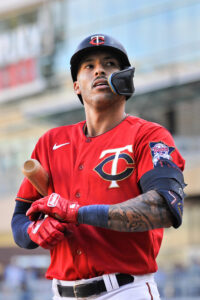
Over the past four seasons, the former first overall pick has tallied just under 1800 plate appearances. He’s hit .281/.359/.481 with a strong 10.6% walk rate and a lower than average 20.4% strikeout percentage. Correa has posted a hard contact rate north of 42% in each of the past four seasons, well above the 35-36% league marks. Broadly speaking, there’s nothing to nitpick with his offensive ability. He makes contact, has strong plate discipline and has topped 20 home runs in six of the seven 162-game seasons of his career. Correa has unsurprisingly been better against left-handers than righties, but he’s been excellent against pitchers of either handedness. He owns a .291/.386/.482 career mark against southpaws, while he’s hit .274/.346/.477 against same-handed arms.
Correa had some injury issues earlier in his career, missing time in 2018 with back discomfort and fracturing a rib in 2019. He’s only twice topped 600 plate appearances in a season, but the aforementioned finger contusion is the only non-virus ailment that has sent him to the IL within the past three seasons. With his recent health and the strong finish to his 2022 campaign, his camp made the easy call to opt out of the final two years and $70.2MM on his Twins deal.
For the second straight winter, he was the top free agent option in a loaded shortstop class. Even with Trea Turner, Xander Bogaerts and Dansby Swanson hitting the open market, Correa was the best available shortstop. Aaron Judge was the market’s top free agent overall on the heels of an MVP-winning, 62-homer season, but one can argue Correa was the best long-term bet available.
In addition to his strong offensive track record, the two-time All-Star is typically one of the sport’s most valuable defenders. Defensive Runs Saved has pegged him as an above-average shortstop in every season of his career. Altogether, DRS has pegged him as 70 runs better than par in more than 7600 innings. Statcast hasn’t been as bullish, but it also generally rates him as a plus gloveman. Statcast has pegged Correa as 17 runs above average since it began tracking defense in 2016, including plus grades each year from 2018-21.
Correa’s defense marks were particularly excellent during his final season in Houston, when he rated as +20 runs by DRS and +9 runs at Statcast. He secured his first career Gold Glove award in the process. This year’s reviews weren’t so impressive. DRS still considered him a net positive at three runs above average, but that was the lowest mark of his career. Statcast pegged him two runs below par, his first below-average showing by that metric since 2017.
Defensive metrics can vary on an annual basis, and it doesn’t seem San Francisco’s concerned with this past season’s mid-tier showing. Correa boasts a plus arm and has generally been very sure-handed. There may be some trepidation about how his 6’4″, 220 pound frame will hold up into his mid-late 30’s, particularly since he’s only an average runner. With his hands and arm strength, however, the Giants can at least project above-average glovework for the next few seasons.
San Francisco has four-time Gold Glove winner Brandon Crawford under contract for another year. They didn’t enter the offseason needing shortstop help necessarily, but their infield around Crawford had its share of question marks. San Francisco re-signed Wilmer Flores to a two-year guarantee to add a productive righty bat to the mix at first, second or third base. Tommy La Stella is under contract for another season but hasn’t played well since landing in San Francisco. J.D. Davis and David Villar are on hand as corner options, while Thairo Estrada can cover the middle infield and adds a solid righty bat.
There are a lot of moving pieces available for skipper Gabe Kapler, but adding Correa figures to solidify the left side of the infield with an everyday pair. Susan Slusser of the San Francisco Chronicle wrote last month the team planned to move Crawford to the hot corner if they were to sign Correa. Crawford has never played an inning outside of shortstop in the majors, but he figures to handle the less demanding position well.
While shortstop itself may not have been a priority for president of baseball operations Farhan Zaidi and his front office, adding impact talent certainly was. The Giants made no secret of their desire to land Judge. When he returned to the Bronx, the club pivoted to Correa — the clear top hitter remaining. He’ll now become the highlight acquisition of the offseason, joining outfielder Mitch Haniger and pitchers Sean Manaea and Ross Stripling as players brought in to try to rebound from an 81-81 campaign.
Doing so requires one of the largest investments in major league history. The $350MM guarantee checks in as the fourth-largest ever. It’s the second-biggest free agent deal of all-time, just narrowly below the $360MM deal that Judge inked a week ago. Correa becomes the second free agent to land a 13-year contract, matching the record length secured by Bryce Harper with the Phillies over the 2018-19 offseason. The deal runs through the 2035 campaign, what will be Correa’s age-40 season.
That kind of lengthy megadeal has become en vogue this offseason. Turner and Bogaerts signed 11-year deals with the Phillies and Padres, respectively, taking them each through their own age-40 seasons. Judge inked a nine-year deal that paid him through age 39. MLBTR had predicted Correa for a nine-year, $288MM contract at the start of the offseason. As with Turner and Bogaerts, those deals lasted longer than anticipated, with each correspondingly securing a greater guarantee than expected.
That has involved a bit of a tradeoff with regards to annual salary, however. Correa’s deal comes with an average annual value around $26.92MM, a mark that’s outside the top 25 in MLB history. That’s well lower than the $32MM per-year salary MLBTR had projected, with the Puerto Rico native electing to sacrifice some money on an annual basis to secure a larger total sum. Doing so could very well position him to spend the remainder of his career in the Bay Area.
From a team perspective, spreading the guarantee over a longer term adds more future downside but has the more immediate benefit of reducing the club’s luxury tax hit. A team’s CBT commitments are based on deals’ average annual values, and the $26.92MM mark is more manageable in that regard.
That’s now relevant for the Giants, whose payroll has spiked dramatically. The specific financial breakdown isn’t yet clear, but an evenly distributed salary would push the Giants 2023 payroll around $190MM, as projected by Roster Resource. Their luxury tax figure is about $206MM, $27MM below the base threshold. San Francisco’s spending is well above the $150-155MM range of the past few seasons, but it’s still shy of their $200MM franchise-record Opening Day mark from 2018.
The Giants could keep pushing forward as they jostle for position atop a stacked NL West with the Dodgers and Padres. The bullpen is still a question mark, and San Francisco could look into upgrades at first base and/or center field. The Giants remained involved in the bidding for ace Carlos Rodón as of this afternoon as well, although signing both Correa and the top remaining free agent starting pitcher may push beyond their financial comfort level.
As for Correa’s now-former team, they’ll be left to regroup having missed out on their top target of the winter. Minnesota offered a 10-year deal worth $285MM, tweets Jon Heyman of the New York Post. That came with a higher annual salary than the offer Correa actually accepted, but the Twins were apparently reluctant to commit deep into his 30’s. They’re now facing an uncertain shortstop situation, with Kyle Farmer and Royce Lewis looking like the top internal options.
Minnesota has already had some discussions with Swanson this offseason, keeping tabs on him as a fallback possibility to Correa. The organization should have a decent amount of financial flexibility and could now pivot more strongly after Swanson if they’re determined to address shortstop. They’ve also been linked to Rodón at various points and could try to allocate their spending capacity to a top-of-the-rotation arm. The Twins surely aren’t done in any event, although that’ll be little consolation for the front office and fanbase for the moment. Because Correa was ineligible for the qualifying offer, they don’t receive any compensation for his departure.
It’s the latest massive move in an offseason that has gained plenty of steam since the calendar flipped to December. Correa joins an increasingly loaded division and, more generally, a very competitive National League. In the process, he becomes the new face of the Giants — a role the club hopes he’ll effectively hold well into the next decade.
Jeff Passan of ESPN first reported Correa and the Giants had agreed to a 13-year, $350MM contract. Jon Heyman of the New York Post reported the deal didn’t include any opt-out provisions but contained a full no-trade clause.
Image courtesy of USA Today Sports.
Latest On Carlos Rodon’s Market
10:42pm: The Yankees have indeed put forth an offer to Rodon, Heyman writes. There’s apparently still a fair bit of work to do in order to get a deal done, as Heyman indicates there’s a notable gap between New York’s proposal and Rodon’s asking price.
2:55pm: Carlos Rodon is the clear top pitcher remaining on the open market, and despite a lofty asking price reportedly in the $200MM neighborhood, multiple clubs remain in pursuit of the left-hander. Jon Heyman of the New York Post reported yesterday that the Yankees are prepping a formal offer for Rodon, and Brendan Kuty of NJ.com now tweets that the Yankees appear to be Rodon’s preferred landing spot. However, Kuty adds that both the Twins and the Cardinals both remain “seriously in play” for the southpaw as of this afternoon. Meanwhile, Susan Slusser of the San Francisco Chronicle tweets that even after agreeing to identical two-year, $25MM deals with both Ross Stripling and Sean Manaea this week, the Giants are still involved in Rodon’s market.
The Twins’ interest in Rodon is perhaps contingent on the looming decision of Carlos Correa who, like Rodon, is represented by the Boras Corporation. Dan Hayes of The Athletic suggests that Correa remains the Twins’ top priority, though he adds that the team nonetheless made a pitch to Rodon earlier in the month (Twitter thread). Given that the Giants are viewed as Minnesota’s primary competition for Correa, it’s fair to wonder whether both clubs might be prioritizing Correa with the intent of pivoting to Rodon should they be spurned by Correa. That both players have the same agent makes concurrent negotiations a smoother process.
After agreeing to a three-year deal with free-agent catcher Christian Vazquez yesterday, Minnesota projects to about $107MM in total commitments for the upcoming season. That’s well shy of the more than $140MM they spent on last year’s Opening Day roster, but not so far south of the mark that it becomes easy to envision a scenario in which both Correa and Rodon sign on to call Target Field home. The Twins have drawn interest in right fielder Max Kepler this winter, but even in the event of a Kepler deal coming together, a Correa/Rodon combo would push Minnesota well past $150MM in total payroll for the first time in franchise history and would likely lock them into $75-80MM worth of annual commitments to the trio of Correa, Rodon and Byron Buxton.
The Giants, meanwhile, are roughly $43MM from their franchise-record Opening Day payroll even after their deals with Stripling and Manaea. Similarly, though, it’s difficult to see both players landing in San Francisco. The Giants are already a bit north of $180MM in terms of luxury obligations, and that pairing would likely push them into tax territory for the first time. That said, the Giants have topped $200MM in payroll before, and the only player currently signed beyond the 2024 season is Mitch Haniger, who’s signed through 2025. The Giants have been averse to long-term contracts under president of baseball operations Farhan Zaidi, though they made hefty bids for both Aaron Judge and Bryce Harper under his watch.
As for the Cardinals, they were linked to Rodon this past weekend, and Kuty paints them as a fairly prominent player in the bidding. The Cards would make for something of a surprise bidder, having already spent $87.5MM to bring Willson Contreras to St. Louis on a five-year contract. Signing Rodon would likely mean doling out the largest commitment in franchise history and pushing payroll to height never before seen in St. Louis. The Cardinals’ current record for Opening Day payroll is a bit more north of $163MM, in 2021, but they’re already at that rough level right now Rodon could well take them north of $190MM.
Circling back to the Yankees, they at one point reportedly hoped to limit any Rodon deals to four or five years in length, though that doesn’t seem likely to get them in the ballpark. With Judge and Cole both locked into a combined $76MM in annual commitments through the 2028 season (2029 in Judge’s case), adding Rodon to the mix would require budgeting more than $100MM annually for a trio of players for at least the next six years. Giancarlo Stanton is under contract through 2027, as well, further complicating the long-term scenario for Rodon.
At present, Roster Resource projects a $266MM luxury-tax ledger for the Yankees. They’re already set to pay the tax for a second straight season, so they’ll owe $6MM on the first $20MM by which they cross the $233MM threshold and $8.5MM on the next $20MM. Once they reach $273MM in luxury obligations, they’ll be taxed at a rate of 75%, and they’d be taxed at 90% on any dollars beyond the $293MM mark.
Speculatively penciling in an even $30MM AAV (which could, of course, be off by a few million dollars one way or another), the Yankees would jump from their currently projected $11.74MM of penalties all the way up to about $32.65MM in penalties. In other words, they’d pay an approximate $21MM in taxes on top of Rodon’s actual salary for the 2023 season. Passing the luxury threshold by more than $40MM would also drop the Yankees’ top pick in the 2023 draft by 10 places, and any Rodon deal would make it quite difficult to drop under the tax line (and avoid even steeper tax rates as a third-time offender) in 2024.
Mets Interested In Carlos Correa
The Mets are showing interest in Carlos Correa, report Ken Rosenthal, Dan Hayes and Andy McCullough of the Athletic. It’s not clear precisely how committed they are to making a run at the top remaining free agent, but their presence on at least the periphery of the market makes for a fascinating twist.
This offseason has been dominated by Mets headlines, with the team signing a number of top free agents. New York made nine-figure commitments to retain Edwin Díaz ($102MM over five years) and Brandon Nimmo ($162MM over eight years). The Mets brought in Justin Verlander on a two-year, $86.66MM deal — tying the annual salary record they established with last offseason’s three-year pact for Max Scherzer. They agreed to terms with Kodai Senga on a five-year, $75MM pact and have signed smaller but still notable deals with José Quintana (two years, $26MM) and David Robertson (one year, $10MM).
That spending spree added to a roster that already had the league’s highest payroll. Certainly, the Mets faced a number of key departures as well. They allowed Jacob deGrom, Chris Bassitt and Taijuan Walker to sign elsewhere. That said, they’re already projected well beyond this year’s spending level. New York opened the 2022 campaign with a player payroll around $264MM; they’re projected by Roster Resource at a staggering $336MM figure for next season.
It’s an unparalleled number in league history, one that leaves open the question of how far owner Steve Cohen and his front office are willing to go. Cohen has proven himself undeterred by traditional spending habits, and he’s certainly seemed unfazed by the luxury tax that’s ostensibly in place to prevent any team from spending head and shoulders above the rest.
Roster Resource projects the Mets’ luxury tax number around $350MM at the moment. They’re $117MM clear of the base tax threshold and are going to blow past all four tiers of penalization. New York paid the CBT this past season, so they’re also facing escalating penalties for going over for a second straight year. The Mets will pay a 30% tax on their first $20MM above the threshold ($6MM), a 42% tax on their next $20MM in overages ($8.4MM), a 75% tax on their next $20MM in surplus spending ($15MM) and a 90% tax on any additional dollars. New York is currently an estimated $57MM above the fourth and final tier, one colloquially known as the “Cohen tax” after being introduced in the most recent CBA at least partially in response to Cohen’s reputation for spending. That’s another $51.3MM in taxes, bringing New York’s total projected tax bill to a staggering $80.7MM.
Of course, that’s before considering the possibility of adding another megadeal. Correa is the best free agent still on the board. At the start of the offseason, MLBTR forecasted a nine-year, $288MM contract. The two top shortstops already off the board — Trea Turner and Xander Bogaerts — each best our predictions, with Bogaerts’ $280MM contract coming in well above most expectations. In light of the strength of the market, Correa pushing past $300MM now seems likely, and one could argue for him to approach the $360MM guarantee Aaron Judge received from the Yankees given Correa’s youth and greater defensive value.
Even if we conservatively pencil Correa in for the pre-offseason prediction of $288MM over nine years, that’d come out to a $32MM annual salary. New York would be taxed at 90% on top of that, effectively making it a $60.8MM commitment to the star shortstop for next season. It’d be the kind of move a team has never made for an individual player, and again, that now seems a rather pessimistic view of Correa’s earning power. Certainly, the deal could push longer than nine years and lower the annual salary somewhat — Turner and Bogaerts each received 11 years despite being older than Correa — but any permutation of the contract would involve the team investing an immense sum. Cohen has clearly established himself as an owner unconcerned with precedent, and it’d be foolish to count the Mets out on any free agent at this point.
The Mets don’t need a shortstop, of course, with Francisco Lindor locked in as their long-term answer at the position. Third base isn’t accounted for by a star, with veteran Eduardo Escobar coming off an average season and top prospect Brett Baty still unproven at the MLB level. Relying on Escobar and Baty wouldn’t be a disaster, but installing Correa alongside Pete Alonso, Jeff McNeil and Lindor would lock in All-Star caliber players everywhere on the infield.
Beyond the Mets, the Giants and incumbent Twins are reported to be prioritizing Correa at this stage of the offseason. They’re widely viewed as the top suitors, while teams like the Cubs and Red Sox have been more loosely linked to him. Dansby Swanson, who’s drawing attention from many of the same clubs, remains available as the clear second-best position player still on the open market.
Twins To Sign Jose De León
Right-hander Jose De León is joining the Twins, with the hurler himself announcing the agreement on Twitter. Presumably, it’s a minor league deal with an invite to Spring Training, though no formal announcement has been made.
De León, 30, was once considered one of the best prospects in all of baseball. While in the Dodgers’ organization, Baseball America ranked him #23 in 2016 and #29 in 2017 among all prospects in the league. Unfortunately, injuries have been severely holding him back from living up to his potential since then.
He was traded to the Rays prior to 2017 but only pitched in 11 games that season. In March of 2018, he required Tommy John surgery, which wiped out that entire year. He returned and pitched in 22 games in 2019 before getting flipped to Cincinnati. He saw some brief time in the big leagues with the Reds in 2020 and 2021 but was released. For 2022, he signed a minors deal with the Jays but got hurt in the spring and didn’t make his season debut until August.
De León continues to get chances based on his previous prospect pedigree but it’s been a while since he’s had an extended period of time to showcase his skills. For the Twins, there’s little harm in adding him to their system as a depth option in case injuries elsewhere on the roster create a need for him down the line.
Twins, Patrick Murphy Agree To Minor League Deal
The Twins are in agreement with right-hander Patrick Murphy on a minor league contract, reports Jon Heyman of the New York Post (on Twitter). Presumably, the 27-year-old will get a chance to compete for a big league job in Spring Training.
Murphy has suited up at the highest level in each of the past three seasons. Originally a third-round selection of the Blue Jays in 2013, he spent parts of eight years in the Toronto system. Murphy was generally regarded as a solid prospect, but he battled myriad injury concerns in the minors that delayed his push up the ladder. He finally reached the majors during the abbreviated 2020 season, working six innings of relief across four appearances.
Toronto shuttled him on and off the active roster for most of 2021, eventually designating him for assignment in August. He landed with the Nationals via waivers, making 17 appearances with Washington down the stretch. Murphy held his roster spot over the winter and pitched six more times this past April before the Nats took him off the 40-man roster. He went unclaimed this time around, spending the remainder of the year with Triple-A Rochester before electing minor league free agency at season’s end.
Over his three MLB seasons, Murphy has tallied 39 2/3 innings of 4.76 ERA ball. He has a below-average 20.3% strikeout rate and an elevated 10.7% walk percentage. He’s averaged north of 96 MPH on his fastball but hasn’t missed many bats at the big league level. Murphy did punch out a solid 26.1% of opponents with a lofty 50% grounder rate over 63 frames in Triple-A this year, although he still walked just under 12% of batters faced.
While Murphy has some experience as a starter in the minors, he’s worked primarily as a multi-inning reliever for the past three seasons. That’s the role he’s expected to play in Minnesota, where he’ll compete for a spot in Rocco Baldelli’s bullpen. He’s out of minor league option years, so if he does crack the MLB roster at any point, he’ll have to remain in the majors or again be designated for assignment.