
Offseason In Review: Washington Nationals
The Nats have enjoyed plenty of success but also plenty of disappointment over the last three years. While the club remains set up to challenge for championships in the future, 2015 is probably the last year it can do so with its current core fully intact.
Major League Signings
- Max Scherzer: seven years, $210MM (subject to complicated bonus/deferral structure; see Cot’s on Contracts for full detail)
- Casey Janssen: one year, $5MM plus club option
- Denard Span: one year, $9MM (exercised club option)
- Total spend: $224MM
Notable Minor League Signings
- Tim Alderson, Heath Bell (since released), Bruce Billings, Emmanuel Burriss, Mike Carp, Manny Delcarmen, Tony Gwynn Jr., Rich Hill, Kila Ka’aihue, Steven Lerud, Mitch Lively, Evan Meek, Mark Minicozzi, Matt Purke, Clint Robinson, Ian Stewart, Dan Uggla
Trades And Claims
- Acquired OF Matt den Dekker from Mets in exchange for RP Jerry Blevins
- Acquired IF Yunel Escobar from Athletics in exchange for RP Tyler Clippard
- Acquired SP Joe Ross, PTBNL (reportedly SS Trea Turner) from Padres in exchange for OF Steven Souza, SP Travis Ott in three-team deal also involving Rays
- Acquired IF Chris Bostick, RP Abel De Los Santos from Rangers in exchange for SP Ross Detwiler
- Acquired C Dan Butler from Red Sox in exchange for SP Daniel Rosenbaum
- Claimed RP Eric Fornataro from Cardinals
Extensions
- None
Notable Losses
- Blevins, Asdrubal Cabrera, Clippard, Kevin Frandsen, Scott Hairston, Reed Johnson, Jeff Kobernus, Adam LaRoche, Ryan Mattheus, Ross Ohlendorf, Nate Schierholtz, Jhonatan Solano, Rafael Soriano
Needs Addressed
This offseason was obviously dominated by the team’s signing of Max Scherzer, who was installed as the Opening Day starter. But it’s hard to say that the move functioned to fill a need, so we’ll take a closer look at it below in the “Deal of Note” section.
Topping off the MLB rotation is not all the club did to bolster its future pitching ranks this offseason. The organization is loaded with arms for the post-Zimmermann era. After dealing away pitchers like Cole, Brad Peacock, Tommy Milone, Alex Meyer, Robbie Ray, and Nate Karns over the last several offseasons, the Nats did not shed any prized young arms this winter. Instead, after signing high upside Tommy John patient Erick Fedde out of the amateur draft, the Nats added well-regarded righty Joe Ross in the Wil Myers trade.
Then again, if the wisdom of the Rays’ front office is to be trusted, perhaps that trade will ultimately become known as the Wil Myers–Steven Souza swap. Or, if Rizzo has his way, the Joe Ross–Trea Turner deal. That last piece, Turner, was the key to the gambit from the Nats’ perspective, even if he remains an as-yet unnamed part of the transaction. The speedy young shortstop figures to be the long-term replacement for Ian Desmond, though he’ll need to show a lot in 2015 at the Double-A level to enter the big league picture for the start of next season.
To bolster things up the middle in the meantime, the Nats shipped one of the game’s most consistent set-up men, Tyler Clippard — yet another organizational stalwart in his final year of control — in exchange for the mercurial Yunel Escobar. The early relationship with Escobar has already seen some rough patches, with some positional consternation and injuries clouding the picture. But things seem to be going smoothly now, with Escobar voluntarily stepping in at third to open the season, and Washington will hope that he can return to being a quality defender and good-enough hitter to occupy one middle infield spot over the next two seasons.
With Clippard gone, the Nats had an opening in the veteran late-inning department, and added former Blue Jays closer Casey Janssen on a deal that reflected his difficulties last year. The Nats will hope there is some gas left in the tank for Janssen, who is currently out with shoulder issues that are hoped to be minor. There are some up-and-coming young arms (Treinen, Aaron Barrett) that could see big innings as well, particularly if Janssen is limited or ineffective.
From the left-handed side, Rizzo continued to tinker. The Nationals will rely upon August claimee Matt Thornton and former minor league signee Xavier Cedeno. Rizzo dealt away Ross Detwiler, who has been a plenty serviceable starter in the past but who did not turn into the dominant reliever the club hoped. And he parted ways with Jerry Blevins after one forgettable year, sending him to the division rival Mets in order to bolster the team’s outfield reserves with Matt den Dekker.
As for den Dekker, he looks to be a useful option with the outfield in need of bolstering early this year and a spot in center clearing after the season. Importantly, he has an option year remaining. While Michael Taylor is the player that the club hopes will become the long-term answer there, den Dekker could represent an affordable backup whose left-handed bat will pair nicely with the right-handed-swinging Taylor. He also looks to be a nice fit with the aging Jayson Werth in left to afford extra rest when matchups or game situations permit.
Questions Remaining
This is one of the most complete lineups in baseball — when healthy. But the Nationals have some injury concerns to start the year, with Werth, Denard Span, and Anthony Rendon all on the DL (along with reserve Nate McLouth). The club will fill the void with players like Taylor, den Dekker, Tyler Moore, Reed Johnson, Dan Uggla, and Danny Espinosa. That is probably fine for a short stretch, but could lead to some consternation if Werth, Span, or (especially) Rendon take longer than is hoped.
Elsewhere, the team will be taking on some risk by shifting players to new positions. Escobar has mostly played short, which he seems likely to do again next year, but will play third until Rendon returns and he is bumped back to second. And longtime hot corner stalwart Ryan Zimmerman will move across the diamond to first to account for his balky shoulder. He has looked comfortable there this spring, but will need to lock down the position defensively — and provide a bat to match — to deliver a return on his big contract.
It is not hard to foresee a need arising behind the plate, though that is hardly what the club expects. Wilson Ramos has dealt with various injury issues over the years, and neither he nor backup Jose Lobaton hit much last year. Most teams would be pleased with this arrangement, so it isn’t exactly a concern, but could be an area to watch. The organization lost some depth when it was forced to part with the out-of-options Sandy Leon and Jhonatan Solano this offseason, but did trade for Dan Butler and sign Steven Lerud to bolster the ranks at Triple-A.
The pitching staff has ample depth, particularly in terms of starters, so there is not much to discuss there. Then again, the ninth inning has been an area of some concern in the not-so-distant past, and Drew Storen is now without the safety net that Clippard once provided. Then there is the fact that there may have been at least some financial motivation behind the departures of Clippard and Blevins. While Rizzo and company probably feel just fine with the club’s options, don’t be surprised to see some hand-wringing if injury or short-term performance problems arise at the back of the pen in the season’s early going.
Deal of Note
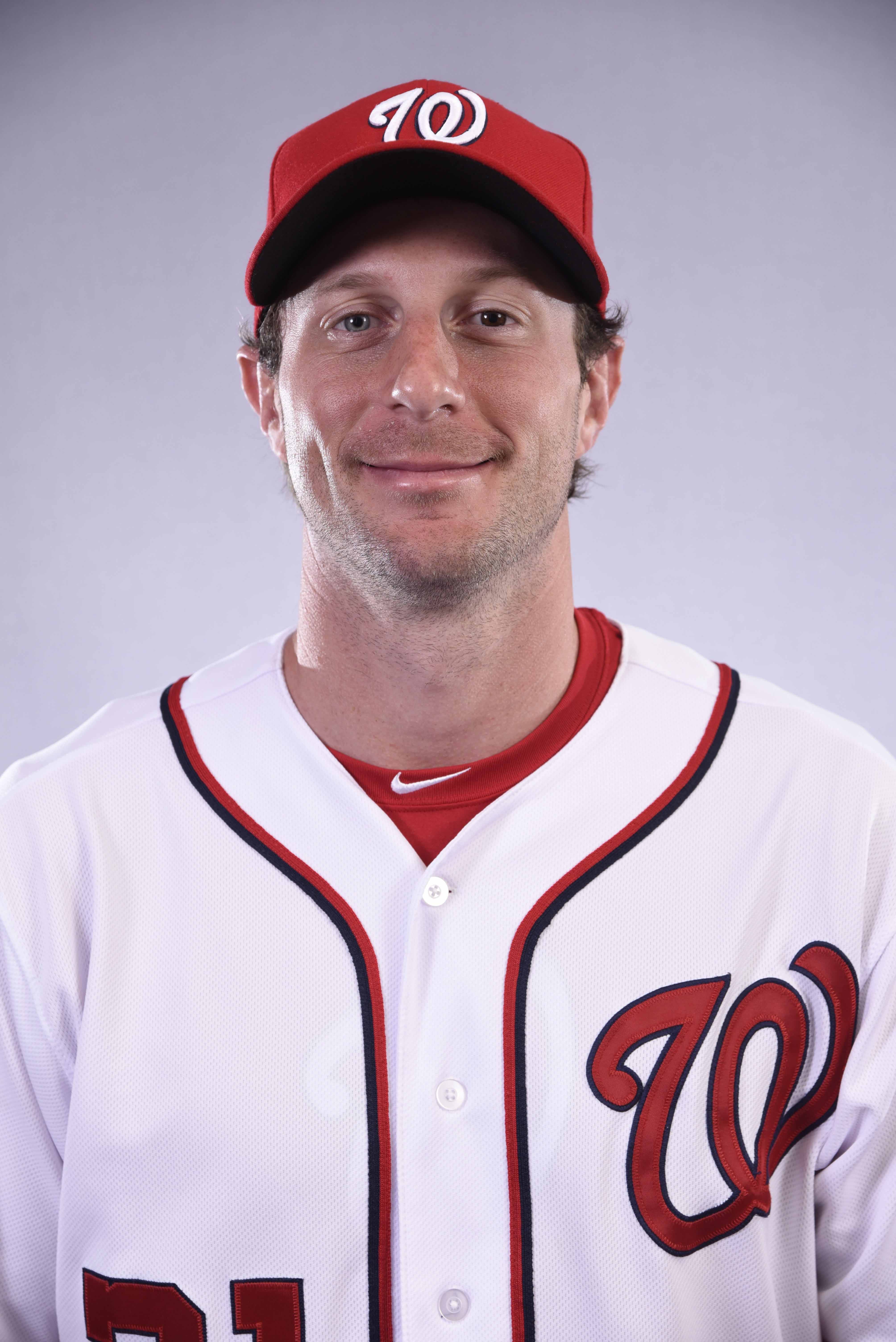 Nationals GM Mike Rizzo does not seem to act out of sentimentality. And neither, apparently, do longtime key players Ian Desmond and Jordan Zimmermann. The clock has likely run on the possibility of extensions for that pair, whose rise to become highly productive big leaguers played an enormous role in the organization’s turnaround. Last year was probably the time to get a deal done, but neither player bit at the sizable numbers being dangled. It is hard to blame them for doing so, or to blame the team for not going as high as might’ve been necessary, with potential nine-figure free agencies beckoning.
If it wasn’t already, the writing was scrawled on the wall when Max Scherzer signed his monster deal to join a loaded Nationals rotation. While deferrals reduce the total cost to the team, the investment in Scherzer is enormous, and made new contracts for Desmond and (especially) Zimmermann seem quite unlikely.
Bold as the Scherzer contract is in the long run, it is all the more stunning in the short. Effectively, Washington has taken baseball’s best rotation from 2014 — every piece of which returns — and added the best pitcher from the league’s second best rotation of last year. If all goes according to plan, the Nats’ pitching will be dominant.
Indeed, looking ahead, if all the arms remain healthy — or, perhaps, if the team completely falls apart — it is not impossible to imagine the Nats dealing Zimmermann or Doug Fister over the summer to address other needs. Washington could still maintain a powerful group of postseason starters while filling in the fifth slot with Tanner Roark (the game’s most eligible sixth starter), Blake Treinen, Taylor Jordan, or A.J. Cole. More likely, one or more of those pitchers will be installed in the rotation next year as the club waits for younger, even higher-ceiling arms (namely, Lucas Giolito, Reynaldo Lopez, and Fedde) to develop.
Overview
This is a win-now team, but not one that is structured to fall apart with its veterans. Washington has run its payroll up to over $160MM, near the top of the league (non-LA/NYC bracket). But its future commitments remain manageable even after signing Scherzer: $84MM next year and no greater than $59MM in the years that follow. The club’s top arb-eligible players for 2016 and beyond (Stephen Strasburg, Bryce Harper, Storen, Ramos, and, potentially, Rendon) have all seen their arbitration earning power suppressed to some extent, leaving additional room.
Likewise, plenty of young talent is filtering up and should soon be ready to plug into the MLB roster or deal away for more established players. By most accounts (including Baseball America) the Nats possess a top-ten farm system, representing a quick replenishing for a system that had lost a ton of well-regarded players to graduation and trade.
While the future still looks bright, it will be a tall order to meet or exceed the organization’s current situation. Not only are the club’s best young players and veterans alike at or near their primes — a difficult nexus to achieve — but the rest of the division seemingly features two still-advancing hopefuls (Mets, Marlins) and a pair of rebuilding outfits (Braves, Phillies). The window will still be open after this year, but probably not as wide.
Photo courtesy of USA Today Sports Images.
Offseason In Review: Arizona Diamondbacks
Despite finishing with baseball’s worst record in 2014, the Diamondbacks stopped short of a full-scale rebuild and added a high-priced talent they hope will help them quickly return to contention.
Major League Signings
- Yasmany Tomas, 3B/LF: Six years, $68.5MM (player opt-out clause after 2018 season)
- Daniel Hudson, SP/RP: One year, $800K (club option exercised)
- Matt Reynolds, RP: One year, $600K (club option exercised)
- Total spend: $69.9MM
Pool-Eligible International Signings
- Yoan Lopez, SP: $8.27MM signing bonus
Notable Minor League Signings
- Blake Beavan, Gerald Laird, Justin Marks, Jordan Pacheco, Matt Pagnozzi, Nick Punto, J.C. Ramirez, Cody Ransom, Jamie Romak, Dan Runzler, Danny Worth
Trades And Claims
- Acquired SP Jeremy Hellickson from Rays for OF Justin Williams and SS Andrew Velazquez
- Acquired SP Rubby De La Rosa, SP Allen Webster and MI Raymel Flores from Red Sox for SP Wade Miley
- Acquired OF Josh Elander and OF Victor Reyes from Braves for SP Trevor Cahill, $6.5MM in cash considerations and Arizona’s Competitive Balance Round B selection in the 2015 draft (75th overall)
- Acquired RP Zack Godley and RP Jeferson Mejia from Cubs for C Miguel Montero
- Acquired SP Robbie Ray and MI Domingo Leyba from Tigers as part of a three-team trade (Yankees received SS Didi Gregorius from Diamondbacks; Tigers received SP Shane Greene from Yankees)
- Acquired RP Myles Smith from Red Sox for RP Zeke Spruill
- Acquired cash considerations from Athletics for RP Eury De La Rosa
- Acquired cash considerations from Dodgers for SP Mike Bolsinger
- Acquired cash considerations from Indians for RP Charles Brewer
- Claimed C Oscar Hernandez from Rays in Rule 5 Draft
Notable Losses
- Miley, Montero, Gregorius, Cahill, Cody Ross, Will Harris, De La Rosa, Bolsinger, Spruill, Nolan Reimold
Needs Addressed
The Diamondbacks’ first order of business was to hire Chip Hale as the club’s new manager, deciding on the former Athletics bench coach after an extensive search. Hale faces an interesting challenge in his first Major League managing job, as he inherits a last-place club that doesn’t plan on being a bottom-dweller for long. Around the start of the offseason, both Chief Baseball Officer Tony La Russa and senior VP of baseball operations De Jon Watson felt that a quick turn-around was possible, with La Russa going so far as to say that he would “be absolutely brokenhearted” if the D’Backs didn’t at least manage a winning record in 2015.
To that end, the Snakes unloaded a couple of notable contracts to shed payroll, yet also just as quickly reinvested that money into new talent, most notably in the international market. Their biggest move came with the signing of Yasmany Tomas, as the D’Backs outbid several other teams (including their division rivals in San Diego and San Francisco) to ink the Cuban slugger to a six-year, $68.5MM deal.
Several pundits, including MLBTR’s own Tim Dierkes, thought Tomas would land a contract in the $100MM range this winter, so if the 24-year-old lives up to expectations, the D’Backs will have scored a bargain. Tomas can even opt out of his contract after four seasons, so the deal could turn into a four-year, $36MM commitment for the team.
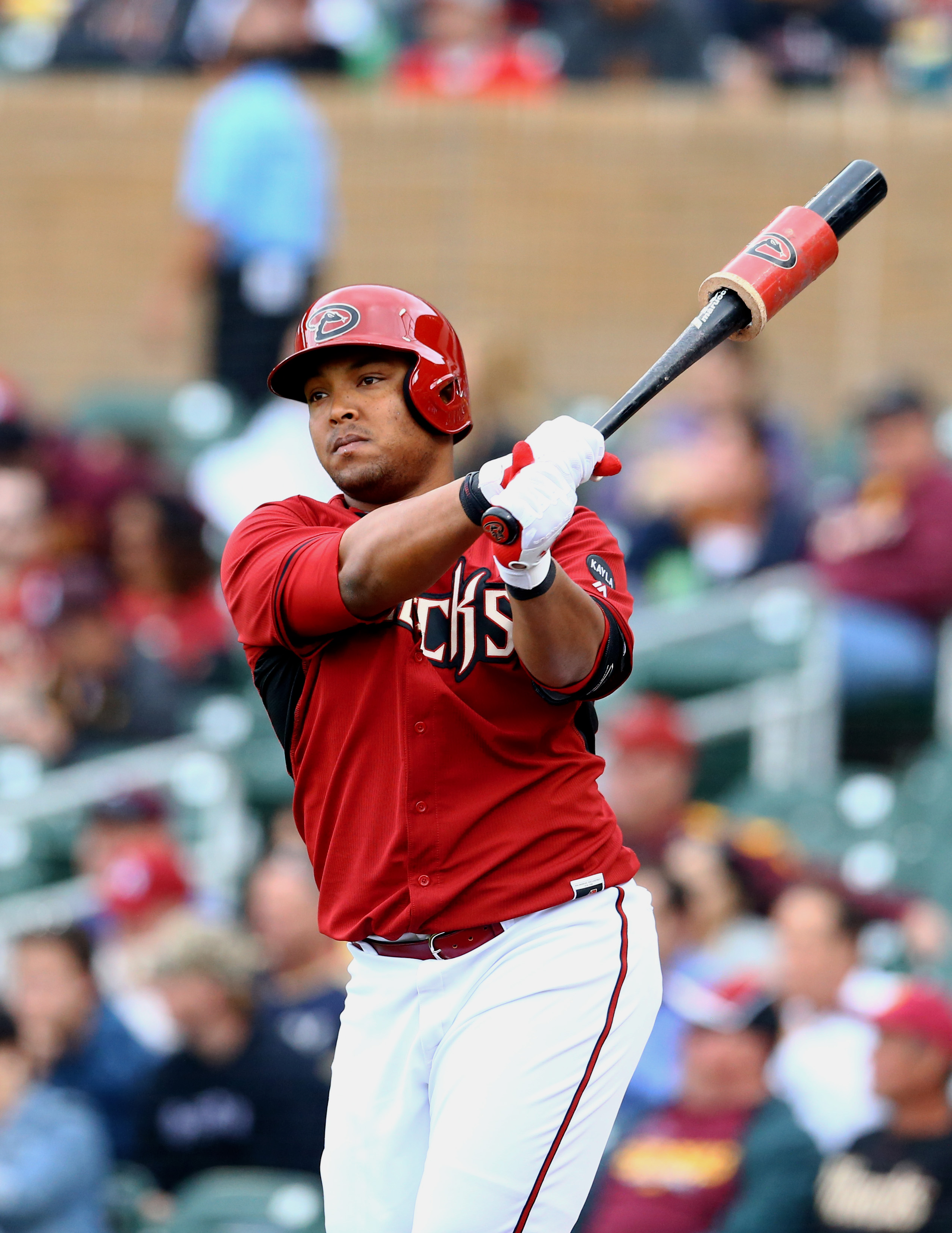
GM Dave Stewart made another big international outlay in signing Cuban right-hander Yoan Lopez to a contract with an $8.27MM signing bonus. As with Tomas, the Diamondbacks may have scored a bit of a bargain since Lopez turned down at least one larger offer to join the team. The 22-year-old righty brings a multi-pitch arsenal and a fastball that has touched 100mph, giving Arizona a building block for the future.
If Lopez represents the future, the present was addressed in the form of a payroll-reducing trade. The Diamondbacks unloaded their biggest salary pre-existing commitment by dealing Miguel Montero (and the $40MM remaining on his contract) to the Cubs for two low-level pitching prospects. While still a strong defensive catcher, Montero’s offense had declined over the last two seasons and the D’Backs felt comfortable moving on from the 31-year-old.
Likewise, Trevor Cahill‘s time in Arizona didn’t pan out as expected, and the Snakes dealt the righty to Atlanta along with $6.5MM to help cover Cahill’s $12MM salary for the 2015 season. The Cahill and Montero trades have further helped to reduce the Diamondbacks’ payroll from a club-record $112.3MM in 2014 to roughly $85MM for the coming season.
While dealing Montero was mostly about clearing salary obligations, the trade that sent Wade Miley to the Red Sox brought back more immediate help (as you’d expect given Miley’s more favorable contract situation). Miley became arbitration-eligible for the first time this winter, and rather than pay his increasing price tag, the D’Backs brought back a total of 10 controllable years of right-handers Rubby De La Rosa and Allen Webster. De La Rosa has earned a spot in Arizona’s rotation while Webster remains an intriguing prospect, though he hasn’t shown much in 89 1/3 Major League innings.
With Miley gone, the D’Backs brought another veteran arm into the mix by acquiring Jeremy Hellickson from the Rays. Hellickson is looking to rebound after an injury-shortened 2014 and, now that he’s healthy, should be closer to the hurler who averaged 180 innings per year and a 3.72 ERA from 2011-13 (though he did so with less-than-promising peripherals). Hellickson will join Josh Collmenter, De La Rosa, Chase Anderson and top prospect Archie Bradley in the rotation, as Bradley’s strong Spring Training performance earned him his first crack at the bigs, and provided even more incentive for the D’Backs to move Cahill.
Arizona’s middle infield situation got a bit less crowded after Didi Gregorius was sent to the Yankees as a part of a three-way trade with the Tigers. The deal allows Nick Ahmed to take over at shortstop and Chris Owings to become the new second baseman. For Gregorius, the D’Backs obtained another middle infield prospect in Domingo Leyba and a possible future rotation candidate in left-hander Robbie Ray.
Addison Reed pitched better (2.68 SIERA, 3.26 xFIP, 4.03 FIP) than his 4.25 ERA would suggest, though he’ll have to cut down on the fly balls (only a 28.9% grounder rate) to be a long-term answer at closer, especially with a growing salary through his arbitration years. Still, Oliver Perez, Brad Ziegler, Evan Marshall, Randall Delgado and former starter Daniel Hudson make up a pretty solid bullpen corps for the Snakes. It wouldn’t be a shock to see veterans Reed, Perez or Ziegler get shopped at the trade deadline, especially since the D’Backs will have a bit of an arms surplus at midseason when Patrick Corbin, Bronson Arroyo and David Hernandez all get back from Tommy John rehab.
Questions Remaining
La Russa’s optimism notwithstanding, the Diamondbacks are going to have a difficult path to 82 or more wins. Consider that the Snakes entered 2014 on the heels of consecutive 81-81 records, so despite all of the injuries suffered by the club last year, it could be argued that even at full strength the D’Backs still didn’t have a proven winning nucleus.
De La Rosa, Bradley and Anderson were the winners of a widely-contested Spring Training battle for the last three spots in Arizona’s rotation, and while this trio has plenty of promise, it’s a tall order to see all three blossoming at the same time. Combine that with the fact that Collmenter and Hellickson wouldn’t be top-of-the-rotation choices on most teams, and the Diamondbacks’ rotation looks like a problem area. (Though, as noted, Corbin and Arroyo could provide some midseason reinforcements.)
The staff also likely won’t be helped by the uncertainty at catcher, which stands out as one of the most glaring roster holes on any team in baseball. Montero’s departure left Tuffy Gosewisch as the presumptive starter, with Gerald Laird and Jordan Pacheco both making the roster as backups. While the D’Backs have been linked to Toronto’s Dioner Navarro in trade rumors for almost the entire offseason, no deal appears to be forthcoming, according to Stewart.
If Stewart’s comments aren’t just gamesmanship, then the D’Backs appear to be content with having the inexperienced Gosewisch as the bridge to top prospect Peter O’Brien. The hitch with that plan, however, is that O’Brien is widely seen by most evaluators as unlikely to stick behind the plate, and he has recently developed an inability to throw the ball back to the mound. Catcher looms as a big issue for the team both in 2015 and, if O’Brien’s struggles continue, into the future.
Tomas is, at the moment, a man without a position or even a spot on the Snakes’ big league roster. Tomas will start the season at Triple-A following an unremarkable spring at the plate (.257/.307/.414 with two homers over 73 PA) and a very shaky defensive performance as a third baseman. While one could just write off Tomas’ time at third as a failed experiment, scouts also have questions if he would be able to handle a corner outfield spot.
Compounding the problem for the D’Backs is that they also don’t have much room at any of Tomas’ positions. Third baseman Jake Lamb enjoyed a red-hot spring at the plate and was ranked as a top-80 prospect by both MLB.com and Baseball America prior to last season. If Tomas becomes a left or right fielder, he joins Mark Trumbo as another power-hitting right-handed bat with questionable defensive ability working the corner outfield positions. (Fortunately for the D’Backs, A.J. Pollock is an excellent defender who covers a lot of ground in center.) Trumbo drew some trade interest this winter but the D’Backs are intent on keeping him, despite his defensive shortcomings, low OBP and increasing expense after winning an arbitration hearing.
Once Tomas is promoted, Arizona’s probable best plan of attack would be to liberally use David Peralta and Ender Inciarte — both left-handed hitters — to spell Tomas and Trumbo both for defensive purposes and against tougher right-handed pitching. Until Tomas gets the call, Peralta and Inciarte will split time in left field and as Trumbo’s late-inning defensive replacement.
One name missing from the outfield mix is veteran Cody Ross, who was rather surprisingly released just prior to Opening Day. The Snakes shopped Ross during the offseason but couldn’t find any takers, and thus were stuck having to eat the $9.5MM ($8.5MM in salary, $1MM buyout of his 2016 option) remaining on Ross’ contract. All told, Ross’ three-year, $26MM deal from the 2012-13 offseason ended up being a bust for the D’Backs, as he only contributed a .699 OPS line in 570 PA and appeared in only 177 games due to injury.
Aaron Hill is another high-priced veteran the D’Backs would like to deal, though he’s another tough sell given his poor 2014 season and $24MM salary owed through 2016. Hill has already lost his starting second base job to Owings, so he won’t have much opportunity to rebuild his value in a bench role unless Owings struggles. Arizona will almost surely have to pay a big chunk of Hill’s salary in any deal, but I would guess they’ll eventually find a trade partner; Hill was putting up strong numbers as recently as 2013 and several teams could use second base help.
Deal Of Note
Lopez’s signing added an obstacle to the Snakes’ rebuilding process. Since Lopez was subject to international signing pool limits, his bonus put the D’Backs well over their pool limit. Not only will they be taxed on the overage, but they’ll also be prohibited from spending more than $300K to sign any pool-eligible player over the next two international signing periods (so, until July 2017). Since Lopez will need at least a year or two of minor league seasoning, Arizona might not see any return on its investment until its penalty period is up, making the signing an even riskier one for the club.
For a team with a renewed emphasis on international scouting, essentially closing the door on one avenue of the international market until 2017 is a curious decision. The D’Backs also have the largest international spending pool of any team for 2015-16 as per their poor finish last season, yet they’re now unable to spend much of it due to the penalty, though the bonus slots can be traded. Rival scouts have thus far delivered middling reports on Lopez’s ability (while acknowledging that it’s still very early in his career), so Arizona is making a big bet that he’ll eventually be worth their investment both in terms of money and in other international opportunities lost.
Overview
If Arizona struggles this year, then waiting another season (or at least until this year’s trade deadline) to fully commit to the rebuild could be perceived as wasted time, given how many feel a rebuild is already overdue for the franchise. That said, since injuries so badly hampered the 2014 squad, Stewart may simply want to see exactly what he has before deciding to either make wholesale changes.
It could that this will be something of a treading-water season for the Diamondbacks as they prepare for a more thorough overhaul next winter. Only three players (Tomas, Hill and star slugger Paul Goldschmidt) are under contract for 2016, leaving lots of flexibility to build around controllable long-term pieces like Pollock and Bradley. It’s worth noting that the D’Backs already at least explored some bigger moves for star veterans this past winter, such as a trade for Matt Kemp or signing James Shields. Between payroll space, one of the game’s better-regarded minor league systems, and a front office that seems willing to be aggressive, Diamondbacks fans can be forgiven for already looking ahead to the 2015-16 offseason.
Photo courtesy of USA Today Sports Images.
Rick Porcello, GM Ben Cherington On Extension
What a difference a year makes. In April 2014, many doubted that Rick Porcello could ever meet the lofty expectations set for him roughly twelve years ago when he was mowing down every high school batter in Central Jersey. Today, Porcello inked an extension with the Red Sox that will net him a guaranteed $82.5MM over four seasons. That’s big bucks any way you slice it, but as Steve Adams noted earlier tonight, Porcello is sacrificing some earning potential by signing a deal at this juncture. On a conference call with reporters, I asked the right-hander if he was hesitant to sign a deal just months away from being able to hit the open market at the age of 27.
“I mean obviously I knew the opportunity that was ahead of me in entering free agency, but when I first got to camp and I saw the way the team was run from the ownership to Ben [Cherington] to the coaching staff and the players that were there, I saw that it was run very well from top to bottom,” Porcello said. “The devotion to win was here and it was something that I wanted to be a part of. It wasn’t a very difficult decision for me.”
Porcello went on to explain that he wasn’t thinking about signing an extension upon his arrival to Boston but he was board once that possibility presented itself. As for the Red Sox, Cherington said that he was impressed with Porcello from the get-go. One might think that a deal of this magnitude was hammered out over months of late nights at the office and bad takeout, but the GM explained that the deal actually came together rather quickly. Cherington had “informal” conversations with agent Jim Murray towards the end of Spring Training and negotiations actually didn’t pick up until the last few days.
“When we made the trade we had interest in at least having a conversation about [an extension], but as Rick alluded to, we respected that he was new to the Red Sox and we wanted to give him an opportunity to get to know us a little more and vice versa,” Cherington said. “It gave us a chance to get to know him too…Aside from the pitcher that he is, which we obviously like, getting to know Rick more over the winter and spring we came to learn that he just has a lot of qualities that we really admire and we felt that he was type of guy that we wanted here and we see him as a very important part of our team going forward for many years.”
There’s already plenty of discussion about the deal, with some believing that Porcello wisely locked in after a career year and others feeling that the Red Sox ace should have tried to build off of his 2014 effort and land an even bigger deal next winter. Porcello, for his part, could do without any of the attention.
“If we could have signed it without announcing it, that would have been fine with me. Today was about our season opener and the Red Sox winning.”
MLBTR Originals
A look back at the original reporting and analysis found on MLBTR this past week:
- MLB Trade Rumors Podcast featured host Jeff Todd and MLBTR’s Steve Adams looking back at the notable Hot Stove moves and looking forward to what the 2015 season may hold. A new edition of MLB Trade Rumors Podcast drops every Thursday and can be accessed on iTunes, SoundCloud, and Stitcher.
- Evan Gattis spoke with Zach Links about his trade from the Braves to the Astros. “I wasn’t really actually bummed about the trade. I was just more surprised than anything. I just didn’t think it would happen. I’m always the type to focus on my own business and I just worry about what I need to do to play.“
- The 2014-15 Offseason In Review series continued with a rundown of the Brewers (by Charlie Wilmoth), Blue Jays (by Mark Polishuk), and Marlins (by Jeff).
- Steve was the first to report right-hander Juan Gutierrez decided not to opt out of his minor league deal with Giants and will remain in the organization.
- MLBTR was the first to learn left-hander Scott Downs, recently released by the Indians, is only interested in MLB offers.
- MLBTR also learned right-hander Freddy Garcia has joined the Praver/Shapiro agency.
- Jeff asked MLBTR readers which extension given to a pre-arbitration outfielder was best. Nearly 42% of you believe the Marlins’ seven year, $49.57MM deal with Christian Yelich will provide the most value.
- Steve hosted this week’s chat.
- Zach compiled the latest edition of Baseball Blogs Weigh In.
Offseason In Review: Toronto Blue Jays
The Blue Jays shored up their batting order with two of the winter’s biggest transactions, and they’re counting on a mix of veterans and rookies throughout the roster to help them grab that elusive playoff berth.
Major League Signings
- Russell Martin, C: Five years, $82M
- Josh Thole, C: One year, $1.75MM (club option exercised)
- Justin Smoak, 1B: One year, $1MM
- Total spend: $84.75MM
Notable Minor League Signings
- Andrew Albers, Daric Barton, Ezequiel Carrera, Chris Dickerson, Jonathan Diaz, Andy Dirks, Felix Doubront, Jeff Francis, Caleb Gindl, Bobby Korecky, Wilton Lopez, Munenori Kawasaki, Luis Perez, Johan Santana ($2.5MM if he makes the MLB roster), Randy Wolf
Trades And Claims
- Acquired 3B Josh Donaldson from Athletics for 3B Brett Lawrie, SP Sean Nolin, SP Kendall Graveman and SS Franklin Barreto
- Acquired OF Michael Saunders from Mariners for SP J.A. Happ
- Acquired SP/RP Marco Estrada from Brewers for 1B Adam Lind
- Acquired 2B Devon Travis from Tigers for OF Anthony Gose
- Acquired SP Liam Hendriks from Royals for C Santiago Nessy
- Claimed 1B/OF Chris Colabello off waivers from Twins
- Claimed RP Matt West off waivers from Rangers
- Claimed RP Scott Barnes off waivers from Rangers
- Claimed RP Preston Guilmet off waivers from Pirates
- Claimed 1B Andy Wilkins off waivers from White Sox
Notable Losses
- Melky Cabrera, Casey Janssen, Colby Rasmus, Lawrie, Lind, Happ, Gose, Brandon Morrow, Dustin McGowan, Sergio Santos, Juan Francisco, John Mayberry, Kyle Drabek
Needs Addressed
Going into the offseason, the Jays were expected to address a long-standing hole at second base either by acquiring a full-time player for the keystone or by acquiring a third baseman and then shifting Brett Lawrie to second. Instead, Toronto used Lawrie to obtain that third baseman, bringing Josh Donaldson to the Rogers Centre for a package of Lawrie, shortstop prospect Franklin Barreto and young pitchers Sean Nolin and Kendall Graveman.
While Oakland received some promise back in that blockbuster trade, the Jays did well to hang onto their top-tier prospects while landing four years of control over one of the game’s best third basemen. The relationship between Donaldson and the Jays got off to a less-than-ideal start as the two sides went to an arbitration hearing, yet there were apparently no hard feelings, and winning the hearing helps the Jays establish a lower baseline for Donaldson’s salaries through his three remaining arb years. (Though as MLBTR’s Charlie Wilmoth recently explained, there might not be enough common ground between Donaldson and the Jays to work out an extension.)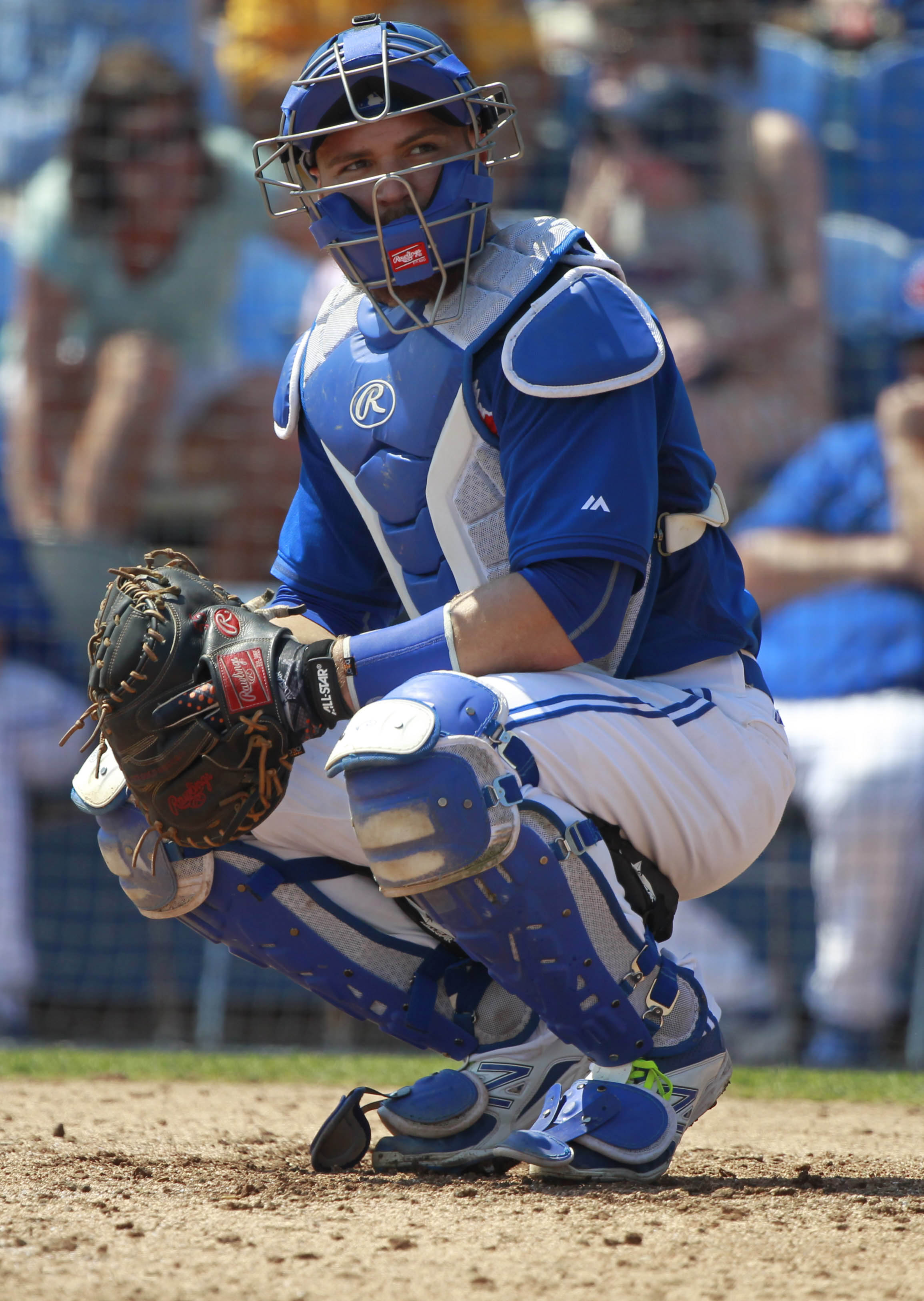
The Jays added another significant right-handed bat to their lineup by inking Russell Martin to the most expensive free agent signing in franchise history. While Martin did hit .290/.402/.430 for the Pirates last season, he posted only a .702 OPS in his five previous seasons, and the Jays have spoken less about Martin’s bat than what he’s expected to contribute as a clubhouse leader and with his outstanding defense.
Melky Cabrera‘s departure created a hole in left field that was filled with the acquisition of Michael Saunders from the Mariners. Unfortunately for Saunders, however, he suffered a torn meniscus after a fluke accident in Spring Training camp, and he had the meniscus removed entirely in order to cut his time on the DL from midseason to only mid-April. While this quick recovery is great for Saunders and the Blue Jays in the short term, it remains to be seen how his knee will hold up over the season, particularly playing on an artificial surface.
The Jays did make a move to address second base by trading Anthony Gose to the Tigers in exchange for prospect Devon Travis, who will start at the keystone on Opening Day. While Travis was a Baseball America top-100 prospect headed into 2014 and he had an impressive year at Double-A last season, he wasn’t expected to be a factor in the bigs quite so soon given that he hasn’t even played a game at the Triple-A level. Injuries to Maicer Izturis and Ramon Santiago, however, created an opportunity for Travis and he seized his chance with a big Spring Training performance.
Adam Lind was traded to the Brewers in exchange for righty Marco Estrada, a move that will free up more DH time for Edwin Encarnacion. Danny Valencia and the newly-acquired Justin Smoak are expected to see most of the action at first when Encarnacion is DH’ing, and Smoak could be another ex-Mariner who could benefit away from Safeco Field. Estrada is currently ticketed for a bullpen role though his starting experience makes him a decent depth option as a swingman.
Questions Remaining
While Donaldson and Martin are undoubtedly big upgrades over Lawrie and Dioner Navarro, the Blue Jays spent a lot of money and trade capital on two positions that weren’t really big problems in 2014. The bullpen and second base were areas of need as the offseason began and they’re still question marks now, barring several young players stepping up as reliable contributors. If Travis isn’t yet ready for the big leagues, that will leave the Jays with the same combination of Ryan Goins, Steve Tolleson, and Munenori Kawasaki that underwhelmed last season. Izturis will be in the mix once he recovers from his groin injury, though he had so many issues staying healthy and then performing when healthy that he is almost a wild card option at this point.
Aside from Estrada, the team did little of note to address a bullpen that underachieved in 2014 and lost key personnel to free agency in the form of long-time Blue Jays Casey Janssen and Dustin McGowan. GM Alex Anthopoulos certainly explored his options, as the team checked in on the likes of Rafael Soriano, Francisco Rodriguez and Phil Coke, while also discussing a trade with the Phillies for Jonathan Papelbon. The closer himself has expressed interest in becoming a Blue Jay, and Anthopoulos personally watched Papelbon throw during a recent Spring Training outing. Papelbon is owed $13MM this season and has a $13MM vesting option for 2016, however, so that might be too high a price for Toronto to pay.
Barring a further move, Brett Cecil will be the Blue Jays’ closer. While he has posted very good numbers over the last two seasons, Cecil has only six career saves to his name and has been bothered by shoulder problems this spring. The most intriguing story coming out of the Jays’ camp has been the emergence of 20-year-old right-handers Miguel Castro and Roberto Osuna, both of whom are expected to be in the bullpen on Opening Day. While both have looked dominant in spring action, neither young hurler has pitched above the high-A level before, so it’s anyone’s guess as to how they’ll adjust to the Majors.
The Blue Jays felt they had amassed enough starting pitching depth that they could afford to trade Happ, Nolin and Graveman, and also allow Brandon Morrow to leave for free agency. This decision instantly became second-guessed when Marcus Stroman tore his ACL during a Spring Training drill, leaving the Jays without a pitcher many felt would be the ace of the staff in 2015.
With Stroman out, the Jays went from planning to use Aaron Sanchez as a set-up man to inserting the young righty into the rotation alongside fellow rookie Daniel Norris. While Norris and Sanchez are the club’s top prospects, it still leaves Toronto with a decided lack of Major League experience at the back of their rotation. If either of those two falter (or if something happens to Mark Buehrle, R.A. Dickey or Drew Hutchison), the Blue Jays have a thin cupboard of replacements. Estrada or Todd Redmond could be stretched out, or the team could turn to veteran minor league acquisitions like Felix Doubront, Jeff Francis, Liam Hendriks or even Johan Santana if the former Cy Young Award winner is healthy.
The injuries to both Stroman and Saunders (before his recovery time was shortened) underscored an overall lack of depth on Toronto’s roster. While any team would obviously suffer in losing an everyday player or a front-of-the-rotation starter, the Jays already face enough uncertainty at so many positions that stalwarts like Jose Bautista, Jose Reyes, Encarnacion, Buehrle, Dickey and now Martin and Donaldson are being heavily relied upon to carry the team. If one or more of those players were to miss time, the Jays could see another season scuttled due to injuries, as has been the case in each of the last three years.
Bautista and the rest of the veteran core become even more important given that six rookies are being counted on to play major roles — Sanchez, Norris, Castro, Osuna, Travis and center fielder Dalton Pompey. While there’s certainly a lot to like about the pedigree of this young talent (Norris, Sanchez and Pompey are all ranked as top-30 prospects by Baseball America), there’s a lot of risk in trying to contend with multiple rookies in key positions, as the 2014 Red Sox could attest.
Deal Of Note
Saunders’ torn meniscus wasn’t a good sign coming off an injury-plagued 2014 season for the outfielder, yet if his borderline miraculous recovery holds up, he could be a quality addition for the Jays. Despite Saunders’ health issues in recent years, he still posted a 111 OPS+ over the last three seasons for Seattle, including a .273/.341/.450 slash line over 263 plate appearances last year. A move from Safeco Field to the much more hitter-friendly Rogers Centre should make his bat even more potent.
Overview
It’s not exactly a make-or-break season for the Blue Jays given all these young talents just starting their careers and the number of notable veterans all under contract (or team options) for 2016 and beyond. Falling short of the postseason again could spell the end of manager John Gibbons, however, and possibly even Anthopoulos as well given how Jays ownership is already searching for a new club president. You would imagine that a new president would prefer to have his own baseball operations personnel in place, especially if that president is himself a former general manager like Dan Duquette or Kenny Williams. That said, the Jays’ search has been so public and so unusually handled thus far that it’s hard to predict how it will play out, so it’s probably a story best explored after the season.
Anthopoulos may not quite be done with his offseason maneuvering, as the GM has hinted that the team could still make bullpen additions at the end of Spring Training or even past Opening Day. The Jays could also upgrade their depth elsewhere around the diamond by moving Navarro, who has been a subject of trade speculation all winter long and has even voiced a desire to start for another club. (I examined his Trade Candidate status in February.) The Tigers and Diamondbacks are among the teams who have reportedly shown interest in Navarro, though D’Backs GM Dave Stewart has denied his team will be making a move for the catcher.
If this collection of Jays ends up being the Opening Day squad, however, it’s still a team to be reckoned with, especially since the other AL East clubs are also dealing with their own share of question marks. Reyes, Martin, Bautista, Encarnacion and Donaldson is as good a start to a batting order as any in the league, and the lineup could be even more daunting if Saunders blossoms in Toronto or if Pompey and/or Travis break out. Hutchison could be ready to take a step forward after making an adjustment to his slider late last season, while Norris and Sanchez are so highly regarded that it wouldn’t be a surprise to see either emulate Stroman’s immediate success.
It could be that this injection of fresh blood is just what the Blue Jays need to finally get back to the playoffs. Stroman’s torn ACL was a huge blow right off the bat, yet if the Jays can avoid any similarly devastating injuries, they should be in the AL East hunt through September.
Photo courtesy of Kim Klement/USA Today Sports Images
Offseason In Review: Miami Marlins
Miami tied its fortunes to star slugger Giancarlo Stanton, kicking off an incredibly busy offseason in which the organization announced its intentions to compete in 2015 and beyond.
Major League Signings
- 1B Michael Morse: two years, $16MM
- OF Ichiro Suzuki: one year, $2MM
- C Jeff Mathis: one year, $1.5MM (exercised option)
- Total spend: $19.5MM
Notable Minor League Signings
- David Adams, Reid Brignac, Tyler Colvin, Cole Gillespie, Reed Johnson, Don Kelly, Nick Masset, Vin Mazzaro, Pat Misch, Chris Narveson, Ryan Reid, Vinny Rottino, Scott Sizemore, Jhonatan Solano, Jordany Valdespin
Trades And Claims
- Acquired 2B Dee Gordon, SP Dan Haren, IF Miguel Rojas, PTBNL, $10MM from Dodgers in exchange for SP Andrew Heaney, IF/OF Enrique Hernandez, RP Chris Hatcher, C Austin Barnes
- Acquired SP Mat Latos from Reds in exchange for SP Anthony DeSclafani, C Chad Wallach
- Acquired IF/OF Martin Prado, SP/RP David Phelps, $6MM from Yankees in exchange for SP Nathan Eovaldi, 1B Garrett Jones, RP Domingo German
- Acquired SP Kendry Flores, RP Luis Castillo from Giants in exchange for 3B Casey McGehee
- Acquired RP Aaron Crow from Royals in exchange for SP Brian Flynn, RP Reid Redman
- Acquired SP/RP Andre Rienzo from White Sox in exchange for RP Dan Jennings
- Acquired cash from Pirates in exchange for RP Arquimedes Caminero
- Claimed RP Preston Claiborne from Yankees
- Claimed RP Andrew McKirahan from Cubs in Rule 5 draft
Extensions
- OF Giancarlo Stanton: thirteen years, $325MM plus club option; player can opt out after six years
- OF Christian Yelich: seven years, $47.57MM plus club option
- RP Mike Dunn: two years, $5.8MM
Notable Losses
- Barnes, Rob Brantly, Mark Canha, DeSclafani, Eovaldi, Flynn, Rafael Furcal, Kevin Gregg, Hatcher, Heaney, Hernandez, Jones, McGehee, Edgar Olmos, Brad Penny, Wallach
Needs Addressed
After a somewhat surprisingly promising 2014 campaign, many tabbed the Marlins as a team to watch heading in 2015. Expectations were that Miami would ramp up its competitive timeline somewhat and make a legitimate run at extending Giancarlo Stanton.
The Marlins did that and more by inking Stanton right off the bat, locking up outfield mate Christian Yelich in mid-March, and making a whole host of acquisitions in between. Fulfilling its assurances to Stanton, and using some — but not all — of the salary space that his back-loaded deal opened up, Miami methodically plugged holes all winter.
Michael Morse upgrades Garrett Jones at first for a reasonable price. Ichiro Suzuki provides a veteran fourth outfielder to go with the young trio of Stanton, Yelich, and Marcell Ozuna. Re-upping Jeff Mathis as the backup catcher is, perhaps, somewhat questionable given his anemic bat, but at least he’ll be cheap and offers the team rather a different skillset than does starter Jarrod Saltalamacchia.
The biggest move, surely, was the addition of speedy second baseman Dee Gordon. Miami is betting that 2014 was a breakout, not a brief uptick, for Gordon. It sacrificed a good bit of talent (and future flexibility) to do so: top pitching prospect Andrew Heaney, interesting utility man Enrique Hernandez, useful reliever Chris Hatcher, and solid catching/utility prospect Austin Barnes.
That deal also left the Fish with a free roll on veteran righty Dan Haren, who will be joined by fellow trade acquisition Mat Latos in an interesting but hard-to-predict rotation. Those two arms are more or less opposites at this point: Haren has been a workhorse of declining quality, while Latos has had injury questions but nothing but quality results when healthy. It took another young arm and catching prospect to add Latos to the mix. Miami was not even sure when it made the deal to add Haren whether he would pitch for the team — he was included, in large part, as a mechanism for the Dodgers to kick in $10MM cash — but his decision to do so provides useful stability at the back of the rotation.
The other major bit of roster orchestration performed by president of baseball ops Michael Hill and GM Dan Jennings was designed to upgrade the team at third. Miami bought low on Martin Prado from the Yankees (who had already bought low on him from the Diamondbacks), in turn selling low on talented-but-unpolished pitcher Nate Eovaldi (who had come to Miami as the crown jewel of the Hanley Ramirez trade). In turn, the team had to move incumbent Casey McGehee, who had an excellent but questionably sustainable comeback in 2014 and will now look to repeat with the Giants.
A host of the other moves listed above filled in smaller gaps and provided the team with some options.
Questions Remaining
In the immediate term, the Fish look like a pretty complete club. The outfield is a reasonable choice as one of the three best outfits in the game, while the infield seems in much better shape than last year. To be sure, the new trio of Gordon, Prado, and Morse has its fair share of questions. But there is good reason to prefer that group to what it replaced, by a fair margin.
The biggest question, perhaps, is at short. Adeiny Hechavarria has struggled at the plate and is not well-loved by defensive metrics. But the team obviously feels good about him, since it explored an extension. Indeed, last year was his best at the plate, he is only entering his age-26 season, and Hech seems to have all the tools to be quite a good defender.
That being said, if the Marlins are contending and Hechavarria is not performing, the possibility of a deal for another option cannot be ruled out. Likewise, the catching position does not presently look to be a strength and could ultimately require a temporary patch while the club awaits J.T. Realmuto‘s final developmental steps. The club has some reasonable options lined up elsewhere on the diamond — players like Donovan Solano, Jeff Baker, Don Kelly, and Jordany Valdespin come to mind — but looks thinner at short and catcher.
It is fair to wonder, too, whether an injury or two could expose some fault lines in the rotation. It is somewhat remarkable, really, that all of Eovaldi, Heaney, DeSclafani, Brian Flynn, and Jacob Turner are gone from the rotation mix, taking a lot of potential innings with them. While second overall pick Tyler Kolek is the new top dog in the system, he remains years away (even as third choice Carlos Rodon nears a big league job with the White Sox).
To be sure, things look solid as camp winds to a close. Henderson Alvarez, Jarred Cosart, and Tom Koehler will presumably join Latos and Haren while the team awaits the mid-season return of precocious ace Jose Fernandez. But the rest of the depth chart includes a somewhat questionable mix of swingmen (Brad Hand, David Phelps) and untested prospects (Jose Urena, Justin Nicolino, Adam Conley).
There is depth and quality in the pen, led by late-inning arms Steve Cishek, A.J. Ramos, and Mike Dunn. For a second lefty, the club will go with the out-of-options Hand (after waiving Rule 5 pick Andrew McKirahan). The club went out and added Aaron Crow in hopes that he would bounce back in Miami, giving up Flynn to do so. But with Crow out with a torn UCL, the right-handed pen contingent will be drawn from the returning Bryan Morris and Carter Capps, offseason additions Phelps and Preston Claiborne, and veteran minor league free agents Nick Masset, Vin Mazzaro, Pat Misch, Chris Narveson, and Ryan Reid. We already know that the Fish attempted to bolster this group by pursuing Francisco Rodriguez; with Crow now gone (and a likely non-tender after the year), could they have a look at the still-unsigned Rafael Soriano or other veterans that have recently been set adrift?
Deal of Note
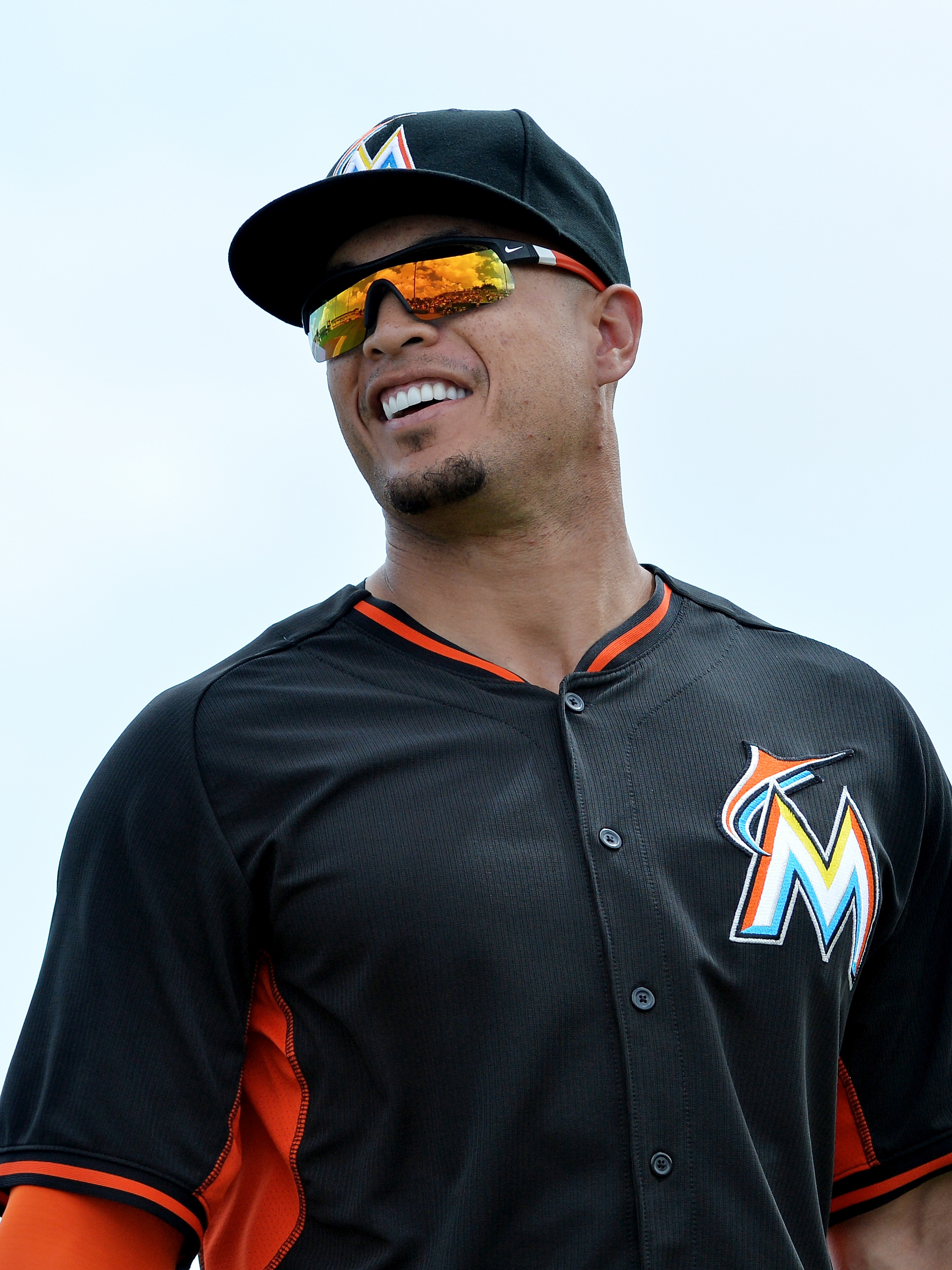
The prevailing notion entering the winter was that the Marlins had to do something to “prove” to Stanton that the franchise was serious about winning, enticing him to commit for the long haul as he entered his second (and second-to-last) season of arbitration eligibility. It was expected, perhaps, that a series of additions earlier in the offseason might, in part, set up a spring extension.
Instead, Miami put the horse before the cart by making a record-setting contract with Stanton its first order of business. His youth and essentially unmatched power (in today’s game) made a huge guarantee an obvious requirement of any deal. But the final structure still managed to shock the industry, in large part due to its remarkable 13-year term, sixth-year opt-out, and backloaded payout.
It remains to be seen how things play out under this contract, of course, but it ensures Stanton will make an astronomical sum even if he is injured or experiences a severe production decline. Though Miami seems quite likely to achieve excellent value if Stanton opts out, there is some frightening downside. (And the deal makes all the more clear how well the Angels did to lock up the historically-excellent Mike Trout without having to dangle a seven-year player option on the deal’s back side.)
Overview
Stanton’s new contract kicked off an offseason of ever-cresting promise which culminated in the long-term signing of Yelich. Expectations are high, the Fish are a confident bunch, and the organization seems out to regain the trust of its fans. But expectations can be dangerous, as Miami knows all too well, and a postseason berth seems far from a certainty.
Then there’s the fact that Miami has sacrificed a good deal of its upper minor league talent in the last eight months. Indeed, five of the team’s six best prospects entering 2014 (per Baseball America) have since been traded. Many other, lesser-regarded young players have also seen their departure. Re-acquiring top-level prospect talent while rebuilding system depth — all while facing increasing arbitration costs and demands for spending at the big league level — will pose a significant challenge.
This is where the biggest long-term questions factor in: will the team’s on-field performance and popularity enable it to draw and earn, and will owner Jeffrey Loria continue to approve payroll increases? Needless to say, all of these questions are interconnected and remain impossible to predict at this stage.
As for the present season, the most interesting thing about the Fish may not be what they did, but what they might have done. The team was in on K-Rod, James Shields, and Hector Olivera, and will enter the year with the league’s lowest payroll. Miami was fairly aggressive at last year’s trade deadline; if it is in the hunt this year, there could be some fireworks yet to come.
Photo courtesy of USA Today Sports Images.
Evan Gattis Settling In With Astros
Even after watching the Braves ship out key players such as Justin Upton and Jason Heyward, Evan Gattis wasn’t expecting to be the next one to go. In January, after weeks of rumors and speculation, Atlanta struck a deal with the upstart Astros to continue their massive overhaul. Gattis was caught off guard, but it didn’t take him long to come to terms with the move and get comfortable with his new club.
“I wasn’t really actually bummed about the trade, I was just more surprised than anything. I just didn’t think it would happen,” Gattis told MLBTR prior to Wednesday’s game against the Phillies. “Other than that, its been a good camp and there’s a really good group of guys here. I’m just excited and looking forward to the season.”
Gattis understood that major change was coming to the Braves, but he figured that he would be immune to it all since he’s still pre-arbitration eligible for one more season and playing near the league minimum. Eventually, when it became clear that the Braves were listening on offers for him, he still didn’t panic or personally reach out to anyone in the Atlanta front office. “I’m always the type to focus on my own business and I just worry about what I need to do to play,” Gattis explained.
With the Braves eyeing 2017 as their year to get back to contention, Gattis sounds legitimately enthused to be with a team that has advanced their own timeline considerably. In fact, he says he’s okay with being flexible with regards to his exact role this season and isn’t fretting the split he might have between left field, the DH spot, or occasional time behind the plate. Gattis hasn’t gotten a ton of balls hit his way in left during spring training, but he’s confident that he’ll get comfortable there in time, just as he did with his new club.
Offseason In Review: Milwaukee Brewers
Although the Brewers made a few significant moves this offseason, they hold about the same cards they did last year — too strong to fold, too weak to raise.
Major League Signings
- Francisco Rodriguez, RP: Two years, $13MM plus 2017 option
- Neal Cotts, RP: One year, $3MM
- Total spend: $16MM
Trades And Claims
- Traded P Yovani Gallardo and cash to the Rangers for SS Luis Sardinas, P Corey Knebel and P Marcos Diplan
- Traded P Marco Estrada to the Blue Jays for 1B Adam Lind
- Traded C Shawn Zarraga to the Dodgers for OF Matt Long and P Jarrett Martin
- Traded P Zach Quintana to the Braves for OF Kyle Wren
- Claimed OF Shane Peterson from the Cubs
- Claimed C Juan Centeno from the Mets
Extensions
- None
Notable Minor League Signings
- Chris Perez (since released), Donnie Murphy, Chris Leroux
Notable Losses
- Zach Duke, Mark Reynolds, Tom Gorzelanny, Mark Reynolds, Lyle Overbay, Estrada
Needs Addressed
The Brewers entered the offseason in a precarious place. They fell apart down the stretch in 2014 and didn’t necessarily look like they’d contend in 2015. But they were also too talented to dismiss that possibility entirely, and didn’t appear to have enough minor-league talent to be able to get through a quick rebuild. Their offseason seems to reflect their situation — they made one significant trade to exchange a veteran for young talent, but their other key deal actually added a veteran. They seem to be trying to win as many games as possible in 2015 while still aiming for 2016 and beyond. That is, of course, what many teams are doing — going for it and and rebuilding have both become passé, with organizations trying to position themselves for playoff runs both now and in the future. But the thin line the Brewers are walking is one that makes some degree of sense for them, regardless of what’s happening elsewhere.
The biggest move of the Brewers’ offseason was their trade of Yovani Gallardo and $4MM to Texas, which netted them shortstop Luis Sardinas and pitchers Corey Knebel and Marcos Diplan. None of those players will make the Brewers’ Opening Day roster. Sardinas has significant upside if he can develop offensively, given his speed and excellent defense. Even for a 21-year-old with time to improve, however, that might be a tall order, given what he’s shown so far in the minors: good batting averages, but with no power and few walks. Even if he doesn’t improve much, though, he at least has a future as a utility infielder.
The hard-throwing Knebel was a first-round pick in 2013 who zoomed through the minors with the Tigers and then came to the Rangers organization in the Joakim Soria deal. He’s racked up huge strikeout totals everywhere he’s gone and might eventually become a late-inning option in the big leagues, although his upside is somewhat limited since he’s a reliever. Diplan, meanwhile, is a small Dominican righty with a good fastball who the Rangers gave a $1.3MM bonus in 2013. He’s promising, but he’s 18 and so far from the Majors that it’s impossible to guess what he’ll become.
In the end, then, the Brewers got three interesting pieces. None of them are sure bets, but the Brewers likely didn’t expect to get any blue-chip prospects, given that Gallardo was only one year from free agency. And more broadly, Gallardo gave the Brewers more of something they don’t necessarily need right now: adequacy. Gallardo, whose strikeout rate declined for the second straight year in 2014, has become more of an innings-eater than an ace. As we’ll see below, the Brewers have plenty of players who project to be good, but not enough who project to be more than that, and that goes for their rotation as well as the rest of the team.
The Brewers’ other big move of the offseason was to send Marco Estrada to Toronto for Adam Lind. Lind should solve what’s been a persistent problem at first base, where they haven’t had a reliable regular since Corey Hart in 2012. Lind comes relatively cheap, too, at $7.5MM in 2015 and either an $8MM option or a $500K buyout the following year. To get two years of a hitter who produced a .321/.381/.479 line last season, even if he won’t help much defensively and is likely to take a step backward in 2015, was a coup for Milwaukee, particularly given that Estrada isn’t a high-wattage arm and is only one year away from free agency.
The Brewers also added lefty Neal Cotts for $3MM, a deal roughly in line with his talent. The three-run jump in Cotts’ ERA from 2013 to 2014 suggests an extreme decrease in performance that wasn’t exactly there, but his peripherals did take a step backward, and he’s 35. He isn’t a specialist, however — he’s good against lefties and not bad against righties, so the Brewers will have some flexibility with how they use him. He’s not Zach Duke, the pitcher he’s effectively replacing, but he’ll probably be worth about a half a win above replacement, which makes his deal a reasonable one.
The big move the Brewers made to address their bullpen was to re-sign Francisco Rodriguez for two years and $13MM. The Brewers were already set to pay a former closer, Jonathan Broxton, $9MM in 2015, and they easily could have had Broxton take over the closer’s job and spent the money elsewhere. $13MM for Rodriguez wasn’t a massive overpay, however — in fact, K-Rod’s $13MM total fell $1MM below the contract MLBTR’s Jeff Todd projected at the beginning of the offseason. (Whether the Brewers should have traded for Broxton’s contract in the first place is a different question, although that happened before this offseason. Without Broxton on the books, the Brewers might have found more room to do something really creative this offseason, or to sign someone who projected to be a big bullpen upgrade, like Andrew Miller.)
Anyway, increasingly, even veteran relievers without significant closing experience get contracts in the $10MM-$15MM range, like the lefty Duke (who got three years and $15MM from the White Sox) or righty Pat Neshek (who got two years and $12.5MM from the Astros). The Brewers could perhaps have tried to re-sign Duke rather than re-signing Rodriguez and signing Cotts, but Rodriguez has a much longer track record of success than Duke does and is coming off a perfectly good season in which he posted 9.7 K/9 and 2.4 BB/9 over 68 innings. If the Brewers paid extra for his ability to get saves, it wasn’t by much. Getting what is effectively a $4MM option for 2017 ($6MM minus a $2MM buyout) was a nice touch, too.
Questions Remaining
The Brewers have options that are at least reasonable at every position throughout their lineup and rotation, but only a few players who are likely to be standouts — Carlos Gomez, Jonathan Lucroy, and Ryan Braun, who’s young and talented enough to rebound after having thumb surgery in the offseason to fix a nerve problem that bothered him in 2014. Gomez and Lucroy especially stand out as stars who are both very good and dramatically underpaid.
Beyond that, though, it’s hard to say where the Brewers’ upside will come from, particularly in their lineup. Lind, Jean Segura, Aramis Ramirez, Khris Davis and Scooter Gennett (who has second base mostly to himself now that the Brewers declined their option on Rickie Weeks) are all capable, but it’s hard to imagine any of them producing, say, 3 WAR. (Segura might be a possibility, though his performance last season, although it was a year touched by the tragic death of his young son, was probably more in line with the career patterns he established in the minors than his breakout 2013 season was.) This doesn’t mean these players aren’t valuable. Lind, for example, provides a good bat at a position where the Brewers didn’t previously have one. But they’re complementary players on a team that doesn’t have enough stars.
The rotation has similar problems — everyone in it projects to be competent, but no one projects to be a standout. Matt Garza‘s peripherals have declined in the past two seasons, and he isn’t as good as he was with the Cubs. Kyle Lohse has been essentially the same pitcher for the past several seasons, but he’s 36 and isn’t an ace. That leaves Mike Fiers (a 29-year-old soft-tosser who was mysteriously brilliant in 71 2/3 big-league innings last year), Wily Peralta and youngster Jimmy Nelson as the Brewers’ best hopes of providing very high-quality innings. (Fiers had shoulder issues this spring but figures to be fine to start the season.)
The 2015 Brewers figure to have a high floor, then — they have talent, and it’s hard to see them losing, say, 92 games. While predicting how a season will go is a notoriously inexact science, though, it isn’t easy to imagine scenarios where they win 92.
Deal Of Note
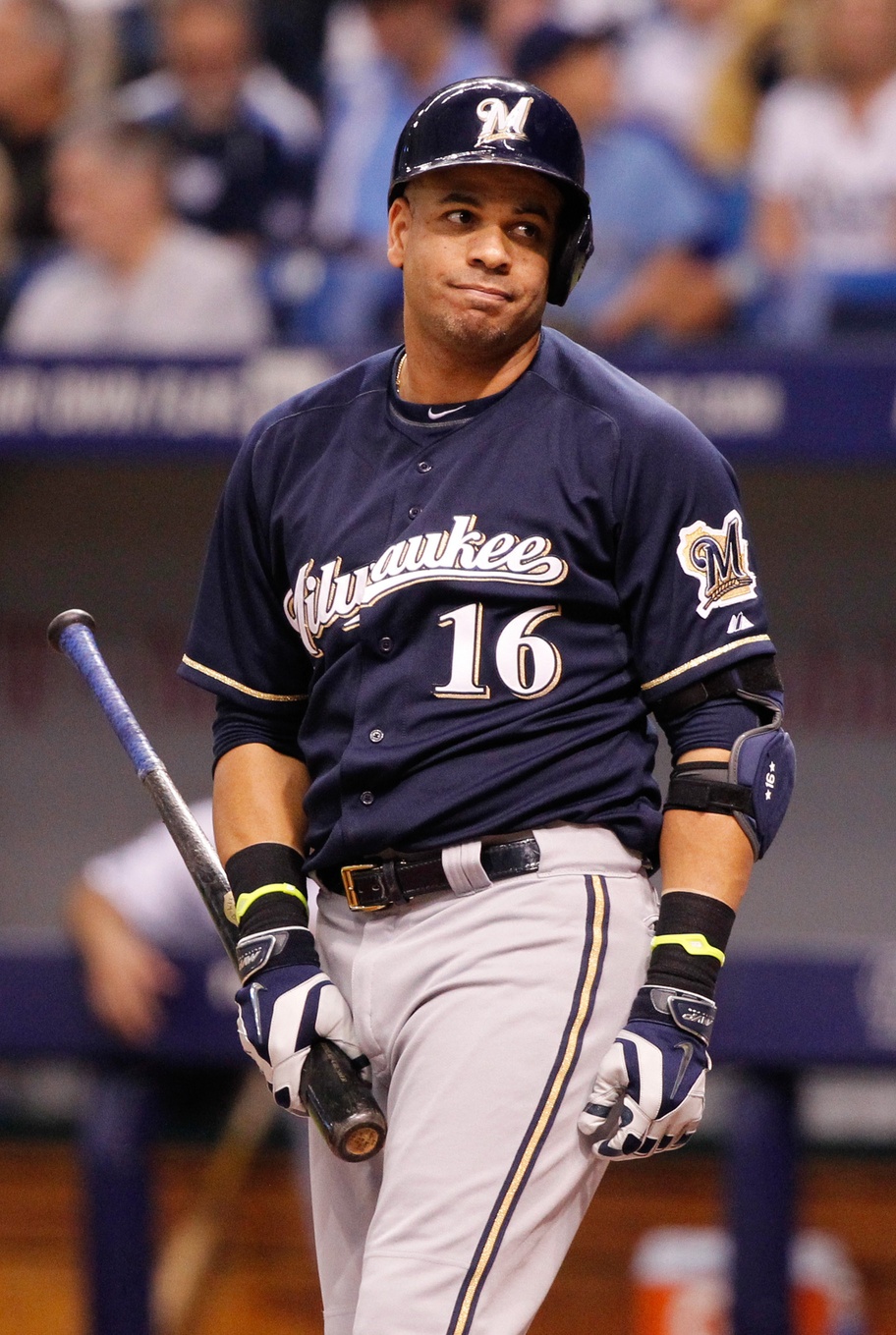 Mutual options aren’t often exercised, but Aramis Ramirez and the Brewers each exercised their ends of a mutual option this offseason, and Ramirez is back in Milwaukee for one more year, after which he plans to retire. Personal reasons surely played a role in Ramirez’s decision to stay. “I’m comfortable here,” he told the Journal Sentinel’s Todd Rosiak at the time. Rosiak also quoted Brewers manager Ron Roenicke noting that Ramirez was “set financially.” Ramirez’s decision to accept his end of the option was, therefore, not primarily financially driven.
The structure of the option, however, also made it something close to financially rational for player and team. The $14MM option contained a large buyout of $4MM on the Brewers’ side. So for Ramirez, the option was effectively a decision on a one-year, $14MM contract. The $4MM buyout was a sunk cost for the Brewers, so the decision from their perspective was effectively a one-year, $10MM deal. So even if Ramirez hadn’t been thinking about retiring, it would have made sense for both sides to exercise the option if Ramirez’s market value had been between $10MM and $14MM (and if Ramirez hadn’t expected to get a lucrative multi-year deal if he rejected it). Ramirez produced 1.8 fWAR last year and projects to produce similarly next year. Given the cost of wins on the free-agent market, that puts him near or in that $10MM-$14MM range. Of course, Ramirez probably could have gotten a multi-year deal on the open market, but it’s interesting that, for the price of a single year, the option made good financial sense for both sides.
Overview
The Brewers aren’t particularly old, but they’re still essentially an aging team rather than a dynamic or young one. They’re victims of their own success — they’ve won 80 or more games in seven of the past ten seasons, so they’ve only had one top-ten draft pick since taking Braun fifth overall in 2005. They also haven’t generally been top bidders for international talent. As a result, their farm system, which previously had produced top players like Braun, Lucroy, Gallardo and Prince Fielder, hasn’t been as bountiful lately.
The Brewers did add Dominican infielder Gilbert Lara for $3.2MM last year, though, and also significantly improved their collection of minor-leaguers by drafting Kodi Medeiros, Jacob Gatewood and Monte Harrison and trading for Sardinas, Knebel and Diplan. A minor deal for Kyle Wren (a speedy outfielder who might one day become a useful bench player) also moved the needle a bit too.
In, say, two years, the Brewers could have an exciting group of prospects. For now, though, they’re a bit stuck, the result of a farm system that, following the 2013 season, Baseball America had ranked the least likely of any organization to provide high-quality help in the near term. Most of the Brewers’ best prospects are still far from the Majors. As I noted in my preview of their offseason, that makes rebuilding a difficult proposition, and the their big-league team could still contend if it catches some breaks. So what the Brewers did this offseason made sense — they didn’t rebuild, but they also didn’t do anything that would get in the way of rebuilding in the future. For example, they added Lind without giving up anyone likely to help them beyond 2015.
If they get off to a slow start in 2015, however, the Gallardo trade could be a preview of what’s to come, with pitchers like Lohse and Broxton potentially on the block. Again, though, there’s a case that more radical trades don’t make much sense — the Brewers have few payroll commitments beyond 2015 and could find a way to cobble together an interesting 2016 team even without much in the way of reinforcements from their farm system.
Photo courtesy of USA Today Sports Images.
MLBTR Originals
A look back at the original reporting and analysis found on MLBTR the last seven days:
- MLB Trade Rumors Podcast featured host Jeff Todd discussing the Dodgers front office overhaul and their slew of offseason manuevers with Dylan Hernandez of the Los Angeles Times. Jeff also welcomed MLBTR’s Zach Links who spent the past week touring the Grapefruit League. A new edition of MLB Trade Rumors Podcast drops every Thursday and can be accessed on iTunes, SoundCloud, and Stitcher.
- Tim Dierkes revised MLBTR’s 2016 Free Agent Power Rankings with Yoenis Cespedes knocking Matt Wieters out of the tenth spot.
- Zach visited the Spring Training camps of the Blue Jays, Twins, and Phillies.
- In Dunedin, Blue Jays first baseman Justin Smoak told Zach a change of scenery may be what it takes for his career to take off. “I feel like I’m at a point where I’ve learned what works for me and I’ve learned a lot. In Seattle, I had some good times and I learned a lot, but it’ll be a fresh start in Toronto and, hopefully, I’ll get things going here.“
- In Ft. Myers, Zach spoke to Twins reliever Blaine Boyer about why he insists on traveling with his family, asked Mike Pelfrey about his time with the Mets and his decision to sign with the Twins three years ago, and queried Twins GM Terry Ryan about the negotiations surrounding the recent Phil Hughes extension and the spring play of shortstop Eduardo Escobar.
- In Clearwater, Zach sat down with Phillies starting pitchers Aaron Harang and Jerome Williams and third baseman Cody Asche explained his reasoning for choosing Arland Sports as his agency.
- Agent Jim Munsey told MLBTR free agent left-hander Sean Burnett, recovering from his second Tommy John surgery, will throw for interested clubs in May or June and anticipates his client will be game-ready sometime in July.
- Tim and Jeff continued MLBTR’s Offseason In Review series with their assessment of the Cubs, White Sox, Mets, and Phillies.
- Steve Adams identified eight teams who have a need for recently released right-hander Jhoulys Chacin.
- Mark Polishuk sees Dodgers third baseman Juan Uribe as a possible trade candidate.
- Jeff surveyed MLBTR readers on the best (acquiring Howie Kendrick/trading Dee Gordon) and worst (trading Matt Kemp) Dodger transactions this past winter.
- MLBTR was the first to learn the Rays released outfielder James Harris.
- Zach assembled the best of the baseball blogosphere for you in Baseball Blogs Weigh In.
Why I Chose My Agency: Cody Asche
Over the years, third baseman Cody Asche has drawn comparisons to Chase Utley from wishful Phillies fans. However, even though they’re both infielders that bat left-handed, Asche is a different type of player and is still working towards making that major step forward at the big league level. This spring, Asche has given the Phillies plenty of reason to believe that 2015 could be his year to break out. Last week against the Twins, Asche took Mike Pelfrey deep for his third homer in just five games. Prior to his next outing against the Astros on Wednesday, Asche spoke with MLBTR in the team’s Clearwater clubhouse about his representatives at Arland Sports.
On how he first came in contact with his primary agent, Jason Wood:
He was close to one of my summer coaches in high school and he represents one of my good friends, Jake Odorizzi (Odorizzi spoke with MLBTR’s Tim Dierkes back in 2013 about Arland Sports). We kept in contact a little bit and when it came time in college to find someone, me and my family just felt really comfortable with him. We didn’t really interview anyone else, we just knew that he was a good guy with the same kind of morals as us so we went with him.
On whether there’s an advantage to being with a smaller agency like Arland Sports:
I think for sure there’s an advantage, just because you get to know him on such a personal level. I wouldn’t even consider him my agent first, I would consider him my friend first before calling him my agent. But, being that he’s a smaller agent, only having a couple guys in the big leagues, we get a lot more attention than someone might get at a bigger agency.
On the things his agency does for him outside of baseball:
Anything, you name it. He’ll help me with restaurant reservations, tickets to games, lots of stuff like that. A lot of the time I’ll just reach out to him so that I can go to dinner with him. Obviously, he also helps me line up things like apparel deals. Also, my wife Angie is a dietician and he’s helped a lot with her startup business, Eleat Sports Nutrition, and getting that off the ground. Overall, I try not to ask Jason for too much though and I’m not the most demanding guy, so there’s not a ton of stuff I really want.
On whether he’s tried to recruit other players to the agency:
I haven’t done that a lot, I’ve had it more the other way actually. I’ve had a lot of guys say to me, “If you ever want to talk to [my agent] about making a change you can,” but I think everyone knows that I’m rock solid with Jason and all of Jason’s guys are rock solid and a lot of people in the business know that. Myself, Jake Odorizzi, and David Phelps are the three main guys we have in the big leagues right now, all three of us know what he’s about, we’re loyal, and I couldn’t foresee a situation where any of us would ever want to leave.