
Top Ten Remaining Free Agents
Now that the smoke has cleared after an extremely busy Winter Meetings, here’s a look at the top ten remaining free agents available (based on Tim Dierkes’ early-November ranking of the top 50 free agents), with updates on each. We’ll assume here that Brandon McCarthy, whose pact with the Dodgers has is not yet confirmed, is off the market.
1. Max Scherzer — Six weeks into the offseason, it’s Jon Lester, and not Scherzer, who has dominated discussions, but that’s mostly because Scherzer’s agent, Scott Boras, often prefers to have his clients sign later in the offseason. A reunion with the Tigers appears possible for Scherzer, although a Tigers official recently said a new deal for Scherzer was “not happening.” The Yankees also appear to be a possibility for Scherzer, who is reportedly looking for at least $200MM.
3. James Shields — The Red Sox are an obvious match for Shields, despite all the starting pitching Boston has already added. The Giants also seem keenly interested in Shields. Shields has also met with the Rangers, although GM Jon Daniels has said the club was mostly just doing due diligence.
7. Melky Cabrera — The Mariners appear to be the clear favorites here, although reports indicate that neither the Mariners nor the Orioles are willing to go beyond three years. Cabrera is reportedly the Royals’ top priority to (re-)join their outfield as well.
12. Kenta Maeda — It still isn’t clear whether the Hiroshima Carp will post Maeda this winter. If they do, expect the Diamondbacks to have interest. Teams in the pitching market who lose out on Shields or Cole Hamels could be possibilities as well. Phillies GM Ruben Amaro has flown to Japan to watch Maeda pitch.
16. Chase Headley — The Yankees continue to be connected to Headley, with the Giants (who, of course, lost Pablo Sandoval already this offseason) in the mix as well. Before the Winter Meetings, it was rumored that a mystery team had offered Headley four years and $65MM. (Another report had the Astros offering Headley five years and $65MM.) One would think the four-year, $65 offer (which went way over the four years and $48MM MLBTR projected) would have seemed like a good deal for Headley, but he remains on the market a week and a half later. Some within the industry reportedly doubted that offer was legitimate.
20. Colby Rasmus — The market for Rasmus has been fairly quiet, with the Orioles and Royals lurking as possibilities. And even there, the Royals reportedly only see Rasmus as a backup plan in case they’re unable to land Cabrera. Rasmus has talent and youth on his side, but his strikeout numbers and his benching by the Jays are concerns. Still, the lack of a clear market for Rasmus seems a little incongruous, given that he’s 28 and produced a 4.8-fWAR season in 2013.
21. Jed Lowrie — The Giants have asked about Lowrie as a potential addition at third base or second (in which case Joe Panik would move to third). Lowrie is reportedly looking for a three-year deal, with the Mets and Marlins as potential landing spots along with the Giants.
22. Asdrubal Cabrera — The Giants have inquired about Cabrera as a potential third baseman as well, only to be told that he would rather play up the middle. The Royals have shown interest in Cabrera, but they might not have much use for him unless they can move Omar Infante. The Mets, on the hunt for a shortstop, reportedly have more interest in Lowrie or Stephen Drew than in Cabrera. Given Cabrera’s recent defensive struggles, it’s hard to imagine a team signing him to start at shortstop at this point, so if he’s not willing to play third, he might be limited to second.
26. Jake Peavy — The market for Peavy has been rather quiet, which isn’t a surprise, given that the pitching market only recently broke open with Lester’s signing. The Marlins have been connected to Peavy, and Miami might be a possibility for him if Dan Haren retires, although the Marlins’ acquisition of Mat Latos probably makes a signing less likely. The Dodgers have also had discussions with Peavy, although that was reported before we learned they were deep in talks with Brandon McCarthy.
27. Hiroki Kuroda — At last check, Kuroda had reportedly not yet decided whether to pitch in the Majors next season (in which case he might return to the Yankees) to pitch in Japan, or to retire. He remained a durable and effective starter even at age 39 last season, so the Yankees could certainly still use him if he were to decide to return.
Arbitration Breakdown: Rick Porcello
Over the next few weeks, I will be discussing some of the higher profile upcoming arbitration cases. I will rely partly on my arbitration model developed exclusively for MLB Trade Rumors, but will also break out some interesting comparables and determine where the model might be wrong.
Rick Porcello enters his fourth and final arbitration year coming off of a career year — and heading to a new team. With a 3.43 ERA, he bested his career ERA by over a run, and he had personal records with 15 wins and 204 2/3 innings too. Porcello had never had an ERA better than 3.96—and that was his rookie year—and he had gotten 14 wins a couple times, although not since 2011. Porcello had also never thrown more than 182 innings, yet he beat that handily this year. After establishing himself as a slightly below average starter whose best characteristic was that he was durable, Porcello emerged as an important contributor in 2014.

Those three key statistics for which Porcello had a career record in 2014 (ERA, wins, innings) are by far the most important ones for starting pitchers in arbitration. Furthermore, in general only the most recent season counts towards a player’s arbitration raise once they have reached their second year of eligibility or later. The previous years’ performances only really matter in as much as they affect the salary base from which the player will earn a raise. As a result, Porcello is likely to get a healthy raise from his $8.5MM salary in 2014, and my model projects his raise to be $3.7MM, putting him at $12.2MM. By looking at other comparables, this looks like a reasonable estimate.
Shaun Marcum in 2012 received a $3.30MM raise after going 13-7 with a 3.54 ERA in 200.2 innings. Although strikeouts do appear to have some effect on starting pitchers’ arbitration cases, and Marcum had 158 to Porcello’s 129, the rest of Marcum’s case seems to be slightly worse across the board. His ERA is barely higher, his innings are barely lower, yet he won two fewer games. As a result, Marcum is likely to be seen as floor for Porcello. This means that Porcello is likely to be able to argue that any agreement should give him a raise of more than the $3.3MM than Marcum received.
A possible ceiling for Porcello could be Justin Masterson’s $4.07MM raise last year. Masteron had a 14-10 record, so he did win one fewer game than Porcello, and his 3.45 ERA was similar. Masterson also had 193 innings, which is less than Porcello’s 204.2. However, all of those numbers are similar and Masterson had 195 strikeouts, beating Porcello by 69. If strikeouts are given any real weight in Porcello’s process (which does not always seem to be the case), they are likely to make Masterson look like a ceiling because of the similarity of his case otherwise. However, if they are not considered strongly, then Masterson would look more like an even comparable for Porcello.
Another possible comparable could be Jason Vargas from 2013, who got a $3.65MM raise—just $50K less than my model predicts. Vargas went 14-11 with a 3.85 ERA, so he had one fewer win and an ERA 0.42 higher. But Vargas had 217.1 innings, topping Masterson by 12.2 innings, and he struck out twelve more batters. The case is definitely similar, with the extra win and better ERA not necessarily giving a better case because of the 12.2 fewer innings and twelve fewer strikeouts. As a result, the $3.65MM seems likely to be close to what Porcello earns.
I suspect that the model will nail this case based on these three comparable pitchers. This would put Porcello at $12.2MM in his last year before free agency.
Poll: Are The White Sox Ready To Contend?
Before last night, the White Sox had already made noise this offseason, signing Adam LaRoche to complement Jose Abreu at first base and DH and Zach Duke to provide a strong lefty for their bullpen. On Monday, though, they took their offseason to a new level, agreeing to terms with former Yankees closer David Robertson on a four-year, $46MM deal and agreeing to acquire Athletics starter Jeff Samardzija, reportedly for infielder Marcus Semien, pitcher Chris Bassitt and a third player.
Add in pitcher Carlos Rodon, who has moved through the minor leagues as quickly as anticipated after the White Sox drafted him third overall last season, and it appears GM Rick Hahn has swiftly turned the White Sox from a franchise with weak big-league talent and an even weaker farm system into something far more interesting. But is it enough?
Next year’s AL Central appears to be up for grabs. The Tigers figure to lose Max Scherzer, and they’re getting older; the Royals will almost certainly lose James Shields. The Twins’ recent streak of losing seasons looks likely to continue, leaving the Indians as the only team that appears to have improved, adding Brandon Moss to a roster that finished third last year. An AL Wild Card spot might be a bit more attainable than last season, too, with the Royals and Athletics appearing likely to move backwards, although the Blue Jays, Red Sox and perhaps Mariners could complicate that picture.
The White Sox, however, only won 73 games in 2014, and it remains to be seen if their aggressive offseason is enough to move them past the Tigers, Royals and Indians, all of whom won at least 12 more games than they did. The White Sox’ rotation, led by Chris Sale, Jose Quintana and Samardzija, now looks like it should be a strength, particularly if Rodon can make an impact. Adding Robertson and Duke to what had been a weak group of relievers should provide a big boost, and young-ish arms like Jake Petricka, Zach Putnam and Daniel Webb are interesting enough to imagine that the bullpen could be a strength overall.
Offensively, the White Sox will lean heavily on Abreu and LaRoche, with Adam Eaton, Alexei Ramirez and Conor Gillaspie all expected to play key roles. It remains to be seen what they’ll do at second base now that Semien is reportedly gone, and what they’ll get out of corner outfielders Dayan Viciedo and Avisail Garcia, both of whom struggled in 2014. The White Sox also still aren’t a strong team defensively. One more clever addition — perhaps someone like Nori Aoki to add to their corner outfield talent — might make a big difference.
That possibility aside, though, what do you think? Have the White Sox done enough already this offseason to mold themselves into a contender?
Are The White Sox Ready To Contend?
-
Yes 56% (10,650)
-
No 44% (8,454)
Total votes: 19,104
Free Agent Profile: Stephen Drew
A year after rejecting a qualifying offer from the Red Sox that derailed his offseason, Stephen Drew is back on the market. This time, Drew is coming off a poor season, but the lack of a qualifying offer should help him this time around, as should the weak shortstop market.
Pros/Strengths
Drew is a plus defensive shortstop, posting positive UZR numbers in five of the last six seasons. He’s consistent in the field, and he has good hands and decent range, which he augments by using data to position himself before plays. “He’s one of the best in baseball,” Red Sox coach Brian Butterfield said in 2013. “I feel fortunate to be able to see him every day. He has great hands and great feet.”
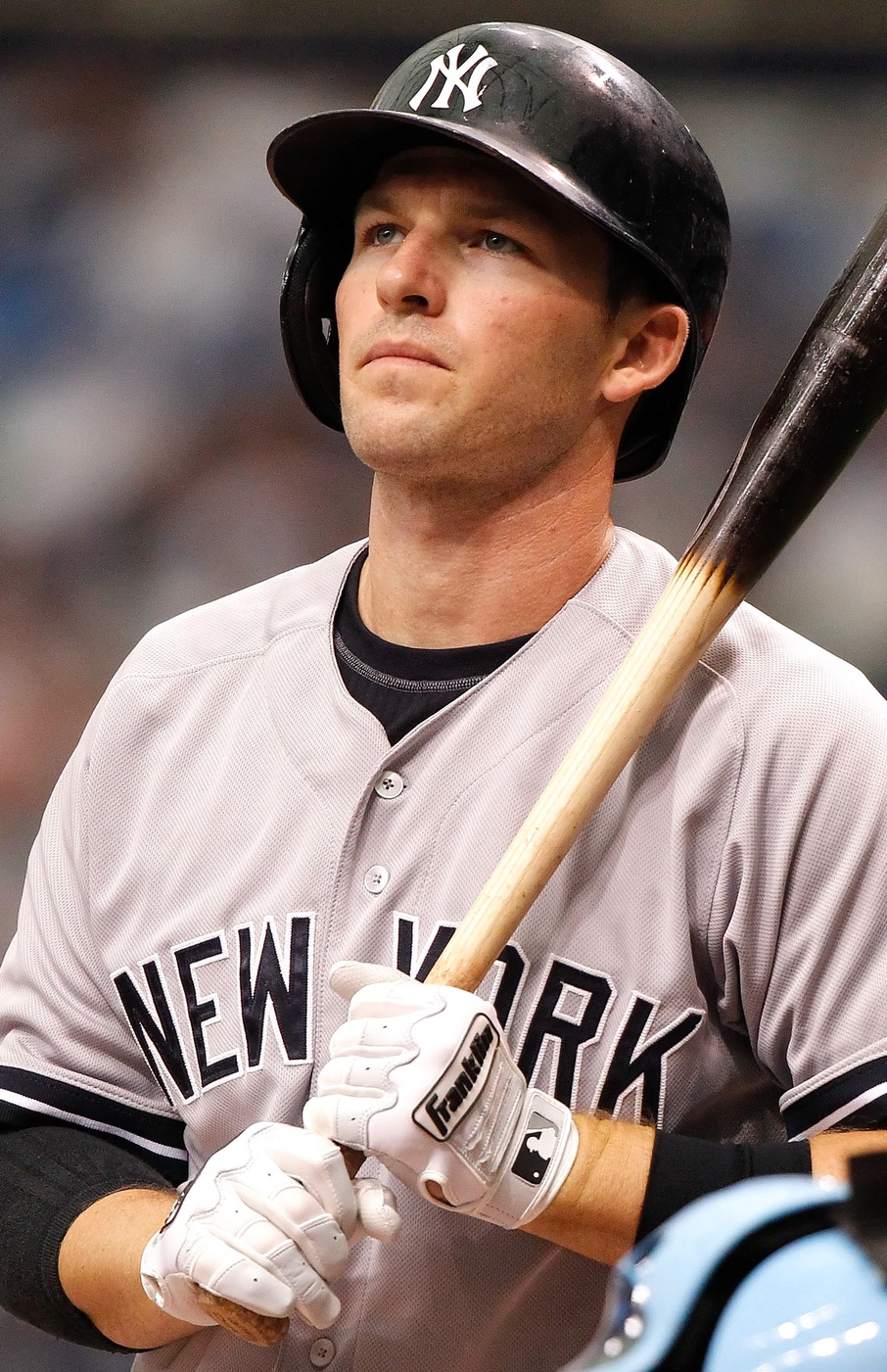 Even while Drew struggled at the plate in 2014, he was comfortably above average at shortstop. He also played a bit of second base with the Yankees in 2014, and by eventually moving to a utility infielder role, he could prolong his career for quite awhile even if his offense doesn’t rebound much. Clint Barmes, a similarly strong defender who provided value for the Pirates from 2012 through 2014 even as his bat faded, demonstrates what the last few years of Drew’s career, whenever those might come, might look like.
In his better years, Drew has a good bat as well, with plenty of line drives and walks to go along with 15-homer power. In 2013, he hit .253/.333/.443 with 50 extra-base hits, a fine total for a shortstop. At 31, he also isn’t so old that he’s obviously over the hill, and he’s only one year removed from having enough value to be extended (and to reject) a qualifying offer. If he can recoup a significant percentage of that value in 2015, he’ll be a bargain for his next team.
Cons/Weaknesses
Thanks to the qualifying offer, Drew’s 2014 season didn’t get started until June, and he never got going after that. The layoff from game action surely affected his season, but many other players have missed the starts of their seasons (usually due to injury, of course, and not a protracted period of free agency) and still been productive upon returning. At 31, it’s possible Drew’s poor performance in 2014 could be primarily the result of age-related decline.
Drew also has not batted above .253 since 2010, so he should not be expected to hit for a good average going forward. That limits his upside, which means that if he rebounds offensively in 2015, it could be a bounce-back of the dead-cat variety; Steamer projects he’ll hit just .218/.294/.352 next season. Given Drew’s defensive value, that would still place him above replacement level, although not by nearly as much as he’s been in the past.
Personal
Drew and older brothers J.D. and Tim are the first trio of siblings to all be first-round draft picks, and former star outfielder J.D., in particular, has had a big influence on Drew’s career. Stephen is naturally right-handed, but became a left-handed hitter by imitating J.D. “A lot of people don’t know I was a switch-hitter,” says Stephen. “I always wanted to come back and hit right-handed. If I had to do it over, I would, but it’s too late in my career to fiddle with that.” Stephen also wore the same No. 7 that J.D. wore in Boston. Stephen, wife Laura, and their two sons live in the small town of Hahira, Georgia in the offseason, down the road from J.D. and his family.
Market
The list of free agent starting shortstops is short — there’s Drew, Asdrubal Cabrera, and Jed Lowrie, and that’s all, and even that assumes that teams will view Cabrera and Lowrie as shortstops rather than second basemen. Meanwhile, many teams need a shortstop, including the Mets, Dodgers and Athletics. Some of those teams could try to address their needs via trades, but that could be tricky — prying away Troy Tulowitzki from the Rockies or Jimmy Rollins (who has 10-and-5 rights anyway) from the Phillies should prove difficult. Brad Miller from the Mariners could be a more realistic target.
The Mets have already been connected to Drew, and Oakland is another possibility. Yankees GM Brian Cashman (whose recent trade for Didi Gregorius probably eliminated his team as a landing spot for Drew) has said that he does not believe Drew’s awful 2014 season reflects his true talent level, and it’s not hard to imagine other teams hoping he’s right, if only because they won’t have many choices. There’s also the possibility that Drew could market himself as a second baseman, but in this market, he shouldn’t need to.
Expected Contract
Drew has made about $40MM in his career, but poor timing and luck have prevented the Scott Boras client from ever landing a big contract. A nasty ankle injury in 2011 caused him to miss much of the 2012 season just before he hit free agency, and he settled for a one-year deal with the Red Sox in 2013. Then the qualifying offer ruined his offseason market, and he had to settle for a prorated one-year deal. Now he’s finally free of injury and the qualifying offer, but his poor performance will be a major drag on his next deal. Drew’s 2014 season should force him to take a one-year contract, perhaps for one year and $7MM.
Photo courtesy of USA Today Sports Images.
MLBTR Originals
A look back at the original reporting and analysis found on MLBTR this past week:
- MLB Trade Rumors Podcast featured the conclusion of host Jeff Todd’s interview with agent Matt Sosnick of Sosnick Cobbe Sports. MLB.com’s Jane Lee also joined Jeff to discuss the A’s recent moves, including the Josh Donaldson trade. A new edition of MLB Trade Rumors Podcast will drop every Thursday and can be accessed on iTunes, SoundCloud, and Stitcher.
- There was also a special edition of the MLB Trade Rumors Podcast previewing this week’s Winter Meetings. MLBTR will provide around-the-clock coverage from San Diego with Tim Dierkes and Steve Adams reporting live from the Manchester Grand Hyatt.
- Tim was the first to report the breakdown of Kyle Seager‘s seven-year, $100MM contract extension: $3.5MM signing bonus, $4MM (2015), $7.5MM (2016), $10.5MM (2017), $18.5MM (2018), $19MM (2019 and 2020), and $18MM (2021). Tim also learned Seager’s 2022 option will convert to a player’s option, if he is traded, and how the value of that option will be calculated.
- Yankees GM Brian Cashman told reporters, including Zach Links, he still has some shopping to do this offseason despite signing free agent reliever Andrew Miller and acquiring shortstop Didi Gregorius in a three-way trade. “We need to address the left side of the infield, the starting rotation, finding a fourth outfielder…we’ll evaluate every opportunity that comes our way and with all the moving pieces that we have going on, we have to take a serious interest in all of those things and I can’t predict how that will go.“
- Tim was first with details of the one-year contract right-hander Fernando Rodriguez signed with the A’s to avoid arbitration: $635K.
- Prior to Tuesday’s deadline to tender contracts to arbitration eligible players, Tim offered his thoughts on the arbitration bubble players.
- Results from Tuesday’s non-tender deadline can be found in MLBTR’s Non-Tender Tracker, which is located on the right sidebar under MLBTR Features.
- Steve explained how the non-tender system works.
- Charlie Wilmoth profiled Alejandro De Aza as a non-tender candidate who could obtain a greater guarantee on the open market rather than through arbitration. Unfortunately for De Aza, he will have to settle for arbitration as the Orioles tendered the outfielder.
- MLBTR contributor Matt Swartz examined the arbitration cases of A’s ace Jeff Samardzija and Pirates closer Mark Melancon.
- Steve broke the news of the Brewers signing left-hander Brent Leach to a minor league deal with a Spring Training invite.
- Zach assembled the best of the baseball blogosphere for you in Baseball Blogs Weigh In.
- Steve hosted this week’s live chat.
Brian Cashman On Andrew Miller, Didi Gregorius
The Yankees addressed two major needs earlier today when they completed a three-team deal to land shortstop Didi Gregorius and later signed reliever Andrew Miller to a four-year, $36MM deal. Since the Miller deal came to light, some have wondered whether he will displace free agent David Robertson as the team’s closer. In a conference call earlier today, GM Brian Cashman left the door open for Robertson but also made it clear that he’ll be addressing other needs as well.
“We’ll wait and see. We’re still evaluating all opportunities in this market place,” Cashman said. “We need to address the left side of the infield, the starting rotation, finding a fourth outfielder…we’ll evaluate every opportunity that comes our way and with all the moving pieces that we have going on, we have to take a serious interest in all of those things and I can’t predict how that will go.”
If one thing is for certain in Cashman’s mind, it’s that there is plenty more work to be done this winter. He told reporters that he is in “acquisition mode” this offseason as the Yankees look to take care of their multiple needs. Still, he won’t prioritize one area over another as intends to pounce on whatever opportunities and strong fits come his way.
Of course, he trimmed down the checklist a good amount today with the acquisitions of Miller and Gregorius. As Cashman explained, his pursuit of the young shortstop has been going on for some time.
“He’s a young athletic shortstop and his defense is very good. He’s struggled against left-handed pitching and we believe he hits right-handed pitching well, so I think at the very least, we open up 2015 with him in a platoon with Brendan Ryan until he separates himself. So, the high end projection is that we think there’s more in the tank there as he continues to develop. We think he’s an exciting talent, but honestly he’s not a finished product.
“He’s someone we targeted not just this winter, but in past seasons, both with the old regime and the new regime. I had to go through another club to get my hands on him. We believe we’re in a better place than we were before we had him,” Cashman explained.
Even though Cashman was happy to finally get his man, it was difficult for him to part with right-hander Shane Greene in order to make it happen. In the end, Cashman felt that Greene established himself as a promising talent after last season, but that was the price he had to pay in order to get an up-and-coming player at a premium position.
While today’s acquisitions will be counted on for big performances in 2014, Cashman knows that it’ll be even more crucial for the Bombers to get strong play out of their veterans coming back from injury. Alex Rodriguez‘s name was mentioned alongside the likes of Carlos Beltran, Mark Teixeira, and Brian McCann, but he was noticeably left out when Cashman noted that he has one possibility to play third base (Martin Prado) on the roster. When asked to expand, Cashman explained that he’s only hoping for, not banking on, A-Rod to be a factor at third base.
“I think it’s every color on the rainbow. The extreme hope is that you can get the middle of the lineup bat to play third whenever you want, if not all the time. The worst case scenario is that he’s no longer a third baseman and doesn’t have that bat and you’re looking other places,” said the GM.
Ultimately, Prado could wind up being slotted in at second or third base and Cashman sounded like someone who was equally open to either possibility. Figuring out a solution for one of those two positions will be amongst the Bombers’ top priorities going forward, but the crazy nature of the baseball offseason means that Cashman will have to be equal parts proactive and reactive in filling the team’s holes. Whether the Yankees put more resources into the infield or, say, fortifying the starting rotation will hinge on what opportunities present themselves in the coming weeks.
“I will gravitate faster to whatever presents itself as the most interesting option. I will have to act accordingly because there are many teams with the same needs as us,” Cashman said.
Arbitration Breakdown: Mark Melancon
Over the next few weeks, I will be discussing some of the higher profile upcoming arbitration cases. I will rely partly on my arbitration model developed exclusively for MLB Trade Rumors, but will also break out some interesting comparables and determine where the model might be wrong.
Mark Melancon has mostly bounced back and forth between closing and set-up roles over the last few years, but after starting 2014 as a set-up man, he finally put together a 30-save season. Since Melancon also had 14 holds accumulated early in the season, he became a rare player who had both solid set-up numbers and solid closing numbers in the same season. Saves and holds are highly dependent on factors outside of a pitcher’s control — mainly when he gets used — but they both factor into arbitration prices. Melancon also was great at performing well independent of context. With a 1.90 ERA in 71 innings, his run prevention skill adds to his arbitration case this winter, too.
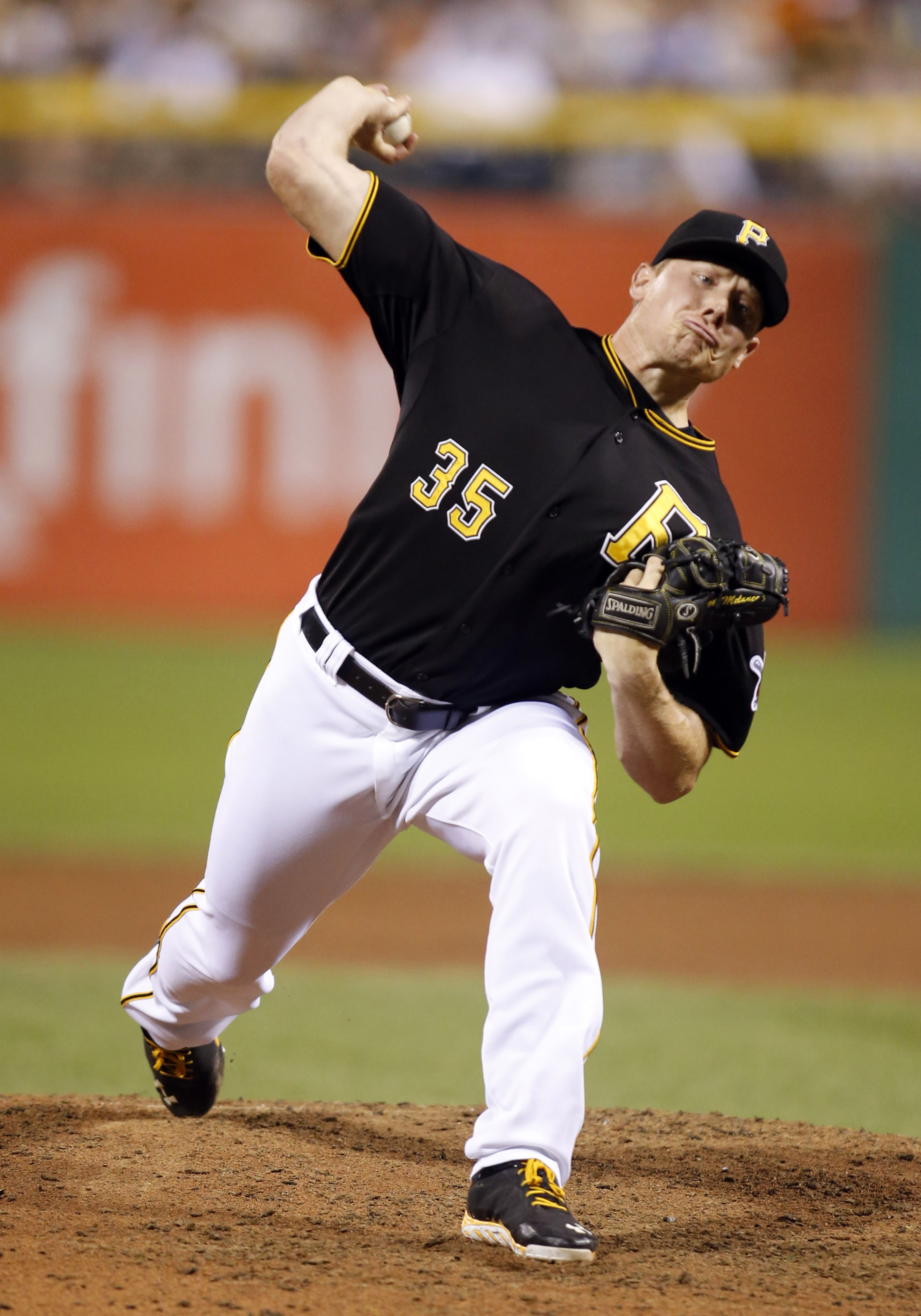
One of my goals for the arbitration model that I always strive for is to mimic real life to the extent possible. However, since the model is an algorithm, it cannot mimic the process perfectly, and I think the model really overstated Melancon this year. The model itself projected a $5MM raise from $2.6MM to $7.6MM, but the application of “The Kimbrel Rule,” which states that a player cannot beat the previous record for his role and service class by more than $1MM, keeps Melancon at a $4.275MM raise (topping Francisco Rodriguez’s $3.275MM raise in 2007 as an Arb 2 reliever), which would put him at $6.875MM. Even still, it is hard to make the case that Melancon will actually be earning that much next season.
The reason that the model is so bullish on Melancon is because he has impressive numbers in three different important categories: ERA, saves, and holds. The model knows that relievers who excel in a couple of these categories earn much more than those who only thrive in one, and it has inferred that Melancon’s success should translate to a record-breaking number. He is getting credit for being a full-time closer—because many solid closers do not get enough opportunities to rack up 33 saves in the first place—and for being a semi-regular set-up man with 14 holds. Many set-up men who share the role do not even top 14 holds in a season. On top of that, his 1.90 ERA puts him in elite status.
Of course, despite my belief that the model exaggerated Melancon’s likely salary, it was difficult to find many comparables. I tried to look for anyone in recent history who had at least 25 saves and at least 10 holds in his second year of arbitration eligibility. The only such pitcher that existed was Tyler Clippard, who had 32 holds and 13 saves two years ago, but Clippard had a 3.71 ERA, almost double that of Melancon. It seems likely that Melancon has a strong enough case to crush Clippard’s $2.35MM raise. Clippard also did not have the same history of saves that is often important in arbitration cases. He had only one career save before his 2012 season, but Melancon had already accumulated 47 saves before 2014.
I tried to look for pitchers who had just 20 saves and five holds, and only one extra pitcher emerged. Juan Carlos Oviedo had 30 saves and 5 holds four years ago, but he also had a pedestrian 3.46 ERA. His $1.65MM raise is very unlikely to look appropriate for Melancon. Going back further than five years added a couple more hybrids to the bunch—Brad Lidge in 2007 and Kevin Gregg in 2008. They got raises under $2MM as well, and neither had an amazing ERA or even had 10 holds. Looking for hybrid closer/set-up man types was not producing guys who had great seasons. Instead, it was finding guys with talent but who allowed a few too many runs.
That led me to abandon the holds criteria altogether. If we start with the idea that Melancon is a closer, and then give him a little bump for his set-up numbers, we may get somewhere more quickly. How many closers had 30 saves and ERAs under 2.00 like Melancon over the last few years? A very stale case, Francisco Rodriguez’s $3.275MM raise in 2007, arose as a possibility. He had 47 saves along with 1.73 ERA. Although that case is typically too old to be considered, it could serve as a clue. If Melancon’s 14 holds had all been saves, his case would look very similar. However, with eight years of salary inflation on top of that, Melancon could be in a position to get a more notable raise.
Jonathan Papelbon got a $3.1MM raise in his second year of arbitration eligibility in 2010 with a 1.85 ERA and 38 saves. Of course, he had 113 career saves going into his platform year, so he may have a slight advantage over Melacon’s 47. Joel Hanrahan in 2012 got a $2.7MM raise after a 1.83 ERA season in which he accumulated 40 saves. That could also serve as a solid comparable for Melancon, but without the set-up credentials. Hanrahan only had 20 pre-platform saves. No one else even managed a 2.50 ERA, so the other historical raises for second-year arbitration eligible relievers are less applicable. However, it is worth noting that several guys did get raises over $2.5MM.
Putting all of this together, Melancon’s case does seem genuinely unique. Hanrahan’s $2.7MM and Papelbon’s $3.1MM both look like reasonable comparables, with a few more saves and far fewer holds. I could see Melancon being able to successfully argue past K-Rod’s $3.275MM raise from eight years ago, but that could be challenging because of the 47 saves that K-Rod had in his platform season. On the other hand, an argument of Papelbon/Hanrahan’s raises near $3MM, plus a set-up man bonus of $500K or so, could put Melancon past K-Rod. My best guess is that Melancon gets a raise of about $3-3.5MM, good for a $5.6-6.1MM salary in 2015. That is nowhere near where the model puts him, but it seems more realistic in light of the relevant comparables that could be drawn upon.
Photo courtesy of USA Today Sports Images.
Arbitration Breakdown: Jeff Samardzija
Over the next few weeks, I will be discussing some of the higher profile upcoming arbitration cases. I will rely partly on my arbitration model developed exclusively for MLB Trade Rumors, but will also break out some interesting comparables and determine where the model might be wrong.
Jeff Samardzija enters his third year of arbitration eligibility this winter following an excellent season in which he struggled to get run support. Samardzija threw a total of 219 2/3 innings with a 2.99 ERA and 202 strikeouts, but the Cubs and Athletics each failed to score runs behind him, and he finished with a 7-13 record (and remember that for all the problems with the Win statistic, it’s still a notable component of arbitration valuation).
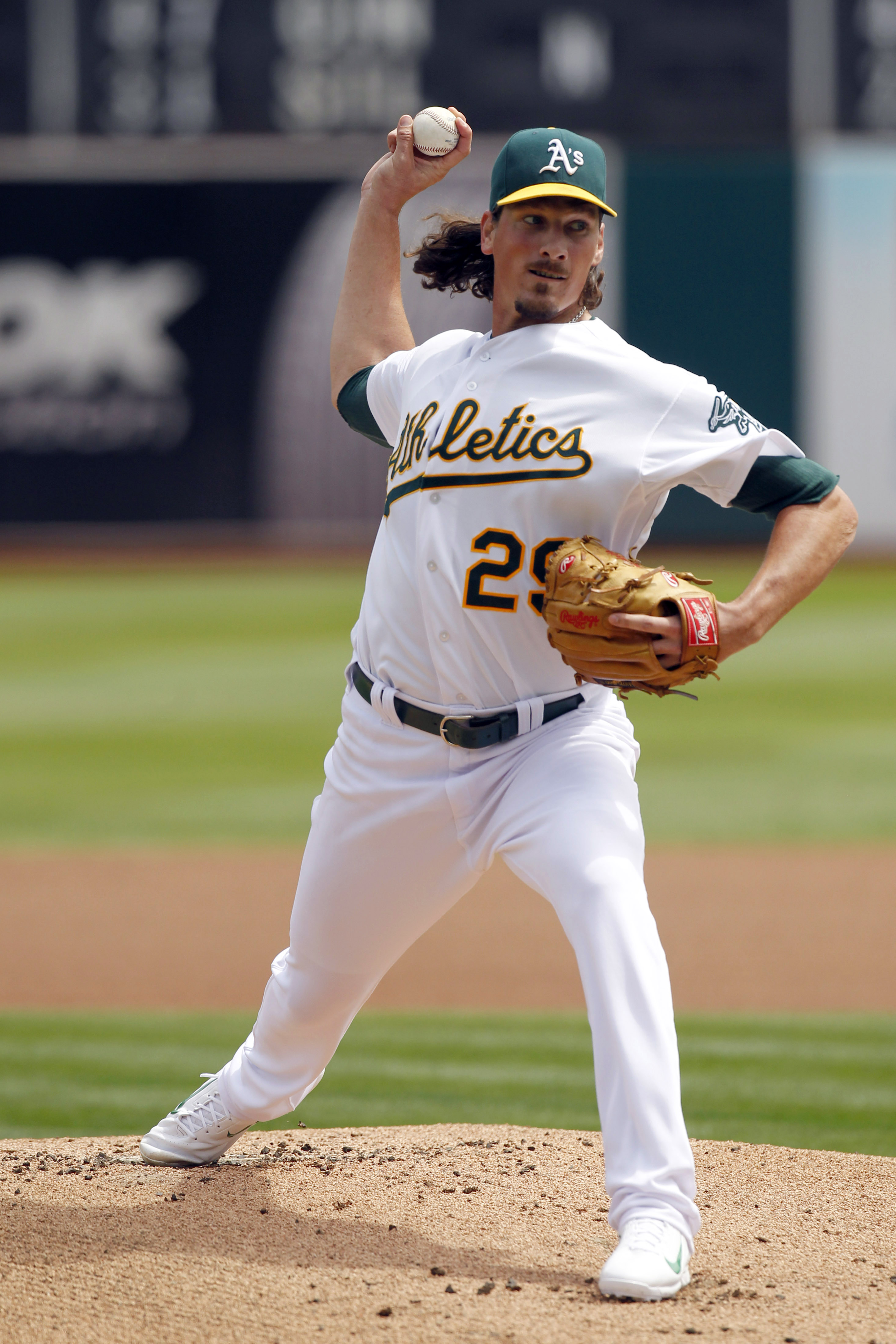
It is rare that a player has a sub-3.00 ERA in over 200 innings yet fails to win more than seven games. However, that type of odd case is what my arbitration model is designed to handle. By putting the right weight on the right statistics, the model strives to match players like Samardzija up with the comparable players that are likely to come up in a potential arbitration hearing. The model has projected a $3.85MM raise for Samardzija in 2015 to take him from a $5.35MM salary up to a $9.2MM salary.
Trying to find actual comparables for Samardzija was tricky. There were no Arb 3 starters with an ERA under 3.50 who had single-digit wins at all in the last eight years, at least among those with 180 innings pitched. There were also no pitchers under a 3.30 ERA with under 13 wins either with that number of innings either. No one with an ERA under 3.50 with less than 13 wins had more than 210 innings. However, three pitchers were close to these criteria.
David Price got a $3.89MM raise last year with a 10-8 record and a 3.33 ERA in 186 2/3 innings. Homer Bailey had an 11-12 record with a 3.49 ERA in 209 innings last year too, which got him a $3.65MM raise. A couple years earlier, Matt Garza had a 10-10 record with a 3.32 ERA in 198 innings, which got him a $3.55MM raise. Each of these three guys had more wins than Samardzija’s seven, but they also had fewer innings and higher ERAs. Samardzija also passed 200 strikeouts, something that none of those three did (though Bailey had 199 and Garza had 197). With the extra innings and lower ERA, it seems likely that Samardzija could pass this group. One potential roadblock is that Price’s track record and the fact that he was over .500.
In cases like these, it can be helpful to try to establish a floor and a ceiling player. In other words, players that are likely worse than/better than the player in question, whose salaries are close enough together that you can find a solid range for the player.
One reasonable floor for Samardzija could be Brandon McCarthy from 2012. He had just a 9-9 record with a 3.32 ERA in 170 2/3 innings and struck out only 123 batters. Although he did have two more wins that Samardzija, it’s unlikely that a 9-9 record bests a 7-13 record by enough to offset the 49 extra innings and 79 extra strikeouts. McCarthy got a $3.28MM raise that year.
A potential ceiling for Samardzija could be a pitcher with a sub-3 ERA with a similar number of innings, but double digit wins. However, finding such players was tricky. Max Scherzer went 21-3 with a 2.90 ERA in 214.1 innings last year, which is obviously better. It did net him an $8.8MM raise. Carlos Zambrano way back in 2007 got a $5.9MM raise after a 16-7 season with a 3.41 ERA in 214 innings. But his case was obviously better than Samardzija’s, so he does not look like a useful comparable.
Justin Masterson’s case last year could be appropriate to establish a ceiling, but he falls short of Samardzija’s case in a few ways. He had a 14-10 record with a 3.45 ERA in 193 innings, and he struck out 195 batters. Masterson got a $4.07MM raise. Doubling up Samardzija’s win total is probably enough to offset to extra innings and lower ERA after Samardzija, but he doesn’t quite work like a typical ceiling.
Using McCarthy and Masterson as a floor and a ceiling leaves a pretty wide window between a $3.2MM and $4.07MM raise for Samardzija to fit in. All three of the aforementioned comparables (Price, Bailey, Garza) fell in that window. In the end, there’s a strong case for Samardzija to get a raise somewhere in the $3.55MM to $3.89MM raise range from those three players, and the $3.85MM that the model projected fits in there as well. It’s possible that Samardzija’s record hurts him enough that he ends up with a good deal less, or that his ERA and innings place him above this group, but a safe midpoint is probably the model’s projection.
Photo courtesy of USA Today Sports Images.
Non-Tender Candidate: Alejandro De Aza
Halfway through the 2014 season, longtime White Sox outfielder Alejandro De Aza looked like a probable non-tender after hitting .243/.309/.354 and getting eaten alive by left-handed pitching in a lackluster age-30 season in Chicago. De Aza made $4.25MM in his second year of arbitration eligibility, and there was little indication he would be worth a raise on that heading into 2015 and his likely decline phase.
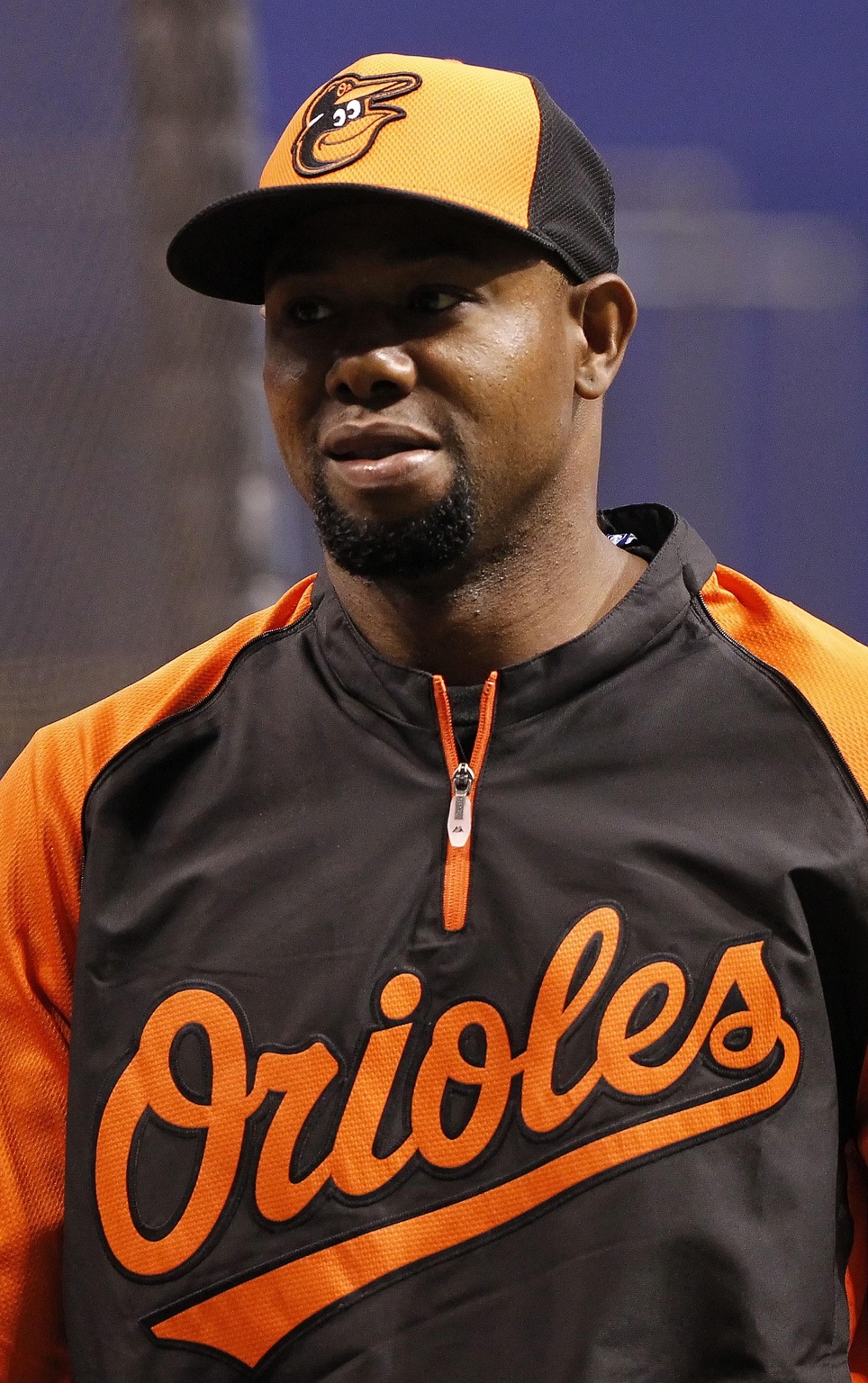 A late-August trade to Baltimore and a well timed hot streak might have earned De Aza another season in the arbitration system, however. He hit .293/.341/.537 in 89 plate appearances with the Orioles, bringing hit 2014 total to a more respectable .252/.314/.386, then kept hitting in the postseason. De Aza is also a slightly above average defender in an outfield corner and can play center field, so he has defensive value to fall back on. MLBTR projects he’ll make $5.9MM through the arbitration process this offseason, and for the right team, he’s probably worth it.
The only question is whether the Orioles are the right team. The O’s are trying to re-sign a fellow left-handed outfielder in Nick Markakis, as well as DH/OF Nelson Cruz. They’ve also reportedly discussed Matt Kemp with the Dodgers, and they’re in on Torii Hunter and Melky Cabrera. How much worse De Aza is than someone like Markakis or Hunter could actually be debated, but any combination of Markakis, Cruz, Kemp, Hunter and Cabrera would make De Aza less useful to the Orioles.
On top of that, Baltimore faces a crunch of arbitration-eligible players, many of whom either are coming off very good seasons or have high salaries already. The Orioles’ 11 arbitration-eligibles (De Aza, Matt Wieters, Steve Pearce, Bud Norris, Tommy Hunter, Chris Davis, Brian Matusz, Chris Tillman, Miguel Gonzalez, Ryan Flaherty and Zach Britton) are projected to make a combined $56.9MM, and the Orioles could decide De Aza is a luxury they can do without, particularly if they splurge on, say, Markakis and Cruz, or at least feel it’s likely they’ll re-sign. They already have a lefty backup outfielder in David Lough who had a similar season to De Aza with the bat and will make near the league minimum in 2015, so heading into the season with De Aza on their roster only makes sense for the Orioles if they have a starting spot available for him.
The good news for De Aza (assuming he wants to be tendered — he might actually get slightly more than one year and $5.9MM on the open market) is that there’s little time before Tuesday night’s tender deadline for the Orioles to settle their outfield picture. If the O’s do strike out on Markakis, Cruz, Kemp or anyone else they might pursue, De Aza should have significant value for them. If they do tender him and then acquire more players who might make him superfluous, they would probably still be able to trade him, even though they wouldn’t be likely to get much back. The best guess here, then, is that the Orioles tender De Aza, and that’s reportedly the direction they’re leaning anyway. The Praver/Shapiro client probably ought to plan on heading into the season with Baltimore.
Photo courtesy of USA Today Sports Images.
MLBTR Originals
A look back at the original reporting and analysis found on MLBTR the last seven days scattered amongst the Thanksgiving leftovers, Black Friday shopping bags, and Cyber Monday ads:
- MLB Trade Rumors Podcast featured part I of host Jeff Todd’s interview with agent Matt Sosnick of Sosnick Cobbe Sports. Tim Dierkes also joined Jeff to discuss the impact the signings of Pablo Sandoval and Hanley Ramirez will have on the rest of the Red Sox’s offseason, how well the Red Sox and Reds match up as trade partners, and the value of Cole Hamels. A new edition of MLB Trade Rumors Podcast will be released every Thursday and can be accessed on iTunes, SoundCloud, and Stitcher.
- MLBTR contributor Matt Swartz broke down the arbitration cases of Reds third baseman Todd Frazier and a quartet of closers (the Royals’ Greg Holland, the Reds’ Aroldis Chapman, the Dodgers’ Kenley Jansen, and the Marlins’ Steve Cishek).
- MLBTR contributor Jeff Zimmerman analyzed the pitch counts of free agent starters Max Scherzer, Jon Lester, and James Shields and opines the best factor in determining a pitcher’s durability is age, not the odometer.
- The Offseason Outlook series concluded with Steve Adams’ forecast for the World Champion Giants and the team they vanquished in the World Series, the Royals.
- Steve issued a Free Agent Profile of Torii Hunter (two years, $22MM).
- Brad Johnson examined Braves right-hander Kris Medlen and Angels infielder Gordon Beckham as non-tender candidates while Charlie Wilmoth did likewise with Rangers first baseman Mitch Moreland.
- Tim was the first to report the Rangers signed right-hander Ross Wolf to a minor league contract with an invitation to Spring Training.
- Steve presented a Free Agent Faceoff between the top two free agents on MLBTR’s 2014-15 Top 50 Free Agents list. A slim majority of you (51%) prefer Jon Lester (#2) over Max Scherzer (#1).
- Jeff asked MLBTR readers to name the best free agent acquisition to date. Nearly one-quarter of you believe Blue Jays GM Alex Anthopoulos made the best move by coming to terms with Russell Martin.
- Brad asked MLBTR readers who will be traded next by the A’s. More than 64% of you expect it will be Jeff Samardzija.
- Steve hosted the weekly live chat.
- Zach Links gathered the best the baseball corner of the web had to offer in Baseball Blogs Weigh In.