
Each Team’s Free Agent Spending Thus Far
The New Year serves as a symbolic halfway point of the offseason. It has been just over two months since the Dodgers knocked off the Yankees to win the World Series. We’re a little more than six weeks from pitchers and catchers reporting to Spring Training.
Twenty six of MLBTR’s Top 50 free agents have come off the board. Four of the top 10 remain unsigned, as well as Roki Sasaki (who was not ranked because his earning power is limited). More than half the money has been spent — Alex Bregman is the only unsigned player who landed within our top six free agents — but the offseason is proceeding at a relatively normal pace. It has moved a little more quickly than last winter, when 22 players from our Top 50 had signed by the time the calendar flipped to January.
Using MLBTR’s Contract Tracker, we’ll look through every team’s activity on the open market. We’ll stretch back to November 4, the date at which free agents were first allowed to begin discussing contract terms with every team. That excludes a pair of deals that were signed within the five-day exclusive negotiation window for teams to discuss contracts with their own free agents: the Reds’ $2.25MM deal with Brent Suter and the Royals retaining Michael Wacha on a three-year, $51MM contract.
This isn’t an exhaustive look at a team’s offseason activity. The Blue Jays (Andrés Giménez), Angels (Jorge Soler), Cubs (Kyle Tucker) and Yankees (Cody Bellinger) are among teams that have acquired highly-paid players in trade. The Dodgers signed Tommy Edman to an extension that guaranteed $64.5MM in new money. This is strictly a look at free agent activity.
For this exercise, we’ll take the total amount even if the contract includes deferred money. Teams are ordered by overall spending.
1. New York Mets
Total guarantees: $917.25MM
- OF Juan Soto: Fifteen years, $765MM
- LHP Sean Manaea: Three years, $75MM ($23.25MM deferred)
- RHP Clay Holmes: Three years, $38MM
- RHP Frankie Montas: Two years, $34MM
- RHP Griffin Canning: One year, $4.25MM
- INF Jared Young: One year split contract ($425K in minors)
- RHP Dylan Covey: One year split contract ($350K in minors)
- RHP Justin Hagenman: One year split contract ($225K in minors)
2. Los Angeles Dodgers
Total spending: $287MM
- LHP Blake Snell: Five years, $182MM ($65MM deferred)
- OF Teoscar Hernández: Three years, $66MM (approximately $23MM deferred)
- RHP Blake Treinen: Two years, $22MM
- OF Michael Conforto: One year, $17MM
3. New York Yankees
Total guarantees: $235.5MM
- LHP Max Fried: Eight years, $218MM
- 1B Paul Goldschmidt: One year, $12.5MM
- RHP Jonathan Loáisiga: One year, $5MM
4. Arizona Diamondbacks
Total guarantees: $210MM
- RHP Corbin Burnes: Six years, $210MM (roughly $60MM deferred)
5. San Francisco Giants
Total guarantees: $182MM
6. Texas Rangers
Total guarantees: $130.5MM
- RHP Nathan Eovaldi: Three years, $75MM
- DH Joc Pederson: Two years, $37MM
- C Kyle Higashioka: Two years, $13.5MM
- LHP Hoby Milner: One year, $2.5MM
- RHP Jacob Webb: One year, $1.25MM
- RHP Shawn Armstrong: One year, $1.25MM
- RHP Luis Curvelo: One year split deal
7. Los Angeles Angels
Total guarantees: $80.25MM
- LHP Yusei Kikuchi: Three years, $63MM
- C Travis d’Arnaud: Two years, $12MM
- SS Kevin Newman: One year, $2.75MM
- RHP Kyle Hendricks: One year, $2.5MM
8. Baltimore Orioles
Total guarantees: $71MM
- OF Tyler O’Neill: Three years, $49.5MM
- RHP Tomoyuki Sugano: One year, $13MM
- C Gary Sánchez: One year, $8.5MM
9. Athletics
Total guarantees: $70.95MM
- RHP Luis Severino: Three years, $67MM
- 3B Gio Urshela: One year, $2.15MM
- LHP T.J. McFarland: One year, $1.8MM
10. Houston Astros
Total guarantees: $60MM
11. Boston Red Sox
Total guarantees: $52.3MM
- RHP Walker Buehler: One year, $21.05MM
- LHP Patrick Sandoval: Two years, $18.25MM
- LHP Aroldis Chapman: One year, $10.75MM
- LHP Justin Wilson: One year, $2.25MM
12. Cleveland Guardians
Total guarantees: $42MM
- RHP Shane Bieber: Two years, $26MM
- 1B Carlos Santana: One year, $12MM
- C Austin Hedges: One year, $4MM
13. Chicago Cubs
Total guarantees: More than $40.5MM
- LHP Matthew Boyd: Two years, $29MM
- C Carson Kelly: Two years, $11.5MM
- LHP Caleb Thielbar: One year, salary unreported
14. Detroit Tigers
Total guarantees: $30MM
15. Washington Nationals
Total guarantees: $29MM
- RHP Trevor Williams: Two years, $14MM
- RHP Michael Soroka: One year, $9MM
- 1B Josh Bell: One year, $6MM
16. Philadelphia Phillies
Total guarantees: $22.5MM
- OF Max Kepler: One year, $10MM
- RHP Jordan Romano: One year, $8.5MM
- RHP Joe Ross: One year, $4MM
17. Cincinnati Reds
Total guarantees: $21.05MM
- RHP Nick Martinez: One year, $21.05MM qualifying offer
18. Toronto Blue Jays
Total guarantees: $15MM
19. Tampa Bay Rays
Total guarantees: $8.5MM
19. Colorado Rockies
Total guarantees: $8.5MM
- 2B Thairo Estrada: One year, $3.25MM
- 2B Kyle Farmer: One year, $3.25MM
- C Jacob Stallings: One year, $2MM
21. Pittsburgh Pirates
Total guarantees: More than $5MM
22. Chicago White Sox
Total guarantees: $4.75MM
- OF Mike Tauchman: One year, $1.95MM
- OF Austin Slater: One year, $1.75MM
- RHP Bryse Wilson: One year, $1.05MM
23. Atlanta Braves
Total guarantees: More than $360K
- OF Bryan De La Cruz: One year split contract ($180K in minors)
- RHP Connor Gillispie: One year split contract ($180K in minors)
- OF Carlos Rodríguez: One year split contract (salary unreported)
24. Miami Marlins
Total guarantees: $200K
- 3B Eric Wagaman: One year split contract ($200K in minors)
25. Milwaukee Brewers
Total guarantees: More than $0
- LHP Grant Wolfram: One year contract (salary unreported)
26. Kansas City Royals
Total guarantees: $0
- None*
26. Minnesota Twins
Total guarantees: $0
- None
26. San Diego Padres
Total guarantees: $0
- None
26. Seattle Mariners
Total guarantees: $0
- None
26. St. Louis Cardinals
Total guarantees: $0
- None
* Counting Wacha as a free agent deal rather than an extension would push Kansas City to 12th in total spending
Looking For A Match In A Luis Castillo Trade
One of the worst-kept secrets in baseball this winter is the Mariners’ need for infield help. If the 2024 season were to start today, the club would have J.P. Crawford locked in at shortstop but little certainty around the rest of the diamond. First base would likely be occupied by a platoon of Luke Raley and Tyler Locklear, the latter of whom struggled badly in a 16-game cup of coffee with Seattle last year. Second and third base would be even dicier. Dylan Moore is capable of playing both positions and could be an everyday player for the club after appearing in 135 games last year but may be better suited for a super utility role given his impressive versatility and struggles against same-handed pitching. Ryan Bliss, Austin Shenton, and Leo Rivas are all young and intriguing hitters who made their big league debuts in 2024, but none of them got even 100 plate appearances in the majors last year and would be risky to rely on in full-time roles.
That obvious need for an infielder or two has led the Mariners to consider making a move they’ve long resisted pulling the trigger on: trading from their vaunted starting rotation. There’s an argument to be made that Seattle boasts the best starting rotation in baseball. George Kirby, Logan Gilbert, Bryce Miller, and Bryan Woo form the sort of proven, controllable corps of young starters that most teams can only dream of developing, and veteran right-hander Luis Castillo has served as a veteran anchor for the club’s rotation ever since he was acquired from the Reds following the 2022 trade deadline. While the Mariners still seem unlikely to part with any of the youngsters in their rotation, they’ve begun to at least listen to offers on Castillo, who has drawn interest around the league thanks to his fairly affordable contract and consistently above average results.
That’s not to say a Castillo trade comes without potential obstacles. While the right-hander has pitched well during his two full seasons in Seattle, he’s not posted the same front-of-the-rotation results he flashed earlier in his career with Cincinnati. After posting a 3.46 ERA (132 ERA+) with a near-matching 3.43 FIP from 2019 to 2022, Castillo’s 3.48 ERA (110 ERA+) has remained stagnant the last two years despite a much friendlier home ballpark for pitching while his 3.86 FIP is a noticeable step backwards from the earlier days of his career and his fastball velocity has lost a tick or two since he arrived in Washington.
Aside from those potential concerns for would-be suitors, Castillo also wields a full no-trade clause and could block any trade if he so chooses. One final wrinkle from the Mariners’ perspective is their lack of starting pitching depth behind an excellent top five rotation pieces; Emerson Hancock would likely be the next man up if Castillo was dealt, but he struggled in 12 starts last year and there’s virtually no big league ready starting depth behind him in the organization. That could make a team that could offer a young starter in addition to infield help a particularly attractive trade partner for Seattle.
So, which clubs are best suited to swinging a deal for the right-hander? Let’s take a look at nine possible options, listed alphabetically between three tiers:
Best Fits:
- Blue Jays: The Blue Jays have had a difficult offseason so far, as they’ve struck out on both Juan Soto and Corbin Burnes in free agency. Their biggest addition to this point is infielder Andrés Giménez, who they swung a deal to acquire from the Guardians during the Winter Meetings. With that said, they’re known to be in the market for starting pitching help, and Castillo would form a solid veteran nucleus in the rotation alongside Kevin Gausman, José Berríos, and Chris Bassitt. What’s more, the Jays have a number of interesting young infielders like Davis Schneider, Leo Jiménez, and Will Wagner who could be of interest to the Mariners.
- Giants: The Giants made a big splash just before the Winter Meetings began by signing Willy Adames but join Toronto in being a top reported suitor for Burnes who missed out on the right-hander when he agreed to a deal with Arizona late Friday night. Castillo would be an excellent starter to pair with Logan Webb at the front of San Francisco’s rotation, and the Giants have previously expressed a willingness to deal first baseman LaMonte Wade Jr. this winter. Wade, 31 on New Year’s Day, has posted a solid .258/.376/.401 (120 wRC+) with a fantastic 15% walk rate over the past two seasons.
- Orioles: As the team Burnes pitched for in 2024 prior to reaching free agency, the Orioles join the Blue Jays and Giants in the hunt for a top-of-the-rotation arm now that he’s departed for the desert. The need for a front-end arm in Baltimore is perhaps more acute than it is anywhere else on this list, as 2023’s staff ace Kyle Bradish isn’t expected to pitch in the first half of 2025 following UCL surgery last year. Castillo would slot in front of Zach Eflin and Grayson Rodriguez for the Orioles, offering some much-needed stability to the Baltimore rotation. In return, the Orioles could offer a player from their surplus of first base options such as Ryan Mountcastle and perhaps even add in a young starter like Cade Povich to help replace Castillo in the Seattle rotation. Notably, the Orioles are among the teams that have reportedly inquired after the right-hander this winter.
Next Tier Down:
- Braves: The Braves watched both Max Fried and Charlie Morton depart from their rotation for free agency last month but have yet to make a significant move this offseason outside of trading Jorge Soler away to the Angels. Adding an arm like Castillo to the mix behind Chris Sale and (eventually) Spencer Strider would offer the club another high-end starter while also providing security to a rotation full of frequently injured hurlers. Atlanta doesn’t have much to offer in the way of infield help outside of prospect Nacho Alvarez Jr. but could help supplement the Mariners rotation by offering a controllable starter like Bryce Elder or AJ Smith-Shawver as part of the return.
- Cubs: The Cubs have already been connected to Castillo this winter and are known to be in the market for a front-end starter to pair with Justin Steele and Shota Imanaga, but the club’s recent trade for Kyle Tucker has seemingly complicated the fit between the two sides. The Mariners are known to have had interest in Cubs second baseman Nico Hoerner this winter, and the Cubs previously could part with Hoerner and replace him at the keystone with Matt Shaw. Since then, however, the Cubs shipped third baseman Isaac Paredes to the Astros in exchange for Tucker. With Shaw now penciled in as Paredes’s replacement at the hot corner, the Cubs may be less inclined to part with Hoerner to bolster the Mariners’ infield. While a young starter such as Javier Assad or Jordan Wicks could help facilitate a trade, it’s hard to imagine a deal for Castillo getting done that doesn’t send some sort of infield help back to Seattle.
- Red Sox: The Red Sox are also among the teams known to have discussed Castillo with Seattle, and the club specifically attempted to swing a trade involving him, Triston Casas, and Masataka Yoshida that was eventually shut down by the Mariners. It’s hard to imagine Boston parting with Casas in a straight one-for-one swap for Castillo, which could make finding a match between the two sides difficult. Perhaps a deal could still be had that sends a lesser infield piece such as Vaughn Grissom or David Hamilton to Seattle alongside a young starter like Kutter Crawford, but now that the Red Sox have brought Walker Buehler into the rotation other clubs may be more motivated to get a deal done with Seattle than Boston is.
Longer Shots:
- Dodgers: The Dodgers are not known to have interest in Castillo but are always a threat to upgrade their roster and could certainly benefit from adding a steady, innings-eating arm like him to the cavalcade of high-octane arms with durability questions that currently make up their starting rotation. Even so, however, the Dodgers have little to offer from their infield mix at the moment. Perhaps Gavin Lux could be a serviceable platoon partner for Moore at second base, but even adding a young starter such as Landon Knack alongside Lux seems unlikely to entice the Mariners to part ways with Castillo.
- Mets: The Mets are among the teams that have been connected to Castillo this winter, but they subsequently rounded out their rotation by adding left-hander Sean Manaea. It’s at least theoretically feasible that the club could add Castillo and push Clay Holmes out of their projected rotation and into the bullpen, but given the fact that New York explicitly signed Holmes to start that would be a major surprise, even as the Mets have excess pieces such as Brett Baty and Tylor Megill that would surely interest Seattle.
- Tigers: Detroit could use a bona fide front-end arm to pair with Tarik Skubal next season, and adding mid-rotation veteran Alex Cobb didn’t exactly fill that need. The Tigers also recently signed Gleyber Torres in a move that pushed youngster Colt Keith to first base, seemingly leaving former first overall pick Spencer Torkelson without a role in the majors. Torkelson would be a high-upside addition who’s sure to be intriguing to the Mariners as they search for first base help, but it’s unclear whether they would part with Castillo to land him or if the Tigers are interested in taking on the $72.45MM Castillo is guaranteed over the next three seasons.
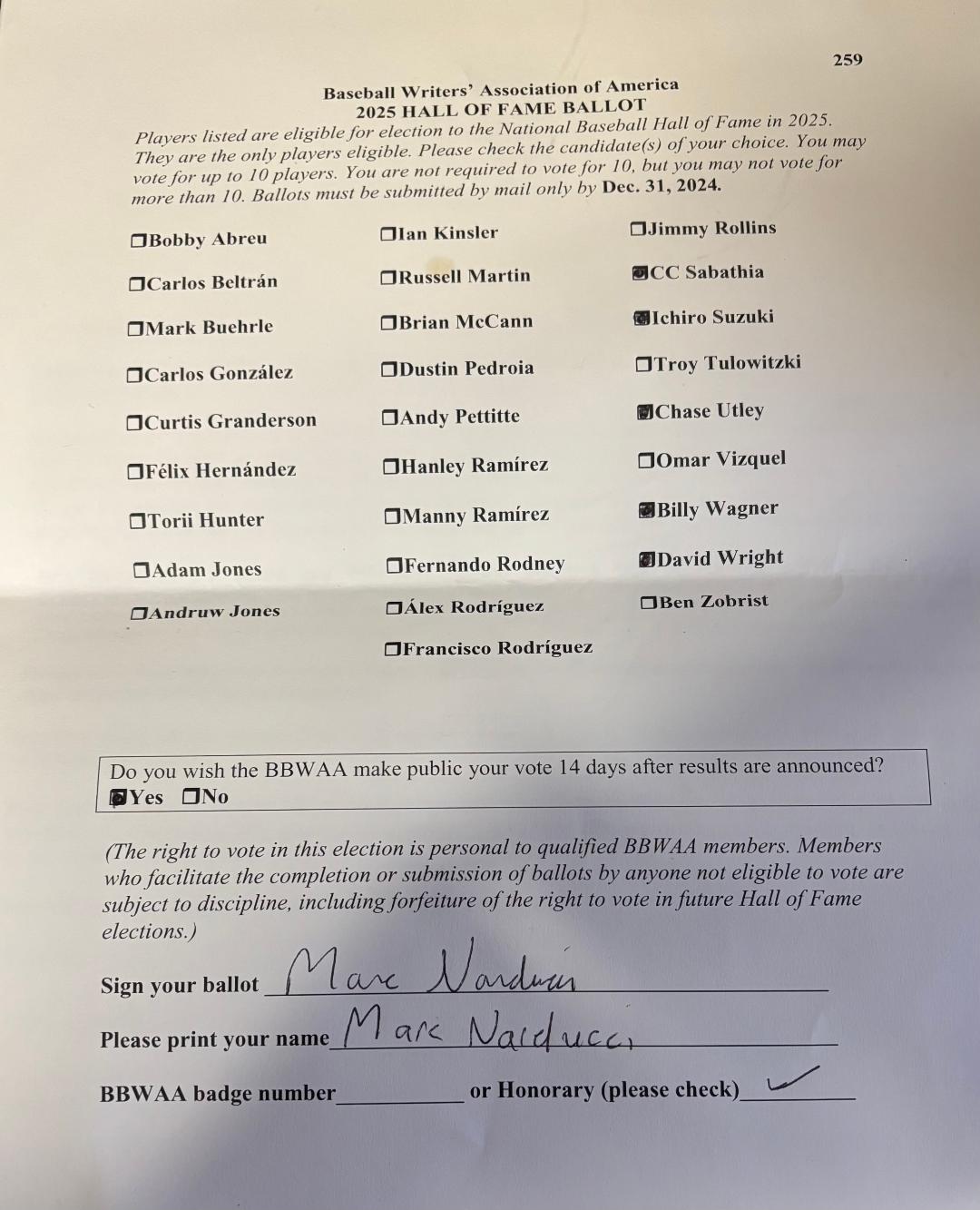
Marc Narducci: My Hall Of Fame Ballot
Marc Narducci spent 37 years covering all sports for The Philadelphia Inquirer before retiring in July 2021. He covered everything from high school sports to the Phillies winning the World Series and the Eagles winning the Super Bowl. A lifelong southern New Jersey resident, he remains a freelance writer and broadcaster. Once again, Marc reached out to see if MLB Trade Rumors would be interested in publishing his Hall of Fame ballot. I am happy to do it and hope it can be an interesting topic of debate for our readers. Here’s Marc…

It’s always an honor to be published by MLBTradeRumors.com, among the most respected baseball publications around. For those who haven’t read the previous years, just a little housekeeping. I don’t vote for those associated with steroids, which means Alex Rodriguez and Manny Ramirez, don’t receive my vote.
I have also not voted for Carlos Beltran who admittedly was the mastermind of the 2017 Houston Astros sign-stealing scandal, which altered the perception of that World Series winning team. Those actions cost him his job as a manager and for now, this vote. I don’t feel all the Astros should be punished, but as stated before, that’s a story for another day.
I never criticize how a fellow voter votes. That doesn’t mean our votes aren’t subject to criticism, including mine. Each voter has to do what he or she feels is best.
And now, here is this year’s ballot, which includes five names.
The Holdovers
There are three holdovers I voted for last year and again got my vote this year.
There is no question injuries slowed down Utley’s career and many feel he didn’t have the counting stats to get in, but he was a six-time All-Star and only four HOF second basemen have more home runs than Utley’s 259. Those four are Rogers Hornsby (301), Craig Biggio (291), Ryne Sandberg (282) and Joe Morgan (268). I’m big on second basemen who show great power, which is why I voted for Jeff Kent (377 career home runs) when he was on the ballot. Also, we tend to look at excellence, even if it is shorter-term. As mentioned last year, from 2005-2009, Utley’s slash line was .301/.388/535 and he averaged 29.2 home runs, 110. Runs. 101.4 RBI, 151 games and 675 plate appearances. His BWAR during that time was 7.7. Just nine HOF second basemen have a higher career B-War than Utley (64.5).
Utley won a World Series in 2008 with the Philadelphia Phillies and the next year hit five home runs in the 2009 World Series against the Yankees, tying an MLB record with Reggie Jackson in 1977 and George Springer in 2017. He was a career 275/.358/.465 hitter with an 823 OPS and 117 OPS+. Utley also won four Silver Slugger awards. Will it be enough? Last year in his first season on the ballot, Utley received 28.8% of the vote, so he has a long way to go.
This is Wagner’s 10th and final season on the ballot after coming close last year by earning 73.8% of the vote, missing by five votes. Those who don’t feel Wagner is a HOF player point to his low number of appearances and World Series statistics. Both are valid.
Wagner pitched just 903 innings. His postseason production, even though it only consisted of 11 1/3 innings over 14 appearances, was poor to say the least. He had a 10.03 ERA.
The reason for voting for Wagner was his excellence. According to the Baseball Hall of Fame, his career WHIP of 0.998 is the lowest among all retired relievers with at least 700 innings pitched, and his career 2.31 ERA is lowest among retired left-handed pitchers with at least 500 innings pitched in the live ball era. His ERA+ of 187 is second all-time to only Mariano Rivera.
According to HOF expert Jay Jaffe, Wagner’s 11.9 strikeouts per nine innings (minimum of 900 innings pitched) is the best in MLB history. There are now others ahead of him, but they have pitched fewer than 900 innings.
Wagner finished with 422 saves, second highest among left-handed relievers and eighth overall. According to MLB.com, he converted 422 of 476 save opportunities (.887).
He was a seven-time All-Star and played on teams that advanced to the postseason seven times.
Wright falls in the Utley category of not having the counting stats due to injury. This is his second year on the ballot, and he only received 6.2 percent of the vote last year. Still, Wright was a dominant force when healthy. Wright was a seven-time All-Star during a nine-year period from 2005-2013. During that time, his slash line was .302/384/.505 with a 138 OPS+. He averaged 23 home runs, 90 runs and 93 RBI while also winning two Gold Gloves and two Silver Slugger awards. Wright finished in the Top 10 for MVP voting four times. During that nine-year period, he was among the best players not only at his position, but in baseball.
According to the Baseball HOF, Wright is one of our four third basemen in history (along with Hall of Famers George Brett, Chipper Jones and Mike Schmidt) who retired with at least 350 doubles, 200 home runs and 150 stolen bases. He ended with 390 doubles, 242 home runs and 196 stolen bases.
He was a career .296/376/.491 hitter with a 133 OPS+. Only seven HOF third baseman have a higher OPS+ than Wright. Due to injuries, he was never a full-time player past his age 31 season.
The Newcomers
This is one player who is sure to create some debate. Among his biggest selling points were his career wins (251) and winning percentage (.609) in an era where wins aren’t valued the way they used to be. He is tied for 47th all-time in career wins.
Some would use his 3.74 ERA against Sabathia, which is fair. His career ERA+ was 116, solid but not spectacular.
On the positive side, he was the ace for the three teams that he played for (Cleveland, Milwaukee and the NY Yankees) and led all three to the postseason. (Later In his career he wasn’t the best pitcher on the Yankees, but for the first five years in New York, he was the ace).
The lefthander was a six-time all-star and the 2007 Cy Young Award winner with Cleveland. He finished in the top 10 of Cy Young voting four other times. He was a workhorse, having made 30 or more starts 12 times. Sabathia helped lead the Yankees to the 2009 World Series championship during his first year with the club. During that year he was the ALCS MVP, going 2-0 with a 1.13 ERA in two starts against the Los Angeles Angels. In 10 of his 19 seasons he played on playoff teams and has a career 10-7 record and 4.28 ERA in 26 postseason games. Sabathia is one of three left-handers with at least 3,000 strikeouts. He recorded 3,093 strikeouts, which is 18th all-time.
Just as Adrian Beltre was a slam-dunk first-ballot selection last year, so is Ichiro this year. He has the credentials to be a unanimous selection. Probably the best stat is that Ichiro had 200 or more hits and won a Gold Glove in each of his first 10 seasons with Seattle. In 2001 he became the second player to win both the Rookie of the Year and Most Valuable Player award in the same season. What’s more impressive is that he didn’t make his MLB debut until the age of 27. In those first 10 seasons, he his slash line was .331/.376/.430. Before coming to play with the Seattle Mariners, he had 1,278 hits while playing in Japan. He finished with 3,089 career MLB hits and a .311/.355/.402 slash line. Ichiro won two batting tiles when he hit .350 in 2001 and .372 in 2004. He also stole 509 bases in 626 attempts (83%) in his career and was a 10-time All-Star, all coming in his first 10 seasons. In 86 postseason plate appearances, he hit .346/.400/.436. Mainly a right-fielder, Ichiro played 1,970 career games in right, 322 in center and 117 in left. He also had great durability, playing 150 or more games 13 times and 160 or more on nine occasions.
Exploring A Potential Pablo Lopez Trade
It's been a quiet offseason for the Twins as the front office faces payroll constraints for a second straight offseason. Minnesota's signing of Carlos Correa and extension for Pablo Lopez in the 2022-23 offseason -- among other moves -- pushed the club's payroll up into the $150-160MM range. Both deals came just months after owner Jim Pohlad took a step back as his nephew, Joe Pohlad, took on a far more prominent role. That ownership shuffle, coupled with the long-term nature of those deals, made it look like there'd be a lasting bump in payroll.
Clearly, that hasn't been the case. Amid uncertainty regarding the team's television broadcast rights, ownership slashed payroll back down to the $130MM range for the 2024 season. The Twins largely sat out the 2023-24 offseason, with their largest moves coming via the trade market (dealing Jorge Polanco to Seattle) and in the bargain aisle of free agency (a $5.25MM deal for Carlos Santana being their most expensive). At the end of the 2024 season, Joe Pohlad announced his intent to explore a potential sale of the team.
That's led to even more uncertainty and inflexibility with the budget this offseason, as evidenced by the Twins' complete lack of activity. RosterResource projects the Twins' payroll at about $142MM. Ownership would like that back into the $130MM range again. It's expected that at some point they'll trade righty Chris Paddack, whose $7.5MM salary looks quite affordable when juxtaposed with the aggressive market for starters this winter. They'll shop Christian Vazquez but would need to eat some of his $10MM salary. A trade of their excellent utilityman, Willi Castro, could also be explored.
Speculation regarding the possibility of larger-scale deals was inevitable, but president of baseball operations Derek Falvey said early in the offseason that the team views Correa, Lopez and Byron Buxton as "key" players to the team's 2025 outlook. Falvey has emphasized that the Twins are intent on contending in 2025, even as it looks like he'll be forced to find ways to trim player payroll before making a single addition.
A Correa trade always seemed far-fetched. He's owed $128MM over the next four years and has a full no-trade clause. Buxton also has full no-trade protection. However, the recent report from ESPN's Jeff Passan that the Twins have at least listened to offers on Lopez presents a far more compelling thought exercise. Lopez's contract is teeming with surplus value in a way that isn't true -- or isn't as true, anyway -- of the Twins' other most expensive players.
Trading Lopez would ignite swift backlash from an already frustrated and put-off fanbase. At the same time, the huge return and the potential avenues for restructuring the team in the wake of such a surprising deal are compelling enough that it's understandable if the Twins perform due diligence to at least see what the market might bear.
Let's dive into an admittedly very hypothetical look at why a Lopez trade could actually appeal to the Twins, who could be involved, and how the Twins could proceed (and possibly improve) in the aftermath.

Unlock Subscriber-Exclusive Articles Like This One With a Trade Rumors Front Office Subscription
- Access weekly subscriber-only articles by Tim Dierkes, Steve Adams, and Anthony Franco.
- Join exclusive weekly live chats with Anthony.
- Remove ads and support our writers.
- Access GM-caliber tools like our MLB Contract Tracker
2024-25 MLB Free Agents
The following players are currently eligible for free agency. Each player’s 2025 age is in parentheses. Generally, our cutoff for this list is 50 plate appearances or 20 innings pitched in the Majors in 2024.
Updated 4-4-25
Catchers
Yan Gomes (37)
Yasmani Grandal (36)
First Basemen
Jose Abreu (38)
Anthony Rizzo (35)
Jared Walsh (31)
Second Basemen
Whit Merrifield (36)
Shortstops
None
Third Basemen
Danny Mendick (31)
Miguel Sano (32)
Cole Tucker (28)
Left Fielders
David Dahl (31)
Adam Duvall (36)
Robbie Grossman (35)
Whit Merrifield (36)
Center Fielders
Aaron Hicks (35)
Right Fielders
Adam Duvall (36)
Avisail Garcia (34)
Whit Merrifield (36)
David Peralta (37)
Designated Hitters
Matt Carpenter (39)
Robbie Grossman (35)
J.D. Martinez (37)
Starting Pitchers
Ty Blach (34)
Aaron Brooks (35)
Anthony DeSclafani (35)
Domingo German (32)
Marco Gonzales (33)
Jordan Lyles (34)
Sixto Sanchez (26)
Spencer Turnbull (32)
Alex Wood (34)
Right-Handed Relievers
Chase Anderson (37)
Daniel Bard (40)
Adam Cimber (34)
Jose Cisnero (36)
Domingo German (32)
Brent Honeywell Jr. (30)
Joe Kelly (37)
Keynan Middleton (31)
David Robertson (40)
Touki Toussaint (29)
Spencer Turnbull (32)
Left-Handed Relievers
Ty Blach (34)
Brooks Raley (37)
Will Smith (35)
Drew Smyly (36)
Where Will Pete Alonso End Up?
There is no doubt this year’s free agent market has moved slower for position players than it has for pitchers. While 17 pitchers have signed deals worth at least $5MM, only nine position players can say the same – and five of them are catchers. Even with that in mind, the rumor mill has been strangely quiet for one top free agent in particular: All-Star first baseman Pete Alonso.
MLB Trade Rumors ranked Alonso as the seventh-best free agent of the offseason on our annual Top 50 Free Agents list. He was the top first baseman available and, arguably, the second-best pure hitter, behind only Juan Soto. We predicted he’d sign a five-year, $125MM contract. Yet, we haven’t had many opportunities to write about Alonso ever since. Over the past six weeks, the Mets are the only team that has clearly and repeatedly expressed interest in the two-time Home Run Derby champion. Their crosstown rivals are the only other team to be publically linked to Alonso.
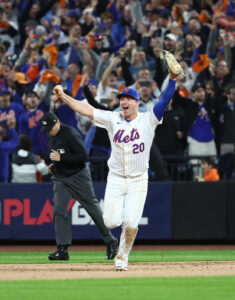
Not so long ago, Alonso would have been one of the most sought-after free agents on the market, and his potential contract would have been much easier to predict. After all, he is one of the most powerful (and durable) hitters in the game. He has averaged 43 home runs and 112 RBI per 162 games throughout his career. However, teams look at a lot more than just home runs and RBIs these days. They’re also less likely to pay for past performance. Thus, as Alonso approaches his age-30 season coming off two consecutive down years, it’s not hard to imagine why teams might be hesitant to meet his presumptive nine-figure demands. Earlier this offseason, MLBTR’s Anthony Franco wrote about why Alonso’s contract was one of the hardest to predict for the Top 50 list.
Even so, it’s impossible to deny that Alonso is one of the premier power hitters in the game. Over the past two seasons, down years by his own standards, Alonso ranks fifth among all hitters with 80 home runs. His 121 wRC+ in that span is 21% better than league average. Only a handful of players are capable of swinging the bat faster or hitting the ball harder than the Polar Bear. In other words, he is still going to find a lucrative contract this winter, even if he has to wait a little longer for his market to heat up.
Let’s take a closer look at every team’s chances of signing Alonso.
Likely Suitors (listed alphabetically)
Astros: The Astros freed up some payroll (approximately $8.9MM) by trading star outfielder Kyle Tucker to the Cubs and taking on third baseman Isaac Paredes, among others, in return. Adding Paredes won’t necessarily stop Houston from pursuing Alex Bregman, since Paredes could slide over to first base in deference to Bregman, the superior defender. However, this trade makes it more likely the Astros will look to add a new first baseman instead.
Houston has needed a new first baseman since optioning and subsequently releasing José Abreu earlier this year. The team has already expressed interest in Christian Walker, but Alonso could be another target, especially if Bregman signs elsewhere. The Astros reportedly offered Bregman a six-year, $156MM deal earlier this winter. It’s no surprise Bregman turned that number down, but it would probably be enough to land Alonso. That’s not to say the Astros would be willing to spend the same amount for Alonso as they would for Bregman, but at least it suggests that GM Dana Brown has the necessary funds to get a deal done.
Mets: The Mets have always seemed like strong contenders to retain their homegrown slugger. Although winning the Juan Soto sweepstakes may have reduced the pressure on David Stearns to make any other big additions to the offense, it’s not as if signing Soto precludes the Mets from re-signing Alonso. For one thing, the team’s projected payroll for 2025 is still far below where it was in 2023 and ’24. There might be a payroll number even Steve Cohen won’t spend past, but Stearns has tens of millions to work with before that could possibly become an issue.
Stearns also needs to think about how he’s going to address the holes at first base and DH that free agents Alonso and J.D. Martinez left behind. Mark Vientos is an option to play first, but he held the third base job in 2024. His defense was graded poorly there but the Mets could be better off if Vientos can hold down a more valuable defensive position. Last week, Cohen noted that the Mets are “still engaged” in contract discussions with Alonso.
Nationals: There’s a reason why Tim Dierkes, Anthony Franco, and Darragh McDonald all predicted Alonso would sign with Washington on our Top 50 list. Several promising young Nationals players took big steps forward in 2024. Perhaps that will encourage ownership and the front office to make a big splash this offseason as the Nats look to get back into contention. Keibert Ruiz is currently the only player on the roster with a guaranteed contract, and RosterResource estimates the club’s 2025 payroll is currently $52MM lower than the team’s final payroll in 2024.
Furthermore, first base is wide open in Washington. Joey Gallo and Joey Meneses, who combined to play more than 100 games at first for the Nationals this past season, are out of the organization. Juan Yepez is the most likely internal option to play first base in 2025, but he has not done enough over parts of three big league seasons to warrant an everyday role. President of baseball operations Mike Rizzo has said the club is looking for middle-of-the-order bats and Alonso would certainly fit the bill.
Yankees: Aside from the Mets, the Yankees are the only other team to be credibly linked to Alonso. Early in November, Brian Cashman told Mike Puma of the New York Post that he had spoken to agent Scott Boras about his slugging client. However, MLB Network’s Jon Morosi recently suggested the Yankees would prefer to sign a first baseman on a shorter deal, describing Walker as “more of a priority.”
Nonetheless, it certainly seems like Alonso is still on the table in the Bronx. That should be true even after the Yankees acquired Cody Bellinger from the Cubs on Tuesday. Bellinger can play first base, but he’s more useful to the team in the outfield; he can play center field, allowing Aaron Judge to move back to right. Thus, this team could still use a replacement for Anthony Rizzo at first. Ben Rice, who hit .171/.264/.349 over 50 games in his rookie season, and DJ LeMahieu, who hit .204/.269/.259 in his age-35 campaign, are currently the best in-house options.
With a projected $270MM payroll for 2025 (per RosterResource), the Yanks are still about $33MM under their final estimate from 2024. And while they have made several additions, including Bellinger, Max Fried, and Devin Williams, they still have work to do to replace an incredible talent like Soto. That’s especially true when it comes to the offense.
Plausible/On-Paper Dark Horses
Blue Jays: The Blue Jays have money to spend and a strong desire to add star power. Alonso isn’t on the same level as some of Toronto’s top targets this winter (including Soto, Fried, and Corbin Burnes), but presumably, the Blue Jays will keep trying until they sign somebody if they continue to lose out on star free agents. To that end, Ben Nicholson-Smith of Sportsnet reports that “Everyone in the [Blue Jays] organization” believes the offense would look a lot more dangerous with another “legitimate slugger.”
The only thing keeping the Blue Jays out of the “likely suitors” category is the fact that they already have a superstar first baseman: Vladimir Guerrero Jr. However, the two could split first and DH this coming year with Alonso taking over at first if Guerrero leaves in free agency following the 2025 season.
Diamondbacks: The Diamondbacks were one of the best offensive teams in MLB this past year, but they lost two of their best hitters to free agency in Walker and Joc Pederson. Alonso could help to make up for much of that missing production. However, if the D-backs are indeed planning to keep payroll at a similar level in 2025, they only have about $24MM to spend, according to the estimates from RosterResource. That might not be enough for them to make a serious run at Alonso, especially if they’re planning to address any other areas of need this winter. Then again, GM Mike Hazen could free up some cash if he can find a way to offload Jordan Montgomery‘s contract.
Giants: New president of baseball operations Buster Posey is clearly trying to get the Giants back into contention as soon as possible; he already signed Willy Adames and has expressed serious interest in Burnes as well. Pitching will probably remain his priority even if he misses out on Burnes. Still, if Posey is considering Burnes, that means he has the funds to make a run at Alonso. LaMonte Wade Jr. was San Francisco’s primary first baseman in 2024, but the team is reportedly willing to make him available in a trade.
Reds: The Reds are the darkest horse here. They don’t have a clear hole at first base for Alonso, and it’s unclear how much they’re willing to spend this offseason. That said, they could badly use the offense if they want to contend in 2025. New manager Terry Francona could make room for Alonso at first by putting Spencer Steer in left field, Jeimer Candelario at third, and Christian Encarnacion-Strand at DH. And while Cincinnati’s front office hasn’t committed to increasing payroll this winter, they haven’t outwardly shut down the possibility either.
Tigers: Despite such a strong finish in 2024, the Tigers haven’t given their fanbase much reason to believe they’ll spend big to improve this winter. However, if they are going to spend – and they really should – Alonso would be a great fit for the lineup. POBO Scott Harris has acknowledged his team could use another right-handed bat and that Spencer Torkelson‘s job at first base is far from secure. A reliable righty bat like Alonso would be a big upgrade over Torkelson and a strong addition to a lefty-heavy Detroit lineup. While the Tigers haven’t been big spenders recently, they’ve run higher payrolls in the not-so-distant past.
Unlikely/Not Happening
Angels: The Angels have been active this offseason, but first base doesn’t seem to be at the top of their priority list. Former first-round pick Nolan Schanuel was mediocre in his first full MLB season, but presumably, the Angels haven’t given up on the young first baseman just yet. Meanwhile, Jorge Soler is penciled in at DH, and Anthony Rendon, Mike Trout, and Travis d’Arnaud could see some time there as well.
Athletics: The A’s could theoretically make room for Alonso at first base/DH by having Brent Rooker play more outfield and Tyler Soderstrom catch more often, but it’s far from a perfect fit. While this team might need to keep spending to avoid an MLBPA grievance, there are better uses for that money.
Braves: With Matt Olson at first base and Marcell Ozuna as their designated hitter, the Braves have no need or room for Alonso.
Brewers: The Brewers have been linked to at least one veteran first baseman this offseason; according to USA Today’s Bob Nightengale, they’re interested in Paul Goldschmidt. However, they’re not usually in play for more expensive free agents like Alonso. Milwaukee hasn’t signed a free agent for more than $35MM or more than three years since Lorenzo Cain in 2018. Even a modest splash on Goldschmidt might require them to offload the Rhys Hoskins contract.
Cardinals: Willson Contreras will be the Cardinals’ full-time first baseman going forward. Even if that weren’t the case, St. Louis is highly unlikely to sign any long-term contracts this winter.
Cubs: Chicago already made a big offensive addition this offseason, trading for Tucker last week. In order to make room for Alonso, the Cubs would most likely have to trade first baseman Michael Busch or presumptive DH Seiya Suzuki. After trading Bellinger to the Yankees, there’s no indication they’re planning to do that.
Dodgers: The Dodgers need Alonso even less than the Braves, thanks to their MVP first baseman Freddie Freeman and MVP DH Shohei Ohtani.
Guardians: On the rare occasions the Guardians have spent significant money in free agency, it has often been for a defensively limited slugger – think Josh Bell, Yonder Alonso, and Edwin Encarnacion. That said, a contract for Pete Alonso would easily be the biggest this front office has ever handed out to a free agent. What’s more, Alonso would only fit in Cleveland if the team were to trade current first baseman Josh Naylor. It would seem counterproductive for the Guardians to deal Naylor and his projected $12MM salary only to turn around and sign Alonso.
Mariners: The Mariners are looking for a righty-batting first baseman, and Alonso would certainly be a nice offensive upgrade for a team that struggled to score runs in 2024. Still, their reported interest in players like Carlos Santana and Justin Turner suggests they aren’t in the market for a bigger free agent addition. The M’s might be planning to increase payroll in 2025, but signing a big name like Alonso still seems unlikely. They haven’t signed a free agent hitter to a contract worth more than $25MM since Nelson Cruz a decade ago.
Marlins: Sure, the Marlins could use Alonso. They could use just about every available free agent. That said, this team is highly unlikely to pursue any free agents who aren’t one-year stopgaps/veterans to flip at the trade deadline.
Orioles: GM Mike Elias has already signed his slugger to replace Anthony Santander, and he went with outfielder Tyler O’Neill. That leaves the O’s with a bit of a logjam at first base/DH, where Ryan Mountcastle, Ryan O’Hearn, and Heston Kjerstad could all vie for playing time. Elias might make a trade to clear that up, but even so, Baltimore’s payroll is already significantly higher than it was last year, and another big signing for the offense seems improbable.
Padres: The Padres have room for Alonso, especially if they trade Luis Arraez, and they could use a big bat to replace Jurickson Profar. However, POBO A.J. Preller is operating under tight payroll constraints this winter. Even for Preller, who always seems to have a surprise up his sleeve, Alonso doesn’t seem like a realistic target.
Phillies: The Phillies fall into the Braves/Dodgers camp. Their two best hitters, Bryce Harper (1B) and Kyle Schwarber (DH), already occupy the only positions Alonso could fill.
Pirates: Like the Nationals, the Pirates are an up-and-coming young team with room for a veteran bat at first base. Unlike the Nationals, however, the Pirates have never been big players on the free agent market. There’s a good chance they’re planning to run with recent trade acquisition Spencer Horwitz at first base in 2025.
Rangers: With the addition of Jake Burger, the Rangers don’t really have room for Alonso in the lineup. Given their desire to slip beneath the luxury tax in 2025, they probably don’t have the payroll space either. First baseman Nathaniel Lowe has come up in loose trade rumors this offseason, but it wouldn’t really make sense for Texas to part with the cost-controlled Lowe to sign Alonso. Both players have been similarly productive over the past three years. Moreover, the Rangers are reportedly seeking a left-handed bat. Trading the lefty-batting Lowe to sign the righty-batting Alonso would only set them back in that respect.
Rays: Even if the Rays were finally going to shock the baseball world and sign a top free agent to a nine-figure contract, Alonso probably wouldn’t be their guy. According to wRC+, Tampa Bay’s cost-controlled first baseman Yandy Díaz has outperformed Alonso at the plate in each of the past three seasons.
Red Sox: Boston already has money to spend but a cluttered first base and DH mix. Rafael Devers is a poor defender at third and the club has considered moving him over to first. But since they have Triston Casas there and Masataka Yoshida likely taking up a lot of DH time, it’s led to rumors of Casas being available on the trading block. Signing Alonso would be an expensive way of further crowding that situation.
Rockies: You can’t completely count out the Rockies – this is the team that signed Kris Bryant to a $182MM deal just a few years ago – but there is no reason to believe Colorado is in on any of the top free agents this year. After Charlie Blackmon‘s retirement, Bryant is likely to get most of the reps at DH in 2025, while the Rockies surely want to see what they have in Michael Toglia at first base.
Royals: The Royals could use the offense, but they’re highly unlikely to spend what it will take to land Alonso. On top of that, they already have a full-time first baseman in Vinnie Pasquantino. With players like Jonathan India and Salvador Perez already on the roster, Kansas City probably isn’t looking for a full-time DH.
Twins: The Twins could use a first baseman to replace Carlos Santana, but Alonso is almost surely out of their price range. RosterResource already projects their 2025 payroll to be $12MM higher than the final estimate from 2024.
White Sox: Not happening.
Image courtesy of Imagn.
MLB Mailbag: Burnes, Soto, Brewers, Dodgers, A’s, Astros
Today's mailbag gets into where Corbin Burnes might go, why we write about players' salaries, whether Juan Soto will opt out, how the Brewers might sort out their outfield, chances of the Dodgers signing various free agents, and what's next for the A's.
Please note that this mailbag was initially published shortly before news of the Cody Bellinger trade broke. I'm sure we'll get into that trade in the next mailbag, but since some of the Bellinger material in the mailbag was usurped by the trade, I've added several bonus Astros questions and answers to the end.
Joel asks:
Why is there not even a shred of a suggestion anywhere that the Mets have interest in Corbin Burnes? If they were willing to pay dinosaurs like Scherzer and Verlander, why not pay Burnes? Otherwise, they'll lose a lot of games 7-5.
Tony asks:
Corbin Burnes will sign with ?
Bud asks:
As a Giant fan it’s a little concerning hearing the rumors of Corbin Burns nearing a deal with the team and then a week or more of quiet. I was hoping for more moves…
Neil asks:
Will Giants sign Burnes or will it be another pitcher?
David Stearns was the GM of the Brewers when the team drafted Burnes in the fourth round out of Saint Mary's College of California in 2016. With the Mets needing three starters this winter, it was natural to expect Stearns to be interested. While it's true Stearns topped out at $15.5MM for a free agent starter with the Brewers (Jhoulys Chacin in 2016), it's also true that the Mets have way more money than the Brewers.
Even a comparison to Stearns' 2023-24 offseason would not be fair, because that was, as my colleague Darragh McDonald wrote, "a sort of bridge year." Hence the relatively affordable additions of Sean Manaea, Luis Severino, and Adrian Houser.
To date, the Mets have made the ownership-driven decision to sign Juan Soto to a record-shattering contract, while Stearns has added Clay Holmes and Frankie Montas on two-year deals (if Holmes uses his opt-out) to help fill out the rotation. Kodai Senga barely pitched this year, and David Peterson's 21 starts matched a career high. Paul Blackburn is a back of the rotation type who has battled injuries, including October back surgery. The rotation lacks reliability, which would likely be solved by Burnes.
Stearns seems more interested in the trade market of late, showing interest in Garrett Crochet and Luis Castillo this month. Speculatively, they could go after Dylan Cease as well. On December 7th, Ken Rosenthal and Will Sammon of The Athletic wrote that the Mets had interest in Manaea, Nathan Eovaldi, Walker Buehler, Jack Flaherty, and Nick Pivetta. Around that time, Tim Healey of Newsday wrote that the Mets were not in on Max Fried and are not expected to land Burnes. It would seem that Stearns simply does not like the return on investment of huge pitching contracts (at least for the players available this winter) and does not want to spend $250MM+ on Burnes.
Unlock Subscriber-Exclusive Articles Like This One With a Trade Rumors Front Office Subscription
- Access weekly subscriber-only articles by Tim Dierkes, Steve Adams, and Anthony Franco.
- Join exclusive weekly live chats with Anthony.
- Remove ads and support our writers.
- Access GM-caliber tools like our MLB Contract Tracker
Third Base Options For The A’s
After largely sleepwalking through recent offseasons, the A’s have woken up ahead of their temporary move to West Sacramento with splashes both in the free-agent market and trade market. Luis Severino (three years, $67MM) and Jeffrey Springs (Joe Boyle, Will Simpson, Jacob Watters, Competitive Balance draft pick) now stand atop the rotation depth chart.
Some of the maneuvering could be due to a desire to draw in fans from a new market. Some could be early groundwork to convince the eventual long-term fans in Las Vegas that this isn’t the same spendthrift A’s club we saw in Oakland. More realistically, a good portion of the spending is simply to boost payroll enough to avoid a grievance from the MLBPA. The A’s already had their status as a revenue-sharing recipient revoked once after failing to sufficiently utilize the funds they receive from that arena; they were only reinstated as a recipient in the 2022-26 collective bargaining agreement.
With that in mind, it’s worth looking ahead to what the remainder of the offseason might hold. General manager David Forst was candid about his desire to add a third baseman last week, and he stated that he’s open to further rotation moves as well. With regard to third base, the A’s have plenty of options but will likely need to get creative. The two most oft-discussed third base options on the market right now are free agent Alex Bregman and trade candidate Nolan Arenado.
The A’s might be spending, but they’re almost certainly not going to dole out the $200MM+ required to sign Bregman. Arenado, meanwhile, has a full no-trade clause and would need to green-light a trade to the A’s in order to spend the next three seasons playing in a Triple-A facility. Arenado’s agent, Joel Wolfe, suggested that if a trade indeed comes together, his client will want it to be to a team capable of being a perennial contender. The A’s have made some waves this winter, but I don’t think anyone’s convinced they fit that description just yet.
So, where could they turn? Let’s run down some of the in-house options and handful of potential outside fits who could jump to the front of the line for playing time…
In-House Candidates
Darell Hernaiz, Max Schuemann, Brett Harris, CJ Alexander
A click through the results that quartet posted this past season will reveal why the A’s are so open to the idea of adding at the hot corner. Each of Hernaiz, Schuemann and Harris logged over 100 plate appearances with the A’s. None hit well in the majors. Harris and Hernaiz hit some in Triple-A, but both are generally regarded as fringey prospects for different reasons. Harris is a good defender and has good bat-to-ball skills but offers little power and plodding speed. Hernaiz has an even better hit tool with more power but far more questions about his glovework. Alexander was an August waiver claim who’s already 27 and has all of eight MLB plate appearances. He ripped apart Triple-A pitching this year but struggled in his first taste of that level as a 26-year-old in 2023.
Free Agency Route
Paul DeJong: Big flies, slick plays and punchouts galore. Anyone who signs DeJong at this point in the 31-year-old’s career knows that’s what they’re getting. DeJong has fanned in at least 30% of his plate appearances in each of the past three seasons. He’s also slugged 44 home runs in his past 1119 plate appearances and delivered strong glovework on the left side of the infield. He’s typically been a shortstop, but both Defensive Runs Saved and Outs Above Average were bullish on his defense in 328 1/3 innings at third base last year between the White Sox and Royals. DeJong can very likely be had on a one-year deal, and the allure of an everyday gig to begin the season would hold appeal, given that many of his suitors are going to view him as more of a bench piece.
Yoan Moncada: This is the biggest upside play on this winter’s crop of options at the hot corner. Moncada is still 29 years old (30 in May). He was the consensus top prospect in the sport at one point and was so touted as a prospect that the Red Sox paid more than $60MM (signing bonus and penalty taxes combined) to sign him under the former iteration of MLB’s international bonus pool system. Moncada looked like a star in 2019 and 2021 but has battled injuries since. Dating back to Opening Day 2022, he’s posted a .236/.291/.387 slash. He’s been playing Winter Ball in Puerto Rico, but Francys Romero reported that he’s stepping away — in part because of an injury scare after fouling a ball into his right foot recently but also perhaps because he’s on the cusp of an agreement with a big league team. Moncada can’t be too picky about where he plays, and of all the names available on short-term deals, he’s the one who could most plausibly erupt with a rebound that turns him into a coveted trade candidate.
Jorge Polanco: At 31 (32 in July), Polanco isn’t as “upside-y” as Moncada, but he has a longer track record of hitting in the big leagues. From 2018-23, the switch-hitter slashed .270/.338/.455 for the Twins — highlighted by a 33-homer season in 2021. He became the latest established hitter to flop following a trade to Seattle, though October knee surgery revealed that perhaps there was more than just the pitcher-friendly environment impacting his struggles. Polanco’s agency says he’s healthy now and he very superficially looks the part — MLBTR’s Tim Dierkes and I saw him multiple times at the Winter Meetings in Dallas as he met with interested clubs — and if so, he should be a strong rebound candidate. Polanco hit .255/.335/.454 as recently as 2023. The Astros are one team considering him as a third base option, and the A’s could do the same. Polanco could also be insurance at second base, should Zack Gelof‘s 2024 struggles continue.
Josh Rojas: The 30-year-old Rojas hasn’t hit much these past two seasons (.234/.304/.337), but he’s played the heck out of third base for the D-backs and the Athletics’ division-rival Mariners. Like Polanco, he has ample experience at second base and can provide a safety net in the event that Gelof struggles. Rojas was non-tendered by the Mariners as they look for offensive upgrades in the infield while facing tight budgetary constraints from ownership. From 2021-22 in Arizona, he hit .266/.345/.401 (106 wRC+) while walking in nearly 11% of his plate appearances. If he can come close to that level of production while replicating his brilliant 2024 defense (+6 DRS, +7 OAA), he’d be a steal at the one-year deal he’ll likely command.
Trade Route
Brett Baty, Mets: The former No. 12 overall pick (2019) and longtime top prospect has mustered only a .215/.282/.325 line in his first 602 MLB plate appearances, although those have been spread across three seasons. Baty is a .273/.368/.531 hitter in 416 Triple-A plate appearances and has shown improving strike zone awareness even in the majors. He walked at a 9.4% clip last year and cut his strikeout rate from 28% in 2023 down to 24.6% in 2024. Baty fanned in 21.2% of his Triple-A plate appearances and walked at a 12.4% clip in 2024. The emergence of Mark Vientos has at least temporarily blocked Baty’s path to the majors, although if Pete Alonso signs elsewhere in free agency, then Vientos could slide to first base and create another chance for Baty. Still, the Mets are getting hits on Baty, and they’re likely open to moving him for the right return. He wouldn’t help the A’s boost payroll, as he’s not yet into arbitration … but if the A’s wanted to take on a portion of Starling Marte‘s contract to lower the cost to acquire Baty, the Mets might have interest in that.
Alec Bohm, Phillies: You miss 100% of the shots you don’t take. Can’t blame the Phillies for reportedly asking about Mason Miller when talking to the A’s about Bohm — just as you can’t blame them for reportedly looking at Logan Gilbert and George Kirby in Seattle. It doesn’t sound as though the Phils have a realistic price tag on Bohm right now, but that could change as the winter wears on. If they get to the point where they’d look at moving Bohm for some optionable back-of-the-rotation arms, the scenario becomes more plausible. Bohm is projected by MLBTR contributor Matt Swartz to earn $8.1MM next year. The Phillies are looking to shake up their offense and could move Bohm to address other needs and create an opening for a new acquisition of their own.
Willi Castro/Jose Miranda, Twins: The Twins are deep in infielders. They’re almost certainly not going to move former No. 1 overall pick Royce Lewis or Brooks Lee, the No. 8 pick from the 2022 draft. Carlos Correa is entrenched at shortstop, and the Twins have repeatedly downplayed speculation about a trade regarding their highest-paid player. Castro makes more sense as a trade candidate, given that he’s entering his final season of club control and projected to earn $6.2MM as the Twins face payroll issues amid a potential sale. But, he can play anywhere on the field, is beloved in the clubhouse and just hit .251/.344/.395 with good defense and plus baserunning across the past two seasons. Miranda could be a go-to bat at first base; he excelled as a rookie in 2022, didn’t hit in 2023 before undergoing shoulder surgery, and bounced back with a .284/.322/.441 line in a resurgent 2024. The Twins still have Edouard Julien as a potential option at first base. Top infield prospect Luke Keaschall is rising quickly. They could move one of Miranda or Castro and possibly even pair him with Chris Paddack to fill multiple needs for the A’s while trimming payroll and adding some young talent in the process.
Nolan Gorman, Cardinals: All the talk in St. Louis is about trading Arenado to open playing time for young hitters, but what about possibly trading some of those young hitters themselves? Gorman feels like a change of scenery candidate after being unable to solidify himself as a big leaguer despite looks in three different seasons. He has clear plus power but some notable contact issues. The Cards, even if they move Arenado, might like to get Jordan Walker back to third base and could prefer Thomas Saggese or Brendan Donovan at second base. This year’s first-round pick, JJ Wetherholt, could rise quickly. We’re also still only four months removed from president of baseball operations John Mozeliak saying this about Gorman before optioning him to Triple-A:
“Obviously, it’s a game of production up here and at some point, you’ve got to consistently produce, or we have to find someone who can. I mean, that’s what it ultimately comes down to, and these are hard messages to hear. It can be frustrating, but this is what ends up defining you. With our offensive struggles this year, I think you can strictly look at the inability for consistent performance, day in and day out.”
Mozeliak has since changed his tune, telling The Athletic’s Katie Woo earlier this winter that the club hoped to get Gorman close to 600 plate appearances next season. Even if that’s true, Gorman has had multiple auditions and hasn’t yet claimed a spot. Walker, Saggese and Wetherholt are all in the mix for playing time around shortstop Masyn Winn and first baseman Willson Contreras (Wetherholt more in the second half of 2025). If the A’s offer the right young player(s), they’d have a chance at buying four years of Gorman. As with Baty, he wouldn’t do anything to bump payroll (unless paired up with, say, Steven Matz), but he’s an intriguing candidate.
Ke’Bryan Hayes, Pirates: Had the Pirates known Hayes would run into chronic back troubles that would send him to the IL five times over the first three seasons of his contract extension, they’d have thought twice about guaranteeing the former top prospect $70MM. Hindsight is 20/20. At the time of the extension, Hayes was a recent top pick who’d hit .282/.342/.432 through his first 506 plate appearances while playing flat-out elite defense. The plus-plus glovework is still there, but in a possible 482 games since putting pen to paper, Hayes has suited up just 352 times and batted .250/.303/.369 in that time. He’s still owed $43MM over the next five years on what was a front-loaded contract extension. That front-loading will make him easier to trade than a more conventional backloaded deal, and Hayes’ sensational glovework gives him a high floor whenever he’s on the field. The always payroll-crunched Bucs surely wouldn’t mind escaping the remainder of this deal.
Casey Schmitt, Giants: Another former high pick with big defensive skills, Schmitt has posted a tepid .219/.264/.369 slash in 390 big league plate appearances across the past two seasons. His defensive grades at shortstop have been surprisingly down for a player whom scouting reports praised in that regard, but plenty of plus defensive shortstops slide down the defensive spectrum to third base in the majors. Schmitt has strong grades for his small sample of 296 MLB frames at the hot corner. He’s a career .286/.343/.460 hitter in Triple-A. The Giants have nowhere to put him except in a utility role, now that Matt Chapman and Willy Adames own the left side of the infield and Tyler Fitzgerald is ticketed for regular work at second base. That might be a fine role for Schmitt, too, but the Giants have other candidates for that role. You could argue 27-year-old David Villar also works for the A’s, but he’s older and has failed in the majors in a larger sample; he’s also out of minor league options and doesn’t have near Schmitt’s defensive acumen. Schmitt is another player who won’t do anything to add to the payroll, but he’s a recently well regarded prospect who’s now blocked from a path to regular playing time.
Where Will Corbin Burnes End Up?
With Blake Snell and Max Fried off the board, Corbin Burnes stands alone at the top of the pitching market. There was some thought that the former Cy Young winner might sign within a day or two of Fried agreeing to an eight-year term at the Winter Meetings. That hasn’t happened, though it wouldn’t be a surprise if Burnes signs before league activity goes quiet with the holidays next week.
Thus far, the starting pitching class has outperformed expectations. That’s most true of Fried, whom few would’ve foreseen getting eight years or handily beating $200MM at the start of the offseason. With Fried securing $218MM, how much should one project upwards on Burnes? Every free agent projection would’ve had Burnes above Fried when the offseason got underway. Fried money feels like a floor for Burnes, whom MLBTR predicted for seven years and $200MM just six weeks ago.
That said, the Yankees and Mets were two of the most obvious on-paper fits at the start of the offseason. The Yankees can safely be ruled out after the Fried deal. The Mets are still in the market for starting pitching and have the payroll room to lurk as a threat on Burnes even after landing Juan Soto. Yet it seems the Mets’ focus for starting pitching has been on the middle tiers. They added Frankie Montas and converted Clay Holmes to the rotation, preferring more affordable upside plays than a quick strike for any of free agency’s top three arms. They’re reportedly still interested in re-signing Sean Manaea, which would very likely close the door on a Burnes acquisition.
Recent rumors have most prominently connected Burnes to a few teams: the Red Sox, Blue Jays, Giants and (to a lesser extent) the Orioles. Boston is still engaged in the rotation market after landing Garrett Crochet last week. Trading for Crochet leaves them with ample payroll space — the former White Sox staff ace is projected for a meager $2.9MM arbitration salary — but could indicate that the Sox weren’t keen on the climbing cost for free agent starting pitching.
The Giants would benefit greatly from an ace they could plug alongside Logan Webb in the rotation to replace Snell’s production. Yet San Francisco has already made a pair of big investments ($151MM on the Matt Chapman extension, $182MM for Willy Adames) within the past few months. Does ownership have interest in a deal that should easily exceed those already significant contracts?
Depending on how one feels about the Andrés Giménez trade, it’s debatable whether the Blue Jays have made a splash acquisition this offseason. They were heavily involved on Soto and Fried but watched both players head elsewhere. Their front office could be most motivated to land a marquee free agent, but they’re also faced with some payroll questions. Sportsnet’s Ben Nicholson-Smith wrote last week that the Jays landing Burnes “doesn’t seem especially likely,” suggesting the organization could prefer to focus on a bat as its biggest addition while looking for a cheaper rebound target on the rotation front.
Maybe that opens the opportunity for the incumbent Orioles to make a push. GM Mike Elias has said that the ownership change has allowed the O’s front office to explore the top of the rotation market. (They reportedly were involved on Snell, in particular.) Still, it’s fair to take a “believe it when I see it” approach for Baltimore. The O’s have brought up spending since David Rubenstein purchased the franchise in April. They took on Zach Eflin’s $18MM salary in a deadline trade with the Rays and signed Tyler O’Neill for three years and $49.5MM last week. Yet neither investment is close to what it’d take to retain Burnes.
How will the Burnes situation play out? Will there be a late push by a mystery team to land him, and how much will it take? Is he soon to be the latest beneficiary of a bullish rotation market, or is the number of teams willing to make a $200MM+ investment drying up?
Which Team Will Sign Corbin Burnes?
-
Giants. 35% (4,487)
-
Red Sox. 21% (2,665)
-
Orioles. 14% (1,809)
-
Blue Jays. 11% (1,478)
-
Other (specify in comments). 10% (1,304)
-
Mets. 9% (1,222)
Total votes: 12,965
What Will Burnes Be Guaranteed?
-
$240MM - $259MM. 28% (2,346)
-
$220MM - $239MM. 26% (2,186)
-
$260MM - $279MM. 14% (1,204)
-
$200MM - $219MM. 11% (942)
-
$280MM - $299MM. 8% (625)
-
$300MM or more. 6% (537)
-
Less than $200MM. 6% (485)
Total votes: 8,325
MLB Mailbag: Vlad Jr., Yankees, Seiya Suzuki, Sasaki, Giants
We (Steve Adams and Tim Dierkes) are on the scene at the Hilton Anatole in Dallas for Day 2 of the Winter Meetings. At the time of this writing, Tuesday has been quiet in terms of completed deals, but plenty of action is yet to come. We carved out some time from meandering the lobby to field subscriber questions on Vladimir Guerrero Jr.'s potential contract, what the Yankees might do after losing out on Juan Soto, the Cubs and the Seiya Suzuki trade situation, the idea of signing Roki Sasaki to an extension, what's next for the Giants, and much more.
Jeff asks:
Jays fan question - if 26 year old Soto is worth 765M, isn't 26 year old free agent Vlad Jr now worth ~500M? How bad has Ross Atkins bungled his window to sign Vlad at a more reasonable price, over several years of dithering? All the talk had been a Devers comp in the mid-300s, but that ship has surely sailed, right?
Vladimir Guerrero Jr.'s likely rising price tag was a big topic of conversation around the lobby of the MLB Winter Meetings in Dallas Monday night.
It's worth noting that Guerrero will turn 27 shortly in advance of his first free agent season, as opposed to Juan Soto spending the entire first year of his new deal at the age of 26. We have rarely seen a prominent free agent hit the market at 27, perhaps with the exception of Carlos Correa's weird three-year post-lockout contract. Otherwise you're looking at international free agents like Jose Abreu or Seiya Suzuki, or Cody Bellinger who took a one-year deal at that point.
Steve and I spoke to our esteemed former colleague Ben Nicholson-Smith last night about a potential Vlad Jr. price tag, and Ben mentioned Rafael Devers as a comp just as Jeff did in his question. Indeed, Devers' contract only covers free agent years and started with his age-27 season. That was a ten-year, $313.5MM extension. Due to deferred money, Alex Speier of the Boston Globe wrote that the CBT hit on Devers' deal is "just more than $29 million." In other words, the present value of Devers' deal was below $300MM. It was also not signed on the open market.
Unlock Subscriber-Exclusive Articles Like This One With a Trade Rumors Front Office Subscription
- Access weekly subscriber-only articles by Tim Dierkes, Steve Adams, and Anthony Franco.
- Join exclusive weekly live chats with Anthony.
- Remove ads and support our writers.
- Access GM-caliber tools like our MLB Contract Tracker