
Latest On Indians’ Top Starters
The Yankees and Mariners pulled off a blockbuster trade on Monday, when New York sent three prospects – including left-hander Justus Sheffield – to Seattle for southpaw James Paxton. But before that deal went down, there was a possibility of the Yankees returning Sheffield to the Indians, his first professional organization.
Paul Hoynes of cleveland.com reports the Indians likely could have accepted a Sheffield-fronted package for any of Corey Kluber, Carlos Carrasco and Trevor Bauer, whom they’ve discussed with the Yankees. In the end, however, the two sides couldn’t match up, as Hoynes writes that the Mariners placed a higher value on Sheffield than the Indians did. According to Hoynes, Cleveland still likes Sheffield, whom it chose in the first round of the 2014 draft but later traded to the Yankees in a 2016 deal headlined by reliever Andrew Miller. Still, it’s no surprise that the Tribe elected against trading any of its ace-caliber starters to reunite with the 22-year-old Sheffield.
If Cleveland’s going to move Kluber, Carrasco or Bauer, Hoynes relays that it’ll need to receive a return that would unquestionably help the club stay atop the American League Central, a division it has won three years in a row. Conversely, the Mariners don’t figure to contend in 2019, so they were more willing to accept a future-oriented package for Paxton. In addition to the well-regarded Sheffield, Paxton brought back a pair of non-elite prospects in righty Erik Swanson and outfielder Dom Thompson-Williams.
Even if the Indians were to subtract one of Kluber, Carrasco or Bauer, starting pitching wouldn’t be a weak point for the club, as it also counts Mike Clevinger, Shane Bieber, Danny Salazar and Triston McKenzie among its rotation possibilities. The team’s outfield is an obvious concern, on the other hand, and as Kyle Downing of MLBTR pointed out in previewing the Indians’ offseason, it would make more sense for a Kluber, Carrasco or Bauer trade to net them a cheap, controllable solution in that area.
If the Indians do part with any of their three right-handed stars this offseason, each would warrant a greater return than Paxton. The Big Maple, who’s down to his final two years of arbitration eligibility, hasn’t been as durable as any member of Cleveland’s trio. There’s also a rather strong case to be made that he simply isn’t as good as Kluber, Carrasco or Bauer.
Few have been able to combine dominance and durability like the 32-year-old Kluber dating back to his 2014 breakout. The two-time AL Cy Young winner also comes with up to three years of team control. Kluber’s due $17MM next year, and after that, his employer will have decisions to make on a $17.5MM club option in 2020 and an $18MM option in ’21. Barring major injury issues or a noticeable downturn in performance, those options will be exercised.
Like Paxton, both Carrasco and Bauer have two years of team control left. Carrasco will earn $9MM in 2019 and perhaps another $9.5MM by way of a club option in 2020, though that figure could increase based on AL Cy Young voting. Bauer’s future salaries are less certain than his two teammates’, but he’s projected to earn an affordable sum – $11.6MM – in his second-last year of arbitration eligibility. Although the 27-year-old doesn’t yet have the long-term track record of Kluber or Carrasco, Bauer may have been better than both of them in 2018, when he logged a 2.21 ERA/2.44 FIP with 11.34 K/9 and 2.93 BB/9 in 175 1/3 innings.
It’s unclear whether the Indians will trade any of their three No. 1 starters in the coming months, but their futures will undoubtedly be among the majors’ most interesting storylines this offseason. Kluber, Carrasco and Bauer, along with Noah Syndergaard (Mets), Zack Greinke (Diamondbacks), Madison Bumgarner (Giants) and free agents Patrick Corbin and Dallas Keuchel, appear to be the best starters who have at least some chance to end up on the move prior to the 2019 campaign.
Olney’s Latest: Goldy, Yanks, Astros, Pollock, Brantley, Cutch, Mariners
It’s unclear whether the Diamondbacks will trade their franchise player, first baseman Paul Goldschmidt, though Buster Olney of ESPN (subscription required) hears from rival evaluators that they are “intent” on dealing the 31-year-old. While Goldschmidt has consistently been one of the majors’ best players during his career, it’s unlikely the Diamondbacks would receive a significant haul in exchange for his final year of team control, observes Olney, who notes that most contenders aren’t seeking a first baseman. But St. Louis and Houston continue to show a good amount of interest in Goldschmidt, per Olney, which jibes with a previous report from Ken Rosenthal of The Athletic. Olney adds that rival clubs believe the Astros have seemingly tried to move young right-hander J.B. Bukauskas, their eighth-ranked prospect at MLB.com, in trade talks. Similarly, the Yankees were “pushing” left-handed pitching prospect Justus Sheffield in Goldschmidt discussions, Olney reports. Sheffield’s no longer in the picture for New York, though, as it traded him to Seattle this week in a deal for lefty James Paxton.
- Back to Houston, which has been shopping near the top of the market for free-agent outfielders, according to Olney, who lists A.J. Pollock, Andrew McCutchen and Michael Brantley among their targets. Unless the Astros deem soon-to-be 22-year-old prospect Kyle Tucker ready for a full-time role, they have an opening in the outfield, where George Springer and Josh Reddick are their only obvious starters. Signing Pollock, a center fielder, would enable them to move Springer back to a corner after he spent the majority of 2017-18 in center. Pollock’s likely to rake in the biggest payday of the trio, though; further, given that Pollock comes with a qualifying offer attached, adding him would also cost the Astros their second-highest draft pick in 2019 and $500K in international pool space.
- The Mariners have been the most active team on the trade market this offseason, having already dealt Paxton and catcher Mike Zunino. With aggressive general manager Jerry Dipoto at the helm and the M’s desire to take a step back in 2019, more trades involving their veterans are likely on the way. However, it continues to look as though the Mariners will keep their two top players, outfielder Mitch Haniger and closer Edwin Diaz. It would take overwhelming offers for the Mariners to seriously consider moving either Haniger or Diaz, Olney tweets. Both stars are controllable for the next four years, including another pre-arbitration season apiece.
Yankees Notes: Ottavino, Kikuchi, Harper
A few notes from the Bronx…
- With crucial bullpen pieces David Robertson and Zach Britton among their free agents, the Yankees are planning to add two relievers this offseason, according to general manager Brian Cashman (via Joel Sherman of the New York Post). One of those pickups may be free-agent right-hander Adam Ottavino, whom the Yankees are interested in, Sherman reports. The 33-year-old Ottavino – a New York City native – just put up a career season in Colorado, where he logged a 2.43 ERA/2.74 FIP with 12.98 K/9 and 4.17 BB/9 across 77 2/3 innings. On the heels of his marvelous 2018 campaign, MLBTR predicts Ottavino will join the Yankees on a three-year, $30MM contract this offseason.
- The Yankees have discussed signing Japanese left-hander Yusei Kikuchi, team owner Hal Steinbrenner revealed earlier this month (per David Lennon of Newsday). “I saw film on him during the pro scouting meetings,” Steinbrenner said. “We talked about that individual. We’ve always been paying attention to that area of the world — some unbelievably great players came out of there. So it won’t be any different this year.” Steinbrenner’s comments came before the Yankees acquired fellow lefty James Paxton from the Mariners this past Monday, which in theory could lessen the need for Kikuchi. However, the Yankees still seem destined to get at least one more high-end starter this offseason, and they’ve never been shy about pursuing hyped Japanese talent, evidenced by past signings such as Hideki Irabu, Hideki Matsui, Kei Igawa and Masahiro Tanaka. While the 27-year-old Kikuchi’s not yet available to major league clubs, that will change when the Seibu Lions – his team in Nippon Professional Baseball – post him in early December.
- New York is loaded in the outfield, where it boasts Aaron Judge, Giancarlo Stanton, Aaron Hicks, Brett Gardner, Clint Frazier and Jacoby Ellsbury. Free-agent outfielder Bryce Harper seems like more of a luxury than a need, then, though there has been speculation about the Yankees signing the superstar to play first base, where their top holdover, Luke Voit, dominated late in 2018 but doesn’t carry an extensive major league track record. Earlier this week, Cashman discussed the possibility of signing Harper to line up at first, telling the YES Network (via Mike Rosenstein of NJ.com): “People have talked about Bryce Harper being able to play first base, I don’t know if he can or can’t. I know he’s very athletic, but that’s not necessarily a bet I would recommend placing with the amount of money he’s expected to get.” Although Cashman doesn’t seem enthusiastic about Harper as a first base option, the executive added that he’s “not ruling anything out.”
Latest On Sonny Gray’s Market
After a nightmarish year in the Bronx, his first full season with the Yankees, right-hander Sonny Gray is among the majors’ most obvious trade candidates this winter. General manager Brian Cashman has made it known the Yankees are aiming to move Gray, who has drawn plenty of interest this offseason. Along with the previously reported Athletics and Padres, teams that are eyeing Gray include the Braves, Rangers and Twins, according to Nick Cafardo of the Boston Globe.
Any team that picks up Gray would be taking on a rental, as 2019 will be the 29-year-old’s final arbitration-eligible campaign. MLBTR contributor Matt Swartz projects Gray to earn $9.1MM, which may look steep for a pitcher who failed to maintain a spot in the Yankees’ rotation for all of last season and only managed a 4.90 ERA across 130 1/3 innings (30 appearances, 23 starts). However, ERA estimators such as FIP (4.17), xFIP (4.10) and SIERA (4.28) suggest Gray deserved better in the run prevention department in 2018, and while he did issue a high number of walks (3.94 per nine), he also posted quality strikeout (8.49 K/9) and groundball (50 percent) rates. Moreover, Gray’s struggles were mostly limited to the Bronx, as he logged a horrendous 6.98 ERA/5.98 FIP at home and a terrific 3.17 ERA/2.65 FIP on the road. Historically, Gray has been closer to the pitcher he was away from Yankee Stadium last season, as his 3.66 ERA and 3.74 FIP over 900 combined 2/3 innings with the A’s and Yankees demonstrate.
Of the newly listed teams pursuing Gray, the Rangers stand out as the club likely to have the most difficult time making the playoffs next season. Not only are the Rangers a rebuilding team stuck in a division with the Astros, A’s, Mariners and Angels, but they’re ridiculously thin on starting pitchers and may soon deal their No. 1 option, Mike Minor. It would be a surprise to see Texas come out on top in the race for Gray, then, while the other teams seem like more plausible landing spots.
The reigning NL East champion Braves have shown past interest in Gray – albeit with different front office leadership than they have now – and need to replace free agent Anibal Sanchez, who was unexpectedly one of their best starters in 2018. And though the Braves seem to have the payroll room to aim higher than Gray, general manager Alex Anthopoulos has suggested they’re hesitant to dish out expensive long-term deals at this juncture. Therefore, it makes sense that the Braves are interested in Gray, who’d be a relatively low-risk addition.
Minnesota, unlike Atlanta, disappointed last season, taking several steps backward after earning a playoff spot in 2017. The Twins are in a division that may be there for the taking, though, so the right moves this offseason could make the team serious AL Central contenders next year. In Jose Berrios, Kyle Gibson, Jake Odorizzi and Michael Pineda (who missed all of last season), the Twins already have four established starters under control for next season. However, they’re lacking another proven hurler along the lines of Gray, who’d seemingly slot in ahead of the likes of Fernando Romero, Adalberto Mejia, and Stephen Gonsalves – a trio which has combined for 203 innings and 40 starts in the majors.
MLBTR Poll: Grading The Paxton Swap
As usual, Thanksgiving weekend brings a lull in the transactional market. We’ve yet to see a ton of movement at the top of the free agent class, so there isn’t much to digest on that front. But there has been one quite notable trade: four days ago, the Yankees landed James Paxton from the Mariners, as we wrote up in full at the time. That swap was significant enough to warrant further assessment from the MLBTR readership. After all, it sets the stage for both clubs for the rest of the winter.
For the Yankees, getting Paxton means saving some immediate salary as against a generally commensurate free agent arm. He’s an excellent hurler, albeit one with health questions. Notably, the organization added a high-quality piece at an area of need without adding any ink to the long-term balance sheet. That’s important whether or not the team has designs on any massive free agent outlays, as it will help maintain long-term flexibility.
Of course, the expectation remains that the Bronx Bombers will add another notable rotation piece while also exploring other intriguing assets on the open market. If the organization was operating under any financial limitations, whether via hard limits or soft ones, then it’ll now presumably be able more comfortably to absorb salary as it chases Patrick Corbin or another starter, Zach Britton or some other reliever, or perhaps top-of-the-market stars Bryce Harper and Manny Machado.
Nabbing Paxton obviously didn’t come free, though. The Yankees parted with two hurlers who could’ve contributed to the MLB staff now and for years to come in Justus Sheffield and Erik Swanson. Also heading out the door was an increasingly interesting, though not very widely hyped, outfield prospect named Dom Thmpson-Williams.
On the Mariners side, picking up those new pieces helps set the organization up for what it hopes will be a fairly brief reloading period. Sheffield has long been graded a top prospect, though many have come to doubt his upside (and his ability to stick in the rotation at all). Clearly, the M’s like his ability and think he can make good on his promise. While Swanson is not nearly as well-known, he seems to have a legitimate shot at turning into a productive MLB piece in Seattle.
Prioritizing near-term talent may have been a reflection, at least in part, of the sorts of offers that Mariners GM Jerry Dipoto received. But it likely represents a part of his stated strategy to target the opening of a new contention period in 2020 or 2021. There’s no reason to doubt that both of the hurlers will reach the majors at some point in the coming years, so they’ll each have a shot at carving out a role in what the front office hopes will be a cost-effective and capable pitching staff.
So, how do you grade this deal for both clubs?
In New York … (link for app users):
Grade the James Paxton Swap for the Yankees.
-
B 46% (11,977)
-
A 36% (9,526)
-
C 14% (3,562)
-
D 3% (683)
-
F 2% (545)
Total votes: 26,293
And on the Seattle side … (link for app users):
Grade the James Paxton Swap for the Mariners.
-
B 37% (8,848)
-
C 30% (7,045)
-
A 22% (5,240)
-
D 8% (1,873)
-
F 3% (689)
Total votes: 23,695
Projecting Payrolls: New York Yankees
As we kick off the fifth installment of this series, here are links to the previous team payroll projections:
Philadelphia Phillies
Los Angeles Dodgers
Los Angeles Angels
Atlanta Braves
If you have questions about financial information made available to the public and the assumptions used in this series, please refer to the Phillies piece linked above.
Today, we’re moving north to visit with the once and future biggest spenders in the game: the New York Yankees.
Team Leadership
The ownership portion of this section likely needs very little explanation, but a bit of history is actually instructive. Going back to the end of World War II, The Yankees were owned by Lee MacPhail, Dan Topping, and Del Webb from 1945-64. The team failed to reach the World Series in 1945 and 1946, then, improbably, played in the Fall Classic in all but three of the remaining years of their ownership run. CBS then purchased a controlling stake in the team in 1964 and the Yankees failed to make the playoffs during all 10 campaigns of corporate ownership.
Then, the Boss arrived. George Steinbrenner led a group of investors in purchasing the Yankees in 1973 for an unfathomable $10 million. While the team has had minority owners since then, the Steinbrenner family has held the reins with George relinquishing control to his son Hal and his three siblings in 2008, two years prior to George’s passing.
The baseball operations department is headed by senior vice president and chairman Brian Cashman. Cashman took control of the baseball operations department in early 1998 and promptly saw the team make the World Series five times in his first six years at the helm, winning three championships in the process. Perhaps somewhat surprisingly, Cashman’s job security has rarely been at issue despite the fact that the Bronx Bombers have won just one World Series title since 2000 (2009).
Historical Payrolls
Before hitting the numbers, please recall that we use data from Cot’s Baseball Contracts, we’ll use average annual value (“AAV”) on historical deals but actual cash for 2019 and beyond, and deferrals will be reflected where appropriate. And, of course, the value of examining historical payrolls is twofold: they show us either what type of payroll a team’s market can support or how significantly a given ownership group is willing to spend. In the most useful cases, they show us both. We’ll focus on a 15-year span for the Yankees, covering 2005-18 for historical data as a means to understanding year 15: 2019. We’ll also use Opening Day payrolls as those better approximate expected spending by ownership.
Fasten your seatbelts, the payroll figures are about to get gaudy.
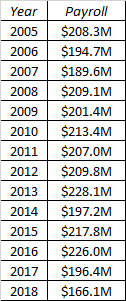
The Yankees surprisingly began the 2000s with a payroll of just $107.6 million and that figure held true in 2001 at $112.3 million. Then the spending boon started in 2002 as the team increased payroll by $13.6 million, $26.8 million, $31.4 million, and $24.1 million in four consecutive offseasons causing payroll to soar to the 2005 starting point above of $208.3 million. Incredibly, payroll has been largely stagnant since 2005 with only modest dips and climbs over the next 12 years before a notable drop in 2018 that reset the Yankees luxury taxpayer status (more on that below).
The Yankees have been a model franchise when it comes to finding ways to use their financial might to improve their club on talent beyond the Major League roster. The best recent example of this spending acumen came in the international amateur market in 2014 when the Yankees zoomed past their bonus threshold to sign one third of the top-30 prospects that year. It is overwhelmingly likely that this bonanza spurred Major League Baseball to revisit and revise the international spending limitations in the next iteration of the Collective Bargaining Agreement. To read more about this spending spree, check out this piece on Baseball Prospectus from Dustin Palmateer. Needless to say, if there is a way to use the club’s financial might to create a competitive advantage, the Yankees have done and will do it, even if significant taxes are at issue.
Speaking of taxes: since Major League Baseball instituted its first version of a luxury tax in 1997 through 2017, teams paid approximately $548,155,916 in taxes. The Yankees paid $329,519,651 of that amount, accounting for 60.1 percent of total luxury tax payments. Truly astonishing. Keep in mind that these tax payments do not include the taxes paid for overspending in the international marketplace. Simply put, the Yankees will spend and spend big, not that this is news to anyone.
Future Liabilities
The Yankees entered the offseason with a truly bizarre contract table: they had no guaranteed contracts with one year remaining, instead holding multi-year guarantees only. The recent re-signings of CC Sabathia and Brett Gardner added a pair of contract year players to the payroll table. Here are the guaranteed future dollars with club options highlighted in peach and player options — in this case, opt-out clauses — are highlighted in light blue.

We’ll start with Stanton. It was an imperfect debut season for the former National League Most Valuable Player, but on the whole, Stanton delivered what was expected: a whole bunch of home runs. His contract comes with two deeply intriguing facets. First, the Yankees enjoy a significant luxury tax benefit as a result of the inexpensive early year guarantees on his deal when with the Marlins and financial help Miami will send to New York in the mid-2020s. The Yankees should seek out players for whom they can pay exorbitant amounts while enjoying relatively depressed luxury tax figures. Stanton’s $22.7 million annual luxury tax hit is on par with the likes of Justin Upton, not befitting an in-prime superstar. Second, the 2026-28 commitments are comparatively very small given the influx of money from the Marlins. Assuming that the Yankees exercise their option on him in 2028, they’ll be responsible for just $49 million over those three years. In the meantime, obviously, they’ll pay an MVP level rate.
The other commitments are for the team’s three most recent marquee free agent acquisitions: Tanaka, Ellsbury, and Chapman. The returns for those three have been all over the place. Despite some control issues this past season, Chapman has largely excelled since returning starting with the 2017 season. At the other end of the spectrum, Ellsbury enjoyed a good first year with the Yankees in 2014, but he provided below-average production in 2015-17 before missing all of 2018 with a hip injury. Tanaka has occupied the space between stars and scrubs. He looked like an ace in 2014 and again in 2016. In the middle, he struggled with an elbow injury and since 2016, he has been a slightly above-average starter but not the ace that the Yankees hoped he would become. His value isn’t poor by any stretch, but he’s being paid at almost exactly his market rate.
As for the arbitration projections, the Yankees figure to spend a good amount on controllable talent with less than six years of service time. The Yankees don’t appear to have any obvious non-tender candidates. Here are their arbitration projections (salary projections by MLBTR and Matt Swartz):
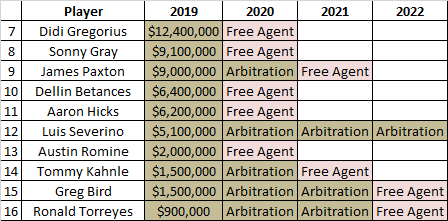
It’s likely Gray finds himself wearing a new uniform when 2019 kicks off, but the front office will nevertheless take pleasure in seeing both Paxton and Severino occupying only arbitration salary slots instead of monster eight-figure annual salaries.
There is one name that comes with oodles of intrigue: injured shortstop Didi Gregorius. Gregorius underwent Tommy John surgery on October 17, an operation that will keep him on the shelf for months. With a $12.4 million arbitration payday on the way, could the Yankees consider non-tendering him, especially if he won’t be available until late in the 2019 season?
I don’t see it. His middle infield partner, Gleyber Torres, underwent Tommy John surgery on June 19, 2017, but he was ready for Spring Training in 2018, participating fully and playing the entire 2018 regular season starting on Opening Day. Torres needed only about eight months to return to full participation, though it’s possible that he would have been ready even earlier. If Gregorius is ready to return in mid-June, he’s certainly worth his arbitration estimate. It’s also possible that the Yankees come to a multi-year agreement with him in lieu of playing out his final year in advance of free agency.
What Does Team Leadership Have to Say?
When asked about how the team will fill out its rotation holes early in November, Cashman unsurprisingly explained that the Yankees will take whatever path necessary to build a winning rotation. “I think we’ll just gravitate to anything that will make sense,” Cashman said. “It could be a combination; something could make sense via trade in the same category as free agency. I’m interested in adding more than one pitcher. I need to, I think, add multiple. If I can do so, we’ll see.” While commenting on his preference to remain south of the luxury tax line, Cashman admitted what we all already know: “…because of the market we’re in and the ownership we have I know that we’re capable of and it’s a decision they ultimately will make when they’re forced to make it…” Quite simply, Cashman has openly admitted that big spending is a viable option, even if he publicly states a desire to avoid doing so.
Are the Yankees a Player for Bryce Harper or Manny Machado?
Yes.
We could spend a long time explaining why this is viable for the Yankees, but for a team with revenue estimated at $619 million as of 2017, it probably doesn’t require much in-depth examination to see how this works financially.
The more interesting question with the Yankees involves the fit of these two young stars. Incredibly, the Yankees’ top seven players by WAR in 2018 were four outfielders (Aaron Judge, Aaron Hicks, Stanton, and Gardner), two shortstops (Gregorius and Torres), and a third baseman (Miguel Andujar). Judge, Hicks, Gregorius, and Stanton all produced at star-level rates.
That said, it’s not terribly difficult to see the fit for Machado. Andujar’s rookie year defensive metrics were putrid. He could justifiably be moved to first base and/or designated hitter, or traded, opening up third base for Machado. Shortstop will be open to begin the season with Gregorius recovering from surgery and Torres also comes with Tommy John in his background, so Machado would be a safer bet to hold the spot defensively into the future, especially with Gregorius an impending free agent. Machado could easily cover shortstop or third base with minimal roster revisions.
But Harper? The Yankees would need to kick Harper to center field, enforcing a massive defensive downgrade for their outfield, move one of Judge, Stanton, or Harper to designated hitter, or trade one of their current corner outfield stars to clear a spot for Harper. Or they could do something even more surprising like moving one of Judge, Stanton, or Harper to first base, a risky defensive move.
I’m sure that Cashman would find a way for this to work. But the Harper fit is clearly tougher.
What Will the 2019 Payroll Be?
The standard disclaimer: ownership and management knows the actual budget whereas we’re focusing on historical data and other relevant factors to project future spending in the immediate and more distant years to come.
The Yankees’ payroll is going to go up. The only question is whether they sneak over the $200 million threshold or if they blow past it.
Assuming that Gray is gone but that Gregorius stays at his arbitration salary, the Yankees are staring at a cash payroll of $152.2 million with a luxury tax payroll of $164.9 million. There’s absolutely no chance that they’ll end the offseason with payroll figures that low.
They’re going to be major players for the elite free agents with cash, prestige, and a young core of premium talent to offer any players looking for a new fortune and a ring or two to go along with it…and that’s before we factor in that the Red Sox have won four World Series titles over the last 15 years while the Yankees have just one flag. Given their need for pitching, expect to hear plenty of Patrick Corbin, Dallas Keuchel, and J.A. Happ rumors, even after the acquisition of Paxton. And expect to hear Harper and Machado linked to the Bombers until the day they sign, be it in New York or elsewhere.
I could see them marrying Cashman’s desire to stay below the luxury tax line with a couple of impact additions, setting payroll above the $206 million tax line but below the maximum penalty threshold of $246 million. As a refresher, the Yankees will incur a 20 percent tax on amounts spent over $206 million and a 12 percent surtax on amounts over $226 million. Once spending reaches $246 million, the tax rate is 42.5 percent and the club would see its top draft selection lowered ten spots. Those penalties are tough to swallow.
I expect that the club will begin the 2019 season either in the first tax tier or narrowly into the second tax tier in order to maintain some flexibility for in-season acquisitions and to stay safely below that $246 million threshold. This will bring spending back in line with where it has been for much of the past decade and a half.
Projected 2019 Payroll: $220 million cash (approximately $232.7 million for luxury tax purposes)
Projected 2019 Payroll Space: $67.8 million
Yankees Acquire Tim Locastro
The Yankees have acquired infielder/outfielder Tim Locastro from the Dodgers, per a club announcement. Righty Drew Finley and cash considerations will head to Los Angeles in return.
Locastro was dropped from the L.A. 40-man yesterday, among many other moves. He has experience all over the diamond, with most of his time in the minors coming at second base and shortstop, but was announced by the Yanks as an outfielder.
It seems his likeliest fit, though, is as a pure utility piece; perhaps he’ll have a shot at competing with Ronald Torreyes (assuming he’s tendered), Hanser Alberto, and any other potential contenders to take up a reserve role. It’s not hard to see why the Yankees had interest, given that broad defensive background combined with Locastro’s generally productive numbers at the plate in the upper minors. He’s a .283/.354/.401 hitter through 626 Double-A plate appearances and has turned in an eyebrow-raising .307/.402/.443 slash in his 471 trips to the dish at the game’s highest level.
Finley, a 22-year-old righty, has yet to move past the low A level despite three attempts. In 120 innings as a professional over four seasons, he carries an unsightly 5.48 ERA with 9.7 K/9 and 4.8 BB/9. That said, Finley was a third-round pick back in 2015, and it could well be that the Dodgers still think there’s some talent to be unlocked.
Players Added To The 40-Man Roster
Tonight marks the deadline for players to be added to their respective organizations’ 40-man rosters. Over the nine hours, there’ll be a flurry of moves, ranging from minor trades (like the one the Indians and Rays made yesterday), waiver claims and players being designated for assignment or outrighted. Each will be made to clear room for players who need protection from this year’s Rule 5 Draft. As a reminder, players who signed at 18 years of age or younger and have five professional seasons are eligible, as are players who signed at 19 or older and have four professional seasons under their belts.
Here’s a rundown of players who’ve been added to their respective 40-man rosters (which will be updated throughout the day)…
- There are three additions for the Twins: outfielder LaMonte Wade and infielders Nick Gordon and Luis Arraez.
- The Giants announced that they have added a trio of righties: Melvin Adon, Sam Coonrod, and Logan Webb.
- Lefty Justin Steele is now a member of the Cubs‘ 40-man, per an announcement.
- The Rangers announced that they are protecting veteran hurler Edinson Volquez, who’s returning from Tommy John surgery, along with outfielder Scott Heineman, righty Wei-Chieh Huang, and lefty Taylor Hearn.
- Righties Mitch Keller and JT Brubaker, infielder Cole Tucker, and outfielder Jason Martin are all joining the Pirates‘ 40-man, per Tim Williams of Pirates Prospects (via Twitter).
- The Blue Jays will add righty Patrick Murphy to their 40-man, per Shi Davidi of Sportsnet.ca (via Twitter). Toronto has announced his addition, along with those of fellow righties Trent Thornton, Yennsy Diaz, Hector Perez, and Jacob Waguespack.
- Three Indians players have been boosted up to the 40-man, the club announced: first baseman Bobby Bradley, southpaw Sam Hentges, and righty Jean Carlos Mejίa.
- Righty Joe Harvey is joining the Yankees‘ MLB roster, the club announced.
- The Phillies have added shortstop Arquimedes Gamboa along with righties Edgar Garcia and Adonis Medina to the 40-man, per a club announcement.
- Former first-round draft pick Dillon Tate, a right-handed pitcher, was selected to the Orioles‘ 40-man.
Trade Chatter: Segura, Goldschmidt, Astros, Gomes
After last winter’s deep freeze, many in the game are surely wondering when the action will truly get underway this time around. We’re still awaiting a monster free agent pact, but the first blockbuster trade is now in the books. For the Mariners, sending James Paxton out for a package featuring two near-MLB pitchers was designed to open a new contention window in one or two years, GM Jerry Dipoto acknowledged today in an interview on 710 ESPN. (H/t TJ Cotterill of the Tacoma News Tribune, via Twitter.) That largely fits the prior indications that Dipoto has given, perhaps helping set the stage for the club’s remaining offseason work. Certainly, there could be quite a few more deals for the ever-active Dipoto to explore with that goal in mind. As we recently covered in breaking down the club’s offseason situation, the M’s have several other assets that could make sense as trade chips.
Now that the ice has been broken, here’s the latest trade chatter from around the game:
- In an interesting side note following tonight’s major swap, Jon Morosi of MLB Network tweets that the Yankees also sought to discuss Jean Segura in their talks with the Mariners. Segura has now established himself as a quality regular at short and is playing on a reasonably priced contract extension. He’d obviously help the Yanks fill in for the injured Didi Gregorius — which would presumably all but take the club out of the running for free agent star Manny Machado. Obviously, the Segura side of the talks did not progress. Whether the possibility of a deal could be revisited is not clear, but it wouldn’t be terribly surprising to see the clubs circle back.
- While the Astros had interest in Paxton, they weren’t willing to budge on including top pitching prospect Forrest Whitley to get a deal done, Morosi adds on Twitter. It’s rather unsurprising to hear that the Houston organization drew a hard line there, as the 21-year-old has one of the loftiest ceilings of any pre-MLB hurler in baseball and perhaps isn’t far from cracking the majors. Presumably the ‘Stros had a different package on offer that was simply deemed inferior to the one that got the deal done. Houston GM Jeff Luhnow will no doubt move on to a series of other potential targets, as rotation improvement remains a clear need.
- Trade talks involving Diamondbacks first baseman Paul Goldschmidt, meanwhile have seemingly yet to get going in earnest. To this point, Ken Rosenthal of The Athletic tweets, the Astros and Cardinals “have had the most meaningful discussions” of any organizations in baseball. But that’s just relative to their peers, not an indication that either club is particularly likely (let alone close) to striking a deal for one of the game’s best and steadiest offensive performers. Of course, it’s also still entirely unclear just what the D-Backs will look to do with such a key player. An extension still does not appear to be out of the question, though there have been no hints that one is in the works. Even in a trade scenario, the team will have to decide whether to try to use Goldschmidt as a vehicle to shed salary (by attaching another contract) or recoup talent.
- As they seek to make some tweaks to an increasingly expensive roster, the Indians are receiving “significant trade interest” in backstop Yan Gomes, Rosenthal tweets. It’ll be interesting to see how the market ends up valuing Gomes, who’s due $7MM in 2019 and then another $2MM in buyouts on successive options (if they aren’t exercised). That seemed a bargain when he was turning in big offensive numbers back in 2013 and 2014, but his multi-year lull left the contract seemingly turned the back end of the contract sour. Now, though, the 31-year-old is coming off of his best showing with the bat in years. In 2018, he slashed .266/.313/.449 and swatted 16 home runs in 435 plate appearances. That said, it’s far from clear whether the bump in productivity was the result of a sustainable improvement. Gomes walked at an anemic 4.8% clip and rode a .336 batting average on balls in play — though he did produce a greater hard-hit rate (38.7%) and average exit velocity (88.9%) than he ever had previously. He also set new personal high-water marks in launch angle and line-drive rate, accomplishing the latter by significantly paring down on the number of balls he put on the ground. Given his strong reputation as a defender, Gomes would seem to be quite an appealing target as a league-average hitter, so teams that find cause to believe in the bat will surely have interest.
Yankees Acquire James Paxton
The Yankees have officially struck a deal to acquire lefty James Paxton from the Mariners, as Jeff Passan of Yahoo Sports (Twitter link) first reported. Top pitching prospect Justus Sheffield is coming to Seattle in return, per Ryan Divish of the Seattle Times (Twitter link). Completing the return are outfielder Dom Thompson-Williams and righty Erik Swanson, per Corey Brock of The Athletic (via Twitter).
This is the first major move of the winter market, bringing a top-shelf starter to a New York club that has long been rumored to be seeking to boost its rotation. Having already inked CC Sabathia earlier in the winter, the Yanks now appear unlikely to pursue more than one additional starter, though they’ll still have ample financial flexibility to go after any available pitchers.
Meanwhile, the M’s have now kicked off a winter in which they’ll attempt to walk a tightrope act of staying at least reasonably competitive while enhancing their roster’s long-term outlook. Paxton just turned 30 earlier this month, but he’s down to two more season of arbitration control, so he was one of the team’s more obvious assets to market. Previously, the club sent out regular catcher Mike Zunino, another player with two seasons to go until free agency.
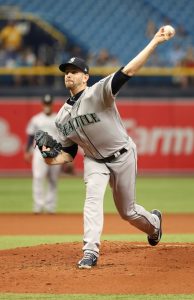
In adding Paxton, the Yankees aren’t just getting a highly talented pitcher. They’re getting one at an eminently reasonable rate of pay. MLBTR and contributor Matt Swartz project Paxton to earn $9.0MM this winter; if he turns in a great year, he’ll get a nice raise on that amount, but that would also mean the club would be more than happy to pay it. Ultimately, these salary levels land a far sight shy of Paxton’s open-market value — at least, that is, assuming he’s at full health.
At his best, Paxton is among the game’s most dominant rotation pieces. Aptly dubbed the Big Maple, the Canadian southpaw has struck out 11 batters per nine over the past two seasons while averaging a reasonable 2.4 BB/9. That’s rare air for a starter. His ERA ballooned a bit this year to 3.76, owing to a few extra long balls, but he posted a 2.98 mark in 2017. Plus, ERA estimators were quite enamored of his output in the just-completed campaign (3.24 FIP, 3.02 xFIP, 2.96 SIERA).
Of course, this all comes with a caveat. Paxton has never thrown a full MLB campaign, with his 28 starts in 2018 representing a career high. He also just barely (by a third of a frame) passed the 160 innings-pitched threshold for the first time last year. Health issues remain an ever-present concern and will perhaps dictate the outcome of this swap from the Yankees’ perspective.
The Yankees will hang their hat on the fact that Paxton mostly avoided significant injury issues in 2018. He missed time after being struck by a comebacker, which was obviously just an instance of poor fortune, after previously being sidelined for lower back inflammation. Those sorts of maladies aren’t the real concern, though. Previously, Paxton has missed time with forearm, shoulder, and biceps problems.
The good news is that Paxton has delivered a pristine version of his power arsenal when he has been able to unleash it. He has averaged 95.9 mph on his four-seamer over each of the past two seasons. And his swinging-strike rate is still on the rise, moving up to a personal-best 14.3% in 2018. If he can carry that forward, even if it’s not quite for a full 32-start campaign, the Yankees will likely be quite pleased with this move.
Turning back to the Mariners side, it’s still a bit difficult to know whether this portends quite a few more moves or whether the club will mostly pick around the edges from this point forward. Certainly, the organization has other marketable assets — as well as some under-water contracts that it might look to unload. It was only two weeks ago that we first learned of the Mariners’ somewhat surprising plans to move some key MLB assets this winter. The shape of the final roster remains very much in doubt, though GM Jerry Dipoto acknowledged today that the club is focused on a 2020-2021 window. (H/t TJ Cotterill of the Tacoma News Tribune, via Twitter).
It’s worth noting that, in both this and the Zunino swap, the M’s have brought back players who figure to represent near-term MLB contributors. If things break right, then, the club could rebound quickly. Here, the key asset is Sheffield, a 22-year-old southpaw who originally went to New York along with Clint Frazier in the swap that send Andrew Miller to the Indians. Scouts and prospect hounds alike have long loved Sheffield for his stuff. But questions remain as to whether he’ll every full command the full arsenal sufficiently to reach his ceiling at the game’s highest level.
It’s not as if Sheffield tends to have difficulties finding the zone. He has averaged only 3.4 walks per nine innings over his five minor-league seasons, which is hardly elite but also isn’t a concerning number, standing alone. But an inability to fully dictate the location of your pitches can obviously tell in other ways, particularly against major-league hitters.
Thus far, Sheffield has managed just fine with his explosive three-pitch mix, which is led by a fastball that occasionally edges into the upper-nineties. In 2018, he turned in a 2.48 ERA in 116 games at the Double-A and (mostly) Triple-A level. He also briefly debuted in the bigs; while things didn’t go well in his three relief outings, that hardly means much for the future.
While he’s not nearly so well-known as Sheffield, Swanson is also a near-term possibility for the Mariners’ active roster. He’ll need to take a 40-man spot from the jump, as he’d otherwise be eligible for the Rule 5 draft. The 25-year-old joined Sheffield at Triple-A this year after a dominant stop at the penultimate level of the minors to begin the season.
After arriving at the Yanks’ top affiliate, Swanson worked to a 3.86 ERA over 72 1/3 innings. He was touched for ten long balls, but otherwise impressed with 9.7 K/9 and 1.7 BB/9. Prospect watchers tend to view Swanson as a back-of-the-rotation possibility, rather than any kind of frontline starter, but that’d certainly be a welcome outcome for the Mariners.
Thompson-Williams, meanwhile, reached the High-A level last year at 23 years of age. He did turn in an impressive output there, slashing .290/.356/.517 and racking up 17 home runs and 17 steals in 375 plate appearances. That represented a big leap forward for the former fifth-round pick, so it remains to be seen whether he can continue to develop as he reaches the high minors.
Photos courtesy of USA Today Sports Images.