
Offseason Outlook: Colorado Rockies
MLBTR is publishing Offseason Outlooks for all 30 teams. Click here to read the other entries in this series.
The Rockies made their triumphant return to the postseason, but bowed out after dropping the Wild Card play-in game. Overcoming the Dodgers in the NL West will be a tall order, and the Rox face several roster questions.
Guaranteed Contracts
- Ian Desmond, 1B/OF: $62MM through 2021 (includes buyout of club option for 2022)
- Nolan Arenado, 3B: $17.75MM through 2018 (also controllable via arbitration in 2019)
- Mike Dunn, RP: $15MM through 2019 (includes buyout of club option for 2020)
- Gerardo Parra, OF: $10MM through 2018
- Adam Ottavino, RP: $7MM through 2018
Options
- Greg Holland, RP: $15MM player option (declined)
- Alexi Amarista, INF: $2.5MM club option (declined in favor of $150K buyout)
Arbitration-Eligible Players (service time in parentheses; projections via MLBTR & Matt Swartz)
- DJ LeMahieu (5.128) – $8.8MM
- Charlie Blackmon (5.102) – $13.4MM
- Chad Bettis (3.096) – $1.5MM
- Chris Rusin (3.092) – $1.4MM
- Zac Rosscup (3.021) – $600K
- Non-tender candidates: Rosscup
Free Agents
- Amarista, Tyler Chatwood, Carlos Gonzalez, Holland, Ryan Hanigan, Jonathan Lucroy, Jake McGee, Pat Neshek, Mark Reynolds
[Colorado Rockies Depth Chart; Colorado Rockies Payroll]
There are some needs here, but also some resources. Colorado’s payroll has ramped up rather noticeably in the past three seasons, going from $97MM to $112MM and then up to $127MM. As things stand, the team’s 2018 guarantees plus anticipated arb costs add up to about $90MM. Thus, even if there’s no further boost — that’s still unclear — GM Jeff Bridich could have nearly $40MM of open payroll to play around with.
Where, then, do the needs lie? The most noticeable hole, perhaps, is at the back of the bullpen. Greg Holland proved a worthwhile free agent acquisition last winter, though incentives drove his one-year cost up to a healthy $15MM (from an initial $6MM salary). He gave up the chance at another $15MM payday and is expected to decline a $17.4MM qualifying offer, preferring instead to return to free agency. With live-armed lefty Jake McGee and midseason acquisition Pat Neshek also reaching the open market, the Rox will lose a large portion of the their late-inning firepower.
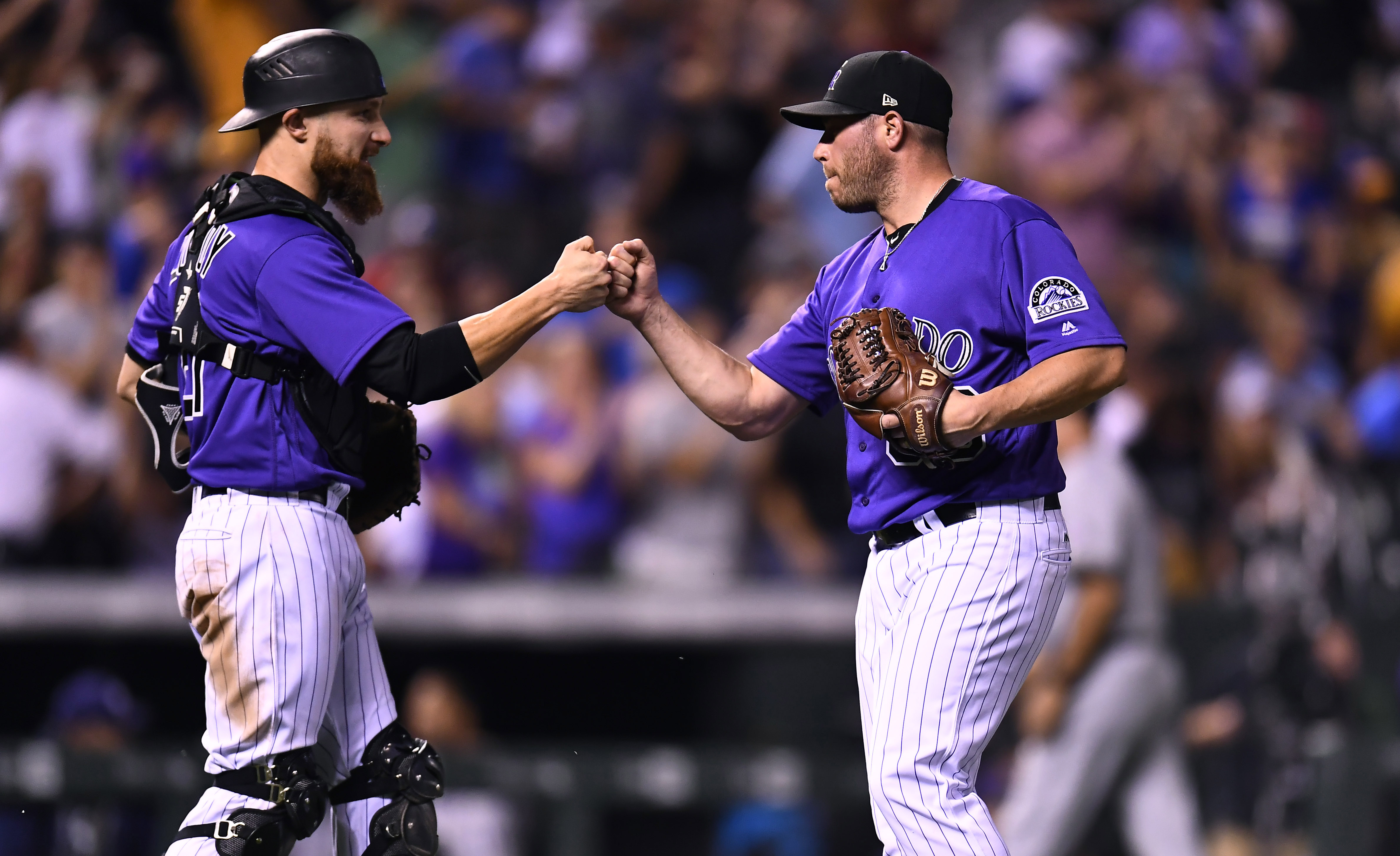
Colorado could pursue some or all of its own free agents, and perhaps it’s reasonable to anticipate that to a point. It certainly seems that both Holland and the team are fond of one another, but he’s going to cost a bundle and comes with all the risks one might imagine would accompany a soon-to-be 32-year-old reliever that recently underwent elbow surgery. The Rockies have a few power arms on hand, including Adam Ottavino and youngsters such as Carlos Estevez, but it’s difficult to imagine any being entrusted with the ninth inning. If Holland can’t be had, then, it’s possible to imagine Bridich checking into the trade market or shopping from among a variety of late-inning arms. Some free-agent hurlers have significant closing experience, such as Addison Reed and Steve Cishek, while others have arguably shown enough to deserve such an opportunity. Among the interesting names on the market are the veteran control artist Neshek, former Rockies hurler Juan Nicasio, and Brandon Morrow. Even if the club lands a big closer, it could consider those and other options as it seeks additional setup options. The team has two southpaws with Mike Dunn and Chris Rusin, but another righty late-inning arm would be welcome.
The fact that there are some openings shouldn’t be read as a suggestion that the pitching staff isn’t in a good place. In fact, the rotation looks solid enough that it could distribute some spare arms to the ‘pen if the team enjoys good health fortune. Though Tyler Chatwood is on his way out, the Rockies have compiled a group of solid hurlers behind staff ace Jon Gray. German Marquez and Kyle Freeland, and Chad Bettis are all but certainties for rotation spots so long as they are healthy. Antonio Senzatela and Jeff Hoffman faded late, while Tyler Anderson struggled early and closed strong, but all three could compete for the final job out of camp. Those that fall shy will bolster the relief corps or remains stretched out at Triple-A for depth. It’s conceivable that the Rockies could add another veteran pitcher to this mix, but hardly necessary; it’s more likely, perhaps, that the club will sign a swingman type for the pen and/or add a veteran or two on low-commitment minors deals.
One way to squeeze value out of an existing pitching staff is to improve the catching situation, and that figures to be an area of focus for Colorado. Tony Wolters slid offensively last year, while Tom Murphy struggled through an injury-limited campaign. Mid-season acquisition Jonathan Lucroy shored things up once he arrived and looks to be a strong candidate for a return. Lucroy is already 31 years of age and comes with some questions after lagging at the plate and in the framing department in the first half of 2017. But he has been one of the game’s best receivers for some time now and rebounded upon his arrival in Colorado. Now, he’s a known quantity who would fill a clear need. Other open-market options include Alex Avila and Welington Castillo.
Otherwise, half of the lineup is fixed. Third baseman Nolan Arenado, shortstop Trevor Story, second baseman DJ LeMahieu, and center fielder Charlie Blackmon are all everyday players. The only offseason questions facing this group relate to the possibility of new contracts. Blackmon and LeMahieu are each entering their walk years, while Arenado is just one season behind them. It’s possible to imagine the Rockies exploring long-term arrangements with any of these players, but getting something done will likely require an uncomfortable contractual commitment — especially with Arenado and Blackmon, who are among the very most productive players in the game. The former is still just 26 and could reasonably point to the Giancarlo Stanton extension as a comp; the latter is already 31, thus limiting his contractual upside, but could legitimately seek a four-year promise at a premium rate of pay to forego a shot at free agency. Story, meanwhile, seems safe in his job for now but doesn’t look like an extension candidate at this point given his strikeout problems and the presence of the fast-rising Brendan Rodgers.
That brings us to the potential moving parts on the position-player side of things: first base, the corner outfield, and the bench. There are options here, though it’s also possible the Rockies will take a fairly simple path to rounding things out.
Ian Desmond was supposed to slot in at first last year, a quizzical decision from the start that only looked worse as the season wore on. Desmond struggled at the plate upon returning from injury and ultimately ceded first base to Mark Reynolds, who is now again a free agent. Ultimately, Desmond played mostly in the corner outfield, and it seems likely the versatile veteran will be penciled in there to open the year. Colorado can do little but hope that he follows the path of Gerardo Parra, who surged after a disappointing first season after joining the club as a free agent. Those two could serve to occupy a major portion of the time flanking Blackmon. Meanwhile, the Rockies have a slate of other outfield possibilities on hand. Left-handed hitters Raimel Tapia, Mike Tauchman, and David Dahl are all on the 40-man. Each has shown quite a bit of promise at times but also comes with questions of varying kind and degree. The righty-swinging Noel Cuevas was also just placed on the 40-man and could compete for a job.
Put it all together, and it’s certainly possible that the Rockies already have compiled their outfield unit. Viewed that way, the offseason path is simple: salute former star Carlos Gonzalez on his way out the door and think about a plan to account for the loss of first baseman Mark Reynolds, who provided sufficient production at a bargain rate in 2017. With Pat Valaika on hand to function as a utility option, there really isn’t much to do but settle first base.
At first, there are a multitude of options. Colorado could plan to rely upon youngster Ryan McMahon, who has little to prove at Triple-A. (He has also spent time at second and third, which increases his roster utility now and in the future.) The lefty hitter might be complemented with a right-handed-hitting addition, which could come in the person of Reynolds. Despite tallying thirty home runs, it is worth noting that the 34-year-old’s overall batting productivity remained in the realm of league average, as it has been for most of the past six seasons. With quite a few other slugger types floating around in free agency, Reynolds likely won’t require a major outlay to bring back. Alternatively, the club could look to players such as Mike Napoli or Danny Valencia to join McMahon.
That is the most straightforward and cost-effective way for things to go, but hardly the only one. It’s plenty arguable that the Rockies can and should pursue a more aggressive approach — particularly with an imposing Dodgers team still dominating the division. Colorado pursued Jose Abreu as a free agent and might see a lot to like in his contractual rights. Abreu is one of the game’s better hitters; while he’s not cheap with a projected $17.9MM arbitration salary in his second-to-last arb year, that’s a cost level that won’t break the bank. And the Rockies likely have sufficient prospect depth to entice the White Sox without bankrupting their future. You can probably squint and see high-priced free agent Eric Hosmer as a fit here, particularly given Colorado’s track record of seeking reputed high-character types, and free agency also comes with a variety of other quality first basemen (most notably, the switch-hitting Carlos Santana). Conceivably, the Rockies could also even revert to their original plans with Desmond, putting him in some sort of first base/super-utility role while adding a bigger corner outfield piece instead of a first baseman.
It’s possible to imagine quite a few scenarios, really. Investing in a veteran position player, for instance, might free the Rockies to utilize young position-player assets to acquire a quality young reliever. It’s an exciting time to be a Rockies fan — though that also means expectations will be high for Bridich and his staff.
Photo courtesy of USA Today Sports Images.
NL Notes: Giants, Mattingly, Stanton, Braves, Schu
Giants executive Brian Sabean discussed his organization’s chief needs recently with reporters including MLB.com’s Chris Haft. While the team is facing a difficult situation with regard to payroll — both in 2018 and beyond — Sabean says there’s urgency to improve in several areas. “Center field needs to be upgraded,” he said. “We have to find an everyday third baseman. And we have to be resourceful in how we reconstruct the bullpen.” Those are the primary spots that seem in need of improvement from the outside; truly getting better, though, will require some combination of creativity and tough tradeoffs.
Here’s more from the National League:
- The Marlins have confirmed that Don Mattingly will, as expected, be back as manager, as Tim Healey of the Sun-Sentinel writes. The veteran skipper is under contract, as president of baseball operations Michael Hill noted, but the organization had not yet made clear in the midst of an ownership change that he would retain his role. (Of course, it would have rated as a big surprise had the team suddenly gone in a different direction at this point in the offseason.) Mattingly has said he’s excited to get underway with the new ownership group led by fellow Yankees legend Derek Jeter, but it’s yet to be seen just what kind of roster he’ll have to work with.
- Speaking of notable possible roster changes, Hill has held a conversation with Giancarlo Stanton, Healey reports, but the Marlins are understandably keeping things close to the vest. Expectations remain that the club will slash salary through some significant trades; Hill acknowledged that things haven’t gone as hoped of late and says the goal is to “build a sustainable, consistent, productive major league organization.” Stanton’s massive contract and excellent 2017 season seemingly make him a rather obvious trade piece, and we took a look earlier today at some teams that could line up on paper for Stanton, but his no-trade clause gives him quite a lot of say in a future destination.
- We’re still waiting to hear about league punishments for the Braves slate of alleged amateur signing transgressions, and it seems the wait will take a while longer. A decision is expected sometime between the GM Meetings and Winter Meetings, per Joel Sherman of the New York Post. It’s likely that word won’t come down until December, ESPN.com’s Jerry Crasnick adds on Twitter. Interestingly, though, Sherman says that the organization could end up making a front office decision before the commisioner’s office acts. Indeed, the team has been “quietly interviewing” some potential candidates that could join the front office in some capacity, per Sherman, who adds that the preference remains to seek a reunion with Royals GM Dayton Moore — who hasn’t been allowed to speak with the Atlanta organization to this point.
- The Giants have hired Rick Schu as their assistant hitting coach, Ken Rosenthal of The Athletic reports on Twitter. Schu, a former big league third baseman, had served as the Nationals’ hitting coach since 2013 but was among the personnel allowed to seek other opportunities after the Nats decided not to retain Dusty Baker. Washington ended up hiring Kevin Long as its new hitting coach.
Offseason Outlook: Minnesota Twins
MLBTR is publishing Offseason Outlooks for all 30 teams. Click here for the other entries in this series.
For the second time in three years, the Twins made a surprising push for the AL Wild Card. Unlike their 2015 campaign, though, Minnesota made it to the postseason this time around. The 2017 Twins look like a much more believable contender than the ’15 group, so chief baseball officer Derek Falvey and GM Thad Levine figure to approach this offseason much differently than the 2016-17 offseason.
Guaranteed Contracts
- Phil Hughes, SP/RP: $26.4MM through 2019
- Joe Mauer, 1B: $23MM through 2018
- Jason Castro, C: $16MM through 2019
- Ervin Santana, SP: $14.5MM through 2018 (includes $1MM buyout of 2019 option)
- Brian Dozier, 2B: $9MM through 2018
- ByungHo Park, 1B/DH: $6MM through 2019
Arbitration-Eligible Players (service time in parentheses; projections via MLBTR contributor Matt Swartz)
- Eduardo Escobar (5.128) – $4.9MM
- Kyle Gibson (4.051) – $5.3MM
- Ehire Adrianza (3.131) – $1.0MM
- Ryan Pressly (3.118) – $1.6MM
- Robbie Grossman (3.060) – $2.4MM
- Trevor May (3.051) – $600K
Free Agents
- Matt Belisle, Chris Gimenez (outrighted, elected FA), Dillon Gee, Bartolo Colon, Hector Santiago, Glen Perkins (option declined)
[Minnesota Twins depth chart | Minnesota Twins payroll outlook]
A lot went right for the 2017 Twins, who surprised baseball with an 85-win season and an American League Wild Card berth. That several top-rated young talents took steps forward this season means that much of the lineup is already set.
Byron Buxton rebounded from an awful start to hit .274/.333/.452 over his final 459 plate appearances. Coupled with elite defense and baserunning, Buxton’s turnaround led to a 5-WAR season by measure of Baseball-Reference and 3.5 WAR by Fangraphs. Miguel Sano homered 28 times in 114 games, though he fouled a ball into his shin in August, resulting in a fracture that all but ended his season. He’s expected to be healthy by Spring Training after November surgery. Meanwhile, 26-year-old Eddie Rosario had a breakout year at the plate with 27 homers, improved K/BB numbers and a strong .290/.328/.507 overall line. Jorge Polanco was one of baseball’s worst hitters in July but erupted with a .316/.377/.553 slash over the final two months (234 PAs).
The Twins also received contributions from veteran hitters that are expected to return. Brian Dozier was again one of the top second basemen in the game, hitting 34 homers and swiping 16 bags with a 124 wRC+. Joe Mauer turned back the clock with a .305/.384/.417 line — good for a 116 wRC+. Robbie Grossman walked at a near 15 percent clip and posted a .361 OBP.
With Sano, Polanco, Dozier and Mauer set to return, the Twins could consider their infield largely set. Eduardo Escobar is on hand as an offensive-minded backup, while Ehire Adrianza can provide excellent defense at any infield spot. However, there’s also room yet to make an addition. With Grossman penciled in as the primary DH, the Twins could conceivably look to shift Sano to that spot on a more regular basis. That’d open up the possibility of signing an infielder for the left side of the diamond (e.g. Zack Cozart, Todd Frazier). Alternatively, the Twins could grab a first baseman like Carlos Santana or a corner bat like Carlos Gonzalez to mix in at DH. Santana would give the Twins two of the game’s better first-base defenders (Mauer rated quite well there in ’17) to rotate between first base and DH.
The other spot the Twins could conceivably add would be in right field. Max Kepler is still just 24 years old (25 in February) and has shown plenty of promise in the Majors, but he’s yet to put it all together. An above-average defender who has shown the ability to hit for power, Kepler has also struggled against left-handed pitching, and he’s yet to hit righties well enough to truly compensate for that deficiency. Young Zack Granite profiles as a quality fourth outfielder, but he’s also a left-handed bat, so perhaps the Twins could pursue a right-handed bat in the Austin Jackson mold to at least provide Kepler with a platoon partner.
Minnesota could also look to add a backup catcher to the fray. Castro provided slightly below-league-average offense (above-average relative to other catchers) and a massive defensive upgrade in Minnesota, so they’re likely content with him as the starter. Minnesota could simply opt to re-sign clubhouse favorite Gimenez or turn to prospect Mitch Garver to fill that role. Names like Chris Iannetta and Rene Rivera are among the right-handed-hitting alternatives that could pair well with the southpaw-swinging Castro. (Castro handled lefties just fine with a .737 OPS in 2017, but he’s historically struggled against same-handed opponents.)
While the position-player side of the equation looks promising and gives the Twins the flexibility to be opportunistic, things aren’t as rosy on the pitching staff. Outside of Ervin Santana and Jose Berrios, the Twins don’t have much in the way of rotation stability heading into 2017. Santana finished second in the Majors in innings pitched and turned in a 3.28 ERA, though secondary metrics were far less optimistic about his performance. At worst, he should be a durable innings-eater capable of posting an ERA in the low 4.00s, but he’s outperformed his peripherals for nearly two full years now and could again turn in a mid-3.00s mark. Berrios solidified himself as a Major Leaguer in ’17, and the Twins will now count on him to take a step forward in 2018. He won’t turn 24 until late May, and he comes with some yet-untapped potential despite a quality 3.89 ERA in 145 2/3 MLB innings this year.
Kyle Gibson figures to return after once again teasing the Twins with a Jekyll and Hyde act. Gibson was one of baseball’s worst starters in the first half of the season, but the former first-rounder was Minnesota’s best pitcher in the second half. In 70 2/3 frames after the break, he turned in a 3.57 ERA with 8.3 K/9, 2.3 BB/9 and a 50.2 percent grounder rate. We’ve seen this roller coaster ride out of Gibson before, but the strong finish likely spared him from a non-tender.
Adalberto Mejia, who showed promise but needs to dramatically improve his efficiency to work deeper into games, is a candidate to grab the fourth spot in the rotation. Minnesota has a pair of top 100 pitching prospects on the cusp of MLB readiness in lefty Stephen Gonsalves and righty Fernando Romero, but both will open the season in Triple-A. Other candidates for the back of the rotation that are currently on the 40-man roster include Aaron Slegers, Felix Jorge and Dietrich Enns. Veteran Phil Hughes is a wild card after undergoing a thoracic outlet syndrome revision surgery this past summer, but he could also work out of the ‘pen if he’s healthy enough to contribute.
In short: there’s room to add to the rotation, and that’s perhaps where the greatest level of intrigue sits when looking at the Twins’ offseason. As recently explored at length here at MLBTR, the Twins have an extremely favorable long-term payroll outlook. They’re at about $85MM after arb projections for the 2018 season — some $30MM shy of their franchise-record payroll — but they’re set to see Joe Mauer’s $23MM salary come off the books after 2018. Minnesota has just $24MM guaranteed on the 2019 books and, somewhat incredibly, doesn’t have a single guaranteed dollar committed to the 2020 roster.
The Twins, obviously, aren’t known for pursuing top-tier free agents. But with clubs like the Yankees, Giants, Red Sox and Rangers (among others) all unlikely to commit substantial dollars to starting pitching for various reasons this winter, the Twins could surprise. FanRag’s Jon Heyman has already linked the Twins to the very top levels of the free-agent market, including Yu Darvish and Jake Arrieta plus noted second-tier arms Lance Lynn and Alex Cobb. It’d still be a shock to see Minnesota commit $25MM+ annually to Darvish or Arrieta, but the club could realistically afford to do so — especially on a more backloaded deal. And, with the White Sox, Tigers and possibly Royals rebuilding within their division — there’s increased motivation to be aggressive and try to win right now.
Nippon Professional Baseball star Shohei Ohtani is seemingly mentioned in all of our Offseason Outlooks, as he’d unequivocally make sense for any team. It’s at least worth noting a recent AP report that indicated the Twins have the third-most money remaining in their international pool to entice Ohtani (behind the Yankees and Rangers). One has to consider Minnesota a long-shot to sway Ohtani to sign, but it’s an avenue they’ll at the very least explore — and with more resources than most of their competitors. Their lack of a firm DH could also allow them to at least offer occasional at-bats to Ohtani there.
As murky as things are in the Twins’ rotation, the bullpen may be even more unsettled. Sidearm righty Trevor Hildenberger was quietly excellent in his rookie season and has firmly entrenched himself in the team’s late-inning mix. Lefty Taylor Rogers turned in a solid sophomore season and will be back. Hard throwing Alan Busenitz posted a 1.99 ERA in 31 2/3 innings, but he didn’t show much of an ability to miss bats despite averaging nearly 96 mph on his heater. He’ll still likely receive another look. Fellow righty Ryan Pressly threw just as hard, missed more bats and racked up grounders while showing passable control — but a proclivity for serving up homers torpedoed his ERA. His combination of whiffs, grounders and solid control should earn him another chance. Tyler Duffey shined early in a multi-inning role but faded as the season wore on.
The Twins will also have hard-throwing righty (and MLBTR contributor) Trevor May coming back from Tommy John surgery. He could factor into either the rotation or the bullpen mix, though it’s not yet certain which role the club envisions. Other ‘pen candidates include righty John Curtiss and lefty Gabriel Moya, each of whom posted video-game numbers in the minors and earned a September call-up. J.T. Chargois, who missed most of the season with an elbow issue but has dominated upper-minors hitters, is another option, as are Jake Reed and Nick Burdi (once he returns from Tommy John surgery).
It’s a long list of names that comes with minimal certainty. If the Twins expect to enter the season as contenders, they’ll need to stabilize the late innings. As is the case with regards to the rotation, the Twins have the payroll capacity to spend. Perhaps the notion of committing a four-year deal at more than $10MM annually won’t sit well with the front office, but even if they don’t pursue Wade Davis or Greg Holland (both reasonable on-paper targets), the market is flush with high-quality arms.
Brandon Morrow, Mike Minor, Addison Reed, Juan Nicasio, Bryan Shaw (who Falvey knows well from his Indians days), Jake McGee and old friend Pat Neshek are all among the relievers coming off strong seasons that should command multi-year commitments. Minor, McGee and Tony Watson may be of particular interest, as the Twins currently lack a second lefty to pair with Rogers. (Buddy Boshers was the most common option in 2017, though he often looked overmatched.) Frankly, it’d be a surprise if the Twins didn’t add at least one reliever on a multi-year deal, and it seems quite likely that they’ll be in play for some higher-end arms that could serve as a closer.
As Spring Training draws nearer, the Twins will also have internal questions to address. Namely, Dozier is controlled for just one more season — his age-31 campaign — leaving the front office with the task of deciding whether to lock up a player that has emerged as a clubhouse leader, a fan favorite and one of the better second basemen in all of baseball.
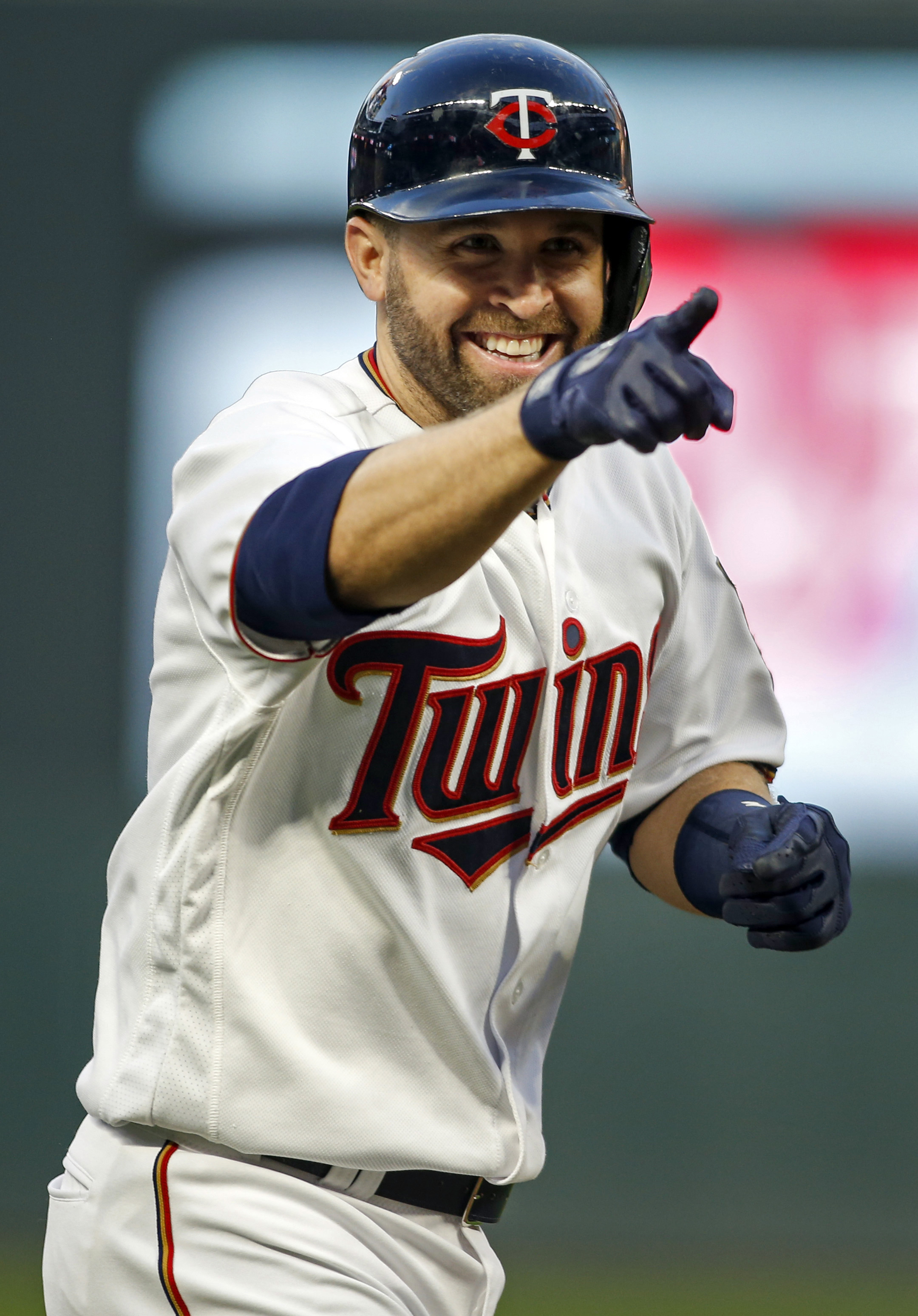
Dozier’s age will likely prevent the Twins from wanting to offer an especially lengthy commitment, but Minnesota should at least explore the possibility of retaining him. Daniel Murphy inked a three-year, $37.5MM deal beginning with his age-31 season, though Dozier’s 2016-17 production vastly outpaces Murphy’s two-year platform for that contract. Justin Turner inked a four-year, $64MM deal beginning with his age-32 season. I’d lean toward Turner as the better comp, but both could be talking points in extension discussions.
Top shortstop prospect Nick Gordon is near MLB-ready and could push Polanco to second base in the event that Dozier departs, but Dozier’s presence both on and off the field would be tough to replace.
The Twins will also have to look hard at whether they’d like to approach Buxton, Sano, Rosario, Polanco or Berrios about long-term deals, though there’s obviously quite a bit less urgency on that front; Sano, Buxton and Rosario won’t even be eligible for arbitration until next winter. Polanco and Berrios are even further out.
It’s an odd feeling to write sentences such as: “The Twins should have money to spend this offseason, and it’d be curious if they didn’t do so in a much more aggressive manner than in recent years.” But, that genuinely seems to be the case for the Twins, whose young core, pristine payroll outlook in 2020 and beyond and presence in a division rife with rebuilding clubs gives them an opportunity to reestablish their presence as an annual contender.
We’ve yet to see Falvey and Levine navigate an offseason in which the team acts as an expected contender, so it’s tough to gauge whether the club will utilize free agency or the trade market more in adding to the 2018 roster. Regardless of their preferred avenue, the 2017-18 offseason should be the most active in recent history for the Twins in terms of player acquisition.
Photo courtesy of USA Today Sports Images.
Minor MLB Transactions: 11/9/17
This week’s Minor League Transactions roundup from Baseball America’s Matt Eddy features a staggering 572 minor leaguers that have elected free agency now that the offseason is underway. While many are relative unknowns, there’s also no shortage of former big league contributors among the bunch. Justin Masterson, Jair Jurrjens, Dustin Ackley, Nick Franklin, Chris Heston, Felix Doubront, Kris Medlen, Christian Bethancourt, Anthony Gose, Christian Colon and Jose Tabata are among the many recognizable names that are now available for any club to sign. Virtually everyone on Eddy’s list that finds a new team will be inking a minor league pact, but that certainly doesn’t preclude them from delivering significant value in 2018.
Once you’re done perusing that list, here are the rest of the day’s minor moves from around baseball…
- The Rays have re-signed southpaw Adam Kolarek to a minor league pact and invited him to Spring Training, tweets Marc Topkin of the Tampa Bay Times. The 28-year-old Kolarek (29 in January) made his MLB debut with the Rays last season and wound up yielding six runs in 8 1/3 innings at the Major League level. Kolarek turned in a sensational 1.65 ERA with 9.5 K/9, 3.3 BB/9 and a ludicrous 72.6 percent ground-ball rate in 43 1/3 innings at the Triple-A level, however. The soft-tosser averaged just 88.1 mph on his heater in his brief big league sample of work, but his strikeout rate and otherworldly ground-ball tendencies in Triple-A make him an intriguing depth option next season.
- Former big league righties Joe Wieland and Spencer Patton are set to return to the Yokohama DeNa BayStars of the Japan’s Nippon Professional Baseball, per a report from the Kyodo News. Each is signing a one-year deal to return for his second season in NPB. The 27-year-old Wieland turned in an excellent 2.98 ERA with 7.5 K/9 against 2.5 BB/9 in 133 innings (21 starts) with the BayStars in 2016. He’s previously seen MLB time in parts of four seasons, totaling 52 2/3 innings between the Padres, Dodgers and Mariners. Patton, 30 in February, pitched 60 innings with a 2.75 ERA, 9.9 K/9 and 2.9 BB/9 in his first NPB campaign. Patton previously tossed 54 2/3 innings between the Rangers and Cubs from 2014-16.
Free Agent Rumors: Holland, Bruce, LoMo, Hosmer, Morrow, Ichiro
Though Greg Holland turned down his $15MM player option and will also reject his $17.4MM qualifying offer, it’s not yet a foregone conclusion that his Denver days are in the past, writes FanRag’s Jon Heyman. The Rockies “believe that Holland is the right leader” for their young pitching staff and will seek to re-sign him to a more lucrative multi-year offer, per Heyman. They will, of course, face a fair bit of competition in that pursuit. Heyman lists the Cubs and Cardinals as teams that will possibly be in the market for Holland this offseason as well.
A few more early notes on the free agent market…
- Jay Bruce‘s camp is reportedly setting its sights high and asking for a five-year deal worth $80-90MM, ESPN’s Jerry Crasnick reported yesterday. High asking price notwithstanding, Heyman reports today in his weekly notes column that the Blue Jays, Giants, Mariners and Cardinals are four potential landing spots for Bruce in free agency. Heyman notes that Bruce should be able to comfortably land a three-year commitment that could price him out of the comfort zones of the Mets and the Indians.
- Free agent first baseman Logan Morrison told Jon Morosi and Jim Duquette in an appearance on MLB Network Radio on SiriusXM today that playing for his hometown Royals “would be a dream come true.” (Twitter link, with audio) Morrison fondly recalls trips to Kauffman Stadium with his father as a child and says it would be “amazing” to be able to have his grandmother come to the park and watch him play regularly in 2018. “All of that stuff would be fun,” said Morrison, “but we’ll see what happens.” The 30-year-old Morrison, meanwhile, hit .246/.353/.516 with a career-high 38 home runs in a breakout campaign with Tampa Bay this past season. Despite that huge year, he didn’t receive a qualifying offer from the Rays and therefore won’t be tied to draft pick compensation. Kansas City will have a void at first base if Eric Hosmer leaves elsewhere, though Heyman notes in the aforementioned notes column that Hosmer is still the Royals’ top priority (at least among their own impending free agents). If he signs elsewhere, the Royals would recoup a draft pick — likely at the end of the first round.
- Right-hander Brandon Morrow also appeared on MLB Network Radio today, stating that “all things being equal,” he’d prefer to return to the Dodgers (Twitter link, with audio). Morrow specified that at age 33, he’d prefer to sign with a contending team, noting that he doesn’t necessarily care about pitching as a closer versus pitching in a setup capacity. Morrow raved about the young talent and clubhouse on the Dodgers, noting that the team is poised to be a contender for years to come — a highly appealing factor to him (and other free agents). Though perhaps we shouldn’t read too much into his comments, Morrow did note that “to be able to hopefully in that for three to four years … it’s definitely an attractive situation.” Morrow does indeed seem to have a strong case for a multi-year deal after a return to prominence in L.A. this past season. We pegged him for a three-year, $24MM contract on last week’s ranking of the game’s top 50 free agents.
- Susan Slusser of the San Francisco Chronicle reports that Ichiro Suzuki‘s agent, John Boggs, has already reached out to the Athletics to try to pitch his client’s services. Slusser the chat between the two sides as “brief,” noting that it was based on Ichiro’s relationship with A’s manager Bob Melvin, who managed Ichiro more than a decade ago. There does not appear to be a fit, she notes, though Boggs tells Slusser that Ichiro “has the ultimate desire to play” in 2018. Heyman noted in the aforementioned notes column that the Marlins did not make an offer to the 44-year-old Ichiro before declining his $2MM option.
MLBTR Chat Transcript: Stanton, Shaw, Pearce, Bruce, More
Click here to read a transcript of today’s chat with host Jeff Todd.
Nationals Add Derek Lilliquist, Tim Bogar To Coaching Staff
The Nationals announced on Thursday that they’ve hired longtime Cardinals pitching coach Derek Lilliquist to fill that same role on their staff under new manager Dave Martinez. The Nats also hired Tim Bogar, who was most recently the Mariners’ bench coach, as their new first base coach. The has also confirmed its previously reported hiring of Chip Hale (bench coach) and Kevin Long (hitting coach), and announced that Joe Dillon will be the new assistant hitting coach to Long. Bobby Henley is back with the team as the third base coach.
The 51-year-old Lilliquist was dismissed as the Cardinals’ pitching coach at season’s end. St. Louis ultimately chose to replace him with former Nats pitching coach Mike Maddux, meaning the two clubs have effectively swapped their 2016 pitching coaches. Lilliquist spent more than a decade and a half with the Cardinals organization, including the past six years as their pitching coach and the two years prior to that as the bullpen coach.
Bogar, also 51, joins the Nats after a long run in the American League West. A bench coach with the Rangers in 2014, Bogar joined the Angels’ front office as a special advisor in 2015 and jumped to the Mariners organization the following year when Jerry Dipoto (with whom he worked in Anaheim) was named GM in Seattle. With the Mariners, Bogar spent two seasons as the bench coach. He’ll bring another experienced coach to the staff as well as one that is quite familiar with analytics due to his close working relationship with Dipoto. He’s also coached on the Red Sox’ staff in the past.
The 42-year-old Dillon was the Nationals’ hitting coach with Triple-A Syracuse in 2014-15 but has spent the past two seasons as a minor league hitting coordinator in the division-rival Marlins organization.
Ken Rosenthal of The Athletic first tweeted the news that Bogar had been hired. Chelsea Janes of the Washington Post first reported Lilliquist had been hired (also via Twitter).
Assessing The Trade Market For Giancarlo Stanton
Giancarlo Stanton was a star before 2017, but he elevated his profile even further with a huge campaign. As was just announced, the burly slugger is among the three finalists for the National League’s Most Valuable Player Award after a season in which he fell just shy of the 60 home run threshold.
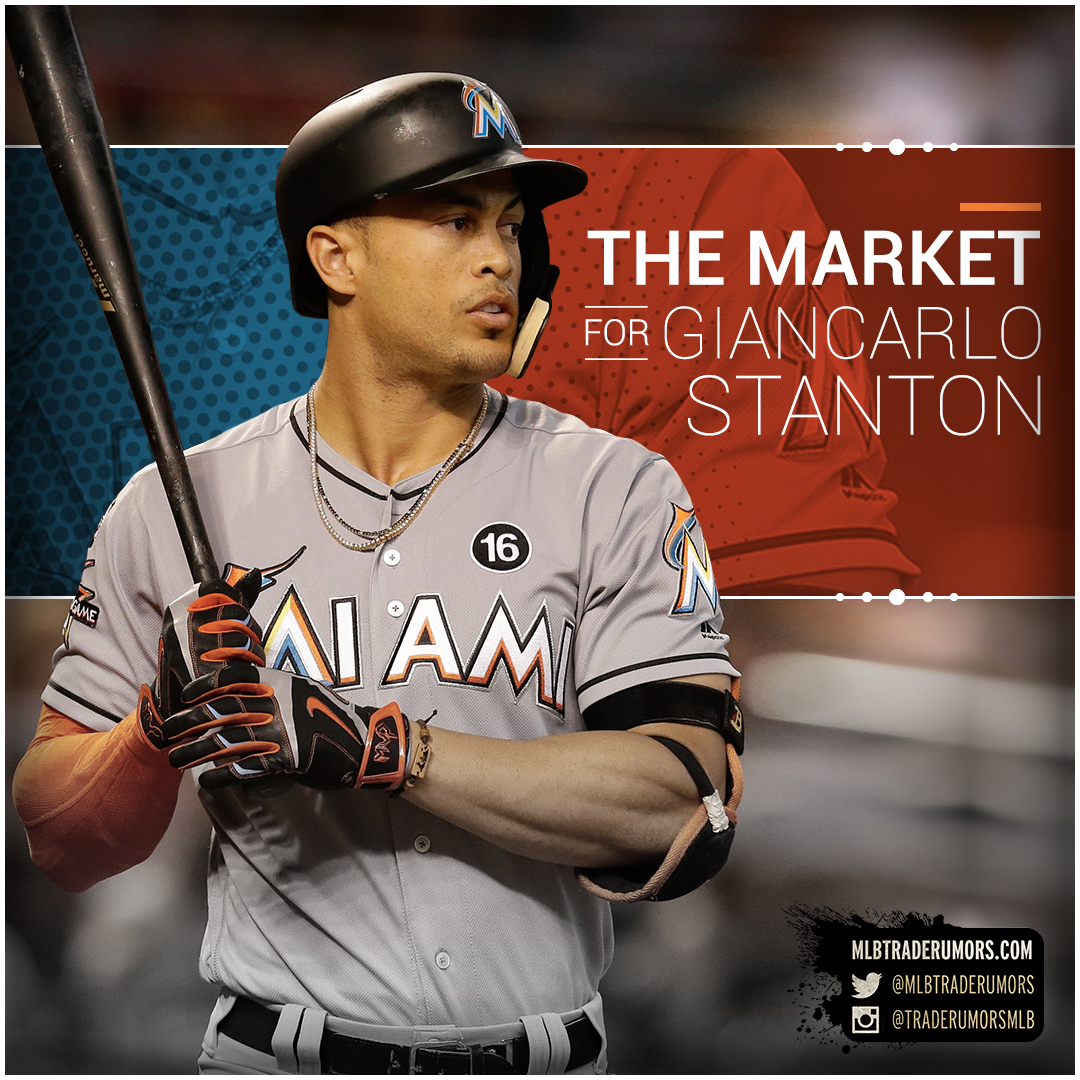
On the whole, Stanton’s 2017 performance — a .281/.376/.631 slash and 156 wRC+ — wasn’t actually all that different from his prior high-water marks in 2012, 2014, and 2015 (by measure of wRC+). It’s promising that he was able to post a personal-low 23.6% strikeout rate while swatting 59 long balls and a .350 ISO. On the other hand, it also seems a bit unlikely that Stanton will sustain a monster 34.3% HR/FB rate and his lofty 16.9% infield fly rate is perhaps cause for some concern. What’s most important, though, is that he was able to demonstrate that an injury-plagued 2016 was mostly a blip.
Stanton, clearly, is among the game’s best hitters. Unlike some other top sluggers, he’s also a quality fielder, making him a legitimate organizational centerpiece. He also just marked his 28th birthday. That relative youth is particularly important given his checkered injury history. Stanton’s 159 games played in 2017 not only sets a personal high, but represents only the third season in which he has appeared in more than 123 contests. While the looming Stanton is a paragon of fitness, and does not have a specific health issue of particular concern, he’s also a very large man who could face some challenges as he ages.
If Stanton was a free agent, he’d unquestionably be the top player available. How much might he get? That’s debatable, but $295MM — the amount left on his contract — isn’t a terrible guess. Opt-outs are de rigueur these days, so Stanton’s post-2020 opportunity would be a reasonable addition, as would be no-trade protection.
Instead of a free-agent bidding war, though, we’ll be treated to one of the trade variety — assuming the Marlins follow through on their intentions to deal Stanton — that’ll hinge upon myriad questions. How much will the opt-out function as a deterrent? What about the availability of other quality power bats this year (J.D. Martinez) and next (Bryce Harper, et al.) in free agency? Is there surplus value in the contract? Can the Marlins get a team to give something significant up for the right to pay Stanton at roughly his market rate?
The answers to those queries will ultimately flow from the demand side. Stanton’s own preferences, of course, represent a critical — and largely unknown — factor. He’ll have to be involved given his veto power. Stanton is from the west coast, though the strength of the geographic pull isn’t entirely clear. All that’s really clear at this point is that he has a strong desire to avoid a rebuilding situation. Let’s take a look, then, at which rival organizations might show interest, and how strong that interest might be:
Best Matches (alphabetical order)
Cardinals
[Depth Chart – Payroll]
- Why it works: The Cards’ need for a big bat is probably overstated — after all, the team was right at league average in hitting last year — but the team clearly wants to add pop. More importantly, St. Louis has a broad base of talent at or near the MLB level, but perhaps lacks sufficient premium players on its roster. Swapping out some of that affordable depth for higher-quality players holds obvious appeal, and the Cardinals are even said to be willing to dangle quality young pitching talent. St. Louis also has excess young outfield talent to work with. That would unquestionably hold appeal to Miami, though indications are that the Cards would also be looking for some cost savings on Stanton’s contract if its top young arms are in play.
- Why it doesn’t: Stanton wouldn’t bust the Cardinals’ payroll, but he’d come close. The team has not gone north of $150MM to start a season yet, and already has $116MM allotted to salaries for 2018 entering the offseason. Perhaps that payroll line could go up, but it’s notable that the early chatter already involves considerations of financial tweaks that may not be to the Marlins’ liking. After all, the Fish are already swallowing hard to consider trading such a star player, and are motivated to do so primarily by payroll pressures.
- Outlook: The Cards will surely take a long look at Stanton, though they’ll no doubt also be looking into the Marlins’ two other talented outfielders, Marcell Ozuna and Christian Yelich. There are plenty of imaginable scenarios that make decent sense on paper between these organizations, but getting something done will require a lot of careful balancing.
Dodgers
[Depth Chart – Payroll]
- Why it works: If you just look at positional openings and payroll, this feels like an obvious fit. The Dodgers’ best outfielders last year — Chris Taylor and Cody Bellinger — are both infielders by training, and at least one is likely to return there for 2018. Yasiel Puig is one year away from free agency. While there are a variety of other quality options — including Joc Pederson, Enrique Hernandez, a rehabbing Andrew Toles, and top prospect Alex Verdugo — the Dodgers could easily stand to plug in a superstar. Arguably, they should, after coming up one game shy of an elusive World Series title. Sure, the team has a lot committed to payroll already in 2018, but it can probably afford more, and the books are fairly clear in the future. If the team previously had interest in Ryan Braun, why not now go after a better and younger option in Stanton?
- Why it doesn’t: It hardly needs to be said, but these aren’t your older sibling’s pre-Friedman Dodgers. This is an organization that has focused, first and foremost, on bringing in and developing amateur talent (Puig, Bellinger, Corey Seager, etc.) while finding and polishing diamonds in the rough at the MLB level (Taylor, Justin Turner, etc.). The administration has paid in dollars and prospects in some circumstances, such as for international amateur talent, somewhat risky veteran starting pitching, veteran bench pieces, retention of stars (Turner, Kenley Jansen), and mid-season rental acquisitions. A splashy outside acquisition, though, would be new territory. There’s a reason, too, beyond the thrill of finding value in hard-to-find places. While the Dodgers can out-spend most organizations, that doesn’t mean they prefer to from a business perspective. Creating a sustainable, annual contender also means avoiding cycles of contractual inefficiencies, and the club needs to consider a future in which Clayton Kershaw and others will command massive new contracts to remain in place.
- Outlook: Los Angeles probably won’t over-extend itself unless it really feels Stanton is a critical piece of the puzzle. But if the Dodgers do think that plugging in an everyday star in the corner outfield is the way to go, they’d likely be the odds-on favorite to make a deal.
Red Sox
[Depth Chart – Payroll]
- Why it works: Boston president of baseball operations Dave Dombrowski is no stranger to swinging big deals and the Sox offense was out-homered by all but three teams last year. Cost isn’t much of an impediment, as the team has now re-set its luxury tax level and has a payroll capacity likely exceeded by only two other teams. While adding Stanton would likely mean going on to trade rangy center fielder Jackie Bradley Jr. to create space, that’s essentially the scenario we posited in predicting that Boston would land top free agent slugger J.D. Martinez. Bradley, certainly, would also be quite an attractive trade piece that would allow the organization to address another need. (Three-team scenarios are especially fun to ponder.) In the long run, Stanton could find a soft landing at DH.
- Why it doesn’t: The Red Sox’ payroll isn’t limitless — it actually has never topped $200MM to open a season — and the club already has some risky long-term commitments. Plus, in the mid-term the pitching staff is arguably the greater concern, as several top arms will hit the open market over the coming years. Bradley is no slouch; he’s younger and cheaper than Stanton and handily outperformed him in a 5-WAR season in 2016. Perhaps re-arranging the deck chairs in this manner isn’t the most efficient way to improve in the near term and isn’t worth the long-term risk. The club might find it easier simply to acquire a shiny new first baseman, with Jose Abreu representing a particularly interesting trade candidate. And the Sox aren’t exactly overflowing with expendable, quality young players at or near the majors in the way that the Cardinals are; that doesn’t preclude a deal, but makes it a bit more difficult to see how the sides would line up if there’s competition in the market.
- Outlook: Getting Stanton would make for something of a classic Dombrowski move, but it’s not a perfect fit. Boston has other options for adding the power it desires, though it also must be considered one of the chief possibilities until we hear otherwise.
Other Possibilities (alphabetical order)
Astros
[Depth Chart – Payroll]
- Why it works: The Astros, you may have heard, are fresh off of a World Series victory. Staying at the top of the hill, though, means always looking for the next opportunity. The team has a fair bit of money committed to its 2017 payroll, but relatively little beyond it. And it’s easy to imagine freeing some added salary by non-tendering or trading players such as Evan Gattis and Mike Fiers. While Marwin Gonzalez was a revelation and Josh Reddick had a strong season in the first year of his contract, the corner outfield is a clear spot for the ‘Stros to make strides. Putting Stanton’s bat in the middle of the lineup might also free the organization to dangle young players such as Derek Fisher and Kyle Tucker in a bid to add controllable, high-quality pitching. This is the sort of move that could represent an appropriate tradeoff given the fact that the team is obviously at or near a high point of MLB talent. And we do know there has been some past interest on Houston’s behalf.
- Why it doesn’t: Houston had the game’s best offense, by a wide margin, in 2017. So this isn’t really a target area, particularly with Fisher, Tucker, and others on the rise. It’s arguable that the Houston front office would be wiser to target shorter-term role players that fit in with the current roster core, rather than taking some risky gambit at adding another central piece. Pitching, though, can always be improved; the Astros could instead look to spend their money to pursue a quality starter, top-end closer, and/or bullpen depth. Plus, we don’t really know how high the payroll can go. And the future money would remove resources that might be used if the team tries to strike long-term deals with current stars such as George Springer, Carlos Correa, Jose Altuve, and Dallas Keuchel.
- Outlook: Once the confetti is swept up, the Astros will be left facing a tough but enviable question of how to build upon the success. Stanton will have to be a name that’s at least considered, but it’s anybody’s guess whether he’s seriously pursued.
Blue Jays
[Depth Chart – Payroll]
- Why it works: If you look past the current season, the Blue Jays have loads of free payroll. With Edwin Encarnacion gone and Jose Bautista on his way back to free agency, there’s a need for a slugging corner outfielder. The Jays did make a fairly significant offer to Encarnacion early last winter, so there’s some willingness to commit cash to a power bat. Adding Stanton would give the team a major lineup threat to pair with Josh Donaldson for 2018 and replace him if he departs via free agency next winter.
- Why it doesn’t: The Toronto balance sheet isn’t quite as favorable for 2018 as it is beyond. And GM Ross Atkins and president Mark Shapiro haven’t yet taken on or handed out a major, long-term deal since taking over the front office in 2016. Indeed, they allowed Encarnacion to depart and did not extend Bautista before he hit free agency (though he ultimately returned). The biggest barrier here, though, is probably Stanton’s no-trade rights. We have no way of knowing whether he’d be inclined to go to Toronto, but the tax implications for his contract could make it a much harder sell. (Analyses reach different conclusions, and this point is perhaps generally overstated, but it seems that highly compensated athletes in Canada should expect to pay at least as much or more than they would in any U.S. state. Estimates from the major Jays-Marlins trade of 2012 suggest a significant financial difference between playing in Canada and Florida.)
- Outlook: These organizations have a history of swapping major contracts, but Stanton will call the shots here. If he is truly willing to go north, and the Jays are open to considering that kind of contract, then they make as good a fit as any team.
Braves
[Depth Chart – Payroll]
- Why it works: Atlanta is looking to a future in which aging corner outfielders Nick Markakis and Matt Kemp are replaced by top youngster Ronald Acuna and … a player to be determined. Plugging Stanton into the mix would be an emphatic move to boost the club into contention and settle a long-term need. He and Acuna, surely, would be quite pleasing additions to a lineup rooted by Freddie Freeman. And the Braves are overflowing with the kind of pitching talent that the Marlins so desperately need. After opening a new park in 2017, perhaps the Braves could consider trying to keep the good times rolling by stunning the baseball world with a Stanton deal.
- Why it doesn’t: The Braves’ ownership group, Liberty Media, may or may not be willing to boost payroll, but it surely won’t operate the way a megarich individual owner would — in some cases, at least, throwing profits to the wind in the hunt for a title. That makes a Stanton-level commitment feel steep for this organization. And then there’s the front office uncertainty. At this point, it’s unclear who’ll be running the show and what kind of advisers will be around to dole out opinions. Pulling off a move of this magnitude in this particular winter may be asking too much. Beyond all that, patience is often a virtue in a rebuilding effort; the organization may be better served by waiting to see how its internal assets develop before committing to a major outside move. And the team would need to convince Stanton that it’s ready to contend.
- Outlook: If the Marlins decide to push for a Stanton deal early in the offseason, it’s tough to see the Braves as a plausible suitor. But perhaps if the process drags out, Atlanta could get involved.
Cubs
[Depth Chart – Payroll]
- Why it works: Chicago is a big-market team with a mandate to win, which gets you much of the way to understanding why this can’t be ruled out. The Cubs have room to spend and are far from settled in the outfield corners, where Kyle Schwarber, Jason Heyward, Ben Zobrist, and Ian Happ are all imperfect options. While the big need is pitching, Chicago could conceivably strike a deal for Stanton, then spin off a few other assets to land the rotation and pen help that’s lacking. Since Zobrist and Happ can play in the outfield or at second base, there are plenty of ways the pieces could be shuffled to make it all work.
- Why it doesn’t: To some extent, Heyward already represents the team’s big move in the outfield. That he hasn’t worked out as hoped represents a major problem for the organization and could preclude another big bet on a younger, high-end outfielder. There are only so many huge salaries a given team can carry, after all, and Chicago needs to keep some powder dry to accommodate pitching additions, allow for contingencies, and eventually, perhaps, enable the organization to retain still-cheap stars Anthony Rizzo, Kris Bryant, and Willson Contreras. Plus, the Cubs have already moved most of the upper-level talent they are willing to trade, making it tough to structure a deal that would appeal to Miami.
- Outlook: This would be a more plausible scenario were it not for Heyward’s contract. As it stands, it’s hardly an impossibility, but doesn’t seem like the best match.
Giants
[Depth Chart – Payroll]
- Why it works: Lots of chatter has linked the Giants to Stanton, who is just the type of player they want to add. With a notable power outage in 2017, Stanton would provide an immediate upgrade. He’s capable of fielding the spacious outfield in AT&T Park, too. For an organization that is in need of some excitement, a big move for the game’s best-known slugger would surely do it. And unlike many big free agent moves, adding Stanton wouldn’t mean parting with draft picks and international money — a particular consideration given the Giants’ excellent amateur position next summer.
- Why it doesn’t: Frankly, it’s still not entirely clear how the San Francisco organization is going to proceed with a tricky offseason. The team’s future balance sheets are riddled with questionable commitments to older, often injury-plagued players. Adding a commitment of this magnitude just feels awfully dangerous and would almost certainly mean another year of luxury tax payments. Plus, the Giants would really prefer to add a new center fielder, while mostly relying upon Hunter Pence and Denard Span in the corners. That’s not going to dictate a decision on Stanton, but will factor into the calculus. The team has to be looking to improve in other areas, too, and making this kind of blockbuster might limit the more budget-friendly means of getting better. Then there’s the matter of the return; what pieces would work to make a match with Miami?
- Outlook: This may well be the move the Giants want to make. But it would take quite a leap of faith to do it, and it’s frankly difficult to imagine that taking place.
Mariners
[Depth Chart – Payroll]
- Why it works: The M’s have found themselves within six games of .500 (in either direction) in each of the past four seasons. Breaking out of that magnetic field of mediocrity could require a bold move. While GM Jerry Dipoto’s many trades have focused mostly on enhancing the team’s youth and control rather than on taking shots on veteran players, perhaps those efforts make it plausible to imagine the addition of another major salary. With Nelson Cruz entering his walk season and two more years left on Felix Hernandez‘s contract, two of the club’s bigger payroll slots will be opening — and there’ll be a need to fill in for Cruz’s power production. The corner outfield would certainly be a nice spot to target for a power bat, as Seattle could utilize Mitch Haniger in center with Ben Gamel and Guillermo Heredia sharing left field and spelling the others.
- Why it doesn’t: In the near term, Seattle may not have much room to spend. The club opened last year with a club-record $154MM payroll and is already pushing that tally before filling out a 2018 roster. In the long run, the team owes Robinson Cano $24MM annually through 2023. It’s worth remembering, too, that #HelloCano hasn’t quite panned out as hoped; while he has mostly played at a high level, it wasn’t enough to put the M’s over the top. In any event, there’s a bigger hole at first base, where the club could hope to find a highly productive bat at a much lower cost. There’s an argument to be made that the team’s rotation should be targeted if there’s to be a bold investment. And the Mariners surely won’t be interested in parting with the controllable pitching that the Marlins will likely seek in a deal — to the extent it can even be said that they possess it in the first place.
- Outlook: The Mariners have been incredibly active on the trade market under Dipoto, but haven’t pursued prospects-for-stars deals of this type. While that could always change, a bold move for Stanton doesn’t feel like it fits the m.o. of this iteration of the organization’s leadership.
Nationals
[Depth Chart – Payroll]
- Why it works: As with the Yanks, there’s no hole that needs to be filled, but there are arguments for doing it anyway. In this case, upon landing Stanton, the Nats would presumably keep Adam Eaton in center field while utilizing Michael Taylor as a quality fourth outfielder (or, instead, as part of this trade or in another). While the DH angle isn’t available here, the addition of Stanton would function to give the team a ready replacement for Bryce Harper, who’s entering his final season of control. And the Nats don’t really have many glaring needs that are susceptible of being addressed anyway, leaving the team free this winter to act in an opportunistic way to make good on an ownership mandate to win a World Series.
- Why it doesn’t: While the Nats’ long-term commitments aren’t too great in total, they mostly reflect two major obligations to veteran starters (Stephen Strasburg and Max Scherzer). It could be too risky to add another premium salary. And if the team is going to do so, perhaps it first ought to exhaust every possibility of making a deal with Harper, who is a homegrown star and a younger player — even if he may prefer to seek a gobstopping deal on the open market. (Daniel Murphy and Anthony Rendon are also nearing their own free agencies; the latter, in particular, seems to be an extension candidate — and one that won’t be cheap.) Regardless of the long-term outlook, adding Stanton would mean blowing past the luxury tax line and all prior payroll highpoints for 2018. The Lerner family has deep enough pockets to do that, but it would be a big step for an organization that has already reached new spending heights in recent years. Top prospect Victor Robles is also a factor; while he could coexist with Stanton and Eaton in a hypothetical post-Harper outfield, his presence (and perhaps also that of fellow young outfielder Juan Soto) arguably reduces the need to take this kind of drastic action.
- Outlook: Again, you can see an avenue to a fit, but it’s far from a slam dunk. The fact that the Nats share a division with the Marlins may complicate things a bit, too, since the incoming ownership group will no doubt be sensitive to its fans watching Stanton launch bombs in Marlins Park in a different uniform.
Phillies
[Depth Chart – Payroll]
- Why it works: Don’t sleep on the Phillies, because they may be nearing an awakening. Let’s focus less on the solid second-half record than on the pieces this organization has compiled. With Rhys Hoskins showing himself to be a fearsome young slugger, J.P. Crawford reaching the majors, and Aaron Nola pitching like an ace, quite a lot of the team’s best young talent is now at or near the majors. The club had established itself as one of the league’s biggest spenders before reaching a new TV deal that locked in big money for decades to come, and the future payroll is virtually devoid of commitments. If GM Matt Klentak and President Andy MacPhail decide it’s time to ramp things up and land a superstar, the reasonably youthful Stanton is a nice target. And the team has quite a few solid young players that could be sent to Miami in return; like the Cardinals, the upper-level depth situation seems favorable to aiding the Fish in what will be a tough transition.
- Why it doesn’t: The Phillies have practiced their pitch on fans, but they’ll need it to convince Stanton that they are ready to win. After all, the club was significantly worse than the Marlins last year. But should they even bother? There’s a strong case to be made that the club would be better served spending its cash on pitching assets — or, perhaps, keeping it dry to pursue yet younger premium free agents next winter. Plus, corner outfielders Nick Williams and Aaron Altherr joined Odubel Herrera to make a productive trio last year, so it would be sensible for the team to give them a longer leash.
- Outlook: There’s just somewhat less urgency for the Phillies than for the other teams listed in this grouping. While the club would no doubt like to begin competing, and would see Stanton as a near and long-term asset, there are questions whether they’d extend themselves this far, this soon, for this player.
Rangers
[Depth Chart – Payroll]
- Why it works: Texas is no stranger to significant splashes and could have a fair bit of open payroll space to work with — for 2018 and into the future. While Nomar Mazara is still viewed as the answer at one corner outfield spot, the other is unsettled. The team’s most promising offensive possibilities — expensive veteran Shin-Soo Choo, Darvish deal headliner Willie Calhoun, and all-or-nothing slugger Joey Gallo — are all best written into the lineup at first base or DH. Adding Stanton might increase the team’s desire to move on from Choo, both to avoid a logjam and to clear some of his salary, but that’s probably not going to drive any decisions here.
- Why it doesn’t: As with the Cubs, the chief need for the Rangers is pitching. And on offense, power wasn’t exactly in short supply; in fact, the club posted the third-highest homer tally in the majors. Making this kind of financial commitment for a slugger — even one as well-rounded as Stanton — would be a debatable approach with the pitching staff looking so rough. As importantly, Texas would likely be served much better by adding a center fielder if the team is going to spend on a hitter. With payroll likely to move south, there’s not a lot of free space to fit this kind of contract.
- Outlook: This isn’t a terrible fit, despite some logistical impediments, but it would be tough to make this kind of acquisition while also sufficiently improving the team’s unappealing pitching staff.
Rockies
[Depth Chart – Payroll]
- Why it works: We all would love to see Stanton driving baseballs out toward the organization’s namesake mountains, but might the Rockies really consider it? He could replace the presence and former power of Carlos Gonzalez while helping the team prepare for the eventual loss of Charlie Blackmon. The Rox finally made it back to the postseason in 2017 but are hardly guaranteed a return. While the bullpen is a need, the rotation may mostly be set, so this represents a reasonable area in which to improve. Plus, Colorado’s best prospect talent is made up of pitchers and infielders, reducing concerns over blocking the youngsters and leaving the Rox with plenty of trade chips to entice the Marlins.
- Why it doesn’t: The Rockies have never struggled to produce bats, and ought to be able to find quality short-term candidates for a reasonable rate, so perhaps there’s no real cause to make a major acquisition in the outfield. Plus, the Rockies have a less problematic version of the Heyward difficulty in Ian Desmond‘s contract. He will presumably shift to the outfield next year, for one. And he’s still owed $62MM over four years (including a 2022 option buyout) under his backloaded contract. That deal represents a bit of an impediment and a cautionary tale for an organization that is only just moving into a new payroll bracket. And supposing Miami does want to recoup some young pitching, is that really the type of asset the Rockies should be willing to part with?
- Outlook: If the Rockies are going to trade for a big hitter, Jose Abreu could make for a better fit.
Twins
[Depth Chart – Payroll]
- Why it works: The Twins raced back into contention last year and have a lot of talented younger players — as well as an unspoiled balance sheet after 2019. Eddie Rosario had a big season last year in left, but Max Kepler was not quite as exciting in right. And primary DH Robbie Grossman has been more solid than spectacular. Adding Stanton would transform the lineup, plugging in a star bat alongside Miguel Sano while reducing the roles of some of those players to the betterment of the entire lineup.
- Why it doesn’t: Again, the need for pitching suggests that’s where any big investment would and should go. For an organization that is trying to build something sustainable, this sort of splash would constitute a monumental — and quite likely unnecessary — level of risk. The Minnesota org has never opened a season with over $113MM on its books (way back in 2011), so Stanton’s average annual salary would gobble up something on the order of a quarter of the team’s peak Opening Day payroll. As the team’s homegrown stars reach and proceed through arbitration, they’ll increasingly be expensive, and the club will no doubt also find it necessary to spend on both the rotation and the bullpen.
- Outlook: In the end, it’s just hard to make it all work. If chief baseball officer Derek Falvey is to push the pedal to the floor, it’s much more likely to happen with the pitching staff.
Yankees
[Depth Chart – Payroll]
- Why it works: Some might say that the emergence of Aaron Judge precludes the need for Stanton; for others, perhaps recalling the addition of A-Rod to an infield already featuring Jeter, it’s all the more tantalizing to consider a lineup that features both otherworldly sluggers. Strictly speaking, New York doesn’t need to do this. But it can, especially if the team opens a roster spot and clears some payroll by shipping out Jacoby Ellsbury. Aaron Hicks and Brett Gardner would still fit quite comfortably, allowing the organization to rotate players through the DH slot to keep everyone fresh. And it should not be forgotten that the Yankees have a lot of open future payroll space.
- Why it doesn’t: The organization is trying to dip under the luxury tax line to reset its tax rate. While it’s possible to do that while adding Stanton, there wouldn’t be much room for other additions (or, rather, for mid-season acquisitions). It’s plenty arguable that, if the organization is going to take on a major commitment, the better risk would be on a premium starter. Even if resources will go to the lineup, the infield could be upgraded in several ways and/or the team could plug a bat-only player into the DH slot for a much lower price. And then there’s the question whether the Yanks would rather wait to make a run at Bryce Harper, Manny Machado, or another big-time free agent next winter, once the luxury tax limbo has been accomplished.
- Outlook: GM Brian Cashman and owner Hal Steinbrenner have legitimately changed how things run in New York. As with the Dodgers, though, that only makes for a more fearsome market presence. It’s far from clear that a big move for Stanton is the right play, but it’s not out of the question.
Which Draft Picks Each Team Would Lose By Signing A Qualified Free Agent
Jake Arrieta, Wade Davis, Lance Lynn, Eric Hosmer, Mike Moustakas, Lorenzo Cain, Alex Cobb, Greg Holland, and Carlos Santana received one-year, $17.4MM qualifying offers from their teams earlier this week. If those players sign elsewhere, here’s a look at the draft picks the signing team would lose.
Competitive Balance Tax Payors: Tigers, Dodgers, Yankees, Giants, Nationals
If one of these teams signs a qualified free agent, it must forfeit its second-highest and fifth-highest pick in the 2018 draft. The team will also have its international signing bonus pool reduced by $1MM. The Tigers are highly unlikely to sign one of the nine players listed above, but the other four teams might. The Giants’ second-highest pick will fall somewhere in the 30s overall, so they stand to lose the most if they sign a qualified free agent.
Non-Disqualified Revenue Sharing Payees: Diamondbacks, Braves, Orioles, Reds, Indians, Rockies, Astros, Royals, Marlins, Brewers, Twins, Athletics, Pirates, Padres, Mariners, Rays
These 16 teams received revenue sharing and did not exceed the competitive balance tax. If one of these teams signs a qualified free agent, it forfeits its third-highest pick. These teams face the smallest draft pick penalty.
All Other Clubs: Red Sox, Cubs, White Sox, Angels, Mets, Phillies, Cardinals, Rangers, Blue Jays
These nine remaining teams would forfeit their second-highest pick and and have their international signing bonus pool reduced by $500K. The penalty is something of a middle ground, but it would sting for a team like the Phillies to sacrifice a pick in the 30s.
What happens if a team signs two of these nine free agents? The CBA calls for forfeiture of the next highest available draft pick. For example, if a team has already lost its second and fifth-highest picks and it signs a second qualified free agent, it would lose its third and sixth-highest picks. So as in the past, if you’ve already signed one qualified free agent, the draft pick cost to sign another is reduced.
RELATED: Examining Draft Pick Compensation For The 6 Teams That Could Lose Qualified Free Agents
Cubs To Hire Brandon Hyde As Bench Coach
The Cubs have decided to hire Brandon Hyde as their new bench coach, according to Ken Rosenthal of The Athletic (via Twitter). Chicago found itself in need when Dave Martinez departed to manage the Nationals.
Hyde, 44, is certainly a familiar face for the Cubs. He most recently served on skipper Joe Maddon’s staff as first base coach. Before that, Hyde was the bench coach under prior manager Rick Renteria and also coached for the Marlins earlier in his career.