
NL Central Notes: Cubs, Pirates, Brewers, Reds
No team will fret over having too much in the way of talent, but Phil Rogers of MLB.com wonders if the Cubs‘ depth could stifle the growth of Javier Baez and Jorge Soler. In the case of Baez, manager Joe Maddon believes that he can get enough work in as a utility player. Overall, Maddon is grateful to have such strong insurance against injuries.
“It’s obvious just by making the daily lineups now,” he said on Sunday. “When you give guys a day off playing but the team that goes to play that day is pretty thick still. That’s what has hit home with me. … The depth is really intriguing. You need that to be successful during the course of a long season. You’re going to have things happen. No question.”
Here’s more out of the NL Central:
- Stephen J. Nesbitt of the Pittsburgh Post-Gazette took on the tough task of predicting the Pirates‘ Opening Day roster. His projections do not include outfielder Matt Joyce, who was brought in on a minor-league deal this offseason. Nesbitt’s writes that his projections could be thrown off by a few factors, including the possibility that Michael Morse is moved in anticipation of Jung Ho Kang’s return.
- Brewers left-hander Sean Nolin won’t be ready for Opening Day and that could have roster implications for Milwaukee, as Tom Haudricourt of the Journal-Sentinel writes. As Nolin deals with his elbow issue, only two lefties – Chris Capuano and Franklin Morales – are left vying for spots and both were brought in on minor league deals. Those two southpaws plus reliever Blaine Boyer have opt out clauses in their contracts that could spring them from their deals before Opening Day.
- Nolin is out-of-options, but his elbow issue likely will buy the Brewers time in making a decision on him, Haudricourt tweets. Nolin is likely destined for the DL.
- J.J. Hoover is likely to be the Reds‘ closer and manager Bryan Price says he would “definitely” be the choice if the season started now, Mark Sheldon of MLB.com writes. Hoover, who won his arbitration case against the Reds this offseason, could help his arb case next offseason if he can rack up saves.
Red Sox Notes: Sandoval, Shaw, Dombrowski
The Red Sox aren’t “actively looking” for pitching help, president of baseball operations Dave Dombrowski tells Ken Rosenthal of FOX Sports.
“Can you always be better? Sure. Will we always be open-minded? Sure. But we’re not actively looking for pitching,” said Dombrowski, who added that he doesn’t “even know where” he would slot a No. 2 starter type.
Here’s more out of the AL East:
- The fact that there is a real competition between Travis Shaw and Pablo Sandoval at third base is a reminder of exactly how Dombrowski runs the Red Sox and how much control he exerts over the team, Michael Silverman of The Boston Herald writes. For his part, Sandoval is trying to play down the attention that the brewing competition is getting. “Every day is a competition — every single day, every moment. Every guy competes to be better and better,” Sandoval said. “I don’t know why you guys make a big deal. Every guy is here working hard to make the team look better, win games. Every guy here is working together to be better and better, so that’s good.”
- Peter Abraham of The Boston Globe laid out the pros and cons of benching Sandoval in favor of Shaw. On one hand, putting Sandoval on the bench would send a clear message to players like Rick Porcello, Hanley Ramirez, and Rusney Castillo that a high-priced contract does not guarantee your place as a starter. On the other hand, Sandoval is the type of player that needs support to succeed rather than negativity. Also, Sandoval probably wouldn’t be much of a contributor off the bench and would likely be relegated to pinch-hitting against righties, Abraham writes.
- Indeed, Dombrowski says that he does not believe that contracts should dictate spots in the lineup, as Rob Bradford of WEEI.com writes. “I thought it was important, because I’m new here, that that was my philosophy, and our philosophy as an organization, that I had a chance to visit with [principal owner] John Henry and [chairman] Tom Werner and know they supported that. I thought it was important to do that. I think for good organizations, and clubs that are trying to win, you need to play the best guys to win,” Dombrowski said.
- Earlier today, the Red Sox announced that reliever Carson Smith will be placed on the disabled list due to a strain of his flexor mass muscle.
Dodgers OF Andre Ethier Out 10-14 Weeks
The Dodgers announced that Andre Ethier has suffered a broken leg, as Mike DiGiovanna of the Los Angeles Times tweets. The fractured right tibia will sideline the outfielder for 10-14 weeks. Luckily, the outfielder will not require surgery.
Ethier, 34 in April, slumped to a .249/.322/.370 slash line in 2014 but rebounded in a major way in 2015. Last year, Ethier slashed .294/.366/.486 with 14 homers across 445 plate appearances, primarily as a platoon bat. After he restored his value, the Dodgers received trade interest on Ethier this winter, including some bites from the White Sox. With a crowded outfield, the Dodgers probably could have afforded to part with the two-time All-Star, but Dodgers GM Farhan Zaidi shot down that talk in February, referring to Ethier as a “really important part” of the team. Indeed, after his bounce-back campaign, the Dodgers were looking forward to seeing what Ethier’s left-handed bat could do in 2016. Now, they’ll have to wait until the summer to find out.
For his career, Ethier has a strong batting line of .286/.359/.464 across ten seasons for the Dodgers. He has two years remaining on his contract and is owed $38MM, including a modest buyout on an option for 2018. Aside from Ethier, the Dodgers have outfielders Joc Pederson, Yasiel Puig, Carl Crawford, Scott Van Slyke, Trayce Thompson, and Enrique Hernandez on the 40-man roster. Ethier’s 10-and-5 rights kick in next month, but Zaidi has publicly said that he is not concerned about that happening.
AL Central Notes: Tigers, Cespedes, Indians, Twins
Before signing Justin Upton, the Tigers were also in on free agent outfielder Yoenis Cespedes, as Jon Heyman of CBSSports.com tweets. Detroit was open to a reunion with the slugger, but they liked Upton “slightly more.” The Tigers offered Cespedes a four-year deal, but had the Upton agreement not come together, they could have potentially gone to five years, Heyman says.
Why did they prefer Upton to Cespedes? Well, in part (link), the Tigers loved Upton’s consistent demeanor and his personality. Upton also came with the endorsement of Alan Trammell and Kirk Gibson. When all was said and done, Upton agreed to a six-year, $132.75MM deal with Detroit and Cespedes stayed with the Mets on a three-year deal that will allow him to opt out after year one.
Here’s more from the AL Central:
- Some Indians fans have been critical of the team’s decision to sign Mike Napoli, Rajai Davis, Juan Uribe, and Marlon Byrd (minor league deal) to one-year pacts rather than make one high-priced free agent splash this winter. Terry Pluto of The Plain Dealer explained the Tribe’s thinking a little bit while pointing out the pitfalls of pricey multi-year deals, like the ones given to Nick Swisher and Michael Bourn. The Indians wound up committing ~$104MM to both players and recently they had to trade both veterans to try and unload a portion of that money.
- Carlos Quentin has a June 1st opt-out in his deal with the Twins, assistant GM Rob Antony tells Mike Berardino of the Pioneer Press (on Twitter). However, there’s also a “gentleman’s agreement” to cut him loose prior to that date if the team does not have big league plans for him. Quentin appeared destined for retirement before he had a change of heart during the offseason.
- Ryan Sweeney has a straight minor-league deal with no opt-out clause or right to demand his release, Antony tells Berardino (on Twitter). Sweeney sat out the 2015 season in an effort to allow his body to heal from multiple ailments. While he was out of the game, the veteran collected on the $2MM still owed to him by the Cubs.
- Outfielder Darin Mastroianni also has a straight minor-league deal with the Twins, according to Berardino (Twitter link). The assistant GM says that the 30-year-old (31 in August) didn’t even ask the club for an opt-out due to his comfort with team brass. Mastroianni signed on with Minnesota in December.
Carson Smith To Be Placed On DL
Red Sox reliever Carson Smith will be placed on the disabled list after an MRI revealed that he has suffered a strain of his flexor mass muscle, as Michael Silverman of the Boston Herald tweets. Smith is expected to pitch this year, but there is currently no timetable for his potential return.
Smith, 26, exited Monday’s game after experiencing forearm tightness just five pitches into his outing. As it turns out, that tightness was foreshadowing for a more serious issue. Fortunately, however, the pain was not the result of damage to the ulnar collateral ligament, which could have necessitated Tommy John surgery. Late last month, MLBTR contributor Bradley Woodrum delved deep into the causes of and warning signs for Tommy John surgery. In his research, Woodrum found that Smith was among the players with a slightly elevated risk of requiring TJ.
The Red Sox acquired Smith this offseason along with southpaw Roenis Elias when they traded Wade Miley and Jonathan Aro to Seattle. Smith was being counted upon for a significant late-inning role, so the Red Sox are obviously less-than-thrilled about today’s news. As Jeff outlined on Monday, there’s still plenty of late-inning depth for Boston, starting with closer Craig Kimbrel plus veterans Koji Uehara and Junichi Tazawa.
Last year marked Smith’s first full season in the majors. He took the opportunity and ran with it, recording a 2.31 ERA with 11.8 K/9 and 2.8 BB/9 across 70 innings.
MLBTR Live Chat: 3/22/16
Click here to read a transcript of today’s chat with host Jeff Todd.
Offseason In Review: Houston Astros
This is the latest entry in our Offseason in Review series. See a full index of the series here.
The Astros’ famed rebuilding process paid unexpectedly quick dividends in the form of a 2015 ALDS appearance, and they’ll enter the 2016 season with the loftiest expectations they’ve carried in years.
Major League Signings
- Tony Sipp, LHP: Three years, $18MM
- Colby Rasmus, OF: One year, $15.8MM (accepted qualifying offer)
- Doug Fister, RHP: One year, $7MM
- Total Spend: $40.8MM
Notable Minor League Signings
Trades and Claims
- Acquired RHP Ken Giles and IF Jonathan Arauz from the Phillies in exchange for RHP Mark Appel, RHP Vincent Velasquez, LHP Brett Oberholtzer, RHP Thomas Eshelman and RHP Harold Arauz
- Traded SS Jonathan Villar to the Brewers in exchange for minor league RHP Cy Sneed
- Traded SS Jed Lowrie to the Athletics in exchange for minor league RHP Brendan McCurry
- Traded C Hank Conger to the Rays in exchange for cash considerations
- Claimed RHP Danny Reynolds off waivers from the Dodgers
Extensions
- None
Notable Losses
- Scott Kazmir, Chris Carter, Chad Qualls, Oliver Perez, Brett Oberholtzer, Vincent Velazquez, Jonathan Villar, Hank Conger, Joe Thatcher, Roberto Hernandez, Samuel Deduno, L.J. Hoes, Robbie Grossman
Needs Addressed
The Astros spent a good bit of time looking at bullpen upgrades at the non-waiver trade deadline but ultimately didn’t pull the trigger on any of their rumored targets, which included Aroldis Chapman and Craig Kimbrel. GM Jeff Luhnow said in July that he sought a “flamethrower” to join a collection of relievers that already came with an eclectic collection of deliveries and velocities. Though the summer trade market didn’t see that desire come to fruition, Luhnow and his staff continued the pursuit into the offseason and were rewarded for their persistence. In acquiring Ken Giles, the Astros not only landed one of the game’s most intriguing young pen arms, but got him for the next five seasons.
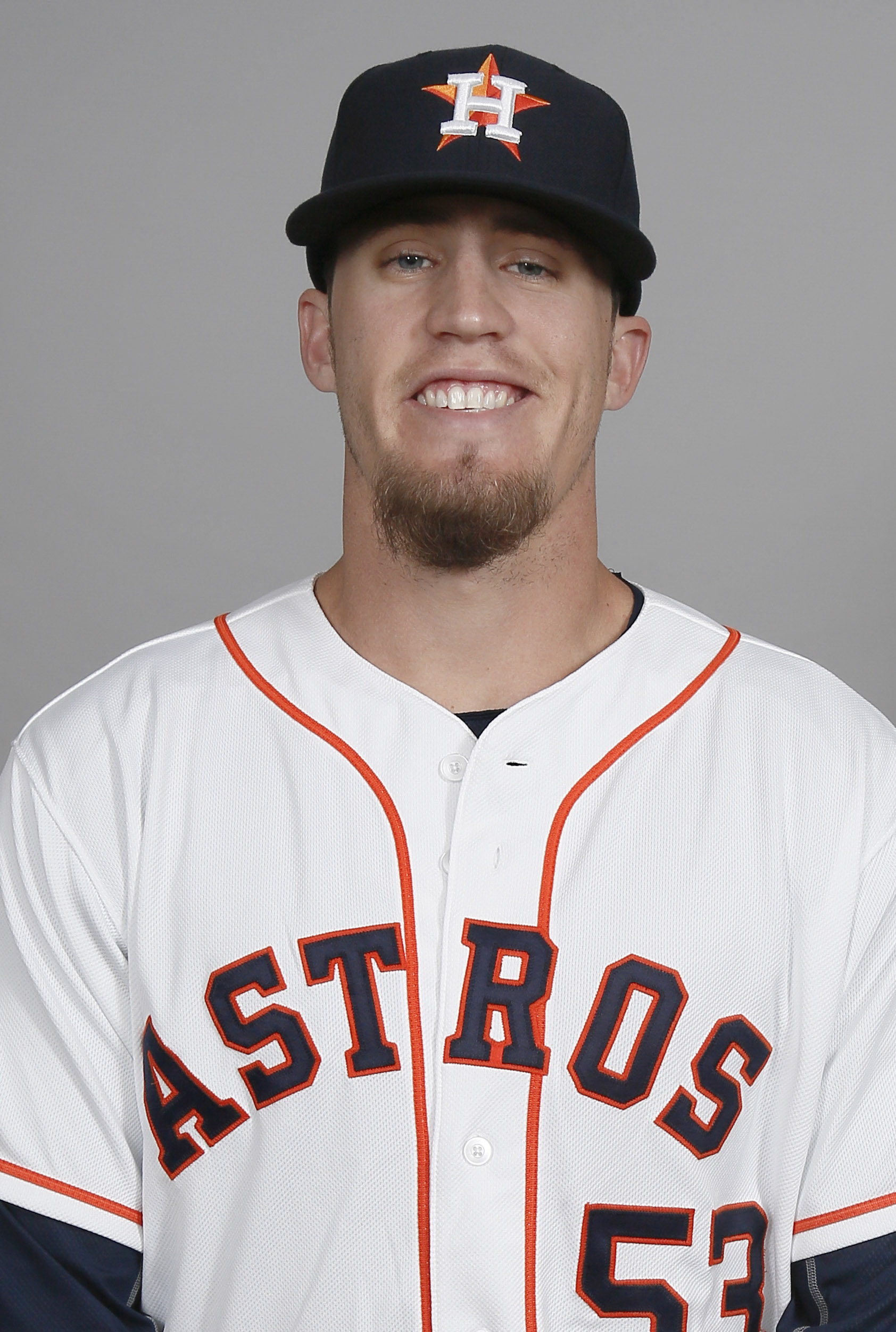
That level of control, which includes two campaigns at scarcely more than the league minimum, also dictated a steep acquisition cost. Indeed, Houston parted with five young pitchers in order to land Giles and minor league infielder Jonathan Arauz. Two of the pitchers included in the deal — Vincent Velasquez and Brett Oberholtzer — could step directly onto the Phillies’ Major League roster. Another, Mark Appel, was selected with the first overall pick in the 2013 draft. While Appel has failed to live up to the lofty expectations that accompany that draft status, his raw stuff still gives scouts hope that his numbers will eventually catch up to his talent. Eshelman joins the Phillies as a starter with elite control but a lack of overpowering pitches. It’s possible that within a couple of years, the Phillies will have a pair of starters or at least one starter and a new power arm in the bullpen as a result of the trade. The deal certainly comes with the potential for the Phils to make out with a large quantity of big league arms, but the Astros had depth in their pitching ranks and felt the need for a high-quality, late-inning arm was pressing enough to part with a wide swath of pitching talent.
Joining Giles in the ‘pen will be a returning face for the Astros; Tony Sipp hit free agency but ultimately never changed jerseys, remaining with the team where he experienced a breakout by inking a new three-year, $18MM contract. That deal proved to be the top contract given out to a left-handed reliever this offseason by a wide margin, though Sipp’s excellence against both left- and right-handed opponents over the past two seasons made him a sensible candidate for a three-year commitment from the onset of free agency. (He did, however, top MLBTR’s prediction in terms of annual value.)
By trading both Velasquez and Oberholtzer, the Astros thinned out their Major League pitching depth, leaving them somewhat exposed in the event of rotation injuries. A one-year deal for rebound candidate Doug Fister restored some of that depth, even if the signing essentially pushed Scott Feldman into the role of an $8MM swingman. (Mike Fiers could also float between the rotation and the pen as need and performance dictate.) Fister’s velocity plummeted last season, and his strikeout rate went with it, so there’s very legitimate cause to be concerned that he might never rebound to the form he showed with the Tigers. However, considering the relatively modest price paid to bring the veteran into the fold, the Astros had every reason to take a chance on some degree of resurgence.
The acquisition of Fister may have been made possible by the fact that the Astros were able to jettison the remainder of Lowrie’s three-year contract in that trade with the Athletics. Houston may have been more financially limited than it had hoped entering the offseason due to Colby Rasmus’ acceptance of the qualifying offer, but shedding Lowrie’s $7.5MM salary for the 2016 season and the $6.5MM he’s owed in 2017 (plus a $1MM buyout on a 2018 option) was a well-executed move on Houston’s behalf; Carlos Correa immediately established himself as a superstar with Lowrie sidelined last year, and with Marwin Gonzalez and Luis Valbuena on the roster, the Astros had affordable infield depth that made Lowrie somewhat superfluous.
Continue reading after the page break for more analysis …
NL East Notes: TJ, Wright, Marlins, Nats, Chacin
In a piece for ESPN The Magazine, Sam Miller speaks with Scott Boras about pitching injuries — focusing, particularly, on several key NL East former TJ patients who are repped by the super agent. It’s an interesting piece, and I recommend you give it a full read. Boras says that his sometimes rather public discussion of the care of arms is “not an authority-driven exercise,” but rather “an education exercise” designed to draw attention to the issue. He explains that he hopes only to help ensure that all involved — including teams and, especially, his players — are able to “make an informed decision” for themselves. As Miller notes, that was precisely the purpose of the recent Tommy John study of MLBTR contributor Bradley Woodrum, which endeavored to identify statistical clues of UCL tear susceptibility.
Here’s more from the National League East:
- Speaking of key injury situations, Mets third baseman David Wright faces an ongoing battle to overcome spinal stenosis, as Ron Berler writes in an excellent article for Men’s Fitness. New York will hope that he is able to remain productive and healthy, but it’s going to take a continued effort from the veteran — who has certainly been up to the task thus far, as the piece details.
- The Marlins announced several camp decisions today; among them, the team is optioning righty Kyle Barraclough and southpaw Justin Nicolino to Triple-A. Barraclough had an impressive debut last year after coming over in the Steve Cishek trade, and looked to be a power pen option to help fill in for the injured Carter Capps. He still may have that chance, but will need to keep working on refining his command after permitting eight walks to go with eight strikeouts in 6 1/3 spring innings. Nicolino, meanwhile, had good results in the earned run department but only managed two strikeouts in his 8 1/3 frames, but he’ll likely be the first man up if and when a rotation need arises.
- The Nationals have an interesting potential dilemma brewing in the outfield, Ken Rosenthal of FOX Sports writes. Michael Taylor has had a strong camp, and seems clearly ready for a full test at the MLB level, but Ben Revere is now in the fold at center while Jayson Werth‘s contract (and, it might be added, standing in the organization) make it difficult to create space. From my perspective, Werth’s injury history makes him a prime candidate for regular rest, which ought to provide plenty of opportunity for all of these players. It’s interesting to note, though, that Rosenthal says the Nats likely would have traded Taylor had the club managed to sign Jason Heyward or Yoenis Cespedes over the winter.
- Off the field, but relating to it, the Nationals are engaged in a renewed effort to sell their ballpark’s naming rights, Chelsea Janes of the Washington Post reports. Valerie Camillo, the organization’s chief revenue and marketing officer, explained that “this is a major revenue opportunity that was untapped by the team, when you look at overall picture of revenue growth potential.” Particularly with the MASN television dispute still proving a tough nut to crack, it obviously makes sense to pursue all avenues to improve the bottom line. While that may require some difficult tradeoffs with the Nationals Park name fairly entrenched, Camillo says that the club is doing it for a good reason: “It’s not as if we’ll be maximizing revenue without a competitive product on the field. We’re doing what we can to keep the fans happy, and I think the predominant thing fans want is winning.”
- Braves righty Jhoulys Chacin is making a push for a rotation job, as Michael Kolligian reports for MLB.com. He has generally been expected to land in the pen after signing a minor league pact, but skipper Fredi Gonzalez says that Chacin is “really making a case.” Gonzalez continued: “he is definitely a guy who, if he keeps pitching like he is, he’ll be in the rotation someplace.” Utilizing Chacin and other veterans in the starting staff would certainly allow the organization to be conservative in deploying its younger options — a topic I discussed in reviewing the Braves’ offseason earlier this morning.
Offseason In Review: Atlanta Braves
You can find all the published entries in our Offseason in Review series here.
The rebuild continues, but the Braves have concentrated the bulk of their talent acquisitions at or near the MLB level.
Major League Signings
- C Tyler Flowers: Two years, $5.3MM
- C A.J. Pierzynski: One year, $3MM
- SP Bud Norris: One year, $2.5MM
- RP Jim Johnson: One year, $2.5MM
- IF Kelly Johnson: One year, $2MM
- IF Gordon Beckham: One year, $1.25MM
- IF Emilio Bonifacio: One year, $1.25MM
- RP Carlos Portuondo: $990K bonus (minor-league deal)
- Total spend: $18.8MM
Trades and Claims
- Acquired SS Erick Aybar, SP Sean Newcomb, SP Chris Ellis and $2.5MM from Angels for SS Andrelton Simmons and C Jose Briceno
- Acquired CF Ender Inciarte, SP Aaron Blair, SS Dansby Swanson from Diamondbacks for SP Shelby Miller, RP Gabe Speier
- Acquired RP Ian Krol, RP Gabe Speier from Tigers for OF Cameron Maybin
- Acquired SP/RP Casey Kelly, C Ricardo Rodriguez from Padres for C Christian Bethancourt
- Acquired RP Jose Ramirez from Mariners for PTBNL (RP Ryne Harper)
- Claimed LHP Evan Rutckyj from Yankees in Rule 5 Draft (since returned to New York)
Extensions
- None
Notable Minor League Signings
- Willians Astudillo, Reid Brignac, Jhoulys Chacin, Chase d’Arnaud, Jeff Francoeur, Nate Freiman, David Holmberg, Kyle Kendrick (since released), Blake Lalli, Ryan Lavarnway, Alexi Ogando, Alex Torres, Carlos Torres, Matt Tuiasosopo, Rob Wooten, Chris Volstad (since released)
Notable Losses
- Betancourt, Pedro Ciriaco, Ross Detwiler, Edwin Jackson, Mike Minor, Sugar Ray Marimon, Maybin, Miller, Peter Moylan, Eury Perez, Simmons, Joey Terdoslavich
Needs Addressed
The biggest move made by Atlanta last winter came on the eve of Opening Day, when closer Craig Kimbrel was shipped to the Padres. This time around, the stunner came early in the offseason, with defensive magician Andrelton Simmons heading to the Angels for one year of veteran shortstop Erick Aybar and two pitching prospects: the high-upside Sean Newcomb and near-ready Chris Ellis.
While GM John Coppolella had to defend the Simmons swap to fans and observers, the later send-off of Shelby Miller largely sold itself. The 25-year-old Miller, the key piece of last year’s Jason Heyward deal, had a strong first campaign in Atlanta and is controllable for three more seasons. But the Diamondbacks paid big to get him, parting with five years of Ender Inciarte, last year’s top overall pick Dansby Swanson, and highly-rated pitching prospect Aaron Blair. Inciarte looks like a solid building block piece — if he, too, isn’t eventually flipped — while Swanson may form a future middle infield pairing with rising youngster Ozhaino Albies. As for Blair, he joins Newcomb and Ellis in an increasingly loaded stockpile of promising young arms.
That’s not all that Atlanta accomplished on the trade front. Cameron Maybin was another recent trade piece who was passed along, adding to the cost savings achieved in the Kimbrel pact. And the club officially gave up on one-time catcher-of-the-future Christian Bethancourt, who was out of options, preferring instead to roll the dice on promising but oft-injured righty Casey Kelly and young backstop Ricardo Rodriguez.
That set of swaps opened quite a few needs and opportunities at the major league level. Aybar promises to play regularly at short, keeping the seat warm for Swanson and Albies while providing a potential trade chip at this year’s deadline. Likewise, Inciarte will move into the center field role, shifting Michael Bourn to a reserve role.
Joining those new faces are a host of veterans signed to short-term contracts. At catcher, Atlanta gave two years to the non-tendered Tyler Flowers and brought back A.J. Pierzynski on a one-year pact. That looks like a fairly sturdy duo behind the plate: Flowers has an average bat for the position and has posted good framing numbers, while the 39-year-old Pierzynski slashed .300/.339/.430 last year for the Braves. Ryan Lavarnway was re-signed to a minor league deal to provide further depth.
Kelly Johnson, Emilio Bonifacio, and Gordon Beckham will join Jace Peterson and Adonis Garcia in the mix at second and third at a total cost of just $4.5MM. It would be a surprise if that group produced at a terribly high level, but the club will hope that it will be able to make out a serviceable enough unit from those options. If nothing else, the pressure will be reduced on Peterson, who wasn’t quite up for everyday duty when he joined Atlanta before last season as part of the Justin Upton trade.
Among the team’s minor league signings were veteran utilitymen Reid Brignac and Chase d’Arnaud, who could step in at short if Aybar is moved. (Light-hitting Daniel Castro also represents a place-holding option there.) And players like Jeff Francoeur, Nate Freiman, and Matt Tuiasosopo also joined the organization over the winter in hopes of pushing for a bench spot.
Rounding things out were a host of pitching additions, led by guaranteed deals for right-handers Bud Norris and Jim Johnson. The 31-year-old Norris will be relied upon in the rotation, where he’ll look to re-establish himself as a durable back-of-the-rotation starter. Kyle Kendrick might’ve hoped for the same, but was already released after struggling early this spring. The same fate befell Chris Volstad, though David Holmberg and Carlos Torres are still in camp as depth options for an otherwise youthful staff.
Meanwhile, Johnson will hope to replicate his solid form in the first half of 2015 with the Braves after struggling following his mid-season move to the Dodgers. Minor league signees like Jhoulys Chacin, Alexi Ogando, and Alex Torres all bring plenty of experience to the pen mix, too.
Continued analysis after the break …

Andy MacPhail On The 25-Year Anniversary Of The Twins’ 1991 World Series Championship
The Minnesota Twins surprised the baseball world in 1987 when they finished first in the American League West with an 85-77 record – just one season after going 71-91. But they didn’t stop there; the Twins stunned Detroit (98-64 in the regular season) to win the A.L. Championship Series, then shocked St. Louis (95-67) to bring home a World Series title.
Just four years later, after a complete retooling of the pitching staff, the 1991 Twins rebounded from a last-place finish the year before to win the A.L. West. After dropping nine of their first 11 games, they started putting things together – and eventually went on a 24-3 tear from May 28-June 25 (including a 15-game winning streak). By the time that stretch ended, they found themselves atop the divisional standings – and never entered a day’s action the rest of the season looking up at anyone. After defeating Toronto in the ALCS, they outlasted Atlanta in the worst-to-first World Series to bring home another trophy.

The architect of both championship clubs was Andy MacPhail, who was just 32 years old when he took over as Minnesota’s General Manager in August 1985. Now the President of the Philadelphia Phillies, MacPhail took some time to speak to MLB Trade Rumors about the 1991 Twins in this – the 25th anniversary of their last World Championship.
The pitching staff was completely overhauled between 1987 and 1991. The front three in 1987 were Frank Viola, Bert Blyleven and Les Straker; by 1991, Jack Morris, Scott Erickson and Kevin Tapani sat atop the rotation. Jeff Reardon was the closer in 1987; Rick Aguilera was in that role in 1991.
“We had to turn the entire pitching staff over in a four-year period, which was no easy feat,” MacPhail said. “As I recall, it was a little bit of everything – trades, free agent acquisitions, minor league free agents, major league free agents … Some came from the system, like Scott Erickson. Some were more high-profile free agents, like Jack Morris. But one of the most critical signings was a minor league free agent named Carl Willis – who ended up pitching the 8th inning and doing an extraordinary job for us. With Willis in the 8th and Aguilera in the 9th, we locked down the last two innings. It just goes to remind you that you have to get contributions from every potential artery you can to improve your club – not just rely on one aspect alone. Tapani and Aguilera were trades. Morris – major league free agent. Mark Guthrie – minor league free agent. They all combined in one year to help us completely turn over the pitching staff.”
The best pitcher on the 1987 team – and the most recognizable – was Frank Viola, who earned World Series MVP honors that season and went on to win the A.L. Cy Young Award in 1988. The trade of Viola at the July 1989 deadline turned out to be a big reason why the Twins won the 1991 World Series, as three pitchers acquired for him – Tapani, Aguilera and David West – became key members of the Minnesota staff.
“At the time we moved him, we were in last place, and it felt like we needed some volume as opposed to one great starter,” MacPhail said. “We had a difficult negotiation after the ’88 season. He ended up signing a three-year agreement, but we were probably going to have another negotiation that would not be easy. We just felt it was time to make a move. When he went over to the Mets, he won 20 games and pitched well there. Given our circumstances, we were looking for volume. We got Kevin Tapani – who did a tremendous job for us and was an integral piece of the ’91 puzzle. And we were able to add David West, who ended up starting and relieving for us over the course of ’91. And then another critical piece was Rick Aguilera, who was our closer and filled an important void for us.”
From a fan standpoint, moving such a popular player and person as Viola had to be tough. MacPhail was asked if it was harder to remove him from the team because Minnesota was a small market club.
“That was a harder one to do. We ended up doing it right at the deadline on July 31st,” MacPhail said. “Back then, it was a midnight deadline. We did it with minutes to spare. It was not an easy decision by any stretch. I remember just wanting to have to sit down for a moment and sort of collect myself. Independent of the market size, it clearly was not an easy decision. It was not going to be popular, because you are trading a known for multiple unknowns to some degree. While I felt conviction that it was the right thing for us to make the trade … I wouldn’t say I was conflicted, but I recognized back then that of all the trades I had made in my career, this one was going to have the most riding on it. If it was not successful, it was going to come back and bite you personally – probably in a big way. You trade a potential 20-game winner to a New York club, you better be getting something back.”
A year and a half later, the Twins were playing in the 1991 World Series. Vindication, or still a tad conflicted?
“No, the end game object is to be the last club standing. We were able to accomplish that. The pitchers we acquired in that deal were big parts of it. So I felt the actions of the organization were justified,” he said.