
Offseason In Review: Atlanta Braves
You can find all the published entries in our Offseason in Review series here.
The rebuild continues, but the Braves have concentrated the bulk of their talent acquisitions at or near the MLB level.
Major League Signings
- C Tyler Flowers: Two years, $5.3MM
- C A.J. Pierzynski: One year, $3MM
- SP Bud Norris: One year, $2.5MM
- RP Jim Johnson: One year, $2.5MM
- IF Kelly Johnson: One year, $2MM
- IF Gordon Beckham: One year, $1.25MM
- IF Emilio Bonifacio: One year, $1.25MM
- RP Carlos Portuondo: $990K bonus (minor-league deal)
- Total spend: $18.8MM
Trades and Claims
- Acquired SS Erick Aybar, SP Sean Newcomb, SP Chris Ellis and $2.5MM from Angels for SS Andrelton Simmons and C Jose Briceno
- Acquired CF Ender Inciarte, SP Aaron Blair, SS Dansby Swanson from Diamondbacks for SP Shelby Miller, RP Gabe Speier
- Acquired RP Ian Krol, RP Gabe Speier from Tigers for OF Cameron Maybin
- Acquired SP/RP Casey Kelly, C Ricardo Rodriguez from Padres for C Christian Bethancourt
- Acquired RP Jose Ramirez from Mariners for PTBNL (RP Ryne Harper)
- Claimed LHP Evan Rutckyj from Yankees in Rule 5 Draft (since returned to New York)
Extensions
- None
Notable Minor League Signings
- Willians Astudillo, Reid Brignac, Jhoulys Chacin, Chase d’Arnaud, Jeff Francoeur, Nate Freiman, David Holmberg, Kyle Kendrick (since released), Blake Lalli, Ryan Lavarnway, Alexi Ogando, Alex Torres, Carlos Torres, Matt Tuiasosopo, Rob Wooten, Chris Volstad (since released)
Notable Losses
- Betancourt, Pedro Ciriaco, Ross Detwiler, Edwin Jackson, Mike Minor, Sugar Ray Marimon, Maybin, Miller, Peter Moylan, Eury Perez, Simmons, Joey Terdoslavich
Needs Addressed
The biggest move made by Atlanta last winter came on the eve of Opening Day, when closer Craig Kimbrel was shipped to the Padres. This time around, the stunner came early in the offseason, with defensive magician Andrelton Simmons heading to the Angels for one year of veteran shortstop Erick Aybar and two pitching prospects: the high-upside Sean Newcomb and near-ready Chris Ellis.
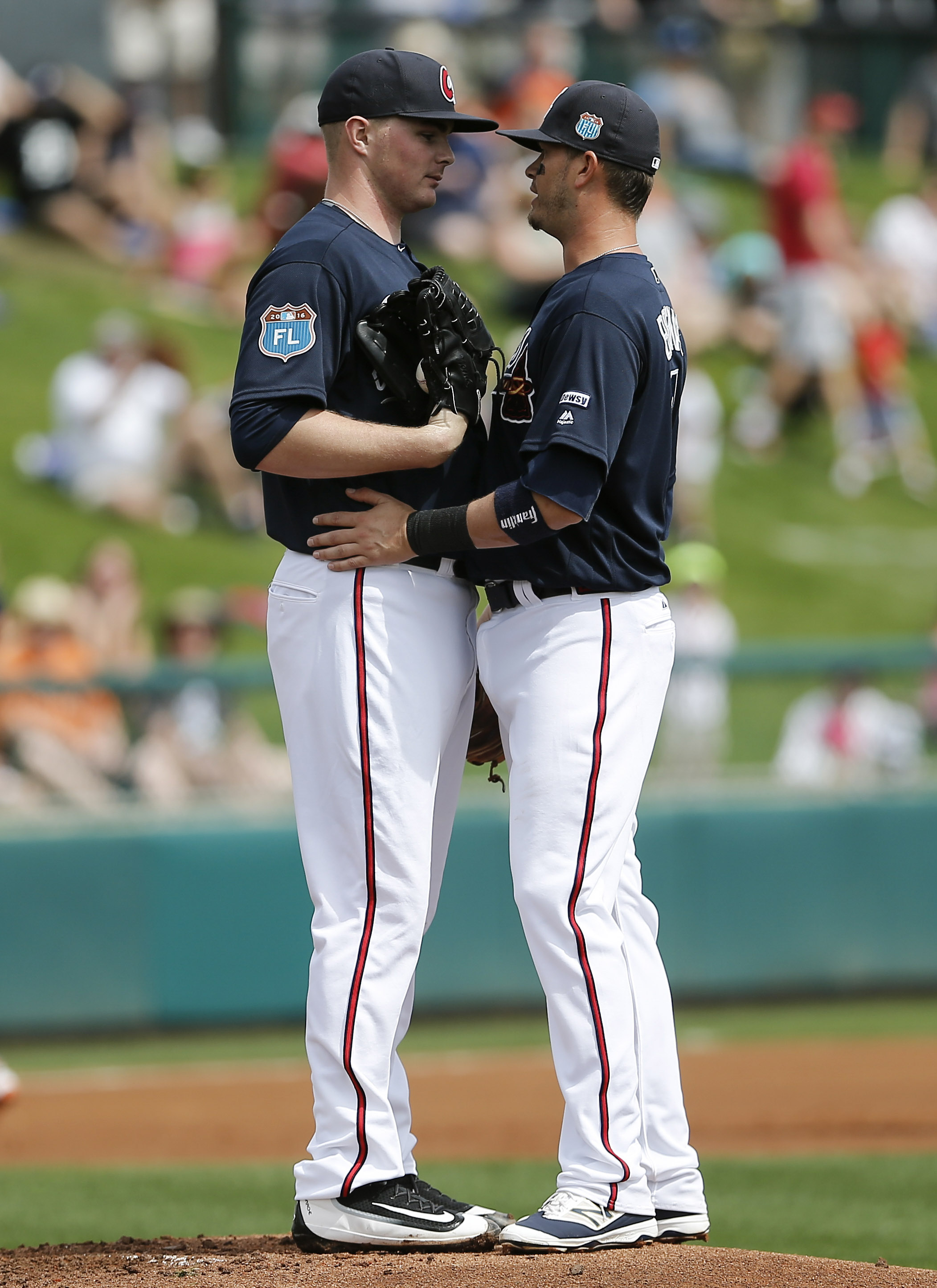
While GM John Coppolella had to defend the Simmons swap to fans and observers, the later send-off of Shelby Miller largely sold itself. The 25-year-old Miller, the key piece of last year’s Jason Heyward deal, had a strong first campaign in Atlanta and is controllable for three more seasons. But the Diamondbacks paid big to get him, parting with five years of Ender Inciarte, last year’s top overall pick Dansby Swanson, and highly-rated pitching prospect Aaron Blair. Inciarte looks like a solid building block piece — if he, too, isn’t eventually flipped — while Swanson may form a future middle infield pairing with rising youngster Ozhaino Albies. As for Blair, he joins Newcomb and Ellis in an increasingly loaded stockpile of promising young arms.
That’s not all that Atlanta accomplished on the trade front. Cameron Maybin was another recent trade piece who was passed along, adding to the cost savings achieved in the Kimbrel pact. And the club officially gave up on one-time catcher-of-the-future Christian Bethancourt, who was out of options, preferring instead to roll the dice on promising but oft-injured righty Casey Kelly and young backstop Ricardo Rodriguez.
That set of swaps opened quite a few needs and opportunities at the major league level. Aybar promises to play regularly at short, keeping the seat warm for Swanson and Albies while providing a potential trade chip at this year’s deadline. Likewise, Inciarte will move into the center field role, shifting Michael Bourn to a reserve role.
Joining those new faces are a host of veterans signed to short-term contracts. At catcher, Atlanta gave two years to the non-tendered Tyler Flowers and brought back A.J. Pierzynski on a one-year pact. That looks like a fairly sturdy duo behind the plate: Flowers has an average bat for the position and has posted good framing numbers, while the 39-year-old Pierzynski slashed .300/.339/.430 last year for the Braves. Ryan Lavarnway was re-signed to a minor league deal to provide further depth.
Kelly Johnson, Emilio Bonifacio, and Gordon Beckham will join Jace Peterson and Adonis Garcia in the mix at second and third at a total cost of just $4.5MM. It would be a surprise if that group produced at a terribly high level, but the club will hope that it will be able to make out a serviceable enough unit from those options. If nothing else, the pressure will be reduced on Peterson, who wasn’t quite up for everyday duty when he joined Atlanta before last season as part of the Justin Upton trade.
Among the team’s minor league signings were veteran utilitymen Reid Brignac and Chase d’Arnaud, who could step in at short if Aybar is moved. (Light-hitting Daniel Castro also represents a place-holding option there.) And players like Jeff Francoeur, Nate Freiman, and Matt Tuiasosopo also joined the organization over the winter in hopes of pushing for a bench spot.
Rounding things out were a host of pitching additions, led by guaranteed deals for right-handers Bud Norris and Jim Johnson. The 31-year-old Norris will be relied upon in the rotation, where he’ll look to re-establish himself as a durable back-of-the-rotation starter. Kyle Kendrick might’ve hoped for the same, but was already released after struggling early this spring. The same fate befell Chris Volstad, though David Holmberg and Carlos Torres are still in camp as depth options for an otherwise youthful staff.
Meanwhile, Johnson will hope to replicate his solid form in the first half of 2015 with the Braves after struggling following his mid-season move to the Dodgers. Minor league signees like Jhoulys Chacin, Alexi Ogando, and Alex Torres all bring plenty of experience to the pen mix, too.
Continued analysis after the break …

Andy MacPhail On The 25-Year Anniversary Of The Twins’ 1991 World Series Championship
The Minnesota Twins surprised the baseball world in 1987 when they finished first in the American League West with an 85-77 record – just one season after going 71-91. But they didn’t stop there; the Twins stunned Detroit (98-64 in the regular season) to win the A.L. Championship Series, then shocked St. Louis (95-67) to bring home a World Series title.
Just four years later, after a complete retooling of the pitching staff, the 1991 Twins rebounded from a last-place finish the year before to win the A.L. West. After dropping nine of their first 11 games, they started putting things together – and eventually went on a 24-3 tear from May 28-June 25 (including a 15-game winning streak). By the time that stretch ended, they found themselves atop the divisional standings – and never entered a day’s action the rest of the season looking up at anyone. After defeating Toronto in the ALCS, they outlasted Atlanta in the worst-to-first World Series to bring home another trophy.

The architect of both championship clubs was Andy MacPhail, who was just 32 years old when he took over as Minnesota’s General Manager in August 1985. Now the President of the Philadelphia Phillies, MacPhail took some time to speak to MLB Trade Rumors about the 1991 Twins in this – the 25th anniversary of their last World Championship.
The pitching staff was completely overhauled between 1987 and 1991. The front three in 1987 were Frank Viola, Bert Blyleven and Les Straker; by 1991, Jack Morris, Scott Erickson and Kevin Tapani sat atop the rotation. Jeff Reardon was the closer in 1987; Rick Aguilera was in that role in 1991.
“We had to turn the entire pitching staff over in a four-year period, which was no easy feat,” MacPhail said. “As I recall, it was a little bit of everything – trades, free agent acquisitions, minor league free agents, major league free agents … Some came from the system, like Scott Erickson. Some were more high-profile free agents, like Jack Morris. But one of the most critical signings was a minor league free agent named Carl Willis – who ended up pitching the 8th inning and doing an extraordinary job for us. With Willis in the 8th and Aguilera in the 9th, we locked down the last two innings. It just goes to remind you that you have to get contributions from every potential artery you can to improve your club – not just rely on one aspect alone. Tapani and Aguilera were trades. Morris – major league free agent. Mark Guthrie – minor league free agent. They all combined in one year to help us completely turn over the pitching staff.”
The best pitcher on the 1987 team – and the most recognizable – was Frank Viola, who earned World Series MVP honors that season and went on to win the A.L. Cy Young Award in 1988. The trade of Viola at the July 1989 deadline turned out to be a big reason why the Twins won the 1991 World Series, as three pitchers acquired for him – Tapani, Aguilera and David West – became key members of the Minnesota staff.
“At the time we moved him, we were in last place, and it felt like we needed some volume as opposed to one great starter,” MacPhail said. “We had a difficult negotiation after the ’88 season. He ended up signing a three-year agreement, but we were probably going to have another negotiation that would not be easy. We just felt it was time to make a move. When he went over to the Mets, he won 20 games and pitched well there. Given our circumstances, we were looking for volume. We got Kevin Tapani – who did a tremendous job for us and was an integral piece of the ’91 puzzle. And we were able to add David West, who ended up starting and relieving for us over the course of ’91. And then another critical piece was Rick Aguilera, who was our closer and filled an important void for us.”
From a fan standpoint, moving such a popular player and person as Viola had to be tough. MacPhail was asked if it was harder to remove him from the team because Minnesota was a small market club.
“That was a harder one to do. We ended up doing it right at the deadline on July 31st,” MacPhail said. “Back then, it was a midnight deadline. We did it with minutes to spare. It was not an easy decision by any stretch. I remember just wanting to have to sit down for a moment and sort of collect myself. Independent of the market size, it clearly was not an easy decision. It was not going to be popular, because you are trading a known for multiple unknowns to some degree. While I felt conviction that it was the right thing for us to make the trade … I wouldn’t say I was conflicted, but I recognized back then that of all the trades I had made in my career, this one was going to have the most riding on it. If it was not successful, it was going to come back and bite you personally – probably in a big way. You trade a potential 20-game winner to a New York club, you better be getting something back.”
A year and a half later, the Twins were playing in the 1991 World Series. Vindication, or still a tad conflicted?
“No, the end game object is to be the last club standing. We were able to accomplish that. The pitchers we acquired in that deal were big parts of it. So I felt the actions of the organization were justified,” he said.
West Notes: Preller, Belt, Susac, Story, Skaggs, Wandy, Cotts
The Padres very nearly passed on A.J. Preller in the club’s 2014 general manager hiring process, Bryce Miller of the San Diego Union-Tribune writes. President Mike Dee says he had settled on another candidate — very likely, now-Angels GM Billy Eppler, but took Preller up on his request for a final sit-down “just as a kind of courtesy, because he was so good throughout the process.” Preller obviously made a great final impression, because Dee left the meeting convinced in the young executive and told San Diego chairman Ron Fowler the next morning that he’d “had a change of heart overnight.” The story details how the organization’s current leadership group came together, and is well worth a full read.
Here’s more from out west:
- The Giants plan to meet with representatives of first baseman Brandon Belt this week to discuss a long-term contract, Andrew Baggarly of the Mercury News reports. Baggarly takes a deep and excellent look at the complicated matter of valuing the soon-to-be 28-year-old, talking with Belt and GM Bobby Evans about the upcoming talks. For his part, Belt says he hopes to remain in San Francisco but notes: “It’s all going to come down to what’s fair. And, you know, I hate to say it like that, but that’s the reality.” Evans declined to offer any thoughts on what might be fair from the team’s perspective, but said that the organization “believe[s] in his bat, his defense, his character and the continuity that he, if healthy, can add to our lineup.” He went on to note some of the matters that may hold down the team’s bottom-line on price: “Strikeouts are certainly a challenge for him, but he’s also a guy who gets on base at a pretty fair clip. It’s a fair debate in the sense of the different perspectives. But on some level, injuries have been more of an issue than performance.”
- While Angel Pagan is showing well this spring, the Giants are dealing with concerns at the catching position, Baggarly further reports. In particular, presumed backup Andrew Susac is struggling with soreness in his right wrist, which was operated on last fall. While there are options on hand, including veterans George Kottaras and Miguel Olivo, and the younger Trevor Brown, Susac has long been viewed as a legitimate talent and will be looking to play an increasingly important role in support of the great Buster Posey.
- Trevor Story has made a strong case to take over at shortstop for the Rockies this spring, as Patrick Saunders of the Denver Post writes. GM Jeff Bridich wouldn’t commit to a decision, but praised Story’s ability and approach in camp and certainly suggested he’d continue to have every opportunity to win the job as camp draws to a closer — regardless of service-time considerations. Meanwhile, promising backstop Tom Murphy has been sent down to minor league camp, with expectations that he’ll get plenty of time at Triple-A, but could well find his way to the majors at some point during the season to come.
- Angels lefty Tyler Skaggs will return to competitive action on Thursday for the first time since his Tommy John procedure, Jeff Fletcher of the Orange County Register tweets. The Halos’ rotation hasn’t developed quite as hoped this spring, making Skaggs’ already-important comeback all the more critical. Fletcher suggests he could be ready for regular season action as soon as late April.
- The Astros are getting close to making some decisions in rounding out their bullpen, as MLB.com’s Brian McTaggart explains. Lefties Wandy Rodriguez and Neal Cotts have opt-out dates of Saturday, per the report, and they are embroiled in competition with a group of other arms — including the out-of-options Dan Straily.
Indians Still Exploring Trade Market For Outfielders
The Indians are still engaged in trade talks to add to their outfield mix, according to Ken Rosenthal of FOX Sports. While a deal is ultimately seen as unlikely, Cleveland appears to be exploring all possible means to upgrade a unit that still has many questions as the season approaches.
As MLBTR’s Steve Adams wrote in reviewing the club’s offseason, it was surprising that the organization did not do more to address the outfield — especially after losing Abraham Almonte for eighty games due to suspension. Since that piece was published, of course, the club did pick up Marlon Byrd on a minor league deal and has received positive signs on Michael Brantley‘s injury rehab, but it seems that the overall mix remains a concern.
As before, the Indians are weighing the idea of moving pitching for the right player. But Rosenthal says that the club’s top three starters are no longer seriously being discussed. Instead, per the report, rotation options such as Trevor Bauer, Josh Tomlin, Cody Anderson, Michael Clevinger, and just-optioned southpaw T.J. House could be “in play” in trade dialogue.
It isn’t clear precisely what kind of player might be pursued at this point, but Cleveland does have some options on hand. Brantley will be expected to play everyday in left once he’s ready, of course. Rajai Davis, Will Venable, and Shane Robinson all have experience in center, while Byrd, Joey Butler, and Lonnie Chisenhall are also available to man right field. While a relatively minor addition could certainly make sense to improve the platoon mix at those two spots, the club might be more inclined to part with pitching depth to acquire a more-or-less full-time piece — particularly, someone capable of playing up the middle.
Offseason In Review: Arizona Diamondbacks
You can find all the published entries in our Offseason in Review series here.
The D-backs had perhaps the most surprising, aggressive offseason of any club in baseball in an effort to make a run at the NL West crown.
Major League Signings
- Zack Greinke, RHP: Six years, $206.5MM
- Tyler Clippard, RHP: Two years, $12.25MM
- Total Spend: $218.75MM
Notable Minor League Signings
- Brett Hayes, Kyle Drabek, Joaquin Arias, Wesley Wright, Sam LeCure, Rickie Weeks, Matt Capps, Scott Rice, Tim Stauffer, Jason Bourgeois
Trades and Claims
- Acquired RHP Shelby Miller and LHP Gabe Speier from Braves in exchange for CF Ender Inciarte, SS Dansby Swanson and RHP Aaron Blair
- Acquired SS Jean Segura, RHP Tyler Wagner and $4MM from Brewers in exchange for 2B Aaron Hill, RHP Chase Anderson and SS/2B Isan Diaz
- Acquired C/OF Chris Herrmann from Twins in exchange for 1B/OF Daniel Palka
- Acquired RHP Sam McWilliams from Phillies in exchange for RHP Jeremy Hellickson
- Acquired RHP Cody Hall from Giants in exchange for cash considerations
Extensions
- A.J. Pollock, CF: Two years, $10.25MM
Notable Losses
- Ender Inciarte, Chase Anderson, Jeremy Hellickson, Oliver Perez, David Hernandez, Aaron Hill, Jarrod Saltalamacchia, Allen Webster, Jhoulys Chacin
Needs Addressed
Entering the offseason, the rotation was known to be Arizona’s greatest need, but for financial reasons, the expectation was more that the D-backs would pursue second-tier arms like Kenta Maeda and Mike Leake than the names at the very top of the market. That, of course, changed in a matter of about 12 hours, which is reportedly the length of time it took the D-backs to sign Zack Greinke to a staggering six-year, $206.5MM contract after owner Ken Kendrick called his front office and gave the green light.
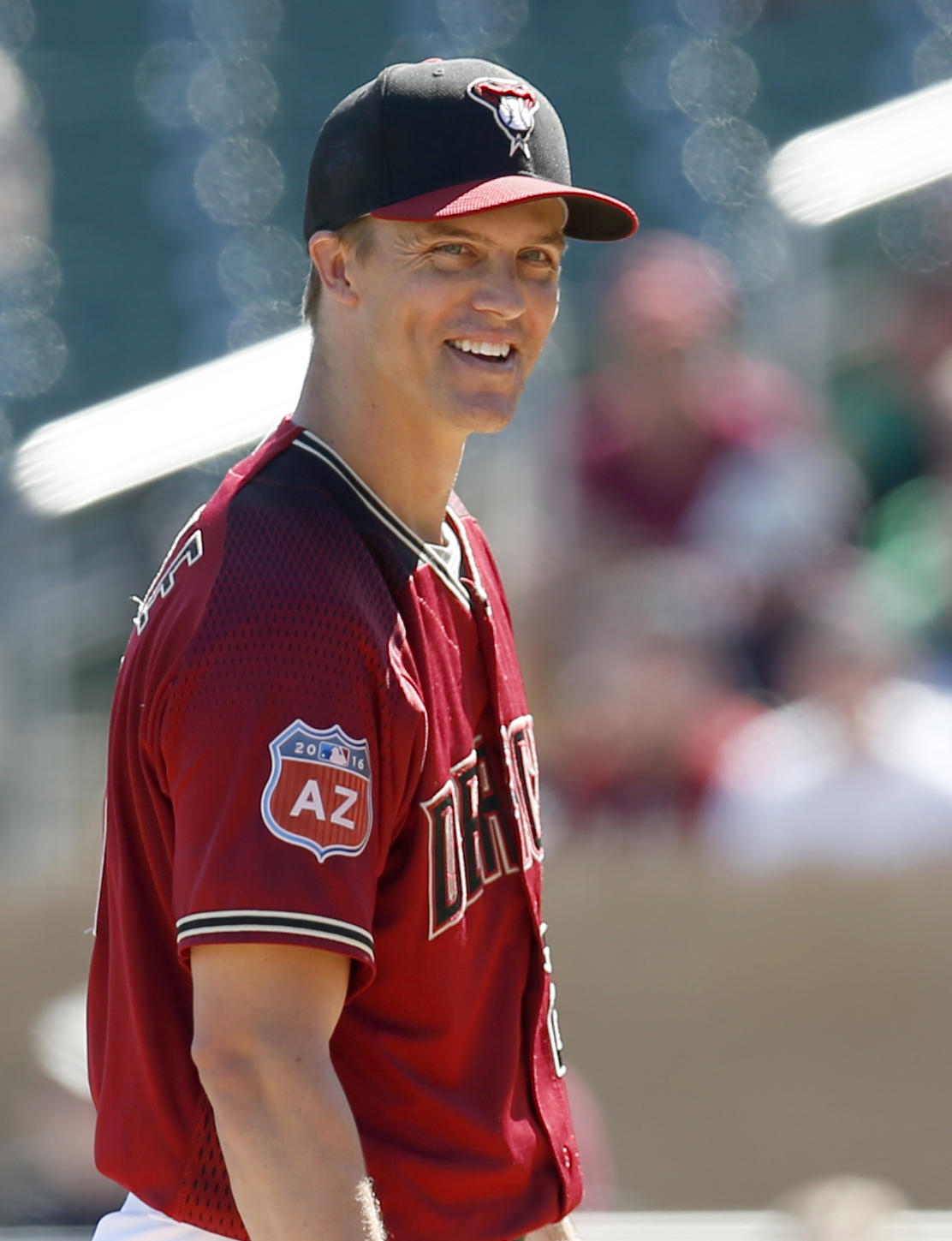
Unlike Greinke’s previous deal, this new contract doesn’t contain an opt-out. While a few million dollars of that sum is deferred, the Diamondbacks are paying Greinke more than $31MM annually, and the actual $34.4MM annual value of the deal (before deferrals) is the largest in Major League history. That represents a huge percentage of the spending capacity of an organization that has only once topped $100MM in Opening Day payroll. The Diamondbacks are betting that Greinke will not only age well, but continue to produce at an elite level — one near the collective 2.30 ERA that he posted over the life of his three years with the division-rival Dodgers. At the very least, they’re counting on him to perform over the life of the next three years, which is the amount of time for which the club controls standout center fielder A.J. Pollock and the team’s other blockbuster offseason addition: right-hander Shelby Miller.
In order to acquire three years of Miller, the D-backs parted with 2015 breakout Ender Inciarte, 2015 No. 1 overall draft pick Dansby Swanson and top prospect Aaron Blair. The price paid was astounding to most, and I’ll look at the Miller deal in full later in this review, but there’s little doubt that the D-backs have overwhelmingly improved upon the collection of starters with which they entered the 2015 season. Greinke, Miller and a full season of the excellent and underrated Patrick Corbin (who missed half of the ’15 campaign recovering from Tommy John surgery) give the club one of the more impressive rotation trios in the big leagues.
Joining that group will be right-hander Rubby De La Rosa and left-hander Robbie Ray. While De La Rosa hasn’t yet cemented himself as a high-quality big league starter, he proved durable last season by racking up 188 1/3 innings and carries further upside. (If nothing else, his velocity and dominance over right-handers suggests that he could be converted to a successful reliever if he continues posting upper-4.00 ERAs.) Ray, acquired in the three-team deal that sent Didi Gregorius to the Yankees, somewhat quietly delivered a strong season, posting a 3.52 ERA and solid peripheral stats in 127 1/3 innings. Although they traded a near-MLB-ready arm in Blair, the D-backs still have Archie Bradley and Braden Shipley on the cusp of the Major Leagues, so there’s depth beyond the starting five should a need arise.
The Diamondbacks have also long been connected to bullpen help — most notably, Aroldis Chapman — but they instead brought in the highly durable Tyler Clippard on a two-year deal late in the offseason. Clippard has been baseball’s iron man in the pen. Dating back to the 2009 season, his 524 1/3 lead all big league relievers, and it’s not even close. Luke Gregerson ranks second on that list but is 44 1/3 innings behind; essentially, Clippard has thrown two-thirds of a season’s worth of innings more than any other reliever since establishing himself in 2009.
There are varying ways to interpret that durability, of course. MLBTR’s Jeff Todd and I discussed the deal this offseason on our podcast, with Jeff viewing the deal as a solid value and a sensible move given the organization’s other acquisitions. I’m more skeptical, particularly in light of last year’s results. While Clippard delivered an excellent 2.92 ERA in his age-30 season, his strikeout rate, walk rate, swinging-strike rate and velocity all trended in the wrong direction, and he posted a 21.2 percent ground-ball rate. If the innings have begun to catch up to Clippard and/or he posts a fly-ball rate near 60 percent at the homer-friendly Chase Field, the return on Arizona’s investment could be marginal. The D-backs were already burned once by acquiring an extreme fly-ball reliever in Addison Reed, and Clippard is an even more pronounced fly-ball arm. If, on the other hand, last year was an anomaly and Clippard pitches more like his 2010-14 self, the Diamondbacks will have deepened their ‘pen at a very reasonable price.
Continued analysis after the break …
Carson Smith Exits Spring Game With Forearm Tightness
Red Sox reliever Carson Smith left today’s game after just five pitches upon experiencing forearm issues, as Michael Silverman of the Boston Herald reports. The righty is said to have had “tightness” and “a little cramping,” which he said he’s never felt before.
Forearm issues, of course, can often be predecessors to more significant elbow troubles, so it’s easy to see why Boston manager John Farrell was quick to react. Both Farrell and Smith expressed some concern, though it’s obviously too soon to know the prognosis. According to the statistical research of MLBTR contributor Bradley Woodrum, Smith has a slightly elevated Tommy John risk profile entering 2016.
Smith was a significant offseason acquisition for newly-minted Red Sox president of baseball operations Dave Dombrowski, who sent Wade Miley and Jonathan Aro to the Mariners for Smith and southpaw Roenis Elias. He is expected to hold down an important setup role in a reworked Boston pen.
After an outstanding but brief debut in 2014, Smith delivered a big campaign last year in his first full season of MLB work, getting excellent results from his sidearm delivery and sinker/slider combo. The former eight-round draft pick spun 70 frames of 2.31 ERA pitching, racking up 11.8 K/9 against 2.8 BB/9. He also induced grounders on 64.8% of the balls put in play against him while surrendering only two long balls, making for a rare combination of strikeout ability and batted-ball dominance.
Smith is not just a near-term asset, of course, as he’s compiled just 1.028 years of MLB service to date. Boston controls him for two more seasons at the league minimum and can keep him via arbitration through 2020.
The Red Sox will send Smith in for an evaluation with the club physician this evening, and Silverman suggests an MRI appears likely. While acknowledging his concern, Smith did note that “we toyed with some tests in there” — presumably, referring to the clubhouse — “and … there were optimistic results.”
There’s still ample late-inning depth in Boston, of course, beginning with fellow offseason acquisition Craig Kimbrel in the 9th inning. Stalwarts Koji Uehara and Junichi Tazawa are still on hand, with other options in camp including righties Matt Barnes, Heath Hembree, Noe Ramirez, Roman Mendez, and Carlos Marmol. Knuckler Steven Wright could work from the pen if he doesn’t crack the rotation, as could Elias or fellow southpaw Brian Johnson.
Blue Jays, John Gibbons Restructure Contract
The Blue Jays have agreed to a new contract structure with manager John Gibbons, according to MLB Network Radio’s Steve Phillips (Twitter links). His new deal provides a pay raise and guarantees his salary through 2017.
Notably, Gibbons will no longer be managing to pursuant to an annual rollover clause. His prior contract included an anti-lame duck provision pursuant to which the following year’s option would be picked up automatically if the club did not decline it by January 1, with another option year then added.
GM Ross Atkins addressed the subject in an appearance on MLB Network Radio on Sirius XM (audio link). He suggested that the new front office was not interested in the same structure moving forward, but remains committed to the skipper.
Gibbons, of course, led the Jays to do an AL East title last year. They ultimately lost in the ALCS after winning a divisional playoff series. Over his three years in Toronto, the club has won 250 games and improved its record in each season.
AL Notes: Drellich, Odor, Wang, Parker
The Boston Herald has announced that it has hired Evan Drellich to join Michael Silverman and Jason Mastrodonato on their Red Sox beat. Drellich had previously been with the Houston Chronicle, where he covered the Astros. Before that, he had written about the Red Sox for MLB.com and MassLive.com. We at MLBTR wish Drellich the best of luck as he returns to Boston. Here’s more from the American League.
- The Rangers have tried to sign young infielder Rougned Odor to an extension, but the two sides found themselves far apart and talks are no longer active, CBS Sports’ Jon Heyman tweets. Heyman reported in October that Odor and the Rangers would discuss a deal. Odor, who only recently turned 22, posted a .261/.316/.465 line in 2015 that was perhaps even more promising than it sounds, given the trajectory his season took — he struggled for the first six weeks of the season, headed down to Triple-A Round Rock, posted a 1.065 OPS there, and then batted .292/.334/.527 in the big leagues from June through the end of the year.
- Earlier today, we noted that one potential competitor for a spot in the Royals‘ bullpen, Ross Ohlendorf, had opted out of his contract, giving the Royals 48 hours to place him on the roster or release him. Another potential competitor for one of the bullpen spots Ohlendorf is trying to win is Chien-Ming Wang, who has looked good in Spring Training. Wang’s opt-out date is May 1, Rustin Dodd of the Kansas City Star tweets. That means that, unlike with Ohlendorf, the Royals have a bit of time to figure out how they want to use him.
- Athletics pitcher Jarrod Parker has “no doubt” he will attempt to return to the mound, Susan Slusser of the San Francisco Chronicle writes. Parker was once one of the game’s most promising starters after two strong seasons with the A’s in 2012 and 2013, but since then his career has become a mess of injuries. Last month, Parker re-fractured the medial epicondyle in his right elbow. He has already had two Tommy John surgeries and has missed the past two seasons, and in April he’ll undergo what sounds like a somewhat experimental surgery performed by Dr. Neal ElAttrache to see if it’s possible his UCL can be repaired.
With Opt-Out Approaching, David Murphy Could Consider Retirement
The opt-out date in outfielder David Murphy‘s minor-league contract with the Red Sox is this coming Sunday, and he could consider retiring rather than playing in the minors, John Tomase of WEEI.com writes. “I think I’m to the point in my career where I’ve played plenty of baseball, and I don’t think I’m interested in playing in the minor leagues,” says Murphy. “I would love to play until somebody tells me I can’t play anymore, until they rip the shirt off my back, but I think it’s got to be a big league situation.”
Murphy could win a job with the Red Sox, perhaps thanks in part to the fact that Rusney Castillo has struggled somewhat in Spring Training (batting .267/.333/.300) and can be optioned to the minors. If the Red Sox were to send Castillo to Triple-A Pawtucket, that could set up an outfield that includes the left-handed Murphy and the right-handed Chris Young as complementary pieces.
This is Murphy’s second stint with the Red Sox, who made him a first-round pick in 2003. Since then, the 34-year-old has also played for the Rangers, Indians and Angels, and he’s put together a solid track record that includes a .795 career OPS against righties over a career spanning ten MLB seasons. Last season, he batted .283/.318/.421 in 391 plate appearances.
Twins Assistant GM Antony On Hunter, Park, Murphy, Nolasco
Jesse Lund, of SB Nation’s Twins blog Twinkie Town, recently did a wide-ranging interview with Twins assistant GM Rob Antony (Part 1, Part 2). Here are a few highlights.
- The Twins weren’t necessarily surprised by Torii Hunter‘s retirement in October, Antony says. That Hunter made his decision early in the offseason allowed the Twins time to plan, and helped them enter the bidding for KBO slugger Byung Ho Park. Later, Antony adds that the Twins had been aware of Park since he was in high school, and they were interested in signing him even then.
- The Twins struggled offensively at the catcher position in 2015, and especially didn’t do well from the backup catcher spot. That deficiency led them to acquire John Ryan Murphy (who they got from the Yankees for Aaron Hicks). Murphy, Antony feels, can be a long-term answer as a starting catcher. That trade took place in November, and Antony says that the Twins wanted to make the deal quickly because many teams were looking for catching and the Twins wanted to get a player who might be around for several years. For that reason, they felt that the trade market was a better avenue to pursue than the free agent market.
- The Twins considered blowing past their international bonus pool in recent years but did not do so because of the way the market for international amateur talent unfolded. “[W]hat ended up happening was a few teams – basically we had about six, seven players that we were prepared to just go get and spend millions of dollars on – well, some teams that lost out on guys they were after went after some of those same players and basically doubled what we were prepared to do,” Antony says.
- The Twins have not discussed the possibility of eating a portion of the $25MM remaining on Ricky Nolasco‘s contract in a potential trade, despite how poorly the first two years of his contract have gone. Nolasco’s role on this year’s team is unclear, but Antony emphasizes that the Twins plan to use him and still view him as a potentially helpful pitcher.