
Mets Notes: Baty, McNeil, Alvarez, Senga
TODAY: Senga won’t return prior to the All-Star break, Mets manager Carlos Mendoza told DiComo (X link) and other reporters today.
JUNE 7: The Mets and Phillies face off this weekend in MLB’s London Series, and both clubs will be afforded a 27th man for the overseas event. For the Mets, that’ll be infielder Brett Baty, who was recently optioned to Triple-A Syracuse in a move designed to help him get back on track but also to get hot-hitting Mark Vientos a legitimate audition at third base.
While Vientos is clearly outplaying his fellow corner-infield prospect at the moment, it seems the Mets are open to ideas that could keep both in the lineup, even with a full-time designated hitter (J.D. Martinez) and with Pete Alonso entrenched at first base. Baty told the Mets beat this morning that the team has informed him he’ll likely begin taking reps at second base soon down in Syracuse (X link via Newsday’s Tim Healey). It hasn’t happened in a game setting yet, but the Mets approached him about the possibility when he was optioned on May 31.
The potential addition of second base to Baty’s skill set comes at a time when longtime second baseman Jeff McNeil is struggling through the worst results of his career. McNeil, the 2022 National League batting champion, is hitting just .227/.296/.320 this season — about 16% worse than league-average, by measure of wRC+.
The 32-year-old McNeil is in just the second season of a four-year, $50MM extension and thus isn’t in jeopardy of being cut loose, but this is the second straight season his offensive output has declined in notable fashion. McNeil still has elite bat-to-ball skills (11.2% strikeout rate, 87.6% contact rate), but he’s hitting more fly-balls than ever before, which is having an adverse impact on his results. (Fly-balls — at least those in play — are the easiest type of batted ball to convert into an out.) There’s still surely some poor fortune in play, as McNeil’s fly-ball rate is only a few percentage points higher than when he won his batting title, while his .246 BABIP checks in 70 points shy of his career mark. But clearly the Mets have some level of concern, and clearly they’re also still looking at ways for both Baty and Vientos to factor into the long-term plan (particularly if the club ends up re-signing Pete Alonso and thus removing a Vientos-to-first base scenario).
Baty has never played second base in his professional career. He’s logged 250 innings in left field and otherwise spent every defensive inning since being drafted at third base. But with Vientos viewed more strictly as a corner infielder and also batting an outstanding .333/.392/.621 through his first 74 plate appearances this year, the Mets will take a look at the possibility of Baty slotting in elsewhere on the diamond. Baty hit just .225/.304/.325 in 169 turns at the plate prior to being optioned, so he has some obvious work to do on the offensive side of things as well — but it’s nevertheless interesting to see the Mets experimenting with the defensive alignment in a manner that could accommodate two of the organization’s longtime top prospects who have previously had the same primary position.
Both Baty and Vientos have the potential to emerge as cornerstones in Queens, and if they’re able to do so they’ll likely slot in alongside catcher Francisco Alvarez in forming a young core of hitters around which president of baseball ops David Stearns can build. Alvarez has been out since mid-April, when he required surgery to repair a torn ligament in his thumb. He’s been on a minor league rehab assignment and had been slated for a return early next week. However, Anthony DiComo of MLB.com reports that Alvarez’s return will be delayed by at least a few days. There’s no setback or new injury, but Alvarez has flown home to Venezuela to tend to a family matter.
At this point, there’s no indication Alvarez will be delayed long. A return in latter half of next week still seems feasible. The 25-year-old has already appeared in five minor league games but could get a few more under his belt before being activated. He hit .236/.288/.364 in 16 games before incurring his injury but swatted 25 homers in 123 games (423 plate appearances) last season. Alvarez has hit for a subpar .212 average in 496 big league plate appearances but makes plenty of hard contact, draws a roughly average number of walks, has clear plus power and has made substantial defensive improvements in the past couple years.
In further Mets injury news, there’s some optimism with regard to Kodai Senga‘s lengthy rehab process. He’s slated to throw a bullpen session next Monday or Tuesday, tweets Mike Puma of the New York Post. Originally placed on the IL due to a moderate capsule strain his right shoulder, Senga has encountered multiple setbacks along the way. He progressed to facing live hitters by late April but was scaled back to try to get his mechanics back in order. While going through that step, Senga sustained a triceps injury that necessitated a cortisone injection and another five-day shutdown period.
That latter setback came in late May, but the silver lining was that his ailing shoulder looked to be healed on that MRI. It seems both the shoulder and triceps are now approaching a point where he’ll be cleared to throw. There will still be multiple steps to check off before Senga is a realistic option to return to the Mets’ rotation. He’ll likely need multiple bullpen sessions, followed by live sessions against hitters and then a minor league rehab assignment that figures to last multiple starts (with a full slate of rest between each, of course). It seems unlikely he’d be able to check all those boxes by the end of this month, making a July return far more likely.
Senga, 31, is in the second season of a five-year, $75MM contract. The former NPB standout made the All-Star team last year in his rookie season. He also finished second in NL Rookie of the Year voting and seventh in NL Cy Young voting after pitching 166 1/3 innings of 2.98 ERA ball with a 29.1% strikeout rate, 11.1% walk rate, 44.7% grounder rate and 0.92 HR/9.
Mets Notes: Senga, Peterson, Houser, Alvarez
Kodai Senga underwent an MRI on Friday and was diagnosed with triceps inflammation, Mets manager Carlos Mendoza told reporters (including Dan Martin of the New York Post). Senga received a cortisone shot to deal with the issue and will be shut down from throwing for the next 3-5 days.
The news represents another setback for Senga, who has yet to pitch this season after suffering a moderate posterior capsule strain in his right shoulder during Spring Training. Senga’s rehab process didn’t have any formal timeline attached, as the most recent reports indicated that he was first working on his mechanics before embarking on any clear ramp-up regiment. Senga was supposed to toss a bullpen session on Friday before the triceps discomfort shelved that plan.
If there is any silver lining, Mendoza noted that Senga’s shoulder and elbow looked good in the MRI scan, so the triceps area seems to be the only concern at this point. However, Senga and the Mets will now have to wait out this shutdown period before again re-evaluating the righty’s status.
Senga is already on the 60-day injured list and obviously won’t be activated when he hits the 60-day threshold this coming week, and it would now seem like he might not make his 2024 debut until perhaps after the All-Star break. Assuming he emerges from this shutdown period feeling better, Senga’s rehab assignment will still take at least a month given that he has to essentially start his preparation from scratch after missing all of Spring Training. From the Mets’ perspective, surely they weren’t going to take any risks with their ace righty’s health anyway, but there’s even less of a rush to get Senga back onto a big league mound since New York is 21-29 and doesn’t look like a contender.
An inconsistent rotation has been a big reason behind the Amazins’ lackluster record, as only five teams have a worse rotation ERA than the collective 4.59 posted by Mets starters. Some potential help could be on the way since David Peterson is nearing the end of his 60-day IL stint, and he made his second and potentially final Triple-A rehab start last night. Peterson has a 2.79 ERA over 9 2/3 innings in those two rehab outings, tossing 81 pitches in his first start and then 89 pitches last night.
Peterson underwent hip surgery last November, necessitating a season-opening stint on the 60-day injured list given the procedure’s recovery timeline of 6-7 months. It seems as though Peterson has gotten through his rehab in good form, so barring any last-minute health issues, the left-hander appears to be on track to be activated from the injured list this week.
Over four seasons and 333 innings for New York, Peterson has a 4.51 ERA while starting 64 of his 80 appearances. While nobody expects Peterson to step in and be a savior for the struggling rotation, Peterson might at least represent an upgrade over Adrian Houser, who Mendoza said could be moved back to the bullpen. Houser has a 7.88 ERA in 37 2/3 innings this season, starting his first six games before a shift to the relief corps, and was then inserted back into the rotation as the Mets moved to a six-man staff during a busy stretch of the schedule. Things didn’t go smoothly for Houser in his return to starting duty, as he allowed six earned runs over five innings in the Mets’ 10-4 loss to the Guardians on May 21.
In another injury update, catcher Francisco Alvarez is expected to take batting practice today for the first time since undergoing thumb surgery back on April 23. (MLB.com was among those to report the news.). Alvarez was given an eight-week recovery timeline, so it’s a good sign that he is already feeling better enough to face any sort of live pitching. He has also been taking some pitches behind the plate, catching with a splint inside of his glove — a process that is likely to continue for at least some time after Alvarez returns to action. The former top prospect was hitting .236/.288/.364 in 59 plate appearances prior to his torn thumb ligament, and this lengthy injury rehab has already drastically reduced what was supposed to be Alvarez’s second full Major League season.
Latest On Kodai Senga
Kodai Senga threw a live batting practice session on April 29, seemingly a sign that the Mets hurler was making good progress on his way back from a moderate posterior capsule strain in his right shoulder. However, the latest updates on Senga’s status aren’t as promising, as Mets manager Carlos Mendoza and pitching coach Jeremy Hefner told reporters (including MLB.com’s Anthony DiComo) that Senga has dialed back his rehab to work out his pitching mechanics, which will come in the form of bullpen sessions and lighter sessions of catch. This will be the plan for at least the next week, Mendoza said, until Senga indicated that he was ready for more.
While Mendoza said that having Senga face live hitters could be a possible injury risk for either the pitcher or the batters, Mendoza repeatedly said that Senga was physically fine, and that the change of course in rehab work wasn’t a true setback. Hefner compared the situation to Spring Training, “where a guy is working through mechanics and feeling things out and he wants to throw another bullpen instead of a live [session], or push it a couple days. That’s what’s going on. He wants to work through some mechanical stuff, and he wants to feel good in the bullpen before he does maybe another live or goes into a game. He just wants to feel good before he starts that clock.”
Senga’s shoulder injury arose early in the Mets’ actual spring camp, and he began the season on first the 15-day injured list and then the 60-day injured list. The expectation was that Senga would need an extended ramp-up period to make up for all his lost prep work, and though the 60-day IL designation will keep him sidelined until at least late May, it now looks like it will be longer than that before Senga is a candidate to join New York’s rotation. Neither Mendoza or Hefner mentioned even a loose timeline for Senga’s return, leaving everything quite fluid.
After signing a five-year, $75MM deal to join the Mets in the 2022-23 offseason, Senga more than lived up to expectations in his first MLB campaign, posting a 2.98 ERA over 166 1/3 innings. Even though the Mets started a partial rebuild or retooling at last year’s trade deadline, the team could take solace in the fact that Senga was looking like a rotation staple, though his shoulder injury has now thrown a wrench into that plan.
As DiComo notes, there is a contractual element at play to Senga’s extended stint on the IL. The right-hander can opt out of his contract following the 2025 season if he amasses at least 400 innings in 2023-25. His workload last year left him with the very manageable figure of 233 2/3 remaining innings to trigger the opt-out, yet hitting that threshold now looks a bit more difficult if Senga misses an increasingly large chunk of the 2024 campaign.
Senga’s absence also has the more immediate problem of hampering the Mets’ chances of contending this season. Though new president of baseball operations David Stearns wasn’t overly aggressive with big-ticket moves this past winter, the organization still had some expectation of playing competitive baseball. The Mets haven’t exactly been on fire yet, but even with a 19-20 record, they are a game out in the crowded NL wild card race. This has been despite an inconsistent showing from the rotation, as Jose Quintana and Adrian Houser have both struggled badly.
NL East Notes: Ozuna, Turnbull, Mets, Senga, Megill, Cavalli
“There’s no way you want to go explore somewhere else when you feel comfortable, when you’ve got your teammates and you’ve got your organization’s love. There’s no doubt in my decision. I don’t want to go anywhere else,” Marcell Ozuna told The Athletic’s David O’Brien about his desire to sign a contract extension with the Braves. Ozuna’s four-year, $65MM deal is up at season’s end, though the Braves hold a $16MM club option for 2025 that looks like a sure bet to be exercised give how well Ozuna is performing at the plate. Coming off a 40-homer campaign in 2023, Ozuna has stayed hot by hitting .344/.419/.677 over his first 105 plate appearances in 2024, leading the National League with nine homers.
The idea of Ozuna remaining in Atlanta over the long term would’ve seemed far-fetched a year ago. The veteran struggled badly over the first two seasons of his contract, and that two-year stint also included an arrest on a DUI charge, and a 20-game suspension under MLB’s joint domestic violence, sexual assault and child abuse policy. Since the Braves reportedly never considered parting ways with Ozuna in the wake of these issues or his lack of production on the field, it would stand to reason that the team would be open to some kind of longer-term commitment beyond just the club option year. Some obvious obstacles exist — Ozuna will be 35 in November 2025 and is essentially a DH-only player at this point in his career, plus Atlanta’s payroll is already at team-record heights in both pure dollars and in luxury tax value.
More from the NL East…
- Taijuan Walker is expected to be activated from the 15-day injured list on Sunday to start the Phillies‘ game against the Padres. A shoulder impingement delayed Walker’s 2024 debut, and it also created an opportunity for Spencer Turnbull to open some eyes as the fill-in starter in Philadelphia’s rotation. With an outstanding 1.33 ERA over 27 innings and five starts, Turnbull has certainly pitched well enough to remain in the starting mix, but Rob Thomson told the Philadelphia Inquirer’s Alex Coffey (X link) and other reporters that a decision will be held off on Turnbull’s next step until after Walker throws on Sunday. Turnbull could get a proper start on Tuesday, or be part of a piggyback start with Cristopher Sanchez in Monday’s game. With Zack Wheeler, Aaron Nola, Ranger Suarez, Sanchez, and Turnbull all looking great thus far in the season, Walker’s return gives the Phillies a rare pitching surplus at the moment, and creates a nice problem for the team to navigate.
- In some Mets injury updates, Kodai Senga will throw a live batting practice session on Monday, and Tylor Megill will begin a minor league rehab assignment today with high-A Brooklyn. (The Athletic’s Tim Britton was among those to report the news.) Senga has yet to pitch this season due to a moderate posterior capsule strain suffered during Spring Training, and because of his placement on the 60-day injured list, won’t be eligible to join the Mets until May 27 at the earliest. Megill pitched in one game before a shoulder strain sent him to the 15-day IL. Megill and Senga could each potentially be part of a six-man rotation over the next six weeks, as Britton writes that New York is considering using an extra starter to keep everyone fresh through a busy stretch of the schedule.
- Cade Cavalli is set for a live batting practice session on Monday, his first time facing real hitters since undergoing Tommy John surgery in March 2023. Cavalli updated reporters (including MASNsports.com’s Bobby Blanco) about his rehab progress, as the plan is for the right-hander to start a minor league rehab assignment in the middle of May. Nationals manager Davey Martinez then views Cavalli’s return to the majors for “sometime at the end of June, maybe July.” The 22nd overall pick of the 2020 draft pitched in exactly one MLB game before his career was put on pause by the TJ procedure, and assuming all goes well health-wise, Cavalli should now be in line for his extended stint in a big league rotation.
Mets Transfer Kodai Senga To 60-Day Injured List
The Mets announced that right-hander Kodai Senga has been transferred to the 60-day injured list. That’s the corresponding move to open a roster spot for left-hander Tyler Jay, who was reported earlier to be joining the club.
Senga, 31, was diagnosed with a moderate posterior capsule strain in his throwing shoulder during Spring Training and started the season on the 15-day IL. He’ll now be ineligible to return until 60 days from that initial IL placement, which will be late May. Manger Carlos Mendoza said yesterday that Senga still has not thrown off a mound, per Will Sammon of The Athletic.
The news of Senga’s injury came in late February and the club initially planned for a shutdown period of at least three weeks, though they later planned on adding another seven to ten days to be cautious. It was reported almost three weeks ago that Senga was to begin a throwing program but the fact that he has not made it to a mound yet suggests that he either had some sort of setback or is being ramped up very slowly. Whatever the reason, the Mets apparently don’t expect Senga to be able to rejoin the club in the next six weeks.
It’s obviously a frustrating development for Senga and the team. The righty came over from Japan last year and was an immediate success, pitching 166 1/3 innings with a 2.98 earned run average. His 11.1% walk rate was a tad high but he struck out 29.1% of batters faced while keeping 44.7% of balls in play on the ground. He finished seventh in National Cy Young voting and second in Rookie of the Year voting.
Rotation health has been an issue for the Mets so far this year. David Peterson required hip surgery in the offseason and began the year on the IL, while Senga and Max Kranick followed him due to spring injuries, the latter suffering a hamstring strain. Tylor Megill took a rotation spot to start the year but landed on the IL himself after just one outing due to a shoulder strain.
The current rotation consists of Sean Manaea, Jose Quintana, Luis Severino and Adrian Houser, with José Buttó likely to be recalled soon to join that group. Until the injured hurlers get back, Joey Lucchesi is likely the top depth option, as he’s on the 40-man roster and currently on optional assignment.
Kodai Senga Expected To Begin Throwing Program
Mets ace Kodai Senga has been shut down for nearly a month after being diagnosed with a capsule strain in his right shoulder, but after a recent MRI he’s been cleared to return to baseball activity. Senga won’t start throwing immediately but could do so within the next week, manager Carlos Mendoza announced to reporters this morning (link via SNY’s Danny Abriano).
At the time of his injury, Senga was shut down for a minimum of three weeks. That was extended another week to ten days, but the latest MRI is far more encouraging, it seems. Once he’s cleared some strength tests, he’ll begin a throwing progression.
Senga’s initial diagnosis launched a fifth-starter competition in camp that was eventually won by right-hander Tylor Megill. He’ll slot into the five spot behind Opening Day starter Jose Quintana and the trio of Sean Manaea, Adrian Houser and Luis Severino. Given that Senga will be picking up a ball for the first time in around a month, he’ll effectively need a full spring training to build up to game readiness. That means the Quintana-Manaea-Houser-Severino-Megill quintet could be in place for the first month or so of the season (pending other injuries on the starting staff, of course).
The 31-year-old Senga was a Rookie of the Year finalist in 2023, exceeding preseason expectations by rattling off 166 1/3 innings of 2.98 ERA ball with a 29.1% strikeout rate. Senga’s 11.1% walk rate could use some improvement, but he took little time cementing him as a quality big league starter. He’s in the second season of a five-year, $75MM pact spanning the 2023-27 seasons.
NL Pitching Notes: Senga, Ferrer, Rockies
Kodai Senga has yet to pitch in a game this spring. The 2023 All-Star and Rookie of the Year runner-up is nursing a right shoulder strain. Although Andy Martino of SNY reported on Wednesday that “the word” on Senga’s health remained “very positive,” an update on Friday afternoon from Tim Healey of Newsday Sports is a little less optimistic. Initially, Senga was to be shut down for three weeks. Those three weeks have now passed, but according to president of baseball operations David Stearns, the 31-year-old “won’t throw for another 7-10 days.”
This setback likely removes any hope that Senga would return to the Mets rotation before the end of April, but an early May return is still on the table. Presuming he needs about six weeks to stretch out his arm, the righty could be back on the mound by the first week of May if he starts throwing again next weekend.
Needless to say, the Mets are hoping their ace misses as little time as possible. Senga made 29 starts last season, finishing second among qualified NL starters with a 2.98 ERA. Jose Quintana, who made just 13 starts in 2023, gets the Opening Day nod in his place, while Luis Severino, Sean Manaea, Adrian Houser, and Tylor Megill are likely to round out the rotation.
More pitching updates from the National League…
- The Nationals have shut down Jose A. Ferrer as the southpaw nurses a teres major strain (per Mark Zuckerman of MASN Sports). He will not pitch for at least three weeks. Ferrer, 24, made his MLB debut last season, appearing in 39 games out of the bullpen for Washington. Although his 5.03 ERA and 17.6% strikeout rate were unimpressive, he induced plenty of weak contact on the ground. Only a handful of NL relievers had a higher groundball rate or a lower barrel rate, per Baseball Savant. Ferrer was a strong candidate to make the Nationals’ Opening Day roster, and his injury leaves Robert Garcia as the only healthy left-handed reliever on the 40-man roster.
- According to Patrick Saunders of The Denver Post, right-handed pitchers Dakota Hudson and Peter Lambert are the two favorites for the fifth and final spot in the Rockies starting rotation. Hudson, who spent the first six years of his career with the Cardinals, has more major league experience and a recent track record of moderate success. He has made 38 starts over the past two years with a 4.78 ERA. Lambert, who made his debut with Colorado in 2019, has started just 32 games in his career, pitching to a dismal 6.38 ERA. Even accounting for the different run environments at Busch Stadium and Coors Field, that’s a stark difference. That said, Hudson is more of a proven quantity at this point in his career, while Lambert could still have some of the upside that made him a fringe top-100 prospect before his rookie season. Hudson seems like the leading contender, but there’s a reason Lambert remains in the conversation.
Kodai Senga Diagnosed With Posterior Capsule Strain In Right Shoulder, Will Open Season On IL
TODAY: Senga received a PRP injection in his right shoulder and won’t throw for at least three weeks, the Mets told Anthony DiComo and other reporters. This creates a rough timeline of late April/early May for Senga’s return if he returns from his shutdown period and is then able to ramp up as per usual, though things are still very fluid for a recovery plan. “We’ve got to be careful, but we’ll be flexible, as well,” Mets manager Carlos Mendoza said. “Senga knows his body well. He knows he’s going to be pretty honest, and this is the conversation I’m having with him — making sure he voices his opinion, so we will have to adjust as we get going with his throwing program.”
FEBRUARY 22: The Mets were dealt some difficult injury news on Thursday morning. New York president of baseball operations David Stearns announced that staff ace Kodai Senga was diagnosed with a moderate posterior capsule strain in his throwing shoulder (relayed by Anthony DiComo of MLB.com). Senga is being shut down until his symptoms subside. He’s out indefinitely and will open the year on the injured list.
Senga sat out the team’s workout yesterday after reporting arm fatigue. The Mets sent him for testing yesterday. That evidently revealed the shoulder strain. It subtracts the team’s best starter from the Opening Day rotation mix, although Stearns downplayed the urgency to go outside the organization for additional help (video link via the New York Post).
Senga, 31, signed a five-year, $75MM deal with the Mets last offseason after an 11-year run in Japan’s Nippon Professional Baseball. The former Softbank Hawks ace outperformed even some of the more optimistic expectations for his MLB debut, pitching 166 1/3 innings of 2.98 ERA ball with a 29.1% strikeout rate and 11.1% walk rate. Senga made the NL All-Star team, finished second in NL Rookie of the Year voting and even landed seventh on the NL Cy Young ballot.
Following last summer’s trades of Max Scherzer and Justin Verlander, Senga stood as the presumptive favorite to take the ball for the Mets on Opening Day. He’d have been followed, in some order, by Jose Quintana and offseason acquisitions Adrian Houser, Sean Manaea and Luis Severino. Instead, with Senga sidelined, one of those four (Quintana, most likely) will take the ball on Opening Day, while a battle for the fifth spot among in-house options like Tylor Megill, Joey Lucchesi and Jose Butto plays out during spring training. Many Mets fans will surely hope that the Senga injuries spurs further activity on either the trade or free agent front, but that seems quite unlikely.
“I don’t thinks so,” Stearns replied when asked whether Senga’s injury increases the likelihood of adding someone from outside the organization. “We’re always going to be opportunistic and hear what’s out there, but I don’t think it really changes our thought process.”
The free agent market still features several notable names; each of Blake Snell, Jordan Montgomery, Michael Lorenzen and Mike Clevinger remains unsigned. Presumably, the agents for all of those arms will be reaching out to the Mets in the wake of an ominous injury to their top starter.
However, the team’s mindset throughout the offseason has been to avoid long-term investments ahead of what looks like a largely transitional season. (Yoshinobu Yamamoto was the lone exception to that thinking, due to the 25-year-old’s atypical youth relative to other free agents.) That aversion to long-term deals will surely rule out a run at Snell or Montgomery, barring a change of heart from owner Steve Cohen, and the Mets’ luxury-tax status might make them reluctant to spend further on back-of-the-rotation arms like Lorenzen and Clevinger. Any spending for the Mets at this point comes with a 110% tax, so they’d effectively be paying double for any rotation additions.
Blake Snell Wins National League Cy Young Award
Free agent left-hander Blake Snell has been named the National League Cy Young Award winner for 2023, per an announcement from the Baseball Writers Association of America. Logan Webb of the Giants finished second in the voting while Zac Gallen of the Diamondbacks finished third.
Snell, 31 next month, has now earned a Cy Young award for the second time in his career. The first trophy was in the American League, with Snell winning as a member of the Rays in 2018. He is just the seventh pitcher to win the award in both leagues, joining Roger Clemens, Randy Johnson, Pedro Martínez, Max Scherzer, Gaylord Perry and Roy Halladay.
The left-handed Snell hasn’t been the most consistent pitcher in his career, with both his health and performance wobbling over the years, but his two award-winning campaigns have been excellent. His first trophy came after posting an earned run average of 1.89 with the Rays and this second piece of hardware was earned by posting a 2.25 for the Padres this year. His most recent campaign saw him walk 13.3% of batters faced but he danced around those by striking out 31.5% of his opponents and keeping the ball on the ground at a 44.4% clip. He probably had some help from the baseball gods as his .256 batting average on balls in play and 86.7% strand rate were both on the lucky side of average, but his punchouts and grounders surely helped him somewhat as well.
Outside of those two campaigns, the results have been far more mixed. He got to 180 innings pitched in his award-winning campaigns but hasn’t reached 130 in any other season. He also hasn’t posted an ERA lower than 3.24 in any of them.
Of course, that doesn’t matter for the Cy Young voting. It’s a single-season award and his year-to-year consistency is not something for the voters to consider. Snell’s voting wasn’t quite unanimous but he got 28 of the 30 first-place votes. But his overall track record will be of concern to the clubs considering signing him as a free agent. Pitchers with multiple Cy Youngs don’t hit free agency every day but it’s also incredibly rare for a pitcher to put so many runners on base without allowing them to score. Regardless of those concerns, MLBTR predicted Snell to land a contract of $200MM over seven years and he’s already garnering plenty of interest.
Webb had a 3.25 ERA in 216 innings for the Giants this year, which got him one of the first-place votes and 17 for second. Gallen had a 3.47 ERA in his 210 innings, which led to one first-place vote and three for second. In the full voting, which can be seen here, votes also went to Spencer Strider, Justin Steele, Zack Wheeler, Kodai Senga and Corbin Burnes.
Corbin Carroll Wins National League Rookie Of The Year Award
Diamondbacks outfielder Corbin Carroll has won the National League Rookie of the Year award, the Baseball Writers Association of America announced. Mets right-hander Kodai Senga came in second while Dodgers outfielder James Outman placed third.
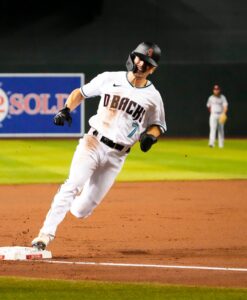 Carroll was selected to Arizona’s roster in late August of last year, allowing him to get a taste of the majors but without exhausting his rookie status. He fared extremely well in that audition, hitting .260/.330/.500 in his first 115 plate appearances for a wRC+ of 131, indicating he was 31% better than the league average hitter in that time. The D’Backs felt confident enough in Carroll based on that showing, and his work as a minor leaguer, to give him an eight-year extension with a guarantee of $111MM.
They were hoping he would be an integral part of the club and help them make the postseason for the first time since 2017. He went on to have an incredible showing in his first full season in the majors, hitting 25 home runs and stealing 54 bases. His .285/.362/.506 line led to a 131 wRC+ and he also got strong grades for his outfield defense. He produced 6.0 wins above replacement in the eyes of FanGraphs while Baseball Reference had him at 5.4. The club did indeed break their postseason drought, snagging a Wild Card spot and eventually going all the way to the World Series.
While the award is surely thrilling for Carroll and the Snakes on its own, there are other implications of Carroll taking the trophy. The new collective bargaining agreement contains measures designed to combat service time manipulation through the prospect promotion incentive, or PPI. Top-two Rookie of the Year finishers who were Top 100 prospects on at least two preseason lists at Baseball America, ESPN and MLB Pipeline are automatically credited with a full service year. That won’t apply to Carroll, who was up all year and earned a full service year regardless, though he was the #2 prospect on all three of those lists. Gunnar Henderson, who got the AL trophy today, was #1.
But players with PPI status can also earn extra draft picks for their clubs if they have less than 60 days of service time to start the season and earn a full service year the traditional way, as Carroll did, while also appearing on those preseason prospect lists. Players in that camp who finish in the top two in Rookie of the Year voting or top three in Cy Young or Most Valuable Player voting during their pre-arbitration seasons earn a bonus pick after the first round for their club. That means the Diamondbacks, who are already loaded with young talent, will get a valuable extra pick in next year’s draft.
Senga also had a strong season, his first after coming over from Japan. He made 29 starts for the Mets with a 2.98 earned run average, 29.1% strikeout rate, 11.1% walk rate and 44.7% ground ball rate. Players considered by MLB to be foreign professionals, as Senga is, aren’t eligible to earn PPI picks for their clubs. Outman also had a solid campaign, hitting 23 home runs and stealing 16 bases. He struck out in 31.9% of his plate appearances but offset that somewhat by walking at a 12% clip. His .248/.353/.437 batting line led to a wRC+ of 118 and he also graded out well in the field. He wasn’t considered a top 100 prospect coming into the year and wouldn’t have qualified for a PPI pick even if he surpassed Senga for second place.
The voting was unanimous, per the vote tally at BBWAA, with Carroll getting all 30 first-place votes. Senga got 22 second-place votes and Outman got five. Other players getting votes were Nolan Jones of the Rockies, Eury Pérez of the Marlins, Patrick Bailey of the Giants and three Reds: Matt McLain, Spencer Steer and Elly De La Cruz.
Image courtesy of USA Today Sports.