
How Nomar Mazara Can Reach His Potential With The White Sox
One of the wild cards of the 2020 season will be the development of 25-year-old outfielder Nomar Mazara, who will look to finally break out, this time in a new environment. By now, Mazara has had four whole seasons to prove himself at the Major League level, and in 2019 he was largely the same player as he was when he debuted with the Rangers in 2016. Last year was critical for the marriage between Mazara and the Rangers; if Mazara were to establish himself as a building block for Texas, he needed to take the leap that the club has been expecting since it signed him in 2011 as an amateur. Unfortunately, that progress didn’t really come, and the Rangers dealt Mazara to the outfield-needy White Sox in December.
At 6’4″ and 215 lbs., Mazara looks the part of an MLB slugger: his frame alone is enough to convince spectators that he’s got superstar potential. He’s almost in the Giancarlo Stanton/Joey Gallo class of physicality, and his mammoth home runs lend credence to that comparison—Mazara hit the longest homer in MLB last year with a Statcast-measured 505-foot blast. When Mazara gets into one, your eyes light up at the thought of him mashing with regularity.
But the fact of the matter is that Mazara has yet to hit more than 20 homers in a season, and has in fact never put up a season of even 1.0 WAR by FanGraphs’ measure (Baseball-Reference agrees). It’s been frustrating for Rangers fans to follow his development, not because he’s been a bad player, but simply because they recognize he could be so much more.
While his average exit velocity of 89.1 mph only ranked in the 51st percentile last year, his hardest-hit balls tell a different story: his maximum exit velo, 114.6 mph, ranked number 41 among all MLB hitters. That’s something you might expect from a perennial 30-homer guy, not someone who’s plateaued at the 20-home run threshold. So what’s holding him back?
For one thing, his ceiling has thus far been limited by just average on-base skills: Mazara has never walked at a rate higher than 9% in a single season, meaning that his yearly on-base percentage has consistently hovered around .320, which is just about MLB-average. Even when he does tap into his prodigious power, that leaves him a step below the likes of Gallo or Stanton, who command enough respect from pitchers—and are disciplined enough—to generate above-average walk rates.
Last year, Mazara was at his most aggressive since entering the big leagues: he swung the bat more often at pitches both inside and outside the zone, and that change yielded mixed results. As you might expect, more swings means that he also missed more often than ever, though that didn’t adversely affect his strikeout rate. His walk rate was the lowest of his career, but the more assertive Mazara was able to post his best hard-hit and slugging numbers yet, though not by a huge margin.
But none of that looks to be the driving force behind Mazara’s stagnation; we’ve seen plenty of players put up big power numbers with subpar plate discipline. To this point in his career, the most frustrating part of Mazara’s game is the frequency with which he does damage. Mazara just hasn’t been able to get to that power as often as we’d like to see. And whether he reaches his ceiling in Chicago seems to hinge on one particularly troubling facet of his game, and that’s his inability to pull the ball in the air.
To preface: generally, pulling fly balls is an undeniably good thing, at least for players with the strength to swing for the fences: in 2019, MLB hitters posted a cumulative wRC+ on pulled grounders of -5. That’s really bad. 100 denotes average, so we’re talking about 105% below average. On the other hand, that number for pulled fly balls was an astronomical 403. So pulling the ball tends to be a profitable endeavor for MLB sluggers. That’s no surprise, and it’s the reason baseball has experienced a “fly ball revolution” in the last half-decade.
But Mazara has thus far been unable to take advantage of that revolution. When he pulls the ball, the results just haven’t been there simply because he hits the ball on the ground too often: in 2019, 66% of the balls Mazara hit to right field were grounders, by the far the least favorable outcome for a player of his stature. In essence, the best way to get extra-base hits—fly balls to the pull field—just haven’t been a significant weapon in Mazara’s arsenal. When he does pull the ball, he simply isn’t doing as much damage as he could be by elevating the ball. That’s been the case for his entire career, and frankly I think it’s the single biggest thing preventing Mazara from becoming an All-Star.
Interestingly, the same trend isn’t true of his hits to the opposite field: in fact, he hit the ball in the air much more often when going to left field (54.1 FB%, compared to just 23.9 GB%), and that translated to better results: Mazara posted a 139 wRC+ when going the other way, which is well above league average. His production on opposite field swings gives us a glimpse of what could be if he’s able to generate a similar batted-ball distribution to his pull field. And one figures those numbers would only get better when he pulls the ball, where it’s easier for hitters to get to their strength. He’s capable of elevating the ball, and good things happen when he does, but to this point he’s failed to do so when it’s most advantageous.
He’ll get the starting right field gig with the White Sox this summer, and while Chicagoans might have preferred their team to go after someone with a more solid track record, the fruits of acquiring Mazara might be sweeter than any other outfielder on the market. The South Siders have had success developing young players in recent years, and Mazara could fit right in with their burgeoning young core. So whatever the mechanical or mental source of the trend we described above, they’ll hope the player development staff can unlock what Texas couldn’t and tap into Mazara’s electric talent. That could make the difference between whether he merely tantalizes with his potential, or actualizes it.
Players Avoiding Arbitration: American League
Entering the day, there were more than 150 players on the clock to exchange arbitration figures with their respective teams prior to a noon ET deadline. As one would expect, there’ll be an utter landslide of arbitration agreements in advance of that deadline. We already ran through some key facts and reminders on the arbitration process earlier this morning for those who are unfamiliar or simply need a refresher on one of MLB’s most complex idiosyncrasies, which will hopefully clear up many questions readers might have.
We’ll track the majority of the American League’s settlements in this post and split off a separate one for NL settlements as well. Note that all projections referenced come courtesy of MLBTR contributor Matt Swartz:
- Newly acquired Angels righty Dylan Bundy receives a $5MM salary, per Jon Heyman of MLB Network (Twitter links). He had projected at a $5.7MM price tag. Teammate Hansel Robles gets $3.85MM, per Heyman, just shy of his $4MM projection.
- The Yankees have worked out deals with all of their eligible players. The team has a hefty $8.5MM pact with Aaron Judge, per MLB.com’s Mark Feinsand (via Twitter). Backstop Gary Sanchez settled for $5MM, per Feinsand (via Twitter). The New York org will pay righty Luis Cessa $895K and Jonathan Holder $750K, Murray reports (Twitter links). Fellow reliever Tommy Kahnle will earn $2.65MM, per Jon Heyman of MLB Network (via Twitter). And star lefty James Paxton has settled at $12.5MM, Heyman adds via Twitter. Chad Green and Jordan Montgomery have also agreed to terms, the former at $1.275MM and the latter at $805K, per Heyman (Twitter links).
- The Twins announced that they struck deals with Trevor May, Taylor Rogers, Eddie Rosario and Byron Buxton. Jon Heyman of MLB Network followed up with salary terms (all links to Twitter). May earns $2,205,000; Rogers takes home $4.45MM; Rosario lands at $7.75MM; and Buxton receives $3.075MM. While the first and last of those land rather close to the projected amount, Rogers got $550K more and Rosario got $1.15MM less than the calculators predicted.
- Shortstop Carlos Correa settled with the Astros for $8MM, per MLB.com’s Brian McTaggart (via Twitter). Righty Brad Peacock lands at a $3.9MM salary, per Chandler Rome of the Houston Chronicle (Twitter link). The former went for more than his $7.4MM projection, while the latter ended up shy of the $4.6MM mark produced by the computers. The ‘Stros also have agreed with closer Roberto Osuna as well, per an announcement. It’s a $10MM deal, slotting in just $200K shy of his projection, per Rome (via Twitter).
- The Orioles have a deal with outfielder/first baseman Trey Mancini, Roch Kubatko of MASNsports.com tweets. It’s for $4.75MM, per Dan Connolly of The Athletic (via Twitter), well south of the $5.7MM projection.
- Outfielder Jorge Soler has agreed to a $7.3MM deal with the Royals, MLB.com’s Jeffrey Flanagan tweets. That’s well off of the $11.2MM that MLBTR’s model projected, though it is likely that the cause of the gulf lies in the interpretation of the correct baseline to start from in building Soler’s salary. He’s in the 4+ service class but had been playing on the original deal he signed out of Cuba.
- The Tigers have a deal in place with southpaw Matthew Boyd, per Anthony Fenech of the Detroit Free Press (via Twitter). It’ll pay him $5.3MM, per Chris McCosky of the Detroit News (Twitter link). That falls comfortably below the $6.4MM, suggesting that Boyd’s camp was concerned with the way his suboptimal ERA would play in the arb process. Fellow lefty starter Daniel Norris will earn $2.96MM, McCosky tweets.
Earlier Settlements
White Sox Acquire Nomar Mazara
12:15am: Both teams have announced the trade.
11:05 pm: The Rangers and White Sox have agreed on a trade that will send outfielder Nomar Mazara to Chicago, Evan Grant of the Dallas Morning News reports. Outfielder Steele Walker is going to Texas in return, per MLB.com’s TR Sullivan (via Twitter).
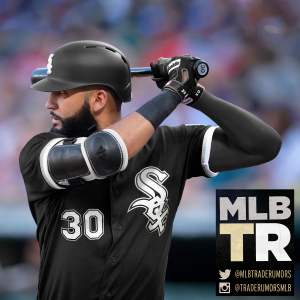
This move represents a bet on Mazara’s long-lauded talent for the South Siders, who’ll hope he can finally break out at the plate after languishing just shy of league average to this point of his career. Mazara is just 24 years of age but is already in his second-to-last season of arbitration eligibility. MLBTR projects a $5.7MM salary.
Mazara has received ample opportunity ever since breaking into the bigs in his age-21 campaign. But through more than two thousand plate appearances at the game’s highest level, he’s hitting just .261/.320/.435 with a steady diet of ~20 home run seasons. That’s certainly not what you’d like to see out of a corner outfielder who isn’t a standout in the field. Mazara has yet to reach 2 WAR for his career. If you’re looking for evidence that Mazara is about to hit his stride, his power did jump in 2019, with a .469 SLG and .200 ISO both career highs. As he approaches his age-25 seasons, there’s certainly time for another developmental leap.
The Chicago organization has announced its intentions to press towards contention in 2020, upping the stakes for this move. Mazara will presumably be asked to handle the lion’s share of the time in right field, joining Eloy Jimenez as a corner outfield regular. No doubt the front office has visions of a breakout, youthful trio emerging when Luis Robert is deemed ready to man center field. Leury Garcia could hold down center to open the season and then step back into a reserve role.
As for the 23-year-old Walker, he’s a recent second-round pick who reached the High-A level last year with the Chicago organization. The former Oklahoma University star slashed .269/.346/.426 in 441 plate appearances for Winston-Salem in 2019. Walker is viewed as a high-quality hitting prospect who has a shot at sticking up the middle. He’s generally considered one of the ten best prospects in a strong White Sox farm. Walker will begin the season in Double-A, per John Blake, the Rangers’ Executive VP of Communications.
Photo courtesy of USA Today Sports Images.
Rangers Exploring Outfield Trades, Pursuing Chirinos Reunion
8:58pm: The Cardinals are also in the mix for Mazara, Jeff Wilson of the Fort Worth Star-Telegram reports. That jibes with their goal of acquiring a lefty-hitting outfielder.
6:17pm: The White Sox are “working hard to land” Mazara, as Jim Bowden of SiriusXM first reported. As for Chirinos, the Astros, Tigers, Rays and Pirates join the Rangers in the market for him, Jon Heyman of MLB Network tweets.
1:04pm: The Rangers have remained busy on the market, with MLB.com’s TR Sullivan reporting that the club is active on multiple fronts (Twitter links). While it stands to reason that the team is still considering moves in the rotation, the attention now is on the position player side after several notable pitching additions.
It has long seemed likely that the Rangers would explore possible swaps involving its existing outfielders. But the team now appears to be engaged in a somewhat dedicated manner. Sullivan says the intention is to “move one of their extra left-handed hitting outfielders,” with Nomar Mazara, Willie Calhoun, and Shin-Soo Choo named as possibilities.
That’s a highly varied group of players. Mazara is a mid-arbitration player that hasn’t turned the corner in the majors but remains quite youthful. Calhoun hasn’t had the same degree of opportunity (and hasn’t logged as much service) but showed well with the bat last year. He’s also still a question mark defensively, as is the aging Choo, who can still hit but isn’t worth the remainder of his big contract.
The Rangers are said to be chatting with the Diamondbacks about some of these players; the clubs were connected last night regarding Mazara. Evidently talks between the Rangers and Marlins didn’t advance. Craig Mish of MLB Network Radio tweets that the Fish were turned off by the asking price for Mazara, a former top prospect.
Meanwhile, there’s “mutual interest” in a new deal with backstop Robinson Chirinos. That’s rather an interesting development, considering the Texas organization surprisingly declined its option over him last fall. The replacement plan fell apart, as MLBTR’s Connor Byrne explored, while Chirinos flourished with the cross-state Astros.
The 35-year-old Chirinos and the Rangers are amply familiar with one another, as he played with the team for six seasons. It seems the sides carry no ill will over the way things ended. The catching market has moved rather swiftly to this point, leaving Chirinos and Jason Castro as the top available options.
Diamondbacks Notes: Haniger, Mazara, Akiyama, Bullpen
“The Diamondbacks are said to have interest in both” Mitch Haniger and Nomar Mazara, Nick Piecoro of the Arizona Republic writes. Either player would address Arizona’s need for a right fielder, and though the D’Backs would be taking something of a risk either both are coming off disappointing 2019 seasons. Haniger didn’t play after June 6 due to a ruptured testicle, and even in the 283 plate appearances prior to his injury was already delivering less production than during his impressive 2017-18 campaigns. Mazara has been a steadily subpar offensive performer (92 wRC+, 93 OPS+) over his four career seasons with the Rangers, hitting .261/.320/.435 with 79 homers over 2189 PA and generating only 1.7 total fWAR.
That said, both offer upside for interested trade partners. Mazara is a former top prospect and he has hit right-handed pitching decently well, which Piecoro notes is an area of need for the D’Backs. Haniger, of course, is a known quantity in Arizona — he broke into the big leagues with the Snakes and then was dealt to the Mariners as part of the November 2016 trade that brought Ketel Marte to the desert. Mazara has two remaining years of arbitration eligibility, while Haniger is arb-eligible for the first time this winter (and at a projected $3MM price tag, so his rough 2019 season also lowered his ceiling for future arbitration earnings). While Seattle is at least open to discussing Haniger in trades, GM Jerry Dipoto still highly values Haniger, so a deal wouldn’t come easily for the Diamondbacks. It would seem that Mazara would be the more available of the two options, as Texas has been rumored to be looking to deal from its surplus of left-handed hitting outfielders.
Here’s more from Arizona…
- In terms of what the D’Backs might give up for Haniger, Mazara, or any other veteran upgrades, GM Mike Hazen indicated that his team is “willing to” part with some “good minor league players.” Piecoro suggests that the team wouldn’t be likely to trade its very top prospects, but would be open to dealing youngsters “from the next tier down” in the rankings. It is perhaps noteworthy that the three names Piecoro cites as “the players [the Diamondbacks] view as their best prospects” are Daulton Varsho, Geraldo Perdomo, and Corbin Carroll, whereas two other prospects (Alek Thomas and Kristian Robinson) occupy the top two spots on MLB Pipeline’s ranking of Arizona’s top 30 minor leaguers, though Piecoro said “perhaps others” are also in the team’s internal top tier.
- Beyond right field, the Diamondbacks are also on the lookout for center field help. While Marte played both center field and second base last year, Hazen told The Athletic’s Zach Buchanan (Twitter link) and other reporters that he would prefer to land a center fielder to lighten the load on Marte. Shogo Akiyama has been mentioned as a potential target for the D’Backs, though Hazen said that he hasn’t yet met with the Japanese center fielder and doesn’t have meetings scheduled for the future.
- Hazen told Piecoro and other reporters that after signing Junior Guerra, the D’Backs are still looking for “one more” reliever. Archie Bradley pitched well enough in the closer role last year that a new reliever doesn’t necessarily require closing experience to be considered, though Hazen said that a reliever that could be used “toward the back end [of the bullpen] would be ideal.”
Quick Hits: Astros Investigation, Minor Leagues, Manfred, Rangers
As part of an organized probe into Houston’s alleged use of technology to steal signs, investigators under the direction of commissioner Rob Manfred met with “15-20” Astros personnel this past week, according to Tom Verducci of Sports Illustrated. Members of the club’s 2017 coaching staff, including manager A.J. Hinch, were among those to interview with investigators, with a source familiar with the investigation telling Verducci that Mike Fiers’ description of the club’s sign-stealing operation has proven accurate. According to Verducci’s report, the scheme–which is said to have relied upon a center-field camera, dugout televisions, and trashcans to signal forthcoming pitches to club hitters–was used for a period of “about three months” in 2017, but investigators are still trying to determine whether the club deployed this system during the playoffs.
A separate investigation is looking into a directive from a Houston front office employee, Kevin Goldstein, to club scouts that suggested the use of cameras to surveil opposing dugouts in 2017. As Verducci’s piece notes, these investigations could have a wide-ranging impact on the broader role of technology in today’s game, where laptops, monitors, and cameras are omnipresent in team clubhouses and video rooms.
A few other items of note from around the game…
- Speaking of the commissioner, Manfred spoke with reporters Thursday at the owner’s meetings in Arlington, with several interesting comments on the league’s proposed reorganization of Minor League Baseball, as relayed by Baseball America’s Kyle Glaser. As Manfred tells it, the league’s overture toward the contraction of 42 minor league affiliates was made in response to four key problems plaguing their system–namely, poor facilities, long travel times, low pay, and a lack of realistic opportunity for many players to make the majors. Manfred doesn’t take kindly to the response issued by minor league officials to the league’s suggested plan–which reportedly would include not only contraction but also the creation of a “dream league” for undrafted players–but he still feels bullish about the ability of both parties to conclude a new working arrangement. “But at the end of the day Minor League Baseball needs to make an agreement with us and I’m sure we probably will make an agreement at some point,” said Manfred. MiLB President Pat O’Conner may not take as rosy of an outlook to this ongoing process, with his recent comments conveying suspicion in regard to the league’s plan. In quotes relayed by The Athletic’s Evan Drellich on Oct 19, O’Conner characterized the plan as a “death sentence” for the 42 teams affected, while also suggesting that the league’s proposed restructuring represents an attempt by MLB to exert more control over the minor leagues.
- Meanwhile, also in Texas, an offseason event allowed Evan Grant of the Dallas Morning News to speak with several Rangers players, including Taylor Hearn and Nomar Mazara (Twitter links). Hearn, who just wrapped an injury-wrecked 2019 that included an inflamed UCL and a fracture underneath his elbow, told Grant that he threw four bullpens in October, followed by a few weeks of rest. Hearn has resumed his throwing program and should be ready to prep for 2020. The 25-year-old lefty appeared in just four minor league games this season, also making his MLB debut in an April 25 start that lasted one-third of an inning. As for Mazara, club officials apparently told the 24-year-old during his 2019 exit interview that he should prepare to play some first base next season. Mazara told Grant that he is prepared to do some work at first, but he is still expected to be used primarily as an outfielder moving forward. Mazara has generally graded out as a slightly below-average defensive option on the grass, recording -2.7 UZR and -4 DRS figures in right field last season. The Rangers have been connected to outfielder Marcell Ozuna this winter, while trade rumors connected Mazara’s name to several teams in advance of this past season’s July 31 trade deadline.
Rangers Plan To Increase Payroll, Could Trade An Outfielder
The 2019 season, in many ways, was a pleasant surprise for the Rangers. While the season’s second half was forgettable in terms of the club’s record, the Rangers saw some individual performances that offered encouragement heading into 2020. Mike Minor and Lance Lynn had impressive seasons while pitching on affordable contracts. Joey Gallo proved himself capable of handling an outfield spot — perhaps even center field. Willie Calhoun rebounded and looks like a quality bat moving forward. Minor league pickups Danny Santana and Hunter Pence enjoyed terrific seasons, and Santana can be controlled through 2021. One of the prior offseason’s bargain pickups, Chris Martin, was flipped to the Braves for a potential long-term option in the rotation (Kolby Allard).
At the same time, one can’t ignore the team’s second-half slide or the ugly seasons turned in by a number of players the organization once tabbed as building blocks. Elvis Andrus and, in particular, Rougned Odor had poor seasons. Ronald Guzman didn’t step up and seize the team’s first base job. Most of the team’s fliers on low-cost pitching acquisitions (e.g. Shelby Miller, Drew Smyly, Edinson Volquez) failed to pan out, and the farm system didn’t yield better alternatives. For all the bright spots, the Rangers have clear areas in which they need to improve.
That was a focal point for president of baseball operations Jon Daniels in meeting with the media in today’s postmortem press conference (link via Jeff Wilson of the Fort Worth Star-Telegram). The season offered some undeniable bright spots, but the club also has a “clear opportunity” for some upgrades at third base, first base and in the rotation, Daniels said. Of the team’s needs, third base and the rotation standing out as “probably the top two on the list,” Daniels said before also citing catcher and the bullpen as positions that could at least use some depth additions.
Third base indeed seems like a prime spot for the Rangers to pursue upgrades; Texas third basemen hit .243/.310/.389 this season, which, when accounting for their hitter-friendly home park, translates to a paltry 76 wRC+ — or 24 percent worse than a league-average hitter. Deadline pickup Nick Solak could be an intriguing option, but there are questions about his glovework and he’s tallied just 135 plate appearances in the Majors.
In the rotation, the Rangers don’t have much in the way of options beyond Minor, Lynn and Allard. Adrian Sampson and Ariel Jurado scarcely kept their ERAs under 6.00, and many of the team’s top pitching prospects have battled injuries. That trend, in fact, will continue to a minor extent with top pitching prospect Hans Crouse undergoing surgery to remove a bone spur from his pitching elbow (Twitter link via Evan Grant of the Dallas Morning News). Crouse isn’t expected to have his 2020 availability impacted, and he won’t be an option given that he’s yet to pitch in Double-A. But the team’s general lack of upper-level pitching depth should force them into pursuing some rotation additions in free agency and/or trade.
The extent to which the Rangers can look for reinforcements in free agency will be determined by how much ownership allows Daniels & Co. to spend this winter. While there’s no specific budget in place, Daniels made clear that he’ll have more resources at his disposal this winter. “Our major-league payroll will be up from where it was this year,” said Daniels, adding that he hasn’t been given a firm number to beyond that but more of a “general range.”
The Texas organization spent much of the 2018-19 offseason working to cut payroll and managed to dip its Opening Day mark to a bit more than $118MM — the lowest point since way back in 2011. The Rangers’ high-water mark for payroll came with 2017’s Opening Day mark of $165MM. A return to those heights can’t be assumed, but that probably provides a rough idea of a ceiling (even if it’s safer to assume a more modest total).
Whatever the number, the Rangers should have the freedom to try to pursue a wide number of free agents. If Gerrit Cole and Anthony Rendon are deemed too expensive, the market will bear some high-caliber fallbacks in the form of Madison Bumgarner, Zack Wheeler and Josh Donaldson. Texas could certainly backload any free-agent additions such that the salary escalates more aggressively in 2021 when Shin-Soo Choo, Minor, Jesse Chavez and Jeff Mathis are off the books.
Alternatively, trading from their surplus of left-handed-hitting corner outfielders could free up some additional space. Daniels acknowledged as much in candid fashion, stating that “when everyone’s healthy we have more left-handed-hitting corner guys than we have spots.” He cautioned that a trade isn’t a foregone conclusion but is also something he’ll have to explore.
Surely, the Rangers would be loath to move either Gallo or Calhoun, but Choo and his $21MM salary or the perennially underwhelming Mazara (.268/.318/.469, 94 wRC+ in 2019) could make sense. Choo is overpaid, to be sure, but he still posted a .265/.371/.455 line with 24 home runs in 660 plate appearances. Mazara, meanwhile, has never delivered on his premium prospect pedigree but still won’t turn 25 until next April despite having four years of MLB service. Other teams will quite likely view him as a buy-low candidate given that pedigree, his modest salary — he’ll earn a raise on this year’s $3.3MM price — and the fact that he’s controlled through 2021.
It’s also worth noting that at a time of year that is frequently punctuated by turnover in the coaching department, the Rangers won’t be making any changes. MLB.com’s T.R. Sullivan tweets that Daniels has invited all of manager Chris Woodward‘s coaching staff back for the 2020 season. So while the composition of the Rangers’ roster will quite likely look quite a bit different in 2020, the group guiding that roster should be a source of stability.
Rangers Place Nomar Mazara on IL, Purchase Nick Solak’s Contract
Following an early exit from last night’s game, Rangers outfielder Nomar Mazara will head to the injured list with a strained left oblique muscle, per Evan Grant of the Dallas Morning-News (link). The team has purchased the contract of infielder Nick Solak in a corresponding move.
This sequence of moves has been suspected since last night when Mazara went down. It’s been a difficult season for Mazara, with these last few weeks particularly trying as the Rangers have cut into his playing time in an open audition to get more production from his spot in the lineup. The 24-year-old outfielder was a star-in-the-making not all that long ago, but he has yet to improve much in any aspect of his game since his rookie season in 2016.
Still, it’s not all doom-and-gloom for Mazara, who was headed for a fourth-straight 20-homer campaign had he stated healthy. Depending on the length of his layoff, he’ll still have a decent shot at notching the three home runs needed to hit the mark in 2019. On the whole, the power has been there for Mazara this season, with .467 slugging and .197 ISO both career-high marks. The rest of his game has maintained an almost bizarre consistency for a player so young. He’s sitting right now at a 95 wRC+ mark–right in line with his previous three marks of 96, 89, and 91 in seasons dating back to 2016. Unfortunately, that’s not quite enough pop from a corner outfielder who doesn’t rate well on defense or on the basepaths.
Solak is penciled into the 6th spot in the batting order to make his major league debut today. He is listed right now as the designated hitter, though much of his perceived long-term value stems from his defensive versatility. Throughout his minor league career, he has shuttled between second base, left field, and centerfield, while seeing an occasional inning at third or in right. It’s a good time to be debuting in Texas: yesterday alone, Jose Trevino, 26, smashed his first career home run, Scott Heineman, 26, registered his first career RBI, and Isiah Kiner-Falefa, 24, ended the night with his first career walkoff knock.
Joe Palumbo has also been added to the roster today to serve as the 26th man for the twin bill against the Angels – one of two rookie starters taking the hill in today’s doubleheader. Palumbo lines up against Andrew Heaney in the afternoon tilt. It will be Palumbo’s 4th appearance of the year for the Rangers, having been hit hard for 11 earned runs across 9 innings of work. Despite the slow start at the ML level, the 24-year-old native of New York state is highly-regarded. MLB.com lists Palumbo as the 6th-best prospect in the Texas system, while Baseball America ranks him 4th.
Danny Santana, Nomar Mazara Exit With Injuries
TUESDAY: Santana’s confident he won’t miss time, according to manager Chris Woodward, but it doesn’t appear Mazara will be as fortunate. His oblique injury is similar to (but not as severe as) the strain that sent teammate Joey Gallo to the IL in June. Gallo wound up sitting out just over three weeks (via Jeff Wilson of the Fort Worth Star-Telegram).
MONDAY: Rangers utilityman Danny Santana and outfielder Nomar Mazara left the team’s game Monday with injuries that seem as if they could lead to IL stints. Santana departed with left hamstring tightness, while Mazara succumbed to tightness in his left oblique. Should at least one of those players end up on the shelf, the Rangers are prepared to promote infield/outfield prospect Nick Solak from Triple-A Nashville, TR Sullivan of MLB.com suggests. Nashville pulled Solak from its game Monday.
At 60-64, the Rangers’ once-legitimate postseason hopes are now dead. But Santana has done everything in his power this season to help propel the Rangers back to prominence. The 28-year-old switch-hitter has slashed .305/.333/.576 with 21 home runs and 13 steals (on 19 attempts) over 376 plate appearances. Between Santana’s offensive production and his defensive versatility (he has appeared in double-digit games in the outfield, at first and at second), he undoubtedly looks like one of the best bargain signings of last offseason. Texas inked the former Twin and Brave to a minor league deal after a couple rough seasons, and the Rangers will be able to control him two more times via arbitration.
This season hasn’t been as prosperous for Mazara, who still hasn’t lived up to the considerable hype he garnered coming up through the Rangers’ system. While the fourth-year man has been on a tear of late, his overall .268/.318/.466 line with 17 HRs in 443 is merely mediocre. There have been rumblings about the Rangers possibly trading the 24-year-old Mazara, who has another two seasons of arb control left. That could be a situation to watch over the winter, but for now, the sizzling Mazara will hope to stay off the IL.
In the event that doesn’t happen, Solak, 24, could crack a big league roster for the first time. He’s just over a month into his tenure with the Rangers, who acquired him from the Rays on July 13 in a swap for young righty Peter Fairbanks. It was already the second trade involving Solak – a 2016 second-round pick whom the Yankees sent to the Rays in a three-teamer back in 2018.
Solak may yet emerge as a regular in Texas, with FanGraphs placing him just outside the game’s top 100 prospects and contending he’ll at least turn into “an average everyday second baseman.” Solak has made a strong case for a promotion by raking since he got to Nashville, where he has slashed an eyebrow-raising .357/.390/.670 with 10 home runs in 124 trips to the plate. Even in the offense-driven Pacific Coast League, Solak’s production has been 48 percent above average, according to wRC+.
AL West Notes: Mazara, Mariners, K. Calhoun
Nomar Mazara has gone from an expected foundational piece with the Rangers to a platoon outfielder whose future is somewhat up in the air, Evan Grant of the Dallas Morning News writes. Texas is committed to getting lengthy looks at Willie Calhoun and Scott Heineman in the outfield, and when Joey Gallo returns from the IL, he’ll reenter the outfield mix as well. Mazara, meanwhile, has the worst OBP against left-handed pitching of any qualified hitter in the AL and ranks near the bottom in terms of average and slugging as well. He’s nearing the conclusion of his fourth full year in the big leagues, and while he’ll likely put together his fourth 20-homer season — he’s at 15 presently — he’s never produced even a league-average offensive season based on OPS+ or wRC+. He’ll be arbitration-eligible for the second time this winter and earn a raise on this year’s $3.3MM salary. Texas has some in-house alternatives and the ability to spend in free agency, and Mazara drew some interest prior to the July 31 trade deadline. It’d be painful to sell low on the former top prospect, but it’s clear that his stock has dropped considerably.
Some more news and notes from the AL West…
- Asked during a conference call about the Mariners‘ plans in free agency this winter (link via Ryan Divish of the Seattle Times), general manager Jerry Dipoto replied: “We don’t expect to go into the offseason scouring the free-agent market at the top of the food chain.” That shouldn’t be a particularly surprising stance for anyone to see, as the Seattle club has made it abundantly clear that its rebuild will be a multiyear process. With Felix Hernandez‘s contract coming off the books and just over $86MM committed to next season’s payroll at present, the Mariners will have plenty of money to spend, but those funds seem likelier to be allocated to stopgaps, potential summer trade chips and/or mid-range free agents than to any top-tier talent. As Divish points out, Seattle would have overpay (substantially, most likely) in order to sway any free agent to join a club that just lost 90-plus games and is publicly rebuilding.
- The Mariners will consider moving to a six-man rotation in the near future, MLB.com’s Greg Johns writes. Well-regarded pitching prospects Justus Sheffield and Justin Dunn, acquired in the offseason deals for James Paxton and Edwin Diaz, respectively, will likely join the club by September. Felix Hernandez, too, could return in September. Such an arrangement could help Seattle in monitoring the workload of rookie Yusei Kikuchi and also preventing Marco Gonzales from a radical increase in his innings count from 2018. Sheffield was given a reprieve from the comically hitter-friendly Pacific Coast League recently and has dominated Double-A opposition with a 1.64 ERA and 65-to-14 K/BB ratio in 60 1/3 innings of work. Dunn has also spent the year in Double-A, compiling 100 1/3 innings of 3.59 ERA ball with 10.7 K/9 against 2.8 BB/9.
- Angels right fielder Kole Calhoun knows that with Jo Adell looming, the team has an affordable alternative to his $14MM club option, but he tells Mik DiGiovanna of the L.A. Times that he’s focused more on his current play than his contractual status. “I’m worried about playing now, and what happens will happen,” said Calhoun. “[Adell] is definitely a great player. He’s a young guy, and we’ll see how he continues to develop, but the talent is there. He’s going to be a big league player for a long time.” Calhoun has been the Angels’ primary right fielder since 2014 and, with the exception of a down season in 2018, has been a generally underrated player. Still, it’s questionable whether the Angels or another club would value him at a net $13MM — the option has a $1MM buyout — in advance of his age-32 season. Free agents entering their mid-30s haven’t fared well in recent years, and corner bats in particular have struggled on the open market. Calhoun’s case is surely helped by the fact that a good bit of his value is tied to his glove and a 10.2 percent walk rate across the past four seasons.