
AL Notes: Cora, Red Sox, Indians, Blue Jays
Ex-Red Sox manager Alex Cora was just suspended for 2020 thanks to the role he played as the Astros’ bench coach during their 2017 sign-stealing scandal. Red Sox chief baseball officer Chaim Bloom and president Sam Kennedy made it sound earlier this week as if they wouldn’t bring Cora back at the end of his ban, but Kennedy may be open to it after all (via Chris Cotillo of MassLive.com). Kennedy told “Ordway, Merloni & Fauria” of WEEI that Cora’s “a great baseball manager.” As for whether the Red Sox would rehire him, Kennedy said: “We’ll talk about that down the road. We just removed Ron Roenicke’s interim tag and he’s going to lead our club going forward. I think a lot of Alex’s future depends on how he approaches this suspension period.” For at least this season, Roenicke – Cora’s former bench coach – will manage the team.
More on a couple other American League franchises…
- The Indians have taken a step to compensate the majority of their employees for the foreseeable future during the COVID-19 pandemic. They’ve committed to paying their full-time staff their entire salaries through at least the end of June, Jeff Passan and Kiley McDaniel of ESPN.com report. Forty of the Indians’ senior staff members took pay cuts so the rest of the full-time staff could receive their typical salaries. The Indians have furloughed part-time workers and interns, on the other hand, but they could make the same amount of money or even more by way of unemployment benefits, according to Passan. While most of the league’s teams have committed to paying their non-player employees through May, the Indians are among the few that we know will extend beyond that point.
- As a result of the season postponement, two fans recently filed a lawsuit against all 30 MLB teams and ticket companies StubHub, Ticketmaster, Live Nation, and Last Minute Transactions because they haven’t been able to get a refund for tickets purchased for 2020. The Blue Jays are not among the teams that have refused to give fans their money back, however, president Mark Shapiro told Gregor Chisholm of the Toronto Star. “We have fielded every single call and whenever there has been a hardship, or a circumstance, that has necessitated a refund, we have refunded those tickets,” said Shapiro, who added, “We have not fought any of those and will continue to do that.” Shapiro’s under the impression that the league’s “very close” to announcing “a broader policy on refunds and exchanges.”
The Blue Jays’ Uncertain Outfield Mix
When the Blue Jays were at their peak in 2015-16, the outfield wasn’t much of an issue. Jose Bautista was holding down right field as one of MLB’s most feared hitters — the brash owner of a .243/.372/.499 slash line that underscored his patience at the plate and his thunderous power. In center field, Kevin Pillar was a staple on highlight reels thanks to a superhuman defensive prowess that led to his gaudy 38 Defensive Runs Saved in that two-year stretch. Pillar’s .272/.309/.388 slash wasn’t particularly impressive, but paired with his world-beating defense, that made him a plenty valuable player on the whole.
Left field was a bit shakier, if only because of persistent injury troubles for the since-retired Michael Saunders. More often than not, Saunders was in the lineup, though the Jays also trotted out Ben Revere, Ezequiel Carrera and Danny Valencia at times. That was the closest they’ve come to any real inconsistency in that time.
That continuity feels like a distant memory now, as the Jays have since turned over their entire outfield mix on multiple occasions and yet still don’t have much certainty. It appears likely that 2019 breakout slugger Lourdes Gurriel Jr. will get the first look in left field whenever play resumes. His 2019 season at the plate was undeniably impressive — .277/.327/.541, 20 homers in 343 PAs — but it also came in a season that was skewed by a juiced ball. Gurriel’s glovework didn’t rate well, either, though he’s a converted infielder so perhaps there’ll be an uptick with more experience.
Center field seems likely to go to Randal Grichuk, though at this point that’s because of his contract more than his recent play. The Jays signed Grichuk to a surprising extension last spring, and Grichuk responded with a career-worst .232/.280/.457 slash. That .280 OBP was the worst in baseball among qualified hitters. Even without a 2020 season, Grichuk would still be owed $29MM from 2021-23, so he’s sure to get a chance (or multiple chances) at redemption — but a replacement-level showing in year one of the deal isn’t what the Jays had in mind.
The remaining outfield options (in alphabetical order):
- Anthony Alford, drafted in third round (2012): A two-sport star who could’ve pursued a career in football as well, Alford has received just 59 plate appearances in the past three seasons and now finds himself out of minor league options. Alford was a top 100 prospect each year from 2016-18, but he’s yet to even hit in Triple-A and now has no clear path to playing time in such a crowded mix.
- Jonathan Davis, drafted in the 15th round (2013): Davis will turn 28 in a few weeks and has just 122 MLB plate appearances to his credit (with a .185/.264/.259 slash). Davis runs well and has shown a patient eye at the plate in the upper minors, but he’s been a roughly average bat in Triple-A and seems more like a fourth outfielder than a big league regular.
- Brandon Drury, acquired from Yankees in exchange for J.A. Happ: As recently as 2016-17, Drury looked like a solid multi-positional piece with the D-backs. Since hitting .275/.323/.453 in that stretch, though, he’s been traded to the Yankees and then the Jays, hitting just .210/.261/.362 in 533 plate appearances along the way. Drury popped up an astonishing 21 times in just 447 plate appearances this past season, and his strikeout rate has risen from 20 percent in ’16 to 25.3 percent in ’19.
- Derek Fisher, acquired from the Astros in exchange for Aaron Sanchez, Joe Biagini: With George Springer, Josh Reddick, Michael Brantley, Jake Marisnick and Kyle Tucker all ahead of him during his time with Houston, Fisher never got much of a chance. Like McKinney, he’s not fooled by Triple-A pitching (career .289/.379/.520), but Fisher has whiffed in nearly 37 percent of his 419 Major League plate appearances — including a 40.2 percent mark in 107 PAs with Toronto. He, too, is out of minor league options.
- Teoscar Hernandez, acquired from the Astros in exchange for Francisco Liriano: Hernandez came to the Jays as an exit-velocity darling and still makes plenty of good contact, but his hard-hit rate and average exit velo did trend in the wrong direction last year. His strikeout issues aren’t as pronounced as those of Fisher, but Hernandez has punched out at a 32 percent clip in just shy of 1000 Blue Jays plate appearances.
- Billy McKinney, acquired from Yankees in exchange for J.A. Happ: A former first-round pick (Athletics, 2013), McKinney has been traded from Oakland to Chicago to New York to Toronto — never receiving a real big league opportunity prior to Toronto. He’s since appeared in 120 games and taken 404 plate appearances with the Jays, but he’s mustered a tepid .227/.289/.437 slash in that stretch. McKinney has consistently hit Triple-A pitching, but that hasn’t stopped the Jays from acquiring new outfield options to join the competition.
The Jays have a potential breakout candidate in left field (Gurriel), a rebound candidate in center (Grichuk) and what seems competition brewing in a make-or-break year for many of their remaining players. The DH spot will give them some extra opportunities to evaluate all of their options from an offensive standpoint, but they’ll also want to get a look at Rowdy Tellez in that spot.
Both Alford and Fisher need to remain on the big league roster or else be exposed to waiver, while Hernandez and McKinney each have just one option year remaining. Drury is more of a utility option than an everyday piece in the outfield, but he was already in danger of being non-tendered this winter and is down to his final option year as well.
On the whole, it’s a rather underwhelming cast of characters despite the club’s considerable efforts to bring together a mix of intriguing, often post-hype outfield candidates. Between this group’s eroding minor league options and talk of Cavan Biggio eventually moving to the outfield — although defensive metrics thought his work at second base was plenty good in ’19 — it’s possible that no one from this set of players will be a part of the next contending outfield unit in Toronto.
The Jays already made one aggressive, win-now move this winter when they signed Hyun-Jin Ryu, and team president Mark Shapiro recently indicated that the Jays could use a center field upgrade. If this group can’t get it done whenever play resumes, it seems likely that Shapiro, GM Ross Atkins and the rest of the front office will be left with little choice other than pursuing more established options now that the club is moving away from its rebuilding phase.
Quick Hits: Bautista, Holland, Pirates, MLB Economics
We’ll round up a few notes from around baseball this weekend.
- Last month, ESPN’s Jeff Passan reported that José Bautista had been eyeing a return as a two-way player. While his hope of representing the Dominican Republic in the Olympic qualifying tournament was dashed by the event’s postponement, Bautista doesn’t appear to be giving up his two-way dream. He tells Sportsnet he would consider trying the dual role in the 2021 World Baseball Classic. Interestingly, he seems open to the idea of representing Team Spain (his father is a Spanish citizen, thus granting him eligibility), Sportsnet adds, if the Dominican team doesn’t offer him a roster spot. The former Blue Jays’ star admitted it’d be a long shot for him to ever pitch in the majors, but noted he’d be “ready just in case.”
- Derek Holland was on track to crack the Pirates’ season-opening rotation prior to the shutdown, reports Jason Mackey of the Pittsburgh Post-Gazette. He’d likely have slotted in behind Chris Archer, Joe Musgrove, Trevor Williams and Mitch Keller for first-year manager Derek Shelton. If the 2020 season is indeed played, Holland would presumably still figure to grab a roster spot, particularly since any playing scenario is likely to involve significant roster expansion. Holland’s minor-league deal originally called for a $1.25MM base salary if he were to make the club, reported ESPN. As MLBTR’s Jeff Todd explained this week, though, player salaries would be paid on a prorated basis in the event of a shortened season.
- Major League Baseball economics are sure to be rocked by the coronavirus hiatus, notes Alex Speier of the Boston Globe. It’s obviously too early to know exactly how teams, players and the league will respond to the loss of gate receipts. Nevertheless, Speier speaks with a handful of sports economists (and Scott Boras) about ways in which MLB could look to mitigate their losses in attendance revenue. As former SABR president Vince Gennaro points out, fan-free games might force teams to explore innovative media packages as alternatives to in-person attendance. Speier’s piece is well worth a full perusal for those interested in the sport’s economic future.
Blue Jays Notes: 2015 ALDS, Borucki, Pearson, Ryu
In a piece that any Blue Jays fan will want to read, Sportsnet’s Shi Davidi chatted with right-hander Anthony Bass about what it was like to be on the other side of Toronto’s stunning ALDS comeback against the Rangers in 2015. Bass wasn’t on Texas’ ALDS roster, Davidi notes, but he was on hand as a member of the taxi squad and experienced the stunning defeat first-hand. Bass chronicles the manner in which tensions began to boil from Game 1 of the series all the way through the baffling (but within the rules) play that allowed Rougned Odor to score on a throw back to the pitcher and the three errors that set up Jose Bautista‘s iconic bat flip a half inning later. Bass called Bautista’s bomb “a dagger” and likened the Rangers’ clubhouse in the wake of that defeat to a morgue. Joining the Jays on a waiver claim nearly a half decade later didn’t conjure up any bad memories for Bass, who explained that he was simply “excited about how much the organization was happy to have me.” It’s an excellent first-hand look back at one of the most epic games in recent memory and a welcome diversion from our current baseball-free landscape.
Some more notes on the Jays…
- Although the Blue Jays shut down left-hander Ryan Borucki in Spring Training due to tightness in his left elbow, but manager Charlie Montoyo revealed today that Borucki is feeling “great” and hasn’t had any setbacks in working his way back from that hiccup (Twitter link via Sportsnet’s Ben Nicholson-Smith). The 26-year-old Borucki should be a candidate for the fifth spot in the rotation behind Hyun-Jin Ryu, Chase Anderson, Tanner Roark and Matt Shoemaker in a dramatically overhauled Jays rotation. Borucki broke into the Majors with 97 2/3 innings of 3.87 ERA/3.80 FIP ball in 2018, but elbow troubles limited him to just 6 2/3 innings last year.
- Of course, many Blue Jays fans are more curious about exactly when uber-prospect Nate Pearson will arrive in the Majors. General manager Ross Atkins touched on that subject a bit when stepping in as the host for Gregor Chisholm’s reader mailbag at the Toronto Star this week. Asked how the delayed season will impact Pearson, who was expected to be on an innings limit in 2020, Atkins explained that rather than stick to a rudimentary and “rigid” innings limit, the organization is more focused on “monitoring fatigue, workload, and effort” with all of their pitchers but perhaps particularly with Borucki and Shoemaker (who is returning from a torn ACL that cost him most of the 2019 season). Asked whether with hypothetical advance knowledge that the season would be up in the air, the Jays still would have still signed Ryu to a four-year pact, Atkins indicated that the signing was as much about 2021 and beyond as 2020 and doubted the Jays’ offseason plans would’ve radically altered. Other topics include the upcoming draft, Atkins’ own day-to-day routine during the shutdown and the ways in which his own approach to player development has evolved over the years.
Offseason In Review: Toronto Blue Jays
The Blue Jays’ quest to overhaul their pitching staff led to one of the biggest signings in franchise history.
Major League Signings
- Hyun-Jin Ryu, SP: Four years, $80MM
- Tanner Roark, SP: Two years, $24MM
- Travis Shaw, IF: One year, $4MM
- Rafael Dolis, RP: One year, $1MM ($1.5MM club option for 2021)
- Total spend: $109MM
International Signings
- Shun Yamaguchi, SP/RP: Two years, $6.35MM (plus $1.27MM to the Yomiuri Giants as a transfer fee)
Trades And Claims
- Acquired SP Chase Anderson from the Brewers for 1B prospect Chad Spanberger
- Acquired cash considerations from the Reds for RP Justin Shafer
- Claimed RP Anthony Bass off waivers from the Mariners
Notable Minor League Signings
- Joe Panik (contract was selected to MLB roster, guaranteeing Panik’s $2.85MM salary), A.J. Cole, Justin Miller, Caleb Joseph, Marc Rzepczynski, Ryan Dull, Jake Petricka, Ruben Tejada, Brian Moran, Patrick Kivlehan, Andy Burns, Phillippe Aumont
Notable Losses
The 2019-20 offseason represented a turning point in the Blue Jays’ rebuild process, as Toronto cast a very wide net in search of upgrades both large and small. The Jays were linked to just about every available pitcher, and also looked into such notable position player trade targets and free agents as Francisco Lindor, Yasmani Grandal, Didi Gregorius, Mike Moustakas, and former Toronto favorite Edwin Encarnacion.
It was a big push from a team coming off three consecutive losing seasons, and one that didn’t necessarily announce an intent to be a full-on contender in 2020. Back in February, Jays president/CEO Mark Shapiro stated that even a “.500 [record] would be a big step forward” for a club that only went 67-95 last season, yet it’s clear that management has a lot of faith that its young core of players can get the Blue Jays back into the playoff hunt sooner rather than later.
This set the stage for Hyun-Jin Ryu’s four-year, $80MM contract. It was the seventh-richest contract given to any free agent this winter in terms of total dollars, and it also marked the third-largest deal the Jays have given to any player. It was a big commitment to make to a 33-year-old pitcher with a lengthy injury history, though Ryu brings genuine top-of-the-rotation ability when healthy. Ryu’s 182 2/3 innings pitched in 2019 was the second-highest total of his career, and he finished second in NL Cy Young Award voting after posting a 2.32 ERA, 6.79 K/BB rate, and 8.0 K/9.
While $80MM is a sizeable expenditure for any team, Ryu’s deal is one the Blue Jays could somewhat comfortably afford to make, given their lack of long-term payroll commitments. By this token, it could be argued that the Jays could have made another splashy signing (or trade) beyond just Ryu, though the counter to that argument is that Toronto perhaps still wants to see what it truly has in its young players. As promising as Vladimir Guerrero Jr., Lourdes Gurriel Jr., Bo Bichette, and Cavan Biggio are, the quartet has combined for only 418 Major League games — the four players have only appeared in the same starting lineup eight times. Between this lack of experience and the fact that the likes of Teoscar Hernandez, Danny Jansen, or Rowdy Tellez have yet to break out, it makes sense that the Jays didn’t want to go overboard in building around a foundation that may not yet be entirely stable.
That said, some extra willingness to build was required given the escalating prices in free agency, and the simple fact that the 2019-20 offseason moved at a much quicker pace than the previous two winters. As noted by Sportsnet’s Shi Davidi back in February, GM Ross Atkins essentially changed tactics midway through the offseason, as failing to adapt to the changing marketplace would have left the Jays without the pitching help they so badly needed.
Ryu was the biggest addition, though Tanner Roark brings some more innings-eating veteran experience to the rotation. The Blue Jays also went overseas to add pitching, signing Shun Yamaguchi to a two-year contract after the right-hander was posted by the Yomiuri Giants. At the time of the COVID-19 shutdown, Yamaguchi was being targeted for the bullpen, though it could have been something of a long relief or swingman role to keep him stretched out for possible starts.
Between these three signings and Chase Anderson (acquired in a trade with the Brewers in early November), Toronto’s pitching situation looks far more solid than it did last season, when injuries and inexperience resulted in the Jays getting just 711 1/3 innings from their starting pitchers, the third-lowest total in baseball. None of Roark, Anderson, Yamaguchi, and Matt Shoemaker are controlled beyond the 2021 season, leaving a lot of flexibility within the rotation for younger pitchers to eventually move into the picture — most prominently, one of the sport’s best pitching prospects in Nate Pearson.
Yamaguchi’s availability in the bullpen helps strengthen a relief corps that also added Anthony Bass, A.J. Cole, old friend Marc Rzepczynski, and Rafael Dolis to the mix. Dolis was the only MLB signing of that trio, inking a $1MM deal to return to North America after four dominant years pitching out of the Hanshin Tigers’ bullpen.
Perhaps the biggest reliever-related headline for the Blue Jays was a move that didn’t happen, as Ken Giles is still in a Toronto uniform. The closer was widely expected to be dealt over the winter, though a lack of early interest seemed to carry through the entire offseason. It could also be that the Jays changed their view on trading Giles after the Ryu signing raised expectations for a competitive season, or at worst, the club figured they could still move him at the trade deadline.
Now, of course, that plan has been entirely altered since we don’t know when a 2020 trade deadline could fall, or whether the 2020 season will be played whatsoever. If the season is indeed cancelled, Giles will still be eligible for free agency as scheduled, leaving the Jays in danger of losing him for nothing. (The Jays could receive a draft pick if Giles rejected a qualifying offer, or Giles could even accept a QO and stay with Toronto, though it remains to be seen if the club would want to pay Giles such a hefty one-year salary.)
Given the flirtations with the likes of Lindor and Moustakas, Travis Shaw could certainly be seen as an underwhelming choice as the Blue Jays’ most notable new position player. Shaw is coming off a terrible 2019 season, though the Jays are betting that year was an aberration considering Shaw’s track record over his previous four MLB campaigns. Shaw will essentially replace Justin Smoak as the regular first baseman, though Shaw’s ability to play third base and second base gives manager Charlie Montoyo the ability to shuffle his lineups.
Multi-position versatility was a stated priority for Atkins heading into the offseason, which also led to Joe Panik being brought aboard to add depth at shortstop and second base. Except for Tellez, the catchers, and maybe Guerrero (who could yet eventually be a first base option), every player on the Blue Jays’ projected roster can play multiple positions, be it an outfielder who can play at least two positions on the grass, or a player like Biggio who could be used all over the diamond.
The catch, however, is that while the Jays have several players who can handle multiple positions, it’s still an open question as to how many can play well at any position. Shaw and Randal Grichuk are coming off rough seasons, while Panik and Brandon Drury have been replacement-level players or worse in each of the last two seasons. As mentioned earlier, the developmental path of so many of Toronto’s young players is still an unknown, so it doesn’t create much of a safety net if the veterans all continue to struggle.
Of the bigger-name position players on the Jays’ target list, Moustakas is perhaps the one that seemed reasonably closest to becoming a reality. Grandal would likely have only been heavily pursued if the Jays had found a good offer for Jansen or Reese McGuire, Toronto’s plan to have Gregorius play second base might not have appealed to the long-time shortstop, and there isn’t much evidence that the Jays’ pursuit of Lindor amounted to anything besides due diligence. (Acquiring Lindor would have also significantly accelerated the Blue Jays’ timeline for contention, since Lindor is only under contract through the 2021 season.)
With Moustakas, however, the Jays were reportedly the second-highest bidder, offering the infielder a three-year, $30MM deal that far surpassed the one-year deals Moustakas had been forced to settle for in the last two free agent markets, and also topped MLBTR’s projected two-year, $20MM contract for him this winter. Considering the Reds went above and beyond all expectations to sign Moustakas to a four-year, $64MM deal, it’s hard to fault the Blue Jays for being outbid by such a massive splurge. Still, if not Moustakas himself, the Jays’ lineup would look a lot more solid had one more proven, above-average hitter been brought into the mix to augment the still-developing younger hitters, rather than just hoping that Shaw can bounce back.
2020 Season Outlook
If some games are played in 2020, there’s a chance a shorter season could be to the Jays’ benefit in terms of actual on-field results. Theoretically, a younger roster could be more suited to handling a compacted schedule with many unusual aspects (regular double-headers, games in minor league or Spring Training parks, etc.) that could be a harder adjustment for a veteran team that is more set in its ways. Also, while it didn’t seem likely that the Blue Jays could hang with the Yankees or Rays over 162 games, keeping pace over something like an 81-game sprint isn’t as far-fetched.
With so many question marks still surrounding the roster, however, the threat of a shortened or altogether canceled 2020 season is particularly tough on the Blue Jays. Not only could all of these questions be kicked down the road into 2021, a reduced or lost season also wipes out invaluable development time for youngsters at both the MLB and minor league levels, and erases the year that the Jays could have most directly counted on as a prime Ryu season.
One significant question that was answered this offseason is that we now have evidence that the Jays are willing and able to make an expensive impact in the free agent market, which was a criticism often directed by Toronto fans towards both club ownership and the Shapiro/Atkins regime. It would have been easy for the front office to respond to the market’s rising price tags by stepping back and making only lower-level signings since the Jays were still in a rebuild phase, yet the team felt the time was right to make the big strike. The Ryu contract is a hint at future aggressiveness down the road, when the Blue Jays are even better positioned to challenge for the postseason.
How would you grade the Blue Jays’ offseason moves? (Link for app users.)
How would you grade the Blue Jays' offseason moves?
-
B 59% (1,392)
-
C 21% (493)
-
A 14% (321)
-
D 3% (81)
-
F 3% (62)
Total votes: 2,349
Quick Hits: Shapiro, Blue Jays, Ryu, Draft, Payrolls
It was on this day in 1916 that one of the biggest trades in early baseball history was finalized, as the Indians acquired superstar center fielder Tris Speaker from the Red Sox for right-hander “Sad” Sam Jones, minor leaguer Fred Thomas, and $55K in cash considerations. A salary dispute prompted the move, as the Sox wanted Speaker to take a pay cut following something of a down year (.322/.416/411 over 653 PA) by his huge standards in 1915. While the two teams agreed to the swap a few days prior to April 12, it wasn’t officially completed until Speaker received a reported $10K bonus to agree to play for Cleveland, a bonus Speaker demanded be personally paid by Red Sox owner Joseph Lannin.
While the Sox were criticized for the trade, they weren’t exactly hurt in the short term, as Boston went on to win the World Series in both 1916 and 1918 — Jones posting a 2.25 ERA in the latter season to play a big role in the championship run. Speaker, meanwhile, had plenty of great baseball left in him, as he hit .354/.444/.520 over 6634 plate appearances with the Tribe from 1916-26, and also served as Cleveland’s manager for the last eight of those seasons. Speaker’s time with the Indians was highlighted by a World Series victory in 1920, the first title in franchise history.
Some notes from around the modern baseball world…
- Though the Blue Jays loaded up on arms this offseason, team president/CEO Mark Shapiro still feels “pitching, pitching and more pitching” is his club’s biggest need. In a Q&A conversation with The Athletic’s Jim Bowden (subscription required), Shapiro noted that Toronto’s splashy $80MM signing of Hyun-Jin Ryu was partially based on that need, since “we have more position players than pitchers that are major-league ready to impact and we needed more balance.” Another factor, however, was the internal confidence amongst the Jays’ current core roster “that they are closer to winning than people think.” This is one of many topics addressed during the interview, as Shapiro also discussed issues as rule changes, how baseball could adapt to a shortened season, and how he is coping with trying to run an organization with everyone staying at home.
- Also of note was Shapiro’s mention that “more of a traditional center fielder” was the Blue Jays‘ second-biggest need, though “we have lots of outfielders and we would like to give them an opportunity before adding to that mix.” Randal Grichuk is slated for the bulk of center field duty, though Teoscar Hernandez, Derek Fisher, Anthony Alford, and perhaps even Cavan Biggio could all get some time up the middle. While Grichuk is mostly thought of as a right fielder, he has actually amassed almost as many innings in center (1988 1/3) as he has in right (2196 2/3) over his MLB career, though defensive metrics are somewhat split on which is his better position. UZR/150 and Statcast’s Outs Above Average favor Grichuk’s work in right field, while the Defensive Runs Saved metric prefers his glovework in center field.
- With this year’s amateur draft slated for only between 5-10 rounds, many top high school prospects could opt to attend college or junior college, while some college seniors could take their renewed year of NCAA eligibility and instead enter the 2021 draft. Other youngsters, however, will opt to begin their pro careers, which MassLive.com’s Chris Cotillo notes will likely lead to a huge free agent market of available amateur talent. Teams can’t spend more than $20K to sign any undrafted amateur, so a host of other factors could impact whether or not a player chooses one particular team over others offering the same dollar figure, as executives, agents, and players tell Cotillo. These factors range from the relationship between a team’s scout and the player, a player choosing a team close to his hometown and family, or perhaps even a club strategically drafting one prospect in order to draft another. As one scouting director put it, “If we draft a kid in the fourth round, do we have a better shot at signing his buddy?“
- “Team officials and player agents are bracing for what they expect to be a dramatic shift in the financial landscape if the sport is shut down for the season,” ESPN.com’s Buster Olney writes (subscription required), which could mean particular concern for teams with major long-term salary commitments on their books. Clubs like the Angels, Padres, and Rockies are in this camp, while teams with less money committed beyond the next season or two — such as the Giants, Rangers, Mariners, or Dodgers — are in a bit better position. Of course, the coming Collective Bargaining Agreement negotiations are “the industry X factor” in all financial forecasts.
Don’t Give Up On The Blue Jays’ Other Top Prospect After A Rough Rookie Year
With Bo Bichette, Vladimir Guerrero Jr. and Cavan Biggio bursting onto the scene in Toronto and right-hander Nate Pearson looming in Triple-A as a potential top-of-the-rotation arm, the Blue Jays have the makings of a strong young core. But the debuts of those three bats and the hype surrounding Pearson have overshadowed the arrival of another of Toronto’s top prospects: catcher Danny Jansen.
Jansen, 25 next week, didn’t exactly help his own cause with a tepid showing at the plate in his rookie season. The former 16th-round pick posted an ugly .207/.279/.360 batting line in 384 plate appearances — not exactly a scintillating followup to the .247/.347/.432 slash he compiled through 95 plate appearances as a late-season call-up in 2018. It’s understandable that such a forgettable performance would lead him to be overlooked, but there’s still reason to believe that Jansen can be an important piece of the Jays’ next contending club.
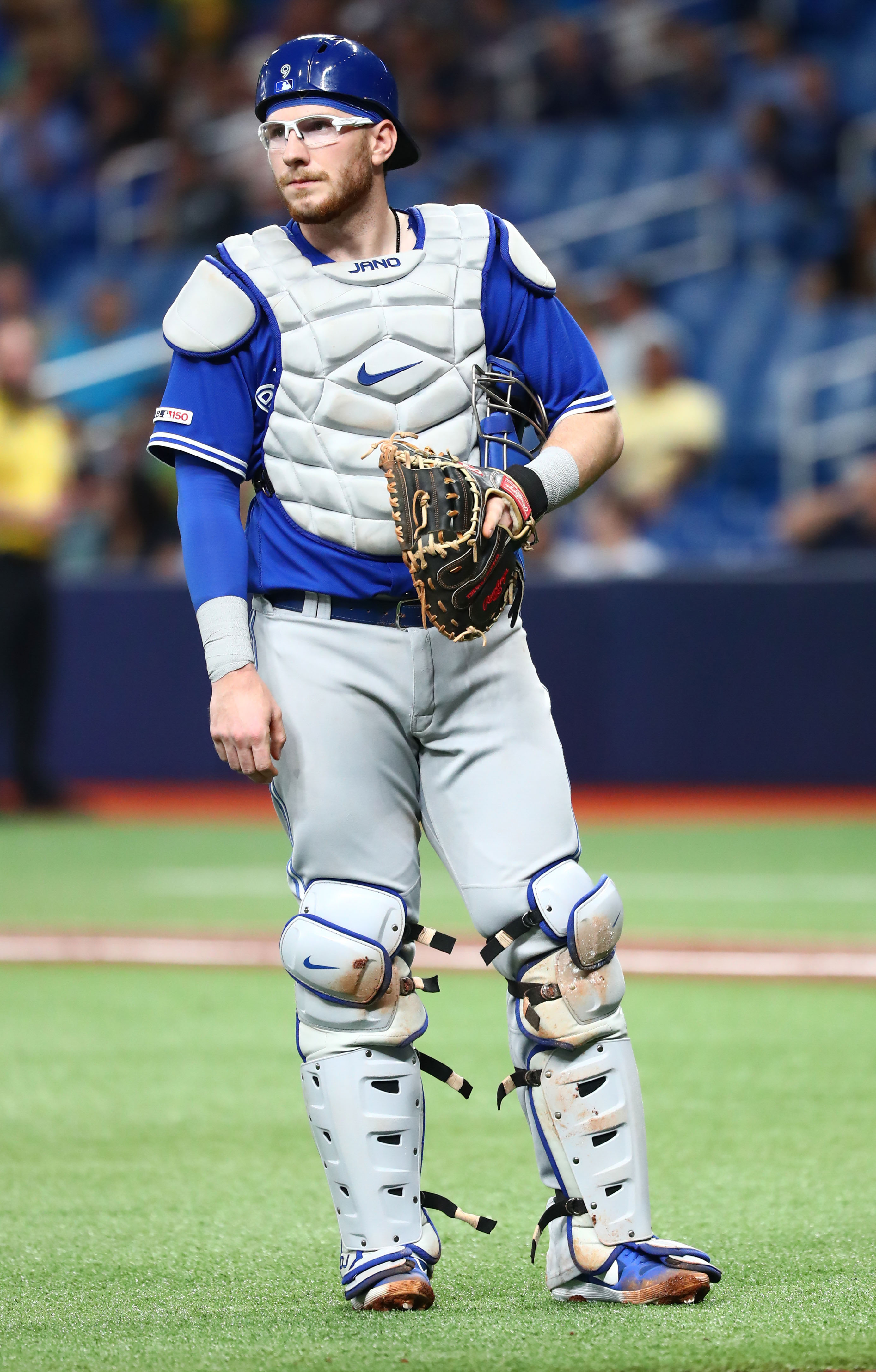
Firstly, it’s worth noting that despite his middling draft status, Jansen emerged as a prospect of considerable note. Prior to the 2019 campaign, Jansen ranked comfortably inside the game’s top 100 prospects according to each of Baseball America (No. 42), FanGraphs (No. 47), MLB.com (No. 65) and Baseball Prospectus (No. 89). He ranked just outside the top 100 (No. 107) on the ESPN’ rankings. During his final full season in Triple-A, Jansen hit .275/.390/.473 with a dozen homers and a 12.2 percent walk rate that only marginally trailed his 13.6 percent strikeout rate. There’s enough pedigree here to suggest improvement based on that alone.
But Jansen’s work at the plate likely wasn’t as bad as it would appear upon first glance. While he doesn’t run well enough to ever be likely to post a particularly high average on balls in play, Jansen’s .230 mark in 2019 still seems ripe for some positive regression. He’d only posted a mark lower than that once in his career — back in 2015 in a 46-game sample in Class-A. During Jansen’s final two seasons in the upper minors, his BABIP hovered around .300.
According to Statcast, Jansen made hard contact (95 mph or better in terms of exit velocity) at a 40 percent clip that, while not elite, was above the league average. Of the 406 hitters who put at least 100 balls into play last season, Jansen ranked 148th. His bottom-line results at the plate (.275 wOBA) were along the lines of what one might expect from a defensive specialist like Austin Hedges (.266 expected wOBA) or Jarrod Dyson (.273 xwOBA), but Jansen’s .314 xwOBA was markedly higher. The 39-point gap between his actual wOBA and expected wOBA was the fourth-largest of any player who underperformed his xwOBA in 2019, trailing only Marcell Ozuna, Justin Smoak and C.J. Cron.
Put another way: based on the quality of his contact and his K/BB tendencies, Statcast felt that Jansen should’ve been within striking distance of league average at the plate. Instead, he was one of the game’s least-productive hitters.
But even that generalization shrouds some positives that Jansen displayed. While he struggled through miserable months in April and May to begin the season, Jansen heated up with the weather and found himself as one of the game’s more productive catchers from June through August. In that stretch, he notched a respectable .243/.310/.459 batting line in 205 plate appearances — good for a 101 wRC+. League-average production out of a catcher is rare — catchers posted a collective 85 wRC+ in 2019 — so Jansen demonstrating that type of ability over a three-month stretch is heartening. And if he can drop his 20.9 percent strikeout rate such that it more closely mirrors his excellent marks in the upper minors, Jansen’s profile becomes all the more interesting.
Defensively, Jansen shined in 2019, which is a bit odd given that most scouting reports on him cast him as a bat-first catcher and a mediocre defender. His 2.05 second average pop time was well below average — 58th of 78 qualified catchers — but Jansen still threw out 31 percent of those who attempted to run on him. In terms of framing, Jansen ranked among the game’s best according to each of Statcast, FanGraphs and Baseball Prospectus. He was also strong in terms of blocking pitches in the dirt per Baseball Prospectus, which ranked Jansen seventh among all MLB catchers in terms of adjusted fielding runs above average.
Jansen might not possess the superstar upside of current teammates like Bichette and Guerrero or his soon-to-be battery-mate Pearson. But he clearly has the makings of an average or better hitter moving forward, and the 2019 season suggests that his defense might be far more valuable than many had hoped of him as a prospect. An above-average defensive catcher with a competent (or better) bat is the type of talent clubs spend years trying to get their hands on — there’s a reason Jansen drew trade interest early in the offseason — and Jansen could be just that for an increasingly interesting Blue Jays club. It’s easy for Jansen to get lost in the shuffle when looking at the Jays’ young core, but a breakout when play resumes shouldn’t surprise anyone.
How To Get A Job In Baseball, According To GMs
Working in baseball operations for a Major League team is a dream job for many baseball fanatics. If front office job-seekers are being honest, the pinnacle would be to one day land in the GM’s chair and call the shots on trades, free agent signings, and draft picks. But in such a competitive field, how do you stand out? What should you focus on to become as appealing as possible to an MLB team in a job interview?
Seven years ago, I polled many MLB executives on their advice for high school students with front office aspirations. With so many new executives in the game since then, I decided to move a bit further down the career path and ask this question:
What one piece of advice would you give to a college student who hopes to work in baseball operations one day?
I posed this question to many of MLB’s top-ranking baseball operations executives. Just like the rest of us, these people are currently sheltered in place with their families trying to get some work done in these difficult and strange times. The following ten execs kindly took the time to answer my question: Ross Atkins of the Blue Jays, Jeff Bridich of the Rockies, Ben Cherington of the Pirates, James Click of the Astros, Mike Elias of the Orioles, Derek Falvey of the Twins, Matt Kleine of the Brewers, Dayton Moore of the Royals, Brodie Van Wagenen of the Mets, and Dick Williams of the Reds. Their answers are below.
I always think of the creative examples of how several of the current team’s GMs and Presidents got their foot in the door when asked this question. Without sharing those ideas specifically, I tell the individual who asked to think of something that they can bring to the table today that would be beneficial for a baseball operations team. Is there something that they do or can do that would have an immediate impact even if very small. It could be data analysis, programming, scouting, performance coaching, or leadership/communication application but ideally in the form of a project or deliverable and in a perfect world something that the organization doesn’t already have.
I believe that if those looking to get into baseball have excelled in other arenas they should think about how they have done that and share that in a way that is applicable to baseball as that is usually an attractive approach to those who are deciding to add to their operations teams. – Ross Atkins, Blue Jays Executive Vice President, Baseball Operations & General Manager
In terms of trying to trying to get into the world of baseball operations out of college, mindset and attitude will determine a lot. Create for yourself a mindset built around relentlessness, flexibility and hard work. The typical college school year and/or graduation timeframe do not lineup perfectly with when most Major League teams are hiring. So there could be some lag time between leaving college and getting hired.
Also, there usually are hundreds, maybe thousands, more applicants for jobs than there are jobs available. So chances are you’ll hear a bunch of “Nos” before you hear a “Yes”. That’s where relentlessness, flexibility and work ethic come into play. Your first opportunity in the baseball industry may not come in the perfect shape, size and package that you desire – but that’s OK. Be flexible in what you are willing to do and where you’re willing to work (be that departmentally or geographically).
At some point in your job search, you may feel like you are being annoying or that you’re bothering team employees too often. But know that relentlessness and persistence often pay off. It’s tough to count up how many times we have said over the years, “You have to give that person credit for his/her persistence,” whether we hired that person or not. If the worst outcome is that you are not hired (yet) but you are given credit for your relentless desire to work in the game, then it’s worth it.
Finally, look at the job search process like it is a job in itself. Put in the time. Make sure your resume is as good as it possibly can be. Ask thoughtful questions of any and all people who could help you. And always be ready – after you’ve sent off your resume and applied for a job, you never know when a team might call you. Those people who are ready for an in-depth discussion at a moment’s notice usually make a good first impression. – Jeff Bridich, Rockies Executive Vice President & General Manager
It’s hard to narrow down to one but if I had to I’d say finding opportunities to solve complicated problems in groups. Almost all of the work we do in baseball operations focuses on assessing, predicting, or improving human performance. Human performance is complicated. Almost none of the work we do in baseball is done by ourselves. Just about everything we do is done by teams of people. So I’d say the more practice combining those two things the better. – Ben Cherington, Pirates General Manager
There’s no magic bullet, no secret code to getting into baseball. All of us have a unique story about how we got here, so play to your strengths and put yourself in as good a position as possible to take any job that you’re offered, even if – especially if – it’s not in the area in which you see yourself long term. Every job is an opportunity to show what you can do, a chance to gain valuable experience and perspective on how the game works, and to make sure that this lifestyle is something you want to take on. Finally, don’t get discouraged! It took a lot of us a long time to get into the game, but it’s worth it. – James Click, Astros General Manager
I think there are so many public forums today to showcase your work online. Whether it’s contract analysis, data analysis, or scouting evaluation that you want to do, you can start to build this body of work on your own, before anyone hires you. It is so helpful when we are interviewing when someone has a portfolio already started. It shows how you work and think, but also shows initiative and that you are truly passionate about this line of work. – Mike Elias, Orioles Executive Vice President and General Manager
I’d recommend that you don’t wait around for the perfect opportunity to come your way and instead find a way to create one. People who want to work in baseball will reach out and say they’re just waiting for that “break” to come their way. It’s not uncommon that a year later we’ll hear from them again still waiting for that opening to show up.
My suggestion – dive into a topic within the game that interests you, learn as much as you can about it, and then generate a work product that shows you have the baseline skills and passion to impact a baseball operation as soon as you walk through the door. Don’t be afraid to try something because you might fail. Of all the resumes we get, it’s the ones that are accompanied by a work product (and therefore a willingness to put yourself out there) that generate the most interest. – Derek Falvey, Twins President of Baseball Operations
My advice to students is to create baseball-specific opportunities for yourself. Don’t wait for them to come to you. Volunteer to capture video, analyze data or operate pitch tracking software for your school’s team. Connect with your Sports Information Director and ask how you can help. Learn SQL. Learn Spanish. Contact baseball-centric websites and volunteer your time. Devise your own work product that attempts to solve meaningful questions you believe are currently unanswered within the public sphere. This is especially important because providing MLB clubs with examples of self-driven work product showcases your curiosity, thought process, and reasoning. It’s equally as important – if not more so – than a strong resume.
Students should also understand that our approach to hiring is shaped by our constant pursuit of the next marginal win. How can the next hire help us win games both today and in the future? Students who approach us with hard skills, novel work product and a strong resume quickly move to the front of that line. – Matt Kleine, Brewers Vice President – Baseball Operations
As it pertains to teams and front office, compatibility is the most important trait. This will only exist if you have an above and beyond attitude with the commitment to do the jobs that others simply find meaningless. You must have an “others first” mindset and model that behavior. Finally, never stop looking at this game from the eyes of your youth. – Dayton Moore, Royals Senior Vice President – Baseball Operations/General Manager
1. When interviewing with a prospective employer/executive, be specific about the area in which you want to work. Prove to your audience that you have you done the research in his/her area of focus. This will enable you to be versed enough to hold a meaningful conversation. Those who want a “PARTICULAR job” are much more compelling than those who simply just want “a job.”
2. Be willing to work in any city that has an opportunity to further your pursuits. Don’t let geography limit your search. – Brodie Van Wagenen, Mets Executive Vice President & General Manager
The best way to get your foot in the door is to figure out how you can solve a problem for me that I may not have even known I had. It makes for a much more effective cold call when you email your resume into an organization if you can articulate what you can do that the Reds are not doing today that could make us better. At least it makes us more likely to read further.
Keep abreast of the evolving trends in the industry and tailor your coursework accordingly. If you have baseball experience, focus on adding database management or machine learning or something technical. And if you are technically skilled, work on adding the baseball experience however you can. – Dick Williams, Reds President of Baseball Operations
Prospect Faceoff: Pearson v. Mize
There might not be two finer right-handed pitching prospects in baseball than the Blue Jays’ Nate Pearson and the Tigers’ Casey Mize. At least a few notable prospect outlets essentially have the pair neck and neck. Baseball America ranks Pearson as the game’s seventh-best farmhand and has Mize at No. 13. FanGraphs puts Pearson at No. 8, Mize 16th. And MLB.com slightly favors Mize, rating him seventh and Pearson eighth.
Between the two, Pearson seems to be closer to making his major league debut. The 23-year-old, whom the Blue Jays chose 28th in the 2017 draft, dazzled in spring training before the game shut down as a result of the coronavirus pandemic. Pearson fired seven innings of one-run, two-hit ball with 11 strikeouts and three walks, flashing triple-digit heat along the way. Carving up the competition isn’t anything new for the 6-foot-6, 245-pound Pearson, who just last season combined for a 2.30 ERA with 10.5 K/9 and 2.4 BB/9 and averaged 97 mph on his fastball in 101 2/3 innings divided among the High-A, Double-A and Triple-A levels. It was the first extensive pro year for Pearson, who tossed a meager 1 2/3 frames in 2018 as he dealt with a back injury and a fractured ulna.
Whether Pearson will be handle a starter’s workload over the long haul is one of the few questions surrounding him. He only averaged a little over four innings per appearance in 2019, and Baseball America writes, “The fact that Pearson throws with so much velocity on every fastball also gives some scouts concerns about whether that’s a durability risk.” If Pearson can hold up, though, he clearly has the potential to evolve into a front-line starter at the MLB level.
Mize, 22, has ace upside in his own right. He was the No. 1 pick in the 2018 draft and has lived up to the billing in the minors thus far. Mize doesn’t throw as hard as Pearson (his typical fastball clocked in at 93 mph in ’19), but he was just about untouchable last year in High-A (0.88 ERA over 30 2/3 innings) before earning a promotion to Double-A. Mize continued to wow at the second-highest level of the minors, where he recorded a 3.20 ERA and 8.69 K/9 against 2.06 BB/9 in 15 starts and 78 2/3 frames; however, Mize did miss a few weeks with shoulder inflammation, and the Tigers put an early end to his season to preserve him for future years. He returned during the spring with four innings of three-hit, two-run pitching, notching six strikeouts and a pair of walks.
If health doesn’t fail either of these hurlers in the coming seasons, baseball fans could be treated to another couple of electrifying arms. Which of the two would you take as a building block? (Poll link for app users)
Pick a prospect
-
Nate Pearson 53% (2,162)
-
Casey Mize 47% (1,903)
Total votes: 4,065
GM Trade History: Blue Jays’ Ross Atkins
It’s not always fair to judge baseball operations leaders for free agent signings. In many cases, the biggest contracts are negotiated to varying extents by ownership. The same can hold true of major extensions. It’s just tough to know from the outside.
There’s obviously involvement from above in trade scenarios as well. But, when it comes to exchanging rights to some players for others, it stands to reason the role of the general manager is all the more clear.
In any event, for what it’s worth, it seemed an opportune moment to take a look back at the trade track records of some of the general managers around the game. We’ve already covered the Diamondbacks’ Mike Hazen, former Astros GM Jeff Luhnow, the Brewers’ David Stearns, the Angels’ Billy Eppler, the Rockies’ Jeff Bridich, the White Sox’ Rick Hahn, the Tigers’ Al Avila, the Braves’ Alex Anthopoulos, and the Padres’ A.J. Preller. We’ll now turn our focus to Ross Atkins of the Blue Jays, who followed Jays president Mark Shapiro in moving to the Toronto organization from Cleveland. (Deals are in chronological order and exclude minor moves; full details at transaction link).
2015-16 Offseason
- Acquired RHP Jesse Chavez from Athletics for RHP Liam Hendriks
- Acquired RHP Drew Storen from Nationals for OF Ben Revere
- Acquired INF Cliff Pennington and cash for INF Dawel Lugo
2016 Season
- Acquired LHP Francisco Liriano, OF Harold Ramirez and C Reese McGuire from Pirates for RHP Drew Hutchison
- Acquired RHP Joaquin Benoit from Mariners for RHP Drew Storen and cash
- Acquired OF Melvin Upton and cash from Padres for RHP Hansel Rodriguez
2017 Season
- Acquired OF Nori Aoki and OF Teoscar Hernandez from Astros for LHP Francisco Liriano
- Acquired LHP Thomas Pannone and SS Samad Taylor from Indians for RHP Joe Smith
2017-18 Offseason
- Acquired OF Randal Grichuk from Cardinals for RHP Dominic Leone and RHP Conner Greene
- Acquired INF Yangervis Solarte from Padres for OF Edward Olivares and RHP Jared Carkuff
- Acquired INF Aledmys Diaz from Cardinals for OF J.B. Woodman
2018 Season
- Acquired RHP Julian Merryweather (as PTBNL) from Indians for 3B Josh Donaldson
- Acquired RHP Ken Giles, RHP Hector Perez and RHP David Paulino from Astros for RHP Roberto Osuna
- Acquired INF Brandon Drury and OF Billy McKinney from Yankees for LHP J.A. Happ
- Acquired 1B Chad Spanberger, 1B Sean Bouchard and INF/OF Forrest Wall from Rockies for RHP Seunghwan Oh
- Acquired RHP Jacob Waguespack from Phillies for LHP Aaron Loup
- Acquired RHP Corey Copping from Dodgers for RHP John Axford
2018-19 Offseason
- Acquired INF Jesus Lopez and international bonus capacity from Athletics for DH Kendrys Morales
- Acquired SS Ronny Brito and RHP Andrew Sopko from Dodgers for C Russell Martin and cash
- Acquired LHP Clayton Richard and cash from Padres for OF Connor Panas
2019 Season
- Acquired RHP Derek Law, INF Alen Hanson and RHP Juan De Paula from Giants for OF Kevin Pillar
- Acquired LHP Anthony Kay and RHP Simeon Woods Richardson from Mets for RHP Marcus Stroman
- Acquired OF Derek Fisher from Astros for RHP Aaron Sanchez and RHP Joe Biagini
- Acquired RHP Kyle Johnston from Nationals for RHP Daniel Hudson
- Acquired RHP Thomas Hatch from Cubs for RHP David Phelps
2019-20 Offseason
- Acquired RHP Chase Anderson from Brewers for 1B Chad Spanberger
—
How do you grade the overall work on the trade market? (Poll link for app users.)
Grade Ross Atkins's trade history
-
C 42% (1,850)
-
B 30% (1,329)
-
D 16% (699)
-
F 8% (345)
-
A 4% (179)
Total votes: 4,402